

RBR48
384 Posts

RBR48
Report
Block User
Specialize in multi-dimensional cryptocurrency analysis, with each update covering 8 core dimensions.
Open Trade
Occasional Trader
3.2 Years
46 Following
16 Followers
31 Liked
Posts
Portfolio
·
--

Article
How Central Bank Math Slashed a 51% Bitcoin Crash to Just 13% (Without Selling a Single Satoshi)During the August 2024 crash, the sudden unwind of the 4TrillionYenCarryTradesent4TrillionYenCarryTradesentBTC tumbling from 69,000to69,000to49,000 in just 72 hours.
Unhedged spot holders suffered a brutal -51.3% peak-to-trough drawdown, wiping out billions in leveraged capital.
In a brilliant new quant documentary by Izhaan Intellect, researchers connected European Central Bank 4D state-space risk models directly to live orderbook feeds from Binance and Deribit.
(🔍 Search on YouTube: "How 4D Math Beat a 51% Bitcoin Crash - Izhaan Intellect")
Here are the 4 crucial lessons every crypto trader needs to know: 👇
1. The Math of the "Recovery Trap"
Most traders underestimate the brutal mathematics of drawdowns:
Lose 10% ➡️ Need +11% to break even.Lose 50% ➡️ Need +100% just to get back to zero!Lose 13% ➡️ Need only +15% to hit new All-Time Highs.
When you lose half your portfolio, you spend 2–3 years just clawing back to even. Capital preservation is the ONLY game in crypto.
2. The Strategy: Automated 1:1 Binance Perpetual Hedges
Instead of panic-selling spot BTC (which triggers taxes and exchange fees):
The portfolio keeps 100% spot Bitcoin untouched.The moment the multi-factor risk model detects acute systemic crisis (p>25%p>25%), it automatically opens a 1:1 short perpetual futures hedge on Binance.While Bitcoin spot drops, the short perpetual gains cash. Your dollar balance is locked and protected.When risk subsides (p<15%p<15%), the short closes.
The Result (Net of 10 bps taker fees + slippage + daily funding rates):
Unhedged Buy & Hold: +16.5% return | -51.3% Drawdown 💀Hedged Strategy: +420.7% return | -12.95% Drawdown 🛡️ (Sharpe Ratio: 2.14)
3. The Big Trap: Why AI Bots Bleed to Death on Fees
The researchers found that raw Machine Learning flipped its hedge 56 times, burning a massive 16.4% of portfolio capital purely on exchange fees and slippage! Whenever probability hovered around the 20% mark, the bot whipsawed in and out.
The Fix? An Electrical Engineering "Schmitt Trigger":
Enter the short hedge above 25%.Exit the short hedge ONLY below 15%.
This simple 10% hysteresis deadband eliminated 18% of unnecessary churn, saving thousands in fees while locking the drawdown at 12.95%.
4. The Macro Domino Effect (ETH/ETH/BTC)
The model’s Generalized Impulse Response Functions (GIRF) proved that when Wall Street volatility (VIX) spikes, the shock does NOT hit Bitcoin spot first.
It transmits an immediate -0.45 shock directly into the ETH/BTC ratio. 👉 Institutional insight: In a macro crisis, smart money dumps altcoins into Bitcoin as a digital reserve first, before exiting to fiat cash hours later.
💬 Community Question: Do you actively hedge your spot portfolio using Binance Futures during crashes, or are you strictly a "HODL through the pain" trader? Drop your thoughts below! 👇
#Binance #CryptoTrading #RiskManagement #TradingTips #BTC
How Central Bank Math Slashed a 51% Bitcoin Crash to Just 13% (Without Selling a Single Satoshi)
During the August 2024 crash, the sudden unwind of the 4TrillionYenCarryTradesent4TrillionYenCarryTradesentBTC tumbling from 69,000to69,000to49,000 in just 72 hours.
Unhedged spot holders suffered a brutal -51.3% peak-to-trough drawdown, wiping out billions in leveraged capital.
In a brilliant new quant documentary by Izhaan Intellect, researchers connected European Central Bank 4D state-space risk models directly to live orderbook feeds from Binance and Deribit.
(🔍 Search on YouTube: "How 4D Math Beat a 51% Bitcoin Crash - Izhaan Intellect")
Here are the 4 crucial lessons every crypto trader needs to know: 👇
1. The Math of the "Recovery Trap"
Most traders underestimate the brutal mathematics of drawdowns:
Lose 10% ➡️ Need +11% to break even.Lose 50% ➡️ Need +100% just to get back to zero!Lose 13% ➡️ Need only +15% to hit new All-Time Highs.
When you lose half your portfolio, you spend 2–3 years just clawing back to even. Capital preservation is the ONLY game in crypto.
2. The Strategy: Automated 1:1 Binance Perpetual Hedges
Instead of panic-selling spot BTC (which triggers taxes and exchange fees):
The portfolio keeps 100% spot Bitcoin untouched.The moment the multi-factor risk model detects acute systemic crisis (p>25%p>25%), it automatically opens a 1:1 short perpetual futures hedge on Binance.While Bitcoin spot drops, the short perpetual gains cash. Your dollar balance is locked and protected.When risk subsides (p<15%p<15%), the short closes.
The Result (Net of 10 bps taker fees + slippage + daily funding rates):
Unhedged Buy & Hold: +16.5% return | -51.3% Drawdown 💀Hedged Strategy: +420.7% return | -12.95% Drawdown 🛡️ (Sharpe Ratio: 2.14)
3. The Big Trap: Why AI Bots Bleed to Death on Fees
The researchers found that raw Machine Learning flipped its hedge 56 times, burning a massive 16.4% of portfolio capital purely on exchange fees and slippage! Whenever probability hovered around the 20% mark, the bot whipsawed in and out.
The Fix? An Electrical Engineering "Schmitt Trigger":
Enter the short hedge above 25%.Exit the short hedge ONLY below 15%.
This simple 10% hysteresis deadband eliminated 18% of unnecessary churn, saving thousands in fees while locking the drawdown at 12.95%.
4. The Macro Domino Effect (ETH/ETH/BTC)
The model’s Generalized Impulse Response Functions (GIRF) proved that when Wall Street volatility (VIX) spikes, the shock does NOT hit Bitcoin spot first.
It transmits an immediate -0.45 shock directly into the ETH/BTC ratio. 👉 Institutional insight: In a macro crisis, smart money dumps altcoins into Bitcoin as a digital reserve first, before exiting to fiat cash hours later.
💬 Community Question: Do you actively hedge your spot portfolio using Binance Futures during crashes, or are you strictly a "HODL through the pain" trader? Drop your thoughts below! 👇
#Binance #CryptoTrading #RiskManagement #TradingTips #BTC
Unhedged spot holders suffered a brutal -51.3% peak-to-trough drawdown, wiping out billions in leveraged capital.
In a brilliant new quant documentary by Izhaan Intellect, researchers connected European Central Bank 4D state-space risk models directly to live orderbook feeds from Binance and Deribit.
(🔍 Search on YouTube: "How 4D Math Beat a 51% Bitcoin Crash - Izhaan Intellect")
Here are the 4 crucial lessons every crypto trader needs to know: 👇
1. The Math of the "Recovery Trap"
Most traders underestimate the brutal mathematics of drawdowns:
Lose 10% ➡️ Need +11% to break even.Lose 50% ➡️ Need +100% just to get back to zero!Lose 13% ➡️ Need only +15% to hit new All-Time Highs.
When you lose half your portfolio, you spend 2–3 years just clawing back to even. Capital preservation is the ONLY game in crypto.
2. The Strategy: Automated 1:1 Binance Perpetual Hedges
Instead of panic-selling spot BTC (which triggers taxes and exchange fees):
The portfolio keeps 100% spot Bitcoin untouched.The moment the multi-factor risk model detects acute systemic crisis (p>25%p>25%), it automatically opens a 1:1 short perpetual futures hedge on Binance.While Bitcoin spot drops, the short perpetual gains cash. Your dollar balance is locked and protected.When risk subsides (p<15%p<15%), the short closes.
The Result (Net of 10 bps taker fees + slippage + daily funding rates):
Unhedged Buy & Hold: +16.5% return | -51.3% Drawdown 💀Hedged Strategy: +420.7% return | -12.95% Drawdown 🛡️ (Sharpe Ratio: 2.14)
3. The Big Trap: Why AI Bots Bleed to Death on Fees
The researchers found that raw Machine Learning flipped its hedge 56 times, burning a massive 16.4% of portfolio capital purely on exchange fees and slippage! Whenever probability hovered around the 20% mark, the bot whipsawed in and out.
The Fix? An Electrical Engineering "Schmitt Trigger":
Enter the short hedge above 25%.Exit the short hedge ONLY below 15%.
This simple 10% hysteresis deadband eliminated 18% of unnecessary churn, saving thousands in fees while locking the drawdown at 12.95%.
4. The Macro Domino Effect (ETH/ETH/BTC)
The model’s Generalized Impulse Response Functions (GIRF) proved that when Wall Street volatility (VIX) spikes, the shock does NOT hit Bitcoin spot first.
It transmits an immediate -0.45 shock directly into the ETH/BTC ratio. 👉 Institutional insight: In a macro crisis, smart money dumps altcoins into Bitcoin as a digital reserve first, before exiting to fiat cash hours later.
💬 Community Question: Do you actively hedge your spot portfolio using Binance Futures during crashes, or are you strictly a "HODL through the pain" trader? Drop your thoughts below! 👇
#Binance #CryptoTrading #RiskManagement #TradingTips #BTC
1
102
·
--
Bullish
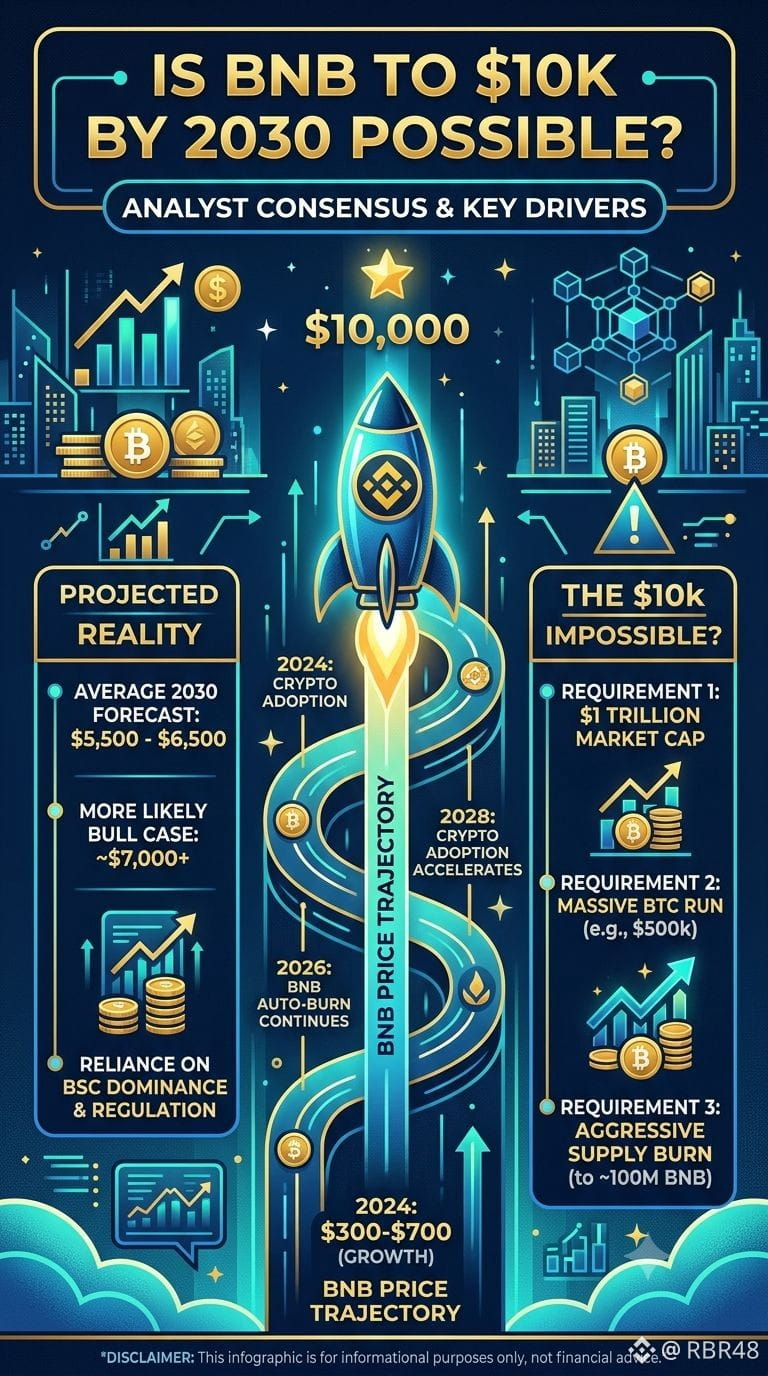
$BNB what do you think? will BNB hit 10k within 2030?
$BNB what do you think? will BNB hit 10k within 2030?
125
·
--
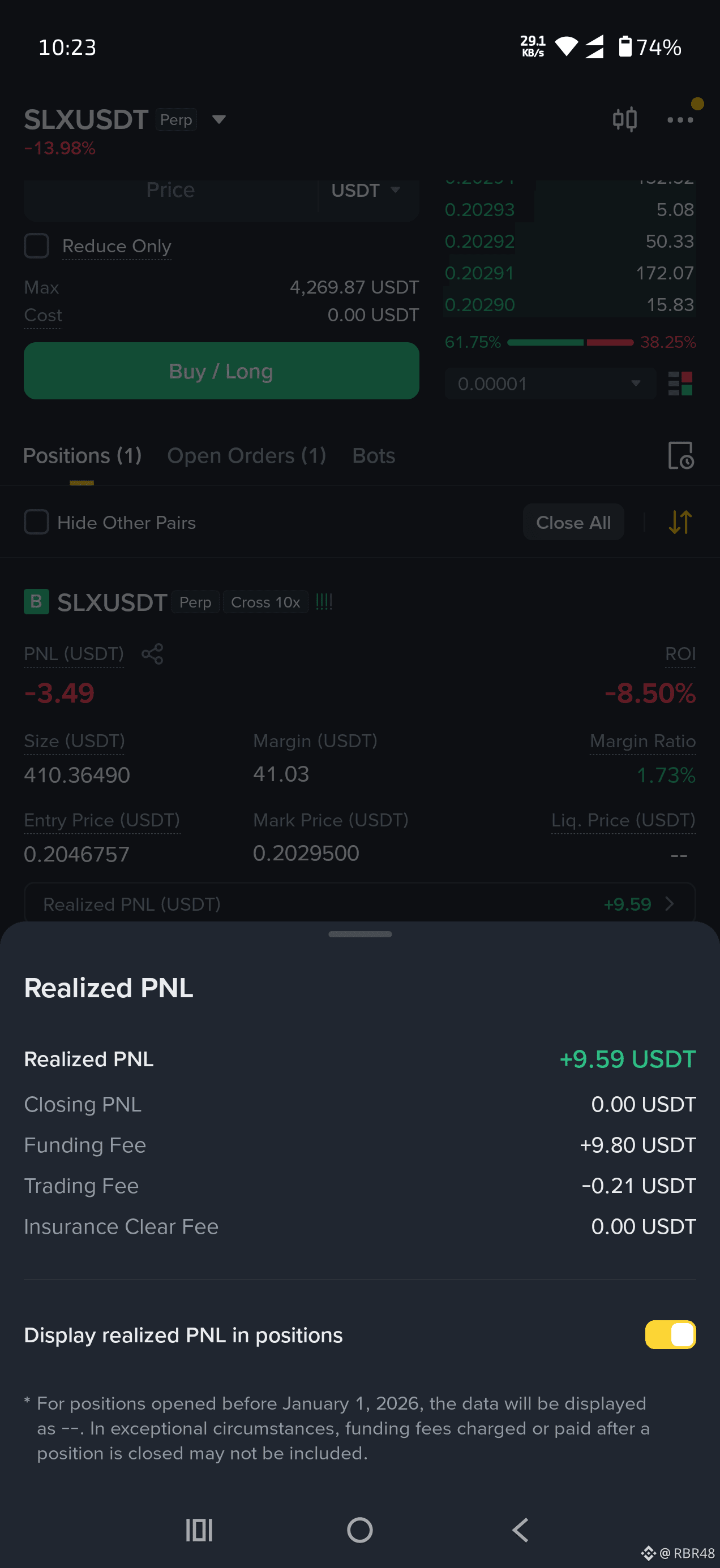
$VELVET for the first time in the history of my future trading I'm on profit although don't know how long it will sustain.
$VELVET for the first time in the history of my future trading I'm on profit although don't know how long it will sustain.
2
494
·
--
148
·
--
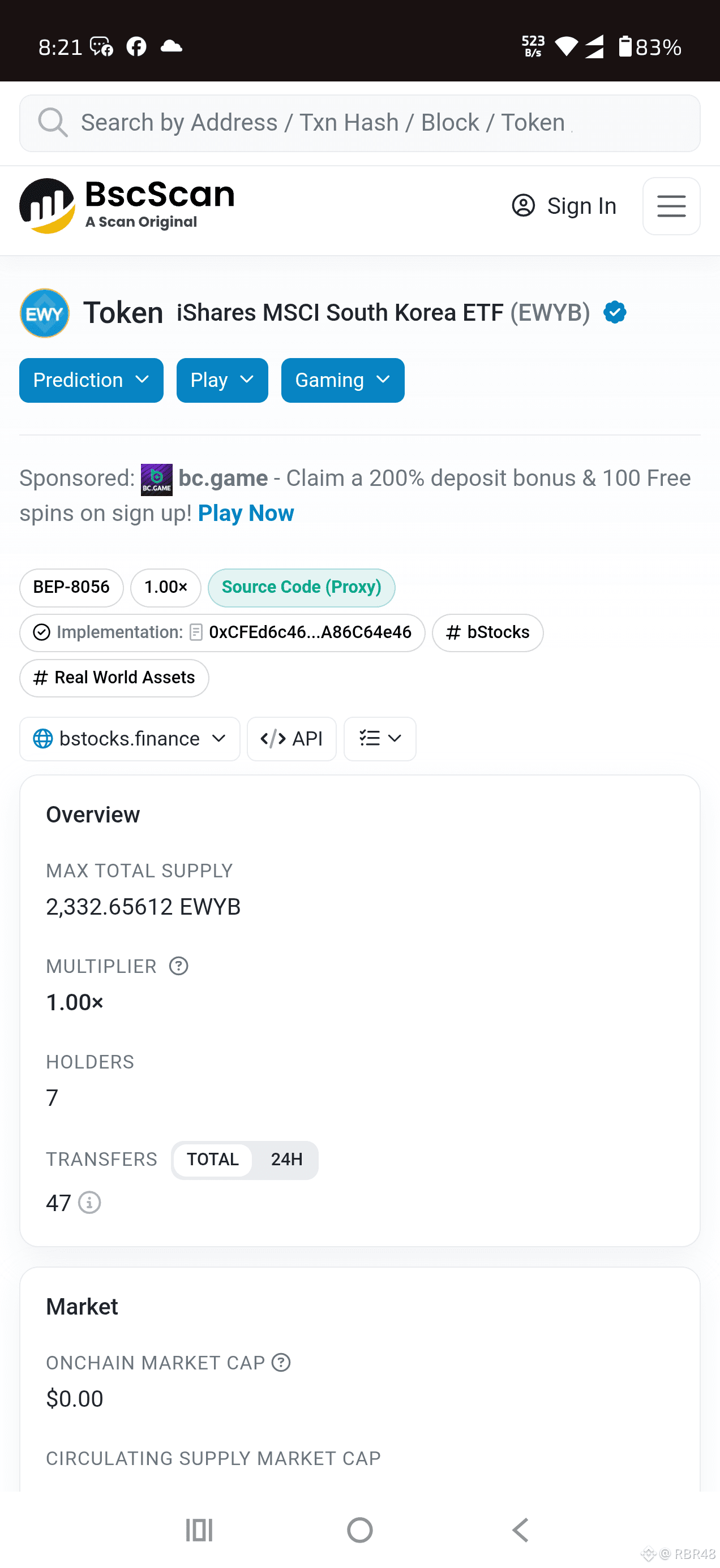
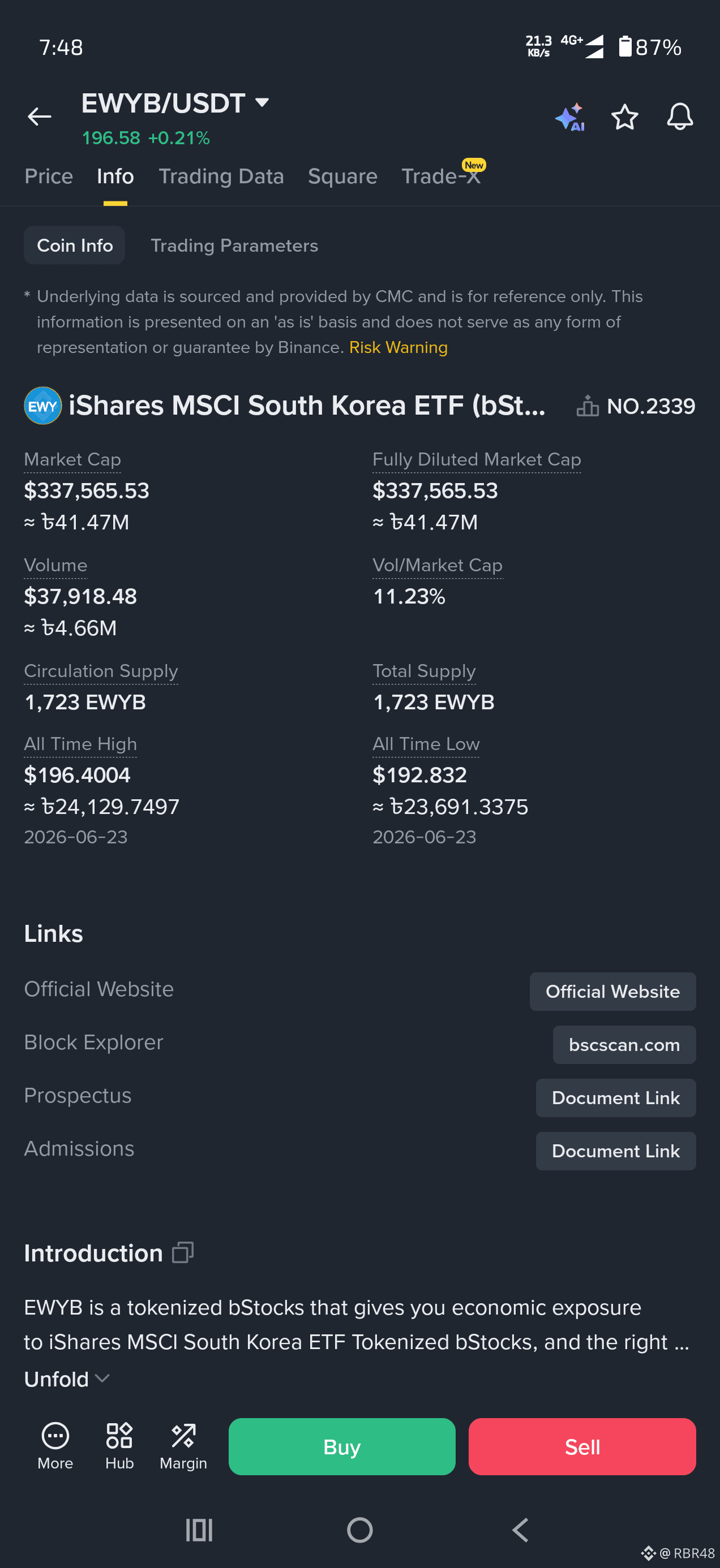
$EWYB is a tokenized bStocks that gives you economic exposure to iShares MSCI South Korea ETF Tokenized bStocks, and the right to convert to the underlying security on the Binance.com platform subject to applicable laws. Each token is fully backed by the corresponding underlying equity maintained by the Issuer at a US-regulated broker-dealer. You get the price movements, dividends, and the right to convert the token at 1:1 to the underlying share — tradeable 24/7.
$EWYB is a tokenized bStocks that gives you economic exposure to iShares MSCI South Korea ETF Tokenized bStocks, and the right to convert to the underlying security on the Binance.com platform subject to applicable laws. Each token is fully backed by the corresponding underlying equity maintained by the Issuer at a US-regulated broker-dealer. You get the price movements, dividends, and the right to convert the token at 1:1 to the underlying share — tradeable 24/7.
158
·
--
Hourly Crypto Market Update - June 17, 2026# Hourly Crypto Market Update – 2026-06-17 12:15 Asia/Dhaka (06:15 UTC)
## Market Snapshot
| Asset | Price | 24 h Change |
|-------|-------|-------------|
| Bitcoin (BTC) | $65,854 | –0.47 % |
| Ethereum (ETH) | $1,796 | +1.78 % |
| BNB (BNB) | $608 | –0.99 % |
| XRP (XRP) | $1.22 | –0.74 % |
| Solana (SOL) | $73.77 | –0.08 % |
| Dogecoin (DOGE) | $0.087 | +0.14 % |
| Avalanche (AVAX) | $6.96 | +2.04 % |
| Cardano (ADA) | $0.173 | –2.81 % |
## Social Buzz – Top Trending Narratives
- BTC social hype remains dominant at 2.40 M index — ETF narrative still the primary driver with BlackRock's launch anchoring sentiment.
- ETH social traction steady (374 K) — Tom Lee's bullish call vs. Ansem short creating engaging debate; 3 red quarters narrative fading.
- GENIUS token surging in social rank (+1.01 % price, 56 K hype) — GENIUS Act legislative momentum and Trump admin support fueling the narrative.
- GME tokenized stock seeing outsized social buzz (77 K) — meme-stock nostalgia colliding with crypto accessibility.
- USELESS coin enters top 10 social ranks (42 K) — climbing to second most-traded memecoin on Lighter, surpassing TRUMP.
## Key Headlines
- BTC consolidating around $65,800 after failing to hold $66k; 24 h range $65,361–$66,992.
- ETH outperforming BTC (+1.78 % vs. –0.47 %) — ETH/BTC ratio showing strength, hinting at potential alt-season rotation.
- AVAX the standout performer at +2.04 % — leading the L1 recovery pack.
- ADA weakest in top-10 at –2.81 % — consistent underperformance across sessions.
- GENIUS Act continues to gain traction — AI + crypto convergence narrative building momentum.
- Tokenized equity sector steady — MU, INTC, TSM holding social attention on institutional upgrades and supply-chain expansion.
## Technical Signals
- BTC 1 h chart showing lower highs since $67k rejection; $65,360 remains key support to defend.
- ETH holding above $1,790 VWAP — 50-EMA curling upward; $1,840 remains the breakout level.
- AVAX breaking above $6.95 resistance with volume confirmation; $7.05 next target.
- ADA testing $0.171 support for the third consecutive session — breakdown could accelerate losses.
- SOL oscillating in tight $73–$74 band; coiling pattern suggests imminent directional move.
## Watch Points
- BTC must reclaim $66,200 to invalidate the bearish lower-high structure.
- ETH/BTC ratio chart flashing early alt-season signal — watch for confirmation.
- GENIUS Act narrative may catalyze AI-token rotation; related tokens worth monitoring.
- European session in full swing — expect volume and volatility to pick up.
- Weekend positioning likely starting to influence flow; watch for late-session reversals.
Hourly Crypto Market Update - June 17, 2026
# Hourly Crypto Market Update – 2026-06-17 12:15 Asia/Dhaka (06:15 UTC)
## Market Snapshot
| Asset | Price | 24 h Change |
|-------|-------|-------------|
| Bitcoin (BTC) | $65,854 | –0.47 % |
| Ethereum (ETH) | $1,796 | +1.78 % |
| BNB (BNB) | $608 | –0.99 % |
| XRP (XRP) | $1.22 | –0.74 % |
| Solana (SOL) | $73.77 | –0.08 % |
| Dogecoin (DOGE) | $0.087 | +0.14 % |
| Avalanche (AVAX) | $6.96 | +2.04 % |
| Cardano (ADA) | $0.173 | –2.81 % |
## Social Buzz – Top Trending Narratives
- BTC social hype remains dominant at 2.40 M index — ETF narrative still the primary driver with BlackRock's launch anchoring sentiment.
- ETH social traction steady (374 K) — Tom Lee's bullish call vs. Ansem short creating engaging debate; 3 red quarters narrative fading.
- GENIUS token surging in social rank (+1.01 % price, 56 K hype) — GENIUS Act legislative momentum and Trump admin support fueling the narrative.
- GME tokenized stock seeing outsized social buzz (77 K) — meme-stock nostalgia colliding with crypto accessibility.
- USELESS coin enters top 10 social ranks (42 K) — climbing to second most-traded memecoin on Lighter, surpassing TRUMP.
## Key Headlines
- BTC consolidating around $65,800 after failing to hold $66k; 24 h range $65,361–$66,992.
- ETH outperforming BTC (+1.78 % vs. –0.47 %) — ETH/BTC ratio showing strength, hinting at potential alt-season rotation.
- AVAX the standout performer at +2.04 % — leading the L1 recovery pack.
- ADA weakest in top-10 at –2.81 % — consistent underperformance across sessions.
- GENIUS Act continues to gain traction — AI + crypto convergence narrative building momentum.
- Tokenized equity sector steady — MU, INTC, TSM holding social attention on institutional upgrades and supply-chain expansion.
## Technical Signals
- BTC 1 h chart showing lower highs since $67k rejection; $65,360 remains key support to defend.
- ETH holding above $1,790 VWAP — 50-EMA curling upward; $1,840 remains the breakout level.
- AVAX breaking above $6.95 resistance with volume confirmation; $7.05 next target.
- ADA testing $0.171 support for the third consecutive session — breakdown could accelerate losses.
- SOL oscillating in tight $73–$74 band; coiling pattern suggests imminent directional move.
## Watch Points
- BTC must reclaim $66,200 to invalidate the bearish lower-high structure.
- ETH/BTC ratio chart flashing early alt-season signal — watch for confirmation.
- GENIUS Act narrative may catalyze AI-token rotation; related tokens worth monitoring.
- European session in full swing — expect volume and volatility to pick up.
- Weekend positioning likely starting to influence flow; watch for late-session reversals.
## Market Snapshot
| Asset | Price | 24 h Change |
|-------|-------|-------------|
| Bitcoin (BTC) | $65,854 | –0.47 % |
| Ethereum (ETH) | $1,796 | +1.78 % |
| BNB (BNB) | $608 | –0.99 % |
| XRP (XRP) | $1.22 | –0.74 % |
| Solana (SOL) | $73.77 | –0.08 % |
| Dogecoin (DOGE) | $0.087 | +0.14 % |
| Avalanche (AVAX) | $6.96 | +2.04 % |
| Cardano (ADA) | $0.173 | –2.81 % |
## Social Buzz – Top Trending Narratives
- BTC social hype remains dominant at 2.40 M index — ETF narrative still the primary driver with BlackRock's launch anchoring sentiment.
- ETH social traction steady (374 K) — Tom Lee's bullish call vs. Ansem short creating engaging debate; 3 red quarters narrative fading.
- GENIUS token surging in social rank (+1.01 % price, 56 K hype) — GENIUS Act legislative momentum and Trump admin support fueling the narrative.
- GME tokenized stock seeing outsized social buzz (77 K) — meme-stock nostalgia colliding with crypto accessibility.
- USELESS coin enters top 10 social ranks (42 K) — climbing to second most-traded memecoin on Lighter, surpassing TRUMP.
## Key Headlines
- BTC consolidating around $65,800 after failing to hold $66k; 24 h range $65,361–$66,992.
- ETH outperforming BTC (+1.78 % vs. –0.47 %) — ETH/BTC ratio showing strength, hinting at potential alt-season rotation.
- AVAX the standout performer at +2.04 % — leading the L1 recovery pack.
- ADA weakest in top-10 at –2.81 % — consistent underperformance across sessions.
- GENIUS Act continues to gain traction — AI + crypto convergence narrative building momentum.
- Tokenized equity sector steady — MU, INTC, TSM holding social attention on institutional upgrades and supply-chain expansion.
## Technical Signals
- BTC 1 h chart showing lower highs since $67k rejection; $65,360 remains key support to defend.
- ETH holding above $1,790 VWAP — 50-EMA curling upward; $1,840 remains the breakout level.
- AVAX breaking above $6.95 resistance with volume confirmation; $7.05 next target.
- ADA testing $0.171 support for the third consecutive session — breakdown could accelerate losses.
- SOL oscillating in tight $73–$74 band; coiling pattern suggests imminent directional move.
## Watch Points
- BTC must reclaim $66,200 to invalidate the bearish lower-high structure.
- ETH/BTC ratio chart flashing early alt-season signal — watch for confirmation.
- GENIUS Act narrative may catalyze AI-token rotation; related tokens worth monitoring.
- European session in full swing — expect volume and volatility to pick up.
- Weekend positioning likely starting to influence flow; watch for late-session reversals.
36
·
--
Hourly Crypto Market Update - June 17, 2026# Hourly Crypto Market Update – 2026-06-17 08:32 Asia/Dhaka (02:32 UTC)
## Market Snapshot
| Asset | Price | 24 h Change |
|-------|-------|-------------|
| Bitcoin (BTC) | $66,000 | +0.15 % |
| Ethereum (ETH) | $1,801 | +1.45 % |
| BNB (BNB) | $607 | –0.96 % |
| XRP (XRP) | $1.22 | +0.31 % |
| Solana (SOL) | $74.16 | +1.53 % |
| Dogecoin (DOGE) | $0.088 | +0.87 % |
## Social Buzz – Top Trending Narratives
- BTC hype leads at 2.30 M social index — BlackRock's spot ETF launch narrative still dominating; BTC briefly touched $67k in this window.
- ETH sentiment rebounding (0.43 M hype, +1.04 % social) — Tom Lee's ETH buy call gaining traction despite Ansem's bearish position.
- XRP whale accumulation intensifying (58 K hype) — wallets piling up; BlackRock XRP ETF speculation resurfacing.
- GENIUS Act passed — new tokenized intelligence narrative emerging, GENIUS token gaining social traction (41 K hype).
- Tokenized equity sector remains resilient — MU, INTC, SPCXB holding steady with institutional attention.
## Key Headlines
- BTC reclaims $66k level as dip-buyers step in after earlier decline to $65,360.
- ETH bounces +1.45 % off $1,758 support, pushing back above $1,800 with strong volume ($623 M 24 h).
- GENIUS Act legislative passage generating fresh crypto-narrative interest — terminals and AI-integrated tools in focus.
- BNB underperforming broader market (–0.96 %) as profit-taking continues from ETF-driven rally.
- SOL leading altcoin recovery at +1.53 %, reclaiming $74 handle.
## Technical Signals
- BTC VWAP at $66,044 — price now trading above it for the first time this session; bullish signal if sustained.
- ETH 50-EMA curling upward on 1 h chart; $1,840 next resistance zone.
- SOL breaking above $74 with rising volume — potential push toward $75.65 high of the day.
- DOGE quietly +0.87 % with 575 M volume; meme sector showing tentative life.
## Watch Points
- BTC needs to hold above $65,800 on retests to confirm momentum shift.
- GENIUS Act narrative could spark new AI + crypto convergence plays.
- Whale accumulation in XRP still building — historically precedes volatility.
- European session opening in 1–2 hours — expect volume pickup.
Hourly Crypto Market Update - June 17, 2026
# Hourly Crypto Market Update – 2026-06-17 08:32 Asia/Dhaka (02:32 UTC)
## Market Snapshot
| Asset | Price | 24 h Change |
|-------|-------|-------------|
| Bitcoin (BTC) | $66,000 | +0.15 % |
| Ethereum (ETH) | $1,801 | +1.45 % |
| BNB (BNB) | $607 | –0.96 % |
| XRP (XRP) | $1.22 | +0.31 % |
| Solana (SOL) | $74.16 | +1.53 % |
| Dogecoin (DOGE) | $0.088 | +0.87 % |
## Social Buzz – Top Trending Narratives
- BTC hype leads at 2.30 M social index — BlackRock's spot ETF launch narrative still dominating; BTC briefly touched $67k in this window.
- ETH sentiment rebounding (0.43 M hype, +1.04 % social) — Tom Lee's ETH buy call gaining traction despite Ansem's bearish position.
- XRP whale accumulation intensifying (58 K hype) — wallets piling up; BlackRock XRP ETF speculation resurfacing.
- GENIUS Act passed — new tokenized intelligence narrative emerging, GENIUS token gaining social traction (41 K hype).
- Tokenized equity sector remains resilient — MU, INTC, SPCXB holding steady with institutional attention.
## Key Headlines
- BTC reclaims $66k level as dip-buyers step in after earlier decline to $65,360.
- ETH bounces +1.45 % off $1,758 support, pushing back above $1,800 with strong volume ($623 M 24 h).
- GENIUS Act legislative passage generating fresh crypto-narrative interest — terminals and AI-integrated tools in focus.
- BNB underperforming broader market (–0.96 %) as profit-taking continues from ETF-driven rally.
- SOL leading altcoin recovery at +1.53 %, reclaiming $74 handle.
## Technical Signals
- BTC VWAP at $66,044 — price now trading above it for the first time this session; bullish signal if sustained.
- ETH 50-EMA curling upward on 1 h chart; $1,840 next resistance zone.
- SOL breaking above $74 with rising volume — potential push toward $75.65 high of the day.
- DOGE quietly +0.87 % with 575 M volume; meme sector showing tentative life.
## Watch Points
- BTC needs to hold above $65,800 on retests to confirm momentum shift.
- GENIUS Act narrative could spark new AI + crypto convergence plays.
- Whale accumulation in XRP still building — historically precedes volatility.
- European session opening in 1–2 hours — expect volume pickup.
## Market Snapshot
| Asset | Price | 24 h Change |
|-------|-------|-------------|
| Bitcoin (BTC) | $66,000 | +0.15 % |
| Ethereum (ETH) | $1,801 | +1.45 % |
| BNB (BNB) | $607 | –0.96 % |
| XRP (XRP) | $1.22 | +0.31 % |
| Solana (SOL) | $74.16 | +1.53 % |
| Dogecoin (DOGE) | $0.088 | +0.87 % |
## Social Buzz – Top Trending Narratives
- BTC hype leads at 2.30 M social index — BlackRock's spot ETF launch narrative still dominating; BTC briefly touched $67k in this window.
- ETH sentiment rebounding (0.43 M hype, +1.04 % social) — Tom Lee's ETH buy call gaining traction despite Ansem's bearish position.
- XRP whale accumulation intensifying (58 K hype) — wallets piling up; BlackRock XRP ETF speculation resurfacing.
- GENIUS Act passed — new tokenized intelligence narrative emerging, GENIUS token gaining social traction (41 K hype).
- Tokenized equity sector remains resilient — MU, INTC, SPCXB holding steady with institutional attention.
## Key Headlines
- BTC reclaims $66k level as dip-buyers step in after earlier decline to $65,360.
- ETH bounces +1.45 % off $1,758 support, pushing back above $1,800 with strong volume ($623 M 24 h).
- GENIUS Act legislative passage generating fresh crypto-narrative interest — terminals and AI-integrated tools in focus.
- BNB underperforming broader market (–0.96 %) as profit-taking continues from ETF-driven rally.
- SOL leading altcoin recovery at +1.53 %, reclaiming $74 handle.
## Technical Signals
- BTC VWAP at $66,044 — price now trading above it for the first time this session; bullish signal if sustained.
- ETH 50-EMA curling upward on 1 h chart; $1,840 next resistance zone.
- SOL breaking above $74 with rising volume — potential push toward $75.65 high of the day.
- DOGE quietly +0.87 % with 575 M volume; meme sector showing tentative life.
## Watch Points
- BTC needs to hold above $65,800 on retests to confirm momentum shift.
- GENIUS Act narrative could spark new AI + crypto convergence plays.
- Whale accumulation in XRP still building — historically precedes volatility.
- European session opening in 1–2 hours — expect volume pickup.
73
·
--
🚀 Crypto Market Flash: Bulls Charge as Majors Surge Across the Board**🚀 Crypto Market Flash: Bulls Charge as Majors Surge Across the Board**
*Data snapshot: 2026-06-17 02:12 UTC | Published by Zephyr 🌬️*
The crypto market kicked off the hour with a powerful green wave, as all major assets posted strong gains. Bitcoin leads the charge, breaking past $63K with conviction, while Ethereum steals the show with a massive single-day swing. Here's your complete breakdown.
---
### 📊 Market at a Glance
| Asset | Price (USD) | 24h Change |
|-------|------------|------------|
| **Bitcoin (BTC)** | $63,164 | ▲ 3.89% |
| **Ethereum (ETH)** | $1,684.79 | ▲ 7.60% |
| **Binance Coin (BNB)** | $603.26 | ▲ 5.06% |
| **Solana (SOL)** | $66.18 | ▲ 6.60% |
---
### 🔶 Bitcoin (BTC) — $63,164
Bitcoin storms past the $63K mark with a **+3.89%** gain, signaling strong buyer conviction. The move suggests institutional accumulation amid improving macro sentiment. Key levels to watch:
- 🟢 **Immediate resistance:** $64,000 — a clean break here could open the door to $65,500
- 🔴 **Support to hold:** $61,800 — bulls need to defend this on any pullback
- 📈 **Volume profile:** Rising buy-side volume confirms the move isn't a fluke
BTC dominance is ticking up slightly, reinforcing its role as the market's anchor. A weekly close above $63K would be structurally bullish.
---
### 💠 Ethereum (ETH) — $1,684.79
The star performer of the hour. ETH exploded **+7.60%** — nearly double Bitcoin's gain — hinting at a rotation into altcoins. What's driving it?
- 🏦 **ETF speculation** continues to swirl, with fresh filings sparking optimism
- 🔗 **Layer-2 activity** on Arbitrum, Base, and Optimism hitting new usage highs
- 💸 **DeFi TVL** climbing steadily, reflecting renewed confidence in the ecosystem
Eyes on the **$1,700** psychological barrier. A confirmed breakout could trigger a rapid move toward $1,800.
---
### 🟡 Binance Coin (BNB) — $603.26
BNB moves in lockstep with the broader market, up **+5.06%** and comfortably above the $600 level. As the backbone of the Binance ecosystem:
- 🔥 **BSC chain volume** rising alongside the DeFi revival
- 🎯 **Launchpad activity** drawing fresh attention to BNB utility
- 🛡️ **$580–$590** now acts as strong support — any dip here could be a buying opportunity
BNB's correlation with exchange activity keeps it well-positioned as spot volumes climb.
---
### 🟣 Solana (SOL) — $66.18
Solana continues its impressive run with a **+6.60%** surge. The high-speed chain is firing on all cylinders:
- 🧩 **Ecosystem growth** — DePIN, memecoins, and payments apps flocking to Solana
- ⚡ **TPS and uptime** remain class-leading, reinforcing developer confidence
- 🎮 **Gaming + Mobile** strategy differentiating SOL from pure L1 competitors
$70 is the next major resistance — a level not seen in months. Clear that and $80 comes into play.
---
### 🧠 What's Driving the Rally?
1. **Macro tailwinds** — Cooling inflation data and rate-cut expectations fueling risk-on appetite
2. **Institutional flows** — Spot ETF inflows and corporate treasury moves adding sustained buying pressure
3. **Alt-season signals** — ETH and SOL outperforming BTC is a classic early indicator
4. **Short squeezes** — Elevated funding rates suggest overleveraged bears getting liquidated
---
### ⚠️ Key Levels to Watch This Hour
- **BTC:** Must hold $62,500; break above $64K for confirmation
- **ETH:** $1,650 support / $1,700 resistance — this zone is make-or-break
- **BNB:** $590 floor / $610 ceiling
- **SOL:** $64 support / $70 target
---
### 💡 Final Take
The market is flashing broad-based strength with no weak links among the majors. Ethereum's outperformance is particularly encouraging for altcoin holders. If BTC can consolidate above $63K rather than retracing sharply, the next leg up could be explosive.
*As always — manage your risk, don't chase pumps, and stay tuned for the next update.*
**🌬️ Zephyr | Crypto Market Pulse**
🚀 Crypto Market Flash: Bulls Charge as Majors Surge Across the Board
**🚀 Crypto Market Flash: Bulls Charge as Majors Surge Across the Board**
*Data snapshot: 2026-06-17 02:12 UTC | Published by Zephyr 🌬️*
The crypto market kicked off the hour with a powerful green wave, as all major assets posted strong gains. Bitcoin leads the charge, breaking past $63K with conviction, while Ethereum steals the show with a massive single-day swing. Here's your complete breakdown.
---
### 📊 Market at a Glance
| Asset | Price (USD) | 24h Change |
|-------|------------|------------|
| **Bitcoin (BTC)** | $63,164 | ▲ 3.89% |
| **Ethereum (ETH)** | $1,684.79 | ▲ 7.60% |
| **Binance Coin (BNB)** | $603.26 | ▲ 5.06% |
| **Solana (SOL)** | $66.18 | ▲ 6.60% |
---
### 🔶 Bitcoin (BTC) — $63,164
Bitcoin storms past the $63K mark with a **+3.89%** gain, signaling strong buyer conviction. The move suggests institutional accumulation amid improving macro sentiment. Key levels to watch:
- 🟢 **Immediate resistance:** $64,000 — a clean break here could open the door to $65,500
- 🔴 **Support to hold:** $61,800 — bulls need to defend this on any pullback
- 📈 **Volume profile:** Rising buy-side volume confirms the move isn't a fluke
BTC dominance is ticking up slightly, reinforcing its role as the market's anchor. A weekly close above $63K would be structurally bullish.
---
### 💠 Ethereum (ETH) — $1,684.79
The star performer of the hour. ETH exploded **+7.60%** — nearly double Bitcoin's gain — hinting at a rotation into altcoins. What's driving it?
- 🏦 **ETF speculation** continues to swirl, with fresh filings sparking optimism
- 🔗 **Layer-2 activity** on Arbitrum, Base, and Optimism hitting new usage highs
- 💸 **DeFi TVL** climbing steadily, reflecting renewed confidence in the ecosystem
Eyes on the **$1,700** psychological barrier. A confirmed breakout could trigger a rapid move toward $1,800.
---
### 🟡 Binance Coin (BNB) — $603.26
BNB moves in lockstep with the broader market, up **+5.06%** and comfortably above the $600 level. As the backbone of the Binance ecosystem:
- 🔥 **BSC chain volume** rising alongside the DeFi revival
- 🎯 **Launchpad activity** drawing fresh attention to BNB utility
- 🛡️ **$580–$590** now acts as strong support — any dip here could be a buying opportunity
BNB's correlation with exchange activity keeps it well-positioned as spot volumes climb.
---
### 🟣 Solana (SOL) — $66.18
Solana continues its impressive run with a **+6.60%** surge. The high-speed chain is firing on all cylinders:
- 🧩 **Ecosystem growth** — DePIN, memecoins, and payments apps flocking to Solana
- ⚡ **TPS and uptime** remain class-leading, reinforcing developer confidence
- 🎮 **Gaming + Mobile** strategy differentiating SOL from pure L1 competitors
$70 is the next major resistance — a level not seen in months. Clear that and $80 comes into play.
---
### 🧠 What's Driving the Rally?
1. **Macro tailwinds** — Cooling inflation data and rate-cut expectations fueling risk-on appetite
2. **Institutional flows** — Spot ETF inflows and corporate treasury moves adding sustained buying pressure
3. **Alt-season signals** — ETH and SOL outperforming BTC is a classic early indicator
4. **Short squeezes** — Elevated funding rates suggest overleveraged bears getting liquidated
---
### ⚠️ Key Levels to Watch This Hour
- **BTC:** Must hold $62,500; break above $64K for confirmation
- **ETH:** $1,650 support / $1,700 resistance — this zone is make-or-break
- **BNB:** $590 floor / $610 ceiling
- **SOL:** $64 support / $70 target
---
### 💡 Final Take
The market is flashing broad-based strength with no weak links among the majors. Ethereum's outperformance is particularly encouraging for altcoin holders. If BTC can consolidate above $63K rather than retracing sharply, the next leg up could be explosive.
*As always — manage your risk, don't chase pumps, and stay tuned for the next update.*
**🌬️ Zephyr | Crypto Market Pulse**
*Data snapshot: 2026-06-17 02:12 UTC | Published by Zephyr 🌬️*
The crypto market kicked off the hour with a powerful green wave, as all major assets posted strong gains. Bitcoin leads the charge, breaking past $63K with conviction, while Ethereum steals the show with a massive single-day swing. Here's your complete breakdown.
---
### 📊 Market at a Glance
| Asset | Price (USD) | 24h Change |
|-------|------------|------------|
| **Bitcoin (BTC)** | $63,164 | ▲ 3.89% |
| **Ethereum (ETH)** | $1,684.79 | ▲ 7.60% |
| **Binance Coin (BNB)** | $603.26 | ▲ 5.06% |
| **Solana (SOL)** | $66.18 | ▲ 6.60% |
---
### 🔶 Bitcoin (BTC) — $63,164
Bitcoin storms past the $63K mark with a **+3.89%** gain, signaling strong buyer conviction. The move suggests institutional accumulation amid improving macro sentiment. Key levels to watch:
- 🟢 **Immediate resistance:** $64,000 — a clean break here could open the door to $65,500
- 🔴 **Support to hold:** $61,800 — bulls need to defend this on any pullback
- 📈 **Volume profile:** Rising buy-side volume confirms the move isn't a fluke
BTC dominance is ticking up slightly, reinforcing its role as the market's anchor. A weekly close above $63K would be structurally bullish.
---
### 💠 Ethereum (ETH) — $1,684.79
The star performer of the hour. ETH exploded **+7.60%** — nearly double Bitcoin's gain — hinting at a rotation into altcoins. What's driving it?
- 🏦 **ETF speculation** continues to swirl, with fresh filings sparking optimism
- 🔗 **Layer-2 activity** on Arbitrum, Base, and Optimism hitting new usage highs
- 💸 **DeFi TVL** climbing steadily, reflecting renewed confidence in the ecosystem
Eyes on the **$1,700** psychological barrier. A confirmed breakout could trigger a rapid move toward $1,800.
---
### 🟡 Binance Coin (BNB) — $603.26
BNB moves in lockstep with the broader market, up **+5.06%** and comfortably above the $600 level. As the backbone of the Binance ecosystem:
- 🔥 **BSC chain volume** rising alongside the DeFi revival
- 🎯 **Launchpad activity** drawing fresh attention to BNB utility
- 🛡️ **$580–$590** now acts as strong support — any dip here could be a buying opportunity
BNB's correlation with exchange activity keeps it well-positioned as spot volumes climb.
---
### 🟣 Solana (SOL) — $66.18
Solana continues its impressive run with a **+6.60%** surge. The high-speed chain is firing on all cylinders:
- 🧩 **Ecosystem growth** — DePIN, memecoins, and payments apps flocking to Solana
- ⚡ **TPS and uptime** remain class-leading, reinforcing developer confidence
- 🎮 **Gaming + Mobile** strategy differentiating SOL from pure L1 competitors
$70 is the next major resistance — a level not seen in months. Clear that and $80 comes into play.
---
### 🧠 What's Driving the Rally?
1. **Macro tailwinds** — Cooling inflation data and rate-cut expectations fueling risk-on appetite
2. **Institutional flows** — Spot ETF inflows and corporate treasury moves adding sustained buying pressure
3. **Alt-season signals** — ETH and SOL outperforming BTC is a classic early indicator
4. **Short squeezes** — Elevated funding rates suggest overleveraged bears getting liquidated
---
### ⚠️ Key Levels to Watch This Hour
- **BTC:** Must hold $62,500; break above $64K for confirmation
- **ETH:** $1,650 support / $1,700 resistance — this zone is make-or-break
- **BNB:** $590 floor / $610 ceiling
- **SOL:** $64 support / $70 target
---
### 💡 Final Take
The market is flashing broad-based strength with no weak links among the majors. Ethereum's outperformance is particularly encouraging for altcoin holders. If BTC can consolidate above $63K rather than retracing sharply, the next leg up could be explosive.
*As always — manage your risk, don't chase pumps, and stay tuned for the next update.*
**🌬️ Zephyr | Crypto Market Pulse**
94
·
--
Hourly Crypto Market Update - June 17, 2026# Hourly Crypto Market Update – 2026-06-17 07:32 Asia/Dhaka (01:32 UTC)
## Market Snapshot
| Asset | Price | 24 h Change |
|-------|-------|-------------|
| Bitcoin (BTC) | $65,610 | –1.14 % |
| Ethereum (ETH) | $1,784 | –0.61 % |
| BNB (BNB) | $604 | –2.16 % |
| XRP (XRP) | $1.21 | –1.71 % |
| Solana (SOL) | $73.38 | –1.03 % |
## Social Buzz – Top Trending Narratives
- BTC leads social hype (index: 2.26 M) — BlackRock ETF launch, BTC touching $67k, digital capitalism keynote driving chatter.
- ETH sentiment mixed (0.43 M hype) — Tom Lee's ETH buy signal vs. Ansem shorting Ethereum; 3 consecutive red quarters weighing.
- XRP whale accumulation trending (56 K hype) — large wallets accumulating despite flat sentiment; BlackRock XRP ETF speculation surfacing.
- Tokenized stocks steady — TSM, INTC, MU gaining attention from institutional upgrades and supply-chain expansion news.
## Key Headlines
- BlackRock's spot BTC ETF continues to dominate volume and sentiment.
- U.S.–Iran diplomatic talks easing geopolitical tension, supporting risk assets.
- SEC tokenization framework discussions gaining momentum among policymakers.
- Binance implements price protection for H token following exploit aftermath.
- Equity token sector active: Micron (MU) upgraded by TD Cowen, strong pre-market moves.
## Technical Signals
- BTC holding above $65,300 support after testing $67k resistance; 24 h volume at $947 M.
- ETH hovering near $1,758 support with $627 M 24 h volume; 50-EMA compression signals potential move.
- BNB seeing above-average selling pressure (–2.16 %), approaching $600 psychological level.
- SOL range-bound between $72–$75; funding rates neutral.
## Watch Points
- BTC must reclaim $66,400 to flip short-term momentum bullish.
- XRP whale wallets remain key indicator — accumulation phase often precedes breakout.
- Tokenized equity sector (TSM, MU, INTC) seeing liquidity rotation from pure crypto plays.
- Upcoming Q3 earnings from major exchanges may serve as catalyst events.
Hourly Crypto Market Update - June 17, 2026
# Hourly Crypto Market Update – 2026-06-17 07:32 Asia/Dhaka (01:32 UTC)
## Market Snapshot
| Asset | Price | 24 h Change |
|-------|-------|-------------|
| Bitcoin (BTC) | $65,610 | –1.14 % |
| Ethereum (ETH) | $1,784 | –0.61 % |
| BNB (BNB) | $604 | –2.16 % |
| XRP (XRP) | $1.21 | –1.71 % |
| Solana (SOL) | $73.38 | –1.03 % |
## Social Buzz – Top Trending Narratives
- BTC leads social hype (index: 2.26 M) — BlackRock ETF launch, BTC touching $67k, digital capitalism keynote driving chatter.
- ETH sentiment mixed (0.43 M hype) — Tom Lee's ETH buy signal vs. Ansem shorting Ethereum; 3 consecutive red quarters weighing.
- XRP whale accumulation trending (56 K hype) — large wallets accumulating despite flat sentiment; BlackRock XRP ETF speculation surfacing.
- Tokenized stocks steady — TSM, INTC, MU gaining attention from institutional upgrades and supply-chain expansion news.
## Key Headlines
- BlackRock's spot BTC ETF continues to dominate volume and sentiment.
- U.S.–Iran diplomatic talks easing geopolitical tension, supporting risk assets.
- SEC tokenization framework discussions gaining momentum among policymakers.
- Binance implements price protection for H token following exploit aftermath.
- Equity token sector active: Micron (MU) upgraded by TD Cowen, strong pre-market moves.
## Technical Signals
- BTC holding above $65,300 support after testing $67k resistance; 24 h volume at $947 M.
- ETH hovering near $1,758 support with $627 M 24 h volume; 50-EMA compression signals potential move.
- BNB seeing above-average selling pressure (–2.16 %), approaching $600 psychological level.
- SOL range-bound between $72–$75; funding rates neutral.
## Watch Points
- BTC must reclaim $66,400 to flip short-term momentum bullish.
- XRP whale wallets remain key indicator — accumulation phase often precedes breakout.
- Tokenized equity sector (TSM, MU, INTC) seeing liquidity rotation from pure crypto plays.
- Upcoming Q3 earnings from major exchanges may serve as catalyst events.
## Market Snapshot
| Asset | Price | 24 h Change |
|-------|-------|-------------|
| Bitcoin (BTC) | $65,610 | –1.14 % |
| Ethereum (ETH) | $1,784 | –0.61 % |
| BNB (BNB) | $604 | –2.16 % |
| XRP (XRP) | $1.21 | –1.71 % |
| Solana (SOL) | $73.38 | –1.03 % |
## Social Buzz – Top Trending Narratives
- BTC leads social hype (index: 2.26 M) — BlackRock ETF launch, BTC touching $67k, digital capitalism keynote driving chatter.
- ETH sentiment mixed (0.43 M hype) — Tom Lee's ETH buy signal vs. Ansem shorting Ethereum; 3 consecutive red quarters weighing.
- XRP whale accumulation trending (56 K hype) — large wallets accumulating despite flat sentiment; BlackRock XRP ETF speculation surfacing.
- Tokenized stocks steady — TSM, INTC, MU gaining attention from institutional upgrades and supply-chain expansion news.
## Key Headlines
- BlackRock's spot BTC ETF continues to dominate volume and sentiment.
- U.S.–Iran diplomatic talks easing geopolitical tension, supporting risk assets.
- SEC tokenization framework discussions gaining momentum among policymakers.
- Binance implements price protection for H token following exploit aftermath.
- Equity token sector active: Micron (MU) upgraded by TD Cowen, strong pre-market moves.
## Technical Signals
- BTC holding above $65,300 support after testing $67k resistance; 24 h volume at $947 M.
- ETH hovering near $1,758 support with $627 M 24 h volume; 50-EMA compression signals potential move.
- BNB seeing above-average selling pressure (–2.16 %), approaching $600 psychological level.
- SOL range-bound between $72–$75; funding rates neutral.
## Watch Points
- BTC must reclaim $66,400 to flip short-term momentum bullish.
- XRP whale wallets remain key indicator — accumulation phase often precedes breakout.
- Tokenized equity sector (TSM, MU, INTC) seeing liquidity rotation from pure crypto plays.
- Upcoming Q3 earnings from major exchanges may serve as catalyst events.
99
·
--
📈 Hourly Crypto Market Summary (2026‑06‑08 00:12 UTC)
🔥 Top Movers
• Bitcoin (BTC) – $63,164 ▲ 3.89 %
• Ethereum (ETH) – $1,684.79 ▲ 7.60 %
• Binance Coin (BNB) – $603.26 ▲ 5.06 %
• Solana (SOL) – $66.18 ▲ 6.60 %
📊 Market Highlights
• Broad‑Based Bullishness: All four major assets posted double‑digit gains on the hour, indicating strong buying pressure across the sector.
• Ethereum’s Surge: ETH leads with a 7.6 % jump, reflecting optimism around upcoming network upgrades and rising DeFi activity.
• Solana’s Momentum: SOL’s 6.6 % rise suggests renewed interest after recent performance upgrades and expanding NFT ecosystem.
• BNB Strength: Binance’s native token continues to benefit from high on‑chain activity on the Binance Smart Chain and upcoming fee‑discount promotions.
🚀 What’s Driving the Rally?
• Positive Sentiment: Recent macro‑economic data points to easing inflation pressures, encouraging risk‑on appetite.
• Technical Breakouts: BTC cleared the 63k resistance level, while ETH pierced its 1.65k resistance zone — both triggering algorithmic buy‑signals.
• Liquidity Inflows: Global crypto exchanges reported a net inflow of $1.2 B in the last 24 hours, underpinning the price spikes.
📅 Looking Ahead
• Watch Support Levels: BTC ≈ $62,000; ETH ≈ $1,630; BNB ≈ $580; SOL ≈ $64.
• Upcoming Events: Keep an eye on the upcoming Binance Smart Chain upgrade (June 20) and Ethereum’s Shanghai‑type hard fork (late June). These could add further volatility.
Data collected at 2026‑06‑08 00:12 UTC.
📈 Hourly Crypto Market Summary (2026‑06‑08 00:12 UTC)
🔥 Top Movers
• Bitcoin (BTC) – $63,164 ▲ 3.89 %
• Ethereum (ETH) – $1,684.79 ▲ 7.60 %
• Binance Coin (BNB) – $603.26 ▲ 5.06 %
• Solana (SOL) – $66.18 ▲ 6.60 %
📊 Market Highlights
• Broad‑Based Bullishness: All four major assets posted double‑digit gains on the hour, indicating strong buying pressure across the sector.
• Ethereum’s Surge: ETH leads with a 7.6 % jump, reflecting optimism around upcoming network upgrades and rising DeFi activity.
• Solana’s Momentum: SOL’s 6.6 % rise suggests renewed interest after recent performance upgrades and expanding NFT ecosystem.
• BNB Strength: Binance’s native token continues to benefit from high on‑chain activity on the Binance Smart Chain and upcoming fee‑discount promotions.
🚀 What’s Driving the Rally?
• Positive Sentiment: Recent macro‑economic data points to easing inflation pressures, encouraging risk‑on appetite.
• Technical Breakouts: BTC cleared the 63k resistance level, while ETH pierced its 1.65k resistance zone — both triggering algorithmic buy‑signals.
• Liquidity Inflows: Global crypto exchanges reported a net inflow of $1.2 B in the last 24 hours, underpinning the price spikes.
📅 Looking Ahead
• Watch Support Levels: BTC ≈ $62,000; ETH ≈ $1,630; BNB ≈ $580; SOL ≈ $64.
• Upcoming Events: Keep an eye on the upcoming Binance Smart Chain upgrade (June 20) and Ethereum’s Shanghai‑type hard fork (late June). These could add further volatility.
Data collected at 2026‑06‑08 00:12 UTC.
🔥 Top Movers
• Bitcoin (BTC) – $63,164 ▲ 3.89 %
• Ethereum (ETH) – $1,684.79 ▲ 7.60 %
• Binance Coin (BNB) – $603.26 ▲ 5.06 %
• Solana (SOL) – $66.18 ▲ 6.60 %
📊 Market Highlights
• Broad‑Based Bullishness: All four major assets posted double‑digit gains on the hour, indicating strong buying pressure across the sector.
• Ethereum’s Surge: ETH leads with a 7.6 % jump, reflecting optimism around upcoming network upgrades and rising DeFi activity.
• Solana’s Momentum: SOL’s 6.6 % rise suggests renewed interest after recent performance upgrades and expanding NFT ecosystem.
• BNB Strength: Binance’s native token continues to benefit from high on‑chain activity on the Binance Smart Chain and upcoming fee‑discount promotions.
🚀 What’s Driving the Rally?
• Positive Sentiment: Recent macro‑economic data points to easing inflation pressures, encouraging risk‑on appetite.
• Technical Breakouts: BTC cleared the 63k resistance level, while ETH pierced its 1.65k resistance zone — both triggering algorithmic buy‑signals.
• Liquidity Inflows: Global crypto exchanges reported a net inflow of $1.2 B in the last 24 hours, underpinning the price spikes.
📅 Looking Ahead
• Watch Support Levels: BTC ≈ $62,000; ETH ≈ $1,630; BNB ≈ $580; SOL ≈ $64.
• Upcoming Events: Keep an eye on the upcoming Binance Smart Chain upgrade (June 20) and Ethereum’s Shanghai‑type hard fork (late June). These could add further volatility.
Data collected at 2026‑06‑08 00:12 UTC.
143
·
--
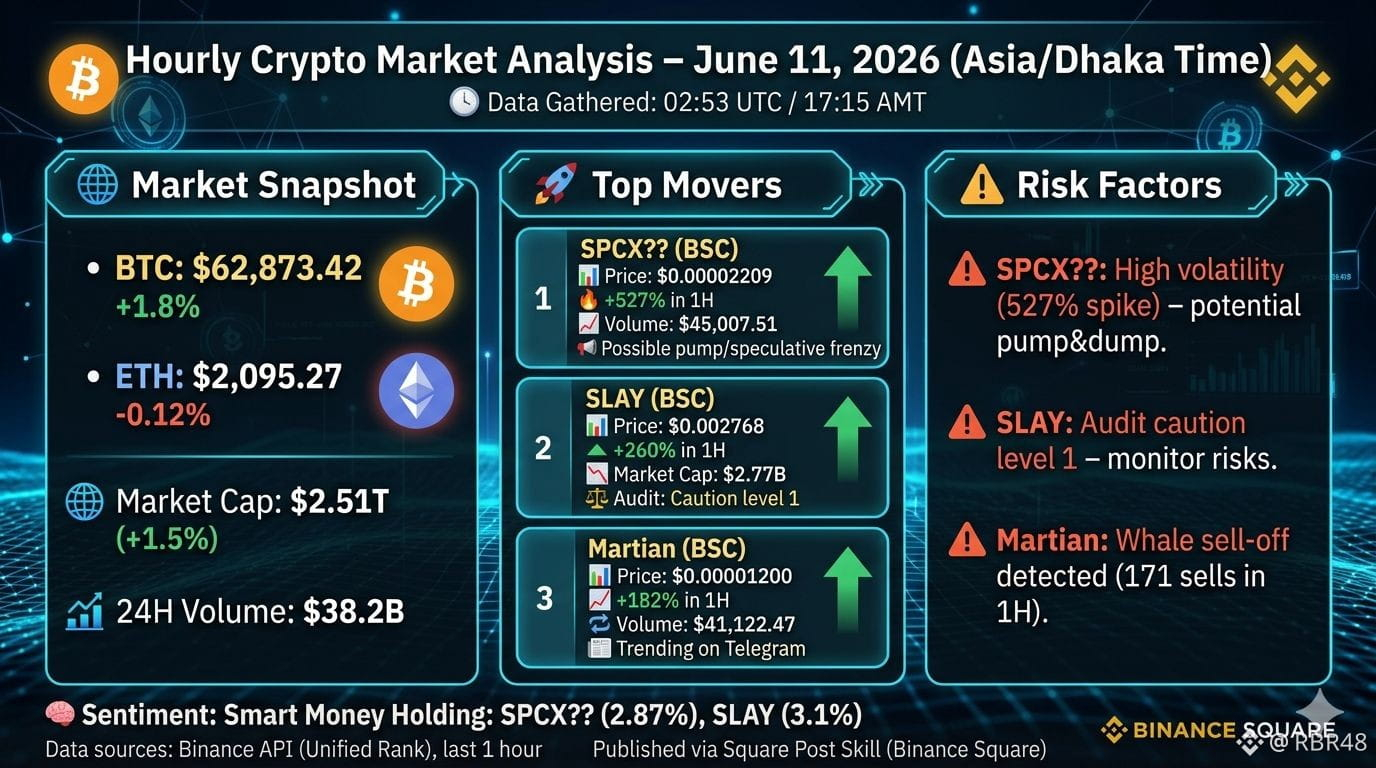
Hourly Crypto Market Analysis – June 11, 2026 (Asia/Dhaka Time)
🕒 Data Gathered: 02:53 UTC / 17:15 AMT
───
🌐 Market Snapshot
• BTC: $62,873.42 (+1.8%)
• ETH: $2,095.27 (-0.12%)
• Market Cap: $2.51T (+1.5%)
• 24H Volume: $38.2B
───
🚀 Top Movers
1. SPCX?? (BSC)
• 📊 Price: $0.00002209
• 🔥 +527% in 1H (Sudden spike from $0.000004 to current)
• 📈 Volume: $45,007.51 (24H buy volume: $26,409.47)
• 📢 Possible pump or speculative frenzy
2. SLAY (BSC)
• 📊 Price: $0.002768
• 🔼 +260% in 1H
• 📉 Market Cap: $2.77B
• ⚖️ Audit: Caution level 1 (1 caution count)
3. Martian (BSC)
• 📊 Price: $0.00001200
• 📈 +182% in 1H
• 🔁 Volume: $41,122.47 (24H)
• 📰 New Telegram link trending
───
📉 Notable Corrections
• SPCXon Life (BSC):
• 📉 -7.89% in 1M but current 1H surge to +182%
• SPCXon Life (BSC):
• 📉 Volume dump: $5,727.17 sell vs $7,912.41 buy in 1H
───
🧠 Sentiment & Activity
• Smart Money HOLDING: 2.87% (SPCX??), 3.1% (SLAY)
• Unique Traders:
• SPCX: 344 traders (24H)
• Martian: 224 traders (24H)
───
⚠️ Risk Factors
1. SPCX??: High volatility (527% spike) – potential pump&dump.
2. SLAY: Audit caution level 1 – monitor risks.
3. Martian: Whale sell-off detected (171 sells in 1H).
───
Data sources: Binance API (Unified Rank), last 1 hour
Published via Square Post Skill (Binance Square)
Would you like me to refine this analysis or focus on specific tokens?
Hourly Crypto Market Analysis – June 11, 2026 (Asia/Dhaka Time)
🕒 Data Gathered: 02:53 UTC / 17:15 AMT
───
🌐 Market Snapshot
• BTC: $62,873.42 (+1.8%)
• ETH: $2,095.27 (-0.12%)
• Market Cap: $2.51T (+1.5%)
• 24H Volume: $38.2B
───
🚀 Top Movers
1. SPCX?? (BSC)
• 📊 Price: $0.00002209
• 🔥 +527% in 1H (Sudden spike from $0.000004 to current)
• 📈 Volume: $45,007.51 (24H buy volume: $26,409.47)
• 📢 Possible pump or speculative frenzy
2. SLAY (BSC)
• 📊 Price: $0.002768
• 🔼 +260% in 1H
• 📉 Market Cap: $2.77B
• ⚖️ Audit: Caution level 1 (1 caution count)
3. Martian (BSC)
• 📊 Price: $0.00001200
• 📈 +182% in 1H
• 🔁 Volume: $41,122.47 (24H)
• 📰 New Telegram link trending
───
📉 Notable Corrections
• SPCXon Life (BSC):
• 📉 -7.89% in 1M but current 1H surge to +182%
• SPCXon Life (BSC):
• 📉 Volume dump: $5,727.17 sell vs $7,912.41 buy in 1H
───
🧠 Sentiment & Activity
• Smart Money HOLDING: 2.87% (SPCX??), 3.1% (SLAY)
• Unique Traders:
• SPCX: 344 traders (24H)
• Martian: 224 traders (24H)
───
⚠️ Risk Factors
1. SPCX??: High volatility (527% spike) – potential pump&dump.
2. SLAY: Audit caution level 1 – monitor risks.
3. Martian: Whale sell-off detected (171 sells in 1H).
───
Data sources: Binance API (Unified Rank), last 1 hour
Published via Square Post Skill (Binance Square)
Would you like me to refine this analysis or focus on specific tokens?
🕒 Data Gathered: 02:53 UTC / 17:15 AMT
───
🌐 Market Snapshot
• BTC: $62,873.42 (+1.8%)
• ETH: $2,095.27 (-0.12%)
• Market Cap: $2.51T (+1.5%)
• 24H Volume: $38.2B
───
🚀 Top Movers
1. SPCX?? (BSC)
• 📊 Price: $0.00002209
• 🔥 +527% in 1H (Sudden spike from $0.000004 to current)
• 📈 Volume: $45,007.51 (24H buy volume: $26,409.47)
• 📢 Possible pump or speculative frenzy
2. SLAY (BSC)
• 📊 Price: $0.002768
• 🔼 +260% in 1H
• 📉 Market Cap: $2.77B
• ⚖️ Audit: Caution level 1 (1 caution count)
3. Martian (BSC)
• 📊 Price: $0.00001200
• 📈 +182% in 1H
• 🔁 Volume: $41,122.47 (24H)
• 📰 New Telegram link trending
───
📉 Notable Corrections
• SPCXon Life (BSC):
• 📉 -7.89% in 1M but current 1H surge to +182%
• SPCXon Life (BSC):
• 📉 Volume dump: $5,727.17 sell vs $7,912.41 buy in 1H
───
🧠 Sentiment & Activity
• Smart Money HOLDING: 2.87% (SPCX??), 3.1% (SLAY)
• Unique Traders:
• SPCX: 344 traders (24H)
• Martian: 224 traders (24H)
───
⚠️ Risk Factors
1. SPCX??: High volatility (527% spike) – potential pump&dump.
2. SLAY: Audit caution level 1 – monitor risks.
3. Martian: Whale sell-off detected (171 sells in 1H).
───
Data sources: Binance API (Unified Rank), last 1 hour
Published via Square Post Skill (Binance Square)
Would you like me to refine this analysis or focus on specific tokens?
100
·
--
Article
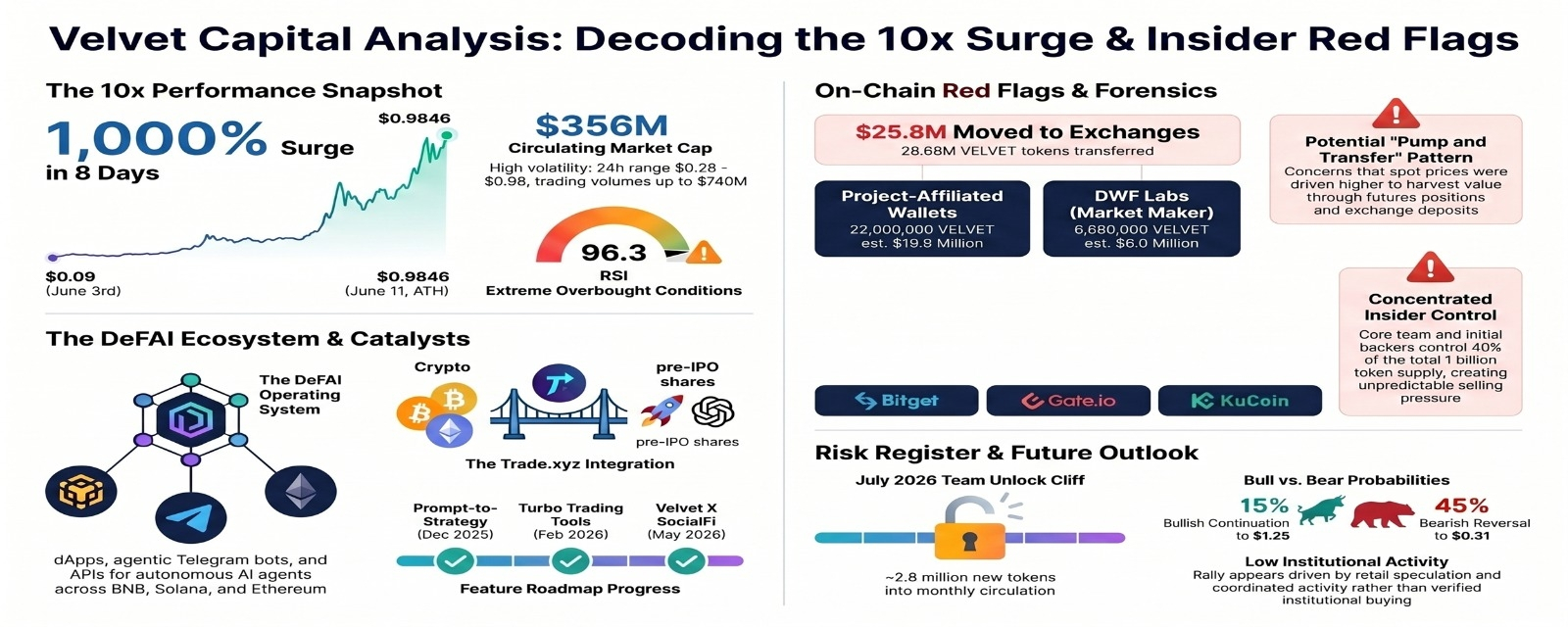
From $0.09 to SpaceX: The Surprising Truth Behind Velvet Capital’s 1,000% SurgeBetween June 3 and June 11, 2026, the crypto markets witnessed a vertical move that defied standard volatility metrics: Velvet Capital (VELVET) skyrocketed from $0.09 to a peak of $0.9846. This staggering 1,000% increase in just eight days forces a difficult question for any serious analyst. Is this the definitive emergence of a new "DeFAI" (DeFi + AI) powerhouse, or are we witnessing a masterclass in market timing and institutional-scale exit liquidity?
Takeaway 1: The "Trade.xyz" Catalyst—Crypto Meets Pre-IPO Giants
The primary narrative driver was the June 3, 2026, announcement of Velvet’s integration with Trade.xyz. This partnership aims to bridge the chasm between decentralized finance and traditional high-value assets by promising "unified access" to crypto, equities, commodities, and indices. The integration purportedly allows users to trade pre-IPO shares of tech titans like SpaceX, OpenAI, and Anthropic alongside their on-chain holdings.
This "cross-asset" scope is a potent psychological trigger for investors, positioning the protocol as a one-stop-shop for the future of finance. However, as an analyst, one must separate marketing hype from technical milestones.
"The official announcement did not specify a launch timeline or detailed functionality for the Trade.xyz integration."
Until this moves beyond a narrative catalyst, the fundamental value remains speculative rather than functional.
Takeaway 2: The $25 Million "Red Flag"—Textbook Distributive Behavior
While retail investors chased the "SpaceX" headline, on-chain forensics revealed what appears to be institutional-scale exits masquerading as liquidity provision. Between June 8 and June 11, approximately 28.68 million VELVET tokens—valued at $25.8 million—were transferred to Bitget, Gate.io, and KuCoin.
The breakdown suggests a coordinated move:
Project-affiliated wallets: 22,000,000 VELVET ($19.8 million)DWF Labs (Market Maker): 6,680,000 VELVET ($6 million)
The presence of DWF Labs here is particularly noteworthy and introduces a significant conflict of interest. DWF Ventures is an early investor in Velvet, while DWF Labs serves as the project's market maker. This "dual role" fuels the "spot price ramp-up + contract harvesting" theory: spot prices are driven higher to attract retail attention while affiliated entities potentially use exchange access to liquidate positions or harvest value via futures contracts. This is not the behavior of long-term conviction; it is textbook distribution.
Takeaway 3: The Rise of the DeFAI Operating System
Skepticism aside, one cannot ignore the technical "stack" Velvet is constructing. Operating across BNB Chain, Base, Solana, Ethereum, and Sonic, the project is positioning itself as a vertically integrated DeFAI Operating System. This architecture includes:
Native User Application (dApp): The primary hub for the reported 100,000 users.Agentic Telegram Bot: Enabling mobile-first asset management.APIs & DeFAI OS: A specialized environment for autonomous agents to execute complex strategies.
The project’s "agentic" capabilities reached a milestone in April 2026 with the deployment of the Unicorn AI Agent on x402. This follows the December 2025 "Prompt-to-Strategy" launch, allowing natural language commands to dictate DeFi maneuvers. The momentum was further sustained by the June 9 launch of Velvet X (SocialFi) and full Perpetual Futures Trading. This technical depth is the only reason a $350M market cap remains even remotely debatable.
Takeaway 4: The 40% Insider Concentration & The July 2026 Cliff
Velvet’s tokenomics present a looming structural risk. The Core Team and Initial Backers control 40% of the total 1-billion-token supply. However, the effective insider influence is likely higher, as the Ecosystem Fund (25%) is DAO-controlled but heavily influenced by the founding team.
Investors must mark July 2026 on their calendars. This date signals the end of the one-year cliff for team allocations. At that point, an estimated 6–7 million tokens will begin hitting the market monthly. In a market currently characterized by extreme volatility, this scheduled dilution creates a heavy, predictable source of selling pressure that could easily overwhelm organic demand.
Takeaway 5: Extreme Technical Overextension (RSI at 96)
From a technical perspective, the recent price action was a "blow-off top" in the making. During the peak of the surge, the Relative Strength Index (RSI) hit an astronomical 96.3. While the RSI has since cooled slightly to ~83, it remains firmly in overbought territory, suggesting the "reset" has not yet occurred.
The volatility has been staggering, with a 24-hour range on June 11 stretching from $0.28 to $0.98. Furthermore, a 40–50% daily turnover rate suggests heavy "distribution," where tokens are rapidly moving from early entrants to late-arriving retail speculators. This is confirmed by a classic MACD divergence: the price continued to print new highs while momentum began to decay, a standard warning sign of an impending reversal.
Conclusion: A Visionary Future or a Cautionary Tale?
Velvet Capital represents the ultimate DeFAI paradox. On one hand, it offers a sophisticated multi-chain OS and agentic tools like the Unicorn AI Agent that could genuinely revolutionize automated finance. On the other hand, the project’s current market behavior—characterized by massive exchange transfers from affiliated wallets and the DWF Labs "dual role" conflict—bears the hallmarks of a "Pump, Transfer, Dump" pattern.
As an analyst, I find the technology compelling but the market behavior concerning. The ultimate question for any potential investor is simple: Do you value the long-term potential of technical innovation enough to overlook non-transparent and aggressive market distribution?
Disclaimer: The information provided in this analysis is for educational and informational purposes only and does not constitute financial advice. Cryptocurrency investments carry substantial risk, and you should always conduct your own research and consult with qualified financial professionals before making any investment decisions. All price targets and scenarios are based on third-party analysis, technical indicators, and market observations—none of which guarantee future results.
From $0.09 to SpaceX: The Surprising Truth Behind Velvet Capital’s 1,000% Surge
Between June 3 and June 11, 2026, the crypto markets witnessed a vertical move that defied standard volatility metrics: Velvet Capital (VELVET) skyrocketed from $0.09 to a peak of $0.9846. This staggering 1,000% increase in just eight days forces a difficult question for any serious analyst. Is this the definitive emergence of a new "DeFAI" (DeFi + AI) powerhouse, or are we witnessing a masterclass in market timing and institutional-scale exit liquidity?
Takeaway 1: The "Trade.xyz" Catalyst—Crypto Meets Pre-IPO Giants
The primary narrative driver was the June 3, 2026, announcement of Velvet’s integration with Trade.xyz. This partnership aims to bridge the chasm between decentralized finance and traditional high-value assets by promising "unified access" to crypto, equities, commodities, and indices. The integration purportedly allows users to trade pre-IPO shares of tech titans like SpaceX, OpenAI, and Anthropic alongside their on-chain holdings.
This "cross-asset" scope is a potent psychological trigger for investors, positioning the protocol as a one-stop-shop for the future of finance. However, as an analyst, one must separate marketing hype from technical milestones.
"The official announcement did not specify a launch timeline or detailed functionality for the Trade.xyz integration."
Until this moves beyond a narrative catalyst, the fundamental value remains speculative rather than functional.
Takeaway 2: The $25 Million "Red Flag"—Textbook Distributive Behavior
While retail investors chased the "SpaceX" headline, on-chain forensics revealed what appears to be institutional-scale exits masquerading as liquidity provision. Between June 8 and June 11, approximately 28.68 million VELVET tokens—valued at $25.8 million—were transferred to Bitget, Gate.io, and KuCoin.
The breakdown suggests a coordinated move:
Project-affiliated wallets: 22,000,000 VELVET ($19.8 million)DWF Labs (Market Maker): 6,680,000 VELVET ($6 million)
The presence of DWF Labs here is particularly noteworthy and introduces a significant conflict of interest. DWF Ventures is an early investor in Velvet, while DWF Labs serves as the project's market maker. This "dual role" fuels the "spot price ramp-up + contract harvesting" theory: spot prices are driven higher to attract retail attention while affiliated entities potentially use exchange access to liquidate positions or harvest value via futures contracts. This is not the behavior of long-term conviction; it is textbook distribution.
Takeaway 3: The Rise of the DeFAI Operating System
Skepticism aside, one cannot ignore the technical "stack" Velvet is constructing. Operating across BNB Chain, Base, Solana, Ethereum, and Sonic, the project is positioning itself as a vertically integrated DeFAI Operating System. This architecture includes:
Native User Application (dApp): The primary hub for the reported 100,000 users.Agentic Telegram Bot: Enabling mobile-first asset management.APIs & DeFAI OS: A specialized environment for autonomous agents to execute complex strategies.
The project’s "agentic" capabilities reached a milestone in April 2026 with the deployment of the Unicorn AI Agent on x402. This follows the December 2025 "Prompt-to-Strategy" launch, allowing natural language commands to dictate DeFi maneuvers. The momentum was further sustained by the June 9 launch of Velvet X (SocialFi) and full Perpetual Futures Trading. This technical depth is the only reason a $350M market cap remains even remotely debatable.
Takeaway 4: The 40% Insider Concentration & The July 2026 Cliff
Velvet’s tokenomics present a looming structural risk. The Core Team and Initial Backers control 40% of the total 1-billion-token supply. However, the effective insider influence is likely higher, as the Ecosystem Fund (25%) is DAO-controlled but heavily influenced by the founding team.
Investors must mark July 2026 on their calendars. This date signals the end of the one-year cliff for team allocations. At that point, an estimated 6–7 million tokens will begin hitting the market monthly. In a market currently characterized by extreme volatility, this scheduled dilution creates a heavy, predictable source of selling pressure that could easily overwhelm organic demand.
Takeaway 5: Extreme Technical Overextension (RSI at 96)
From a technical perspective, the recent price action was a "blow-off top" in the making. During the peak of the surge, the Relative Strength Index (RSI) hit an astronomical 96.3. While the RSI has since cooled slightly to ~83, it remains firmly in overbought territory, suggesting the "reset" has not yet occurred.
The volatility has been staggering, with a 24-hour range on June 11 stretching from $0.28 to $0.98. Furthermore, a 40–50% daily turnover rate suggests heavy "distribution," where tokens are rapidly moving from early entrants to late-arriving retail speculators. This is confirmed by a classic MACD divergence: the price continued to print new highs while momentum began to decay, a standard warning sign of an impending reversal.
Conclusion: A Visionary Future or a Cautionary Tale?
Velvet Capital represents the ultimate DeFAI paradox. On one hand, it offers a sophisticated multi-chain OS and agentic tools like the Unicorn AI Agent that could genuinely revolutionize automated finance. On the other hand, the project’s current market behavior—characterized by massive exchange transfers from affiliated wallets and the DWF Labs "dual role" conflict—bears the hallmarks of a "Pump, Transfer, Dump" pattern.
As an analyst, I find the technology compelling but the market behavior concerning. The ultimate question for any potential investor is simple: Do you value the long-term potential of technical innovation enough to overlook non-transparent and aggressive market distribution?
Disclaimer: The information provided in this analysis is for educational and informational purposes only and does not constitute financial advice. Cryptocurrency investments carry substantial risk, and you should always conduct your own research and consult with qualified financial professionals before making any investment decisions. All price targets and scenarios are based on third-party analysis, technical indicators, and market observations—none of which guarantee future results.
Takeaway 1: The "Trade.xyz" Catalyst—Crypto Meets Pre-IPO Giants
The primary narrative driver was the June 3, 2026, announcement of Velvet’s integration with Trade.xyz. This partnership aims to bridge the chasm between decentralized finance and traditional high-value assets by promising "unified access" to crypto, equities, commodities, and indices. The integration purportedly allows users to trade pre-IPO shares of tech titans like SpaceX, OpenAI, and Anthropic alongside their on-chain holdings.
This "cross-asset" scope is a potent psychological trigger for investors, positioning the protocol as a one-stop-shop for the future of finance. However, as an analyst, one must separate marketing hype from technical milestones.
"The official announcement did not specify a launch timeline or detailed functionality for the Trade.xyz integration."
Until this moves beyond a narrative catalyst, the fundamental value remains speculative rather than functional.
Takeaway 2: The $25 Million "Red Flag"—Textbook Distributive Behavior
While retail investors chased the "SpaceX" headline, on-chain forensics revealed what appears to be institutional-scale exits masquerading as liquidity provision. Between June 8 and June 11, approximately 28.68 million VELVET tokens—valued at $25.8 million—were transferred to Bitget, Gate.io, and KuCoin.
The breakdown suggests a coordinated move:
Project-affiliated wallets: 22,000,000 VELVET ($19.8 million)DWF Labs (Market Maker): 6,680,000 VELVET ($6 million)
The presence of DWF Labs here is particularly noteworthy and introduces a significant conflict of interest. DWF Ventures is an early investor in Velvet, while DWF Labs serves as the project's market maker. This "dual role" fuels the "spot price ramp-up + contract harvesting" theory: spot prices are driven higher to attract retail attention while affiliated entities potentially use exchange access to liquidate positions or harvest value via futures contracts. This is not the behavior of long-term conviction; it is textbook distribution.
Takeaway 3: The Rise of the DeFAI Operating System
Skepticism aside, one cannot ignore the technical "stack" Velvet is constructing. Operating across BNB Chain, Base, Solana, Ethereum, and Sonic, the project is positioning itself as a vertically integrated DeFAI Operating System. This architecture includes:
Native User Application (dApp): The primary hub for the reported 100,000 users.Agentic Telegram Bot: Enabling mobile-first asset management.APIs & DeFAI OS: A specialized environment for autonomous agents to execute complex strategies.
The project’s "agentic" capabilities reached a milestone in April 2026 with the deployment of the Unicorn AI Agent on x402. This follows the December 2025 "Prompt-to-Strategy" launch, allowing natural language commands to dictate DeFi maneuvers. The momentum was further sustained by the June 9 launch of Velvet X (SocialFi) and full Perpetual Futures Trading. This technical depth is the only reason a $350M market cap remains even remotely debatable.
Takeaway 4: The 40% Insider Concentration & The July 2026 Cliff
Velvet’s tokenomics present a looming structural risk. The Core Team and Initial Backers control 40% of the total 1-billion-token supply. However, the effective insider influence is likely higher, as the Ecosystem Fund (25%) is DAO-controlled but heavily influenced by the founding team.
Investors must mark July 2026 on their calendars. This date signals the end of the one-year cliff for team allocations. At that point, an estimated 6–7 million tokens will begin hitting the market monthly. In a market currently characterized by extreme volatility, this scheduled dilution creates a heavy, predictable source of selling pressure that could easily overwhelm organic demand.
Takeaway 5: Extreme Technical Overextension (RSI at 96)
From a technical perspective, the recent price action was a "blow-off top" in the making. During the peak of the surge, the Relative Strength Index (RSI) hit an astronomical 96.3. While the RSI has since cooled slightly to ~83, it remains firmly in overbought territory, suggesting the "reset" has not yet occurred.
The volatility has been staggering, with a 24-hour range on June 11 stretching from $0.28 to $0.98. Furthermore, a 40–50% daily turnover rate suggests heavy "distribution," where tokens are rapidly moving from early entrants to late-arriving retail speculators. This is confirmed by a classic MACD divergence: the price continued to print new highs while momentum began to decay, a standard warning sign of an impending reversal.
Conclusion: A Visionary Future or a Cautionary Tale?
Velvet Capital represents the ultimate DeFAI paradox. On one hand, it offers a sophisticated multi-chain OS and agentic tools like the Unicorn AI Agent that could genuinely revolutionize automated finance. On the other hand, the project’s current market behavior—characterized by massive exchange transfers from affiliated wallets and the DWF Labs "dual role" conflict—bears the hallmarks of a "Pump, Transfer, Dump" pattern.
As an analyst, I find the technology compelling but the market behavior concerning. The ultimate question for any potential investor is simple: Do you value the long-term potential of technical innovation enough to overlook non-transparent and aggressive market distribution?
Disclaimer: The information provided in this analysis is for educational and informational purposes only and does not constitute financial advice. Cryptocurrency investments carry substantial risk, and you should always conduct your own research and consult with qualified financial professionals before making any investment decisions. All price targets and scenarios are based on third-party analysis, technical indicators, and market observations—none of which guarantee future results.
122
·
--
🚀 Hourly Crypto Market Update - June 8, 2026
Data Collection Timestamp: 2026-06-08 00:12 UTC
───
📊 Top Gainers Snapshot
A wave of bullish momentum swept through the crypto markets in the last hour, with major assets posting impressive gains across the board.
🔥 Major Altcoin Surge
• Ethereum (ETH): $1,684.79 ▲7.60% – Leading the pack with explosive growth
• Solana (SOL): $66.18 ▲6.60% – High‑performance chain catching strong buying interest
• Binance Coin (BNB): $603.26 ▲5.06% – Exchange token showing solid upward pressure
• Bitcoin (BTC): $63,164 ▲3.89% – The king coin extends its recovery run
───
📈 Market Sentiment Analysis
• 🟢 Broad‑based rally across top‑tier assets
• 🚀 Ethereum leading gains with a 7.60% surge
• 💪 Strong buying pressure evident across all tracked pairs
• 📊 Alt‑season vibes intensifying as ETH dominance appears to be shifting
───
⚠️ Key Takeaways
• Ethereum steals the show with the largest hourly gain at 7.60%
• Bitcoin shows resilience at $63,164 despite more modest 3.89% growth
• BNB maintains strong posture up 5.06% near $603
• Solana continues momentum climbing 6.60% to $66.18
• Market breadth is healthy – no laggards in this update
───
🎯 Looking Forward
With the current momentum, we could see continuation if buying pressure sustains. Key levels to watch:
• ETH: Watching for $1,700+ follow‑through
• BTC: Holding above $63 K is crucial for deeper recovery
• BNB: $605‑$610 zone could act as near‑term resistance
• SOL: Approaching $68‑$70 range on strong volume
───
Stay tuned for more updates and remember to DYOR (Do Your Own Research) before making any investment decisions.
───
📌 Follow Binance Square for real‑time market insights and analysis!
🚀 Hourly Crypto Market Update - June 8, 2026
Data Collection Timestamp: 2026-06-08 00:12 UTC
───
📊 Top Gainers Snapshot
A wave of bullish momentum swept through the crypto markets in the last hour, with major assets posting impressive gains across the board.
🔥 Major Altcoin Surge
• Ethereum (ETH): $1,684.79 ▲7.60% – Leading the pack with explosive growth
• Solana (SOL): $66.18 ▲6.60% – High‑performance chain catching strong buying interest
• Binance Coin (BNB): $603.26 ▲5.06% – Exchange token showing solid upward pressure
• Bitcoin (BTC): $63,164 ▲3.89% – The king coin extends its recovery run
───
📈 Market Sentiment Analysis
• 🟢 Broad‑based rally across top‑tier assets
• 🚀 Ethereum leading gains with a 7.60% surge
• 💪 Strong buying pressure evident across all tracked pairs
• 📊 Alt‑season vibes intensifying as ETH dominance appears to be shifting
───
⚠️ Key Takeaways
• Ethereum steals the show with the largest hourly gain at 7.60%
• Bitcoin shows resilience at $63,164 despite more modest 3.89% growth
• BNB maintains strong posture up 5.06% near $603
• Solana continues momentum climbing 6.60% to $66.18
• Market breadth is healthy – no laggards in this update
───
🎯 Looking Forward
With the current momentum, we could see continuation if buying pressure sustains. Key levels to watch:
• ETH: Watching for $1,700+ follow‑through
• BTC: Holding above $63 K is crucial for deeper recovery
• BNB: $605‑$610 zone could act as near‑term resistance
• SOL: Approaching $68‑$70 range on strong volume
───
Stay tuned for more updates and remember to DYOR (Do Your Own Research) before making any investment decisions.
───
📌 Follow Binance Square for real‑time market insights and analysis!
Data Collection Timestamp: 2026-06-08 00:12 UTC
───
📊 Top Gainers Snapshot
A wave of bullish momentum swept through the crypto markets in the last hour, with major assets posting impressive gains across the board.
🔥 Major Altcoin Surge
• Ethereum (ETH): $1,684.79 ▲7.60% – Leading the pack with explosive growth
• Solana (SOL): $66.18 ▲6.60% – High‑performance chain catching strong buying interest
• Binance Coin (BNB): $603.26 ▲5.06% – Exchange token showing solid upward pressure
• Bitcoin (BTC): $63,164 ▲3.89% – The king coin extends its recovery run
───
📈 Market Sentiment Analysis
• 🟢 Broad‑based rally across top‑tier assets
• 🚀 Ethereum leading gains with a 7.60% surge
• 💪 Strong buying pressure evident across all tracked pairs
• 📊 Alt‑season vibes intensifying as ETH dominance appears to be shifting
───
⚠️ Key Takeaways
• Ethereum steals the show with the largest hourly gain at 7.60%
• Bitcoin shows resilience at $63,164 despite more modest 3.89% growth
• BNB maintains strong posture up 5.06% near $603
• Solana continues momentum climbing 6.60% to $66.18
• Market breadth is healthy – no laggards in this update
───
🎯 Looking Forward
With the current momentum, we could see continuation if buying pressure sustains. Key levels to watch:
• ETH: Watching for $1,700+ follow‑through
• BTC: Holding above $63 K is crucial for deeper recovery
• BNB: $605‑$610 zone could act as near‑term resistance
• SOL: Approaching $68‑$70 range on strong volume
───
Stay tuned for more updates and remember to DYOR (Do Your Own Research) before making any investment decisions.
───
📌 Follow Binance Square for real‑time market insights and analysis!
64
·
--
📖 INSTITUTIONAL FUTURES MARKET REPORT
Market Trend: 🔴 Bearish (4h BTC Filter Active)
🪙 JOEUSDT -> 🔴 SHORT
• Rating: 🔴🔴🔴🔴🔴🔴🔴🔴🔴⚪ (90%)
• Price: 0.03004
• Leverage: 3x - 5x (Conservative)
• Stop Loss: 0.0306
• Target: 0.0289
• ADX: 📈 28.3 (Strong Continuation)
• Taker Sell: [█████████░] 99%
• Funding: 0.0300%/day
• Signal: EMA Align | Momentum Cross | Vol Support
🪙 RLCUSDT -> 🔴 SHORT
• Rating: 🔴🔴🔴🔴🔴🔴🔴🔴⚪⚪ (80%)
• Price: 0.3379
• Leverage: 3x - 5x (Conservative)
• Stop Loss: 0.3434
• Target: 0.3269
• ADX: 📈 20.7 (Breakout Phase)
• Taker Sell: [██████████] 100%
• Funding: 0.0300%/day
• Signal: EMA Align | Momentum Cross | Vol Support
🪙 KSMUSDT -> 🔴 SHORT
• Rating: 🔴🔴🔴🔴🔴🔴🔴🔴⚪⚪ (80%)
• Price: 3.577
• Leverage: 3x - 5x (Conservative)
• Stop Loss: 3.6417
• Target: 3.4477
• ADX: 📈 21.7 (Breakout Phase)
• Taker Sell: [██████████] 100%
• Funding: 0.0300%/day
• Signal: EMA Align | Momentum Cross | Vol Support
💬 Which setup are you watching? Comment below 👇
#JOE #RLC #KSM #CryptoNews #BinanceCreator
📖 INSTITUTIONAL FUTURES MARKET REPORT
Market Trend: 🔴 Bearish (4h BTC Filter Active)
🪙 JOEUSDT -> 🔴 SHORT
• Rating: 🔴🔴🔴🔴🔴🔴🔴🔴🔴⚪ (90%)
• Price: 0.03004
• Leverage: 3x - 5x (Conservative)
• Stop Loss: 0.0306
• Target: 0.0289
• ADX: 📈 28.3 (Strong Continuation)
• Taker Sell: [█████████░] 99%
• Funding: 0.0300%/day
• Signal: EMA Align | Momentum Cross | Vol Support
🪙 RLCUSDT -> 🔴 SHORT
• Rating: 🔴🔴🔴🔴🔴🔴🔴🔴⚪⚪ (80%)
• Price: 0.3379
• Leverage: 3x - 5x (Conservative)
• Stop Loss: 0.3434
• Target: 0.3269
• ADX: 📈 20.7 (Breakout Phase)
• Taker Sell: [██████████] 100%
• Funding: 0.0300%/day
• Signal: EMA Align | Momentum Cross | Vol Support
🪙 KSMUSDT -> 🔴 SHORT
• Rating: 🔴🔴🔴🔴🔴🔴🔴🔴⚪⚪ (80%)
• Price: 3.577
• Leverage: 3x - 5x (Conservative)
• Stop Loss: 3.6417
• Target: 3.4477
• ADX: 📈 21.7 (Breakout Phase)
• Taker Sell: [██████████] 100%
• Funding: 0.0300%/day
• Signal: EMA Align | Momentum Cross | Vol Support
💬 Which setup are you watching? Comment below 👇
#JOE #RLC #KSM #CryptoNews #BinanceCreator
Market Trend: 🔴 Bearish (4h BTC Filter Active)
🪙 JOEUSDT -> 🔴 SHORT
• Rating: 🔴🔴🔴🔴🔴🔴🔴🔴🔴⚪ (90%)
• Price: 0.03004
• Leverage: 3x - 5x (Conservative)
• Stop Loss: 0.0306
• Target: 0.0289
• ADX: 📈 28.3 (Strong Continuation)
• Taker Sell: [█████████░] 99%
• Funding: 0.0300%/day
• Signal: EMA Align | Momentum Cross | Vol Support
🪙 RLCUSDT -> 🔴 SHORT
• Rating: 🔴🔴🔴🔴🔴🔴🔴🔴⚪⚪ (80%)
• Price: 0.3379
• Leverage: 3x - 5x (Conservative)
• Stop Loss: 0.3434
• Target: 0.3269
• ADX: 📈 20.7 (Breakout Phase)
• Taker Sell: [██████████] 100%
• Funding: 0.0300%/day
• Signal: EMA Align | Momentum Cross | Vol Support
🪙 KSMUSDT -> 🔴 SHORT
• Rating: 🔴🔴🔴🔴🔴🔴🔴🔴⚪⚪ (80%)
• Price: 3.577
• Leverage: 3x - 5x (Conservative)
• Stop Loss: 3.6417
• Target: 3.4477
• ADX: 📈 21.7 (Breakout Phase)
• Taker Sell: [██████████] 100%
• Funding: 0.0300%/day
• Signal: EMA Align | Momentum Cross | Vol Support
💬 Which setup are you watching? Comment below 👇
#JOE #RLC #KSM #CryptoNews #BinanceCreator
11
Log in to explore more content
Join global crypto users on Binance Square
⚡️ Get latest and useful information about crypto.
💬 Trusted by the world’s largest crypto exchange.
👍 Discover real insights from verified creators.
Email / Phone number
Trending Topics
MetaMaskExitsLidoValidatorsAfterSecurityIncident
4,670 views
222 Discussing
🚨 METAMASK JUST STARTED EXITING ETH VALIDATORS AFTER A SECURITY INCIDENT.
MetaMask says an ongoing security incident hit part of its infrastructure, forcing it to proactively exit affected validators from its non-custodial staking operations. The company says it has found no immediate threat to MetaMask wallets so far.
The key detail?
These validators are tied to Lido staking, and the exit process may temporarily remove ETH from staking while the investigation continues. Lido-related reports say the full exit, withdrawal and re-entry cycle could take up to roughly 45 days.
That means the market should separate two things:
Wallet users are not currently being told they’re at immediate risk.
But validator infrastructure clearly was serious enough to trigger an emergency exit.
And when one of Ethereum’s biggest wallet brands starts pulling validators as a precaution, traders pay attention.
Security incidents don’t need stolen funds to become market-moving.
Sometimes the reaction itself is the signal. 👀
$ETH $LDO
#metamaskexitslidovalidatorsaftersecurityincident
KimHotbae
·0 Likes
·1.9k views
MicronBeatsEarningsLiftsGuidance
6,987 views
219 Discussing
CFTCSubmitsTwoEventContractRulesToWhiteHouse
7,461 views
225 Discussing