
nullstate
83 Posts

nullstate
 Square Verified
Report
Block User

Top 7D Traders by Volume

Macro KOL

BNB Holder
High-Frequency Trader
5.7 Years
6 Following
3.0K+ Followers
1.1K+ Liked
2 Badges
Posts
All
Quotes
Videos
PINNED
·
--

Article
The $6.3 Billion TestHow North Korea hit Binance, and why the next one could be harder to stop
It may have started with a test.
According to early reports, a Binance engineer was talked into taking one. Malware landed on their laptop while they did it. That laptop was already logged in and already trusted, so it became the attacker’s way straight into production, and from there to the wallets. Binance hasn’t confirmed the test part. What it has said is that the incident may have started with a compromised DevOps engineer’s laptop, which gave the attacker access to a service container where unauthorized withdrawals were submitted.
By the time the outflows stopped, about $6.3 billion in assets was gone. That is the largest crypto theft on record. The old record was the $1.5 billion Bybit hack in February 2025, so Binance lost more than four times as much. Binance said about $3 billion of it was frozen on-chain early on, with help from its blockchain partners.
On Saturday, the FBI said who did it. The bureau blamed TraderTraitor, a North Korean state-sponsored unit and the same one it blamed for Bybit. It says the group was seen converting the stolen assets mainly into Ethereum, and it expects the money to be laundered further in stages. It also asked exchanges and other crypto service providers to block the addresses it listed.
Binance’s own account is that this was not a one-click job. Co-CEO Richard Teng called it a “complex attack,” said more than one person was involved, and said the malware was built to delete evidence of its own activity. Withdrawals have been suspended while Binance rebuilds that part of its system.
Binance says users will not pay for any of this. It has bought back about 90 percent of the stolen tokens with its own money, pulling from its SAFU reserve (a roughly $1 billion fund held for exactly this kind of emergency), part of its Futures Insurance Fund and its corporate treasury. The rest are less liquid tokens that take longer to buy. Binance says withdrawals reopen Sunday, and it has published a new proof-of-reserves snapshot so users can check that assets are backed at least 1:1.
A very old business
North Korea has been doing this for more than a decade, and the targets keep getting bigger.
In 2014 it was Sony Pictures. In 2016 it was a central bank. Hackers took over systems at Bangladesh Bank and used the SWIFT network to send 35 fraudulent transfer requests to the Federal Reserve Bank of New York, for close to $1 billion. About $81 million went through. The New York Fed stopped the other 30 requests, worth roughly $850 million, after a misspelled instruction raised suspicion. A spelling mistake is a big part of why this wasn’t a billion-dollar heist.
Then came WannaCry in 2017, the ransomware that hit hundreds of thousands of computers across about 150 countries. Symantec said it was highly likely the Lazarus Group was behind it. The US later charged a North Korean national, Park Jin Hyok, over Sony, WannaCry and the Bangladesh job, and in 2019 the Treasury sanctioned Lazarus and its sub-units Bluenoroff and Andariel.
Bangladesh was the preview. MIT Technology Review described that heist as the one that foreshadowed the group’s turn to crypto exchanges, and it is easy to see why. Banks have compliance desks and a Federal Reserve that can be called. Once a crypto transfer lands in the right wallets, nobody picks up the phone.
The numbers show how well it worked. A UN panel looked at 58 suspected North Korean cyberattacks between 2017 and 2023 and put the haul at about $3 billion. Chainalysis counted $1.7 billion stolen in 2022, $660 million in 2023, and $1.34 billion in 2024 across 47 incidents. The FBI tied the same TraderTraitor unit to the $600 million Ronin bridge hack, the $100 million Harmony bridge hack, a $308 million theft from the Japanese exchange DMM in 2024, and then Bybit, a Dubai-based exchange, for $1.5 billion.
As of the Bybit hack, estimates put everything North Korea had stolen from crypto since 2017 at around $6 billion. Binance alone is now about the same.
The motive is not complicated. North Korea is cut off from the global financial system, and a senior US official has called crypto theft a major source of revenue for the regime’s missile program.
Now add AI
Go back to the test. If the early reports are right, the lure was something that looked like part of a hiring process, and fake recruiters are a known North Korean method. Chainalysis has said these groups use generative AI to build believable recruiter profiles on professional networking sites. For years, one way to spot these operations was the writing, because clumsy English or Korean gave them away. AI removes that problem.
To be clear, nobody has said AI was used against Binance. But the direction is plain. In August, the South Korean security firm Genians reported that Kimsuky, a different North Korean hacking unit that the US Treasury sanctioned in 2023, was running open AI models such as Ollama, GPT4All and Msty on its own machines. The reason is simple. Commercial chatbots log activity and screen for abuse. A model on your own hardware has none of that, so there is nobody to refuse the request and nobody to report it.
The toolkit goes well past a chatbot. Genians says the group uses retrieval tools to sift through stolen documents, agent frameworks to chain tasks together, speech-to-text software, and the AI coding tool Cursor to help write and refine malware. One result is finance and crypto-themed lure documents made to look like ordinary workplace reports.
Genians found no sign that the group trained a model of its own, and it didn’t need to. Open models running on private hardware sit outside any provider’s monitoring, and versions with the safety training removed exist. That finding rests on one firm’s research and hasn’t been independently verified. Kimsuky is also an espionage unit, not TraderTraitor, so I’m not saying the same people used the same tools on Binance.
What to watch
Binance says it will publish a detailed technical post-mortem once the investigation is complete. It has already said there were more points of breach than the laptop. That report will show how many layers failed between one engineer’s machine and billions of dollars in customer assets. If North Korea’s operators can write better lures, read stolen internal documents faster and automate more of the work, more layers have to hold.
Binance can absorb a $6.3 billion loss. The next exchange hit this way may not be able to.
The $6.3 Billion Test
How North Korea hit Binance, and why the next one could be harder to stop
It may have started with a test.
According to early reports, a Binance engineer was talked into taking one. Malware landed on their laptop while they did it. That laptop was already logged in and already trusted, so it became the attacker’s way straight into production, and from there to the wallets. Binance hasn’t confirmed the test part. What it has said is that the incident may have started with a compromised DevOps engineer’s laptop, which gave the attacker access to a service container where unauthorized withdrawals were submitted.
By the time the outflows stopped, about $6.3 billion in assets was gone. That is the largest crypto theft on record. The old record was the $1.5 billion Bybit hack in February 2025, so Binance lost more than four times as much. Binance said about $3 billion of it was frozen on-chain early on, with help from its blockchain partners.
On Saturday, the FBI said who did it. The bureau blamed TraderTraitor, a North Korean state-sponsored unit and the same one it blamed for Bybit. It says the group was seen converting the stolen assets mainly into Ethereum, and it expects the money to be laundered further in stages. It also asked exchanges and other crypto service providers to block the addresses it listed.
Binance’s own account is that this was not a one-click job. Co-CEO Richard Teng called it a “complex attack,” said more than one person was involved, and said the malware was built to delete evidence of its own activity. Withdrawals have been suspended while Binance rebuilds that part of its system.
Binance says users will not pay for any of this. It has bought back about 90 percent of the stolen tokens with its own money, pulling from its SAFU reserve (a roughly $1 billion fund held for exactly this kind of emergency), part of its Futures Insurance Fund and its corporate treasury. The rest are less liquid tokens that take longer to buy. Binance says withdrawals reopen Sunday, and it has published a new proof-of-reserves snapshot so users can check that assets are backed at least 1:1.
A very old business
North Korea has been doing this for more than a decade, and the targets keep getting bigger.
In 2014 it was Sony Pictures. In 2016 it was a central bank. Hackers took over systems at Bangladesh Bank and used the SWIFT network to send 35 fraudulent transfer requests to the Federal Reserve Bank of New York, for close to $1 billion. About $81 million went through. The New York Fed stopped the other 30 requests, worth roughly $850 million, after a misspelled instruction raised suspicion. A spelling mistake is a big part of why this wasn’t a billion-dollar heist.
Then came WannaCry in 2017, the ransomware that hit hundreds of thousands of computers across about 150 countries. Symantec said it was highly likely the Lazarus Group was behind it. The US later charged a North Korean national, Park Jin Hyok, over Sony, WannaCry and the Bangladesh job, and in 2019 the Treasury sanctioned Lazarus and its sub-units Bluenoroff and Andariel.
Bangladesh was the preview. MIT Technology Review described that heist as the one that foreshadowed the group’s turn to crypto exchanges, and it is easy to see why. Banks have compliance desks and a Federal Reserve that can be called. Once a crypto transfer lands in the right wallets, nobody picks up the phone.
The numbers show how well it worked. A UN panel looked at 58 suspected North Korean cyberattacks between 2017 and 2023 and put the haul at about $3 billion. Chainalysis counted $1.7 billion stolen in 2022, $660 million in 2023, and $1.34 billion in 2024 across 47 incidents. The FBI tied the same TraderTraitor unit to the $600 million Ronin bridge hack, the $100 million Harmony bridge hack, a $308 million theft from the Japanese exchange DMM in 2024, and then Bybit, a Dubai-based exchange, for $1.5 billion.
As of the Bybit hack, estimates put everything North Korea had stolen from crypto since 2017 at around $6 billion. Binance alone is now about the same.
The motive is not complicated. North Korea is cut off from the global financial system, and a senior US official has called crypto theft a major source of revenue for the regime’s missile program.
Now add AI
Go back to the test. If the early reports are right, the lure was something that looked like part of a hiring process, and fake recruiters are a known North Korean method. Chainalysis has said these groups use generative AI to build believable recruiter profiles on professional networking sites. For years, one way to spot these operations was the writing, because clumsy English or Korean gave them away. AI removes that problem.
To be clear, nobody has said AI was used against Binance. But the direction is plain. In August, the South Korean security firm Genians reported that Kimsuky, a different North Korean hacking unit that the US Treasury sanctioned in 2023, was running open AI models such as Ollama, GPT4All and Msty on its own machines. The reason is simple. Commercial chatbots log activity and screen for abuse. A model on your own hardware has none of that, so there is nobody to refuse the request and nobody to report it.
The toolkit goes well past a chatbot. Genians says the group uses retrieval tools to sift through stolen documents, agent frameworks to chain tasks together, speech-to-text software, and the AI coding tool Cursor to help write and refine malware. One result is finance and crypto-themed lure documents made to look like ordinary workplace reports.
Genians found no sign that the group trained a model of its own, and it didn’t need to. Open models running on private hardware sit outside any provider’s monitoring, and versions with the safety training removed exist. That finding rests on one firm’s research and hasn’t been independently verified. Kimsuky is also an espionage unit, not TraderTraitor, so I’m not saying the same people used the same tools on Binance.
What to watch
Binance says it will publish a detailed technical post-mortem once the investigation is complete. It has already said there were more points of breach than the laptop. That report will show how many layers failed between one engineer’s machine and billions of dollars in customer assets. If North Korea’s operators can write better lures, read stolen internal documents faster and automate more of the work, more layers have to hold.
Binance can absorb a $6.3 billion loss. The next exchange hit this way may not be able to.
1
203
·
--
Scott Galloway at Pivot Tour argues that the "idolatry of innovators" gives tech founders a pass no one else gets. He calls Elon Musk "a traitor to the West" and says he should be held to the same standards as everyone else. #tech #elonmusk
Scott Galloway at Pivot Tour argues that the "idolatry of innovators" gives tech founders a pass no one else gets. He calls Elon Musk "a traitor to the West" and says he should be held to the same standards as everyone else. #tech #elonmusk
1.7k
·
--
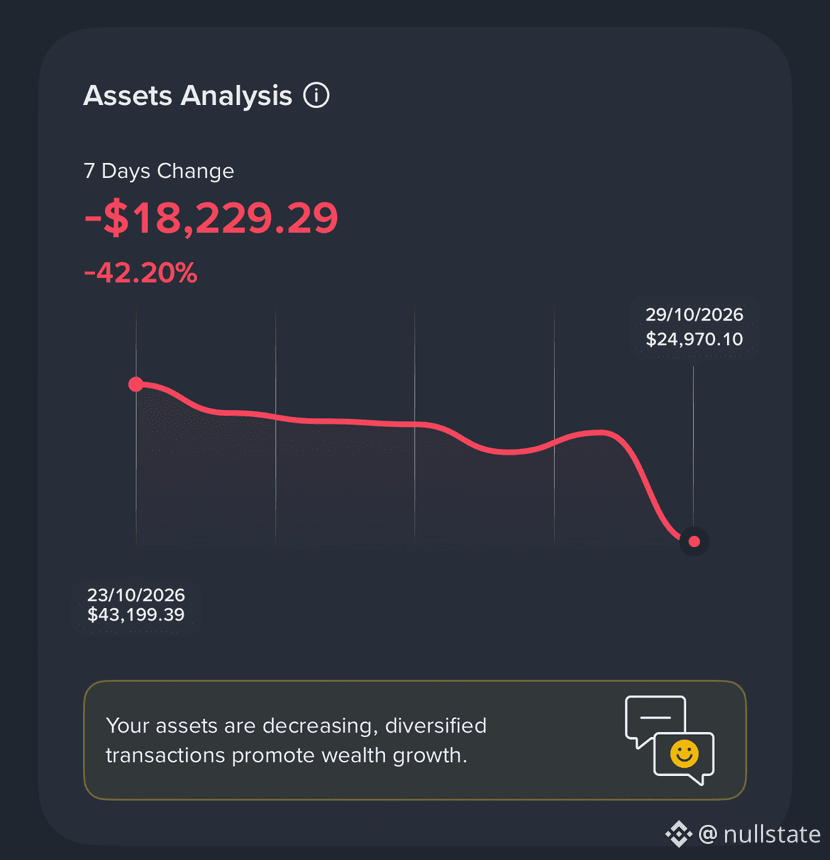
I see people posting their losses and, man, count yourself lucky. I am still holding.
I see people posting their losses and, man, count yourself lucky. I am still holding.
4
327
·
--
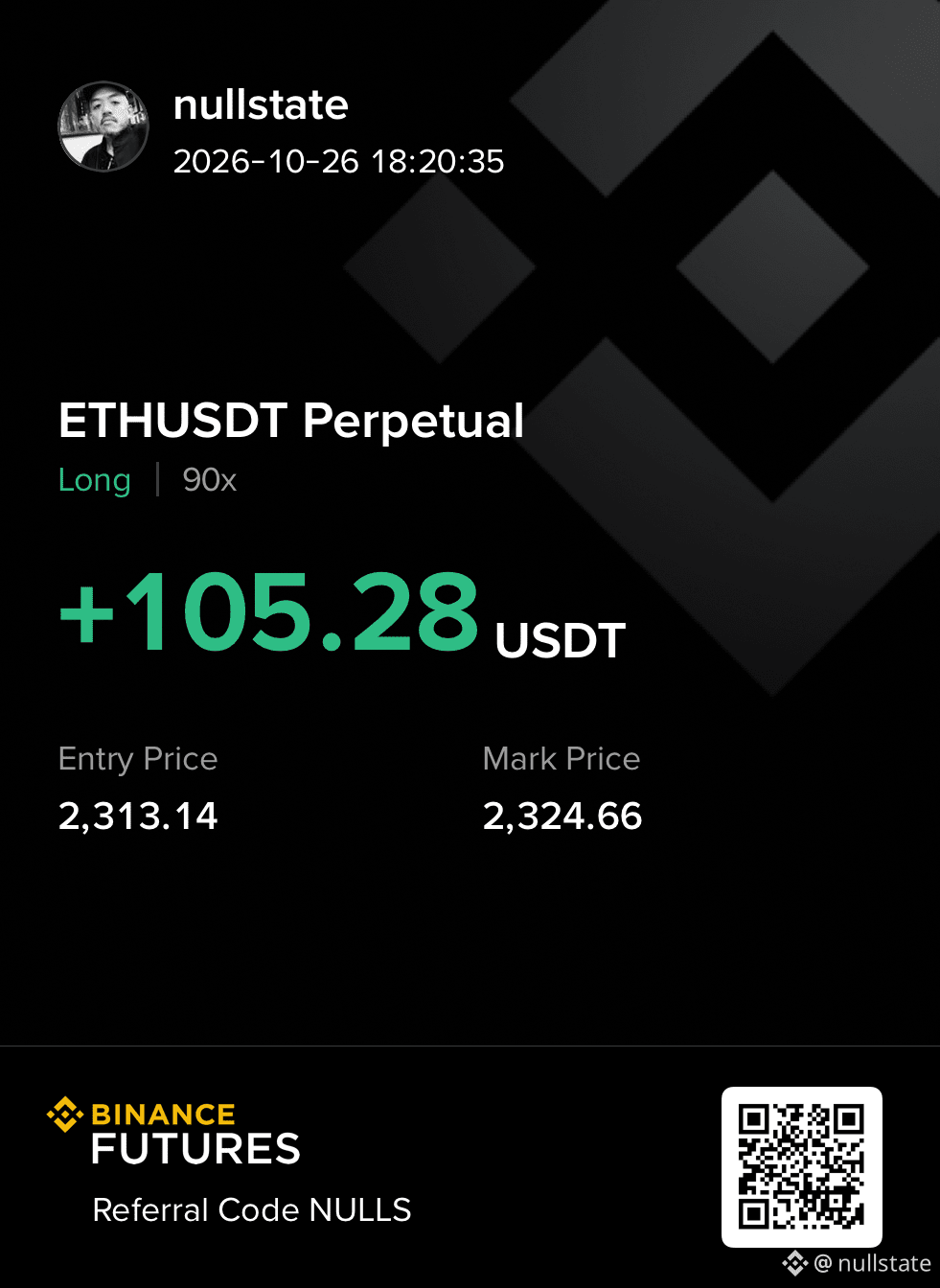
Binance got hacked but Circle froze the funds so nothing was lost. $BNB on the rebound.
Binance got hacked but Circle froze the funds so nothing was lost. $BNB on the rebound.
1
241
·
--
Bullish
2
966
·
--
$BTC traded near $63,000 in August. Two months later it's holding in the low 80s, and that's after this week's pullback, when Brent crude went above $111 and risk assets sold off.
US spot Bitcoin ETFs were about $5.8 billion in net outflows for 2026 by mid-July. They pulled in $6.34 billion during Q3, their strongest quarter of the year, and the year-to-date number flipped positive. Combined ETF assets now sit around 6.4% of Bitcoin's market cap.
Daily flows in October have been choppy, so it isn't a straight line. But the money that left in the first half came back in the second, and it came back at higher prices. An oil spike doesn't change that.
#BTC #Bitcoin
684
1
53
684
·
--
I had a bad entry but this is a long play to $300. $AAVE has been there before.
I had a bad entry but this is a long play to $300. $AAVE has been there before.
2
801
·
--
RIP to anyone who tried to short $AAVE
RIP to anyone who tried to short $AAVE
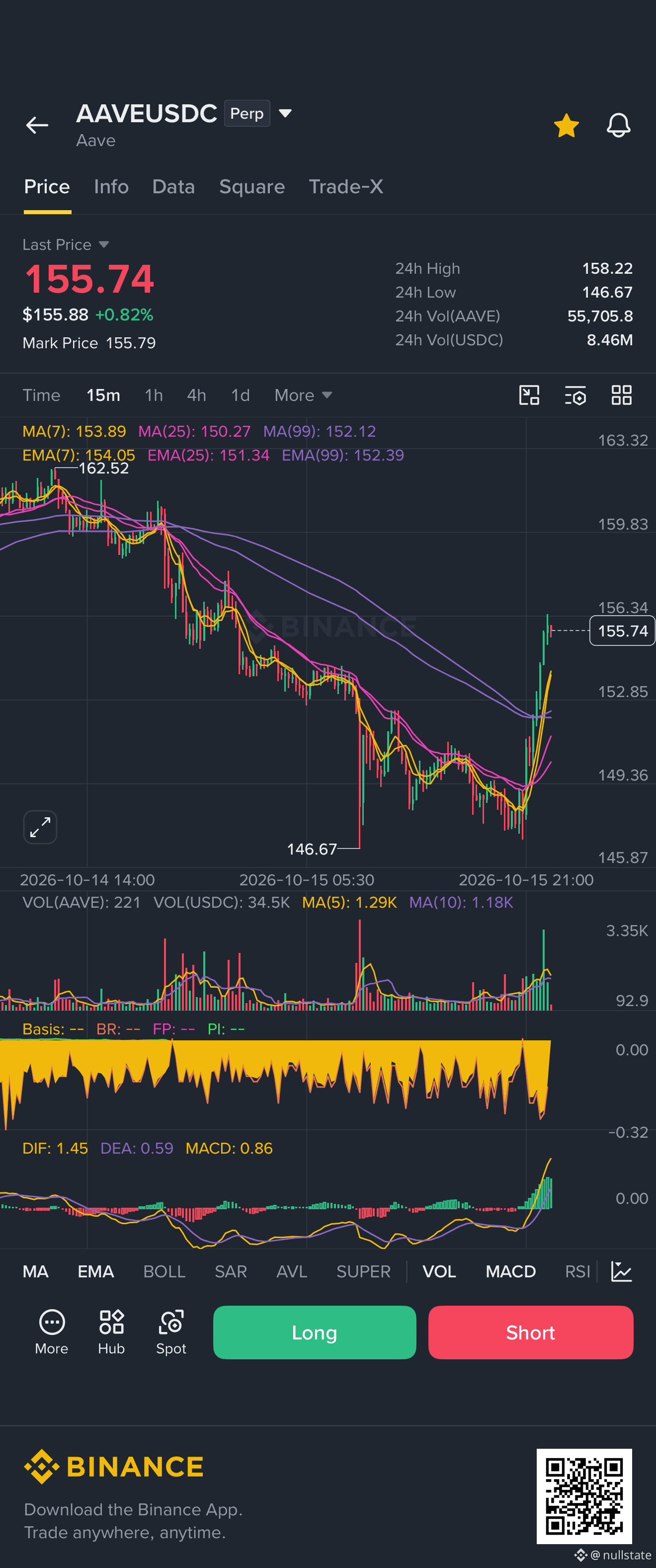
Sourced by user sharing on Binance
2
915

·
--
Donald Trump said Friday that the US will buy diesel fuel from Russia under a deal he made with Vladimir Putin. He announced it on Truth Social and said the purchase is needed to bring down US fuel prices, which have climbed since the start of the war with Iran.
The deal cuts against years of US and Western pressure on the Kremlin to end its war in Ukraine, now in its fifth year. It is likely to cause a new rift with Ukraine and with America's NATO allies in Europe.
Ukrainian President Volodymyr Zelensky called the deal "absolutely terrible" and "unfair and dishonest."

4
1
15
16.8k
·
--
It’s going to be awhile before I make up for my liquidation a few months ago but you only lose if you quit.
It’s going to be awhile before I make up for my liquidation a few months ago but you only lose if you quit.
5
1
13
9.5k
·
--
Bullish
Squeeze every short.
SQUEEZE. EVERY. SHORT.
$BTC $SOL $BNB
Squeeze every short.
SQUEEZE. EVERY. SHORT.
$BTC $SOL $BNB
SQUEEZE. EVERY. SHORT.
$BTC $SOL $BNB
2
2.6k
·
--
LFG $BTC !!!!!!
LFG $BTC !!!!!!

nullstate
·
--
I might eat my words but I think we are going to be okay. This may age well or it might not.
Follow and share for more giveaways!!!
Follow and share for more giveaways!!!
236
·
--
I told you so.
I told you so.
nullstate
·
--
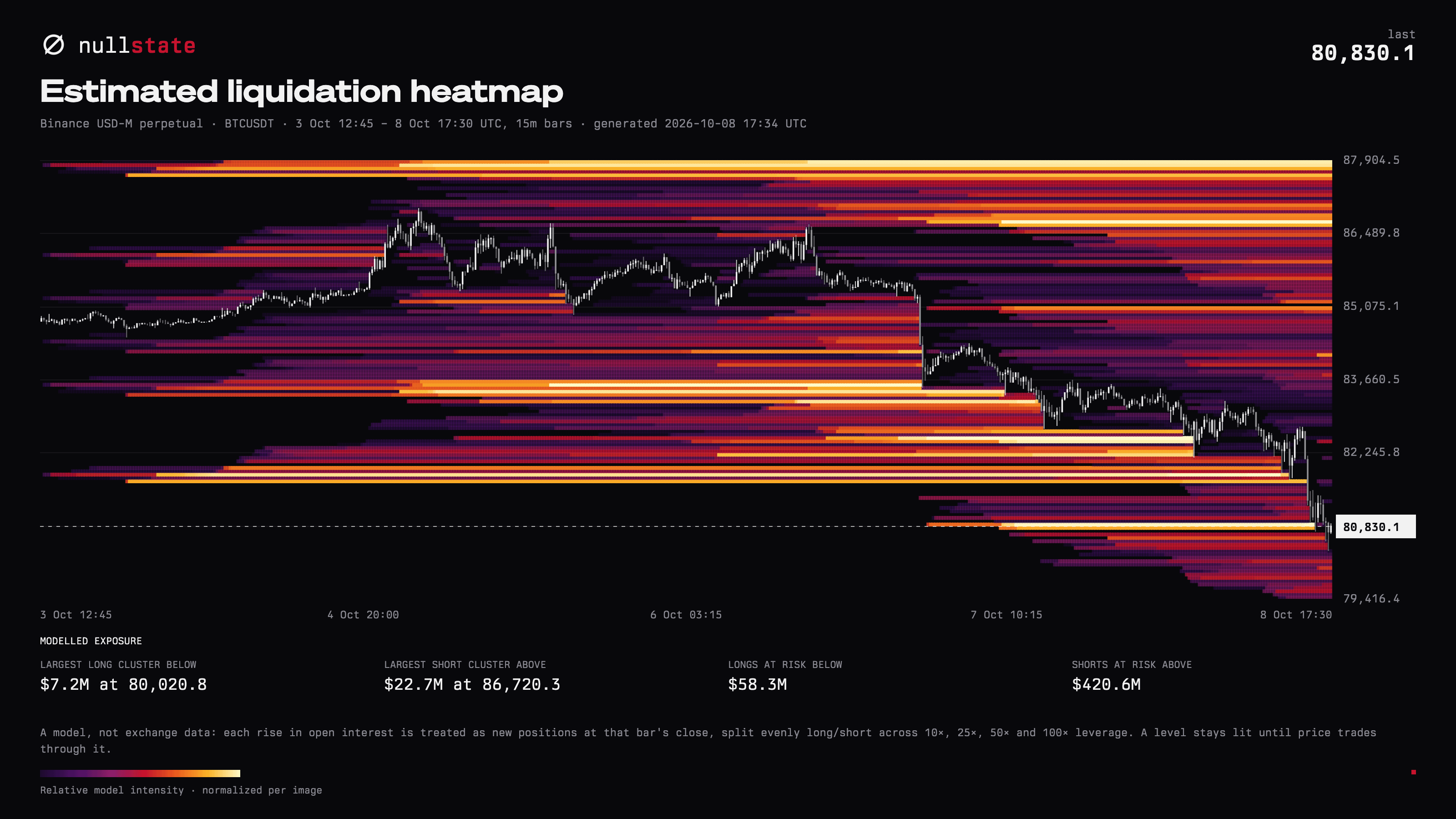
Here’s where the leverage on BTC is sitting right now.
This heatmap estimates the prices where leveraged traders would get force-closed. The brighter the band, the more money gets liquidated if price trades there.
The picture is lopsided. About $58M of longs are at risk below $80.8K, and about $420M of shorts are at risk above it. That’s roughly 7x more on the short side.
It makes sense after this week. The Oct 6-7 drop already flushed most of the longs, and plenty of traders shorted on the way down. Those shorts now sit above the price in layers:
$81-82.5K: the first heavy zone, right where BTC broke down
$83.5-84K: the next layer up
$86.7K: the biggest single cluster, $22.7M, just under the $87K ceiling
Below price it’s thin. The biggest long cluster is only $7.2M at $80.0K, and there’s not much under that down to $79.4K. So there are fewer forced sellers left below. If BTC bounces into $81-82K, shorts start getting closed out, and those forced buybacks can push price into the next layer. That’s how a short squeeze starts.
The catch: this is a model, not exchange data. It assumes every new position is half long and half short, but Binance shows retail is heavily long right now. The real long risk below is probably bigger than $58M. And a daily close under $79.2K would still override all of this.
First thing I’m watching is $82K.
1
238
Log in to explore more content
Join global crypto users on Binance Square
⚡️ Get latest and useful information about crypto.
💬 Trusted by the world’s largest crypto exchange.
👍 Discover real insights from verified creators.
Email / Phone number