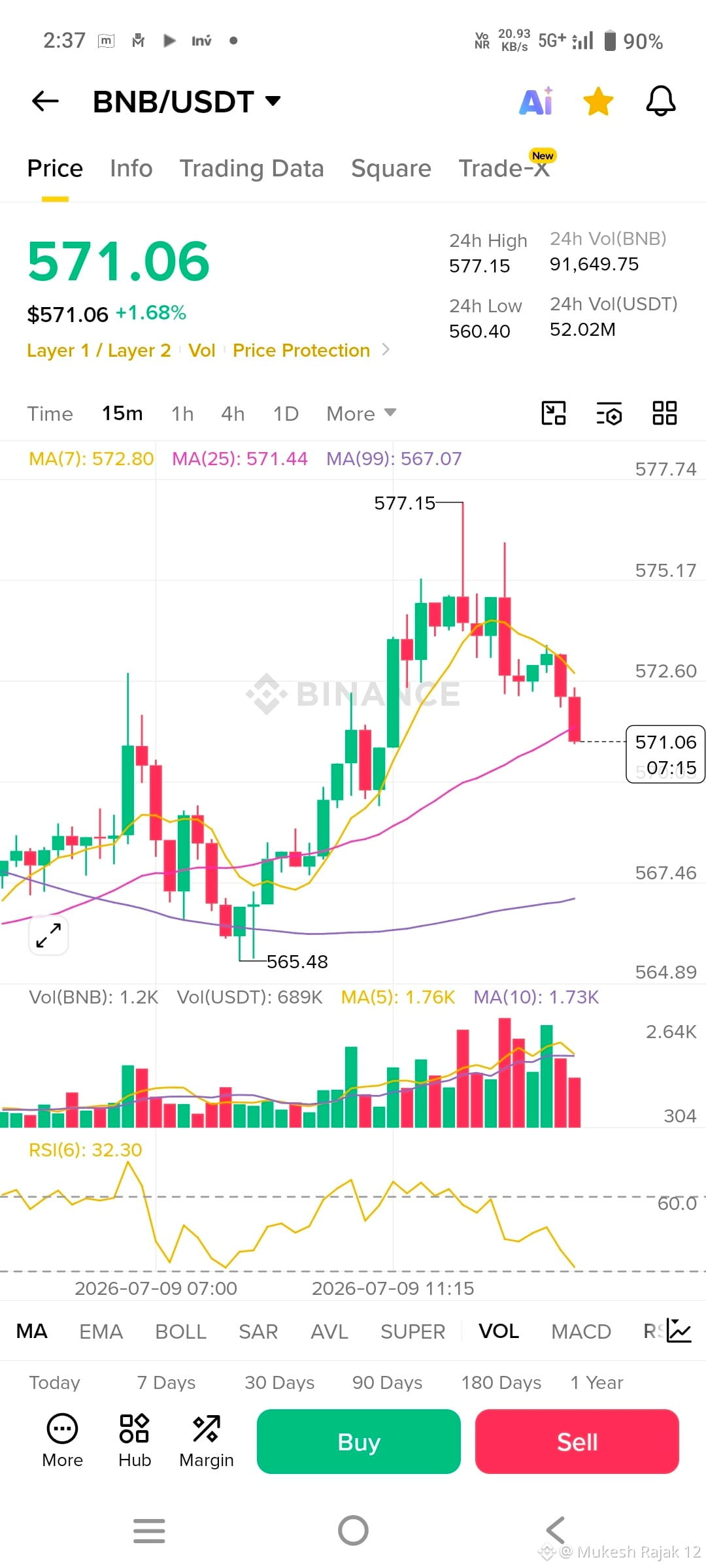
BNB Price Action Update! 🚨 BNB is showing strength! Price is trading at $573.30 per trade, which is above our previous support level ($571.50). 📈 📍 Levels to Watch: ✅ Support: $571.50 (This level has now become a base). 🚀 Target: $585 – $590 (Next immediate targets). The market is in a bullish trend, but keep an eye on the price action. Be ready for both a breakout or a pullback! 📊 ⚠️ Disclaimer: Trading involves risk. Please do your own research. #BNB #CryptoTrading #PriceAction #BullishTrend #MukeshTrader #CryptoUpdate $BNB #BNB_Market_Update
Current Price: ~$1.12–$1.13 Key Levels to Watch: Resistance (Target Levels): Immediate Resistance: $1.18 - $1.20. Crossing this level is very important for bullish momentum. Major Breakout Target: If XRP reaches the $1.28 - $1.30 zone, the possibility of a trend reversal will become quite strong. Support (Downside Risks): Immediate Support: $1.08 - $1.10. To bounce back, the price will need to hold here. Strong Support: $1.00 - $1.05 (Psychological support). If the price falls below this level, then the risk extends to $0.97 and $0.85.
Current Price: ~$583.92 Key Levels to Watch: Resistance (Target Levels): Immediate Resistance: $595 - $600. This is a psychological level; if price breaks above it, we may see a good surge in BNB. Next Big Target: If momentum stays intact, then levels of $620 and then $650 could be possible. Support (Downside Risks): Immediate Support: $560 - $565. BNB has been trying to hold above this level for quite some time. Strong Support: If the market sees a correction, then $540 will act as a strong support zone.
Current price: ~$81–$82 Key Levels to Watch: Resistance (Upper targets): Immediate Resistance: $83.78 (61.8% Fibonacci retracement). If the price closes above it, then the next targets could be $90.21 and then $96.19. Long-term: Some analysts like 'Ansem' expect it to reach up to $150 in the coming months. Support (Downside targets - How low can it go): Immediate Support: $79.27 (50% retracement). Strong Support: If the price falls below $77, then $76.41 (50-day EMA) is a strong cushion. Below that, support levels could form at $74.75 and then $69.16
Wall Street Analysts See 47% Upside in SpaceX After $135 IPO Price
Wall Street banks that marketed SpaceX shares at $135 apiece in the company’s record initial public offering are now telling clients the stock should be worth about $236 a share on average, implying roughly 47% upside, according to Bloomberg.
JPMorgan Sees AI Chip Dip as Buy; Morgan Stanley Says Trade Is Rotating
JPMorgan told clients the recent pullback in AI-linked semiconductor stocks is a buying opportunity, citing strong demand, tight supply and no meaningful new chip capacity until 2028. According to BeInCrypto, the bank prefers chipmakers over hyperscalers and expects global stocks to reach new highs in the second half of 2026.Morgan Stanley CIO Michael Wilson said momentum in chip stocks is fading after leading the rally, with earnings estimates at historic extremes, and pointed to slipping hyperscaler shares despite capex forecasts of $805 billion in 2026 and $1.116 trillion in 2027. Investors are watching Nvidia for signals on AI chip demand.
Oil Slips as OPEC+ Agrees to Raise August Output Targets by 188,000 bpd
According to CNBC, oil prices edged lower on Monday after OPEC+ agreed on Sunday to increase output targets by 188,000 barrels per day from August and as exports via the Strait of Hormuz recovered. Brent crude futures fell 24 cents, or 0.33%, to $71.88 a barrel by 0010 GMT, while U.S. West Texas Intermediate crude was down 11 cents, or 0.16%, at $68.58 a barrel; there was no WTI settlement on Friday because U.S. markets were closed ahead of the Independence Day holiday. IG market analyst Tony Sycamore said the OPEC+ increase was largely in line with expectations, while noting the United Arab Emirates quit OPEC as of May 1. CNBC also cited data showing OPEC oil output in June rose by 3.3 million barrels per day month-on-month to 19.43 million bpd, and Gulf oil exports in June rose more than 3 million barrels from May to exceed 10 million barrels per day, though still 40% below pre-war levels; it also reported that shipments from Russia's western ports hit a record high in June and are expected to maintain that level in July, according to industry sources.
China Galaxy Securities: Q3 Travel Demand May Recover as Oil Prices Ease
China Galaxy Securities said oil prices have been gradually falling, which could help China’s travel-related sectors recover in the third quarter, according to Jiemian News. The brokerage said a sharp rise in oil prices lifted travel costs and hurt the broader travel chain in the second quarter.
Based on high-frequency data, it said the impact of oil prices and weather was particularly evident from May to early June. In weeks 22–23 of 2026 (late May to early June), reduced airline capacity led to a double-digit decline in domestic civil aviation passenger trips. As oil prices eased from mid-June, the decline in passenger trips narrowed to a single-digit range in weeks 24–25 of 2026 (mid-to-late June).
The report added that in July, China’s domestic aviation fuel surcharge and gasoline prices are expected to fall further to levels seen before the U.S.-Israel-Iran conflict, and with an autumn holiday approaching, third-quarter passenger-trip growth is expected to turn positive, supporting a marginal earnings improvement across the travel chain.
China to Expand After-Hours Fixed-Price Trading to Most A-Shares From July 6
New trading rules for China’s A-share market will take effect on July 6, expanding after-hours fixed-price trading from STAR Market and ChiNext stocks to most A-shares and ETFs, according to Jiemian News. Beijing Stock Exchange-listed stocks will not be included in the change on July 6.
Separately, the daily price limit for risk-warning stocks on the Shanghai and Shenzhen main boards (ST and *ST shares) will be raised to 10% from 5%.
Goldman Sachs highlights O'Reilly, NetEase, Tradeweb and Liftoff Mobile as July buy ideas
According to CNBC, Goldman Sachs last week named several buy-rated stocks it said have more room to run in July, including O'Reilly, NetEase, Tradeweb and Liftoff Mobile. Goldman said O'Reilly remains undervalued despite recent pressure and cited data checks suggesting a more robust second quarter than peers; shares are down 1% in 2026. Analyst Lincoln Kong said NetEase is undervalued and expects further margin expansion, citing catalysts including a new game launch in July; the stock is down more than 7% this year. Goldman recently upgraded Tradeweb to buy from neutral, with analyst Alexander Blostein saying concerns about revenue-growth sustainability and long-term tokenization risks are overdone; Tradeweb shares are off more than 4% in 2026. Goldman also said Liftoff Mobile is well positioned for secular growth themes in digital advertising, citing its scaling Cortex AI platform and non-gaming exposure.
Yen Hits Four-Decade Low Against Dollar, Weakest Since 1986
According to Bloomberg, the yen slid to its weakest level against the dollar since 1986, breaching the 161.95 mark in New York trading overnight and extending its decline to 162.40 in Tokyo on Tuesday, despite jawboning from Chief Cabinet Secretary Minoru Kihara and subsequent comments from Finance Minister Satsuki Katayama that had little immediate impact. The breach of 161.95 passes the nadir touched in July 2024 during an earlier intervention campaign and puts traders on high alert for authorities wading into the market. The yen's slump has persisted despite regime change at the Bank of Japan, which ended its negative interest-rate policy in 2024 and lifted its benchmark rate to 1% on June 16 — the highest since 1995 — yet the impact was minimal as traders expect the Federal Reserve to stay hawkish. As long as the gap between Japan's ultra-low rates and those in the US and other major economies remains wide, investors have an incentive to borrow cheaply in yen and invest in higher-yielding assets overseas, with resulting capital outflows keeping downward pressure on the currency. The persistent softness comes despite a record ¥11.73 trillion ($72.4 billion) intervention by the government from April 28 to May 27 after the yen first slid past 160 per dollar, with Japan likely drawing on holdings of foreign securities including US Treasuries to finance the defense. Finance Minister Katayama reiterated on June 19 that authorities were ready to take "bold action" and said the US and Japan are increasingly "aligned" on foreign exchange policy after speaking with US Treasury Secretary Scott Bessent. The US-Iran war added fresh pressure given Japan imports almost all of its energy, with the vast majority of oil coming from the Middle East. An aging and shrinking population has clouded growth prospects and fueled public debt that weighs on substantial rate-hike expectations. Nomura's chief FX strategist Yujiro Goto said the focus will be whether authorities move ahead with actual intervention or stronger verbal warnings. Bloomberg Markets Live strategist Mark Cranfield said the 164-to-165 area is where FX traders will now focus. Toyota Motor Corp. estimates every ¥1 depreciation boosts operating profit by ¥50 billion, with the weak yen potentially delivering a $5.8 billion profit windfall for Japanese carmakers this year.
PRECIOUS METALS | Gold Holds Decline as US-Iran Tensions Cloud Inflation Outlook
Bloomberg reported that gold extended its decline below $4,000 an ounce, falling as much as 1.8% to $3,943 — the lowest intraday level since November — after giving up almost 2% in the previous session, as the US and Iran sent conflicting signals ahead of fresh talks to end the war. Washington said negotiations with Tehran are due to begin Tuesday in Doha, while Iran's foreign ministry said on Telegram it would send a delegation of experts but ruled out direct talks. Iranian Deputy Foreign Minister Kazem Gharibabadi said Tehran intended to continue overseeing traffic through the Strait of Hormuz, a move opposed by the US, Europe, and Gulf Arab nations. Gold has lost around 25% since the war began in late February, breaking through key technical levels including the 200-day moving average. Though oil prices have retreated, expectations remain that central banks will keep interest rates higher for longer, creating headwinds for non-yielding precious metals. A stronger dollar has added further pressure, with a gauge of the greenback rising more than 2% this month. "Although easing geopolitical tensions and lower oil prices could help cool inflation risks, the market is clearly placing more weight on renewed US rate-hike expectations and a stronger dollar into the second half — both of which raise the opportunity cost of holding gold," said Hebe Chen, an analyst at Vantage Markets in Melbourne. Separately, the US Supreme Court ruled that Federal Reserve Governor Lisa Cook can stay in her job while she fights President Trump's bid to oust her over unproven mortgage fraud allegations, reinforcing the autonomy of the central bank. Spot gold was down 1.3% at $3,962.80 an ounce at 10:40 a.m. UTC +8. Silver fell 1.7% to $57.28 an ounce, with platinum and palladium also declining. The Bloomberg Dollar Spot Index gained 0.2% after falling for the previous three sessions.