

MoonMan567
6.5k Posts

MoonMan567
Report
Block User
Navigating the Web3 cosmos | Cutting-edge crypto & finance insights | Professional analysis | Bold opinions | Trusted voice for smart investors
Open Trade
High-Frequency Trader
2.6 Years
55 Following
10.6K+ Followers
24.1K+ Liked
Posts
Portfolio
All
Quotes
Videos
Live
·
--
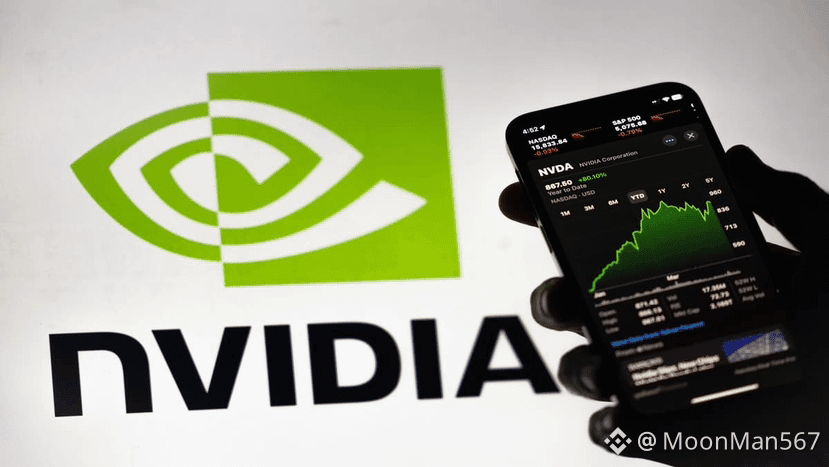
NVIDIA has set a new historical high again — about $237.87 per share.
From the IPO split-adjusted price of roughly $0.025, that’s already over a 900,000% gain.
Social media immediately came up with the favorite kind of math: “I invested $10,000 in $NVDA in 2008 — today it would be $16 million.”.
The figure is impressive. But there’s one problem: in 2008, $NVDA was down by about 76%. So the month in which you bought the shares changes the outcome dramatically.
And this, for me, is much more interesting than those $16 million themselves.
With hindsight, NVIDIA looks like an obvious bet. In real time, though, the investor went through a financial crisis, a drop of more than 50%, and then more years when the future AI boom was far from obvious.
I вообще don’t like stories like “what if you bought then.” They beautifully demonstrate the power of compound interest — and almost nothing about how hard it was to actually hold the position through all that time.
NVIDIA delivered an incredible result. But the hardest part of this story isn’t buying it. It’s knowing you’ll have to hold it for another 18 years.
By the way, thanks to tokenized bStocks (ticker $NVDAB ) from Binance, the entry threshold to the stock market is now minimal — just 5 USD.
If you want to dig into stories like this without the magic of hindsight, follow @MoonMan567
{spot}(NVDABUSDT)
{future}(NVDAUSDT)
NVIDIA has set a new historical high again — about $237.87 per share.
From the IPO split-adjusted price of roughly $0.025, that’s already over a 900,000% gain.
Social media immediately came up with the favorite kind of math: “I invested $10,000 in $NVDA in 2008 — today it would be $16 million.”.
The figure is impressive. But there’s one problem: in 2008, $NVDA was down by about 76%. So the month in which you bought the shares changes the outcome dramatically.
And this, for me, is much more interesting than those $16 million themselves.
With hindsight, NVIDIA looks like an obvious bet. In real time, though, the investor went through a financial crisis, a drop of more than 50%, and then more years when the future AI boom was far from obvious.
I вообще don’t like stories like “what if you bought then.” They beautifully demonstrate the power of compound interest — and almost nothing about how hard it was to actually hold the position through all that time.
NVIDIA delivered an incredible result. But the hardest part of this story isn’t buying it. It’s knowing you’ll have to hold it for another 18 years.
By the way, thanks to tokenized bStocks (ticker $NVDAB ) from Binance, the entry threshold to the stock market is now minimal — just 5 USD.
If you want to dig into stories like this without the magic of hindsight, follow @MoonMan567
From the IPO split-adjusted price of roughly $0.025, that’s already over a 900,000% gain.
Social media immediately came up with the favorite kind of math: “I invested $10,000 in $NVDA in 2008 — today it would be $16 million.”.
The figure is impressive. But there’s one problem: in 2008, $NVDA was down by about 76%. So the month in which you bought the shares changes the outcome dramatically.
And this, for me, is much more interesting than those $16 million themselves.
With hindsight, NVIDIA looks like an obvious bet. In real time, though, the investor went through a financial crisis, a drop of more than 50%, and then more years when the future AI boom was far from obvious.
I вообще don’t like stories like “what if you bought then.” They beautifully demonstrate the power of compound interest — and almost nothing about how hard it was to actually hold the position through all that time.
NVIDIA delivered an incredible result. But the hardest part of this story isn’t buying it. It’s knowing you’ll have to hold it for another 18 years.
By the way, thanks to tokenized bStocks (ticker $NVDAB ) from Binance, the entry threshold to the stock market is now minimal — just 5 USD.
If you want to dig into stories like this without the magic of hindsight, follow @MoonMan567
145
·
--
Verified
$PEPE готується to its own ETF. And that’s already more interesting than another meme coin pump.
On October 2, Canary Capital filed with the SEC an updated S-1/A application for a spot PEPE ETF with a potential listing on Cboe BZX.
Important: this is still an application, not an approved ETF.
But the very fact is telling. Bloomberg ETF analyst Eric Balchunas called the appearance of such an application a sign that the market is coming out of a period of weakness and issuers are starting to test demand for an ever-broader range of crypto products.
And the timing really is interesting: on October 2, the SEC also approved the listing of 3x ETFs on Bitcoin and Ethereum. In other words, the boundaries of which crypto products can end up on traditional exchanges are gradually expanding.
I personally think $PEPE is more interesting here not as an asset, but as a test. If even a meme coin gets a path to an ETF structure, the question is no longer “whether crypto will become part of TradFi,” but how far this integration is ready to go.
But first, the SEC still has to have its say.
If you want to break down how crypto is breaking into traditional financial products without the FOMO around every single application, follow @MoonMan567
{spot}(PEPEUSDT)
$PEPE готується to its own ETF. And that’s already more interesting than another meme coin pump.
On October 2, Canary Capital filed with the SEC an updated S-1/A application for a spot PEPE ETF with a potential listing on Cboe BZX.
Important: this is still an application, not an approved ETF.
But the very fact is telling. Bloomberg ETF analyst Eric Balchunas called the appearance of such an application a sign that the market is coming out of a period of weakness and issuers are starting to test demand for an ever-broader range of crypto products.
And the timing really is interesting: on October 2, the SEC also approved the listing of 3x ETFs on Bitcoin and Ethereum. In other words, the boundaries of which crypto products can end up on traditional exchanges are gradually expanding.
I personally think $PEPE is more interesting here not as an asset, but as a test. If even a meme coin gets a path to an ETF structure, the question is no longer “whether crypto will become part of TradFi,” but how far this integration is ready to go.
But first, the SEC still has to have its say.
If you want to break down how crypto is breaking into traditional financial products without the FOMO around every single application, follow @MoonMan567
On October 2, Canary Capital filed with the SEC an updated S-1/A application for a spot PEPE ETF with a potential listing on Cboe BZX.
Important: this is still an application, not an approved ETF.
But the very fact is telling. Bloomberg ETF analyst Eric Balchunas called the appearance of such an application a sign that the market is coming out of a period of weakness and issuers are starting to test demand for an ever-broader range of crypto products.
And the timing really is interesting: on October 2, the SEC also approved the listing of 3x ETFs on Bitcoin and Ethereum. In other words, the boundaries of which crypto products can end up on traditional exchanges are gradually expanding.
I personally think $PEPE is more interesting here not as an asset, but as a test. If even a meme coin gets a path to an ETF structure, the question is no longer “whether crypto will become part of TradFi,” but how far this integration is ready to go.
But first, the SEC still has to have its say.
If you want to break down how crypto is breaking into traditional financial products without the FOMO around every single application, follow @MoonMan567

552
·
--
Verified
Trump said that a “certain level of inflation” could very quickly help pay off the U.S. national debt.
The mechanism really does exist here. If the government borrowed $1000 at a fixed rate, and prices rose significantly in that time, those $1000 have less purchasing power. For the debtor, the real cost of the old debt goes down.
But there’s a big “but.”
Inflation doesn’t wipe out a $40 trillion debt. If investors expect higher inflation, they may demand higher yields on new Treasuries. And that increases the cost of servicing the debt.
That’s exactly what’s especially interesting right now: the U.S. 10-year yield has already risen to 5.34%—the highest level since 2002.
I personally find the phrase “inflation will solve the debt problem” dangerously neat. It describes one side of the equation and very conveniently forgets about the other.
And for Bitcoin, there’s an even more interesting storyline: not a guaranteed “overflow of funds into $BTC ,” but the question of trust in the fiat system and the independence of monetary policy.
If you want to dig into the mechanics of such macro stories rather than ready-made investment conclusions, subscribe to @MoonMan567
{future}(BTCUSDT)
Trump said that a “certain level of inflation” could very quickly help pay off the U.S. national debt.
The mechanism really does exist here. If the government borrowed $1000 at a fixed rate, and prices rose significantly in that time, those $1000 have less purchasing power. For the debtor, the real cost of the old debt goes down.
But there’s a big “but.”
Inflation doesn’t wipe out a $40 trillion debt. If investors expect higher inflation, they may demand higher yields on new Treasuries. And that increases the cost of servicing the debt.
That’s exactly what’s especially interesting right now: the U.S. 10-year yield has already risen to 5.34%—the highest level since 2002.
I personally find the phrase “inflation will solve the debt problem” dangerously neat. It describes one side of the equation and very conveniently forgets about the other.
And for Bitcoin, there’s an even more interesting storyline: not a guaranteed “overflow of funds into $BTC ,” but the question of trust in the fiat system and the independence of monetary policy.
If you want to dig into the mechanics of such macro stories rather than ready-made investment conclusions, subscribe to @MoonMan567
The mechanism really does exist here. If the government borrowed $1000 at a fixed rate, and prices rose significantly in that time, those $1000 have less purchasing power. For the debtor, the real cost of the old debt goes down.
But there’s a big “but.”
Inflation doesn’t wipe out a $40 trillion debt. If investors expect higher inflation, they may demand higher yields on new Treasuries. And that increases the cost of servicing the debt.
That’s exactly what’s especially interesting right now: the U.S. 10-year yield has already risen to 5.34%—the highest level since 2002.
I personally find the phrase “inflation will solve the debt problem” dangerously neat. It describes one side of the equation and very conveniently forgets about the other.
And for Bitcoin, there’s an even more interesting storyline: not a guaranteed “overflow of funds into $BTC ,” but the question of trust in the fiat system and the independence of monetary policy.
If you want to dig into the mechanics of such macro stories rather than ready-made investment conclusions, subscribe to @MoonMan567
1
2.6k
·
--
Verified
Blast is shutting down its Ethereum L2. And the reason here is far more interesting than yet another token crash.
The team stated directly: the costs of maintaining the network exceeded its revenue, and they no longer see a real path to economic sustainability.
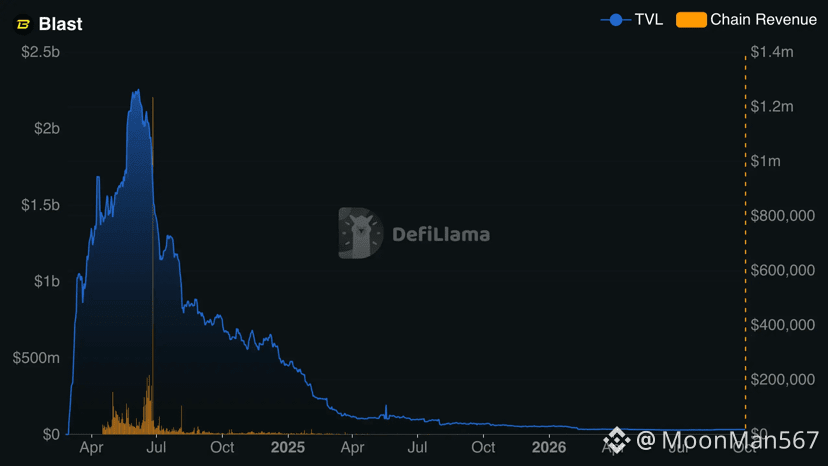
The numbers show the scale of the problem. At its peak, Blast held about $2.24 billion in TVL. Today, based on the latest data, it’s already around $32 million. And over the last 24 hours alone, the network itself generated only about $110 in revenue.
Users are advised to withdraw assets through the standard interface by October 26. After that, the funds will remain accessible, but to withdraw them you’ll have to interact directly with Ethereum bridge contracts.
On the news, BLAST dropped by roughly 17–19%.
But I wouldn’t draw the conclusion “L2s don’t work.” Blast shows something else: a billion-dollar TVL by itself doesn’t create a business model.
I’ve long trusted network revenue more than the TVL figure. Because capital can be attracted with incentives. Keeping it there without real economics is much harder.
And this is probably the main lesson Blast offers for the entire era of L2s and airdrops.
If you want to understand crypto-economics through real numbers—not through a beautiful TVL—subscribe to @MoonMan567
Blast is shutting down its Ethereum L2. And the reason here is far more interesting than yet another token crash.
The team stated directly: the costs of maintaining the network exceeded its revenue, and they no longer see a real path to economic sustainability.
The numbers show the scale of the problem. At its peak, Blast held about $2.24 billion in TVL. Today, based on the latest data, it’s already around $32 million. And over the last 24 hours alone, the network itself generated only about $110 in revenue.
Users are advised to withdraw assets through the standard interface by October 26. After that, the funds will remain accessible, but to withdraw them you’ll have to interact directly with Ethereum bridge contracts.
On the news, BLAST dropped by roughly 17–19%.
But I wouldn’t draw the conclusion “L2s don’t work.” Blast shows something else: a billion-dollar TVL by itself doesn’t create a business model.
I’ve long trusted network revenue more than the TVL figure. Because capital can be attracted with incentives. Keeping it there without real economics is much harder.
And this is probably the main lesson Blast offers for the entire era of L2s and airdrops.
If you want to understand crypto-economics through real numbers—not through a beautiful TVL—subscribe to @MoonMan567
The team stated directly: the costs of maintaining the network exceeded its revenue, and they no longer see a real path to economic sustainability.
The numbers show the scale of the problem. At its peak, Blast held about $2.24 billion in TVL. Today, based on the latest data, it’s already around $32 million. And over the last 24 hours alone, the network itself generated only about $110 in revenue.
Users are advised to withdraw assets through the standard interface by October 26. After that, the funds will remain accessible, but to withdraw them you’ll have to interact directly with Ethereum bridge contracts.
On the news, BLAST dropped by roughly 17–19%.
But I wouldn’t draw the conclusion “L2s don’t work.” Blast shows something else: a billion-dollar TVL by itself doesn’t create a business model.
I’ve long trusted network revenue more than the TVL figure. Because capital can be attracted with incentives. Keeping it there without real economics is much harder.
And this is probably the main lesson Blast offers for the entire era of L2s and airdrops.
If you want to understand crypto-economics through real numbers—not through a beautiful TVL—subscribe to @MoonMan567
1
184
·
--
BNB Chain crossed $1 billion in tokenized stocks and ETFs. And this is no longer just a nice number.
According to fresh research, BNB Chain accounts for about one-third of the tokenized stocks market— the sector’s global capitalization is already measured in billions of dollars. BNB Chain also leads in the number of addresses holding such assets.
But here’s the more interesting part: $BNB isn’t the only one.
Base is actively expanding its own segment of tokenized stocks. Coinbase has launched on-chain shares of NVIDIA, Apple, Meta, and other companies on Base—stocks you can trade 24/7 and use in DeFi.
So RWA are gradually moving from “let’s tokenize a stock” to real competition between infrastructures.
I personally think this matters even more than the $1 billion itself: now the question isn’t whether tokenized stocks are needed. The question is which network will become the real financial infrastructure for them.
And this is where an exciting race begins. If you want to follow it without the advertising noise, subscribe to @MoonMan567
{future}(BNBUSDT)
BNB Chain crossed $1 billion in tokenized stocks and ETFs. And this is no longer just a nice number.
According to fresh research, BNB Chain accounts for about one-third of the tokenized stocks market— the sector’s global capitalization is already measured in billions of dollars. BNB Chain also leads in the number of addresses holding such assets.
But here’s the more interesting part: $BNB isn’t the only one.
Base is actively expanding its own segment of tokenized stocks. Coinbase has launched on-chain shares of NVIDIA, Apple, Meta, and other companies on Base—stocks you can trade 24/7 and use in DeFi.
So RWA are gradually moving from “let’s tokenize a stock” to real competition between infrastructures.
I personally think this matters even more than the $1 billion itself: now the question isn’t whether tokenized stocks are needed. The question is which network will become the real financial infrastructure for them.
And this is where an exciting race begins. If you want to follow it without the advertising noise, subscribe to @MoonMan567
According to fresh research, BNB Chain accounts for about one-third of the tokenized stocks market— the sector’s global capitalization is already measured in billions of dollars. BNB Chain also leads in the number of addresses holding such assets.
But here’s the more interesting part: $BNB isn’t the only one.
Base is actively expanding its own segment of tokenized stocks. Coinbase has launched on-chain shares of NVIDIA, Apple, Meta, and other companies on Base—stocks you can trade 24/7 and use in DeFi.
So RWA are gradually moving from “let’s tokenize a stock” to real competition between infrastructures.
I personally think this matters even more than the $1 billion itself: now the question isn’t whether tokenized stocks are needed. The question is which network will become the real financial infrastructure for them.
And this is where an exciting race begins. If you want to follow it without the advertising noise, subscribe to @MoonMan567

3
865
·
--
Verified
The US labor market gave the Fed another argument to not rush to raise the rate.
In September, the United States created only 29 thousand jobs versus approximately 90 thousand expected. Unemployment rose to 4.2%, and hourly wages added only 0.1% over the month and 3% over the year.
And there’s an even more interesting detail: the August NFP was revised down from 162 thousand to 133 thousand, and the July figure—from +21 thousand to -10 thousand. Together, the previous two months lost 60 thousand jobs in the revisions.
The market reacted quickly: expectations of an October Fed rate hike fell below 20%, and Bitcoin rose to the $86–87k area.
But I wouldn’t call this simply “weak data = $BTC вгору.”
A weak labor market can be good for risk assets if it reduces pressure on the Fed. But if the weakness becomes too deep, the market will start pricing not the rate, but the recession.
I generally love macro like this for this uncomfortable math: the same number can be bullish for Bitcoin and bearish for the economy.
If you want to dig into these exact intersections of macro and crypto, follow @MoonMan567
{future}(BTCUSDT)
The US labor market gave the Fed another argument to not rush to raise the rate.
In September, the United States created only 29 thousand jobs versus approximately 90 thousand expected. Unemployment rose to 4.2%, and hourly wages added only 0.1% over the month and 3% over the year.
And there’s an even more interesting detail: the August NFP was revised down from 162 thousand to 133 thousand, and the July figure—from +21 thousand to -10 thousand. Together, the previous two months lost 60 thousand jobs in the revisions.
The market reacted quickly: expectations of an October Fed rate hike fell below 20%, and Bitcoin rose to the $86–87k area.
But I wouldn’t call this simply “weak data = $BTC вгору.”
A weak labor market can be good for risk assets if it reduces pressure on the Fed. But if the weakness becomes too deep, the market will start pricing not the rate, but the recession.
I generally love macro like this for this uncomfortable math: the same number can be bullish for Bitcoin and bearish for the economy.
If you want to dig into these exact intersections of macro and crypto, follow @MoonMan567
In September, the United States created only 29 thousand jobs versus approximately 90 thousand expected. Unemployment rose to 4.2%, and hourly wages added only 0.1% over the month and 3% over the year.
And there’s an even more interesting detail: the August NFP was revised down from 162 thousand to 133 thousand, and the July figure—from +21 thousand to -10 thousand. Together, the previous two months lost 60 thousand jobs in the revisions.
The market reacted quickly: expectations of an October Fed rate hike fell below 20%, and Bitcoin rose to the $86–87k area.
But I wouldn’t call this simply “weak data = $BTC вгору.”
A weak labor market can be good for risk assets if it reduces pressure on the Fed. But if the weakness becomes too deep, the market will start pricing not the rate, but the recession.
I generally love macro like this for this uncomfortable math: the same number can be bullish for Bitcoin and bearish for the economy.
If you want to dig into these exact intersections of macro and crypto, follow @MoonMan567
1
111
·
--
Verified
Sometimes the main crypto news comes not from exchanges, but from banks.
Fiserv — one of the largest global providers of payment infrastructure — has launched a digital platform for banking settlements. The first real use case was Roughrider Coin — a stablecoin of the Bank of North Dakota for interbank payments.
Transactions run through Solana.
The system involves more than 90 banks and credit unions in the state, and the product is already operating in a real environment.
For me, this is interesting not because of the price $SOL .
Previously, blockchain was often a separate world with its own exchanges, DeFi, and memes. Here we’re seeing a different model: traditional banks use a public blockchain as payment infrastructure without changing the familiar interface for customers.
Maybe this is what real adoption looks like: when the user doesn’t even know that Solana is running in the background somewhere.
Crypto has long been arguing about who’s faster. Banks are starting to test it in practice.
If you want to explore where blockchain is becoming infrastructure rather than just a market, subscribe to @MoonMan567
{future}(SOLUSDT)
Sometimes the main crypto news comes not from exchanges, but from banks.
Fiserv — one of the largest global providers of payment infrastructure — has launched a digital platform for banking settlements. The first real use case was Roughrider Coin — a stablecoin of the Bank of North Dakota for interbank payments.
Transactions run through Solana.
The system involves more than 90 banks and credit unions in the state, and the product is already operating in a real environment.
For me, this is interesting not because of the price $SOL .
Previously, blockchain was often a separate world with its own exchanges, DeFi, and memes. Here we’re seeing a different model: traditional banks use a public blockchain as payment infrastructure without changing the familiar interface for customers.
Maybe this is what real adoption looks like: when the user doesn’t even know that Solana is running in the background somewhere.
Crypto has long been arguing about who’s faster. Banks are starting to test it in practice.
If you want to explore where blockchain is becoming infrastructure rather than just a market, subscribe to @MoonMan567
Fiserv — one of the largest global providers of payment infrastructure — has launched a digital platform for banking settlements. The first real use case was Roughrider Coin — a stablecoin of the Bank of North Dakota for interbank payments.
Transactions run through Solana.
The system involves more than 90 banks and credit unions in the state, and the product is already operating in a real environment.
For me, this is interesting not because of the price $SOL .
Previously, blockchain was often a separate world with its own exchanges, DeFi, and memes. Here we’re seeing a different model: traditional banks use a public blockchain as payment infrastructure without changing the familiar interface for customers.
Maybe this is what real adoption looks like: when the user doesn’t even know that Solana is running in the background somewhere.
Crypto has long been arguing about who’s faster. Banks are starting to test it in practice.
If you want to explore where blockchain is becoming infrastructure rather than just a market, subscribe to @MoonMan567

1
879
·
--
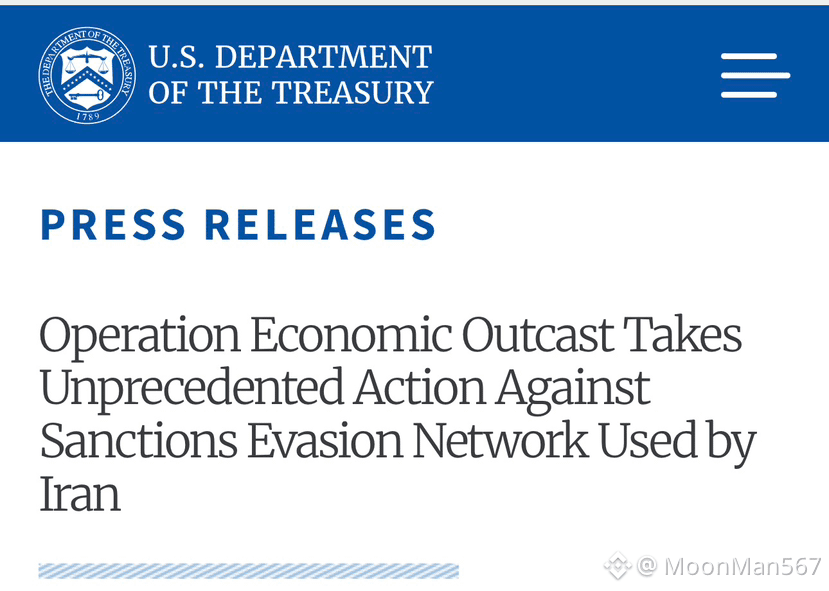
The US struck a shadow financial network that also made room for crypto.
On October 1, the Treasury, through FinCEN, proposed limiting transfers through the A7 Network sub-agents, and OFAC added the network itself to the list of significant transnational criminal organizations.
According to FinCEN, the A7 sub-agents processed over $17 billion from January 2025 to June 2026.
But what’s more interesting for the crypto market is something else.
Treasury directly links A7 with a ruble token which, according to the US agency, Russia used to bypass sanctions. The network is also linked to Nobitex—the largest digital exchange in Iran—and transactions involving North Korean crypto hackers.
And here’s my main takeaway.
In schemes like these, crypto isn’t just “anonymous money.” Tokens become part of an entire financial infrastructure where exchanges, banks, front companies, and payment intermediaries coexist.
I really like cases like this: they show the real role of blockchain much better than a hundred presentations about the future of finance.
If you want to break down crypto where marketing ends and real financial mechanics begin, subscribe to @MoonMan567
The US struck a shadow financial network that also made room for crypto.
On October 1, the Treasury, through FinCEN, proposed limiting transfers through the A7 Network sub-agents, and OFAC added the network itself to the list of significant transnational criminal organizations.
According to FinCEN, the A7 sub-agents processed over $17 billion from January 2025 to June 2026.
But what’s more interesting for the crypto market is something else.
Treasury directly links A7 with a ruble token which, according to the US agency, Russia used to bypass sanctions. The network is also linked to Nobitex—the largest digital exchange in Iran—and transactions involving North Korean crypto hackers.
And here’s my main takeaway.
In schemes like these, crypto isn’t just “anonymous money.” Tokens become part of an entire financial infrastructure where exchanges, banks, front companies, and payment intermediaries coexist.
I really like cases like this: they show the real role of blockchain much better than a hundred presentations about the future of finance.
If you want to break down crypto where marketing ends and real financial mechanics begin, subscribe to @MoonMan567
On October 1, the Treasury, through FinCEN, proposed limiting transfers through the A7 Network sub-agents, and OFAC added the network itself to the list of significant transnational criminal organizations.
According to FinCEN, the A7 sub-agents processed over $17 billion from January 2025 to June 2026.
But what’s more interesting for the crypto market is something else.
Treasury directly links A7 with a ruble token which, according to the US agency, Russia used to bypass sanctions. The network is also linked to Nobitex—the largest digital exchange in Iran—and transactions involving North Korean crypto hackers.
And here’s my main takeaway.
In schemes like these, crypto isn’t just “anonymous money.” Tokens become part of an entire financial infrastructure where exchanges, banks, front companies, and payment intermediaries coexist.
I really like cases like this: they show the real role of blockchain much better than a hundred presentations about the future of finance.
If you want to break down crypto where marketing ends and real financial mechanics begin, subscribe to @MoonMan567
1
177
·
--
The SEC proposed new rules for storing crypto-assets for investment advisers and regulated funds.
The idea is quite practical: advisers and funds are being allowed to store certain crypto-assets in state trust companies, and, under specific conditions, to use so-called self-custody.
But there’s an important legal detail here. In the SEC’s proposal, “self-custody” does not mean when an investor hides a seed phrase in a safe. It refers to a situation where the adviser themselves holds the client’s assets under established conditions.
For me, something else is more important: the regulator is trying to eliminate one of the practical problems of institutional crypto—where exactly to legally and technically store digital assets.
The SEC opened a 60-day period for public comments after publishing the proposal in the Federal Register.
This is not a new rule yet. But if it’s finalized, the choice of custody models for regulated participants will become broader.
I generally love regulatory news like this more than loud declarations: infrastructure changes quietly, and the consequences can be much more interesting.
If you want to follow how crypto gradually makes its way into traditional finance, subscribe to @MoonMan567
The SEC proposed new rules for storing crypto-assets for investment advisers and regulated funds.
The idea is quite practical: advisers and funds are being allowed to store certain crypto-assets in state trust companies, and, under specific conditions, to use so-called self-custody.
But there’s an important legal detail here. In the SEC’s proposal, “self-custody” does not mean when an investor hides a seed phrase in a safe. It refers to a situation where the adviser themselves holds the client’s assets under established conditions.
For me, something else is more important: the regulator is trying to eliminate one of the practical problems of institutional crypto—where exactly to legally and technically store digital assets.
The SEC opened a 60-day period for public comments after publishing the proposal in the Federal Register.
This is not a new rule yet. But if it’s finalized, the choice of custody models for regulated participants will become broader.
I generally love regulatory news like this more than loud declarations: infrastructure changes quietly, and the consequences can be much more interesting.
If you want to follow how crypto gradually makes its way into traditional finance, subscribe to @MoonMan567
The idea is quite practical: advisers and funds are being allowed to store certain crypto-assets in state trust companies, and, under specific conditions, to use so-called self-custody.
But there’s an important legal detail here. In the SEC’s proposal, “self-custody” does not mean when an investor hides a seed phrase in a safe. It refers to a situation where the adviser themselves holds the client’s assets under established conditions.
For me, something else is more important: the regulator is trying to eliminate one of the practical problems of institutional crypto—where exactly to legally and technically store digital assets.
The SEC opened a 60-day period for public comments after publishing the proposal in the Federal Register.
This is not a new rule yet. But if it’s finalized, the choice of custody models for regulated participants will become broader.
I generally love regulatory news like this more than loud declarations: infrastructure changes quietly, and the consequences can be much more interesting.
If you want to follow how crypto gradually makes its way into traditional finance, subscribe to @MoonMan567

530
·
--
Verified
30D trade $BTC 17.2K USDT
A curious split has begun at the Fed.
The Fed vice chair Philip Jefferson said there’s no need to rush the next rate change—new data is required. Michelle Bowman also does not see an urgent need for a further step.
Then Lorie Logan from the Dallas Fed took the floor.
Her assessment is much more hawkish: after the September rate hike by another 25 bps, she believes it is necessary to further tighten policy by at least another 50 bps in order to bring inflation back to 2%.
The market heard both sides. The probability of a rate hike in October fell from about 69% to 26%.
Bitcoin, meanwhile, is holding in the $83–84K range.
But I wouldn’t write, “The Fed changed its mind—$BTC is growing.” The Fed hasn’t decided anything definitively. One camp wants more data, while the other sees the need for further tightening.
And here’s the key for me: the market is no longer trading the Fed’s decision, but the disagreement within the Fed itself.
Tomorrow’s main test will be fresh labor market data. If you want to dig into macro without fortune-telling based on a single vote, follow @MoonMan567
{future}(BTCUSDT)
A curious split has begun at the Fed.
The Fed vice chair Philip Jefferson said there’s no need to rush the next rate change—new data is required. Michelle Bowman also does not see an urgent need for a further step.
Then Lorie Logan from the Dallas Fed took the floor.
Her assessment is much more hawkish: after the September rate hike by another 25 bps, she believes it is necessary to further tighten policy by at least another 50 bps in order to bring inflation back to 2%.
The market heard both sides. The probability of a rate hike in October fell from about 69% to 26%.
Bitcoin, meanwhile, is holding in the $83–84K range.
But I wouldn’t write, “The Fed changed its mind—$BTC is growing.” The Fed hasn’t decided anything definitively. One camp wants more data, while the other sees the need for further tightening.
And here’s the key for me: the market is no longer trading the Fed’s decision, but the disagreement within the Fed itself.
Tomorrow’s main test will be fresh labor market data. If you want to dig into macro without fortune-telling based on a single vote, follow @MoonMan567
The Fed vice chair Philip Jefferson said there’s no need to rush the next rate change—new data is required. Michelle Bowman also does not see an urgent need for a further step.
Then Lorie Logan from the Dallas Fed took the floor.
Her assessment is much more hawkish: after the September rate hike by another 25 bps, she believes it is necessary to further tighten policy by at least another 50 bps in order to bring inflation back to 2%.
The market heard both sides. The probability of a rate hike in October fell from about 69% to 26%.
Bitcoin, meanwhile, is holding in the $83–84K range.
But I wouldn’t write, “The Fed changed its mind—$BTC is growing.” The Fed hasn’t decided anything definitively. One camp wants more data, while the other sees the need for further tightening.
And here’s the key for me: the market is no longer trading the Fed’s decision, but the disagreement within the Fed itself.
Tomorrow’s main test will be fresh labor market data. If you want to dig into macro without fortune-telling based on a single vote, follow @MoonMan567

4
1.8k
·
--
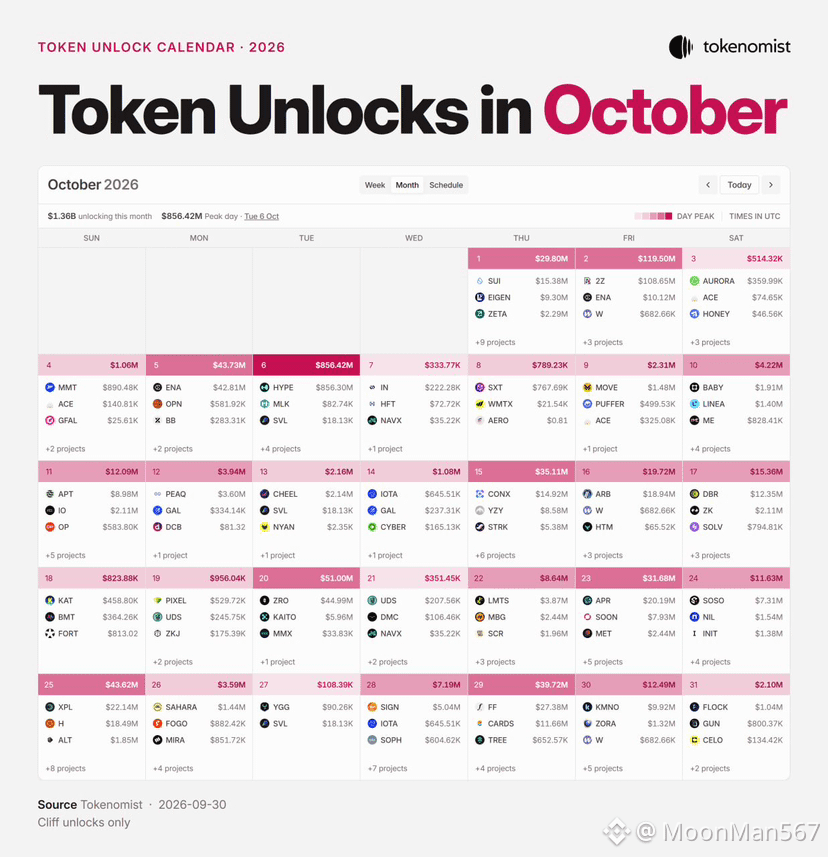
In October, the crypto market will face yet another liquidity stress test: tokens worth approximately $1.3 billion are set to move from locked distributions into available circulation.
Among the biggest events are the unlocks of $SUI , $APT , and $TIA . For example, on October 1, SUI will unlock 64.19 million tokens—about $108 million based on the valuation price at the time.
But there’s a typical crypto trap here.
An unlock does not automatically mean a sell-off. The recipient may sell the tokens, keep them, stake them, or move them into DeFi. Even the actual number of tokens that ends up on the market may differ from the nominal amount of the unlock.
So I wouldn’t call the October unlocks a ready-made bearish signal.
What interests me more is this: can the market absorb the new supply without noticeable pressure on the price?
Because an unlock tells you how many tokens could become available. But the blockchain and exchanges will already show how many of them people actually wanted to sell.
If you want to analyze tokenomics through real flows—not through a calendar of fear—subscribe to @MoonMan567
In October, the crypto market will face yet another liquidity stress test: tokens worth approximately $1.3 billion are set to move from locked distributions into available circulation.
Among the biggest events are the unlocks of $SUI , $APT , and $TIA . For example, on October 1, SUI will unlock 64.19 million tokens—about $108 million based on the valuation price at the time.
But there’s a typical crypto trap here.
An unlock does not automatically mean a sell-off. The recipient may sell the tokens, keep them, stake them, or move them into DeFi. Even the actual number of tokens that ends up on the market may differ from the nominal amount of the unlock.
So I wouldn’t call the October unlocks a ready-made bearish signal.
What interests me more is this: can the market absorb the new supply without noticeable pressure on the price?
Because an unlock tells you how many tokens could become available. But the blockchain and exchanges will already show how many of them people actually wanted to sell.
If you want to analyze tokenomics through real flows—not through a calendar of fear—subscribe to @MoonMan567
Among the biggest events are the unlocks of $SUI , $APT , and $TIA . For example, on October 1, SUI will unlock 64.19 million tokens—about $108 million based on the valuation price at the time.
But there’s a typical crypto trap here.
An unlock does not automatically mean a sell-off. The recipient may sell the tokens, keep them, stake them, or move them into DeFi. Even the actual number of tokens that ends up on the market may differ from the nominal amount of the unlock.
So I wouldn’t call the October unlocks a ready-made bearish signal.
What interests me more is this: can the market absorb the new supply without noticeable pressure on the price?
Because an unlock tells you how many tokens could become available. But the blockchain and exchanges will already show how many of them people actually wanted to sell.
If you want to analyze tokenomics through real flows—not through a calendar of fear—subscribe to @MoonMan567
1
1
3
2.9k
·
--
In the US, the same inflation figure that the whole market expected has come out.
Core PCE rose 3.0% y/y in August versus the expected 3.3%. Monthly growth was 0.2%. Headline PCE came in at 3.4%.
There’s an important nuance: part of the improvement is due to a methodological revision of historical data by the BEA. In other words, it’s not simply that “inflation suddenly cooled off.”
But the market for rates reacted. Goldman Sachs pushed the expected next Fed hike from October to December, and it already allows that an additional hike may not be needed at all.
Crypto also didn’t stay on the sidelines: $BTC broke through $85K, $ETH returned above $2.7K, and in a day about $255 million worth of positions were liquidated.
But I wouldn’t write “PCE lifted Bitcoin.” Between the inflation number and the BTC candle there are still rates, Treasuries, positioning, and the usual short squeeze.
I generally like days like this for one reason: a single economic release can change not the price itself, but first of all expectations. And those expectations move the market.
If you want to break down macro without magical cause-and-effect relationships, follow @MoonMan567
{future}(BTCUSDT)
{future}(ETHUSDT)
In the US, the same inflation figure that the whole market expected has come out.
Core PCE rose 3.0% y/y in August versus the expected 3.3%. Monthly growth was 0.2%. Headline PCE came in at 3.4%.
There’s an important nuance: part of the improvement is due to a methodological revision of historical data by the BEA. In other words, it’s not simply that “inflation suddenly cooled off.”
But the market for rates reacted. Goldman Sachs pushed the expected next Fed hike from October to December, and it already allows that an additional hike may not be needed at all.
Crypto also didn’t stay on the sidelines: $BTC broke through $85K, $ETH returned above $2.7K, and in a day about $255 million worth of positions were liquidated.
But I wouldn’t write “PCE lifted Bitcoin.” Between the inflation number and the BTC candle there are still rates, Treasuries, positioning, and the usual short squeeze.
I generally like days like this for one reason: a single economic release can change not the price itself, but first of all expectations. And those expectations move the market.
If you want to break down macro without magical cause-and-effect relationships, follow @MoonMan567
Core PCE rose 3.0% y/y in August versus the expected 3.3%. Monthly growth was 0.2%. Headline PCE came in at 3.4%.
There’s an important nuance: part of the improvement is due to a methodological revision of historical data by the BEA. In other words, it’s not simply that “inflation suddenly cooled off.”
But the market for rates reacted. Goldman Sachs pushed the expected next Fed hike from October to December, and it already allows that an additional hike may not be needed at all.
Crypto also didn’t stay on the sidelines: $BTC broke through $85K, $ETH returned above $2.7K, and in a day about $255 million worth of positions were liquidated.
But I wouldn’t write “PCE lifted Bitcoin.” Between the inflation number and the BTC candle there are still rates, Treasuries, positioning, and the usual short squeeze.
I generally like days like this for one reason: a single economic release can change not the price itself, but first of all expectations. And those expectations move the market.
If you want to break down macro without magical cause-and-effect relationships, follow @MoonMan567

235
·
--
$MOVR suddenly came alive at the migration finish in Base.
On September 30, the token was up by nearly 80% in a day, and at certain moments it even exceeded $1.48. Binance reported about +52% over 24 hours.
The catalyst is obvious by timing: it was exactly September 30 that the application submission period for the migration of $MOVR to Base ended. The transfer itself occurs on a 1:1 basis.
But there’s a more interesting detail. According to Nansen, the balances of the top-100 addresses for $MOVR grew by more than 11% amid the pump.
Does that mean whales were buying the token? Not necessarily. On-chain balance shows the movement of assets, but it doesn’t read the owner’s intent.
There’s also another risk: those who didn’t manage to complete the migration may lose access to their MOVR under the old scheme. This creates uncertainty around liquidity after the transition is completed.
And this is where I’d look not at the nice +80%, but at what will remain after the migration noise.
Because the pump shows the strength of the moment. Liquidity after the pump shows the real state of the market.
If you want to analyze these kinds of moves without FOMO and shamanism, subscribe to @MoonMan567
{future}(MOVRUSDT)
$MOVR suddenly came alive at the migration finish in Base.
On September 30, the token was up by nearly 80% in a day, and at certain moments it even exceeded $1.48. Binance reported about +52% over 24 hours.
The catalyst is obvious by timing: it was exactly September 30 that the application submission period for the migration of $MOVR to Base ended. The transfer itself occurs on a 1:1 basis.
But there’s a more interesting detail. According to Nansen, the balances of the top-100 addresses for $MOVR grew by more than 11% amid the pump.
Does that mean whales were buying the token? Not necessarily. On-chain balance shows the movement of assets, but it doesn’t read the owner’s intent.
There’s also another risk: those who didn’t manage to complete the migration may lose access to their MOVR under the old scheme. This creates uncertainty around liquidity after the transition is completed.
And this is where I’d look not at the nice +80%, but at what will remain after the migration noise.
Because the pump shows the strength of the moment. Liquidity after the pump shows the real state of the market.
If you want to analyze these kinds of moves without FOMO and shamanism, subscribe to @MoonMan567
On September 30, the token was up by nearly 80% in a day, and at certain moments it even exceeded $1.48. Binance reported about +52% over 24 hours.
The catalyst is obvious by timing: it was exactly September 30 that the application submission period for the migration of $MOVR to Base ended. The transfer itself occurs on a 1:1 basis.
But there’s a more interesting detail. According to Nansen, the balances of the top-100 addresses for $MOVR grew by more than 11% amid the pump.
Does that mean whales were buying the token? Not necessarily. On-chain balance shows the movement of assets, but it doesn’t read the owner’s intent.
There’s also another risk: those who didn’t manage to complete the migration may lose access to their MOVR under the old scheme. This creates uncertainty around liquidity after the transition is completed.
And this is where I’d look not at the nice +80%, but at what will remain after the migration noise.
Because the pump shows the strength of the moment. Liquidity after the pump shows the real state of the market.
If you want to analyze these kinds of moves without FOMO and shamanism, subscribe to @MoonMan567

175
·
--
Tom Li announced: the crypto market is already in a bull market.
And here’s a small detail-sized at 6 million $ETH .
On September 28, his BitMine reported that it has accumulated 6,001,302 $ETH —approximately 4.9% of the entire Ethereum supply. Li himself says the bull market began back in late June.
But the $7.5 billion figure for unrealized losses, which some Telegram channels are actively dragging along under this headline, is outdated. It referred to an estimate from February–March, when BitMine held about 4.3–4.5 million $ETH .
So today, it’s more honest to say this: the company holds more than 6 million ETH, and its current paper result needs to be calculated again.
And here’s what interests me most.
When someone says “the bull market has started,” and at the same time their company owns nearly 5% of ETH, this is no longer just a comment from the podium. They have a very specific financial exposure.
I generally love checking bullish claims not with emotions, but by where the money is.
If you want to analyze the crypto market exactly that way, subscribe to @MoonMan567
{future}(ETHUSDT)
Tom Li announced: the crypto market is already in a bull market.
And here’s a small detail-sized at 6 million $ETH .
On September 28, his BitMine reported that it has accumulated 6,001,302 $ETH —approximately 4.9% of the entire Ethereum supply. Li himself says the bull market began back in late June.
But the $7.5 billion figure for unrealized losses, which some Telegram channels are actively dragging along under this headline, is outdated. It referred to an estimate from February–March, when BitMine held about 4.3–4.5 million $ETH .
So today, it’s more honest to say this: the company holds more than 6 million ETH, and its current paper result needs to be calculated again.
And here’s what interests me most.
When someone says “the bull market has started,” and at the same time their company owns nearly 5% of ETH, this is no longer just a comment from the podium. They have a very specific financial exposure.
I generally love checking bullish claims not with emotions, but by where the money is.
If you want to analyze the crypto market exactly that way, subscribe to @MoonMan567
And here’s a small detail-sized at 6 million $ETH .
On September 28, his BitMine reported that it has accumulated 6,001,302 $ETH —approximately 4.9% of the entire Ethereum supply. Li himself says the bull market began back in late June.
But the $7.5 billion figure for unrealized losses, which some Telegram channels are actively dragging along under this headline, is outdated. It referred to an estimate from February–March, when BitMine held about 4.3–4.5 million $ETH .
So today, it’s more honest to say this: the company holds more than 6 million ETH, and its current paper result needs to be calculated again.
And here’s what interests me most.
When someone says “the bull market has started,” and at the same time their company owns nearly 5% of ETH, this is no longer just a comment from the podium. They have a very specific financial exposure.
I generally love checking bullish claims not with emotions, but by where the money is.
If you want to analyze the crypto market exactly that way, subscribe to @MoonMan567

1
2
1.3k
·
--
USDT is back at the center of an American debate about sanctions.
Democratic staffers on the Senate subcommittee on investigations analyzed 846 crypto wallets linked to Iran and its proxy networks. In 84% of them, transactions were carried out exclusively or almost exclusively at $USDT .
Senator Richard Blumenthal urged the Treasury and the DOJ to investigate whether Tether sufficiently complies with sanctions and AML requirements. Important: these are still the findings of Senate staff and a subject for further investigation—not a confirmed violation by Tether.
Tether responded with its own figures: the company says that in 2026 it helped freeze nearly $550 million in assets associated with Iran’s sanctions networks.
And this is where it gets most interesting.
The same infrastructure can be a tool to evade sanctions—and at the same time a tool that allows law enforcement to quickly freeze funds.
I generally believe this is one of the main paradoxes of stablecoins: blockchain transparency creates risk for the criminal, but a centralized issuer creates a separate regulatory risk.
If you want to unpack these kinds of conflicts without political noise, subscribe to @MoonMan567
USDT is back at the center of an American debate about sanctions.
Democratic staffers on the Senate subcommittee on investigations analyzed 846 crypto wallets linked to Iran and its proxy networks. In 84% of them, transactions were carried out exclusively or almost exclusively at $USDT .
Senator Richard Blumenthal urged the Treasury and the DOJ to investigate whether Tether sufficiently complies with sanctions and AML requirements. Important: these are still the findings of Senate staff and a subject for further investigation—not a confirmed violation by Tether.
Tether responded with its own figures: the company says that in 2026 it helped freeze nearly $550 million in assets associated with Iran’s sanctions networks.
And this is where it gets most interesting.
The same infrastructure can be a tool to evade sanctions—and at the same time a tool that allows law enforcement to quickly freeze funds.
I generally believe this is one of the main paradoxes of stablecoins: blockchain transparency creates risk for the criminal, but a centralized issuer creates a separate regulatory risk.
If you want to unpack these kinds of conflicts without political noise, subscribe to @MoonMan567
Democratic staffers on the Senate subcommittee on investigations analyzed 846 crypto wallets linked to Iran and its proxy networks. In 84% of them, transactions were carried out exclusively or almost exclusively at $USDT .
Senator Richard Blumenthal urged the Treasury and the DOJ to investigate whether Tether sufficiently complies with sanctions and AML requirements. Important: these are still the findings of Senate staff and a subject for further investigation—not a confirmed violation by Tether.
Tether responded with its own figures: the company says that in 2026 it helped freeze nearly $550 million in assets associated with Iran’s sanctions networks.
And this is where it gets most interesting.
The same infrastructure can be a tool to evade sanctions—and at the same time a tool that allows law enforcement to quickly freeze funds.
I generally believe this is one of the main paradoxes of stablecoins: blockchain transparency creates risk for the criminal, but a centralized issuer creates a separate regulatory risk.
If you want to unpack these kinds of conflicts without political noise, subscribe to @MoonMan567
3
526
·
--
October is knocking on the door again, and the crypto market is already taking out from the cupboard its favorite word — Uptober.
And the statistics really are interesting.
From 2016 to 2025, Bitcoin closed October in the green 8 times out of 10. The average return over these ten Octobers is about 17.9%.
The best year was 2017: almost +49%. But there were also some far from “uptober” scenarios: in 2018, $BTC lost 4.6%, and in 2025 — about 4%.
So, seasonality in October really does exist. But the words “seasonality” and “guarantee” — thankfully — are not synonyms.
I’m generally cautious about calendar patterns in crypto. They’re interesting as context, but they don’t explain what the Fed will do, liquidity, ETF flows, or what the market itself will do in a given year.
That’s why I’d look at Uptober not as a forecast, but as a historical pattern that this year still has to pass its own test.
If you want to break down such patterns without turning statistics into fortune-telling, follow @MoonMan567
October is knocking on the door again, and the crypto market is already taking out from the cupboard its favorite word — Uptober.
And the statistics really are interesting.
From 2016 to 2025, Bitcoin closed October in the green 8 times out of 10. The average return over these ten Octobers is about 17.9%.
The best year was 2017: almost +49%. But there were also some far from “uptober” scenarios: in 2018, $BTC lost 4.6%, and in 2025 — about 4%.
So, seasonality in October really does exist. But the words “seasonality” and “guarantee” — thankfully — are not synonyms.
I’m generally cautious about calendar patterns in crypto. They’re interesting as context, but they don’t explain what the Fed will do, liquidity, ETF flows, or what the market itself will do in a given year.
That’s why I’d look at Uptober not as a forecast, but as a historical pattern that this year still has to pass its own test.
If you want to break down such patterns without turning statistics into fortune-telling, follow @MoonMan567
And the statistics really are interesting.
From 2016 to 2025, Bitcoin closed October in the green 8 times out of 10. The average return over these ten Octobers is about 17.9%.
The best year was 2017: almost +49%. But there were also some far from “uptober” scenarios: in 2018, $BTC lost 4.6%, and in 2025 — about 4%.
So, seasonality in October really does exist. But the words “seasonality” and “guarantee” — thankfully — are not synonyms.
I’m generally cautious about calendar patterns in crypto. They’re interesting as context, but they don’t explain what the Fed will do, liquidity, ETF flows, or what the market itself will do in a given year.
That’s why I’d look at Uptober not as a forecast, but as a historical pattern that this year still has to pass its own test.
If you want to break down such patterns without turning statistics into fortune-telling, follow @MoonMan567

1.6k
·
--
Bitcoin received several major demand channels at once.
U.S. spot BTC ETFs attracted $2.4 billion in a week up to September 25—this is the biggest weekly inflow since October 2025.
At the same time, Strategy bought 1,665 $BTC for $142.7 million, and Strive—another 1,107 $BTC for approximately $94.5 million. Together, just these two companies took 2,772 $BTC off the market.
On paper, it looks powerful. But there’s a catch.
During the ETF week, daily inflows were steadily shrinking: from $999 million on Monday to $134.5 million on Friday. And after moving above $87K, Bitcoin returned to the $83K area.
So demand is there. But for now it’s not enough to simply draw on the chart an “institutional pump.”
I generally love moments like this: when the numbers say “they’re buying,” and the price responds with “and what?”
The macro backdrop remains harsh—Treasury yields are high, and expectations for further Fed rate hikes haven’t gone away.
So right now it’s more interesting to watch not the fact of big purchases themselves, but whether this demand can absorb the counter-supply.
If you want to analyze Bitcoin through real flows, not loud talk about “institutional FOMO,” follow @MoonMan567
{future}(BTCUSDT)
Bitcoin received several major demand channels at once.
U.S. spot BTC ETFs attracted $2.4 billion in a week up to September 25—this is the biggest weekly inflow since October 2025.
At the same time, Strategy bought 1,665 $BTC for $142.7 million, and Strive—another 1,107 $BTC for approximately $94.5 million. Together, just these two companies took 2,772 $BTC off the market.
On paper, it looks powerful. But there’s a catch.
During the ETF week, daily inflows were steadily shrinking: from $999 million on Monday to $134.5 million on Friday. And after moving above $87K, Bitcoin returned to the $83K area.
So demand is there. But for now it’s not enough to simply draw on the chart an “institutional pump.”
I generally love moments like this: when the numbers say “they’re buying,” and the price responds with “and what?”
The macro backdrop remains harsh—Treasury yields are high, and expectations for further Fed rate hikes haven’t gone away.
So right now it’s more interesting to watch not the fact of big purchases themselves, but whether this demand can absorb the counter-supply.
If you want to analyze Bitcoin through real flows, not loud talk about “institutional FOMO,” follow @MoonMan567
U.S. spot BTC ETFs attracted $2.4 billion in a week up to September 25—this is the biggest weekly inflow since October 2025.
At the same time, Strategy bought 1,665 $BTC for $142.7 million, and Strive—another 1,107 $BTC for approximately $94.5 million. Together, just these two companies took 2,772 $BTC off the market.
On paper, it looks powerful. But there’s a catch.
During the ETF week, daily inflows were steadily shrinking: from $999 million on Monday to $134.5 million on Friday. And after moving above $87K, Bitcoin returned to the $83K area.
So demand is there. But for now it’s not enough to simply draw on the chart an “institutional pump.”
I generally love moments like this: when the numbers say “they’re buying,” and the price responds with “and what?”
The macro backdrop remains harsh—Treasury yields are high, and expectations for further Fed rate hikes haven’t gone away.
So right now it’s more interesting to watch not the fact of big purchases themselves, but whether this demand can absorb the counter-supply.
If you want to analyze Bitcoin through real flows, not loud talk about “institutional FOMO,” follow @MoonMan567
3
1.6k
·
--
Binance continues to expand TradFi - but there’s an important detail.
On September 28, Binance added five more papers to its Stock Trading: Boost Run (BRUN), Greenland Mines (GRML), Octave Intelligence (OCTV), StablecoinX (USDE), and Wise Group (WSE).
But I wouldn’t automatically call them “tokenized stocks.” In Binance’s official announcement, they are specifically referred to as stocks. Tokenized bStocks are a separate product where the security is represented by an on-chain token and backed by an underlying share 1:1.
And this distinction matters.
Because at the same time, Binance really is expanding bStocks—adding tokenized assets as collateral and developing other tools at the intersection of crypto and TradFi.
In general, I think it’s more interesting right now not to track the number of new tickers, but to see how Binance is gradually stitching together two infrastructures—traditional stock trading and on-chain financial products.
This is no longer just “a crypto exchange added stocks.” But calling every stock on Binance tokenized is also the wrong path.
If you want to figure out where TradFi truly moves on-chain—and where it’s just a nice-sounding phrase—subscribe to @MoonMan567
Binance continues to expand TradFi - but there’s an important detail.
On September 28, Binance added five more papers to its Stock Trading: Boost Run (BRUN), Greenland Mines (GRML), Octave Intelligence (OCTV), StablecoinX (USDE), and Wise Group (WSE).
But I wouldn’t automatically call them “tokenized stocks.” In Binance’s official announcement, they are specifically referred to as stocks. Tokenized bStocks are a separate product where the security is represented by an on-chain token and backed by an underlying share 1:1.
And this distinction matters.
Because at the same time, Binance really is expanding bStocks—adding tokenized assets as collateral and developing other tools at the intersection of crypto and TradFi.
In general, I think it’s more interesting right now not to track the number of new tickers, but to see how Binance is gradually stitching together two infrastructures—traditional stock trading and on-chain financial products.
This is no longer just “a crypto exchange added stocks.” But calling every stock on Binance tokenized is also the wrong path.
If you want to figure out where TradFi truly moves on-chain—and where it’s just a nice-sounding phrase—subscribe to @MoonMan567
On September 28, Binance added five more papers to its Stock Trading: Boost Run (BRUN), Greenland Mines (GRML), Octave Intelligence (OCTV), StablecoinX (USDE), and Wise Group (WSE).
But I wouldn’t automatically call them “tokenized stocks.” In Binance’s official announcement, they are specifically referred to as stocks. Tokenized bStocks are a separate product where the security is represented by an on-chain token and backed by an underlying share 1:1.
And this distinction matters.
Because at the same time, Binance really is expanding bStocks—adding tokenized assets as collateral and developing other tools at the intersection of crypto and TradFi.
In general, I think it’s more interesting right now not to track the number of new tickers, but to see how Binance is gradually stitching together two infrastructures—traditional stock trading and on-chain financial products.
This is no longer just “a crypto exchange added stocks.” But calling every stock on Binance tokenized is also the wrong path.
If you want to figure out where TradFi truly moves on-chain—and where it’s just a nice-sounding phrase—subscribe to @MoonMan567
468
·
--
California was the first in the US to introduce special restrictions on memecoins associated with government officials.
On September 27, Governor Gavin Newsom signed AB 2409. The law prohibits California public officers and certain public employees from issuing memecoins.
And starting January 1, 2027, digital asset providers will be prohibited from listing for California residents new memecoins issued by federal, state, or local officials, or created in partnership with them.
And here’s an interesting detail: $TRUMP does not automatically fall under this ban. The token was issued long before the date set by law.
Newsom directly linked the new law to criticism of political memecoins, including $TRUMP . But legally, AB 2409 does not ban “all political tokens.” It creates a specific restriction for future issuances and platforms.
What I’m interested in here is the mechanics. California isn’t trying to ban memecoin as a technology. It draws the line where a government position intersects with a financial asset.
This is already a much more interesting regulatory experiment than another case of “crypto has been banned.”
If you want to break down rules like these without the political noise, subscribe to @MoonMan567
{future}(TRUMPUSDT)
California was the first in the US to introduce special restrictions on memecoins associated with government officials.
On September 27, Governor Gavin Newsom signed AB 2409. The law prohibits California public officers and certain public employees from issuing memecoins.
And starting January 1, 2027, digital asset providers will be prohibited from listing for California residents new memecoins issued by federal, state, or local officials, or created in partnership with them.
And here’s an interesting detail: $TRUMP does not automatically fall under this ban. The token was issued long before the date set by law.
Newsom directly linked the new law to criticism of political memecoins, including $TRUMP . But legally, AB 2409 does not ban “all political tokens.” It creates a specific restriction for future issuances and platforms.
What I’m interested in here is the mechanics. California isn’t trying to ban memecoin as a technology. It draws the line where a government position intersects with a financial asset.
This is already a much more interesting regulatory experiment than another case of “crypto has been banned.”
If you want to break down rules like these without the political noise, subscribe to @MoonMan567
On September 27, Governor Gavin Newsom signed AB 2409. The law prohibits California public officers and certain public employees from issuing memecoins.
And starting January 1, 2027, digital asset providers will be prohibited from listing for California residents new memecoins issued by federal, state, or local officials, or created in partnership with them.
And here’s an interesting detail: $TRUMP does not automatically fall under this ban. The token was issued long before the date set by law.
Newsom directly linked the new law to criticism of political memecoins, including $TRUMP . But legally, AB 2409 does not ban “all political tokens.” It creates a specific restriction for future issuances and platforms.
What I’m interested in here is the mechanics. California isn’t trying to ban memecoin as a technology. It draws the line where a government position intersects with a financial asset.
This is already a much more interesting regulatory experiment than another case of “crypto has been banned.”
If you want to break down rules like these without the political noise, subscribe to @MoonMan567

1
1
1.6k
·
--
The Fed hasn’t raised rates yet, but the market has already started preparing for it.
CME FedWatch is currently pricing the probability of a 25 bps rate hike in October at approximately 66.4%.
At the same time, 10-year Treasuries rose to 5.23%—the highest level since 2007. And MOVE, the bond volatility index, jumped by about 30% over the week.
For risk assets, this is an important backdrop: more expensive money and higher volatility in government bonds mean tighter financial conditions.
But there’s an interesting nuance here. Bitcoin still isn’t showing the same level of panic: its expected volatility remains close to its annual lows.
So I wouldn’t write, “Yields have risen—$BTC will fall right now.” The market is showing a different picture so far: macro conditions are becoming stricter, but crypto hasn’t yet synced with this stress.
This divergence is exactly what I’m interested in. Because the real signal won’t appear when MOVE just rises, but when risk assets begin to respond to it in a systematic way.
If you want to break down macro without magical cause-and-effect links, follow @MoonMan567
The Fed hasn’t raised rates yet, but the market has already started preparing for it.
CME FedWatch is currently pricing the probability of a 25 bps rate hike in October at approximately 66.4%.
At the same time, 10-year Treasuries rose to 5.23%—the highest level since 2007. And MOVE, the bond volatility index, jumped by about 30% over the week.
For risk assets, this is an important backdrop: more expensive money and higher volatility in government bonds mean tighter financial conditions.
But there’s an interesting nuance here. Bitcoin still isn’t showing the same level of panic: its expected volatility remains close to its annual lows.
So I wouldn’t write, “Yields have risen—$BTC will fall right now.” The market is showing a different picture so far: macro conditions are becoming stricter, but crypto hasn’t yet synced with this stress.
This divergence is exactly what I’m interested in. Because the real signal won’t appear when MOVE just rises, but when risk assets begin to respond to it in a systematic way.
If you want to break down macro without magical cause-and-effect links, follow @MoonMan567
CME FedWatch is currently pricing the probability of a 25 bps rate hike in October at approximately 66.4%.
At the same time, 10-year Treasuries rose to 5.23%—the highest level since 2007. And MOVE, the bond volatility index, jumped by about 30% over the week.
For risk assets, this is an important backdrop: more expensive money and higher volatility in government bonds mean tighter financial conditions.
But there’s an interesting nuance here. Bitcoin still isn’t showing the same level of panic: its expected volatility remains close to its annual lows.
So I wouldn’t write, “Yields have risen—$BTC will fall right now.” The market is showing a different picture so far: macro conditions are becoming stricter, but crypto hasn’t yet synced with this stress.
This divergence is exactly what I’m interested in. Because the real signal won’t appear when MOVE just rises, but when risk assets begin to respond to it in a systematic way.
If you want to break down macro without magical cause-and-effect links, follow @MoonMan567
5
2.7k
Log in to explore more content
Join global crypto users on Binance Square
⚡️ Get latest and useful information about crypto.
💬 Trusted by the world’s largest crypto exchange.
👍 Discover real insights from verified creators.
Email / Phone number
Trending Topics
SECHaltsCryptoETFReviewsAmidFundingLapse
1,205 views
77 Discussing
#SECHaltsCryptoETFReviewsAmidFundingLapse
SEC Halts Crypto ETF Reviews Amid Funding Lapse
The U.S. Securities and Exchange Commission (SEC) has reportedly paused certain cryptocurrency ETF review activities amid a government funding lapse.
This development has created uncertainty in the crypto market, particularly for investors and companies waiting for regulatory decisions on crypto-related exchange-traded funds (ETFs).
Impact on the Crypto Market
The delay could affect the approval timeline of pending crypto ETF applications. Investors are closely monitoring the situation as regulatory clarity remains an important factor in the growth of the digital asset industry.
Although the pause does not necessarily mean that crypto ETF applications will be rejected, it highlights how government funding disruptions can influence financial regulatory processes.
What Happens Next?
Market participants will be watching for updates on government funding and the SEC's ability to resume normal operations.
Crypto ETFs remain an important topic for institutional adoption, market development, and investor confidence.
Conclusion: The temporary halt highlights the importance of regulatory stability for the future of cryptocurrency investments.
#Crypto #Bitcoin #ETF #SEC #CryptoNews #Blockchain #Binance
King2112
·0 Likes
·31 views
ZcashETFPostsFirstWeeklyOutflow$93.6M
54,582 views
165 Discussing
GreekPoliceBustCryptoScamRingArrest17
157,710 views
1,100 Discussing