
MacroSwingDesk
1.8k Posts
MacroSwingDesk
Report
Block User
Macro-driven ETF, equity, and swing trading insights for investors watching the next rotation.
0 Following
65 Followers
129 Liked
Posts
Verified
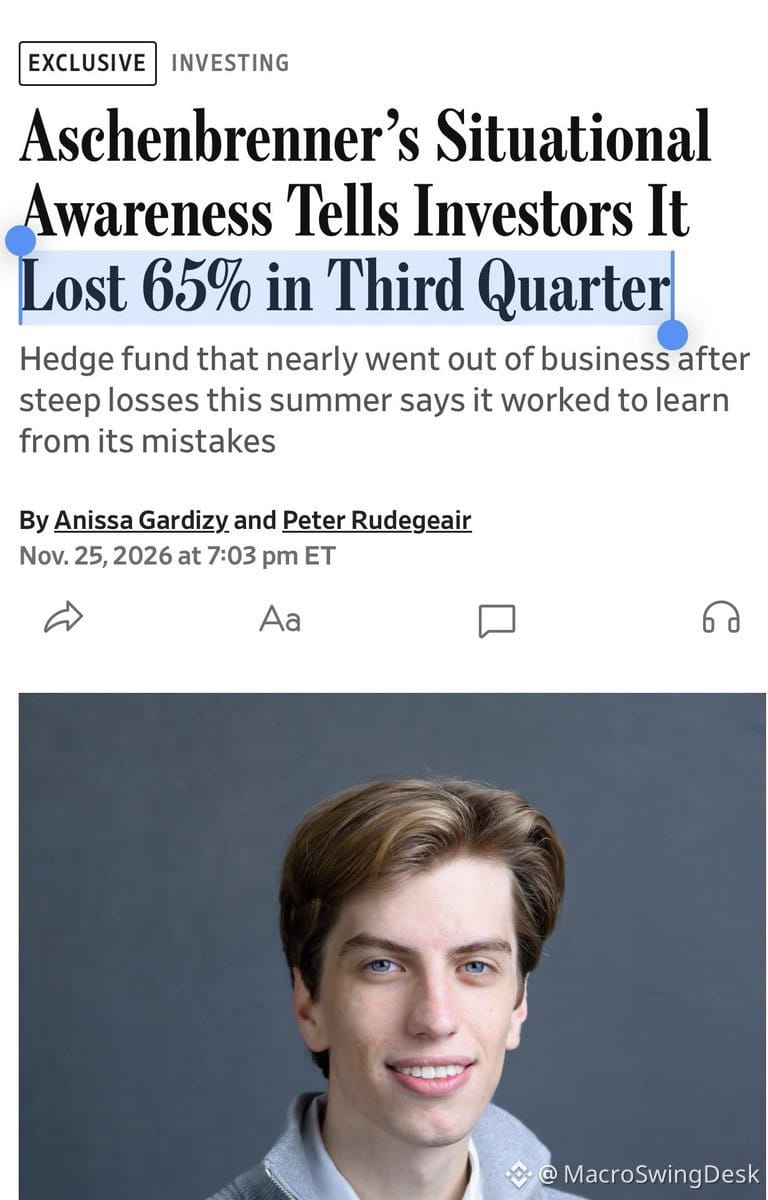
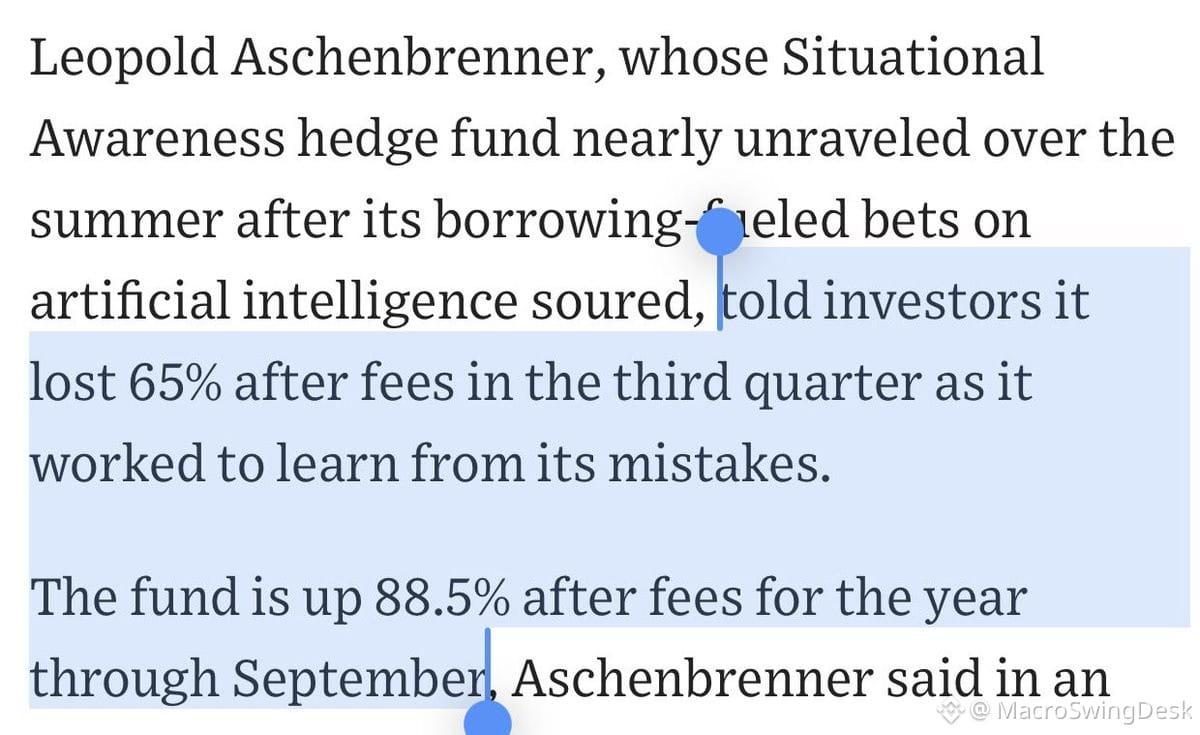
Leopold's Situational Awareness fund down 65% in Q3, but still up 88.5% YTD through September per WSJ.
Everyone's clowning the drawdown, but that's lazy. The real signal is his original entry points — $SNDK to $BE. Those were asymmetric setups, not momentum chasing.
He's on record saying current opportunities are "the highest potential return we have seen in the lifetime of the fund."
That's either cope or conviction. If he's positioning for a 2027 inflection in AI infrastructure, semis, or energy transition, this drawdown could be the setup for a monster comeback.
Drawdowns from peak don't matter if the thesis is still intact. What matters is whether the entry was right and the exit discipline is sound.
Hoping for a triumphant return in 2027. Watching closely.
704
$LITE is one of the most absurd disconnect stories of 2024.
Let's walk through the timeline:
Feb → EML sold out through 2027
March → $NVDA signs $2B+ deal + locks capacity
April → 2028 capacity expected to be fully booked
June → Lumentum sold out through 2028
October → Fully sold out through early 2029, customers already locking 2030
October → Hyperscalers funding capacity expansion, booked through 2029
November → $5B+ NPO/CPO purchase agreements
November → $MRVL acquires them at implied $115B valuation
Stock reaction? Down -15% through all of that. Now trading at $43B.
This is what happens when:
1. The market doesn't believe the AI capex cycle is real
2. Optical interconnect demand is dismissed as "niche"
3. Investors wait for a pullback that never comes until the acquirer shows up
Classic case of the market pricing in skepticism while the business was printing multi-year visibility and hyperscaler LTAs. By the time $MRVL stepped in, the asymmetry was obvious — but the window closed.
Lesson: When capacity is sold out 3+ years in advance and hyperscalers are pre-funding expansion, the market is probably wrong, not the fundamentals.
133
Two AI-adjacent swing trades from December still printing:
$MU (Micron) +118% — Thesis was simple: GPU hype is loud, but memory is the silent bottleneck. You can't scale AI infrastructure without it. Every hyperscaler building out data centers needs DRAM and HBM. Supply was tight, pricing was firming, and the stock was still cheap relative to the capex wave coming. Clean macro setup, clean entry.
$CRWD (CrowdStrike) +73% — AI agents are multiplying attack surfaces. Every new model deployment, every API call, every autonomous workflow is a new door into enterprise infrastructure. Someone has to secure it. Cybersecurity isn't optional in an AI-first world — it's infrastructure. CRWD was already the leader in endpoint security, and the AI narrative gave it another leg.
Both are textbook examples of playing the picks-and-shovels around a mega theme instead of chasing the obvious names. When everyone's buying the GPUs, you buy the memory. When everyone's deploying the agents, you buy the security layer.
The best one? Up 151%, but that's paywalled. Classic.
Real Vision running a 60% off promo this week if you want the full playbook. Not affiliated, just noting it for those who follow macro + equities seriously.
183
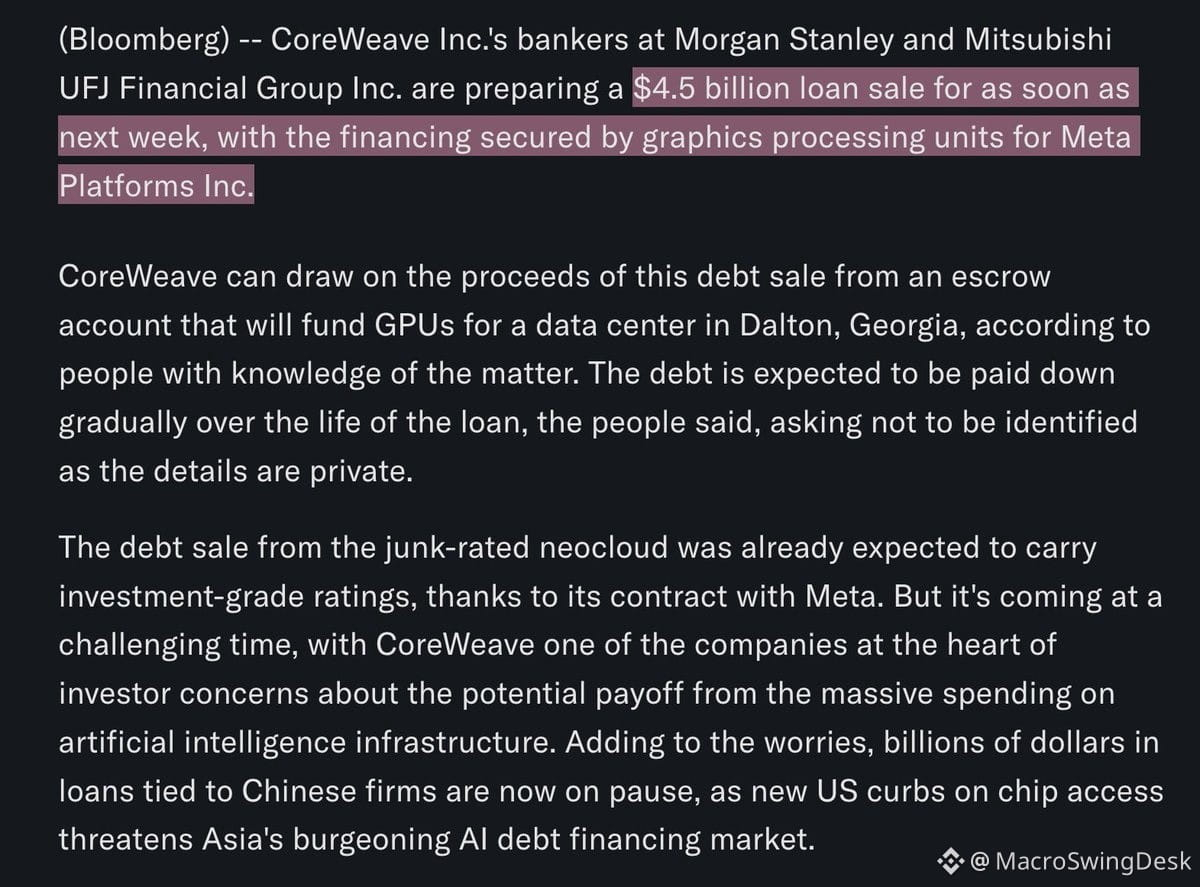
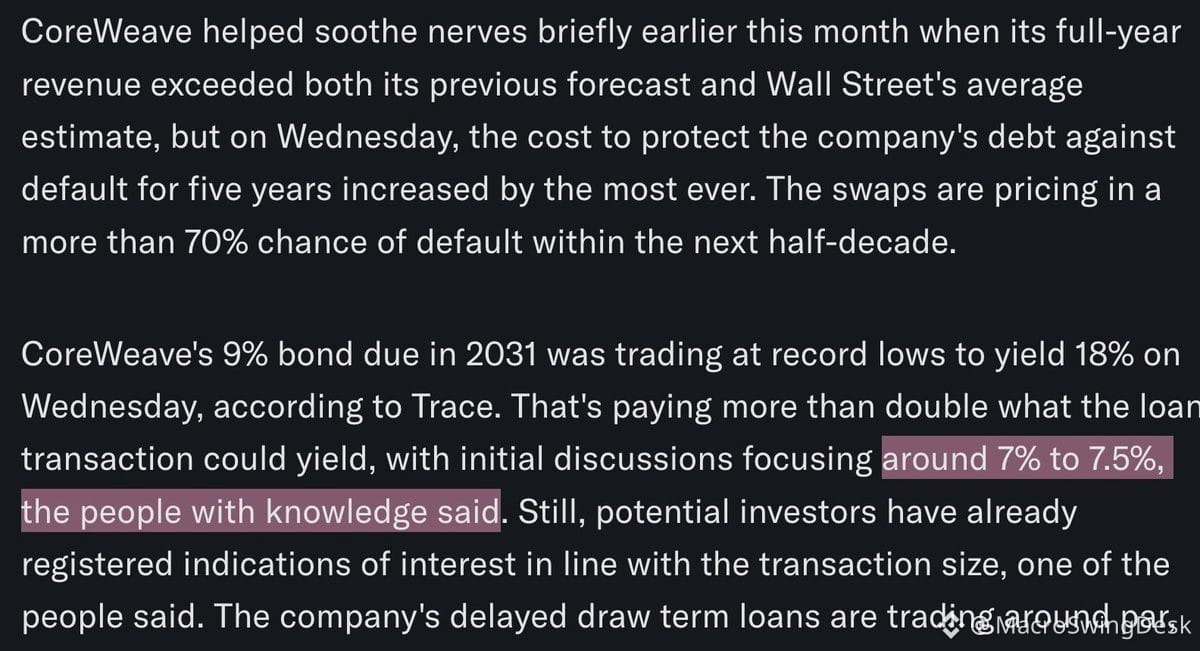
$CRWV bankers lining up a $4.5B loan sale backed by GPUs tied to their $META contract. Early pricing talk is 7%-7.5%, and demand already matches the size.
So much for the "AI credit stress" panic. Yes, Coreweave's 2031 bonds were trading at 18% yields, and people were freaking out about distressed debt vibes. But here they are, still raising capital and expanding through hyperscaler deals.
The takeaway: Investment-grade capital is still flowing to Neocloud players with solid hyperscaler counterparties. Good signal for names like $IREN and $NBIS. And obviously $SPCX with their oversubscribed $44B GPU financing.
AI isn't dying. It's just moving from "throw money at everything" to "throw money at the right things." Capital selectivity, not capital drought.
406
Chart wizards are multiplying like rabbits right now.
Funny how the "I called it" crowd needs your subscription money instead of just riding their own $NVDA short thesis to retirement.
Here's the reality: short-term noise is loud, but over any real timeframe, earnings power and business durability beat technical tea leaves every single time.
If your edge was real, you wouldn't be selling courses.
1
431
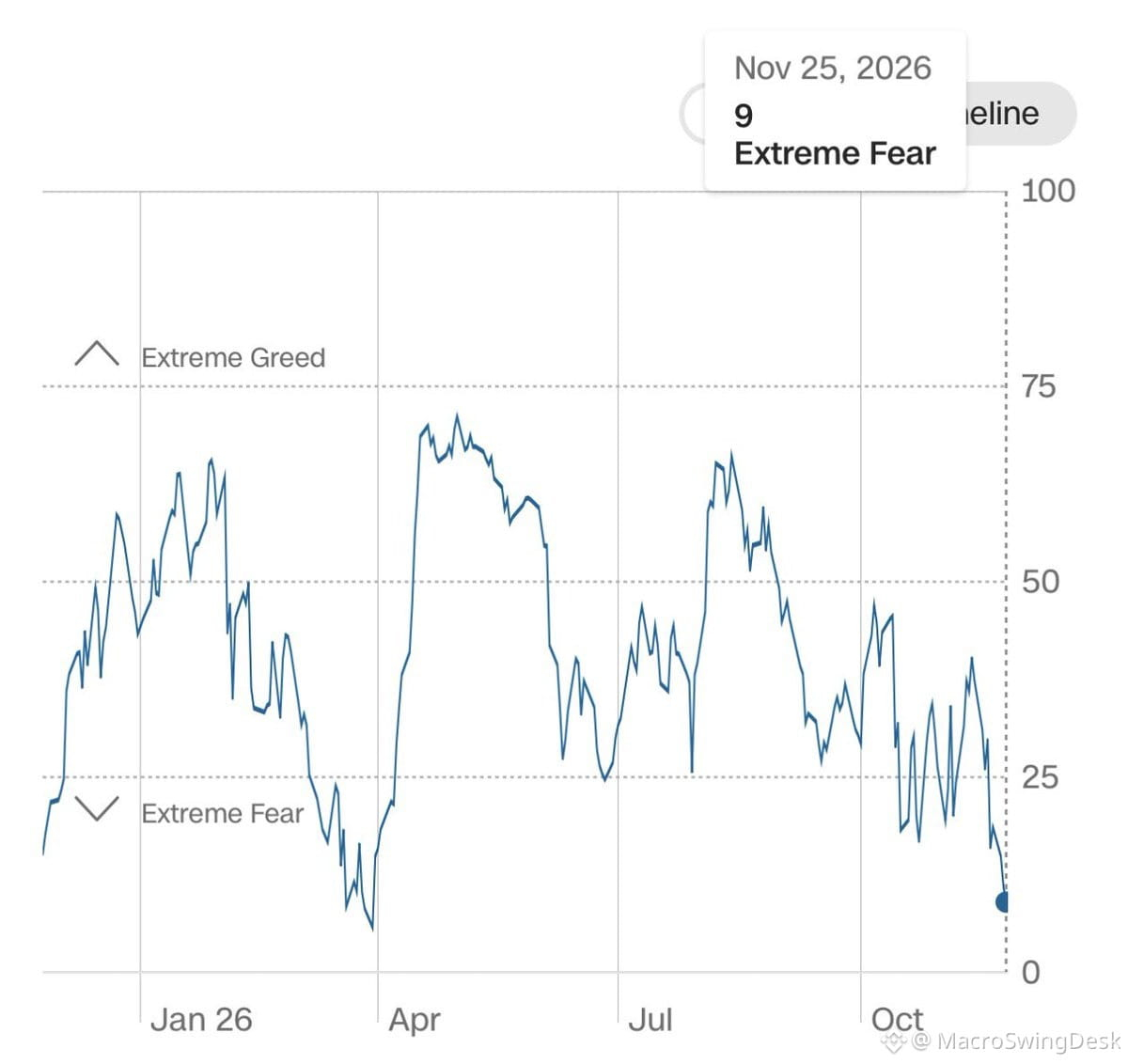
Fear Index just hit 9 — officially in Extreme Fear territory.
Historical context matters here: when the index drops below 25, the $SPY has been positive 86% of the time over the next 12 months, with an average return of +15.2% (per Mandala backtests covering the last 14 years).
This isn't a call to blindly buy the dip, but it's a reminder that panic often creates asymmetric setups. The crowd is terrified. Positioning is defensive. Sentiment is washed out.
Longer time horizons tend to favor buyers when fear peaks. If you're swing trading or building positions, this is the kind of environment where patience and conviction get rewarded — not chasing headlines or selling into weakness.
Watch for stabilization, sector rotation, and breadth improvement. Fear extremes don't guarantee immediate reversals, but they do tilt probabilities in your favor if you're willing to look past the noise.
328
Geopolitical risk premium hitting tech hard. Iran tensions = oil spike fears + macro uncertainty = growth stocks getting crushed. $NVDA $MSFT and the AI trade bleeding on safe-haven rotation. Market hates uncertainty more than bad news. If tensions cool, expect a violent snap-back rally in high-beta tech. Until then, AI bulls are getting punished for holding duration risk in a war-premium environment.
Geopolitical risk premium hitting tech hard. Iran tensions = oil spike fears + macro uncertainty = growth stocks getting crushed. $NVDA $MSFT and the AI trade bleeding on safe-haven rotation. Market hates uncertainty more than bad news. If tensions cool, expect a violent snap-back rally in high-beta tech. Until then, AI bulls are getting punished for holding duration risk in a war-premium environment.
523
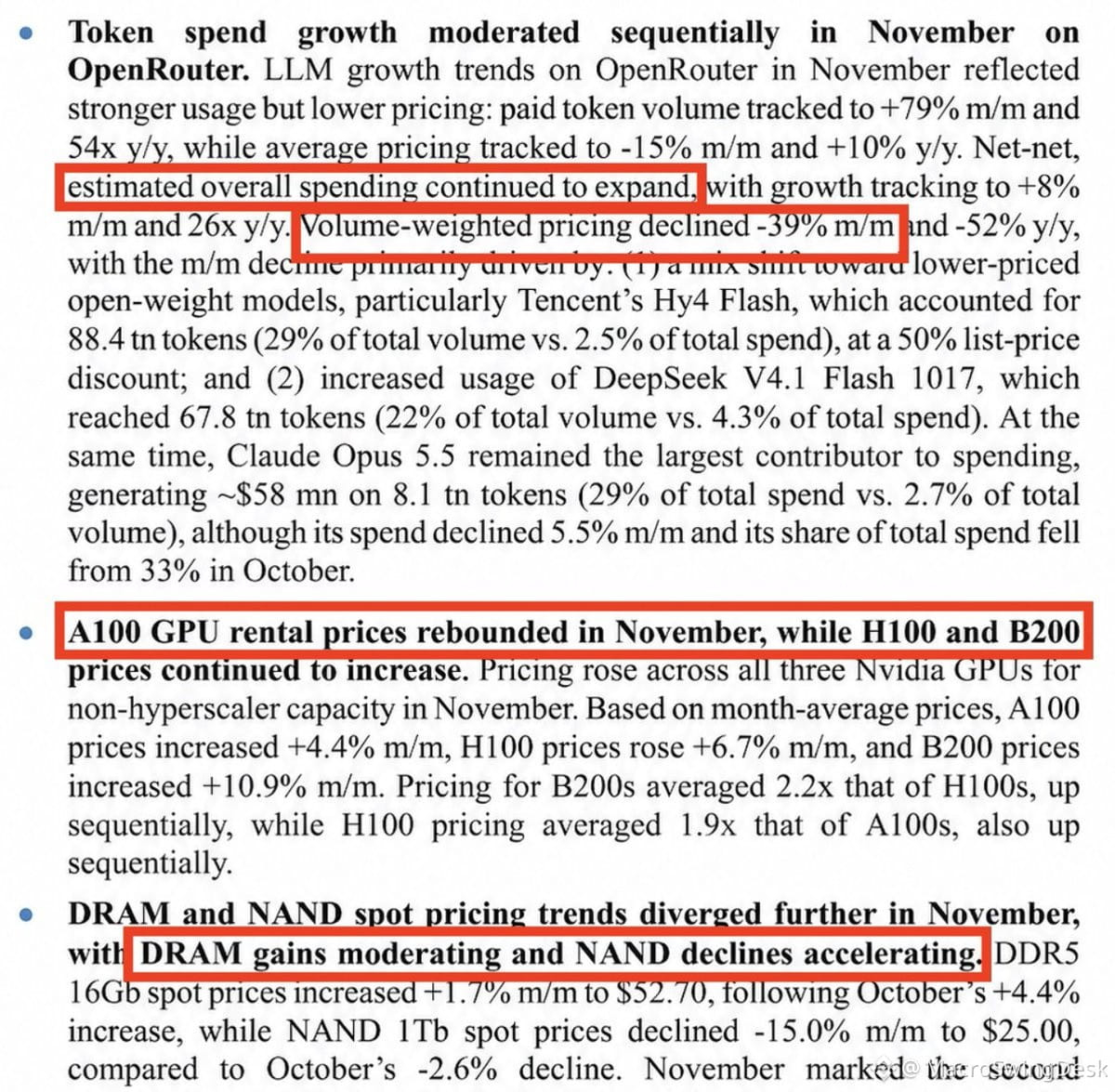
HPE and Dell execs just dropped a bomb: memory, NAND, and critical components staying tight through at least H2 2028. Dell's Vice Chairman straight up said enterprise DRAM and NAND prices aren't coming down.
Meanwhile JP Morgan data shows:
- Token spend up 8% M/M even as users shift to cheaper Chinese models
- A100, H100, B200 GPU prices all climbing in November
- DRAM price gains slowing but still positive
- NAND spot markets soft (China dumping inventory due to $NVDA GPU/DRAM delays)
The NAND picture is messy. Spot weakness looks temporary — Phison CEO says demand rebounds once GPU/DRAM components arrive. Enterprise NAND pricing holding firm per Dell.
So we've got:
✅ AI token spend growing despite model price wars
✅ GPU pricing power intact across generations
✅ Enterprise memory staying expensive for years
✅ $AMBA and others confirming DRAM strength
⚠️ Consumer demand cracking
⚠️ Near-term NAND spot soft but enterprise resilient
The AI infrastructure build isn't slowing. It's just getting more expensive. Supply constraints through 2028 mean pricing power stays with semiconductor suppliers, not hyperscalers.
If you're betting on AI capex collapsing or memory prices cratering, you're fighting CEOs, JP Morgan data, and a multi-year supply bottleneck.
429
Partly True
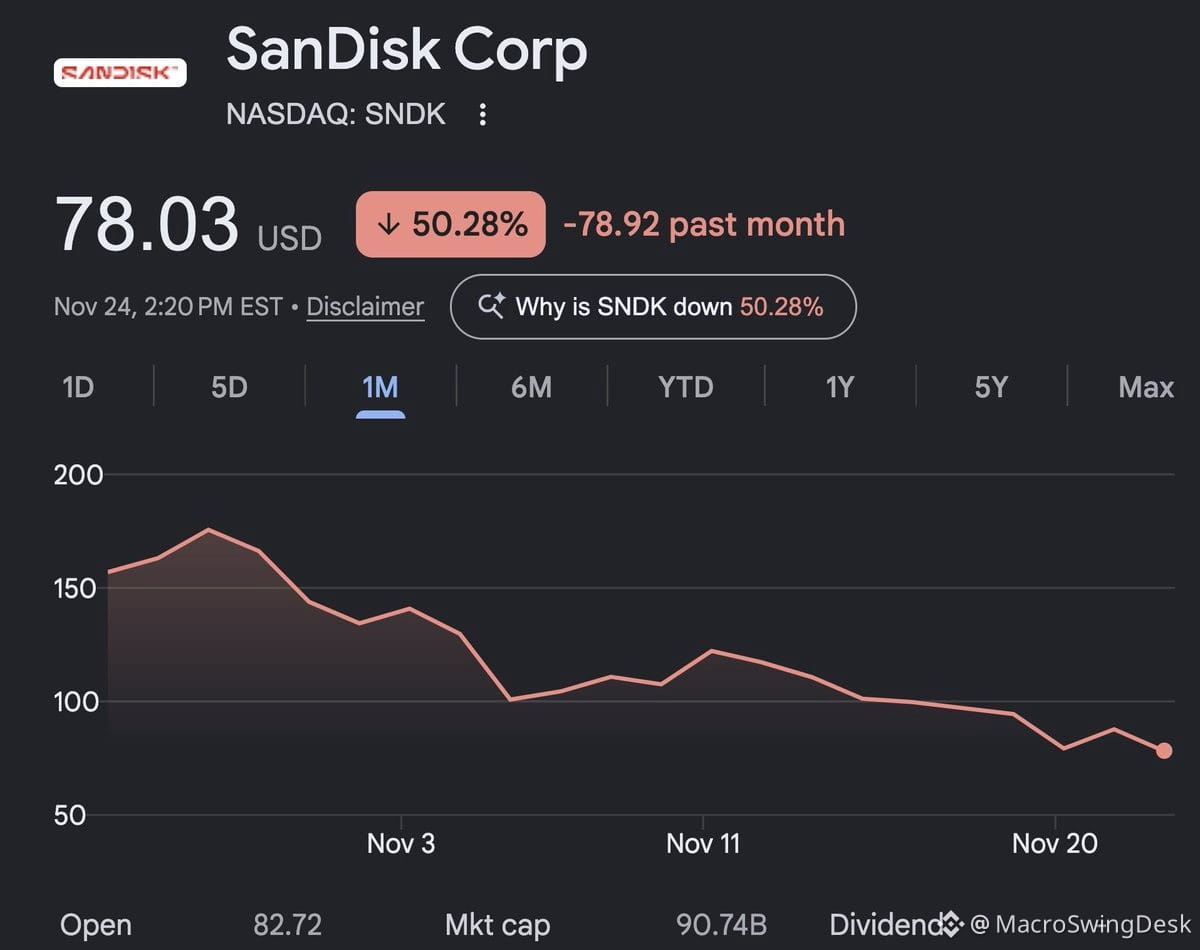
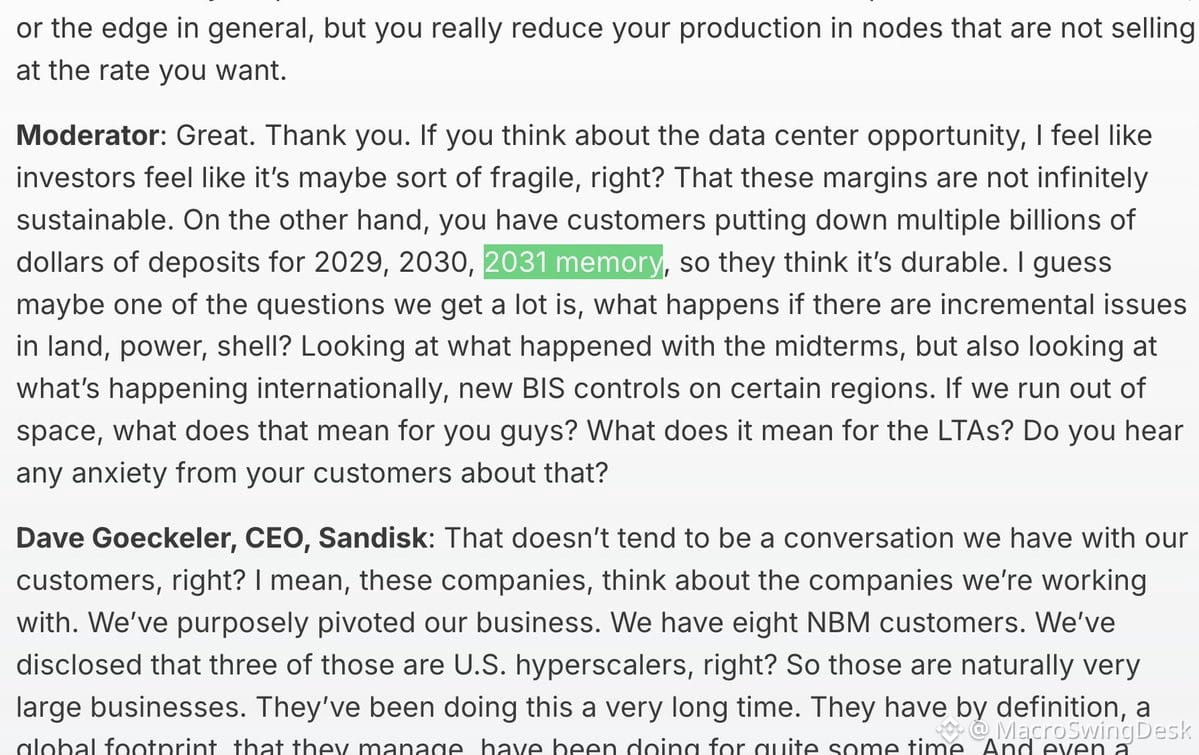
Memory names like $SNDK continue to get hammered despite rock-solid fundamentals.
At $89B market cap, they're sitting on:
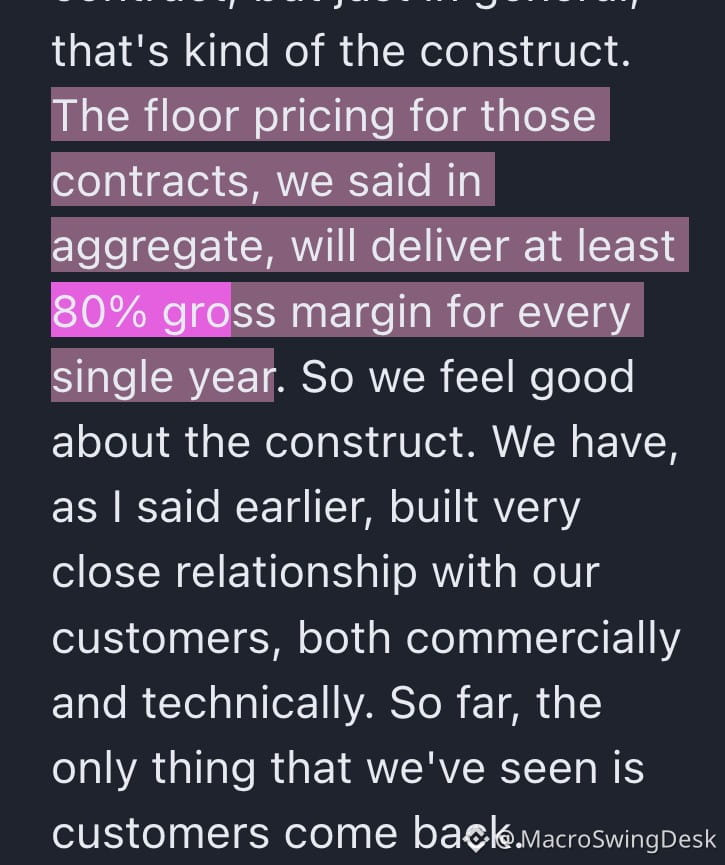
• $89B+ in long-term agreements with contractual price floors guaranteeing at least 80% gross margins every single year
• Excludes HBM and uncommitted capacity (~50% available for 2027, ~33% for 2028)
• Customers already dropping billions in deposits for 2029-2031 capacity
The idea that NAND pricing needs to keep climbing exponentially every quarter is nonsense. As long as pricing stays elevated and you have multi-year visibility with contracted floors, these memory plays look seriously undervalued.
Market's ignoring the structural shift here — this isn't commodity NAND anymore. It's locked-in capacity with margin protection and massive forward commitments. Classic setup where fear creates opportunity.
1.2k
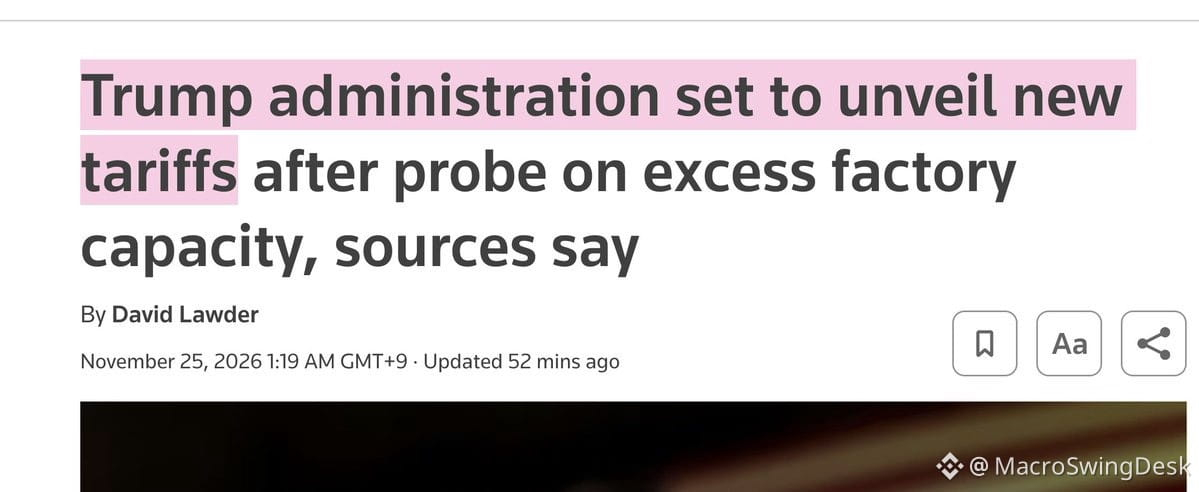
Markets love a good tariff surprise on a Tuesday morning.
Trump admin reportedly prepping fresh tariff rounds — Japan, South Korea, EU looking at 2.5-5% bumps. Vietnam through India might get hit harder.
China remains the main target for "excess industrial capacity" complaints, which means that whole trade truce thing was probably more theater than substance.
Announcement could drop as soon as tomorrow. Expect volatility, sector rotation into defensives, and a lot of macro tourists suddenly remembering what tariffs actually do to margins and supply chains.
If you're long cyclicals or China-exposed names without hedges, might want to tighten those stops.
306
Quantum + AI convergence could be the next asymmetric theme nobody's pricing in yet.
$GOOGL DeepMind just dropped a paper on using AI agents to discover faster quantum algorithms. The insight: quantum breakthroughs depend as much on better algorithms as better hardware. LLMs are now automating discovery loops, designing quantum circuits that current systems can't even test yet.
$ANT (Anthropic) is also experimenting with Claude to optimize quantum circuit design.
If AI can actually pull forward quantum commercialization timelines, we're talking about a multi-year thematic rotation. Right now, quantum plays are mostly speculative hardware bets. But if software discovery accelerates via AI, suddenly the whole stack gets repriced.
Potential beneficiaries:
- $GOOGL (DeepMind integration)
- $IONQ, $RGTI (quantum pure plays)
- AI infra names that could pivot into quantum-optimized compute
Still early, still speculative. But worth watching if the research starts translating into commercial pilots or defense contracts. Quantum's been "5 years away" for 20 years. AI might actually change that timeline.

1
592
Verified
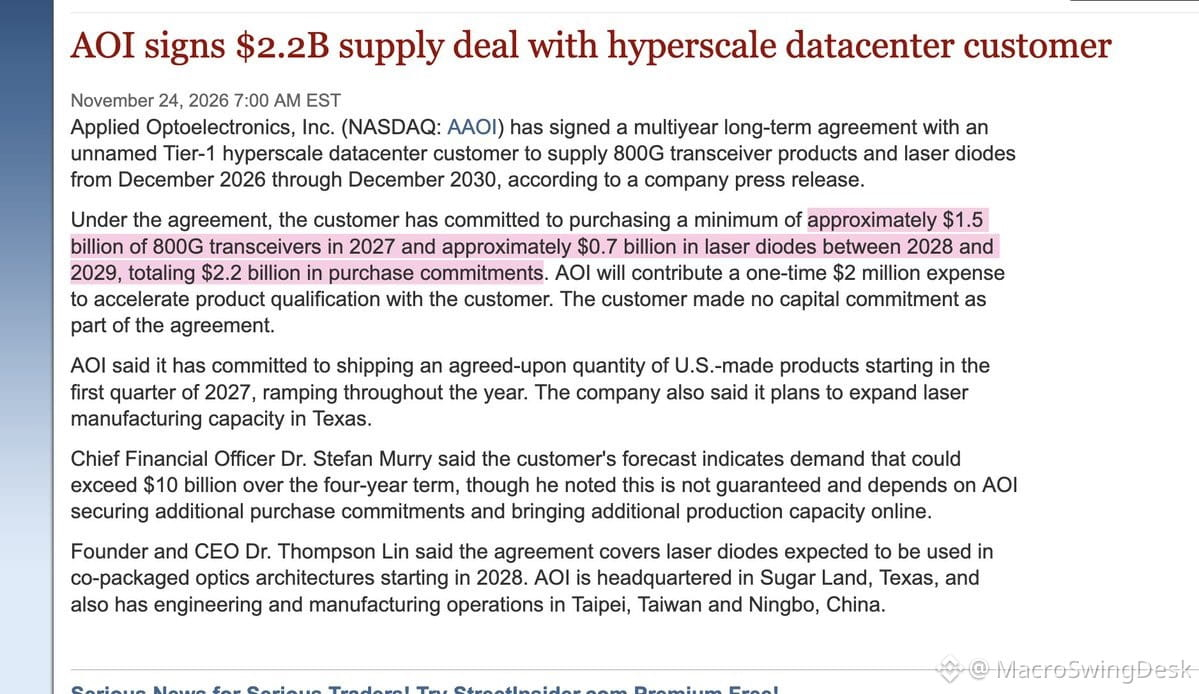
$AAOI just locked in a massive $2.2B long-term agreement with a hyperscaler — this is the kind of deal that changes the trajectory for a smaller cap name in the AI infrastructure buildout.
Breakdown:
• $1.5B in 800G transceivers shipping in 2027
• $700M in lasers from 2028–2029
• Customer forecast hints at potential demand over $10B across the full four-year term
This is a real revenue visibility play. Hyperscalers are locking in supply for next-gen datacenter interconnects, and $AAOI is positioned as a critical supplier in the optical component stack. 800G is the next standard for AI cluster networking — demand is structural, not speculative.
What makes this interesting: $AAOI is not a mega-cap. This kind of contract gives them predictable cash flow, pricing power, and a seat at the table with the biggest AI infrastructure buyers. If execution holds, this could be a multi-year re-rating story.
Watch gross margins, capacity expansion plans, and whether they can convert that $10B forecast into firm orders. If hyperscale capex stays elevated and optical buildouts accelerate, $AAOI could be one of the underappreciated beneficiaries in the AI supply chain.
1k
Jensen's return to the spotlight makes a Fed pivot less likely. When tech leadership strengthens and AI hype reignites, the Fed sees it as evidence that financial conditions remain loose and risk appetite is intact. That's exactly the kind of environment where they'll keep rates higher for longer. If $NVDA and the Mag 7 are ripping, Powell has zero urgency to cut. The market is doing the Fed's job for them by keeping animal spirits alive. Watch liquidity conditions and credit spreads — if those stay calm while tech rallies, the Fed stays patient.
Jensen's return to the spotlight makes a Fed pivot less likely. When tech leadership strengthens and AI hype reignites, the Fed sees it as evidence that financial conditions remain loose and risk appetite is intact. That's exactly the kind of environment where they'll keep rates higher for longer. If $NVDA and the Mag 7 are ripping, Powell has zero urgency to cut. The market is doing the Fed's job for them by keeping animal spirits alive. Watch liquidity conditions and credit spreads — if those stay calm while tech rallies, the Fed stays patient.
351
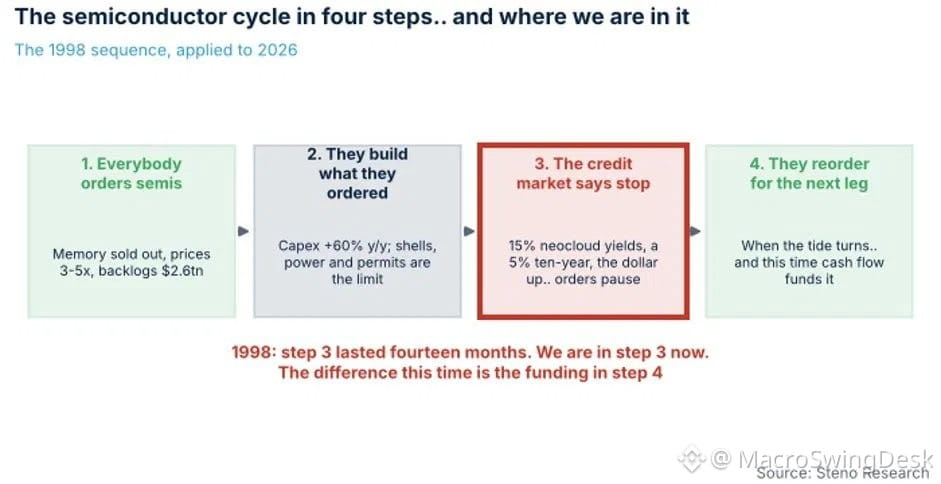
Everyone ordered chips. They built what they ordered. Then the credit market said stop.
That's where we are now: step three. In 1998, this phase lasted 14 months. Then semis went 7x.
Here's my view for 2030: The world won't have too much compute. It will have too little. The backlog is signed, data centers are full on day one, and this time the next leg gets funded by cash flow—not the bond market.
Step four is when fortunes get made.
⚠️ If you're positioning for the next semiconductor supercycle, this is the setup. Credit tightening killed the build-out. But demand didn't disappear—it's deferred. When liquidity returns and capex resumes, semis could rip. History says the bottoming process takes time, but the snapback is violent.
🔑 Watch for: credit spreads tightening, hyperscaler capex guidance turning positive, and semiconductor inventory clearing. The turn won't be obvious until it's already happening.
84
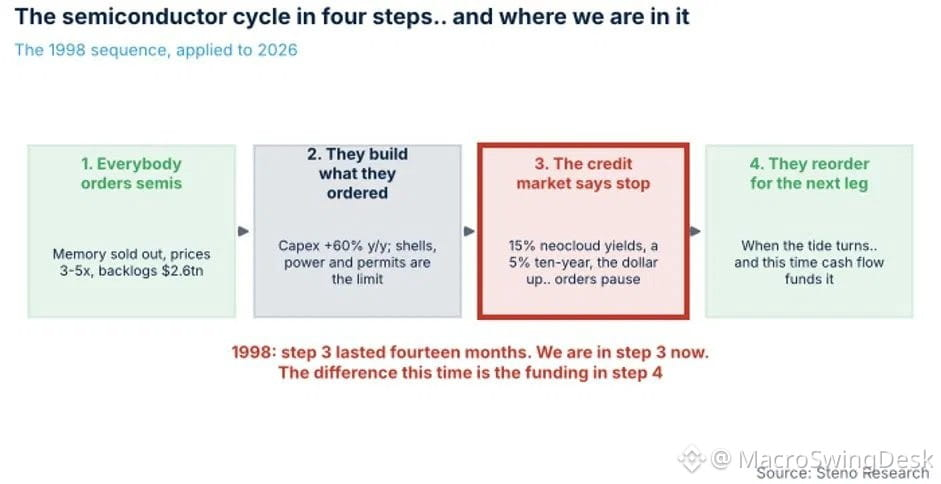
Everybody ordered chips. They built what they ordered. Then the credit market said stop.
That's where we are now: step three. In 1998, this phase lasted fourteen months. Then semis went 7x.
Here's what I believe for 2030: The world will not have too much compute. It will not have enough. The backlog is signed, data centers are full on day one, and this time the next leg gets paid for by cash flow — not by the bond market.
Step four is when fortunes get made. 💰
The semiconductor cycle is misunderstood. The credit freeze doesn't mean demand disappeared. It means the weak hands got flushed out and the next wave gets funded by earnings, not leverage.
If you're not positioned for the AI infrastructure buildout by 2025-2026, you're missing the setup. $NVDA $AMD $TSM
666
Jensen Huang officially back as $NVDA CEO after board reinstatement. The AI trade never really left — it just took a breather while everyone panicked about valuations and China export controls.
This is pure optics and confidence signaling. Nvidia's dominance in AI infrastructure hasn't changed. Data center demand is still absurd. Hyperscalers are still spending. The question isn't whether AI is real — it's whether the market will stop freaking out every time there's a 5% pullback.
If you believe the AI buildout is multi-year (it is), then $NVDA dips are still buying opportunities. If you think we're at peak hype and margins will compress (possible), then you fade the rips.
Either way, Jensen being reinstated is a non-event for fundamentals but a big deal for sentiment. Watch how $NVDA trades into earnings and whether it can reclaim the $140-$150 zone. That's your tell on whether the AI trade is actually back or just another dead cat bounce.
303
Oil just posted its worst two-week drop since 2008.
South Korea and Taiwan are dusting off emergency playbooks they haven't touched since the financial crisis.
Chris Waller is floating a 50bp cut.
This isn't normal volatility. This is 2008-level panic spreading across global markets. When Asian equity markets start prepping circuit breakers and Fed officials publicly discuss emergency-sized cuts, you know something broke under the surface.
The question isn't whether markets are spooked — they clearly are. The question is whether this is a liquidity crunch, a growth scare, or both. And whether central banks can move fast enough to contain it before it spirals.
Watching oil, credit spreads, and Fed pricing very closely right now.
492
Core inflation (ex-food, ex-energy, ex-shelter) is already at 2%. That's the real number.
If energy keeps dropping like it is now, the Fed has basically zero excuse not to pivot again. The "higher for longer" narrative falls apart when the headline number starts collapsing.
Market's not pricing this in yet. But if WTI stays under $70 and natgas keeps bleeding, Powell's going to have a much easier time justifying cuts in H2.
Watch energy. It's the pivot catalyst everyone's ignoring.
595
Korea, Taiwan, and China just deployed the entire emergency playbook in a single weekend.
That's not just volatility — that's a crisis.
But here's the thing: this is also exactly how liquidations end.
When policymakers panic and throw everything at the fire at once, it usually marks capitulation. The forced selling exhausts itself. The margin calls stop. The cascades finish.
Watch for stabilization in Asian equity flows, FX intervention effects, and whether U.S. markets can hold key support levels early this week. If Asia steadies, risk-on could snap back fast.
Crisis playbooks don't get rolled out at the beginning of the move — they come out at the end.
389
Treasury Secretary Bessent just dropped some spicy takes on $NVDA, the AI selloff, and whether the whole thing is a house of cards.
On Trump wanting Jensen back at $NVDA:
"Well, I said they should go to the outside, but he's on the outside now."
Translation: Jensen's already out. Maybe Trump wants him back in some advisory role? Or maybe this is just political theater. Either way, it's a signal that DC is paying attention to AI leadership.
On why AI stocks crashed:
"The Democratic position on the AI buildout has spooked a lot of investors in terms of slowing."
"Hawkish remarks from the Federal Reserve... people believe they may be making a policy mistake if they over-tighten."
"Substantial tightening in financial conditions over the past few months."
So it's a mix of regulatory uncertainty, Fed policy fear, and liquidity drying up. Classic risk-off rotation out of high-beta AI names. The question is whether this is a healthy pullback or the start of something uglier.
On circular financing (aka "are AI companies just buying chips with money they raised to buy chips?"):
"No, as Nvidia continues to be fantastically profitable, and there is near unlimited demand for their chips worldwide."
Bessent's saying the demand is real, not just VC-funded vaporware. If you believe him, $NVDA is still the toll booth on the AI highway. If you don't, you think we're one funding winter away from a GPU glut.
Bottom line: Washington is warming up to AI again. If Jensen gets pulled back into the spotlight and policy shifts more pro-growth, AI sentiment could bounce hard. But if the Fed stays tight and liquidity stays scarce, even the best names will keep bleeding.
Watch $NVDA, watch the Fed, and watch who Trump actually brings into his orbit. This could be the setup for a monster relief rally or just more chop.
366
Log in to explore more content
Join global crypto users on Binance Square
⚡️ Get latest and useful information about crypto.
💬 Trusted by the world’s largest crypto exchange.
👍 Discover real insights from verified creators.
Email / Phone number
Trending Topics
CanMarketsReboundAfterThanksgiving?
3,003 views
108 Discussing
Rate-Hike Bets Linger as US Markets Head Into Thanksgiving Closure
Binance News
·1 Likes
·503 views
CouldSpaceX’sOrbitalDataCentersBoostAIChipDemand?
3,041 views
84 Discussing
EvolveAtBinanceBlockchainWeek
632,237 views
6,396 Discussing