

lillyvuchkova
14 Posts
lillyvuchkova
Report
Block User
10 Following
11 Followers
30 Liked
Posts
PINNED
Nominated for AI Master in this year's @Binance_Angels Awards 🏆
A pleasant surprise to be nominated for something I genuinely like doing - and even more motivation to keep creating, award or not.
Fingers crossed 💛
@Binancelatam
Nominated for AI Master in this year's @Binance Angels Awards 🏆
A pleasant surprise to be nominated for something I genuinely like doing - and even more motivation to keep creating, award or not.
Fingers crossed 💛
@Binance LATAM Official
A pleasant surprise to be nominated for something I genuinely like doing - and even more motivation to keep creating, award or not.
Fingers crossed 💛
@Binance LATAM Official

1
98
Article
Binance vs Coinbase: Which Crypto Platform Is Best for Buying U.S. Stocks?Binance and Coinbase both sell U.S. stocks inside a crypto app, but they sell them to different people. Coinbase's stock brokerage serves only U.S. and U.K. residents, while Binance's serves eligible users outside the United States. Investors based in Mexico and Latin America have Binance as the only one of the two with direct U.S. stock trading. Elsewhere, where you live decides the answer before fees or features do.
This comparison combines official pages from both platforms with hands-on checks run on September 14, 2026.
How we testedBinance: an account verified in Mexico. We opened order forms for Apple stock (AAPL) and Apple's tokenized version (AAPLB) and read the estimated fees, without placing trades.Coinbase: averified account, plus Coinbase's public stock pages. Stock trading was unavailable in that region, so Coinbase details come from its official U.S. and U.K. pages.Fees: Binance's stock fees include a promotion that ends September 30, 2026. Standard rates appear alongside.
Which is better for buying U.S. stocks, Binance or Coinbase?
The better platform depends on your country of residence.
Mexico and Latin America: Binance, where eligible. Coinbase doesn't offer direct stock trading to residents there.U.S. residents: Coinbase. Binance does not offer these products to U.S. persons, and Coinbase charges no commission or trading fees on U.S. stock trades.U.K. residents: Coinbase offers U.S. stock trading through an FCA-regulated entity, but U.K. users cannot trade ETFs.Eligible users elsewhere: Binance offers the widest range in one account: direct stocks and ETFs, tokenized stocks (bStocks), stock options, equity-linked perpetual futures and recurring buys. Outside the U.S., Coinbase offers tokenized stocks on its Base network, only in eligible jurisdictions.
Can you buy U.S. stocks from Mexico and Latin America?
On Binance, yes: our Mexico-verified account showed every Binance stock product we checked. The account showed:
direct trading in more than 7,000 U.S. stocks and ETFsrecurring stock purchasesbStocks, with a "Buy with MXN" option on the trading pagean Options tab on the Apple stock page
On Coinbase, direct stock trading is limited to U.S. and U.K. residents, so Mexican and other Latin American residents can't use it. The Coinbase pages we reviewed don't say whether Coinbase Tokenized Stocks are available in Mexico; the eligibility check at base.org/stocks gives the current answer.
Across Latin America, availability on Binance varies by country. The reliable test is your own app: if the Stocks section loads and an order form opens after verification, the product is available on your account.
Two practical notes for Mexico:
Funding: direct stocks are paid in USDC or other supported crypto, not pesos. The "Buy with MXN" option appears on the bStocks trading page; we didn't test its payment methods or fees.Taxes: U.S. tax is withheld from dividends at a default rate of 30% before they reach your account. Mexican tax residents may have their own reporting obligations, so check with a tax adviser.
Who can buy U.S. stocks on each platform?
Binance offers stock trading to eligible users outside the United States, and availability varies by jurisdiction.
Coinbase offers direct stock trading to U.S. residents through Coinbase Capital Markets and to U.K. residents through CB Payments Ltd. From Bulgaria, Coinbase's Apple page showed "Trading stocks is not available in your area," and our Bulgaria-verified account had no stock trading. Coinbase Tokenized Stocks are offered only in eligible jurisdictions outside the U.S.
What are the ways to buy U.S. stocks on each platform?
Binance offers five routes:
Direct stocks and ETFs: more than 7,000 U.S.-listed stocks and ETFs, from 5 USD. You become the beneficial owner of the shares, which a U.S. clearing broker, Alpaca Securities, holds in custody. Trading runs up to 24 hours a day, five days a week, but only selected stocks trade overnight, and market orders execute only during regular hours.bStocks: tokenized securities backed 1:1 by U.S. stocks. They trade 24/7 against USDT, and you can withdraw them to BNB Chain-compatible wallets.Stock options: physically settled options on more than 1,000 U.S. stocks and ETFs, added in September 2026.Equity-linked perpetual futures: leveraged contracts that follow stock prices, without ownership.Recurring buys: automatic periodic purchases of selected stocks and ETFs. A single plan can split one amount across several stocks.
Coinbase offers two routes to U.K. and U.S. retail investors:
Direct stocks: U.S. residents trade thousands of stocks and ETFs 24/5, with fractional shares from 1 USD. U.K. residents trade roughly 3,800 U.S. stocks, from £1, funded in GBP or USDC.Coinbase Tokenized Stocks on Base: tokens backed 1:1 by shares, launched on August 24, 2026 with Apple, Alphabet, Meta and NVIDIA, and since expanded to ten tickers. They trade 24/7, sit in self-custody wallets and can be used in Base DeFi applications.
Coinbase also offers perpetuals and futures in the U.K., but its best execution policy states it does not offer them to retail clients there. Binance offers equity-linked perpetual futures to eligible users without that restriction.
How much does it cost to buy U.S. stocks on Binance and Coinbase?
Binance direct stocks charge no commission but do charge a platform fee or spread:
Small orders: a flat 0.35 USD on orders up to 350 USD. During a promotion running until 23:59 UTC on September 30, 2026, this drops to a flat 0.17 USD on orders up to 340 USD.Larger orders: a 0.10% spread, reduced to 0.05% during the same promotion.
The fee is calculated out of the amount you enter. On our account, a 10 USDC market order showed 9.83 USD of Apple stock during the promotion. The same fee applies again when you sell.
Funding matters too. Binance converts USDC to USD for free, while USDT, BNB, USD1, and U first convert to USDC at the market spread.
Binance bStocks use spot trading fees instead. The AAPLB trading page showed a 0.1% taker fee and a 0% maker fee before the optional BNB discount; your rate can vary with account tier.
A market order pays the taker fee. A limit order that waits in the order book pays the maker fee.Binance deducts the fee in AAPLB, not in USDT.Orders move in steps of 0.001 AAPLB, so a 10 USDT order came to about 9.77 USD at Apple's price that morning.
Coinbase charges no commission or fees on U.S. stock trades through Coinbase Capital Markets and currently charges no regulatory fees.
In the U.K., "no commission" is not the whole cost. U.S. shares are priced in USD, so paying in pounds triggers a currency conversion, and Coinbase's FCA cost disclosure puts that conversion fee at 0.50% of the transaction amount. Its own worked example shows a £10,000 purchase costing £50 on entry, cutting a 5% annual return to 4.5%. The disclosure lists no account, deposit, withdrawal, or ongoing custody fees beyond it.
What that means on a real purchase, excluding the market bid/ask spread:
A 10 USD buy costs 0.35 USD on a Binance direct stock at the standard rate, which is 3.5% of the purchase, or 0.17 USD during the promotion. As a bStock, it costs about 0.01 USD. On Coinbase in the U.S., it costs nothing; in the U.K., paying in pounds, about 0.05 USD.A 100 USD buy costs the same flat 0.35 USD on a Binance direct stock, now only 0.35% of the purchase, or 0.17 USD during the promotion. As a bStock, 0.10 USD. Coinbase U.S.: nothing; Coinbase U.K. in pounds: 0.50 USD.A 1,000 USD buy costs 1.00 USD on a Binance direct stock, or 0.50 USD during the promotion. As a bStock, 1.00 USD. Coinbase U.S.: nothing; Coinbase U.K. in pounds: 5.00 USD.
The Coinbase U.S. figures apply only to U.S. residents, who cannot use Binance's stock products. The U.K. figure is the currency conversion fee, which applies when funding in pounds rather than USDC.
Two patterns are worth noticing. Flat fees punish small orders: the same 0.35 USD is 3.5% of a 10 USD purchase and 0.35% of a 100 USD one. And none of these platforms charges a commission, yet all of them charge something. On a 1,000 USD purchase, the real cost runs from nothing to 5 USD, depending on the platform and the currency you fund with.
Other Binance costs to know before you buy:
Dividend tax: the clearing partner withholds U.S. tax at a default rate of 30%. This is a U.S. tax obligation, not a Binance fee.ADR fees: 0.01 to 0.03 USD per share on depositary receipts of non-U.S. companies.Voluntary corporate actions, such as tender offers: 200 USD per election.Moving shares out to another broker: 150 USD per stock, per request. Binance does not support ACATS transfers.Account fees: none. Binance also absorbs the SEC, FINRA, and CAT regulatory fees on sales.
Coinbase's U.K. disclosure lists comparable event-driven charges: a 150 USD standard legal transfer fee, matching Binance's, and a 50 USD voluntary corporate action election fee against Binance's 200 USD.
Does either platform get paid for sending your order somewhere?
Binance's stock trading disclaimer states that Binance may receive payment for order flow remuneration for directing your orders. Payment for order flow means a venue or market maker pays the platform for the right to fill your trade, which is why a service can be free at the point of use.
Coinbase's U.K. arm takes the opposite position. Its best execution policy says it does not structure or charge commissions in a way that would undermine compliance with FCA rules on conflicts and inducements, including restrictions on payment for order flow. It also commits to seeking the best total consideration for retail clients, meaning price plus execution costs.
Neither disclosure tells you what any individual order earned the platform. But the two describe different business models, and that is worth knowing before you judge a fee table.
What do you actually own on each platform?
What you own ranges from a share to a contract:
Binance direct stocks: you are the beneficial owner of real shares, eligible for dividends and corporate actions. The Apple page listed its August dividend under Events.Binance bStocks: a certificate representing the underlying stock, not a share. It gives no direct ownership in the company. Binance says bStocks convert 1:1 with the underlying share, with no conversion fee.Coinbase direct stocks (U.S. and U.K.): shares held through Coinbase's regulated brokerage entities.Coinbase Tokenized Stocks: Coinbase describes each token as a beneficial claim on a real share. The share is held by Alpaca in trust for token holders, and your claim runs against Coinbase's Abu Dhabi issuing vehicle rather than against Coinbase Global or the company itself.Perpetual futures and options: contracts, not ownership. On Binance, an exercised stock option delivers real shares.
Who holds the shares, and what happens if something goes wrong?
The company whose name is on the app is rarely the company holding your shares. Each product runs a different chain.
Binance direct stocks: Binance's broker-dealer, regulated in Abu Dhabi Global Market, sends orders to Alpaca Securities. Alpaca executes, clears, settles and holds the shares; Binance does not hold your securities.Coinbase U.K. stocks: three companies sit between you and the share. CB Payments Ltd is FCA-authorised to receive and transmit orders only, and states that it does not execute trades or hold client equities. It passes orders to Coinbase Capital Markets, a U.S. broker-dealer, which routes them to an external clearing broker such as Apex Clearing Corporation for execution, settlement and custody. CB Payments also warns that no order type carries a guaranteed execution price.On Coinbase Tokenized Stocks: the tokens are issued by a Coinbase special purpose vehicle licensed by the Abu Dhabi Global Market's Financial Services Regulatory Authority. Alpaca buys and custodies the underlying shares in segregated accounts, held in trust for token holders in a bankruptcy-remote structure. Coinbase says Alpaca is registered with the SEC and is a FINRA and SIPC member.Leaving: on Binance, moving a position to another broker costs 150 USD per stock. Coinbase's U.K. disclosure lists the same 150 USD standard legal transfer fee.
On protection, the two sides document very different amounts of detail.
Coinbase's U.K. filings are explicit. CB Payments states that it does not receive, hold or control client money or safeguard custody assets for these services, so the FCA's client asset rules, CASS, do not apply between you and CB Payments. Protection instead depends on the third party you end up contracted with. The FSCS may cover a valid claim if CB Payments itself fails in its arranging role, but it does not cover losses from falling share prices or poor investment performance, and any FSCS protection tied to a third party depends on that firm's own regulatory status. Complaints about CB Payments' conduct may be eligible for the Financial Ombudsman Service.
On the Binance side, the answer is partly knowable from the protection scheme itself. Binance describes Alpaca as a FINRA and SIPC member. SIPC covers customers of a failed member firm up to 500,000 USD, including 250,000 USD for cash claims, and SIPC states there is no requirement that a customer live in or be a citizen of the United States: a non-U.S. citizen is treated the same as a U.S. one. Alpaca also says it holds excess coverage above the SIPC limits.
Residency, then, is not the obstacle. The open question is narrower: SIPC protects customers of the member firm, and Binance's materials do not spell out whether someone who reaches Alpaca through Binance's introducing broker is a customer of Alpaca in that sense, or holds a share of a pooled account. That distinction determines what a claim would look like, and we could not resolve it from published sources.
Neither arrangement protects you from the stock going down. Both are about what happens if a firm in the chain fails.
Does 24/7 stock trading on a crypto platform actually work?
Early data suggests weekend bStock prices track Monday's opening prices closely, with caveats.
Binance Research studied the seven weekends after bStocks launched on June 11, 2026:
Weekend bStock prices captured a median 92% of the price gap at Monday's open, leaving an average residual deviation of 0.19%.Directional accuracy rose with the size of the move: 81% for gaps under 0.5%, 90% for 0.5–1%, 97% for 1–3%, and all 41 cases above 3%.
Binance Research notes the sample is small and does not present the data as a forecast. Its comparison also runs to the Monday open, by which time Binance's overnight stock session and U.S. pre-market trading have already begun.
Our own snapshot, taken during U.S. pre-market on September 11, 2026:
AAPLB bStock (05:58 ET): 325.80 USDT, with a 0.02 USDT gap between bid and ask (about 0.006%).Direct AAPL (06:04 ET): 325.78 USD, with a bid of 325.62 and an ask of 326.05 (about 0.13%). Binance labels this quote as indicative third-party data.Reference: Apple closed the previous day at 326.57 USD.
Coinbase Tokenized Stocks also trade 24/7 on Base; Coinbase direct stocks trade 24/5.
What "24/5" actually restricts
Both platforms limit what you can do outside regular U.S. hours, in similar ways.
Coinbase's U.K. risk disclosure states that market orders are not accepted during pre-market, overnight, and after-hours sessions; only collared limit orders are. Not every share is available for extended-hours trading, and Coinbase does not currently offer fractional share trading outside 9:30 a.m. to 4:00 p.m. ET. There is also a short daily window, 7:44:30 p.m. to 8:00 p.m. ET, when orders cannot be accepted at all because of third-party system limits.
Binance applies the same core restriction: market orders execute only during regular hours, and only selected stocks trade in its 24-hour session.
Coinbase also warns that outside regular hours there are fewer buyers and sellers, spreads widen, orders may fill partly or not at all, prices can move faster, and the same security may show different prices on different venues. Our pre-market readings above are consistent with that.
So "around the clock" describes when the market is open, not when every order type and every stock is available.
What are the risks of buying U.S. stocks on a crypto platform?
Market risk: stock prices fall as well as rise, and volatility rises outside regular U.S. market hours.Structure: bStocks are certificates, not shares, and carry issuer, custody, and technology risk. Self-custody does not mean the issuer has no control: reporting on Coinbase's prospectus describes powers to freeze and claw back tokens to meet legal requirements. Read the prospectus for whichever token you buy.Self-custody: tokens moved to your own wallet depend on your wallet security, so check the contract address before moving them.Leverage: perpetual futures use leverage, and positions can be liquidated. A Binance stock option expires worthless or is liquidated unless you submit an exercise instruction before the cut-off.Small-order costs: flat fees take a larger share of small purchases.Tax: U.S. dividend withholding reduces payouts.Borrowed money: Coinbase's risk disclosure tells U.K. clients not to fund investments with loans or credit facilities, and not to rely on expected profits to meet repayments. Sound advice on any platform.Eligibility: product availability depends on your country and can change. Binance places the responsibility on users to confirm that access to tokenized securities is lawful where they live.
Which should you choose?
You live in Mexico or elsewhere in Latin America: Binance, if the Stocks section is available on your verified account.Direct stocks, funded with USDC, if you want share ownership and dividends.bStocks, if you buy in small amounts or want to trade outside U.S. market hours, and accept the certificate structure.You live in the U.S.: Coinbase.You live in the U.K.: Coinbase for stocks, without ETFs.You live in another eligible country: the same logic as Mexico applies, and direct stocks cost less than bStocks for larger orders while the promotion runs.You want tokenized stocks in your own wallet: compare bStocks with Coinbase Tokenized Stocks, where each is available to you. Their legal structures differ.
Frequently asked questions
Do Binance and Coinbase sell real U.S. shares, or only tokens? Both sell real shares as well as tokens. Binance's direct stocks make eligible users beneficial owners of shares held by Alpaca Securities, and Coinbase sells shares to U.S. and U.K. residents. bStocks and Coinbase Tokenized Stocks are the tokenized versions.
Can I buy U.S. stocks on Binance from Mexico? Yes, if your account is eligible. Our account verified in Mexico showed direct stocks, bStocks, recurring buys, and an Options tab.
Can I use Coinbase to buy U.S. stocks from Mexico? Not Coinbase's direct stock trading, which serves only U.S. and U.K. residents. The Coinbase pages we reviewed don't confirm whether its tokenized stocks are available in Mexico; the eligibility check at base.org/stocks gives the current answer.
Can I buy U.S. stocks on Binance with pesos? Direct stocks are paid in USDC or other supported crypto. A "Buy with MXN" option appears on the bStocks trading page;
Do Binance stocks pay dividends? Yes. As a beneficial owner, you receive dividends after U.S. tax withholding, which defaults to 30%. Binance charges nothing to process them.
Can I transfer my stocks from Binance to another broker? Yes, through a DTC transfer costing 150 USD per stock, per request. Binance does not support ACATS transfers.
Can I trade U.S. stocks on Binance on weekends? Direct stocks close from Friday 8 p.m. to Sunday 8 p.m. ET. bStocks trade 24/7, including weekends.
What is the difference between bStocks and Binance direct stocks? Direct stocks make you the beneficial owner of real shares. A bStock is a certificate representing a share, with no direct ownership. Binance says the two convert 1:1 with no conversion fee.
Are my U.S. stocks on Binance protected? Alpaca Securities holds the shares and is a FINRA and SIPC member. The disclosures we reviewed don't state whether SIPC protection applies to non-U.S. customers accessing stocks through Binance.
Can I set up automatic stock purchases on Binance? Yes. Recurring buys run on a schedule you choose, and one plan can split an amount across several stocks and ETFs.
Are my stocks protected if the platform fails? Partly, and not in the way most people assume. Neither scheme covers your stock going down. Coinbase's U.K. disclosure says the FSCS may cover a valid claim if CB Payments fails in its arranging role, and that protection tied to a third party depends on that firm's own status. On Binance, the shares sit with Alpaca, a SIPC member; SIPC covers up to 500,000 USD per customer and applies regardless of where you live. What Binance's materials don't spell out is whether a Binance user counts as a customer of Alpaca for that purpose.
Can I place a market order outside U.S. trading hours? No, on either platform. Coinbase accepts only collared limit orders in extended sessions; Binance executes market orders during regular hours only.
Is "zero commission" really free? No. Binance charges a platform fee or spread instead of a commission. Coinbase charges nothing on U.S. stock trades, but its U.K. disclosure sets a 0.50% currency conversion fee when you pay in pounds. Read the cost disclosure, not the headline.
What is the cheapest way to buy a small amount of U.S. stock on Binance? For small orders, bStocks cost less: a 0.1% taker fee against a flat 0.17 USD (0.35 USD after September 30, 2026) on direct stocks. The trade-off is owning a certificate instead of the share.
This article is for information only and is not financial, investment, or tax advice. Data verified on September 11, 2026, from official Binance, Coinbase, and Base pages and hands-on account checks. Fees and availability change. Disclosure: The author is a Binance Angel.
Binance vs Coinbase: Which Crypto Platform Is Best for Buying U.S. Stocks?
Binance and Coinbase both sell U.S. stocks inside a crypto app, but they sell them to different people. Coinbase's stock brokerage serves only U.S. and U.K. residents, while Binance's serves eligible users outside the United States. Investors based in Mexico and Latin America have Binance as the only one of the two with direct U.S. stock trading. Elsewhere, where you live decides the answer before fees or features do.
This comparison combines official pages from both platforms with hands-on checks run on September 14, 2026.
How we testedBinance: an account verified in Mexico. We opened order forms for Apple stock (AAPL) and Apple's tokenized version (AAPLB) and read the estimated fees, without placing trades.Coinbase: averified account, plus Coinbase's public stock pages. Stock trading was unavailable in that region, so Coinbase details come from its official U.S. and U.K. pages.Fees: Binance's stock fees include a promotion that ends September 30, 2026. Standard rates appear alongside.
Which is better for buying U.S. stocks, Binance or Coinbase?
The better platform depends on your country of residence.
Mexico and Latin America: Binance, where eligible. Coinbase doesn't offer direct stock trading to residents there.U.S. residents: Coinbase. Binance does not offer these products to U.S. persons, and Coinbase charges no commission or trading fees on U.S. stock trades.U.K. residents: Coinbase offers U.S. stock trading through an FCA-regulated entity, but U.K. users cannot trade ETFs.Eligible users elsewhere: Binance offers the widest range in one account: direct stocks and ETFs, tokenized stocks (bStocks), stock options, equity-linked perpetual futures and recurring buys. Outside the U.S., Coinbase offers tokenized stocks on its Base network, only in eligible jurisdictions.
Can you buy U.S. stocks from Mexico and Latin America?
On Binance, yes: our Mexico-verified account showed every Binance stock product we checked. The account showed:
direct trading in more than 7,000 U.S. stocks and ETFsrecurring stock purchasesbStocks, with a "Buy with MXN" option on the trading pagean Options tab on the Apple stock page
On Coinbase, direct stock trading is limited to U.S. and U.K. residents, so Mexican and other Latin American residents can't use it. The Coinbase pages we reviewed don't say whether Coinbase Tokenized Stocks are available in Mexico; the eligibility check at base.org/stocks gives the current answer.
Across Latin America, availability on Binance varies by country. The reliable test is your own app: if the Stocks section loads and an order form opens after verification, the product is available on your account.
Two practical notes for Mexico:
Funding: direct stocks are paid in USDC or other supported crypto, not pesos. The "Buy with MXN" option appears on the bStocks trading page; we didn't test its payment methods or fees.Taxes: U.S. tax is withheld from dividends at a default rate of 30% before they reach your account. Mexican tax residents may have their own reporting obligations, so check with a tax adviser.
Who can buy U.S. stocks on each platform?
Binance offers stock trading to eligible users outside the United States, and availability varies by jurisdiction.
Coinbase offers direct stock trading to U.S. residents through Coinbase Capital Markets and to U.K. residents through CB Payments Ltd. From Bulgaria, Coinbase's Apple page showed "Trading stocks is not available in your area," and our Bulgaria-verified account had no stock trading. Coinbase Tokenized Stocks are offered only in eligible jurisdictions outside the U.S.
What are the ways to buy U.S. stocks on each platform?
Binance offers five routes:
Direct stocks and ETFs: more than 7,000 U.S.-listed stocks and ETFs, from 5 USD. You become the beneficial owner of the shares, which a U.S. clearing broker, Alpaca Securities, holds in custody. Trading runs up to 24 hours a day, five days a week, but only selected stocks trade overnight, and market orders execute only during regular hours.bStocks: tokenized securities backed 1:1 by U.S. stocks. They trade 24/7 against USDT, and you can withdraw them to BNB Chain-compatible wallets.Stock options: physically settled options on more than 1,000 U.S. stocks and ETFs, added in September 2026.Equity-linked perpetual futures: leveraged contracts that follow stock prices, without ownership.Recurring buys: automatic periodic purchases of selected stocks and ETFs. A single plan can split one amount across several stocks.
Coinbase offers two routes to U.K. and U.S. retail investors:
Direct stocks: U.S. residents trade thousands of stocks and ETFs 24/5, with fractional shares from 1 USD. U.K. residents trade roughly 3,800 U.S. stocks, from £1, funded in GBP or USDC.Coinbase Tokenized Stocks on Base: tokens backed 1:1 by shares, launched on August 24, 2026 with Apple, Alphabet, Meta and NVIDIA, and since expanded to ten tickers. They trade 24/7, sit in self-custody wallets and can be used in Base DeFi applications.
Coinbase also offers perpetuals and futures in the U.K., but its best execution policy states it does not offer them to retail clients there. Binance offers equity-linked perpetual futures to eligible users without that restriction.
How much does it cost to buy U.S. stocks on Binance and Coinbase?
Binance direct stocks charge no commission but do charge a platform fee or spread:
Small orders: a flat 0.35 USD on orders up to 350 USD. During a promotion running until 23:59 UTC on September 30, 2026, this drops to a flat 0.17 USD on orders up to 340 USD.Larger orders: a 0.10% spread, reduced to 0.05% during the same promotion.
The fee is calculated out of the amount you enter. On our account, a 10 USDC market order showed 9.83 USD of Apple stock during the promotion. The same fee applies again when you sell.
Funding matters too. Binance converts USDC to USD for free, while USDT, BNB, USD1, and U first convert to USDC at the market spread.
Binance bStocks use spot trading fees instead. The AAPLB trading page showed a 0.1% taker fee and a 0% maker fee before the optional BNB discount; your rate can vary with account tier.
A market order pays the taker fee. A limit order that waits in the order book pays the maker fee.Binance deducts the fee in AAPLB, not in USDT.Orders move in steps of 0.001 AAPLB, so a 10 USDT order came to about 9.77 USD at Apple's price that morning.
Coinbase charges no commission or fees on U.S. stock trades through Coinbase Capital Markets and currently charges no regulatory fees.
In the U.K., "no commission" is not the whole cost. U.S. shares are priced in USD, so paying in pounds triggers a currency conversion, and Coinbase's FCA cost disclosure puts that conversion fee at 0.50% of the transaction amount. Its own worked example shows a £10,000 purchase costing £50 on entry, cutting a 5% annual return to 4.5%. The disclosure lists no account, deposit, withdrawal, or ongoing custody fees beyond it.
What that means on a real purchase, excluding the market bid/ask spread:
A 10 USD buy costs 0.35 USD on a Binance direct stock at the standard rate, which is 3.5% of the purchase, or 0.17 USD during the promotion. As a bStock, it costs about 0.01 USD. On Coinbase in the U.S., it costs nothing; in the U.K., paying in pounds, about 0.05 USD.A 100 USD buy costs the same flat 0.35 USD on a Binance direct stock, now only 0.35% of the purchase, or 0.17 USD during the promotion. As a bStock, 0.10 USD. Coinbase U.S.: nothing; Coinbase U.K. in pounds: 0.50 USD.A 1,000 USD buy costs 1.00 USD on a Binance direct stock, or 0.50 USD during the promotion. As a bStock, 1.00 USD. Coinbase U.S.: nothing; Coinbase U.K. in pounds: 5.00 USD.
The Coinbase U.S. figures apply only to U.S. residents, who cannot use Binance's stock products. The U.K. figure is the currency conversion fee, which applies when funding in pounds rather than USDC.
Two patterns are worth noticing. Flat fees punish small orders: the same 0.35 USD is 3.5% of a 10 USD purchase and 0.35% of a 100 USD one. And none of these platforms charges a commission, yet all of them charge something. On a 1,000 USD purchase, the real cost runs from nothing to 5 USD, depending on the platform and the currency you fund with.
Other Binance costs to know before you buy:
Dividend tax: the clearing partner withholds U.S. tax at a default rate of 30%. This is a U.S. tax obligation, not a Binance fee.ADR fees: 0.01 to 0.03 USD per share on depositary receipts of non-U.S. companies.Voluntary corporate actions, such as tender offers: 200 USD per election.Moving shares out to another broker: 150 USD per stock, per request. Binance does not support ACATS transfers.Account fees: none. Binance also absorbs the SEC, FINRA, and CAT regulatory fees on sales.
Coinbase's U.K. disclosure lists comparable event-driven charges: a 150 USD standard legal transfer fee, matching Binance's, and a 50 USD voluntary corporate action election fee against Binance's 200 USD.
Does either platform get paid for sending your order somewhere?
Binance's stock trading disclaimer states that Binance may receive payment for order flow remuneration for directing your orders. Payment for order flow means a venue or market maker pays the platform for the right to fill your trade, which is why a service can be free at the point of use.
Coinbase's U.K. arm takes the opposite position. Its best execution policy says it does not structure or charge commissions in a way that would undermine compliance with FCA rules on conflicts and inducements, including restrictions on payment for order flow. It also commits to seeking the best total consideration for retail clients, meaning price plus execution costs.
Neither disclosure tells you what any individual order earned the platform. But the two describe different business models, and that is worth knowing before you judge a fee table.
What do you actually own on each platform?
What you own ranges from a share to a contract:
Binance direct stocks: you are the beneficial owner of real shares, eligible for dividends and corporate actions. The Apple page listed its August dividend under Events.Binance bStocks: a certificate representing the underlying stock, not a share. It gives no direct ownership in the company. Binance says bStocks convert 1:1 with the underlying share, with no conversion fee.Coinbase direct stocks (U.S. and U.K.): shares held through Coinbase's regulated brokerage entities.Coinbase Tokenized Stocks: Coinbase describes each token as a beneficial claim on a real share. The share is held by Alpaca in trust for token holders, and your claim runs against Coinbase's Abu Dhabi issuing vehicle rather than against Coinbase Global or the company itself.Perpetual futures and options: contracts, not ownership. On Binance, an exercised stock option delivers real shares.
Who holds the shares, and what happens if something goes wrong?
The company whose name is on the app is rarely the company holding your shares. Each product runs a different chain.
Binance direct stocks: Binance's broker-dealer, regulated in Abu Dhabi Global Market, sends orders to Alpaca Securities. Alpaca executes, clears, settles and holds the shares; Binance does not hold your securities.Coinbase U.K. stocks: three companies sit between you and the share. CB Payments Ltd is FCA-authorised to receive and transmit orders only, and states that it does not execute trades or hold client equities. It passes orders to Coinbase Capital Markets, a U.S. broker-dealer, which routes them to an external clearing broker such as Apex Clearing Corporation for execution, settlement and custody. CB Payments also warns that no order type carries a guaranteed execution price.On Coinbase Tokenized Stocks: the tokens are issued by a Coinbase special purpose vehicle licensed by the Abu Dhabi Global Market's Financial Services Regulatory Authority. Alpaca buys and custodies the underlying shares in segregated accounts, held in trust for token holders in a bankruptcy-remote structure. Coinbase says Alpaca is registered with the SEC and is a FINRA and SIPC member.Leaving: on Binance, moving a position to another broker costs 150 USD per stock. Coinbase's U.K. disclosure lists the same 150 USD standard legal transfer fee.
On protection, the two sides document very different amounts of detail.
Coinbase's U.K. filings are explicit. CB Payments states that it does not receive, hold or control client money or safeguard custody assets for these services, so the FCA's client asset rules, CASS, do not apply between you and CB Payments. Protection instead depends on the third party you end up contracted with. The FSCS may cover a valid claim if CB Payments itself fails in its arranging role, but it does not cover losses from falling share prices or poor investment performance, and any FSCS protection tied to a third party depends on that firm's own regulatory status. Complaints about CB Payments' conduct may be eligible for the Financial Ombudsman Service.
On the Binance side, the answer is partly knowable from the protection scheme itself. Binance describes Alpaca as a FINRA and SIPC member. SIPC covers customers of a failed member firm up to 500,000 USD, including 250,000 USD for cash claims, and SIPC states there is no requirement that a customer live in or be a citizen of the United States: a non-U.S. citizen is treated the same as a U.S. one. Alpaca also says it holds excess coverage above the SIPC limits.
Residency, then, is not the obstacle. The open question is narrower: SIPC protects customers of the member firm, and Binance's materials do not spell out whether someone who reaches Alpaca through Binance's introducing broker is a customer of Alpaca in that sense, or holds a share of a pooled account. That distinction determines what a claim would look like, and we could not resolve it from published sources.
Neither arrangement protects you from the stock going down. Both are about what happens if a firm in the chain fails.
Does 24/7 stock trading on a crypto platform actually work?
Early data suggests weekend bStock prices track Monday's opening prices closely, with caveats.
Binance Research studied the seven weekends after bStocks launched on June 11, 2026:
Weekend bStock prices captured a median 92% of the price gap at Monday's open, leaving an average residual deviation of 0.19%.Directional accuracy rose with the size of the move: 81% for gaps under 0.5%, 90% for 0.5–1%, 97% for 1–3%, and all 41 cases above 3%.
Binance Research notes the sample is small and does not present the data as a forecast. Its comparison also runs to the Monday open, by which time Binance's overnight stock session and U.S. pre-market trading have already begun.
Our own snapshot, taken during U.S. pre-market on September 11, 2026:
AAPLB bStock (05:58 ET): 325.80 USDT, with a 0.02 USDT gap between bid and ask (about 0.006%).Direct AAPL (06:04 ET): 325.78 USD, with a bid of 325.62 and an ask of 326.05 (about 0.13%). Binance labels this quote as indicative third-party data.Reference: Apple closed the previous day at 326.57 USD.
Coinbase Tokenized Stocks also trade 24/7 on Base; Coinbase direct stocks trade 24/5.
What "24/5" actually restricts
Both platforms limit what you can do outside regular U.S. hours, in similar ways.
Coinbase's U.K. risk disclosure states that market orders are not accepted during pre-market, overnight, and after-hours sessions; only collared limit orders are. Not every share is available for extended-hours trading, and Coinbase does not currently offer fractional share trading outside 9:30 a.m. to 4:00 p.m. ET. There is also a short daily window, 7:44:30 p.m. to 8:00 p.m. ET, when orders cannot be accepted at all because of third-party system limits.
Binance applies the same core restriction: market orders execute only during regular hours, and only selected stocks trade in its 24-hour session.
Coinbase also warns that outside regular hours there are fewer buyers and sellers, spreads widen, orders may fill partly or not at all, prices can move faster, and the same security may show different prices on different venues. Our pre-market readings above are consistent with that.
So "around the clock" describes when the market is open, not when every order type and every stock is available.
What are the risks of buying U.S. stocks on a crypto platform?
Market risk: stock prices fall as well as rise, and volatility rises outside regular U.S. market hours.Structure: bStocks are certificates, not shares, and carry issuer, custody, and technology risk. Self-custody does not mean the issuer has no control: reporting on Coinbase's prospectus describes powers to freeze and claw back tokens to meet legal requirements. Read the prospectus for whichever token you buy.Self-custody: tokens moved to your own wallet depend on your wallet security, so check the contract address before moving them.Leverage: perpetual futures use leverage, and positions can be liquidated. A Binance stock option expires worthless or is liquidated unless you submit an exercise instruction before the cut-off.Small-order costs: flat fees take a larger share of small purchases.Tax: U.S. dividend withholding reduces payouts.Borrowed money: Coinbase's risk disclosure tells U.K. clients not to fund investments with loans or credit facilities, and not to rely on expected profits to meet repayments. Sound advice on any platform.Eligibility: product availability depends on your country and can change. Binance places the responsibility on users to confirm that access to tokenized securities is lawful where they live.
Which should you choose?
You live in Mexico or elsewhere in Latin America: Binance, if the Stocks section is available on your verified account.Direct stocks, funded with USDC, if you want share ownership and dividends.bStocks, if you buy in small amounts or want to trade outside U.S. market hours, and accept the certificate structure.You live in the U.S.: Coinbase.You live in the U.K.: Coinbase for stocks, without ETFs.You live in another eligible country: the same logic as Mexico applies, and direct stocks cost less than bStocks for larger orders while the promotion runs.You want tokenized stocks in your own wallet: compare bStocks with Coinbase Tokenized Stocks, where each is available to you. Their legal structures differ.
Frequently asked questions
Do Binance and Coinbase sell real U.S. shares, or only tokens? Both sell real shares as well as tokens. Binance's direct stocks make eligible users beneficial owners of shares held by Alpaca Securities, and Coinbase sells shares to U.S. and U.K. residents. bStocks and Coinbase Tokenized Stocks are the tokenized versions.
Can I buy U.S. stocks on Binance from Mexico? Yes, if your account is eligible. Our account verified in Mexico showed direct stocks, bStocks, recurring buys, and an Options tab.
Can I use Coinbase to buy U.S. stocks from Mexico? Not Coinbase's direct stock trading, which serves only U.S. and U.K. residents. The Coinbase pages we reviewed don't confirm whether its tokenized stocks are available in Mexico; the eligibility check at base.org/stocks gives the current answer.
Can I buy U.S. stocks on Binance with pesos? Direct stocks are paid in USDC or other supported crypto. A "Buy with MXN" option appears on the bStocks trading page;
Do Binance stocks pay dividends? Yes. As a beneficial owner, you receive dividends after U.S. tax withholding, which defaults to 30%. Binance charges nothing to process them.
Can I transfer my stocks from Binance to another broker? Yes, through a DTC transfer costing 150 USD per stock, per request. Binance does not support ACATS transfers.
Can I trade U.S. stocks on Binance on weekends? Direct stocks close from Friday 8 p.m. to Sunday 8 p.m. ET. bStocks trade 24/7, including weekends.
What is the difference between bStocks and Binance direct stocks? Direct stocks make you the beneficial owner of real shares. A bStock is a certificate representing a share, with no direct ownership. Binance says the two convert 1:1 with no conversion fee.
Are my U.S. stocks on Binance protected? Alpaca Securities holds the shares and is a FINRA and SIPC member. The disclosures we reviewed don't state whether SIPC protection applies to non-U.S. customers accessing stocks through Binance.
Can I set up automatic stock purchases on Binance? Yes. Recurring buys run on a schedule you choose, and one plan can split an amount across several stocks and ETFs.
Are my stocks protected if the platform fails? Partly, and not in the way most people assume. Neither scheme covers your stock going down. Coinbase's U.K. disclosure says the FSCS may cover a valid claim if CB Payments fails in its arranging role, and that protection tied to a third party depends on that firm's own status. On Binance, the shares sit with Alpaca, a SIPC member; SIPC covers up to 500,000 USD per customer and applies regardless of where you live. What Binance's materials don't spell out is whether a Binance user counts as a customer of Alpaca for that purpose.
Can I place a market order outside U.S. trading hours? No, on either platform. Coinbase accepts only collared limit orders in extended sessions; Binance executes market orders during regular hours only.
Is "zero commission" really free? No. Binance charges a platform fee or spread instead of a commission. Coinbase charges nothing on U.S. stock trades, but its U.K. disclosure sets a 0.50% currency conversion fee when you pay in pounds. Read the cost disclosure, not the headline.
What is the cheapest way to buy a small amount of U.S. stock on Binance? For small orders, bStocks cost less: a 0.1% taker fee against a flat 0.17 USD (0.35 USD after September 30, 2026) on direct stocks. The trade-off is owning a certificate instead of the share.
This article is for information only and is not financial, investment, or tax advice. Data verified on September 11, 2026, from official Binance, Coinbase, and Base pages and hands-on account checks. Fees and availability change. Disclosure: The author is a Binance Angel.
This comparison combines official pages from both platforms with hands-on checks run on September 14, 2026.
How we testedBinance: an account verified in Mexico. We opened order forms for Apple stock (AAPL) and Apple's tokenized version (AAPLB) and read the estimated fees, without placing trades.Coinbase: averified account, plus Coinbase's public stock pages. Stock trading was unavailable in that region, so Coinbase details come from its official U.S. and U.K. pages.Fees: Binance's stock fees include a promotion that ends September 30, 2026. Standard rates appear alongside.
Which is better for buying U.S. stocks, Binance or Coinbase?
The better platform depends on your country of residence.
Mexico and Latin America: Binance, where eligible. Coinbase doesn't offer direct stock trading to residents there.U.S. residents: Coinbase. Binance does not offer these products to U.S. persons, and Coinbase charges no commission or trading fees on U.S. stock trades.U.K. residents: Coinbase offers U.S. stock trading through an FCA-regulated entity, but U.K. users cannot trade ETFs.Eligible users elsewhere: Binance offers the widest range in one account: direct stocks and ETFs, tokenized stocks (bStocks), stock options, equity-linked perpetual futures and recurring buys. Outside the U.S., Coinbase offers tokenized stocks on its Base network, only in eligible jurisdictions.
Can you buy U.S. stocks from Mexico and Latin America?
On Binance, yes: our Mexico-verified account showed every Binance stock product we checked. The account showed:
direct trading in more than 7,000 U.S. stocks and ETFsrecurring stock purchasesbStocks, with a "Buy with MXN" option on the trading pagean Options tab on the Apple stock page
On Coinbase, direct stock trading is limited to U.S. and U.K. residents, so Mexican and other Latin American residents can't use it. The Coinbase pages we reviewed don't say whether Coinbase Tokenized Stocks are available in Mexico; the eligibility check at base.org/stocks gives the current answer.
Across Latin America, availability on Binance varies by country. The reliable test is your own app: if the Stocks section loads and an order form opens after verification, the product is available on your account.
Two practical notes for Mexico:
Funding: direct stocks are paid in USDC or other supported crypto, not pesos. The "Buy with MXN" option appears on the bStocks trading page; we didn't test its payment methods or fees.Taxes: U.S. tax is withheld from dividends at a default rate of 30% before they reach your account. Mexican tax residents may have their own reporting obligations, so check with a tax adviser.
Who can buy U.S. stocks on each platform?
Binance offers stock trading to eligible users outside the United States, and availability varies by jurisdiction.
Coinbase offers direct stock trading to U.S. residents through Coinbase Capital Markets and to U.K. residents through CB Payments Ltd. From Bulgaria, Coinbase's Apple page showed "Trading stocks is not available in your area," and our Bulgaria-verified account had no stock trading. Coinbase Tokenized Stocks are offered only in eligible jurisdictions outside the U.S.
What are the ways to buy U.S. stocks on each platform?
Binance offers five routes:
Direct stocks and ETFs: more than 7,000 U.S.-listed stocks and ETFs, from 5 USD. You become the beneficial owner of the shares, which a U.S. clearing broker, Alpaca Securities, holds in custody. Trading runs up to 24 hours a day, five days a week, but only selected stocks trade overnight, and market orders execute only during regular hours.bStocks: tokenized securities backed 1:1 by U.S. stocks. They trade 24/7 against USDT, and you can withdraw them to BNB Chain-compatible wallets.Stock options: physically settled options on more than 1,000 U.S. stocks and ETFs, added in September 2026.Equity-linked perpetual futures: leveraged contracts that follow stock prices, without ownership.Recurring buys: automatic periodic purchases of selected stocks and ETFs. A single plan can split one amount across several stocks.
Coinbase offers two routes to U.K. and U.S. retail investors:
Direct stocks: U.S. residents trade thousands of stocks and ETFs 24/5, with fractional shares from 1 USD. U.K. residents trade roughly 3,800 U.S. stocks, from £1, funded in GBP or USDC.Coinbase Tokenized Stocks on Base: tokens backed 1:1 by shares, launched on August 24, 2026 with Apple, Alphabet, Meta and NVIDIA, and since expanded to ten tickers. They trade 24/7, sit in self-custody wallets and can be used in Base DeFi applications.
Coinbase also offers perpetuals and futures in the U.K., but its best execution policy states it does not offer them to retail clients there. Binance offers equity-linked perpetual futures to eligible users without that restriction.
How much does it cost to buy U.S. stocks on Binance and Coinbase?
Binance direct stocks charge no commission but do charge a platform fee or spread:
Small orders: a flat 0.35 USD on orders up to 350 USD. During a promotion running until 23:59 UTC on September 30, 2026, this drops to a flat 0.17 USD on orders up to 340 USD.Larger orders: a 0.10% spread, reduced to 0.05% during the same promotion.
The fee is calculated out of the amount you enter. On our account, a 10 USDC market order showed 9.83 USD of Apple stock during the promotion. The same fee applies again when you sell.
Funding matters too. Binance converts USDC to USD for free, while USDT, BNB, USD1, and U first convert to USDC at the market spread.
Binance bStocks use spot trading fees instead. The AAPLB trading page showed a 0.1% taker fee and a 0% maker fee before the optional BNB discount; your rate can vary with account tier.
A market order pays the taker fee. A limit order that waits in the order book pays the maker fee.Binance deducts the fee in AAPLB, not in USDT.Orders move in steps of 0.001 AAPLB, so a 10 USDT order came to about 9.77 USD at Apple's price that morning.
Coinbase charges no commission or fees on U.S. stock trades through Coinbase Capital Markets and currently charges no regulatory fees.
In the U.K., "no commission" is not the whole cost. U.S. shares are priced in USD, so paying in pounds triggers a currency conversion, and Coinbase's FCA cost disclosure puts that conversion fee at 0.50% of the transaction amount. Its own worked example shows a £10,000 purchase costing £50 on entry, cutting a 5% annual return to 4.5%. The disclosure lists no account, deposit, withdrawal, or ongoing custody fees beyond it.
What that means on a real purchase, excluding the market bid/ask spread:
A 10 USD buy costs 0.35 USD on a Binance direct stock at the standard rate, which is 3.5% of the purchase, or 0.17 USD during the promotion. As a bStock, it costs about 0.01 USD. On Coinbase in the U.S., it costs nothing; in the U.K., paying in pounds, about 0.05 USD.A 100 USD buy costs the same flat 0.35 USD on a Binance direct stock, now only 0.35% of the purchase, or 0.17 USD during the promotion. As a bStock, 0.10 USD. Coinbase U.S.: nothing; Coinbase U.K. in pounds: 0.50 USD.A 1,000 USD buy costs 1.00 USD on a Binance direct stock, or 0.50 USD during the promotion. As a bStock, 1.00 USD. Coinbase U.S.: nothing; Coinbase U.K. in pounds: 5.00 USD.
The Coinbase U.S. figures apply only to U.S. residents, who cannot use Binance's stock products. The U.K. figure is the currency conversion fee, which applies when funding in pounds rather than USDC.
Two patterns are worth noticing. Flat fees punish small orders: the same 0.35 USD is 3.5% of a 10 USD purchase and 0.35% of a 100 USD one. And none of these platforms charges a commission, yet all of them charge something. On a 1,000 USD purchase, the real cost runs from nothing to 5 USD, depending on the platform and the currency you fund with.
Other Binance costs to know before you buy:
Dividend tax: the clearing partner withholds U.S. tax at a default rate of 30%. This is a U.S. tax obligation, not a Binance fee.ADR fees: 0.01 to 0.03 USD per share on depositary receipts of non-U.S. companies.Voluntary corporate actions, such as tender offers: 200 USD per election.Moving shares out to another broker: 150 USD per stock, per request. Binance does not support ACATS transfers.Account fees: none. Binance also absorbs the SEC, FINRA, and CAT regulatory fees on sales.
Coinbase's U.K. disclosure lists comparable event-driven charges: a 150 USD standard legal transfer fee, matching Binance's, and a 50 USD voluntary corporate action election fee against Binance's 200 USD.
Does either platform get paid for sending your order somewhere?
Binance's stock trading disclaimer states that Binance may receive payment for order flow remuneration for directing your orders. Payment for order flow means a venue or market maker pays the platform for the right to fill your trade, which is why a service can be free at the point of use.
Coinbase's U.K. arm takes the opposite position. Its best execution policy says it does not structure or charge commissions in a way that would undermine compliance with FCA rules on conflicts and inducements, including restrictions on payment for order flow. It also commits to seeking the best total consideration for retail clients, meaning price plus execution costs.
Neither disclosure tells you what any individual order earned the platform. But the two describe different business models, and that is worth knowing before you judge a fee table.
What do you actually own on each platform?
What you own ranges from a share to a contract:
Binance direct stocks: you are the beneficial owner of real shares, eligible for dividends and corporate actions. The Apple page listed its August dividend under Events.Binance bStocks: a certificate representing the underlying stock, not a share. It gives no direct ownership in the company. Binance says bStocks convert 1:1 with the underlying share, with no conversion fee.Coinbase direct stocks (U.S. and U.K.): shares held through Coinbase's regulated brokerage entities.Coinbase Tokenized Stocks: Coinbase describes each token as a beneficial claim on a real share. The share is held by Alpaca in trust for token holders, and your claim runs against Coinbase's Abu Dhabi issuing vehicle rather than against Coinbase Global or the company itself.Perpetual futures and options: contracts, not ownership. On Binance, an exercised stock option delivers real shares.
Who holds the shares, and what happens if something goes wrong?
The company whose name is on the app is rarely the company holding your shares. Each product runs a different chain.
Binance direct stocks: Binance's broker-dealer, regulated in Abu Dhabi Global Market, sends orders to Alpaca Securities. Alpaca executes, clears, settles and holds the shares; Binance does not hold your securities.Coinbase U.K. stocks: three companies sit between you and the share. CB Payments Ltd is FCA-authorised to receive and transmit orders only, and states that it does not execute trades or hold client equities. It passes orders to Coinbase Capital Markets, a U.S. broker-dealer, which routes them to an external clearing broker such as Apex Clearing Corporation for execution, settlement and custody. CB Payments also warns that no order type carries a guaranteed execution price.On Coinbase Tokenized Stocks: the tokens are issued by a Coinbase special purpose vehicle licensed by the Abu Dhabi Global Market's Financial Services Regulatory Authority. Alpaca buys and custodies the underlying shares in segregated accounts, held in trust for token holders in a bankruptcy-remote structure. Coinbase says Alpaca is registered with the SEC and is a FINRA and SIPC member.Leaving: on Binance, moving a position to another broker costs 150 USD per stock. Coinbase's U.K. disclosure lists the same 150 USD standard legal transfer fee.
On protection, the two sides document very different amounts of detail.
Coinbase's U.K. filings are explicit. CB Payments states that it does not receive, hold or control client money or safeguard custody assets for these services, so the FCA's client asset rules, CASS, do not apply between you and CB Payments. Protection instead depends on the third party you end up contracted with. The FSCS may cover a valid claim if CB Payments itself fails in its arranging role, but it does not cover losses from falling share prices or poor investment performance, and any FSCS protection tied to a third party depends on that firm's own regulatory status. Complaints about CB Payments' conduct may be eligible for the Financial Ombudsman Service.
On the Binance side, the answer is partly knowable from the protection scheme itself. Binance describes Alpaca as a FINRA and SIPC member. SIPC covers customers of a failed member firm up to 500,000 USD, including 250,000 USD for cash claims, and SIPC states there is no requirement that a customer live in or be a citizen of the United States: a non-U.S. citizen is treated the same as a U.S. one. Alpaca also says it holds excess coverage above the SIPC limits.
Residency, then, is not the obstacle. The open question is narrower: SIPC protects customers of the member firm, and Binance's materials do not spell out whether someone who reaches Alpaca through Binance's introducing broker is a customer of Alpaca in that sense, or holds a share of a pooled account. That distinction determines what a claim would look like, and we could not resolve it from published sources.
Neither arrangement protects you from the stock going down. Both are about what happens if a firm in the chain fails.
Does 24/7 stock trading on a crypto platform actually work?
Early data suggests weekend bStock prices track Monday's opening prices closely, with caveats.
Binance Research studied the seven weekends after bStocks launched on June 11, 2026:
Weekend bStock prices captured a median 92% of the price gap at Monday's open, leaving an average residual deviation of 0.19%.Directional accuracy rose with the size of the move: 81% for gaps under 0.5%, 90% for 0.5–1%, 97% for 1–3%, and all 41 cases above 3%.
Binance Research notes the sample is small and does not present the data as a forecast. Its comparison also runs to the Monday open, by which time Binance's overnight stock session and U.S. pre-market trading have already begun.
Our own snapshot, taken during U.S. pre-market on September 11, 2026:
AAPLB bStock (05:58 ET): 325.80 USDT, with a 0.02 USDT gap between bid and ask (about 0.006%).Direct AAPL (06:04 ET): 325.78 USD, with a bid of 325.62 and an ask of 326.05 (about 0.13%). Binance labels this quote as indicative third-party data.Reference: Apple closed the previous day at 326.57 USD.
Coinbase Tokenized Stocks also trade 24/7 on Base; Coinbase direct stocks trade 24/5.
What "24/5" actually restricts
Both platforms limit what you can do outside regular U.S. hours, in similar ways.
Coinbase's U.K. risk disclosure states that market orders are not accepted during pre-market, overnight, and after-hours sessions; only collared limit orders are. Not every share is available for extended-hours trading, and Coinbase does not currently offer fractional share trading outside 9:30 a.m. to 4:00 p.m. ET. There is also a short daily window, 7:44:30 p.m. to 8:00 p.m. ET, when orders cannot be accepted at all because of third-party system limits.
Binance applies the same core restriction: market orders execute only during regular hours, and only selected stocks trade in its 24-hour session.
Coinbase also warns that outside regular hours there are fewer buyers and sellers, spreads widen, orders may fill partly or not at all, prices can move faster, and the same security may show different prices on different venues. Our pre-market readings above are consistent with that.
So "around the clock" describes when the market is open, not when every order type and every stock is available.
What are the risks of buying U.S. stocks on a crypto platform?
Market risk: stock prices fall as well as rise, and volatility rises outside regular U.S. market hours.Structure: bStocks are certificates, not shares, and carry issuer, custody, and technology risk. Self-custody does not mean the issuer has no control: reporting on Coinbase's prospectus describes powers to freeze and claw back tokens to meet legal requirements. Read the prospectus for whichever token you buy.Self-custody: tokens moved to your own wallet depend on your wallet security, so check the contract address before moving them.Leverage: perpetual futures use leverage, and positions can be liquidated. A Binance stock option expires worthless or is liquidated unless you submit an exercise instruction before the cut-off.Small-order costs: flat fees take a larger share of small purchases.Tax: U.S. dividend withholding reduces payouts.Borrowed money: Coinbase's risk disclosure tells U.K. clients not to fund investments with loans or credit facilities, and not to rely on expected profits to meet repayments. Sound advice on any platform.Eligibility: product availability depends on your country and can change. Binance places the responsibility on users to confirm that access to tokenized securities is lawful where they live.
Which should you choose?
You live in Mexico or elsewhere in Latin America: Binance, if the Stocks section is available on your verified account.Direct stocks, funded with USDC, if you want share ownership and dividends.bStocks, if you buy in small amounts or want to trade outside U.S. market hours, and accept the certificate structure.You live in the U.S.: Coinbase.You live in the U.K.: Coinbase for stocks, without ETFs.You live in another eligible country: the same logic as Mexico applies, and direct stocks cost less than bStocks for larger orders while the promotion runs.You want tokenized stocks in your own wallet: compare bStocks with Coinbase Tokenized Stocks, where each is available to you. Their legal structures differ.
Frequently asked questions
Do Binance and Coinbase sell real U.S. shares, or only tokens? Both sell real shares as well as tokens. Binance's direct stocks make eligible users beneficial owners of shares held by Alpaca Securities, and Coinbase sells shares to U.S. and U.K. residents. bStocks and Coinbase Tokenized Stocks are the tokenized versions.
Can I buy U.S. stocks on Binance from Mexico? Yes, if your account is eligible. Our account verified in Mexico showed direct stocks, bStocks, recurring buys, and an Options tab.
Can I use Coinbase to buy U.S. stocks from Mexico? Not Coinbase's direct stock trading, which serves only U.S. and U.K. residents. The Coinbase pages we reviewed don't confirm whether its tokenized stocks are available in Mexico; the eligibility check at base.org/stocks gives the current answer.
Can I buy U.S. stocks on Binance with pesos? Direct stocks are paid in USDC or other supported crypto. A "Buy with MXN" option appears on the bStocks trading page;
Do Binance stocks pay dividends? Yes. As a beneficial owner, you receive dividends after U.S. tax withholding, which defaults to 30%. Binance charges nothing to process them.
Can I transfer my stocks from Binance to another broker? Yes, through a DTC transfer costing 150 USD per stock, per request. Binance does not support ACATS transfers.
Can I trade U.S. stocks on Binance on weekends? Direct stocks close from Friday 8 p.m. to Sunday 8 p.m. ET. bStocks trade 24/7, including weekends.
What is the difference between bStocks and Binance direct stocks? Direct stocks make you the beneficial owner of real shares. A bStock is a certificate representing a share, with no direct ownership. Binance says the two convert 1:1 with no conversion fee.
Are my U.S. stocks on Binance protected? Alpaca Securities holds the shares and is a FINRA and SIPC member. The disclosures we reviewed don't state whether SIPC protection applies to non-U.S. customers accessing stocks through Binance.
Can I set up automatic stock purchases on Binance? Yes. Recurring buys run on a schedule you choose, and one plan can split an amount across several stocks and ETFs.
Are my stocks protected if the platform fails? Partly, and not in the way most people assume. Neither scheme covers your stock going down. Coinbase's U.K. disclosure says the FSCS may cover a valid claim if CB Payments fails in its arranging role, and that protection tied to a third party depends on that firm's own status. On Binance, the shares sit with Alpaca, a SIPC member; SIPC covers up to 500,000 USD per customer and applies regardless of where you live. What Binance's materials don't spell out is whether a Binance user counts as a customer of Alpaca for that purpose.
Can I place a market order outside U.S. trading hours? No, on either platform. Coinbase accepts only collared limit orders in extended sessions; Binance executes market orders during regular hours only.
Is "zero commission" really free? No. Binance charges a platform fee or spread instead of a commission. Coinbase charges nothing on U.S. stock trades, but its U.K. disclosure sets a 0.50% currency conversion fee when you pay in pounds. Read the cost disclosure, not the headline.
What is the cheapest way to buy a small amount of U.S. stock on Binance? For small orders, bStocks cost less: a 0.1% taker fee against a flat 0.17 USD (0.35 USD after September 30, 2026) on direct stocks. The trade-off is owning a certificate instead of the share.
This article is for information only and is not financial, investment, or tax advice. Data verified on September 11, 2026, from official Binance, Coinbase, and Base pages and hands-on account checks. Fees and availability change. Disclosure: The author is a Binance Angel.
4
2
5
59

Article
Is it safe to use Binance in Mexico in 2026?Yes, and the important thing is that you don’t have to believe me: almost everything that supports that answer can be verified by yourself in less than ten minutes. Binance keeps users’ balances backed 1:1 with publicly verifiable reserves, operates an emergency fund of approximately one billion dollars with a public wallet address, and puts the account protection tools in the user’s hands.
But “safe” is not one single thing, and that’s where most answers fall short. In this guide, I separate the four distinct questions that are usually answered as if they were one, I answer each one with data you can verify, and I explain what isn’t covered. Because in Mexico, most losses don’t happen where you’d imagine.
Is it safe to use Binance in Mexico in 2026?
Yes, and the important thing is that you don’t have to believe me: almost everything that supports that answer can be verified by yourself in less than ten minutes. Binance keeps users’ balances backed 1:1 with publicly verifiable reserves, operates an emergency fund of approximately one billion dollars with a public wallet address, and puts the account protection tools in the user’s hands.
But “safe” is not one single thing, and that’s where most answers fall short. In this guide, I separate the four distinct questions that are usually answered as if they were one, I answer each one with data you can verify, and I explain what isn’t covered. Because in Mexico, most losses don’t happen where you’d imagine.
But “safe” is not one single thing, and that’s where most answers fall short. In this guide, I separate the four distinct questions that are usually answered as if they were one, I answer each one with data you can verify, and I explain what isn’t covered. Because in Mexico, most losses don’t happen where you’d imagine.
2
338
Verified

Article
Your Agents, Your Rules, Your Finance: Why Binance Is Building the Financial Layer for the AI AgentAI is crossing the line from answering questions to taking action.
That sentence has been a forecast for two years. On August 20, it became infrastructure. Binance launched Agent OS, a developer platform and standardized access layer connecting AI applications to its trading, market data, wallet, payment, and on-chain capabilities across crypto and traditional markets.
The significance is not that an AI can now place a trade. Scripts have placed trades for decades. It is that software which reasons about markets can now reach them through the same kind of permissioned, revocable authorization we grant a human being — and that the perimeter around it was designed before the first order was filled.
When AI starts acting rather than answering, someone has to make finance safe for it to touch.
What actually changed on August 20
Binance Agent OS brings together Binance APIs, the Binance Wallet Agentic Hub, Binance x402 for programmable payments, the Binance Skill Hub, and newly introduced support for the Model Context Protocol. It was built as part of Binance Intelligence, the exchange's strategic initiative for AI-powered products.
The pitch addresses a specific pain. "Binance Agent OS addresses the fragmentation developers face when building agentic finance applications across crypto and traditional markets," said Jeff Li, VP of Product at Binance. Before this, every team wiring an agent to an exchange built its own bridge, its own authentication, its own permission logic. The result was a hundred bespoke perimeters of a hundred different qualities.
One standardized layer replaces that. Connect once, and an agent inside Claude, Cursor, Codex, or ChatGPT can discover and use Binance capabilities within limits the user sets.
Why MCP is the standard that matters
The choice of protocol is the strategic decision inside this launch, and it is worth understanding why it was not a close call.
Model Context Protocol is an open standard, introduced by Anthropic in November 2024, defining how AI applications discover and invoke external tools. Within a year it stopped being one company's specification. OpenAI adopted it across its products in March 2025 and joined its steering committee. Google DeepMind followed weeks later. Microsoft built it into Copilot and VS Code.
Then came the move that settled the question. In December 2025, Anthropic donated MCP to the Agentic AI Foundation, a directed fund under the Linux Foundation, co-founded with Block and OpenAI, with support from Google, Microsoft, AWS, Cloudflare, and Bloomberg. The protocol became vendor-neutral infrastructure, governed in common by companies that compete with one another on nearly everything else.
The clearest signal is what OpenAI did next: it deprecated its own proprietary Assistants API in favour of MCP, with a mid-2026 sunset. The primary commercial alternative concluded that adopting the open standard beat maintaining a rival to it.
Today there are more than 10,000 active public MCP servers and over 97 million monthly SDK downloads. By early 2026, 80% of Fortune 500 companies were running AI agents in production, and 28% had implemented MCP servers directly.
Binance did not bet on an emerging protocol. It connected to the one the industry had already converged on. That is why an agent running in a tool Binance has never heard of can still reach Binance markets - the interface is common ground.
What "your rules" means in practice
The operative word in this launch is not autonomous. It is permissioned.
An agent connected through the Binance MCP server operates inside a dedicated Agentic sub-account, isolated from the user's main holdings. That sub-account starts empty, and the user funds it manually — the agent cannot move assets from the main account into its own workspace. That transfer is a human action by design.
From there, the boundaries are explicit:
The agent can trade Spot, Margin, Convert, USDⓈ-M and COIN-M Futures; read live market data; view its own balances, positions, and transaction history; and transfer funds within its sub-account.The agent can see, but not touch, the main account's balance and portfolio information - read-only.The agent cannot withdraw to external addresses. The MCP connection provides no withdrawal scope at all. Nor can it reach non-trading personal data, which explicitly includes email address and KYC records.
Every scope is off until the user switches it on. And three exits remain available at all times: permissions can be reviewed and changed under Sub Accounts → Account Management, individual agents revoked under Account Permissions → Disconnect Agents, and Emergency Stop cuts access for every connected agent while additionally cancelling spot, margin, and futures positions and orders in the Agentic account.
Binance is notably unwilling to oversell this. Its own framing: Agent OS is not an autonomous trading system; it does not remove the need for authorization, safeguards, or careful judgement, and the agent acts only on what the user has explicitly allowed.
For actions involving trades or transfers, users remain responsible for confirming the transaction before execution. The human stays in the loop because the architecture puts them there.
Why an exchange had to build this
An agent that trades badly is a user's problem. An agent that trades badly at scale, through infrastructure with no way to stop it, is everyone's problem. That distinction is why this layer had to come from venues rather than from model providers.
Only the exchange can enforce a scope. A prompt cannot. Instructing an AI not to exceed a position size is a request; a permission toggle at the account layer is a control. What a model provider offers at the application level is advisory. What the venue enforces is binding.
Execution quality points the same direction. Agents trade at frequencies where liquidity depth stops being an abstraction - thin order books mean slower fills and worse prices than expected. Binance argues that a single connection reaches deep crypto liquidity, more than 7,000 U.S.-listed stocks, TradFi perpetuals, and tokenized securities through bStocks.
It is not alone in reaching this conclusion. Coinbase shipped Agentic Wallets in February and Coinbase for Agents in June. Kraken published a CLI with a built-in MCP server in March, then an assistant in July that recommends trades but requires approval before execution. OKX released an open-source agent trade kit in June. The industry converged within a single year - and converged on exchange-hosted, permission-scoped sub-accounts as the containment model.
What the perimeter covers - and what stays with you
Binance is unusually direct about where its architecture ends, and the user's judgement begins, and that clarity is worth taking seriously rather than skimming past.
The withdrawal wall does exactly what it was built to do: it keeps funds on the exchange and out of an external address. What it deliberately doesn't do is second-guess your strategy. The sub-account balance is the working limit by design - that is the whole point of the isolation, and it is why the amount you fund is the most consequential decision you make. Size it to what you'd be comfortable putting to work, and the containment model does the rest.
There is a second boundary worth understanding, and it is not specific to Binance. The exchange can monitor the trading activity an agent produces, including its orders, but not the agent's broader workflow or reasoning, which runs inside whichever AI application you connected.
So the venue holds a complete record of what an agent did, while the why stays inside your own tooling. For everyday use, this is unremarkable, and it is arguably the correct privacy boundary - your prompts and your strategy remain yours. But it is a genuinely new shape of accountability, structural to agentic finance as a whole rather than to any one platform, and it is the question the entire industry will be working through as these systems mature.
The layer, not the moment
Agent OS is the first release of a longer roadmap. MCP support currently covers trading and market data; payments and on-chain capabilities arrive in later releases and run through other Agent OS tools in the meantime. Availability depends on location, account status, and access to individual Binance products.
That incompleteness is the tell that this is infrastructure rather than an event. Financial layers are not shipped finished. They are shipped as a perimeter, and then filled in.
The forecast that software would begin acting on our behalf has arrived. What Binance built is the part that decides how far it can go — and who gets to say so.
Your agents. Your rules. Your finance.
Verified against Binance's official announcement, the Agent OS blog post, and developer documentation, August 2026. Agent OS launched August 20, 2026, and functionality is evolving; confirm current capabilities before configuring anything.
Not financial advice. Digital asset prices are volatile, and all trading outcomes are the user's responsibility.
Your Agents, Your Rules, Your Finance: Why Binance Is Building the Financial Layer for the AI Agent
AI is crossing the line from answering questions to taking action.
That sentence has been a forecast for two years. On August 20, it became infrastructure. Binance launched Agent OS, a developer platform and standardized access layer connecting AI applications to its trading, market data, wallet, payment, and on-chain capabilities across crypto and traditional markets.
The significance is not that an AI can now place a trade. Scripts have placed trades for decades. It is that software which reasons about markets can now reach them through the same kind of permissioned, revocable authorization we grant a human being — and that the perimeter around it was designed before the first order was filled.
When AI starts acting rather than answering, someone has to make finance safe for it to touch.
What actually changed on August 20
Binance Agent OS brings together Binance APIs, the Binance Wallet Agentic Hub, Binance x402 for programmable payments, the Binance Skill Hub, and newly introduced support for the Model Context Protocol. It was built as part of Binance Intelligence, the exchange's strategic initiative for AI-powered products.
The pitch addresses a specific pain. "Binance Agent OS addresses the fragmentation developers face when building agentic finance applications across crypto and traditional markets," said Jeff Li, VP of Product at Binance. Before this, every team wiring an agent to an exchange built its own bridge, its own authentication, its own permission logic. The result was a hundred bespoke perimeters of a hundred different qualities.
One standardized layer replaces that. Connect once, and an agent inside Claude, Cursor, Codex, or ChatGPT can discover and use Binance capabilities within limits the user sets.
Why MCP is the standard that matters
The choice of protocol is the strategic decision inside this launch, and it is worth understanding why it was not a close call.
Model Context Protocol is an open standard, introduced by Anthropic in November 2024, defining how AI applications discover and invoke external tools. Within a year it stopped being one company's specification. OpenAI adopted it across its products in March 2025 and joined its steering committee. Google DeepMind followed weeks later. Microsoft built it into Copilot and VS Code.
Then came the move that settled the question. In December 2025, Anthropic donated MCP to the Agentic AI Foundation, a directed fund under the Linux Foundation, co-founded with Block and OpenAI, with support from Google, Microsoft, AWS, Cloudflare, and Bloomberg. The protocol became vendor-neutral infrastructure, governed in common by companies that compete with one another on nearly everything else.
The clearest signal is what OpenAI did next: it deprecated its own proprietary Assistants API in favour of MCP, with a mid-2026 sunset. The primary commercial alternative concluded that adopting the open standard beat maintaining a rival to it.
Today there are more than 10,000 active public MCP servers and over 97 million monthly SDK downloads. By early 2026, 80% of Fortune 500 companies were running AI agents in production, and 28% had implemented MCP servers directly.
Binance did not bet on an emerging protocol. It connected to the one the industry had already converged on. That is why an agent running in a tool Binance has never heard of can still reach Binance markets - the interface is common ground.
What "your rules" means in practice
The operative word in this launch is not autonomous. It is permissioned.
An agent connected through the Binance MCP server operates inside a dedicated Agentic sub-account, isolated from the user's main holdings. That sub-account starts empty, and the user funds it manually — the agent cannot move assets from the main account into its own workspace. That transfer is a human action by design.
From there, the boundaries are explicit:
The agent can trade Spot, Margin, Convert, USDⓈ-M and COIN-M Futures; read live market data; view its own balances, positions, and transaction history; and transfer funds within its sub-account.The agent can see, but not touch, the main account's balance and portfolio information - read-only.The agent cannot withdraw to external addresses. The MCP connection provides no withdrawal scope at all. Nor can it reach non-trading personal data, which explicitly includes email address and KYC records.
Every scope is off until the user switches it on. And three exits remain available at all times: permissions can be reviewed and changed under Sub Accounts → Account Management, individual agents revoked under Account Permissions → Disconnect Agents, and Emergency Stop cuts access for every connected agent while additionally cancelling spot, margin, and futures positions and orders in the Agentic account.
Binance is notably unwilling to oversell this. Its own framing: Agent OS is not an autonomous trading system; it does not remove the need for authorization, safeguards, or careful judgement, and the agent acts only on what the user has explicitly allowed.
For actions involving trades or transfers, users remain responsible for confirming the transaction before execution. The human stays in the loop because the architecture puts them there.
Why an exchange had to build this
An agent that trades badly is a user's problem. An agent that trades badly at scale, through infrastructure with no way to stop it, is everyone's problem. That distinction is why this layer had to come from venues rather than from model providers.
Only the exchange can enforce a scope. A prompt cannot. Instructing an AI not to exceed a position size is a request; a permission toggle at the account layer is a control. What a model provider offers at the application level is advisory. What the venue enforces is binding.
Execution quality points the same direction. Agents trade at frequencies where liquidity depth stops being an abstraction - thin order books mean slower fills and worse prices than expected. Binance argues that a single connection reaches deep crypto liquidity, more than 7,000 U.S.-listed stocks, TradFi perpetuals, and tokenized securities through bStocks.
It is not alone in reaching this conclusion. Coinbase shipped Agentic Wallets in February and Coinbase for Agents in June. Kraken published a CLI with a built-in MCP server in March, then an assistant in July that recommends trades but requires approval before execution. OKX released an open-source agent trade kit in June. The industry converged within a single year - and converged on exchange-hosted, permission-scoped sub-accounts as the containment model.
What the perimeter covers - and what stays with you
Binance is unusually direct about where its architecture ends, and the user's judgement begins, and that clarity is worth taking seriously rather than skimming past.
The withdrawal wall does exactly what it was built to do: it keeps funds on the exchange and out of an external address. What it deliberately doesn't do is second-guess your strategy. The sub-account balance is the working limit by design - that is the whole point of the isolation, and it is why the amount you fund is the most consequential decision you make. Size it to what you'd be comfortable putting to work, and the containment model does the rest.
There is a second boundary worth understanding, and it is not specific to Binance. The exchange can monitor the trading activity an agent produces, including its orders, but not the agent's broader workflow or reasoning, which runs inside whichever AI application you connected.
So the venue holds a complete record of what an agent did, while the why stays inside your own tooling. For everyday use, this is unremarkable, and it is arguably the correct privacy boundary - your prompts and your strategy remain yours. But it is a genuinely new shape of accountability, structural to agentic finance as a whole rather than to any one platform, and it is the question the entire industry will be working through as these systems mature.
The layer, not the moment
Agent OS is the first release of a longer roadmap. MCP support currently covers trading and market data; payments and on-chain capabilities arrive in later releases and run through other Agent OS tools in the meantime. Availability depends on location, account status, and access to individual Binance products.
That incompleteness is the tell that this is infrastructure rather than an event. Financial layers are not shipped finished. They are shipped as a perimeter, and then filled in.
The forecast that software would begin acting on our behalf has arrived. What Binance built is the part that decides how far it can go — and who gets to say so.
Your agents. Your rules. Your finance.
Verified against Binance's official announcement, the Agent OS blog post, and developer documentation, August 2026. Agent OS launched August 20, 2026, and functionality is evolving; confirm current capabilities before configuring anything.
Not financial advice. Digital asset prices are volatile, and all trading outcomes are the user's responsibility.
That sentence has been a forecast for two years. On August 20, it became infrastructure. Binance launched Agent OS, a developer platform and standardized access layer connecting AI applications to its trading, market data, wallet, payment, and on-chain capabilities across crypto and traditional markets.
The significance is not that an AI can now place a trade. Scripts have placed trades for decades. It is that software which reasons about markets can now reach them through the same kind of permissioned, revocable authorization we grant a human being — and that the perimeter around it was designed before the first order was filled.
When AI starts acting rather than answering, someone has to make finance safe for it to touch.
What actually changed on August 20
Binance Agent OS brings together Binance APIs, the Binance Wallet Agentic Hub, Binance x402 for programmable payments, the Binance Skill Hub, and newly introduced support for the Model Context Protocol. It was built as part of Binance Intelligence, the exchange's strategic initiative for AI-powered products.
The pitch addresses a specific pain. "Binance Agent OS addresses the fragmentation developers face when building agentic finance applications across crypto and traditional markets," said Jeff Li, VP of Product at Binance. Before this, every team wiring an agent to an exchange built its own bridge, its own authentication, its own permission logic. The result was a hundred bespoke perimeters of a hundred different qualities.
One standardized layer replaces that. Connect once, and an agent inside Claude, Cursor, Codex, or ChatGPT can discover and use Binance capabilities within limits the user sets.
Why MCP is the standard that matters
The choice of protocol is the strategic decision inside this launch, and it is worth understanding why it was not a close call.
Model Context Protocol is an open standard, introduced by Anthropic in November 2024, defining how AI applications discover and invoke external tools. Within a year it stopped being one company's specification. OpenAI adopted it across its products in March 2025 and joined its steering committee. Google DeepMind followed weeks later. Microsoft built it into Copilot and VS Code.
Then came the move that settled the question. In December 2025, Anthropic donated MCP to the Agentic AI Foundation, a directed fund under the Linux Foundation, co-founded with Block and OpenAI, with support from Google, Microsoft, AWS, Cloudflare, and Bloomberg. The protocol became vendor-neutral infrastructure, governed in common by companies that compete with one another on nearly everything else.
The clearest signal is what OpenAI did next: it deprecated its own proprietary Assistants API in favour of MCP, with a mid-2026 sunset. The primary commercial alternative concluded that adopting the open standard beat maintaining a rival to it.
Today there are more than 10,000 active public MCP servers and over 97 million monthly SDK downloads. By early 2026, 80% of Fortune 500 companies were running AI agents in production, and 28% had implemented MCP servers directly.
Binance did not bet on an emerging protocol. It connected to the one the industry had already converged on. That is why an agent running in a tool Binance has never heard of can still reach Binance markets - the interface is common ground.
What "your rules" means in practice
The operative word in this launch is not autonomous. It is permissioned.
An agent connected through the Binance MCP server operates inside a dedicated Agentic sub-account, isolated from the user's main holdings. That sub-account starts empty, and the user funds it manually — the agent cannot move assets from the main account into its own workspace. That transfer is a human action by design.
From there, the boundaries are explicit:
The agent can trade Spot, Margin, Convert, USDⓈ-M and COIN-M Futures; read live market data; view its own balances, positions, and transaction history; and transfer funds within its sub-account.The agent can see, but not touch, the main account's balance and portfolio information - read-only.The agent cannot withdraw to external addresses. The MCP connection provides no withdrawal scope at all. Nor can it reach non-trading personal data, which explicitly includes email address and KYC records.
Every scope is off until the user switches it on. And three exits remain available at all times: permissions can be reviewed and changed under Sub Accounts → Account Management, individual agents revoked under Account Permissions → Disconnect Agents, and Emergency Stop cuts access for every connected agent while additionally cancelling spot, margin, and futures positions and orders in the Agentic account.
Binance is notably unwilling to oversell this. Its own framing: Agent OS is not an autonomous trading system; it does not remove the need for authorization, safeguards, or careful judgement, and the agent acts only on what the user has explicitly allowed.
For actions involving trades or transfers, users remain responsible for confirming the transaction before execution. The human stays in the loop because the architecture puts them there.
Why an exchange had to build this
An agent that trades badly is a user's problem. An agent that trades badly at scale, through infrastructure with no way to stop it, is everyone's problem. That distinction is why this layer had to come from venues rather than from model providers.
Only the exchange can enforce a scope. A prompt cannot. Instructing an AI not to exceed a position size is a request; a permission toggle at the account layer is a control. What a model provider offers at the application level is advisory. What the venue enforces is binding.
Execution quality points the same direction. Agents trade at frequencies where liquidity depth stops being an abstraction - thin order books mean slower fills and worse prices than expected. Binance argues that a single connection reaches deep crypto liquidity, more than 7,000 U.S.-listed stocks, TradFi perpetuals, and tokenized securities through bStocks.
It is not alone in reaching this conclusion. Coinbase shipped Agentic Wallets in February and Coinbase for Agents in June. Kraken published a CLI with a built-in MCP server in March, then an assistant in July that recommends trades but requires approval before execution. OKX released an open-source agent trade kit in June. The industry converged within a single year - and converged on exchange-hosted, permission-scoped sub-accounts as the containment model.
What the perimeter covers - and what stays with you
Binance is unusually direct about where its architecture ends, and the user's judgement begins, and that clarity is worth taking seriously rather than skimming past.
The withdrawal wall does exactly what it was built to do: it keeps funds on the exchange and out of an external address. What it deliberately doesn't do is second-guess your strategy. The sub-account balance is the working limit by design - that is the whole point of the isolation, and it is why the amount you fund is the most consequential decision you make. Size it to what you'd be comfortable putting to work, and the containment model does the rest.
There is a second boundary worth understanding, and it is not specific to Binance. The exchange can monitor the trading activity an agent produces, including its orders, but not the agent's broader workflow or reasoning, which runs inside whichever AI application you connected.
So the venue holds a complete record of what an agent did, while the why stays inside your own tooling. For everyday use, this is unremarkable, and it is arguably the correct privacy boundary - your prompts and your strategy remain yours. But it is a genuinely new shape of accountability, structural to agentic finance as a whole rather than to any one platform, and it is the question the entire industry will be working through as these systems mature.
The layer, not the moment
Agent OS is the first release of a longer roadmap. MCP support currently covers trading and market data; payments and on-chain capabilities arrive in later releases and run through other Agent OS tools in the meantime. Availability depends on location, account status, and access to individual Binance products.
That incompleteness is the tell that this is infrastructure rather than an event. Financial layers are not shipped finished. They are shipped as a perimeter, and then filled in.
The forecast that software would begin acting on our behalf has arrived. What Binance built is the part that decides how far it can go — and who gets to say so.
Your agents. Your rules. Your finance.
Verified against Binance's official announcement, the Agent OS blog post, and developer documentation, August 2026. Agent OS launched August 20, 2026, and functionality is evolving; confirm current capabilities before configuring anything.
Not financial advice. Digital asset prices are volatile, and all trading outcomes are the user's responsibility.
5
146

Article
How does Binance protect user funds in Mexico in 2026?Binance protects funds through four layers: the SAFU emergency fund, verifiable Proof of Reserves, security tools you can enable from your account, and automated fraud detection systems.
This guide explains how to use them: what backs SAFU today, how to verify your own balance, and how to configure the protections that depend on you in five minutes.
Because the most effective part of this system isn’t operated by Binance. You enable it.
Quick summary
Not much time? This is the essential:
How does Binance protect user funds in Mexico in 2026?
Binance protects funds through four layers: the SAFU emergency fund, verifiable Proof of Reserves, security tools you can enable from your account, and automated fraud detection systems.
This guide explains how to use them: what backs SAFU today, how to verify your own balance, and how to configure the protections that depend on you in five minutes.
Because the most effective part of this system isn’t operated by Binance. You enable it.
Quick summary
Not much time? This is the essential:
This guide explains how to use them: what backs SAFU today, how to verify your own balance, and how to configure the protections that depend on you in five minutes.
Because the most effective part of this system isn’t operated by Binance. You enable it.
Quick summary
Not much time? This is the essential:
2
140
Binance can see every order your agent places.
It can't see why.
Your AI reasons. Binance executes.
That's what the subaccount is for: giving an #AgentOS financial capabilities while keeping your main account separate. 🔥
Find out how on ↠ https://cf-workers-proxy-cyt.pages.dev/agent-os
@Binance_Angels
Binance can see every order your agent places.
It can't see why.
Your AI reasons. Binance executes.
That's what the subaccount is for: giving an #AgentOS financial capabilities while keeping your main account separate. 🔥
Find out how on ↠ https://cf-workers-proxy-cyt.pages.dev/agent-os
@Binance Angels
It can't see why.
Your AI reasons. Binance executes.
That's what the subaccount is for: giving an #AgentOS financial capabilities while keeping your main account separate. 🔥
Find out how on ↠ https://cf-workers-proxy-cyt.pages.dev/agent-os
@Binance Angels
2
93
I have been reading #freedomofmoney this summer and honestly it’s changed how I look at work and life a bit. Not finished yet so I’ll come back with proper reflections, but I already wanted to say thank you @CZ 🙏 and thank you @Binance_Angels , genuinely grateful to be part of it.
I have been reading #freedomofmoney this summer and honestly it’s changed how I look at work and life a bit. Not finished yet so I’ll come back with proper reflections, but I already wanted to say thank you @CZ 🙏 and thank you @Binance Angels , genuinely grateful to be part of it.

2
95

Article
Binance Never Sleeps: How bStocks Prices the Market Before Wall Street OpensThe short version
On June 24, Micron reported earnings two minutes after the closing bell. Its tokenised version on Binance repriced immediately. Seventeen hours later, the actual stock opened almost exactly where the token had already been trading.Hyperliquid got to off-hours equities first - but a perp prices against an oracle that freezes at 4 pm. A spot token has no anchor to freeze.Nvidia reports on August 26 after the bell, same seventeen hours. Watch what happens.
On Wednesday, August 26, at around 4:20 pm Eastern, Nvidia will publish the most consequential number in global equities.
The NYSE closed twenty minutes earlier. The Nasdaq closed twenty minutes earlier. Trillions of dollars of market capitalisation are about to reprice, and the venues that officially price it are dark until 9:30 the next morning.
Seventeen hours. That is the gap.
It's worth being precise about how big this gap is. US equity markets are open six and a half hours a day, five days a week - around 32 of the 168 hours in a week. For the other 80%, the world's benchmark asset class has no price.
Earnings land after the bell. Central banks speak at odd hours. Geopolitics does not observe the Sabbath. And for most of financial history, the answer to "what is this worth now?" was simply: wait.
That answer is expiring. We already have the receipt.
Micron proved it on June 24
Micron filed its fiscal Q3 results at 4:02 pm Eastern - two minutes after the close.
It was a genuine surprise. Revenue came in at $41.46 billion against roughly $35.84 billion expected, and the stock had fallen more than 13% the previous session on nerves about the AI trade. Nobody had this priced.
The listed market could do nothing about it for seventeen hours.
According to Binance Research's own analysis, $MUB the tokenised Micron product moved from a closing reference of $1,051.95 to $1,128.95 within five minutes of the filing. An hour later: $1,185.87. By 4:00 am Eastern, it was trading around $1,236.
Then the stock reopened. Micron gapped to $1,189.69 - roughly 13% above its prior close, within a fraction of where the token had settled overnight - and hit $1,225.61 in the first minute. It closed the day up about 15%.
That's the test that matters, and it's worth being clear why. A weekend premium proves nothing; a token can drift above the Friday close on thin volume and mean absolutely nothing.
Micron is different. A real information event arrived while the market was shut. The token repriced immediately. It got the direction right, got the magnitude approximately right, and the listed stock converged toward it within sixty seconds of opening.
The seventeen hours were not dead time. They were where the price was found.
The wider numbers, and their limits
Binance has published a broader sample. Across seven weekends between June 12 and July 27, it reports that weekend bStocks prices captured a median 92% of the eventual Monday gap, with a median residual deviation of 0.19% at the reopen - and that for moves larger than 3%, all 41 observations were directionally correct.
Read those with appropriate caution. The sample is short. Binance itself notes the period was unusually news-heavy. And the figures are issuer-published - this is the company measuring its own product. They're consistent with the Micron case rather than independent confirmation of it.
One cleaner structural datapoint: on June 19, US markets closed for Juneteenth and bStocks kept trading through the full closure. Binance Research reports average spreads against regulated-market equivalents ran at 0.13% into the holiday and narrowed to 0.11% by the Monday open, with the most liquid names converging to under 0.01%.
Nothing broke. The market held alignment across a complete shutdown of the venue it tracks.
Hyperliquid got here first.
Credit where it belongs. The first venue to show at scale that people would trade equities at 3 am on a Sunday was not Binance. It was the on-chain perpetuals market.
Hyperliquid's HIP-3 framework, introduced in October 2025, let independent builders deploy perpetual markets on a shared order book. Equity perps followed, and they were not a token gesture: builder-deployed markets now run into the hundreds of billions in cumulative volume, with equity names among the largest by open interest.
When SpaceX listed, its perp tracked the debut before, during and after - and was the only practical retail short available, with no locate and no borrow.
That is genuine price discovery, and anyone telling you otherwise is selling something.
But there's a mechanical detail inside those markets that almost nobody writes about, and it's the whole argument.
Their price has a dead anchor.
A perpetual future doesn't have a price of its own. It has a mark, anchored to an oracle, with funding payments pulling the two together. During the US session, that oracle reads the live tape, and perp and stock stay tight because arbitrageurs can hedge one against the other.
After the close, the oracle freezes at the closing print.
The market keeps trading. Funding keeps settling. But the anchor is now a stale number from 4:00 pm, and what the market is discovering is the distance from a dead reference, expressed through a funding rate.
It works. It's clever. It's also a derivative of a corpse until 9:30 am - and when the oracle itself misbehaves, the consequences land on traders rather than on the reference.
A bStock has no oracle. It's a spot order book with two sides and a last-traded price, and that price is the price. On June 24, there was nothing to freeze.
Binance built the other half
bStocks launched on June 11, 2026 - tokenised securities issued by BTech Holdings, a Binance affiliate registered in the Abu Dhabi Global Market, following prospectus approval from the ADGM's Financial Services Regulatory Authority. It opened with five tickers: Circle, Micron, Nvidia, Sandisk, Tesla.
Ten weeks later, Token Terminal - an independent on-chain data provider, not a Binance source - put bStocks at $672.2 million in tokenised stock market cap on August 7, across 56 tracked assets, calling it the fastest-growing issuer of tokenised stocks over the preceding ninety days.
The largest positions: Sandisk at $114.4 million, SpaceX at $109.9 million, Micron at $76.3 million, Circle at $71.7 million - with a Nasdaq-100 ETF, a semiconductor ETF and a South Korea ETF all in the top ten.
The composition matters as much as the size. Binance reports that 58% of equity-linked trading volume on its platform happens after US markets close, that a single weekend has done $2 billion in bStocks volume, that Gen Z accounts for 44% of activity, and that 41.5% of users began their traditional-finance investing journey through tokenised securities.
These are not TradFi traders migrating. They're people for whom a brokerage account was never the default, meeting Micron for the first time as a ticker that trades on Sunday.
And there's a structural leg no perp venue has. A stock perp is a synthetic bet - no ownership, no dividend, and it can liquidate you. A bStock is a certificate backed 1:1 by a real share held with a regulated custodian, processing corporate actions and dividend reinvestment, convertible to and from the underlying share at 1:1 with no fee in either direction. Fractional, from $5. Self-custody on BNB Chain.
So this isn't a better-or-worse version of the same thing. One venue built the fastest way to express a view on a stock at 3 am. The other built a bridge between the 3 am price and the share certificate itself.
Hyperliquid proved the demand. Binance is what happens when that demand meets distribution.
The exchanges call this a bug, not a feature
Not everyone reads those seventeen hours as progress.
The SEC has spent 2026 preparing an "innovation exemption" for tokenised securities under Chair Paul Atkins - a framework that would let stock tokens trade continuously on blockchain rails. Bloomberg reported on August 11 that it could open the door to 24/7 stock-token trading.
It hasn't been released. A May rollout was pulled after Nasdaq, NYSE and Cboe leadership objected in closed-door meetings.
Their objection wasn't vague hostility to crypto. It was precisely about off-hours execution: the listed reference price is unavailable for sixteen hours of the tokenised trading day, and retail orders filled overnight have no national best bid and offer to be checked against.
Under that reading, the seventeen hours aren't price discovery. They're a stretch of the day when investors transact without the protections the rest of the market takes for granted. Commissioner Hester Peirce has put the principle plainly: "Tokenized securities are still securities."
Both things can be true. Micron shows the overnight price was informative. The exchanges are pointing out that being informative is not the same as being supervised.
The question the exemption has to answer isn't whether continuous markets work - the evidence says they do. It's what a retail investor is owed at 2 am. That question is unresolved, and it's the reason bStocks currently excludes US persons at all.
Now watch Nvidia
Nvidia's own guidance for the quarter is $91.0 billion in revenue, plus or minus 2% - management's outlook, not analyst consensus. The release lands at approximately 1:20 pm Pacific, the call at 5:00 pm Eastern, and the tape doesn't reopen until Thursday morning.
Watch $NVDAB . Watch where it settles overnight, and watch how far Thursday's opening print in New York travels from where the 24/7 market already put it.
If Micron is any guide, the gap will be small - and the exchange opening will be what it increasingly is: an administrative confirmation of a number the market found hours earlier.
bStocks are certificates tracking the performance of underlying stocks, not direct share ownership. Availability is restricted by jurisdiction and excludes US, UK and EU persons. Tokenised securities and equity perpetuals carry distinct risks including liquidity, custody, oracle and - for leveraged products - liquidation risk. Trading data attributed to Binance Research is issuer-published. Figures are dated where cited and move quickly. Nothing here is investment advice.
Binance Never Sleeps: How bStocks Prices the Market Before Wall Street Opens
The short version
On June 24, Micron reported earnings two minutes after the closing bell. Its tokenised version on Binance repriced immediately. Seventeen hours later, the actual stock opened almost exactly where the token had already been trading.Hyperliquid got to off-hours equities first - but a perp prices against an oracle that freezes at 4 pm. A spot token has no anchor to freeze.Nvidia reports on August 26 after the bell, same seventeen hours. Watch what happens.
On Wednesday, August 26, at around 4:20 pm Eastern, Nvidia will publish the most consequential number in global equities.
The NYSE closed twenty minutes earlier. The Nasdaq closed twenty minutes earlier. Trillions of dollars of market capitalisation are about to reprice, and the venues that officially price it are dark until 9:30 the next morning.
Seventeen hours. That is the gap.
It's worth being precise about how big this gap is. US equity markets are open six and a half hours a day, five days a week - around 32 of the 168 hours in a week. For the other 80%, the world's benchmark asset class has no price.
Earnings land after the bell. Central banks speak at odd hours. Geopolitics does not observe the Sabbath. And for most of financial history, the answer to "what is this worth now?" was simply: wait.
That answer is expiring. We already have the receipt.
Micron proved it on June 24
Micron filed its fiscal Q3 results at 4:02 pm Eastern - two minutes after the close.
It was a genuine surprise. Revenue came in at $41.46 billion against roughly $35.84 billion expected, and the stock had fallen more than 13% the previous session on nerves about the AI trade. Nobody had this priced.
The listed market could do nothing about it for seventeen hours.
According to Binance Research's own analysis, $MUB the tokenised Micron product moved from a closing reference of $1,051.95 to $1,128.95 within five minutes of the filing. An hour later: $1,185.87. By 4:00 am Eastern, it was trading around $1,236.
Then the stock reopened. Micron gapped to $1,189.69 - roughly 13% above its prior close, within a fraction of where the token had settled overnight - and hit $1,225.61 in the first minute. It closed the day up about 15%.
That's the test that matters, and it's worth being clear why. A weekend premium proves nothing; a token can drift above the Friday close on thin volume and mean absolutely nothing.
Micron is different. A real information event arrived while the market was shut. The token repriced immediately. It got the direction right, got the magnitude approximately right, and the listed stock converged toward it within sixty seconds of opening.
The seventeen hours were not dead time. They were where the price was found.
The wider numbers, and their limits
Binance has published a broader sample. Across seven weekends between June 12 and July 27, it reports that weekend bStocks prices captured a median 92% of the eventual Monday gap, with a median residual deviation of 0.19% at the reopen - and that for moves larger than 3%, all 41 observations were directionally correct.
Read those with appropriate caution. The sample is short. Binance itself notes the period was unusually news-heavy. And the figures are issuer-published - this is the company measuring its own product. They're consistent with the Micron case rather than independent confirmation of it.
One cleaner structural datapoint: on June 19, US markets closed for Juneteenth and bStocks kept trading through the full closure. Binance Research reports average spreads against regulated-market equivalents ran at 0.13% into the holiday and narrowed to 0.11% by the Monday open, with the most liquid names converging to under 0.01%.
Nothing broke. The market held alignment across a complete shutdown of the venue it tracks.
Hyperliquid got here first.
Credit where it belongs. The first venue to show at scale that people would trade equities at 3 am on a Sunday was not Binance. It was the on-chain perpetuals market.
Hyperliquid's HIP-3 framework, introduced in October 2025, let independent builders deploy perpetual markets on a shared order book. Equity perps followed, and they were not a token gesture: builder-deployed markets now run into the hundreds of billions in cumulative volume, with equity names among the largest by open interest.
When SpaceX listed, its perp tracked the debut before, during and after - and was the only practical retail short available, with no locate and no borrow.
That is genuine price discovery, and anyone telling you otherwise is selling something.
But there's a mechanical detail inside those markets that almost nobody writes about, and it's the whole argument.
Their price has a dead anchor.
A perpetual future doesn't have a price of its own. It has a mark, anchored to an oracle, with funding payments pulling the two together. During the US session, that oracle reads the live tape, and perp and stock stay tight because arbitrageurs can hedge one against the other.
After the close, the oracle freezes at the closing print.
The market keeps trading. Funding keeps settling. But the anchor is now a stale number from 4:00 pm, and what the market is discovering is the distance from a dead reference, expressed through a funding rate.
It works. It's clever. It's also a derivative of a corpse until 9:30 am - and when the oracle itself misbehaves, the consequences land on traders rather than on the reference.
A bStock has no oracle. It's a spot order book with two sides and a last-traded price, and that price is the price. On June 24, there was nothing to freeze.
Binance built the other half
bStocks launched on June 11, 2026 - tokenised securities issued by BTech Holdings, a Binance affiliate registered in the Abu Dhabi Global Market, following prospectus approval from the ADGM's Financial Services Regulatory Authority. It opened with five tickers: Circle, Micron, Nvidia, Sandisk, Tesla.
Ten weeks later, Token Terminal - an independent on-chain data provider, not a Binance source - put bStocks at $672.2 million in tokenised stock market cap on August 7, across 56 tracked assets, calling it the fastest-growing issuer of tokenised stocks over the preceding ninety days.
The largest positions: Sandisk at $114.4 million, SpaceX at $109.9 million, Micron at $76.3 million, Circle at $71.7 million - with a Nasdaq-100 ETF, a semiconductor ETF and a South Korea ETF all in the top ten.
The composition matters as much as the size. Binance reports that 58% of equity-linked trading volume on its platform happens after US markets close, that a single weekend has done $2 billion in bStocks volume, that Gen Z accounts for 44% of activity, and that 41.5% of users began their traditional-finance investing journey through tokenised securities.
These are not TradFi traders migrating. They're people for whom a brokerage account was never the default, meeting Micron for the first time as a ticker that trades on Sunday.
And there's a structural leg no perp venue has. A stock perp is a synthetic bet - no ownership, no dividend, and it can liquidate you. A bStock is a certificate backed 1:1 by a real share held with a regulated custodian, processing corporate actions and dividend reinvestment, convertible to and from the underlying share at 1:1 with no fee in either direction. Fractional, from $5. Self-custody on BNB Chain.
So this isn't a better-or-worse version of the same thing. One venue built the fastest way to express a view on a stock at 3 am. The other built a bridge between the 3 am price and the share certificate itself.
Hyperliquid proved the demand. Binance is what happens when that demand meets distribution.
The exchanges call this a bug, not a feature
Not everyone reads those seventeen hours as progress.
The SEC has spent 2026 preparing an "innovation exemption" for tokenised securities under Chair Paul Atkins - a framework that would let stock tokens trade continuously on blockchain rails. Bloomberg reported on August 11 that it could open the door to 24/7 stock-token trading.
It hasn't been released. A May rollout was pulled after Nasdaq, NYSE and Cboe leadership objected in closed-door meetings.
Their objection wasn't vague hostility to crypto. It was precisely about off-hours execution: the listed reference price is unavailable for sixteen hours of the tokenised trading day, and retail orders filled overnight have no national best bid and offer to be checked against.
Under that reading, the seventeen hours aren't price discovery. They're a stretch of the day when investors transact without the protections the rest of the market takes for granted. Commissioner Hester Peirce has put the principle plainly: "Tokenized securities are still securities."
Both things can be true. Micron shows the overnight price was informative. The exchanges are pointing out that being informative is not the same as being supervised.
The question the exemption has to answer isn't whether continuous markets work - the evidence says they do. It's what a retail investor is owed at 2 am. That question is unresolved, and it's the reason bStocks currently excludes US persons at all.
Now watch Nvidia
Nvidia's own guidance for the quarter is $91.0 billion in revenue, plus or minus 2% - management's outlook, not analyst consensus. The release lands at approximately 1:20 pm Pacific, the call at 5:00 pm Eastern, and the tape doesn't reopen until Thursday morning.
Watch $NVDAB . Watch where it settles overnight, and watch how far Thursday's opening print in New York travels from where the 24/7 market already put it.
If Micron is any guide, the gap will be small - and the exchange opening will be what it increasingly is: an administrative confirmation of a number the market found hours earlier.
bStocks are certificates tracking the performance of underlying stocks, not direct share ownership. Availability is restricted by jurisdiction and excludes US, UK and EU persons. Tokenised securities and equity perpetuals carry distinct risks including liquidity, custody, oracle and - for leveraged products - liquidation risk. Trading data attributed to Binance Research is issuer-published. Figures are dated where cited and move quickly. Nothing here is investment advice.
On June 24, Micron reported earnings two minutes after the closing bell. Its tokenised version on Binance repriced immediately. Seventeen hours later, the actual stock opened almost exactly where the token had already been trading.Hyperliquid got to off-hours equities first - but a perp prices against an oracle that freezes at 4 pm. A spot token has no anchor to freeze.Nvidia reports on August 26 after the bell, same seventeen hours. Watch what happens.
On Wednesday, August 26, at around 4:20 pm Eastern, Nvidia will publish the most consequential number in global equities.
The NYSE closed twenty minutes earlier. The Nasdaq closed twenty minutes earlier. Trillions of dollars of market capitalisation are about to reprice, and the venues that officially price it are dark until 9:30 the next morning.
Seventeen hours. That is the gap.
It's worth being precise about how big this gap is. US equity markets are open six and a half hours a day, five days a week - around 32 of the 168 hours in a week. For the other 80%, the world's benchmark asset class has no price.
Earnings land after the bell. Central banks speak at odd hours. Geopolitics does not observe the Sabbath. And for most of financial history, the answer to "what is this worth now?" was simply: wait.
That answer is expiring. We already have the receipt.
Micron proved it on June 24
Micron filed its fiscal Q3 results at 4:02 pm Eastern - two minutes after the close.
It was a genuine surprise. Revenue came in at $41.46 billion against roughly $35.84 billion expected, and the stock had fallen more than 13% the previous session on nerves about the AI trade. Nobody had this priced.
The listed market could do nothing about it for seventeen hours.
According to Binance Research's own analysis, $MUB the tokenised Micron product moved from a closing reference of $1,051.95 to $1,128.95 within five minutes of the filing. An hour later: $1,185.87. By 4:00 am Eastern, it was trading around $1,236.
Then the stock reopened. Micron gapped to $1,189.69 - roughly 13% above its prior close, within a fraction of where the token had settled overnight - and hit $1,225.61 in the first minute. It closed the day up about 15%.
That's the test that matters, and it's worth being clear why. A weekend premium proves nothing; a token can drift above the Friday close on thin volume and mean absolutely nothing.
Micron is different. A real information event arrived while the market was shut. The token repriced immediately. It got the direction right, got the magnitude approximately right, and the listed stock converged toward it within sixty seconds of opening.
The seventeen hours were not dead time. They were where the price was found.
The wider numbers, and their limits
Binance has published a broader sample. Across seven weekends between June 12 and July 27, it reports that weekend bStocks prices captured a median 92% of the eventual Monday gap, with a median residual deviation of 0.19% at the reopen - and that for moves larger than 3%, all 41 observations were directionally correct.
Read those with appropriate caution. The sample is short. Binance itself notes the period was unusually news-heavy. And the figures are issuer-published - this is the company measuring its own product. They're consistent with the Micron case rather than independent confirmation of it.
One cleaner structural datapoint: on June 19, US markets closed for Juneteenth and bStocks kept trading through the full closure. Binance Research reports average spreads against regulated-market equivalents ran at 0.13% into the holiday and narrowed to 0.11% by the Monday open, with the most liquid names converging to under 0.01%.
Nothing broke. The market held alignment across a complete shutdown of the venue it tracks.
Hyperliquid got here first.
Credit where it belongs. The first venue to show at scale that people would trade equities at 3 am on a Sunday was not Binance. It was the on-chain perpetuals market.
Hyperliquid's HIP-3 framework, introduced in October 2025, let independent builders deploy perpetual markets on a shared order book. Equity perps followed, and they were not a token gesture: builder-deployed markets now run into the hundreds of billions in cumulative volume, with equity names among the largest by open interest.
When SpaceX listed, its perp tracked the debut before, during and after - and was the only practical retail short available, with no locate and no borrow.
That is genuine price discovery, and anyone telling you otherwise is selling something.
But there's a mechanical detail inside those markets that almost nobody writes about, and it's the whole argument.
Their price has a dead anchor.
A perpetual future doesn't have a price of its own. It has a mark, anchored to an oracle, with funding payments pulling the two together. During the US session, that oracle reads the live tape, and perp and stock stay tight because arbitrageurs can hedge one against the other.
After the close, the oracle freezes at the closing print.
The market keeps trading. Funding keeps settling. But the anchor is now a stale number from 4:00 pm, and what the market is discovering is the distance from a dead reference, expressed through a funding rate.
It works. It's clever. It's also a derivative of a corpse until 9:30 am - and when the oracle itself misbehaves, the consequences land on traders rather than on the reference.
A bStock has no oracle. It's a spot order book with two sides and a last-traded price, and that price is the price. On June 24, there was nothing to freeze.
Binance built the other half
bStocks launched on June 11, 2026 - tokenised securities issued by BTech Holdings, a Binance affiliate registered in the Abu Dhabi Global Market, following prospectus approval from the ADGM's Financial Services Regulatory Authority. It opened with five tickers: Circle, Micron, Nvidia, Sandisk, Tesla.
Ten weeks later, Token Terminal - an independent on-chain data provider, not a Binance source - put bStocks at $672.2 million in tokenised stock market cap on August 7, across 56 tracked assets, calling it the fastest-growing issuer of tokenised stocks over the preceding ninety days.
The largest positions: Sandisk at $114.4 million, SpaceX at $109.9 million, Micron at $76.3 million, Circle at $71.7 million - with a Nasdaq-100 ETF, a semiconductor ETF and a South Korea ETF all in the top ten.
The composition matters as much as the size. Binance reports that 58% of equity-linked trading volume on its platform happens after US markets close, that a single weekend has done $2 billion in bStocks volume, that Gen Z accounts for 44% of activity, and that 41.5% of users began their traditional-finance investing journey through tokenised securities.
These are not TradFi traders migrating. They're people for whom a brokerage account was never the default, meeting Micron for the first time as a ticker that trades on Sunday.
And there's a structural leg no perp venue has. A stock perp is a synthetic bet - no ownership, no dividend, and it can liquidate you. A bStock is a certificate backed 1:1 by a real share held with a regulated custodian, processing corporate actions and dividend reinvestment, convertible to and from the underlying share at 1:1 with no fee in either direction. Fractional, from $5. Self-custody on BNB Chain.
So this isn't a better-or-worse version of the same thing. One venue built the fastest way to express a view on a stock at 3 am. The other built a bridge between the 3 am price and the share certificate itself.
Hyperliquid proved the demand. Binance is what happens when that demand meets distribution.
The exchanges call this a bug, not a feature
Not everyone reads those seventeen hours as progress.
The SEC has spent 2026 preparing an "innovation exemption" for tokenised securities under Chair Paul Atkins - a framework that would let stock tokens trade continuously on blockchain rails. Bloomberg reported on August 11 that it could open the door to 24/7 stock-token trading.
It hasn't been released. A May rollout was pulled after Nasdaq, NYSE and Cboe leadership objected in closed-door meetings.
Their objection wasn't vague hostility to crypto. It was precisely about off-hours execution: the listed reference price is unavailable for sixteen hours of the tokenised trading day, and retail orders filled overnight have no national best bid and offer to be checked against.
Under that reading, the seventeen hours aren't price discovery. They're a stretch of the day when investors transact without the protections the rest of the market takes for granted. Commissioner Hester Peirce has put the principle plainly: "Tokenized securities are still securities."
Both things can be true. Micron shows the overnight price was informative. The exchanges are pointing out that being informative is not the same as being supervised.
The question the exemption has to answer isn't whether continuous markets work - the evidence says they do. It's what a retail investor is owed at 2 am. That question is unresolved, and it's the reason bStocks currently excludes US persons at all.
Now watch Nvidia
Nvidia's own guidance for the quarter is $91.0 billion in revenue, plus or minus 2% - management's outlook, not analyst consensus. The release lands at approximately 1:20 pm Pacific, the call at 5:00 pm Eastern, and the tape doesn't reopen until Thursday morning.
Watch $NVDAB . Watch where it settles overnight, and watch how far Thursday's opening print in New York travels from where the 24/7 market already put it.
If Micron is any guide, the gap will be small - and the exchange opening will be what it increasingly is: an administrative confirmation of a number the market found hours earlier.
bStocks are certificates tracking the performance of underlying stocks, not direct share ownership. Availability is restricted by jurisdiction and excludes US, UK and EU persons. Tokenised securities and equity perpetuals carry distinct risks including liquidity, custody, oracle and - for leveraged products - liquidation risk. Trading data attributed to Binance Research is issuer-published. Figures are dated where cited and move quickly. Nothing here is investment advice.
1
135


Verified
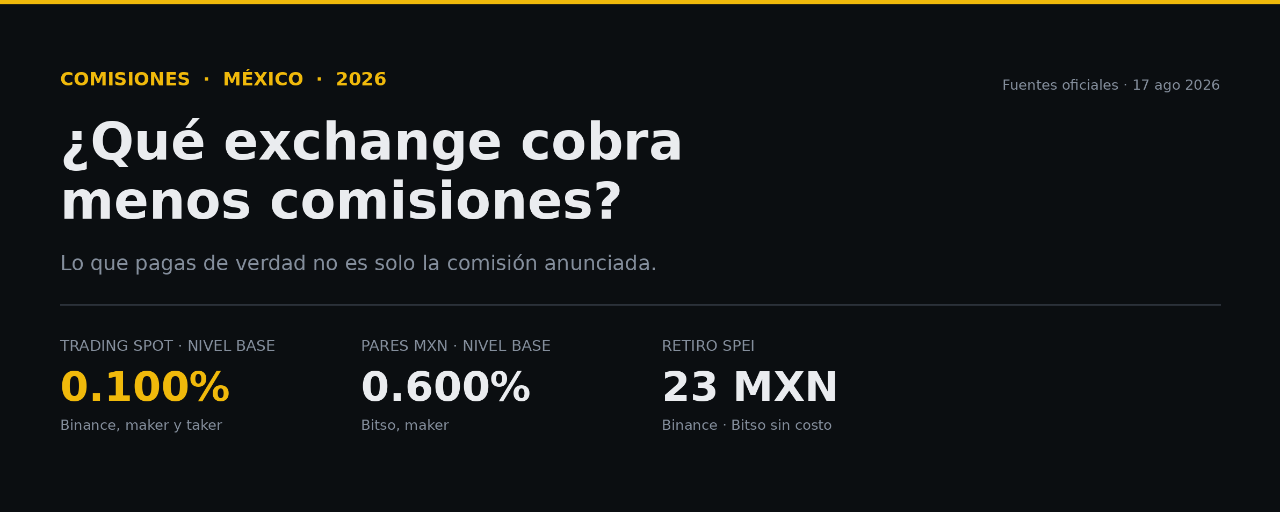
Article
Which exchange charges lower fees in Mexico in 2026?There isn’t a single answer, and if someone tells you there is, they’re probably looking at a single number. The real cost of buying crypto with pesos depends on whether you trade or simply buy: the advertised fee is only one of four things you pay. To trade in the order book, Binance charges 0.100% at the base level, compared to Bitso’s 0.600%–0.780% on MXN pairs. To deposit and withdraw pesos, Bitso is cheaper. And for quick buys, neither of the two publishes what it really costs.
Fees checked on August 17, 2026 on the official pages of each platform. All of them correspond to the base level: no accumulated volume, no discounts enabled, and no promotions.
Which exchange charges lower fees in Mexico in 2026?
There isn’t a single answer, and if someone tells you there is, they’re probably looking at a single number. The real cost of buying crypto with pesos depends on whether you trade or simply buy: the advertised fee is only one of four things you pay. To trade in the order book, Binance charges 0.100% at the base level, compared to Bitso’s 0.600%–0.780% on MXN pairs. To deposit and withdraw pesos, Bitso is cheaper. And for quick buys, neither of the two publishes what it really costs.
Fees checked on August 17, 2026 on the official pages of each platform. All of them correspond to the base level: no accumulated volume, no discounts enabled, and no promotions.
Fees checked on August 17, 2026 on the official pages of each platform. All of them correspond to the base level: no accumulated volume, no discounts enabled, and no promotions.
3
157
Log in to explore more content
Join global crypto users on Binance Square
⚡️ Get latest and useful information about crypto.
💬 Trusted by the world’s largest crypto exchange.
👍 Discover real insights from verified creators.
Email / Phone number
Trending Topics
MetaMaskExitsLidoValidatorsAfterSecurityIncident
39,534 views
686 Discussing
🚨 METAMASK JUST STARTED EXITING ETH VALIDATORS AFTER A SECURITY INCIDENT.
MetaMask says an ongoing security incident hit part of its infrastructure, forcing it to proactively exit affected validators from its non-custodial staking operations. The company says it has found no immediate threat to MetaMask wallets so far.
The key detail?
These validators are tied to Lido staking, and the exit process may temporarily remove ETH from staking while the investigation continues. Lido-related reports say the full exit, withdrawal and re-entry cycle could take up to roughly 45 days.
That means the market should separate two things:
Wallet users are not currently being told they’re at immediate risk.
But validator infrastructure clearly was serious enough to trigger an emergency exit.
And when one of Ethereum’s biggest wallet brands starts pulling validators as a precaution, traders pay attention.
Security incidents don’t need stolen funds to become market-moving.
Sometimes the reaction itself is the signal. 👀
$ETH $LDO
#metamaskexitslidovalidatorsaftersecurityincident
KimHotbae
·1 Likes
·2.6k views
MicronBeatsEarningsLiftsGuidance
25,391 views
552 Discussing
CFTCSubmitsTwoEventContractRulesToWhiteHouse
19,697 views
490 Discussing