

LeraOsta
3.7k Posts

LeraOsta
Report
Block User
Привіт ✨ Досліджую крипторинок, збираю Alpha-бали, беру участь у трейдингових активностях та розвиваю контент у CreatorPad.
Open Trade

GRAM Holder
High-Frequency Trader
4.3 Years
2.6K+ Following
6.1K+ Followers
16.1K+ Liked
Posts
Portfolio
All
Quotes
·
--
#dusk $DUSK @Dusk_Foundation and then…. I returned to DUSK again, and this time it wasn’t the word “privacy” that caught me, but the way the team is trying to embed privacy directly into the mechanics of the financial market 🤔
Because if you strip away all the crypto noise, traditional finance has one weird problem: we need to trust the system, but there’s absolutely no need to show everyone everything. Imagine a fund that is performing a major transaction. The regulator needs to confirm that everything is legal. The counterparty needs to make sure the transaction is valid. And the competitor doesn’t need to know how many assets the fund just bought.
And that’s where Dusk looks interesting.
Their model is built around the principle: “privacy where it’s needed, transparency where it’s useful.” Dusk combines confidential transfers, selective disclosure, ZK smart contracts, and deterministic settlement in a single base layer.
And this is where it gets really interesting—what triggers it… A regular blockchain often forces us into a choice: either everything is transparent, or everything is hidden.
Dusk is trying to make a third option 🔥🔥 You can hide data, but still prove that the necessary fact is true. Weird, right??! Don’t show the whole portfolio—but confirm the right of ownership
#dusk $DUSK @Dusk and then…. I returned to DUSK again, and this time it wasn’t the word “privacy” that caught me, but the way the team is trying to embed privacy directly into the mechanics of the financial market 🤔
Because if you strip away all the crypto noise, traditional finance has one weird problem: we need to trust the system, but there’s absolutely no need to show everyone everything. Imagine a fund that is performing a major transaction. The regulator needs to confirm that everything is legal. The counterparty needs to make sure the transaction is valid. And the competitor doesn’t need to know how many assets the fund just bought.
And that’s where Dusk looks interesting.
Their model is built around the principle: “privacy where it’s needed, transparency where it’s useful.” Dusk combines confidential transfers, selective disclosure, ZK smart contracts, and deterministic settlement in a single base layer.
And this is where it gets really interesting—what triggers it… A regular blockchain often forces us into a choice: either everything is transparent, or everything is hidden.
Dusk is trying to make a third option 🔥🔥 You can hide data, but still prove that the necessary fact is true. Weird, right??! Don’t show the whole portfolio—but confirm the right of ownership
Because if you strip away all the crypto noise, traditional finance has one weird problem: we need to trust the system, but there’s absolutely no need to show everyone everything. Imagine a fund that is performing a major transaction. The regulator needs to confirm that everything is legal. The counterparty needs to make sure the transaction is valid. And the competitor doesn’t need to know how many assets the fund just bought.
And that’s where Dusk looks interesting.
Their model is built around the principle: “privacy where it’s needed, transparency where it’s useful.” Dusk combines confidential transfers, selective disclosure, ZK smart contracts, and deterministic settlement in a single base layer.
And this is where it gets really interesting—what triggers it… A regular blockchain often forces us into a choice: either everything is transparent, or everything is hidden.
Dusk is trying to make a third option 🔥🔥 You can hide data, but still prove that the necessary fact is true. Weird, right??! Don’t show the whole portfolio—but confirm the right of ownership
1
10
264
·
--
#termmax @termmax …..again I got sucked into TermMax and this time one simple thing caught my attention: why do most DeFi protocols still behave as if interest rates have no memory? 🤔
In regular DeFi, the rate can change literally under your feet🤔🤔
Today a loan costs 5%, tomorrow 8%, and after the next market move you’re no longer sure whether your strategy is still profitable.
TermMax is built on a different logic: rate + amount + maturity date are set in advance.
And I think this tie to time is what makes the most interesting part of the whole design.
Because TermMax is gradually trying to turn fixed-rate from a standalone product into a full-fledged building block for DeFi.
In V2, we got Order Aggregator, limit orders on markets, Smart Unwind, and other mechanisms meant to make fixed liquidity more flexible.
App V2 already combines markets from different networks in one interface and automatically finds execution across available liquidity sources.
And that’s where an interesting thought comes in…..🗣️
TermMax doesn’t trade just money. It trades time!!!🧐🧐
But let’s not wear rose-colored glasses…..🫠
The more complex the financial machine, the more points of failure it has.
#termmax @TermMax …..again I got sucked into TermMax and this time one simple thing caught my attention: why do most DeFi protocols still behave as if interest rates have no memory? 🤔
In regular DeFi, the rate can change literally under your feet🤔🤔
Today a loan costs 5%, tomorrow 8%, and after the next market move you’re no longer sure whether your strategy is still profitable.
TermMax is built on a different logic: rate + amount + maturity date are set in advance.
And I think this tie to time is what makes the most interesting part of the whole design.
Because TermMax is gradually trying to turn fixed-rate from a standalone product into a full-fledged building block for DeFi.
In V2, we got Order Aggregator, limit orders on markets, Smart Unwind, and other mechanisms meant to make fixed liquidity more flexible.
App V2 already combines markets from different networks in one interface and automatically finds execution across available liquidity sources.
And that’s where an interesting thought comes in…..🗣️
TermMax doesn’t trade just money. It trades time!!!🧐🧐
But let’s not wear rose-colored glasses…..🫠
The more complex the financial machine, the more points of failure it has.
In regular DeFi, the rate can change literally under your feet🤔🤔
Today a loan costs 5%, tomorrow 8%, and after the next market move you’re no longer sure whether your strategy is still profitable.
TermMax is built on a different logic: rate + amount + maturity date are set in advance.
And I think this tie to time is what makes the most interesting part of the whole design.
Because TermMax is gradually trying to turn fixed-rate from a standalone product into a full-fledged building block for DeFi.
In V2, we got Order Aggregator, limit orders on markets, Smart Unwind, and other mechanisms meant to make fixed liquidity more flexible.
App V2 already combines markets from different networks in one interface and automatically finds execution across available liquidity sources.
And that’s where an interesting thought comes in…..🗣️
TermMax doesn’t trade just money. It trades time!!!🧐🧐
But let’s not wear rose-colored glasses…..🫠
The more complex the financial machine, the more points of failure it has.
1
10
555
·
--
Bullish
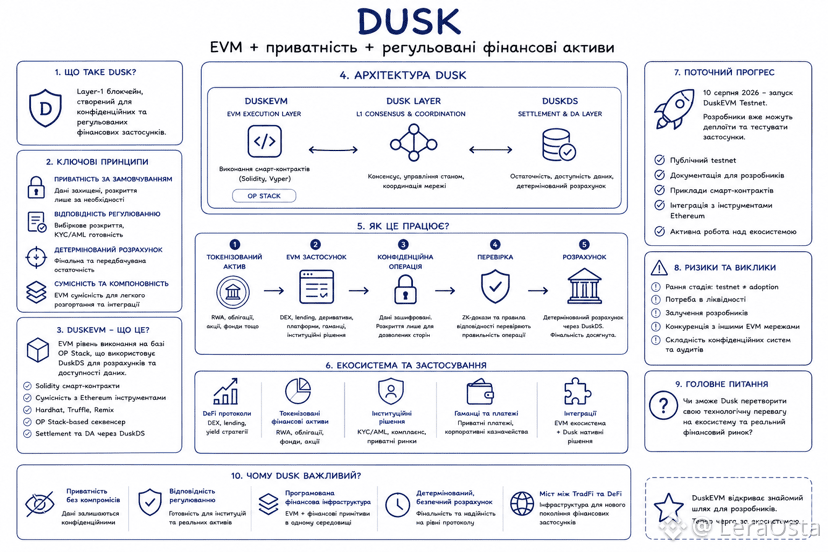
#dusk $DUSK @Dusk_Foundation I looked at DUSK again, and this time one very specific moment caught my attention: DuskEVM has finally moved from talks about the future to the testnet 🤔
On 10.08.2026, Dusk launched the DuskEVM testnet, where developers can already deploy and test applications using the familiar Solidity and Hardhat.
And you know what’s more interesting here than the word “EVM” itself?
It’s that Dusk is essentially opening the door for developers who no longer need to learn an entirely new stack just to try building something on Dusk.
Because one thing is to say:
“ We’re compatible with eth. ”
And quite another is to give developers familiar tools—Solidity—and a real testnet where they can start experimenting right now.
DUSK itself describes DuskEVM as an OP Stack-based EVM execution layer that uses DuskDS for settlement and data availability.
And this is where it gets most interesting for me…..🧐
Dusk isn’t trying to simply create yet another EVM network where you can launch another DEX.
Their bet is much more specific: EVM + privacy + regulated financial assets + deterministic settlement.
That is, the developer gets a familiar path through EVM, while the infrastructure itself remains tailored for financial scenarios where what matters isn’t just speed and fees, but also privacy and access control.
#dusk $DUSK @Dusk I looked at DUSK again, and this time one very specific moment caught my attention: DuskEVM has finally moved from talks about the future to the testnet 🤔
On 10.08.2026, Dusk launched the DuskEVM testnet, where developers can already deploy and test applications using the familiar Solidity and Hardhat.
And you know what’s more interesting here than the word “EVM” itself?
It’s that Dusk is essentially opening the door for developers who no longer need to learn an entirely new stack just to try building something on Dusk.
Because one thing is to say:
“ We’re compatible with eth. ”
And quite another is to give developers familiar tools—Solidity—and a real testnet where they can start experimenting right now.
DUSK itself describes DuskEVM as an OP Stack-based EVM execution layer that uses DuskDS for settlement and data availability.
And this is where it gets most interesting for me…..🧐
Dusk isn’t trying to simply create yet another EVM network where you can launch another DEX.
Their bet is much more specific: EVM + privacy + regulated financial assets + deterministic settlement.
That is, the developer gets a familiar path through EVM, while the infrastructure itself remains tailored for financial scenarios where what matters isn’t just speed and fees, but also privacy and access control.
On 10.08.2026, Dusk launched the DuskEVM testnet, where developers can already deploy and test applications using the familiar Solidity and Hardhat.
And you know what’s more interesting here than the word “EVM” itself?
It’s that Dusk is essentially opening the door for developers who no longer need to learn an entirely new stack just to try building something on Dusk.
Because one thing is to say:
“ We’re compatible with eth. ”
And quite another is to give developers familiar tools—Solidity—and a real testnet where they can start experimenting right now.
DUSK itself describes DuskEVM as an OP Stack-based EVM execution layer that uses DuskDS for settlement and data availability.
And this is where it gets most interesting for me…..🧐
Dusk isn’t trying to simply create yet another EVM network where you can launch another DEX.
Their bet is much more specific: EVM + privacy + regulated financial assets + deterministic settlement.
That is, the developer gets a familiar path through EVM, while the infrastructure itself remains tailored for financial scenarios where what matters isn’t just speed and fees, but also privacy and access control.
3
10
428
·
--
Bearish
#termmax @termmax I looked again at TermMax and this time what got my attention wasn’t the fixed-rate itself, but where the team is trying to take it 🧐🤔
Because at first, @termmax could be seen simply as a protocol where you can borrow and lend under a fixed rate.
But!! the latest development looks a bit more interesting, in my opinion….
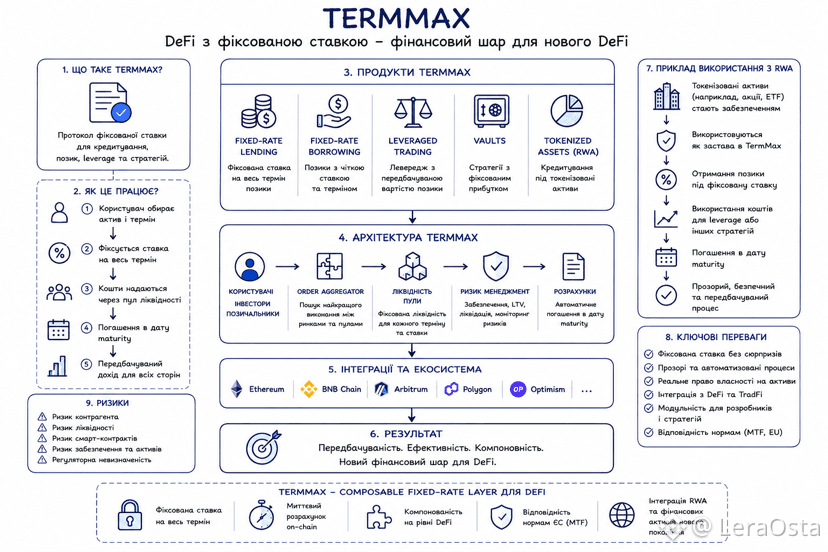
TermMax V2 is positioned not just as a lending protocol, but as a composable fixed-rate layer for DeFi—meaning it’s a kind of financial layer that other strategies and protocols can use as a building block.
And this is where, in my opinion, it gets really interesting.
Most DeFi protocols still force the user to assemble the financial setup themselves: find liquidity, choose a market, open a position, keep an eye on the rate, and then close everything properly too… well, it is what it is, honestly.
TermMax is moving in the opposite direction.
Its App V2 combines markets from different networks into a single interface, adds order routing, and enables working with positions through one system. That is, instead of “running between protocols,” one financial layer is gradually formed over different markets.
In the end, it’s starting to look less like a standalone DeFi product….and more like a financial building set.
#termmax @TermMax I looked again at TermMax and this time what got my attention wasn’t the fixed-rate itself, but where the team is trying to take it 🧐🤔
Because at first, @TermMax could be seen simply as a protocol where you can borrow and lend under a fixed rate.
But!! the latest development looks a bit more interesting, in my opinion….
TermMax V2 is positioned not just as a lending protocol, but as a composable fixed-rate layer for DeFi—meaning it’s a kind of financial layer that other strategies and protocols can use as a building block.
And this is where, in my opinion, it gets really interesting.
Most DeFi protocols still force the user to assemble the financial setup themselves: find liquidity, choose a market, open a position, keep an eye on the rate, and then close everything properly too… well, it is what it is, honestly.
TermMax is moving in the opposite direction.
Its App V2 combines markets from different networks into a single interface, adds order routing, and enables working with positions through one system. That is, instead of “running between protocols,” one financial layer is gradually formed over different markets.
In the end, it’s starting to look less like a standalone DeFi product….and more like a financial building set.
Because at first, @TermMax could be seen simply as a protocol where you can borrow and lend under a fixed rate.
But!! the latest development looks a bit more interesting, in my opinion….
TermMax V2 is positioned not just as a lending protocol, but as a composable fixed-rate layer for DeFi—meaning it’s a kind of financial layer that other strategies and protocols can use as a building block.
And this is where, in my opinion, it gets really interesting.
Most DeFi protocols still force the user to assemble the financial setup themselves: find liquidity, choose a market, open a position, keep an eye on the rate, and then close everything properly too… well, it is what it is, honestly.
TermMax is moving in the opposite direction.
Its App V2 combines markets from different networks into a single interface, adds order routing, and enables working with positions through one system. That is, instead of “running between protocols,” one financial layer is gradually formed over different markets.
In the end, it’s starting to look less like a standalone DeFi product….and more like a financial building set.
1
5
183
·
--
#termmax @termmax she returned to TermMax again, and this time it didn’t catch me with another campaign, not with APY and not even with the future $TMX. I became interested in something else: why does TermMax so stubbornly try to get rid of one of the most unpleasant things in DeFi—interest rate uncertainty? Usually, classic DeFi works with a familiar scenario: you enter a position, the rate changes, the risk changes, and you find out about it only after the market has decided to surprise you.
It seems to me that TermMax is trying to flip this logic.
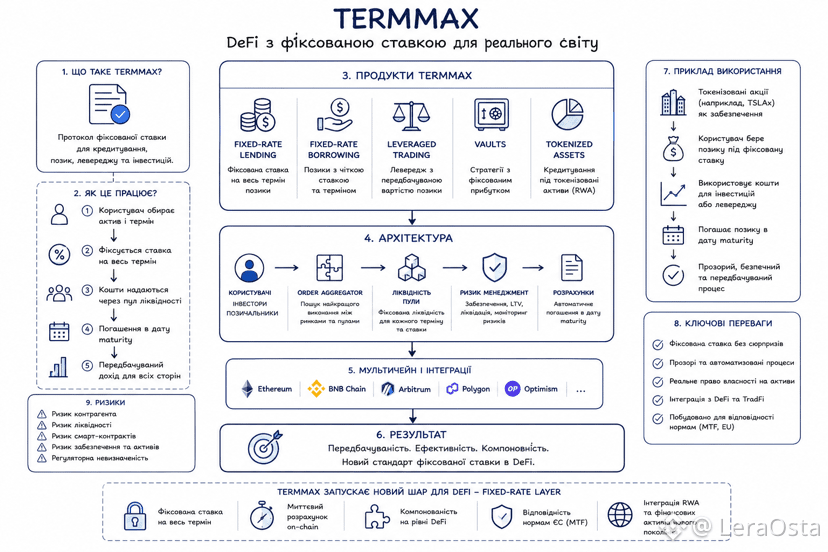
Here, the rate is fixed in advance, and the loan has a defined repayment term. You know in advance how much the loan will cost or what income the position can generate by maturity. That’s the TermMax model positioned as the foundation of a more predictable DeFi.
And that’s where, in my view, it gets interesting 🗣️
TermMax is gradually starting to look less like just another lending protocol. Let me explain. In May, the team launched App V2, where markets from different networks are consolidated into a single interface, and the Order Aggregator can combine available liquidity to find better execution. So the user doesn’t necessarily have to go between dozens of markets and manually piece together a position.
But the real intrigue for me is where everything is headed. Time will tell
#termmax @TermMax she returned to TermMax again, and this time it didn’t catch me with another campaign, not with APY and not even with the future $TMX. I became interested in something else: why does TermMax so stubbornly try to get rid of one of the most unpleasant things in DeFi—interest rate uncertainty? Usually, classic DeFi works with a familiar scenario: you enter a position, the rate changes, the risk changes, and you find out about it only after the market has decided to surprise you.
It seems to me that TermMax is trying to flip this logic.
Here, the rate is fixed in advance, and the loan has a defined repayment term. You know in advance how much the loan will cost or what income the position can generate by maturity. That’s the TermMax model positioned as the foundation of a more predictable DeFi.
And that’s where, in my view, it gets interesting 🗣️
TermMax is gradually starting to look less like just another lending protocol. Let me explain. In May, the team launched App V2, where markets from different networks are consolidated into a single interface, and the Order Aggregator can combine available liquidity to find better execution. So the user doesn’t necessarily have to go between dozens of markets and manually piece together a position.
But the real intrigue for me is where everything is headed. Time will tell
It seems to me that TermMax is trying to flip this logic.
Here, the rate is fixed in advance, and the loan has a defined repayment term. You know in advance how much the loan will cost or what income the position can generate by maturity. That’s the TermMax model positioned as the foundation of a more predictable DeFi.
And that’s where, in my view, it gets interesting 🗣️
TermMax is gradually starting to look less like just another lending protocol. Let me explain. In May, the team launched App V2, where markets from different networks are consolidated into a single interface, and the Order Aggregator can combine available liquidity to find better execution. So the user doesn’t necessarily have to go between dozens of markets and manually piece together a position.
But the real intrigue for me is where everything is headed. Time will tell
7
235
·
--
#dusk $DUSK you know.... today I sat down and really paid attention to what exactly Dusk wants to do with Dusk Trade, instead of just reading yet another someone else’s thread. And the first thing that stayed in my mind wasn’t the word “no broker”...
What got me is how easily people today talk about “tokenized financial assets”🤔 A lot of projects actually take a traditional financial asset, wrap it into a token, and then put a big fat period on that. The asset is already on-chain, but the actual financial process remains somewhere outside the blockchain: trading separately, settlement separately, ownership separately. A mess! Isn’t it true? @Dusk_Foundation is trying to bring these parts together in one place.
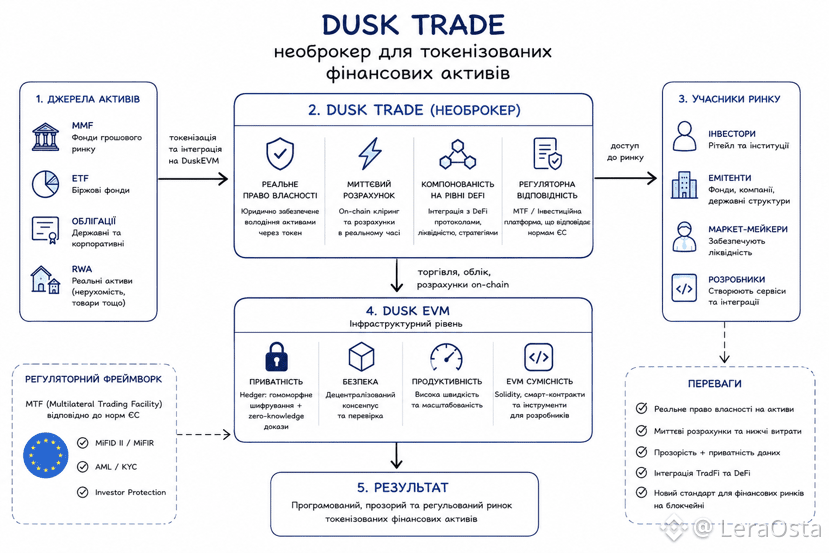
As a no-broker on DuskEVM, it’s designed as an application layer for tokenized financial assets—from MMFs and ETFs to bonds and the broader RWA class.
And this is where it gets really interesting for me—and what personally hooks me🗣️
It’s about real ownership rights, instant settlement, and the ability to make a tokenized asset a DeFi component—so it can interact with other financial primitives, not just sit on-chain as a beautiful digital souvenir. And the question is no longer whether the concept itself is interesting. It is. The more practical question is: can this be implemented!!??
#dusk $DUSK you know.... today I sat down and really paid attention to what exactly Dusk wants to do with Dusk Trade, instead of just reading yet another someone else’s thread. And the first thing that stayed in my mind wasn’t the word “no broker”...
What got me is how easily people today talk about “tokenized financial assets”🤔 A lot of projects actually take a traditional financial asset, wrap it into a token, and then put a big fat period on that. The asset is already on-chain, but the actual financial process remains somewhere outside the blockchain: trading separately, settlement separately, ownership separately. A mess! Isn’t it true? @Dusk is trying to bring these parts together in one place.
As a no-broker on DuskEVM, it’s designed as an application layer for tokenized financial assets—from MMFs and ETFs to bonds and the broader RWA class.
And this is where it gets really interesting for me—and what personally hooks me🗣️
It’s about real ownership rights, instant settlement, and the ability to make a tokenized asset a DeFi component—so it can interact with other financial primitives, not just sit on-chain as a beautiful digital souvenir. And the question is no longer whether the concept itself is interesting. It is. The more practical question is: can this be implemented!!??
What got me is how easily people today talk about “tokenized financial assets”🤔 A lot of projects actually take a traditional financial asset, wrap it into a token, and then put a big fat period on that. The asset is already on-chain, but the actual financial process remains somewhere outside the blockchain: trading separately, settlement separately, ownership separately. A mess! Isn’t it true? @Dusk is trying to bring these parts together in one place.
As a no-broker on DuskEVM, it’s designed as an application layer for tokenized financial assets—from MMFs and ETFs to bonds and the broader RWA class.
And this is where it gets really interesting for me—and what personally hooks me🗣️
It’s about real ownership rights, instant settlement, and the ability to make a tokenized asset a DeFi component—so it can interact with other financial primitives, not just sit on-chain as a beautiful digital souvenir. And the question is no longer whether the concept itself is interesting. It is. The more practical question is: can this be implemented!!??
2
11
619
·
--
Bullish
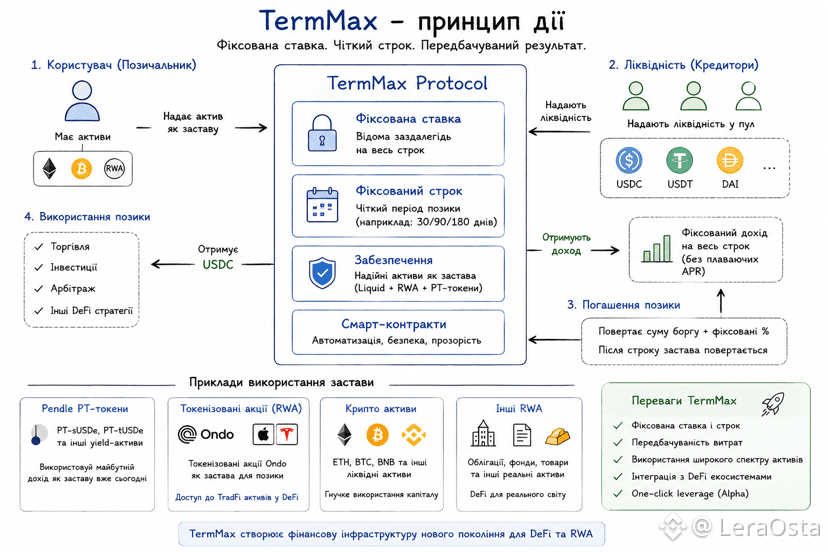
#termmax @termmax It looks even more interesting to work with Pendle PT tokens.
TermMax has already been integrated with the Pendle ecosystem: for example, PT-sUSDe, PT-tUSDe, and other yield-bearing assets can be used as collateral for fixed-rate borrowing.
And that’s no longer just “another lending protocol.”
It’s an opportunity to build complex strategies around an asset’s yield.
There’s also a more practical example—tokenized stocks. On BNB Chain, TermMax launched a fixed-rate borrowing market where tokenized securities from Ondo Global Markets can be used as collateral.
And that’s where I’d look at TermMax more broadly. 🧐🤔
Because as DeFi gradually moves toward RWA—tokenized stocks, bonds, and other real-world assets—they need more than just trading.
They need financial infrastructure around these assets.
Collateral—loan—fixed rate—term—yield.
That’s exactly the layer TermMax is trying to build.
There’s also one-click leverage and TermMax Alpha: users can get leveraged exposure with a fixed upfront premium, without the classic model of ongoing margin calls.
I like this way of thinking.
Not “how to build one more protocol where you deposit a token and get an APR.”
But how to turn DeFi into a proper financial system where you can plan the cost of capital and returns.
#termmax @TermMax It looks even more interesting to work with Pendle PT tokens.
TermMax has already been integrated with the Pendle ecosystem: for example, PT-sUSDe, PT-tUSDe, and other yield-bearing assets can be used as collateral for fixed-rate borrowing.
And that’s no longer just “another lending protocol.”
It’s an opportunity to build complex strategies around an asset’s yield.
There’s also a more practical example—tokenized stocks. On BNB Chain, TermMax launched a fixed-rate borrowing market where tokenized securities from Ondo Global Markets can be used as collateral.
And that’s where I’d look at TermMax more broadly. 🧐🤔
Because as DeFi gradually moves toward RWA—tokenized stocks, bonds, and other real-world assets—they need more than just trading.
They need financial infrastructure around these assets.
Collateral—loan—fixed rate—term—yield.
That’s exactly the layer TermMax is trying to build.
There’s also one-click leverage and TermMax Alpha: users can get leveraged exposure with a fixed upfront premium, without the classic model of ongoing margin calls.
I like this way of thinking.
Not “how to build one more protocol where you deposit a token and get an APR.”
But how to turn DeFi into a proper financial system where you can plan the cost of capital and returns.
TermMax has already been integrated with the Pendle ecosystem: for example, PT-sUSDe, PT-tUSDe, and other yield-bearing assets can be used as collateral for fixed-rate borrowing.
And that’s no longer just “another lending protocol.”
It’s an opportunity to build complex strategies around an asset’s yield.
There’s also a more practical example—tokenized stocks. On BNB Chain, TermMax launched a fixed-rate borrowing market where tokenized securities from Ondo Global Markets can be used as collateral.
And that’s where I’d look at TermMax more broadly. 🧐🤔
Because as DeFi gradually moves toward RWA—tokenized stocks, bonds, and other real-world assets—they need more than just trading.
They need financial infrastructure around these assets.
Collateral—loan—fixed rate—term—yield.
That’s exactly the layer TermMax is trying to build.
There’s also one-click leverage and TermMax Alpha: users can get leveraged exposure with a fixed upfront premium, without the classic model of ongoing margin calls.
I like this way of thinking.
Not “how to build one more protocol where you deposit a token and get an APR.”
But how to turn DeFi into a proper financial system where you can plan the cost of capital and returns.
1
6
319
·
--
Bullish
#dusk $DUSK @Dusk_Foundation Trade: when tokenized assets get their own trading tier🤔
Yesterday I looked again at DUSK and thought: what if the next big step for the ecosystem isn’t yet another DeFi protocol, but a place where tokenized financial assets can finally be properly bought and sold?
If you strip away all the noise around RWA, most projects today sell the same familiar package: tokenize an asset, move it on-chain, and then we’ll figure out the rest.
DUSK Trade, it seems, is looking at this from a different angle.
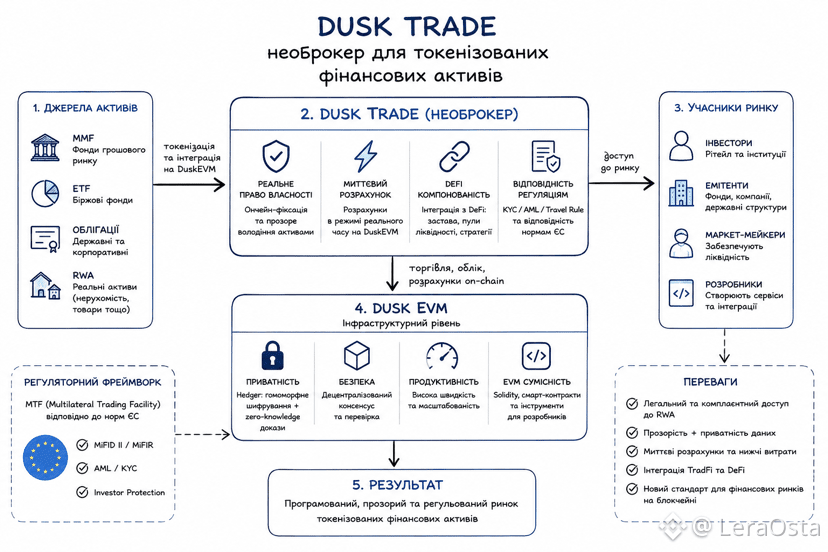
This is a non-broker on DuskEVM—an example tier for trading tokenized financial assets, where MMF, ETFs, bonds, and other RWAs can get their own on-chain environment.
And this is where, in my opinion, it starts to get interesting.
Because tokenization by itself isn’t yet a financial market. You can turn an asset into a token, but the much more important question is: what can you do with it after that?
DUSK Trade is trying to close that gap.
Real ownership rights, instant settlement, and the ability to use assets in DeFi create a completely different picture.
In other words, RWAs stop being just a “digital copy” of a traditional asset and gain the opportunity to become part of a programmable financial system. Sounds great, right?
#dusk $DUSK @Dusk Trade: when tokenized assets get their own trading tier🤔
Yesterday I looked again at DUSK and thought: what if the next big step for the ecosystem isn’t yet another DeFi protocol, but a place where tokenized financial assets can finally be properly bought and sold?
If you strip away all the noise around RWA, most projects today sell the same familiar package: tokenize an asset, move it on-chain, and then we’ll figure out the rest.
DUSK Trade, it seems, is looking at this from a different angle.
This is a non-broker on DuskEVM—an example tier for trading tokenized financial assets, where MMF, ETFs, bonds, and other RWAs can get their own on-chain environment.
And this is where, in my opinion, it starts to get interesting.
Because tokenization by itself isn’t yet a financial market. You can turn an asset into a token, but the much more important question is: what can you do with it after that?
DUSK Trade is trying to close that gap.
Real ownership rights, instant settlement, and the ability to use assets in DeFi create a completely different picture.
In other words, RWAs stop being just a “digital copy” of a traditional asset and gain the opportunity to become part of a programmable financial system. Sounds great, right?
Yesterday I looked again at DUSK and thought: what if the next big step for the ecosystem isn’t yet another DeFi protocol, but a place where tokenized financial assets can finally be properly bought and sold?
If you strip away all the noise around RWA, most projects today sell the same familiar package: tokenize an asset, move it on-chain, and then we’ll figure out the rest.
DUSK Trade, it seems, is looking at this from a different angle.
This is a non-broker on DuskEVM—an example tier for trading tokenized financial assets, where MMF, ETFs, bonds, and other RWAs can get their own on-chain environment.
And this is where, in my opinion, it starts to get interesting.
Because tokenization by itself isn’t yet a financial market. You can turn an asset into a token, but the much more important question is: what can you do with it after that?
DUSK Trade is trying to close that gap.
Real ownership rights, instant settlement, and the ability to use assets in DeFi create a completely different picture.
In other words, RWAs stop being just a “digital copy” of a traditional asset and gain the opportunity to become part of a programmable financial system. Sounds great, right?
1
1
9
176
·
--
Bullish
#termmax @termmax TermMax: What if DeFi finally learned to count money in advance?I think one of the most underestimated problems in DeFi isn’t the lack of yield.🤔
The issue is that very often you don’t know what the price of money will be tomorrow.
The rate is floating.
The cost of the loan changes.
The leverage needs constant monitoring.
And complex strategies turn into dozens of transactions.
That’s where TermMax becomes interesting.
Its idea is quite simple: make DeFi financial instruments where the rate and the term are known ahead of time.
So instead of “let’s see what happens to APR in a week” you get a more predictable setup.
And this is where the most interesting part begins, the part that really catches my attention.
For example, a trader has an asset, but doesn’t want to sell it.
They can use it as collateral, get USDC at a fixed rate, and understand the cost of the loan in advance. Sounds great, right?
Or another situation.
There’s an investor who doesn’t need the maximum APY at any cost.
They care more about knowing how much they’ll receive.
Then fixed-rate lending becomes much more interesting than classic floating APR.
After all, mature DeFi isn’t only about high APY.
It’s about predictability.
That’s why it’s exciting to watch TermMax in this direction 👀
#termmax @TermMax TermMax: What if DeFi finally learned to count money in advance?I think one of the most underestimated problems in DeFi isn’t the lack of yield.🤔
The issue is that very often you don’t know what the price of money will be tomorrow.
The rate is floating.
The cost of the loan changes.
The leverage needs constant monitoring.
And complex strategies turn into dozens of transactions.
That’s where TermMax becomes interesting.
Its idea is quite simple: make DeFi financial instruments where the rate and the term are known ahead of time.
So instead of “let’s see what happens to APR in a week” you get a more predictable setup.
And this is where the most interesting part begins, the part that really catches my attention.
For example, a trader has an asset, but doesn’t want to sell it.
They can use it as collateral, get USDC at a fixed rate, and understand the cost of the loan in advance. Sounds great, right?
Or another situation.
There’s an investor who doesn’t need the maximum APY at any cost.
They care more about knowing how much they’ll receive.
Then fixed-rate lending becomes much more interesting than classic floating APR.
After all, mature DeFi isn’t only about high APY.
It’s about predictability.
That’s why it’s exciting to watch TermMax in this direction 👀
The issue is that very often you don’t know what the price of money will be tomorrow.
The rate is floating.
The cost of the loan changes.
The leverage needs constant monitoring.
And complex strategies turn into dozens of transactions.
That’s where TermMax becomes interesting.
Its idea is quite simple: make DeFi financial instruments where the rate and the term are known ahead of time.
So instead of “let’s see what happens to APR in a week” you get a more predictable setup.
And this is where the most interesting part begins, the part that really catches my attention.
For example, a trader has an asset, but doesn’t want to sell it.
They can use it as collateral, get USDC at a fixed rate, and understand the cost of the loan in advance. Sounds great, right?
Or another situation.
There’s an investor who doesn’t need the maximum APY at any cost.
They care more about knowing how much they’ll receive.
Then fixed-rate lending becomes much more interesting than classic floating APR.
After all, mature DeFi isn’t only about high APY.
It’s about predictability.
That’s why it’s exciting to watch TermMax in this direction 👀
2
1
9
258
·
--
Bullish
#dusk $DUSK @Dusk_Foundation DuskEVM Mainnet is about to launch, and that’s where it gets interesting. Instead of forcing everyone to learn a whole new ecosystem from scratch, Dusk offers a familiar path through Solidity and the EVM.
But the most interesting part starts next. DuskEVM enables building confidential EVM applications through Hedger — a module that uses homomorphic encryption and zero-knowledge proofs. Simply put: financial data can be protected while still allowing for verification. And that combination could be critical for regulated finance.
Because privacy without oversight for institutions is a problem. And transparency without privacy is also far from ideal! Dusk is trying to put these two things on the same table.
But let’s not wear rose-colored glasses: the Mainnet launch by itself guarantees nothing. You can give EVM developers privacy and a beautiful technology. But if nobody starts using it, all that will remain is a loud headline. So the real test of DuskEVM won’t begin on launch day. It will begin when real applications, users, and financial use cases appear on it.🤔👌
#dusk $DUSK @Dusk DuskEVM Mainnet is about to launch, and that’s where it gets interesting. Instead of forcing everyone to learn a whole new ecosystem from scratch, Dusk offers a familiar path through Solidity and the EVM.
But the most interesting part starts next. DuskEVM enables building confidential EVM applications through Hedger — a module that uses homomorphic encryption and zero-knowledge proofs. Simply put: financial data can be protected while still allowing for verification. And that combination could be critical for regulated finance.
Because privacy without oversight for institutions is a problem. And transparency without privacy is also far from ideal! Dusk is trying to put these two things on the same table.
But let’s not wear rose-colored glasses: the Mainnet launch by itself guarantees nothing. You can give EVM developers privacy and a beautiful technology. But if nobody starts using it, all that will remain is a loud headline. So the real test of DuskEVM won’t begin on launch day. It will begin when real applications, users, and financial use cases appear on it.🤔👌
But the most interesting part starts next. DuskEVM enables building confidential EVM applications through Hedger — a module that uses homomorphic encryption and zero-knowledge proofs. Simply put: financial data can be protected while still allowing for verification. And that combination could be critical for regulated finance.
Because privacy without oversight for institutions is a problem. And transparency without privacy is also far from ideal! Dusk is trying to put these two things on the same table.
But let’s not wear rose-colored glasses: the Mainnet launch by itself guarantees nothing. You can give EVM developers privacy and a beautiful technology. But if nobody starts using it, all that will remain is a loud headline. So the real test of DuskEVM won’t begin on launch day. It will begin when real applications, users, and financial use cases appear on it.🤔👌
3
10
189
·
--
Bullish
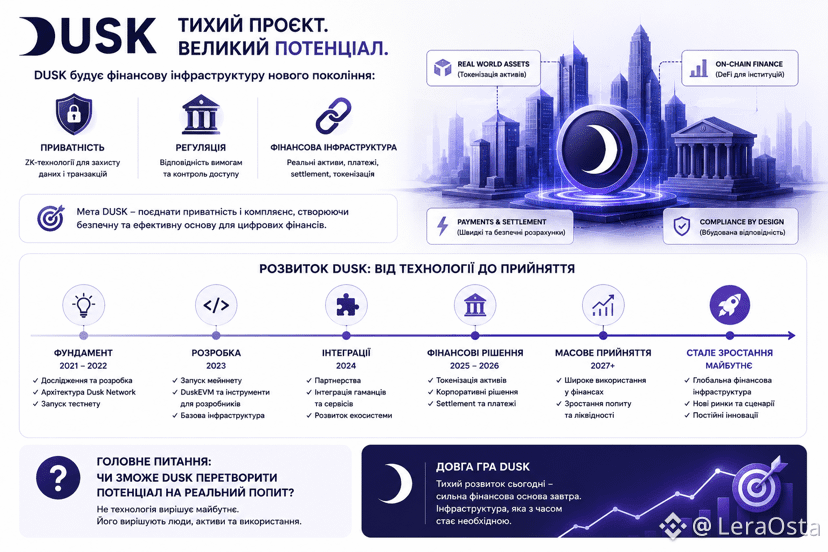
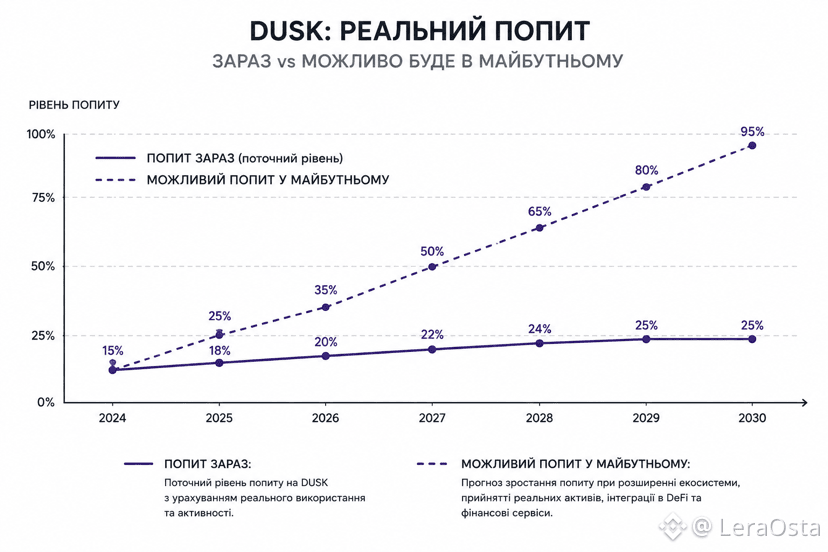
#dusk $DUSK @Dusk_Foundation DUSK: development that doesn't shout about itself, but can change the game🤔 Yesterday I looked at DUSK again and thought: what if its main trump card is not trying to outshout the entire crypto market? What if you remove the noise around L1—most projects end up selling the familiar set: speed, scalability, low fees. DUSK is taking a different route: it builds infrastructure for finance, where privacy, regulation, and blockchain don't have to interfere with each other, but instead work in sync. And that's, in my opinion, where it gets most interesting. After all, network development isn't the number of beautiful announcements. It's the number of real use cases that gradually move on-chain. And if DUSK can attract tokenized assets, financial services, and business cases, its ecosystem may start growing not just in words, but in actual usage. But let's not wear rose-colored glasses: strong technology doesn't automatically mean a strong ecosystem. You can build ideal infrastructure, but without users, assets, and developers, it will remain just a beautiful city without residents. So the main question now isn't “how interesting is its technology?”. It's more practical: can it turn a technical advantage into steady demand??!
#dusk $DUSK @Dusk DUSK: development that doesn't shout about itself, but can change the game🤔 Yesterday I looked at DUSK again and thought: what if its main trump card is not trying to outshout the entire crypto market? What if you remove the noise around L1—most projects end up selling the familiar set: speed, scalability, low fees. DUSK is taking a different route: it builds infrastructure for finance, where privacy, regulation, and blockchain don't have to interfere with each other, but instead work in sync. And that's, in my opinion, where it gets most interesting. After all, network development isn't the number of beautiful announcements. It's the number of real use cases that gradually move on-chain. And if DUSK can attract tokenized assets, financial services, and business cases, its ecosystem may start growing not just in words, but in actual usage. But let's not wear rose-colored glasses: strong technology doesn't automatically mean a strong ecosystem. You can build ideal infrastructure, but without users, assets, and developers, it will remain just a beautiful city without residents. So the main question now isn't “how interesting is its technology?”. It's more practical: can it turn a technical advantage into steady demand??!
6
10
140
·
--
Bullish
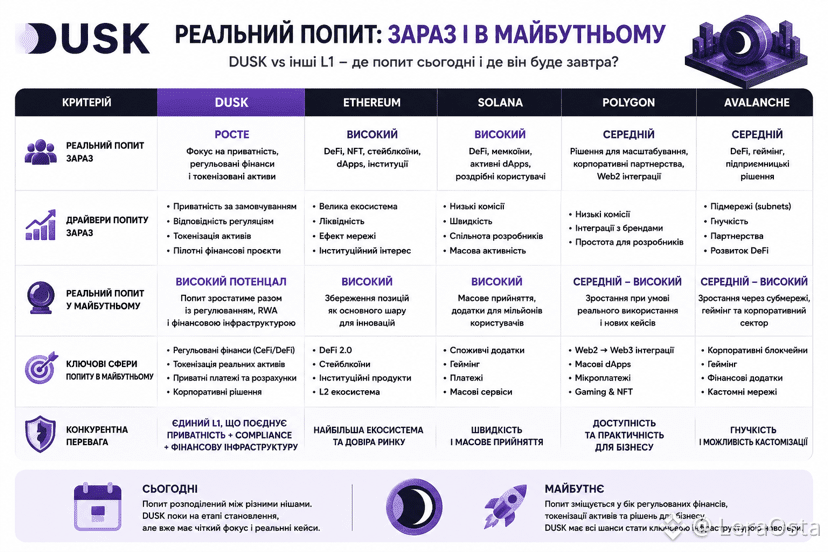
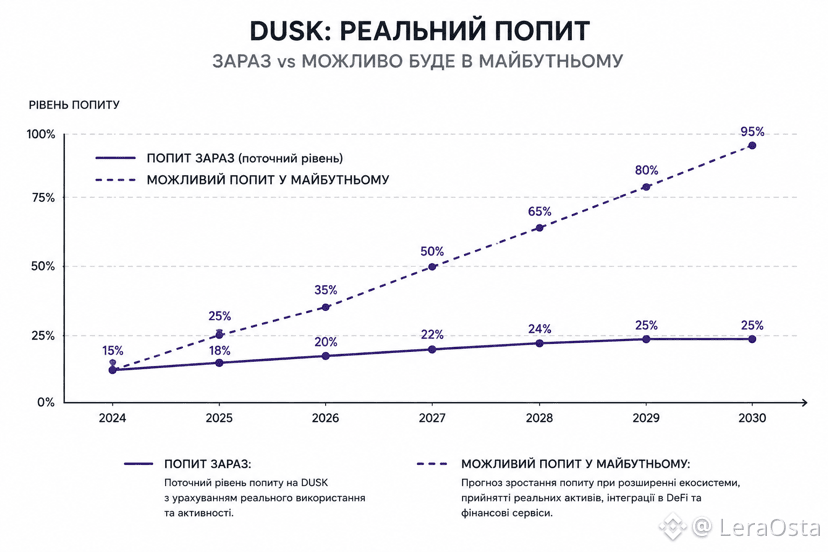
#dusk $DUSK @Dusk_Foundation a quiet project that could go off—completely in the wrong place🤔Yesterday I looked at DUSK again and thought: what if its main strength isn’t actually to be yet another “fast blockchain”?Because if you strip away all the crypto noise, most L1s today are basically selling the same story: faster, cheaper, more scalable.DUSK is trying to occupy a different niche—financial infrastructure, where privacy and regulation should work together, not fight each other.And that’s where it gets interesting.The token can grow on hype.The ecosystem can grow on speculation.But infrastructure grows when people start using it for real.DUSK is essentially playing the long game.It’s not just about attracting crypto traders—it’s about proving that blockchain can work properly with real financial assets and business use cases.But let’s not put on rose-colored glasses: the technology by itself guarantees nothing.So the main question for DUSK right now isn’t “how cool is the technology?”.In my opinion, it’s much simpler: can it turn from promising infrastructure into something people genuinely need??!
#dusk $DUSK @Dusk a quiet project that could go off—completely in the wrong place🤔Yesterday I looked at DUSK again and thought: what if its main strength isn’t actually to be yet another “fast blockchain”?Because if you strip away all the crypto noise, most L1s today are basically selling the same story: faster, cheaper, more scalable.DUSK is trying to occupy a different niche—financial infrastructure, where privacy and regulation should work together, not fight each other.And that’s where it gets interesting.The token can grow on hype.The ecosystem can grow on speculation.But infrastructure grows when people start using it for real.DUSK is essentially playing the long game.It’s not just about attracting crypto traders—it’s about proving that blockchain can work properly with real financial assets and business use cases.But let’s not put on rose-colored glasses: the technology by itself guarantees nothing.So the main question for DUSK right now isn’t “how cool is the technology?”.In my opinion, it’s much simpler: can it turn from promising infrastructure into something people genuinely need??!
2
3
11
234
·
--
Bullish
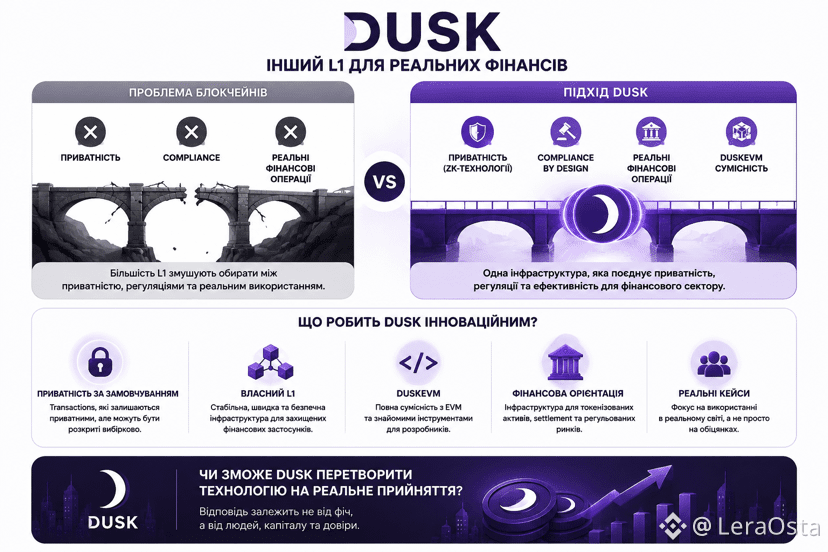
#dusk $DUSK @Dusk_Foundation Yesterday again got stuck in my thoughts about DUSK and, honestly, the longer you look at the project, the more you understand—this isn’t just another Layer-1. DUSK is trying to combine what still remains difficult for blockchains: privacy, compliance, and real financial transactions. The bet here isn’t on another hype, but on infrastructure for tokenized assets, finance, and regulated markets. And that’s its main feature. But let’s be honest: technology without users is worth nothing!! DUSK might have a strong architecture, private transactions, and DuskEVM, but the real value will show through user interest. No matter how you look at it. In the end, blockchains are judged not by beautiful promises, but by how many people and how much capital actually use them. And here’s where it gets interesting: can DUSK turn its technological advantage into adoption? 😏 We’ll see. But the main question that really gets under my skin is: is this innovation actually needed in the market?? Not just for crypto enthusiasts?! It may have a strong technological foundation, but technology without users is just an expensive kit. If DUSK really can make private and regulated on-chain finance practical—then that would be a completely different story.
#dusk $DUSK @Dusk Yesterday again got stuck in my thoughts about DUSK and, honestly, the longer you look at the project, the more you understand—this isn’t just another Layer-1. DUSK is trying to combine what still remains difficult for blockchains: privacy, compliance, and real financial transactions. The bet here isn’t on another hype, but on infrastructure for tokenized assets, finance, and regulated markets. And that’s its main feature. But let’s be honest: technology without users is worth nothing!! DUSK might have a strong architecture, private transactions, and DuskEVM, but the real value will show through user interest. No matter how you look at it. In the end, blockchains are judged not by beautiful promises, but by how many people and how much capital actually use them. And here’s where it gets interesting: can DUSK turn its technological advantage into adoption? 😏 We’ll see. But the main question that really gets under my skin is: is this innovation actually needed in the market?? Not just for crypto enthusiasts?! It may have a strong technological foundation, but technology without users is just an expensive kit. If DUSK really can make private and regulated on-chain finance practical—then that would be a completely different story.
15
2
11
258
·
--
Bullish
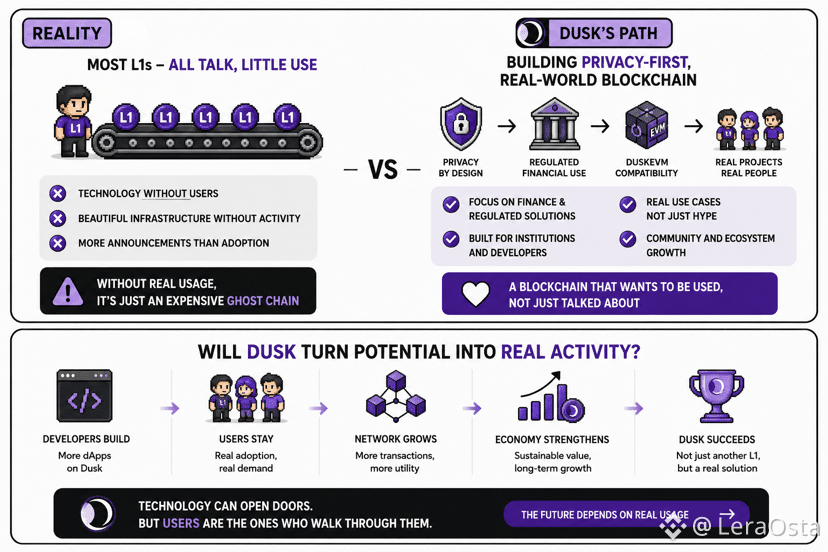
$DUSK Yesterday it got stuck again on a thought about DUSK and, honestly, the longer you look at this project, the more you understand—this isn’t just about technology or beautiful claims. It’s essentially about whether Dusk can turn its infrastructure into real-world usage. Because if you strip away all the noise around L1, most blockchains aren’t fighting for technological sophistication—they’re fighting for the user. And that’s where it gets really interesting. In @Dusk_Foundation , the stake looks clear: privacy, regulated financial decisions, DuskEVM, and building an ecosystem where the blockchain is needed not for the blockchain’s sake. But the main question that triggers me is: how many people and projects are actually ready to use it? Because the problem with most L1s is that the technology can be strong, but activity is minimal. A beautiful blockchain without users, transactions, and applications is just expensive infrastructure sitting idle.
So far, Dusk is trying to take a different line. There’s a focus on real financial use cases, privacy, and the regulatory sector. But let’s be honest: that’s not enough if the ecosystem doesn’t start showing real demand. And here’s the key. The success #dusk will be determined not by the number of updates or the loudness of partnerships. It will be determined by usage!!
$DUSK Yesterday it got stuck again on a thought about DUSK and, honestly, the longer you look at this project, the more you understand—this isn’t just about technology or beautiful claims. It’s essentially about whether Dusk can turn its infrastructure into real-world usage. Because if you strip away all the noise around L1, most blockchains aren’t fighting for technological sophistication—they’re fighting for the user. And that’s where it gets really interesting. In @Dusk , the stake looks clear: privacy, regulated financial decisions, DuskEVM, and building an ecosystem where the blockchain is needed not for the blockchain’s sake. But the main question that triggers me is: how many people and projects are actually ready to use it? Because the problem with most L1s is that the technology can be strong, but activity is minimal. A beautiful blockchain without users, transactions, and applications is just expensive infrastructure sitting idle.
So far, Dusk is trying to take a different line. There’s a focus on real financial use cases, privacy, and the regulatory sector. But let’s be honest: that’s not enough if the ecosystem doesn’t start showing real demand. And here’s the key. The success #dusk will be determined not by the number of updates or the loudness of partnerships. It will be determined by usage!!
So far, Dusk is trying to take a different line. There’s a focus on real financial use cases, privacy, and the regulatory sector. But let’s be honest: that’s not enough if the ecosystem doesn’t start showing real demand. And here’s the key. The success #dusk will be determined not by the number of updates or the loudness of partnerships. It will be determined by usage!!
3
1
12
302
·
--
[Футбольний челендж](https://www.binance.com/activity/pick-and-win/2026-football-challenge?ref=472034532&utm_medium=web_share_copy)
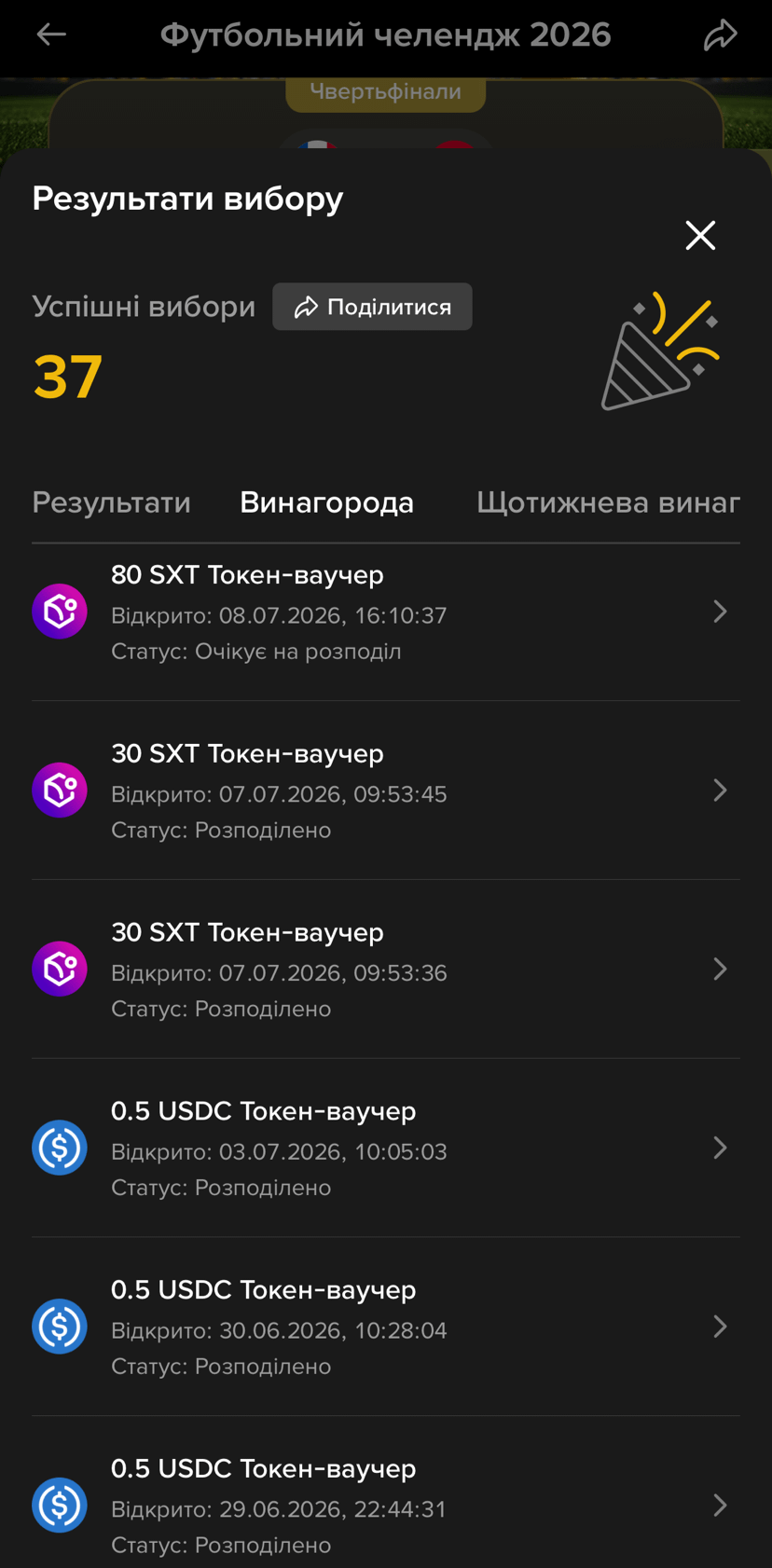
Do you know, quite decent rewards👏
To get two attempts per day, I do a trading volume of 100$ with coins from Spot Colosseum, and I get rewards here and there😌😍#BinancePickAndWin
Футбольний челендж
Do you know, quite decent rewards👏
To get two attempts per day, I do a trading volume of 100$ with coins from Spot Colosseum, and I get rewards here and there😌😍#BinancePickAndWin
Do you know, quite decent rewards👏
To get two attempts per day, I do a trading volume of 100$ with coins from Spot Colosseum, and I get rewards here and there😌😍#BinancePickAndWin
LeraOsta
·
--
BullishФутбольний челендж #BinancePickAndWin ⚽️😍
1
18
52
·
--
#newt $NEWT Honestly, I’m always a bit wary of projects that promise to change the whole world from day one.
In crypto, it’s almost a classic already. Loud statements, beautiful presentations, space-grade roadmaps… But a year or two passes, and most of these promises leave nothing behind. That’s exactly why I’m interested in watching @NewtonProtocol . Because the team set an extremely challenging goal right from the start. They talked not just about creating yet another blockchain, but about building universal infrastructure that would connect Web3, AI, automation, and the tokenization of real-world assets. Honestly, it sounded too ambitious. And probably that’s why many people treated the project with considerable skepticism. After all, implementing just one of these ideas is already difficult. And here the team set a course for several strategic directions at once. However, the most interesting part starts when you look not at the promises, but at the work that’s been done.
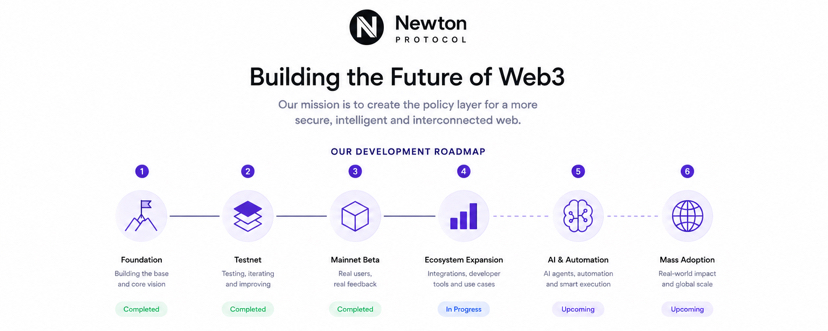
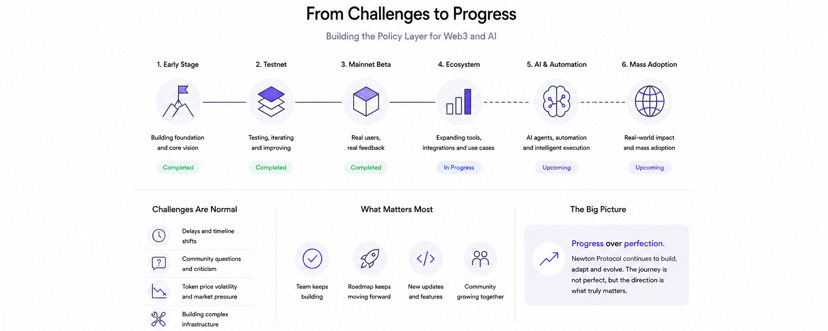
In that time, Newton didn’t stand still. A Testnet appeared; the team developed the core infrastructure; launched Mainnet Beta; continued working on the Internet of Policies; and expanded tools for developers. Were the goals achieved? Of course not! But progress is real 🔥
So what is your indicator of a strong crypto project??! 🤔
#newt $NEWT Honestly, I’m always a bit wary of projects that promise to change the whole world from day one.
In crypto, it’s almost a classic already. Loud statements, beautiful presentations, space-grade roadmaps… But a year or two passes, and most of these promises leave nothing behind. That’s exactly why I’m interested in watching @NewtonProtocol . Because the team set an extremely challenging goal right from the start. They talked not just about creating yet another blockchain, but about building universal infrastructure that would connect Web3, AI, automation, and the tokenization of real-world assets. Honestly, it sounded too ambitious. And probably that’s why many people treated the project with considerable skepticism. After all, implementing just one of these ideas is already difficult. And here the team set a course for several strategic directions at once. However, the most interesting part starts when you look not at the promises, but at the work that’s been done.
In that time, Newton didn’t stand still. A Testnet appeared; the team developed the core infrastructure; launched Mainnet Beta; continued working on the Internet of Policies; and expanded tools for developers. Were the goals achieved? Of course not! But progress is real 🔥
So what is your indicator of a strong crypto project??! 🤔
In crypto, it’s almost a classic already. Loud statements, beautiful presentations, space-grade roadmaps… But a year or two passes, and most of these promises leave nothing behind. That’s exactly why I’m interested in watching @NewtonProtocol . Because the team set an extremely challenging goal right from the start. They talked not just about creating yet another blockchain, but about building universal infrastructure that would connect Web3, AI, automation, and the tokenization of real-world assets. Honestly, it sounded too ambitious. And probably that’s why many people treated the project with considerable skepticism. After all, implementing just one of these ideas is already difficult. And here the team set a course for several strategic directions at once. However, the most interesting part starts when you look not at the promises, but at the work that’s been done.
In that time, Newton didn’t stand still. A Testnet appeared; the team developed the core infrastructure; launched Mainnet Beta; continued working on the Internet of Policies; and expanded tools for developers. Were the goals achieved? Of course not! But progress is real 🔥
So what is your indicator of a strong crypto project??! 🤔
Амбітне бачення та великі цілі
33%
Послідовне виконання обіцянок
0%
Реальний продукт
67%
Активна екосистема
0%
3 votes • Voting closed
15
26
147
·
--
Article
Newton Protocol Team’s Vision and Long-Term Goals.To be honest, lately I’ve been more interested not in what Newton Protocol has already done, but in where the team is trying to take this project.
Because one thing on the one hand is to create another blockchain. And quite another is to build infrastructure that can become a foundation for other projects.
That, as I see it, is the main idea of Newton.
Newton Protocol Team’s Vision and Long-Term Goals.
To be honest, lately I’ve been more interested not in what Newton Protocol has already done, but in where the team is trying to take this project.
Because one thing on the one hand is to create another blockchain. And quite another is to build infrastructure that can become a foundation for other projects.
That, as I see it, is the main idea of Newton.
Because one thing on the one hand is to create another blockchain. And quite another is to build infrastructure that can become a foundation for other projects.
That, as I see it, is the main idea of Newton.
12
20
144

·
--
Verified
Article
Newton Protocol: or who manages to go their own way without criticism, delays, or failed decisions.To be honest, the most trust I have comes not from projects that never make mistakes. Such things just don’t exist in crypto. It’s much more interesting to watch how the team responds to its own mistakes, handles personal screw-ups.
And Newton Protocol was no exception here.
During the project’s development, there were plenty of moments when the community asked uncomfortable questions. Someone wasn’t happy with the pace of development, others didn’t like the shifting of certain stages, and still others expected faster ecosystem growth after loud announcements. And after the token launch, part of the participants were looking only at the chart—which, to be fair, didn’t give euphoria to everyone without exception.
Newton Protocol: or who manages to go their own way without criticism, delays, or failed decisions.
To be honest, the most trust I have comes not from projects that never make mistakes. Such things just don’t exist in crypto. It’s much more interesting to watch how the team responds to its own mistakes, handles personal screw-ups.
And Newton Protocol was no exception here.
During the project’s development, there were plenty of moments when the community asked uncomfortable questions. Someone wasn’t happy with the pace of development, others didn’t like the shifting of certain stages, and still others expected faster ecosystem growth after loud announcements. And after the token launch, part of the participants were looking only at the chart—which, to be fair, didn’t give euphoria to everyone without exception.
And Newton Protocol was no exception here.
During the project’s development, there were plenty of moments when the community asked uncomfortable questions. Someone wasn’t happy with the pace of development, others didn’t like the shifting of certain stages, and still others expected faster ecosystem growth after loud announcements. And after the token launch, part of the participants were looking only at the chart—which, to be fair, didn’t give euphoria to everyone without exception.
15
21
287
·
--
#newt $NEWT Recently, I’m more and more often thinking that in crypto the most valuable asset isn’t even a token. It’s trust.
Trust can’t be bought, drawn in a presentation, or created with a loud announcement. It’s built gradually: when the team regularly delivers what it promises, the product develops, and the community sees not only words, but also actions. It seems to me that right now @NewtonProtocol is going through one of the most important stages. After the Mainnet Beta launch, attention gradually shifts from expectations to practice. It’s no longer enough to just talk about the future — it’s necessary to show that the ecosystem is growing, new integrations are appearing, developers are building products, and users find reasons to stay in the network. In my opinion, it’s exactly these things that create real trust.
Just as important is the community itself. An active community isn’t only likes or reposts. It’s people who test new features, share their experience, help newcomers, and whose feedback influences the project’s development. Without that, even the best technology can go unnoticed.
Trust is a process, not a final destination.
It needs to be confirmed again and again.
What affects your trust in the ecosystem??!🤔
#newt $NEWT Recently, I’m more and more often thinking that in crypto the most valuable asset isn’t even a token. It’s trust.
Trust can’t be bought, drawn in a presentation, or created with a loud announcement. It’s built gradually: when the team regularly delivers what it promises, the product develops, and the community sees not only words, but also actions. It seems to me that right now @NewtonProtocol is going through one of the most important stages. After the Mainnet Beta launch, attention gradually shifts from expectations to practice. It’s no longer enough to just talk about the future — it’s necessary to show that the ecosystem is growing, new integrations are appearing, developers are building products, and users find reasons to stay in the network. In my opinion, it’s exactly these things that create real trust.
Just as important is the community itself. An active community isn’t only likes or reposts. It’s people who test new features, share their experience, help newcomers, and whose feedback influences the project’s development. Without that, even the best technology can go unnoticed.
Trust is a process, not a final destination.
It needs to be confirmed again and again.
What affects your trust in the ecosystem??!🤔
Trust can’t be bought, drawn in a presentation, or created with a loud announcement. It’s built gradually: when the team regularly delivers what it promises, the product develops, and the community sees not only words, but also actions. It seems to me that right now @NewtonProtocol is going through one of the most important stages. After the Mainnet Beta launch, attention gradually shifts from expectations to practice. It’s no longer enough to just talk about the future — it’s necessary to show that the ecosystem is growing, new integrations are appearing, developers are building products, and users find reasons to stay in the network. In my opinion, it’s exactly these things that create real trust.
Just as important is the community itself. An active community isn’t only likes or reposts. It’s people who test new features, share their experience, help newcomers, and whose feedback influences the project’s development. Without that, even the best technology can go unnoticed.
Trust is a process, not a final destination.
It needs to be confirmed again and again.
What affects your trust in the ecosystem??!🤔
Команда чітко виконує обіцянки
100%
Реальні продукти, інтеграції
0%
Сильна та активна спільнота
0%
1 votes • Voting closed
15
20
218
Log in to explore more content
Join global crypto users on Binance Square
⚡️ Get latest and useful information about crypto.
💬 Trusted by the world’s largest crypto exchange.
👍 Discover real insights from verified creators.
Email / Phone number
Trending Topics
DriftHackVictimsBeginClaims
29,964 views
465 Discussing
🚨 DRIFT HACK VICTIMS CAN FINALLY START CLAIMING RECOVERY!
Victims of Drift’s April 2026 exploit are now able to claim DFX recovery tokens. The attack caused roughly $295.4M in verified losses, while the initial recovery pool held about $3.11M.
At launch, 1 DFX represented $1 of verified loss, but the initial redemption value was only around $0.0104 per DFX — roughly 1 cent recovered for every $1 lost. Users can redeem, sell, or hold DFX for potentially larger future recoveries as the pool receives additional funding.
⚠️ Important: Redeeming DFX burns the tokens, meaning users give up their share of future recovery funding for those tokens.
Could Drift victims eventually recover a much larger portion of their losses? 👇
#drifthackvictimsbeginclaims
#PEPE $PEPE
ASHFAQ NAEEM
·4 Likes
·6.8k views
SolanaTokenizedStockVolumeTops$4.4BInSeptember
4,807 views
55 Discussing
BitcoinSpotETFsDraw$6.34BInflowsInQ3
16,119 views
171 Discussing