

合约涨跌AI预判-VIP-0907版
9.5k Posts

合约涨跌AI预判-VIP-0907版
 Square Verified+
Report
Block User
以咨询级视角拆解 AI 趋势、智能工具与商业应用,过滤信息噪音,提炼真正有价值的前沿洞察 | 任何帖子非财务投资建议 | Opinions are my own & Not Financial Advice

Creator Awards 2024

原创之星

Level 1 Creator
Open Trade
Occasional Trader
5.7 Years
0 Following
72.5K+ Followers
691.0K+ Liked
4 Badges
Posts
Portfolio
All
Quotes
Videos
Live
Here are the data for the funding rate and open interest. There aren’t many signals we can verify today, and the ones selected have all been checked and hold up.
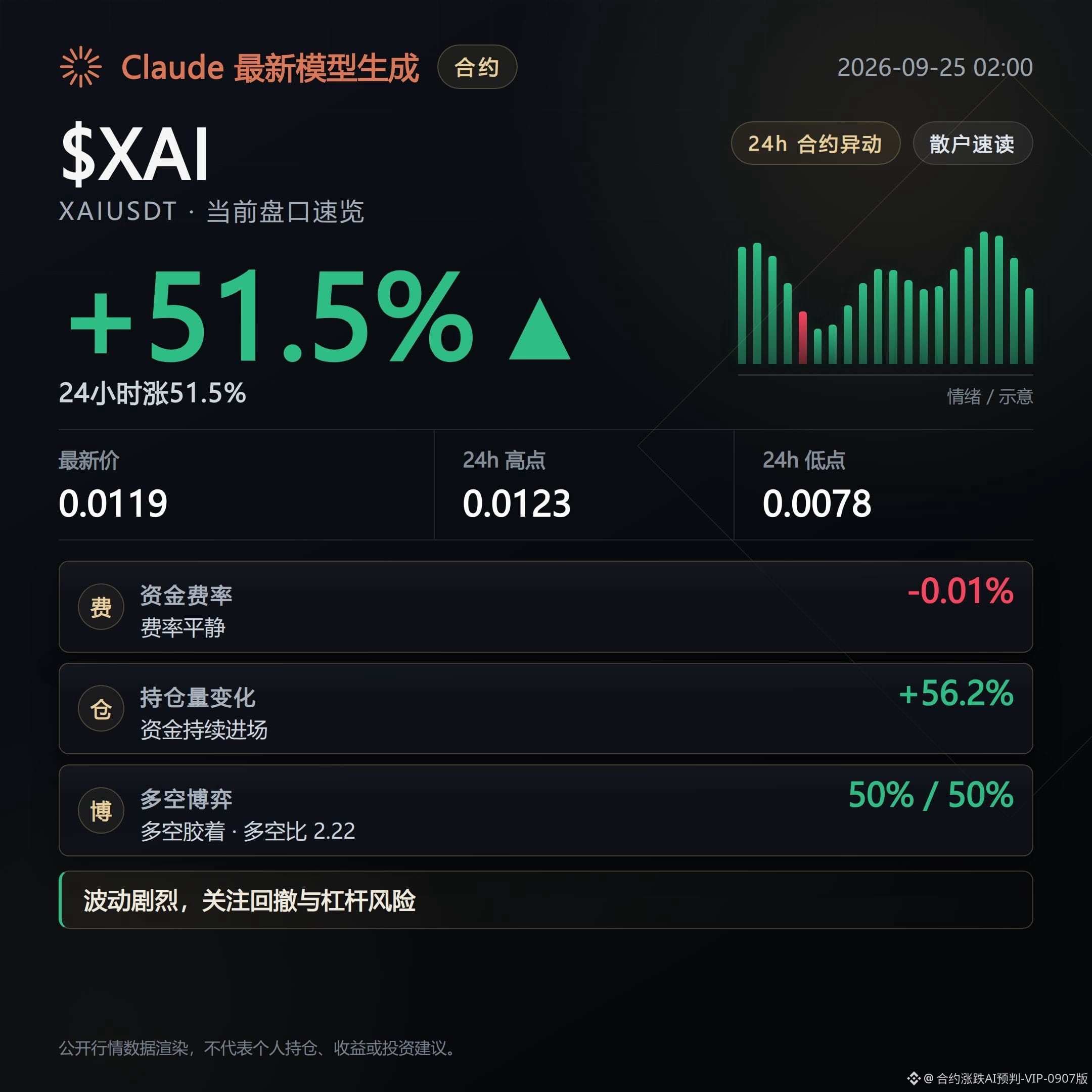
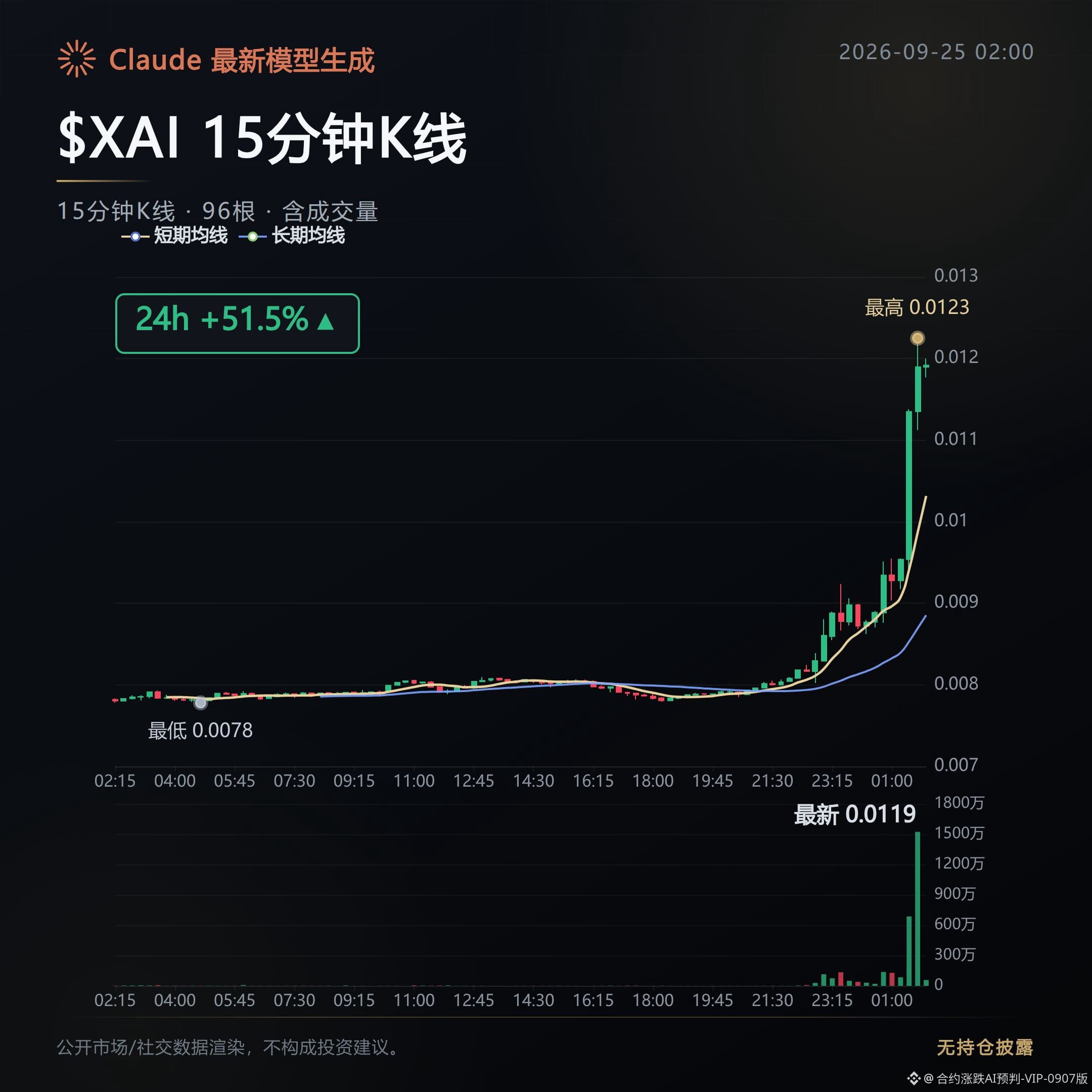
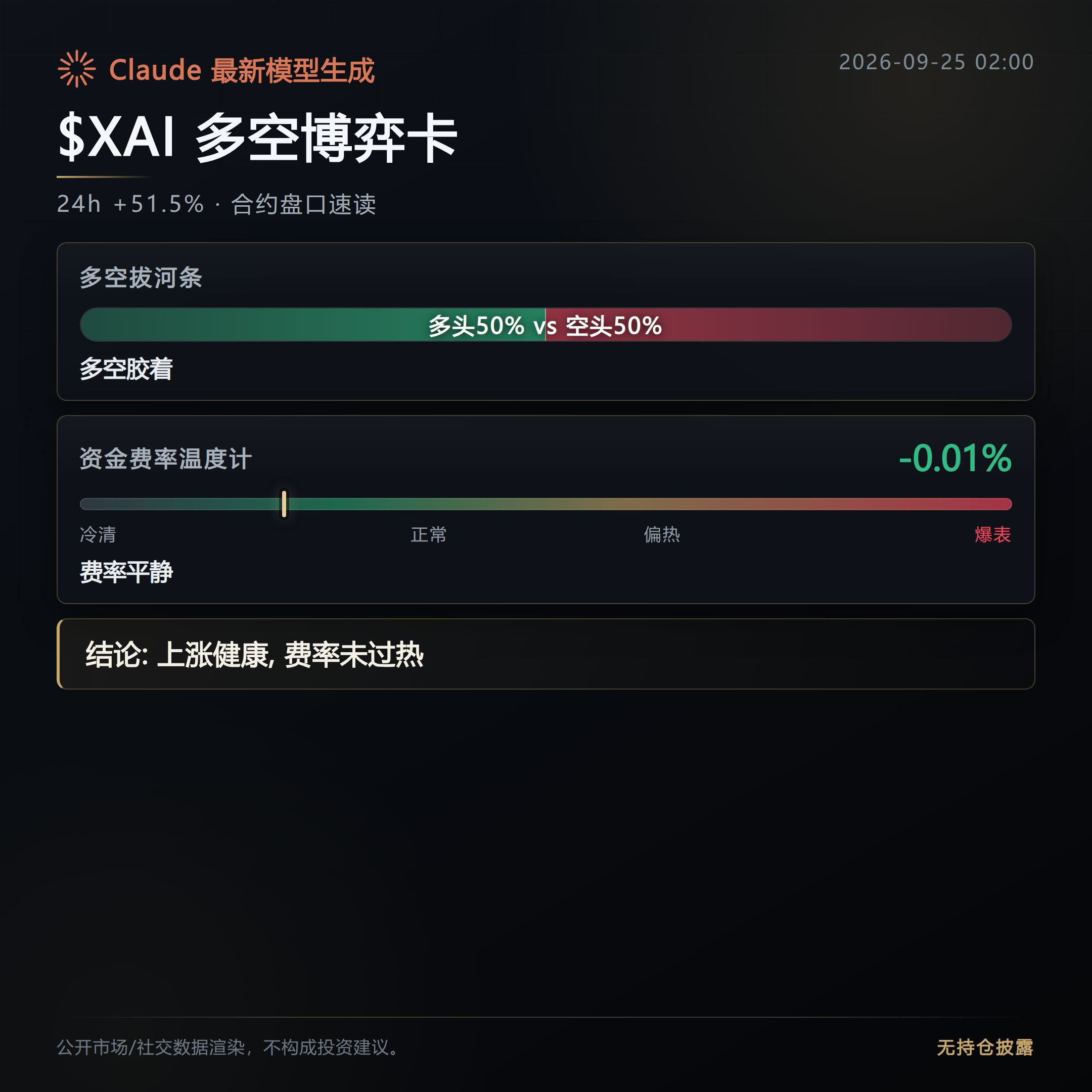
$XAI rose 51.5%; funding rate -0.015%. The shorts are hard-pressing and paying the funding. Open interest surged in sync by 56.2%—this is a signal that shorts are being forced to add positions.
Invalidation conditions: the funding rate turns positive, or open interest reverses and starts falling; if either happens, the signal is void.
$BROCCOLI714 rose 35.2%, while open interest spiked 203.6%. Volume/turnover reached $140 million—this signals that new positions are being rapidly accumulated.
Invalidation conditions: if the growth rate of open interest turns negative, it means funding is starting to withdraw; the signal is void.
$LSK rose 33.0%, open interest up 36.7%. Volume/turnover at $409 million—the largest among the three. This is a signal of a volume-backed rally, not an empty/false breakout.
Invalidation conditions: if the price breaks down below the vicinity of the 24-hour low while volume can’t keep up, the signal is void.
Quickly go through ranks 4 to 10: NOM up 31.5%, ONDO up 25.7%, NIL up 19.5%, QNT up 19.2%, ARX up 19.1%, LTC up 17.9%, PLUME up 16.9%. None of their scale is yet big enough to qualify as a standalone signal.
For potential squeeze candidates, look at ONE. Funding rate is -0.792%, and the cost for shorts to pay funding has reached an extreme level. The longer this structure persists, the easier it becomes to squeeze the shorts out of their direction.
Invalidation conditions: if the funding rate falls back into the normal range, the squeeze signal is解除.
In the early-morning hours, funding signals are clearly only provided for a small handful of names that we can verify. Next, the most important thing to watch is whether the growth rate of open interest can hold up.
$XAI $BROCCOLI714 $LSK #合约异动 #逼空
This content was generated with the assistance of Claude Fable 5 and is for reference only; please verify it yourself.
Here are the data for the funding rate and open interest. There aren’t many signals we can verify today, and the ones selected have all been checked and hold up.
$XAI rose 51.5%; funding rate -0.015%. The shorts are hard-pressing and paying the funding. Open interest surged in sync by 56.2%—this is a signal that shorts are being forced to add positions.
Invalidation conditions: the funding rate turns positive, or open interest reverses and starts falling; if either happens, the signal is void.
$BROCCOLI714 rose 35.2%, while open interest spiked 203.6%. Volume/turnover reached $140 million—this signals that new positions are being rapidly accumulated.
Invalidation conditions: if the growth rate of open interest turns negative, it means funding is starting to withdraw; the signal is void.
$LSK rose 33.0%, open interest up 36.7%. Volume/turnover at $409 million—the largest among the three. This is a signal of a volume-backed rally, not an empty/false breakout.
Invalidation conditions: if the price breaks down below the vicinity of the 24-hour low while volume can’t keep up, the signal is void.
Quickly go through ranks 4 to 10: NOM up 31.5%, ONDO up 25.7%, NIL up 19.5%, QNT up 19.2%, ARX up 19.1%, LTC up 17.9%, PLUME up 16.9%. None of their scale is yet big enough to qualify as a standalone signal.
For potential squeeze candidates, look at ONE. Funding rate is -0.792%, and the cost for shorts to pay funding has reached an extreme level. The longer this structure persists, the easier it becomes to squeeze the shorts out of their direction.
Invalidation conditions: if the funding rate falls back into the normal range, the squeeze signal is解除.
In the early-morning hours, funding signals are clearly only provided for a small handful of names that we can verify. Next, the most important thing to watch is whether the growth rate of open interest can hold up.
$XAI $BROCCOLI714 $LSK #合约异动 #逼空
This content was generated with the assistance of Claude Fable 5 and is for reference only; please verify it yourself.
$XAI rose 51.5%; funding rate -0.015%. The shorts are hard-pressing and paying the funding. Open interest surged in sync by 56.2%—this is a signal that shorts are being forced to add positions.
Invalidation conditions: the funding rate turns positive, or open interest reverses and starts falling; if either happens, the signal is void.
$BROCCOLI714 rose 35.2%, while open interest spiked 203.6%. Volume/turnover reached $140 million—this signals that new positions are being rapidly accumulated.
Invalidation conditions: if the growth rate of open interest turns negative, it means funding is starting to withdraw; the signal is void.
$LSK rose 33.0%, open interest up 36.7%. Volume/turnover at $409 million—the largest among the three. This is a signal of a volume-backed rally, not an empty/false breakout.
Invalidation conditions: if the price breaks down below the vicinity of the 24-hour low while volume can’t keep up, the signal is void.
Quickly go through ranks 4 to 10: NOM up 31.5%, ONDO up 25.7%, NIL up 19.5%, QNT up 19.2%, ARX up 19.1%, LTC up 17.9%, PLUME up 16.9%. None of their scale is yet big enough to qualify as a standalone signal.
For potential squeeze candidates, look at ONE. Funding rate is -0.792%, and the cost for shorts to pay funding has reached an extreme level. The longer this structure persists, the easier it becomes to squeeze the shorts out of their direction.
Invalidation conditions: if the funding rate falls back into the normal range, the squeeze signal is解除.
In the early-morning hours, funding signals are clearly only provided for a small handful of names that we can verify. Next, the most important thing to watch is whether the growth rate of open interest can hold up.
$XAI $BROCCOLI714 $LSK #合约异动 #逼空
This content was generated with the assistance of Claude Fable 5 and is for reference only; please verify it yourself.
574
Contract Order Book Daily Report | 9/24 The exit doesn’t stop, but the funding rate is nearly back to zero
The signals from this morning indicated a broad-based decline across the board: the funding rate didn’t collapse, but open interest kept seeing a massive outflow.
Now let’s review it again—there was no reversal, but the slope has changed.
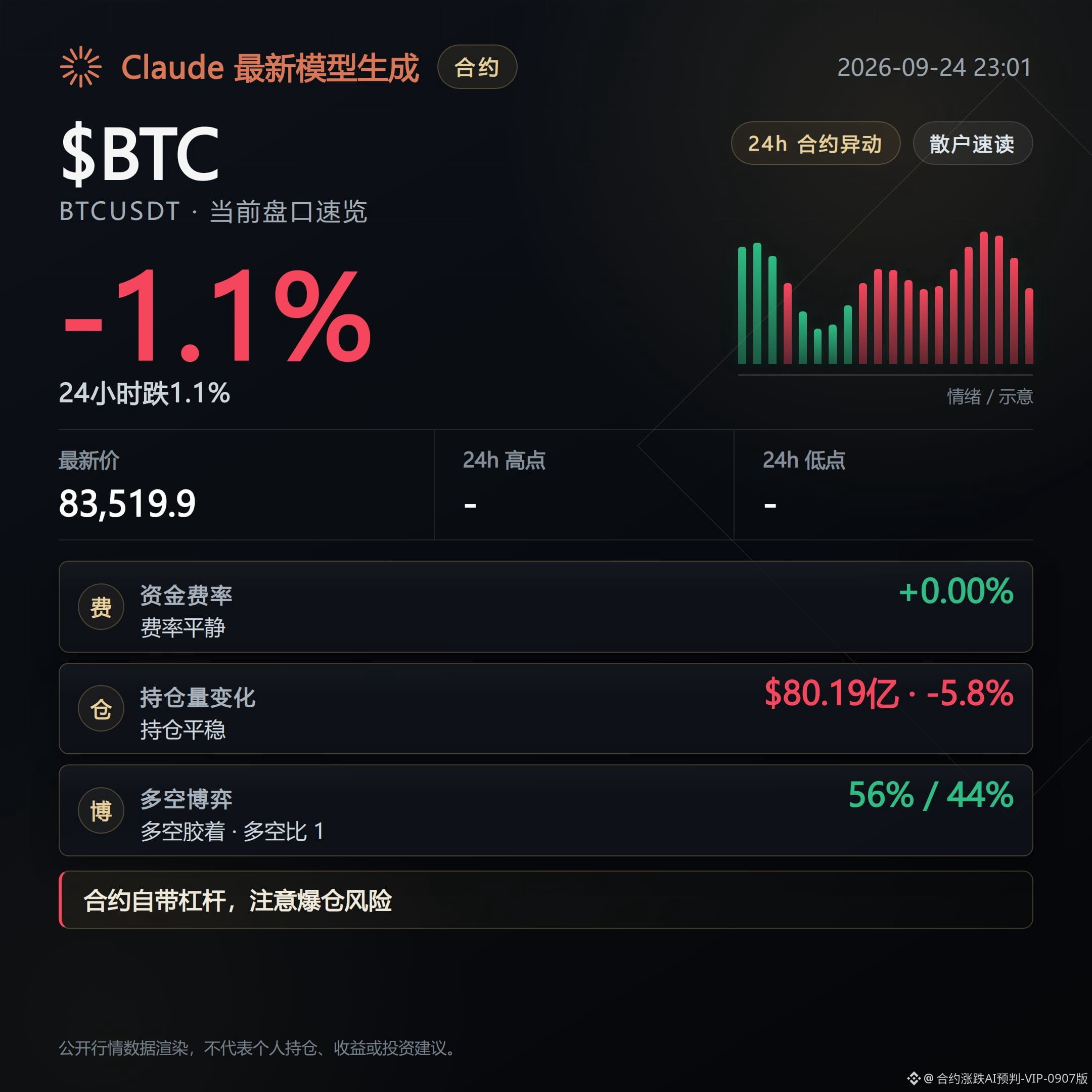
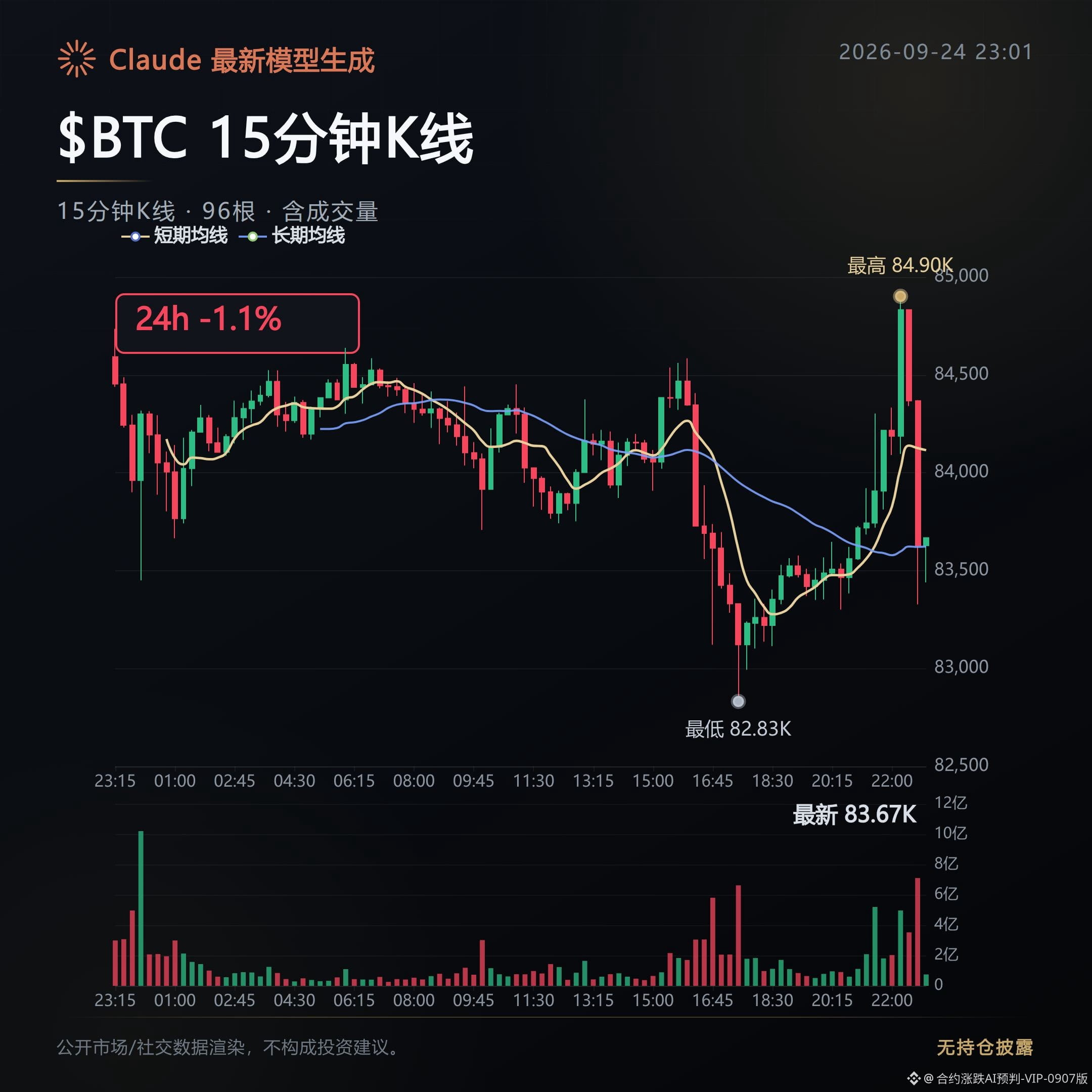
$BTC is now probing at $835,000, down 1.15% over the past 24 hours; the drop is narrower than the earlier move.
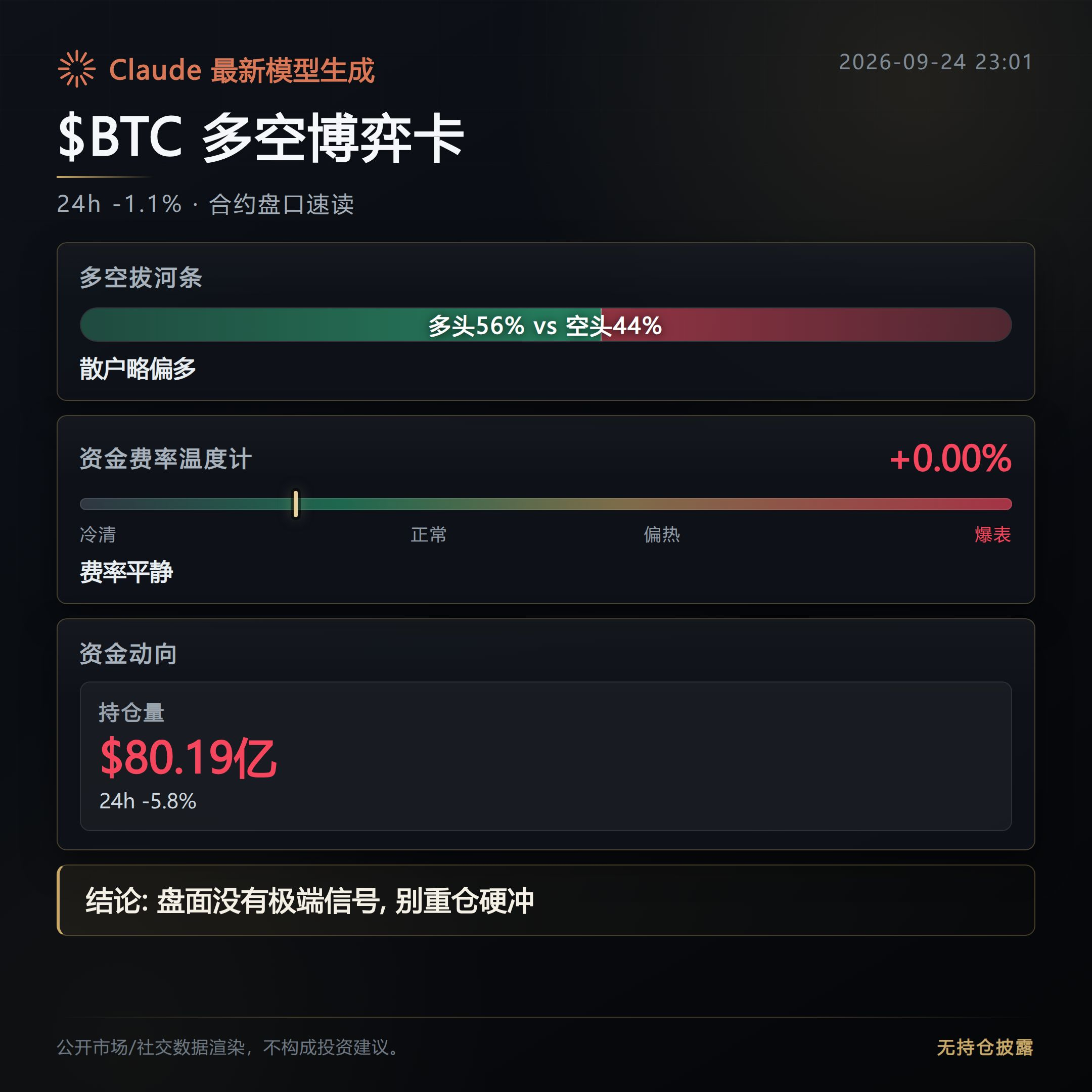
The funding rate has slid in sync to 0.0014%, nearly hugging the zero line, suggesting those who leveraged up to go long have truly let go—not just talking.
But open interest hasn’t stabilized: $8.019 billion, down another 5.8% over 24 hours. The outflow from earlier has not stopped even until now.
What’s interesting is that active buy/sell orders aren’t following the same pessimism. The buy side exceeds the sell side by a noticeable margin, and the long positions’ share at 56% hasn’t fallen below half.
The Fear & Greed Index is still stuck at 71, staying in the greed zone for several days without moving.
This is the key disagreement revealed by this round of review: leverage is withdrawing, but sentiment isn’t backing off.
And this divergence isn’t coming out of thin air.
Yesterday, spot Bitcoin ETF net inflows were nearly $1 billion—institutions haven’t stopped.
The U.S. Commodity Futures Trading Commission is pushing for clearer crypto market-structure rules, meaning the regulatory “leak” is easing.
The U.S. Treasury is even more direct: tomorrow it will repurchase $6 billion in Treasury notes—three times the market’s previous expectation of $2 billion. Liquidity hasn’t been left out.
So going forward, what to watch isn’t price itself, but when open interest finally stops falling.
The exit is still continuing, yet greed refuses to退. Once this divergence converges, the direction will become very clear.
#资金费率 #Open interest
This content was generated with assistance from Claude Fable 5 and is for informational reference only. Please verify it yourself.
Contract Order Book Daily Report | 9/24 The exit doesn’t stop, but the funding rate is nearly back to zero
The signals from this morning indicated a broad-based decline across the board: the funding rate didn’t collapse, but open interest kept seeing a massive outflow.
Now let’s review it again—there was no reversal, but the slope has changed.
$BTC is now probing at $835,000, down 1.15% over the past 24 hours; the drop is narrower than the earlier move.
The funding rate has slid in sync to 0.0014%, nearly hugging the zero line, suggesting those who leveraged up to go long have truly let go—not just talking.
But open interest hasn’t stabilized: $8.019 billion, down another 5.8% over 24 hours. The outflow from earlier has not stopped even until now.
What’s interesting is that active buy/sell orders aren’t following the same pessimism. The buy side exceeds the sell side by a noticeable margin, and the long positions’ share at 56% hasn’t fallen below half.
The Fear & Greed Index is still stuck at 71, staying in the greed zone for several days without moving.
This is the key disagreement revealed by this round of review: leverage is withdrawing, but sentiment isn’t backing off.
And this divergence isn’t coming out of thin air.
Yesterday, spot Bitcoin ETF net inflows were nearly $1 billion—institutions haven’t stopped.
The U.S. Commodity Futures Trading Commission is pushing for clearer crypto market-structure rules, meaning the regulatory “leak” is easing.
The U.S. Treasury is even more direct: tomorrow it will repurchase $6 billion in Treasury notes—three times the market’s previous expectation of $2 billion. Liquidity hasn’t been left out.
So going forward, what to watch isn’t price itself, but when open interest finally stops falling.
The exit is still continuing, yet greed refuses to退. Once this divergence converges, the direction will become very clear.
#资金费率 #Open interest
This content was generated with assistance from Claude Fable 5 and is for informational reference only. Please verify it yourself.
The signals from this morning indicated a broad-based decline across the board: the funding rate didn’t collapse, but open interest kept seeing a massive outflow.
Now let’s review it again—there was no reversal, but the slope has changed.
$BTC is now probing at $835,000, down 1.15% over the past 24 hours; the drop is narrower than the earlier move.
The funding rate has slid in sync to 0.0014%, nearly hugging the zero line, suggesting those who leveraged up to go long have truly let go—not just talking.
But open interest hasn’t stabilized: $8.019 billion, down another 5.8% over 24 hours. The outflow from earlier has not stopped even until now.
What’s interesting is that active buy/sell orders aren’t following the same pessimism. The buy side exceeds the sell side by a noticeable margin, and the long positions’ share at 56% hasn’t fallen below half.
The Fear & Greed Index is still stuck at 71, staying in the greed zone for several days without moving.
This is the key disagreement revealed by this round of review: leverage is withdrawing, but sentiment isn’t backing off.
And this divergence isn’t coming out of thin air.
Yesterday, spot Bitcoin ETF net inflows were nearly $1 billion—institutions haven’t stopped.
The U.S. Commodity Futures Trading Commission is pushing for clearer crypto market-structure rules, meaning the regulatory “leak” is easing.
The U.S. Treasury is even more direct: tomorrow it will repurchase $6 billion in Treasury notes—three times the market’s previous expectation of $2 billion. Liquidity hasn’t been left out.
So going forward, what to watch isn’t price itself, but when open interest finally stops falling.
The exit is still continuing, yet greed refuses to退. Once this divergence converges, the direction will become very clear.
#资金费率 #Open interest
This content was generated with assistance from Claude Fable 5 and is for informational reference only. Please verify it yourself.
379
About 13 hours ago, for these 3 coins, the morning signals were a high-level distribution/dispersion observation with a bearish bias. The initial observation was that the chips were dispersed.
Now, based on the public order-book review: ACE realized its move and went into a downturn; LSK rebounded—the price didn’t fall and instead rose; SUPER is still being pulled—no clear one-way downward move has formed yet.
Of the 3, 1 dropped out, 1 reversed direction, and 1 remains undecided; the bearish thesis hasn’t been fully realized.
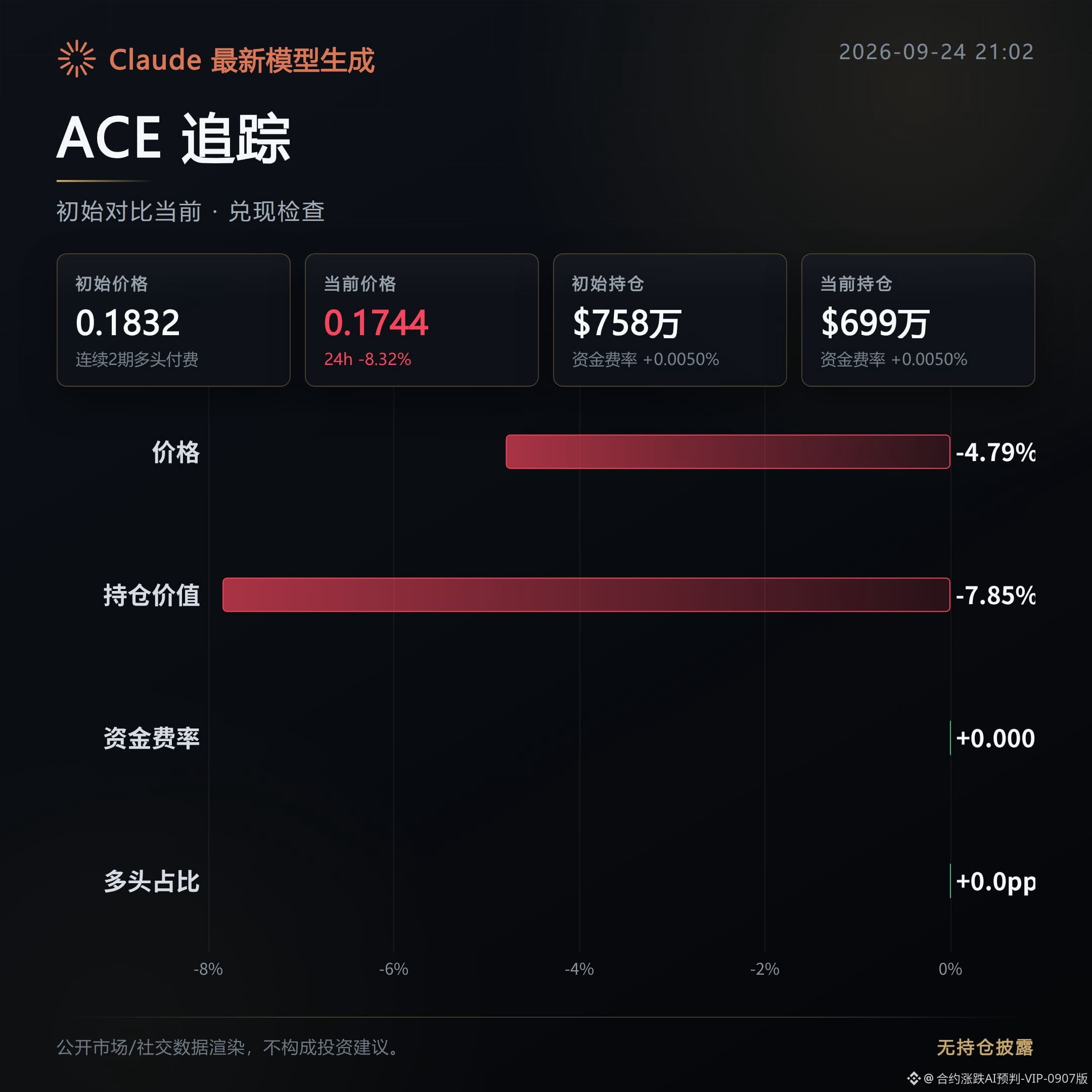
ACE: realized. The bearish direction from the morning signal actually played out.
After the initial price move, it pulled back by 4.79%, while open interest fell in sync by 7.85%. During the decline, positions were being withdrawn rather than added.
The share of aggressive buying dropped to 0.91, and the support/absorption clearly thinned out.
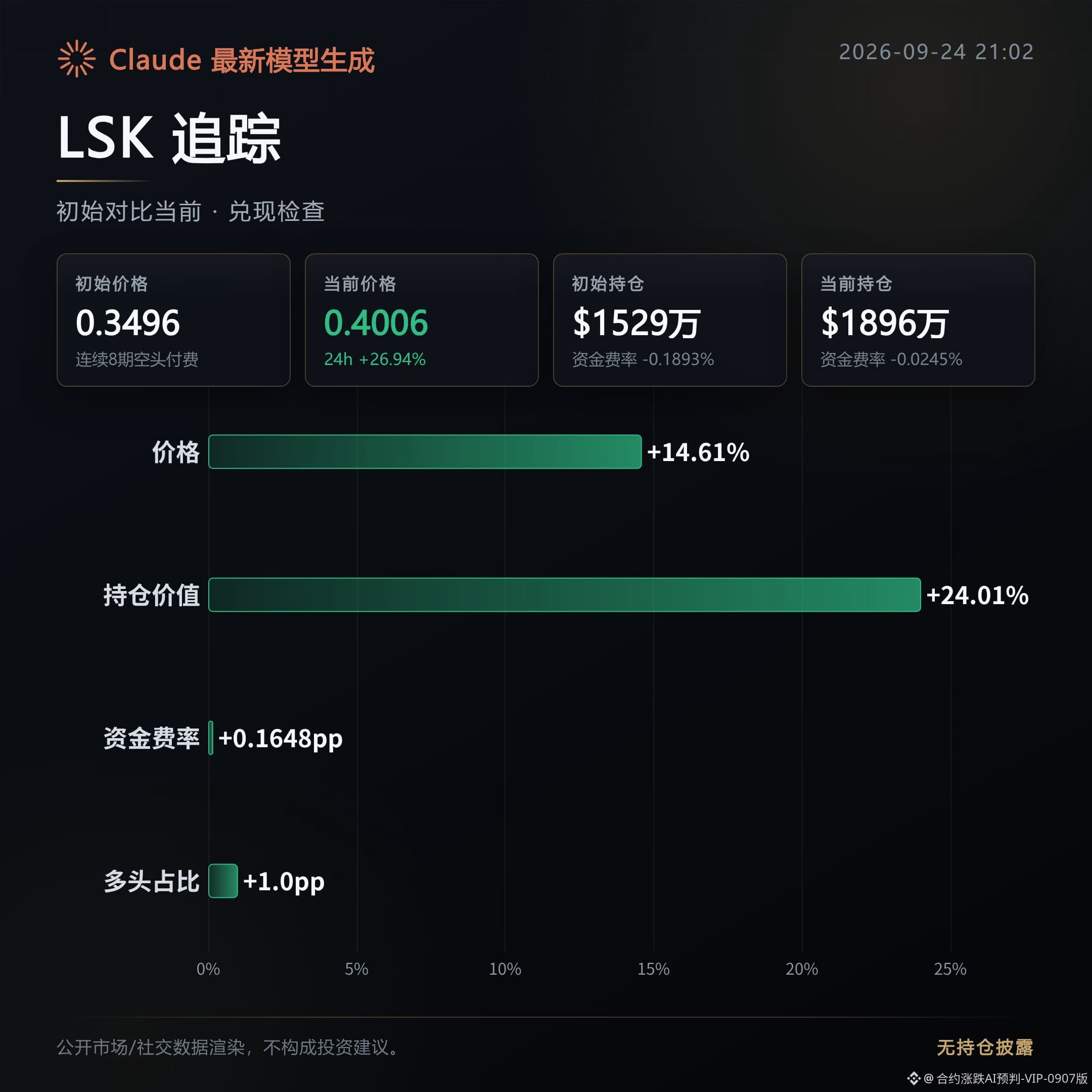
LSK: rebound. The bearish view from the morning didn’t play out—the direction already reversed.
After the initial price move, it didn’t drop but instead rose 14.61%, and open interest simultaneously expanded by 24.01%. The longs are putting in real money.
Trading volume increased by 227.84%. This rebound has genuine transaction support, not a low-volume rebound.
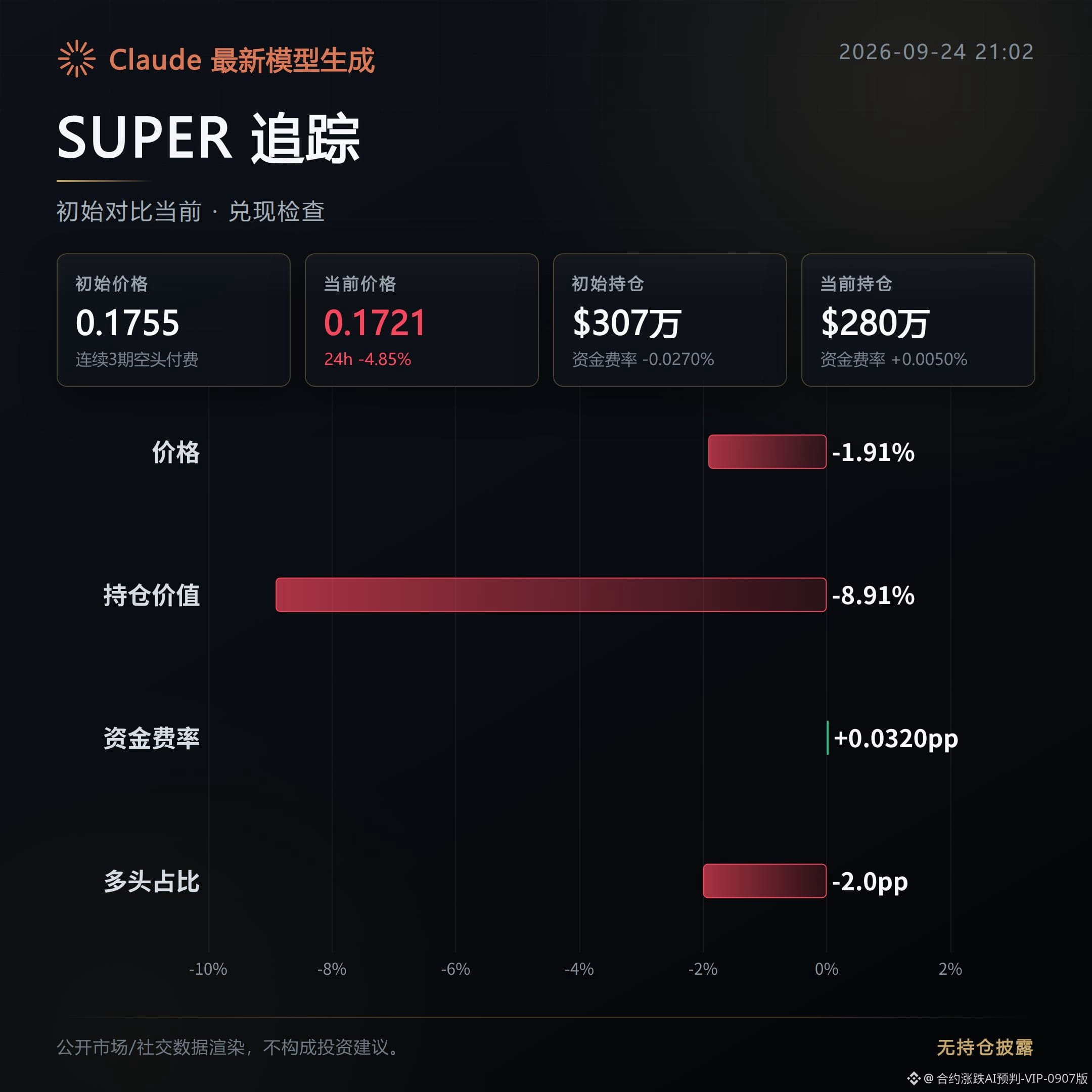
SUPER: pull-and-tug. For now, the bearish warning has neither been confirmed nor refuted.
After the initial move, it dipped only 1.91%, with a limited drawdown; it hasn’t broken into a one-way downtrend yet.
The share of aggressive buying rose from 0.98 to 1.25, indicating that capital is picking up near the lows—unlike ACE’s support-thinning pattern.
Next, keep watching the three signals along this line.
For ACE, watch whether open interest and absorption continue pushing lower. Once it stops falling and stabilizes, whether this realized move can continue will need to be re-assessed.
For LSK, watch whether this rebound can hold up. If open interest and trading volume turn downward again, it means the rebound itself is also fading.
SUPER is the key point of divergence: only when aggressive buy/sell flows truly shift to become seller-dominant can the bearish direction be considered confirmed.
#ACE #LSK #SUPER #Contract review
Compiled with assistance from Claude Fable 5. For informational reference only—please verify on your own.
About 13 hours ago, for these 3 coins, the morning signals were a high-level distribution/dispersion observation with a bearish bias. The initial observation was that the chips were dispersed.
Now, based on the public order-book review: ACE realized its move and went into a downturn; LSK rebounded—the price didn’t fall and instead rose; SUPER is still being pulled—no clear one-way downward move has formed yet.
Of the 3, 1 dropped out, 1 reversed direction, and 1 remains undecided; the bearish thesis hasn’t been fully realized.
ACE: realized. The bearish direction from the morning signal actually played out.
After the initial price move, it pulled back by 4.79%, while open interest fell in sync by 7.85%. During the decline, positions were being withdrawn rather than added.
The share of aggressive buying dropped to 0.91, and the support/absorption clearly thinned out.
LSK: rebound. The bearish view from the morning didn’t play out—the direction already reversed.
After the initial price move, it didn’t drop but instead rose 14.61%, and open interest simultaneously expanded by 24.01%. The longs are putting in real money.
Trading volume increased by 227.84%. This rebound has genuine transaction support, not a low-volume rebound.
SUPER: pull-and-tug. For now, the bearish warning has neither been confirmed nor refuted.
After the initial move, it dipped only 1.91%, with a limited drawdown; it hasn’t broken into a one-way downtrend yet.
The share of aggressive buying rose from 0.98 to 1.25, indicating that capital is picking up near the lows—unlike ACE’s support-thinning pattern.
Next, keep watching the three signals along this line.
For ACE, watch whether open interest and absorption continue pushing lower. Once it stops falling and stabilizes, whether this realized move can continue will need to be re-assessed.
For LSK, watch whether this rebound can hold up. If open interest and trading volume turn downward again, it means the rebound itself is also fading.
SUPER is the key point of divergence: only when aggressive buy/sell flows truly shift to become seller-dominant can the bearish direction be considered confirmed.
#ACE #LSK #SUPER #Contract review
Compiled with assistance from Claude Fable 5. For informational reference only—please verify on your own.
Now, based on the public order-book review: ACE realized its move and went into a downturn; LSK rebounded—the price didn’t fall and instead rose; SUPER is still being pulled—no clear one-way downward move has formed yet.
Of the 3, 1 dropped out, 1 reversed direction, and 1 remains undecided; the bearish thesis hasn’t been fully realized.
ACE: realized. The bearish direction from the morning signal actually played out.
After the initial price move, it pulled back by 4.79%, while open interest fell in sync by 7.85%. During the decline, positions were being withdrawn rather than added.
The share of aggressive buying dropped to 0.91, and the support/absorption clearly thinned out.
LSK: rebound. The bearish view from the morning didn’t play out—the direction already reversed.
After the initial price move, it didn’t drop but instead rose 14.61%, and open interest simultaneously expanded by 24.01%. The longs are putting in real money.
Trading volume increased by 227.84%. This rebound has genuine transaction support, not a low-volume rebound.
SUPER: pull-and-tug. For now, the bearish warning has neither been confirmed nor refuted.
After the initial move, it dipped only 1.91%, with a limited drawdown; it hasn’t broken into a one-way downtrend yet.
The share of aggressive buying rose from 0.98 to 1.25, indicating that capital is picking up near the lows—unlike ACE’s support-thinning pattern.
Next, keep watching the three signals along this line.
For ACE, watch whether open interest and absorption continue pushing lower. Once it stops falling and stabilizes, whether this realized move can continue will need to be re-assessed.
For LSK, watch whether this rebound can hold up. If open interest and trading volume turn downward again, it means the rebound itself is also fading.
SUPER is the key point of divergence: only when aggressive buy/sell flows truly shift to become seller-dominant can the bearish direction be considered confirmed.
#ACE #LSK #SUPER #Contract review
Compiled with assistance from Claude Fable 5. For informational reference only—please verify on your own.
292
A bullish call based on an early-morning pullback observation from about 13 hours ago was given once before, covering three contracts: NIL, COTI, and ZRO. At the initial release, the observation was that the chips were “in the process of gathering.”
Now, according to the publicly available order-book check: among the three bullish setups, 0 have been fulfilled, 1 is still being dragged/pulled, and 2 have already gone cold.
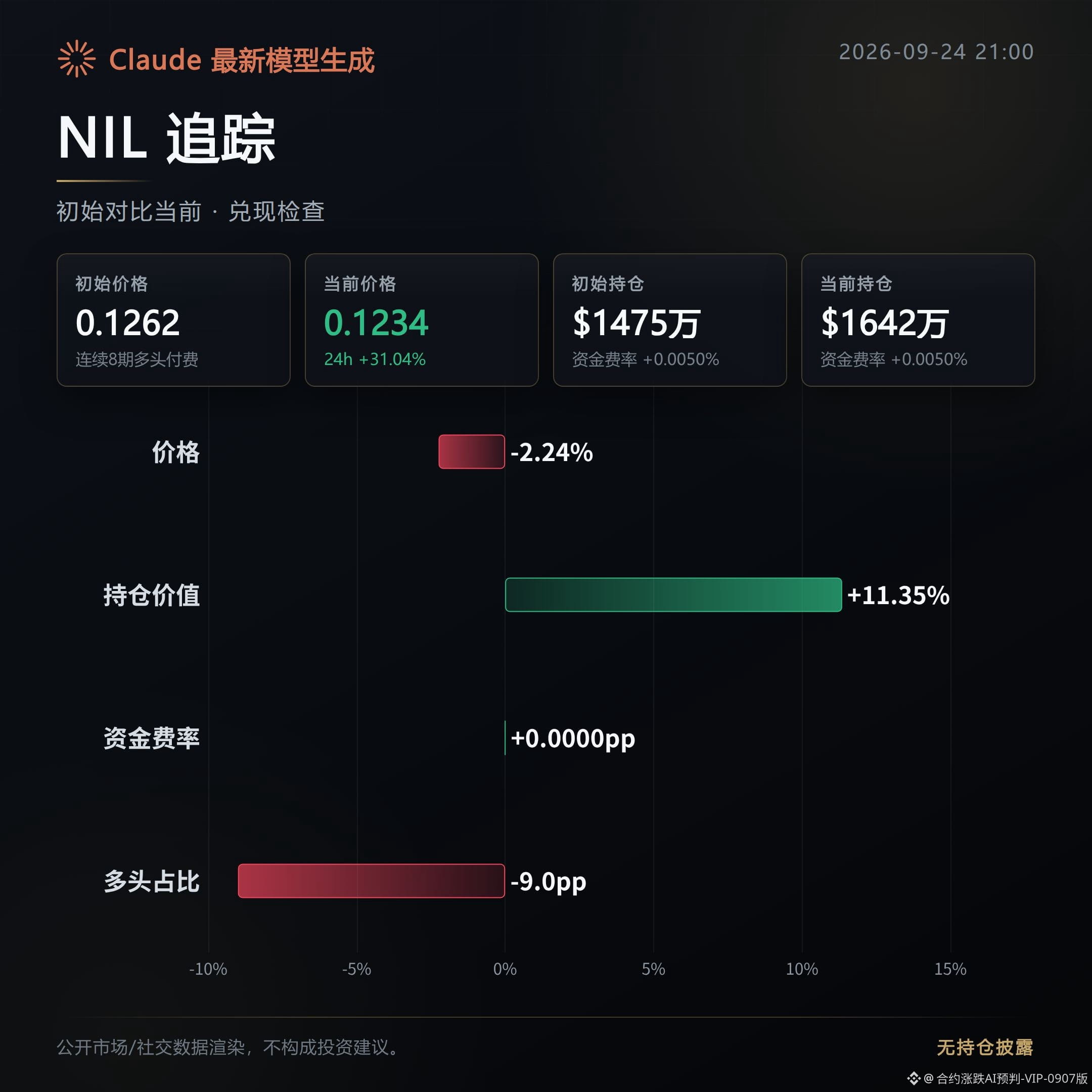
NIL: Still being dragged/pulled; the bullish move from the morning hasn’t yet confirmed a clear direction.
Since the initial release, the price has dipped slightly by 2.24%, basically oscillating around the original level without breaking out decisively.
However, open interest has risen against the trend by 11.35%, suggesting capital hasn’t fully withdrawn yet. But the aggressive/active buy pressure has eased a bit, and there’s no one-way directional confirmation.
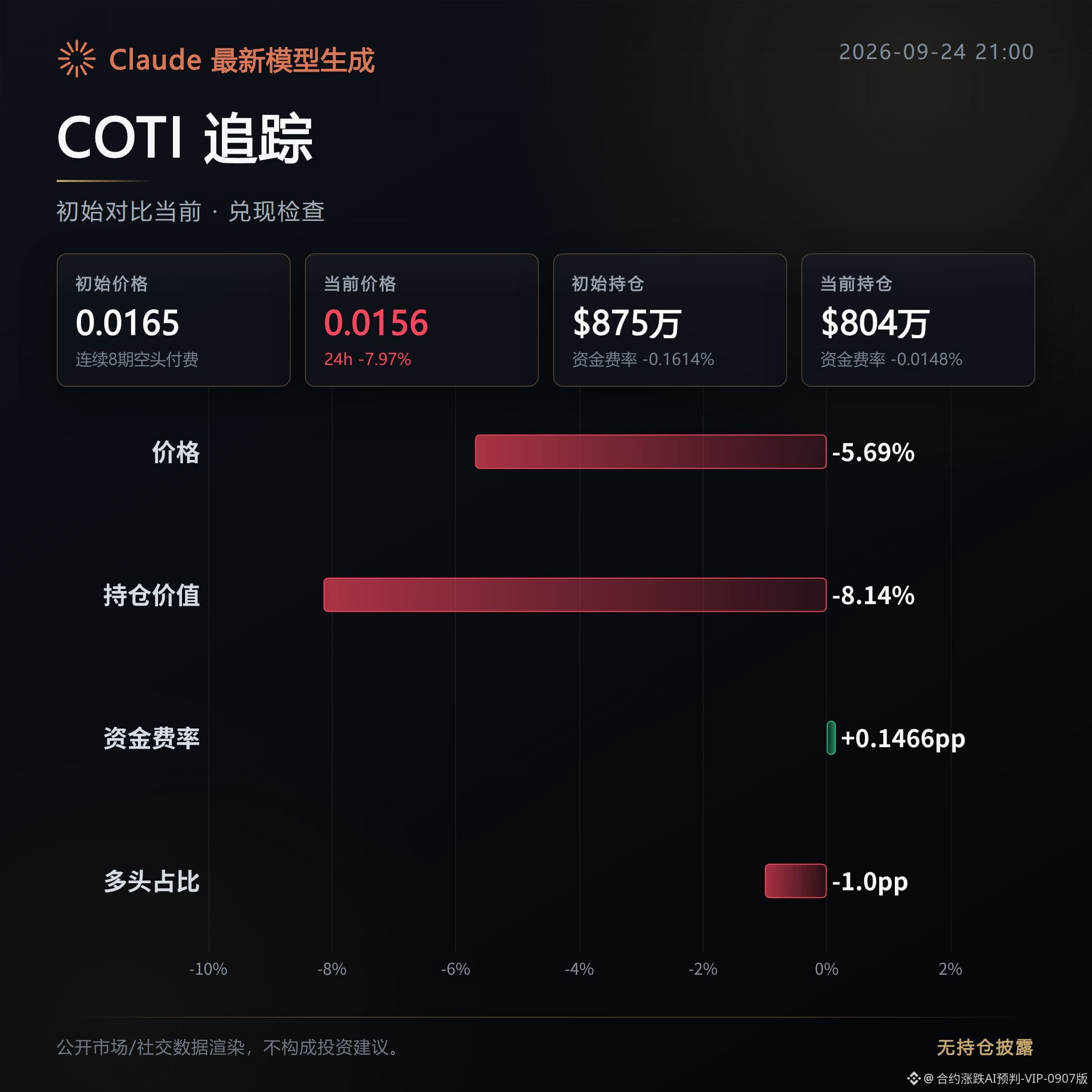
COTI: Gone cold; the bullish setup from the morning didn’t play out.
After the initial release, the price fell by 5.69%, meaning the direction is already opposite to the bullish judgment.
Open interest declined in parallel by 8.14%, and active buy pressure also weakened—momentum hasn’t been picked back up.
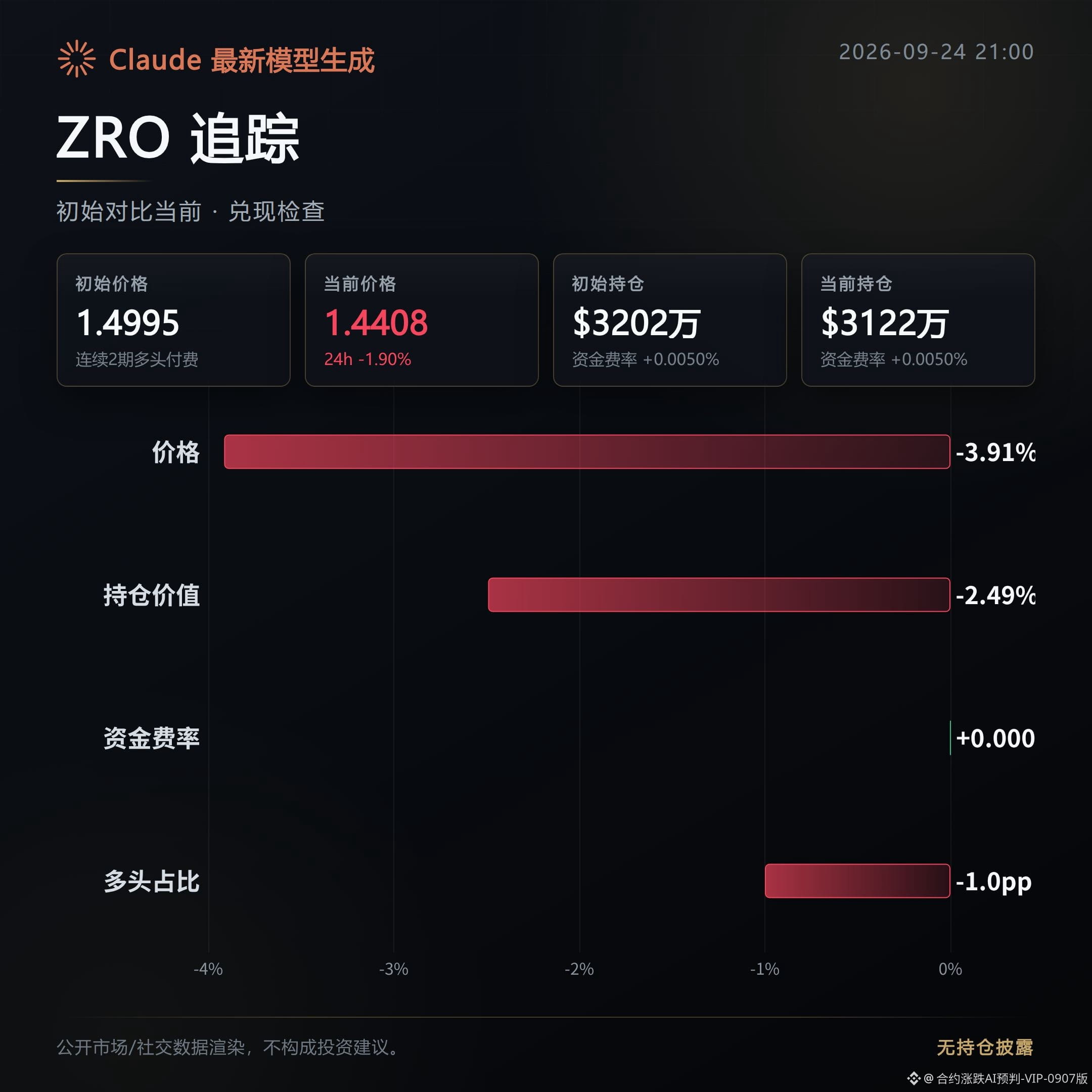
ZRO: Gone cold; the bullish setup from the morning didn’t play out either.
After the initial release, the price dropped by 3.91%, with the gain flipping from positive to negative—direction has already reversed.
The strength of active buying has clearly diminished, and open interest has also withdrawn slightly. The momentum behind the pullback couldn’t be sustained.
What to watch next along this line: For NIL, see whether open interest can drive the price back higher—verifying whether the “chips gathering” observation is genuinely building up. For COTI and ZRO, look to whether active buy pressure and funding rates can turn back up as a counter-confirmation condition for re-establishing direction after going cold.
#NIL #COTI #ZRO #Pullback Observation
This content is generated with assistance from Claude Fable 5 and is for informational reference only. Please verify it yourself.
A bullish call based on an early-morning pullback observation from about 13 hours ago was given once before, covering three contracts: NIL, COTI, and ZRO. At the initial release, the observation was that the chips were “in the process of gathering.”
Now, according to the publicly available order-book check: among the three bullish setups, 0 have been fulfilled, 1 is still being dragged/pulled, and 2 have already gone cold.
NIL: Still being dragged/pulled; the bullish move from the morning hasn’t yet confirmed a clear direction.
Since the initial release, the price has dipped slightly by 2.24%, basically oscillating around the original level without breaking out decisively.
However, open interest has risen against the trend by 11.35%, suggesting capital hasn’t fully withdrawn yet. But the aggressive/active buy pressure has eased a bit, and there’s no one-way directional confirmation.
COTI: Gone cold; the bullish setup from the morning didn’t play out.
After the initial release, the price fell by 5.69%, meaning the direction is already opposite to the bullish judgment.
Open interest declined in parallel by 8.14%, and active buy pressure also weakened—momentum hasn’t been picked back up.
ZRO: Gone cold; the bullish setup from the morning didn’t play out either.
After the initial release, the price dropped by 3.91%, with the gain flipping from positive to negative—direction has already reversed.
The strength of active buying has clearly diminished, and open interest has also withdrawn slightly. The momentum behind the pullback couldn’t be sustained.
What to watch next along this line: For NIL, see whether open interest can drive the price back higher—verifying whether the “chips gathering” observation is genuinely building up. For COTI and ZRO, look to whether active buy pressure and funding rates can turn back up as a counter-confirmation condition for re-establishing direction after going cold.
#NIL #COTI #ZRO #Pullback Observation
This content is generated with assistance from Claude Fable 5 and is for informational reference only. Please verify it yourself.
Now, according to the publicly available order-book check: among the three bullish setups, 0 have been fulfilled, 1 is still being dragged/pulled, and 2 have already gone cold.
NIL: Still being dragged/pulled; the bullish move from the morning hasn’t yet confirmed a clear direction.
Since the initial release, the price has dipped slightly by 2.24%, basically oscillating around the original level without breaking out decisively.
However, open interest has risen against the trend by 11.35%, suggesting capital hasn’t fully withdrawn yet. But the aggressive/active buy pressure has eased a bit, and there’s no one-way directional confirmation.
COTI: Gone cold; the bullish setup from the morning didn’t play out.
After the initial release, the price fell by 5.69%, meaning the direction is already opposite to the bullish judgment.
Open interest declined in parallel by 8.14%, and active buy pressure also weakened—momentum hasn’t been picked back up.
ZRO: Gone cold; the bullish setup from the morning didn’t play out either.
After the initial release, the price dropped by 3.91%, with the gain flipping from positive to negative—direction has already reversed.
The strength of active buying has clearly diminished, and open interest has also withdrawn slightly. The momentum behind the pullback couldn’t be sustained.
What to watch next along this line: For NIL, see whether open interest can drive the price back higher—verifying whether the “chips gathering” observation is genuinely building up. For COTI and ZRO, look to whether active buy pressure and funding rates can turn back up as a counter-confirmation condition for re-establishing direction after going cold.
#NIL #COTI #ZRO #Pullback Observation
This content is generated with assistance from Claude Fable 5 and is for informational reference only. Please verify it yourself.
143
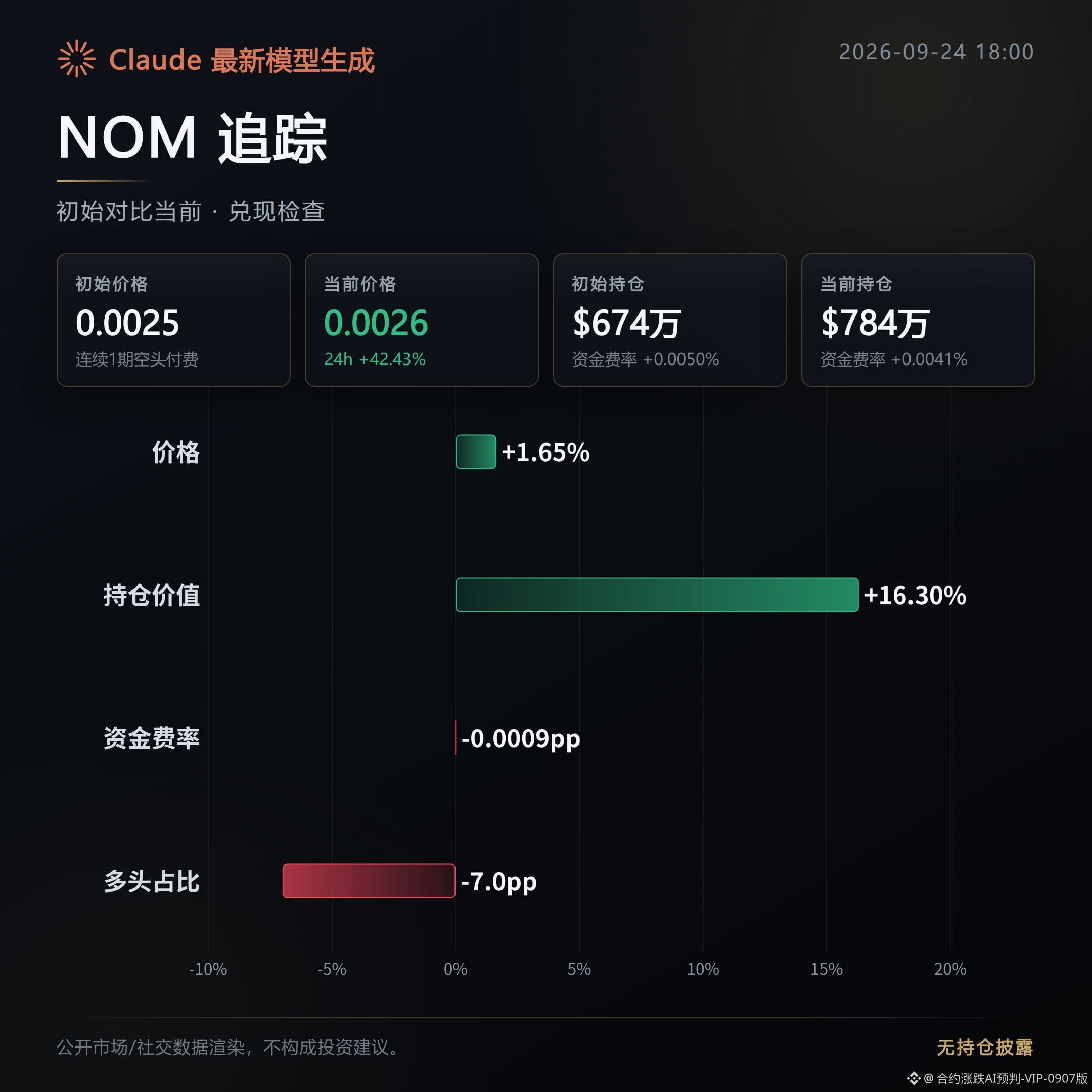
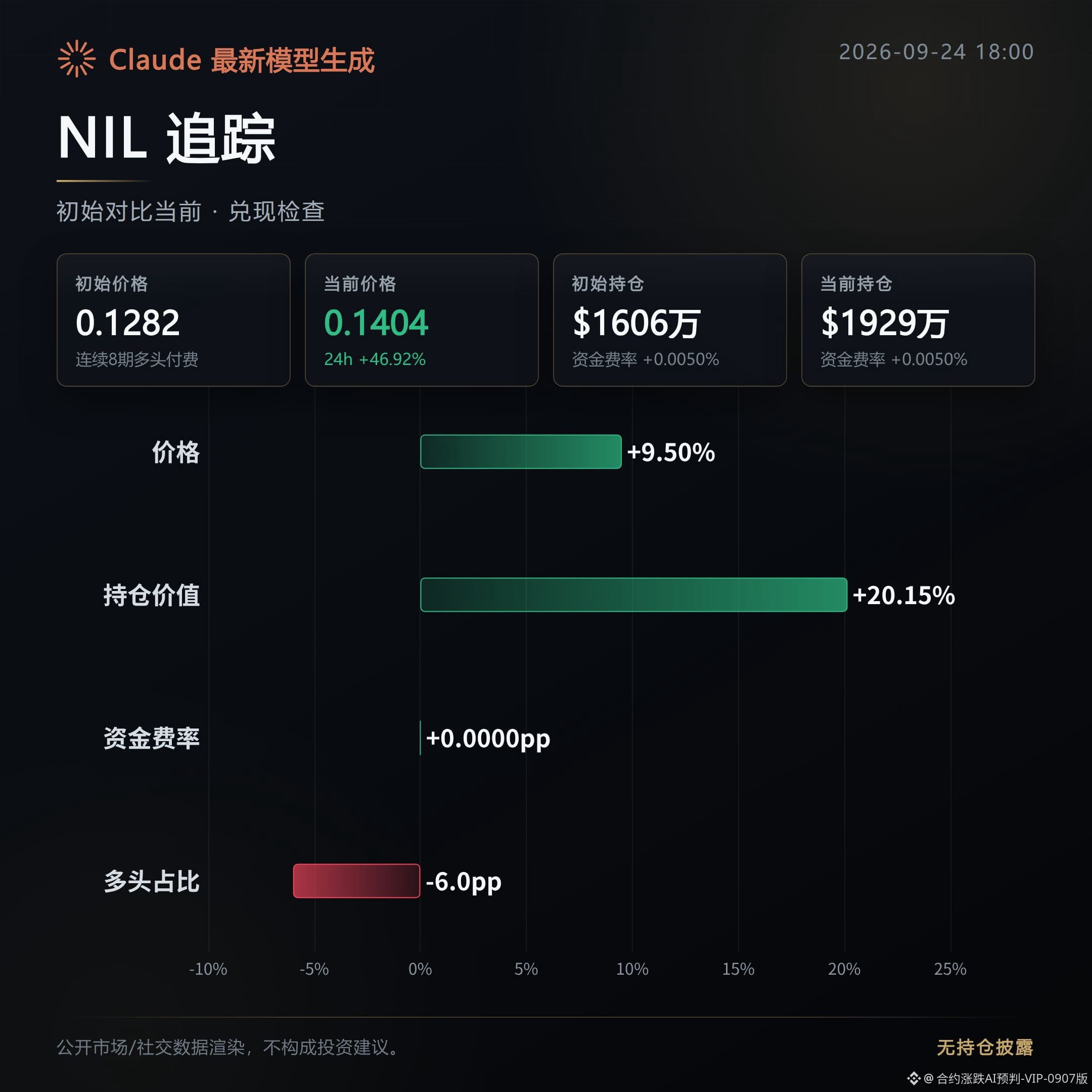
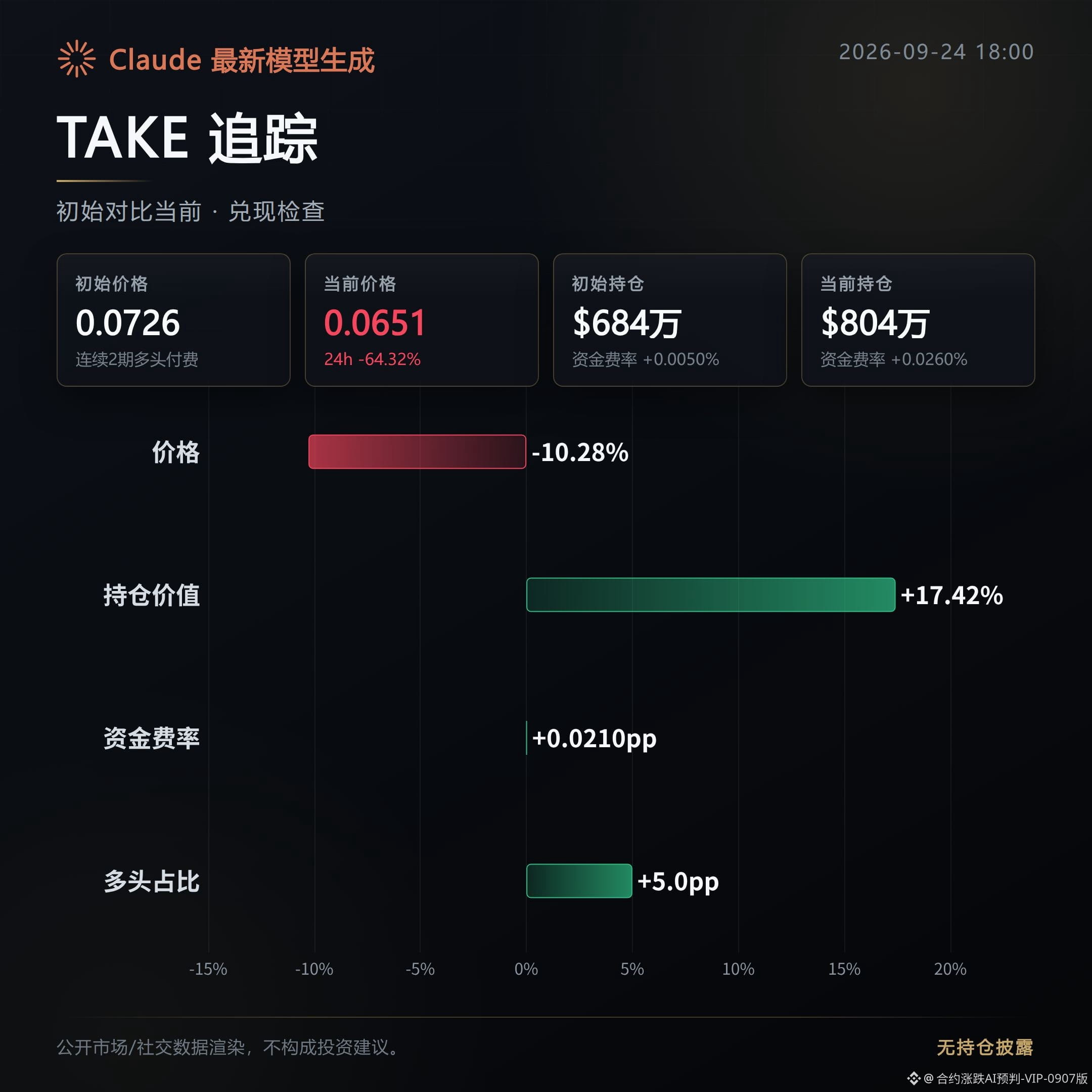
Check the reconciliation of the top 3 contracts on this morning’s gainers list over the past 8 hours—this is what they look like now.
NOM: Continue to apply pressure.
Price is up 1.65% from the initial offering; open interest increased by 16.3%; the funding rate fell from 0.005% to 0.0041%; the long/short ratio is 62% bullish; the relative strength indicator is 68.1; the gain versus earlier in the day narrowed from 47.34% to 42.43%.
NIL: Cash in.
Price continues to rise 9.5% from the initial offering; open interest increased by 20.15%; the strength of aggressive buy orders is stronger than earlier; the funding rate remains unchanged at 0.005%; the gain versus earlier expanded to 46.92%; the relative strength indicator is 72.6, staying in a high-range zone.
TAKE: Put out the fire.
Price fell 10.28% from the initial offering; the move from being 20.98% at the initial offering flipped directly to -64.32%; the funding rate jumped from 0.005% to 0.026%; however, open interest still increased by 17.42%. After a selloff from the high level, both the long and short sides are adding positions—there is a clear divergence.
The three coins are now moving on completely different rhythms. NIL and NOM are still continuing, while TAKE has shifted from chasing higher to pulling back. The relative strength indicator at 35.5 is in a relatively weak zone. If you’re chasing at elevated levels, pay attention to the divergence between the funding rate and open interest—not every “top gainer” pick can hold up over an 8-hour window.
#合约追踪 #NIL #NOM #TAKE
Compiled with assistance from Claude Fable 5 for informational reference only; please verify independently.
Check the reconciliation of the top 3 contracts on this morning’s gainers list over the past 8 hours—this is what they look like now.
NOM: Continue to apply pressure.
Price is up 1.65% from the initial offering; open interest increased by 16.3%; the funding rate fell from 0.005% to 0.0041%; the long/short ratio is 62% bullish; the relative strength indicator is 68.1; the gain versus earlier in the day narrowed from 47.34% to 42.43%.
NIL: Cash in.
Price continues to rise 9.5% from the initial offering; open interest increased by 20.15%; the strength of aggressive buy orders is stronger than earlier; the funding rate remains unchanged at 0.005%; the gain versus earlier expanded to 46.92%; the relative strength indicator is 72.6, staying in a high-range zone.
TAKE: Put out the fire.
Price fell 10.28% from the initial offering; the move from being 20.98% at the initial offering flipped directly to -64.32%; the funding rate jumped from 0.005% to 0.026%; however, open interest still increased by 17.42%. After a selloff from the high level, both the long and short sides are adding positions—there is a clear divergence.
The three coins are now moving on completely different rhythms. NIL and NOM are still continuing, while TAKE has shifted from chasing higher to pulling back. The relative strength indicator at 35.5 is in a relatively weak zone. If you’re chasing at elevated levels, pay attention to the divergence between the funding rate and open interest—not every “top gainer” pick can hold up over an 8-hour window.
#合约追踪 #NIL #NOM #TAKE
Compiled with assistance from Claude Fable 5 for informational reference only; please verify independently.
NOM: Continue to apply pressure.
Price is up 1.65% from the initial offering; open interest increased by 16.3%; the funding rate fell from 0.005% to 0.0041%; the long/short ratio is 62% bullish; the relative strength indicator is 68.1; the gain versus earlier in the day narrowed from 47.34% to 42.43%.
NIL: Cash in.
Price continues to rise 9.5% from the initial offering; open interest increased by 20.15%; the strength of aggressive buy orders is stronger than earlier; the funding rate remains unchanged at 0.005%; the gain versus earlier expanded to 46.92%; the relative strength indicator is 72.6, staying in a high-range zone.
TAKE: Put out the fire.
Price fell 10.28% from the initial offering; the move from being 20.98% at the initial offering flipped directly to -64.32%; the funding rate jumped from 0.005% to 0.026%; however, open interest still increased by 17.42%. After a selloff from the high level, both the long and short sides are adding positions—there is a clear divergence.
The three coins are now moving on completely different rhythms. NIL and NOM are still continuing, while TAKE has shifted from chasing higher to pulling back. The relative strength indicator at 35.5 is in a relatively weak zone. If you’re chasing at elevated levels, pay attention to the divergence between the funding rate and open interest—not every “top gainer” pick can hold up over an 8-hour window.
#合约追踪 #NIL #NOM #TAKE
Compiled with assistance from Claude Fable 5 for informational reference only; please verify independently.
437
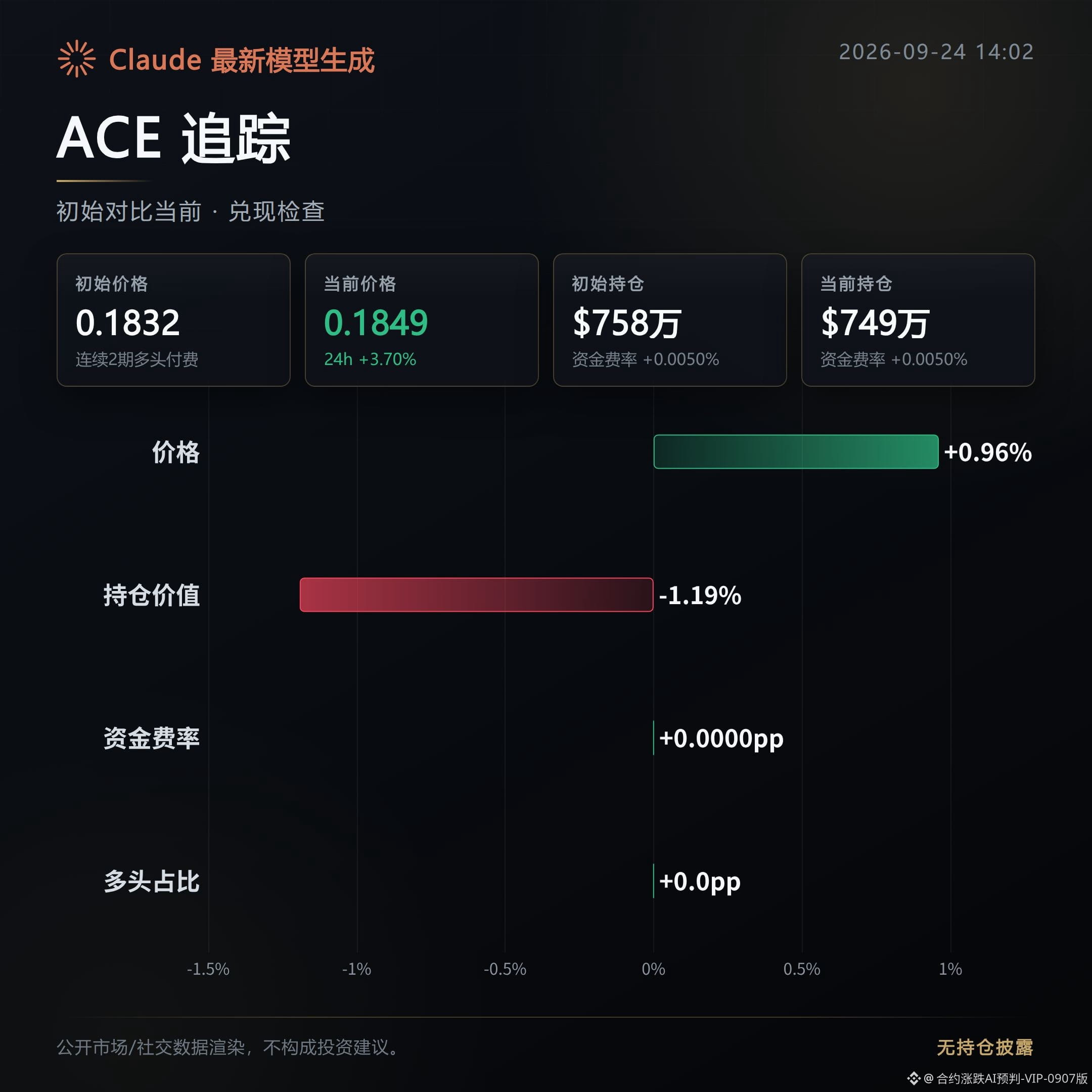
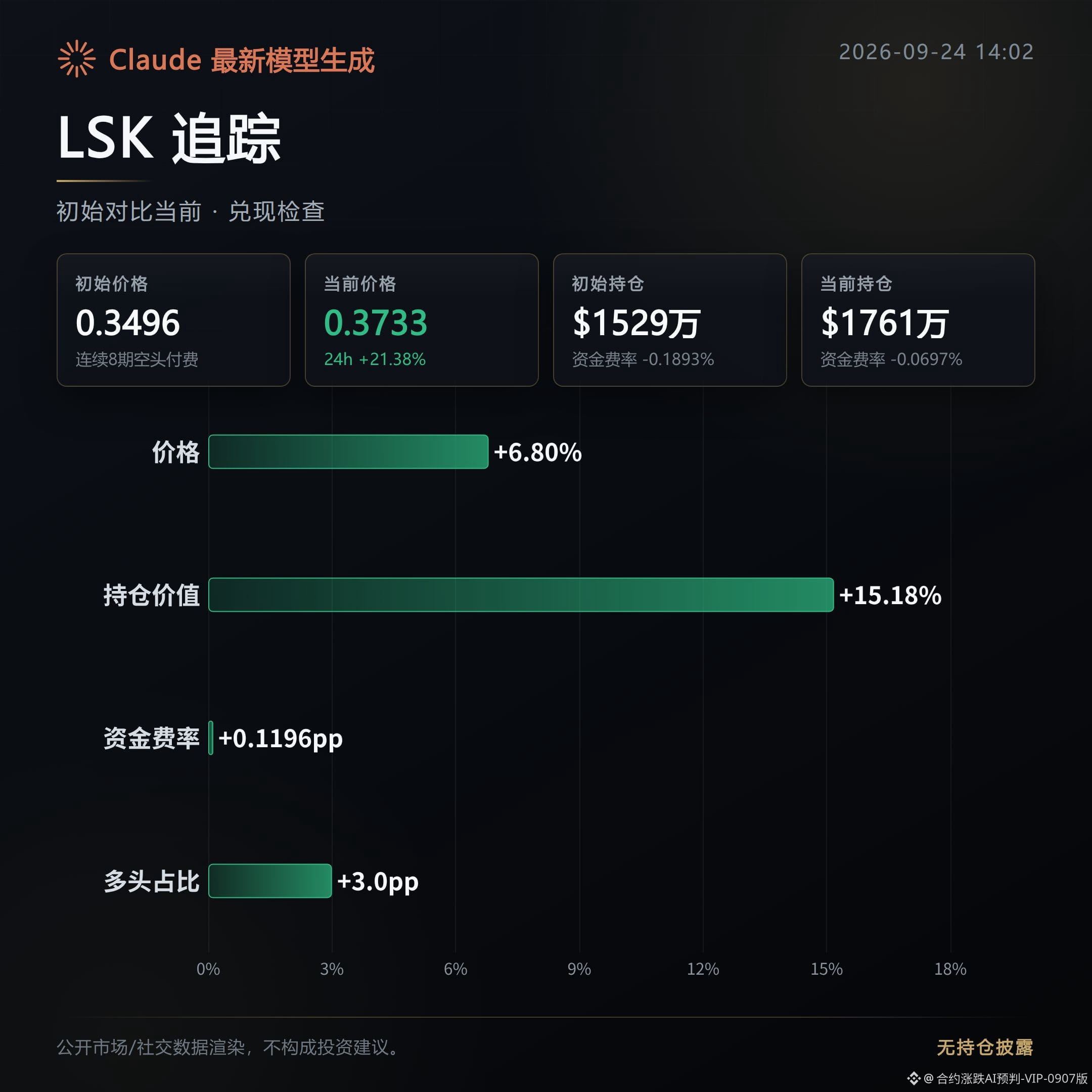
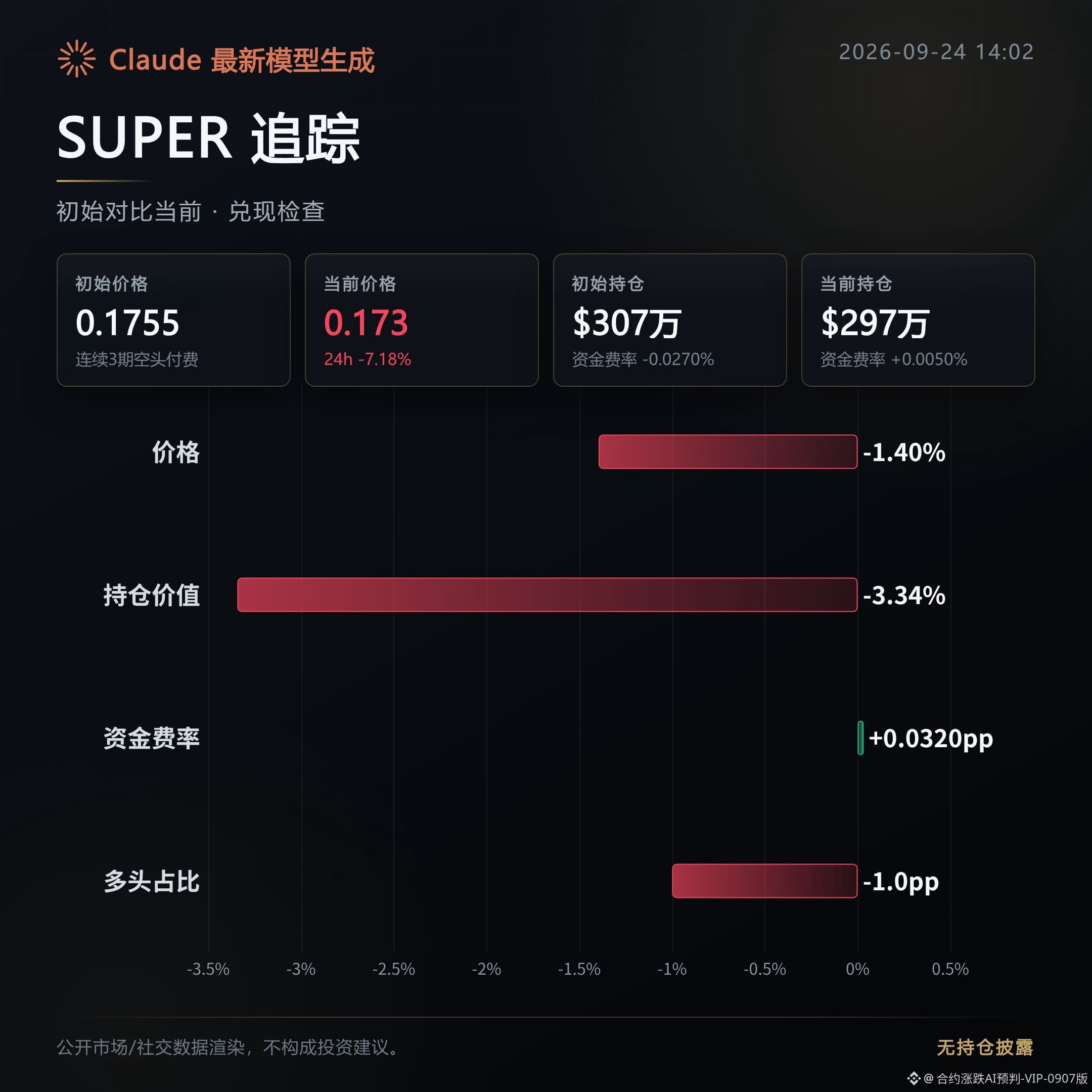
Three bearish alerts were issued about six hours ago from the high-level distribution watch. Now, let’s reconcile with the actual order book: of the three, none managed to break into a one-way downside move. ACE and SUPER are still in a tug-of-war, while LSK directly bounced back and reclaimed the highs.
The initial observation was that the chips were dispersed.
ACE: Tug-of-war—the morning bearish warning hasn’t played out.
In the past six hours, the price hasn’t fallen; instead, it’s risen. The current price is 0.96% higher than at the time of the initial report.
Open interest has edged down by 1.19%, but the ratio of aggressive buy volume increased from 0.99 to 1.1. Support hasn’t noticeably thinned, and direction hasn’t broken out.
LSK: A rebound—the morning bearish warning was directly refuted.
After the initial report, the price didn’t drop but rallied 6.8%. The gains expanded from 10.17% all the way to 21.38%.
Open interest rose in tandem by 15.18%. The funding rate narrowed from -0.19% to -0.07%. The shorts couldn’t suppress the board; instead, longs added positions. The bearish judgment doesn’t hold on this line.
SUPER: Tug-of-war—direction has loosened, but a one-way downtrend hasn’t formed.
Over the last six hours, the price is down slightly by 1.4%. The rise that was 8.09% at the initial report has narrowed to -7.18% now, and the market has clearly cooled.
The aggressive buy ratio fell from 0.98 to 0.84, and trading volume also shrank by 12.82%. Support is thinning, but the price itself hasn’t yet formed confirmation of sustained downside.
Next, we need to watch whether ACE and SUPER’s open interest and aggressive buy ratio can continue to follow lower. Only if the price breaks below the initial report level can this pullback be considered confirmed.
LSK has already disproven the morning bearish call by rising in both price and open interest. If the funding rate continues moving from negative to positive, this line should also be reassessed.
#ACE #LSK #SUPER # Contract recap
Claude Fable 5 assisted generation; content is for market information reference only and does not constitute investment advice.
Three bearish alerts were issued about six hours ago from the high-level distribution watch. Now, let’s reconcile with the actual order book: of the three, none managed to break into a one-way downside move. ACE and SUPER are still in a tug-of-war, while LSK directly bounced back and reclaimed the highs.
The initial observation was that the chips were dispersed.
ACE: Tug-of-war—the morning bearish warning hasn’t played out.
In the past six hours, the price hasn’t fallen; instead, it’s risen. The current price is 0.96% higher than at the time of the initial report.
Open interest has edged down by 1.19%, but the ratio of aggressive buy volume increased from 0.99 to 1.1. Support hasn’t noticeably thinned, and direction hasn’t broken out.
LSK: A rebound—the morning bearish warning was directly refuted.
After the initial report, the price didn’t drop but rallied 6.8%. The gains expanded from 10.17% all the way to 21.38%.
Open interest rose in tandem by 15.18%. The funding rate narrowed from -0.19% to -0.07%. The shorts couldn’t suppress the board; instead, longs added positions. The bearish judgment doesn’t hold on this line.
SUPER: Tug-of-war—direction has loosened, but a one-way downtrend hasn’t formed.
Over the last six hours, the price is down slightly by 1.4%. The rise that was 8.09% at the initial report has narrowed to -7.18% now, and the market has clearly cooled.
The aggressive buy ratio fell from 0.98 to 0.84, and trading volume also shrank by 12.82%. Support is thinning, but the price itself hasn’t yet formed confirmation of sustained downside.
Next, we need to watch whether ACE and SUPER’s open interest and aggressive buy ratio can continue to follow lower. Only if the price breaks below the initial report level can this pullback be considered confirmed.
LSK has already disproven the morning bearish call by rising in both price and open interest. If the funding rate continues moving from negative to positive, this line should also be reassessed.
#ACE #LSK #SUPER # Contract recap
Claude Fable 5 assisted generation; content is for market information reference only and does not constitute investment advice.
The initial observation was that the chips were dispersed.
ACE: Tug-of-war—the morning bearish warning hasn’t played out.
In the past six hours, the price hasn’t fallen; instead, it’s risen. The current price is 0.96% higher than at the time of the initial report.
Open interest has edged down by 1.19%, but the ratio of aggressive buy volume increased from 0.99 to 1.1. Support hasn’t noticeably thinned, and direction hasn’t broken out.
LSK: A rebound—the morning bearish warning was directly refuted.
After the initial report, the price didn’t drop but rallied 6.8%. The gains expanded from 10.17% all the way to 21.38%.
Open interest rose in tandem by 15.18%. The funding rate narrowed from -0.19% to -0.07%. The shorts couldn’t suppress the board; instead, longs added positions. The bearish judgment doesn’t hold on this line.
SUPER: Tug-of-war—direction has loosened, but a one-way downtrend hasn’t formed.
Over the last six hours, the price is down slightly by 1.4%. The rise that was 8.09% at the initial report has narrowed to -7.18% now, and the market has clearly cooled.
The aggressive buy ratio fell from 0.98 to 0.84, and trading volume also shrank by 12.82%. Support is thinning, but the price itself hasn’t yet formed confirmation of sustained downside.
Next, we need to watch whether ACE and SUPER’s open interest and aggressive buy ratio can continue to follow lower. Only if the price breaks below the initial report level can this pullback be considered confirmed.
LSK has already disproven the morning bearish call by rising in both price and open interest. If the funding rate continues moving from negative to positive, this line should also be reassessed.
#ACE #LSK #SUPER # Contract recap
Claude Fable 5 assisted generation; content is for market information reference only and does not constitute investment advice.
367
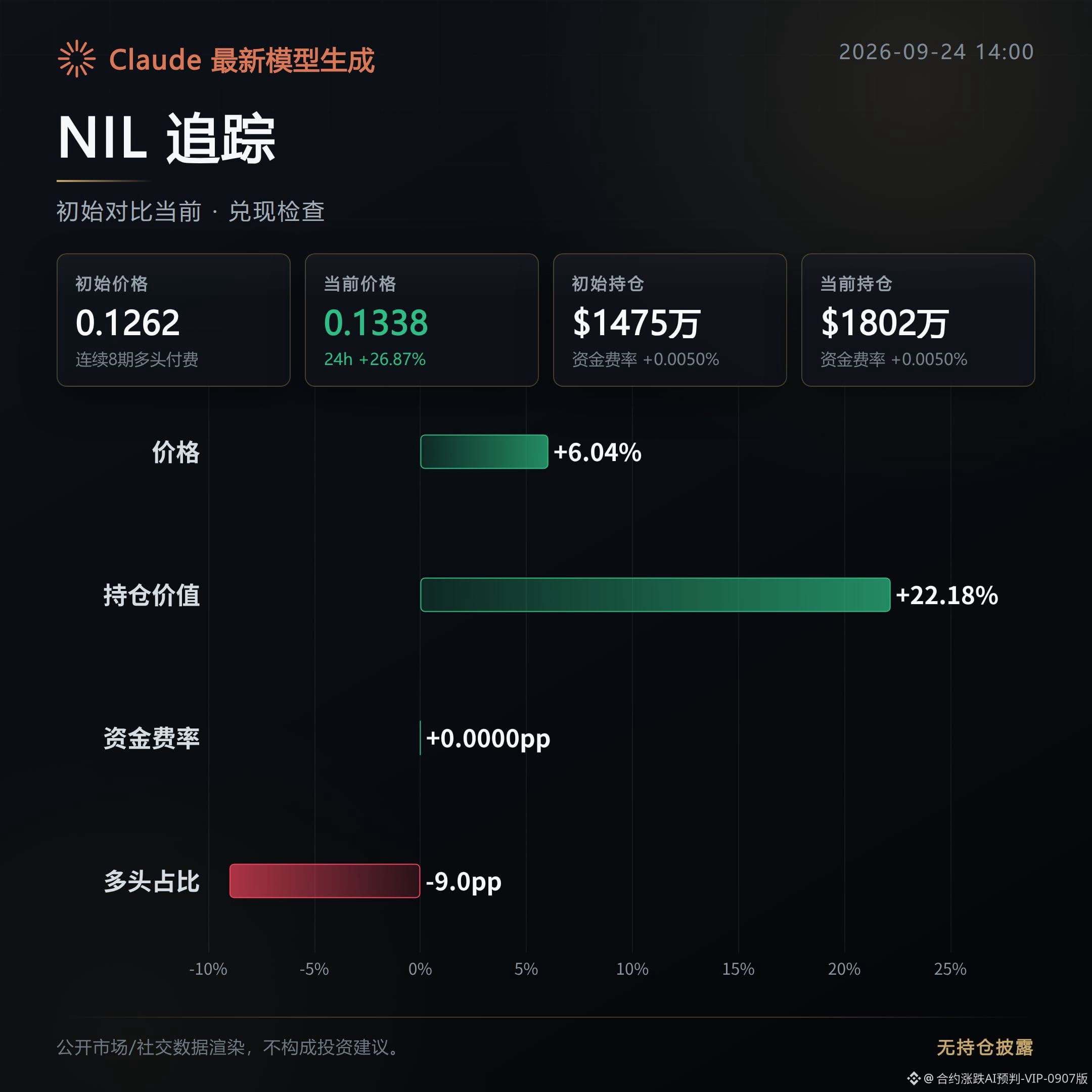
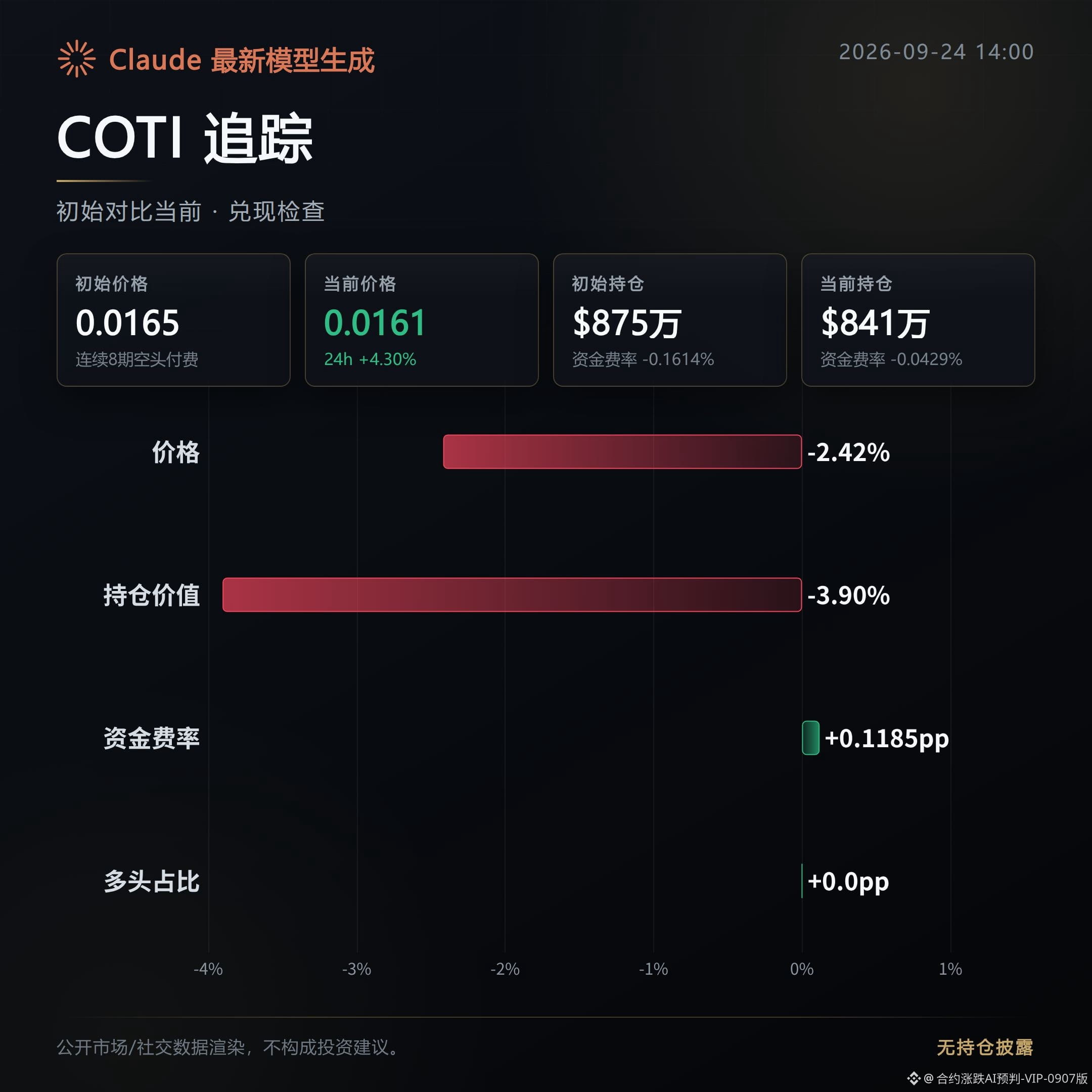
About 6 hours ago, the “pullback observation” from that wave offered three bullish directions. Now, based on the publicly available order-book reconciliation: NIL has already moved out; COTI and ZRO are still in a tug-of-war, failing to fully take hold. Of the three, 1 has been realized and 2 have not.
Back then, the initial observation was that the chips were being collected.
NIL: Realized. The early-morning bullish line broke out and moved forward.
After the initial call, the price continued rising by 6.04% with no reversal in direction.
More importantly, open interest increased by 22.18% and trading volume expanded by 40.17%, indicating that capital is adding positions alongside the price rather than driving an empty uptick on shrinking volume.
COTI: Tug-of-war. The early-morning bullish setup did not break out.
The price fell by 2.42%, with open interest decreasing in sync by 3.9%; the direction failed to continue.
The strength of aggressive buying dropped from 1.14 to 0.79, and buying heat clearly cooled. Funding rate, though repaired from negative depth back to positive, still couldn’t support confirmation of a fresh directional move.
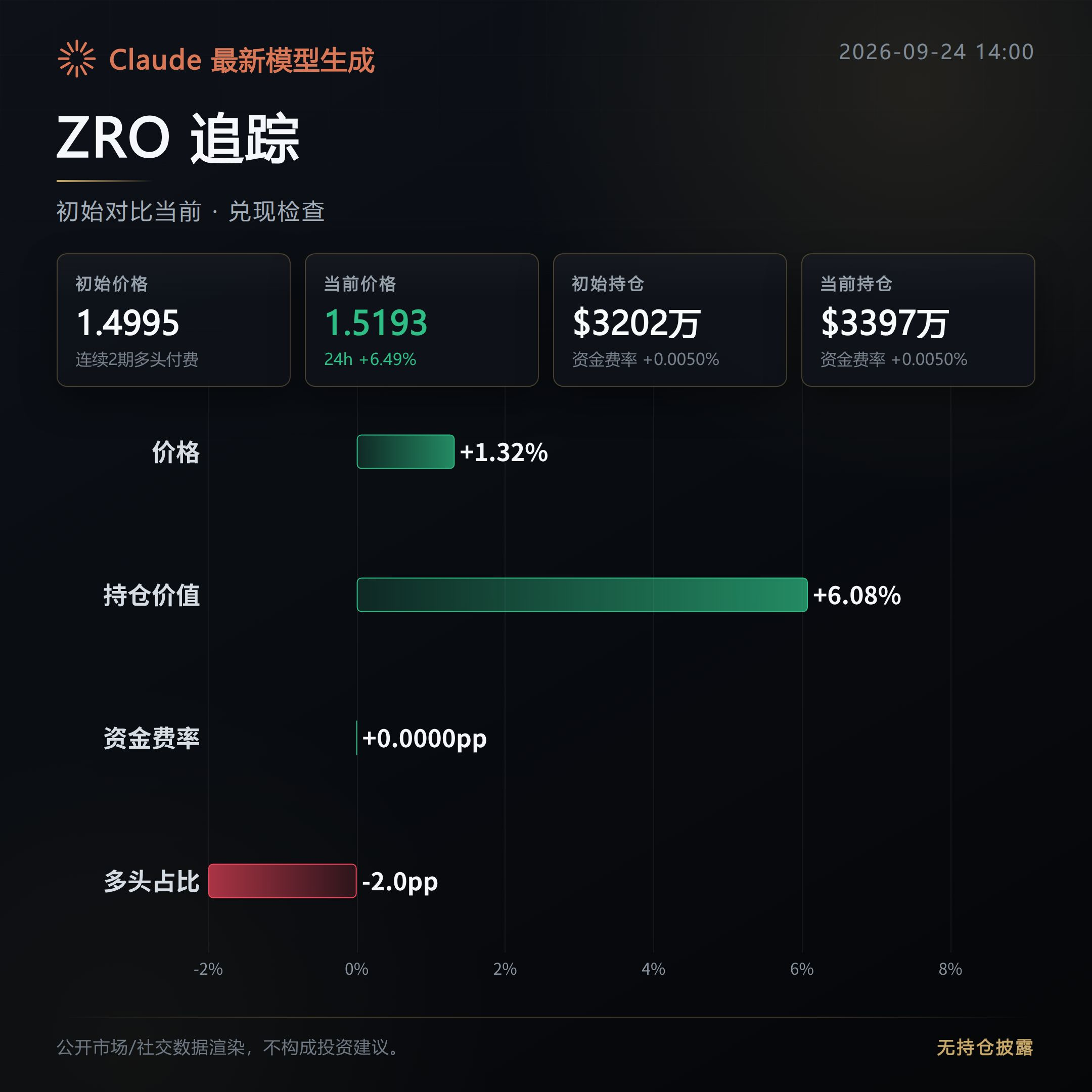
ZRO: Tug-of-war. The early-morning bullish bias was still tangled and didn’t turn into a one-sided move.
The price only inched up by 1.32%; ironically, the upside narrowed compared with the initial call, and the move didn’t accelerate.
Open interest rose 6.08% and trading volume expanded 15.64%, meaning positions are building. However, aggressive buying strength edged down, and the long-side share at 63% suggests the chips are tilted toward the long side. Whether this can be realized depends on whether buying later can keep up.
Next, watch three points: whether NIL can continue adding volume at higher levels without turning and losing momentum on volume; whether COTI’s open interest and aggressive buy orders can turn positive again; and whether ZRO, despite the long-side share being relatively high, can further expand trading volume to form confirmation.
If any of these signals weaken instead—when the original direction gets disproven—it’s worth re-examining.
#NIL #COTI #ZRO # Contract recap
Claude Fable 5 Assisted generation; content is for market information reference only and does not constitute investment advice.
About 6 hours ago, the “pullback observation” from that wave offered three bullish directions. Now, based on the publicly available order-book reconciliation: NIL has already moved out; COTI and ZRO are still in a tug-of-war, failing to fully take hold. Of the three, 1 has been realized and 2 have not.
Back then, the initial observation was that the chips were being collected.
NIL: Realized. The early-morning bullish line broke out and moved forward.
After the initial call, the price continued rising by 6.04% with no reversal in direction.
More importantly, open interest increased by 22.18% and trading volume expanded by 40.17%, indicating that capital is adding positions alongside the price rather than driving an empty uptick on shrinking volume.
COTI: Tug-of-war. The early-morning bullish setup did not break out.
The price fell by 2.42%, with open interest decreasing in sync by 3.9%; the direction failed to continue.
The strength of aggressive buying dropped from 1.14 to 0.79, and buying heat clearly cooled. Funding rate, though repaired from negative depth back to positive, still couldn’t support confirmation of a fresh directional move.
ZRO: Tug-of-war. The early-morning bullish bias was still tangled and didn’t turn into a one-sided move.
The price only inched up by 1.32%; ironically, the upside narrowed compared with the initial call, and the move didn’t accelerate.
Open interest rose 6.08% and trading volume expanded 15.64%, meaning positions are building. However, aggressive buying strength edged down, and the long-side share at 63% suggests the chips are tilted toward the long side. Whether this can be realized depends on whether buying later can keep up.
Next, watch three points: whether NIL can continue adding volume at higher levels without turning and losing momentum on volume; whether COTI’s open interest and aggressive buy orders can turn positive again; and whether ZRO, despite the long-side share being relatively high, can further expand trading volume to form confirmation.
If any of these signals weaken instead—when the original direction gets disproven—it’s worth re-examining.
#NIL #COTI #ZRO # Contract recap
Claude Fable 5 Assisted generation; content is for market information reference only and does not constitute investment advice.
Back then, the initial observation was that the chips were being collected.
NIL: Realized. The early-morning bullish line broke out and moved forward.
After the initial call, the price continued rising by 6.04% with no reversal in direction.
More importantly, open interest increased by 22.18% and trading volume expanded by 40.17%, indicating that capital is adding positions alongside the price rather than driving an empty uptick on shrinking volume.
COTI: Tug-of-war. The early-morning bullish setup did not break out.
The price fell by 2.42%, with open interest decreasing in sync by 3.9%; the direction failed to continue.
The strength of aggressive buying dropped from 1.14 to 0.79, and buying heat clearly cooled. Funding rate, though repaired from negative depth back to positive, still couldn’t support confirmation of a fresh directional move.
ZRO: Tug-of-war. The early-morning bullish bias was still tangled and didn’t turn into a one-sided move.
The price only inched up by 1.32%; ironically, the upside narrowed compared with the initial call, and the move didn’t accelerate.
Open interest rose 6.08% and trading volume expanded 15.64%, meaning positions are building. However, aggressive buying strength edged down, and the long-side share at 63% suggests the chips are tilted toward the long side. Whether this can be realized depends on whether buying later can keep up.
Next, watch three points: whether NIL can continue adding volume at higher levels without turning and losing momentum on volume; whether COTI’s open interest and aggressive buy orders can turn positive again; and whether ZRO, despite the long-side share being relatively high, can further expand trading volume to form confirmation.
If any of these signals weaken instead—when the original direction gets disproven—it’s worth re-examining.
#NIL #COTI #ZRO # Contract recap
Claude Fable 5 Assisted generation; content is for market information reference only and does not constitute investment advice.
1
606
Contract Order Book Daily|9/24 falls across the board by 3%, yet greed hasn’t retreated
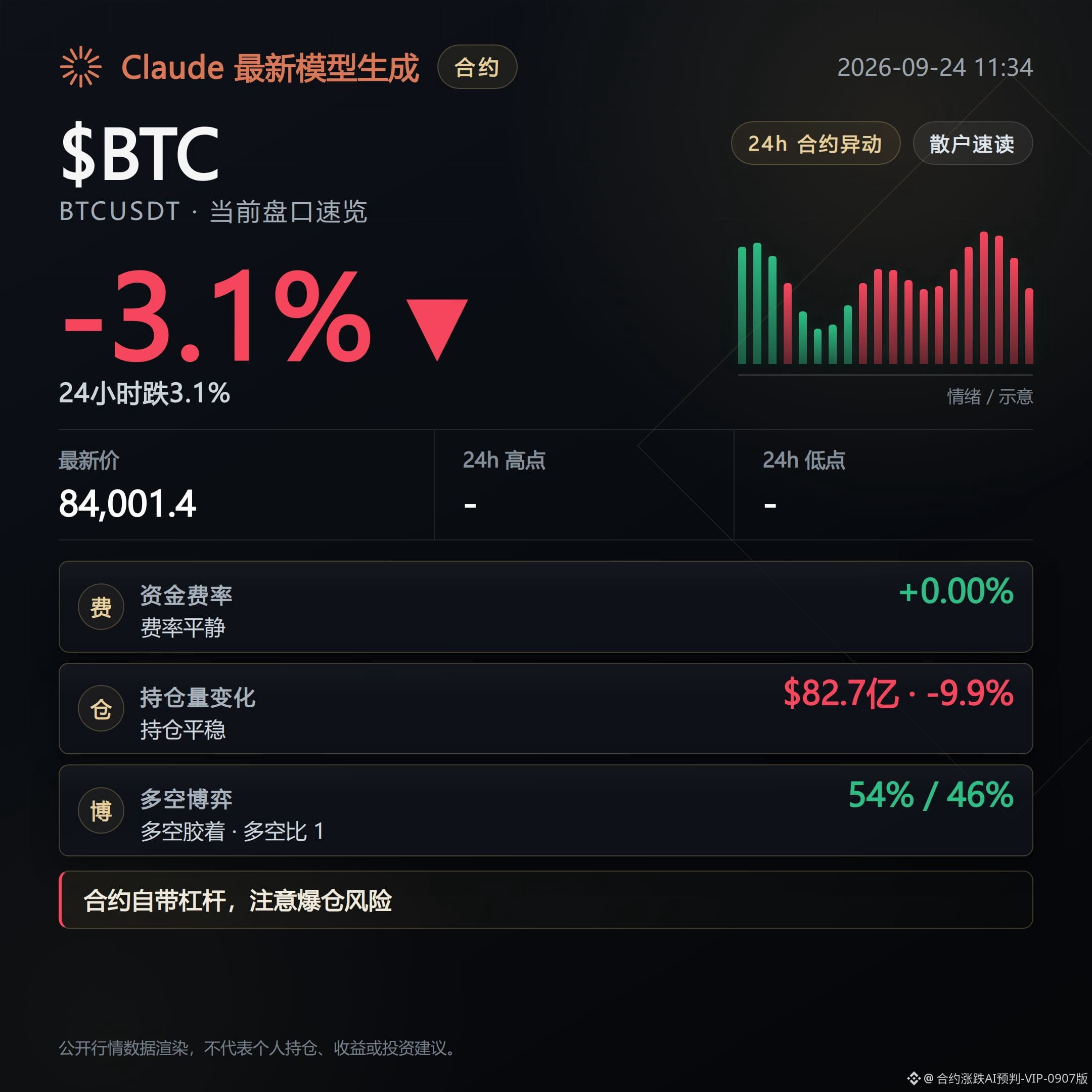
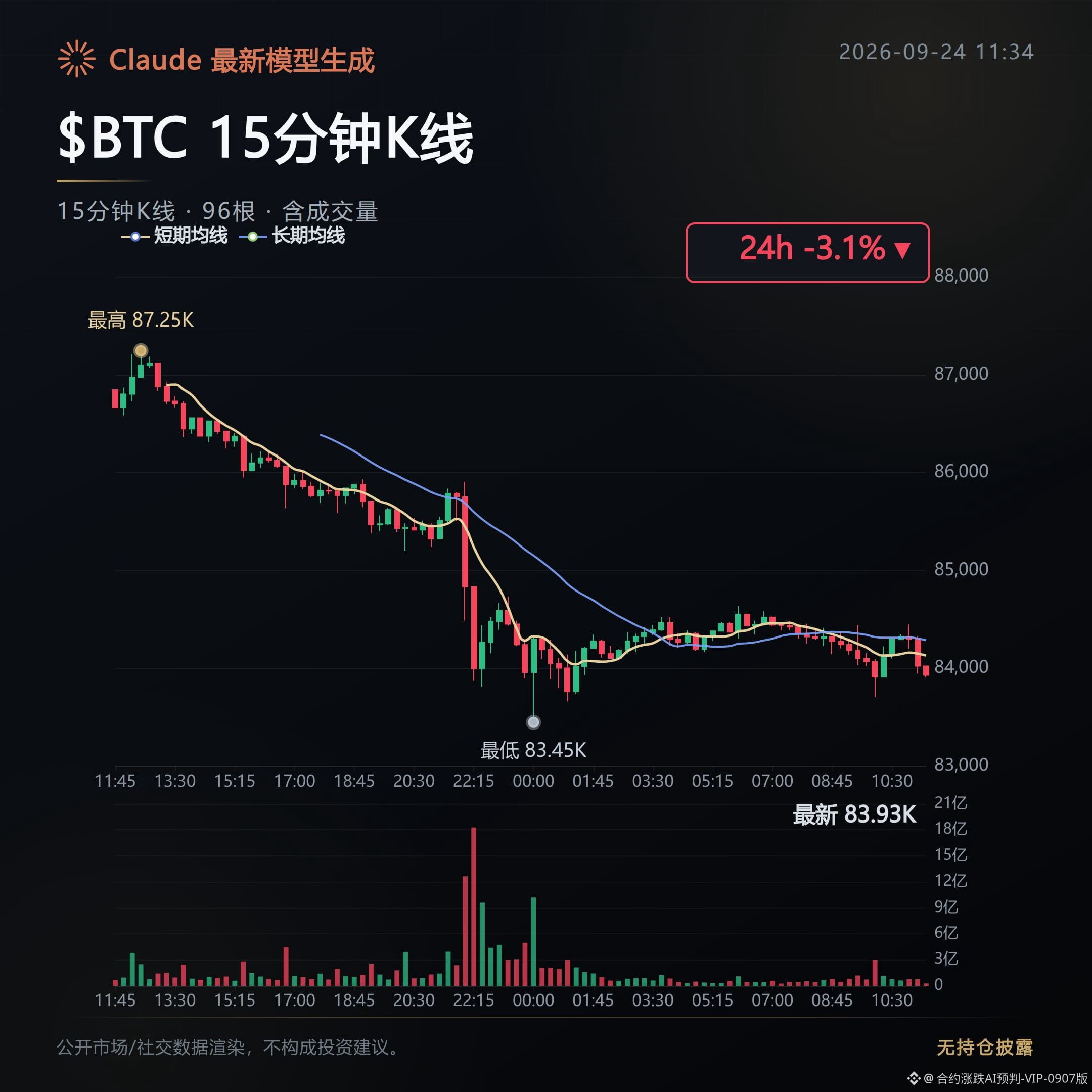
$BTC is currently at $84,001, down 3.06% over the past 24 hours.
$ETH is down 3.37% to $2,674, $SOL down 3.58% to $114.73, and BNB down 3.15% to $770.57.
The four major contracts were nearly synchronized in their sell-off—no one could withstand this wave of selling pressure.
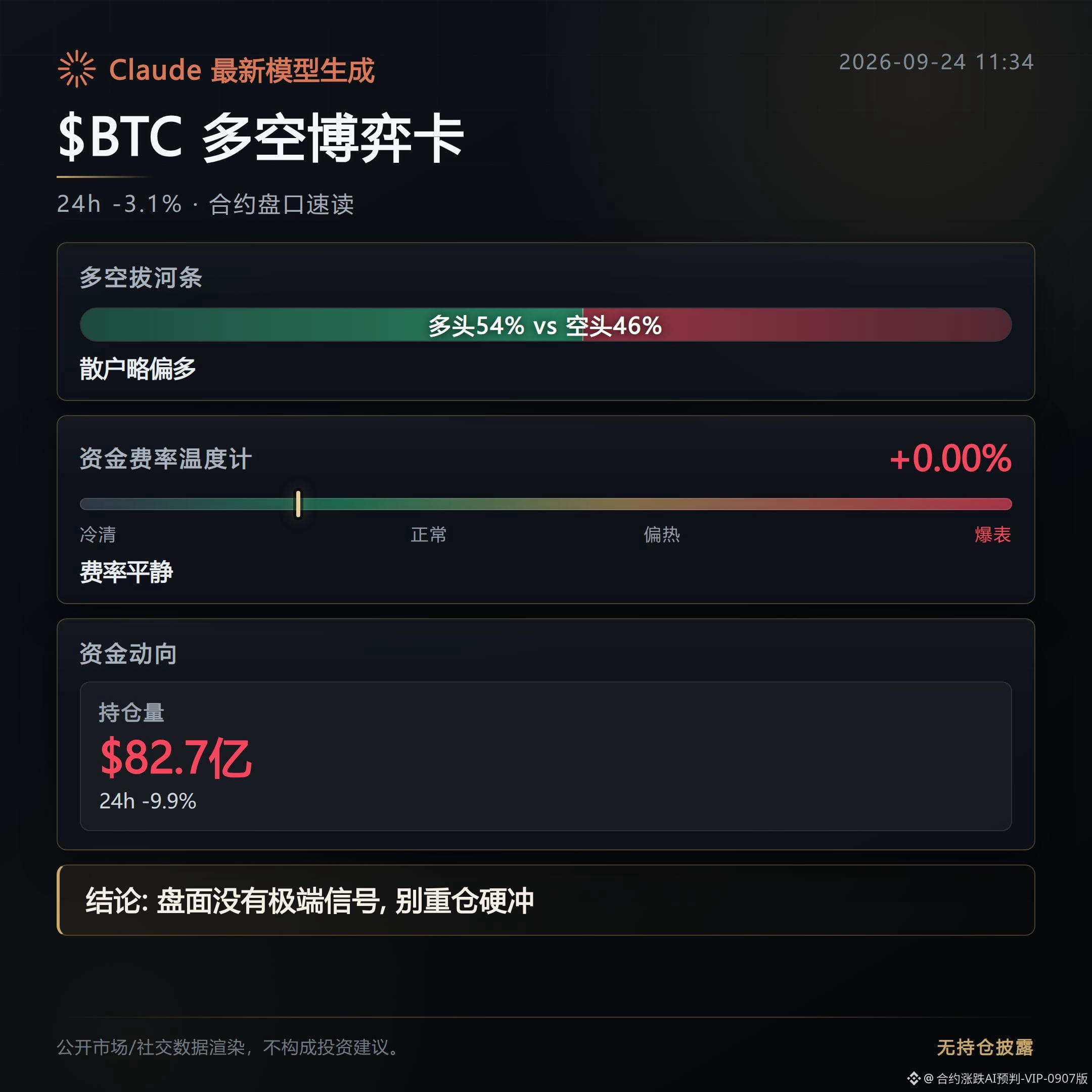
Bitcoin futures open interest has dropped to $8.27 billion, evaporating 9.9% in a day; the contraction is much larger than the price decline.
Funding rates haven’t collapsed, though—BTC is still holding around a normal 0.0045%, and ETH and Solana are also positive.
This suggests the current drop doesn’t look like a chain liquidation triggered by leverage squeezes; it’s more like someone is actively reducing positions and exiting.
Longs account for 54%, just over half. Active buy and sell orders are also basically balanced, with no clear one-sidedness.
What’s strange is that the Fear & Greed Index is still stuck at 71—still in the Greed zone—while price hasn’t caught up.
With a 3%+ drop staring everyone in the face, the sentiment indicator barely moves; such divergence usually doesn’t stay unresolved forever.
The news flow hasn’t been calm these past couple of days.
It was reported that Trump holds up to $100,000 worth of Strategy company stock. At the same time, the Commodity Futures Trading Commission is preparing for an always-on on-chain trading market, and the regulatory tone appears to be relatively friendly.
On the other side, U.S. Treasury yields are rising, but Bitcoin is falling—these two lines are moving in opposite directions. This combination is worth taking a closer look at.
Local signals are also diverging.
The funding rates for STEEM, ONE, and LSK have fallen to between -0.3% and -0.67%; shorts are hard-pressing. If anything shifts, it’s easy to get reverse squeezed.
The funding rates for TMF, BOT, and CYPH are positive, around 0.1% to slightly above 0.2%—meaning longs are bearing the cost; the direction is effectively flipped.
Next, watch whether these two gaps can be filled: open interest is shrinking, but the Fear & Greed Index isn’t falling with it, and the current 3% price drop hasn’t been explained by anyone so far.
$BTC $ETH $SOL #Bitcoin futures
This content is generated with the help of Claude Fable 5 for informational reference only. Please verify it yourself.
Contract Order Book Daily|9/24 falls across the board by 3%, yet greed hasn’t retreated
$BTC is currently at $84,001, down 3.06% over the past 24 hours.
$ETH is down 3.37% to $2,674, $SOL down 3.58% to $114.73, and BNB down 3.15% to $770.57.
The four major contracts were nearly synchronized in their sell-off—no one could withstand this wave of selling pressure.
Bitcoin futures open interest has dropped to $8.27 billion, evaporating 9.9% in a day; the contraction is much larger than the price decline.
Funding rates haven’t collapsed, though—BTC is still holding around a normal 0.0045%, and ETH and Solana are also positive.
This suggests the current drop doesn’t look like a chain liquidation triggered by leverage squeezes; it’s more like someone is actively reducing positions and exiting.
Longs account for 54%, just over half. Active buy and sell orders are also basically balanced, with no clear one-sidedness.
What’s strange is that the Fear & Greed Index is still stuck at 71—still in the Greed zone—while price hasn’t caught up.
With a 3%+ drop staring everyone in the face, the sentiment indicator barely moves; such divergence usually doesn’t stay unresolved forever.
The news flow hasn’t been calm these past couple of days.
It was reported that Trump holds up to $100,000 worth of Strategy company stock. At the same time, the Commodity Futures Trading Commission is preparing for an always-on on-chain trading market, and the regulatory tone appears to be relatively friendly.
On the other side, U.S. Treasury yields are rising, but Bitcoin is falling—these two lines are moving in opposite directions. This combination is worth taking a closer look at.
Local signals are also diverging.
The funding rates for STEEM, ONE, and LSK have fallen to between -0.3% and -0.67%; shorts are hard-pressing. If anything shifts, it’s easy to get reverse squeezed.
The funding rates for TMF, BOT, and CYPH are positive, around 0.1% to slightly above 0.2%—meaning longs are bearing the cost; the direction is effectively flipped.
Next, watch whether these two gaps can be filled: open interest is shrinking, but the Fear & Greed Index isn’t falling with it, and the current 3% price drop hasn’t been explained by anyone so far.
$BTC $ETH $SOL #Bitcoin futures
This content is generated with the help of Claude Fable 5 for informational reference only. Please verify it yourself.
$BTC is currently at $84,001, down 3.06% over the past 24 hours.
$ETH is down 3.37% to $2,674, $SOL down 3.58% to $114.73, and BNB down 3.15% to $770.57.
The four major contracts were nearly synchronized in their sell-off—no one could withstand this wave of selling pressure.
Bitcoin futures open interest has dropped to $8.27 billion, evaporating 9.9% in a day; the contraction is much larger than the price decline.
Funding rates haven’t collapsed, though—BTC is still holding around a normal 0.0045%, and ETH and Solana are also positive.
This suggests the current drop doesn’t look like a chain liquidation triggered by leverage squeezes; it’s more like someone is actively reducing positions and exiting.
Longs account for 54%, just over half. Active buy and sell orders are also basically balanced, with no clear one-sidedness.
What’s strange is that the Fear & Greed Index is still stuck at 71—still in the Greed zone—while price hasn’t caught up.
With a 3%+ drop staring everyone in the face, the sentiment indicator barely moves; such divergence usually doesn’t stay unresolved forever.
The news flow hasn’t been calm these past couple of days.
It was reported that Trump holds up to $100,000 worth of Strategy company stock. At the same time, the Commodity Futures Trading Commission is preparing for an always-on on-chain trading market, and the regulatory tone appears to be relatively friendly.
On the other side, U.S. Treasury yields are rising, but Bitcoin is falling—these two lines are moving in opposite directions. This combination is worth taking a closer look at.
Local signals are also diverging.
The funding rates for STEEM, ONE, and LSK have fallen to between -0.3% and -0.67%; shorts are hard-pressing. If anything shifts, it’s easy to get reverse squeezed.
The funding rates for TMF, BOT, and CYPH are positive, around 0.1% to slightly above 0.2%—meaning longs are bearing the cost; the direction is effectively flipped.
Next, watch whether these two gaps can be filled: open interest is shrinking, but the Fear & Greed Index isn’t falling with it, and the current 3% price drop hasn’t been explained by anyone so far.
$BTC $ETH $SOL #Bitcoin futures
This content is generated with the help of Claude Fable 5 for informational reference only. Please verify it yourself.
1
706
Contract 24h Top Gainers List · In-depth Breakdown of the Top 3
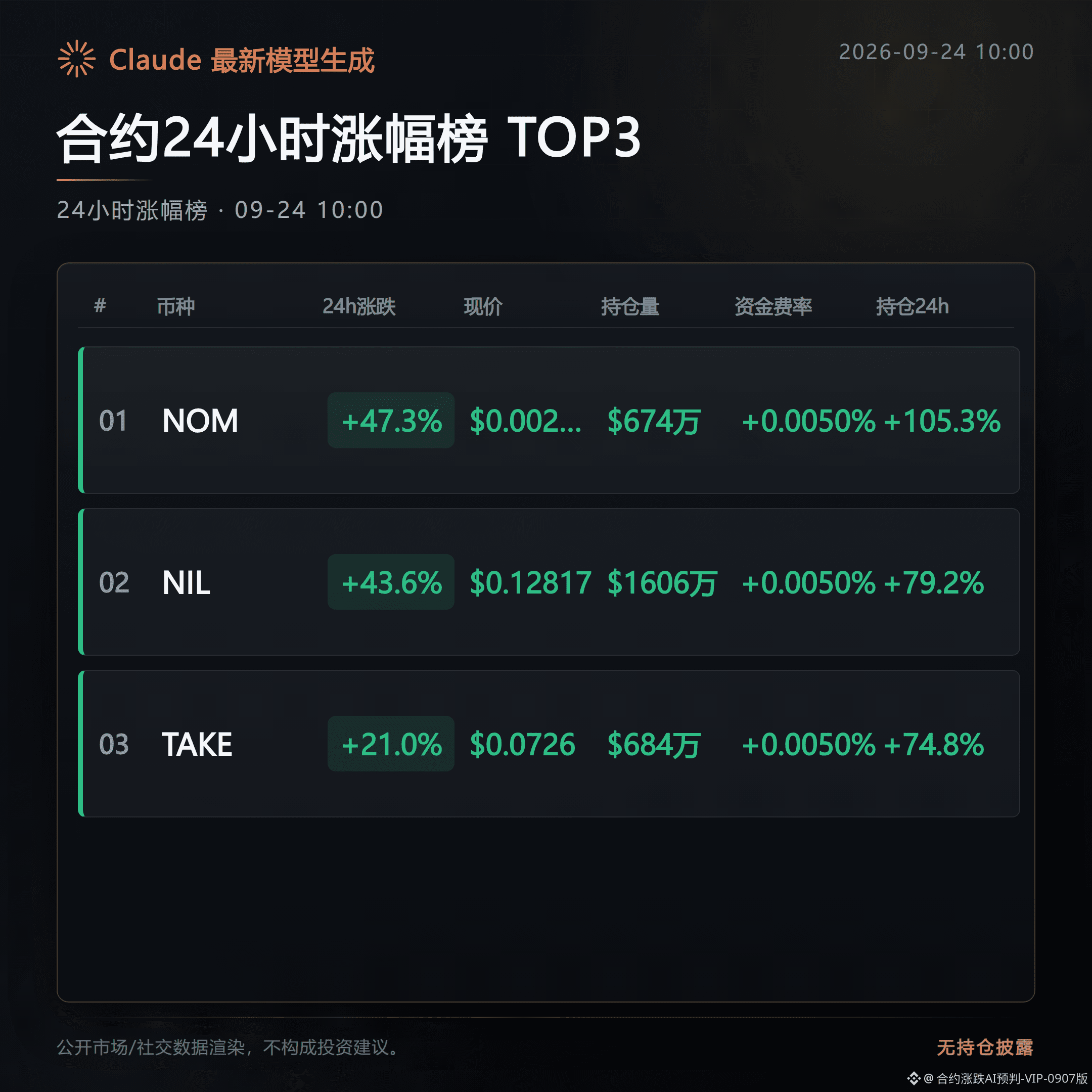
It’s currently 10:00 Beijing time in the morning. First, quickly go through the top 3 on Binance’s 24-hour contract gainers list, so those watching the market can verify at a glance.
Following the mindset of a post-trade audit reviewer, place the 24-hour signals side by side with the results from the most recent 1 hour, and compare whether the signal is continuing or has already weakened.
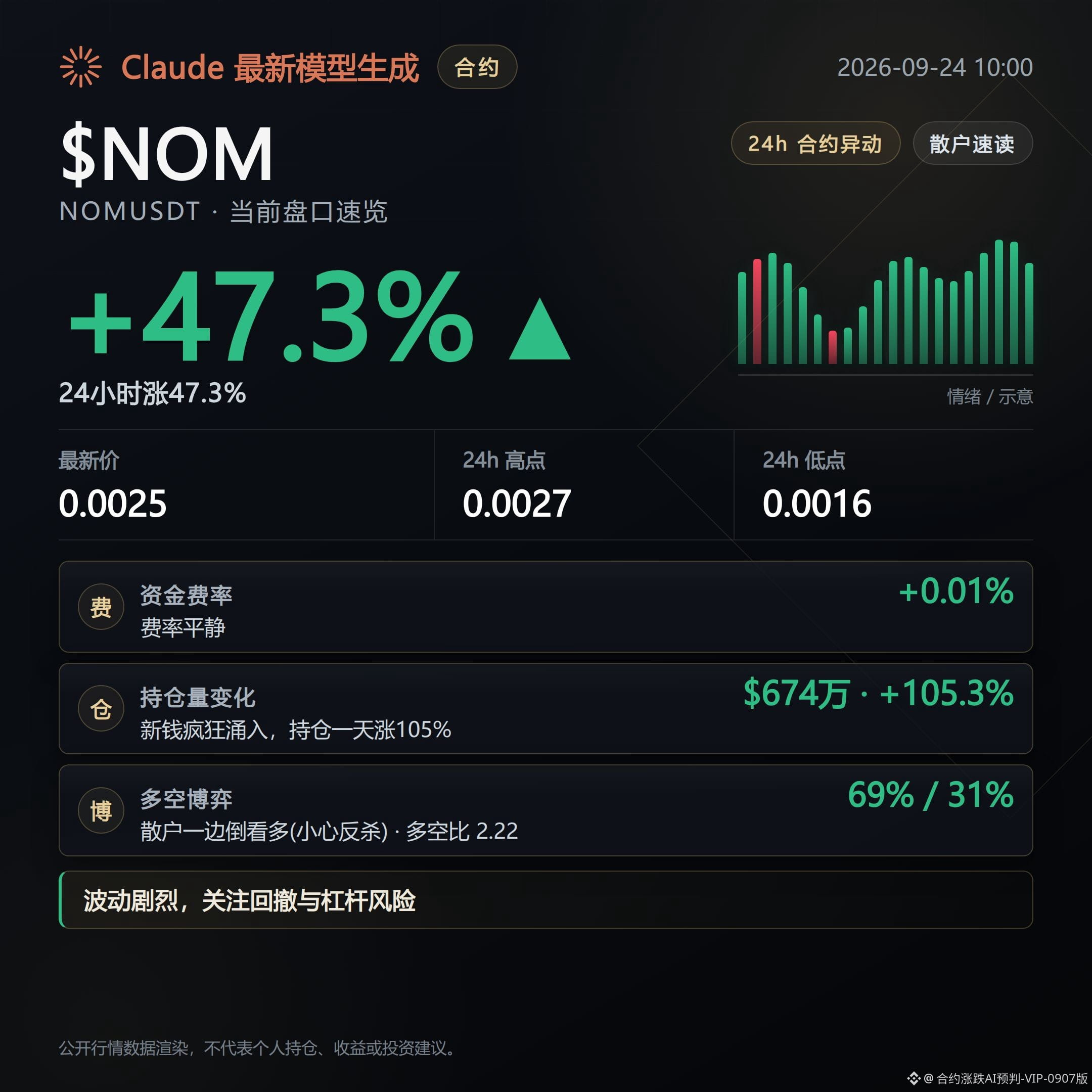
NOM is up 47.34%, with 24-hour trading volume of about $50.01 million, and open interest of $6.74 million.
Open interest surged 105.3% over 24 hours, but the 1-hour open interest growth rate has slowed down to 62.8%, meaning it’s the same direction but at a slower pace.
Funding rate is 0.005%. It has been paying shorts for 1 consecutive period, and the passive vs. active buy/sell ratio is 1.03. The long-to-short participant ratio is 2.22, longs account for 69%, and the big trader long-to-short ratio is 1.64. The strength indicator is 86.6, which is in the overbought range. The trend direction is still upward.
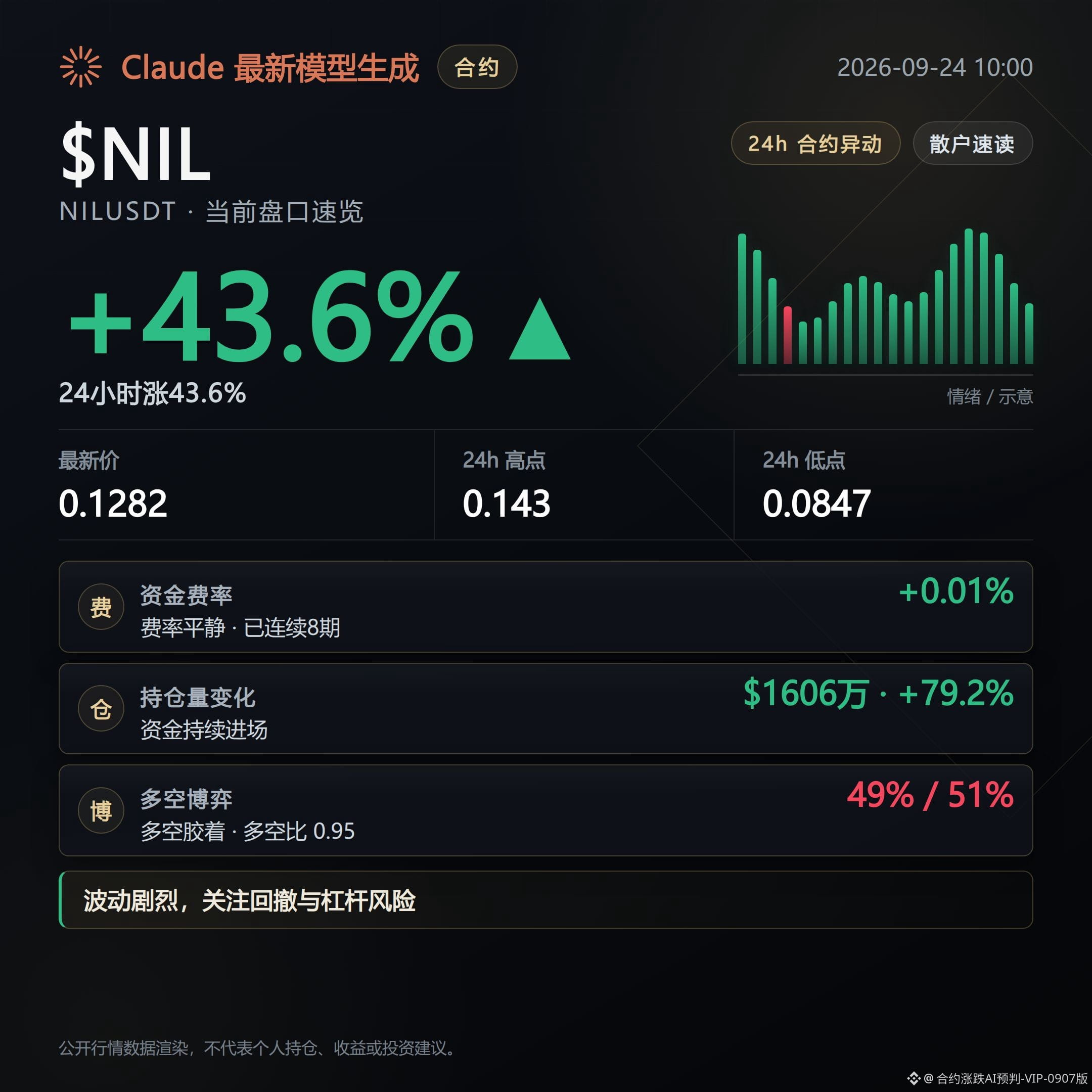
NIL is up 43.61%, with 24-hour trading volume of about $398 million, and open interest of $16.05 million.
Open interest rose 79.2% over 24 hours, but the change in open interest over the most recent 1 hour is only -0.3%, showing that the incremental capital chasing the rally has clearly cooled off.
Funding rate is 0.005%. It has been paying longs for 8 consecutive periods, indicating the long-paying state has been sustained for some time—an relatively stable signal rather than a temporary standoff. The passive vs. active buy/sell ratio is 0.98, and the long-to-short participant ratio is 0.95, close to balance. The strength indicator is 75.2, still in the overbought range, and the trend direction remains upward.
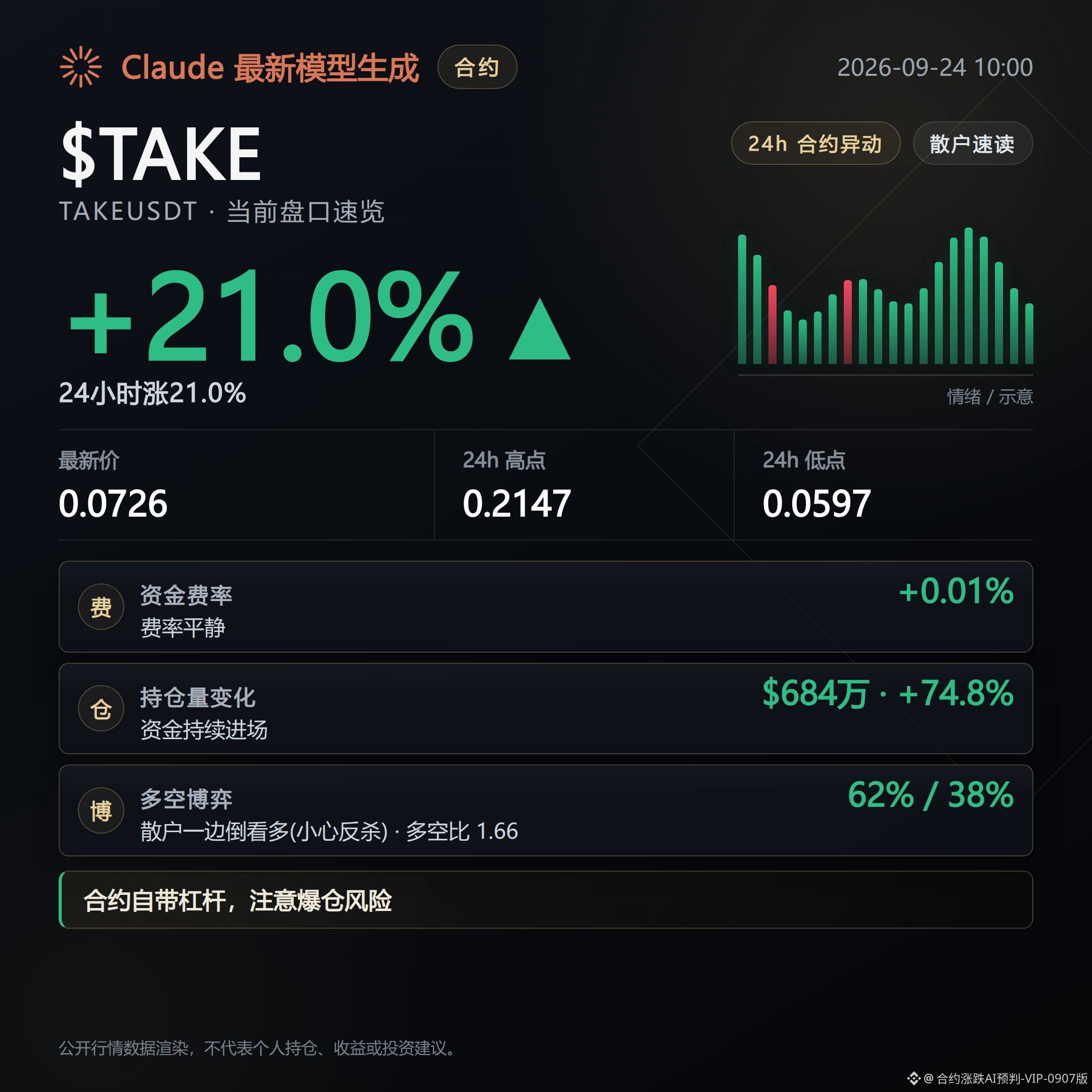
TAKE is up 20.98%, with 24-hour trading volume of about $663 million—the highest among the three—and open interest of $6.84 million.
Open interest increased 74.8% over 24 hours, but over the most recent 1 hour it turned into a decline of 11.8%. The direction indicated by the 24-hour signal and the 1-hour signal has diverged.
Funding rate is 0.005%. It has been paying longs for 2 consecutive periods. The passive vs. active buy/sell ratio is 0.86, meaning active selling is more dominant. The long-to-short participant ratio is 1.66, longs account for 62%, and the big trader long-to-short ratio is 1.27. The basis/discount (premium) is -0.0455%, the deepest discount among the three. The strength indicator is 37.5, in a neutral range. The trend direction has shifted to downward, and the technical structure and the gain-ranking have also shown divergence.
The common point among the three coins is that all of them saw a significant increase in open interest over the past 24 hours—typical of rally-chasing and piling on positions.
However, when you compare the 24-hour view with the most recent 1-hour view, the open interest growth rate weakens progressively from NOM to NIL to TAKE, and finally turns negative. This suggests that the latest 1-hour capital actions are more cautious than what the 24-hour statistics indicate.
The position on the gainers list only reflects results from the past 24 hours and does not guarantee the trend will continue. High open interest and chasing-high positions are more sensitive to volatility. Going forward, keep monitoring whether open interest and the funding rate shift in sync.
$NOM $NIL $TAKE # Contract market行情
This content is generated with assistance from Claude Fable 5 and is for informational reference only. Please verify independently.
Contract 24h Top Gainers List · In-depth Breakdown of the Top 3
It’s currently 10:00 Beijing time in the morning. First, quickly go through the top 3 on Binance’s 24-hour contract gainers list, so those watching the market can verify at a glance.
Following the mindset of a post-trade audit reviewer, place the 24-hour signals side by side with the results from the most recent 1 hour, and compare whether the signal is continuing or has already weakened.
NOM is up 47.34%, with 24-hour trading volume of about $50.01 million, and open interest of $6.74 million.
Open interest surged 105.3% over 24 hours, but the 1-hour open interest growth rate has slowed down to 62.8%, meaning it’s the same direction but at a slower pace.
Funding rate is 0.005%. It has been paying shorts for 1 consecutive period, and the passive vs. active buy/sell ratio is 1.03. The long-to-short participant ratio is 2.22, longs account for 69%, and the big trader long-to-short ratio is 1.64. The strength indicator is 86.6, which is in the overbought range. The trend direction is still upward.
NIL is up 43.61%, with 24-hour trading volume of about $398 million, and open interest of $16.05 million.
Open interest rose 79.2% over 24 hours, but the change in open interest over the most recent 1 hour is only -0.3%, showing that the incremental capital chasing the rally has clearly cooled off.
Funding rate is 0.005%. It has been paying longs for 8 consecutive periods, indicating the long-paying state has been sustained for some time—an relatively stable signal rather than a temporary standoff. The passive vs. active buy/sell ratio is 0.98, and the long-to-short participant ratio is 0.95, close to balance. The strength indicator is 75.2, still in the overbought range, and the trend direction remains upward.
TAKE is up 20.98%, with 24-hour trading volume of about $663 million—the highest among the three—and open interest of $6.84 million.
Open interest increased 74.8% over 24 hours, but over the most recent 1 hour it turned into a decline of 11.8%. The direction indicated by the 24-hour signal and the 1-hour signal has diverged.
Funding rate is 0.005%. It has been paying longs for 2 consecutive periods. The passive vs. active buy/sell ratio is 0.86, meaning active selling is more dominant. The long-to-short participant ratio is 1.66, longs account for 62%, and the big trader long-to-short ratio is 1.27. The basis/discount (premium) is -0.0455%, the deepest discount among the three. The strength indicator is 37.5, in a neutral range. The trend direction has shifted to downward, and the technical structure and the gain-ranking have also shown divergence.
The common point among the three coins is that all of them saw a significant increase in open interest over the past 24 hours—typical of rally-chasing and piling on positions.
However, when you compare the 24-hour view with the most recent 1-hour view, the open interest growth rate weakens progressively from NOM to NIL to TAKE, and finally turns negative. This suggests that the latest 1-hour capital actions are more cautious than what the 24-hour statistics indicate.
The position on the gainers list only reflects results from the past 24 hours and does not guarantee the trend will continue. High open interest and chasing-high positions are more sensitive to volatility. Going forward, keep monitoring whether open interest and the funding rate shift in sync.
$NOM $NIL $TAKE # Contract market行情
This content is generated with assistance from Claude Fable 5 and is for informational reference only. Please verify independently.
It’s currently 10:00 Beijing time in the morning. First, quickly go through the top 3 on Binance’s 24-hour contract gainers list, so those watching the market can verify at a glance.
Following the mindset of a post-trade audit reviewer, place the 24-hour signals side by side with the results from the most recent 1 hour, and compare whether the signal is continuing or has already weakened.
NOM is up 47.34%, with 24-hour trading volume of about $50.01 million, and open interest of $6.74 million.
Open interest surged 105.3% over 24 hours, but the 1-hour open interest growth rate has slowed down to 62.8%, meaning it’s the same direction but at a slower pace.
Funding rate is 0.005%. It has been paying shorts for 1 consecutive period, and the passive vs. active buy/sell ratio is 1.03. The long-to-short participant ratio is 2.22, longs account for 69%, and the big trader long-to-short ratio is 1.64. The strength indicator is 86.6, which is in the overbought range. The trend direction is still upward.
NIL is up 43.61%, with 24-hour trading volume of about $398 million, and open interest of $16.05 million.
Open interest rose 79.2% over 24 hours, but the change in open interest over the most recent 1 hour is only -0.3%, showing that the incremental capital chasing the rally has clearly cooled off.
Funding rate is 0.005%. It has been paying longs for 8 consecutive periods, indicating the long-paying state has been sustained for some time—an relatively stable signal rather than a temporary standoff. The passive vs. active buy/sell ratio is 0.98, and the long-to-short participant ratio is 0.95, close to balance. The strength indicator is 75.2, still in the overbought range, and the trend direction remains upward.
TAKE is up 20.98%, with 24-hour trading volume of about $663 million—the highest among the three—and open interest of $6.84 million.
Open interest increased 74.8% over 24 hours, but over the most recent 1 hour it turned into a decline of 11.8%. The direction indicated by the 24-hour signal and the 1-hour signal has diverged.
Funding rate is 0.005%. It has been paying longs for 2 consecutive periods. The passive vs. active buy/sell ratio is 0.86, meaning active selling is more dominant. The long-to-short participant ratio is 1.66, longs account for 62%, and the big trader long-to-short ratio is 1.27. The basis/discount (premium) is -0.0455%, the deepest discount among the three. The strength indicator is 37.5, in a neutral range. The trend direction has shifted to downward, and the technical structure and the gain-ranking have also shown divergence.
The common point among the three coins is that all of them saw a significant increase in open interest over the past 24 hours—typical of rally-chasing and piling on positions.
However, when you compare the 24-hour view with the most recent 1-hour view, the open interest growth rate weakens progressively from NOM to NIL to TAKE, and finally turns negative. This suggests that the latest 1-hour capital actions are more cautious than what the 24-hour statistics indicate.
The position on the gainers list only reflects results from the past 24 hours and does not guarantee the trend will continue. High open interest and chasing-high positions are more sensitive to volatility. Going forward, keep monitoring whether open interest and the funding rate shift in sync.
$NOM $NIL $TAKE # Contract market行情
This content is generated with assistance from Claude Fable 5 and is for informational reference only. Please verify independently.
729
Contracts that may see a slight downward grind and sell-off today
Bearish signals are strengthening. These coins are still rising in price, but the order book structure has already loosened. The risk of chasing higher is greater than what the percentage gain numbers alone seem to suggest.
Don’t focus only on the green percentage gains. The concern isn’t that price won’t rise—it’s that as it keeps rising, there won’t be enough follow-through support to keep it going.
Next, watch whether the pullback has any sign of bottoming out, and whether the support (follow-through) continues to thin.
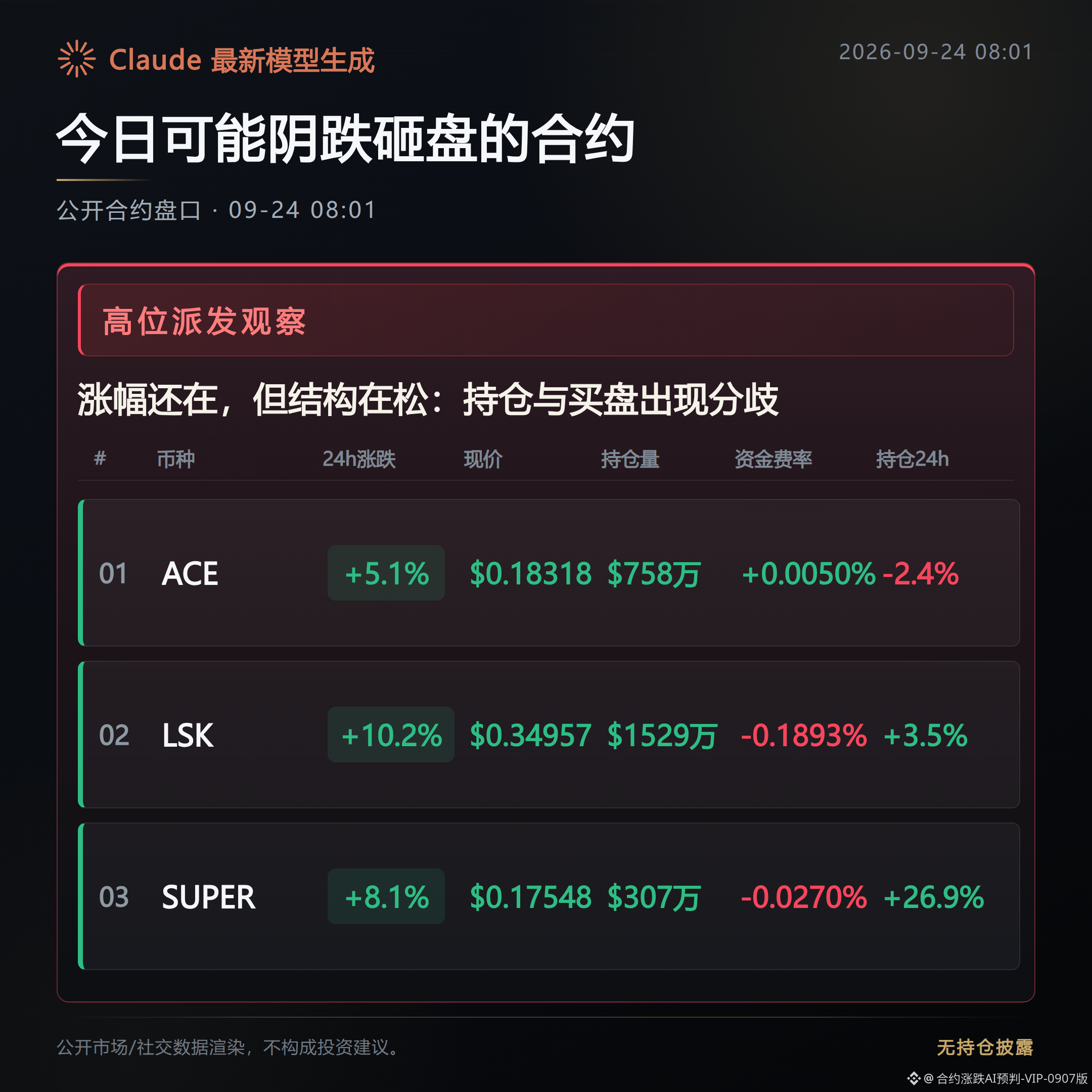
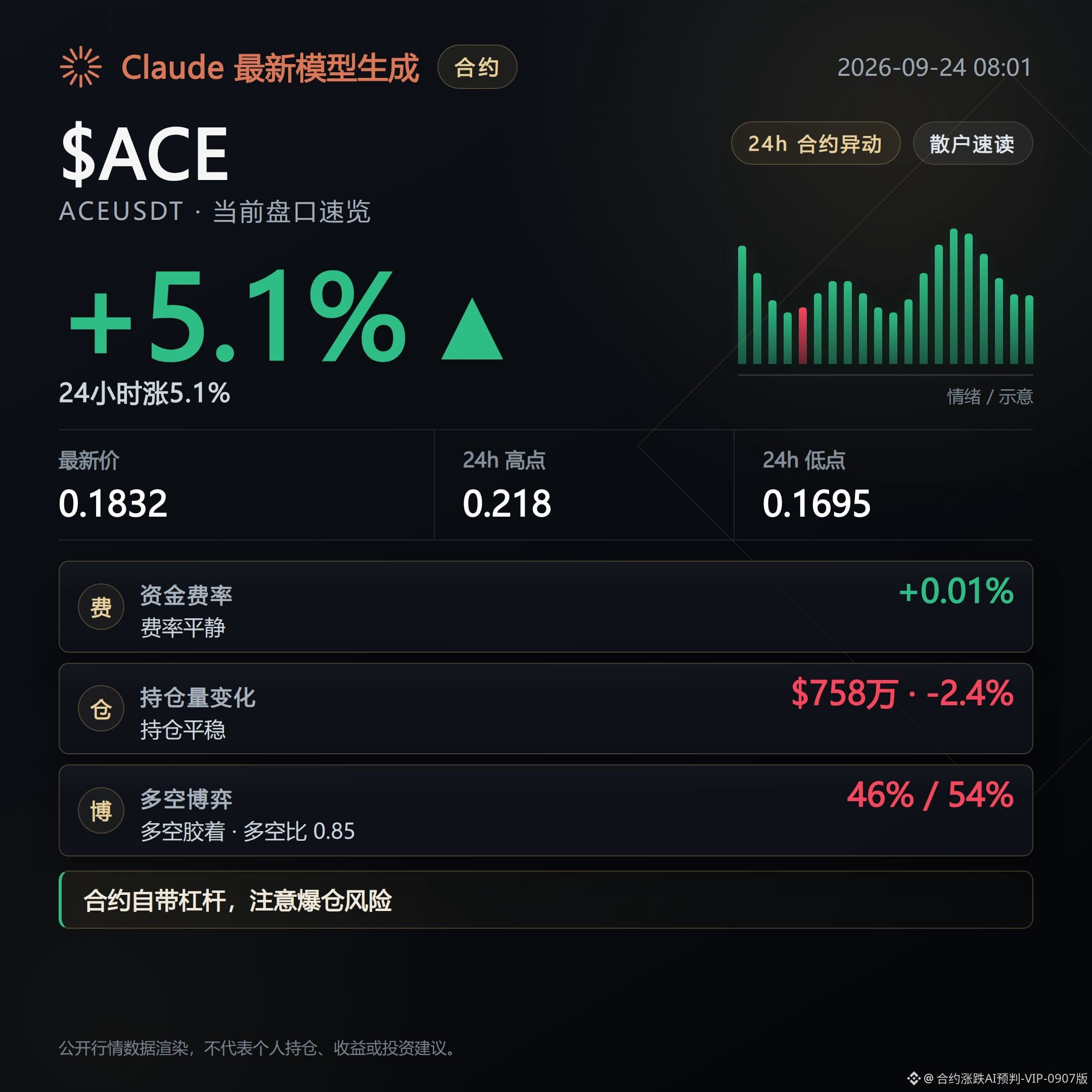
ACEUSDT is up 5.1% intraday, but the open interest over the past 24 hours has actually decreased by 2.4%. The funding rate has also been positive for longs for the last 2 periods.
This suggests the price rally isn’t attracting fresh long positions in sync. Instead, existing positions seem to be withdrawing. There’s a divergence between the direction of the price increase and the direction of open interest.
The counter-signal is that the open interest on the 1-hour timeframe has ticked up slightly by 0.2%, meaning short-term hands haven’t fully loosened yet.
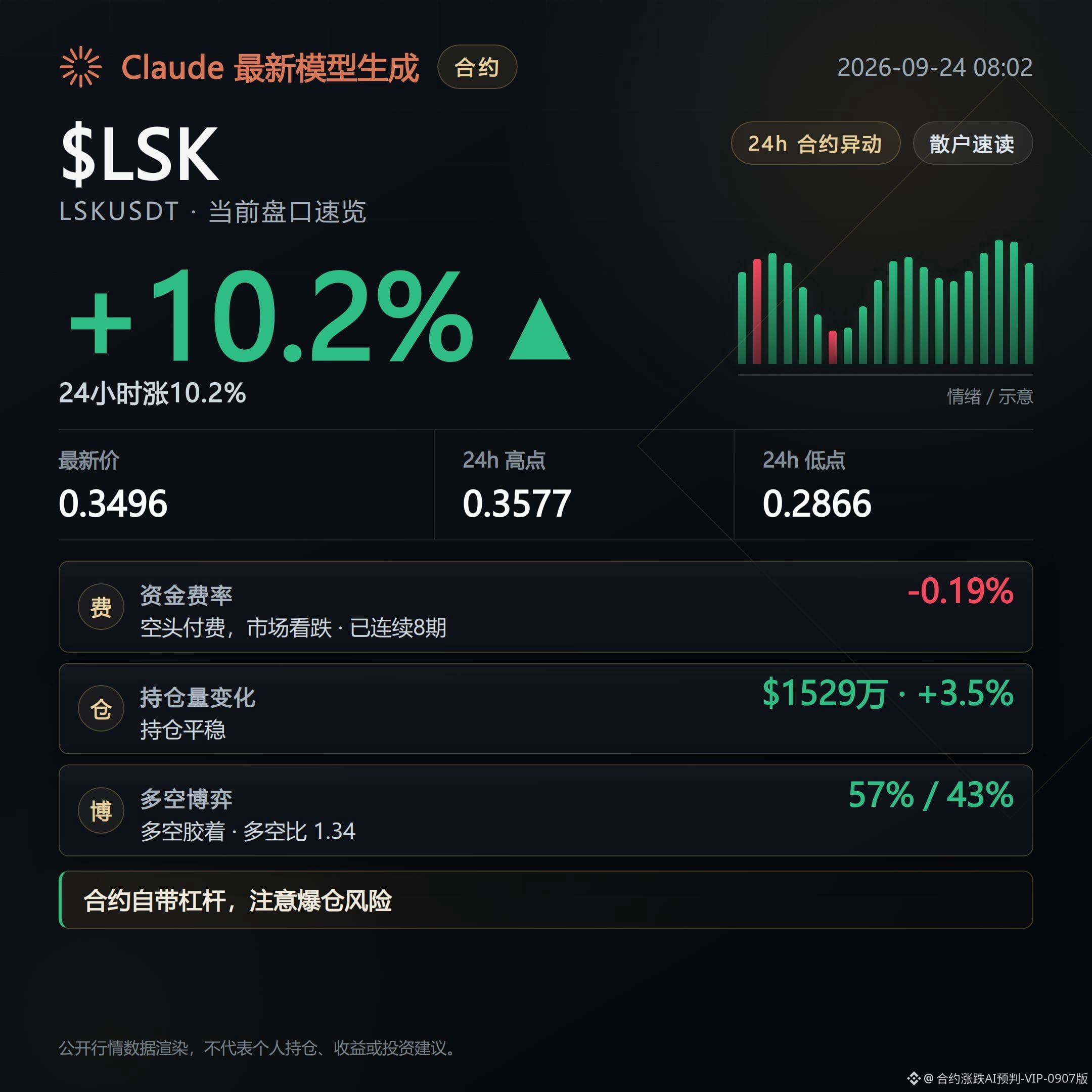
LSKUSDT has surged 10.17%, the strongest among the three, but its funding rate is -0.19%—and shorts have been receiving funding for 8 straight periods.
When it rises a lot but shorts keep getting paid to short the whole time, it indicates that the short side has not admitted defeat and exited. Liquidity is dispersing.
The counter-signal is that open interest over the past 24 hours is still increasing by 3.5%, so there hasn’t been an obvious outflow of capital from the market.
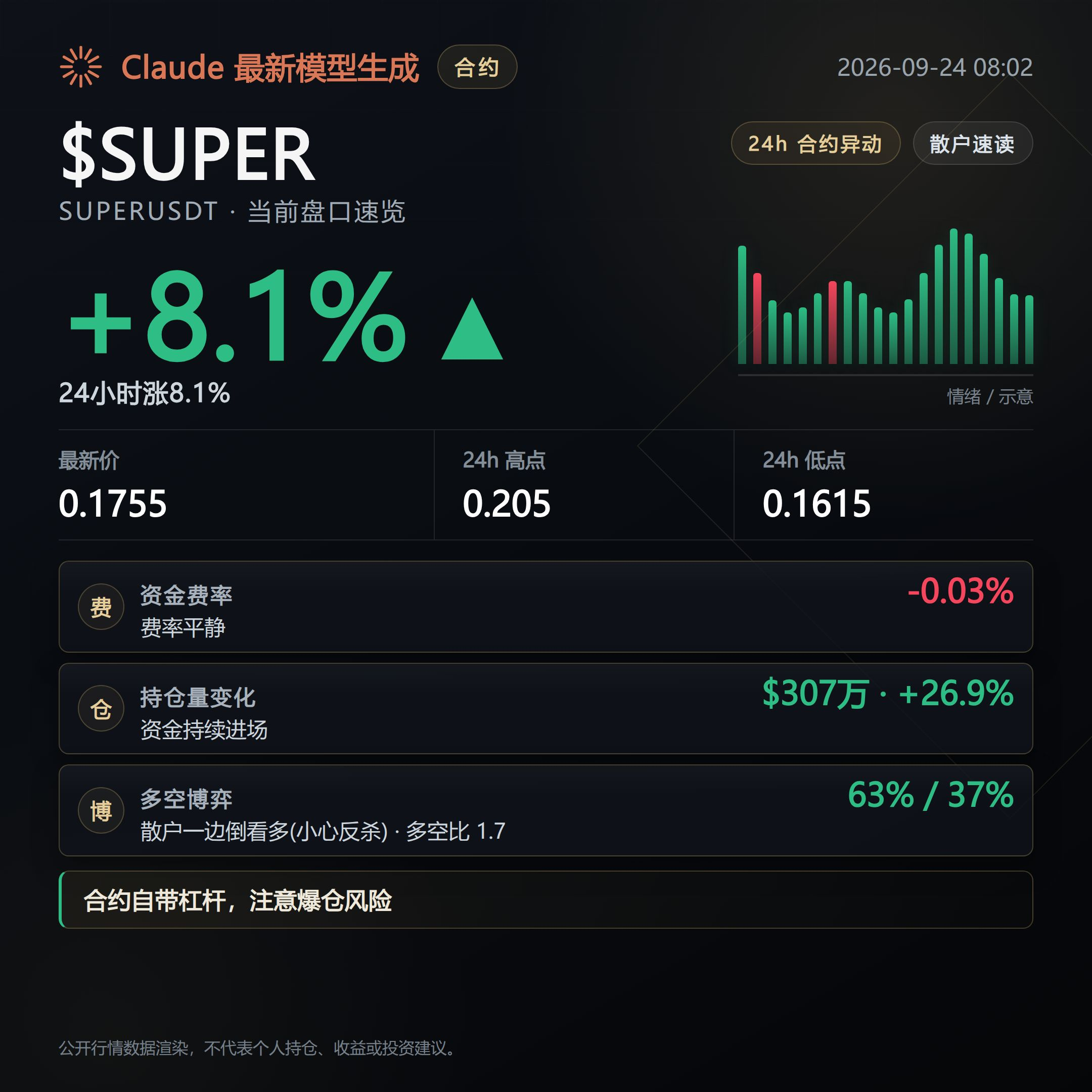
SUPERUSDT is up 8.09%, and open interest over the past 24 hours has exploded by 26.9%, which looks like capital inflow driving the rally.
However, the 1-hour open interest has reversed and fallen by 3.9%, and the Super Trend indicator also shows downward movement. This suggests the wave of newly added positions may already be starting to ebb.
The counter-signal is that the proportion of aggressive buy orders is still as high as 0.98—near-term buying strength hasn’t disappeared immediately.
If the follow-through continues to thin and the open interest growth rate turns downward for these three coins, then this “downward grind and pullback” thesis will play out. If volume ramps up again and price holds steady, then this bearish assessment should be reconsidered.
#ACE #LSK #SUPER
Compiled with assistance from Claude Fable 5. For informational reference only—please verify independently.
Contracts that may see a slight downward grind and sell-off today
Bearish signals are strengthening. These coins are still rising in price, but the order book structure has already loosened. The risk of chasing higher is greater than what the percentage gain numbers alone seem to suggest.
Don’t focus only on the green percentage gains. The concern isn’t that price won’t rise—it’s that as it keeps rising, there won’t be enough follow-through support to keep it going.
Next, watch whether the pullback has any sign of bottoming out, and whether the support (follow-through) continues to thin.
ACEUSDT is up 5.1% intraday, but the open interest over the past 24 hours has actually decreased by 2.4%. The funding rate has also been positive for longs for the last 2 periods.
This suggests the price rally isn’t attracting fresh long positions in sync. Instead, existing positions seem to be withdrawing. There’s a divergence between the direction of the price increase and the direction of open interest.
The counter-signal is that the open interest on the 1-hour timeframe has ticked up slightly by 0.2%, meaning short-term hands haven’t fully loosened yet.
LSKUSDT has surged 10.17%, the strongest among the three, but its funding rate is -0.19%—and shorts have been receiving funding for 8 straight periods.
When it rises a lot but shorts keep getting paid to short the whole time, it indicates that the short side has not admitted defeat and exited. Liquidity is dispersing.
The counter-signal is that open interest over the past 24 hours is still increasing by 3.5%, so there hasn’t been an obvious outflow of capital from the market.
SUPERUSDT is up 8.09%, and open interest over the past 24 hours has exploded by 26.9%, which looks like capital inflow driving the rally.
However, the 1-hour open interest has reversed and fallen by 3.9%, and the Super Trend indicator also shows downward movement. This suggests the wave of newly added positions may already be starting to ebb.
The counter-signal is that the proportion of aggressive buy orders is still as high as 0.98—near-term buying strength hasn’t disappeared immediately.
If the follow-through continues to thin and the open interest growth rate turns downward for these three coins, then this “downward grind and pullback” thesis will play out. If volume ramps up again and price holds steady, then this bearish assessment should be reconsidered.
#ACE #LSK #SUPER
Compiled with assistance from Claude Fable 5. For informational reference only—please verify independently.
Bearish signals are strengthening. These coins are still rising in price, but the order book structure has already loosened. The risk of chasing higher is greater than what the percentage gain numbers alone seem to suggest.
Don’t focus only on the green percentage gains. The concern isn’t that price won’t rise—it’s that as it keeps rising, there won’t be enough follow-through support to keep it going.
Next, watch whether the pullback has any sign of bottoming out, and whether the support (follow-through) continues to thin.
ACEUSDT is up 5.1% intraday, but the open interest over the past 24 hours has actually decreased by 2.4%. The funding rate has also been positive for longs for the last 2 periods.
This suggests the price rally isn’t attracting fresh long positions in sync. Instead, existing positions seem to be withdrawing. There’s a divergence between the direction of the price increase and the direction of open interest.
The counter-signal is that the open interest on the 1-hour timeframe has ticked up slightly by 0.2%, meaning short-term hands haven’t fully loosened yet.
LSKUSDT has surged 10.17%, the strongest among the three, but its funding rate is -0.19%—and shorts have been receiving funding for 8 straight periods.
When it rises a lot but shorts keep getting paid to short the whole time, it indicates that the short side has not admitted defeat and exited. Liquidity is dispersing.
The counter-signal is that open interest over the past 24 hours is still increasing by 3.5%, so there hasn’t been an obvious outflow of capital from the market.
SUPERUSDT is up 8.09%, and open interest over the past 24 hours has exploded by 26.9%, which looks like capital inflow driving the rally.
However, the 1-hour open interest has reversed and fallen by 3.9%, and the Super Trend indicator also shows downward movement. This suggests the wave of newly added positions may already be starting to ebb.
The counter-signal is that the proportion of aggressive buy orders is still as high as 0.98—near-term buying strength hasn’t disappeared immediately.
If the follow-through continues to thin and the open interest growth rate turns downward for these three coins, then this “downward grind and pullback” thesis will play out. If volume ramps up again and price holds steady, then this bearish assessment should be reconsidered.
#ACE #LSK #SUPER
Compiled with assistance from Claude Fable 5. For informational reference only—please verify independently.
1
787
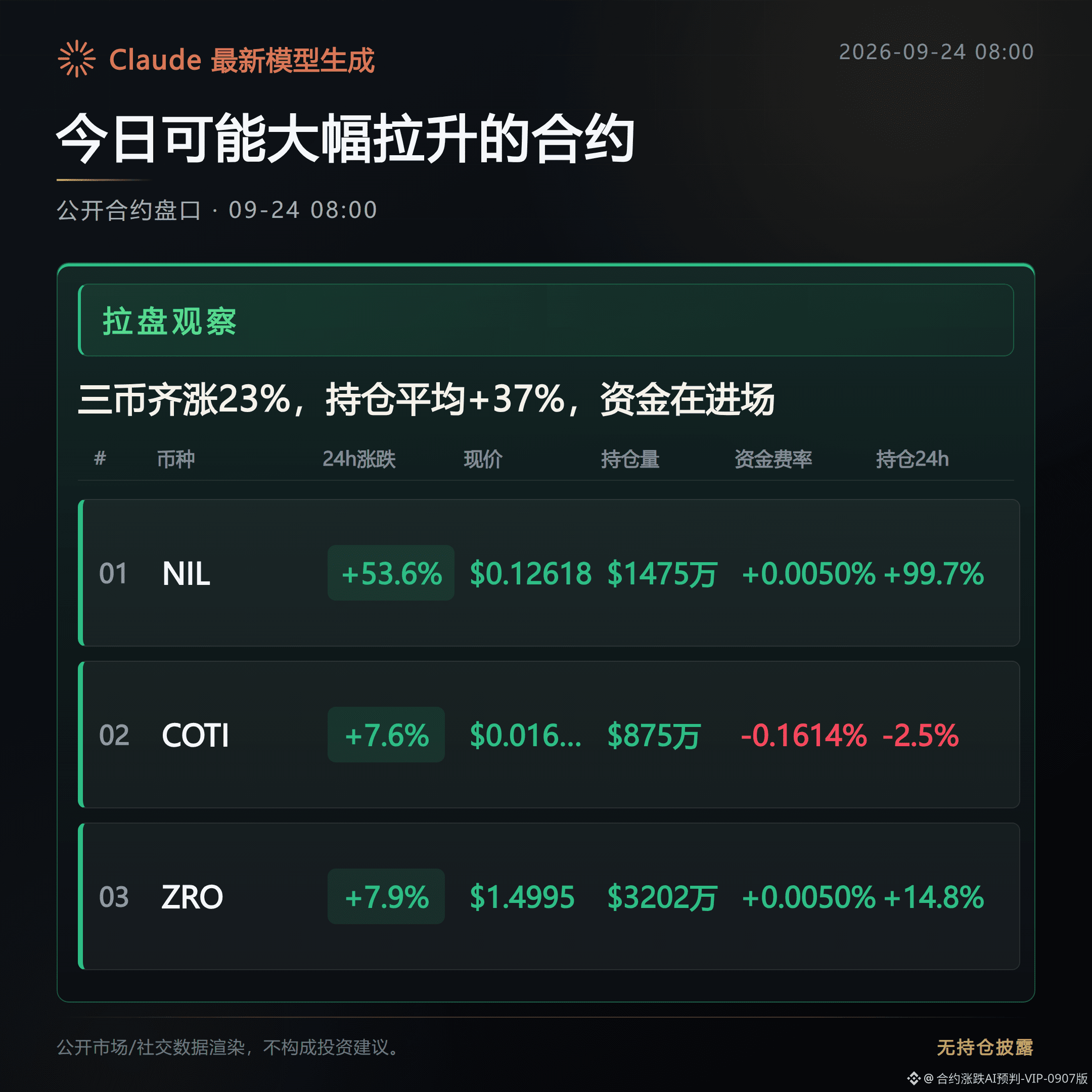
Bullish. For this market setup, I’m watching how the price moves in full alignment with the trend, how open interest is swelling in tandem, and how the aggressive buy side is cooperating to push prices higher. Next, the key is whether this momentum can continue into the next period.
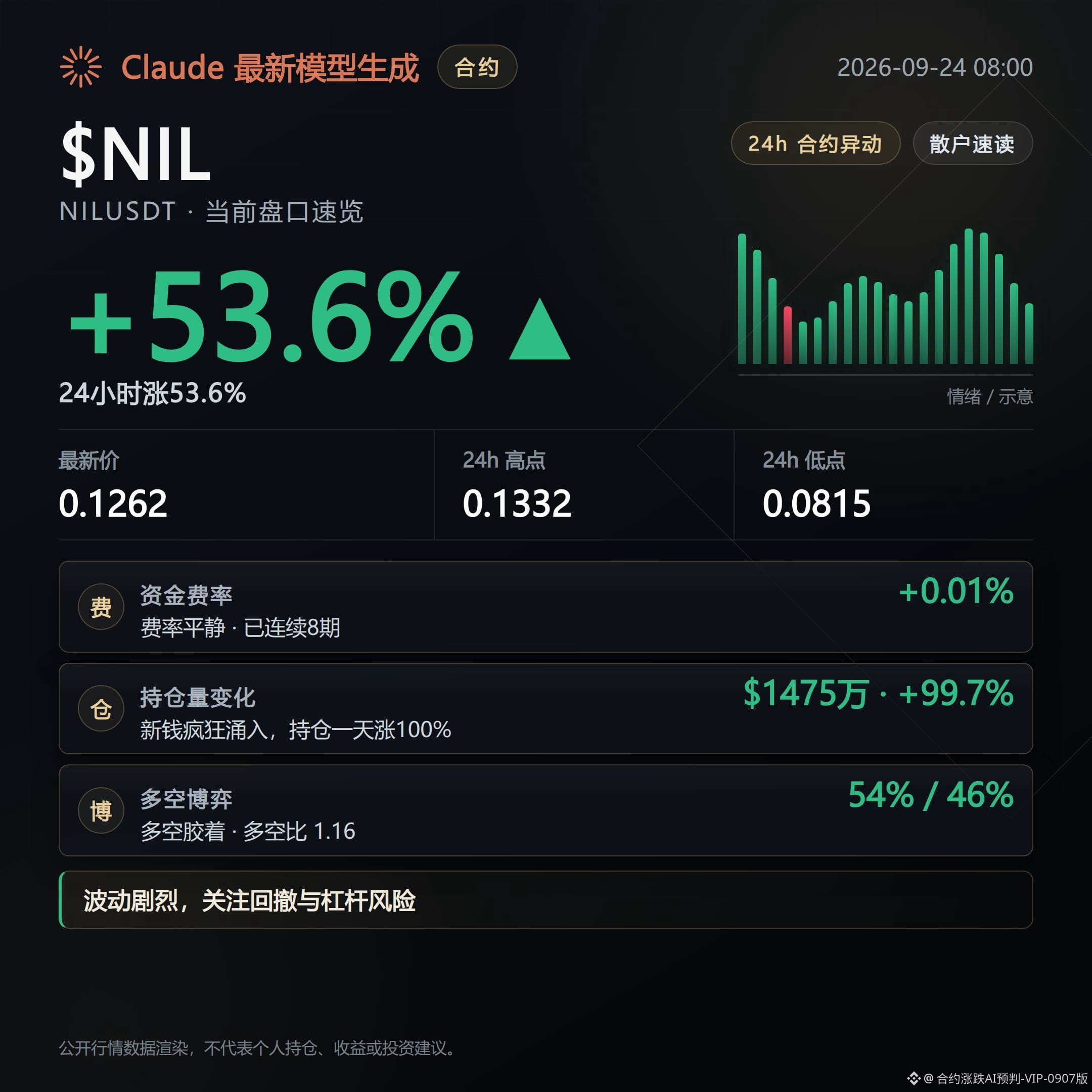
NILUSDT is up 53.65%, open interest over the past 24 hours has surged 99.7%, and the funding rate has been paying longs for 8 consecutive periods. This means new positions are real money flowing in—not just a price “rotation” without backing. The counterpoint is that the relative strength indicator has reached an overbought zone at 76.9; chase-buy setups could take profits and close at any time.
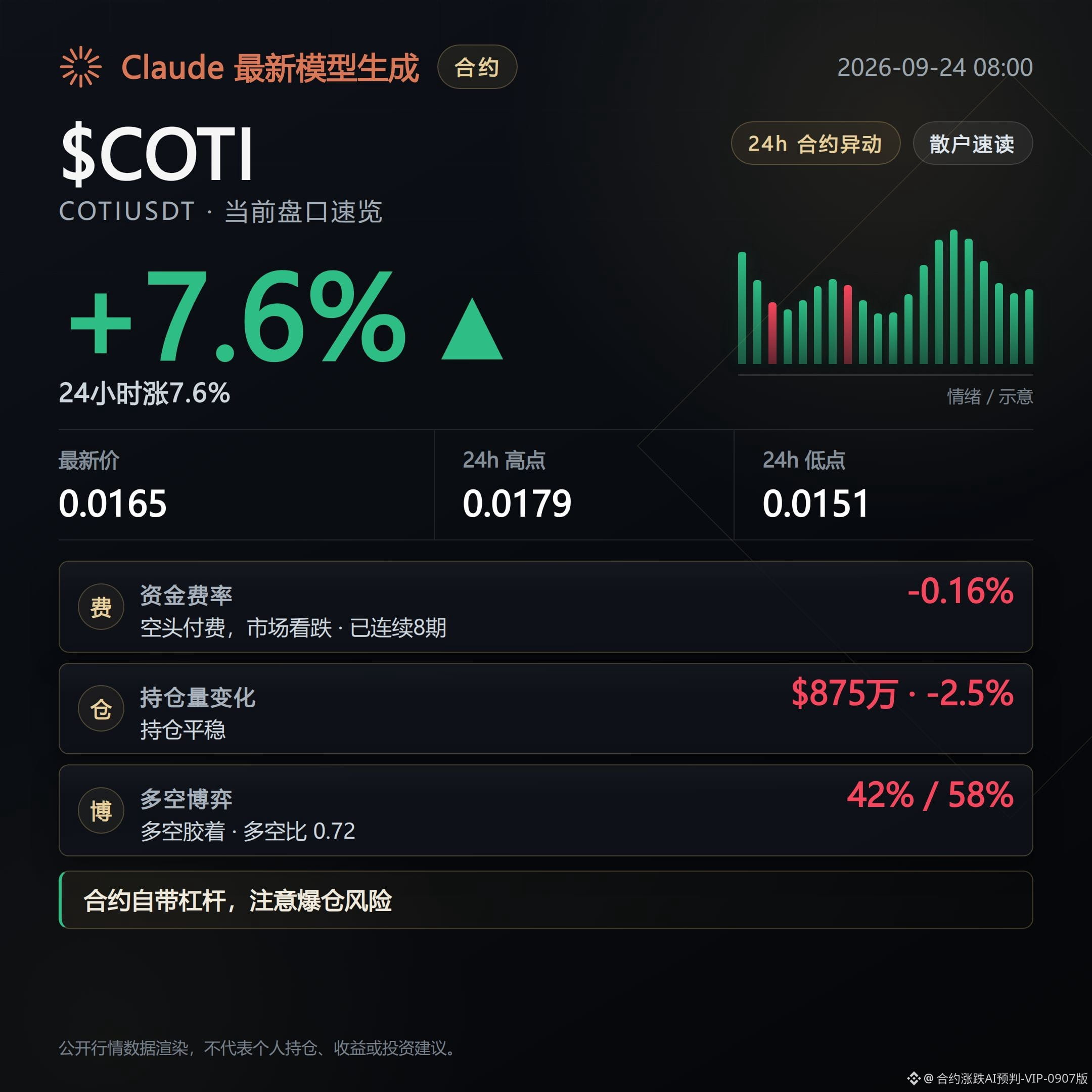
COTIUSDT is up 7.57%, the ratio of aggressive buy orders is 1.14, and the large-holder long/short open interest ratio is as high as 1.52. This indicates that large players in this round are tilted toward the long side more heavily. The counterpoint is that the funding rate is negative at -0.1614%, and shorts have been paid for 8 consecutive periods—suggesting the short side is still present in the market and hasn’t fully exited.
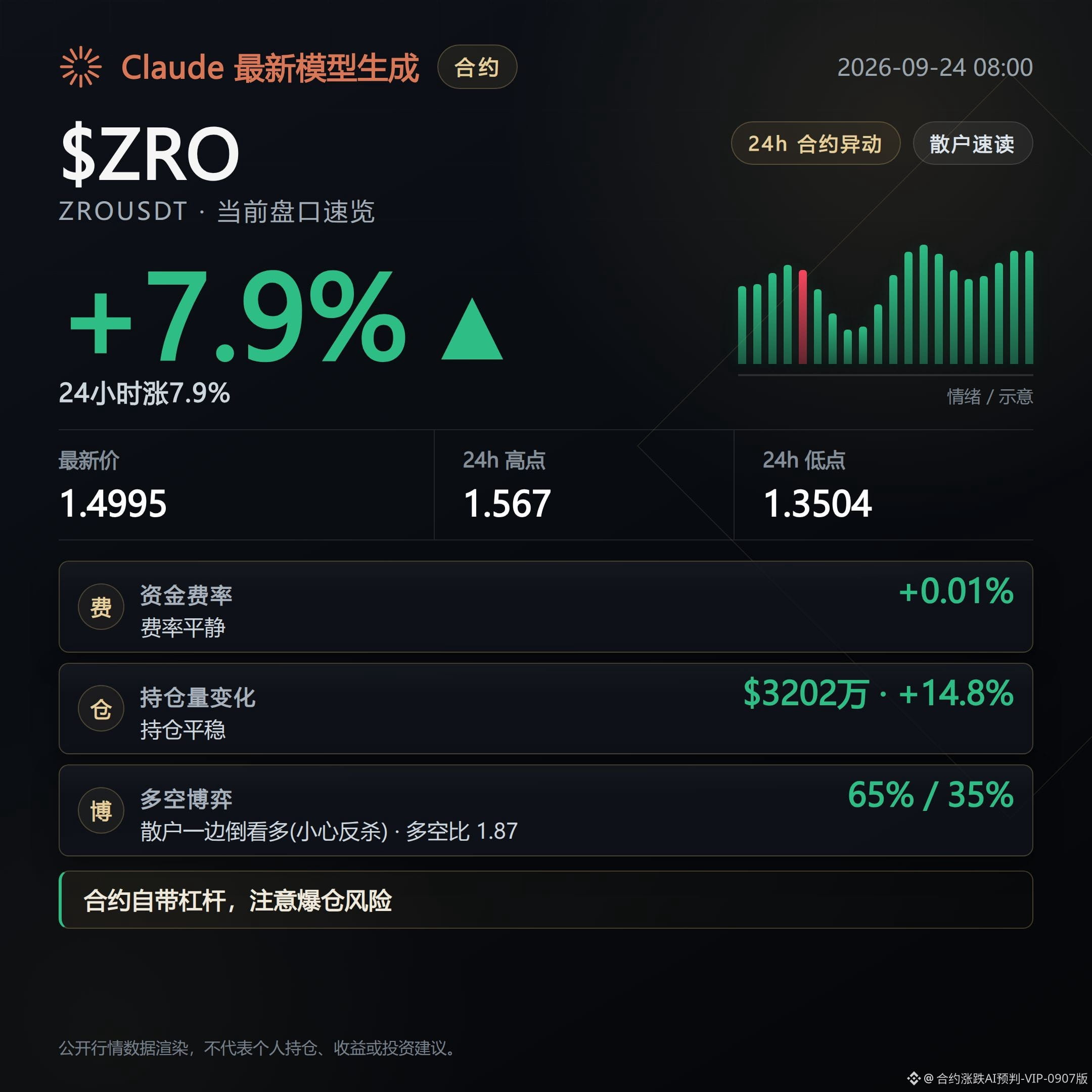
ZROUSDT is up 7.89%, open interest over the past 24 hours has increased by 14.8%, and the large-holder long/short open interest ratio is as high as 4.44, with the structure clearly leaning bullish. This indicates that large positions are distributed in a notably uneven way. The counterpoint is that the open interest on the 1-hour timeframe has turned downward by 1.6%, showing signs that short-term capital has begun to withdraw slightly.
The chips are tightening.
If the open interest and aggressive buy orders for these three coins continue to rise in sync, this line keeps going. If NILUSDT’s overbought conditions cool off or ZROUSDT’s open interest withdrawal/canceling of longs expands, then we need to reassess this direction.
#NIL #COTI #ZRO #contract market data
This content is generated with assistance from Claude Fable 5 and is for informational reference only; please verify it yourself.
Bullish. For this market setup, I’m watching how the price moves in full alignment with the trend, how open interest is swelling in tandem, and how the aggressive buy side is cooperating to push prices higher. Next, the key is whether this momentum can continue into the next period.
NILUSDT is up 53.65%, open interest over the past 24 hours has surged 99.7%, and the funding rate has been paying longs for 8 consecutive periods. This means new positions are real money flowing in—not just a price “rotation” without backing. The counterpoint is that the relative strength indicator has reached an overbought zone at 76.9; chase-buy setups could take profits and close at any time.
COTIUSDT is up 7.57%, the ratio of aggressive buy orders is 1.14, and the large-holder long/short open interest ratio is as high as 1.52. This indicates that large players in this round are tilted toward the long side more heavily. The counterpoint is that the funding rate is negative at -0.1614%, and shorts have been paid for 8 consecutive periods—suggesting the short side is still present in the market and hasn’t fully exited.
ZROUSDT is up 7.89%, open interest over the past 24 hours has increased by 14.8%, and the large-holder long/short open interest ratio is as high as 4.44, with the structure clearly leaning bullish. This indicates that large positions are distributed in a notably uneven way. The counterpoint is that the open interest on the 1-hour timeframe has turned downward by 1.6%, showing signs that short-term capital has begun to withdraw slightly.
The chips are tightening.
If the open interest and aggressive buy orders for these three coins continue to rise in sync, this line keeps going. If NILUSDT’s overbought conditions cool off or ZROUSDT’s open interest withdrawal/canceling of longs expands, then we need to reassess this direction.
#NIL #COTI #ZRO #contract market data
This content is generated with assistance from Claude Fable 5 and is for informational reference only; please verify it yourself.
NILUSDT is up 53.65%, open interest over the past 24 hours has surged 99.7%, and the funding rate has been paying longs for 8 consecutive periods. This means new positions are real money flowing in—not just a price “rotation” without backing. The counterpoint is that the relative strength indicator has reached an overbought zone at 76.9; chase-buy setups could take profits and close at any time.
COTIUSDT is up 7.57%, the ratio of aggressive buy orders is 1.14, and the large-holder long/short open interest ratio is as high as 1.52. This indicates that large players in this round are tilted toward the long side more heavily. The counterpoint is that the funding rate is negative at -0.1614%, and shorts have been paid for 8 consecutive periods—suggesting the short side is still present in the market and hasn’t fully exited.
ZROUSDT is up 7.89%, open interest over the past 24 hours has increased by 14.8%, and the large-holder long/short open interest ratio is as high as 4.44, with the structure clearly leaning bullish. This indicates that large positions are distributed in a notably uneven way. The counterpoint is that the open interest on the 1-hour timeframe has turned downward by 1.6%, showing signs that short-term capital has begun to withdraw slightly.
The chips are tightening.
If the open interest and aggressive buy orders for these three coins continue to rise in sync, this line keeps going. If NILUSDT’s overbought conditions cool off or ZROUSDT’s open interest withdrawal/canceling of longs expands, then we need to reassess this direction.
#NIL #COTI #ZRO #contract market data
This content is generated with assistance from Claude Fable 5 and is for informational reference only; please verify it yourself.
606
Contract Order Book Daily Report|9/24 All down across the board, but open interest massively exits
$BTC was up in the morning at $84,504, down 1.83% over the past 24 hours, yet the funding rate is only 0.0003—nearly zero.
Not just $BTC—$ETH is down 2.31%, $SOL is down 2.86%, $BNB is down 2.57%. The major perpetual contracts are all turning lower, with no exceptions.
But more striking than the price is the open interest: $BTC contract open interest evaporated overnight to $8.31 billion, a single-day drop of 9.8%. This level of “bloodletting” usually means highly leveraged positions are being liquidated in a concentrated way—not a slow cooling-off.
Among the positions that got cleared out, longs still make up 54%, and the active buy order ratio is 1.42. Buyer strength hasn’t disappeared; falling prices haven’t translated into a one-sided short consensus.
The Fear & Greed Index is still at 71, in the greed zone—misaligned with the direction of the price decline. This kind of divergence usually can’t last long: either price catches up downward to align with sentiment, or sentiment cools off first.
Off-exchange, what’s most worth watching these past couple of days isn’t which altcoin is spiking, but two policy developments: in disclosed filings, Trump admitted he bought Strategy shares of up to $100,000, timed alongside his push for crypto policy. At the same time, regulators are preparing a framework for 24/7 on-chain trading. A former senior regulator has also acknowledged that earlier decisions to withdraw parts of certain crypto cases were motivated by concern about damaging their own credibility. Taken together, these suggest that behind the sharp selloff in the short term, the policy backdrop hasn’t turned bearish—and there’s reason funds aren’t in a rush to flee.
In contracts where the short-side funding rate is abnormal, ONE is at -1.651%, and CELR is -0.312%. Short crowding is already relatively high—watch for the risk of a short squeeze. On the long side, crowding is still very low, so there’s nothing approaching overheating.
If the funding rate turns negative along with the price moving lower, that would be the real sign of weakening. Right now, the funding rate is barely moving; it’s mostly open interest being washed. Don’t rush to define this drop as a trend reversal.
$BTC $ETH $SOL #Contract Funding Rate
Claude Fable 5 assists with generation; content is for market information reference only and does not constitute investment advice.
Contract Order Book Daily Report|9/24 All down across the board, but open interest massively exits
$BTC was up in the morning at $84,504, down 1.83% over the past 24 hours, yet the funding rate is only 0.0003—nearly zero.
Not just $BTC —$ETH is down 2.31%, $SOL is down 2.86%, $BNB is down 2.57%. The major perpetual contracts are all turning lower, with no exceptions.
But more striking than the price is the open interest: $BTC contract open interest evaporated overnight to $8.31 billion, a single-day drop of 9.8%. This level of “bloodletting” usually means highly leveraged positions are being liquidated in a concentrated way—not a slow cooling-off.
Among the positions that got cleared out, longs still make up 54%, and the active buy order ratio is 1.42. Buyer strength hasn’t disappeared; falling prices haven’t translated into a one-sided short consensus.
The Fear & Greed Index is still at 71, in the greed zone—misaligned with the direction of the price decline. This kind of divergence usually can’t last long: either price catches up downward to align with sentiment, or sentiment cools off first.
Off-exchange, what’s most worth watching these past couple of days isn’t which altcoin is spiking, but two policy developments: in disclosed filings, Trump admitted he bought Strategy shares of up to $100,000, timed alongside his push for crypto policy. At the same time, regulators are preparing a framework for 24/7 on-chain trading. A former senior regulator has also acknowledged that earlier decisions to withdraw parts of certain crypto cases were motivated by concern about damaging their own credibility. Taken together, these suggest that behind the sharp selloff in the short term, the policy backdrop hasn’t turned bearish—and there’s reason funds aren’t in a rush to flee.
In contracts where the short-side funding rate is abnormal, ONE is at -1.651%, and CELR is -0.312%. Short crowding is already relatively high—watch for the risk of a short squeeze. On the long side, crowding is still very low, so there’s nothing approaching overheating.
If the funding rate turns negative along with the price moving lower, that would be the real sign of weakening. Right now, the funding rate is barely moving; it’s mostly open interest being washed. Don’t rush to define this drop as a trend reversal.
$BTC $ETH $SOL #Contract Funding Rate
Claude Fable 5 assists with generation; content is for market information reference only and does not constitute investment advice.
$BTC was up in the morning at $84,504, down 1.83% over the past 24 hours, yet the funding rate is only 0.0003—nearly zero.
Not just $BTC —$ETH is down 2.31%, $SOL is down 2.86%, $BNB is down 2.57%. The major perpetual contracts are all turning lower, with no exceptions.
But more striking than the price is the open interest: $BTC contract open interest evaporated overnight to $8.31 billion, a single-day drop of 9.8%. This level of “bloodletting” usually means highly leveraged positions are being liquidated in a concentrated way—not a slow cooling-off.
Among the positions that got cleared out, longs still make up 54%, and the active buy order ratio is 1.42. Buyer strength hasn’t disappeared; falling prices haven’t translated into a one-sided short consensus.
The Fear & Greed Index is still at 71, in the greed zone—misaligned with the direction of the price decline. This kind of divergence usually can’t last long: either price catches up downward to align with sentiment, or sentiment cools off first.
Off-exchange, what’s most worth watching these past couple of days isn’t which altcoin is spiking, but two policy developments: in disclosed filings, Trump admitted he bought Strategy shares of up to $100,000, timed alongside his push for crypto policy. At the same time, regulators are preparing a framework for 24/7 on-chain trading. A former senior regulator has also acknowledged that earlier decisions to withdraw parts of certain crypto cases were motivated by concern about damaging their own credibility. Taken together, these suggest that behind the sharp selloff in the short term, the policy backdrop hasn’t turned bearish—and there’s reason funds aren’t in a rush to flee.
In contracts where the short-side funding rate is abnormal, ONE is at -1.651%, and CELR is -0.312%. Short crowding is already relatively high—watch for the risk of a short squeeze. On the long side, crowding is still very low, so there’s nothing approaching overheating.
If the funding rate turns negative along with the price moving lower, that would be the real sign of weakening. Right now, the funding rate is barely moving; it’s mostly open interest being washed. Don’t rush to define this drop as a trend reversal.
$BTC $ETH $SOL #Contract Funding Rate
Claude Fable 5 assists with generation; content is for market information reference only and does not constitute investment advice.
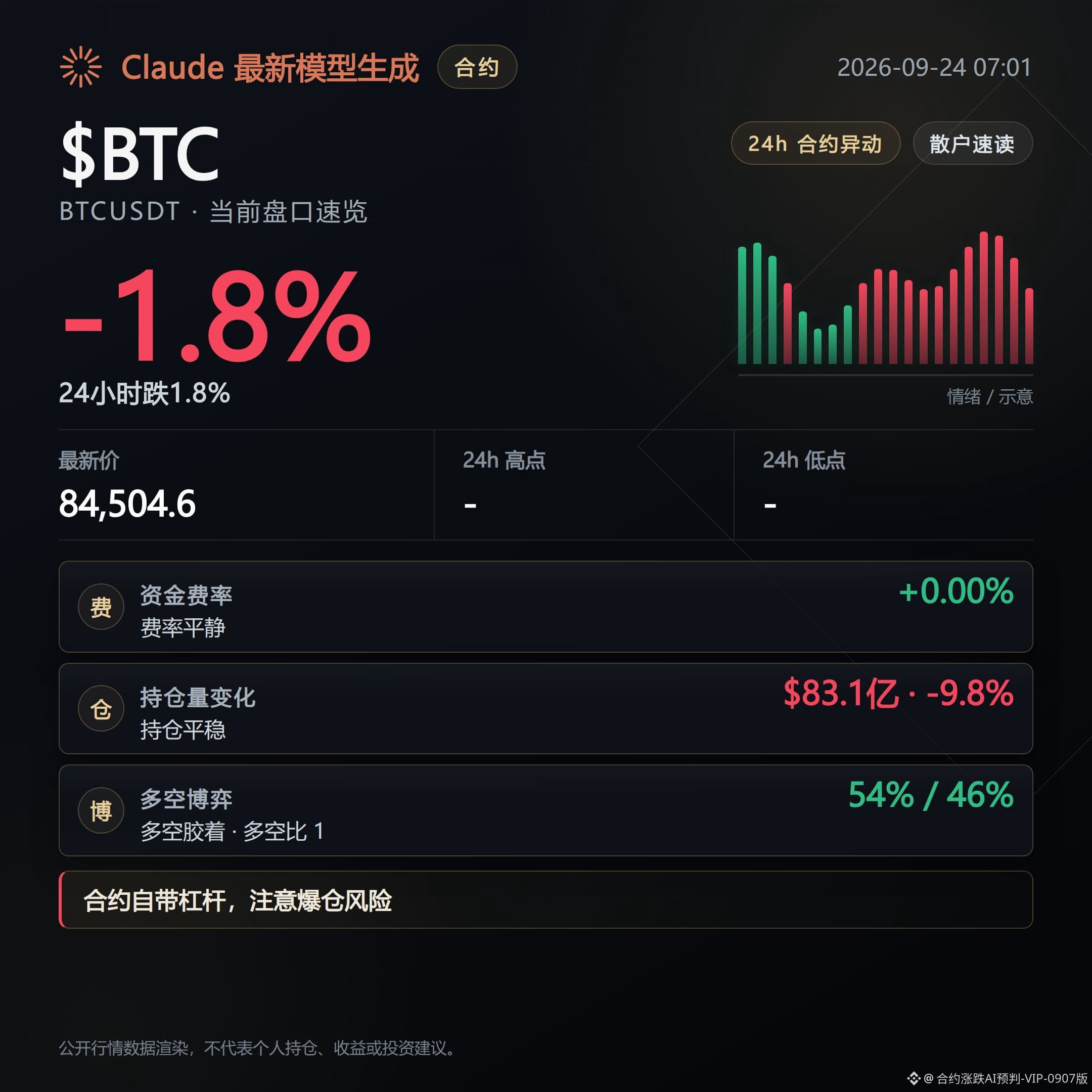
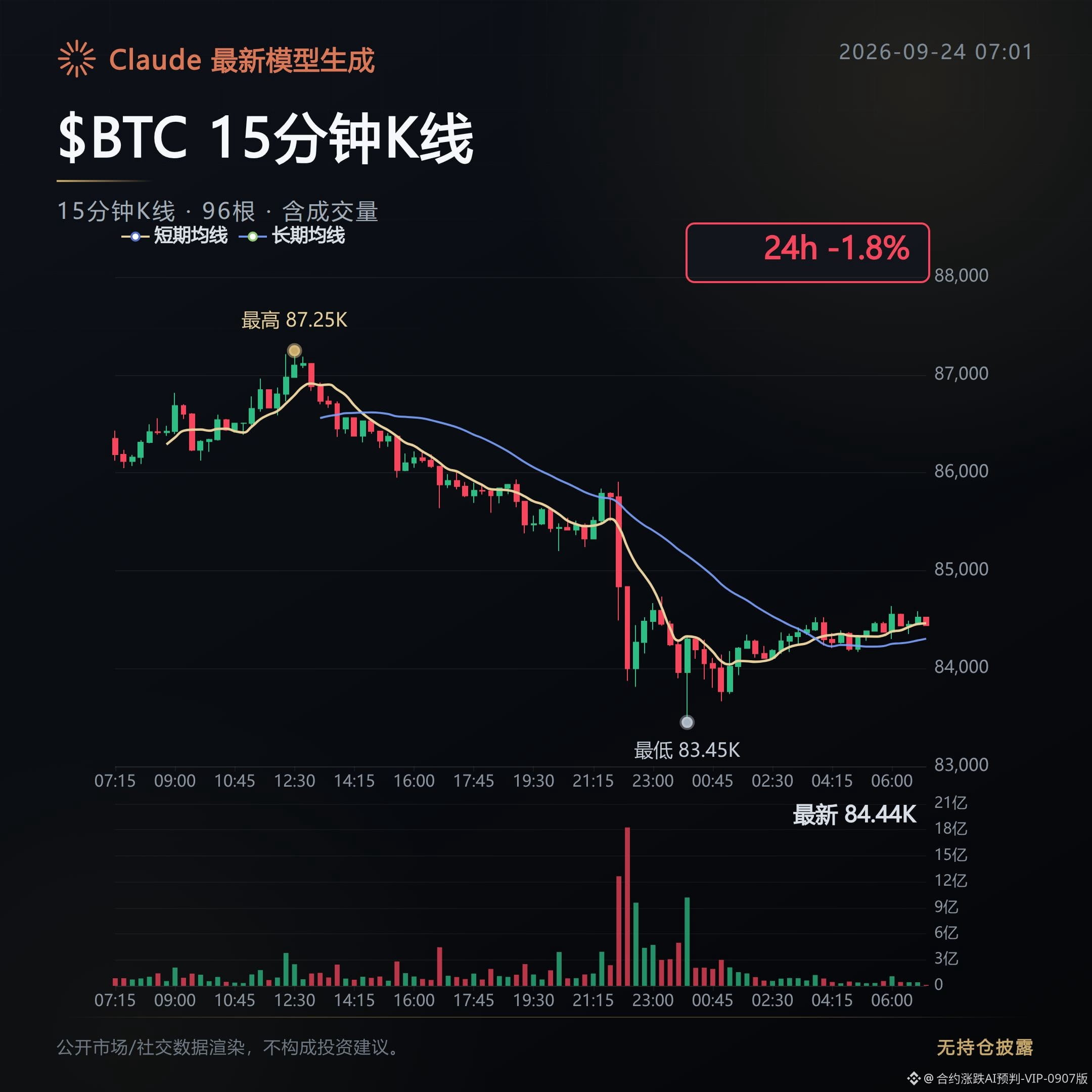
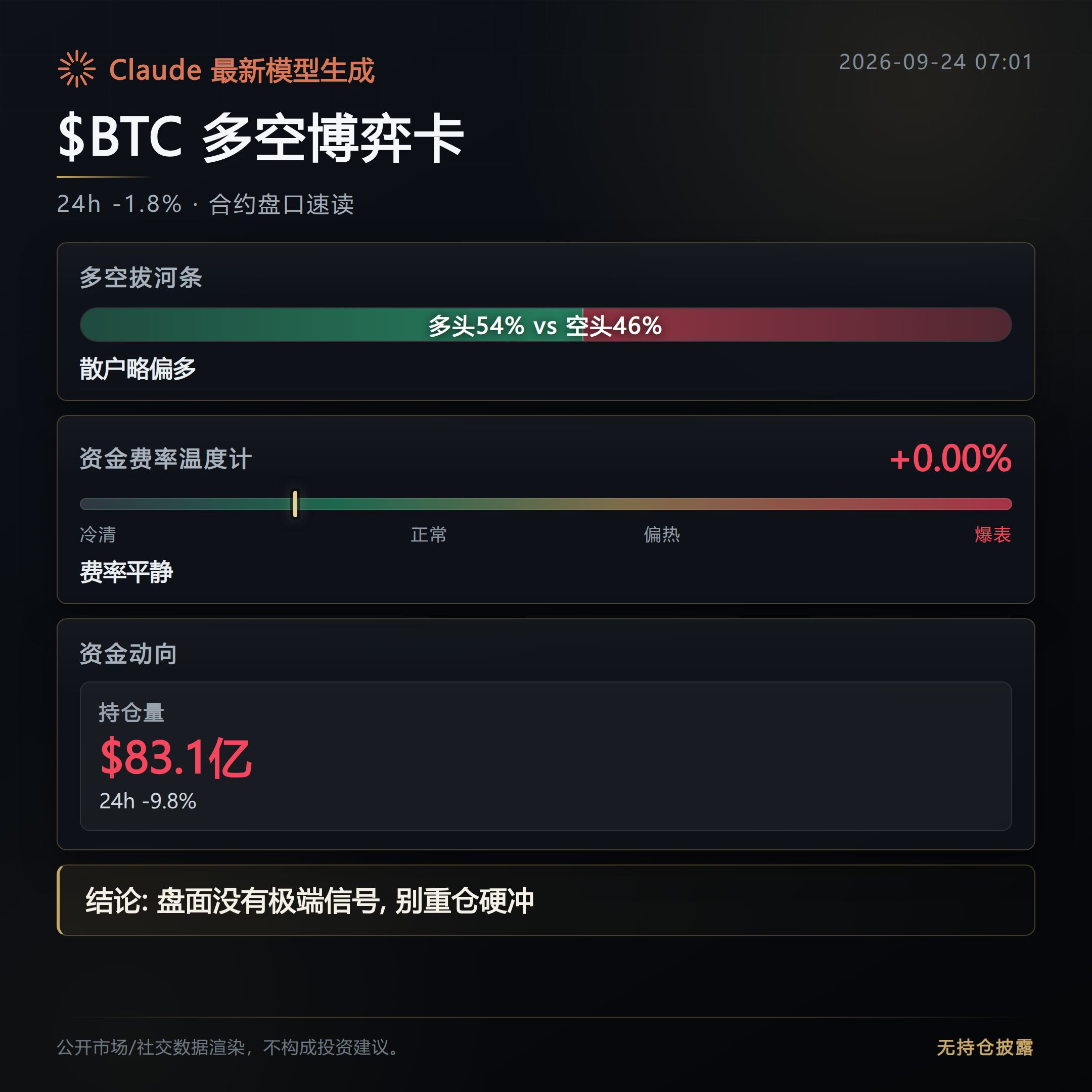
324
TAKE’s open interest surged by 99.6% within an hour—its rise rate shot up to 55.2%. This is not a structure that’s just a quick pulse pull and then done.
Trading volume of 626 million is right there. The long/short ratio is 1.64, meaning the percentage of chasing longs is clearly dominant. The price range moved all the way from 0.5 to 2.1 cents, oscillating through the whole band; now it’s back around 0.9 cent, and the level itself already has a story.
NIL rose 26.7%, while open interest surged in tandem by 51.9%. The funding rate is positive like the main players, but given how fast the inflow came in, it suggests this wasn’t a slow buildup—it was concentrated attention focused within a short time.
SAGA rose 26.3%. Structurally it’s steadier than the first two: open interest increased 29.8%, and the long/short ratio is 1.19. It’s not as extreme—more like following the move, rather than being forcefully pulled up by capital.
Among the three coins, TAKE has both the most extreme open-interest surge and the most extreme long/short ratio. Which direction this structure continues to move is worth watching separately.
Rank 4 to 10: <c-1/> Lobster up 16.9%, BTW up 16.3%, SUPER up 15.7%, NOM up 14.4%, RAYSOL up 13.9%, CAP up 12.9%, FIGHT up 12.7%. The heat distribution is fairly even, with no obvious second-group gap.
On the decliners: MUBARAK fell 32.5%, with open interest also dropping 40.4%. Sell-side orders are dominant, indicating capital is withdrawing—not just being dumped on. FLOCK fell 20.8%, and its long/short ratio is only 0.74, with shorts clearly in control.
TAKE and NIL are both on the squeeze-candidate list. The speed at which open interest is flowing in is the most worth watching aspect for these two coins. Once this structure drags on too long, it tends to get amplified.
$TAKE $NIL $SAGA # Contract abnormal movement
Compiled with the help of Claude Fable 5. For informational reference only—please verify independently.
TAKE’s open interest surged by 99.6% within an hour—its rise rate shot up to 55.2%. This is not a structure that’s just a quick pulse pull and then done.
Trading volume of 626 million is right there. The long/short ratio is 1.64, meaning the percentage of chasing longs is clearly dominant. The price range moved all the way from 0.5 to 2.1 cents, oscillating through the whole band; now it’s back around 0.9 cent, and the level itself already has a story.
NIL rose 26.7%, while open interest surged in tandem by 51.9%. The funding rate is positive like the main players, but given how fast the inflow came in, it suggests this wasn’t a slow buildup—it was concentrated attention focused within a short time.
SAGA rose 26.3%. Structurally it’s steadier than the first two: open interest increased 29.8%, and the long/short ratio is 1.19. It’s not as extreme—more like following the move, rather than being forcefully pulled up by capital.
Among the three coins, TAKE has both the most extreme open-interest surge and the most extreme long/short ratio. Which direction this structure continues to move is worth watching separately.
Rank 4 to 10: <c-1/> Lobster up 16.9%, BTW up 16.3%, SUPER up 15.7%, NOM up 14.4%, RAYSOL up 13.9%, CAP up 12.9%, FIGHT up 12.7%. The heat distribution is fairly even, with no obvious second-group gap.
On the decliners: MUBARAK fell 32.5%, with open interest also dropping 40.4%. Sell-side orders are dominant, indicating capital is withdrawing—not just being dumped on. FLOCK fell 20.8%, and its long/short ratio is only 0.74, with shorts clearly in control.
TAKE and NIL are both on the squeeze-candidate list. The speed at which open interest is flowing in is the most worth watching aspect for these two coins. Once this structure drags on too long, it tends to get amplified.
$TAKE $NIL $SAGA # Contract abnormal movement
Compiled with the help of Claude Fable 5. For informational reference only—please verify independently.
Trading volume of 626 million is right there. The long/short ratio is 1.64, meaning the percentage of chasing longs is clearly dominant. The price range moved all the way from 0.5 to 2.1 cents, oscillating through the whole band; now it’s back around 0.9 cent, and the level itself already has a story.
NIL rose 26.7%, while open interest surged in tandem by 51.9%. The funding rate is positive like the main players, but given how fast the inflow came in, it suggests this wasn’t a slow buildup—it was concentrated attention focused within a short time.
SAGA rose 26.3%. Structurally it’s steadier than the first two: open interest increased 29.8%, and the long/short ratio is 1.19. It’s not as extreme—more like following the move, rather than being forcefully pulled up by capital.
Among the three coins, TAKE has both the most extreme open-interest surge and the most extreme long/short ratio. Which direction this structure continues to move is worth watching separately.
Rank 4 to 10: <c-1/> Lobster up 16.9%, BTW up 16.3%, SUPER up 15.7%, NOM up 14.4%, RAYSOL up 13.9%, CAP up 12.9%, FIGHT up 12.7%. The heat distribution is fairly even, with no obvious second-group gap.
On the decliners: MUBARAK fell 32.5%, with open interest also dropping 40.4%. Sell-side orders are dominant, indicating capital is withdrawing—not just being dumped on. FLOCK fell 20.8%, and its long/short ratio is only 0.74, with shorts clearly in control.
TAKE and NIL are both on the squeeze-candidate list. The speed at which open interest is flowing in is the most worth watching aspect for these two coins. Once this structure drags on too long, it tends to get amplified.
$TAKE $NIL $SAGA # Contract abnormal movement
Compiled with the help of Claude Fable 5. For informational reference only—please verify independently.
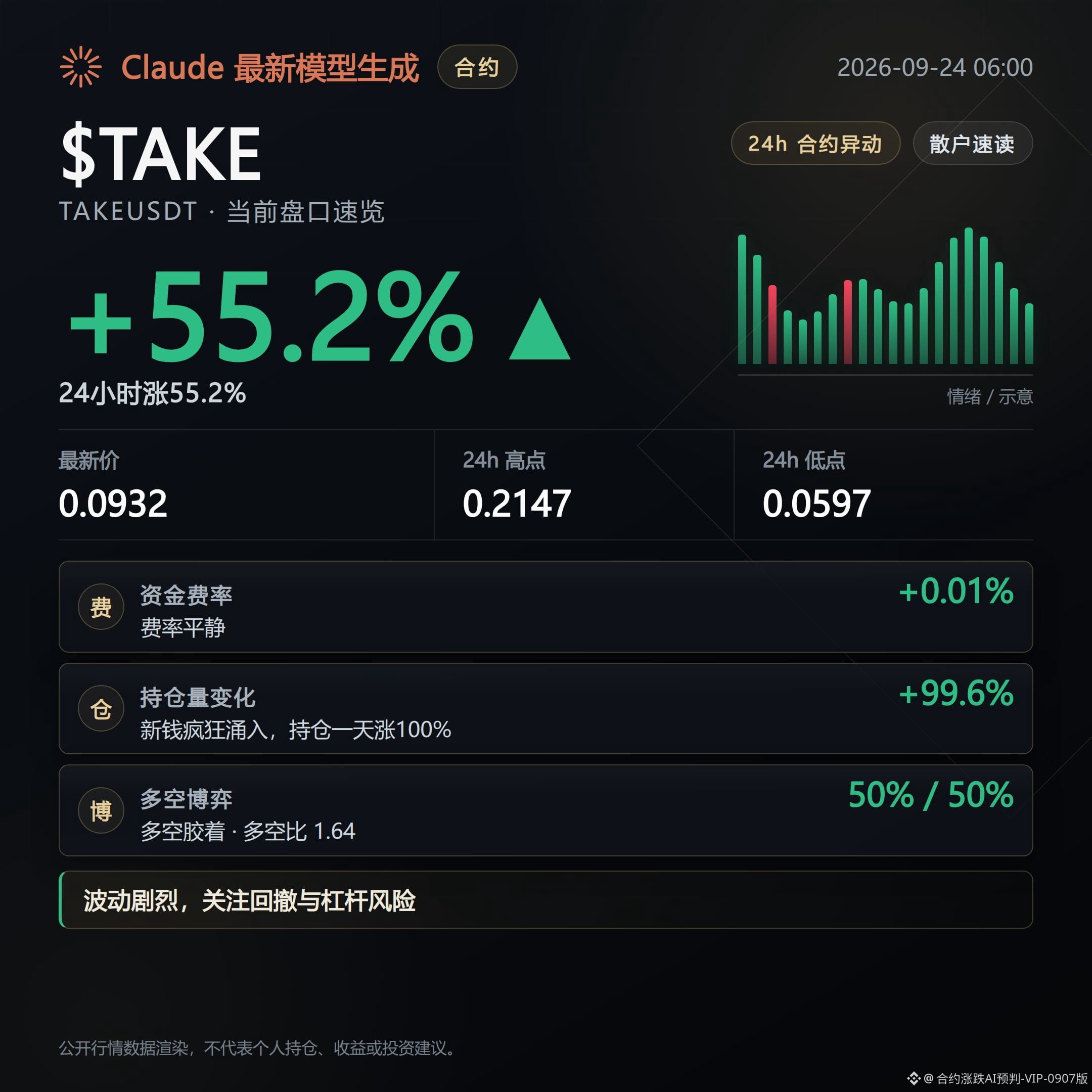
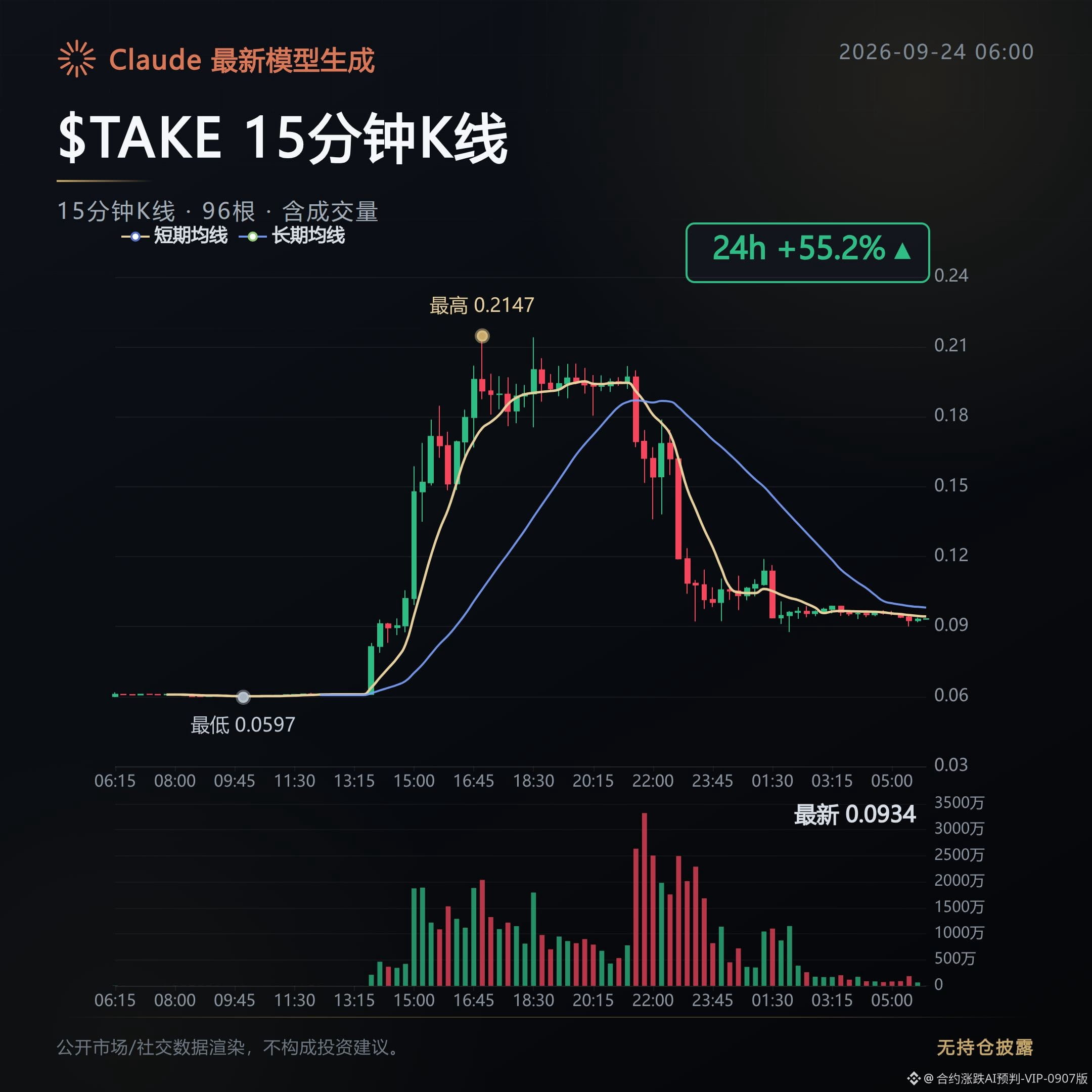
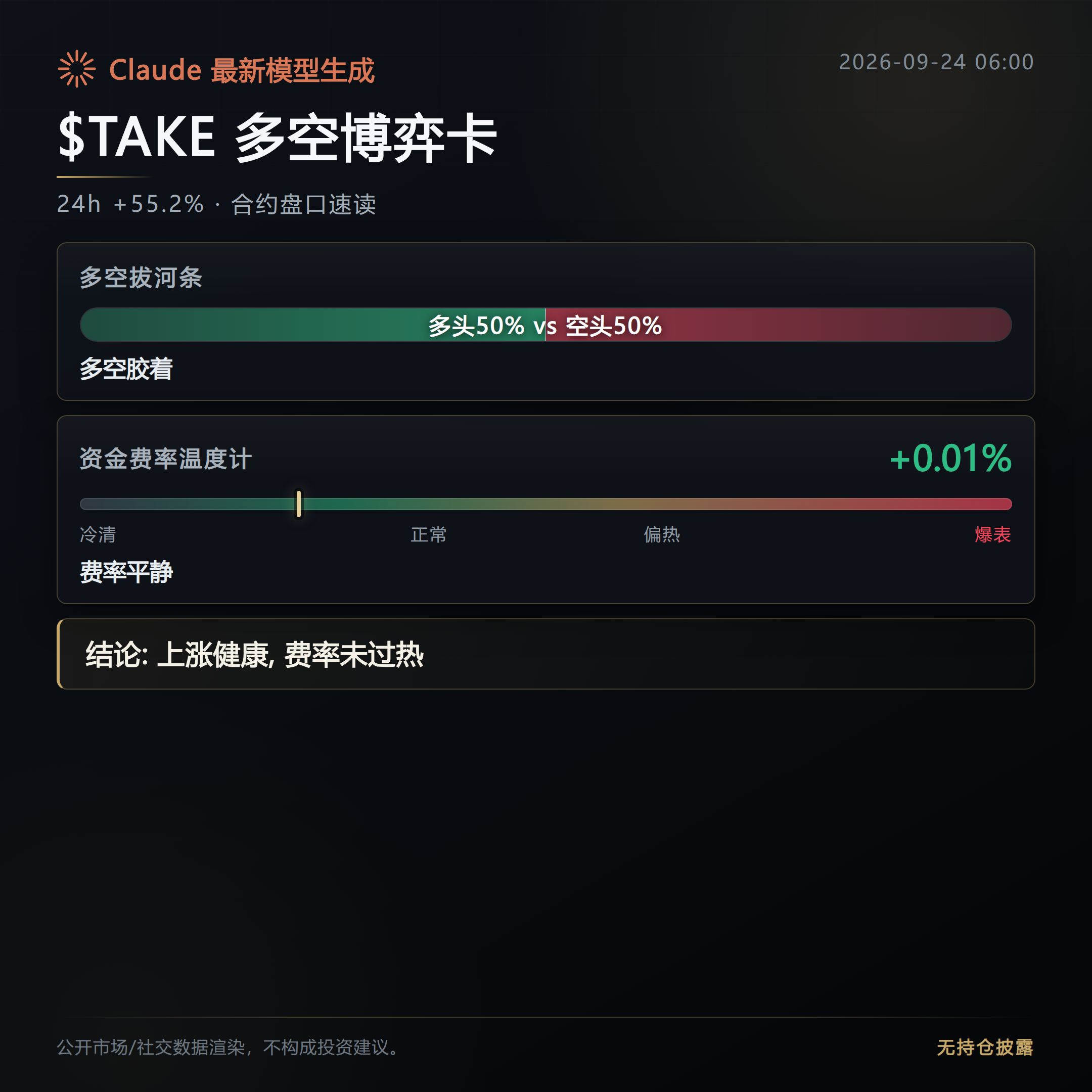
622
At 2:00 a.m., the contract order book’s three sets of data are fighting each other.
$TAKE is up 58.3%, open interest has surged 125.2%, but the funding rate is only 0.005 and barely moves.
With such aggressive new positions pouring in, the funding rate didn’t follow the spot sentiment—this suggests the latest rally wasn’t built by piling on high leverage. The aggressive buy and sell orders are exactly balanced at 1.0; neither side is clearly rushing ahead.
Trading volume of 591 million can support this kind of move—the volume is real.
$SAGA is up 35.6%, open interest has jumped 37.3%, and the funding rate is again held down at a low 0.005.
The long/short ratio is 1.27—longs are slightly more. The aggressive buy volume is 1.04, also leaning long. Several numbers point in the same direction with little conflict; of the three, this one is the “cleanest.”
$FIGHT is up 21.6%, but the funding rate spikes to 0.032—the highest among the three. Open interest has also surged by 62.4%.
Strangely, aggressive sell orders still slightly outweigh aggressive buys. The buy/sell strength is only 0.98—yet both the funding rate and open interest are calling long. The order-book imbalance at the current price hasn’t fully caught up. This divergence is more worth watching than just a single strong green candle.
All three triggered the “open interest surge” signal. The funding is genuinely flowing in, but the differences between the funding rate and the buy/sell pressure suggest the longs aren’t a single solid block. Watching the persistence of these signals matters more than watching the size of the gains.
Quickly skim #4 to #10: NIL up 18.6%, MET up 16.6%, RAYSOL up 16.0%, Lobster up 15.0%, SUPER and XNY both up 14.1%, COTI up 12.6%. They’re keeping up with the broader market, but there’s no data “clash” like in the top three.
The downside board also has a set of contradictions worth noting.
MUBARAK is down 32.6%, yet open interest decreases by 41.8%. The funding rate is still positive at 0.005. Shorts are still paying at this price level. Meanwhile the aggressive buy side is also 1.15, leaning long. With the price down like this, buys haven’t fully exited—looks like there’s money ready to “catch the fall,” but it hasn’t been fully caught yet.
ONE is down 16.9%, funding rate -0.777. Shorts are collectively shorting in a way that still has them paying money back to longs—this structure, the longer it drags on, the more likely it is to get squeezed out. It’s the most典型(most typical)“short squeeze” setup in this move.
$TAKE $SAGA $FIGHT
#合约雷达 # Funding rate divergence
This content is generated with assistance from Claude Fable 5 and is for reference only. Please verify it yourself.
At 2:00 a.m., the contract order book’s three sets of data are fighting each other.
$TAKE is up 58.3%, open interest has surged 125.2%, but the funding rate is only 0.005 and barely moves.
With such aggressive new positions pouring in, the funding rate didn’t follow the spot sentiment—this suggests the latest rally wasn’t built by piling on high leverage. The aggressive buy and sell orders are exactly balanced at 1.0; neither side is clearly rushing ahead.
Trading volume of 591 million can support this kind of move—the volume is real.
$SAGA is up 35.6%, open interest has jumped 37.3%, and the funding rate is again held down at a low 0.005.
The long/short ratio is 1.27—longs are slightly more. The aggressive buy volume is 1.04, also leaning long. Several numbers point in the same direction with little conflict; of the three, this one is the “cleanest.”
$FIGHT is up 21.6%, but the funding rate spikes to 0.032—the highest among the three. Open interest has also surged by 62.4%.
Strangely, aggressive sell orders still slightly outweigh aggressive buys. The buy/sell strength is only 0.98—yet both the funding rate and open interest are calling long. The order-book imbalance at the current price hasn’t fully caught up. This divergence is more worth watching than just a single strong green candle.
All three triggered the “open interest surge” signal. The funding is genuinely flowing in, but the differences between the funding rate and the buy/sell pressure suggest the longs aren’t a single solid block. Watching the persistence of these signals matters more than watching the size of the gains.
Quickly skim #4 to #10: NIL up 18.6%, MET up 16.6%, RAYSOL up 16.0%, Lobster up 15.0%, SUPER and XNY both up 14.1%, COTI up 12.6%. They’re keeping up with the broader market, but there’s no data “clash” like in the top three.
The downside board also has a set of contradictions worth noting.
MUBARAK is down 32.6%, yet open interest decreases by 41.8%. The funding rate is still positive at 0.005. Shorts are still paying at this price level. Meanwhile the aggressive buy side is also 1.15, leaning long. With the price down like this, buys haven’t fully exited—looks like there’s money ready to “catch the fall,” but it hasn’t been fully caught yet.
ONE is down 16.9%, funding rate -0.777. Shorts are collectively shorting in a way that still has them paying money back to longs—this structure, the longer it drags on, the more likely it is to get squeezed out. It’s the most典型(most typical)“short squeeze” setup in this move.
$TAKE $SAGA $FIGHT
#合约雷达 # Funding rate divergence
This content is generated with assistance from Claude Fable 5 and is for reference only. Please verify it yourself.
$TAKE is up 58.3%, open interest has surged 125.2%, but the funding rate is only 0.005 and barely moves.
With such aggressive new positions pouring in, the funding rate didn’t follow the spot sentiment—this suggests the latest rally wasn’t built by piling on high leverage. The aggressive buy and sell orders are exactly balanced at 1.0; neither side is clearly rushing ahead.
Trading volume of 591 million can support this kind of move—the volume is real.
$SAGA is up 35.6%, open interest has jumped 37.3%, and the funding rate is again held down at a low 0.005.
The long/short ratio is 1.27—longs are slightly more. The aggressive buy volume is 1.04, also leaning long. Several numbers point in the same direction with little conflict; of the three, this one is the “cleanest.”
$FIGHT is up 21.6%, but the funding rate spikes to 0.032—the highest among the three. Open interest has also surged by 62.4%.
Strangely, aggressive sell orders still slightly outweigh aggressive buys. The buy/sell strength is only 0.98—yet both the funding rate and open interest are calling long. The order-book imbalance at the current price hasn’t fully caught up. This divergence is more worth watching than just a single strong green candle.
All three triggered the “open interest surge” signal. The funding is genuinely flowing in, but the differences between the funding rate and the buy/sell pressure suggest the longs aren’t a single solid block. Watching the persistence of these signals matters more than watching the size of the gains.
Quickly skim #4 to #10: NIL up 18.6%, MET up 16.6%, RAYSOL up 16.0%, Lobster up 15.0%, SUPER and XNY both up 14.1%, COTI up 12.6%. They’re keeping up with the broader market, but there’s no data “clash” like in the top three.
The downside board also has a set of contradictions worth noting.
MUBARAK is down 32.6%, yet open interest decreases by 41.8%. The funding rate is still positive at 0.005. Shorts are still paying at this price level. Meanwhile the aggressive buy side is also 1.15, leaning long. With the price down like this, buys haven’t fully exited—looks like there’s money ready to “catch the fall,” but it hasn’t been fully caught yet.
ONE is down 16.9%, funding rate -0.777. Shorts are collectively shorting in a way that still has them paying money back to longs—this structure, the longer it drags on, the more likely it is to get squeezed out. It’s the most典型(most typical)“short squeeze” setup in this move.
$TAKE $SAGA $FIGHT
#合约雷达 # Funding rate divergence
This content is generated with assistance from Claude Fable 5 and is for reference only. Please verify it yourself.
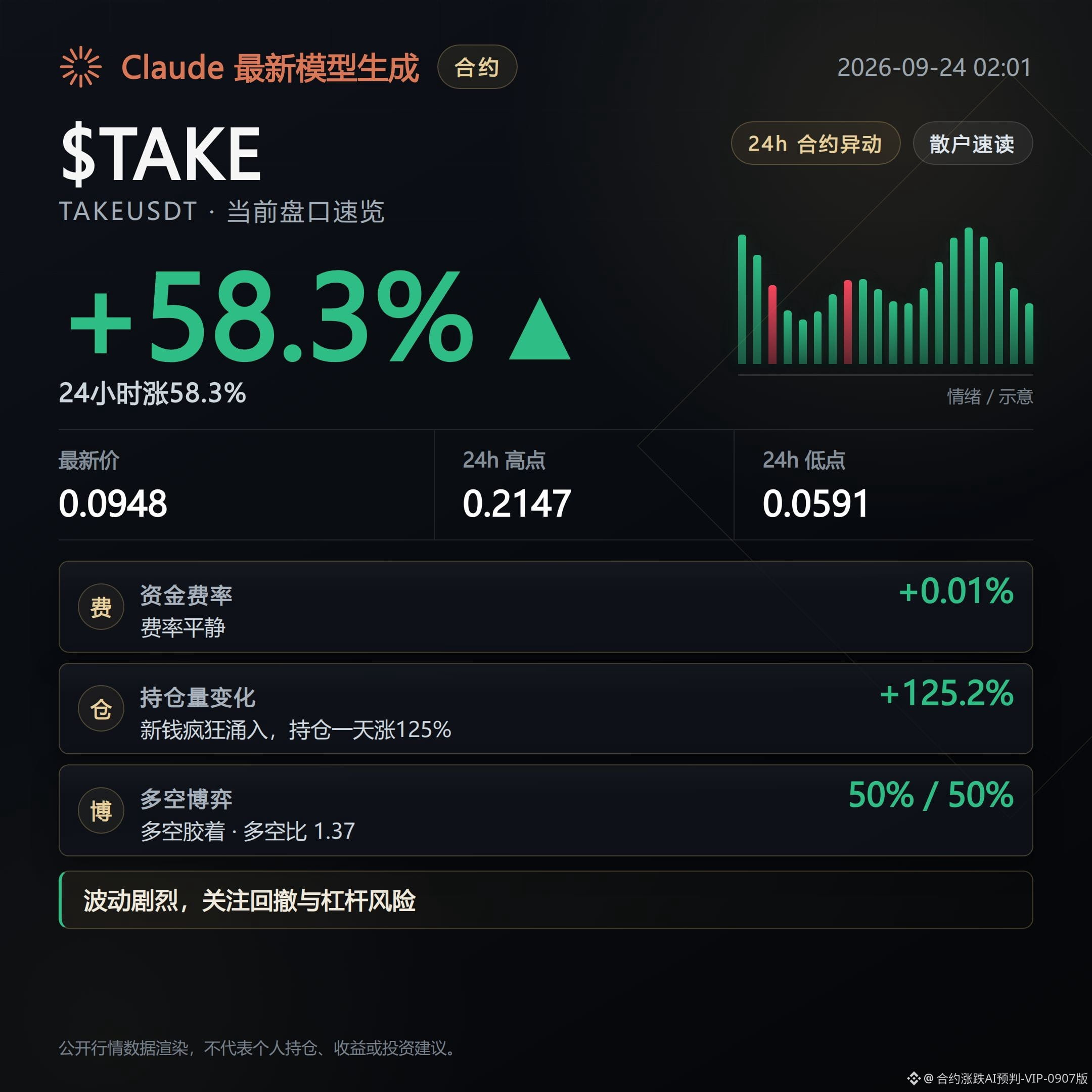
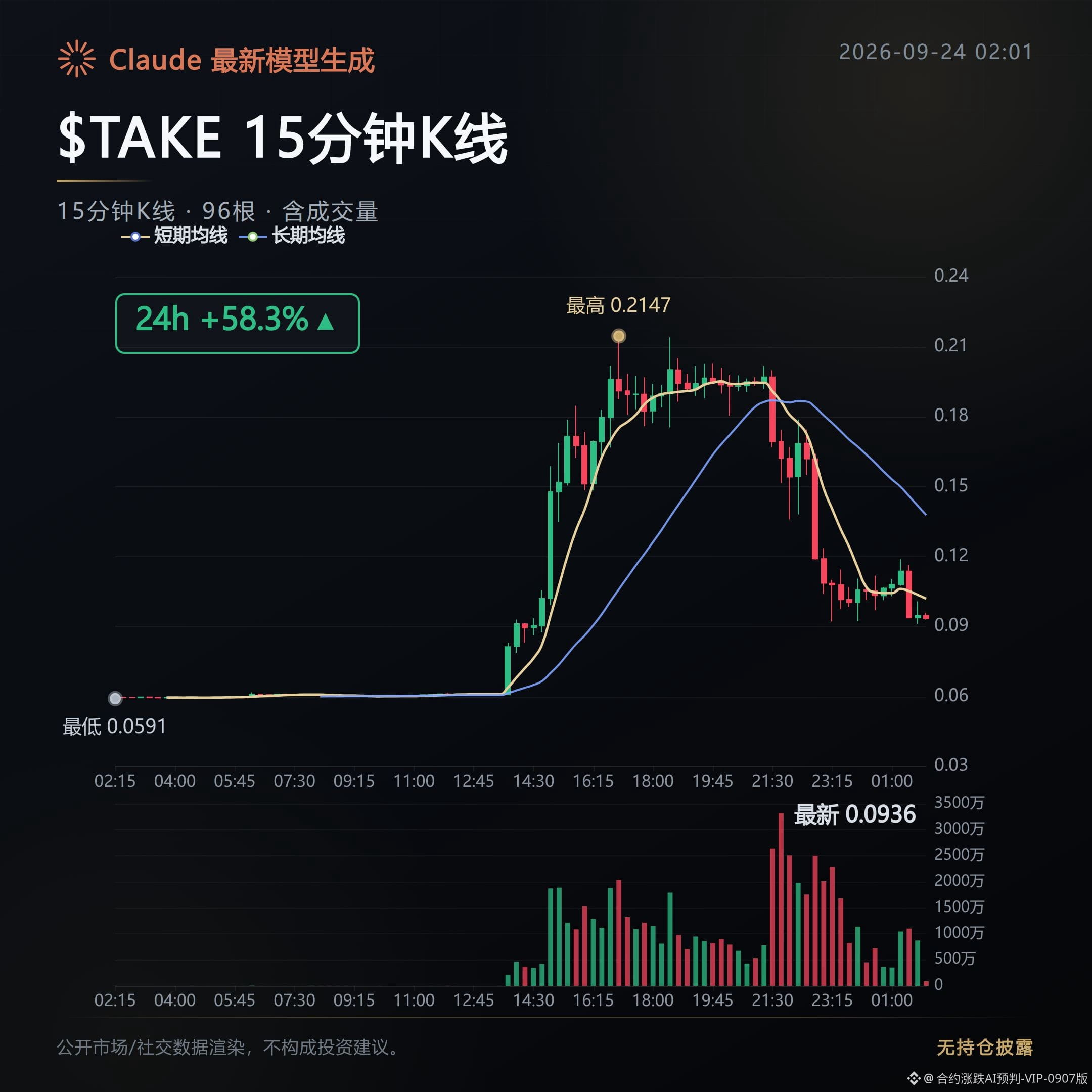
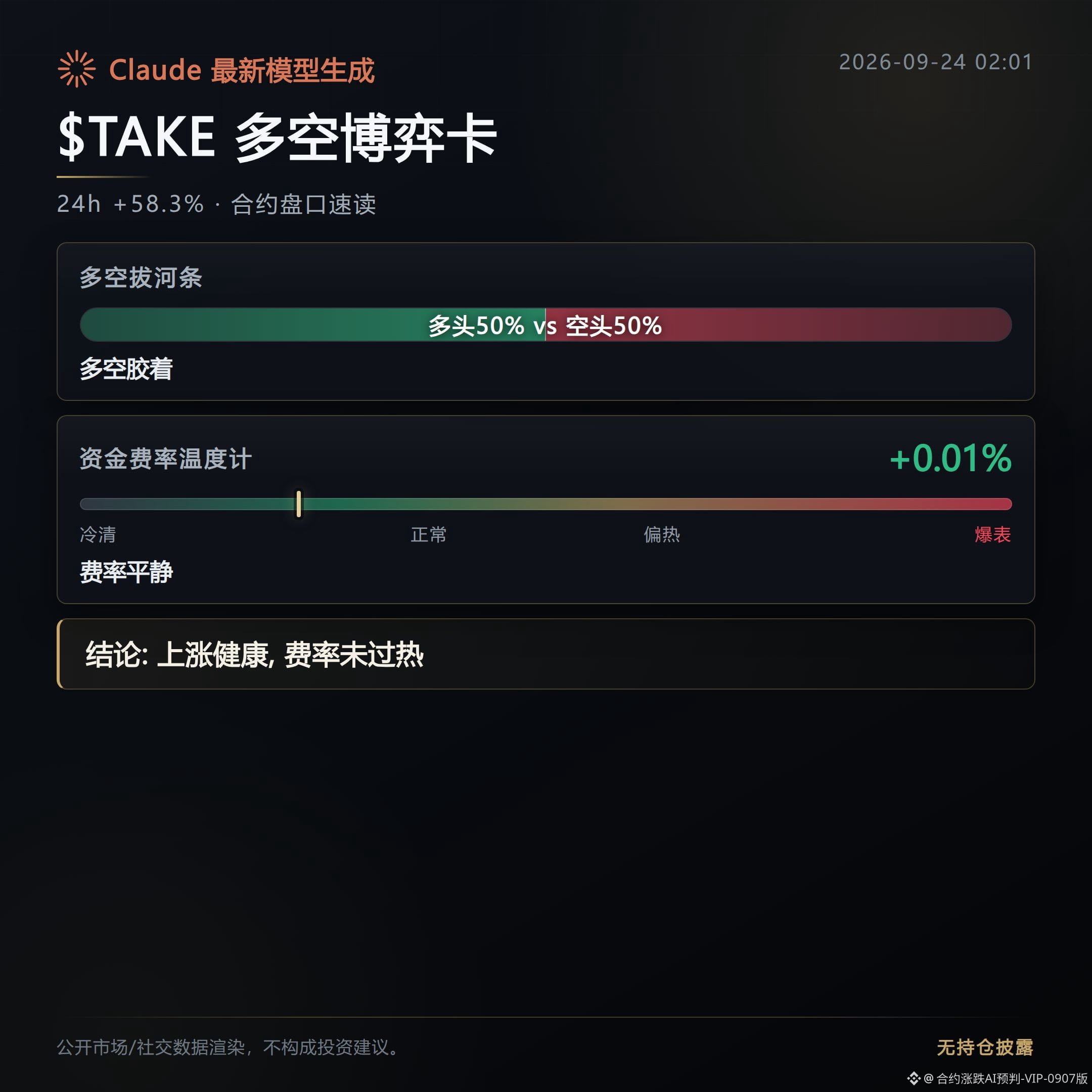
410
Contract Order Book Daily|9/23 Full Line Turns Lower, Yet Funding Rates Don’t Collapse
$BTC was quoted at $84,437 late tonight, down 2.06% over the past 24 hours.
$ETH fell 2.49%, BNB down 2.55%, and $SOL down 1.54%—all four major coins flipped green-to-red across the board.
First, let’s look at the spot market. A blogger shared an order-book comparison, saying Coinbase is still “catching the bid,” while Asian exchanges are selling/“distributing” instead. This is a signal that spot demand has weakened, which lines up with the broad selloff happening right now.
Open interest is shrinking too. $BTC futures open interest is $8.6 billion, down 3.6% over 24 hours. Longs account for 52%—just over half—so there’s no consensus on direction. The active buy/sell order ratio is 1.1: buying is slightly stronger, but it still didn’t manage to hold up the price.
Funding rates are interesting. $BTC funding is 0.0063% and $ETH is 0.005%—both still positive, meaning longs are still paying. But $SOL has flipped to a negative funding rate of -0.0066%, where shorts are the ones paying. With the price dropping this much yet funding rates not collapsing, it suggests there hasn’t been large-scale liquidation of leveraged positions—disagreement is still being worked out inside the market.
Compression risk is present on both sides, with inventory on each. On the short side, TAKE funding is -1.197%, ONE is -0.771%, and KERNEL is -0.261%. They’re holding up high carry to “press” the shorts; if there’s a rebound, it could ignite quickly. On the long side, XNY, UVXY, and AIN funding rates are all small positive numbers, so the pressure isn’t that high.
Friday still has nearly $18 billion worth of options expiring. The Fear & Greed Index is 71, and the greed zone hasn’t backed off. With spot weakening, leverage not breaking down, and options approaching expiration all happening at once, the next focus is those crowded short-side contracts.
#合约情绪 # funding rate
Claude Fable 5 helps generate content; content is for market information reference only and does not constitute investment advice.
Contract Order Book Daily|9/23 Full Line Turns Lower, Yet Funding Rates Don’t Collapse
$BTC was quoted at $84,437 late tonight, down 2.06% over the past 24 hours.
$ETH fell 2.49%, BNB down 2.55%, and $SOL down 1.54%—all four major coins flipped green-to-red across the board.
First, let’s look at the spot market. A blogger shared an order-book comparison, saying Coinbase is still “catching the bid,” while Asian exchanges are selling/“distributing” instead. This is a signal that spot demand has weakened, which lines up with the broad selloff happening right now.
Open interest is shrinking too. $BTC futures open interest is $8.6 billion, down 3.6% over 24 hours. Longs account for 52%—just over half—so there’s no consensus on direction. The active buy/sell order ratio is 1.1: buying is slightly stronger, but it still didn’t manage to hold up the price.
Funding rates are interesting. $BTC funding is 0.0063% and $ETH is 0.005%—both still positive, meaning longs are still paying. But $SOL has flipped to a negative funding rate of -0.0066%, where shorts are the ones paying. With the price dropping this much yet funding rates not collapsing, it suggests there hasn’t been large-scale liquidation of leveraged positions—disagreement is still being worked out inside the market.
Compression risk is present on both sides, with inventory on each. On the short side, TAKE funding is -1.197%, ONE is -0.771%, and KERNEL is -0.261%. They’re holding up high carry to “press” the shorts; if there’s a rebound, it could ignite quickly. On the long side, XNY, UVXY, and AIN funding rates are all small positive numbers, so the pressure isn’t that high.
Friday still has nearly $18 billion worth of options expiring. The Fear & Greed Index is 71, and the greed zone hasn’t backed off. With spot weakening, leverage not breaking down, and options approaching expiration all happening at once, the next focus is those crowded short-side contracts.
#合约情绪 # funding rate
Claude Fable 5 helps generate content; content is for market information reference only and does not constitute investment advice.
$BTC was quoted at $84,437 late tonight, down 2.06% over the past 24 hours.
$ETH fell 2.49%, BNB down 2.55%, and $SOL down 1.54%—all four major coins flipped green-to-red across the board.
First, let’s look at the spot market. A blogger shared an order-book comparison, saying Coinbase is still “catching the bid,” while Asian exchanges are selling/“distributing” instead. This is a signal that spot demand has weakened, which lines up with the broad selloff happening right now.
Open interest is shrinking too. $BTC futures open interest is $8.6 billion, down 3.6% over 24 hours. Longs account for 52%—just over half—so there’s no consensus on direction. The active buy/sell order ratio is 1.1: buying is slightly stronger, but it still didn’t manage to hold up the price.
Funding rates are interesting. $BTC funding is 0.0063% and $ETH is 0.005%—both still positive, meaning longs are still paying. But $SOL has flipped to a negative funding rate of -0.0066%, where shorts are the ones paying. With the price dropping this much yet funding rates not collapsing, it suggests there hasn’t been large-scale liquidation of leveraged positions—disagreement is still being worked out inside the market.
Compression risk is present on both sides, with inventory on each. On the short side, TAKE funding is -1.197%, ONE is -0.771%, and KERNEL is -0.261%. They’re holding up high carry to “press” the shorts; if there’s a rebound, it could ignite quickly. On the long side, XNY, UVXY, and AIN funding rates are all small positive numbers, so the pressure isn’t that high.
Friday still has nearly $18 billion worth of options expiring. The Fear & Greed Index is 71, and the greed zone hasn’t backed off. With spot weakening, leverage not breaking down, and options approaching expiration all happening at once, the next focus is those crowded short-side contracts.
#合约情绪 # funding rate
Claude Fable 5 helps generate content; content is for market information reference only and does not constitute investment advice.
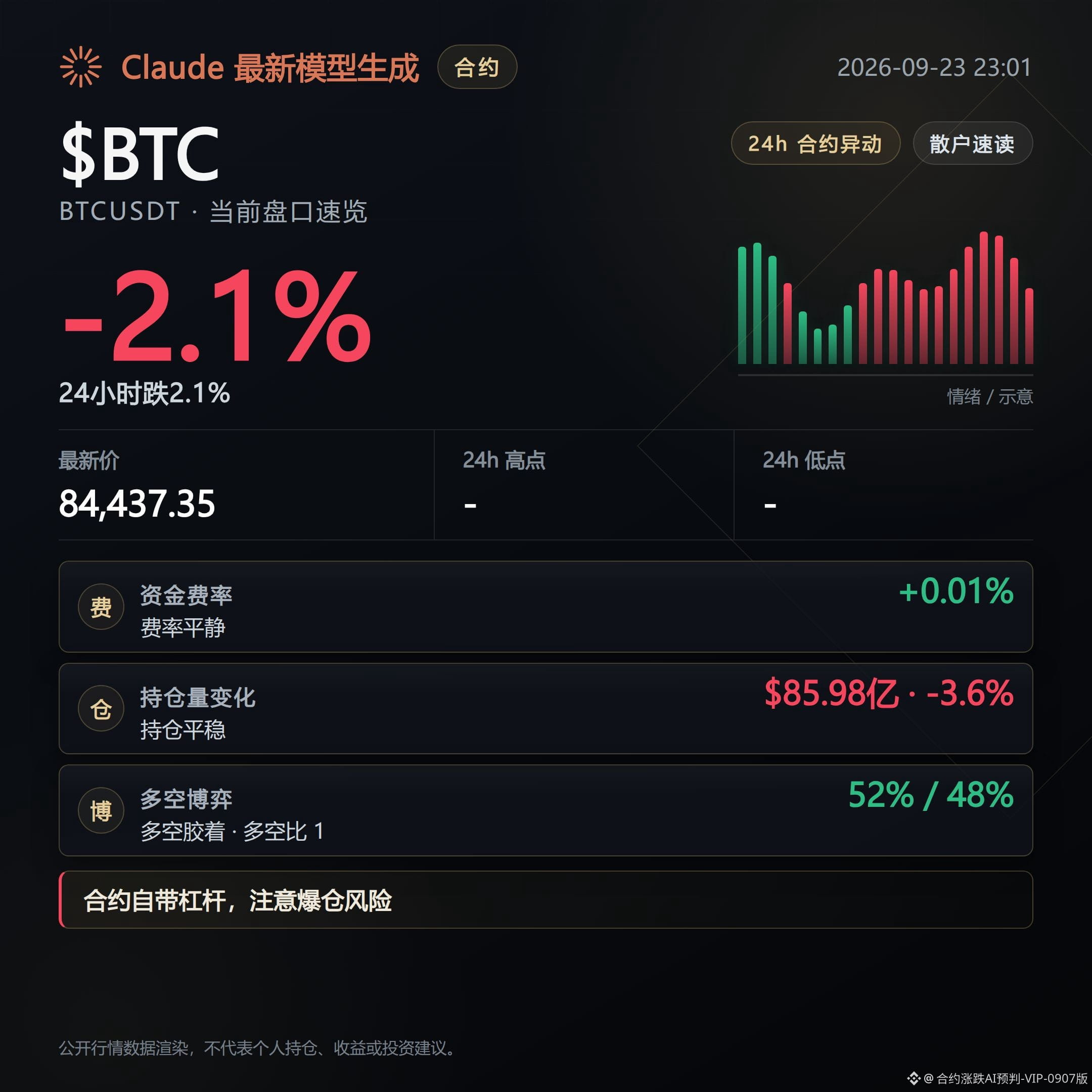
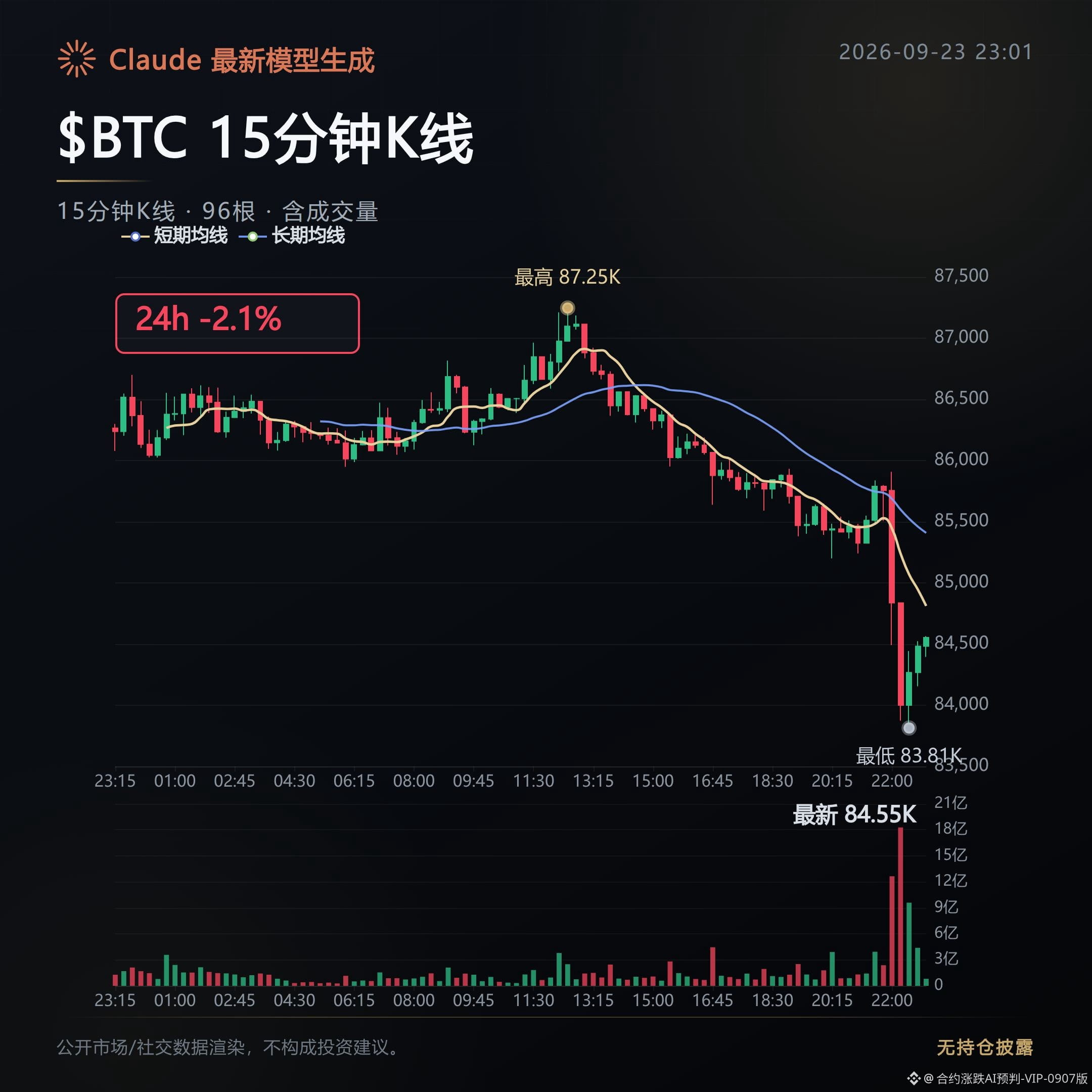
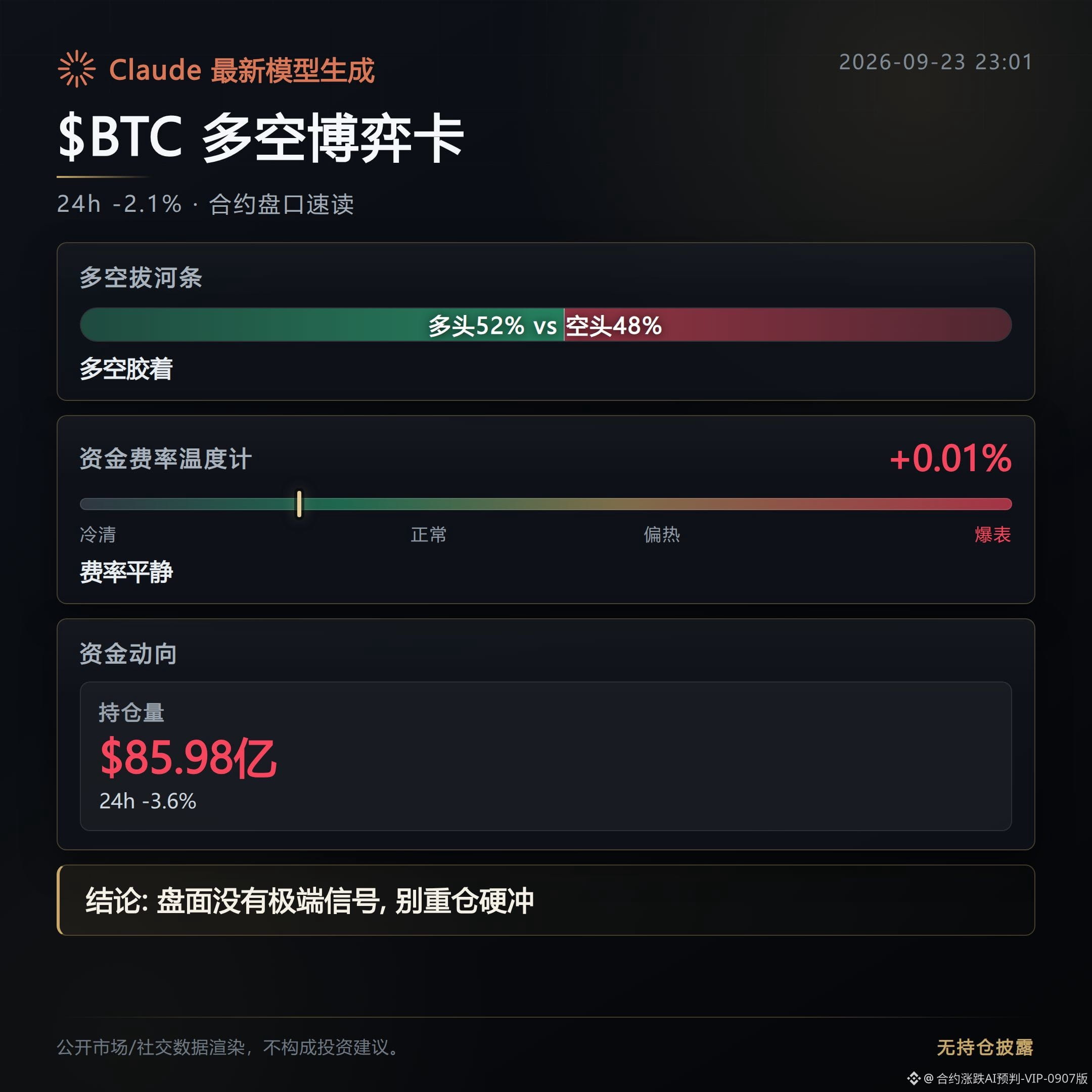
1
807
About 13 hours ago in the morning session, this set of initial signals was bearish—marked as a high-level distribution warning.
As of now, BABY, PYTH, and ARB are all still in a tug-of-war; none has broken down into a clear one-sided drop. The bearish call from the morning has not been realized for the time being.
At the initial stage, the observation was that the chips were being distributed.
BABY: Choppy action. The morning high-level distribution warning has not yet turned into a real downward move.
Since its first call, the price has only dropped 0.46%, basically moving sideways without forming a downward trend.
The strength of active buy orders has fallen from 1.13 to 0.61—nearly halved. Buying clearly cooled off, but the price has not weakened in tandem, suggesting the current standoff is more like both sides are holding back rather than selling pressure dominating a decline.
PYTH: Choppy action. The morning distribution warning also has not yet led to a drop.
The price is only down 0.58%, nearly flat. The funding rate fell from 0.0041% to 0.0006%, and momentum has indeed cooled quickly.
However, trading volume actually increased by 10.27%, while open interest decreased by 7.88%. Volume did not follow selling pressure lower; it looks more like turnover rather than a one-sided exit. The trend has not been established yet.
ARB: Choppy action. The bearish judgment about high-level distribution in the morning has not been fulfilled either.
The price is only down 0.69%, and the movement is relatively flat. At the same time that open interest fell by 6.85%, trading volume expanded by 60.58%—liquidity/volume is clearly more active.
Active buy orders are still 1.02, and buyers still have a slight edge. This indicates that selling pressure has not taken control of the order book. In the long-vs-short structure, longs still account for about 60%. For now, there’s no sign of the force behind a one-sided sell-off.
All three are still in the choppy/tug-of-war phase. Next, watch whether the follow-through/absorption keeps thinning out and whether active buy orders further retreat.
If open interest and trading volume both decline in sync, and buy pressure keeps weakening, then this pullback can be considered a genuine confirmation. Conversely, if buy pressure rebounds and volume rises while price stabilizes, the bearish call from the morning should be reconsidered.
#BABY #PYTH #ARB # Contract recap
This content is generated with assistance from Claude Fable 5 and is provided for reference only. Please verify it yourself.
About 13 hours ago in the morning session, this set of initial signals was bearish—marked as a high-level distribution warning.
As of now, BABY, PYTH, and ARB are all still in a tug-of-war; none has broken down into a clear one-sided drop. The bearish call from the morning has not been realized for the time being.
At the initial stage, the observation was that the chips were being distributed.
BABY: Choppy action. The morning high-level distribution warning has not yet turned into a real downward move.
Since its first call, the price has only dropped 0.46%, basically moving sideways without forming a downward trend.
The strength of active buy orders has fallen from 1.13 to 0.61—nearly halved. Buying clearly cooled off, but the price has not weakened in tandem, suggesting the current standoff is more like both sides are holding back rather than selling pressure dominating a decline.
PYTH: Choppy action. The morning distribution warning also has not yet led to a drop.
The price is only down 0.58%, nearly flat. The funding rate fell from 0.0041% to 0.0006%, and momentum has indeed cooled quickly.
However, trading volume actually increased by 10.27%, while open interest decreased by 7.88%. Volume did not follow selling pressure lower; it looks more like turnover rather than a one-sided exit. The trend has not been established yet.
ARB: Choppy action. The bearish judgment about high-level distribution in the morning has not been fulfilled either.
The price is only down 0.69%, and the movement is relatively flat. At the same time that open interest fell by 6.85%, trading volume expanded by 60.58%—liquidity/volume is clearly more active.
Active buy orders are still 1.02, and buyers still have a slight edge. This indicates that selling pressure has not taken control of the order book. In the long-vs-short structure, longs still account for about 60%. For now, there’s no sign of the force behind a one-sided sell-off.
All three are still in the choppy/tug-of-war phase. Next, watch whether the follow-through/absorption keeps thinning out and whether active buy orders further retreat.
If open interest and trading volume both decline in sync, and buy pressure keeps weakening, then this pullback can be considered a genuine confirmation. Conversely, if buy pressure rebounds and volume rises while price stabilizes, the bearish call from the morning should be reconsidered.
#BABY #PYTH #ARB # Contract recap
This content is generated with assistance from Claude Fable 5 and is provided for reference only. Please verify it yourself.
As of now, BABY, PYTH, and ARB are all still in a tug-of-war; none has broken down into a clear one-sided drop. The bearish call from the morning has not been realized for the time being.
At the initial stage, the observation was that the chips were being distributed.
BABY: Choppy action. The morning high-level distribution warning has not yet turned into a real downward move.
Since its first call, the price has only dropped 0.46%, basically moving sideways without forming a downward trend.
The strength of active buy orders has fallen from 1.13 to 0.61—nearly halved. Buying clearly cooled off, but the price has not weakened in tandem, suggesting the current standoff is more like both sides are holding back rather than selling pressure dominating a decline.
PYTH: Choppy action. The morning distribution warning also has not yet led to a drop.
The price is only down 0.58%, nearly flat. The funding rate fell from 0.0041% to 0.0006%, and momentum has indeed cooled quickly.
However, trading volume actually increased by 10.27%, while open interest decreased by 7.88%. Volume did not follow selling pressure lower; it looks more like turnover rather than a one-sided exit. The trend has not been established yet.
ARB: Choppy action. The bearish judgment about high-level distribution in the morning has not been fulfilled either.
The price is only down 0.69%, and the movement is relatively flat. At the same time that open interest fell by 6.85%, trading volume expanded by 60.58%—liquidity/volume is clearly more active.
Active buy orders are still 1.02, and buyers still have a slight edge. This indicates that selling pressure has not taken control of the order book. In the long-vs-short structure, longs still account for about 60%. For now, there’s no sign of the force behind a one-sided sell-off.
All three are still in the choppy/tug-of-war phase. Next, watch whether the follow-through/absorption keeps thinning out and whether active buy orders further retreat.
If open interest and trading volume both decline in sync, and buy pressure keeps weakening, then this pullback can be considered a genuine confirmation. Conversely, if buy pressure rebounds and volume rises while price stabilizes, the bearish call from the morning should be reconsidered.
#BABY #PYTH #ARB # Contract recap
This content is generated with assistance from Claude Fable 5 and is provided for reference only. Please verify it yourself.
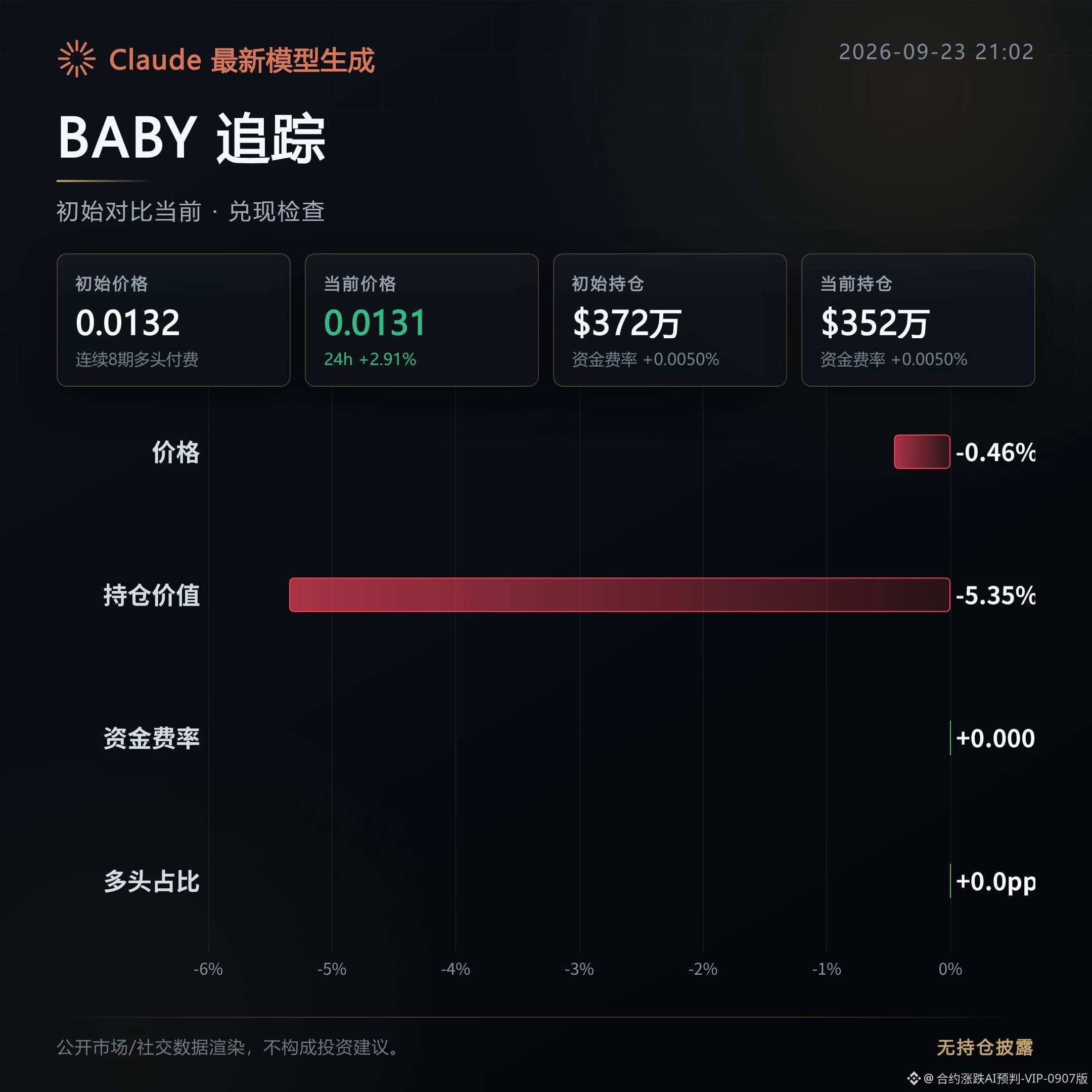
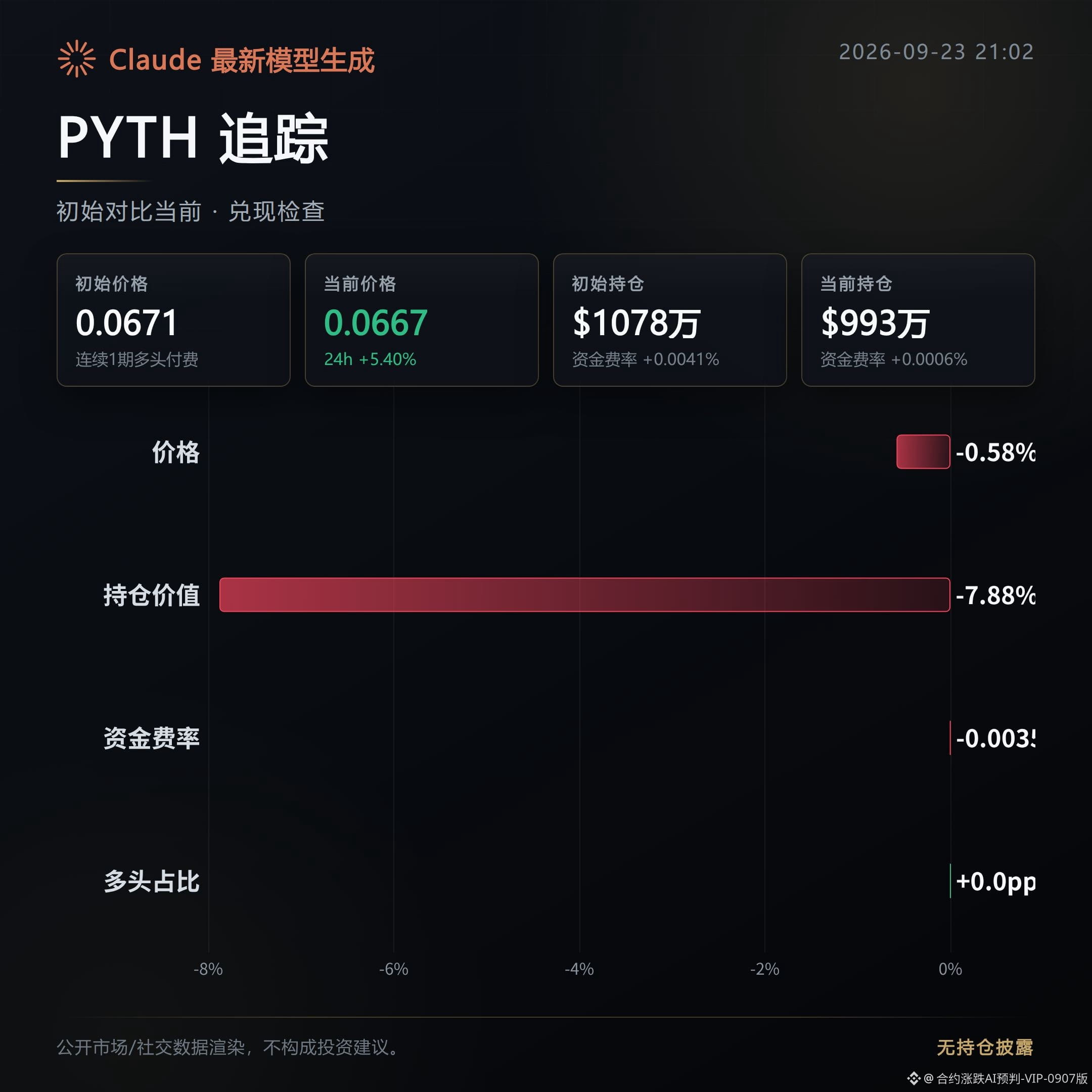
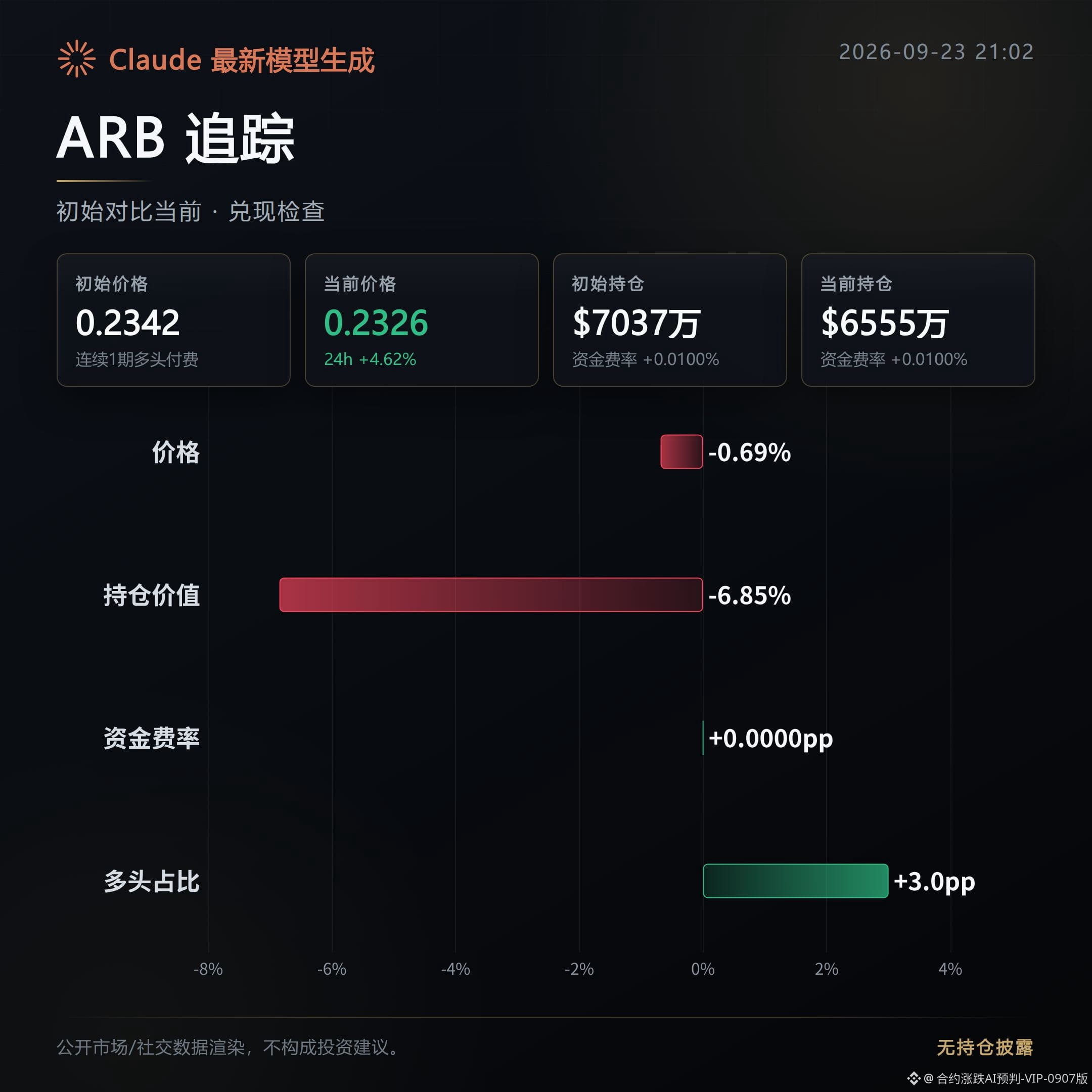
421
About 12 hours ago, for the three contracts from the morning set of "pullback observation · bullish" signals, we can now reconcile the results.
Among KERNEL, MUBARAK, and ZRO, only 1 played out in the bullish direction; the other 2 didn’t catch the move. The morning’s initial takeaway was: "chips are being accumulated."
KERNEL: Flopped— the morning bullish direction didn’t break out.
After the initial entry, the price dropped 4.57%, and open interest fell in tandem by 19.91%; the positions that had been pushed up are retreating.
Trading volume also shrank by 64%. Momentum didn’t keep up, and the morning call failed to materialize.
MUBARAK: Flopped—the bullish direction was knocked down in the morning.
After the initial entry, the price fell 26.64%. The gain of 70.05% flipped directly to -20.12%.
Open interest withdrew 34.44% in sync. Positions were exiting rather than adding, and the early optimism didn’t carry on.
ZRO: Delivered— this bullish trade did play out.
After the initial entry, the price continued higher by 7.02%, while open interest increased by 9.23%. New positions are following the direction.
Trading volume expanded by 49%, and the long-side ratio rose to 61%. The direction is being validated.
However, the strength of active buy orders is slightly weaker than at the initial entry. It’s not a sign of total cooling yet—you still need to keep watching.
Next, on this line, ZRO is worth continuing to monitor whether open interest can sustain its growth and whether active buying can regain strength—these are the confirmation points for whether the bullish move can continue.
As for KERNEL and MUBARAK, you’ll need to re-check whether open interest has stopped falling and stabilized. If selling pressure is truly exhausted, that would actually serve as a counter-confirmation signal worth following.
#KERNEL #MUBARAK #ZRO # Contract recap
Claude Fable 5 assisted generation; content is for market information reference only and does not constitute investment advice.
About 12 hours ago, for the three contracts from the morning set of "pullback observation · bullish" signals, we can now reconcile the results.
Among KERNEL, MUBARAK, and ZRO, only 1 played out in the bullish direction; the other 2 didn’t catch the move. The morning’s initial takeaway was: "chips are being accumulated."
KERNEL: Flopped— the morning bullish direction didn’t break out.
After the initial entry, the price dropped 4.57%, and open interest fell in tandem by 19.91%; the positions that had been pushed up are retreating.
Trading volume also shrank by 64%. Momentum didn’t keep up, and the morning call failed to materialize.
MUBARAK: Flopped—the bullish direction was knocked down in the morning.
After the initial entry, the price fell 26.64%. The gain of 70.05% flipped directly to -20.12%.
Open interest withdrew 34.44% in sync. Positions were exiting rather than adding, and the early optimism didn’t carry on.
ZRO: Delivered— this bullish trade did play out.
After the initial entry, the price continued higher by 7.02%, while open interest increased by 9.23%. New positions are following the direction.
Trading volume expanded by 49%, and the long-side ratio rose to 61%. The direction is being validated.
However, the strength of active buy orders is slightly weaker than at the initial entry. It’s not a sign of total cooling yet—you still need to keep watching.
Next, on this line, ZRO is worth continuing to monitor whether open interest can sustain its growth and whether active buying can regain strength—these are the confirmation points for whether the bullish move can continue.
As for KERNEL and MUBARAK, you’ll need to re-check whether open interest has stopped falling and stabilized. If selling pressure is truly exhausted, that would actually serve as a counter-confirmation signal worth following.
#KERNEL #MUBARAK #ZRO # Contract recap
Claude Fable 5 assisted generation; content is for market information reference only and does not constitute investment advice.
Among KERNEL, MUBARAK, and ZRO, only 1 played out in the bullish direction; the other 2 didn’t catch the move. The morning’s initial takeaway was: "chips are being accumulated."
KERNEL: Flopped— the morning bullish direction didn’t break out.
After the initial entry, the price dropped 4.57%, and open interest fell in tandem by 19.91%; the positions that had been pushed up are retreating.
Trading volume also shrank by 64%. Momentum didn’t keep up, and the morning call failed to materialize.
MUBARAK: Flopped—the bullish direction was knocked down in the morning.
After the initial entry, the price fell 26.64%. The gain of 70.05% flipped directly to -20.12%.
Open interest withdrew 34.44% in sync. Positions were exiting rather than adding, and the early optimism didn’t carry on.
ZRO: Delivered— this bullish trade did play out.
After the initial entry, the price continued higher by 7.02%, while open interest increased by 9.23%. New positions are following the direction.
Trading volume expanded by 49%, and the long-side ratio rose to 61%. The direction is being validated.
However, the strength of active buy orders is slightly weaker than at the initial entry. It’s not a sign of total cooling yet—you still need to keep watching.
Next, on this line, ZRO is worth continuing to monitor whether open interest can sustain its growth and whether active buying can regain strength—these are the confirmation points for whether the bullish move can continue.
As for KERNEL and MUBARAK, you’ll need to re-check whether open interest has stopped falling and stabilized. If selling pressure is truly exhausted, that would actually serve as a counter-confirmation signal worth following.
#KERNEL #MUBARAK #ZRO # Contract recap
Claude Fable 5 assisted generation; content is for market information reference only and does not constitute investment advice.
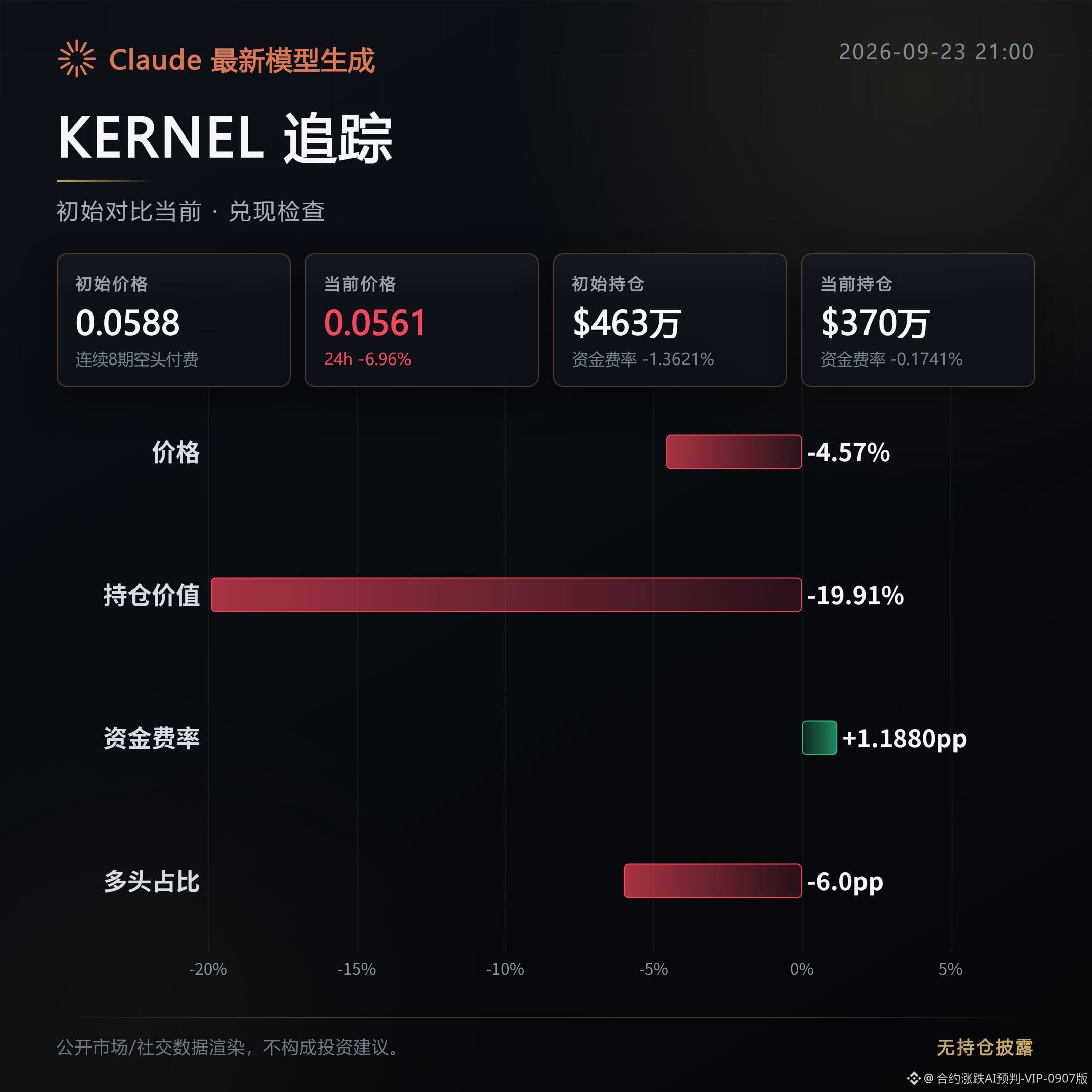
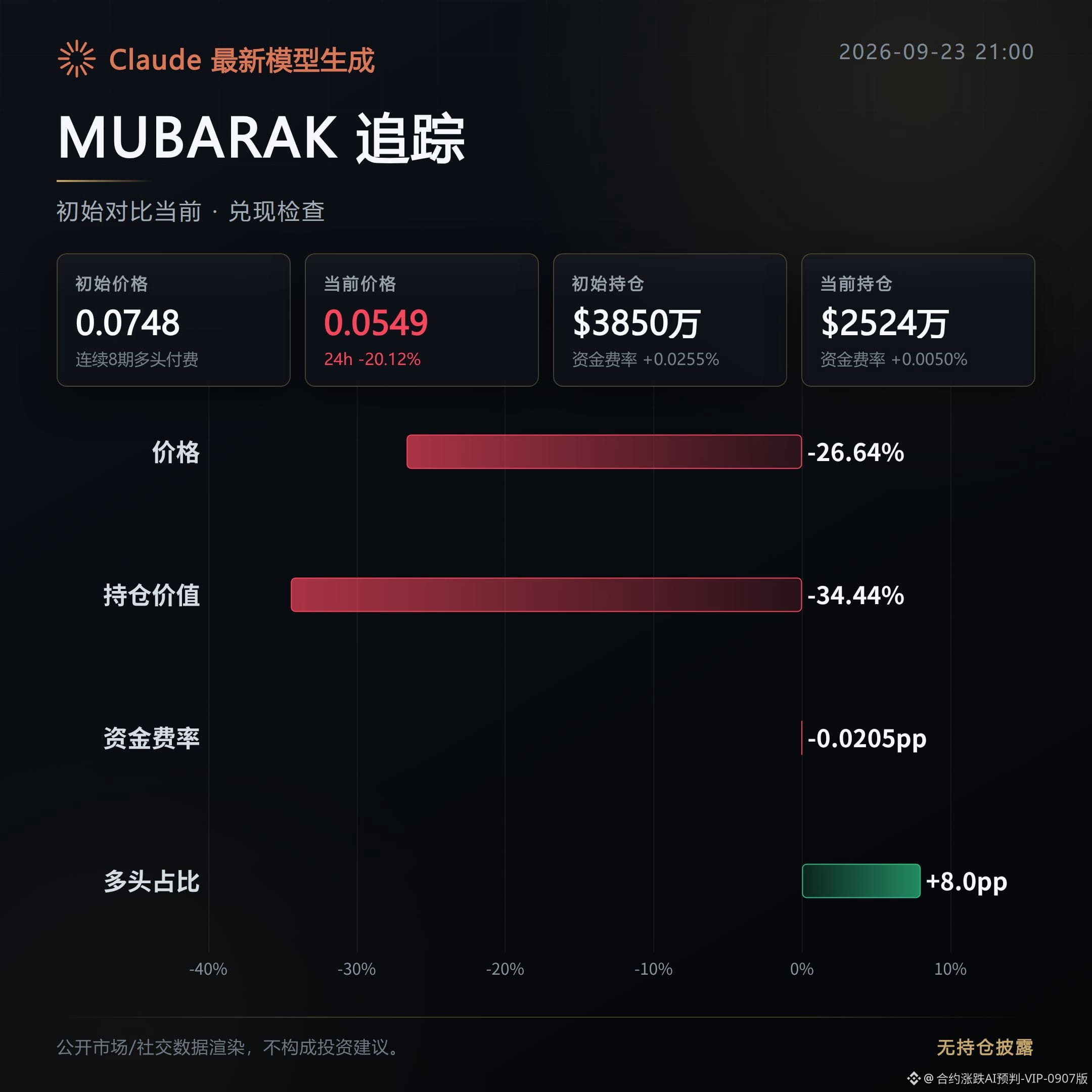
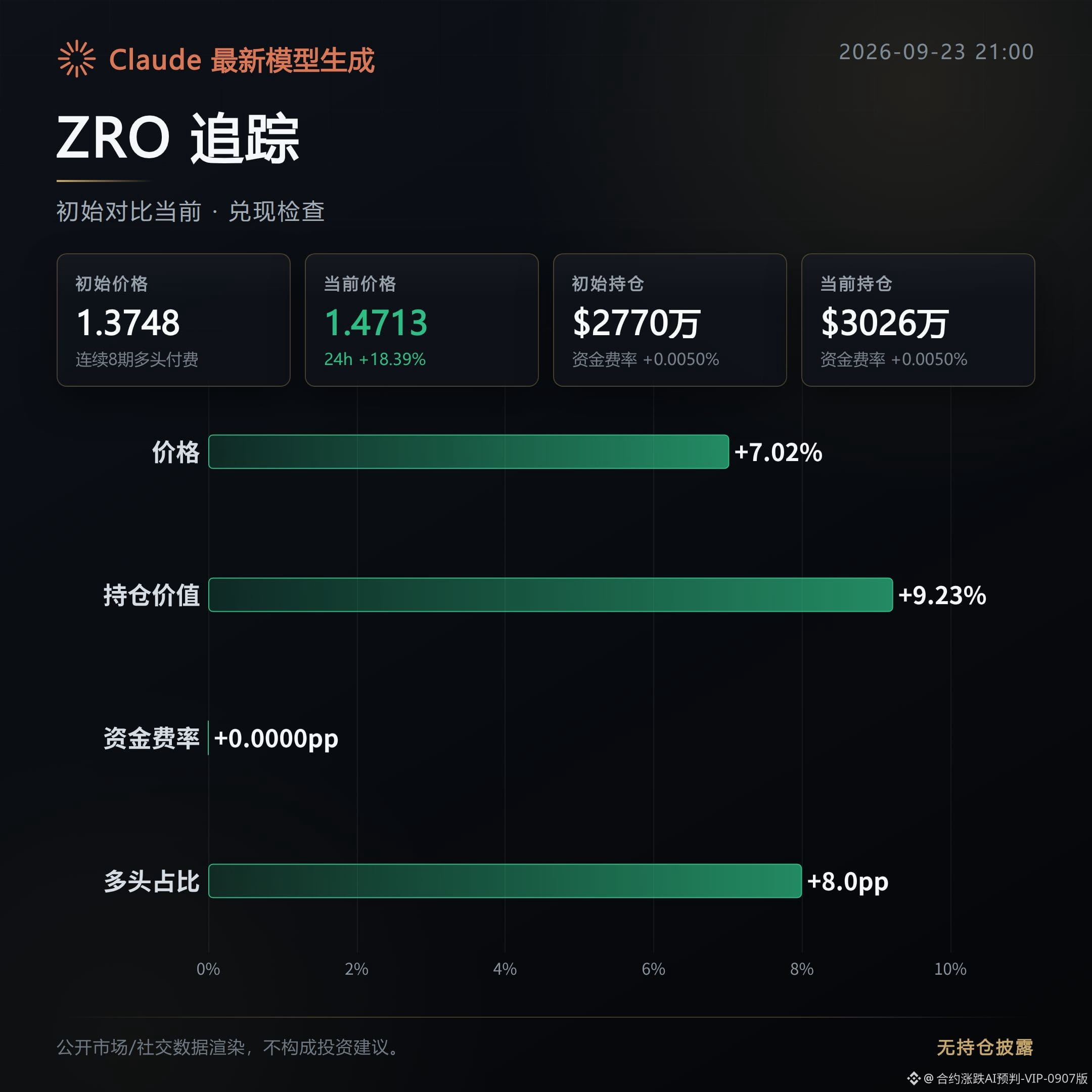
1
894
This morning, top 3 on the 24-hour gainers list—now it’s time to settle the accounts.
MUBARAK has stalled.
At launch, the price surge once reached 68.34%. Now, the price has fallen from 0.07565 to 0.05833, down 22.89%. Open interest has dropped from $39.37 million to $27.14 million, and the funding rate has also slid from 0.0277% to 0.005%. The momentum from those who chased at the highs is now shifting into a drawdown/realization phase.
FOLKS has stalled as well.
The price fell from 2.867 to 2.429, down 15.28%. Open interest decreased by 21.15%, and the funding rate dropped from 0.1282% to 0.0467%. The strength of the active buy-side has also clearly weakened—the “gainers list” halo fades pretty quickly.
Of the three, BCH is the only one still continuing.
The price has risen from 342.83 to 359.7, pushing higher another 4.92%. Open interest is moving up in sync, increasing by 5.74%. The 24-hour gain is now 32.54%, and the current price’s relative strength indicator is already at 75.5—sitting in a somewhat overheated zone.
Keep an eye on whether, for BCH, the open interest and buying pressure cool off together. Once it turns around like MUBARAK and FOLKS, the risk of chasing at the highs will become apparent—drawdowns have already played out once on the first two.
#合约 #BCH
Assisted by Claude Fable 5 in compiling the contract data for informational reference only—please verify independently.
This morning, top 3 on the 24-hour gainers list—now it’s time to settle the accounts.
MUBARAK has stalled.
At launch, the price surge once reached 68.34%. Now, the price has fallen from 0.07565 to 0.05833, down 22.89%. Open interest has dropped from $39.37 million to $27.14 million, and the funding rate has also slid from 0.0277% to 0.005%. The momentum from those who chased at the highs is now shifting into a drawdown/realization phase.
FOLKS has stalled as well.
The price fell from 2.867 to 2.429, down 15.28%. Open interest decreased by 21.15%, and the funding rate dropped from 0.1282% to 0.0467%. The strength of the active buy-side has also clearly weakened—the “gainers list” halo fades pretty quickly.
Of the three, BCH is the only one still continuing.
The price has risen from 342.83 to 359.7, pushing higher another 4.92%. Open interest is moving up in sync, increasing by 5.74%. The 24-hour gain is now 32.54%, and the current price’s relative strength indicator is already at 75.5—sitting in a somewhat overheated zone.
Keep an eye on whether, for BCH, the open interest and buying pressure cool off together. Once it turns around like MUBARAK and FOLKS, the risk of chasing at the highs will become apparent—drawdowns have already played out once on the first two.
#合约 #BCH
Assisted by Claude Fable 5 in compiling the contract data for informational reference only—please verify independently.
MUBARAK has stalled.
At launch, the price surge once reached 68.34%. Now, the price has fallen from 0.07565 to 0.05833, down 22.89%. Open interest has dropped from $39.37 million to $27.14 million, and the funding rate has also slid from 0.0277% to 0.005%. The momentum from those who chased at the highs is now shifting into a drawdown/realization phase.
FOLKS has stalled as well.
The price fell from 2.867 to 2.429, down 15.28%. Open interest decreased by 21.15%, and the funding rate dropped from 0.1282% to 0.0467%. The strength of the active buy-side has also clearly weakened—the “gainers list” halo fades pretty quickly.
Of the three, BCH is the only one still continuing.
The price has risen from 342.83 to 359.7, pushing higher another 4.92%. Open interest is moving up in sync, increasing by 5.74%. The 24-hour gain is now 32.54%, and the current price’s relative strength indicator is already at 75.5—sitting in a somewhat overheated zone.
Keep an eye on whether, for BCH, the open interest and buying pressure cool off together. Once it turns around like MUBARAK and FOLKS, the risk of chasing at the highs will become apparent—drawdowns have already played out once on the first two.
#合约 #BCH
Assisted by Claude Fable 5 in compiling the contract data for informational reference only—please verify independently.
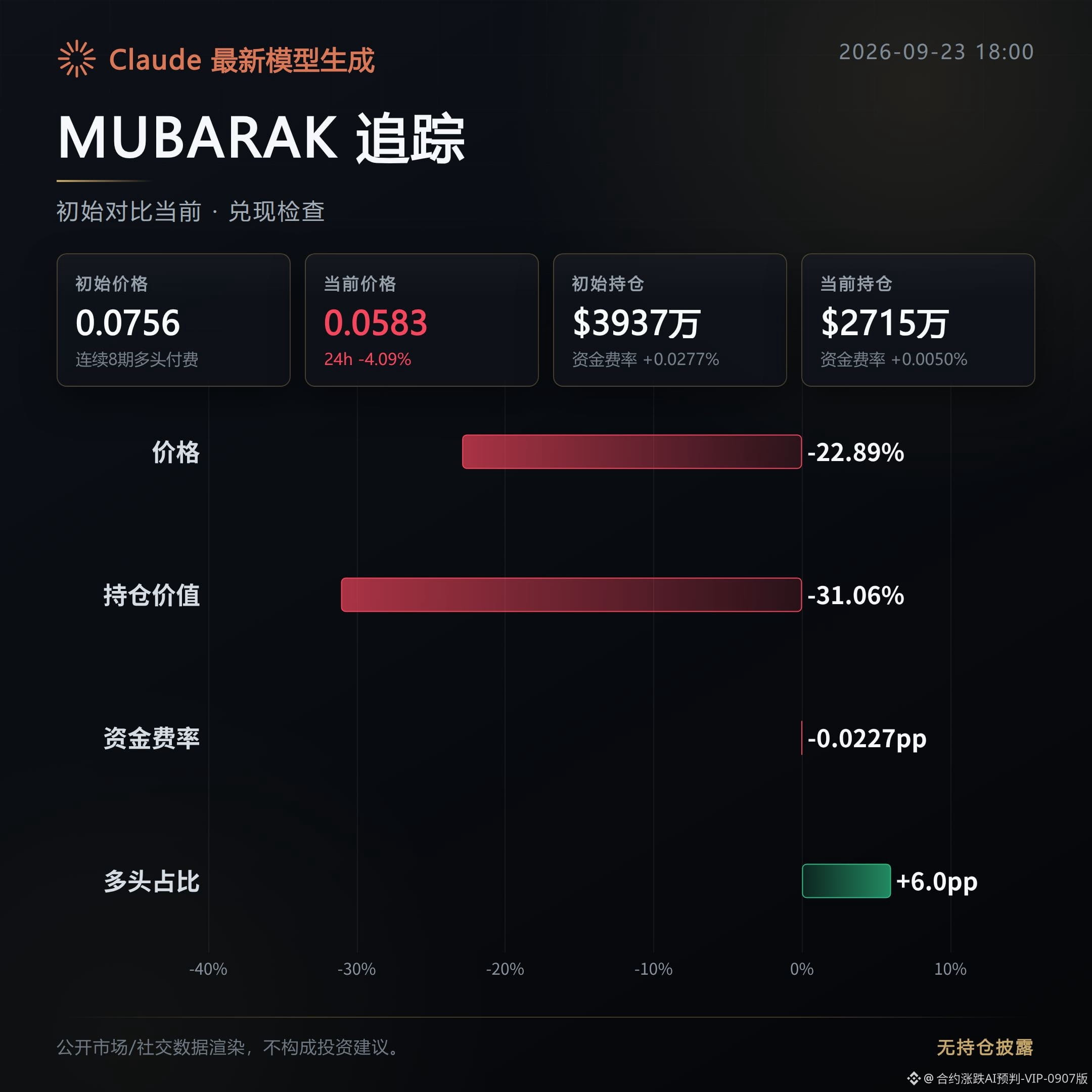
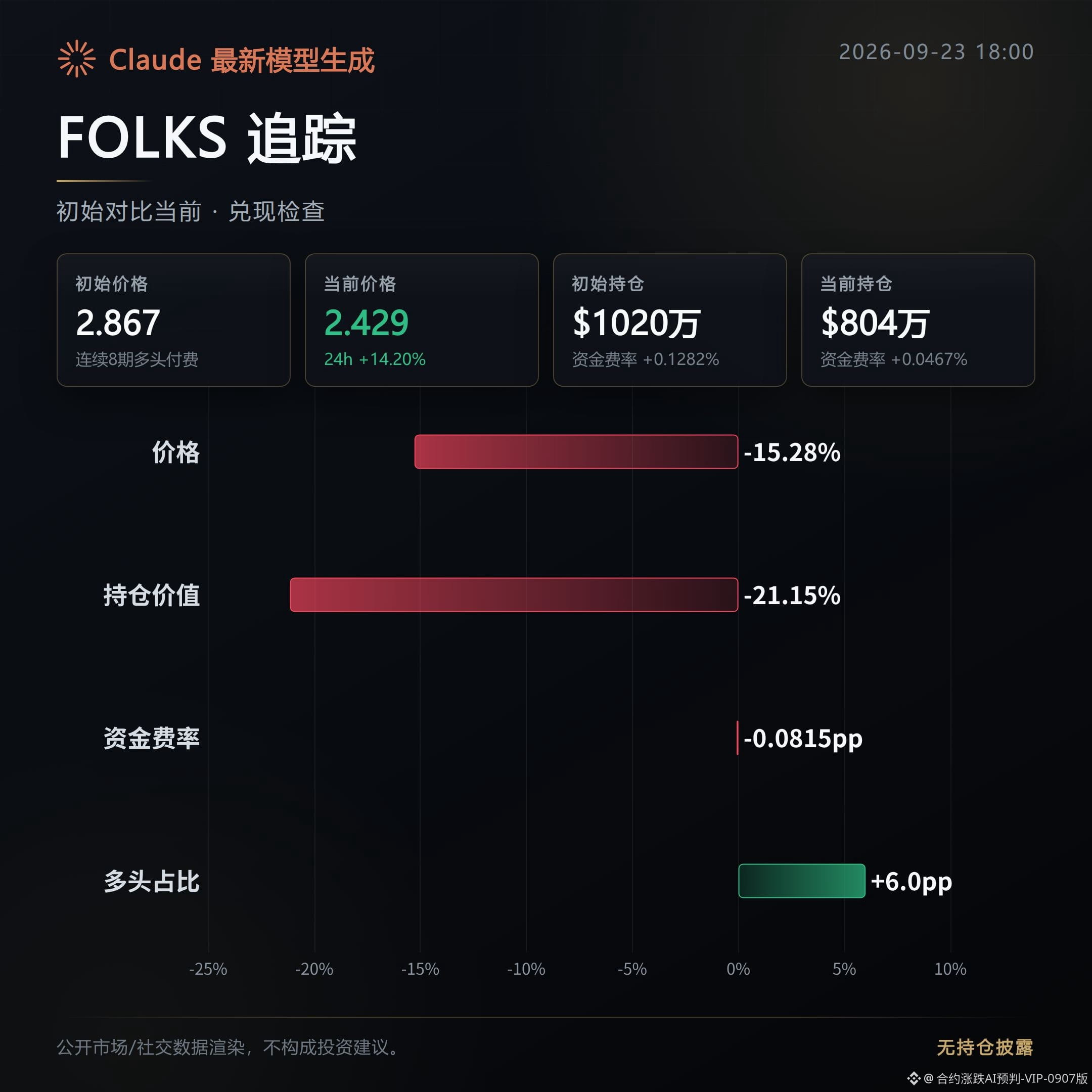
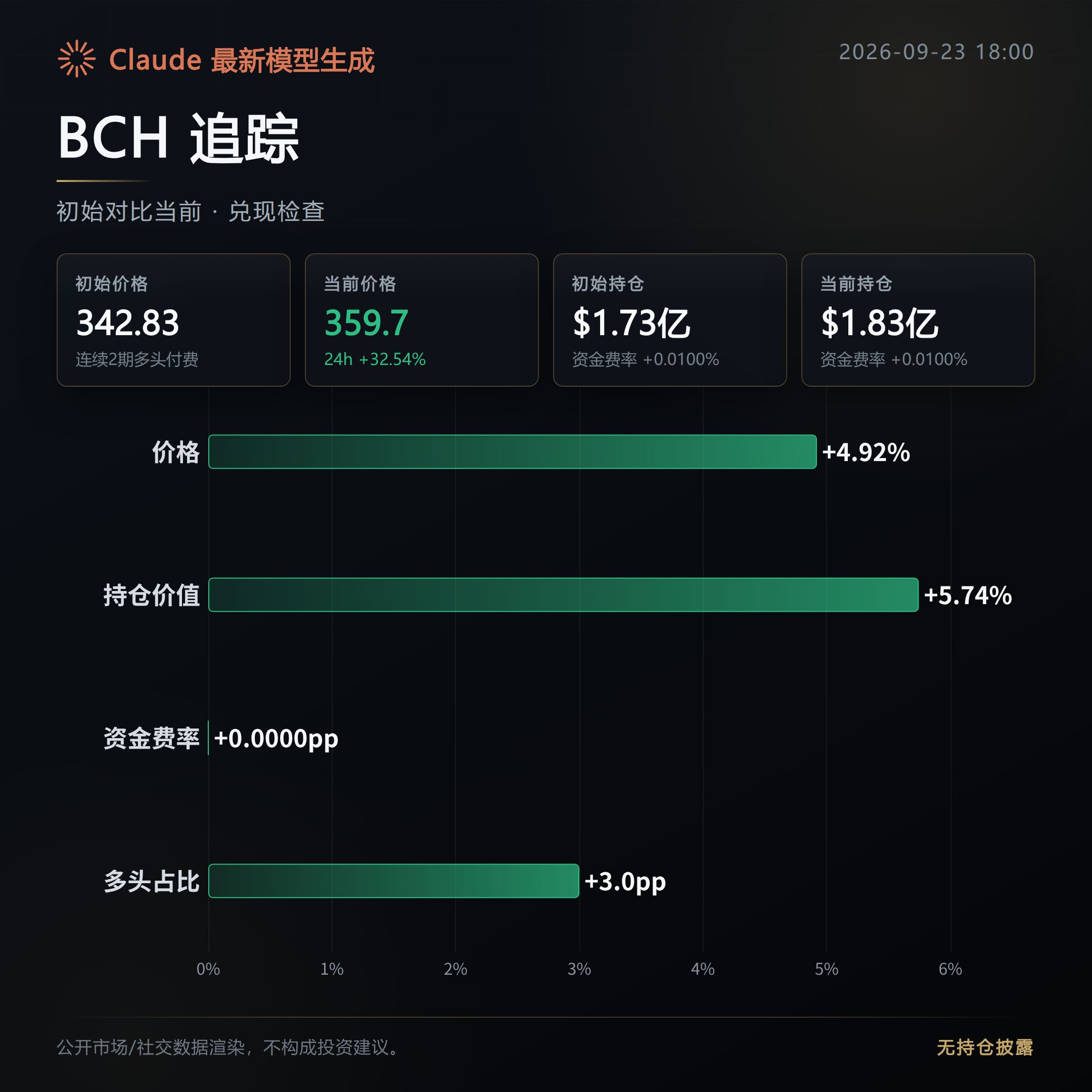
2
1.1k
This is a replay of that set of bearish alerts from about 6 hours ago, the “high-level distribution observation.”
Of the three contracts issued in the morning alert, none has broken into a one-way downside move: two are still in a tug-of-war, and one instead pulled back upward.
The basis for the initial call was that the chips were scattered.
BABY: Choppy/tug-of-war. The morning bearish alert still hasn’t played out.
After the initial launch, the price rose only 0.53% and did not break into a downward trend.
The strength of the aggressive buy orders dropped from 1.13 to 0.94—follow-through willingness is weakening—but the price is still holding up. Bulls and bears are still in the midst of a struggle.
PYTH: Choppy/tug-of-war, the closest in this group to showing weakness, but it hasn’t yet been confirmed as a one-way down move.
After the initial launch, the price fell 1.77%, and open interest fell in sync by 5.29%. The two directions match, making it the one that most resembles an ongoing move.
However, aggressive buy orders only dropped from 1.19 to 0.89—the decline isn’t steep. Whether it will truly break down next hasn’t been established yet.
ARB: A rebound—the one that was most clearly “slapped in the face” by the morning bearish alert.
After the initial launch, instead of falling, the price surged 6.07%, and the rise/fall percentage widened by another 8.53 percentage points compared with the initial move.
Open interest increased in sync by 4.29%, while trading volume expanded by 43.13%. The price strengthening has confirmation from both position (open interest) and volume, not just an emotional spike.
This morning’s bearish alert for this set still hasn’t been fulfilled. Next, the key to watch is whether support/follow-through will truly thin out.
For BABY and PYTH, watch whether aggressive buy orders continue to retreat, and whether open interest can move down along with price. Only when both signals weaken in sync can the pullback be confirmed.
ARB’s technical indicators currently lean toward the overbought zone, and open interest is still rising with the price. If this combination continues to strengthen, the morning bearish judgment will need to be revisited.
#BABY #PYTH #ARB # Contract replay
This content is generated with the assistance of Claude Fable 5 and is for reference only. Please verify it yourself.
This is a replay of that set of bearish alerts from about 6 hours ago, the “high-level distribution observation.”
Of the three contracts issued in the morning alert, none has broken into a one-way downside move: two are still in a tug-of-war, and one instead pulled back upward.
The basis for the initial call was that the chips were scattered.
BABY: Choppy/tug-of-war. The morning bearish alert still hasn’t played out.
After the initial launch, the price rose only 0.53% and did not break into a downward trend.
The strength of the aggressive buy orders dropped from 1.13 to 0.94—follow-through willingness is weakening—but the price is still holding up. Bulls and bears are still in the midst of a struggle.
PYTH: Choppy/tug-of-war, the closest in this group to showing weakness, but it hasn’t yet been confirmed as a one-way down move.
After the initial launch, the price fell 1.77%, and open interest fell in sync by 5.29%. The two directions match, making it the one that most resembles an ongoing move.
However, aggressive buy orders only dropped from 1.19 to 0.89—the decline isn’t steep. Whether it will truly break down next hasn’t been established yet.
ARB: A rebound—the one that was most clearly “slapped in the face” by the morning bearish alert.
After the initial launch, instead of falling, the price surged 6.07%, and the rise/fall percentage widened by another 8.53 percentage points compared with the initial move.
Open interest increased in sync by 4.29%, while trading volume expanded by 43.13%. The price strengthening has confirmation from both position (open interest) and volume, not just an emotional spike.
This morning’s bearish alert for this set still hasn’t been fulfilled. Next, the key to watch is whether support/follow-through will truly thin out.
For BABY and PYTH, watch whether aggressive buy orders continue to retreat, and whether open interest can move down along with price. Only when both signals weaken in sync can the pullback be confirmed.
ARB’s technical indicators currently lean toward the overbought zone, and open interest is still rising with the price. If this combination continues to strengthen, the morning bearish judgment will need to be revisited.
#BABY #PYTH #ARB # Contract replay
This content is generated with the assistance of Claude Fable 5 and is for reference only. Please verify it yourself.
Of the three contracts issued in the morning alert, none has broken into a one-way downside move: two are still in a tug-of-war, and one instead pulled back upward.
The basis for the initial call was that the chips were scattered.
BABY: Choppy/tug-of-war. The morning bearish alert still hasn’t played out.
After the initial launch, the price rose only 0.53% and did not break into a downward trend.
The strength of the aggressive buy orders dropped from 1.13 to 0.94—follow-through willingness is weakening—but the price is still holding up. Bulls and bears are still in the midst of a struggle.
PYTH: Choppy/tug-of-war, the closest in this group to showing weakness, but it hasn’t yet been confirmed as a one-way down move.
After the initial launch, the price fell 1.77%, and open interest fell in sync by 5.29%. The two directions match, making it the one that most resembles an ongoing move.
However, aggressive buy orders only dropped from 1.19 to 0.89—the decline isn’t steep. Whether it will truly break down next hasn’t been established yet.
ARB: A rebound—the one that was most clearly “slapped in the face” by the morning bearish alert.
After the initial launch, instead of falling, the price surged 6.07%, and the rise/fall percentage widened by another 8.53 percentage points compared with the initial move.
Open interest increased in sync by 4.29%, while trading volume expanded by 43.13%. The price strengthening has confirmation from both position (open interest) and volume, not just an emotional spike.
This morning’s bearish alert for this set still hasn’t been fulfilled. Next, the key to watch is whether support/follow-through will truly thin out.
For BABY and PYTH, watch whether aggressive buy orders continue to retreat, and whether open interest can move down along with price. Only when both signals weaken in sync can the pullback be confirmed.
ARB’s technical indicators currently lean toward the overbought zone, and open interest is still rising with the price. If this combination continues to strengthen, the morning bearish judgment will need to be revisited.
#BABY #PYTH #ARB # Contract replay
This content is generated with the assistance of Claude Fable 5 and is for reference only. Please verify it yourself.
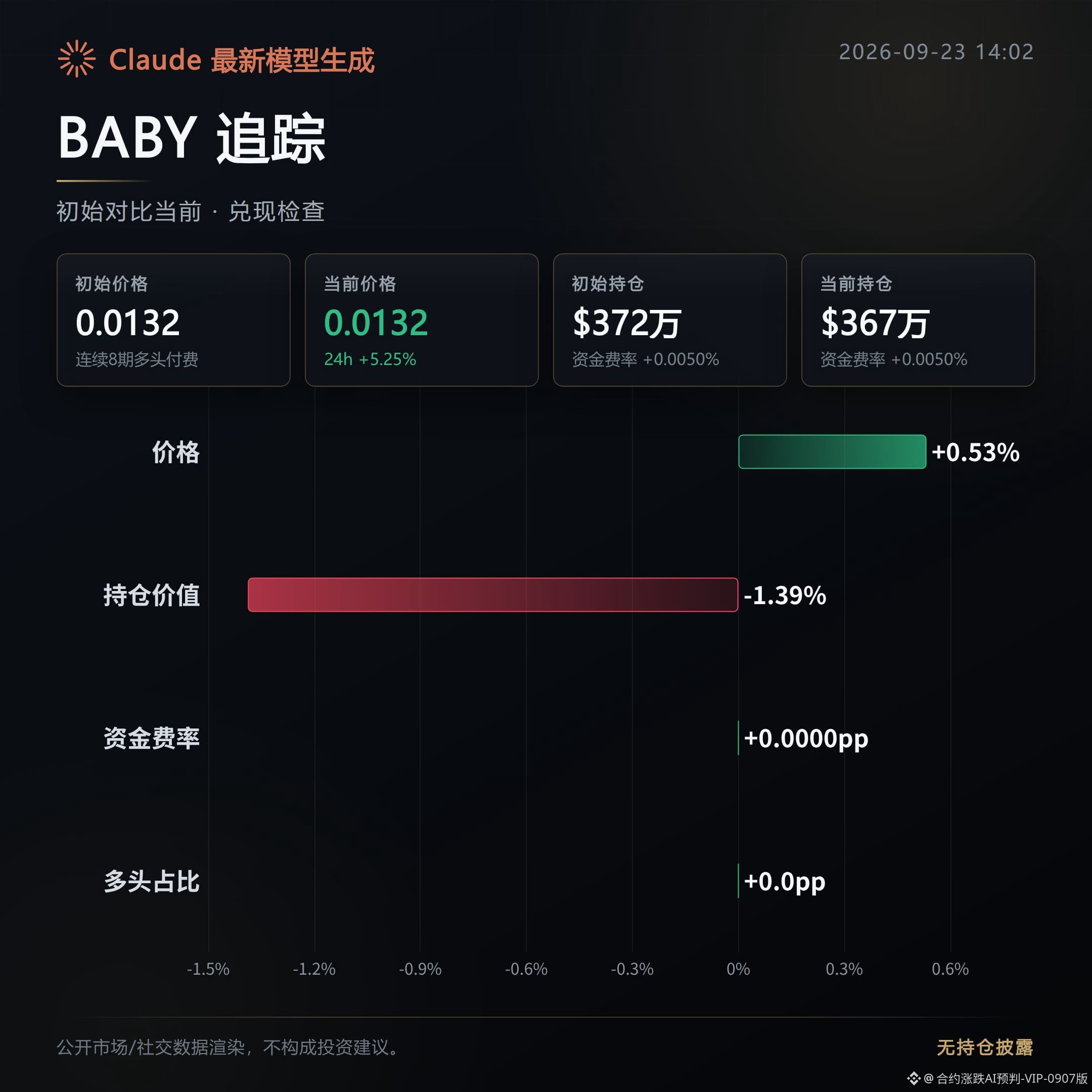
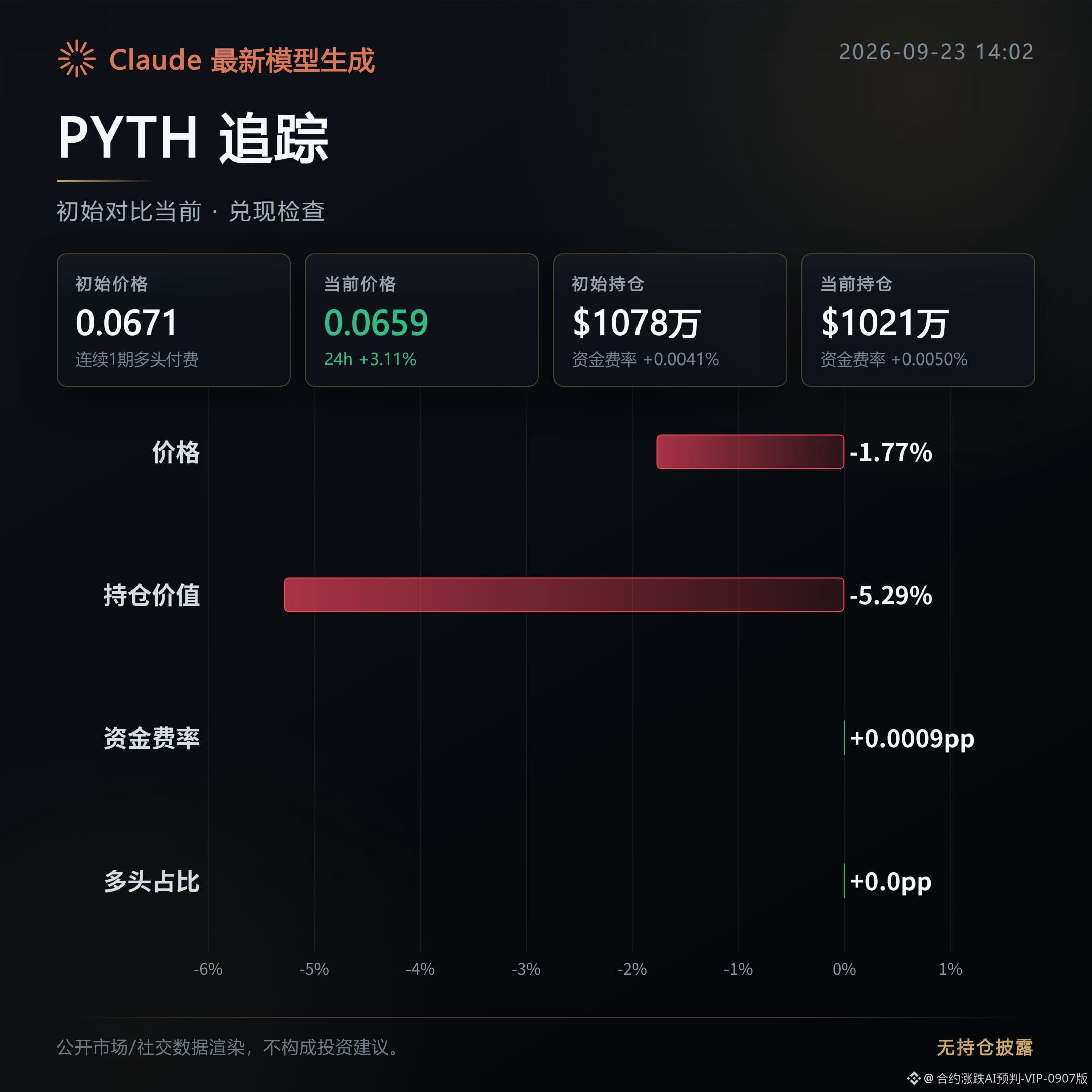
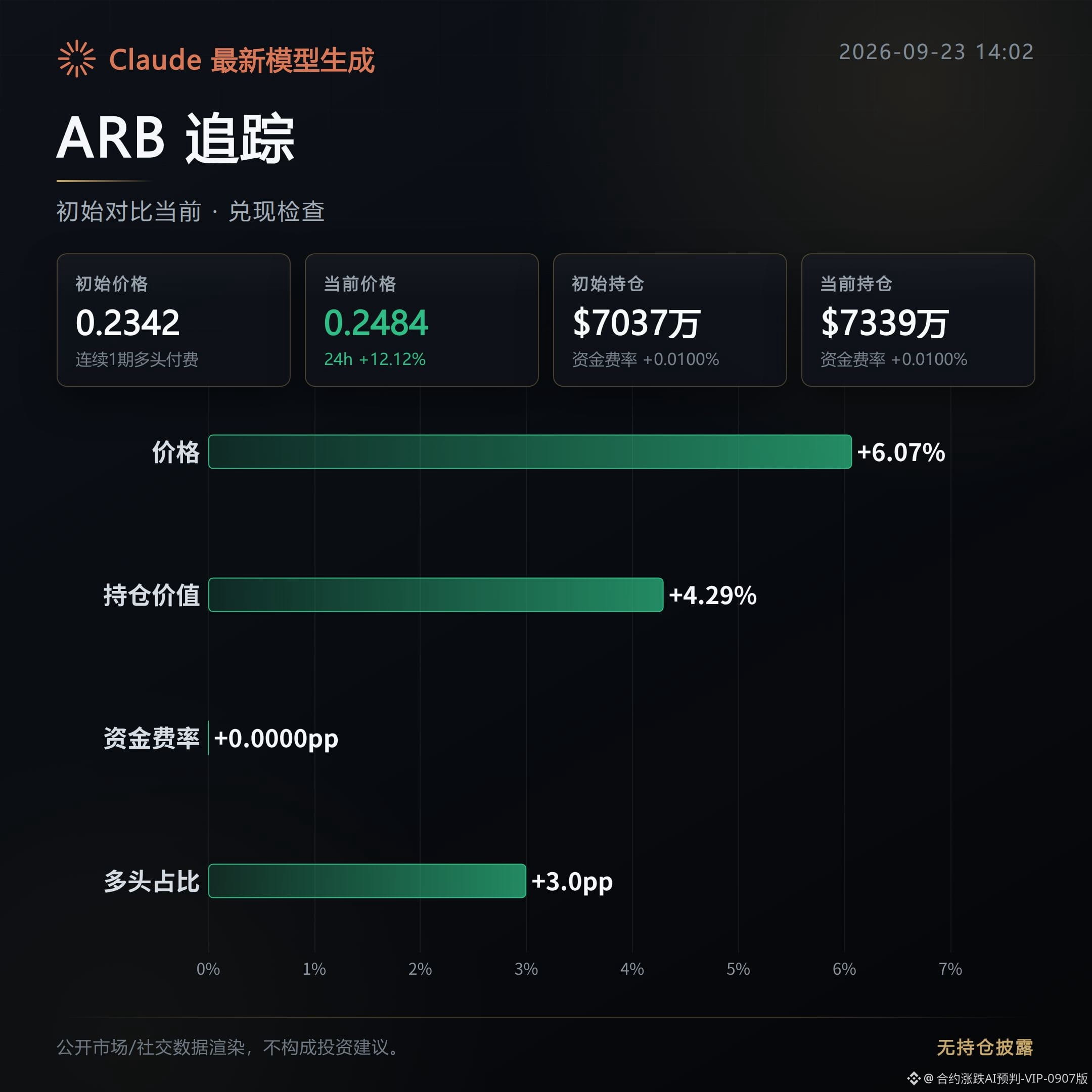
1
499
About 5 hours ago, in the morning bullish watch—i.e., that pull-watch group—now it’s time to reconcile.
Back then, the initial watch recap was that the chips were getting collected.
Among the three targets, ZRO pushed out, while KERNEL and MUBARAK didn’t catch.
KERNEL: Cooling off—the morning bullish momentum is fading.
The 24-hour price change slipped from 20.48% at the initial watch down to -9.4% now; the gains have basically been erased.
Open interest also fell from $4.62M to $4.13M, down 10.64%, and the heat of new positions hasn’t kept up.
MUBARAK: Power cut—morning bullishness didn’t break through.
After the initial price, it pulled back by 8.16%, dropping from 0.07477 to 0.06867, with the direction already going opposite to the morning assessment.
Open interest fell in sync by 8.44%, and the desire to chase longs didn’t keep up.
ZRO: Taking profits—the morning bullish line has finally played out.
After the initial push, price continued higher by 3.73%, rising from 1.3748 to 1.4261; the 24-hour price change also expanded from 15.81% to 21.82%.
Open interest increased by 7.32% in sync, and trading volume jumped 17.35%—the longs are genuinely adding.
Next, focus mainly on whether ZRO’s open interest and trading volume can continue to rise along with the price gains. If the gains expand but open interest turns downward, then it’s time to reassess whether this move might be near a top.
For KERNEL and MUBARAK, the focus is on whether price can reclaim the area around the initial price, and whether open interest can stop falling and rebound—these are the counter-evidence conditions for whether the morning bullish logic can be re-established.
$KERNEL $MUBARAK $ZRO #Contract recap
This content is generated with assistance from Claude Fable 5 and is for informational reference only. Please verify it yourself.
About 5 hours ago, in the morning bullish watch—i.e., that pull-watch group—now it’s time to reconcile.
Back then, the initial watch recap was that the chips were getting collected.
Among the three targets, ZRO pushed out, while KERNEL and MUBARAK didn’t catch.
KERNEL: Cooling off—the morning bullish momentum is fading.
The 24-hour price change slipped from 20.48% at the initial watch down to -9.4% now; the gains have basically been erased.
Open interest also fell from $4.62M to $4.13M, down 10.64%, and the heat of new positions hasn’t kept up.
MUBARAK: Power cut—morning bullishness didn’t break through.
After the initial price, it pulled back by 8.16%, dropping from 0.07477 to 0.06867, with the direction already going opposite to the morning assessment.
Open interest fell in sync by 8.44%, and the desire to chase longs didn’t keep up.
ZRO: Taking profits—the morning bullish line has finally played out.
After the initial push, price continued higher by 3.73%, rising from 1.3748 to 1.4261; the 24-hour price change also expanded from 15.81% to 21.82%.
Open interest increased by 7.32% in sync, and trading volume jumped 17.35%—the longs are genuinely adding.
Next, focus mainly on whether ZRO’s open interest and trading volume can continue to rise along with the price gains. If the gains expand but open interest turns downward, then it’s time to reassess whether this move might be near a top.
For KERNEL and MUBARAK, the focus is on whether price can reclaim the area around the initial price, and whether open interest can stop falling and rebound—these are the counter-evidence conditions for whether the morning bullish logic can be re-established.
$KERNEL $MUBARAK $ZRO #Contract recap
This content is generated with assistance from Claude Fable 5 and is for informational reference only. Please verify it yourself.
Back then, the initial watch recap was that the chips were getting collected.
Among the three targets, ZRO pushed out, while KERNEL and MUBARAK didn’t catch.
KERNEL: Cooling off—the morning bullish momentum is fading.
The 24-hour price change slipped from 20.48% at the initial watch down to -9.4% now; the gains have basically been erased.
Open interest also fell from $4.62M to $4.13M, down 10.64%, and the heat of new positions hasn’t kept up.
MUBARAK: Power cut—morning bullishness didn’t break through.
After the initial price, it pulled back by 8.16%, dropping from 0.07477 to 0.06867, with the direction already going opposite to the morning assessment.
Open interest fell in sync by 8.44%, and the desire to chase longs didn’t keep up.
ZRO: Taking profits—the morning bullish line has finally played out.
After the initial push, price continued higher by 3.73%, rising from 1.3748 to 1.4261; the 24-hour price change also expanded from 15.81% to 21.82%.
Open interest increased by 7.32% in sync, and trading volume jumped 17.35%—the longs are genuinely adding.
Next, focus mainly on whether ZRO’s open interest and trading volume can continue to rise along with the price gains. If the gains expand but open interest turns downward, then it’s time to reassess whether this move might be near a top.
For KERNEL and MUBARAK, the focus is on whether price can reclaim the area around the initial price, and whether open interest can stop falling and rebound—these are the counter-evidence conditions for whether the morning bullish logic can be re-established.
$KERNEL $MUBARAK $ZRO #Contract recap
This content is generated with assistance from Claude Fable 5 and is for informational reference only. Please verify it yourself.
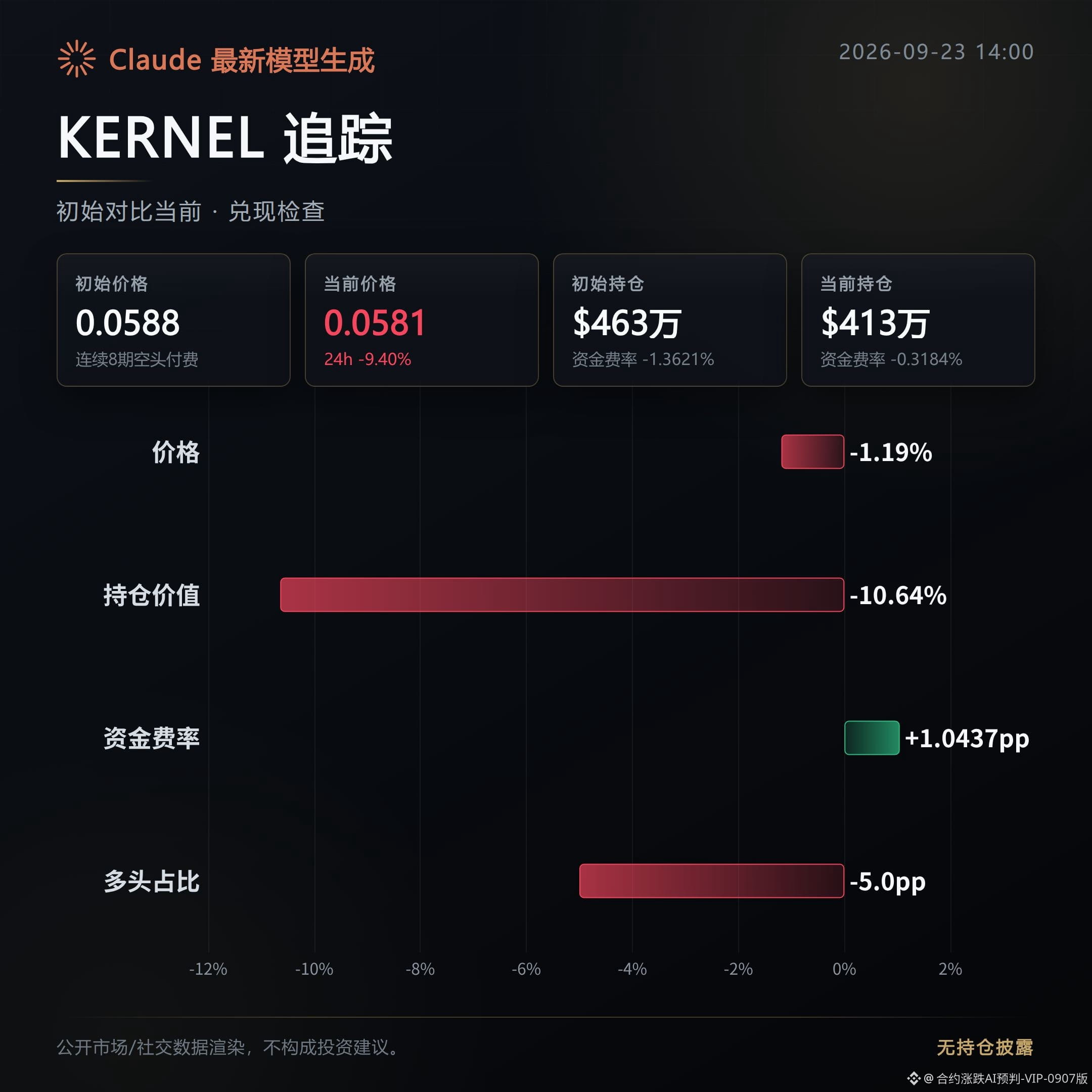
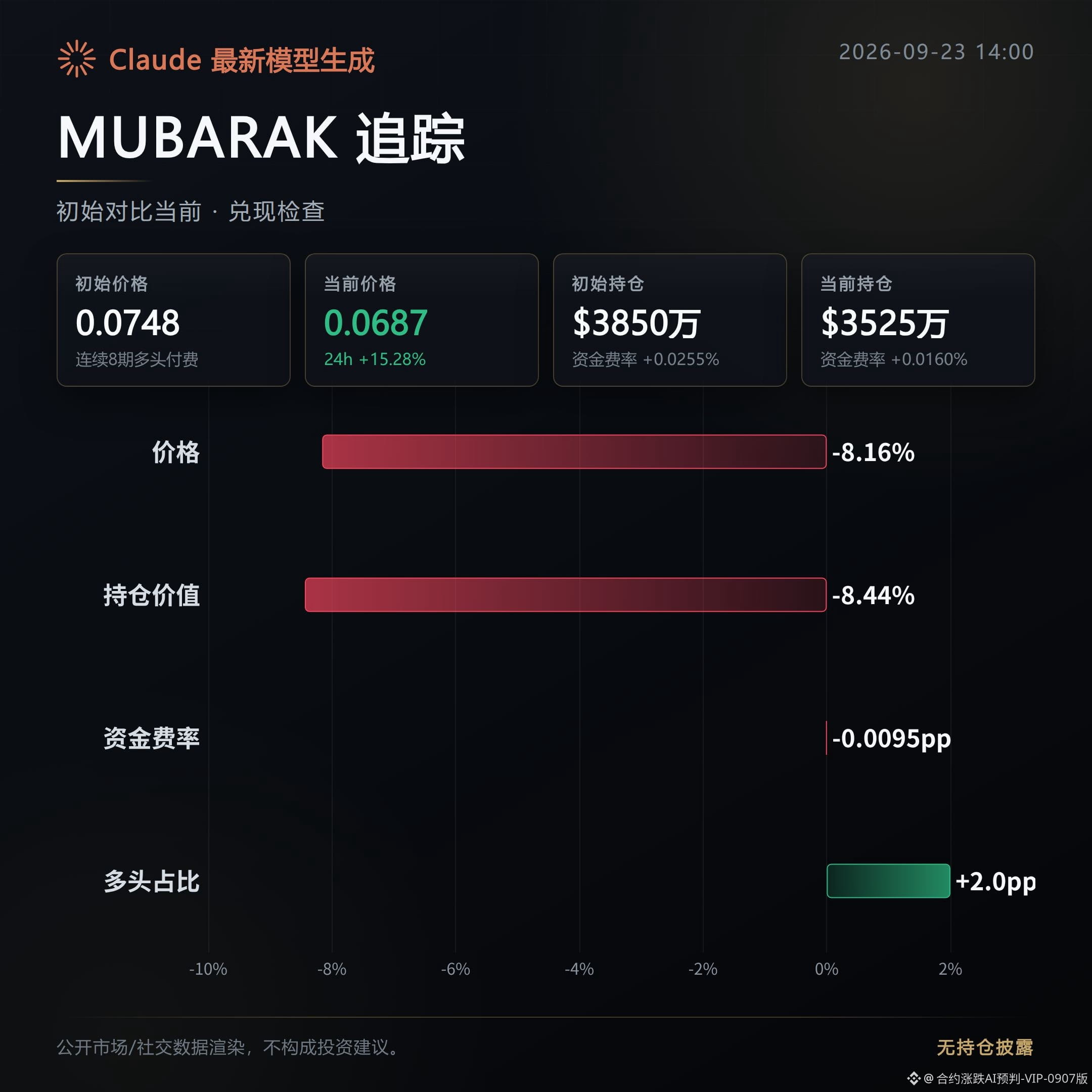
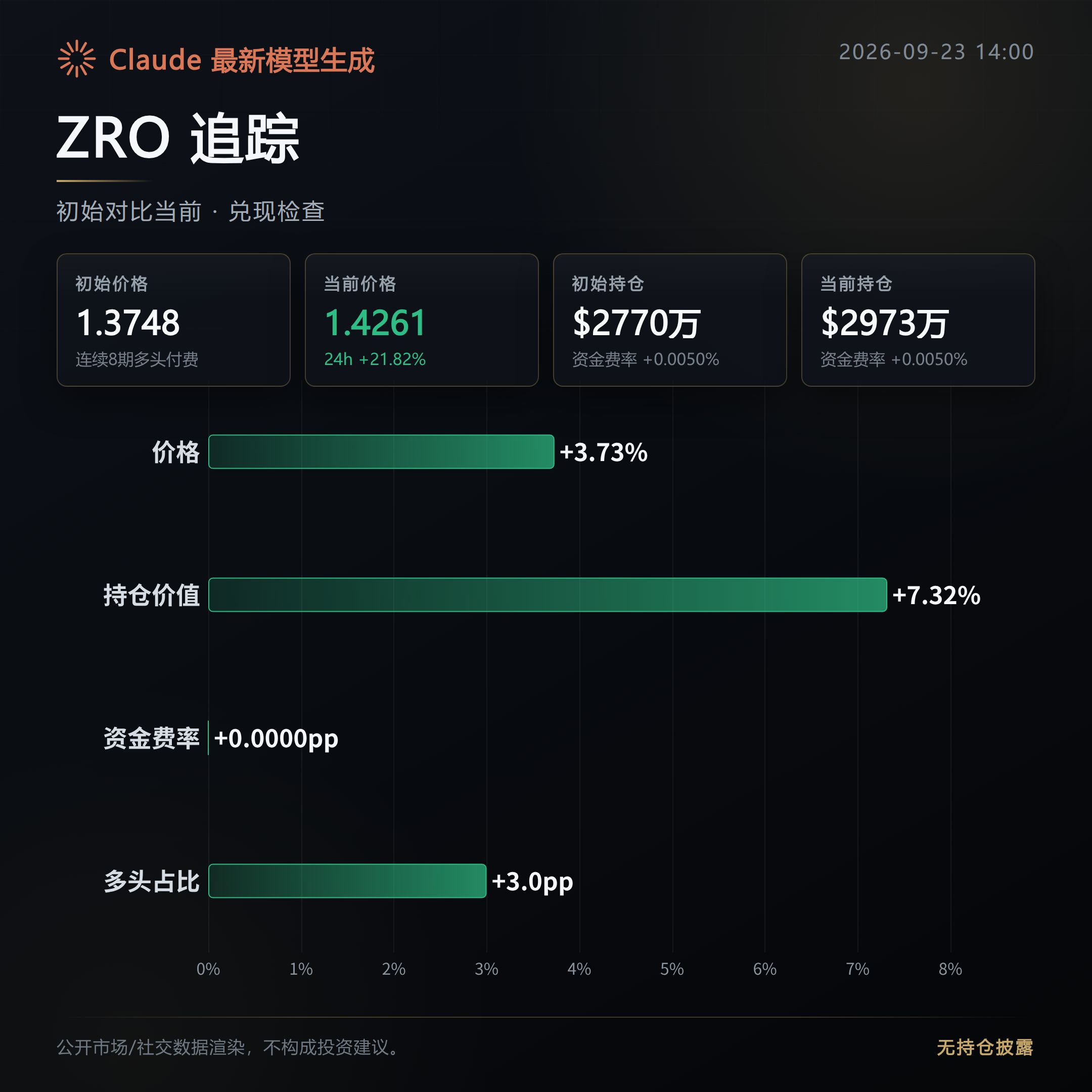
515
Log in to explore more content
Join global crypto users on Binance Square
⚡️ Get latest and useful information about crypto.
💬 Trusted by the world’s largest crypto exchange.
👍 Discover real insights from verified creators.
Email / Phone number