
ICWT
872 Posts

ICWT
Report
Block User
You’re locked in with me now.
Frequent Trader
6.3 Years
15 Following
780 Followers
5.5K+ Liked
Posts
All
Quotes
Videos
Live
·
--
Bearish
I don’t really like this timing ao I think I’m hoing out soon
I don’t really like this timing ao I think I’m hoing out soon
90
·
--
Bearish
320
·
--
Bearish
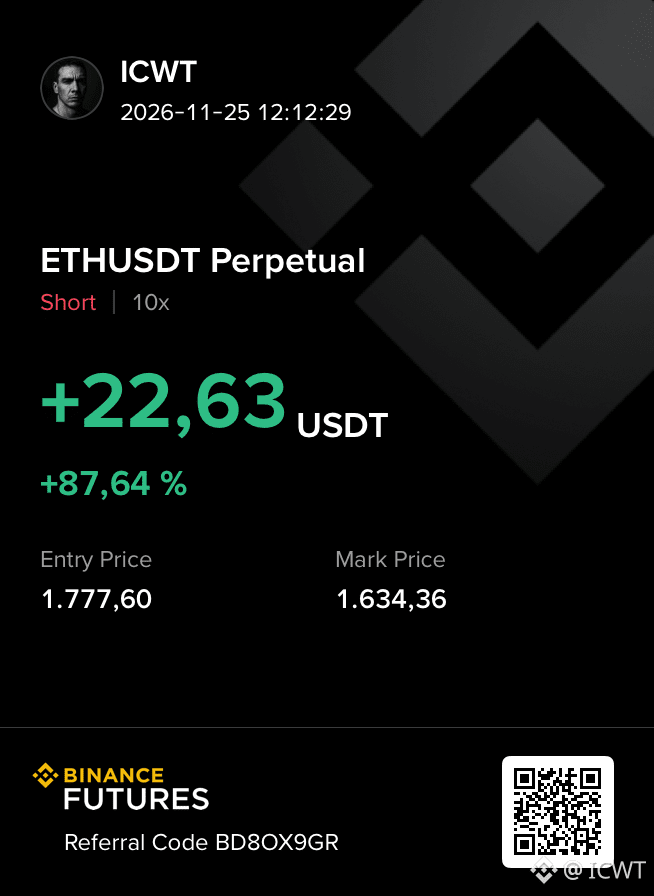
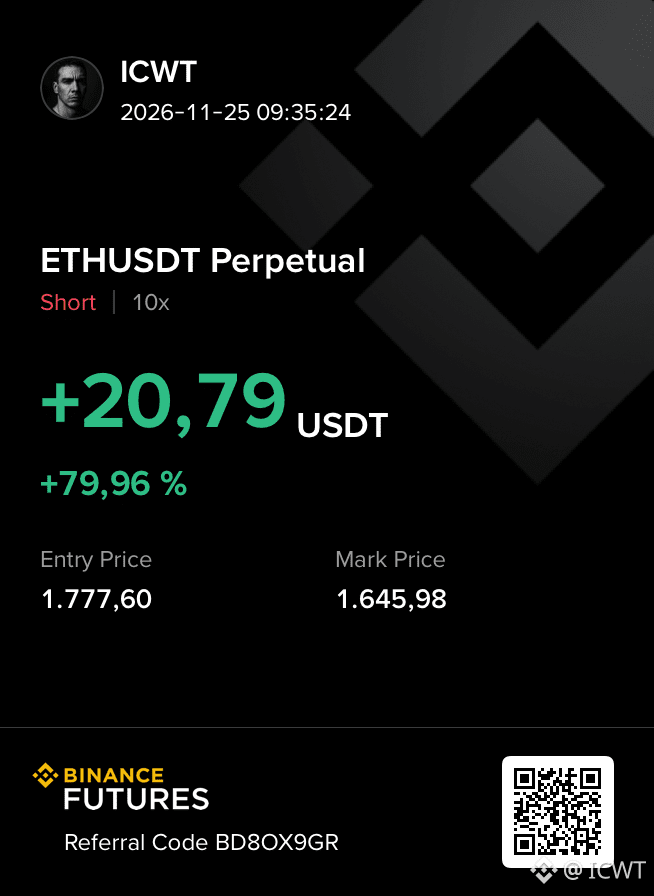
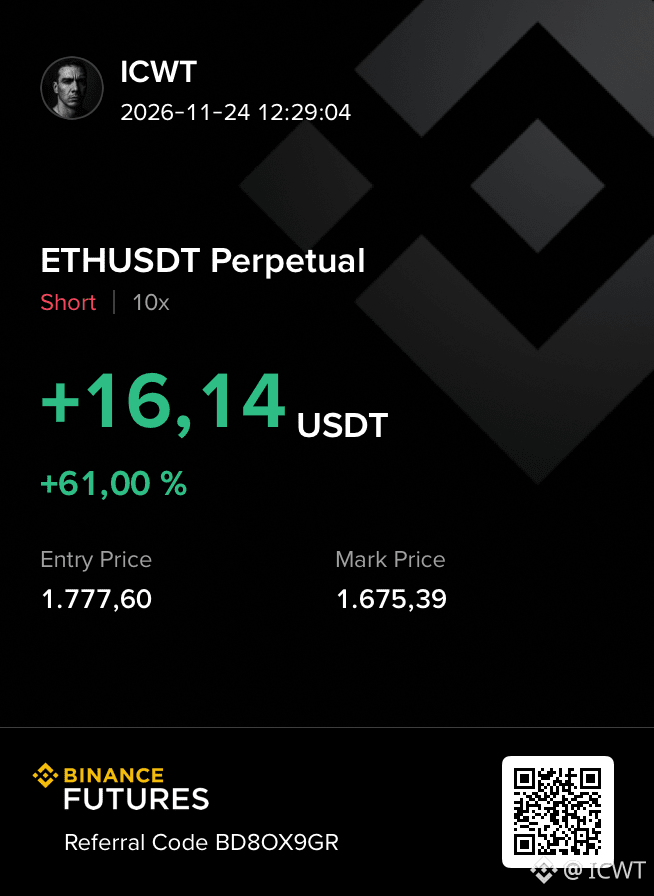
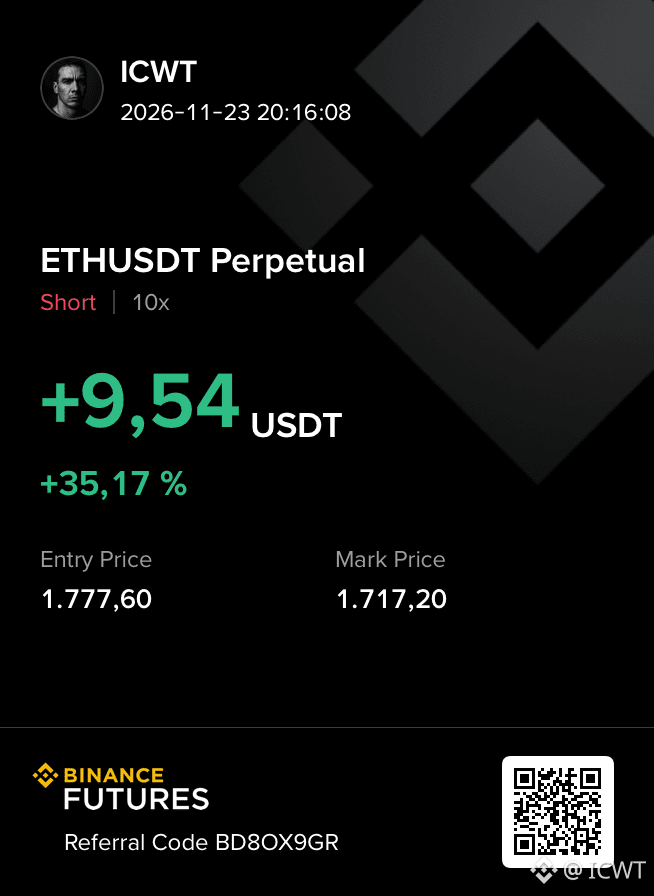
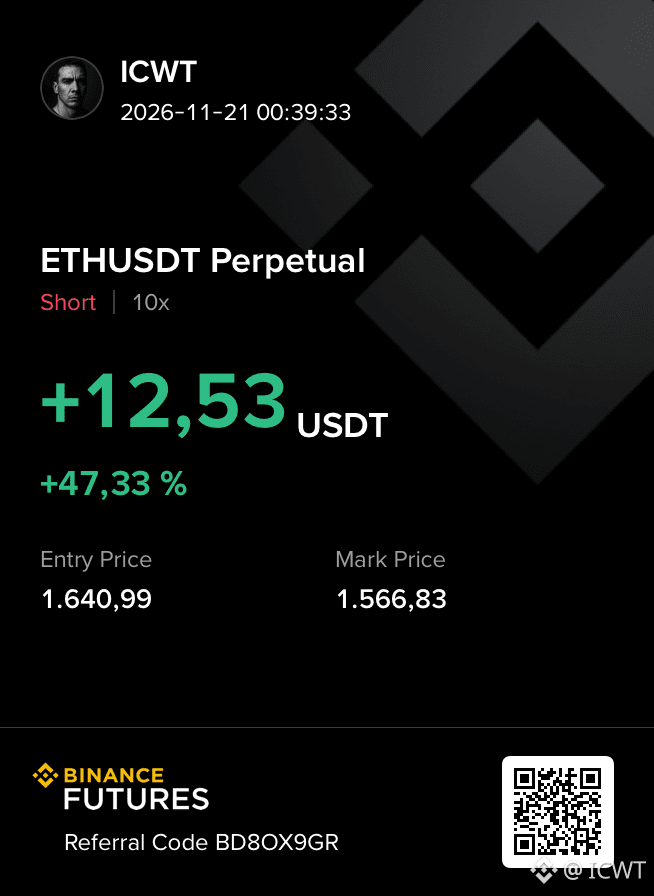
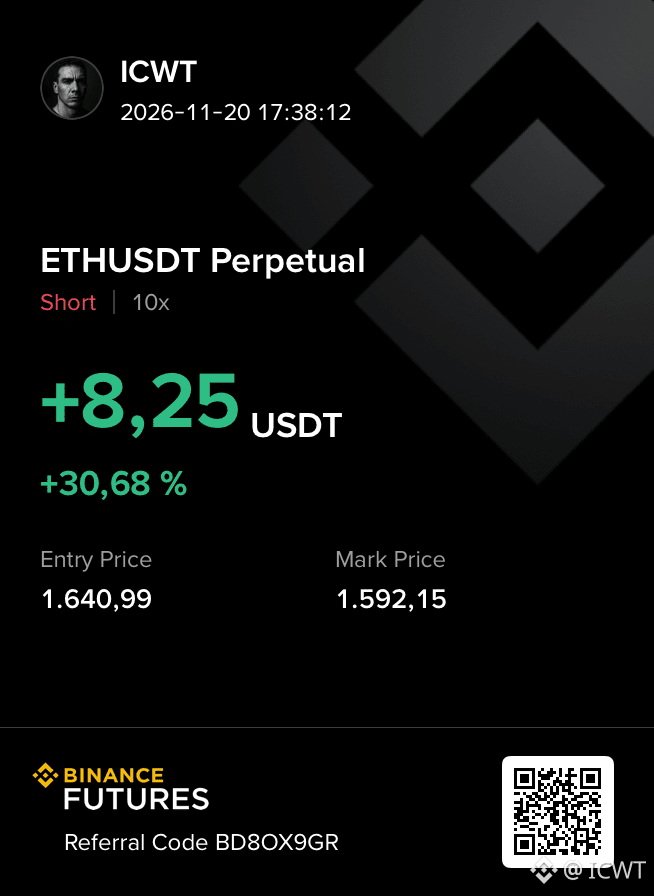
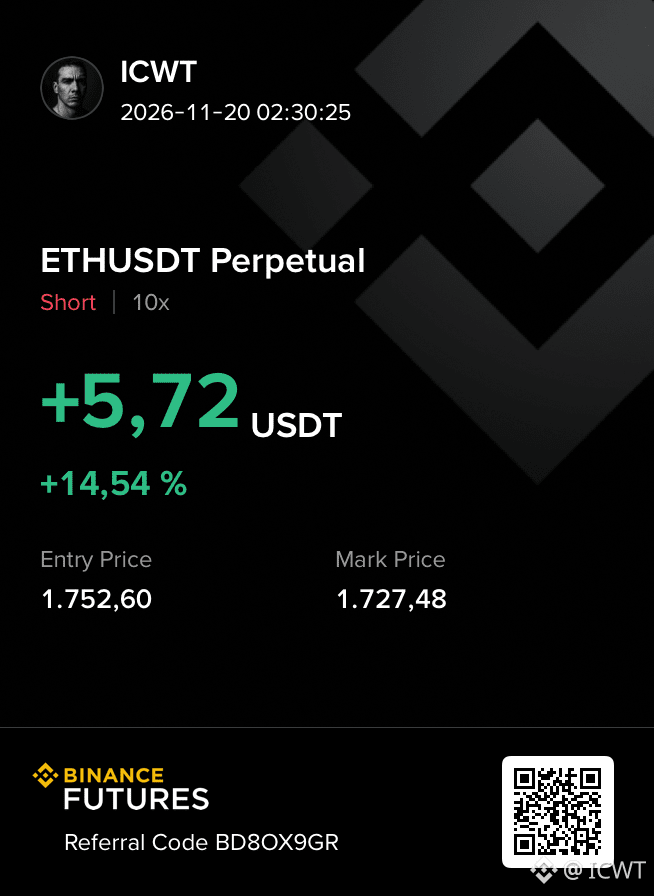
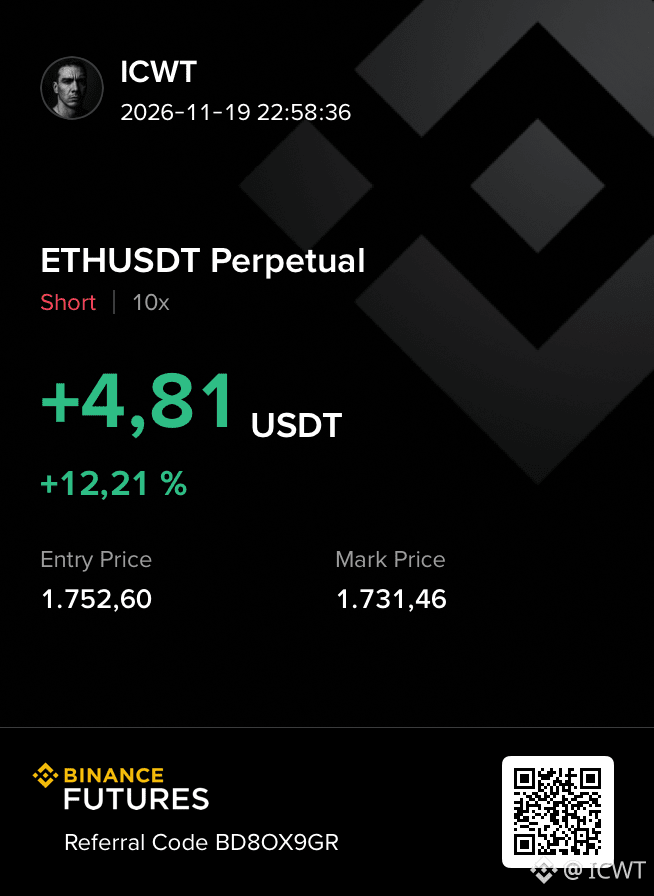
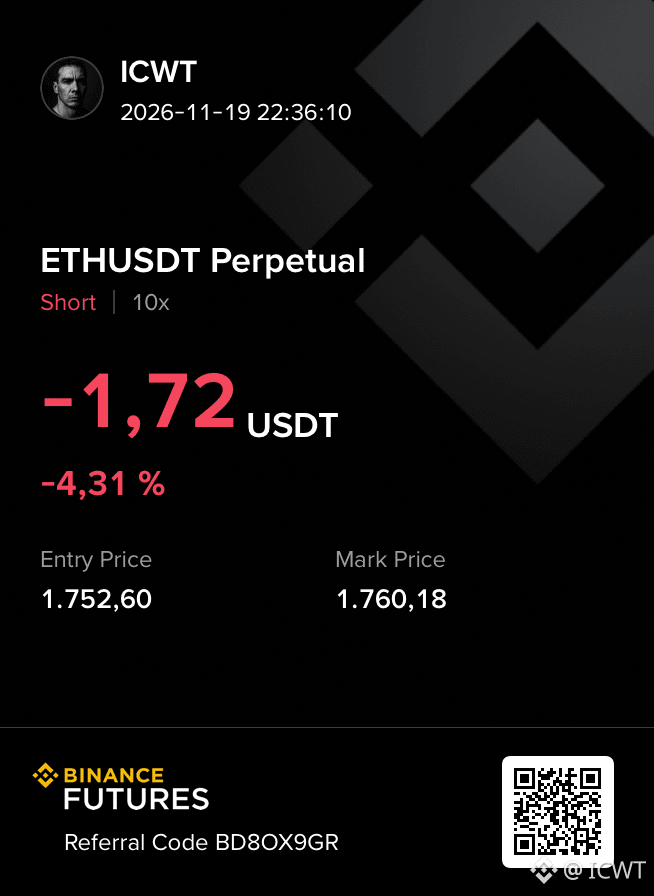
I'm already in bed because I'm falling asleep, but I'll wait until Tokyo to see what happens. $ETH
I'm already in bed because I'm falling asleep, but I'll wait until Tokyo to see what happens. $ETH
115
·
--
We’re going to tokenize real estate in a land development in Córdoba, Argentina.
Potrero de Garay. 1,000 m² per lot.
Roads are being opened, and streetlights have been purchased.
5 minutes from the lake.
We’re going to tokenize real estate in a land development in Córdoba, Argentina.
Potrero de Garay. 1,000 m² per lot.
Roads are being opened, and streetlights have been purchased.
5 minutes from the lake.
Me interesa!
0%
Mm todavía no
0%
0 votes • Voting closed
100
·
--
Have you ever tried to trade on auto pilot with a bot?
Have you ever tried to trade on auto pilot with a bot?
122
·
--
Are you here for a business and companies podcast? 🎧
Are you here for a business and companies podcast? 🎧

108
·
--
The emergence of Hyperliquid in the derivatives volume is complicating the economics of centralized stablecoins, and it is a fact that it will shake up the liquidity landscape. I’ve been seeing how on-chain protocols are displacing traditional trading because capital efficiency is simply better, and that directly pressures issuers that rely on custodied reserves. This isn’t just a matter of competition—it’s a change in how global liquidity is structured, where participants prefer sovereign execution over the window/counter model. I trade $BTC under the thesis that this shift toward high-performance on-chain protocols is what will sustain volume over the coming months. If we look at the flows, the rotation from traditional models toward native infrastructure is clear. My strategy focuses on maintaining a position in $BTC while the market absorbs this change, with an eye on the $65,000 levels as a key support. If the price breaks below $63,800, the setup is invalidated and I look for re-entry lower down. Key data: Volumes in decentralized derivatives protocols have grown 14% this quarter, surpassing $500 million per day, while the liquidity dominance of the most used stablecoins is facing spread pressure never seen since 2022, according to data from on-chain aggregators.
The emergence of Hyperliquid in the derivatives volume is complicating the economics of centralized stablecoins, and it is a fact that it will shake up the liquidity landscape. I’ve been seeing how on-chain protocols are displacing traditional trading because capital efficiency is simply better, and that directly pressures issuers that rely on custodied reserves. This isn’t just a matter of competition—it’s a change in how global liquidity is structured, where participants prefer sovereign execution over the window/counter model. I trade $BTC under the thesis that this shift toward high-performance on-chain protocols is what will sustain volume over the coming months. If we look at the flows, the rotation from traditional models toward native infrastructure is clear. My strategy focuses on maintaining a position in $BTC while the market absorbs this change, with an eye on the $65,000 levels as a key support. If the price breaks below $63,800, the setup is invalidated and I look for re-entry lower down. Key data: Volumes in decentralized derivatives protocols have grown 14% this quarter, surpassing $500 million per day, while the liquidity dominance of the most used stablecoins is facing spread pressure never seen since 2022, according to data from on-chain aggregators.
32
·
--
The friction between the decentralization of derivatives and the centralization of collateral is starting to show cracks in the profitability of stablecoins. I’ve been noticing that integrating high-liquidity protocols with global issuers inevitably erodes the margins of whoever controls the underlying asset. For me, this confirms that the market is rewarding execution speed and on-chain transparency over traditional capital structures. I operate $BTC with attention to these flows, because if liquidity fragments, short-term volatility is the most likely outcome. The relationship between stablecoin issuance and the volume of $SOL reflects that capital is seeking operational efficiency rather than mere safeguarding. My thesis is that if the $BTC/USDC pair maintains its current structure without a bounce above $68,500, the market will look for liquidity in lower demand zones. The setup is invalidated if we lose $64,200 with sell-side volume. Key data: Stablecoins’ dominance in derivatives volumes represents today more than 65% of total flow, with a 12% increase in open interest across decentralized markets during the last quarter, according to aggregated market data.
The friction between the decentralization of derivatives and the centralization of collateral is starting to show cracks in the profitability of stablecoins. I’ve been noticing that integrating high-liquidity protocols with global issuers inevitably erodes the margins of whoever controls the underlying asset. For me, this confirms that the market is rewarding execution speed and on-chain transparency over traditional capital structures. I operate $BTC with attention to these flows, because if liquidity fragments, short-term volatility is the most likely outcome. The relationship between stablecoin issuance and the volume of $SOL reflects that capital is seeking operational efficiency rather than mere safeguarding. My thesis is that if the $BTC /USDC pair maintains its current structure without a bounce above $68,500, the market will look for liquidity in lower demand zones. The setup is invalidated if we lose $64,200 with sell-side volume. Key data: Stablecoins’ dominance in derivatives volumes represents today more than 65% of total flow, with a 12% increase in open interest across decentralized markets during the last quarter, according to aggregated market data.
29
·
--
The announcement regarding the operational restructuring of the platform in the United States is a tactical move to capture the institutional volume that today feels orphaned by deep liquidity. I’ve been operating in this sector for years, and I understand that, beyond marketing, the only metric that moves the needle is the spread. If they can stabilize low fees while maintaining the current levels of $BTC and $ETH, the inflow will return naturally. What traditional media ignores is that the market isn’t looking for nostalgia; it’s looking for efficiency in executing high-volume orders. If open interest in $BTC can be kept above current levels, this infrastructure improvement will provide the necessary backing to consolidate a higher floor in the short term. My thesis for the next 72 hours is one of caution: if spot volume doesn’t show a real increase, any rise is simply derivatives volatility. I trade $BTC as long as it stays above $64,500, looking for a resistance test at 68,000. The setup is invalidated if we lose 61,200 with force. Key data: daily volume in the spot market remains 15% below monthly averages, while net flows into institutional instruments show a trend change, with inflows exceeding $250 million in the last sessions, according to exchange flow reports.
The announcement regarding the operational restructuring of the platform in the United States is a tactical move to capture the institutional volume that today feels orphaned by deep liquidity. I’ve been operating in this sector for years, and I understand that, beyond marketing, the only metric that moves the needle is the spread. If they can stabilize low fees while maintaining the current levels of $BTC and $ETH , the inflow will return naturally. What traditional media ignores is that the market isn’t looking for nostalgia; it’s looking for efficiency in executing high-volume orders. If open interest in $BTC can be kept above current levels, this infrastructure improvement will provide the necessary backing to consolidate a higher floor in the short term. My thesis for the next 72 hours is one of caution: if spot volume doesn’t show a real increase, any rise is simply derivatives volatility. I trade $BTC as long as it stays above $64,500, looking for a resistance test at 68,000. The setup is invalidated if we lose 61,200 with force. Key data: daily volume in the spot market remains 15% below monthly averages, while net flows into institutional instruments show a trend change, with inflows exceeding $250 million in the last sessions, according to exchange flow reports.
22
·
--
The intention to recover 20% of market share in the United States is the liquidity-driving force that many of us have been waiting for to clean up the order book. After two years of pullbacks, the bet on ultra-low fees and regulated products aims to attract back the institutional volume that moved into assets like $BTC y $ETH. I’ve been trading in this ecosystem for years and I understand that market depth isn’t recovered with marketing alone, but with an execution infrastructure that makes market makers see arbitrage as efficient again. If the spread tightens and depth improves, the impact on the prices of $SOL should be immediate by reducing slippage on entry orders. The setup is invalidated if actual liquidity doesn’t support this announcement within the next 30 days, since today’s market doesn’t forgive promises without technical execution. Key data: average daily volume on regulated platforms remains 18% below the 2021 peaks, while on-chain flows show a direct correlation of 0.85 between the increase in institutional volume and the stability of technical support levels in $BTC.
The intention to recover 20% of market share in the United States is the liquidity-driving force that many of us have been waiting for to clean up the order book. After two years of pullbacks, the bet on ultra-low fees and regulated products aims to attract back the institutional volume that moved into assets like $BTC y $ETH . I’ve been trading in this ecosystem for years and I understand that market depth isn’t recovered with marketing alone, but with an execution infrastructure that makes market makers see arbitrage as efficient again. If the spread tightens and depth improves, the impact on the prices of $SOL should be immediate by reducing slippage on entry orders. The setup is invalidated if actual liquidity doesn’t support this announcement within the next 30 days, since today’s market doesn’t forgive promises without technical execution. Key data: average daily volume on regulated platforms remains 18% below the 2021 peaks, while on-chain flows show a direct correlation of 0.85 between the increase in institutional volume and the stability of technical support levels in $BTC .
46
·
--
The intention to recover a 20% market share in the United States by cutting fees and increasing liquidity depth is the necessary step I’ve been waiting for to see a real volume reactivation in that pair. The market has been digesting regulatory issues for the past two years, but when an exchange focuses on improving its execution metrics and reducing slippage, institutional capital starts to return gradually. I’ve been operating in this sector for years, and I know that liquidity attracts more liquidity; focusing on regulated products is the key to drawing in the large players that have, until now, stayed on the sidelines.
On the technical side, this news is constructive for the market’s overall sentiment, especially when we observe how $BTC ha has consolidated key positions. If we see an increase in daily traded volume at current levels, we could see a solid test around $68,500. My thesis is that if the market manages to hold above $65,200 over the next 72 hours, the market structure will be strong enough to attempt a new bullish push. If we lose that floor, the setup is invalidated and I prefer to wait in cash. I trade $BTC b under the premise that market fundamentals are aligning again after months of uncertainty.
Key data: The current market shows a volume-to-market-cap ratio that suggests an average accumulation phase. Outflow flows on the highest-volume exchanges have averaged $350 million per day during the last week, indicating that investors are moving positions to cold wallets, reducing the liquid supply available for immediate trading. Order book depth indicators show that the strongest support in the short term is located in the $63,800 area, while the main resistance remains at $71,000 according to market depth data.
60
Log in to explore more content
Join global crypto users on Binance Square
⚡️ Get latest and useful information about crypto.
💬 Trusted by the world’s largest crypto exchange.
👍 Discover real insights from verified creators.
Email / Phone number
Trending Topics
CorePCEBeatLiftsFedHikeOdds
103,082 views
942 Discussing
U.S. October PCE Price Index at 0.3% Month Over Month, Versus 0.30% Expected and 0.50% Prior
Binance News
·13 Likes
·29.4k views
BitcoinAndStocksSlipAgainAmidTrump’sTariffPlans
172,019 views
1,831 Discussing
JensenHuangSaysNvidiaDoesn’tNeedASuccessionPlan
84,686 views
1,097 Discussing