

Hmundocripto
1.2k Posts

Hmundocripto
Report
Block User
la vida es la vida Bendiciones y éxitos
Open Trade
Frequent Trader
2.1 Years
43 Following
371 Followers
1.3K+ Liked
Posts
Portfolio
All
Quotes
Videos
·
--
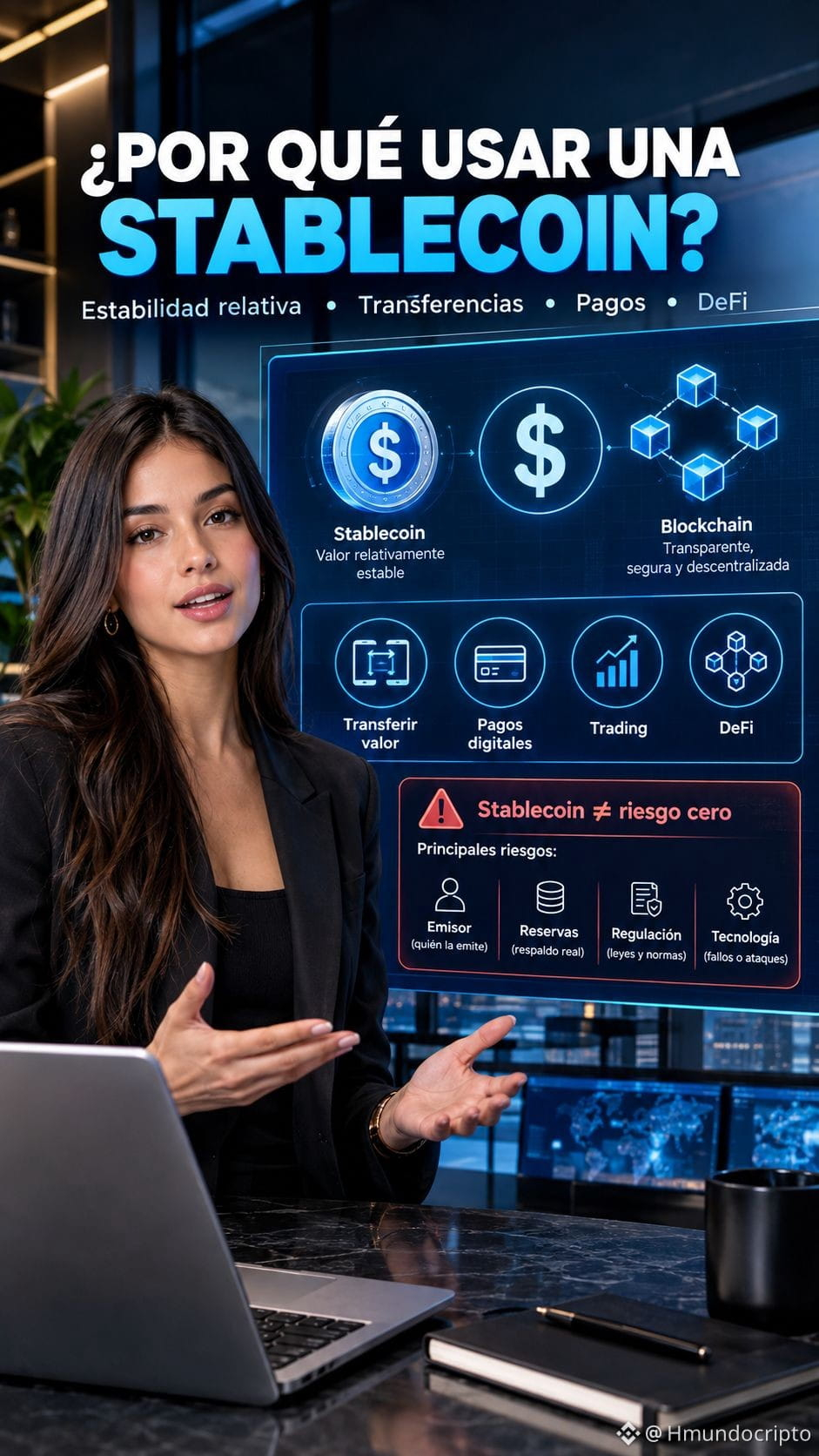
Why would someone use a stablecoin?
Family, a stablecoin is a cryptocurrency designed to keep a relatively stable value, normally pegged to a currency like the US dollar.
What can it be used for?
1. To move value within the crypto ecosystem without having to rely directly on more volatile cryptocurrencies.
2. To send and receive money digitally, depending on the network and the issuer.
3. To trade without having to immediately convert to fiat money.
4. And it can also be used in DeFi applications and other blockchain-based services.
But watch out: stablecoin doesn’t mean zero risk.
There are risks related to the issuer, the reserves, regulation, and the technology itself.
The key isn’t using a stablecoin because it’s trendy; it’s understanding how it works and what risks it has before using it.
Blessings and success. Thanks for following me.
$USDC $USDT $EURI #venezuela #ElSalvador #argentina #Colombia #Panama
Why would someone use a stablecoin?
Family, a stablecoin is a cryptocurrency designed to keep a relatively stable value, normally pegged to a currency like the US dollar.
What can it be used for?
1. To move value within the crypto ecosystem without having to rely directly on more volatile cryptocurrencies.
2. To send and receive money digitally, depending on the network and the issuer.
3. To trade without having to immediately convert to fiat money.
4. And it can also be used in DeFi applications and other blockchain-based services.
But watch out: stablecoin doesn’t mean zero risk.
There are risks related to the issuer, the reserves, regulation, and the technology itself.
The key isn’t using a stablecoin because it’s trendy; it’s understanding how it works and what risks it has before using it.
Blessings and success. Thanks for following me.
$USDC $USDT $EURI #venezuela #ElSalvador #argentina #Colombia #Panama
Family, a stablecoin is a cryptocurrency designed to keep a relatively stable value, normally pegged to a currency like the US dollar.
What can it be used for?
1. To move value within the crypto ecosystem without having to rely directly on more volatile cryptocurrencies.
2. To send and receive money digitally, depending on the network and the issuer.
3. To trade without having to immediately convert to fiat money.
4. And it can also be used in DeFi applications and other blockchain-based services.
But watch out: stablecoin doesn’t mean zero risk.
There are risks related to the issuer, the reserves, regulation, and the technology itself.
The key isn’t using a stablecoin because it’s trendy; it’s understanding how it works and what risks it has before using it.
Blessings and success. Thanks for following me.
$USDC $USDT $EURI #venezuela #ElSalvador #argentina #Colombia #Panama
98
·
--
THIS IS HOW A CRYPTO SCAM WORKS
“Here’s how a crypto scam works and some signs you should recognize.”
1. Guaranteed profit promises
They make it seem like you can’t lose money.
2. Pressure to invest quickly
They try to get you to decide without researching.
3. They ask for your keys
No legitimate person needs your password, seed phrase, or private keys.
4. Suspicious links or platforms
They may try to steal your data or funds.
5. They promise to multiply your money
Especially if they can’t clearly explain how the project works.
Before sending your money, research and verify. In crypto, understanding risk is essential.
BLESSINGS AND SUCCESS
THANK YOU FOR FOLLOWING ME
$NVDAB $BTC $BNB #ElSalvador #venezuela #argentina #china
THIS IS HOW A CRYPTO SCAM WORKS
“Here’s how a crypto scam works and some signs you should recognize.”
1. Guaranteed profit promises
They make it seem like you can’t lose money.
2. Pressure to invest quickly
They try to get you to decide without researching.
3. They ask for your keys
No legitimate person needs your password, seed phrase, or private keys.
4. Suspicious links or platforms
They may try to steal your data or funds.
5. They promise to multiply your money
Especially if they can’t clearly explain how the project works.
Before sending your money, research and verify. In crypto, understanding risk is essential.
BLESSINGS AND SUCCESS
THANK YOU FOR FOLLOWING ME
$NVDAB $BTC $BNB #ElSalvador #venezuela #argentina #china
“Here’s how a crypto scam works and some signs you should recognize.”
1. Guaranteed profit promises
They make it seem like you can’t lose money.
2. Pressure to invest quickly
They try to get you to decide without researching.
3. They ask for your keys
No legitimate person needs your password, seed phrase, or private keys.
4. Suspicious links or platforms
They may try to steal your data or funds.
5. They promise to multiply your money
Especially if they can’t clearly explain how the project works.
Before sending your money, research and verify. In crypto, understanding risk is essential.
BLESSINGS AND SUCCESS
THANK YOU FOR FOLLOWING ME
$NVDAB $BTC $BNB #ElSalvador #venezuela #argentina #china

3
1.1k
·
--
FAMILY
“Before buying this cryptocurrency, I did something that almost nobody does: I investigated it.”
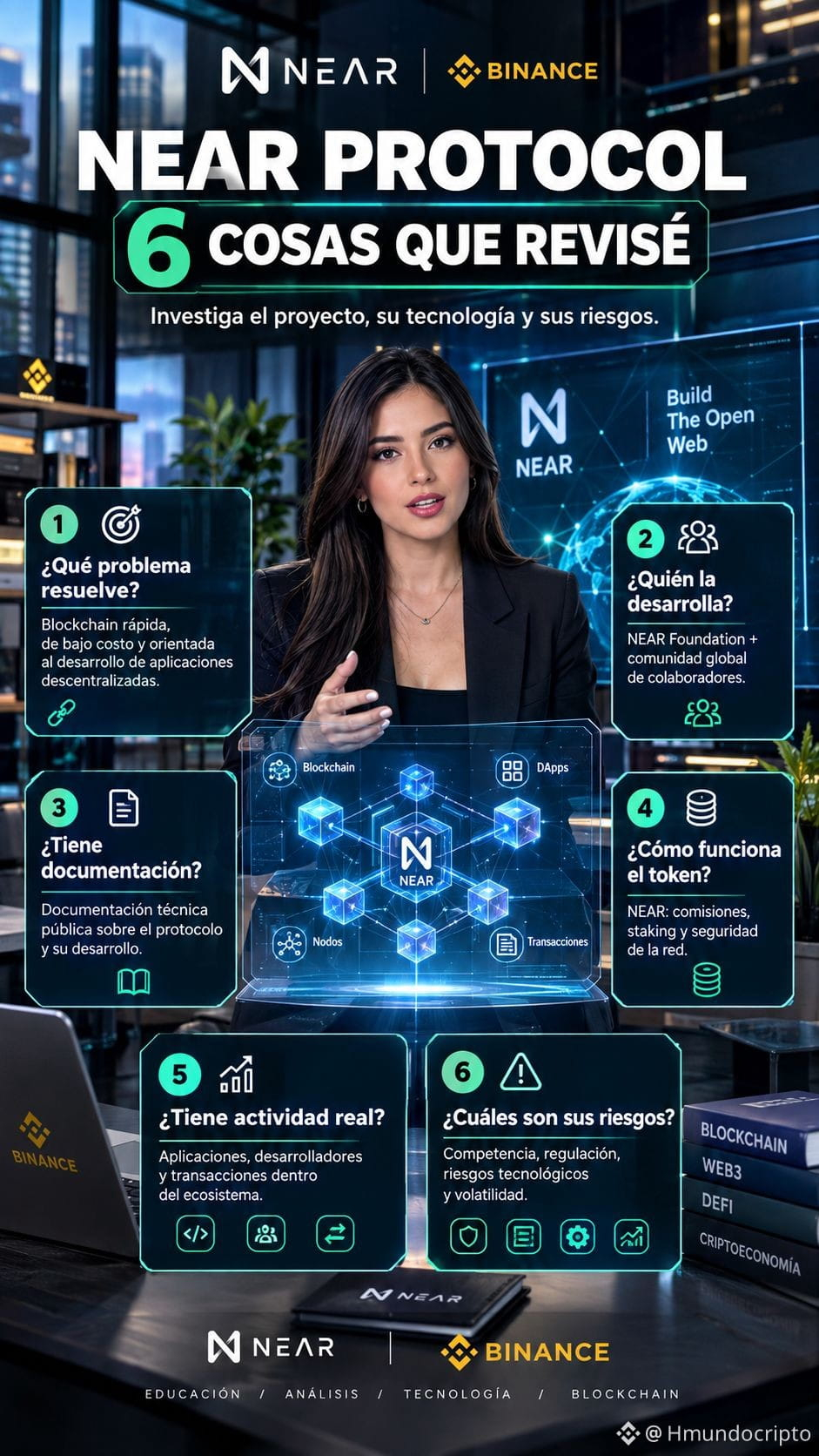
NEAR Protocol: 6 things I checked
What problem does it solve?
It aims to make it easier to develop decentralized applications with a fast, low-cost blockchain.
Who develops it?
The ecosystem is supported by the NEAR Foundation and developed by a global community of contributors.
Does it have documentation?
Yes. NEAR has public technical documentation about its protocol and development.
How does the token work?
NEAR is used to pay fees, participate in staking, and help secure the network.
Does it have real activity?
Yes. The network maintains applications, developers, and transactions within its ecosystem.
What are its risks?
Competition between blockchains, regulatory changes, technological risks, and market volatility.
Conclusion:
“Research the project, its technology, and its risks before making any decision.”
Blessings and success. Thanks for following me.
$NEAR #Near #venezuela #ElSalvador #argentina #Colombia
$
FAMILY
“Before buying this cryptocurrency, I did something that almost nobody does: I investigated it.”
NEAR Protocol: 6 things I checked
What problem does it solve?
It aims to make it easier to develop decentralized applications with a fast, low-cost blockchain.
Who develops it?
The ecosystem is supported by the NEAR Foundation and developed by a global community of contributors.
Does it have documentation?
Yes. NEAR has public technical documentation about its protocol and development.
How does the token work?
NEAR is used to pay fees, participate in staking, and help secure the network.
Does it have real activity?
Yes. The network maintains applications, developers, and transactions within its ecosystem.
What are its risks?
Competition between blockchains, regulatory changes, technological risks, and market volatility.
Conclusion:
“Research the project, its technology, and its risks before making any decision.”
Blessings and success. Thanks for following me.
$NEAR #Near #venezuela #ElSalvador #argentina #Colombia
$
“Before buying this cryptocurrency, I did something that almost nobody does: I investigated it.”
NEAR Protocol: 6 things I checked
What problem does it solve?
It aims to make it easier to develop decentralized applications with a fast, low-cost blockchain.
Who develops it?
The ecosystem is supported by the NEAR Foundation and developed by a global community of contributors.
Does it have documentation?
Yes. NEAR has public technical documentation about its protocol and development.
How does the token work?
NEAR is used to pay fees, participate in staking, and help secure the network.
Does it have real activity?
Yes. The network maintains applications, developers, and transactions within its ecosystem.
What are its risks?
Competition between blockchains, regulatory changes, technological risks, and market volatility.
Conclusion:
“Research the project, its technology, and its risks before making any decision.”
Blessings and success. Thanks for following me.
$NEAR #Near #venezuela #ElSalvador #argentina #Colombia
$
2
948
·
--
FAMILY
“Before buying a cryptocurrency, check these 6 things”
What problem is it trying to solve?
Who develops the project?
Is there documentation/whitepaper?
How does its token work?
Is there real activity on the network?
What are its main risks?
“Don’t buy a crypto just because it’s trending. First, check this.”
Blessings and success
Thank you for following me
$NVDAB $BTC $BNB #venezuela #ElSalvador #argentina #china #Colombia
FAMILY
“Before buying a cryptocurrency, check these 6 things”
What problem is it trying to solve?
Who develops the project?
Is there documentation/whitepaper?
How does its token work?
Is there real activity on the network?
What are its main risks?
“Don’t buy a crypto just because it’s trending. First, check this.”
Blessings and success
Thank you for following me
$NVDAB $BTC $BNB #venezuela #ElSalvador #argentina #china #Colombia
“Before buying a cryptocurrency, check these 6 things”
What problem is it trying to solve?
Who develops the project?
Is there documentation/whitepaper?
How does its token work?
Is there real activity on the network?
What are its main risks?
“Don’t buy a crypto just because it’s trending. First, check this.”
Blessings and success
Thank you for following me
$NVDAB $BTC $BNB #venezuela #ElSalvador #argentina #china #Colombia

159
·
--
FAMILY
“How to recognize a crypto scam”
warning signs:
1. Guaranteed profits
2. Pressure to invest quickly.
3. Request for private keys.
4. Suspicious links.
5. People who promise to multiply your money.
Hook: “If someone promises you easy money in crypto, check these 5 signs.”
BLESSINGS AND SUCCESS
THANK YOU FOR FOLLOWING ME
$NVDAB $BTC $BNB #venezuela #ElSalvador #Colombia #argentina #BTC
FAMILY
“How to recognize a crypto scam”
warning signs:
1. Guaranteed profits
2. Pressure to invest quickly.
3. Request for private keys.
4. Suspicious links.
5. People who promise to multiply your money.
Hook: “If someone promises you easy money in crypto, check these 5 signs.”
BLESSINGS AND SUCCESS
THANK YOU FOR FOLLOWING ME
$NVDAB $BTC $BNB #venezuela #ElSalvador #Colombia #argentina #BTC
“How to recognize a crypto scam”
warning signs:
1. Guaranteed profits
2. Pressure to invest quickly.
3. Request for private keys.
4. Suspicious links.
5. People who promise to multiply your money.
Hook: “If someone promises you easy money in crypto, check these 5 signs.”
BLESSINGS AND SUCCESS
THANK YOU FOR FOLLOWING ME
$NVDAB $BTC $BNB #venezuela #ElSalvador #Colombia #argentina #BTC

40
·
--
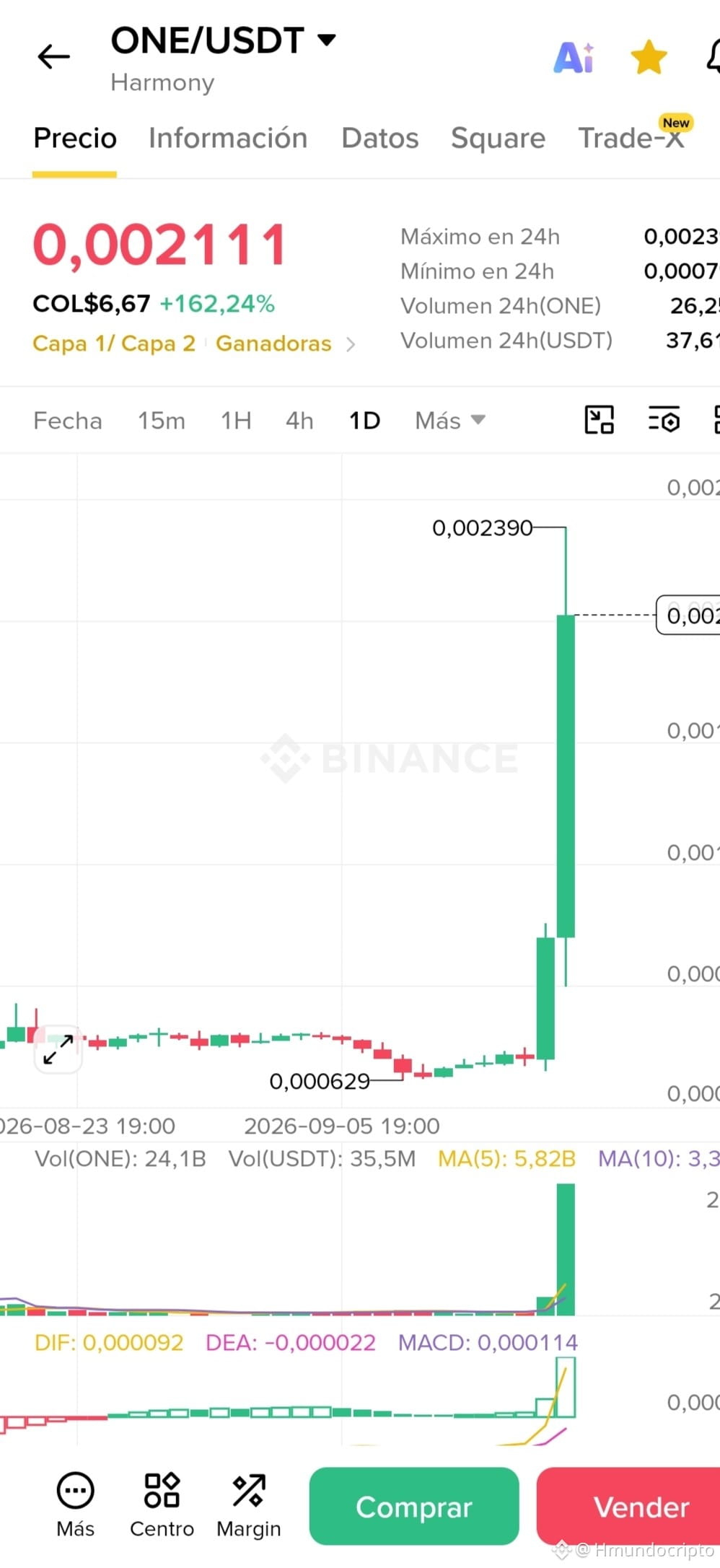
Familia Harmony is a fast and secure blockchain for decentralized applications. Primarily, it focuses on achieving scalability by not only dividing the network nodes, but also the blockchain states into fragments or "shards", meaning scaling linearly across the three aspects of machines, transactions, and storage.
Blessings and success
Thank you for following me
$ONE #venezuela #ElSalvador #china #argentina #Colombia
Familia Harmony is a fast and secure blockchain for decentralized applications. Primarily, it focuses on achieving scalability by not only dividing the network nodes, but also the blockchain states into fragments or "shards", meaning scaling linearly across the three aspects of machines, transactions, and storage.
Blessings and success
Thank you for following me
$ONE #venezuela #ElSalvador #china #argentina #Colombia
Blessings and success
Thank you for following me
$ONE #venezuela #ElSalvador #china #argentina #Colombia
1
406
·
--
$XRP FAMILY
5 crypto concepts every beginner should know
1. Blockchain: A digital record where transactions are stored and verified.
2. Wallet: A digital wallet that lets you manage your cryptocurrencies.
3. Stablecoin: A cryptocurrency designed to keep a stable value, usually linked to a currency like the dollar.
4. Smart Contract: A program that automatically executes agreements when certain conditions are met.
5. Gas / Fee: The commission you pay to perform an operation on a blockchain network.
“Save it: in your mini crypto dictionary.”
Blessings and success
Thank you for following me
$BTC $BNB #venezuela #ElSalvador #xrp #PEPE #argentina
$XRP FAMILY
5 crypto concepts every beginner should know
1. Blockchain: A digital record where transactions are stored and verified.
2. Wallet: A digital wallet that lets you manage your cryptocurrencies.
3. Stablecoin: A cryptocurrency designed to keep a stable value, usually linked to a currency like the dollar.
4. Smart Contract: A program that automatically executes agreements when certain conditions are met.
5. Gas / Fee: The commission you pay to perform an operation on a blockchain network.
“Save it: in your mini crypto dictionary.”
Blessings and success
Thank you for following me
$BTC $BNB #venezuela #ElSalvador #xrp #PEPE #argentina
5 crypto concepts every beginner should know
1. Blockchain: A digital record where transactions are stored and verified.
2. Wallet: A digital wallet that lets you manage your cryptocurrencies.
3. Stablecoin: A cryptocurrency designed to keep a stable value, usually linked to a currency like the dollar.
4. Smart Contract: A program that automatically executes agreements when certain conditions are met.
5. Gas / Fee: The commission you pay to perform an operation on a blockchain network.
“Save it: in your mini crypto dictionary.”
Blessings and success
Thank you for following me
$BTC $BNB #venezuela #ElSalvador #xrp #PEPE #argentina

1
351
·
--
FAMILY
“What's the difference between Spot and Futures?”
Spot: you buy/sell the asset directly.
Futures: you trade contracts and you can use leverage.
“If you’re starting out in crypto, you need to understand this difference.”
BLESSINGS AND SUCCESSES
THANK YOU FOR FOLLOWING ME
$BTC $BNB $XRP #venezuela #ElSalvador #argentina #Colombia #bnb
FAMILY
“What's the difference between Spot and Futures?”
Spot: you buy/sell the asset directly.
Futures: you trade contracts and you can use leverage.
“If you’re starting out in crypto, you need to understand this difference.”
BLESSINGS AND SUCCESSES
THANK YOU FOR FOLLOWING ME
$BTC $BNB $XRP #venezuela #ElSalvador #argentina #Colombia #bnb
“What's the difference between Spot and Futures?”
Spot: you buy/sell the asset directly.
Futures: you trade contracts and you can use leverage.
“If you’re starting out in crypto, you need to understand this difference.”
BLESSINGS AND SUCCESSES
THANK YOU FOR FOLLOWING ME
$BTC $BNB $XRP #venezuela #ElSalvador #argentina #Colombia #bnb

155
·
--
Family
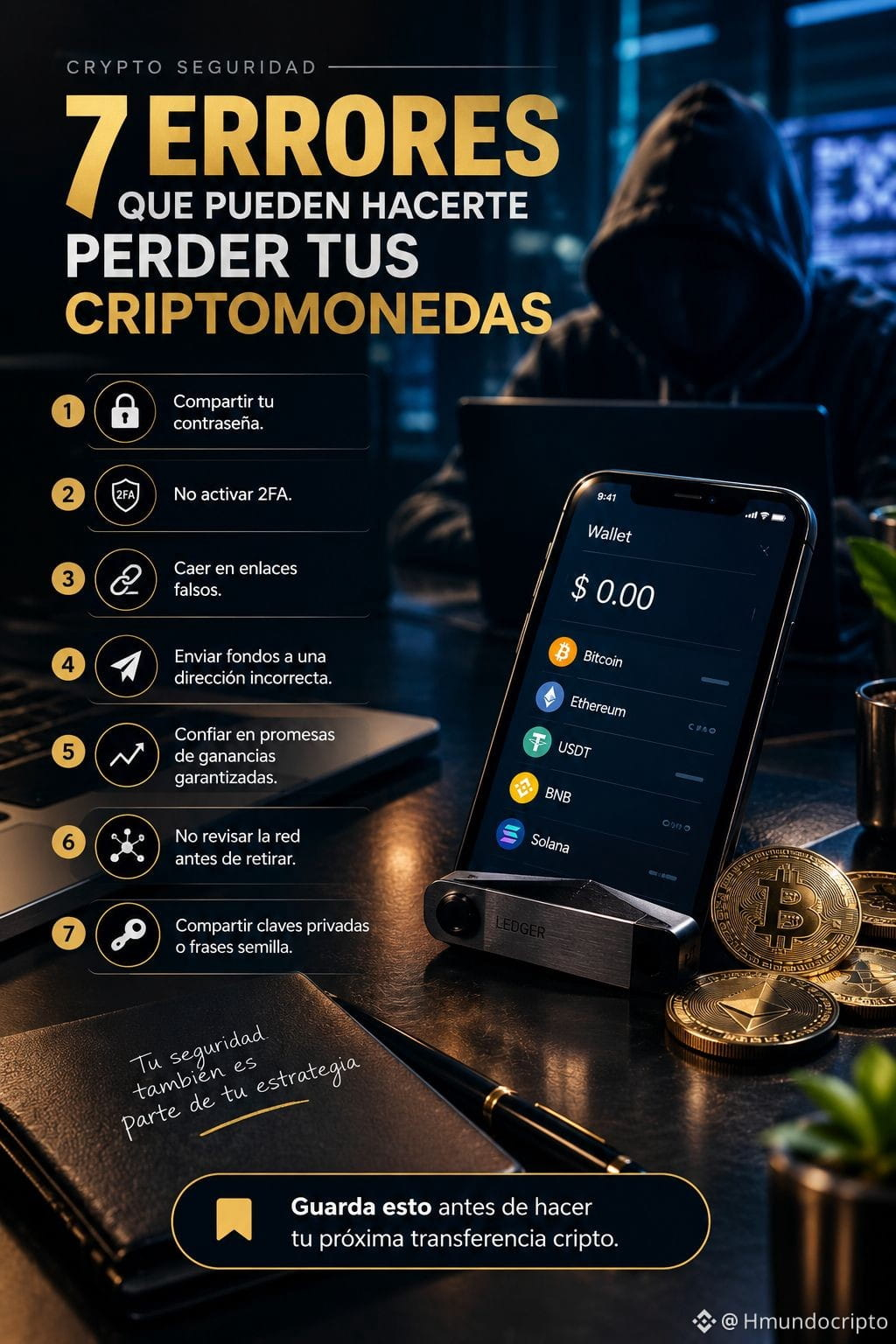
7 mistakes that can make you lose your crypto assets
1. Sharing your password.
2. Not enabling 2FA.
3. Falling for fake links.
4. Sending funds to the wrong address.
5. Trusting promises of guaranteed profits.
6. Not checking the network before withdrawing.
7. Sharing private keys or seed phrases.
“Save this before making your next crypto transfer.”
Blessings and success
Thanks for following me
#venezuela #ElSalvador #Colombia #argentina #BTC $BNB $XRP $ETH
Family
7 mistakes that can make you lose your crypto assets
1. Sharing your password.
2. Not enabling 2FA.
3. Falling for fake links.
4. Sending funds to the wrong address.
5. Trusting promises of guaranteed profits.
6. Not checking the network before withdrawing.
7. Sharing private keys or seed phrases.
“Save this before making your next crypto transfer.”
Blessings and success
Thanks for following me
#venezuela #ElSalvador #Colombia #argentina #BTC $BNB $XRP $ETH
7 mistakes that can make you lose your crypto assets
1. Sharing your password.
2. Not enabling 2FA.
3. Falling for fake links.
4. Sending funds to the wrong address.
5. Trusting promises of guaranteed profits.
6. Not checking the network before withdrawing.
7. Sharing private keys or seed phrases.
“Save this before making your next crypto transfer.”
Blessings and success
Thanks for following me
#venezuela #ElSalvador #Colombia #argentina #BTC $BNB $XRP $ETH
154

·
--
FAMILY
PEPE Coin: a community-driven memecoin, culture and blockchain technology.
BLESSINGS AND SUCCESSES
THANK YOU FOR FOLLOWING ME $PEPE #venezuela #ElSalvador #argentina #Colombia #PEPE
FAMILY
PEPE Coin: a community-driven memecoin, culture and blockchain technology.
BLESSINGS AND SUCCESSES
THANK YOU FOR FOLLOWING ME $PEPE #venezuela #ElSalvador #argentina #Colombia #PEPE
PEPE Coin: a community-driven memecoin, culture and blockchain technology.
BLESSINGS AND SUCCESSES
THANK YOU FOR FOLLOWING ME $PEPE #venezuela #ElSalvador #argentina #Colombia #PEPE

5
683
·
--
FAMILY — what’s happening with the Near protocol
NEAR is a blockchain focused on scalability, decentralized applications, and infrastructure for artificial intelligence.
During 2026, the ecosystem has continued developing its technology and tools to facilitate interoperability and the use of Web3 applications.
As for the price, NEAR is currently around 2.5 USDT, but the value can change quickly and it does not, by itself, reflect the project’s technological status.
What matters is to look at its updates, development, adoption, and network activity—not just price movement.
Blessings and successes
Thank you for following me
$NEAR $NEAR.ETF #venezuela #ElSalvador #argentina #china #NEAR🚀🚀🚀
FAMILY — what’s happening with the Near protocol
NEAR is a blockchain focused on scalability, decentralized applications, and infrastructure for artificial intelligence.
During 2026, the ecosystem has continued developing its technology and tools to facilitate interoperability and the use of Web3 applications.
As for the price, NEAR is currently around 2.5 USDT, but the value can change quickly and it does not, by itself, reflect the project’s technological status.
What matters is to look at its updates, development, adoption, and network activity—not just price movement.
Blessings and successes
Thank you for following me
$NEAR $NEAR .ETF #venezuela #ElSalvador #argentina #china #NEAR🚀🚀🚀
NEAR is a blockchain focused on scalability, decentralized applications, and infrastructure for artificial intelligence.
During 2026, the ecosystem has continued developing its technology and tools to facilitate interoperability and the use of Web3 applications.
As for the price, NEAR is currently around 2.5 USDT, but the value can change quickly and it does not, by itself, reflect the project’s technological status.
What matters is to look at its updates, development, adoption, and network activity—not just price movement.
Blessings and successes
Thank you for following me
$NEAR $NEAR .ETF #venezuela #ElSalvador #argentina #china #NEAR🚀🚀🚀
NEARETF+0.06%
1
137

·
--
#venezuela Family 牛 come
Scalping Strategy with $5 and 5x
Capital: $5
Leverage: 5x
Position: ≈ $25
LONG Entry: 0,1370
Stop Loss: 0,1334
Take Profit: 0,140
Example:
If it enters at 0,1370 and exits at 0,1405, the move is approximately +2,55%.
On a $25 position:
Gross profit ≈ $0,64
Minus fees and funding → slightly smaller real profit.
If it hits the stop:
Gross loss ≈ $0,66
More fees.
Important: with only $5, fees matter a lot, and 5x amplifies both gains and losses. I wouldn’t increase leverage just to try to get more profit.
Scalping rule: entry → stop defined → target defined. If there’s no confirmation, don’t enter.
Blessings and success
Thanks for following me
$牛来 $BNB #ElSalvador #argentina #china
#venezuela Family 牛 come
Scalping Strategy with $5 and 5x
Capital: $5
Leverage: 5x
Position: ≈ $25
LONG Entry: 0,1370
Stop Loss: 0,1334
Take Profit: 0,140
Example:
If it enters at 0,1370 and exits at 0,1405, the move is approximately +2,55%.
On a $25 position:
Gross profit ≈ $0,64
Minus fees and funding → slightly smaller real profit.
If it hits the stop:
Gross loss ≈ $0,66
More fees.
Important: with only $5, fees matter a lot, and 5x amplifies both gains and losses. I wouldn’t increase leverage just to try to get more profit.
Scalping rule: entry → stop defined → target defined. If there’s no confirmation, don’t enter.
Blessings and success
Thanks for following me
$牛来 $BNB #ElSalvador #argentina #china
Scalping Strategy with $5 and 5x
Capital: $5
Leverage: 5x
Position: ≈ $25
LONG Entry: 0,1370
Stop Loss: 0,1334
Take Profit: 0,140
Example:
If it enters at 0,1370 and exits at 0,1405, the move is approximately +2,55%.
On a $25 position:
Gross profit ≈ $0,64
Minus fees and funding → slightly smaller real profit.
If it hits the stop:
Gross loss ≈ $0,66
More fees.
Important: with only $5, fees matter a lot, and 5x amplifies both gains and losses. I wouldn’t increase leverage just to try to get more profit.
Scalping rule: entry → stop defined → target defined. If there’s no confirmation, don’t enter.
Blessings and success
Thanks for following me
$牛来 $BNB #ElSalvador #argentina #china

101

·
--
Verified
FAMILY What’s behind NIULAI, the cryptocurrency that’s getting people’s attention?
NIULAI, whose name in Chinese is 牛来, roughly means “the bull is coming”.
It’s a memecoin built on BNB Chain, inspired by a Chinese cultural trend and the idea of a community betting on the return of the bull market.
Its pitch isn’t based on revolutionary technology or a complex financial utility: its main value lies in the community, the narrative, and market speculation.
In addition, the project states a fixed supply of 1 billion tokens.
But watch out: just because a cryptocurrency rises quickly doesn’t mean it has guaranteed fundamental value.
NIULAI is a memecoin, and its price can be extremely volatile.
Information, not investment advice.
but without FOMO.
Blessings and success
Thanks for following me
$牛来 #niulai #china #bnb #venezuela $BNB #ElSalvador
FAMILY What’s behind NIULAI, the cryptocurrency that’s getting people’s attention?
NIULAI, whose name in Chinese is 牛来, roughly means “the bull is coming”.
It’s a memecoin built on BNB Chain, inspired by a Chinese cultural trend and the idea of a community betting on the return of the bull market.
Its pitch isn’t based on revolutionary technology or a complex financial utility: its main value lies in the community, the narrative, and market speculation.
In addition, the project states a fixed supply of 1 billion tokens.
But watch out: just because a cryptocurrency rises quickly doesn’t mean it has guaranteed fundamental value.
NIULAI is a memecoin, and its price can be extremely volatile.
Information, not investment advice.
but without FOMO.
Blessings and success
Thanks for following me
$牛来 #niulai #china #bnb #venezuela $BNB #ElSalvador
NIULAI, whose name in Chinese is 牛来, roughly means “the bull is coming”.
It’s a memecoin built on BNB Chain, inspired by a Chinese cultural trend and the idea of a community betting on the return of the bull market.
Its pitch isn’t based on revolutionary technology or a complex financial utility: its main value lies in the community, the narrative, and market speculation.
In addition, the project states a fixed supply of 1 billion tokens.
But watch out: just because a cryptocurrency rises quickly doesn’t mean it has guaranteed fundamental value.
NIULAI is a memecoin, and its price can be extremely volatile.
Information, not investment advice.
but without FOMO.
Blessings and success
Thanks for following me
$牛来 #niulai #china #bnb #venezuela $BNB #ElSalvador

1
769
·
--
The meme coin of the moment
Blessings and success
Thank you for following me
$BNB #bnb #venezuela #ElSalvador #Colombia #argentina
The meme coin of the moment
Blessings and success
Thank you for following me
$BNB #bnb #venezuela #ElSalvador #Colombia #argentina
Blessings and success
Thank you for following me
$BNB #bnb #venezuela #ElSalvador #Colombia #argentina

1
748
·
--
Family: When is it really a good time to start trading Futures?
One of the worst decisions is to enter just because the price is going up or because you’re afraid of missing out.
A disciplined trader first looks for an entry condition.
For example, let’s imagine you’re analyzing BTCUSDT.
Step 1: identify the trend.
If the market is forming higher highs and higher lows, you can assume there’s a bullish structure.
But that alone is not enough of a signal to enter.
Step 2: wait for an important zone.
Instead of buying after a strong move up, you wait for the price to retrace back to a support zone or to a level that was relevant earlier.
Step 3: look for confirmation.
For example:
BTC retraces to a support zone and shows rejection from the bearish price action.
Then, a confirmation candle appears and the price reclaims the level you were watching.
That’s where you can consider an entry.
Step 4: define your Stop Loss before entering.
Let’s say:
Entry: 100 USDT
Stop Loss: 98 USDT
Take Profit: 104 USDT
Your possible loss is 2 USDT per position unit, and your potential target is 4 USDT.
That represents an approximately 1:2 risk/reward ratio.
But pay attention:
It doesn’t mean the trade will be profitable.
It means that before you enter, you already know how much you’re willing to lose and what your goal is.
💰 Risk management example
If you have a 100 USDT account and decide to risk at most 1%, your planned maximum loss would be 1 USDT.
The position size must be calculated based on the distance to the Stop Loss.
And leverage should not be used to increase risk indiscriminately.
When should NOT enter?
❌ The price is rising quickly.
❌ You just lost a trade and want to recover.
❌ You see other people winning.
❌ You’re afraid of missing the move.
❌ You don’t know where to place the Stop Loss.
#venezuela #ElSalvador #Colombia $BTC $BNB #xrp
Family: When is it really a good time to start trading Futures?
One of the worst decisions is to enter just because the price is going up or because you’re afraid of missing out.
A disciplined trader first looks for an entry condition.
For example, let’s imagine you’re analyzing BTCUSDT.
Step 1: identify the trend.
If the market is forming higher highs and higher lows, you can assume there’s a bullish structure.
But that alone is not enough of a signal to enter.
Step 2: wait for an important zone.
Instead of buying after a strong move up, you wait for the price to retrace back to a support zone or to a level that was relevant earlier.
Step 3: look for confirmation.
For example:
BTC retraces to a support zone and shows rejection from the bearish price action.
Then, a confirmation candle appears and the price reclaims the level you were watching.
That’s where you can consider an entry.
Step 4: define your Stop Loss before entering.
Let’s say:
Entry: 100 USDT
Stop Loss: 98 USDT
Take Profit: 104 USDT
Your possible loss is 2 USDT per position unit, and your potential target is 4 USDT.
That represents an approximately 1:2 risk/reward ratio.
But pay attention:
It doesn’t mean the trade will be profitable.
It means that before you enter, you already know how much you’re willing to lose and what your goal is.
💰 Risk management example
If you have a 100 USDT account and decide to risk at most 1%, your planned maximum loss would be 1 USDT.
The position size must be calculated based on the distance to the Stop Loss.
And leverage should not be used to increase risk indiscriminately.
When should NOT enter?
❌ The price is rising quickly.
❌ You just lost a trade and want to recover.
❌ You see other people winning.
❌ You’re afraid of missing the move.
❌ You don’t know where to place the Stop Loss.
#venezuela #ElSalvador #Colombia $BTC $BNB #xrp
One of the worst decisions is to enter just because the price is going up or because you’re afraid of missing out.
A disciplined trader first looks for an entry condition.
For example, let’s imagine you’re analyzing BTCUSDT.
Step 1: identify the trend.
If the market is forming higher highs and higher lows, you can assume there’s a bullish structure.
But that alone is not enough of a signal to enter.
Step 2: wait for an important zone.
Instead of buying after a strong move up, you wait for the price to retrace back to a support zone or to a level that was relevant earlier.
Step 3: look for confirmation.
For example:
BTC retraces to a support zone and shows rejection from the bearish price action.
Then, a confirmation candle appears and the price reclaims the level you were watching.
That’s where you can consider an entry.
Step 4: define your Stop Loss before entering.
Let’s say:
Entry: 100 USDT
Stop Loss: 98 USDT
Take Profit: 104 USDT
Your possible loss is 2 USDT per position unit, and your potential target is 4 USDT.
That represents an approximately 1:2 risk/reward ratio.
But pay attention:
It doesn’t mean the trade will be profitable.
It means that before you enter, you already know how much you’re willing to lose and what your goal is.
💰 Risk management example
If you have a 100 USDT account and decide to risk at most 1%, your planned maximum loss would be 1 USDT.
The position size must be calculated based on the distance to the Stop Loss.
And leverage should not be used to increase risk indiscriminately.
When should NOT enter?
❌ The price is rising quickly.
❌ You just lost a trade and want to recover.
❌ You see other people winning.
❌ You’re afraid of missing the move.
❌ You don’t know where to place the Stop Loss.
#venezuela #ElSalvador #Colombia $BTC $BNB #xrp

118
·
--
FAMILY
What do you do when your Binance Futures trade turns red?
First thing: don’t panic.
Seeing a negative position can trigger fear and lead you to close too early, move your stop loss, or even increase the position trying to recover the loss.
But a professional trader doesn’t trade with emotions: they trade with a plan.
Risk management strategy:
Before you open a trade, define three things:
1️⃣ Entry: at what level will you enter, and why?
2️⃣ Stop Loss: at what point do you accept that your analysis was wrong?
3️⃣ Take Profit: in what zone will you take profits if the price moves in your favor?
For example, if you have a 100 USDT account, you can set a rule that you won’t risk more than 1 USDT per trade.
Important: that 1 USDT is the maximum risk of the trade—not simply the position size. Leverage should be calculated after you’ve defined how much you’re willing to lose.
And remember:
A trade in the red doesn’t automatically mean you should close it. But it also doesn’t mean you should hold it at any price.
If the price reaches your stop, you exit according to your plan.
If your scenario is still valid, don’t make impulsive decisions just because you see red numbers.
And never increase a position solely to recover a loss.
Tip True discipline in Futures isn’t about holding losses. It’s about knowing how much you’re willing to lose before you enter.
No FOMO. No revenge. No improvising.
Just strategy, risk management, and discipline.
Note This is educational content, not an investment recommendation. Leveraged Futures can cause rapid losses, even greater than expected.
“Fear makes you improvise; a plan tells you exactly what to do.”
Blessings and success
Thank you for following me $BNB $BTC $XRP #venezuela #ElSalvador #solana #ETH
FAMILY
What do you do when your Binance Futures trade turns red?
First thing: don’t panic.
Seeing a negative position can trigger fear and lead you to close too early, move your stop loss, or even increase the position trying to recover the loss.
But a professional trader doesn’t trade with emotions: they trade with a plan.
Risk management strategy:
Before you open a trade, define three things:
1️⃣ Entry: at what level will you enter, and why?
2️⃣ Stop Loss: at what point do you accept that your analysis was wrong?
3️⃣ Take Profit: in what zone will you take profits if the price moves in your favor?
For example, if you have a 100 USDT account, you can set a rule that you won’t risk more than 1 USDT per trade.
Important: that 1 USDT is the maximum risk of the trade—not simply the position size. Leverage should be calculated after you’ve defined how much you’re willing to lose.
And remember:
A trade in the red doesn’t automatically mean you should close it. But it also doesn’t mean you should hold it at any price.
If the price reaches your stop, you exit according to your plan.
If your scenario is still valid, don’t make impulsive decisions just because you see red numbers.
And never increase a position solely to recover a loss.
Tip True discipline in Futures isn’t about holding losses. It’s about knowing how much you’re willing to lose before you enter.
No FOMO. No revenge. No improvising.
Just strategy, risk management, and discipline.
Note This is educational content, not an investment recommendation. Leveraged Futures can cause rapid losses, even greater than expected.
“Fear makes you improvise; a plan tells you exactly what to do.”
Blessings and success
Thank you for following me $BNB $BTC $XRP #venezuela #ElSalvador #solana #ETH
What do you do when your Binance Futures trade turns red?
First thing: don’t panic.
Seeing a negative position can trigger fear and lead you to close too early, move your stop loss, or even increase the position trying to recover the loss.
But a professional trader doesn’t trade with emotions: they trade with a plan.
Risk management strategy:
Before you open a trade, define three things:
1️⃣ Entry: at what level will you enter, and why?
2️⃣ Stop Loss: at what point do you accept that your analysis was wrong?
3️⃣ Take Profit: in what zone will you take profits if the price moves in your favor?
For example, if you have a 100 USDT account, you can set a rule that you won’t risk more than 1 USDT per trade.
Important: that 1 USDT is the maximum risk of the trade—not simply the position size. Leverage should be calculated after you’ve defined how much you’re willing to lose.
And remember:
A trade in the red doesn’t automatically mean you should close it. But it also doesn’t mean you should hold it at any price.
If the price reaches your stop, you exit according to your plan.
If your scenario is still valid, don’t make impulsive decisions just because you see red numbers.
And never increase a position solely to recover a loss.
Tip True discipline in Futures isn’t about holding losses. It’s about knowing how much you’re willing to lose before you enter.
No FOMO. No revenge. No improvising.
Just strategy, risk management, and discipline.
Note This is educational content, not an investment recommendation. Leveraged Futures can cause rapid losses, even greater than expected.
“Fear makes you improvise; a plan tells you exactly what to do.”
Blessings and success
Thank you for following me $BNB $BTC $XRP #venezuela #ElSalvador #solana #ETH

121
·
--
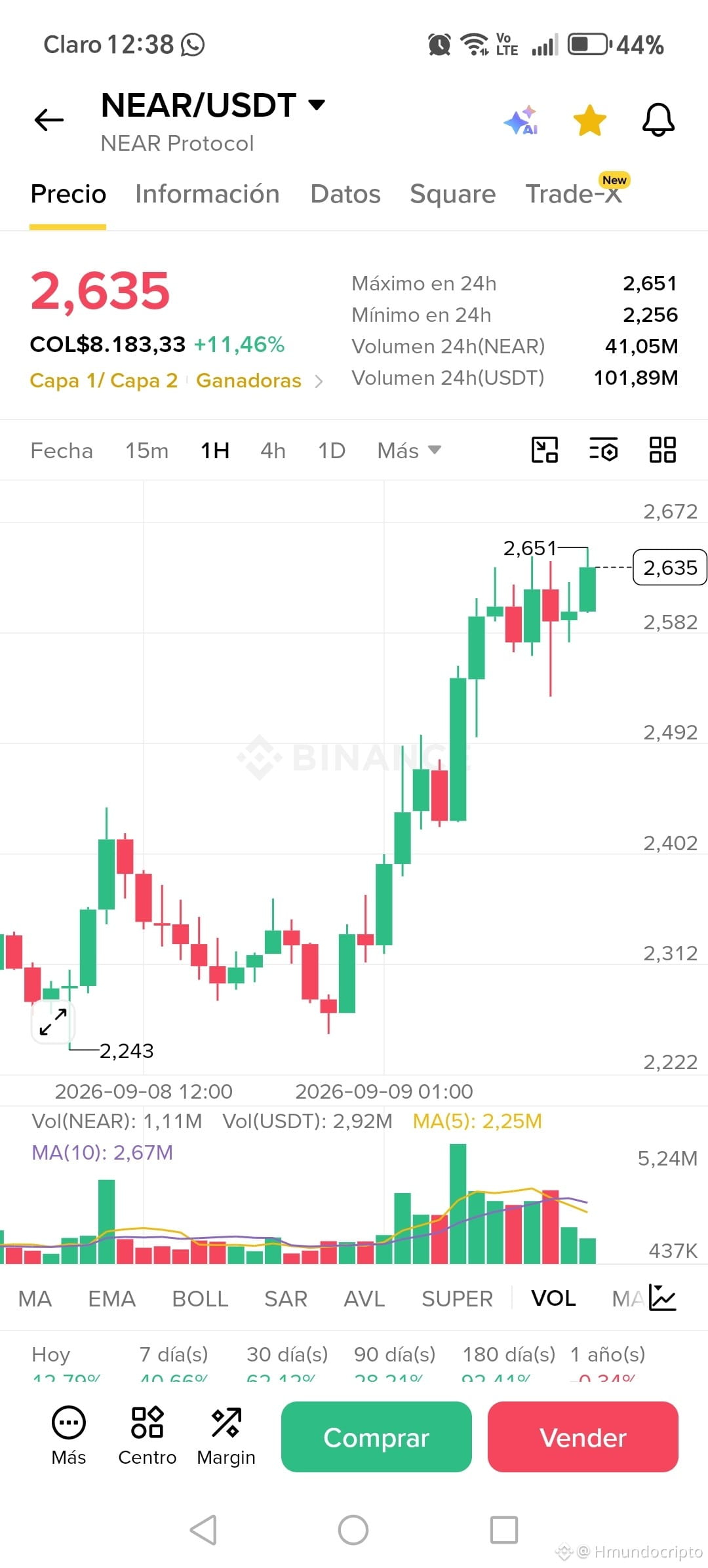
Congratulations $NEAR keeps going up it is a very interesting blockchain
#venezuela #ElSalvador #Near
Congratulations $NEAR keeps going up it is a very interesting blockchain
#venezuela #ElSalvador #Near
#venezuela #ElSalvador #Near
206
Log in to explore more content
Join global crypto users on Binance Square
⚡️ Get latest and useful information about crypto.
💬 Trusted by the world’s largest crypto exchange.
👍 Discover real insights from verified creators.
Email / Phone number