
Mayira_s
186 Posts

Mayira_s
Report
Block User
13 Following
2.2K+ Followers
510 Liked
Posts
Portfolio
All
Quotes
PINNED
·
--
New listing checklist + a little something for the community. Check it out 🧧
New listing checklist + a little something for the community. Check it out 🧧

Hasan Web3
·
--
5 Checks Before You Trade a New Listing 🔍
I've lost money rushing into new listings, so now I run through this list first. Maybe it helps you too:
1️⃣ Supply: low float plus big future unlocks often means selling pressure later.
2️⃣ Unlocks: check when team and investor tokens release.
3️⃣ Volume: a pump without real volume is a weak move.
4️⃣ TVL: are deposits staying, or just chasing short-term rewards?
5️⃣ Exit plan: set your stop-loss and target BEFORE you enter.
The first few days after a listing are mostly noise. The real signal shows up around day 7-30.
🧧 A Red Packet is live with this post. Answer the question below in the comments to claim it.
⚠️ Educational content only. Not financial advice. Always DYOR.
#Binance #Web3 #CryptoEducation #NewListing #DYOR
I've lost money rushing into new listings, so now I run through this list first. Maybe it helps you too:
1️⃣ Supply: low float plus big future unlocks often means selling pressure later.
2️⃣ Unlocks: check when team and investor tokens release.
3️⃣ Volume: a pump without real volume is a weak move.
4️⃣ TVL: are deposits staying, or just chasing short-term rewards?
5️⃣ Exit plan: set your stop-loss and target BEFORE you enter.
The first few days after a listing are mostly noise. The real signal shows up around day 7-30.
🧧 A Red Packet is live with this post. Answer the question below in the comments to claim it.
⚠️ Educational content only. Not financial advice. Always DYOR.
#Binance #Web3 #CryptoEducation #NewListing #DYOR

4
30
·
--
Bullish
Exciting Partnership! 🤝 Claim exclusive Red Packets here and on my partner @Anl_bd profile. Grab yours now—555 slots available on my account! 🧧✨
$BNB
Exciting Partnership! 🤝 Claim exclusive Red Packets here and on my partner @Anl_ profile. Grab yours now—555 slots available on my account! 🧧✨
$BNB
$BNB

Anl_
·
--
Bullish🚀 $BNB
— More Than Just a Market Symbol!
The crypto market is always evolving, and BNB continues to be an important part of the Web3 ecosystem.
📊 Current Market Snapshot:
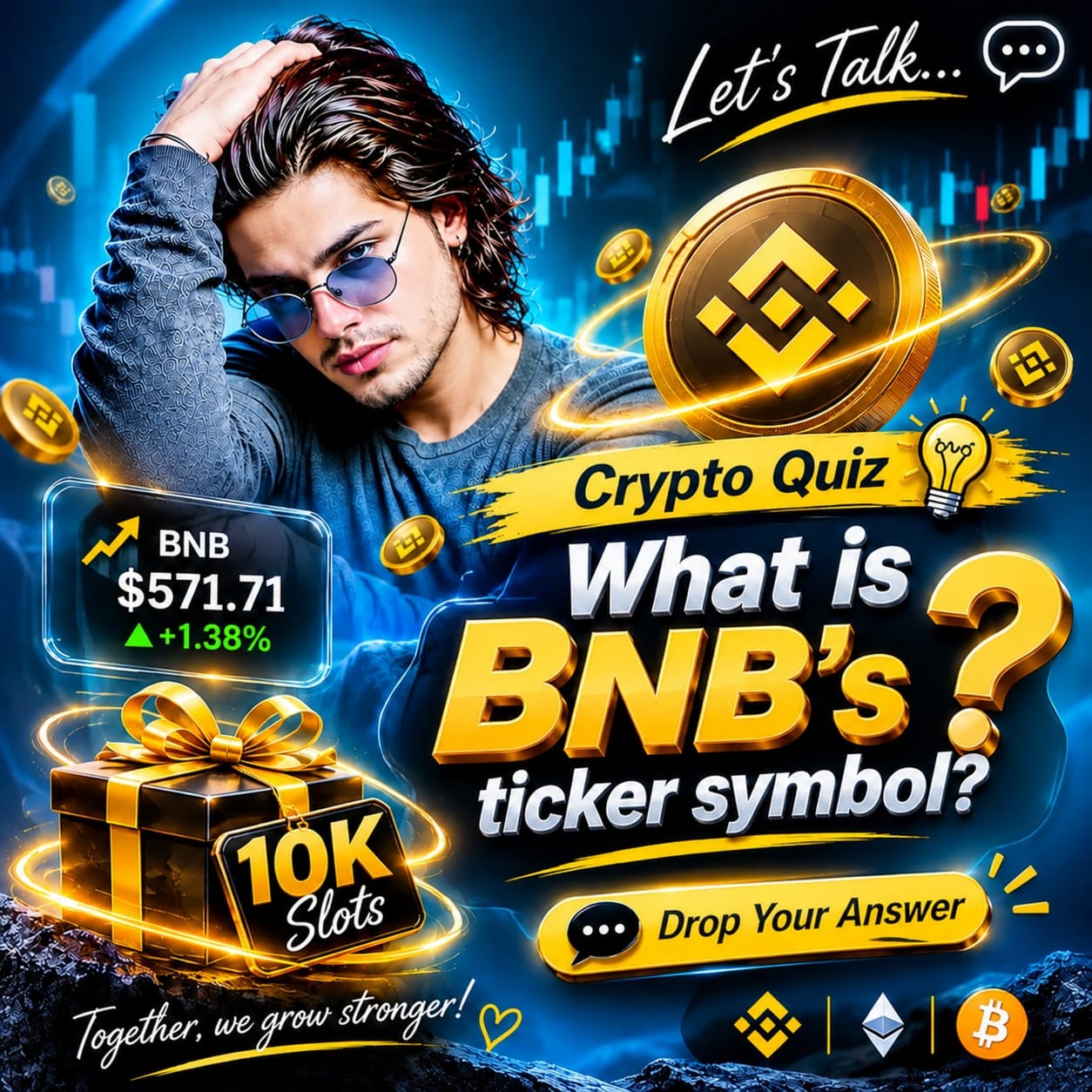
BNB is trading around $581.11, with a reported 24-hour change of approximately +0.57% on Binance's price page.
Beyond its market value, BNB plays an important role in transaction fees, BNB Chain activity, and the wider blockchain ecosystem.
What I find interesting is how one token can connect so many different parts of the crypto world. There's always something new to learn, explore, and discuss.
💬 A quick question for the community:
What is the ticker symbol of Binance Coin?
Let's see how many of us know! 👇
Answer in the comments! 💛
#BNB #Binance #BNBChain #CryptoCommunity #Blockchain
— More Than Just a Market Symbol!
The crypto market is always evolving, and BNB continues to be an important part of the Web3 ecosystem.
📊 Current Market Snapshot:
BNB is trading around $581.11, with a reported 24-hour change of approximately +0.57% on Binance's price page.
Beyond its market value, BNB plays an important role in transaction fees, BNB Chain activity, and the wider blockchain ecosystem.
What I find interesting is how one token can connect so many different parts of the crypto world. There's always something new to learn, explore, and discuss.
💬 A quick question for the community:
What is the ticker symbol of Binance Coin?
Let's see how many of us know! 👇
Answer in the comments! 💛
#BNB #Binance #BNBChain #CryptoCommunity #Blockchain
23
6
62
·
--
Bullish
$NES (Nesa) — Recovery or Another Risk? 🤔
I have a personal history with this token, and honestly, it wasn't a good one.
I bought $NES during its previous Binance Alpha listing, when I was in profit initially. But things changed dramatically, and the token experienced a massive decline. Eventually, I had to sell my holdings at around 90% loss. That experience was really disappointing.
Now, seeing $NES listed again and moving upward has caught my attention.
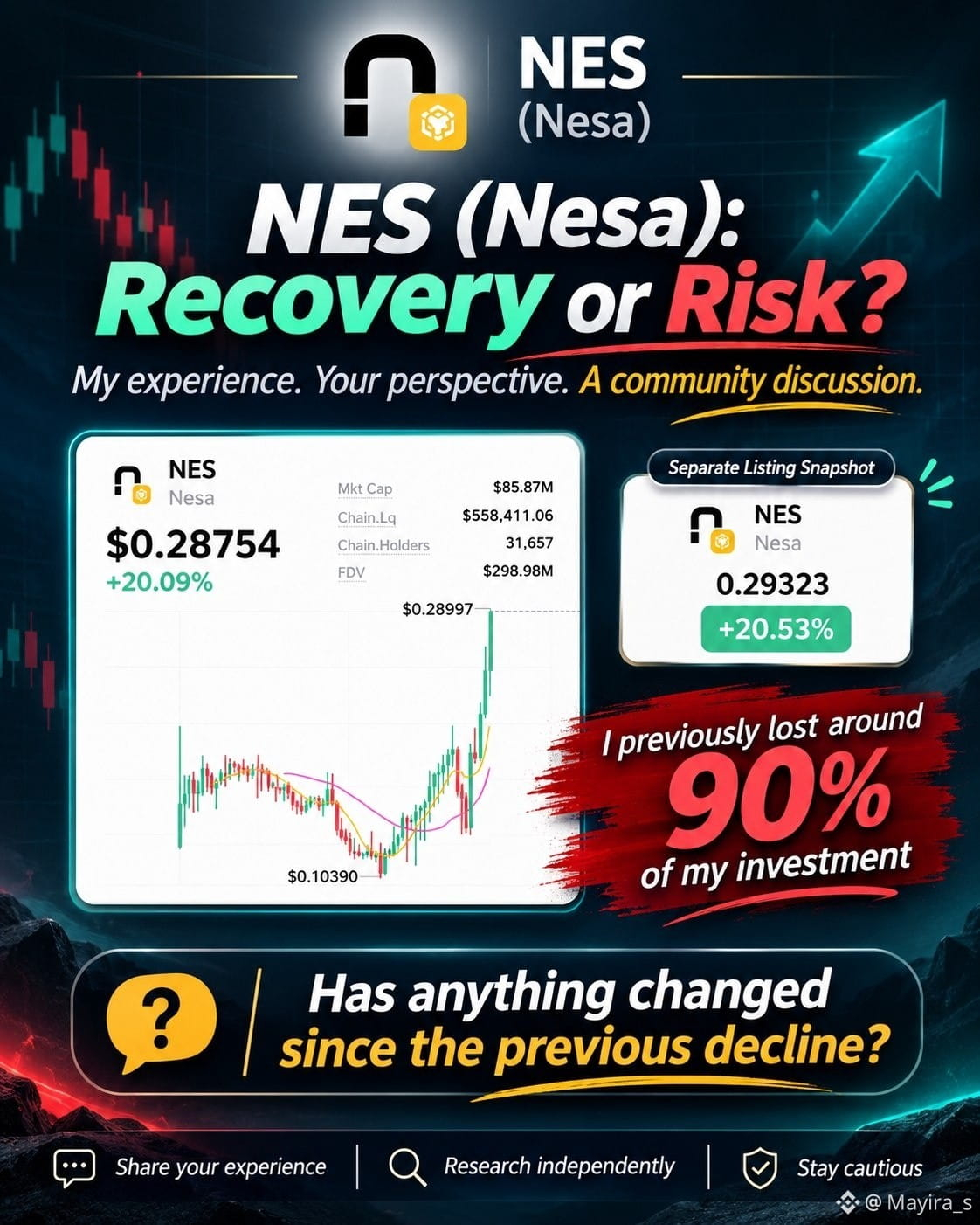
📊 Current Market Snapshot (from my screenshot):
- Price: $0.28754
- 24h Change: +20.09%
- Market Cap: $85.87M
- FDV: $298.98M
- Holders: 31,657
The chart shows a strong recovery from the previous low of around $0.10390.
But one question is still on my mind:
Could this be a sustainable recovery, or is there still a possibility of another major drop?
I'm curious to hear from those who experienced the previous decline. Did you also take a loss, and what do you think about the current movement?
I'm not spreading FUD. Just sharing my experience and trying to understand what the community thinks. ❤️
What's your honest opinion on $NES this time?
#NES #Nesa #BinanceAlpha #CryptoCommunity #dyor
$NES (Nesa) — Recovery or Another Risk? 🤔
I have a personal history with this token, and honestly, it wasn't a good one.
I bought $NES during its previous Binance Alpha listing, when I was in profit initially. But things changed dramatically, and the token experienced a massive decline. Eventually, I had to sell my holdings at around 90% loss. That experience was really disappointing.
Now, seeing $NES listed again and moving upward has caught my attention.
📊 Current Market Snapshot (from my screenshot):
- Price: $0.28754
- 24h Change: +20.09%
- Market Cap: $85.87M
- FDV: $298.98M
- Holders: 31,657
The chart shows a strong recovery from the previous low of around $0.10390.
But one question is still on my mind:
Could this be a sustainable recovery, or is there still a possibility of another major drop?
I'm curious to hear from those who experienced the previous decline. Did you also take a loss, and what do you think about the current movement?
I'm not spreading FUD. Just sharing my experience and trying to understand what the community thinks. ❤️
What's your honest opinion on $NES this time?
#NES #Nesa #BinanceAlpha #CryptoCommunity #dyor
I have a personal history with this token, and honestly, it wasn't a good one.
I bought $NES during its previous Binance Alpha listing, when I was in profit initially. But things changed dramatically, and the token experienced a massive decline. Eventually, I had to sell my holdings at around 90% loss. That experience was really disappointing.
Now, seeing $NES listed again and moving upward has caught my attention.
📊 Current Market Snapshot (from my screenshot):
- Price: $0.28754
- 24h Change: +20.09%
- Market Cap: $85.87M
- FDV: $298.98M
- Holders: 31,657
The chart shows a strong recovery from the previous low of around $0.10390.
But one question is still on my mind:
Could this be a sustainable recovery, or is there still a possibility of another major drop?
I'm curious to hear from those who experienced the previous decline. Did you also take a loss, and what do you think about the current movement?
I'm not spreading FUD. Just sharing my experience and trying to understand what the community thinks. ❤️
What's your honest opinion on $NES this time?
#NES #Nesa #BinanceAlpha #CryptoCommunity #dyor
4
333
·
--

Ra44
·
--
Bullish🦜🎁 WELCOME TO Ra44! ❤️
Hello Dear Friends! 👋
A warm welcome to all my new followers! I'm really happy to have you here. ❤️
Get ready for some fun, surprises, and exciting Red Packet Giveaways! 🎁
🦜 What's waiting for you here?
🔹 Exciting Red Packet Giveaways
🔹 Crypto & Web3 Updates
🔹 Trading Discussions
🔹 Fun Quizzes & Challenges
🔹 More Rewards and Surprises!
🎁 More Red Packets are coming soon!
Stay active, keep supporting, and stay connected so you don't miss your next chance to claim!
Thank you for being part of this journey. Let's grow together! ❤️🚀
Token Community: $BONK $KITE $CELO
#Ra44 #RedPacket #Giveaway #CryptoCommunity #CryptoRewards
Hello Dear Friends! 👋
A warm welcome to all my new followers! I'm really happy to have you here. ❤️
Get ready for some fun, surprises, and exciting Red Packet Giveaways! 🎁
🦜 What's waiting for you here?
🔹 Exciting Red Packet Giveaways
🔹 Crypto & Web3 Updates
🔹 Trading Discussions
🔹 Fun Quizzes & Challenges
🔹 More Rewards and Surprises!
🎁 More Red Packets are coming soon!
Stay active, keep supporting, and stay connected so you don't miss your next chance to claim!
Thank you for being part of this journey. Let's grow together! ❤️🚀
Token Community: $BONK $KITE $CELO
#Ra44 #RedPacket #Giveaway #CryptoCommunity #CryptoRewards

4
40
·
--
Bullish
[🎁 Another Red Packet Giveaway! ❤️](https://app.binance.com/uni-qr/cpos/389883505695660?r=RC4F7EJT&l=en&uco=KOy50KkQyAXs6w4H52dmBQ&uc=app_square_share_link&us=telegram)
Join this account's giveaway with 2,000 Slots and grab your chance to claim a Red Packet! 🎉
👉 @sfsabbir_0
🎁 Another Red Packet Giveaway! ❤️
Join this account's giveaway with 2,000 Slots and grab your chance to claim a Red Packet! 🎉
👉 @Sf_bro
Join this account's giveaway with 2,000 Slots and grab your chance to claim a Red Packet! 🎉
👉 @Sf_bro

1.2k
4
88
1.2k
·
--
Bullish
🧟♂️ $LUNC RISES FROM THE COFFIN WITH A +25% ROCKET PUMP! 🚀
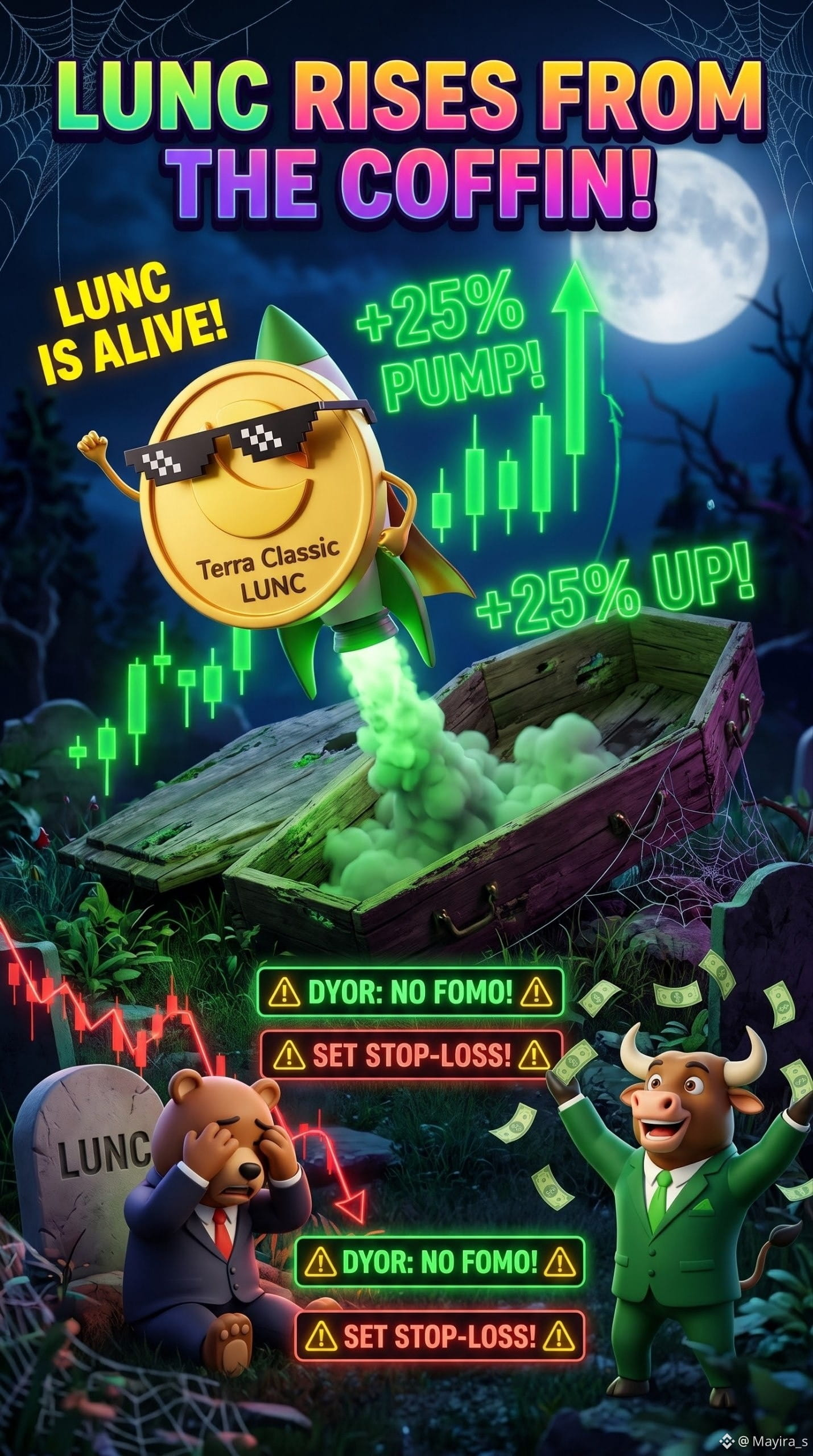
Everyone thought Terra Classic ( $LUNC ) was dead forever... until it kicked open the coffin, put on pixel sunglasses, strapped on a green rocket booster, and blasted through the roof (+25%)! 😎🔥
😭 Bears are fainting in shock!
🐂💸 Bulls are throwing cash in the air!
💡 BUT WAIT! BEFORE YOU FOMO IN
History says $LUNC pump is heavily driven by community hype, not magic! 📉
So, please DO YOUR OWN RESEARCH (DYOR)!
🚫 Avoid over-leveraging.
🚫 Don't use your rent money to buy the hype.
🚫 Set a Take-Profit & Stop-Loss to secure your hard-earned funds! Let's stay smart, not greedy. 🧠💡
Now the big debate: Can this momentum burn a zero and hit $0.0001 soon, OR are whales just pumping to dump on retail? 🤔
Drop your target and safety strategy below! 👇
🚀 $0.0001 Next OR 🛑 Whale Dump?
#LUNC #LUNCcommunity #BinanceSquare #Bullish #RiskManagement
🧟♂️ $LUNC RISES FROM THE COFFIN WITH A +25% ROCKET PUMP! 🚀
Everyone thought Terra Classic ( $LUNC ) was dead forever... until it kicked open the coffin, put on pixel sunglasses, strapped on a green rocket booster, and blasted through the roof (+25%)! 😎🔥
😭 Bears are fainting in shock!
🐂💸 Bulls are throwing cash in the air!
💡 BUT WAIT! BEFORE YOU FOMO IN
History says $LUNC pump is heavily driven by community hype, not magic! 📉
So, please DO YOUR OWN RESEARCH (DYOR)!
🚫 Avoid over-leveraging.
🚫 Don't use your rent money to buy the hype.
🚫 Set a Take-Profit & Stop-Loss to secure your hard-earned funds! Let's stay smart, not greedy. 🧠💡
Now the big debate: Can this momentum burn a zero and hit $0.0001 soon, OR are whales just pumping to dump on retail? 🤔
Drop your target and safety strategy below! 👇
🚀 $0.0001 Next OR 🛑 Whale Dump?
#LUNC #LUNCcommunity #BinanceSquare #Bullish #RiskManagement
Everyone thought Terra Classic ( $LUNC ) was dead forever... until it kicked open the coffin, put on pixel sunglasses, strapped on a green rocket booster, and blasted through the roof (+25%)! 😎🔥
😭 Bears are fainting in shock!
🐂💸 Bulls are throwing cash in the air!
💡 BUT WAIT! BEFORE YOU FOMO IN
History says $LUNC pump is heavily driven by community hype, not magic! 📉
So, please DO YOUR OWN RESEARCH (DYOR)!
🚫 Avoid over-leveraging.
🚫 Don't use your rent money to buy the hype.
🚫 Set a Take-Profit & Stop-Loss to secure your hard-earned funds! Let's stay smart, not greedy. 🧠💡
Now the big debate: Can this momentum burn a zero and hit $0.0001 soon, OR are whales just pumping to dump on retail? 🤔
Drop your target and safety strategy below! 👇
🚀 $0.0001 Next OR 🛑 Whale Dump?
#LUNC #LUNCcommunity #BinanceSquare #Bullish #RiskManagement
49
6
235
·
--
Bullish
🚀 SPOT MARKET | Smart Moves. Strong Conviction.
The real opportunity in crypto isn't about chasing every green candle — it's about recognizing the right tokens, understanding the market, and making decisions with patience. 📊
Spot trading is more than just buying a token. It's about believing in its potential, studying its fundamentals, and knowing when to make your move.
💎 Think Smart. Trade Spot. Stay Ahead.
Remember:
• Research before investing.
• Never let emotions control your decisions.
• Focus on long-term opportunities.
• Always manage your risk.
The market rewards patience, not panic. 🔥
What's your favorite spot token to watch right now? 👇
$BTC 🚀
#Binance #SpotTrading #Crypto #Altcoins #CryptoCommunity
🚀 SPOT MARKET | Smart Moves. Strong Conviction.
The real opportunity in crypto isn't about chasing every green candle — it's about recognizing the right tokens, understanding the market, and making decisions with patience. 📊
Spot trading is more than just buying a token. It's about believing in its potential, studying its fundamentals, and knowing when to make your move.
💎 Think Smart. Trade Spot. Stay Ahead.
Remember:
• Research before investing.
• Never let emotions control your decisions.
• Focus on long-term opportunities.
• Always manage your risk.
The market rewards patience, not panic. 🔥
What's your favorite spot token to watch right now? 👇
$BTC 🚀
#Binance #SpotTrading #Crypto #Altcoins #CryptoCommunity
The real opportunity in crypto isn't about chasing every green candle — it's about recognizing the right tokens, understanding the market, and making decisions with patience. 📊
Spot trading is more than just buying a token. It's about believing in its potential, studying its fundamentals, and knowing when to make your move.
💎 Think Smart. Trade Spot. Stay Ahead.
Remember:
• Research before investing.
• Never let emotions control your decisions.
• Focus on long-term opportunities.
• Always manage your risk.
The market rewards patience, not panic. 🔥
What's your favorite spot token to watch right now? 👇
$BTC 🚀
#Binance #SpotTrading #Crypto #Altcoins #CryptoCommunity
1.8k
1
85
1.8k
·
--
💚 Welcome to my little world! ✨
A heartfelt welcome to all my new followers! 🥰
So happy to have you here. Let's stay connected, spread positivity, and grow together! 💫
With love,
Mayira_s 👑💚
💚 Welcome to my little world! ✨
A heartfelt welcome to all my new followers! 🥰
So happy to have you here. Let's stay connected, spread positivity, and grow together! 💫
With love,
Mayira_s 👑💚
A heartfelt welcome to all my new followers! 🥰
So happy to have you here. Let's stay connected, spread positivity, and grow together! 💫
With love,
Mayira_s 👑💚

4
5
20
·
--
If Binance Alpha opens another Booster round, I’d love to see some fresh names in the mix.
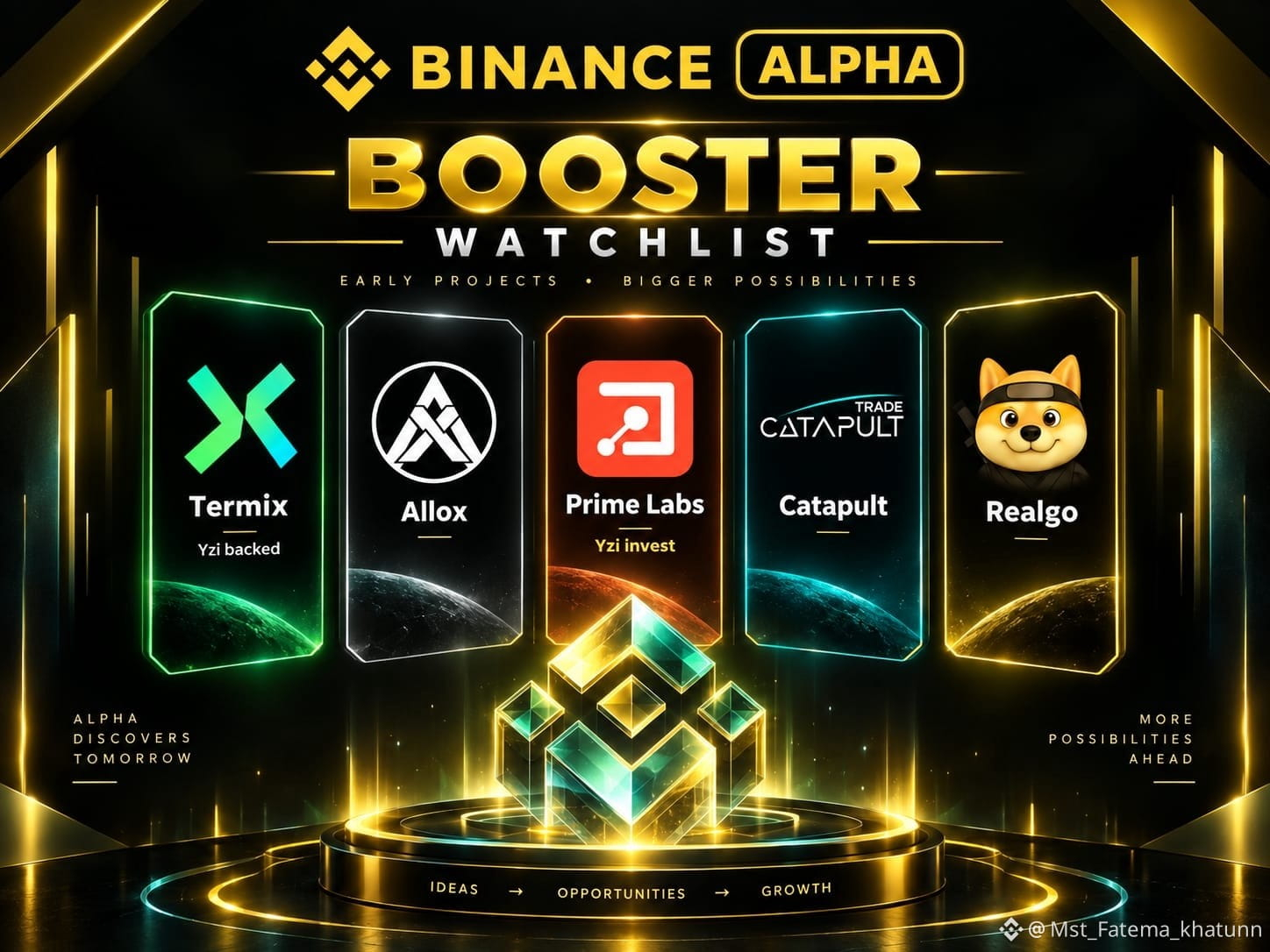
Catapult, Realgo, Termix, Prime Labs, and Allox are a few projects I’m keeping an eye on right now.
None of these are confirmed for any upcoming campaign — just a personal wishlist. I’d rather see @Binance choose projects with real activity, strong communities, and enough value to make the campaign worth joining for both traders and creators.
Would any of these make your list too? 👀
#Binance #BinanceSquare #AlphaBooster #Web3 #CryptoCommunity
If Binance Alpha opens another Booster round, I’d love to see some fresh names in the mix.
Catapult, Realgo, Termix, Prime Labs, and Allox are a few projects I’m keeping an eye on right now.
None of these are confirmed for any upcoming campaign — just a personal wishlist. I’d rather see @Binance choose projects with real activity, strong communities, and enough value to make the campaign worth joining for both traders and creators.
Would any of these make your list too? 👀
#Binance #BinanceSquare #AlphaBooster #Web3 #CryptoCommunity
Catapult, Realgo, Termix, Prime Labs, and Allox are a few projects I’m keeping an eye on right now.
None of these are confirmed for any upcoming campaign — just a personal wishlist. I’d rather see @Binance choose projects with real activity, strong communities, and enough value to make the campaign worth joining for both traders and creators.
Would any of these make your list too? 👀
#Binance #BinanceSquare #AlphaBooster #Web3 #CryptoCommunity
4
100
·
--
#dusk $DUSK @Dusk_Foundation
So what happens if you try to buy more of something than you are allowed to hold?
Until recently I would have said this is not a real situation. If you have funds and the market has supply, you buy. Any limit would be an artificial restriction bolted on by someone.
Then I looked at what regulated instruments actually require, and the situation turns out to be ordinary rather than exotic.
Some instruments carry caps. A single holder may not exceed a certain share. Certain categories of investor may only take a limited position. These limits exist in the legal documentation of the asset, and they are not optional for the issuer.
What caught my attention is where the limit has to live. If it exists only in a policy document, someone has to check it manually after the fact and unwind anything that breached it. If it exists in the asset itself, the transfer simply does not complete, and there is nothing to unwind.
That difference sounds small and is not. Prevention and remediation cost completely different amounts, and the second one usually involves lawyers.
What I cannot judge is how flexible this stays when a rule changes, since the limit written today may not be the limit required next year.
From here I stopped reading transfer restrictions as friction added to a token. Sometimes the restriction is the reason the instrument is legally allowed to exist at all.
#dusk $DUSK @Dusk
So what happens if you try to buy more of something than you are allowed to hold?
Until recently I would have said this is not a real situation. If you have funds and the market has supply, you buy. Any limit would be an artificial restriction bolted on by someone.
Then I looked at what regulated instruments actually require, and the situation turns out to be ordinary rather than exotic.
Some instruments carry caps. A single holder may not exceed a certain share. Certain categories of investor may only take a limited position. These limits exist in the legal documentation of the asset, and they are not optional for the issuer.
What caught my attention is where the limit has to live. If it exists only in a policy document, someone has to check it manually after the fact and unwind anything that breached it. If it exists in the asset itself, the transfer simply does not complete, and there is nothing to unwind.
That difference sounds small and is not. Prevention and remediation cost completely different amounts, and the second one usually involves lawyers.
What I cannot judge is how flexible this stays when a rule changes, since the limit written today may not be the limit required next year.
From here I stopped reading transfer restrictions as friction added to a token. Sometimes the restriction is the reason the instrument is legally allowed to exist at all.
So what happens if you try to buy more of something than you are allowed to hold?
Until recently I would have said this is not a real situation. If you have funds and the market has supply, you buy. Any limit would be an artificial restriction bolted on by someone.
Then I looked at what regulated instruments actually require, and the situation turns out to be ordinary rather than exotic.
Some instruments carry caps. A single holder may not exceed a certain share. Certain categories of investor may only take a limited position. These limits exist in the legal documentation of the asset, and they are not optional for the issuer.
What caught my attention is where the limit has to live. If it exists only in a policy document, someone has to check it manually after the fact and unwind anything that breached it. If it exists in the asset itself, the transfer simply does not complete, and there is nothing to unwind.
That difference sounds small and is not. Prevention and remediation cost completely different amounts, and the second one usually involves lawyers.
What I cannot judge is how flexible this stays when a rule changes, since the limit written today may not be the limit required next year.
From here I stopped reading transfer restrictions as friction added to a token. Sometimes the restriction is the reason the instrument is legally allowed to exist at all.
1
44
·
--
#dusk $DUSK @Dusk_Foundation
Earlier, I treated instant settlement as an obvious improvement. Trades that settle immediately instead of two days later, with no waiting and no counterparty risk in between. It sounded like pure progress.
Reading about how settlement actually works in existing markets changed that for me.
Traditional markets do not settle every trade individually. They collect trades over a period and net them against each other, so that a firm which bought and sold the same thing many times only moves the difference at the end. The delay everyone complains about is what makes the netting possible.
Remove the delay and you remove the netting. Every trade now settles on its own, in full, which means both sides need the full amount available at the moment of the trade rather than the net amount at the end of the day.
What I found notable is that this is a liquidity cost, not a technical one. A chain can be perfectly capable of instant settlement while the institutions using it discover they need considerably more cash sitting idle than before.
So instant settlement is not simply faster. It moves a cost from one place to another. It removes credit risk between the trade and the settlement, and it adds a funding requirement in exchange.
I do not know how that trade-off is being weighed by the institutions actually considering this, and I suspect the answer differs depending on what they trade.
From here I stopped reading settlement speed as a straightforward benefit. It is a choice about which problem you would rather have.
#dusk $DUSK @Dusk
Earlier, I treated instant settlement as an obvious improvement. Trades that settle immediately instead of two days later, with no waiting and no counterparty risk in between. It sounded like pure progress.
Reading about how settlement actually works in existing markets changed that for me.
Traditional markets do not settle every trade individually. They collect trades over a period and net them against each other, so that a firm which bought and sold the same thing many times only moves the difference at the end. The delay everyone complains about is what makes the netting possible.
Remove the delay and you remove the netting. Every trade now settles on its own, in full, which means both sides need the full amount available at the moment of the trade rather than the net amount at the end of the day.
What I found notable is that this is a liquidity cost, not a technical one. A chain can be perfectly capable of instant settlement while the institutions using it discover they need considerably more cash sitting idle than before.
So instant settlement is not simply faster. It moves a cost from one place to another. It removes credit risk between the trade and the settlement, and it adds a funding requirement in exchange.
I do not know how that trade-off is being weighed by the institutions actually considering this, and I suspect the answer differs depending on what they trade.
From here I stopped reading settlement speed as a straightforward benefit. It is a choice about which problem you would rather have.
Earlier, I treated instant settlement as an obvious improvement. Trades that settle immediately instead of two days later, with no waiting and no counterparty risk in between. It sounded like pure progress.
Reading about how settlement actually works in existing markets changed that for me.
Traditional markets do not settle every trade individually. They collect trades over a period and net them against each other, so that a firm which bought and sold the same thing many times only moves the difference at the end. The delay everyone complains about is what makes the netting possible.
Remove the delay and you remove the netting. Every trade now settles on its own, in full, which means both sides need the full amount available at the moment of the trade rather than the net amount at the end of the day.
What I found notable is that this is a liquidity cost, not a technical one. A chain can be perfectly capable of instant settlement while the institutions using it discover they need considerably more cash sitting idle than before.
So instant settlement is not simply faster. It moves a cost from one place to another. It removes credit risk between the trade and the settlement, and it adds a funding requirement in exchange.
I do not know how that trade-off is being weighed by the institutions actually considering this, and I suspect the answer differs depending on what they trade.
From here I stopped reading settlement speed as a straightforward benefit. It is a choice about which problem you would rather have.
1
40
·
--
#dusk $DUSK @Dusk_Foundation Found something in Dusk's old repositories that reframed the whole project for me.
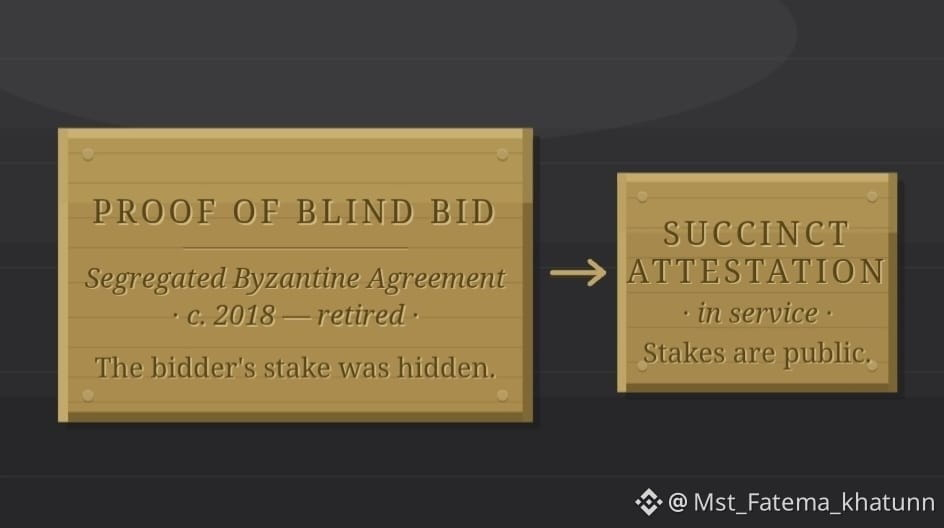
Before Succinct Attestation, Dusk's consensus was called Segregated Byzantine Agreement, and the mechanism at its heart was Proof of Blind Bid. There's still a repository named dusk-blindbidproof, described as an implementation of a privacy-oriented proof-of-stake protocol.
Read that again. A consensus design where the amount you bid — your stake — was hidden.
That is an extraordinarily consistent idea for a chain whose entire thesis is that financial information shouldn't be public by default. If you believe balances deserve confidentiality, why would a validator's balance be the exception?
Today, that's exactly what it is. Provisioner stakes are public. Committee selection is stake-weighted sortition, and the docs describe penalties in terms of reducing "effective stake used in sortition." All of it visible.
Here's my reading of why, and I want to be clear it's my reasoning rather than a Dusk statement: hidden stake fights with almost everything else you need. Slashing requires attributable misbehaviour. Verifying that a committee was selected correctly requires knowing the weights. Institutional counterparties want to know who is securing settlement. Blind bidding is elegant and it makes every one of those problems harder.
So the pragmatic choice was probably the right one. But it's still a trade: the confidentiality thesis stops at the consensus layer, and I've never seen Dusk explain that boundary publicly.
Should a privacy chain's validators be private too — or is transparent security the price of being trusted with regulated assets?
#dusk $DUSK @Dusk Found something in Dusk's old repositories that reframed the whole project for me.
Before Succinct Attestation, Dusk's consensus was called Segregated Byzantine Agreement, and the mechanism at its heart was Proof of Blind Bid. There's still a repository named dusk-blindbidproof, described as an implementation of a privacy-oriented proof-of-stake protocol.
Read that again. A consensus design where the amount you bid — your stake — was hidden.
That is an extraordinarily consistent idea for a chain whose entire thesis is that financial information shouldn't be public by default. If you believe balances deserve confidentiality, why would a validator's balance be the exception?
Today, that's exactly what it is. Provisioner stakes are public. Committee selection is stake-weighted sortition, and the docs describe penalties in terms of reducing "effective stake used in sortition." All of it visible.
Here's my reading of why, and I want to be clear it's my reasoning rather than a Dusk statement: hidden stake fights with almost everything else you need. Slashing requires attributable misbehaviour. Verifying that a committee was selected correctly requires knowing the weights. Institutional counterparties want to know who is securing settlement. Blind bidding is elegant and it makes every one of those problems harder.
So the pragmatic choice was probably the right one. But it's still a trade: the confidentiality thesis stops at the consensus layer, and I've never seen Dusk explain that boundary publicly.
Should a privacy chain's validators be private too — or is transparent security the price of being trusted with regulated assets?
Before Succinct Attestation, Dusk's consensus was called Segregated Byzantine Agreement, and the mechanism at its heart was Proof of Blind Bid. There's still a repository named dusk-blindbidproof, described as an implementation of a privacy-oriented proof-of-stake protocol.
Read that again. A consensus design where the amount you bid — your stake — was hidden.
That is an extraordinarily consistent idea for a chain whose entire thesis is that financial information shouldn't be public by default. If you believe balances deserve confidentiality, why would a validator's balance be the exception?
Today, that's exactly what it is. Provisioner stakes are public. Committee selection is stake-weighted sortition, and the docs describe penalties in terms of reducing "effective stake used in sortition." All of it visible.
Here's my reading of why, and I want to be clear it's my reasoning rather than a Dusk statement: hidden stake fights with almost everything else you need. Slashing requires attributable misbehaviour. Verifying that a committee was selected correctly requires knowing the weights. Institutional counterparties want to know who is securing settlement. Blind bidding is elegant and it makes every one of those problems harder.
So the pragmatic choice was probably the right one. But it's still a trade: the confidentiality thesis stops at the consensus layer, and I've never seen Dusk explain that boundary publicly.
Should a privacy chain's validators be private too — or is transparent security the price of being trusted with regulated assets?
101
·
--
After a few weeks of scrolling Dusk discussions across Twitter, Discord and Telegram, one thing kept standing out.
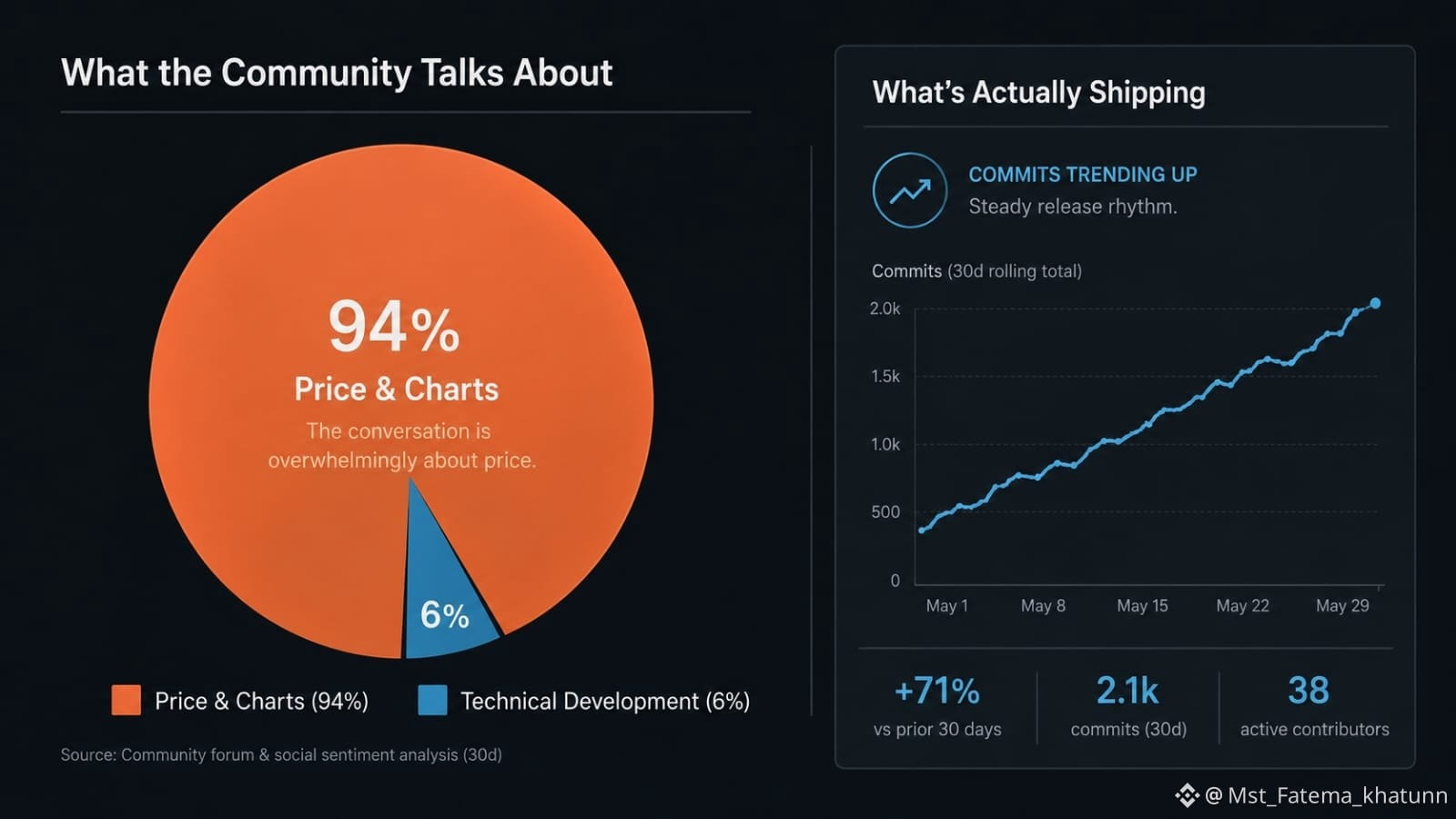
Most of what I saw was about price: charts, breakouts, targets, whether DUSK was about to move.
Then I opened the GitHub.
That was a very different picture.
Dusk has publicly described its development around a three-week release cycle, with active repositories and commit histories running into the hundreds across different parts of the stack.
The gap made me wonder what actually matters more.
Maybe it is harmless. Markets talk about price. Builders build. If the product team keeps shipping regardless of what dominates community chat, maybe nothing is wrong.
But there is another possibility: the technology is progressing faster than the developer ecosystem around it.
That would be a bigger problem.
A chain does not become useful because the core team keeps releasing code. It becomes useful when outside developers choose to build apps, businesses and infrastructure on top of it.
Dusk has developer tooling, documentation and a grants program. The harder question is whether those are creating enough pull.
Good technology alone does not grow an ecosystem.
Builders need usable tools, funding, distribution, users and a real reason to spend months building here instead of somewhere else.
If most community attention stays fixed on the token while the builder base remains small, eventually the gap between “technology” and “usage” matters more than another release.
So I am not convinced the price-heavy conversation is meaningless.
Is price talk simply normal community behaviour — or does it show that Dusk's real utility narrative still hasn't reached most people yet?
#dusk $DUSK @Dusk_Foundation
After a few weeks of scrolling Dusk discussions across Twitter, Discord and Telegram, one thing kept standing out.
Most of what I saw was about price: charts, breakouts, targets, whether DUSK was about to move.
Then I opened the GitHub.
That was a very different picture.
Dusk has publicly described its development around a three-week release cycle, with active repositories and commit histories running into the hundreds across different parts of the stack.
The gap made me wonder what actually matters more.
Maybe it is harmless. Markets talk about price. Builders build. If the product team keeps shipping regardless of what dominates community chat, maybe nothing is wrong.
But there is another possibility: the technology is progressing faster than the developer ecosystem around it.
That would be a bigger problem.
A chain does not become useful because the core team keeps releasing code. It becomes useful when outside developers choose to build apps, businesses and infrastructure on top of it.
Dusk has developer tooling, documentation and a grants program. The harder question is whether those are creating enough pull.
Good technology alone does not grow an ecosystem.
Builders need usable tools, funding, distribution, users and a real reason to spend months building here instead of somewhere else.
If most community attention stays fixed on the token while the builder base remains small, eventually the gap between “technology” and “usage” matters more than another release.
So I am not convinced the price-heavy conversation is meaningless.
Is price talk simply normal community behaviour — or does it show that Dusk's real utility narrative still hasn't reached most people yet?
#dusk $DUSK @Dusk
Most of what I saw was about price: charts, breakouts, targets, whether DUSK was about to move.
Then I opened the GitHub.
That was a very different picture.
Dusk has publicly described its development around a three-week release cycle, with active repositories and commit histories running into the hundreds across different parts of the stack.
The gap made me wonder what actually matters more.
Maybe it is harmless. Markets talk about price. Builders build. If the product team keeps shipping regardless of what dominates community chat, maybe nothing is wrong.
But there is another possibility: the technology is progressing faster than the developer ecosystem around it.
That would be a bigger problem.
A chain does not become useful because the core team keeps releasing code. It becomes useful when outside developers choose to build apps, businesses and infrastructure on top of it.
Dusk has developer tooling, documentation and a grants program. The harder question is whether those are creating enough pull.
Good technology alone does not grow an ecosystem.
Builders need usable tools, funding, distribution, users and a real reason to spend months building here instead of somewhere else.
If most community attention stays fixed on the token while the builder base remains small, eventually the gap between “technology” and “usage” matters more than another release.
So I am not convinced the price-heavy conversation is meaningless.
Is price talk simply normal community behaviour — or does it show that Dusk's real utility narrative still hasn't reached most people yet?
#dusk $DUSK @Dusk
1
1
32
·
--
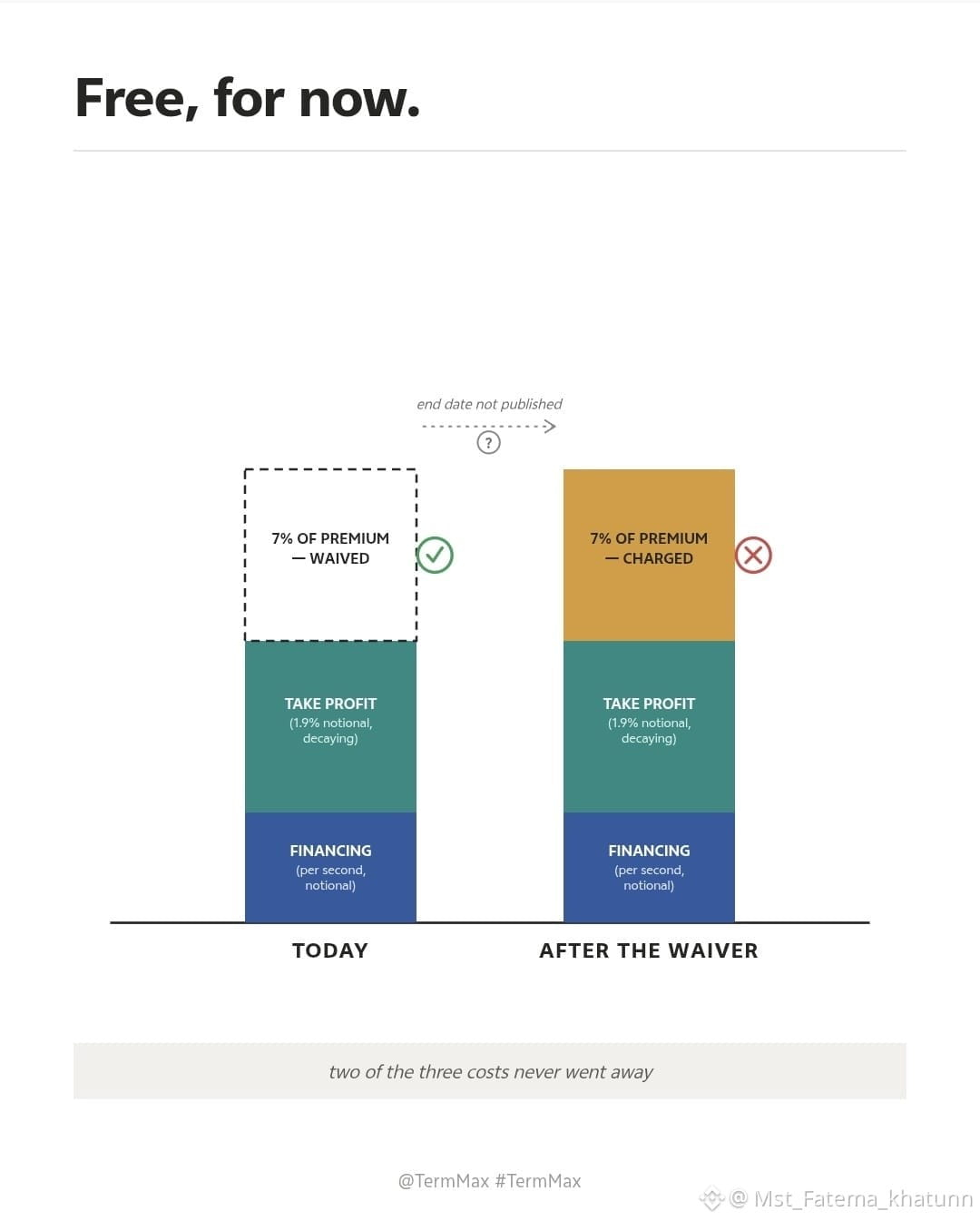
TermMax's Alpha fee page lists a 7% transaction fee on the premium paid, charged on opening and on closing an option.
Then, in the summary, a parenthetical: fee-free during the alpha boosting program.
So the headline cost of trading Alpha options right now is zero — temporarily.
That single word changes how you read every Alpha metric being quoted this month. The activity is happening under promotional pricing. The real test arrives when the waiver lifts and 7% of premium starts landing on both legs of every trade.
Worth being precise, though: traders today are not trading for free. They're trading with the smallest of three costs removed.
The take-profit fee is still charged, on notional rather than premium, starting at 1.9% and decaying linearly toward maturity. And financing still accrues per second on notional at the AMM rate.
So the waived fee is the visible one. The two that scale with position size and holding time are both still running.
Credit where it's due — this is disclosed in the fee documentation itself, sitting directly beside the full schedule, rather than buried in a campaign banner somewhere. That's the right place for it.
What I couldn't find anywhere is the end date of the boosting program. Without that, nobody can tell you when the comparison becomes meaningful, or how much notice traders will get.
This isn't a TermMax-specific point, honestly. It applies to every incentive-era number in this industry. Volume under a waiver measures how attractive free is. Volume after it measures the product.
When the fee comes back, how much of the current activity do you think survives?
#termmax @termmax
TermMax's Alpha fee page lists a 7% transaction fee on the premium paid, charged on opening and on closing an option.
Then, in the summary, a parenthetical: fee-free during the alpha boosting program.
So the headline cost of trading Alpha options right now is zero — temporarily.
That single word changes how you read every Alpha metric being quoted this month. The activity is happening under promotional pricing. The real test arrives when the waiver lifts and 7% of premium starts landing on both legs of every trade.
Worth being precise, though: traders today are not trading for free. They're trading with the smallest of three costs removed.
The take-profit fee is still charged, on notional rather than premium, starting at 1.9% and decaying linearly toward maturity. And financing still accrues per second on notional at the AMM rate.
So the waived fee is the visible one. The two that scale with position size and holding time are both still running.
Credit where it's due — this is disclosed in the fee documentation itself, sitting directly beside the full schedule, rather than buried in a campaign banner somewhere. That's the right place for it.
What I couldn't find anywhere is the end date of the boosting program. Without that, nobody can tell you when the comparison becomes meaningful, or how much notice traders will get.
This isn't a TermMax-specific point, honestly. It applies to every incentive-era number in this industry. Volume under a waiver measures how attractive free is. Volume after it measures the product.
When the fee comes back, how much of the current activity do you think survives?
#termmax @TermMax
Then, in the summary, a parenthetical: fee-free during the alpha boosting program.
So the headline cost of trading Alpha options right now is zero — temporarily.
That single word changes how you read every Alpha metric being quoted this month. The activity is happening under promotional pricing. The real test arrives when the waiver lifts and 7% of premium starts landing on both legs of every trade.
Worth being precise, though: traders today are not trading for free. They're trading with the smallest of three costs removed.
The take-profit fee is still charged, on notional rather than premium, starting at 1.9% and decaying linearly toward maturity. And financing still accrues per second on notional at the AMM rate.
So the waived fee is the visible one. The two that scale with position size and holding time are both still running.
Credit where it's due — this is disclosed in the fee documentation itself, sitting directly beside the full schedule, rather than buried in a campaign banner somewhere. That's the right place for it.
What I couldn't find anywhere is the end date of the boosting program. Without that, nobody can tell you when the comparison becomes meaningful, or how much notice traders will get.
This isn't a TermMax-specific point, honestly. It applies to every incentive-era number in this industry. Volume under a waiver measures how attractive free is. Volume after it measures the product.
When the fee comes back, how much of the current activity do you think survives?
#termmax @TermMax
88
·
--
"Atomic settlement" is one of the most repeated phrases in tokenization, and it quietly hides how much has to be true for it to mean anything.
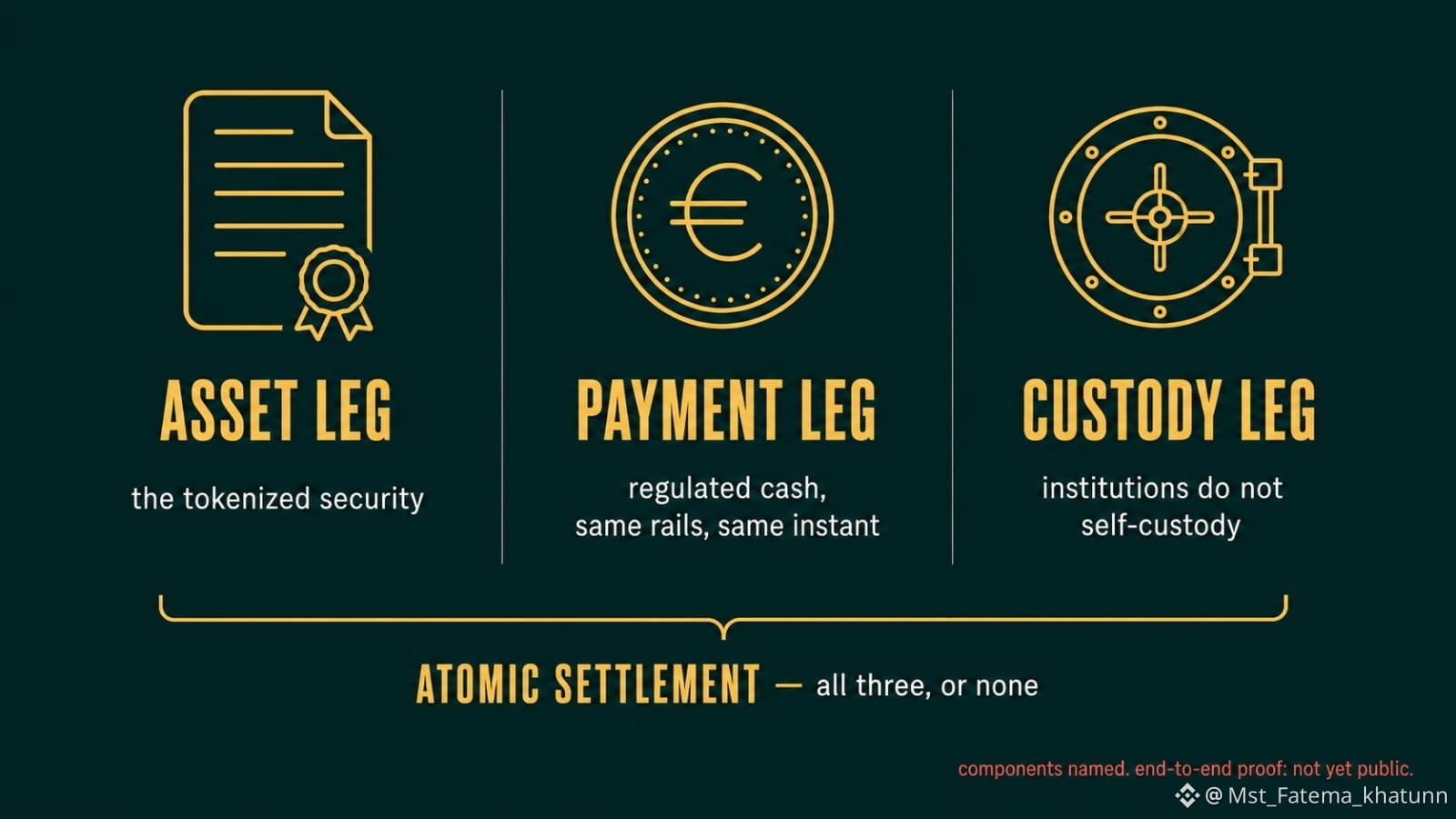
Atomic settlement means the asset leg and the payment leg move together, or neither moves. That's it. And the moment you say it out loud, you need three things on the same rails, not one.
An asset leg. That's the tokenized security, and it's the part crypto is genuinely good at.
A payment leg. Cash has to settle at the same instant, on the same infrastructure, in a form a regulated venue can legally accept. This is why @Dusk_Foundation 's partnership with Quantoz for a regulated euro stablecoin matters more than its announcement traffic suggested. Without a compliant cash leg, "atomic DvP" collapses back into a token transfer and a bank wire that clear on different days — which is exactly the reconciliation problem tokenization was supposed to delete.
A custody leg. Institutions do not self-custody bearer instruments. That's the Cordial Systems piece, and it's the least discussed of the three.
What I find genuinely interesting is that all three arrived within about a week of each other in February 2025 — the stablecoin, then the custody partner. That reads like a deliberate sequence rather than opportunistic announcements: assemble the legs before claiming the settlement.
The honest gap: I can see the components named. I can't see public evidence of the three legs settling a live transaction end to end. That's the milestone I'd actually mark on a calendar.
For the RWA watchers — which leg do you think breaks first at real volume: asset, cash, or custody?
#dusk $DUSK @Dusk_Foundation
"Atomic settlement" is one of the most repeated phrases in tokenization, and it quietly hides how much has to be true for it to mean anything.
Atomic settlement means the asset leg and the payment leg move together, or neither moves. That's it. And the moment you say it out loud, you need three things on the same rails, not one.
An asset leg. That's the tokenized security, and it's the part crypto is genuinely good at.
A payment leg. Cash has to settle at the same instant, on the same infrastructure, in a form a regulated venue can legally accept. This is why @Dusk 's partnership with Quantoz for a regulated euro stablecoin matters more than its announcement traffic suggested. Without a compliant cash leg, "atomic DvP" collapses back into a token transfer and a bank wire that clear on different days — which is exactly the reconciliation problem tokenization was supposed to delete.
A custody leg. Institutions do not self-custody bearer instruments. That's the Cordial Systems piece, and it's the least discussed of the three.
What I find genuinely interesting is that all three arrived within about a week of each other in February 2025 — the stablecoin, then the custody partner. That reads like a deliberate sequence rather than opportunistic announcements: assemble the legs before claiming the settlement.
The honest gap: I can see the components named. I can't see public evidence of the three legs settling a live transaction end to end. That's the milestone I'd actually mark on a calendar.
For the RWA watchers — which leg do you think breaks first at real volume: asset, cash, or custody?
#dusk $DUSK @Dusk
Atomic settlement means the asset leg and the payment leg move together, or neither moves. That's it. And the moment you say it out loud, you need three things on the same rails, not one.
An asset leg. That's the tokenized security, and it's the part crypto is genuinely good at.
A payment leg. Cash has to settle at the same instant, on the same infrastructure, in a form a regulated venue can legally accept. This is why @Dusk 's partnership with Quantoz for a regulated euro stablecoin matters more than its announcement traffic suggested. Without a compliant cash leg, "atomic DvP" collapses back into a token transfer and a bank wire that clear on different days — which is exactly the reconciliation problem tokenization was supposed to delete.
A custody leg. Institutions do not self-custody bearer instruments. That's the Cordial Systems piece, and it's the least discussed of the three.
What I find genuinely interesting is that all three arrived within about a week of each other in February 2025 — the stablecoin, then the custody partner. That reads like a deliberate sequence rather than opportunistic announcements: assemble the legs before claiming the settlement.
The honest gap: I can see the components named. I can't see public evidence of the three legs settling a live transaction end to end. That's the milestone I'd actually mark on a calendar.
For the RWA watchers — which leg do you think breaks first at real volume: asset, cash, or custody?
#dusk $DUSK @Dusk
45
·
--
Verified
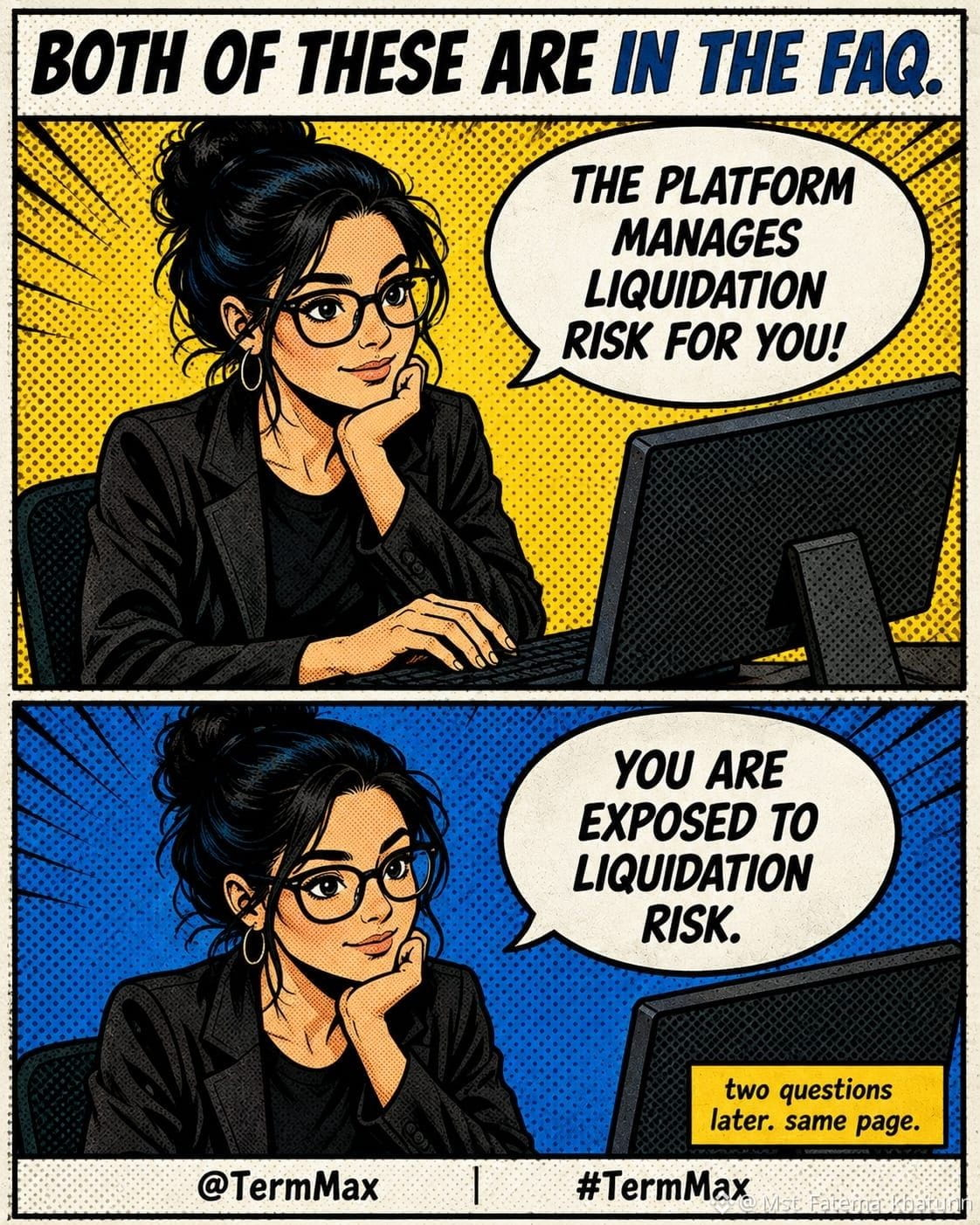
Two questions apart in the same FAQ, TermMax says opposite things.
The first: buying a Gearing Token lets you benefit from higher potential yields "while the platform manages liquidation risks for you."
The very next entry: as a GT holder you're exposed to liquidation risk, and if your collateral drops significantly your position could be liquidated.
The second one is the accurate one. The protocol has a liquidation engine — LLTV thresholds, liquidators, penalties, physical delivery. That's machinery for processing liquidations in an orderly way. It isn't machinery for absorbing them on your behalf.
The first sentence is marketing language sitting inside a technical document, and someone skimming an FAQ before their first leveraged position could reasonably come away with the wrong idea about who carries the risk.
It's a small fix. It's worth making, because the FAQ is what beginners read and the mechanics pages are what they don't.
How much of what you believe about a protocol came from its FAQ rather than its mechanics?
#termmax @termmax
Two questions apart in the same FAQ, TermMax says opposite things.
The first: buying a Gearing Token lets you benefit from higher potential yields "while the platform manages liquidation risks for you."
The very next entry: as a GT holder you're exposed to liquidation risk, and if your collateral drops significantly your position could be liquidated.
The second one is the accurate one. The protocol has a liquidation engine — LLTV thresholds, liquidators, penalties, physical delivery. That's machinery for processing liquidations in an orderly way. It isn't machinery for absorbing them on your behalf.
The first sentence is marketing language sitting inside a technical document, and someone skimming an FAQ before their first leveraged position could reasonably come away with the wrong idea about who carries the risk.
It's a small fix. It's worth making, because the FAQ is what beginners read and the mechanics pages are what they don't.
How much of what you believe about a protocol came from its FAQ rather than its mechanics?
#termmax @TermMax
The first: buying a Gearing Token lets you benefit from higher potential yields "while the platform manages liquidation risks for you."
The very next entry: as a GT holder you're exposed to liquidation risk, and if your collateral drops significantly your position could be liquidated.
The second one is the accurate one. The protocol has a liquidation engine — LLTV thresholds, liquidators, penalties, physical delivery. That's machinery for processing liquidations in an orderly way. It isn't machinery for absorbing them on your behalf.
The first sentence is marketing language sitting inside a technical document, and someone skimming an FAQ before their first leveraged position could reasonably come away with the wrong idea about who carries the risk.
It's a small fix. It's worth making, because the FAQ is what beginners read and the mechanics pages are what they don't.
How much of what you believe about a protocol came from its FAQ rather than its mechanics?
#termmax @TermMax
2
2
81
·
--
Something small has been bothering me since I started reading how Dusk generates proofs.
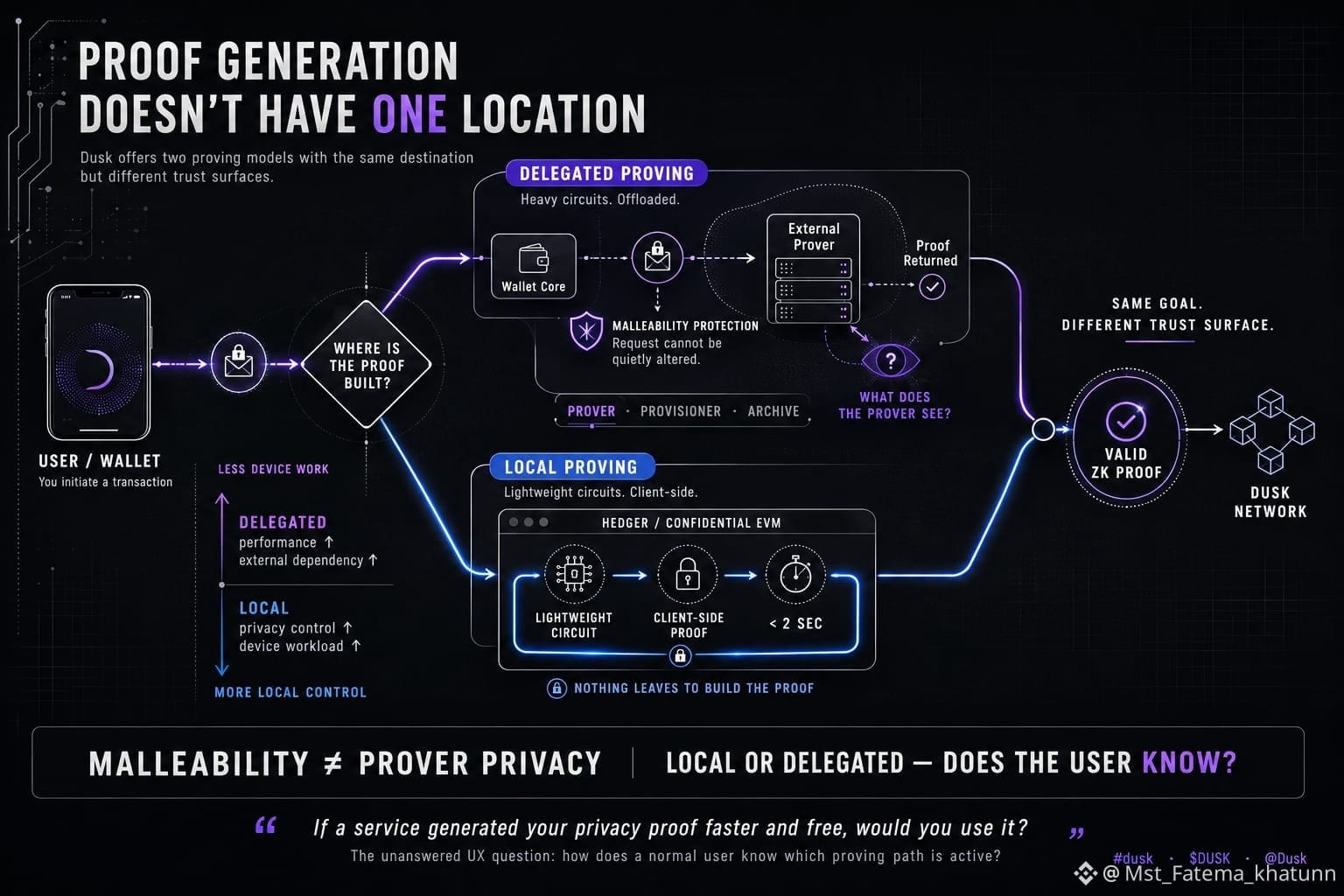
Zero-knowledge proving is expensive. Your phone doesn't want to do it. So Dusk gives you a way out: wallet-core supports delegating proof generation to an external Prover, and Prover is a documented node type you can actually run, alongside Provisioner and Archive.
That's a sensible engineering answer. The engineering update that introduced it specifically mentions the delegation is designed to avoid malleability, so the prover can't quietly alter what you asked for.
But delegation always answers one question and opens another. Malleability is about whether the prover can change your transaction. It isn't the same question as what the prover gets to see while building the proof for you.
Now put Hedger next to it. Hedger's pitch for the EVM side goes the other direction entirely — lightweight circuits, client-side proof generation in under two seconds, in the browser. No third machine involved.
So @Dusk_Foundation has both shapes in the same stack. A delegated proving path for heavy native circuits, and a local proving path for the confidential EVM layer.
I don't think either is wrong. Local proving is cleaner for privacy and worse for weak devices. Delegated proving is the opposite. Most chains just pick one and stop talking about it.
What I can't tell yet from the docs is how a normal user is supposed to know which one they're using at any given moment. That's the part I'd want spelled out before a bank puts a client on it.
If a service offered to generate your privacy proof for you, faster and free — would you use it, or would that defeat the point for you?
#dusk $DUSK @Dusk_Foundation
Something small has been bothering me since I started reading how Dusk generates proofs.
Zero-knowledge proving is expensive. Your phone doesn't want to do it. So Dusk gives you a way out: wallet-core supports delegating proof generation to an external Prover, and Prover is a documented node type you can actually run, alongside Provisioner and Archive.
That's a sensible engineering answer. The engineering update that introduced it specifically mentions the delegation is designed to avoid malleability, so the prover can't quietly alter what you asked for.
But delegation always answers one question and opens another. Malleability is about whether the prover can change your transaction. It isn't the same question as what the prover gets to see while building the proof for you.
Now put Hedger next to it. Hedger's pitch for the EVM side goes the other direction entirely — lightweight circuits, client-side proof generation in under two seconds, in the browser. No third machine involved.
So @Dusk has both shapes in the same stack. A delegated proving path for heavy native circuits, and a local proving path for the confidential EVM layer.
I don't think either is wrong. Local proving is cleaner for privacy and worse for weak devices. Delegated proving is the opposite. Most chains just pick one and stop talking about it.
What I can't tell yet from the docs is how a normal user is supposed to know which one they're using at any given moment. That's the part I'd want spelled out before a bank puts a client on it.
If a service offered to generate your privacy proof for you, faster and free — would you use it, or would that defeat the point for you?
#dusk $DUSK @Dusk
Zero-knowledge proving is expensive. Your phone doesn't want to do it. So Dusk gives you a way out: wallet-core supports delegating proof generation to an external Prover, and Prover is a documented node type you can actually run, alongside Provisioner and Archive.
That's a sensible engineering answer. The engineering update that introduced it specifically mentions the delegation is designed to avoid malleability, so the prover can't quietly alter what you asked for.
But delegation always answers one question and opens another. Malleability is about whether the prover can change your transaction. It isn't the same question as what the prover gets to see while building the proof for you.
Now put Hedger next to it. Hedger's pitch for the EVM side goes the other direction entirely — lightweight circuits, client-side proof generation in under two seconds, in the browser. No third machine involved.
So @Dusk has both shapes in the same stack. A delegated proving path for heavy native circuits, and a local proving path for the confidential EVM layer.
I don't think either is wrong. Local proving is cleaner for privacy and worse for weak devices. Delegated proving is the opposite. Most chains just pick one and stop talking about it.
What I can't tell yet from the docs is how a normal user is supposed to know which one they're using at any given moment. That's the part I'd want spelled out before a bank puts a client on it.
If a service offered to generate your privacy proof for you, faster and free — would you use it, or would that defeat the point for you?
#dusk $DUSK @Dusk
26
·
--
I tried to check the interest formula and got zero
Not a small number. Zero.
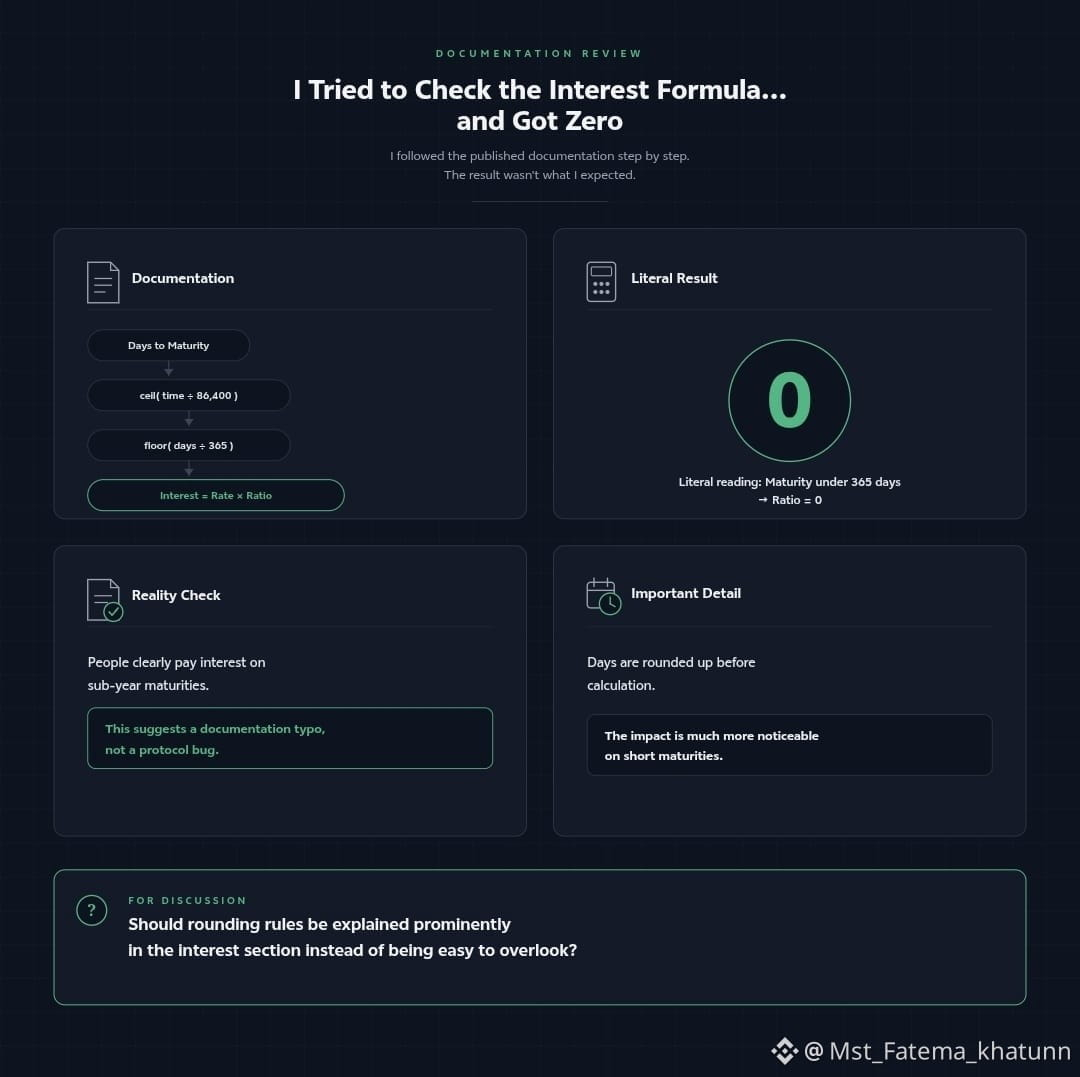
The market page defines days to maturity as the ceiling of the time difference divided by 86,400. Then the time ratio as the floor of days divided by 365. Then interest as rate times that ratio.
Take it literally. Any maturity under 365 days makes floor(days/365) equal zero, so interest equals zero.
Obviously that isn't what the contracts do — people are paying interest today on sub-year maturities. It's a typo in the published formula, a floor where none belongs. I'm flagging it as a docs bug, not a protocol bug.
But the same block contains something that isn't a typo. Days are rounded up. Get matched one hour before a day boundary and you're charged as though a full extra day passed.
On a 365-day position that's noise. On a 7-day position it's over a tenth of the term.
Does a rounding rule like that belong in the interest section, or is it fine as fine print?
#termmax @termmax
I tried to check the interest formula and got zero
Not a small number. Zero.
The market page defines days to maturity as the ceiling of the time difference divided by 86,400. Then the time ratio as the floor of days divided by 365. Then interest as rate times that ratio.
Take it literally. Any maturity under 365 days makes floor(days/365) equal zero, so interest equals zero.
Obviously that isn't what the contracts do — people are paying interest today on sub-year maturities. It's a typo in the published formula, a floor where none belongs. I'm flagging it as a docs bug, not a protocol bug.
But the same block contains something that isn't a typo. Days are rounded up. Get matched one hour before a day boundary and you're charged as though a full extra day passed.
On a 365-day position that's noise. On a 7-day position it's over a tenth of the term.
Does a rounding rule like that belong in the interest section, or is it fine as fine print?
#termmax @TermMax
Not a small number. Zero.
The market page defines days to maturity as the ceiling of the time difference divided by 86,400. Then the time ratio as the floor of days divided by 365. Then interest as rate times that ratio.
Take it literally. Any maturity under 365 days makes floor(days/365) equal zero, so interest equals zero.
Obviously that isn't what the contracts do — people are paying interest today on sub-year maturities. It's a typo in the published formula, a floor where none belongs. I'm flagging it as a docs bug, not a protocol bug.
But the same block contains something that isn't a typo. Days are rounded up. Get matched one hour before a day boundary and you're charged as though a full extra day passed.
On a 365-day position that's noise. On a 7-day position it's over a tenth of the term.
Does a rounding rule like that belong in the interest section, or is it fine as fine print?
#termmax @TermMax
99
·
--
I got Citadel wrong. I assumed it was on-chain KYC — verify once, a badge gets stamped on your wallet address, and every app reads that badge before letting you in. Then I hit one line in $DUSK ' s docs and had to rewrite my notes: Citadel proves a session is cryptographically valid, but it does not decide service policy. (DOCS)
Here is the actual flow. You ask a License Provider — a firm allowed to handle your documents — for a license, which is just a private credential. The LP checks you off-chain, signs the attribute data, publishes an encrypted license, and registers it in a Citadel contract. (DOCS) Later, when you want access to something, you generate a zero-knowledge proof that you hold a registered, LP-signed license — without revealing which one. (DOCS) The contract verifies the proof and records a public session. (DOCS) You then hand a session cookie — a short value showing the license was used correctly — to the Service Provider.
The docs are precise about what never lands on-chain: not your wallet key, not the license used, not the LP or SP key, not the signed attributes, not the Merkle path (DOCS) that would reveal where your license sits in the registered set.
The limit is stated just as plainly. The SP still chooses which LPs it trusts, which attributes are accepted, whether a session is expired or revoked, and whether a cookie can be reused. (DOCS) The trust question does not disappear; it moves off the ledger and into a policy decision made inside a company. The full JavaScript SDK is still listed as coming soon, (DOCS) so today the developer surface is Rust plus a CLI wallet.
I think moving policy off-chain is probably correct — regulation changes faster than deployed contracts do. But then "trustless compliance" is a slogan, not a description.
So where should the accreditation decision live:) in the contract, or with the venue? And which of the two would you rather have making it?
#dusk @Dusk_Foundation $DOCS.US
I got Citadel wrong. I assumed it was on-chain KYC — verify once, a badge gets stamped on your wallet address, and every app reads that badge before letting you in. Then I hit one line in $DUSK ' s docs and had to rewrite my notes: Citadel proves a session is cryptographically valid, but it does not decide service policy. (DOCS)
Here is the actual flow. You ask a License Provider — a firm allowed to handle your documents — for a license, which is just a private credential. The LP checks you off-chain, signs the attribute data, publishes an encrypted license, and registers it in a Citadel contract. (DOCS) Later, when you want access to something, you generate a zero-knowledge proof that you hold a registered, LP-signed license — without revealing which one. (DOCS) The contract verifies the proof and records a public session. (DOCS) You then hand a session cookie — a short value showing the license was used correctly — to the Service Provider.
The docs are precise about what never lands on-chain: not your wallet key, not the license used, not the LP or SP key, not the signed attributes, not the Merkle path (DOCS) that would reveal where your license sits in the registered set.
The limit is stated just as plainly. The SP still chooses which LPs it trusts, which attributes are accepted, whether a session is expired or revoked, and whether a cookie can be reused. (DOCS) The trust question does not disappear; it moves off the ledger and into a policy decision made inside a company. The full JavaScript SDK is still listed as coming soon, (DOCS) so today the developer surface is Rust plus a CLI wallet.
I think moving policy off-chain is probably correct — regulation changes faster than deployed contracts do. But then "trustless compliance" is a slogan, not a description.
So where should the accreditation decision live:) in the contract, or with the venue? And which of the two would you rather have making it?
#dusk @Dusk $DOCS.US
Here is the actual flow. You ask a License Provider — a firm allowed to handle your documents — for a license, which is just a private credential. The LP checks you off-chain, signs the attribute data, publishes an encrypted license, and registers it in a Citadel contract. (DOCS) Later, when you want access to something, you generate a zero-knowledge proof that you hold a registered, LP-signed license — without revealing which one. (DOCS) The contract verifies the proof and records a public session. (DOCS) You then hand a session cookie — a short value showing the license was used correctly — to the Service Provider.
The docs are precise about what never lands on-chain: not your wallet key, not the license used, not the LP or SP key, not the signed attributes, not the Merkle path (DOCS) that would reveal where your license sits in the registered set.
The limit is stated just as plainly. The SP still chooses which LPs it trusts, which attributes are accepted, whether a session is expired or revoked, and whether a cookie can be reused. (DOCS) The trust question does not disappear; it moves off the ledger and into a policy decision made inside a company. The full JavaScript SDK is still listed as coming soon, (DOCS) so today the developer surface is Rust plus a CLI wallet.
I think moving policy off-chain is probably correct — regulation changes faster than deployed contracts do. But then "trustless compliance" is a slogan, not a description.
So where should the accreditation decision live:) in the contract, or with the venue? And which of the two would you rather have making it?
#dusk @Dusk $DOCS.US

DUSK+4.40%
DOCSUS-1.52%
2
4
115
·
--
Verified
I didn't notice I was making this assumption until I saw it contradicted in writing: that "withdraw" from a vault means getting back the exact asset I put in. TermMax's own risk documentation says that isn't guaranteed.
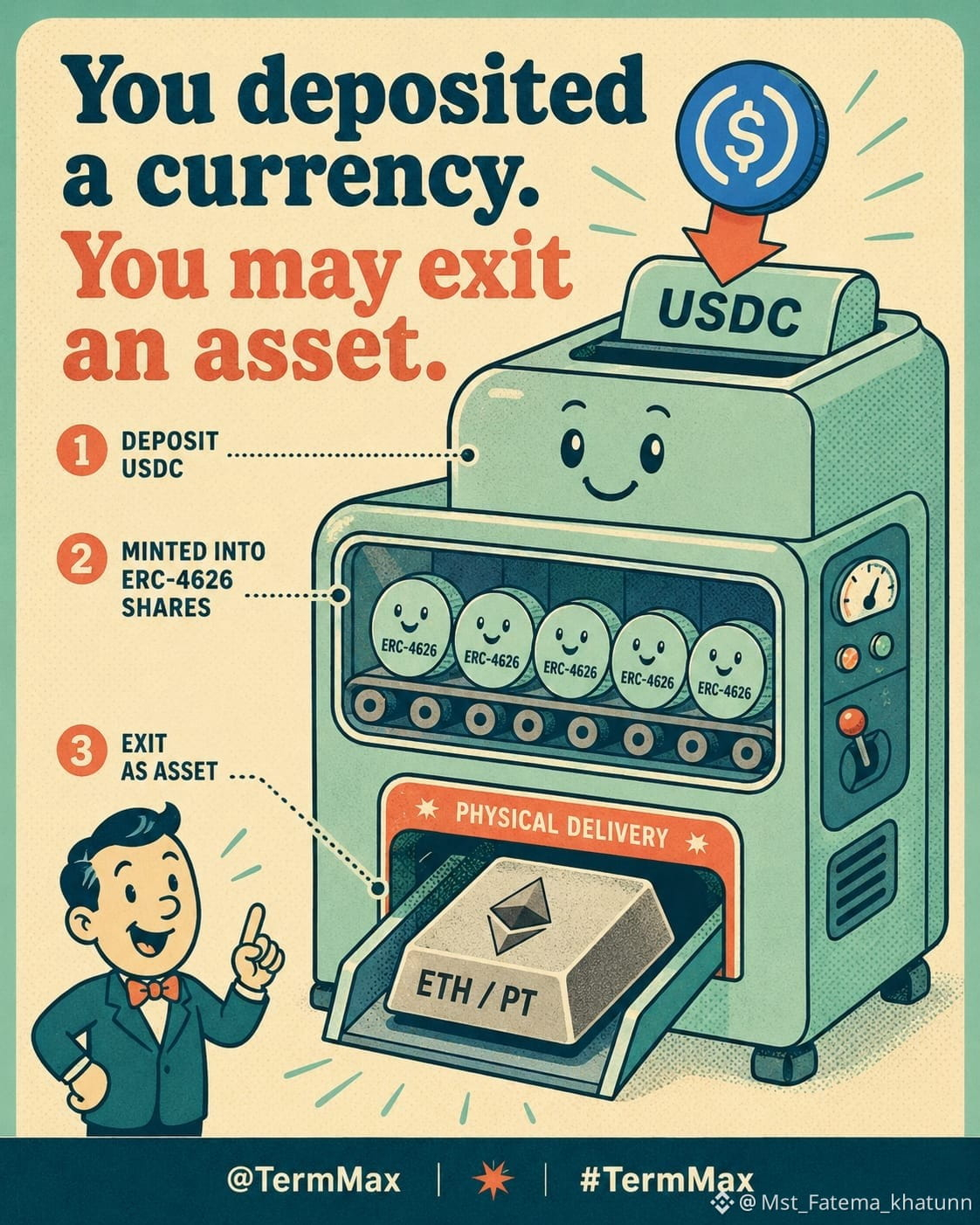
Here's the mechanism. A vault is denominated in one debt token, say USDC, and issues ERC-4626 shares against it. If a market the vault was exposed to has a loan that doesn't get fully liquidated, physical delivery kicks in and the underlying collateral — ETH, a PT token, whatever it was — lands in the vault instead of cash. If available liquidity is thin when you try to exit, the docs say you can wait for incoming liquidity, or burn your vault share to claim that delivered collateral directly. Either way, "withdraw" can mean something other than what you deposited.
What strikes me is where this lives. It's stated plainly on TermMax's risk page. It doesn't show up in the language most vault products use to describe themselves, including earlier @termmax copy promising withdrawals "anytime." Disclosure and marketing are reading from different scripts.
The risk didn't disappear when the vault absorbed it. It moved to whoever assumed their exit would be denominated in the asset they see on the deposit screen.
Is a stablecoin vault that can hand you collateral instead still a stablecoin vault, or a different product wearing the same label?
#termmax $ETH $USDC
I didn't notice I was making this assumption until I saw it contradicted in writing: that "withdraw" from a vault means getting back the exact asset I put in. TermMax's own risk documentation says that isn't guaranteed.
Here's the mechanism. A vault is denominated in one debt token, say USDC, and issues ERC-4626 shares against it. If a market the vault was exposed to has a loan that doesn't get fully liquidated, physical delivery kicks in and the underlying collateral — ETH, a PT token, whatever it was — lands in the vault instead of cash. If available liquidity is thin when you try to exit, the docs say you can wait for incoming liquidity, or burn your vault share to claim that delivered collateral directly. Either way, "withdraw" can mean something other than what you deposited.
What strikes me is where this lives. It's stated plainly on TermMax's risk page. It doesn't show up in the language most vault products use to describe themselves, including earlier @TermMax copy promising withdrawals "anytime." Disclosure and marketing are reading from different scripts.
The risk didn't disappear when the vault absorbed it. It moved to whoever assumed their exit would be denominated in the asset they see on the deposit screen.
Is a stablecoin vault that can hand you collateral instead still a stablecoin vault, or a different product wearing the same label?
#termmax $ETH $USDC
Here's the mechanism. A vault is denominated in one debt token, say USDC, and issues ERC-4626 shares against it. If a market the vault was exposed to has a loan that doesn't get fully liquidated, physical delivery kicks in and the underlying collateral — ETH, a PT token, whatever it was — lands in the vault instead of cash. If available liquidity is thin when you try to exit, the docs say you can wait for incoming liquidity, or burn your vault share to claim that delivered collateral directly. Either way, "withdraw" can mean something other than what you deposited.
What strikes me is where this lives. It's stated plainly on TermMax's risk page. It doesn't show up in the language most vault products use to describe themselves, including earlier @TermMax copy promising withdrawals "anytime." Disclosure and marketing are reading from different scripts.
The risk didn't disappear when the vault absorbed it. It moved to whoever assumed their exit would be denominated in the asset they see on the deposit screen.
Is a stablecoin vault that can hand you collateral instead still a stablecoin vault, or a different product wearing the same label?
#termmax $ETH $USDC
4
4
108
Log in to explore more content
Join global crypto users on Binance Square
⚡️ Get latest and useful information about crypto.
💬 Trusted by the world’s largest crypto exchange.
👍 Discover real insights from verified creators.
Email / Phone number
Trending Topics
BTCReboundsAbove$60KAmidWhaleDipBuying
24,316 views
149 Discussing
Abraxas Capital, Other Whales Buy the BTC Dip as Bitcoin Briefly Reclaims $60,000
Binance News
·27 Likes
·39.2k views
SolanaSets2027RoadmapToDoubleComputeCapacity
7,930 views
270 Discussing
CaliforniaNvidiaProbeExaminesPotentialCriminalViolations
3,444 views
45 Discussing