

HNS CAPITAL
4.5k Posts

HNS CAPITAL
Report
Block User
Choice and effort, both are important.BTC-ETH-BNB
Open Trade

BNB Holder
High-Frequency Trader
4.9 Years
422 Following
1.1K+ Followers
5.5K+ Liked
Posts
Portfolio
All
Quotes
Videos
·
--
Bullish
I fomo again
I bought and sold at a loss $HYPE at a price of 45, and now I’m going long X10 at a price of 90
Sometimes I still don’t understand why anymore
I fomo again
I bought and sold at a loss $HYPE at a price of 45, and now I’m going long X10 at a price of 90
Sometimes I still don’t understand why anymore
I bought and sold at a loss $HYPE at a price of 45, and now I’m going long X10 at a price of 90
Sometimes I still don’t understand why anymore
3
1
1.1k
·
--
Why does the price always move against me whenever I enter a trade?
$ETH $HYPE
Why does the price always move against me whenever I enter a trade?
$ETH $HYPE
$ETH $HYPE
10
1
5
2.7k
·
--
Haha, what the hell kind of trades am I making today?
$BTW
These coins will go to zero, but not everyone will make money.
Haha, what the hell kind of trades am I making today?
$BTW
These coins will go to zero, but not everyone will make money.
$BTW
These coins will go to zero, but not everyone will make money.
1
1.5k
·
--
Yesterday, ETFs purchased $1 billion worth of assets, pushing the price of BTC above the $83,000 resistance level.
I think you have two options now.
Go long on BTC upon a retest of the $83k support level, or short BTC if the $83k level is lost.
$BTC
Yesterday, ETFs purchased $1 billion worth of assets, pushing the price of BTC above the $83,000 resistance level.
I think you have two options now.
Go long on BTC upon a retest of the $83k support level, or short BTC if the $83k level is lost.
$BTC
I think you have two options now.
Go long on BTC upon a retest of the $83k support level, or short BTC if the $83k level is lost.
$BTC
274
·
--
I first learned about $NEAR in 2022 when it was priced at $20; at the time, I didn't realize the market was at the peak of the cycle.
So when NEAR dropped to $12, I bought it and held onto it for a long time, only to end up with a loss.
In 2024, I sold NEAR at a price of 1.2, putting an end to all hope.
Looking at Near today, a flood of emotions comes rushing back; someone once said that Near would never return to its all-time high.
But look at $ZEC —anything can happen.
Should I buy NEAR right now again?
I first learned about $NEAR in 2022 when it was priced at $20; at the time, I didn't realize the market was at the peak of the cycle.
So when NEAR dropped to $12, I bought it and held onto it for a long time, only to end up with a loss.
In 2024, I sold NEAR at a price of 1.2, putting an end to all hope.
Looking at Near today, a flood of emotions comes rushing back; someone once said that Near would never return to its all-time high.
But look at $ZEC —anything can happen.
Should I buy NEAR right now again?
So when NEAR dropped to $12, I bought it and held onto it for a long time, only to end up with a loss.
In 2024, I sold NEAR at a price of 1.2, putting an end to all hope.
Looking at Near today, a flood of emotions comes rushing back; someone once said that Near would never return to its all-time high.
But look at $ZEC —anything can happen.
Should I buy NEAR right now again?
1
364
·
--
30D trade $ZEC 2.3K USDT
1
862
·
--
Bearish
Verified
My girlfriend said: “ZEC will go to $10K.”
I told her: “It could. But not this month. The current macro information, in my view, does not support short-term price growth.”
She asked: “What data?”
I’m looking at two main factors: the U.S. labor market and inflation.
First, the Nonfarm Payrolls (NFP) data.
The August report showed that the U.S. added 162,000 jobs, far above the forecast of around 56,000. The unemployment rate remained at 4.1%.
What matters is not just the 162,000 figure, but the overall picture: the labor market remains relatively strong. When employment has not weakened significantly, the Fed has less pressure to ease monetary policy.
And that brings us to the second factor: inflation.
August CPI, which will be released in September, is currently forecast to rise 0.4% MoM and 3.4% YoY. Core CPI is forecast to rise 0.2% MoM and 2.4% YoY.
Meanwhile, August PPI has already risen 5.4% YoY, showing that price pressures on the producer side remain relatively high.
If actual CPI continues to come in above expectations, the Fed’s situation becomes even more difficult. On one hand, the labor market is not weak enough to force the Fed into aggressive easing; on the other hand, inflation has still not truly returned to its target.
Therefore, I am leaning toward the possibility that the Fed raises interest rates by another 25 bps this month, rather than quickly moving into a strong easing cycle.
When interest rates rise, or the market starts pricing in the risk of higher rates, risk appetite tends to decline. Higher funding costs and tighter liquidity can put pressure on BTC and the entire crypto market, potentially leading to very sharp declines.
That is why I believe macro risk in the short term still needs to be watched very carefully.
#cpiwatch #CPIWatch
My girlfriend said: “ZEC will go to $10K.”
I told her: “It could. But not this month. The current macro information, in my view, does not support short-term price growth.”
She asked: “What data?”
I’m looking at two main factors: the U.S. labor market and inflation.
First, the Nonfarm Payrolls (NFP) data.
The August report showed that the U.S. added 162,000 jobs, far above the forecast of around 56,000. The unemployment rate remained at 4.1%.
What matters is not just the 162,000 figure, but the overall picture: the labor market remains relatively strong. When employment has not weakened significantly, the Fed has less pressure to ease monetary policy.
And that brings us to the second factor: inflation.
August CPI, which will be released in September, is currently forecast to rise 0.4% MoM and 3.4% YoY. Core CPI is forecast to rise 0.2% MoM and 2.4% YoY.
Meanwhile, August PPI has already risen 5.4% YoY, showing that price pressures on the producer side remain relatively high.
If actual CPI continues to come in above expectations, the Fed’s situation becomes even more difficult. On one hand, the labor market is not weak enough to force the Fed into aggressive easing; on the other hand, inflation has still not truly returned to its target.
Therefore, I am leaning toward the possibility that the Fed raises interest rates by another 25 bps this month, rather than quickly moving into a strong easing cycle.
When interest rates rise, or the market starts pricing in the risk of higher rates, risk appetite tends to decline. Higher funding costs and tighter liquidity can put pressure on BTC and the entire crypto market, potentially leading to very sharp declines.
That is why I believe macro risk in the short term still needs to be watched very carefully.
#cpiwatch #CPIWatch
I told her: “It could. But not this month. The current macro information, in my view, does not support short-term price growth.”
She asked: “What data?”
I’m looking at two main factors: the U.S. labor market and inflation.
First, the Nonfarm Payrolls (NFP) data.
The August report showed that the U.S. added 162,000 jobs, far above the forecast of around 56,000. The unemployment rate remained at 4.1%.
What matters is not just the 162,000 figure, but the overall picture: the labor market remains relatively strong. When employment has not weakened significantly, the Fed has less pressure to ease monetary policy.
And that brings us to the second factor: inflation.
August CPI, which will be released in September, is currently forecast to rise 0.4% MoM and 3.4% YoY. Core CPI is forecast to rise 0.2% MoM and 2.4% YoY.
Meanwhile, August PPI has already risen 5.4% YoY, showing that price pressures on the producer side remain relatively high.
If actual CPI continues to come in above expectations, the Fed’s situation becomes even more difficult. On one hand, the labor market is not weak enough to force the Fed into aggressive easing; on the other hand, inflation has still not truly returned to its target.
Therefore, I am leaning toward the possibility that the Fed raises interest rates by another 25 bps this month, rather than quickly moving into a strong easing cycle.
When interest rates rise, or the market starts pricing in the risk of higher rates, risk appetite tends to decline. Higher funding costs and tighter liquidity can put pressure on BTC and the entire crypto market, potentially leading to very sharp declines.
That is why I believe macro risk in the short term still needs to be watched very carefully.
#cpiwatch #CPIWatch

1
4
1.3k
·
--
Bullish
Eth was bottom at 1505
ATH will be very soon that nobody can expect!$ETH
Eth was bottom at 1505
ATH will be very soon that nobody can expect!$ETH
ATH will be very soon that nobody can expect!$ETH
1
130
·
--
BNB Chain meme coins are seeing a massive surge.
I bought some meme coins.
Has the uptrend already begun?
BNB Chain meme coins are seeing a massive surge.
I bought some meme coins.
Has the uptrend already begun?
I bought some meme coins.
Has the uptrend already begun?
3
4
1.5k
·
--
I have closed all my positions.
A truly terrible month of trading.
I have closed all my positions.
A truly terrible month of trading.
A truly terrible month of trading.
3
5
902
·
--
Hello September—the market is so unpredictable.
Will BTC drop sharply in September, as it has in previous cycles?
Hello September—the market is so unpredictable.
Will BTC drop sharply in September, as it has in previous cycles?
Will BTC drop sharply in September, as it has in previous cycles?
4
1.5k
·
--
Bearish
I'm shorting the entire market.
I am betting that the market will fall.
If I make a mistake this time, I stand to lose much
I'm shorting the entire market.
I am betting that the market will fall.
If I make a mistake this time, I stand to lose much
I am betting that the market will fall.
If I make a mistake this time, I stand to lose much
2
3
1.9k
·
--
Bullish
Verified
My mother is 55 years old this year. After 25 years of working as an accountant, she decided to open a pho restaurant.
My mother hired 5 employees, paying each of them $1k per month.
Each person has their own job, and my mother created the procedures and taught them how to do almost everything. The only exception is buying beef, which she handles herself.
Only my mother knows the beef suppliers, quantities, and types. The taste of her beef is completely different from other places, so the restaurant is always crowded.
My mother told me: “The most important parts have to be kept. When you are older, I will hand them over to you to manage.”
I kept thinking about this for a long time before I understood what she meant.
Recently, while researching Dusk, I finally understood the lesson.
Dusk takes a similar approach to financial infrastructure: not everything needs to be public, but the right information must remain verifiable.
Its Confidential Security Contracts (XSC) bring privacy directly into smart-contract logic, allowing sensitive financial applications to protect information while still supporting verification.
The interesting part is selective disclosure.
A transaction does not necessarily need to expose every detail to everyone. Instead, Dusk is designed around the idea that authorized parties can verify what they are entitled to verify, while sensitive information remains protected.
.Ownership, transfers, compliance conditions, and other financial rules can require verification without turning every piece of sensitive information into public data.
That is also why Dusk’s approach to privacy and compliance interests me. It is not simply trying to hide transactions. It is trying to make privacy part of the application architecture itself.
That is exactly the principle I now see in Dusk.
And perhaps the bigger question is: if traditional finance already works this way, why should financial infrastructure on-chain work differently?
#dusk $DUSK @Dusk_Foundation $VELVET $ONG
My mother is 55 years old this year. After 25 years of working as an accountant, she decided to open a pho restaurant.
My mother hired 5 employees, paying each of them $1k per month.
Each person has their own job, and my mother created the procedures and taught them how to do almost everything. The only exception is buying beef, which she handles herself.
Only my mother knows the beef suppliers, quantities, and types. The taste of her beef is completely different from other places, so the restaurant is always crowded.
My mother told me: “The most important parts have to be kept. When you are older, I will hand them over to you to manage.”
I kept thinking about this for a long time before I understood what she meant.
Recently, while researching Dusk, I finally understood the lesson.
Dusk takes a similar approach to financial infrastructure: not everything needs to be public, but the right information must remain verifiable.
Its Confidential Security Contracts (XSC) bring privacy directly into smart-contract logic, allowing sensitive financial applications to protect information while still supporting verification.
The interesting part is selective disclosure.
A transaction does not necessarily need to expose every detail to everyone. Instead, Dusk is designed around the idea that authorized parties can verify what they are entitled to verify, while sensitive information remains protected.
.Ownership, transfers, compliance conditions, and other financial rules can require verification without turning every piece of sensitive information into public data.
That is also why Dusk’s approach to privacy and compliance interests me. It is not simply trying to hide transactions. It is trying to make privacy part of the application architecture itself.
That is exactly the principle I now see in Dusk.
And perhaps the bigger question is: if traditional finance already works this way, why should financial infrastructure on-chain work differently?
#dusk $DUSK @Dusk $VELVET $ONG
My mother hired 5 employees, paying each of them $1k per month.
Each person has their own job, and my mother created the procedures and taught them how to do almost everything. The only exception is buying beef, which she handles herself.
Only my mother knows the beef suppliers, quantities, and types. The taste of her beef is completely different from other places, so the restaurant is always crowded.
My mother told me: “The most important parts have to be kept. When you are older, I will hand them over to you to manage.”
I kept thinking about this for a long time before I understood what she meant.
Recently, while researching Dusk, I finally understood the lesson.
Dusk takes a similar approach to financial infrastructure: not everything needs to be public, but the right information must remain verifiable.
Its Confidential Security Contracts (XSC) bring privacy directly into smart-contract logic, allowing sensitive financial applications to protect information while still supporting verification.
The interesting part is selective disclosure.
A transaction does not necessarily need to expose every detail to everyone. Instead, Dusk is designed around the idea that authorized parties can verify what they are entitled to verify, while sensitive information remains protected.
.Ownership, transfers, compliance conditions, and other financial rules can require verification without turning every piece of sensitive information into public data.
That is also why Dusk’s approach to privacy and compliance interests me. It is not simply trying to hide transactions. It is trying to make privacy part of the application architecture itself.
That is exactly the principle I now see in Dusk.
And perhaps the bigger question is: if traditional finance already works this way, why should financial infrastructure on-chain work differently?
#dusk $DUSK @Dusk $VELVET $ONG
7
5
10.8k
·
--
Bullish
Verified
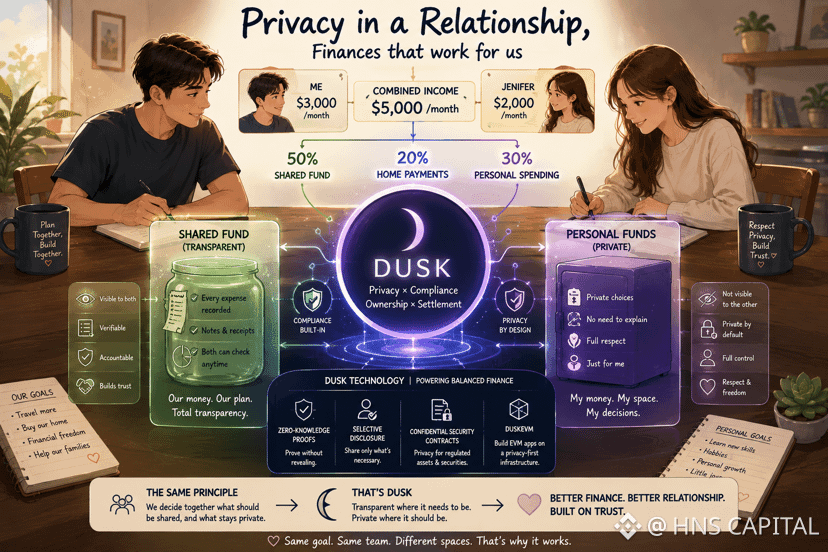
My girlfriend Jenifer and I will get married this December, and today we sat down to talk about our spending and finances once we start living together.
I earn $3K a month, while she earns $2K, so we decided to put 50% of our combined income into a shared household fund, another 20% toward our house payments, and keep the remaining 30% for our own personal spending.
The shared fund will be completely transparent, with every expense recorded and explained so either of us can check where the money goes.
Our personal money is different.
We do not need to explain every personal expense to each other, because we both respect each other’s privacy.
The more I thought about it, the more it reminded me of Dusk.
What I find interesting about Dusk is not simply the idea of privacy, but how Privacy × Compliance can work together.
The technology behind this is what makes Dusk interesting to me.
Zero-Knowledge Proofs allow users to prove that something is valid without revealing the underlying information, while selective disclosure gives the right parties access to what they actually need.
Dusk also uses XSC — Confidential Security Contracts, bringing privacy into tokenized securities while supporting ownership, compliance, transfers, and asset lifecycle management on-chain.
And with DuskEVM, developers can build EVM-compatible applications while accessing Dusk’s privacy-focused infrastructure.
Put these together, and the core thesis becomes quite clear:
Privacy × Compliance × Ownership × Settlement.
Maybe the best financial system is not the one that makes everything public, but the one that lets two people share what matters while still keeping something for themselves.
#dusk $DUSK @Dusk_Foundation $SPK $ZEC
My girlfriend Jenifer and I will get married this December, and today we sat down to talk about our spending and finances once we start living together.
I earn $3K a month, while she earns $2K, so we decided to put 50% of our combined income into a shared household fund, another 20% toward our house payments, and keep the remaining 30% for our own personal spending.
The shared fund will be completely transparent, with every expense recorded and explained so either of us can check where the money goes.
Our personal money is different.
We do not need to explain every personal expense to each other, because we both respect each other’s privacy.
The more I thought about it, the more it reminded me of Dusk.
What I find interesting about Dusk is not simply the idea of privacy, but how Privacy × Compliance can work together.
The technology behind this is what makes Dusk interesting to me.
Zero-Knowledge Proofs allow users to prove that something is valid without revealing the underlying information, while selective disclosure gives the right parties access to what they actually need.
Dusk also uses XSC — Confidential Security Contracts, bringing privacy into tokenized securities while supporting ownership, compliance, transfers, and asset lifecycle management on-chain.
And with DuskEVM, developers can build EVM-compatible applications while accessing Dusk’s privacy-focused infrastructure.
Put these together, and the core thesis becomes quite clear:
Privacy × Compliance × Ownership × Settlement.
Maybe the best financial system is not the one that makes everything public, but the one that lets two people share what matters while still keeping something for themselves.
#dusk $DUSK @Dusk $SPK $ZEC
I earn $3K a month, while she earns $2K, so we decided to put 50% of our combined income into a shared household fund, another 20% toward our house payments, and keep the remaining 30% for our own personal spending.
The shared fund will be completely transparent, with every expense recorded and explained so either of us can check where the money goes.
Our personal money is different.
We do not need to explain every personal expense to each other, because we both respect each other’s privacy.
The more I thought about it, the more it reminded me of Dusk.
What I find interesting about Dusk is not simply the idea of privacy, but how Privacy × Compliance can work together.
The technology behind this is what makes Dusk interesting to me.
Zero-Knowledge Proofs allow users to prove that something is valid without revealing the underlying information, while selective disclosure gives the right parties access to what they actually need.
Dusk also uses XSC — Confidential Security Contracts, bringing privacy into tokenized securities while supporting ownership, compliance, transfers, and asset lifecycle management on-chain.
And with DuskEVM, developers can build EVM-compatible applications while accessing Dusk’s privacy-focused infrastructure.
Put these together, and the core thesis becomes quite clear:
Privacy × Compliance × Ownership × Settlement.
Maybe the best financial system is not the one that makes everything public, but the one that lets two people share what matters while still keeping something for themselves.
#dusk $DUSK @Dusk $SPK $ZEC
13
13
1.1k
·
--
Bullish
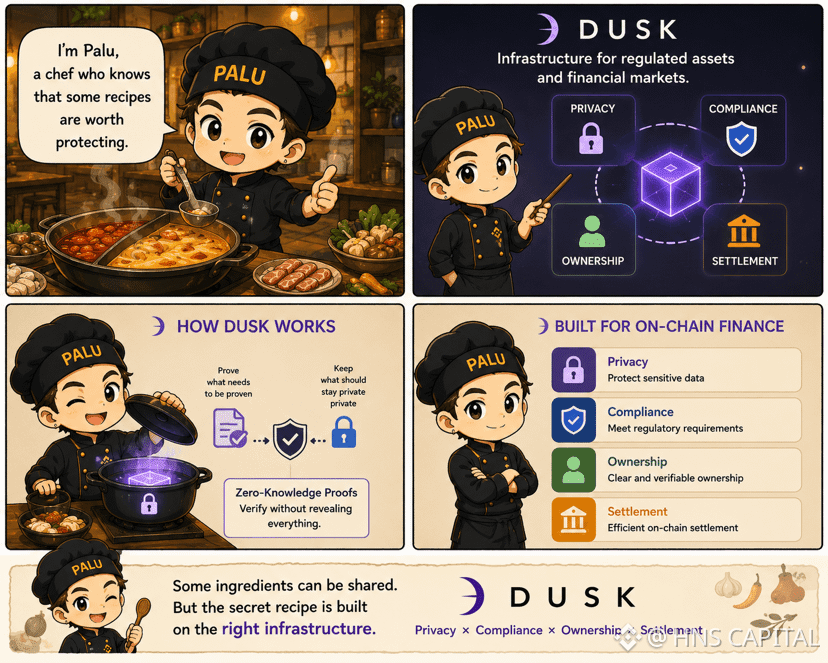
I used to be the head chef at a hotpot restaurant that was always packed because of the distinctive broth I had developed, and during the five years I worked there, I was responsible not only for running the kitchen but also for building the operating processes, training the staff, and developing the recipes and methods that became part of the restaurant’s daily operation.
Recently, I asked the owner to increase my salary from $2K to $4.3K, but he refused, and I assumed that after five years, he probably believed the restaurant had already learned everything it needed from me and could simply find someone else to take my place, so I agreed to leave.
The next day, I handed over the processes, training methods, kitchen operations, and everything else necessary for the restaurant to continue running, but there was one thing I never handed over, because chefs like me understand that a secret recipe is not simply a list of ingredients that can be copied and passed around.
That made me think about Dusk.
Dusk is bringing together Privacy, Compliance, Ownership and Settlement for regulated financial markets.
On the technology side, Zero-Knowledge Proofs allow information to be verified without exposing the underlying data, while XSC — Confidential Security Contracts bring privacy, compliance and asset management into tokenized securities.
The talking points are simple:
Privacy × Compliance
Ownership × Settlement
Regulated Assets × Onchain Finance
And that is what caught my attention.
Not just tokenizing assets, but building the technology around them while keeping sensitive information private.
Some things can be handed over as processes, training and documentation.
But the secret recipe?
That stays with the chef.
#dusk $DUSK @Dusk_Foundation $TRUMP $TUT
I used to be the head chef at a hotpot restaurant that was always packed because of the distinctive broth I had developed, and during the five years I worked there, I was responsible not only for running the kitchen but also for building the operating processes, training the staff, and developing the recipes and methods that became part of the restaurant’s daily operation.
Recently, I asked the owner to increase my salary from $2K to $4.3K, but he refused, and I assumed that after five years, he probably believed the restaurant had already learned everything it needed from me and could simply find someone else to take my place, so I agreed to leave.
The next day, I handed over the processes, training methods, kitchen operations, and everything else necessary for the restaurant to continue running, but there was one thing I never handed over, because chefs like me understand that a secret recipe is not simply a list of ingredients that can be copied and passed around.
That made me think about Dusk.
Dusk is bringing together Privacy, Compliance, Ownership and Settlement for regulated financial markets.
On the technology side, Zero-Knowledge Proofs allow information to be verified without exposing the underlying data, while XSC — Confidential Security Contracts bring privacy, compliance and asset management into tokenized securities.
The talking points are simple:
Privacy × Compliance
Ownership × Settlement
Regulated Assets × Onchain Finance
And that is what caught my attention.
Not just tokenizing assets, but building the technology around them while keeping sensitive information private.
Some things can be handed over as processes, training and documentation.
But the secret recipe?
That stays with the chef.
#dusk $DUSK @Dusk $TRUMP $TUT
Recently, I asked the owner to increase my salary from $2K to $4.3K, but he refused, and I assumed that after five years, he probably believed the restaurant had already learned everything it needed from me and could simply find someone else to take my place, so I agreed to leave.
The next day, I handed over the processes, training methods, kitchen operations, and everything else necessary for the restaurant to continue running, but there was one thing I never handed over, because chefs like me understand that a secret recipe is not simply a list of ingredients that can be copied and passed around.
That made me think about Dusk.
Dusk is bringing together Privacy, Compliance, Ownership and Settlement for regulated financial markets.
On the technology side, Zero-Knowledge Proofs allow information to be verified without exposing the underlying data, while XSC — Confidential Security Contracts bring privacy, compliance and asset management into tokenized securities.
The talking points are simple:
Privacy × Compliance
Ownership × Settlement
Regulated Assets × Onchain Finance
And that is what caught my attention.
Not just tokenizing assets, but building the technology around them while keeping sensitive information private.
Some things can be handed over as processes, training and documentation.
But the secret recipe?
That stays with the chef.
#dusk $DUSK @Dusk $TRUMP $TUT
20
19
14.1k
·
--
Bullish
Verified
My younger brother, 23 years old, pooled money with one or two friends to open a homestay and work in tourism.
My brother contributed $12K from the money he had saved from part-time jobs.
I told him he was still young and lacked experience, and that he should buy BTC or BNB with the money instead. I told him not to put all of it into an investment, but he didn’t listen.
Six months later, the project failed, and he lost everything.
He told me what happened: three of them put money in, but because they lacked experience, they didn’t even know how to properly manage their spending and purchases. When they finally calculated everything, they were already running at a loss. There was no meaningful data left to analyze, so they had to accept the failure.
I didn’t know how to comfort him.
His story made me more interested in Dusk.
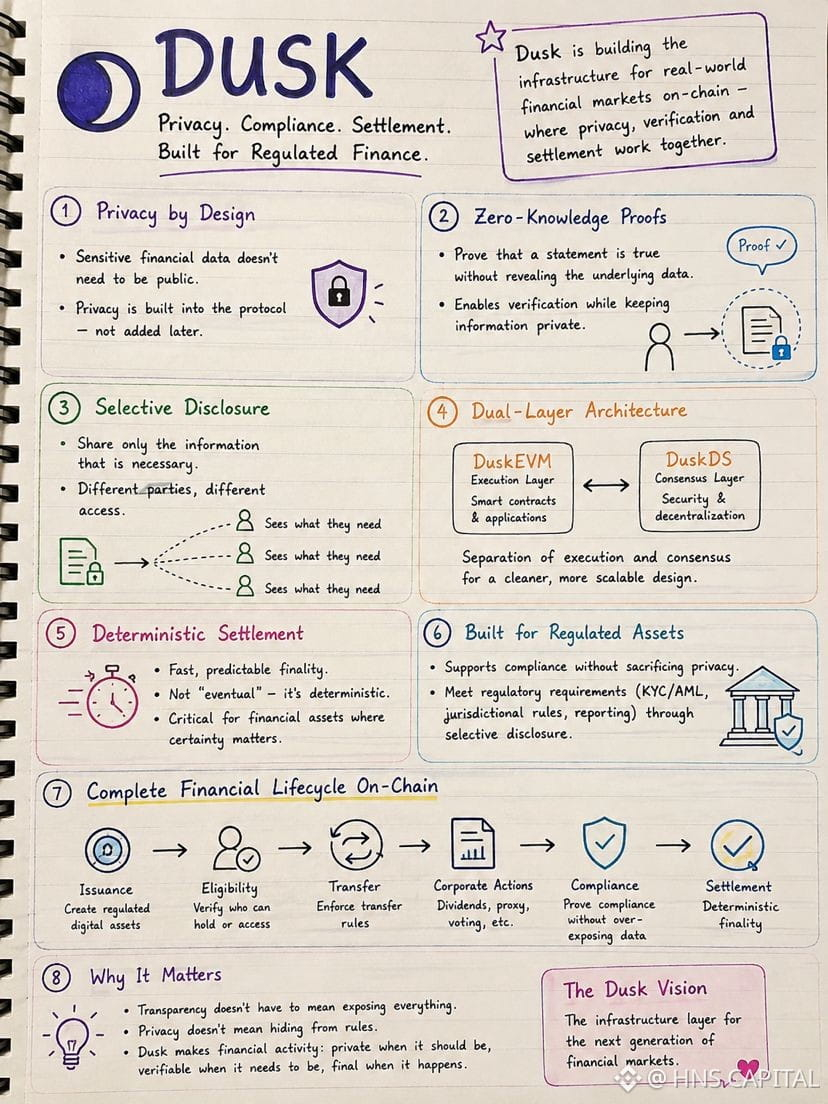
Privacy by design means sensitive financial information does not have to be exposed simply because a transaction needs to be verified.
Zero-knowledge proofs allow a participant to prove that certain conditions are satisfied without revealing the underlying data.
Selective disclosure takes this further: different parties can access only the information they actually need.
For regulated assets, that distinction is important. Compliance does not necessarily require exposing an entire financial history to everyone.
Dusk also separates execution and consensus through DuskEVM and DuskDS, creating a clearer architecture for applications and settlement.
Then comes deterministic settlement.
Instead of treating finality as something users simply wait and hope for, Dusk is designed around predictable, fast finality. For financial assets, that matters because ownership and settlement are not separate problems.
Tokenizing an asset is only one step.
The infrastructure also needs to handle ownership, eligibility, transfer rules, privacy, compliance and settlement.
But it is trying to build the infrastructure where financial activity can be private, verifiable and settled with clear rules.
#dusk $DUSK @Dusk_Foundation $ZEC $ENS
My younger brother, 23 years old, pooled money with one or two friends to open a homestay and work in tourism.
My brother contributed $12K from the money he had saved from part-time jobs.
I told him he was still young and lacked experience, and that he should buy BTC or BNB with the money instead. I told him not to put all of it into an investment, but he didn’t listen.
Six months later, the project failed, and he lost everything.
He told me what happened: three of them put money in, but because they lacked experience, they didn’t even know how to properly manage their spending and purchases. When they finally calculated everything, they were already running at a loss. There was no meaningful data left to analyze, so they had to accept the failure.
I didn’t know how to comfort him.
His story made me more interested in Dusk.
Privacy by design means sensitive financial information does not have to be exposed simply because a transaction needs to be verified.
Zero-knowledge proofs allow a participant to prove that certain conditions are satisfied without revealing the underlying data.
Selective disclosure takes this further: different parties can access only the information they actually need.
For regulated assets, that distinction is important. Compliance does not necessarily require exposing an entire financial history to everyone.
Dusk also separates execution and consensus through DuskEVM and DuskDS, creating a clearer architecture for applications and settlement.
Then comes deterministic settlement.
Instead of treating finality as something users simply wait and hope for, Dusk is designed around predictable, fast finality. For financial assets, that matters because ownership and settlement are not separate problems.
Tokenizing an asset is only one step.
The infrastructure also needs to handle ownership, eligibility, transfer rules, privacy, compliance and settlement.
But it is trying to build the infrastructure where financial activity can be private, verifiable and settled with clear rules.
#dusk $DUSK @Dusk $ZEC $ENS
My brother contributed $12K from the money he had saved from part-time jobs.
I told him he was still young and lacked experience, and that he should buy BTC or BNB with the money instead. I told him not to put all of it into an investment, but he didn’t listen.
Six months later, the project failed, and he lost everything.
He told me what happened: three of them put money in, but because they lacked experience, they didn’t even know how to properly manage their spending and purchases. When they finally calculated everything, they were already running at a loss. There was no meaningful data left to analyze, so they had to accept the failure.
I didn’t know how to comfort him.
His story made me more interested in Dusk.
Privacy by design means sensitive financial information does not have to be exposed simply because a transaction needs to be verified.
Zero-knowledge proofs allow a participant to prove that certain conditions are satisfied without revealing the underlying data.
Selective disclosure takes this further: different parties can access only the information they actually need.
For regulated assets, that distinction is important. Compliance does not necessarily require exposing an entire financial history to everyone.
Dusk also separates execution and consensus through DuskEVM and DuskDS, creating a clearer architecture for applications and settlement.
Then comes deterministic settlement.
Instead of treating finality as something users simply wait and hope for, Dusk is designed around predictable, fast finality. For financial assets, that matters because ownership and settlement are not separate problems.
Tokenizing an asset is only one step.
The infrastructure also needs to handle ownership, eligibility, transfer rules, privacy, compliance and settlement.
But it is trying to build the infrastructure where financial activity can be private, verifiable and settled with clear rules.
#dusk $DUSK @Dusk $ZEC $ENS
25
26
4.6k
·
--
Bullish
Verified
On the occasion of the 30th anniversary of our high school, our class decided to contribute together to create a scholarship fund for the school.
There were 40 of us, each contributing 500,000 VND, making a total of 20 million VND. I was the person who organized everything and also acted as the treasurer.
Every incoming contribution, expense, and transfer was carefully recorded by me, and I always shared the information with every member of the class. This was the first time we had done something like this, and it ended successfully. I hope the next time will be the same.
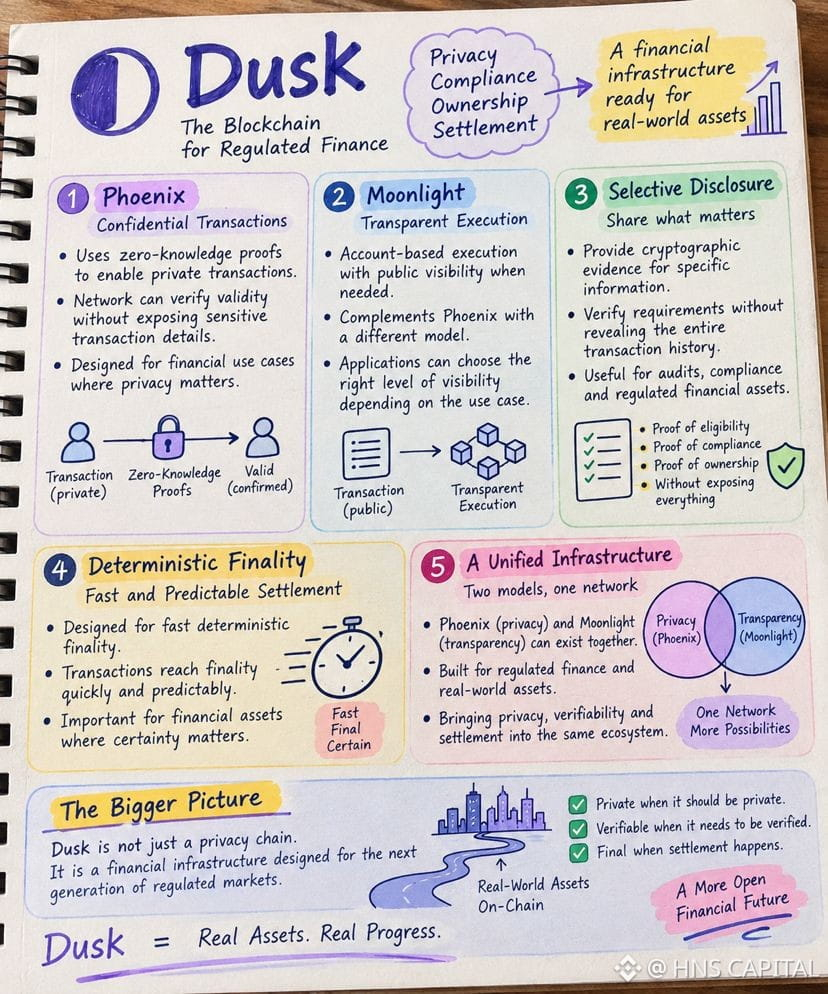
Dusk approaches financial infrastructure with a similar principle, but at the protocol level.
Phoenix enables confidential transactions using zero-knowledge proofs, allowing the network to verify transaction validity without exposing sensitive transaction details.
Moonlight provides transparent, account-based execution, giving applications a different model when public visibility is required.
The interesting part is that both approaches can exist within the same network.
Dusk also supports selective disclosure, allowing authorized parties to verify specific information without accessing everything behind a transaction.
For regulated assets, this is particularly relevant.
An institution may need to prove that a transaction complies with certain rules, while the underlying balances, counterparties, or transaction details should not automatically become public.
Dusk combines this privacy architecture with deterministic finality, targeting fast and predictable settlement rather than leaving financial transactions waiting for uncertain confirmation.
That combination is what caught my attention:
Private when it should be private.
Verifiable when it needs to be verified.
Final when settlement happens.
This is a different way of thinking about blockchain infrastructure.
Instead of treating transparency as “everyone can see everything,” Dusk is building around a more controlled model of information access.
#dusk $DUSK @Dusk_Foundation $ONG $PEOPLE
On the occasion of the 30th anniversary of our high school, our class decided to contribute together to create a scholarship fund for the school.
There were 40 of us, each contributing 500,000 VND, making a total of 20 million VND. I was the person who organized everything and also acted as the treasurer.
Every incoming contribution, expense, and transfer was carefully recorded by me, and I always shared the information with every member of the class. This was the first time we had done something like this, and it ended successfully. I hope the next time will be the same.
Dusk approaches financial infrastructure with a similar principle, but at the protocol level.
Phoenix enables confidential transactions using zero-knowledge proofs, allowing the network to verify transaction validity without exposing sensitive transaction details.
Moonlight provides transparent, account-based execution, giving applications a different model when public visibility is required.
The interesting part is that both approaches can exist within the same network.
Dusk also supports selective disclosure, allowing authorized parties to verify specific information without accessing everything behind a transaction.
For regulated assets, this is particularly relevant.
An institution may need to prove that a transaction complies with certain rules, while the underlying balances, counterparties, or transaction details should not automatically become public.
Dusk combines this privacy architecture with deterministic finality, targeting fast and predictable settlement rather than leaving financial transactions waiting for uncertain confirmation.
That combination is what caught my attention:
Private when it should be private.
Verifiable when it needs to be verified.
Final when settlement happens.
This is a different way of thinking about blockchain infrastructure.
Instead of treating transparency as “everyone can see everything,” Dusk is building around a more controlled model of information access.
#dusk $DUSK @Dusk $ONG $PEOPLE
There were 40 of us, each contributing 500,000 VND, making a total of 20 million VND. I was the person who organized everything and also acted as the treasurer.
Every incoming contribution, expense, and transfer was carefully recorded by me, and I always shared the information with every member of the class. This was the first time we had done something like this, and it ended successfully. I hope the next time will be the same.
Dusk approaches financial infrastructure with a similar principle, but at the protocol level.
Phoenix enables confidential transactions using zero-knowledge proofs, allowing the network to verify transaction validity without exposing sensitive transaction details.
Moonlight provides transparent, account-based execution, giving applications a different model when public visibility is required.
The interesting part is that both approaches can exist within the same network.
Dusk also supports selective disclosure, allowing authorized parties to verify specific information without accessing everything behind a transaction.
For regulated assets, this is particularly relevant.
An institution may need to prove that a transaction complies with certain rules, while the underlying balances, counterparties, or transaction details should not automatically become public.
Dusk combines this privacy architecture with deterministic finality, targeting fast and predictable settlement rather than leaving financial transactions waiting for uncertain confirmation.
That combination is what caught my attention:
Private when it should be private.
Verifiable when it needs to be verified.
Final when settlement happens.
This is a different way of thinking about blockchain infrastructure.
Instead of treating transparency as “everyone can see everything,” Dusk is building around a more controlled model of information access.
#dusk $DUSK @Dusk $ONG $PEOPLE
42
36
4.3k
·
--
I traded like an idiot today.
Almost all of my orders were liquidated.
I open and close opposing positions within just 1–2 minutes.
Trades I had held for 1–2 months closed within 1–2 hours.
I'm going to take a break for a while.
$ETH
I traded like an idiot today.
Almost all of my orders were liquidated.
I open and close opposing positions within just 1–2 minutes.
Trades I had held for 1–2 months closed within 1–2 hours.
I'm going to take a break for a while.
$ETH
Almost all of my orders were liquidated.
I open and close opposing positions within just 1–2 minutes.
Trades I had held for 1–2 months closed within 1–2 hours.
I'm going to take a break for a while.
$ETH
5
20
9.2k
·
--
Bullish
My girlfriend, Jane, recently told me that a project she really likes is about to reach TGE: TermMax.
She has been saving money from her online business for five years. She put 10 ETH into TermMax to lend, and after a year, she made a significant profit. Recently, she even borrowed $4K to buy the dip on BNB.
I asked her, “You seem to have a lot of confidence in this project, don’t you?”
She spent the whole afternoon excitedly explaining TermMax to me.
The more I listened, the more I understood why she was interested.
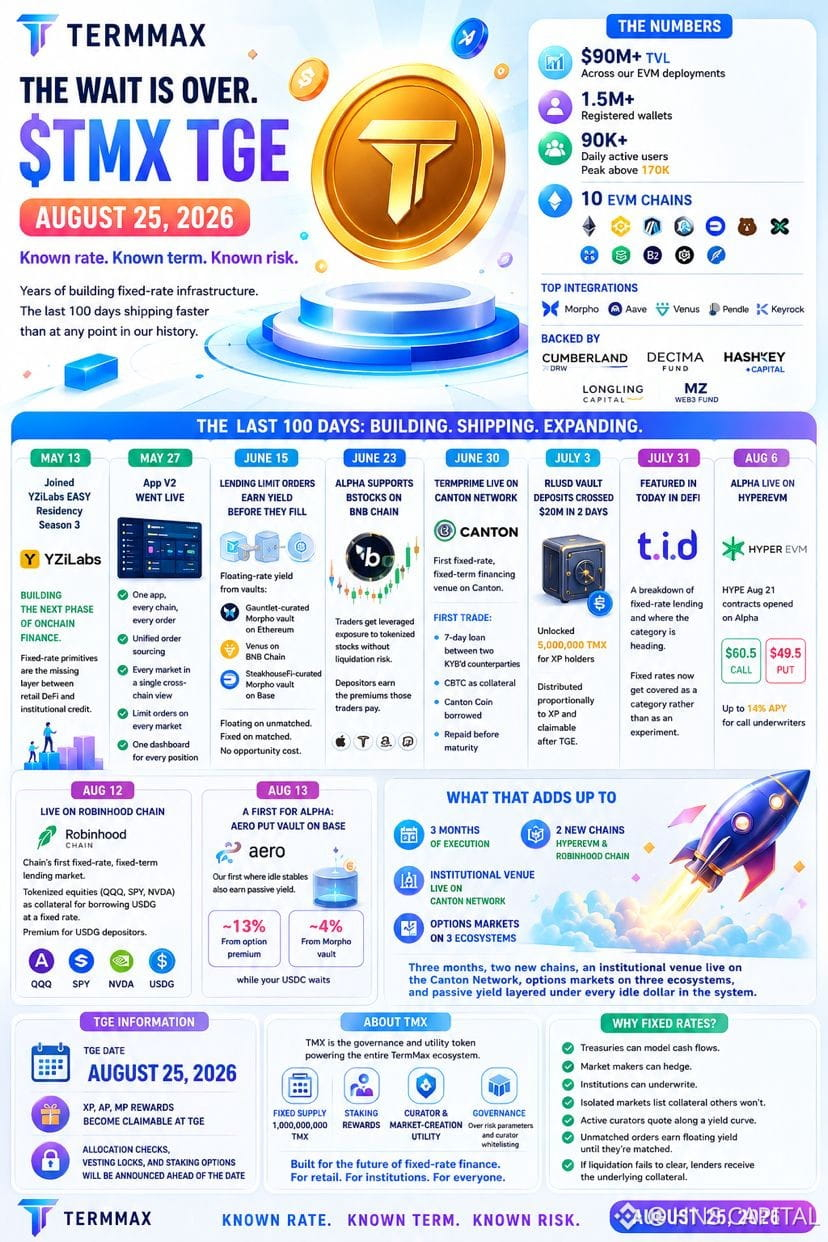
TermMax is building fixed-rate lending, borrowing and options infrastructure for DeFi. Instead of leaving borrowers and lenders exposed to constantly changing rates, each market has a known rate and a defined maturity. Its FT, XT and GT architecture separates debt, interest and collateralized positions into distinct on-chain components.
The scale is what made me look closer.
TermMax now reports $90M+ TVL, 1.5M+ registered wallets and 90K+ daily active users, with peak daily activity above 170K. The protocol is live across 10 EVM chains, including Ethereum, BNB Chain, Arbitrum, Base, Berachain, XLayer, Pharos, B2, HyperEVM and Robinhood Chain.
But the more interesting part isn’t simply the TVL. Over the last 100 days, TermMax has expanded rapidly: App V2 unified markets across chains, lending limit orders began earning floating yield while waiting to fill, Alpha expanded into tokenized equities and options, and TermPrime went live on Canton Network as an institutional fixed-rate, fixed-term financing venue.
And then there is the date Jane has been waiting for.
August 25, 2026 — $TMX TGE.
TMX will have a fixed supply of 1 billion tokens, with staking rewards, curator and market-creation utility, and governance over risk parameters and curator whitelisting. Rewards earned through XP, AP and MP will become claimable at TGE.
After listening to Jane all afternoon, I still wouldn’t say I’m convinced simply because she is confident.
Known rate. Known term. Known risk.
#termmax @termmax $BOME $PEPE $ETH
My girlfriend, Jane, recently told me that a project she really likes is about to reach TGE: TermMax.
She has been saving money from her online business for five years. She put 10 ETH into TermMax to lend, and after a year, she made a significant profit. Recently, she even borrowed $4K to buy the dip on BNB.
I asked her, “You seem to have a lot of confidence in this project, don’t you?”
She spent the whole afternoon excitedly explaining TermMax to me.
The more I listened, the more I understood why she was interested.
TermMax is building fixed-rate lending, borrowing and options infrastructure for DeFi. Instead of leaving borrowers and lenders exposed to constantly changing rates, each market has a known rate and a defined maturity. Its FT, XT and GT architecture separates debt, interest and collateralized positions into distinct on-chain components.
The scale is what made me look closer.
TermMax now reports $90M+ TVL, 1.5M+ registered wallets and 90K+ daily active users, with peak daily activity above 170K. The protocol is live across 10 EVM chains, including Ethereum, BNB Chain, Arbitrum, Base, Berachain, XLayer, Pharos, B2, HyperEVM and Robinhood Chain.
But the more interesting part isn’t simply the TVL. Over the last 100 days, TermMax has expanded rapidly: App V2 unified markets across chains, lending limit orders began earning floating yield while waiting to fill, Alpha expanded into tokenized equities and options, and TermPrime went live on Canton Network as an institutional fixed-rate, fixed-term financing venue.
And then there is the date Jane has been waiting for.
August 25, 2026 — $TMX TGE.
TMX will have a fixed supply of 1 billion tokens, with staking rewards, curator and market-creation utility, and governance over risk parameters and curator whitelisting. Rewards earned through XP, AP and MP will become claimable at TGE.
After listening to Jane all afternoon, I still wouldn’t say I’m convinced simply because she is confident.
Known rate. Known term. Known risk.
#termmax @TermMax $BOME $PEPE $ETH
She has been saving money from her online business for five years. She put 10 ETH into TermMax to lend, and after a year, she made a significant profit. Recently, she even borrowed $4K to buy the dip on BNB.
I asked her, “You seem to have a lot of confidence in this project, don’t you?”
She spent the whole afternoon excitedly explaining TermMax to me.
The more I listened, the more I understood why she was interested.
TermMax is building fixed-rate lending, borrowing and options infrastructure for DeFi. Instead of leaving borrowers and lenders exposed to constantly changing rates, each market has a known rate and a defined maturity. Its FT, XT and GT architecture separates debt, interest and collateralized positions into distinct on-chain components.
The scale is what made me look closer.
TermMax now reports $90M+ TVL, 1.5M+ registered wallets and 90K+ daily active users, with peak daily activity above 170K. The protocol is live across 10 EVM chains, including Ethereum, BNB Chain, Arbitrum, Base, Berachain, XLayer, Pharos, B2, HyperEVM and Robinhood Chain.
But the more interesting part isn’t simply the TVL. Over the last 100 days, TermMax has expanded rapidly: App V2 unified markets across chains, lending limit orders began earning floating yield while waiting to fill, Alpha expanded into tokenized equities and options, and TermPrime went live on Canton Network as an institutional fixed-rate, fixed-term financing venue.
And then there is the date Jane has been waiting for.
August 25, 2026 — $TMX TGE.
TMX will have a fixed supply of 1 billion tokens, with staking rewards, curator and market-creation utility, and governance over risk parameters and curator whitelisting. Rewards earned through XP, AP and MP will become claimable at TGE.
After listening to Jane all afternoon, I still wouldn’t say I’m convinced simply because she is confident.
Known rate. Known term. Known risk.
#termmax @TermMax $BOME $PEPE $ETH
18
16
383
Log in to explore more content
Join global crypto users on Binance Square
⚡️ Get latest and useful information about crypto.
💬 Trusted by the world’s largest crypto exchange.
👍 Discover real insights from verified creators.
Email / Phone number