

Crypto Universe official
14.3k Posts

Crypto Universe official
 Square Verified+
Report
Block User
Crypto Trader| Crypto Influencer|• Analyst • Actively Analyzing All Crypto Market| Blockchain| WEB 3| AI | New Projects| NEWS | LEARNING| ACCOUNT & ADVISER
Frequent Trader
5.3 Years
353 Following
61.6K+ Followers
80.9K+ Liked
Posts
All
Quotes
Videos
Live

·
--
Bullish
🚨 ONE JUST RAN FROM $0.00062 TO $0.00463 — NOW THE SECOND LEG IS LOADING 👀🔥
Stop… stop… stop… scrolling fam!
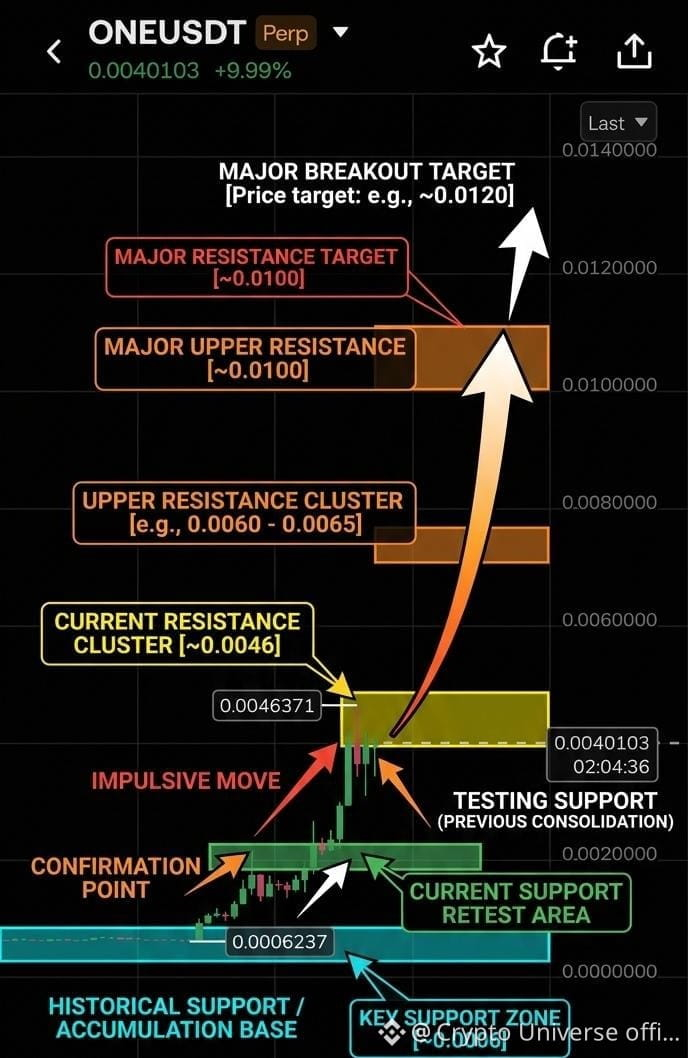
Give me 1 minute because ONE/USDT just delivered a massive expansion from the $0.0006237 accumulation floor, and now price is sitting inside a tight consolidation directly under the next major resistance.
ONE pushed up to $0.0046371 and is currently around $0.0040103.
And this is where I’m watching closely…
🔥 $0.0046 IS THE GATEKEEPER
The first explosive leg has already happened.
Now price is consolidating below the $0.0046 resistance while defending the newly formed demand area.
If ONE gets a clean 4H candle body close above $0.0046, I’ll be watching the next expansion levels:
🎯 $0.00460
🎯 $0.00650
🔥 $0.01000
🚀 $0.01200
The real battlefield sits around $0.0060–$0.0065.
Once that supply zone gets cleared, the bigger $0.0100 → $0.0120 roadmap comes into focus.
📍 MY ONE GAME PLAN
🟢 Entry Zone: $0.00350–$0.00400
🔥 Breakout Trigger: 4H close above $0.0046
🎯 TP1: $0.00460
🎯 TP2: $0.00650
🎯 TP3: $0.01000
🚀 TP4: $0.01200
🛑 SL: $0.00280
Now look at the structure:
$0.0006237 accumulation → confirmation breakout → $0.0046371 high → pullback → higher-low defense → consolidation
That’s a huge structural transformation.
ONE has already shown what happens when momentum catches fire from the bottom.
Now the question is whether this consolidation becomes the launchpad for leg two.
$0.0046 breaks → $0.0065
$0.0065 clears → $0.0100
$0.0100 breaks → $0.0120 comes into focus 🚀
ONE has already made the first move…
Now I’m watching for the second explosion. 👀🔥
ONE fam… are we about to see $0.0046 turn into the launchpad for $0.01+? 🚀
$ONE
{future}(ONEUSDT)
🚨 ONE JUST RAN FROM $0.00062 TO $0.00463 — NOW THE SECOND LEG IS LOADING 👀🔥
Stop… stop… stop… scrolling fam!
Give me 1 minute because ONE/USDT just delivered a massive expansion from the $0.0006237 accumulation floor, and now price is sitting inside a tight consolidation directly under the next major resistance.
ONE pushed up to $0.0046371 and is currently around $0.0040103.
And this is where I’m watching closely…
🔥 $0.0046 IS THE GATEKEEPER
The first explosive leg has already happened.
Now price is consolidating below the $0.0046 resistance while defending the newly formed demand area.
If ONE gets a clean 4H candle body close above $0.0046, I’ll be watching the next expansion levels:
🎯 $0.00460
🎯 $0.00650
🔥 $0.01000
🚀 $0.01200
The real battlefield sits around $0.0060–$0.0065.
Once that supply zone gets cleared, the bigger $0.0100 → $0.0120 roadmap comes into focus.
📍 MY ONE GAME PLAN
🟢 Entry Zone: $0.00350–$0.00400
🔥 Breakout Trigger: 4H close above $0.0046
🎯 TP1: $0.00460
🎯 TP2: $0.00650
🎯 TP3: $0.01000
🚀 TP4: $0.01200
🛑 SL: $0.00280
Now look at the structure:
$0.0006237 accumulation → confirmation breakout → $0.0046371 high → pullback → higher-low defense → consolidation
That’s a huge structural transformation.
ONE has already shown what happens when momentum catches fire from the bottom.
Now the question is whether this consolidation becomes the launchpad for leg two.
$0.0046 breaks → $0.0065
$0.0065 clears → $0.0100
$0.0100 breaks → $0.0120 comes into focus 🚀
ONE has already made the first move…
Now I’m watching for the second explosion. 👀🔥
ONE fam… are we about to see $0.0046 turn into the launchpad for $0.01+? 🚀
$ONE
Stop… stop… stop… scrolling fam!
Give me 1 minute because ONE/USDT just delivered a massive expansion from the $0.0006237 accumulation floor, and now price is sitting inside a tight consolidation directly under the next major resistance.
ONE pushed up to $0.0046371 and is currently around $0.0040103.
And this is where I’m watching closely…
🔥 $0.0046 IS THE GATEKEEPER
The first explosive leg has already happened.
Now price is consolidating below the $0.0046 resistance while defending the newly formed demand area.
If ONE gets a clean 4H candle body close above $0.0046, I’ll be watching the next expansion levels:
🎯 $0.00460
🎯 $0.00650
🔥 $0.01000
🚀 $0.01200
The real battlefield sits around $0.0060–$0.0065.
Once that supply zone gets cleared, the bigger $0.0100 → $0.0120 roadmap comes into focus.
📍 MY ONE GAME PLAN
🟢 Entry Zone: $0.00350–$0.00400
🔥 Breakout Trigger: 4H close above $0.0046
🎯 TP1: $0.00460
🎯 TP2: $0.00650
🎯 TP3: $0.01000
🚀 TP4: $0.01200
🛑 SL: $0.00280
Now look at the structure:
$0.0006237 accumulation → confirmation breakout → $0.0046371 high → pullback → higher-low defense → consolidation
That’s a huge structural transformation.
ONE has already shown what happens when momentum catches fire from the bottom.
Now the question is whether this consolidation becomes the launchpad for leg two.
$0.0046 breaks → $0.0065
$0.0065 clears → $0.0100
$0.0100 breaks → $0.0120 comes into focus 🚀
ONE has already made the first move…
Now I’m watching for the second explosion. 👀🔥
ONE fam… are we about to see $0.0046 turn into the launchpad for $0.01+? 🚀
$ONE
4
1.8k
·
--
Bullish
NICE 👍
NICE 👍

Crypto_Alchemy
·
--
$ONE increased more than 300% in past 3 days today it reached 0.045 which is one of the resistance
so it will pullback to 0.33 or more upto 0.3
keep an eye on 0.26 level
overall it's bullish
so it will pullback to 0.33 or more upto 0.3
keep an eye on 0.26 level
overall it's bullish
1
328
·
--
Bullish
🚨 ZIL JUST EXPLODED FROM $0.0026 — NOW THE $0.0042 BATTLE IS ON 👀🔥
Stop… stop… stop… scrolling fam!
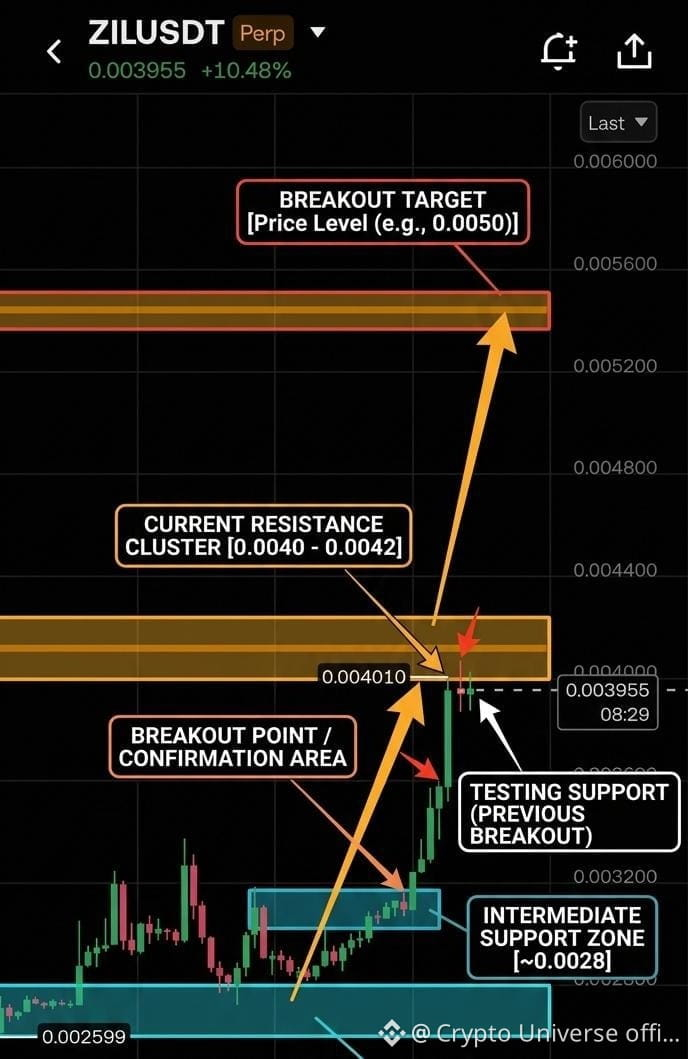
Give me 1 minute because ZIL/USDT just delivered a serious vertical expansion from the $0.002599 floor, and now price is sitting directly under the next major resistance.
ZIL pushed up to $0.004010 and is currently around $0.003955.
The move is already impressive…
But I’m more interested in what happens next.
🔥 $0.0040–$0.0042 IS THE GATEKEEPER
This is the immediate supply zone.
Price is compressing around the breakout area, with the minor pullback near $0.00390 currently acting as the first defense line.
If ZIL prints a clean 4H candle body close above $0.0042, I’ll be watching the next expansion levels:
🎯 $0.00420
🎯 $0.00460
🚀 $0.00500
🔥 $0.00550
The bigger target zone is $0.0050–$0.0055.
📍 MY ZIL GAME PLAN
🟢 Entry Zone: $0.00360–$0.00395
🔥 Breakout Trigger: 4H close above $0.0042
🎯 TP1: $0.00420
🎯 TP2: $0.00460
🎯 TP3: $0.00500
🚀 TP4: $0.00550
🛑 SL: $0.00320
Now look at the structure:
$0.002599 floor → vertical expansion → $0.004010 high → $0.00390 retest → resistance compression
That’s the story.
The old $0.0028 structural zone can now act as a much deeper demand floor, while the current $0.00390 area is the immediate battleground.
What I’m watching now is simple:
Can ZIL absorb the $0.0040–$0.0042 supply and turn this consolidation into another vertical leg? 👀
Because above $0.0042, the roadmap starts opening toward:
$0.0046 → $0.0050 → $0.0055 🚀
ZIL already made the first explosion…
Now I’m watching for the second one. 🔥
ZIL fam… are we getting the $0.0042 breakout next? 👀🚀
$ZIL
{future}(ZILUSDT)
🚨 ZIL JUST EXPLODED FROM $0.0026 — NOW THE $0.0042 BATTLE IS ON 👀🔥
Stop… stop… stop… scrolling fam!
Give me 1 minute because ZIL/USDT just delivered a serious vertical expansion from the $0.002599 floor, and now price is sitting directly under the next major resistance.
ZIL pushed up to $0.004010 and is currently around $0.003955.
The move is already impressive…
But I’m more interested in what happens next.
🔥 $0.0040–$0.0042 IS THE GATEKEEPER
This is the immediate supply zone.
Price is compressing around the breakout area, with the minor pullback near $0.00390 currently acting as the first defense line.
If ZIL prints a clean 4H candle body close above $0.0042, I’ll be watching the next expansion levels:
🎯 $0.00420
🎯 $0.00460
🚀 $0.00500
🔥 $0.00550
The bigger target zone is $0.0050–$0.0055.
📍 MY ZIL GAME PLAN
🟢 Entry Zone: $0.00360–$0.00395
🔥 Breakout Trigger: 4H close above $0.0042
🎯 TP1: $0.00420
🎯 TP2: $0.00460
🎯 TP3: $0.00500
🚀 TP4: $0.00550
🛑 SL: $0.00320
Now look at the structure:
$0.002599 floor → vertical expansion → $0.004010 high → $0.00390 retest → resistance compression
That’s the story.
The old $0.0028 structural zone can now act as a much deeper demand floor, while the current $0.00390 area is the immediate battleground.
What I’m watching now is simple:
Can ZIL absorb the $0.0040–$0.0042 supply and turn this consolidation into another vertical leg? 👀
Because above $0.0042, the roadmap starts opening toward:
$0.0046 → $0.0050 → $0.0055 🚀
ZIL already made the first explosion…
Now I’m watching for the second one. 🔥
ZIL fam… are we getting the $0.0042 breakout next? 👀🚀
$ZIL
Stop… stop… stop… scrolling fam!
Give me 1 minute because ZIL/USDT just delivered a serious vertical expansion from the $0.002599 floor, and now price is sitting directly under the next major resistance.
ZIL pushed up to $0.004010 and is currently around $0.003955.
The move is already impressive…
But I’m more interested in what happens next.
🔥 $0.0040–$0.0042 IS THE GATEKEEPER
This is the immediate supply zone.
Price is compressing around the breakout area, with the minor pullback near $0.00390 currently acting as the first defense line.
If ZIL prints a clean 4H candle body close above $0.0042, I’ll be watching the next expansion levels:
🎯 $0.00420
🎯 $0.00460
🚀 $0.00500
🔥 $0.00550
The bigger target zone is $0.0050–$0.0055.
📍 MY ZIL GAME PLAN
🟢 Entry Zone: $0.00360–$0.00395
🔥 Breakout Trigger: 4H close above $0.0042
🎯 TP1: $0.00420
🎯 TP2: $0.00460
🎯 TP3: $0.00500
🚀 TP4: $0.00550
🛑 SL: $0.00320
Now look at the structure:
$0.002599 floor → vertical expansion → $0.004010 high → $0.00390 retest → resistance compression
That’s the story.
The old $0.0028 structural zone can now act as a much deeper demand floor, while the current $0.00390 area is the immediate battleground.
What I’m watching now is simple:
Can ZIL absorb the $0.0040–$0.0042 supply and turn this consolidation into another vertical leg? 👀
Because above $0.0042, the roadmap starts opening toward:
$0.0046 → $0.0050 → $0.0055 🚀
ZIL already made the first explosion…
Now I’m watching for the second one. 🔥
ZIL fam… are we getting the $0.0042 breakout next? 👀🚀
$ZIL
4
1.5k
·
--
Bullish
🚨 AGLD — BIG BREAKOUT RE-TEST IN PROGRESS 👀🔥
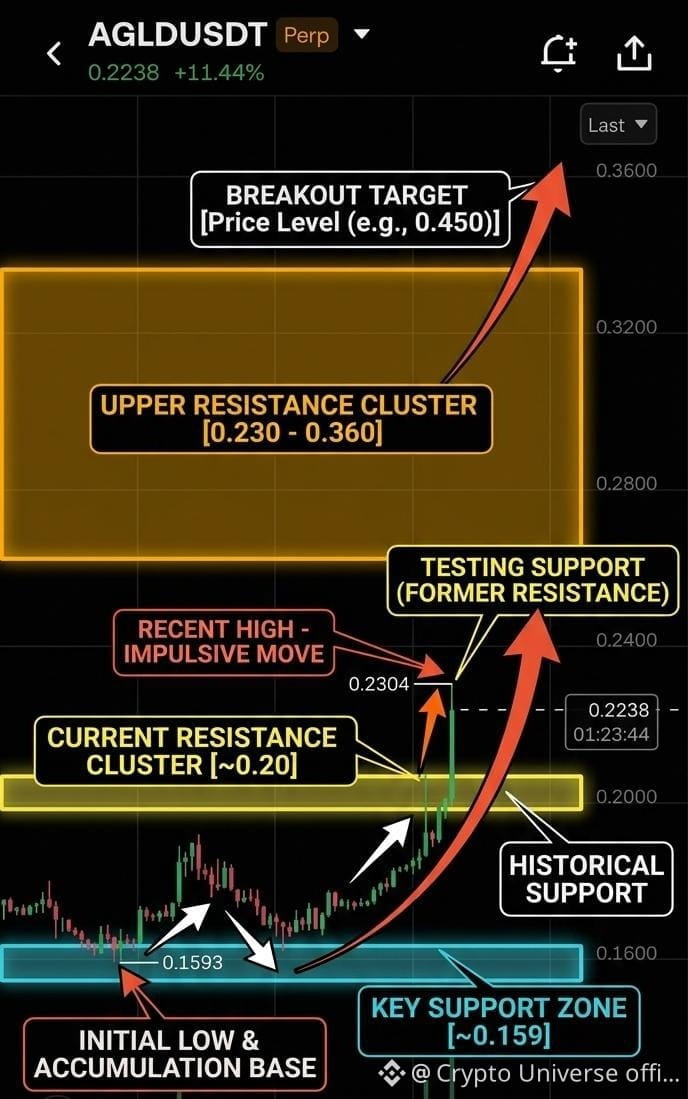
Guys… AGLD just exploded from the $0.159 area, broke the major $0.20 resistance with strong momentum, and pushed up to $0.2304.
Now price is holding around $0.2238, and THIS is the zone I’m watching.
🔥 Entry: $0.200–$0.224
🚀 Breakout: Hold above $0.230
🎯 TP1: $0.230
🎯 TP2: $0.280
🎯 TP3: $0.360
🎯 TP4: $0.450
🛡️ SL: $0.180
The important part is the S/R flip. That old $0.20 resistance is now being tested as support. If buyers continue defending this level, the structure stays bullish and another expansion leg could develop.
Above $0.230, I’m watching $0.28 first. If the upper supply around $0.36 gets cleared, the bigger $0.45 projection comes into focus.
But if $0.20 breaks decisively, the setup needs a fresh confirmation.
AGLD holders… are we preparing for another expansion? 👀🔥
⚠️ Perpetual trading carries high risk. Use proper position sizing and strict stop-loss management.
$AGLD
{future}(AGLDUSDT)
🚨 AGLD — BIG BREAKOUT RE-TEST IN PROGRESS 👀🔥
Guys… AGLD just exploded from the $0.159 area, broke the major $0.20 resistance with strong momentum, and pushed up to $0.2304.
Now price is holding around $0.2238, and THIS is the zone I’m watching.
🔥 Entry: $0.200–$0.224
🚀 Breakout: Hold above $0.230
🎯 TP1: $0.230
🎯 TP2: $0.280
🎯 TP3: $0.360
🎯 TP4: $0.450
🛡️ SL: $0.180
The important part is the S/R flip. That old $0.20 resistance is now being tested as support. If buyers continue defending this level, the structure stays bullish and another expansion leg could develop.
Above $0.230, I’m watching $0.28 first. If the upper supply around $0.36 gets cleared, the bigger $0.45 projection comes into focus.
But if $0.20 breaks decisively, the setup needs a fresh confirmation.
AGLD holders… are we preparing for another expansion? 👀🔥
⚠️ Perpetual trading carries high risk. Use proper position sizing and strict stop-loss management.
$AGLD
Guys… AGLD just exploded from the $0.159 area, broke the major $0.20 resistance with strong momentum, and pushed up to $0.2304.
Now price is holding around $0.2238, and THIS is the zone I’m watching.
🔥 Entry: $0.200–$0.224
🚀 Breakout: Hold above $0.230
🎯 TP1: $0.230
🎯 TP2: $0.280
🎯 TP3: $0.360
🎯 TP4: $0.450
🛡️ SL: $0.180
The important part is the S/R flip. That old $0.20 resistance is now being tested as support. If buyers continue defending this level, the structure stays bullish and another expansion leg could develop.
Above $0.230, I’m watching $0.28 first. If the upper supply around $0.36 gets cleared, the bigger $0.45 projection comes into focus.
But if $0.20 breaks decisively, the setup needs a fresh confirmation.
AGLD holders… are we preparing for another expansion? 👀🔥
⚠️ Perpetual trading carries high risk. Use proper position sizing and strict stop-loss management.
$AGLD
3
1.3k
Risk Management Or Just fun Amazing boy ...
Risk Management Or Just fun Amazing boy ...

赚了亿点点
·
--
Holders of spot stock numbered $ZEC , you bunch of soldiers—sell when the crowd is loud, right now. Time to take your profits!
2
286


·
--
Bullish
Good 👍
Good 👍

ca-散户指标
·
--
#zec got it, next things are going to get really crazy—first up: 1800
1
197
·
--
Bullish
30D trade $INJ 1.5K USDT
🚨 INJECTIVE (INJ) — THE BREAKOUT IS STILL ALIVE 👀🔥
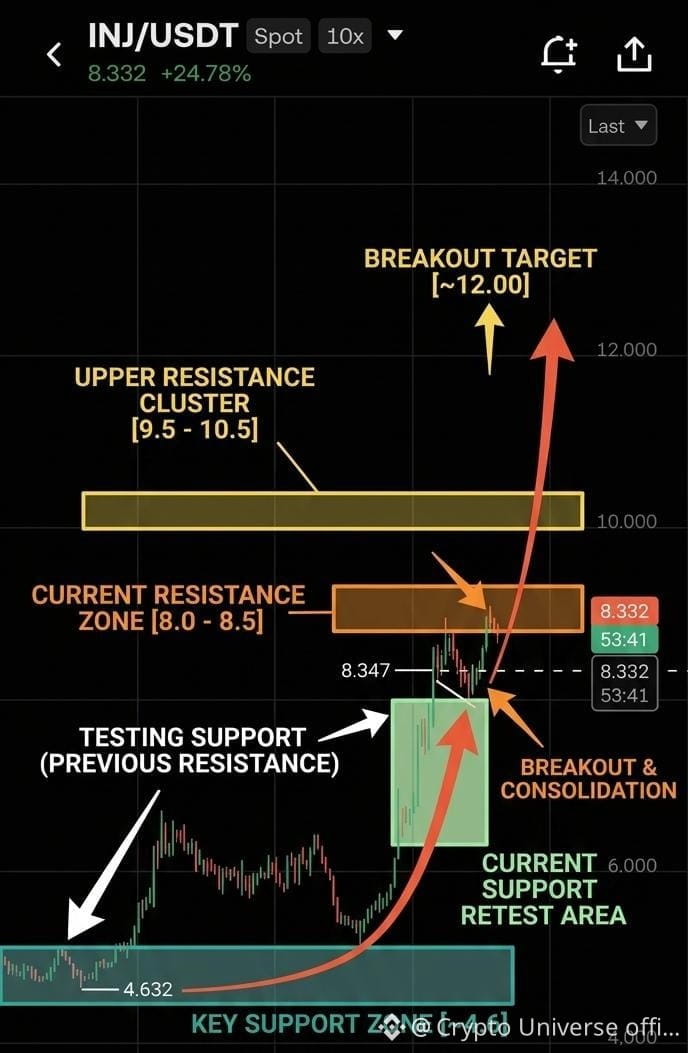
Guys… INJ has exploded from the $4.63 area and is now holding around $8.33 after breaking through the previous resistance.
What I’m watching now is the $8.00–$8.50 zone 👀
🔥 Entry: $7.80–$8.33
🚀 Breakout: Strong 4H closes above $8.50
🎯 TP1: $8.80
🎯 TP2: $9.50
🎯 TP3: $10.50
🎯 TP4: $12.00
🛡️ SL: $7.20
The key part is the retest. INJ pushed higher, pulled back, and is now defending the breakout area around $8.34.
If bulls can reclaim and hold above $8.50 with strong volume, I’ll be watching $9.50 first, followed by the $10.50 supply zone. If that gets cleared, $12 comes into focus.
But if $8.00 fails decisively, I’d want to see another confirmation before entering.
INJ holders… are we getting the next leg toward $10.50–$12? 👀🔥
⚠️ High volatility setup. Use proper position sizing and strict risk management.$INJ
{future}(INJUSDT)
🚨 INJECTIVE (INJ) — THE BREAKOUT IS STILL ALIVE 👀🔥
Guys… INJ has exploded from the $4.63 area and is now holding around $8.33 after breaking through the previous resistance.
What I’m watching now is the $8.00–$8.50 zone 👀
🔥 Entry: $7.80–$8.33
🚀 Breakout: Strong 4H closes above $8.50
🎯 TP1: $8.80
🎯 TP2: $9.50
🎯 TP3: $10.50
🎯 TP4: $12.00
🛡️ SL: $7.20
The key part is the retest. INJ pushed higher, pulled back, and is now defending the breakout area around $8.34.
If bulls can reclaim and hold above $8.50 with strong volume, I’ll be watching $9.50 first, followed by the $10.50 supply zone. If that gets cleared, $12 comes into focus.
But if $8.00 fails decisively, I’d want to see another confirmation before entering.
INJ holders… are we getting the next leg toward $10.50–$12? 👀🔥
⚠️ High volatility setup. Use proper position sizing and strict risk management.$INJ
Guys… INJ has exploded from the $4.63 area and is now holding around $8.33 after breaking through the previous resistance.
What I’m watching now is the $8.00–$8.50 zone 👀
🔥 Entry: $7.80–$8.33
🚀 Breakout: Strong 4H closes above $8.50
🎯 TP1: $8.80
🎯 TP2: $9.50
🎯 TP3: $10.50
🎯 TP4: $12.00
🛡️ SL: $7.20
The key part is the retest. INJ pushed higher, pulled back, and is now defending the breakout area around $8.34.
If bulls can reclaim and hold above $8.50 with strong volume, I’ll be watching $9.50 first, followed by the $10.50 supply zone. If that gets cleared, $12 comes into focus.
But if $8.00 fails decisively, I’d want to see another confirmation before entering.
INJ holders… are we getting the next leg toward $10.50–$12? 👀🔥
⚠️ High volatility setup. Use proper position sizing and strict risk management.$INJ
2
3
1.3k
·
--
Bullish
🚨 STRK IS COMPRESSING UNDER RESISTANCE — AND I’M WATCHING $0.065 👀🔥
Stop… stop… stop… scrolling fam!
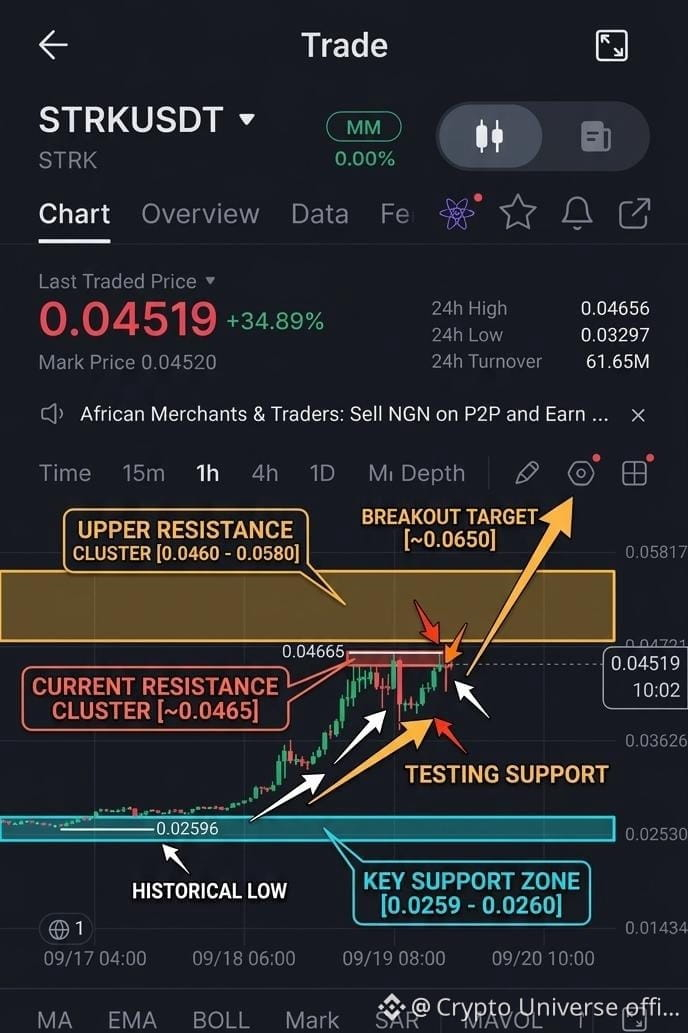
Give me 1 minute because STRK/USDT has gone from the $0.0259–$0.0260 base all the way to $0.04665, and the structure is getting VERY interesting.
STRK is currently around $0.04519, sitting just underneath the recent high.
And look at what price is doing…
Instead of giving back the entire rally, buyers are defending higher lows while price keeps pressing into the same resistance.
That’s the compression I’m watching.
🔥 $0.0465 IS THE GATEKEEPER
The immediate ceiling is around $0.0465–$0.04665.
If STRK gets a clean 1H close above $0.04665, the next levels on my chart are:
🎯 $0.052
🎯 $0.058
🚀 $0.065
And once the $0.058 area is cleared, the bigger expansion toward $0.065 comes into focus.
📍 MY STRK MAP
🟢 Entry zone: $0.04100–$0.04520
🔥 Breakout: 1H close above $0.04665
🎯 TP1: $0.04660
🎯 TP2: $0.05200
🎯 TP3: $0.05800
🚀 TP4: $0.06500
🛑 SL: $0.03800
The story behind this move is simple:
$0.026 base → explosive rally → $0.04665 high → higher lows → resistance compression
That’s why I’m keeping my eyes on the same ceiling.
If buyers finally absorb the supply around $0.0465, STRK could enter the next phase of the move.
$0.0465 is the door.
$0.052 is the first checkpoint.
$0.058 is the bigger battle.
$0.065 is the expansion target. 🚀
Now tell me fam…
{future}(STRKUSDT)
Does $STRK break $0.04665 and start the next leg, or do we get one more shakeout before the breakout? 👀🔥
🚨 STRK IS COMPRESSING UNDER RESISTANCE — AND I’M WATCHING $0.065 👀🔥
Stop… stop… stop… scrolling fam!
Give me 1 minute because STRK/USDT has gone from the $0.0259–$0.0260 base all the way to $0.04665, and the structure is getting VERY interesting.
STRK is currently around $0.04519, sitting just underneath the recent high.
And look at what price is doing…
Instead of giving back the entire rally, buyers are defending higher lows while price keeps pressing into the same resistance.
That’s the compression I’m watching.
🔥 $0.0465 IS THE GATEKEEPER
The immediate ceiling is around $0.0465–$0.04665.
If STRK gets a clean 1H close above $0.04665, the next levels on my chart are:
🎯 $0.052
🎯 $0.058
🚀 $0.065
And once the $0.058 area is cleared, the bigger expansion toward $0.065 comes into focus.
📍 MY STRK MAP
🟢 Entry zone: $0.04100–$0.04520
🔥 Breakout: 1H close above $0.04665
🎯 TP1: $0.04660
🎯 TP2: $0.05200
🎯 TP3: $0.05800
🚀 TP4: $0.06500
🛑 SL: $0.03800
The story behind this move is simple:
$0.026 base → explosive rally → $0.04665 high → higher lows → resistance compression
That’s why I’m keeping my eyes on the same ceiling.
If buyers finally absorb the supply around $0.0465, STRK could enter the next phase of the move.
$0.0465 is the door.
$0.052 is the first checkpoint.
$0.058 is the bigger battle.
$0.065 is the expansion target. 🚀
Now tell me fam…
Does $STRK break $0.04665 and start the next leg, or do we get one more shakeout before the breakout? 👀🔥
Stop… stop… stop… scrolling fam!
Give me 1 minute because STRK/USDT has gone from the $0.0259–$0.0260 base all the way to $0.04665, and the structure is getting VERY interesting.
STRK is currently around $0.04519, sitting just underneath the recent high.
And look at what price is doing…
Instead of giving back the entire rally, buyers are defending higher lows while price keeps pressing into the same resistance.
That’s the compression I’m watching.
🔥 $0.0465 IS THE GATEKEEPER
The immediate ceiling is around $0.0465–$0.04665.
If STRK gets a clean 1H close above $0.04665, the next levels on my chart are:
🎯 $0.052
🎯 $0.058
🚀 $0.065
And once the $0.058 area is cleared, the bigger expansion toward $0.065 comes into focus.
📍 MY STRK MAP
🟢 Entry zone: $0.04100–$0.04520
🔥 Breakout: 1H close above $0.04665
🎯 TP1: $0.04660
🎯 TP2: $0.05200
🎯 TP3: $0.05800
🚀 TP4: $0.06500
🛑 SL: $0.03800
The story behind this move is simple:
$0.026 base → explosive rally → $0.04665 high → higher lows → resistance compression
That’s why I’m keeping my eyes on the same ceiling.
If buyers finally absorb the supply around $0.0465, STRK could enter the next phase of the move.
$0.0465 is the door.
$0.052 is the first checkpoint.
$0.058 is the bigger battle.
$0.065 is the expansion target. 🚀
Now tell me fam…
Does $STRK break $0.04665 and start the next leg, or do we get one more shakeout before the breakout? 👀🔥
5
1.5k
·
--
Bullish
30D trade $INJ 1.5K USDT
🚨 INJ IS PRESSING THE CEILING — AND $9.50 IS THE BIGGER STORY 👀🚀
Stop… stop… stop… scrolling fam!
Give me 1 minute because INJ/USDT has been building a very interesting continuation structure.
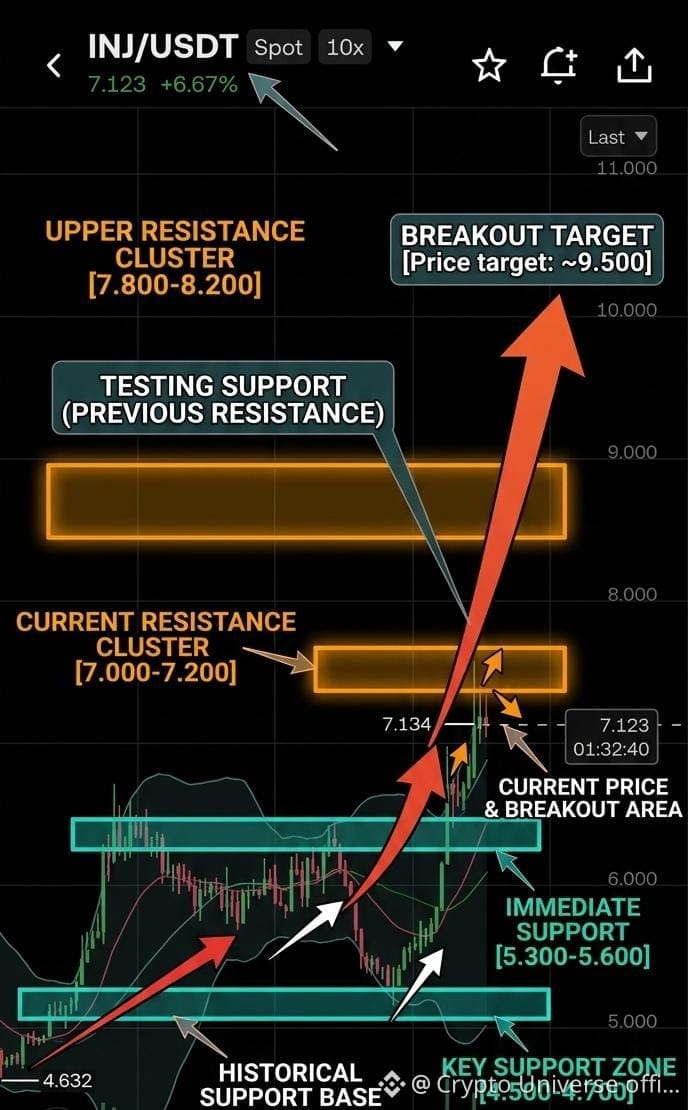
INJ came from the $4.50–$4.70 demand zone, defended the $5.30–$5.60 area, and then started printing a strong bullish wave.
Now look where price is sitting…
$7.123.
The recent high is $7.134, meaning INJ is literally pressing against the $7.00–$7.20 resistance cluster.
And this is the part I’m watching closely.
🔥 $7.20 IS THE GATEKEEPER
If INJ gets a clean 4H close above $7.20, the next levels on my chart are:
🎯 $7.50
🎯 $7.80
🎯 $8.20
🚀 $9.50
What I like here is the tight price action around resistance.
Instead of immediately dumping away from $7.20, price is compressing underneath it.
That means the battle is happening right at the ceiling.
📍 MY INJ GAME PLAN
🟢 Entry zone: $6.80–$7.12
🔥 Breakout: 4H close above $7.20
🎯 TP1: $7.50
🎯 TP2: $7.80
🎯 TP3: $8.20
🚀 Extended target: $9.50
🛑 SL: $6.20
And remember the structure underneath:
$4.63 low → $5.30–$5.60 support → $7.13 high
That’s a serious shift from the previous accumulation area.
Now the question is whether buyers can absorb the remaining supply around $7.00–$7.20.
If they do…
$7.80–$8.20 becomes the next major battlefield, with $9.50 sitting further above. 👀🔥
INJ is knocking.
Do we get the $7.20 breakout next, or does INJ need one more pullback before the next expansion? 🚀
$INJ
{future}(INJUSDT)
🚨 INJ IS PRESSING THE CEILING — AND $9.50 IS THE BIGGER STORY 👀🚀
Stop… stop… stop… scrolling fam!
Give me 1 minute because INJ/USDT has been building a very interesting continuation structure.
INJ came from the $4.50–$4.70 demand zone, defended the $5.30–$5.60 area, and then started printing a strong bullish wave.
Now look where price is sitting…
$7.123.
The recent high is $7.134, meaning INJ is literally pressing against the $7.00–$7.20 resistance cluster.
And this is the part I’m watching closely.
🔥 $7.20 IS THE GATEKEEPER
If INJ gets a clean 4H close above $7.20, the next levels on my chart are:
🎯 $7.50
🎯 $7.80
🎯 $8.20
🚀 $9.50
What I like here is the tight price action around resistance.
Instead of immediately dumping away from $7.20, price is compressing underneath it.
That means the battle is happening right at the ceiling.
📍 MY INJ GAME PLAN
🟢 Entry zone: $6.80–$7.12
🔥 Breakout: 4H close above $7.20
🎯 TP1: $7.50
🎯 TP2: $7.80
🎯 TP3: $8.20
🚀 Extended target: $9.50
🛑 SL: $6.20
And remember the structure underneath:
$4.63 low → $5.30–$5.60 support → $7.13 high
That’s a serious shift from the previous accumulation area.
Now the question is whether buyers can absorb the remaining supply around $7.00–$7.20.
If they do…
$7.80–$8.20 becomes the next major battlefield, with $9.50 sitting further above. 👀🔥
INJ is knocking.
Do we get the $7.20 breakout next, or does INJ need one more pullback before the next expansion? 🚀
$INJ
Stop… stop… stop… scrolling fam!
Give me 1 minute because INJ/USDT has been building a very interesting continuation structure.
INJ came from the $4.50–$4.70 demand zone, defended the $5.30–$5.60 area, and then started printing a strong bullish wave.
Now look where price is sitting…
$7.123.
The recent high is $7.134, meaning INJ is literally pressing against the $7.00–$7.20 resistance cluster.
And this is the part I’m watching closely.
🔥 $7.20 IS THE GATEKEEPER
If INJ gets a clean 4H close above $7.20, the next levels on my chart are:
🎯 $7.50
🎯 $7.80
🎯 $8.20
🚀 $9.50
What I like here is the tight price action around resistance.
Instead of immediately dumping away from $7.20, price is compressing underneath it.
That means the battle is happening right at the ceiling.
📍 MY INJ GAME PLAN
🟢 Entry zone: $6.80–$7.12
🔥 Breakout: 4H close above $7.20
🎯 TP1: $7.50
🎯 TP2: $7.80
🎯 TP3: $8.20
🚀 Extended target: $9.50
🛑 SL: $6.20
And remember the structure underneath:
$4.63 low → $5.30–$5.60 support → $7.13 high
That’s a serious shift from the previous accumulation area.
Now the question is whether buyers can absorb the remaining supply around $7.00–$7.20.
If they do…
$7.80–$8.20 becomes the next major battlefield, with $9.50 sitting further above. 👀🔥
INJ is knocking.
Do we get the $7.20 breakout next, or does INJ need one more pullback before the next expansion? 🚀
$INJ
4
1.8k
·
--
Bullish
🚨 BTC BREAKOUT UPDATE — $85K ON WATCH 👀🔥
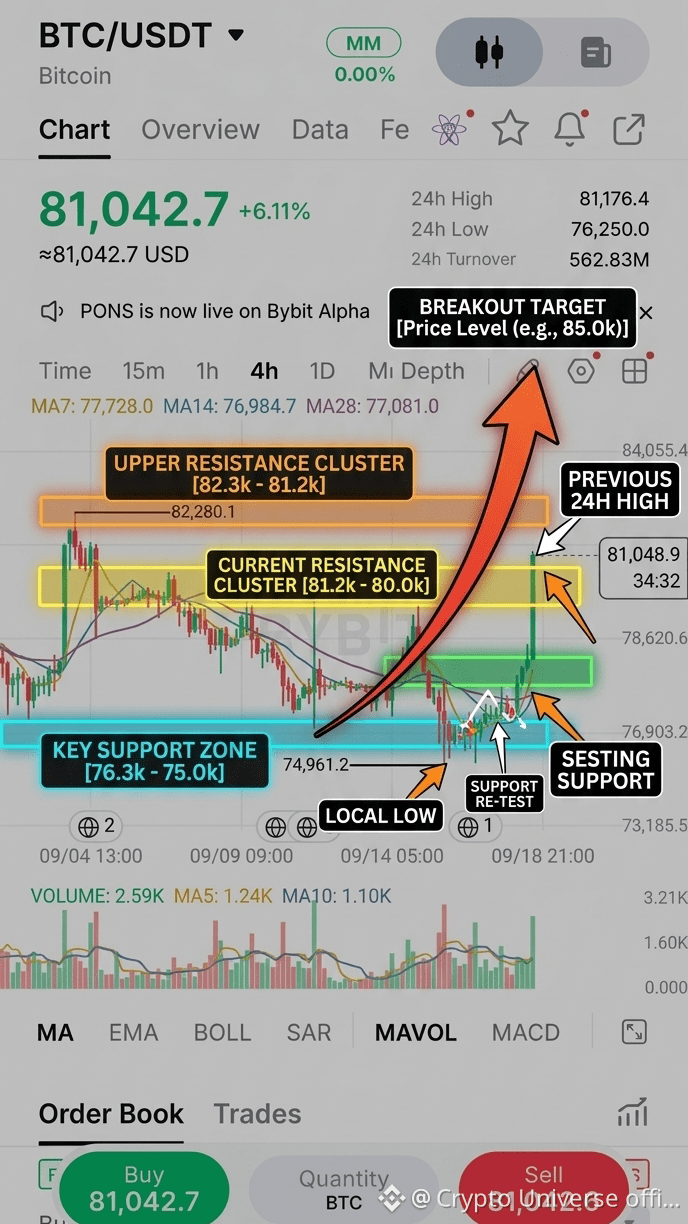
Guys… BTC has finally pushed out of a long consolidation range after buyers defended the $75K–$76.3K support zone. Price is now pressing the $81K area with strong momentum.
This is the level I’m watching 👇
🔥 Entry: $78K–$80K
🚀 Breakout: $81.2K+
🎯 TP1: $82.3K
🎯 TP2: $83.5K
🎯 TP3: $85K
🛡️ SL: $76.8K
If BTC clears the $81.2K–$82.3K supply zone with strong volume, the next upside liquidity could open toward $85K.
But I’m not chasing the vertical move — confirmation matters.
Are you expecting BTC to break $82K next? 👀🚀$BTC
{future}(BTCUSDT)
🚨 BTC BREAKOUT UPDATE — $85K ON WATCH 👀🔥
Guys… BTC has finally pushed out of a long consolidation range after buyers defended the $75K–$76.3K support zone. Price is now pressing the $81K area with strong momentum.
This is the level I’m watching 👇
🔥 Entry: $78K–$80K
🚀 Breakout: $81.2K+
🎯 TP1: $82.3K
🎯 TP2: $83.5K
🎯 TP3: $85K
🛡️ SL: $76.8K
If BTC clears the $81.2K–$82.3K supply zone with strong volume, the next upside liquidity could open toward $85K.
But I’m not chasing the vertical move — confirmation matters.
Are you expecting BTC to break $82K next? 👀🚀$BTC
Guys… BTC has finally pushed out of a long consolidation range after buyers defended the $75K–$76.3K support zone. Price is now pressing the $81K area with strong momentum.
This is the level I’m watching 👇
🔥 Entry: $78K–$80K
🚀 Breakout: $81.2K+
🎯 TP1: $82.3K
🎯 TP2: $83.5K
🎯 TP3: $85K
🛡️ SL: $76.8K
If BTC clears the $81.2K–$82.3K supply zone with strong volume, the next upside liquidity could open toward $85K.
But I’m not chasing the vertical move — confirmation matters.
Are you expecting BTC to break $82K next? 👀🚀$BTC
1
1
1.2k
30D trade $ARB 405.2 USDT
🚨 GRAVITY JUST CAME OUT OF A MULTI-MONTH BASE — NOW $0.01 IS THE FIRST REAL TEST 👀🔥
Stop… stop… stop… scrolling fam!
Give me 1 minute because G/USDT is showing one of those long-term structures that can completely change the chart when momentum finally arrives.
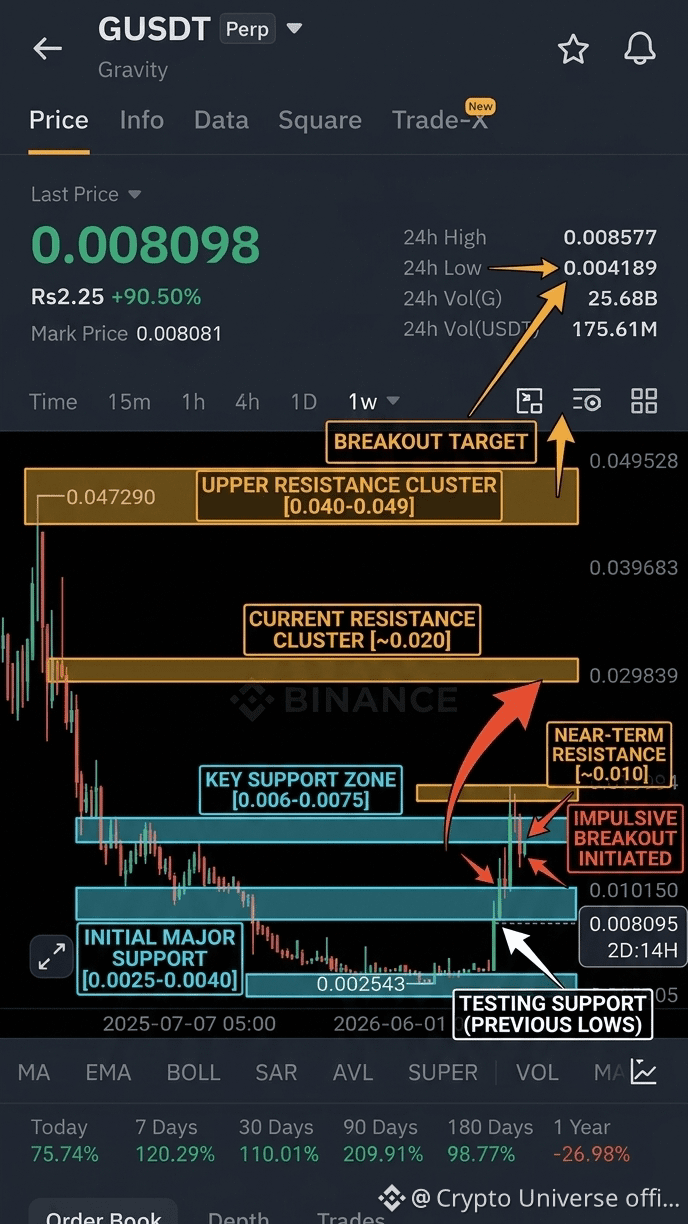
Gravity spent months building a base around $0.0025–$0.0040, with the major swing low around $0.002543.
Then buyers finally stepped in with serious force.
The price pushed through the $0.006–$0.0075 zone with a powerful weekly bullish candle and is now trading around $0.00810, close to the weekly high of $0.00858.
Now comes the first big battle…
🔥 $0.010 IS THE GATEKEEPER
If Gravity can reclaim and hold $0.010 with strong weekly momentum, I’ll be watching the next major zones:
🎯 $0.015
🎯 $0.020
🚀 $0.040+
And that $0.040–$0.049 area is where the bigger historical resistance sits.
📍 MY GRAVITY MAP
🟢 Entry zone: $0.00680–$0.00800
🔥 First breakout level: $0.010
🎯 TP1: $0.010
🎯 TP2: $0.015
🎯 TP3: $0.020
🚀 Extended target: $0.040+
🛑 SL: $0.00550
What catches my attention is the timeframe.
This isn't just a small intraday bounce.
We’re looking at a weekly structure coming out of a multi-month accumulation range.
Gravity went from:
$0.0025–$0.0040 accumulation → $0.006 breakout → $0.008+ momentum
Now the market is standing directly in front of the $0.010 psychological barrier.
If that level flips…
the next chapters of this move could get very interesting. 👀🚀
Who’s watching $G with me — $0.01 first, or straight toward the $0.02 zone?
{future}(GUSDT)
$NEAR
{future}(NEARUSDT)
$ARB
{future}(ARBUSDT)
🚨 GRAVITY JUST CAME OUT OF A MULTI-MONTH BASE — NOW $0.01 IS THE FIRST REAL TEST 👀🔥
Stop… stop… stop… scrolling fam!
Give me 1 minute because G/USDT is showing one of those long-term structures that can completely change the chart when momentum finally arrives.
Gravity spent months building a base around $0.0025–$0.0040, with the major swing low around $0.002543.
Then buyers finally stepped in with serious force.
The price pushed through the $0.006–$0.0075 zone with a powerful weekly bullish candle and is now trading around $0.00810, close to the weekly high of $0.00858.
Now comes the first big battle…
🔥 $0.010 IS THE GATEKEEPER
If Gravity can reclaim and hold $0.010 with strong weekly momentum, I’ll be watching the next major zones:
🎯 $0.015
🎯 $0.020
🚀 $0.040+
And that $0.040–$0.049 area is where the bigger historical resistance sits.
📍 MY GRAVITY MAP
🟢 Entry zone: $0.00680–$0.00800
🔥 First breakout level: $0.010
🎯 TP1: $0.010
🎯 TP2: $0.015
🎯 TP3: $0.020
🚀 Extended target: $0.040+
🛑 SL: $0.00550
What catches my attention is the timeframe.
This isn't just a small intraday bounce.
We’re looking at a weekly structure coming out of a multi-month accumulation range.
Gravity went from:
$0.0025–$0.0040 accumulation → $0.006 breakout → $0.008+ momentum
Now the market is standing directly in front of the $0.010 psychological barrier.
If that level flips…
the next chapters of this move could get very interesting. 👀🚀
Who’s watching $G with me — $0.01 first, or straight toward the $0.02 zone?
$NEAR
$ARB
Stop… stop… stop… scrolling fam!
Give me 1 minute because G/USDT is showing one of those long-term structures that can completely change the chart when momentum finally arrives.
Gravity spent months building a base around $0.0025–$0.0040, with the major swing low around $0.002543.
Then buyers finally stepped in with serious force.
The price pushed through the $0.006–$0.0075 zone with a powerful weekly bullish candle and is now trading around $0.00810, close to the weekly high of $0.00858.
Now comes the first big battle…
🔥 $0.010 IS THE GATEKEEPER
If Gravity can reclaim and hold $0.010 with strong weekly momentum, I’ll be watching the next major zones:
🎯 $0.015
🎯 $0.020
🚀 $0.040+
And that $0.040–$0.049 area is where the bigger historical resistance sits.
📍 MY GRAVITY MAP
🟢 Entry zone: $0.00680–$0.00800
🔥 First breakout level: $0.010
🎯 TP1: $0.010
🎯 TP2: $0.015
🎯 TP3: $0.020
🚀 Extended target: $0.040+
🛑 SL: $0.00550
What catches my attention is the timeframe.
This isn't just a small intraday bounce.
We’re looking at a weekly structure coming out of a multi-month accumulation range.
Gravity went from:
$0.0025–$0.0040 accumulation → $0.006 breakout → $0.008+ momentum
Now the market is standing directly in front of the $0.010 psychological barrier.
If that level flips…
the next chapters of this move could get very interesting. 👀🚀
Who’s watching $G with me — $0.01 first, or straight toward the $0.02 zone?
$NEAR
$ARB
1
980
·
--
Bullish
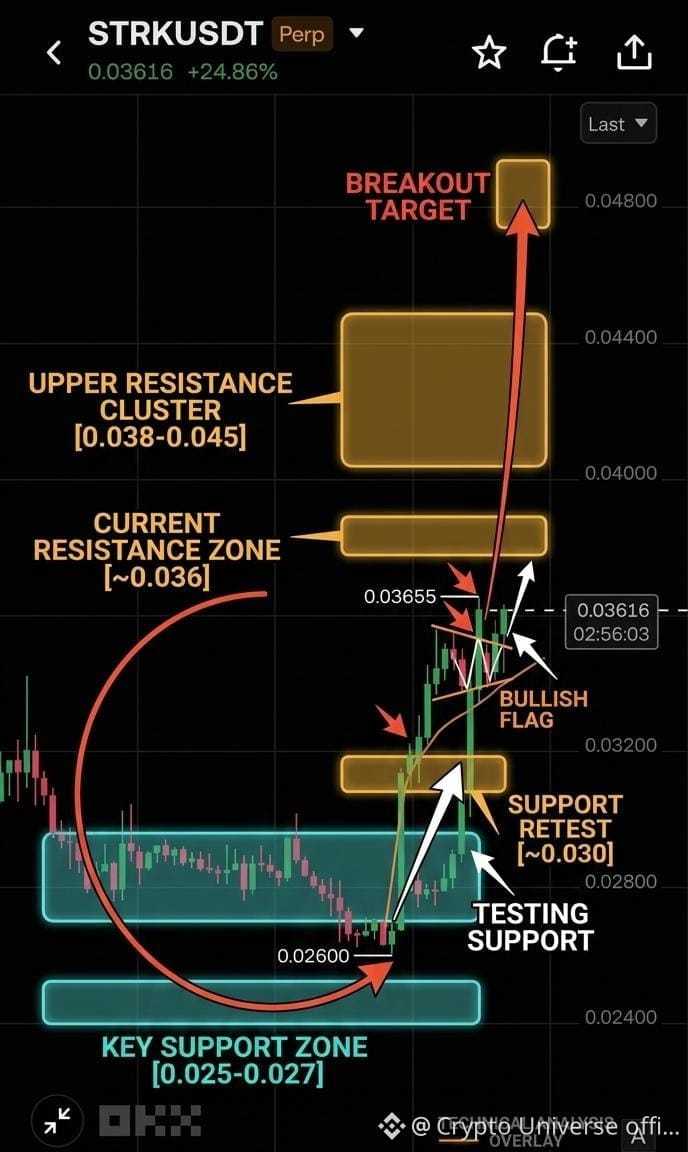
🚨 $STRK IS COILING UNDER RESISTANCE — $0.048 IS BACK ON MY RADAR 👀🔥
Stop… stop… stop… scrolling fam!
{future}(STRKUSDT)
Give me 1 minute because STRK/USDT just made a powerful recovery from the $0.025–$0.027 demand zone, and now the chart is showing something I really like:
A bullish flag forming right under resistance. 📈
STRK pushed aggressively from around $0.026 and reached $0.03655 before pulling into a tight consolidation.
Right now, price is around $0.03616.
And this is the interesting part…
The sellers tried to reject the move near $0.0365, but instead of collapsing, STRK started building a flag.
That tells me the battle is happening right at the ceiling.
🔥 THE $0.036 BREAKOUT BATTLE
If STRK breaks above the $0.036–$0.0365 resistance area with strong momentum, the next liquidity zones on my chart are:
🎯 $0.038
🎯 $0.042
🎯 $0.045
🚀 $0.048
And if that upper resistance cluster finally gets cleared…
$0.048 becomes the bigger expansion target.
📍 MY STRK MAP
🟢 Entry zone: $0.0340–$0.0360
🔥 Breakout zone: $0.036–$0.0365
🎯 TP1: $0.038
🎯 TP2: $0.042
🎯 TP3: $0.045
🚀 TP4: $0.048
🛑 SL: $0.0315
The level I’m watching underneath everything is $0.030.
STRK already tested that area before forming this flag, and buyers stepped in.
So now we have a simple structure:
$0.030 = support
$0.036 = resistance
$0.038–$0.045 = liquidity zone
$0.048 = breakout target
STRK has already made the first move.
Now I’m watching to see whether this flag becomes the launchpad for the next one. 🚀
Who’s watching STRK with me — breakout above $0.0365 or one more shakeout first? 👀
🚨 $STRK IS COILING UNDER RESISTANCE — $0.048 IS BACK ON MY RADAR 👀🔥
Stop… stop… stop… scrolling fam!
Give me 1 minute because STRK/USDT just made a powerful recovery from the $0.025–$0.027 demand zone, and now the chart is showing something I really like:
A bullish flag forming right under resistance. 📈
STRK pushed aggressively from around $0.026 and reached $0.03655 before pulling into a tight consolidation.
Right now, price is around $0.03616.
And this is the interesting part…
The sellers tried to reject the move near $0.0365, but instead of collapsing, STRK started building a flag.
That tells me the battle is happening right at the ceiling.
🔥 THE $0.036 BREAKOUT BATTLE
If STRK breaks above the $0.036–$0.0365 resistance area with strong momentum, the next liquidity zones on my chart are:
🎯 $0.038
🎯 $0.042
🎯 $0.045
🚀 $0.048
And if that upper resistance cluster finally gets cleared…
$0.048 becomes the bigger expansion target.
📍 MY STRK MAP
🟢 Entry zone: $0.0340–$0.0360
🔥 Breakout zone: $0.036–$0.0365
🎯 TP1: $0.038
🎯 TP2: $0.042
🎯 TP3: $0.045
🚀 TP4: $0.048
🛑 SL: $0.0315
The level I’m watching underneath everything is $0.030.
STRK already tested that area before forming this flag, and buyers stepped in.
So now we have a simple structure:
$0.030 = support
$0.036 = resistance
$0.038–$0.045 = liquidity zone
$0.048 = breakout target
STRK has already made the first move.
Now I’m watching to see whether this flag becomes the launchpad for the next one. 🚀
Who’s watching STRK with me — breakout above $0.0365 or one more shakeout first? 👀
Stop… stop… stop… scrolling fam!
Give me 1 minute because STRK/USDT just made a powerful recovery from the $0.025–$0.027 demand zone, and now the chart is showing something I really like:
A bullish flag forming right under resistance. 📈
STRK pushed aggressively from around $0.026 and reached $0.03655 before pulling into a tight consolidation.
Right now, price is around $0.03616.
And this is the interesting part…
The sellers tried to reject the move near $0.0365, but instead of collapsing, STRK started building a flag.
That tells me the battle is happening right at the ceiling.
🔥 THE $0.036 BREAKOUT BATTLE
If STRK breaks above the $0.036–$0.0365 resistance area with strong momentum, the next liquidity zones on my chart are:
🎯 $0.038
🎯 $0.042
🎯 $0.045
🚀 $0.048
And if that upper resistance cluster finally gets cleared…
$0.048 becomes the bigger expansion target.
📍 MY STRK MAP
🟢 Entry zone: $0.0340–$0.0360
🔥 Breakout zone: $0.036–$0.0365
🎯 TP1: $0.038
🎯 TP2: $0.042
🎯 TP3: $0.045
🚀 TP4: $0.048
🛑 SL: $0.0315
The level I’m watching underneath everything is $0.030.
STRK already tested that area before forming this flag, and buyers stepped in.
So now we have a simple structure:
$0.030 = support
$0.036 = resistance
$0.038–$0.045 = liquidity zone
$0.048 = breakout target
STRK has already made the first move.
Now I’m watching to see whether this flag becomes the launchpad for the next one. 🚀
Who’s watching STRK with me — breakout above $0.0365 or one more shakeout first? 👀
1
977
·
--
Bullish
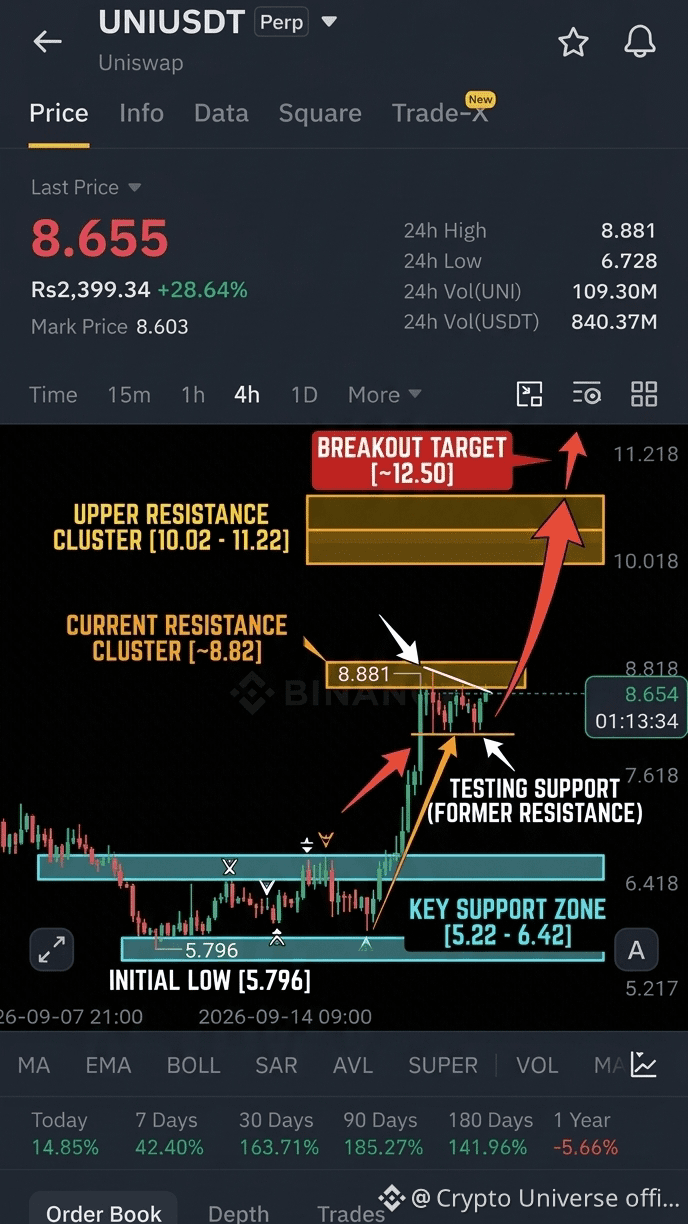
🚨 $UNI NEXT TARGET UPDATE 👀🔥
Guys… UNI just made a strong move from the $5.22–$6.42 demand zone and already pushed to $8.88. Now price is consolidating near $8.65, and this is where I’m watching the next move.
{future}(UNIUSDT)
🔥 Entry zone: $8.00–$8.50
🚀 Breakout: $8.82+
🎯 TP1: $10.00
🎯 TP2: $11.20
🎯 TP3: $12.50
🛡️ SL: $7.60
If buyers clear $8.82 with strong volume, UNI could open the door toward the higher resistance zones.
I’m watching the breakout — are you? 👀🔥
🚨 $UNI NEXT TARGET UPDATE 👀🔥
Guys… UNI just made a strong move from the $5.22–$6.42 demand zone and already pushed to $8.88. Now price is consolidating near $8.65, and this is where I’m watching the next move.
🔥 Entry zone: $8.00–$8.50
🚀 Breakout: $8.82+
🎯 TP1: $10.00
🎯 TP2: $11.20
🎯 TP3: $12.50
🛡️ SL: $7.60
If buyers clear $8.82 with strong volume, UNI could open the door toward the higher resistance zones.
I’m watching the breakout — are you? 👀🔥
Guys… UNI just made a strong move from the $5.22–$6.42 demand zone and already pushed to $8.88. Now price is consolidating near $8.65, and this is where I’m watching the next move.
🔥 Entry zone: $8.00–$8.50
🚀 Breakout: $8.82+
🎯 TP1: $10.00
🎯 TP2: $11.20
🎯 TP3: $12.50
🛡️ SL: $7.60
If buyers clear $8.82 with strong volume, UNI could open the door toward the higher resistance zones.
I’m watching the breakout — are you? 👀🔥
1
911
·
--
Bullish
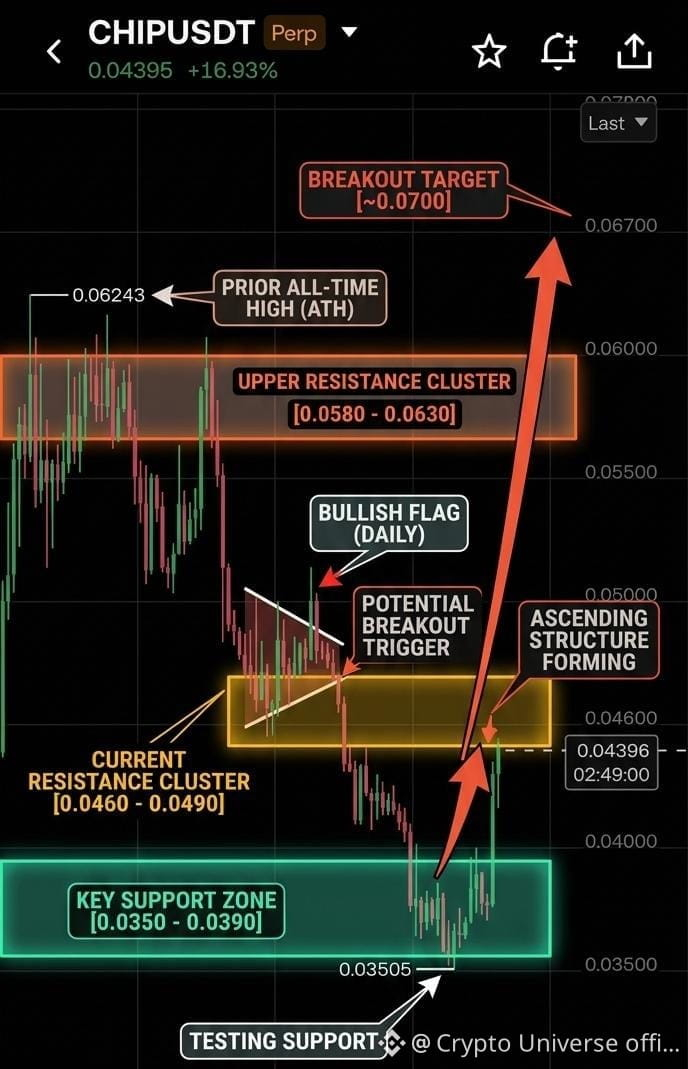
$CHIP is a strong one today. I’m pretty sure CHIP will reach $0.0700 once BTC stabilizes. It’s inevitable. You’re still early! Long setup.
{future}(CHIPUSDT)
Entry: $0.0400 - $0.0440
TP: $0.0490 - $0.0580 - $0.0630 - $0.0670 - $0.0700
SL: $0.0350
$CHIP is a strong one today. I’m pretty sure CHIP will reach $0.0700 once BTC stabilizes. It’s inevitable. You’re still early! Long setup.
Entry: $0.0400 - $0.0440
TP: $0.0490 - $0.0580 - $0.0630 - $0.0670 - $0.0700
SL: $0.0350
Entry: $0.0400 - $0.0440
TP: $0.0490 - $0.0580 - $0.0630 - $0.0670 - $0.0700
SL: $0.0350
2
624
·
--
Bullish
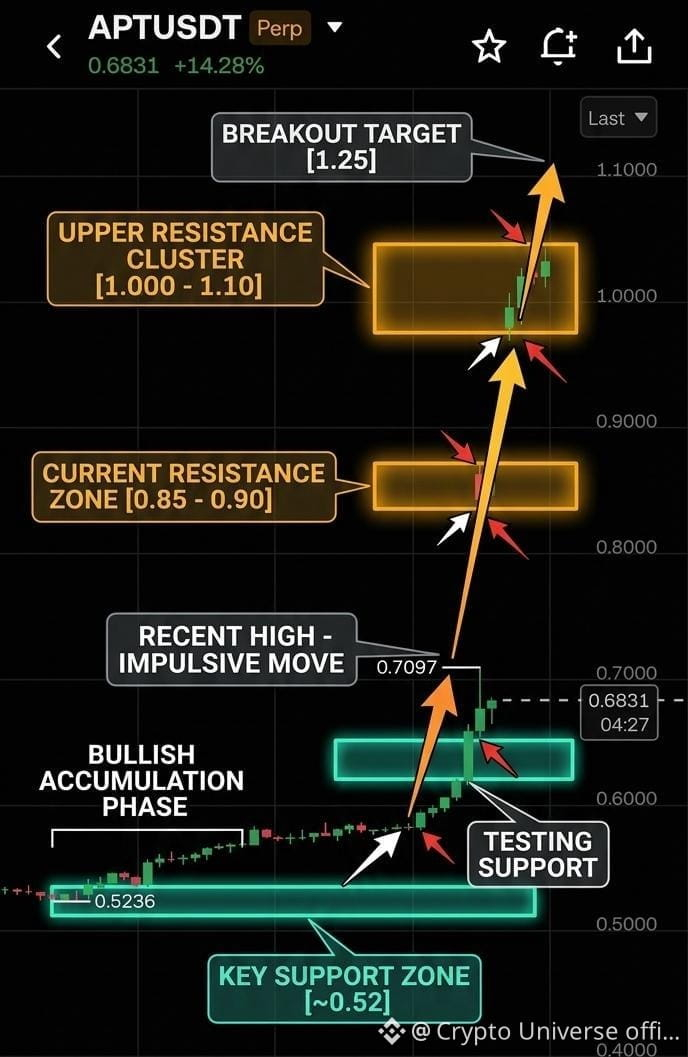
🚨 $APT IS BUILDING ANOTHER MOVE — AND I’M WATCHING $0.71 👀🔥
{future}(APTUSDT)
Stop… stop… stop… scrolling fam!
Give me 1 minute because APT/USDT just made a serious transition from quiet accumulation into a strong momentum structure.
APT is currently around $0.683, after pushing from the $0.52 accumulation floor all the way to a recent high of $0.7097.
Now the chart is giving us an important retest.
🔥 THE LEVEL THAT MATTERS
APT is currently testing the $0.60–$0.63 support area.
This is where I want to see buyers defend the move and build another higher-low.
But the real trigger?
$0.7100.
If APT gets a strong candle close above $0.7100 with high volume, the next levels on my chart are:
🎯 $0.85–$0.90
🎯 $1.00–$1.10
🚀 $1.25
And this is why I’m keeping APT on the radar.
The market already spent time accumulating around $0.52.
Then came the impulsive breakout.
Now price is cooling down around the first support zone instead of completely losing the structure.
📍 MY APT MAP
🟢 Breakout trigger: $0.7100+
🔄 Testing support: $0.60–$0.63
🎯 TP1: $0.85–$0.90
🎯 TP2: $1.00–$1.10
🚀 Extended target: $1.25
🛑 Invalidation: 1H close below $0.5900
The interesting part is that $0.71 is basically the gatekeeper.
Clear that level with volume, and APT enters a completely different price zone.
So tell me fam — does APT reclaim $0.71 and start hunting $0.90 → $1.00+, or do we get another dip toward the $0.60 area first? 👀🚀
🚨 $APT IS BUILDING ANOTHER MOVE — AND I’M WATCHING $0.71 👀🔥
Stop… stop… stop… scrolling fam!
Give me 1 minute because APT/USDT just made a serious transition from quiet accumulation into a strong momentum structure.
APT is currently around $0.683, after pushing from the $0.52 accumulation floor all the way to a recent high of $0.7097.
Now the chart is giving us an important retest.
🔥 THE LEVEL THAT MATTERS
APT is currently testing the $0.60–$0.63 support area.
This is where I want to see buyers defend the move and build another higher-low.
But the real trigger?
$0.7100.
If APT gets a strong candle close above $0.7100 with high volume, the next levels on my chart are:
🎯 $0.85–$0.90
🎯 $1.00–$1.10
🚀 $1.25
And this is why I’m keeping APT on the radar.
The market already spent time accumulating around $0.52.
Then came the impulsive breakout.
Now price is cooling down around the first support zone instead of completely losing the structure.
📍 MY APT MAP
🟢 Breakout trigger: $0.7100+
🔄 Testing support: $0.60–$0.63
🎯 TP1: $0.85–$0.90
🎯 TP2: $1.00–$1.10
🚀 Extended target: $1.25
🛑 Invalidation: 1H close below $0.5900
The interesting part is that $0.71 is basically the gatekeeper.
Clear that level with volume, and APT enters a completely different price zone.
So tell me fam — does APT reclaim $0.71 and start hunting $0.90 → $1.00+, or do we get another dip toward the $0.60 area first? 👀🚀
Stop… stop… stop… scrolling fam!
Give me 1 minute because APT/USDT just made a serious transition from quiet accumulation into a strong momentum structure.
APT is currently around $0.683, after pushing from the $0.52 accumulation floor all the way to a recent high of $0.7097.
Now the chart is giving us an important retest.
🔥 THE LEVEL THAT MATTERS
APT is currently testing the $0.60–$0.63 support area.
This is where I want to see buyers defend the move and build another higher-low.
But the real trigger?
$0.7100.
If APT gets a strong candle close above $0.7100 with high volume, the next levels on my chart are:
🎯 $0.85–$0.90
🎯 $1.00–$1.10
🚀 $1.25
And this is why I’m keeping APT on the radar.
The market already spent time accumulating around $0.52.
Then came the impulsive breakout.
Now price is cooling down around the first support zone instead of completely losing the structure.
📍 MY APT MAP
🟢 Breakout trigger: $0.7100+
🔄 Testing support: $0.60–$0.63
🎯 TP1: $0.85–$0.90
🎯 TP2: $1.00–$1.10
🚀 Extended target: $1.25
🛑 Invalidation: 1H close below $0.5900
The interesting part is that $0.71 is basically the gatekeeper.
Clear that level with volume, and APT enters a completely different price zone.
So tell me fam — does APT reclaim $0.71 and start hunting $0.90 → $1.00+, or do we get another dip toward the $0.60 area first? 👀🚀
3
2.3k
·
--
Bullish
🚨 $NEAR JUST WOKE UP — AND $4 IS NOW ON MY RADAR 👀🔥
{future}(NEARUSDT)
Stop… stop… stop… scrolling fam!
Give me 1 minute because NEAR/USDT just came out of a serious accumulation phase and the chart has completely changed its short-term structure.
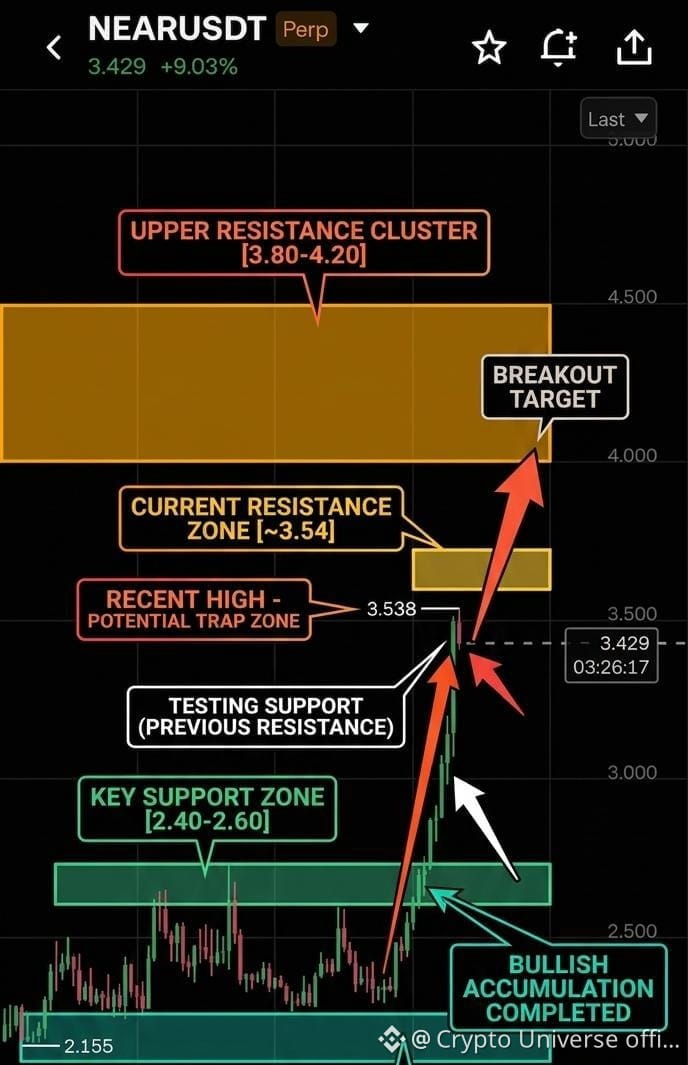
NEAR is currently around $3.43, after holding the major $2.40–$2.60 accumulation zone and launching a powerful vertical rally.
The move already pushed NEAR to $3.538 — and this is where things get VERY interesting.
🔥 THE $3.54 BATTLE
$3.54 is the immediate resistance.
If NEAR can print a solid 4H close above $3.55 with strong volume, I’ll be watching the next liquidity area much higher:
🎯 $3.80
🎯 $4.00
🚀 $4.20
There’s a big gap between the current resistance and that upper zone, so a clean breakout could accelerate quickly.
But here’s the level I really want to see if NEAR pulls back…
🧠 THE RETEST ZONE
If price cools down after this vertical move, $3.00–$3.10 becomes the area I’m watching for a bullish reaction.
A clean rejection wick + buyers stepping back in could create another continuation setup.
📌 MY NEAR MAP
🟢 Breakout: 4H close above $3.55
🎯 TP1: $3.80
🎯 TP2: $4.00–$4.20
🔄 Pullback zone: $3.00–$3.10
🛑 Momentum invalidation: 4H close below $3.15
NEAR spent time building its base around $2.40–$2.60.
Then the range broke.
Now the market is asking one simple question:
Can NEAR turn $3.54 from resistance into support and unlock the $4+ zone? 👀🚀
Because if that happens with volume…
NEAR could get VERY interesting from here.
🚨 $NEAR JUST WOKE UP — AND $4 IS NOW ON MY RADAR 👀🔥
Stop… stop… stop… scrolling fam!
Give me 1 minute because NEAR/USDT just came out of a serious accumulation phase and the chart has completely changed its short-term structure.
NEAR is currently around $3.43, after holding the major $2.40–$2.60 accumulation zone and launching a powerful vertical rally.
The move already pushed NEAR to $3.538 — and this is where things get VERY interesting.
🔥 THE $3.54 BATTLE
$3.54 is the immediate resistance.
If NEAR can print a solid 4H close above $3.55 with strong volume, I’ll be watching the next liquidity area much higher:
🎯 $3.80
🎯 $4.00
🚀 $4.20
There’s a big gap between the current resistance and that upper zone, so a clean breakout could accelerate quickly.
But here’s the level I really want to see if NEAR pulls back…
🧠 THE RETEST ZONE
If price cools down after this vertical move, $3.00–$3.10 becomes the area I’m watching for a bullish reaction.
A clean rejection wick + buyers stepping back in could create another continuation setup.
📌 MY NEAR MAP
🟢 Breakout: 4H close above $3.55
🎯 TP1: $3.80
🎯 TP2: $4.00–$4.20
🔄 Pullback zone: $3.00–$3.10
🛑 Momentum invalidation: 4H close below $3.15
NEAR spent time building its base around $2.40–$2.60.
Then the range broke.
Now the market is asking one simple question:
Can NEAR turn $3.54 from resistance into support and unlock the $4+ zone? 👀🚀
Because if that happens with volume…
NEAR could get VERY interesting from here.
Stop… stop… stop… scrolling fam!
Give me 1 minute because NEAR/USDT just came out of a serious accumulation phase and the chart has completely changed its short-term structure.
NEAR is currently around $3.43, after holding the major $2.40–$2.60 accumulation zone and launching a powerful vertical rally.
The move already pushed NEAR to $3.538 — and this is where things get VERY interesting.
🔥 THE $3.54 BATTLE
$3.54 is the immediate resistance.
If NEAR can print a solid 4H close above $3.55 with strong volume, I’ll be watching the next liquidity area much higher:
🎯 $3.80
🎯 $4.00
🚀 $4.20
There’s a big gap between the current resistance and that upper zone, so a clean breakout could accelerate quickly.
But here’s the level I really want to see if NEAR pulls back…
🧠 THE RETEST ZONE
If price cools down after this vertical move, $3.00–$3.10 becomes the area I’m watching for a bullish reaction.
A clean rejection wick + buyers stepping back in could create another continuation setup.
📌 MY NEAR MAP
🟢 Breakout: 4H close above $3.55
🎯 TP1: $3.80
🎯 TP2: $4.00–$4.20
🔄 Pullback zone: $3.00–$3.10
🛑 Momentum invalidation: 4H close below $3.15
NEAR spent time building its base around $2.40–$2.60.
Then the range broke.
Now the market is asking one simple question:
Can NEAR turn $3.54 from resistance into support and unlock the $4+ zone? 👀🚀
Because if that happens with volume…
NEAR could get VERY interesting from here.
3
6
9.9k
·
--
Bullish
30D trade $ARB 405.2 USDT
🚨 $ARB JUST BROKE OUT OF A LONG ACCUMULATION — NOW THE REAL MOVE COULD BEGIN 👀🔥
Stop… stop… stop… scrolling fam!
Give me 1 minute because ARB/USDT just delivered the kind of breakout I’ve been watching for.
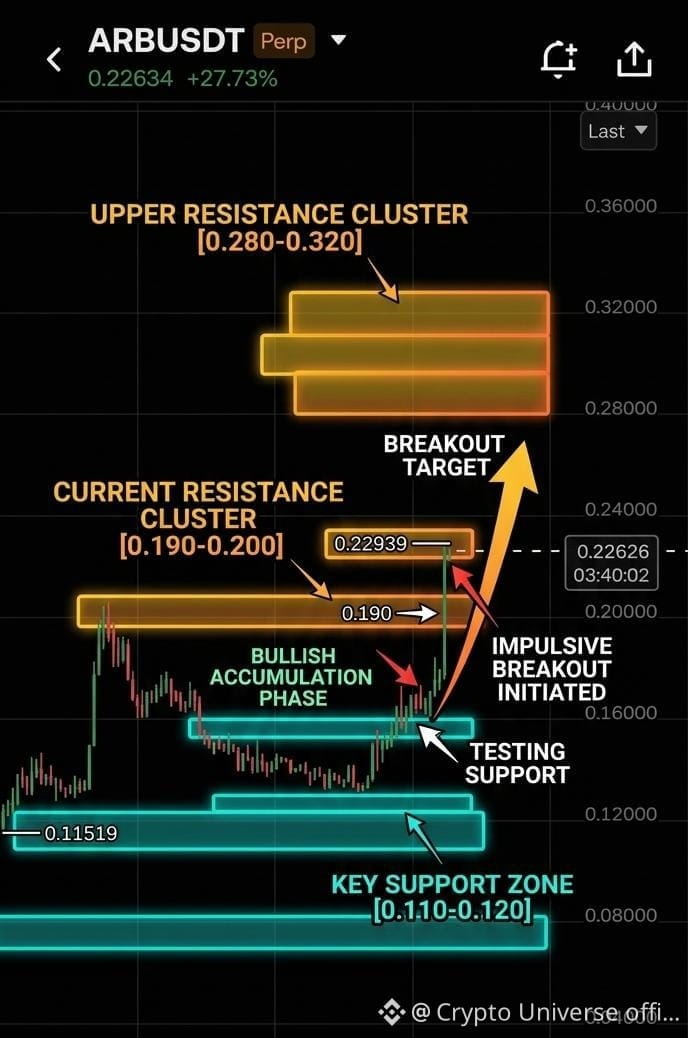
ARB is currently around $0.226, after smashing through the $0.190–$0.200 resistance zone with a strong volume expansion and pushing all the way to $0.2294.
That’s not a small move.
After a long accumulation phase, ARB finally broke above the range and entered a fresh momentum phase. 🔥
Now here’s the level I’m personally watching:
🎯 THE $0.190 FLIP
If ARB pulls back, I want to see $0.190–$0.200 hold as new support.
A clean retest + bullish reaction could give buyers another opportunity to push higher.
🚀 ARB ROADMAP
🟢 Breakout zone: $0.190–$0.200
🎯 Target 1: $0.280
🎯 Target 2: $0.320
🛑 Invalidation: 4H close below $0.180
And there’s an even bigger level underneath…
$0.110–$0.120 remains the major accumulation floor, with the recent structural low around $0.1152.
But right now, ARB has momentum.
The market spent a long time building a base… then one aggressive move broke the ceiling.
Now the question is simple:
Was $0.229 just the beginning, or does ARB need one more retest before attacking $0.28–$0.32? 👀🚀
I’m watching that $0.190–$0.200 flip very closely.
🚨 $ARB JUST BROKE OUT OF A LONG ACCUMULATION — NOW THE REAL MOVE COULD BEGIN 👀🔥
Stop… stop… stop… scrolling fam!
Give me 1 minute because ARB/USDT just delivered the kind of breakout I’ve been watching for.
ARB is currently around $0.226, after smashing through the $0.190–$0.200 resistance zone with a strong volume expansion and pushing all the way to $0.2294.
That’s not a small move.
After a long accumulation phase, ARB finally broke above the range and entered a fresh momentum phase. 🔥
Now here’s the level I’m personally watching:
🎯 THE $0.190 FLIP
If ARB pulls back, I want to see $0.190–$0.200 hold as new support.
A clean retest + bullish reaction could give buyers another opportunity to push higher.
🚀 ARB ROADMAP
🟢 Breakout zone: $0.190–$0.200
🎯 Target 1: $0.280
🎯 Target 2: $0.320
🛑 Invalidation: 4H close below $0.180
And there’s an even bigger level underneath…
$0.110–$0.120 remains the major accumulation floor, with the recent structural low around $0.1152.
But right now, ARB has momentum.
The market spent a long time building a base… then one aggressive move broke the ceiling.
Now the question is simple:
Was $0.229 just the beginning, or does ARB need one more retest before attacking $0.28–$0.32? 👀🚀
I’m watching that $0.190–$0.200 flip very closely.
Stop… stop… stop… scrolling fam!
Give me 1 minute because ARB/USDT just delivered the kind of breakout I’ve been watching for.
ARB is currently around $0.226, after smashing through the $0.190–$0.200 resistance zone with a strong volume expansion and pushing all the way to $0.2294.
That’s not a small move.
After a long accumulation phase, ARB finally broke above the range and entered a fresh momentum phase. 🔥
Now here’s the level I’m personally watching:
🎯 THE $0.190 FLIP
If ARB pulls back, I want to see $0.190–$0.200 hold as new support.
A clean retest + bullish reaction could give buyers another opportunity to push higher.
🚀 ARB ROADMAP
🟢 Breakout zone: $0.190–$0.200
🎯 Target 1: $0.280
🎯 Target 2: $0.320
🛑 Invalidation: 4H close below $0.180
And there’s an even bigger level underneath…
$0.110–$0.120 remains the major accumulation floor, with the recent structural low around $0.1152.
But right now, ARB has momentum.
The market spent a long time building a base… then one aggressive move broke the ceiling.
Now the question is simple:
Was $0.229 just the beginning, or does ARB need one more retest before attacking $0.28–$0.32? 👀🚀
I’m watching that $0.190–$0.200 flip very closely.
1
3
2.6k
Log in to explore more content
Join global crypto users on Binance Square
⚡️ Get latest and useful information about crypto.
💬 Trusted by the world’s largest crypto exchange.
👍 Discover real insights from verified creators.
Email / Phone number
Trending Topics
ETHUp70%InQ3ButLiquidityFalls
268 views
63 Discussing
🚨 Ethereum Update ETH gained 70% in Q3, but liquidity is falling. The price strength looks impressive, but declining liquidity could increase volatility and make the next move more important. 📊 Price up. Liquidity down. What do you think comes next for ETH? #ETH #Ethereum #Crypto #CryptoNews #DeFi #Blockchain #ETHUSD
#ETHUp70%InQ3ButLiquidityFalls
Ethereum’s Q3 2026 performance completely defied historical market relationships. While ETH surged by 70.8% in Q3, vastly outperforming Bitcoin's 42% climb, it achieved this milestone on dramatically thinning order books. According to recent data from CoinGecko, ETH’s median daily market depth plummeted to just 35% to 45% of Bitcoin’s level, down from over 60% during the same timeframe last year. [1, 2, 3]
Valid result indices for FinancePriceChart:
CHASEPA SULUX
·0 Likes
·5 views
EthStakingExitQueueHits2026High
1,106 views
133 Discussing
FedOctoberHoldOdds82.3%
1,312 views
130 Discussing