

FINNEAS
26.5k Posts

FINNEAS
 Square Verified+
Report
Block User
Binance KOL & Crypto Mentor Crypto Expert - Trader - Sharing Market Insights, Trends X:@FINNEAS
Open Trade
Frequent Trader
1.7 Years
1.4K+ Following
33.9K+ Followers
20.4K+ Liked
Posts
Portfolio
All
Quotes
Live
·
--
Bearish
🔥 $ENA — I've been watching the liquidation pressure closely, and this long flush could give us an important short-term reaction zone.
$ENA is currently around $0.209, with approximately $98.5K in long positions liquidated. That's meaningful liquidation pressure for the current price area.
📊 Market Analysis
The heavy long liquidation suggests leveraged buyers were forced out as ENA moved lower. The important question now is whether sellers continue pressing the market or whether buyers use the liquidation zone to rebuild positions.
The immediate support area is around $0.205–$0.209. If this zone holds and buying volume starts returning, ENA could attempt a recovery.
For confirmation, I want to see price reclaim approximately $0.215–$0.218. Above that region, momentum could potentially push toward the next resistance levels around $0.225 and $0.235.
A decisive breakdown below $0.200 would invalidate the bullish scenario and increase downside risk.
🎯 TRADE SETUP — LONG
Entry Point (EP): $0.205–$0.210
TP1: $0.218
TP2: $0.228
TP3: $0.240
SL: $0.198
⚠️ Risk Tip: ENA can move quickly, so keep the position size smaller than usual and consider moving SL toward entry after TP1.
I'm watching the $0.205–$0.210 zone closely. If buyers step in and volume confirms the move, this liquidation flush could turn into a recovery setup.
Not financial advice. Always do your own research.
$ENA
{spot}(ENAUSDT)
🔥 $ENA — I've been watching the liquidation pressure closely, and this long flush could give us an important short-term reaction zone.
$ENA is currently around $0.209, with approximately $98.5K in long positions liquidated. That's meaningful liquidation pressure for the current price area.
📊 Market Analysis
The heavy long liquidation suggests leveraged buyers were forced out as ENA moved lower. The important question now is whether sellers continue pressing the market or whether buyers use the liquidation zone to rebuild positions.
The immediate support area is around $0.205–$0.209. If this zone holds and buying volume starts returning, ENA could attempt a recovery.
For confirmation, I want to see price reclaim approximately $0.215–$0.218. Above that region, momentum could potentially push toward the next resistance levels around $0.225 and $0.235.
A decisive breakdown below $0.200 would invalidate the bullish scenario and increase downside risk.
🎯 TRADE SETUP — LONG
Entry Point (EP): $0.205–$0.210
TP1: $0.218
TP2: $0.228
TP3: $0.240
SL: $0.198
⚠️ Risk Tip: ENA can move quickly, so keep the position size smaller than usual and consider moving SL toward entry after TP1.
I'm watching the $0.205–$0.210 zone closely. If buyers step in and volume confirms the move, this liquidation flush could turn into a recovery setup.
Not financial advice. Always do your own research.
$ENA
$ENA is currently around $0.209, with approximately $98.5K in long positions liquidated. That's meaningful liquidation pressure for the current price area.
📊 Market Analysis
The heavy long liquidation suggests leveraged buyers were forced out as ENA moved lower. The important question now is whether sellers continue pressing the market or whether buyers use the liquidation zone to rebuild positions.
The immediate support area is around $0.205–$0.209. If this zone holds and buying volume starts returning, ENA could attempt a recovery.
For confirmation, I want to see price reclaim approximately $0.215–$0.218. Above that region, momentum could potentially push toward the next resistance levels around $0.225 and $0.235.
A decisive breakdown below $0.200 would invalidate the bullish scenario and increase downside risk.
🎯 TRADE SETUP — LONG
Entry Point (EP): $0.205–$0.210
TP1: $0.218
TP2: $0.228
TP3: $0.240
SL: $0.198
⚠️ Risk Tip: ENA can move quickly, so keep the position size smaller than usual and consider moving SL toward entry after TP1.
I'm watching the $0.205–$0.210 zone closely. If buyers step in and volume confirms the move, this liquidation flush could turn into a recovery setup.
Not financial advice. Always do your own research.
$ENA
1
333
·
--
Bullish
🔥 $BTC — I've been watching the leverage around Bitcoin, and this liquidation is a reminder that the next support reaction could be very important.
$BTC is currently around $85,660.80, with approximately $60.2K in long positions liquidated.
📊 Market Analysis
The liquidation of long positions shows that leveraged buyers were forced out as price moved against them. That kind of flush can temporarily remove weak positions from the market, but BTC still needs confirmation before any aggressive entry.
The immediate support zone I'm watching is around $85,300–$85,700. If Bitcoin holds this region and buying volume starts increasing, a rebound toward the $86K–$87K area becomes possible.
The first resistance is around $86,500, with another important area near $87,200–$87,500. A strong breakout through resistance would provide better confirmation for the long setup.
🎯 TRADE SETUP — LONG
Entry Point (EP): $85,400–$85,800
TP1: $86,500
TP2: $87,200
TP3: $88,000
SL: $84,700
⚠️ Risk Tip: Keep leverage low and position size disciplined. After TP1, consider moving SL toward entry if momentum remains strong.
I'm not interested in chasing BTC after a large candle — I want to see buyers defend the support zone and confirm the reaction.
Not financial advice. Always do your own research.
$BTC
{spot}(BTCUSDT)
🔥 $BTC — I've been watching the leverage around Bitcoin, and this liquidation is a reminder that the next support reaction could be very important.
$BTC is currently around $85,660.80, with approximately $60.2K in long positions liquidated.
📊 Market Analysis
The liquidation of long positions shows that leveraged buyers were forced out as price moved against them. That kind of flush can temporarily remove weak positions from the market, but BTC still needs confirmation before any aggressive entry.
The immediate support zone I'm watching is around $85,300–$85,700. If Bitcoin holds this region and buying volume starts increasing, a rebound toward the $86K–$87K area becomes possible.
The first resistance is around $86,500, with another important area near $87,200–$87,500. A strong breakout through resistance would provide better confirmation for the long setup.
🎯 TRADE SETUP — LONG
Entry Point (EP): $85,400–$85,800
TP1: $86,500
TP2: $87,200
TP3: $88,000
SL: $84,700
⚠️ Risk Tip: Keep leverage low and position size disciplined. After TP1, consider moving SL toward entry if momentum remains strong.
I'm not interested in chasing BTC after a large candle — I want to see buyers defend the support zone and confirm the reaction.
Not financial advice. Always do your own research.
$BTC
$BTC is currently around $85,660.80, with approximately $60.2K in long positions liquidated.
📊 Market Analysis
The liquidation of long positions shows that leveraged buyers were forced out as price moved against them. That kind of flush can temporarily remove weak positions from the market, but BTC still needs confirmation before any aggressive entry.
The immediate support zone I'm watching is around $85,300–$85,700. If Bitcoin holds this region and buying volume starts increasing, a rebound toward the $86K–$87K area becomes possible.
The first resistance is around $86,500, with another important area near $87,200–$87,500. A strong breakout through resistance would provide better confirmation for the long setup.
🎯 TRADE SETUP — LONG
Entry Point (EP): $85,400–$85,800
TP1: $86,500
TP2: $87,200
TP3: $88,000
SL: $84,700
⚠️ Risk Tip: Keep leverage low and position size disciplined. After TP1, consider moving SL toward entry if momentum remains strong.
I'm not interested in chasing BTC after a large candle — I want to see buyers defend the support zone and confirm the reaction.
Not financial advice. Always do your own research.
$BTC
38
·
--
Bullish
🔥 $ETH — I've been watching the leverage buildup closely, and this liquidation flush is exactly the kind of move that can create a new trading opportunity.
$ETH is currently around $2,733.08, with approximately $166K in long positions liquidated. That tells me leveraged buyers have already taken a hit, so the next reaction from this area is important.
📊 Market Analysis
The long liquidation indicates strong short-term selling pressure, but liquidation itself does not automatically mean the trend must continue lower. I want to see whether ETH can hold the nearby support zone and attract fresh spot buying.
The first support area is around $2,700–$2,730. If buyers defend this region and volume begins increasing, ETH could attempt a recovery toward the next resistance zones.
Initial resistance sits around $2,800, followed by the $2,850–$2,900 area. A sustained move through those levels would improve the bullish setup.
🎯 TRADE SETUP — LONG
Entry Point (EP): $2,710–$2,750
TP1: $2,800
TP2: $2,860
TP3: $2,950
SL: $2,650
⚠️ Risk Tip: Don't chase a breakout candle. If TP1 hits, protect the position by reducing risk or moving SL closer to entry.
The key for me is simple: if ETH holds the liquidation zone and buyers return with volume, the recovery setup becomes much more attractive.
Not financial advice. Always do your own research.
$ETH
{spot}(ETHUSDT)
🔥 $ETH — I've been watching the leverage buildup closely, and this liquidation flush is exactly the kind of move that can create a new trading opportunity.
$ETH is currently around $2,733.08, with approximately $166K in long positions liquidated. That tells me leveraged buyers have already taken a hit, so the next reaction from this area is important.
📊 Market Analysis
The long liquidation indicates strong short-term selling pressure, but liquidation itself does not automatically mean the trend must continue lower. I want to see whether ETH can hold the nearby support zone and attract fresh spot buying.
The first support area is around $2,700–$2,730. If buyers defend this region and volume begins increasing, ETH could attempt a recovery toward the next resistance zones.
Initial resistance sits around $2,800, followed by the $2,850–$2,900 area. A sustained move through those levels would improve the bullish setup.
🎯 TRADE SETUP — LONG
Entry Point (EP): $2,710–$2,750
TP1: $2,800
TP2: $2,860
TP3: $2,950
SL: $2,650
⚠️ Risk Tip: Don't chase a breakout candle. If TP1 hits, protect the position by reducing risk or moving SL closer to entry.
The key for me is simple: if ETH holds the liquidation zone and buyers return with volume, the recovery setup becomes much more attractive.
Not financial advice. Always do your own research.
$ETH
$ETH is currently around $2,733.08, with approximately $166K in long positions liquidated. That tells me leveraged buyers have already taken a hit, so the next reaction from this area is important.
📊 Market Analysis
The long liquidation indicates strong short-term selling pressure, but liquidation itself does not automatically mean the trend must continue lower. I want to see whether ETH can hold the nearby support zone and attract fresh spot buying.
The first support area is around $2,700–$2,730. If buyers defend this region and volume begins increasing, ETH could attempt a recovery toward the next resistance zones.
Initial resistance sits around $2,800, followed by the $2,850–$2,900 area. A sustained move through those levels would improve the bullish setup.
🎯 TRADE SETUP — LONG
Entry Point (EP): $2,710–$2,750
TP1: $2,800
TP2: $2,860
TP3: $2,950
SL: $2,650
⚠️ Risk Tip: Don't chase a breakout candle. If TP1 hits, protect the position by reducing risk or moving SL closer to entry.
The key for me is simple: if ETH holds the liquidation zone and buyers return with volume, the recovery setup becomes much more attractive.
Not financial advice. Always do your own research.
$ETH
293
·
--
Bearish
🔥 $CL — I've been watching this move closely, and the fresh long liquidations are giving me a setup worth paying attention to.
$CL is currently around $90.59, where approximately $251K in long positions were liquidated. That is a significant flush of leveraged buyers and can create an important short-term reaction zone.
📊 Market Analysis
The liquidation event suggests aggressive longs were caught on the wrong side of the move. After a flush like this, I want to see whether price can stabilize around $90.50–$90.60 and start building buying volume.
For the bullish setup, the first important resistance area is around $91.20–$91.50. A clean break above that zone with stronger volume would indicate that buyers are regaining control.
On the downside, $90.00 is the key psychological support. Losing that level with strong momentum would weaken the bullish setup and could trigger another round of liquidations.
🎯 TRADE SETUP — LONG
Entry Point (EP): $90.35–$90.75
TP1: $91.30
TP2: $92.00
TP3: $93.00
SL: $89.70
⚠️ Risk Tip: Keep position size controlled, and after TP1 is reached, consider moving your SL toward entry to protect the trade.
I'm watching the reaction around $90.00–$90.60 closely — if buyers defend this zone, the recovery can become interesting.
Not financial advice. Always do your own research.
$CL
{future}(CLUSDT)
🔥 $CL — I've been watching this move closely, and the fresh long liquidations are giving me a setup worth paying attention to.
$CL is currently around $90.59, where approximately $251K in long positions were liquidated. That is a significant flush of leveraged buyers and can create an important short-term reaction zone.
📊 Market Analysis
The liquidation event suggests aggressive longs were caught on the wrong side of the move. After a flush like this, I want to see whether price can stabilize around $90.50–$90.60 and start building buying volume.
For the bullish setup, the first important resistance area is around $91.20–$91.50. A clean break above that zone with stronger volume would indicate that buyers are regaining control.
On the downside, $90.00 is the key psychological support. Losing that level with strong momentum would weaken the bullish setup and could trigger another round of liquidations.
🎯 TRADE SETUP — LONG
Entry Point (EP): $90.35–$90.75
TP1: $91.30
TP2: $92.00
TP3: $93.00
SL: $89.70
⚠️ Risk Tip: Keep position size controlled, and after TP1 is reached, consider moving your SL toward entry to protect the trade.
I'm watching the reaction around $90.00–$90.60 closely — if buyers defend this zone, the recovery can become interesting.
Not financial advice. Always do your own research.
$CL
$CL is currently around $90.59, where approximately $251K in long positions were liquidated. That is a significant flush of leveraged buyers and can create an important short-term reaction zone.
📊 Market Analysis
The liquidation event suggests aggressive longs were caught on the wrong side of the move. After a flush like this, I want to see whether price can stabilize around $90.50–$90.60 and start building buying volume.
For the bullish setup, the first important resistance area is around $91.20–$91.50. A clean break above that zone with stronger volume would indicate that buyers are regaining control.
On the downside, $90.00 is the key psychological support. Losing that level with strong momentum would weaken the bullish setup and could trigger another round of liquidations.
🎯 TRADE SETUP — LONG
Entry Point (EP): $90.35–$90.75
TP1: $91.30
TP2: $92.00
TP3: $93.00
SL: $89.70
⚠️ Risk Tip: Keep position size controlled, and after TP1 is reached, consider moving your SL toward entry to protect the trade.
I'm watching the reaction around $90.00–$90.60 closely — if buyers defend this zone, the recovery can become interesting.
Not financial advice. Always do your own research.
$CL
156
·
--
Bearish
$UNI
I've been watching the recent $UNI move closely, and the liquidation data is telling me that leverage has been getting aggressively flushed from the market.
💰 Current Price: ~$9.04
The important signal here is the $9.04–$8.75 area. Around $8.7488, more than $9K in long positions were liquidated, showing that sellers were able to force leveraged longs out of the market. At the same time, UNI has been trading with elevated volume during its recent advance, so I don't want to chase a breakout blindly.
📊 MARKET ANALYSIS
remains structurally strong after a significant move higher, but the recent long liquidation shows that short-term volatility is high. The $8.70–$8.80 region becomes an important support/retest area.
If buyers defend that zone and price begins printing higher lows, momentum can shift back toward the upside. The first major resistance area is around $9.20–$9.30, followed by the psychological $9.50 level.
Volume confirmation is important here. I want to see buyers returning during the recovery rather than entering during a weak bounce.
🟢 TRADE DIRECTION: LONG
📍 Entry Point (EP): $8.85 – $9.05
🎯 Take Profit:
TP1: $9.25
TP2: $9.50
TP3: $9.85
🛑 Stop Loss (SL): $8.55
⚠️ Risk Tip: Keep position size controlled and consider moving SL toward entry after TP1 is reached.
The liquidation flush has created a much cleaner area to watch. If holds the support zone and volume comes back in, I'll be watching for continuation rather than chasing random candles.
Not financial advice. Always do your own research.
$UNI
{spot}(UNIUSDT)
$UNI
I've been watching the recent $UNI move closely, and the liquidation data is telling me that leverage has been getting aggressively flushed from the market.
💰 Current Price: ~$9.04
The important signal here is the $9.04–$8.75 area. Around $8.7488, more than $9K in long positions were liquidated, showing that sellers were able to force leveraged longs out of the market. At the same time, UNI has been trading with elevated volume during its recent advance, so I don't want to chase a breakout blindly.
📊 MARKET ANALYSIS
remains structurally strong after a significant move higher, but the recent long liquidation shows that short-term volatility is high. The $8.70–$8.80 region becomes an important support/retest area.
If buyers defend that zone and price begins printing higher lows, momentum can shift back toward the upside. The first major resistance area is around $9.20–$9.30, followed by the psychological $9.50 level.
Volume confirmation is important here. I want to see buyers returning during the recovery rather than entering during a weak bounce.
🟢 TRADE DIRECTION: LONG
📍 Entry Point (EP): $8.85 – $9.05
🎯 Take Profit:
TP1: $9.25
TP2: $9.50
TP3: $9.85
🛑 Stop Loss (SL): $8.55
⚠️ Risk Tip: Keep position size controlled and consider moving SL toward entry after TP1 is reached.
The liquidation flush has created a much cleaner area to watch. If holds the support zone and volume comes back in, I'll be watching for continuation rather than chasing random candles.
Not financial advice. Always do your own research.
$UNI
I've been watching the recent $UNI move closely, and the liquidation data is telling me that leverage has been getting aggressively flushed from the market.
💰 Current Price: ~$9.04
The important signal here is the $9.04–$8.75 area. Around $8.7488, more than $9K in long positions were liquidated, showing that sellers were able to force leveraged longs out of the market. At the same time, UNI has been trading with elevated volume during its recent advance, so I don't want to chase a breakout blindly.
📊 MARKET ANALYSIS
remains structurally strong after a significant move higher, but the recent long liquidation shows that short-term volatility is high. The $8.70–$8.80 region becomes an important support/retest area.
If buyers defend that zone and price begins printing higher lows, momentum can shift back toward the upside. The first major resistance area is around $9.20–$9.30, followed by the psychological $9.50 level.
Volume confirmation is important here. I want to see buyers returning during the recovery rather than entering during a weak bounce.
🟢 TRADE DIRECTION: LONG
📍 Entry Point (EP): $8.85 – $9.05
🎯 Take Profit:
TP1: $9.25
TP2: $9.50
TP3: $9.85
🛑 Stop Loss (SL): $8.55
⚠️ Risk Tip: Keep position size controlled and consider moving SL toward entry after TP1 is reached.
The liquidation flush has created a much cleaner area to watch. If holds the support zone and volume comes back in, I'll be watching for continuation rather than chasing random candles.
Not financial advice. Always do your own research.
$UNI
153
·
--
Bullish
$GRASS
I've been watching $GRASS closely because the latest move has the kind of momentum that can create both opportunity and dangerous late entries.
💰 Current Price: ~$0.424
The liquidation data shows approximately $9.79K in long positions liquidated around $0.45617. That matters because recently pushed sharply higher before experiencing a leverage flush. Current market data also shows GRASS up strongly over the recent period, with elevated trading activity and the price near the upper end of its recent range.
📊 MARKET ANALYSIS
The broader short-term structure is bullish, but the key question now is whether buyers can defend the pullback.
The $0.400–$0.415 area is the first support zone I would watch. If buyers step in there and volume increases, can attempt another move toward $0.45 and then higher resistance.
However, chasing after a strong vertical move is risky. I prefer a controlled entry on a retest rather than buying directly into resistance.
🟢 TRADE DIRECTION: LONG
📍 Entry Point (EP): $0.405 – $0.425
🎯 Take Profit:
TP1: $0.450
TP2: $0.480
TP3: $0.520
🛑 Stop Loss (SL): $0.385
⚠️ Risk Tip: After TP1, consider taking partial profit and moving SL closer to entry to protect capital.
The key for me is simple: support must hold, volume must confirm the bounce, and buyers need to reclaim the recent high area. If those conditions appear, remains interesting for continuation.
Not financial advice. Always do your own research.
$GRASS
{future}(GRASSUSDT)
$GRASS
I've been watching $GRASS closely because the latest move has the kind of momentum that can create both opportunity and dangerous late entries.
💰 Current Price: ~$0.424
The liquidation data shows approximately $9.79K in long positions liquidated around $0.45617. That matters because recently pushed sharply higher before experiencing a leverage flush. Current market data also shows GRASS up strongly over the recent period, with elevated trading activity and the price near the upper end of its recent range.
📊 MARKET ANALYSIS
The broader short-term structure is bullish, but the key question now is whether buyers can defend the pullback.
The $0.400–$0.415 area is the first support zone I would watch. If buyers step in there and volume increases, can attempt another move toward $0.45 and then higher resistance.
However, chasing after a strong vertical move is risky. I prefer a controlled entry on a retest rather than buying directly into resistance.
🟢 TRADE DIRECTION: LONG
📍 Entry Point (EP): $0.405 – $0.425
🎯 Take Profit:
TP1: $0.450
TP2: $0.480
TP3: $0.520
🛑 Stop Loss (SL): $0.385
⚠️ Risk Tip: After TP1, consider taking partial profit and moving SL closer to entry to protect capital.
The key for me is simple: support must hold, volume must confirm the bounce, and buyers need to reclaim the recent high area. If those conditions appear, remains interesting for continuation.
Not financial advice. Always do your own research.
$GRASS
I've been watching $GRASS closely because the latest move has the kind of momentum that can create both opportunity and dangerous late entries.
💰 Current Price: ~$0.424
The liquidation data shows approximately $9.79K in long positions liquidated around $0.45617. That matters because recently pushed sharply higher before experiencing a leverage flush. Current market data also shows GRASS up strongly over the recent period, with elevated trading activity and the price near the upper end of its recent range.
📊 MARKET ANALYSIS
The broader short-term structure is bullish, but the key question now is whether buyers can defend the pullback.
The $0.400–$0.415 area is the first support zone I would watch. If buyers step in there and volume increases, can attempt another move toward $0.45 and then higher resistance.
However, chasing after a strong vertical move is risky. I prefer a controlled entry on a retest rather than buying directly into resistance.
🟢 TRADE DIRECTION: LONG
📍 Entry Point (EP): $0.405 – $0.425
🎯 Take Profit:
TP1: $0.450
TP2: $0.480
TP3: $0.520
🛑 Stop Loss (SL): $0.385
⚠️ Risk Tip: After TP1, consider taking partial profit and moving SL closer to entry to protect capital.
The key for me is simple: support must hold, volume must confirm the bounce, and buyers need to reclaim the recent high area. If those conditions appear, remains interesting for continuation.
Not financial advice. Always do your own research.
$GRASS
123
·
--
Bullish
$KERNEL
I've been watching the $KERNEL liquidation side closely, and this is the kind of setup where the direction of the liquidation matters just as much as the size.
💰 Current Reference Price: ~$0.06537
(Reference based on the liquidation price supplied in your feed.)
The latest data shows approximately $1.00K in short positions liquidated around $0.06537. Unlike a long liquidation, a short liquidation means sellers were forced out as price moved upward through their positions.
📊 MARKET ANALYSIS
That gives us an important clue: buyers were strong enough around the liquidation zone to pressure leveraged shorts.
The $0.064–$0.065 area becomes an important support region. If stays above that zone and volume remains healthy, another upside push becomes possible.
The first resistance area is around $0.068–$0.070. A clean breakout above that region could bring additional momentum and potentially trigger more short covering.
I would not chase a sudden candle. The better setup is a controlled retest followed by confirmation from buyers.
🟢 TRADE DIRECTION: LONG
📍 Entry Point (EP): $0.0655 – $0.0670
🎯 Take Profit:
TP1: $0.0690
TP2: $0.0720
TP3: $0.0760
🛑 Stop Loss (SL): $0.0625
⚠️ Risk Tip: Keep leverage low and consider moving SL to entry once TP1 is reached, especially because small-cap tokens can move extremely quickly.
The short liquidation gives us an interesting momentum clue, but confirmation is everything. If holds support and breaks resistance with volume, I'll be watching the upside continuation closely.
Not financial advice. Always do your own research.
$KERNEL
{spot}(KERNELUSDT)
$KERNEL
I've been watching the $KERNEL liquidation side closely, and this is the kind of setup where the direction of the liquidation matters just as much as the size.
💰 Current Reference Price: ~$0.06537
(Reference based on the liquidation price supplied in your feed.)
The latest data shows approximately $1.00K in short positions liquidated around $0.06537. Unlike a long liquidation, a short liquidation means sellers were forced out as price moved upward through their positions.
📊 MARKET ANALYSIS
That gives us an important clue: buyers were strong enough around the liquidation zone to pressure leveraged shorts.
The $0.064–$0.065 area becomes an important support region. If stays above that zone and volume remains healthy, another upside push becomes possible.
The first resistance area is around $0.068–$0.070. A clean breakout above that region could bring additional momentum and potentially trigger more short covering.
I would not chase a sudden candle. The better setup is a controlled retest followed by confirmation from buyers.
🟢 TRADE DIRECTION: LONG
📍 Entry Point (EP): $0.0655 – $0.0670
🎯 Take Profit:
TP1: $0.0690
TP2: $0.0720
TP3: $0.0760
🛑 Stop Loss (SL): $0.0625
⚠️ Risk Tip: Keep leverage low and consider moving SL to entry once TP1 is reached, especially because small-cap tokens can move extremely quickly.
The short liquidation gives us an interesting momentum clue, but confirmation is everything. If holds support and breaks resistance with volume, I'll be watching the upside continuation closely.
Not financial advice. Always do your own research.
$KERNEL
I've been watching the $KERNEL liquidation side closely, and this is the kind of setup where the direction of the liquidation matters just as much as the size.
💰 Current Reference Price: ~$0.06537
(Reference based on the liquidation price supplied in your feed.)
The latest data shows approximately $1.00K in short positions liquidated around $0.06537. Unlike a long liquidation, a short liquidation means sellers were forced out as price moved upward through their positions.
📊 MARKET ANALYSIS
That gives us an important clue: buyers were strong enough around the liquidation zone to pressure leveraged shorts.
The $0.064–$0.065 area becomes an important support region. If stays above that zone and volume remains healthy, another upside push becomes possible.
The first resistance area is around $0.068–$0.070. A clean breakout above that region could bring additional momentum and potentially trigger more short covering.
I would not chase a sudden candle. The better setup is a controlled retest followed by confirmation from buyers.
🟢 TRADE DIRECTION: LONG
📍 Entry Point (EP): $0.0655 – $0.0670
🎯 Take Profit:
TP1: $0.0690
TP2: $0.0720
TP3: $0.0760
🛑 Stop Loss (SL): $0.0625
⚠️ Risk Tip: Keep leverage low and consider moving SL to entry once TP1 is reached, especially because small-cap tokens can move extremely quickly.
The short liquidation gives us an interesting momentum clue, but confirmation is everything. If holds support and breaks resistance with volume, I'll be watching the upside continuation closely.
Not financial advice. Always do your own research.
$KERNEL
135
·
--
🎙️ Crypto market trends discussion; answering questions for newcomers ✅ Build the Binance Plaza🦅 and spread the idea of freedom! Maintain ecological balance!
End
03 h 16 m 06 s
8.5k
23
58
·
--
Bullish
🔴 $ZEC LONG LIQUIDATION ALERT
💥 Liquidated: $75.6K
💵 Price: $1,145.02
⚠️ Heavy long liquidation activity detected.
📊 Watch volatility and market momentum closely.
🔔 Follow for more real-time crypto liquidation alerts.
#ZEC #Zcash #Crypto #cryptosignals #Altcoins
{spot}(ZECUSDT)
🔴 $ZEC LONG LIQUIDATION ALERT
💥 Liquidated: $75.6K
💵 Price: $1,145.02
⚠️ Heavy long liquidation activity detected.
📊 Watch volatility and market momentum closely.
🔔 Follow for more real-time crypto liquidation alerts.
#ZEC #Zcash #Crypto #cryptosignals #Altcoins
💥 Liquidated: $75.6K
💵 Price: $1,145.02
⚠️ Heavy long liquidation activity detected.
📊 Watch volatility and market momentum closely.
🔔 Follow for more real-time crypto liquidation alerts.
#ZEC #Zcash #Crypto #cryptosignals #Altcoins
118
·
--
Bullish
🔴 $HYPE LONG LIQUIDATION ALERT
💥 Liquidated: $82.7K
💵 Price: $78.68
⚠️ Significant long liquidation detected.
📊 Stay alert for increased volatility and sudden moves.
🔔 Follow for more real-time crypto liquidation alerts.
#hype #Hyperliquid #crypto #cryptosignals #Altcoins
{future}(HYPEUSDT)
🔴 $HYPE LONG LIQUIDATION ALERT
💥 Liquidated: $82.7K
💵 Price: $78.68
⚠️ Significant long liquidation detected.
📊 Stay alert for increased volatility and sudden moves.
🔔 Follow for more real-time crypto liquidation alerts.
#hype #Hyperliquid #crypto #cryptosignals #Altcoins
💥 Liquidated: $82.7K
💵 Price: $78.68
⚠️ Significant long liquidation detected.
📊 Stay alert for increased volatility and sudden moves.
🔔 Follow for more real-time crypto liquidation alerts.
#hype #Hyperliquid #crypto #cryptosignals #Altcoins

76
·
--
Bullish
🔴$ETH LONG LIQUIDATION ALERT
💥 Liquidated: $55.7K
💵 Price: $2,510.40
⚠️ Ethereum is seeing notable long liquidation activity.
📊 Monitor price action, volume & open interest.
🔔 Follow for more real-time crypto liquidation alerts.
#ETH #Ethereum #crypto #cryptosignals #EthereumTrading
{spot}(ETHUSDT)
🔴$ETH LONG LIQUIDATION ALERT
💥 Liquidated: $55.7K
💵 Price: $2,510.40
⚠️ Ethereum is seeing notable long liquidation activity.
📊 Monitor price action, volume & open interest.
🔔 Follow for more real-time crypto liquidation alerts.
#ETH #Ethereum #crypto #cryptosignals #EthereumTrading
💥 Liquidated: $55.7K
💵 Price: $2,510.40
⚠️ Ethereum is seeing notable long liquidation activity.
📊 Monitor price action, volume & open interest.
🔔 Follow for more real-time crypto liquidation alerts.
#ETH #Ethereum #crypto #cryptosignals #EthereumTrading

68
·
--
Bearish
🔴 $NEAR LONG LIQUIDATION ALERT
💥 Liquidated: $58K
💵 Price: $2.405
⚠️ Leverage is being flushed from the market.
📊 Keep an eye on volatility and price action.
🔔 Follow for more real-time crypto liquidation alerts.
#NEAR #NEARProtocol #crypto #CryptoSignals
{spot}(NEARUSDT)
🔴 $NEAR LONG LIQUIDATION ALERT
💥 Liquidated: $58K
💵 Price: $2.405
⚠️ Leverage is being flushed from the market.
📊 Keep an eye on volatility and price action.
🔔 Follow for more real-time crypto liquidation alerts.
#NEAR #NEARProtocol #crypto #CryptoSignals
💥 Liquidated: $58K
💵 Price: $2.405
⚠️ Leverage is being flushed from the market.
📊 Keep an eye on volatility and price action.
🔔 Follow for more real-time crypto liquidation alerts.
#NEAR #NEARProtocol #crypto #CryptoSignals

139
·
--
Bullish
$BTC LONG LIQUIDATION ALERT
💥 Liquidated: $231K
💵 Price: $76,958.70
⚠️ Strong liquidation activity detected on BTC.
📊 Watch volatility, volume & open interest closely.
🔔 Follow for more real-time crypto liquidation alerts.
#BTC #BitcoinTrading #Liquidation #FuturesTrading #CryptoMarket
{spot}(BTCUSDT)
$BTC LONG LIQUIDATION ALERT
💥 Liquidated: $231K
💵 Price: $76,958.70
⚠️ Strong liquidation activity detected on BTC.
📊 Watch volatility, volume & open interest closely.
🔔 Follow for more real-time crypto liquidation alerts.
#BTC #BitcoinTrading #Liquidation #FuturesTrading #CryptoMarket
💥 Liquidated: $231K
💵 Price: $76,958.70
⚠️ Strong liquidation activity detected on BTC.
📊 Watch volatility, volume & open interest closely.
🔔 Follow for more real-time crypto liquidation alerts.
#BTC #BitcoinTrading #Liquidation #FuturesTrading #CryptoMarket

170
·
--
Bullish
🚀 I’M BACK ON BINANCE! 🔥
After taking a break, I’m officially making my comeback to Binance. 💪📈
A fresh start, a sharper mindset, and a stronger focus on learning, discipline, and smart trading. This time, the goal isn’t to chase the market it’s to understand it, manage risk, and stay consistent.
The journey starts again. 🚀
New chapter. New opportunities. Same determination.
Let’s see what the market has in store. 📊🔥
#Binance #crypto #cryptotrading #trading #CryptoCommunity
🚀 I’M BACK ON BINANCE! 🔥
After taking a break, I’m officially making my comeback to Binance. 💪📈
A fresh start, a sharper mindset, and a stronger focus on learning, discipline, and smart trading. This time, the goal isn’t to chase the market it’s to understand it, manage risk, and stay consistent.
The journey starts again. 🚀
New chapter. New opportunities. Same determination.
Let’s see what the market has in store. 📊🔥
#Binance #crypto #cryptotrading #trading #CryptoCommunity
After taking a break, I’m officially making my comeback to Binance. 💪📈
A fresh start, a sharper mindset, and a stronger focus on learning, discipline, and smart trading. This time, the goal isn’t to chase the market it’s to understand it, manage risk, and stay consistent.
The journey starts again. 🚀
New chapter. New opportunities. Same determination.
Let’s see what the market has in store. 📊🔥
#Binance #crypto #cryptotrading #trading #CryptoCommunity
104

·
--
Bullish
The more I learn about crypto, the more I realize privacy isn’t just a nice feature — it can be the difference between useful finance and risky finance.
That’s why Dusk Network caught my attention.
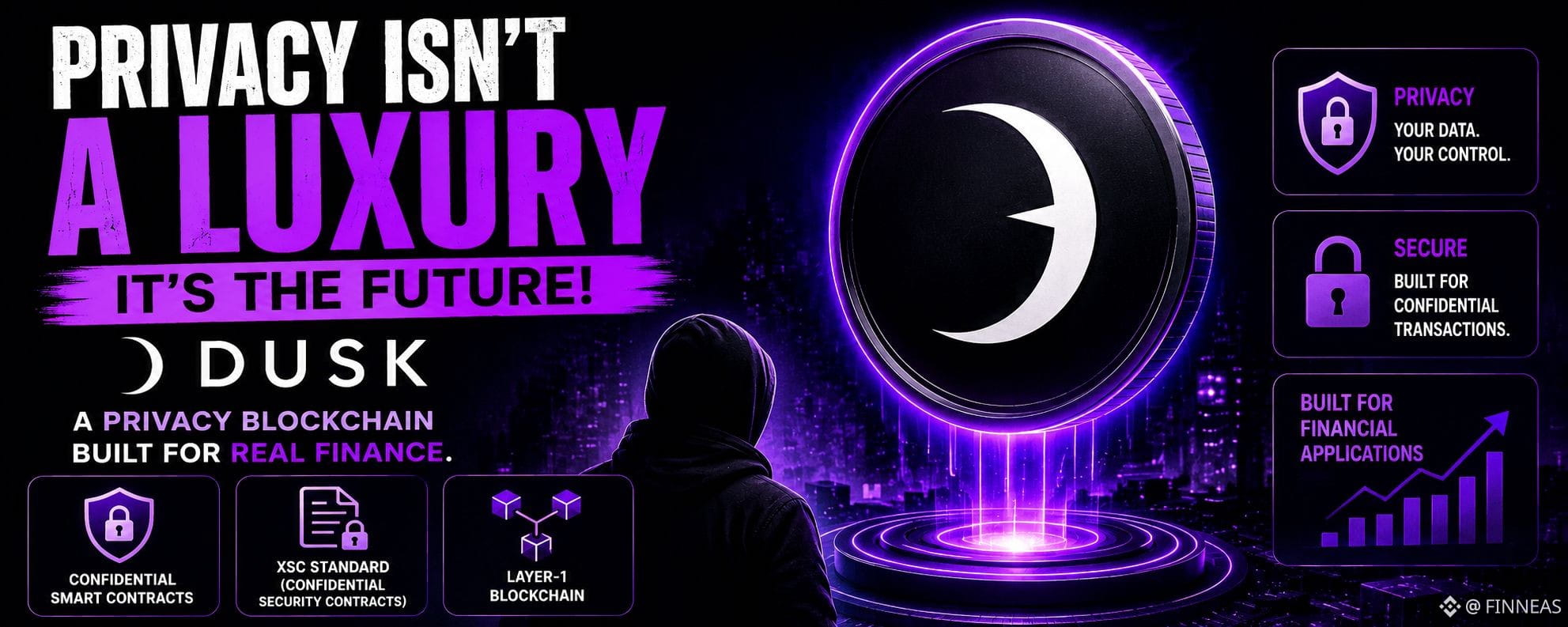
What I find interesting is that it’s built as a Layer-1 blockchain with financial applications in mind, while focusing heavily on privacy. Its Confidential Security Contract standard and confidential smart contracts are designed to let financial activity happen without putting every detail on full display.
As a trader, I’ve always believed transparency matters. But I also think people and businesses deserve control over sensitive financial information.
That balance is what makes Dusk interesting to me. It feels less like chasing hype and more like solving a real problem that blockchain still needs to handle properly.
I’m keeping an eye on how this develops.
Do you think privacy will become essential for the next generation of financial blockchains?
#dusk $DUSK @Dusk_Foundation
{spot}(DUSKUSDT)
The more I learn about crypto, the more I realize privacy isn’t just a nice feature — it can be the difference between useful finance and risky finance.
That’s why Dusk Network caught my attention.
What I find interesting is that it’s built as a Layer-1 blockchain with financial applications in mind, while focusing heavily on privacy. Its Confidential Security Contract standard and confidential smart contracts are designed to let financial activity happen without putting every detail on full display.
As a trader, I’ve always believed transparency matters. But I also think people and businesses deserve control over sensitive financial information.
That balance is what makes Dusk interesting to me. It feels less like chasing hype and more like solving a real problem that blockchain still needs to handle properly.
I’m keeping an eye on how this develops.
Do you think privacy will become essential for the next generation of financial blockchains?
#dusk $DUSK @Dusk
That’s why Dusk Network caught my attention.
What I find interesting is that it’s built as a Layer-1 blockchain with financial applications in mind, while focusing heavily on privacy. Its Confidential Security Contract standard and confidential smart contracts are designed to let financial activity happen without putting every detail on full display.
As a trader, I’ve always believed transparency matters. But I also think people and businesses deserve control over sensitive financial information.
That balance is what makes Dusk interesting to me. It feels less like chasing hype and more like solving a real problem that blockchain still needs to handle properly.
I’m keeping an eye on how this develops.
Do you think privacy will become essential for the next generation of financial blockchains?
#dusk $DUSK @Dusk
8
9
225
·
--
Article
Dusk Network: Privacy Focused Infrastructure for Financial ApplicationsBlockchain technology is often praised for transparency. Every transaction can be verified, records can be stored on chain, and participants can interact without depending entirely on traditional systems. But when we move from simple cryptocurrency transfers to serious financial applications, complete transparency can also create problems.
Financial institutions, businesses, and investors often deal with sensitive information. Transaction details, asset ownership, financial positions, and business activity may need to remain confidential. At the same time, the system still needs to provide reliable verification and settlement.
This is where Dusk Network becomes interesting.
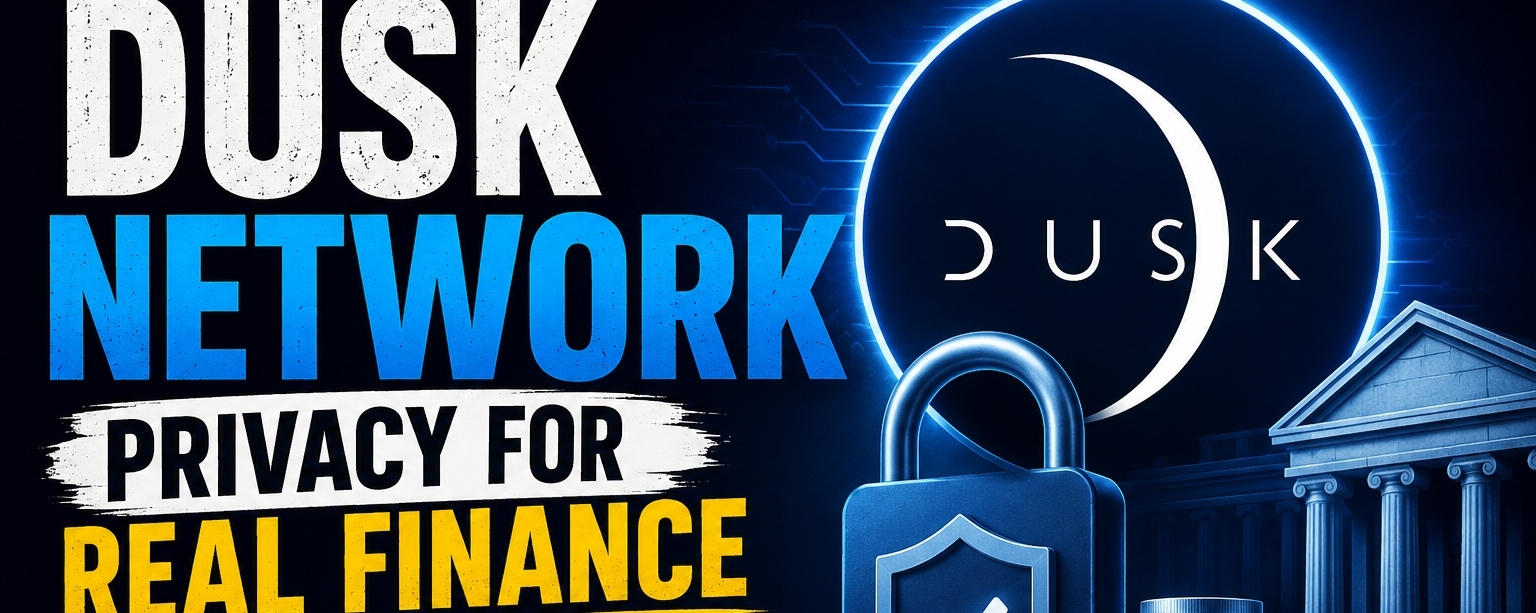
Dusk is a Layer 1 blockchain focused on privacy for financial applications. Its infrastructure is designed around confidential smart contracts and the Confidential Security Contract, or XSC, standard. The broader goal is to combine blockchain based verification with privacy and compliance requirements that can matter in financial markets.
What Is Dusk Network?
Dusk Network can be described as a privacy focused blockchain built with financial applications in mind.
Traditional public blockchains generally make transaction information visible to network participants. That transparency can be useful, but it may not be suitable for every financial use case. A professional financial system may need to prove that an operation is valid without exposing every sensitive detail to everyone.
Dusk focuses on this problem by supporting confidential transactions and smart contracts.
The idea is not simply to hide everything. Instead, the goal is to create a system where sensitive information can remain private while authorized parties can still verify the information or required conditions.
This approach can be especially relevant for regulated financial assets and applications where privacy and accountability need to work together.
Why Confidential Smart Contracts Matter
Smart contracts are programs that automatically execute predefined rules on a blockchain.
They are already an important part of blockchain technology, but financial applications can require more than basic transaction execution. They may need rules related to ownership, eligibility, transfers, compliance, and access.
Confidential smart contracts can help address this requirement by allowing sensitive information to remain protected during blockchain based operations.
For example, an investor may need to prove that they meet certain requirements without publicly revealing every detail about their financial position. A financial asset may also have restrictions that need to be enforced by the underlying system.
This is where confidential smart contract infrastructure can become useful.
Dusk is designed to support these types of applications while maintaining the benefits of blockchain based verification.
The Role of the XSC Standard
One of the important concepts within Dusk is the Confidential Security Contract, known as XSC.
XSC is designed to support confidential smart contracts and financial applications where privacy and programmable rules are important.
Instead of treating a blockchain token as simply something that can be transferred from one wallet to another, this approach allows more complex financial rules to become part of the application logic.
For regulated digital assets, this can be important.
A financial asset may have requirements about who can own it, how it can be transferred, or under what conditions a transaction can take place. Smart contract logic can help enforce these rules automatically.
The main idea is to make blockchain infrastructure more suitable for financial applications where privacy and control are important.
Privacy Is More Than Anonymity
When people hear the word privacy in crypto, they often think about anonymous transactions.
For financial infrastructure, privacy can mean something broader.
Businesses may not want competitors to see their financial positions. Investors may not want every transaction publicly connected to their activity. Institutions may need to protect sensitive information while still proving that transactions follow the required rules.
This creates an important challenge.
A system that hides everything may create problems with accountability. A system that exposes everything may create problems with privacy.
Dusk is attempting to find a middle ground through confidential transactions and selective disclosure.
Selective disclosure means information does not necessarily have to be exposed to everyone. Relevant information can be made available when verification is required.
For financial applications, this balance could be extremely important.
Potential Financial Applications
Dusk is focused on use cases beyond ordinary cryptocurrency transfers.
Its infrastructure can be relevant to areas such as tokenized financial assets, regulated digital assets, confidential transfers, financial applications, and settlement.
Tokenization is an important part of the blockchain industry. It involves representing assets or financial instruments in digital form on a blockchain.
But tokenization alone doesn't solve every problem.
A real financial asset may require ownership rules, transfer restrictions, investor eligibility, compliance checks, and reliable settlement.
If these rules can be incorporated into blockchain based infrastructure, the technology becomes more useful for serious financial applications.
This is one reason Dusk's financial focus stands out to me.
Blockchain Architecture
Dusk is designed as a Layer 1 blockchain with infrastructure aimed at supporting privacy focused applications.
Its architecture includes a native smart contract environment that supports Rust and WebAssembly based contracts. It also provides an EVM compatible environment, giving developers another way to build applications using familiar smart contract technology.
This can be useful because developers have different technical requirements.
Some applications may benefit from native functionality and protocol level features. Others may prefer an environment that is familiar to developers who already work with EVM based applications.
The overall objective is to provide infrastructure that can support different types of blockchain applications while keeping privacy and financial use cases at the center.
Deterministic Settlement
Settlement is another important part of financial infrastructure.
When a financial transaction is completed, participants need confidence that the result is final and predictable.
For traditional financial markets, settlement processes are carefully designed because uncertainty can create significant operational and financial risks.
Dusk places attention on deterministic settlement and finality as part of its network design.
For blockchain based financial applications, reliable settlement can be just as important as transaction speed or privacy.
A system may have impressive technology, but if participants cannot confidently know when an operation is final, it becomes harder to use for serious financial activity.
Privacy and Compliance
One of the biggest challenges for blockchain based finance is finding the right balance between privacy and compliance.
Financial applications may need to protect sensitive information, but certain information may also need to be verified by authorized participants.
Dusk's approach is based around the idea that privacy does not have to mean complete lack of accountability.
Through privacy technology and selective disclosure, the system can aim to protect sensitive information while allowing required verification.
This could become increasingly important as blockchain technology moves into more regulated financial environments.
For me, this is one of the strongest ideas behind Dusk.
My View on Dusk
I don't look at Dusk simply as another privacy blockchain.
What interests me is its specific focus on financial infrastructure.
Blockchain technology has already shown that programmable assets and transparent settlement are possible. But serious financial applications need more than that.
They need privacy.
They need predictable settlement.
They need programmable rules.
They may also need compliance and controlled access.
Dusk is trying to bring these requirements together at the blockchain level.
Of course, having strong technology doesn't automatically guarantee success. The real test will be adoption, security, developer activity, network usage, and whether real financial applications choose to build on the infrastructure.
That's what I would watch most closely.
Final Thoughts
The future of blockchain finance may not be about making every transaction completely public.
It may be about giving users the right level of privacy while still providing reliable verification.
Dusk Network is built around this idea. Its Layer 1 infrastructure, confidential smart contracts, XSC standard, privacy features, and financial focus make it an interesting project to follow.
I think the bigger question isn't whether blockchain needs transparency. It clearly does.
The bigger question is whether we can build financial blockchains that provide transparency where it matters and privacy where it is necessary.
If that balance can be achieved, privacy could become one of the most important parts of the next generation of blockchain based financial infrastructure.
@Dusk_Foundation #dusk $DUSK
{spot}(DUSKUSDT)
Dusk Network: Privacy Focused Infrastructure for Financial Applications
Blockchain technology is often praised for transparency. Every transaction can be verified, records can be stored on chain, and participants can interact without depending entirely on traditional systems. But when we move from simple cryptocurrency transfers to serious financial applications, complete transparency can also create problems.
Financial institutions, businesses, and investors often deal with sensitive information. Transaction details, asset ownership, financial positions, and business activity may need to remain confidential. At the same time, the system still needs to provide reliable verification and settlement.
This is where Dusk Network becomes interesting.
Dusk is a Layer 1 blockchain focused on privacy for financial applications. Its infrastructure is designed around confidential smart contracts and the Confidential Security Contract, or XSC, standard. The broader goal is to combine blockchain based verification with privacy and compliance requirements that can matter in financial markets.
What Is Dusk Network?
Dusk Network can be described as a privacy focused blockchain built with financial applications in mind.
Traditional public blockchains generally make transaction information visible to network participants. That transparency can be useful, but it may not be suitable for every financial use case. A professional financial system may need to prove that an operation is valid without exposing every sensitive detail to everyone.
Dusk focuses on this problem by supporting confidential transactions and smart contracts.
The idea is not simply to hide everything. Instead, the goal is to create a system where sensitive information can remain private while authorized parties can still verify the information or required conditions.
This approach can be especially relevant for regulated financial assets and applications where privacy and accountability need to work together.
Why Confidential Smart Contracts Matter
Smart contracts are programs that automatically execute predefined rules on a blockchain.
They are already an important part of blockchain technology, but financial applications can require more than basic transaction execution. They may need rules related to ownership, eligibility, transfers, compliance, and access.
Confidential smart contracts can help address this requirement by allowing sensitive information to remain protected during blockchain based operations.
For example, an investor may need to prove that they meet certain requirements without publicly revealing every detail about their financial position. A financial asset may also have restrictions that need to be enforced by the underlying system.
This is where confidential smart contract infrastructure can become useful.
Dusk is designed to support these types of applications while maintaining the benefits of blockchain based verification.
The Role of the XSC Standard
One of the important concepts within Dusk is the Confidential Security Contract, known as XSC.
XSC is designed to support confidential smart contracts and financial applications where privacy and programmable rules are important.
Instead of treating a blockchain token as simply something that can be transferred from one wallet to another, this approach allows more complex financial rules to become part of the application logic.
For regulated digital assets, this can be important.
A financial asset may have requirements about who can own it, how it can be transferred, or under what conditions a transaction can take place. Smart contract logic can help enforce these rules automatically.
The main idea is to make blockchain infrastructure more suitable for financial applications where privacy and control are important.
Privacy Is More Than Anonymity
When people hear the word privacy in crypto, they often think about anonymous transactions.
For financial infrastructure, privacy can mean something broader.
Businesses may not want competitors to see their financial positions. Investors may not want every transaction publicly connected to their activity. Institutions may need to protect sensitive information while still proving that transactions follow the required rules.
This creates an important challenge.
A system that hides everything may create problems with accountability. A system that exposes everything may create problems with privacy.
Dusk is attempting to find a middle ground through confidential transactions and selective disclosure.
Selective disclosure means information does not necessarily have to be exposed to everyone. Relevant information can be made available when verification is required.
For financial applications, this balance could be extremely important.
Potential Financial Applications
Dusk is focused on use cases beyond ordinary cryptocurrency transfers.
Its infrastructure can be relevant to areas such as tokenized financial assets, regulated digital assets, confidential transfers, financial applications, and settlement.
Tokenization is an important part of the blockchain industry. It involves representing assets or financial instruments in digital form on a blockchain.
But tokenization alone doesn't solve every problem.
A real financial asset may require ownership rules, transfer restrictions, investor eligibility, compliance checks, and reliable settlement.
If these rules can be incorporated into blockchain based infrastructure, the technology becomes more useful for serious financial applications.
This is one reason Dusk's financial focus stands out to me.
Blockchain Architecture
Dusk is designed as a Layer 1 blockchain with infrastructure aimed at supporting privacy focused applications.
Its architecture includes a native smart contract environment that supports Rust and WebAssembly based contracts. It also provides an EVM compatible environment, giving developers another way to build applications using familiar smart contract technology.
This can be useful because developers have different technical requirements.
Some applications may benefit from native functionality and protocol level features. Others may prefer an environment that is familiar to developers who already work with EVM based applications.
The overall objective is to provide infrastructure that can support different types of blockchain applications while keeping privacy and financial use cases at the center.
Deterministic Settlement
Settlement is another important part of financial infrastructure.
When a financial transaction is completed, participants need confidence that the result is final and predictable.
For traditional financial markets, settlement processes are carefully designed because uncertainty can create significant operational and financial risks.
Dusk places attention on deterministic settlement and finality as part of its network design.
For blockchain based financial applications, reliable settlement can be just as important as transaction speed or privacy.
A system may have impressive technology, but if participants cannot confidently know when an operation is final, it becomes harder to use for serious financial activity.
Privacy and Compliance
One of the biggest challenges for blockchain based finance is finding the right balance between privacy and compliance.
Financial applications may need to protect sensitive information, but certain information may also need to be verified by authorized participants.
Dusk's approach is based around the idea that privacy does not have to mean complete lack of accountability.
Through privacy technology and selective disclosure, the system can aim to protect sensitive information while allowing required verification.
This could become increasingly important as blockchain technology moves into more regulated financial environments.
For me, this is one of the strongest ideas behind Dusk.
My View on Dusk
I don't look at Dusk simply as another privacy blockchain.
What interests me is its specific focus on financial infrastructure.
Blockchain technology has already shown that programmable assets and transparent settlement are possible. But serious financial applications need more than that.
They need privacy.
They need predictable settlement.
They need programmable rules.
They may also need compliance and controlled access.
Dusk is trying to bring these requirements together at the blockchain level.
Of course, having strong technology doesn't automatically guarantee success. The real test will be adoption, security, developer activity, network usage, and whether real financial applications choose to build on the infrastructure.
That's what I would watch most closely.
Final Thoughts
The future of blockchain finance may not be about making every transaction completely public.
It may be about giving users the right level of privacy while still providing reliable verification.
Dusk Network is built around this idea. Its Layer 1 infrastructure, confidential smart contracts, XSC standard, privacy features, and financial focus make it an interesting project to follow.
I think the bigger question isn't whether blockchain needs transparency. It clearly does.
The bigger question is whether we can build financial blockchains that provide transparency where it matters and privacy where it is necessary.
If that balance can be achieved, privacy could become one of the most important parts of the next generation of blockchain based financial infrastructure.
@Dusk #dusk $DUSK
Financial institutions, businesses, and investors often deal with sensitive information. Transaction details, asset ownership, financial positions, and business activity may need to remain confidential. At the same time, the system still needs to provide reliable verification and settlement.
This is where Dusk Network becomes interesting.
Dusk is a Layer 1 blockchain focused on privacy for financial applications. Its infrastructure is designed around confidential smart contracts and the Confidential Security Contract, or XSC, standard. The broader goal is to combine blockchain based verification with privacy and compliance requirements that can matter in financial markets.
What Is Dusk Network?
Dusk Network can be described as a privacy focused blockchain built with financial applications in mind.
Traditional public blockchains generally make transaction information visible to network participants. That transparency can be useful, but it may not be suitable for every financial use case. A professional financial system may need to prove that an operation is valid without exposing every sensitive detail to everyone.
Dusk focuses on this problem by supporting confidential transactions and smart contracts.
The idea is not simply to hide everything. Instead, the goal is to create a system where sensitive information can remain private while authorized parties can still verify the information or required conditions.
This approach can be especially relevant for regulated financial assets and applications where privacy and accountability need to work together.
Why Confidential Smart Contracts Matter
Smart contracts are programs that automatically execute predefined rules on a blockchain.
They are already an important part of blockchain technology, but financial applications can require more than basic transaction execution. They may need rules related to ownership, eligibility, transfers, compliance, and access.
Confidential smart contracts can help address this requirement by allowing sensitive information to remain protected during blockchain based operations.
For example, an investor may need to prove that they meet certain requirements without publicly revealing every detail about their financial position. A financial asset may also have restrictions that need to be enforced by the underlying system.
This is where confidential smart contract infrastructure can become useful.
Dusk is designed to support these types of applications while maintaining the benefits of blockchain based verification.
The Role of the XSC Standard
One of the important concepts within Dusk is the Confidential Security Contract, known as XSC.
XSC is designed to support confidential smart contracts and financial applications where privacy and programmable rules are important.
Instead of treating a blockchain token as simply something that can be transferred from one wallet to another, this approach allows more complex financial rules to become part of the application logic.
For regulated digital assets, this can be important.
A financial asset may have requirements about who can own it, how it can be transferred, or under what conditions a transaction can take place. Smart contract logic can help enforce these rules automatically.
The main idea is to make blockchain infrastructure more suitable for financial applications where privacy and control are important.
Privacy Is More Than Anonymity
When people hear the word privacy in crypto, they often think about anonymous transactions.
For financial infrastructure, privacy can mean something broader.
Businesses may not want competitors to see their financial positions. Investors may not want every transaction publicly connected to their activity. Institutions may need to protect sensitive information while still proving that transactions follow the required rules.
This creates an important challenge.
A system that hides everything may create problems with accountability. A system that exposes everything may create problems with privacy.
Dusk is attempting to find a middle ground through confidential transactions and selective disclosure.
Selective disclosure means information does not necessarily have to be exposed to everyone. Relevant information can be made available when verification is required.
For financial applications, this balance could be extremely important.
Potential Financial Applications
Dusk is focused on use cases beyond ordinary cryptocurrency transfers.
Its infrastructure can be relevant to areas such as tokenized financial assets, regulated digital assets, confidential transfers, financial applications, and settlement.
Tokenization is an important part of the blockchain industry. It involves representing assets or financial instruments in digital form on a blockchain.
But tokenization alone doesn't solve every problem.
A real financial asset may require ownership rules, transfer restrictions, investor eligibility, compliance checks, and reliable settlement.
If these rules can be incorporated into blockchain based infrastructure, the technology becomes more useful for serious financial applications.
This is one reason Dusk's financial focus stands out to me.
Blockchain Architecture
Dusk is designed as a Layer 1 blockchain with infrastructure aimed at supporting privacy focused applications.
Its architecture includes a native smart contract environment that supports Rust and WebAssembly based contracts. It also provides an EVM compatible environment, giving developers another way to build applications using familiar smart contract technology.
This can be useful because developers have different technical requirements.
Some applications may benefit from native functionality and protocol level features. Others may prefer an environment that is familiar to developers who already work with EVM based applications.
The overall objective is to provide infrastructure that can support different types of blockchain applications while keeping privacy and financial use cases at the center.
Deterministic Settlement
Settlement is another important part of financial infrastructure.
When a financial transaction is completed, participants need confidence that the result is final and predictable.
For traditional financial markets, settlement processes are carefully designed because uncertainty can create significant operational and financial risks.
Dusk places attention on deterministic settlement and finality as part of its network design.
For blockchain based financial applications, reliable settlement can be just as important as transaction speed or privacy.
A system may have impressive technology, but if participants cannot confidently know when an operation is final, it becomes harder to use for serious financial activity.
Privacy and Compliance
One of the biggest challenges for blockchain based finance is finding the right balance between privacy and compliance.
Financial applications may need to protect sensitive information, but certain information may also need to be verified by authorized participants.
Dusk's approach is based around the idea that privacy does not have to mean complete lack of accountability.
Through privacy technology and selective disclosure, the system can aim to protect sensitive information while allowing required verification.
This could become increasingly important as blockchain technology moves into more regulated financial environments.
For me, this is one of the strongest ideas behind Dusk.
My View on Dusk
I don't look at Dusk simply as another privacy blockchain.
What interests me is its specific focus on financial infrastructure.
Blockchain technology has already shown that programmable assets and transparent settlement are possible. But serious financial applications need more than that.
They need privacy.
They need predictable settlement.
They need programmable rules.
They may also need compliance and controlled access.
Dusk is trying to bring these requirements together at the blockchain level.
Of course, having strong technology doesn't automatically guarantee success. The real test will be adoption, security, developer activity, network usage, and whether real financial applications choose to build on the infrastructure.
That's what I would watch most closely.
Final Thoughts
The future of blockchain finance may not be about making every transaction completely public.
It may be about giving users the right level of privacy while still providing reliable verification.
Dusk Network is built around this idea. Its Layer 1 infrastructure, confidential smart contracts, XSC standard, privacy features, and financial focus make it an interesting project to follow.
I think the bigger question isn't whether blockchain needs transparency. It clearly does.
The bigger question is whether we can build financial blockchains that provide transparency where it matters and privacy where it is necessary.
If that balance can be achieved, privacy could become one of the most important parts of the next generation of blockchain based financial infrastructure.
@Dusk #dusk $DUSK
7
5
277
·
--
Bearish
The more I look at crypto, the more I realize privacy isn't just about hiding transactions.
For financial applications, privacy can be the difference between something being usable and something being impossible to use at scale.
That's why Dusk Network caught my attention.
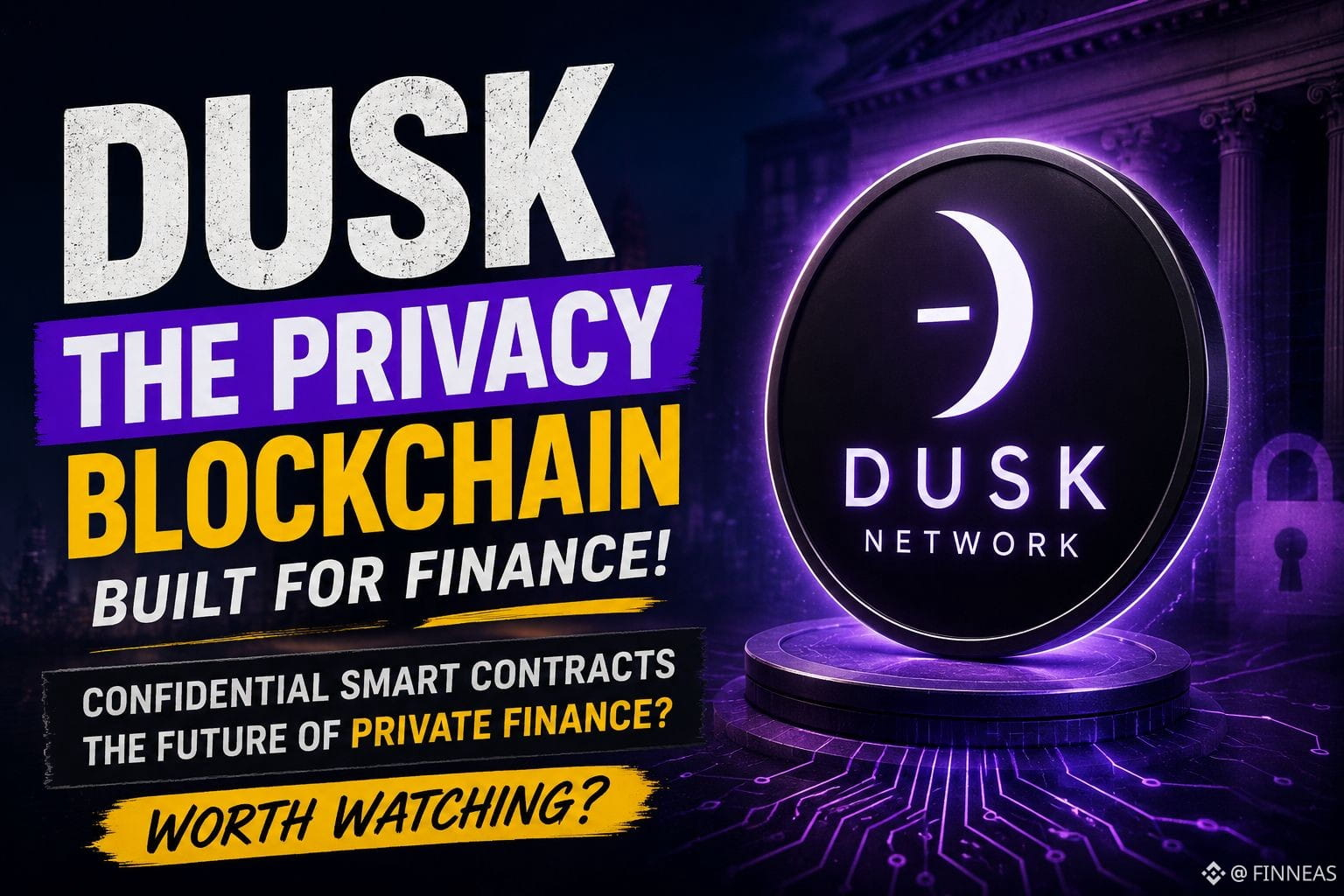
It's a Layer 1 built around financial use cases, with Confidential Security Contracts designed to support confidential smart contracts. I find that idea interesting because it tries to bring privacy into the actual infrastructure instead of treating it like an extra feature.
I'm not saying Dusk has everything figured out. Adoption, real usage, security, and execution still matter more than the narrative.
But the problem it's trying to solve feels real to me. If blockchains are going to handle serious financial activity, they need to balance transparency with confidentiality.
That's the part I'm watching closely.
Can Dusk turn this privacy focused approach into something people actually use?
@Dusk_Foundation #dusk $DUSK
{spot}(DUSKUSDT)
The more I look at crypto, the more I realize privacy isn't just about hiding transactions.
For financial applications, privacy can be the difference between something being usable and something being impossible to use at scale.
That's why Dusk Network caught my attention.
It's a Layer 1 built around financial use cases, with Confidential Security Contracts designed to support confidential smart contracts. I find that idea interesting because it tries to bring privacy into the actual infrastructure instead of treating it like an extra feature.
I'm not saying Dusk has everything figured out. Adoption, real usage, security, and execution still matter more than the narrative.
But the problem it's trying to solve feels real to me. If blockchains are going to handle serious financial activity, they need to balance transparency with confidentiality.
That's the part I'm watching closely.
Can Dusk turn this privacy focused approach into something people actually use?
@Dusk #dusk $DUSK
For financial applications, privacy can be the difference between something being usable and something being impossible to use at scale.
That's why Dusk Network caught my attention.
It's a Layer 1 built around financial use cases, with Confidential Security Contracts designed to support confidential smart contracts. I find that idea interesting because it tries to bring privacy into the actual infrastructure instead of treating it like an extra feature.
I'm not saying Dusk has everything figured out. Adoption, real usage, security, and execution still matter more than the narrative.
But the problem it's trying to solve feels real to me. If blockchains are going to handle serious financial activity, they need to balance transparency with confidentiality.
That's the part I'm watching closely.
Can Dusk turn this privacy focused approach into something people actually use?
@Dusk #dusk $DUSK
5
4
192
·
--
Bearish
Dusk Network caught my attention for a simple reason: privacy is becoming more important as blockchain moves closer to real financial use.
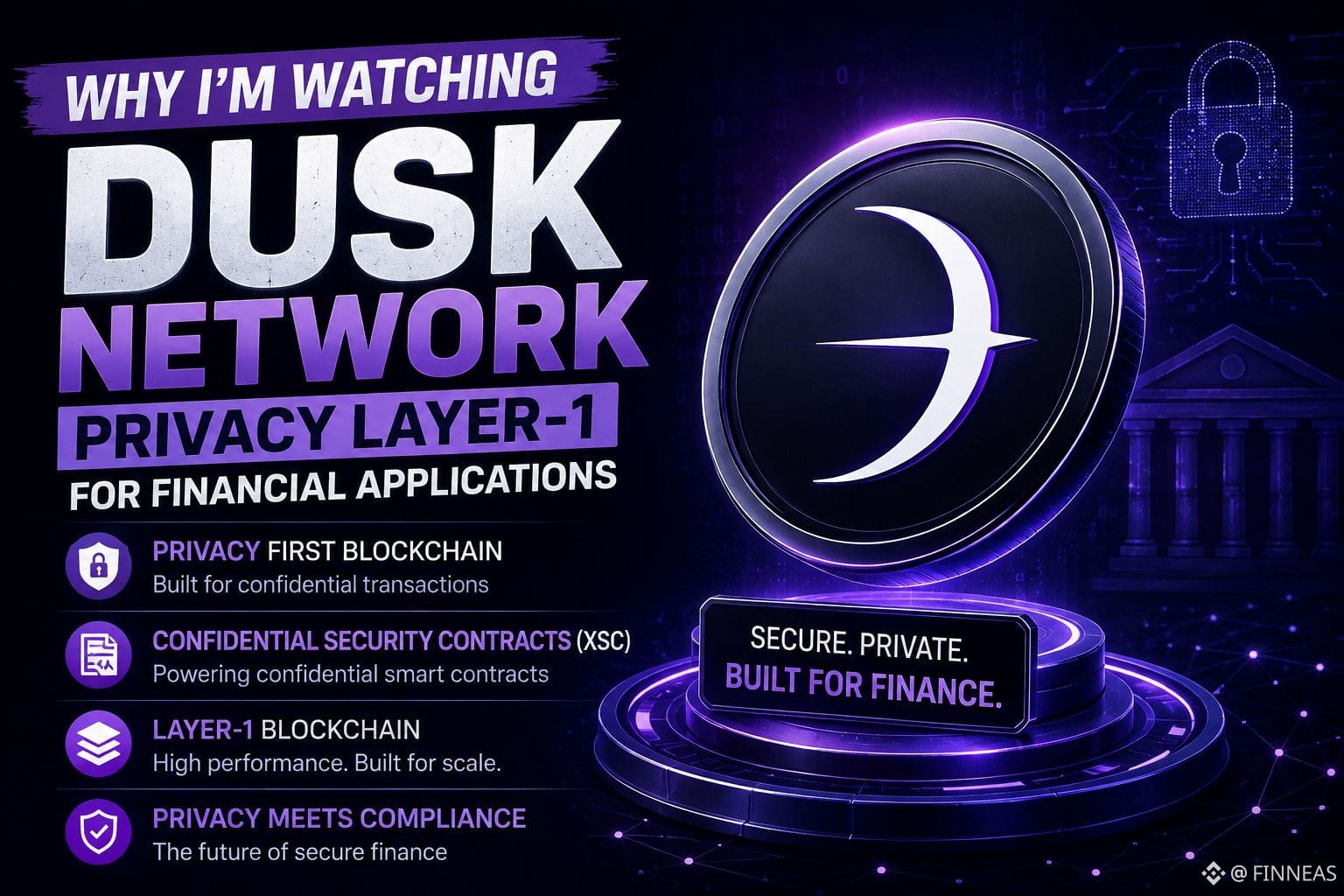
Dusk is a Layer 1 built around financial applications, with its Confidential Security Contract standard supporting confidential smart contracts. What I find interesting is the attempt to bring privacy directly into the infrastructure instead of treating it like an extra feature.
For me, the bigger question is whether blockchains can give users and businesses both transparency and confidentiality when they actually need them. That balance isn't easy, but it's a problem worth solving.
I'm still watching how Dusk develops and whether its technology can turn this idea into real adoption.
Privacy in finance feels less like a luxury and more like a basic requirement. Do you think confidential smart contracts will become a major part of the next phase of blockchain?
@Dusk_Foundation #dusk $DUSK
{spot}(DUSKUSDT)
Dusk Network caught my attention for a simple reason: privacy is becoming more important as blockchain moves closer to real financial use.
Dusk is a Layer 1 built around financial applications, with its Confidential Security Contract standard supporting confidential smart contracts. What I find interesting is the attempt to bring privacy directly into the infrastructure instead of treating it like an extra feature.
For me, the bigger question is whether blockchains can give users and businesses both transparency and confidentiality when they actually need them. That balance isn't easy, but it's a problem worth solving.
I'm still watching how Dusk develops and whether its technology can turn this idea into real adoption.
Privacy in finance feels less like a luxury and more like a basic requirement. Do you think confidential smart contracts will become a major part of the next phase of blockchain?
@Dusk #dusk $DUSK
Dusk is a Layer 1 built around financial applications, with its Confidential Security Contract standard supporting confidential smart contracts. What I find interesting is the attempt to bring privacy directly into the infrastructure instead of treating it like an extra feature.
For me, the bigger question is whether blockchains can give users and businesses both transparency and confidentiality when they actually need them. That balance isn't easy, but it's a problem worth solving.
I'm still watching how Dusk develops and whether its technology can turn this idea into real adoption.
Privacy in finance feels less like a luxury and more like a basic requirement. Do you think confidential smart contracts will become a major part of the next phase of blockchain?
@Dusk #dusk $DUSK
6
3
149
·
--
Bearish
📊 $XLM /USDT SHORT SIGNAL
📉 Direction: SHORT
🎯 EP: $0.1625
💰 TP1: $0.1608
💰 TP2: $0.1592
💰 TP3: $0.1575
🛑 SL: $0.1642
📊 Technical View:
A $1.2K long liquidation near $0.16254 shows sellers are active around this area. If XLM stays below EP, price may move toward the lower targets.
💡 Pro Tip:
Wait for a clear rejection before entering. Don’t chase the move, and keep risk controlled.
⚠️ Trade with proper risk management.
{spot}(XLMUSDT)
📊 $XLM /USDT SHORT SIGNAL
📉 Direction: SHORT
🎯 EP: $0.1625
💰 TP1: $0.1608
💰 TP2: $0.1592
💰 TP3: $0.1575
🛑 SL: $0.1642
📊 Technical View:
A $1.2K long liquidation near $0.16254 shows sellers are active around this area. If XLM stays below EP, price may move toward the lower targets.
💡 Pro Tip:
Wait for a clear rejection before entering. Don’t chase the move, and keep risk controlled.
⚠️ Trade with proper risk management.
📉 Direction: SHORT
🎯 EP: $0.1625
💰 TP1: $0.1608
💰 TP2: $0.1592
💰 TP3: $0.1575
🛑 SL: $0.1642
📊 Technical View:
A $1.2K long liquidation near $0.16254 shows sellers are active around this area. If XLM stays below EP, price may move toward the lower targets.
💡 Pro Tip:
Wait for a clear rejection before entering. Don’t chase the move, and keep risk controlled.
⚠️ Trade with proper risk management.
111
Log in to explore more content
Join global crypto users on Binance Square
⚡️ Get latest and useful information about crypto.
💬 Trusted by the world’s largest crypto exchange.
👍 Discover real insights from verified creators.
Email / Phone number