

Crypto Jrawan-前CEX研究员
808 Posts

Crypto Jrawan-前CEX研究员
Report
Block User
X(Twitter)同广场用户名|交易系统用AI来打造|前KOL、CEX研究员,目前为独立交易者,帮助你少走交易辛苦路与减少踩坑 | 定期直播|每日分享技术分析

BNB Holder
Frequent Trader
5.6 Years
9 Following
527 Followers
515 Liked
Posts
All
Quotes
Live
PINNED
After months of work, I’ve leveraged AI to craft 3 BTC futures quant signals, and today they’re officially open for subscription.
Each strategy has its own role:
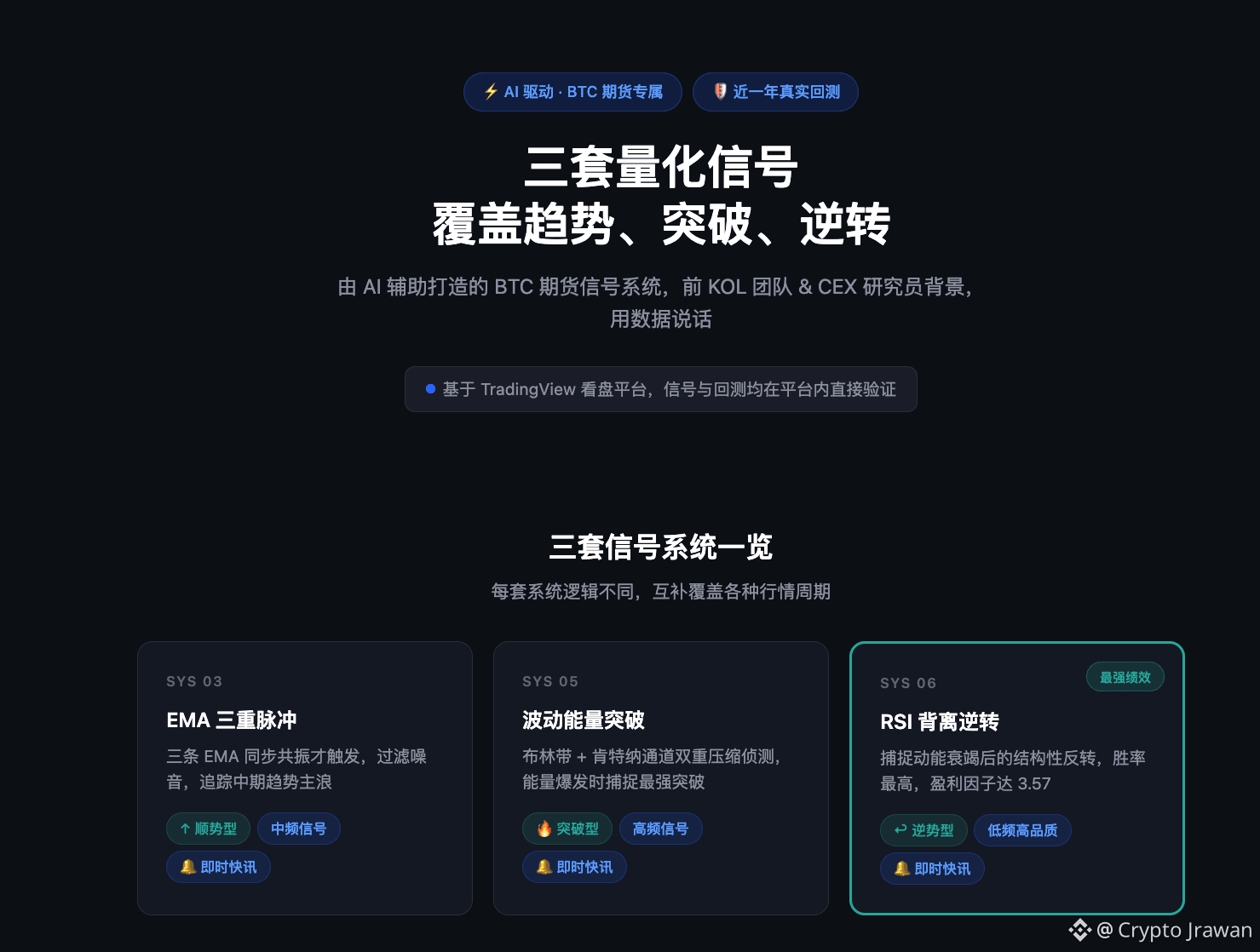
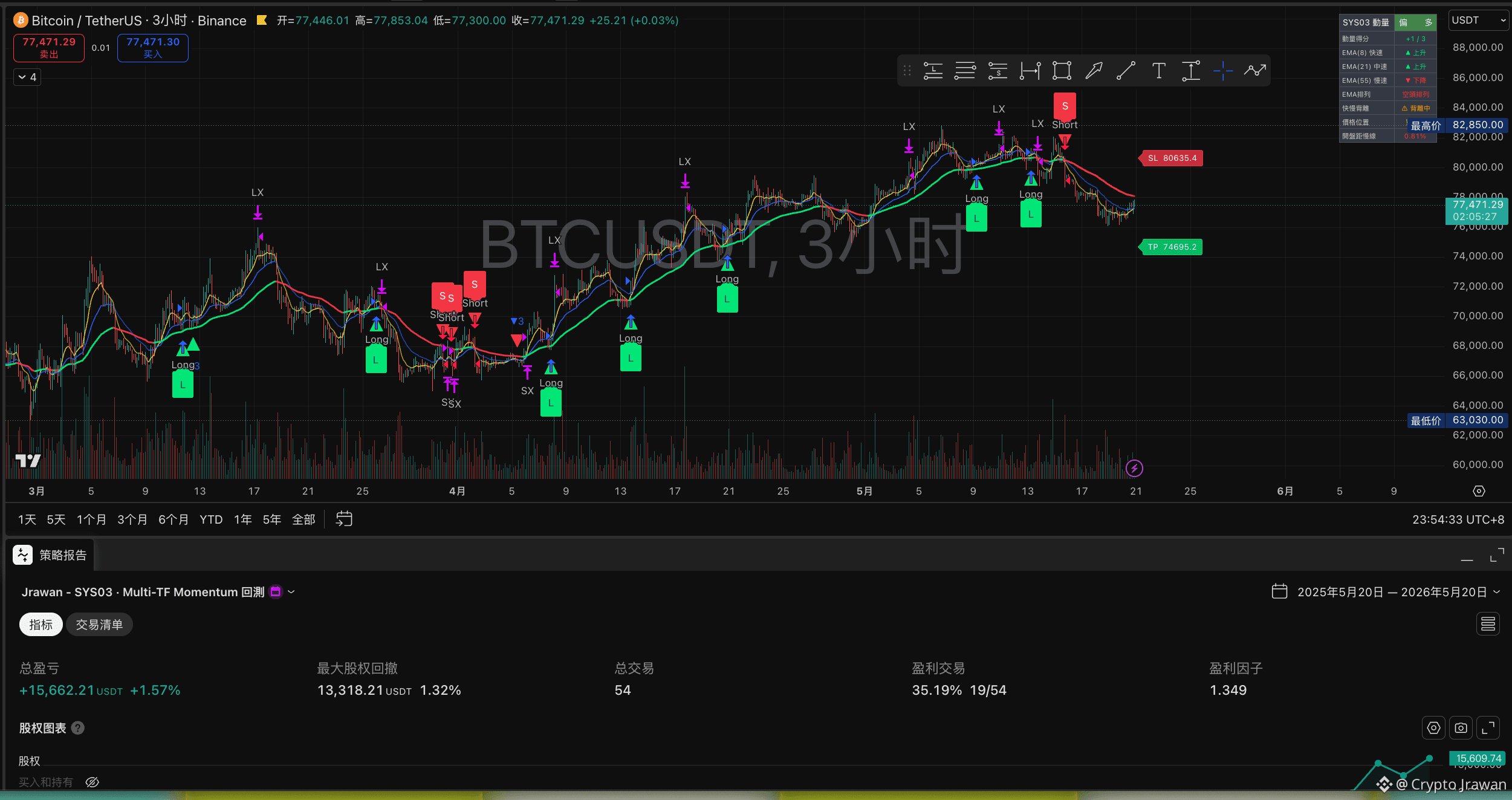
· SYS03 EMA Triple Pulse — Tracks mid-term trend waves, with 54 trades over the past year, profit factor of 1.46
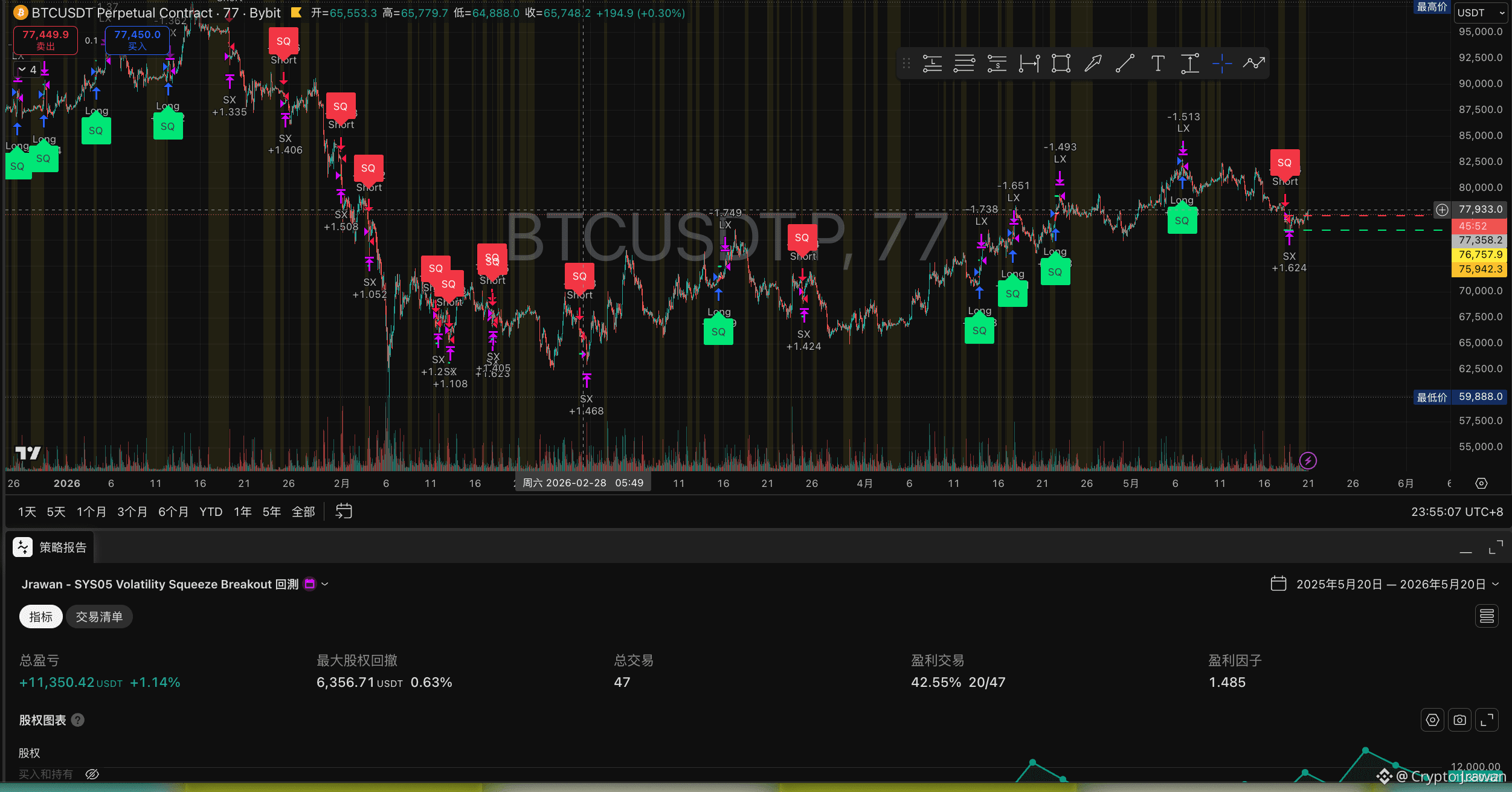
· SYS05 Volatility Energy Breakout — Bollinger Bands + Keltner Double Compression, capturing energy explosions, profit factor of 1.49
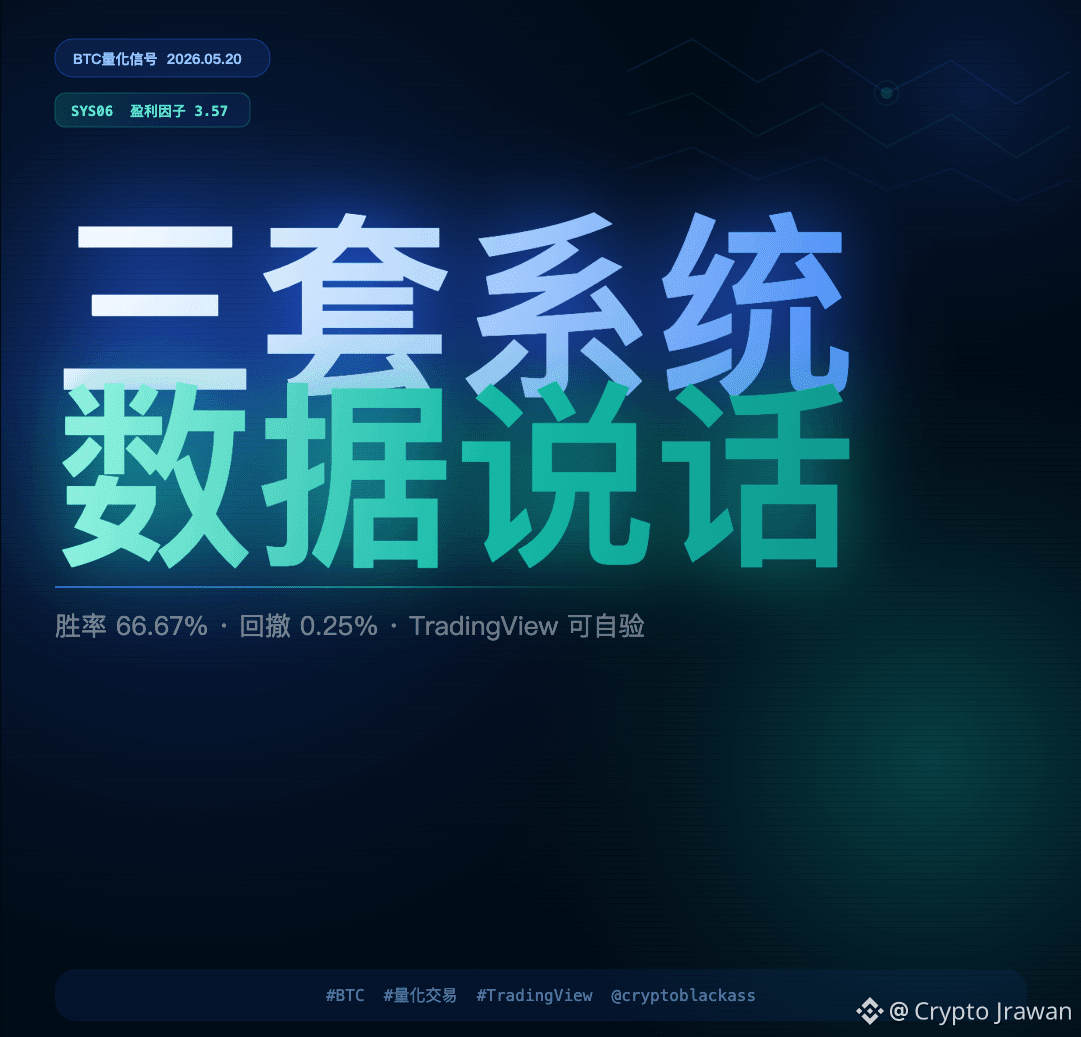
· SYS06 RSI Divergence Reversal — Only 15 trades in the past year, win rate of 66.67%, profit factor of 3.57, with a max drawdown of just 0.25%
All backtested on TradingView, so you can replicate the numbers yourself, no need to take my word for it.
Each signal includes:
✓ Real-time annotations for entry direction + SL / TP levels
✓ TradingView alerts pushed directly, getting notified of entry price / stop-loss / take-profit without having to watch the charts
✓ Backtest version for historical performance verification
Background: Former KOL team & CEX researcher, now independently developing trading systems.
If you're interested, DM me on X (Twitter) to learn about the subscription options, spots are limited, first come, first served.
#量化交易 #TradingView #量化信号
After months of work, I’ve leveraged AI to craft 3 BTC futures quant signals, and today they’re officially open for subscription.
Each strategy has its own role:
· SYS03 EMA Triple Pulse — Tracks mid-term trend waves, with 54 trades over the past year, profit factor of 1.46
· SYS05 Volatility Energy Breakout — Bollinger Bands + Keltner Double Compression, capturing energy explosions, profit factor of 1.49
· SYS06 RSI Divergence Reversal — Only 15 trades in the past year, win rate of 66.67%, profit factor of 3.57, with a max drawdown of just 0.25%
All backtested on TradingView, so you can replicate the numbers yourself, no need to take my word for it.
Each signal includes:
✓ Real-time annotations for entry direction + SL / TP levels
✓ TradingView alerts pushed directly, getting notified of entry price / stop-loss / take-profit without having to watch the charts
✓ Backtest version for historical performance verification
Background: Former KOL team & CEX researcher, now independently developing trading systems.
If you're interested, DM me on X (Twitter) to learn about the subscription options, spots are limited, first come, first served.
#量化交易 #TradingView #量化信号
Each strategy has its own role:
· SYS03 EMA Triple Pulse — Tracks mid-term trend waves, with 54 trades over the past year, profit factor of 1.46
· SYS05 Volatility Energy Breakout — Bollinger Bands + Keltner Double Compression, capturing energy explosions, profit factor of 1.49
· SYS06 RSI Divergence Reversal — Only 15 trades in the past year, win rate of 66.67%, profit factor of 3.57, with a max drawdown of just 0.25%
All backtested on TradingView, so you can replicate the numbers yourself, no need to take my word for it.
Each signal includes:
✓ Real-time annotations for entry direction + SL / TP levels
✓ TradingView alerts pushed directly, getting notified of entry price / stop-loss / take-profit without having to watch the charts
✓ Backtest version for historical performance verification
Background: Former KOL team & CEX researcher, now independently developing trading systems.
If you're interested, DM me on X (Twitter) to learn about the subscription options, spots are limited, first come, first served.
#量化交易 #TradingView #量化信号
6
5
2.4k
PINNED
We'll be going live here from time to time to stream the charts + signal interpretations, no fluff.
Last time, folks said they gained a lot—but those who didn’t follow missed out.
I won’t give too much notice before going live, so make sure to follow to catch the action.
🔔 Follow → Don’t miss me!
We'll be going live here from time to time to stream the charts + signal interpretations, no fluff.
Last time, folks said they gained a lot—but those who didn’t follow missed out.
I won’t give too much notice before going live, so make sure to follow to catch the action.
🔔 Follow → Don’t miss me!
Last time, folks said they gained a lot—but those who didn’t follow missed out.
I won’t give too much notice before going live, so make sure to follow to catch the action.
🔔 Follow → Don’t miss me!

3
1.7k
Stop-loss: is that admitting defeat?
Many people don't want to stop-loss,
because “as long as you haven’t sold, it doesn’t count as truly losing.”
But the market doesn’t care about your psychological ledger.
A stop-loss isn’t surrender—
it’s executing the rules you set before emotions got involved.
You’re not losing to the market; you’re winning by taking control of yourself.
Only those who can stop-loss can continue to survive in the market.
Those who don’t will, sooner or later, give back all their profits.
Which kind of person are you?
#CryptoTrading #交易心理 $BTC
$BTC $XAUT $HYPE
Stop-loss: is that admitting defeat?
Many people don't want to stop-loss,
because “as long as you haven’t sold, it doesn’t count as truly losing.”
But the market doesn’t care about your psychological ledger.
A stop-loss isn’t surrender—
it’s executing the rules you set before emotions got involved.
You’re not losing to the market; you’re winning by taking control of yourself.
Only those who can stop-loss can continue to survive in the market.
Those who don’t will, sooner or later, give back all their profits.
Which kind of person are you?
#CryptoTrading #交易心理 $BTC
$BTC $XAUT $HYPE
Many people don't want to stop-loss,
because “as long as you haven’t sold, it doesn’t count as truly losing.”
But the market doesn’t care about your psychological ledger.
A stop-loss isn’t surrender—
it’s executing the rules you set before emotions got involved.
You’re not losing to the market; you’re winning by taking control of yourself.
Only those who can stop-loss can continue to survive in the market.
Those who don’t will, sooner or later, give back all their profits.
Which kind of person are you?
#CryptoTrading #交易心理 $BTC
$BTC $XAUT $HYPE
203
Tell a trading mistake that left the deepest impression on me.
That was when I was just starting to build quantitative trading systems.
The system generated a short signal. I glanced at it and thought, “The direction isn’t right,”
so I didn’t execute.
As it turned out, if I had placed that trade, the profit factor would have been 4R.
Even scarier was that later, I “made my own call” and went long,
and then I stopped out.
That day taught me something:
I design a system because I don’t trust my intuition.
If I don’t trust the system, then what’s the point of having a system?
From that day on, I stopped “overriding” the system’s signals.
#量化交易 #交易纪律 #system trading
$BTC $XAUT $HYPE
Tell a trading mistake that left the deepest impression on me.
That was when I was just starting to build quantitative trading systems.
The system generated a short signal. I glanced at it and thought, “The direction isn’t right,”
so I didn’t execute.
As it turned out, if I had placed that trade, the profit factor would have been 4R.
Even scarier was that later, I “made my own call” and went long,
and then I stopped out.
That day taught me something:
I design a system because I don’t trust my intuition.
If I don’t trust the system, then what’s the point of having a system?
From that day on, I stopped “overriding” the system’s signals.
#量化交易 #交易纪律 #system trading
$BTC $XAUT $HYPE
That was when I was just starting to build quantitative trading systems.
The system generated a short signal. I glanced at it and thought, “The direction isn’t right,”
so I didn’t execute.
As it turned out, if I had placed that trade, the profit factor would have been 4R.
Even scarier was that later, I “made my own call” and went long,
and then I stopped out.
That day taught me something:
I design a system because I don’t trust my intuition.
If I don’t trust the system, then what’s the point of having a system?
From that day on, I stopped “overriding” the system’s signals.
#量化交易 #交易纪律 #system trading
$BTC $XAUT $HYPE
147
After a few months, I used AI to help build 3 sets of BTC futures quantitative trading signals.
Each of the three strategies has its own role:
· SYS03 EMA triple impulse — tracking the main wave of the medium-term trend; 54 trades in the past year; profit factor 1.46
· SYS05 volatility energy breakout — dual compression using Bollinger Bands + Keltner Channels to catch energy surges; profit factor 1.49
· SYS06 RSI divergence reversal — only 15 trades in the past year; win rate 66.67%; profit factor 3.57; maximum drawdown 0.25%
All of them are backtested on TradingView—feel free to reproduce the numbers yourself; you don’t have to trust what I say.
If you’re interested, DM me directly on X (Twitter). Limited spots—first come, first served.
#量化交易 #TradingView #量化信号
$BTC $XAUT $HYPE
After a few months, I used AI to help build 3 sets of BTC futures quantitative trading signals.
Each of the three strategies has its own role:
· SYS03 EMA triple impulse — tracking the main wave of the medium-term trend; 54 trades in the past year; profit factor 1.46
· SYS05 volatility energy breakout — dual compression using Bollinger Bands + Keltner Channels to catch energy surges; profit factor 1.49
· SYS06 RSI divergence reversal — only 15 trades in the past year; win rate 66.67%; profit factor 3.57; maximum drawdown 0.25%
All of them are backtested on TradingView—feel free to reproduce the numbers yourself; you don’t have to trust what I say.
If you’re interested, DM me directly on X (Twitter). Limited spots—first come, first served.
#量化交易 #TradingView #量化信号
$BTC $XAUT $HYPE
Each of the three strategies has its own role:
· SYS03 EMA triple impulse — tracking the main wave of the medium-term trend; 54 trades in the past year; profit factor 1.46
· SYS05 volatility energy breakout — dual compression using Bollinger Bands + Keltner Channels to catch energy surges; profit factor 1.49
· SYS06 RSI divergence reversal — only 15 trades in the past year; win rate 66.67%; profit factor 3.57; maximum drawdown 0.25%
All of them are backtested on TradingView—feel free to reproduce the numbers yourself; you don’t have to trust what I say.
If you’re interested, DM me directly on X (Twitter). Limited spots—first come, first served.
#量化交易 #TradingView #量化信号
$BTC $XAUT $HYPE
146
Market Weekly Report | What Is BTC Telling Us This Week?
Overall, BTC this week has shown a consolidation pattern at a high level.
Trading volume has gradually decreased, indicating that both bulls and bears are waiting.
Typically, there are two ways this kind of pattern ends:
1. Volume suddenly expands → a direction is chosen
2. Continue ranging until an external catalyst appears
My current view: keep observing until the direction becomes clear.
Waiting for confirmation is the most effortless way.
#周报 #BTC #Market Analysis
$BTC $XAUT $HYPE
Market Weekly Report | What Is BTC Telling Us This Week?
Overall, BTC this week has shown a consolidation pattern at a high level.
Trading volume has gradually decreased, indicating that both bulls and bears are waiting.
Typically, there are two ways this kind of pattern ends:
1. Volume suddenly expands → a direction is chosen
2. Continue ranging until an external catalyst appears
My current view: keep observing until the direction becomes clear.
Waiting for confirmation is the most effortless way.
#周报 #BTC #Market Analysis
$BTC $XAUT $HYPE
Overall, BTC this week has shown a consolidation pattern at a high level.
Trading volume has gradually decreased, indicating that both bulls and bears are waiting.
Typically, there are two ways this kind of pattern ends:
1. Volume suddenly expands → a direction is chosen
2. Continue ranging until an external catalyst appears
My current view: keep observing until the direction becomes clear.
Waiting for confirmation is the most effortless way.
#周报 #BTC #Market Analysis
$BTC $XAUT $HYPE
137
Market Weekly Report | What is BTC telling us this week?
Overall, BTC this week is showing a high-level consolidation pattern.
Trading volume is gradually shrinking, indicating that both bulls and bears are waiting.
Usually, there are two ways this kind of pattern resolves:
1. Trading volume suddenly expands → direction is chosen
2. Continue ranging until an external catalyst appears
My current view: keep observing until the direction becomes clear.
Waiting for confirmation is the most effortless approach.
#周报 #BTC #Market Analysis
$BTC $XAUT $HYPE
Market Weekly Report | What is BTC telling us this week?
Overall, BTC this week is showing a high-level consolidation pattern.
Trading volume is gradually shrinking, indicating that both bulls and bears are waiting.
Usually, there are two ways this kind of pattern resolves:
1. Trading volume suddenly expands → direction is chosen
2. Continue ranging until an external catalyst appears
My current view: keep observing until the direction becomes clear.
Waiting for confirmation is the most effortless approach.
#周报 #BTC #Market Analysis
$BTC $XAUT $HYPE
Overall, BTC this week is showing a high-level consolidation pattern.
Trading volume is gradually shrinking, indicating that both bulls and bears are waiting.
Usually, there are two ways this kind of pattern resolves:
1. Trading volume suddenly expands → direction is chosen
2. Continue ranging until an external catalyst appears
My current view: keep observing until the direction becomes clear.
Waiting for confirmation is the most effortless approach.
#周报 #BTC #Market Analysis
$BTC $XAUT $HYPE
164
After trading for so long, I want to ask you a question.
Right now, on your path to trading, what’s the biggest obstacle?
A. I can’t understand technical analysis
B. I understand it but can’t control myself
C. There’s no consistent position/position-sizing management
D. Once my mindset turns bad, I completely fall apart
Leave a comment and tell me—I'll definitely respond when I see it.
This isn’t me trying to sell a course. I’m just genuinely curious, and I also want to see where everyone gets stuck.
#交易心理 #加密货币 #互动
$BTC $XAUT $HYPE
After trading for so long, I want to ask you a question.
Right now, on your path to trading, what’s the biggest obstacle?
A. I can’t understand technical analysis
B. I understand it but can’t control myself
C. There’s no consistent position/position-sizing management
D. Once my mindset turns bad, I completely fall apart
Leave a comment and tell me—I'll definitely respond when I see it.
This isn’t me trying to sell a course. I’m just genuinely curious, and I also want to see where everyone gets stuck.
#交易心理 #加密货币 #互动
$BTC $XAUT $HYPE
Right now, on your path to trading, what’s the biggest obstacle?
A. I can’t understand technical analysis
B. I understand it but can’t control myself
C. There’s no consistent position/position-sizing management
D. Once my mindset turns bad, I completely fall apart
Leave a comment and tell me—I'll definitely respond when I see it.
This isn’t me trying to sell a course. I’m just genuinely curious, and I also want to see where everyone gets stuck.
#交易心理 #加密货币 #互动
$BTC $XAUT $HYPE
1
231
Trading is something you do—slow is fast.
Just entering the market: you’d almost want to double every day.
After a year: you start learning to wait for signals.
After three years: you realize that “not doing” is a skill.
The market won’t disappear, and opportunities show up every week.
But your principal—one wrong move, and it could be gone.
Don’t use a “fast” rhythm; use a “slow” strategy.
Don’t trade in a “guessing” way; trade by “waiting.”
Go a little slower, be a little steadier—then you’ll be able to go farther.
#Trading #Bitcoin #CryptoTrading
$BTC $XAUT $HYPE
Trading is something you do—slow is fast.
Just entering the market: you’d almost want to double every day.
After a year: you start learning to wait for signals.
After three years: you realize that “not doing” is a skill.
The market won’t disappear, and opportunities show up every week.
But your principal—one wrong move, and it could be gone.
Don’t use a “fast” rhythm; use a “slow” strategy.
Don’t trade in a “guessing” way; trade by “waiting.”
Go a little slower, be a little steadier—then you’ll be able to go farther.
#Trading #Bitcoin #CryptoTrading
$BTC $XAUT $HYPE
Just entering the market: you’d almost want to double every day.
After a year: you start learning to wait for signals.
After three years: you realize that “not doing” is a skill.
The market won’t disappear, and opportunities show up every week.
But your principal—one wrong move, and it could be gone.
Don’t use a “fast” rhythm; use a “slow” strategy.
Don’t trade in a “guessing” way; trade by “waiting.”
Go a little slower, be a little steadier—then you’ll be able to go farther.
#Trading #Bitcoin #CryptoTrading
$BTC $XAUT $HYPE
101
The most correct trade I’ve ever made wasn’t one that made a big profit in a single deal.
It was in the 2022 bear market, when I decided to stop trading for three months.
At the time, the market was full of lamentations—every day someone was shouting “I’ve bottomed it,”
and then it dropped another 30%.
My approach was to close the screen and go study.
I read six trading-related books and rebuilt my trading framework.
After three months, I came back—the market was still falling,
but my mindset and system were much clearer.
The best trade is sometimes not trading.
#交易故事 #熊市策略 #CryptoTrading
$BTC $XAUT $HYPE
The most correct trade I’ve ever made wasn’t one that made a big profit in a single deal.
It was in the 2022 bear market, when I decided to stop trading for three months.
At the time, the market was full of lamentations—every day someone was shouting “I’ve bottomed it,”
and then it dropped another 30%.
My approach was to close the screen and go study.
I read six trading-related books and rebuilt my trading framework.
After three months, I came back—the market was still falling,
but my mindset and system were much clearer.
The best trade is sometimes not trading.
#交易故事 #熊市策略 #CryptoTrading
$BTC $XAUT $HYPE
It was in the 2022 bear market, when I decided to stop trading for three months.
At the time, the market was full of lamentations—every day someone was shouting “I’ve bottomed it,”
and then it dropped another 30%.
My approach was to close the screen and go study.
I read six trading-related books and rebuilt my trading framework.
After three months, I came back—the market was still falling,
but my mindset and system were much clearer.
The best trade is sometimes not trading.
#交易故事 #熊市策略 #CryptoTrading
$BTC $XAUT $HYPE
1
1
423
SYS03’s core logic, explained in one sentence:
All three EMA moving averages must be aligned in the same direction, with the momentum indicator confirming at the same time—only then does the signal trigger.
Why be this strict?
Because I’ve seen too many people enter when they “feel like it’s going up,”
then watch the direction reverse,
only to hold on because they “don’t have a clear stop-loss level,” and end up getting wiped out.
SYS03’s strict conditions are designed to filter out these “looks-like” fake signals.
Do less, but every time you do it, there’s a basis.
Search for SYS03 on TradingView and you can run your own backtest.
#TradingView #量化交易 #BTC
$BTC $XAUT $HYPE
SYS03’s core logic, explained in one sentence:
All three EMA moving averages must be aligned in the same direction, with the momentum indicator confirming at the same time—only then does the signal trigger.
Why be this strict?
Because I’ve seen too many people enter when they “feel like it’s going up,”
then watch the direction reverse,
only to hold on because they “don’t have a clear stop-loss level,” and end up getting wiped out.
SYS03’s strict conditions are designed to filter out these “looks-like” fake signals.
Do less, but every time you do it, there’s a basis.
Search for SYS03 on TradingView and you can run your own backtest.
#TradingView #量化交易 #BTC
$BTC $XAUT $HYPE
All three EMA moving averages must be aligned in the same direction, with the momentum indicator confirming at the same time—only then does the signal trigger.
Why be this strict?
Because I’ve seen too many people enter when they “feel like it’s going up,”
then watch the direction reverse,
only to hold on because they “don’t have a clear stop-loss level,” and end up getting wiped out.
SYS03’s strict conditions are designed to filter out these “looks-like” fake signals.
Do less, but every time you do it, there’s a basis.
Search for SYS03 on TradingView and you can run your own backtest.
#TradingView #量化交易 #BTC
$BTC $XAUT $HYPE
219
Market Weekly Report | What Is BTC Telling Us This Week?
Overall, this week BTC showed a high-level consolidation pattern.
Trading volume gradually shrank, indicating that both bulls and bears are waiting.
There are usually two ways this pattern ends:
1. Trading volume suddenly expands → a direction is chosen
2. Continue moving sideways until an external catalyst appears
My current view: Before the direction is clear, stay observant.
Once confirmed, that’s the most efficient approach.
#周报 #BTC #Market Analysis
$BTC $XAUT $HYPE
Market Weekly Report | What Is BTC Telling Us This Week?
Overall, this week BTC showed a high-level consolidation pattern.
Trading volume gradually shrank, indicating that both bulls and bears are waiting.
There are usually two ways this pattern ends:
1. Trading volume suddenly expands → a direction is chosen
2. Continue moving sideways until an external catalyst appears
My current view: Before the direction is clear, stay observant.
Once confirmed, that’s the most efficient approach.
#周报 #BTC #Market Analysis
$BTC $XAUT $HYPE
Overall, this week BTC showed a high-level consolidation pattern.
Trading volume gradually shrank, indicating that both bulls and bears are waiting.
There are usually two ways this pattern ends:
1. Trading volume suddenly expands → a direction is chosen
2. Continue moving sideways until an external catalyst appears
My current view: Before the direction is clear, stay observant.
Once confirmed, that’s the most efficient approach.
#周报 #BTC #Market Analysis
$BTC $XAUT $HYPE
407
Today's crypto market, summed up in one sentence:
Waiting.
BTC's current trend is like a person doing a deep breath—
inhale, hold it in, ready to burst.
But the problem is, you don't know which direction it will exhale toward.
So my strategy is simple:
Wait until it chooses a direction, then get on.
No guessing, just following. That's the core of systematic trading.
$BTC
#BTC #交易策略 #systematic trading
$BTC $XAUT $HYPE
Today's crypto market, summed up in one sentence:
Waiting.
BTC's current trend is like a person doing a deep breath—
inhale, hold it in, ready to burst.
But the problem is, you don't know which direction it will exhale toward.
So my strategy is simple:
Wait until it chooses a direction, then get on.
No guessing, just following. That's the core of systematic trading.
$BTC
#BTC #交易策略 #systematic trading
$BTC $XAUT $HYPE
Waiting.
BTC's current trend is like a person doing a deep breath—
inhale, hold it in, ready to burst.
But the problem is, you don't know which direction it will exhale toward.
So my strategy is simple:
Wait until it chooses a direction, then get on.
No guessing, just following. That's the core of systematic trading.
$BTC
#BTC #交易策略 #systematic trading
$BTC $XAUT $HYPE
741
Today's Market Watch 09/25
BTC is currently consolidating around $84,381.
Volume is the most important key today.
If the price rises but the volume doesn’t follow—then it’s a fake breakout. Don’t chase.
Let the volume come first, then talk about direction.
Today's strategy:
Wait for volume to confirm → then decide the direction
If there’s no volume → stay on the sidelines; cash is also a position
No rush, no panic—wait for the right time.
$BTC
#市场观察 #BTC #Trading Strategy
$BTC $XAUT $HYPE
Today's Market Watch 09/25
BTC is currently consolidating around $84,381.
Volume is the most important key today.
If the price rises but the volume doesn’t follow—then it’s a fake breakout. Don’t chase.
Let the volume come first, then talk about direction.
Today's strategy:
Wait for volume to confirm → then decide the direction
If there’s no volume → stay on the sidelines; cash is also a position
No rush, no panic—wait for the right time.
$BTC
#市场观察 #BTC #Trading Strategy
$BTC $XAUT $HYPE
BTC is currently consolidating around $84,381.
Volume is the most important key today.
If the price rises but the volume doesn’t follow—then it’s a fake breakout. Don’t chase.
Let the volume come first, then talk about direction.
Today's strategy:
Wait for volume to confirm → then decide the direction
If there’s no volume → stay on the sidelines; cash is also a position
No rush, no panic—wait for the right time.
$BTC
#市场观察 #BTC #Trading Strategy
$BTC $XAUT $HYPE
98
A few key levels for BTC to watch today 09/25
Current price: $84,381
Resistance levels: within the 1–2% range above (there was heavy prior trading)
Support levels: around 1.5% below (along the uptrend line)
Volume interpretation:
If the price breaks above resistance with increased volume → direction is confirmed, you can follow
If price rises on low volume → wait for a pullback and then reassess
A day without trading is also a trading decision.
$BTC {future}(BTCUSDT)
#BTC #技术分析 #quant trading
$BTC $XAUT $HYPE
A few key levels for BTC to watch today 09/25
Current price: $84,381
Resistance levels: within the 1–2% range above (there was heavy prior trading)
Support levels: around 1.5% below (along the uptrend line)
Volume interpretation:
If the price breaks above resistance with increased volume → direction is confirmed, you can follow
If price rises on low volume → wait for a pullback and then reassess
A day without trading is also a trading decision.
$BTC
#BTC #技术分析 #quant trading
$BTC $XAUT $HYPE
Current price: $84,381
Resistance levels: within the 1–2% range above (there was heavy prior trading)
Support levels: around 1.5% below (along the uptrend line)
Volume interpretation:
If the price breaks above resistance with increased volume → direction is confirmed, you can follow
If price rises on low volume → wait for a pullback and then reassess
A day without trading is also a trading decision.
$BTC
#BTC #技术分析 #quant trading
$BTC $XAUT $HYPE
97
Trading for a day—say one heartfelt thing:
The best traders aren’t the ones who trade every day.
They’re the ones who know when not to trade.
Did you do it today?
#交易心法 #CryptoTrading
$BTC $XAUT $HYPE
Trading for a day—say one heartfelt thing:
The best traders aren’t the ones who trade every day.
They’re the ones who know when not to trade.
Did you do it today?
#交易心法 #CryptoTrading
$BTC $XAUT $HYPE
The best traders aren’t the ones who trade every day.
They’re the ones who know when not to trade.
Did you do it today?
#交易心法 #CryptoTrading
$BTC $XAUT $HYPE
327
If you could go back to the first day of trading, what would you most want to tell yourself?
My answer:
"First learn position/risk management, then learn technical analysis."
Most people’s order is the opposite—learn candlesticks, indicators, and patterns first.
You may still be able to call the right direction, but you end up losing money.
The reason is simple: you didn’t do proper risk management.
Even if you only have a 60% win rate, and you pair it with a 2R risk-reward ratio,
long term it’s still a positive expected value.
What’s your answer?
#交易心法 #交易心理 #Cryptocurrency
$BTC $XAUT $HYPE
If you could go back to the first day of trading, what would you most want to tell yourself?
My answer:
"First learn position/risk management, then learn technical analysis."
Most people’s order is the opposite—learn candlesticks, indicators, and patterns first.
You may still be able to call the right direction, but you end up losing money.
The reason is simple: you didn’t do proper risk management.
Even if you only have a 60% win rate, and you pair it with a 2R risk-reward ratio,
long term it’s still a positive expected value.
What’s your answer?
#交易心法 #交易心理 #Cryptocurrency
$BTC $XAUT $HYPE
My answer:
"First learn position/risk management, then learn technical analysis."
Most people’s order is the opposite—learn candlesticks, indicators, and patterns first.
You may still be able to call the right direction, but you end up losing money.
The reason is simple: you didn’t do proper risk management.
Even if you only have a 60% win rate, and you pair it with a 2R risk-reward ratio,
long term it’s still a positive expected value.
What’s your answer?
#交易心法 #交易心理 #Cryptocurrency
$BTC $XAUT $HYPE
229
Trading—slow is fast.
Just entering the market: you’re desperate to double every day.
After a year: you start learning to wait for signals.
After three years: you realize that “not doing” is a skill.
The market won’t disappear, and opportunities show up every week.
But your principal—one mistake in using it and it could be gone.
Don’t use a “fast” pace; follow a “slow” strategy.
Don’t trade by “guessing”; trade by “waiting.”
Go slower, be steadier—that’s how you go farther.
#Trading #Bitcoin #CryptoTrading
$BTC $XAUT $HYPE
Trading—slow is fast.
Just entering the market: you’re desperate to double every day.
After a year: you start learning to wait for signals.
After three years: you realize that “not doing” is a skill.
The market won’t disappear, and opportunities show up every week.
But your principal—one mistake in using it and it could be gone.
Don’t use a “fast” pace; follow a “slow” strategy.
Don’t trade by “guessing”; trade by “waiting.”
Go slower, be steadier—that’s how you go farther.
#Trading #Bitcoin #CryptoTrading
$BTC $XAUT $HYPE
Just entering the market: you’re desperate to double every day.
After a year: you start learning to wait for signals.
After three years: you realize that “not doing” is a skill.
The market won’t disappear, and opportunities show up every week.
But your principal—one mistake in using it and it could be gone.
Don’t use a “fast” pace; follow a “slow” strategy.
Don’t trade by “guessing”; trade by “waiting.”
Go slower, be steadier—that’s how you go farther.
#Trading #Bitcoin #CryptoTrading
$BTC $XAUT $HYPE
141
The single most correct trade I ever made wasn’t one of those trades where you profit big from a specific order.
It was during the 2022 bear market, when I decided to stop trading for three months.
At the time, the market was full of despair—every day people were shouting, “I’ve bottomed it,”
and then it would drop another 30%.
My approach was: close the screen and go study.
I read six trading-related books and rebuilt my trading framework.
Three months later, the market was still falling,
but my mindset and system were a lot clearer.
The best trades are sometimes the ones you don’t make.
#交易故事 #熊市策略 #CryptoTrading
$BTC $XAUT $HYPE
The single most correct trade I ever made wasn’t one of those trades where you profit big from a specific order.
It was during the 2022 bear market, when I decided to stop trading for three months.
At the time, the market was full of despair—every day people were shouting, “I’ve bottomed it,”
and then it would drop another 30%.
My approach was: close the screen and go study.
I read six trading-related books and rebuilt my trading framework.
Three months later, the market was still falling,
but my mindset and system were a lot clearer.
The best trades are sometimes the ones you don’t make.
#交易故事 #熊市策略 #CryptoTrading
$BTC $XAUT $HYPE
It was during the 2022 bear market, when I decided to stop trading for three months.
At the time, the market was full of despair—every day people were shouting, “I’ve bottomed it,”
and then it would drop another 30%.
My approach was: close the screen and go study.
I read six trading-related books and rebuilt my trading framework.
Three months later, the market was still falling,
but my mindset and system were a lot clearer.
The best trades are sometimes the ones you don’t make.
#交易故事 #熊市策略 #CryptoTrading
$BTC $XAUT $HYPE
272
Log in to explore more content
Join global crypto users on Binance Square
⚡️ Get latest and useful information about crypto.
💬 Trusted by the world’s largest crypto exchange.
👍 Discover real insights from verified creators.
Email / Phone number