
airdropbuzzdotcom
3.1k Posts

airdropbuzzdotcom
Report
Block User
Stay updated with the latest in crypto! Bringing you the best in crypto news, technical analysis, and airdrop updates.Visit airdropbuzz.com for more updates
Open Trade

NEAR Holder
Frequent Trader
5.4 Years
33 Following
2.0K+ Followers
4.3K+ Liked
Posts
Portfolio
All
Quotes
Videos
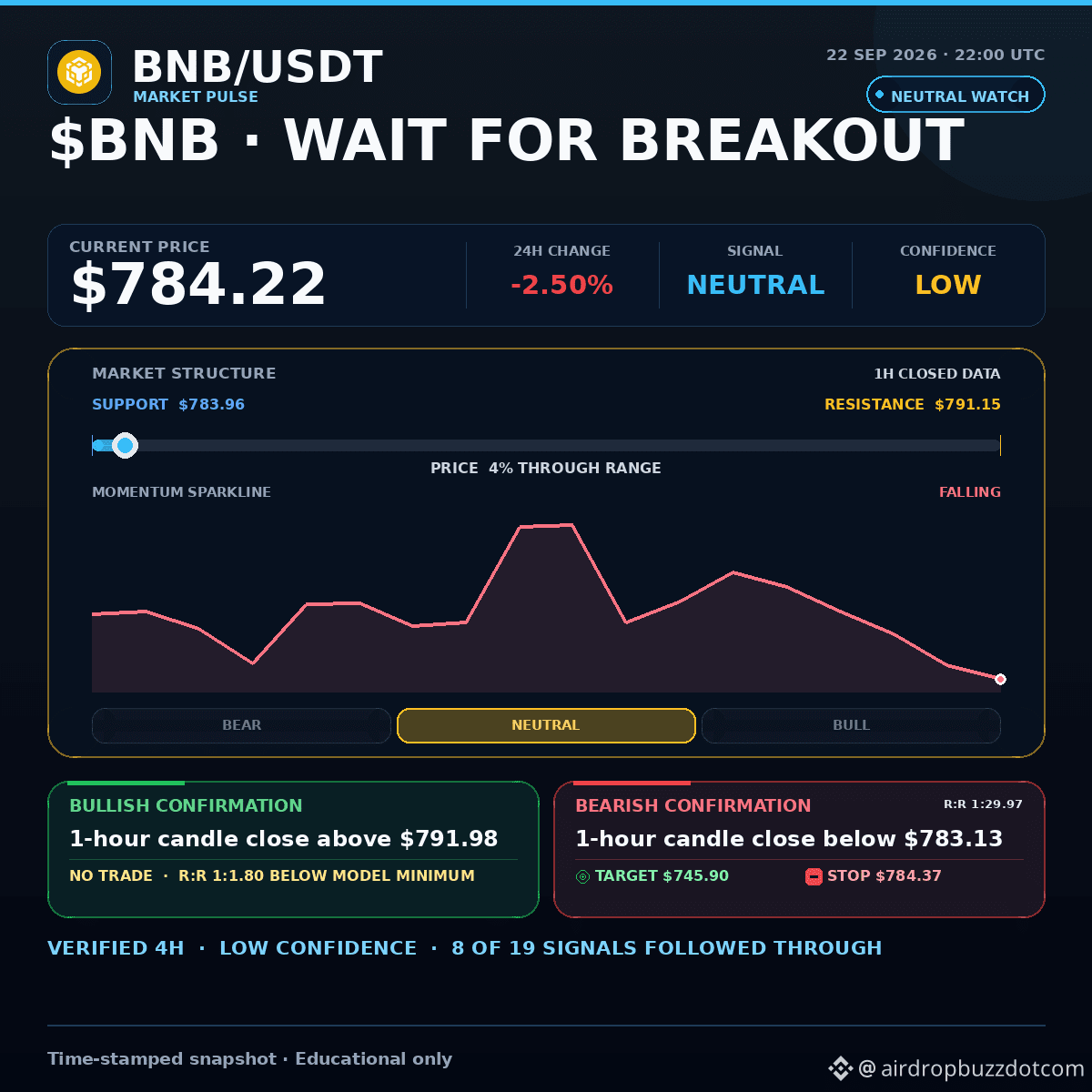
Bull trap or real $BNB confirmation?
📊 Snapshot
• Price: $784.22
• 24H: -2.50%
• Bias: Neutral
📈 Bull Trigger
1-hour close above $791.98 with open interest confirmation
📉 Bear Trigger
1-hour close below $783.13 with open interest confirmation
🎯 Signal Read
Conflicting evidence keeps this conditional, so the close matters more than predicting the direction early.
📌 Confidence
Low · Low historical confidence · 8 of 19 directional moves were favorable
Signal Quality
- OI: Flat (-0.08%)
- 4H: Bullish | 1D: Bullish (Aligned)
- ATR filter: 0.50 ATR ($1.66)
- Risk/reward: 1:29.97
Bear scenario risk plan
- Entry: $783.13
- Stop: $784.37
- Target: $745.90
Wait for a closed candle—trigger levels confirm conditions; they do not predict targets.
Front-run it or wait? Reply FRONT-RUN or WAIT.
#BNB #CryptoTrading #MarketPulse
Educational only. Time-stamped market snapshot, not financial advice.
Bull trap or real $BNB confirmation?
📊 Snapshot
• Price: $784.22
• 24H: -2.50%
• Bias: Neutral
📈 Bull Trigger
1-hour close above $791.98 with open interest confirmation
📉 Bear Trigger
1-hour close below $783.13 with open interest confirmation
🎯 Signal Read
Conflicting evidence keeps this conditional, so the close matters more than predicting the direction early.
📌 Confidence
Low · Low historical confidence · 8 of 19 directional moves were favorable
Signal Quality
- OI: Flat (-0.08%)
- 4H: Bullish | 1D: Bullish (Aligned)
- ATR filter: 0.50 ATR ($1.66)
- Risk/reward: 1:29.97
Bear scenario risk plan
- Entry: $783.13
- Stop: $784.37
- Target: $745.90
Wait for a closed candle—trigger levels confirm conditions; they do not predict targets.
Front-run it or wait? Reply FRONT-RUN or WAIT.
#BNB #CryptoTrading #MarketPulse
Educational only. Time-stamped market snapshot, not financial advice.
📊 Snapshot
• Price: $784.22
• 24H: -2.50%
• Bias: Neutral
📈 Bull Trigger
1-hour close above $791.98 with open interest confirmation
📉 Bear Trigger
1-hour close below $783.13 with open interest confirmation
🎯 Signal Read
Conflicting evidence keeps this conditional, so the close matters more than predicting the direction early.
📌 Confidence
Low · Low historical confidence · 8 of 19 directional moves were favorable
Signal Quality
- OI: Flat (-0.08%)
- 4H: Bullish | 1D: Bullish (Aligned)
- ATR filter: 0.50 ATR ($1.66)
- Risk/reward: 1:29.97
Bear scenario risk plan
- Entry: $783.13
- Stop: $784.37
- Target: $745.90
Wait for a closed candle—trigger levels confirm conditions; they do not predict targets.
Front-run it or wait? Reply FRONT-RUN or WAIT.
#BNB #CryptoTrading #MarketPulse
Educational only. Time-stamped market snapshot, not financial advice.
2
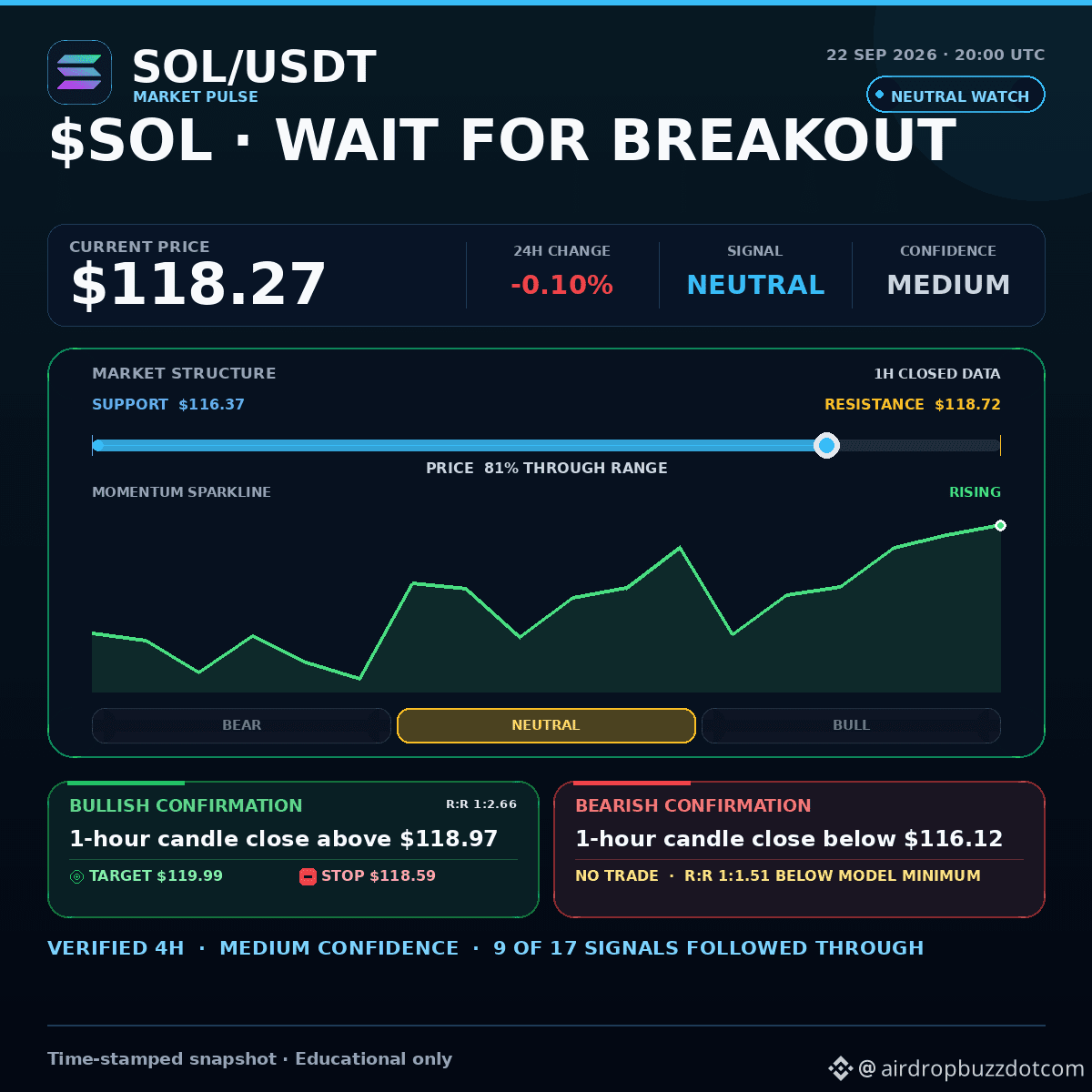
No need to guess early—the next 1H close is the $SOL decision point.
📊 Snapshot
• Price: $118.27
• 24H: -0.10%
• Bias: Neutral
📈 Bull Trigger
1-hour close above $118.97 with open interest confirmation
📉 Bear Trigger
1-hour close below $116.12 with open interest confirmation
🎯 Signal Read
Neither scenario is actionable on movement alone; confirmation decides which side has earned the edge.
📌 Confidence
Medium · Medium historical confidence · 9 of 17 directional moves were favorable
Signal Quality
- OI: Flat (+0.22%)
- 4H: Bullish | 1D: Bullish (Aligned)
- ATR filter: 0.50 ATR ($0.51)
- Risk/reward: 1:2.66
Bull scenario risk plan
- Entry: $118.97
- Stop: $118.59
- Target: $119.99
Use closed-candle confirmation because these levels define conditions, not future price forecasts.
Front-run it or wait? Reply FRONT-RUN or WAIT.
#SOL #Solana #CryptoTrading #MarketPulse
Educational only. Time-stamped market snapshot, not financial advice.
No need to guess early—the next 1H close is the $SOL decision point.
📊 Snapshot
• Price: $118.27
• 24H: -0.10%
• Bias: Neutral
📈 Bull Trigger
1-hour close above $118.97 with open interest confirmation
📉 Bear Trigger
1-hour close below $116.12 with open interest confirmation
🎯 Signal Read
Neither scenario is actionable on movement alone; confirmation decides which side has earned the edge.
📌 Confidence
Medium · Medium historical confidence · 9 of 17 directional moves were favorable
Signal Quality
- OI: Flat (+0.22%)
- 4H: Bullish | 1D: Bullish (Aligned)
- ATR filter: 0.50 ATR ($0.51)
- Risk/reward: 1:2.66
Bull scenario risk plan
- Entry: $118.97
- Stop: $118.59
- Target: $119.99
Use closed-candle confirmation because these levels define conditions, not future price forecasts.
Front-run it or wait? Reply FRONT-RUN or WAIT.
#SOL #Solana #CryptoTrading #MarketPulse
Educational only. Time-stamped market snapshot, not financial advice.
📊 Snapshot
• Price: $118.27
• 24H: -0.10%
• Bias: Neutral
📈 Bull Trigger
1-hour close above $118.97 with open interest confirmation
📉 Bear Trigger
1-hour close below $116.12 with open interest confirmation
🎯 Signal Read
Neither scenario is actionable on movement alone; confirmation decides which side has earned the edge.
📌 Confidence
Medium · Medium historical confidence · 9 of 17 directional moves were favorable
Signal Quality
- OI: Flat (+0.22%)
- 4H: Bullish | 1D: Bullish (Aligned)
- ATR filter: 0.50 ATR ($0.51)
- Risk/reward: 1:2.66
Bull scenario risk plan
- Entry: $118.97
- Stop: $118.59
- Target: $119.99
Use closed-candle confirmation because these levels define conditions, not future price forecasts.
Front-run it or wait? Reply FRONT-RUN or WAIT.
#SOL #Solana #CryptoTrading #MarketPulse
Educational only. Time-stamped market snapshot, not financial advice.
4
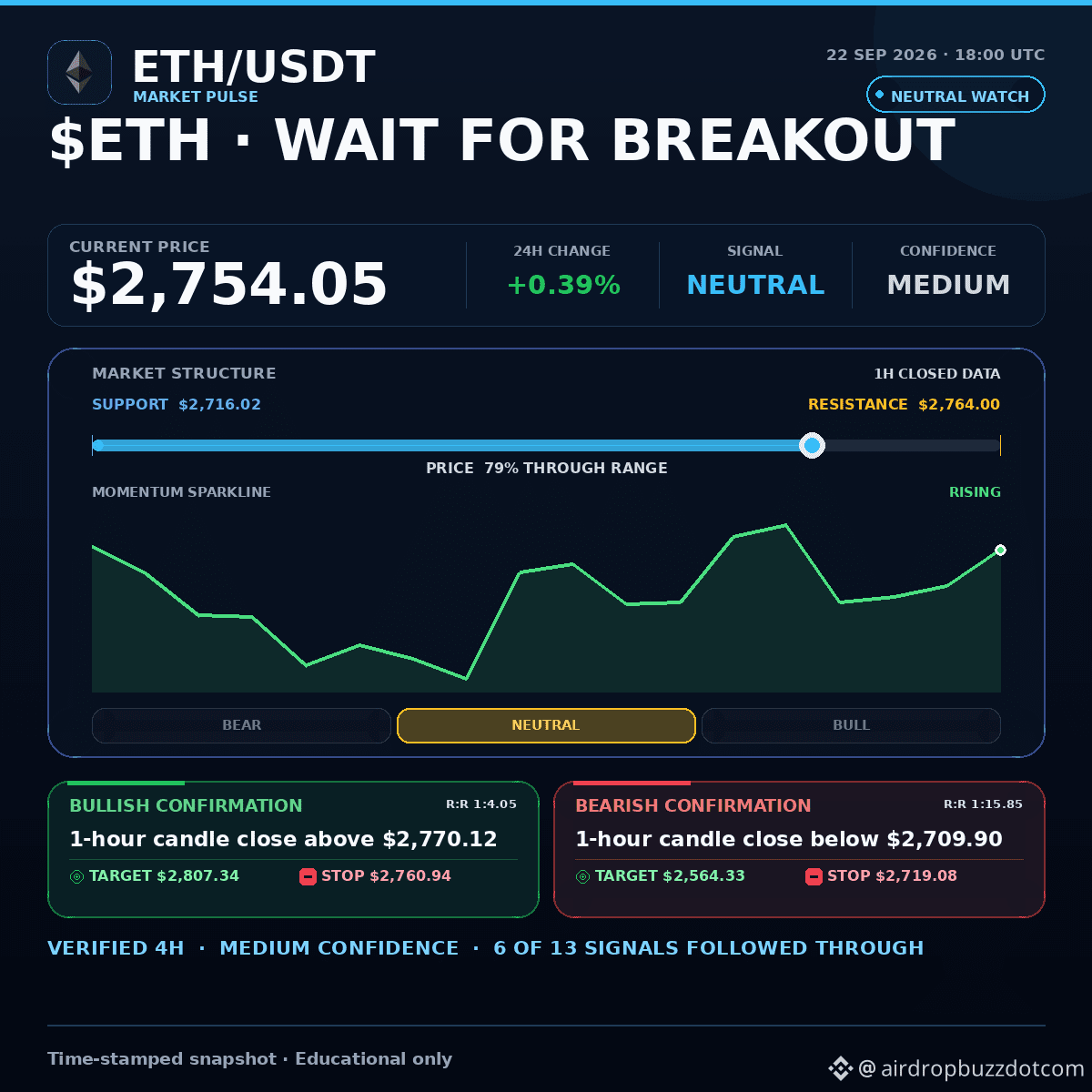
A loud $ETH candle is not automatically a strong signal. The close decides what counts.
📊 Snapshot
• Price: $2,754.05
• 24H: +0.39%
• Bias: Neutral
📈 Bull Trigger
1-hour close above $2,770.12 with open interest confirmation
📉 Bear Trigger
1-hour close below $2,709.90 with open interest confirmation
🎯 Signal Read
Direction is secondary until the market closes beyond a trigger with supporting participation.
📌 Confidence
Medium · Medium historical confidence · 6 of 13 directional moves were favorable
Signal Quality
- OI: Flat (+0.12%)
- 4H: Bullish | 1D: Bullish (Aligned)
- ATR filter: 0.50 ATR ($12.25)
- Risk/reward: 1:4.05
Bull scenario risk plan
- Entry: $2,770.12
- Stop: $2,760.94
- Target: $2,807.34
Wait for a closed candle—trigger levels confirm conditions; they do not predict targets.
Up or down first? Reply UP or DOWN.
#ETH #Ethereum #CryptoTrading #MarketPulse
Educational only. Time-stamped market snapshot, not financial advice.
A loud $ETH candle is not automatically a strong signal. The close decides what counts.
📊 Snapshot
• Price: $2,754.05
• 24H: +0.39%
• Bias: Neutral
📈 Bull Trigger
1-hour close above $2,770.12 with open interest confirmation
📉 Bear Trigger
1-hour close below $2,709.90 with open interest confirmation
🎯 Signal Read
Direction is secondary until the market closes beyond a trigger with supporting participation.
📌 Confidence
Medium · Medium historical confidence · 6 of 13 directional moves were favorable
Signal Quality
- OI: Flat (+0.12%)
- 4H: Bullish | 1D: Bullish (Aligned)
- ATR filter: 0.50 ATR ($12.25)
- Risk/reward: 1:4.05
Bull scenario risk plan
- Entry: $2,770.12
- Stop: $2,760.94
- Target: $2,807.34
Wait for a closed candle—trigger levels confirm conditions; they do not predict targets.
Up or down first? Reply UP or DOWN.
#ETH #Ethereum #CryptoTrading #MarketPulse
Educational only. Time-stamped market snapshot, not financial advice.
📊 Snapshot
• Price: $2,754.05
• 24H: +0.39%
• Bias: Neutral
📈 Bull Trigger
1-hour close above $2,770.12 with open interest confirmation
📉 Bear Trigger
1-hour close below $2,709.90 with open interest confirmation
🎯 Signal Read
Direction is secondary until the market closes beyond a trigger with supporting participation.
📌 Confidence
Medium · Medium historical confidence · 6 of 13 directional moves were favorable
Signal Quality
- OI: Flat (+0.12%)
- 4H: Bullish | 1D: Bullish (Aligned)
- ATR filter: 0.50 ATR ($12.25)
- Risk/reward: 1:4.05
Bull scenario risk plan
- Entry: $2,770.12
- Stop: $2,760.94
- Target: $2,807.34
Wait for a closed candle—trigger levels confirm conditions; they do not predict targets.
Up or down first? Reply UP or DOWN.
#ETH #Ethereum #CryptoTrading #MarketPulse
Educational only. Time-stamped market snapshot, not financial advice.
12
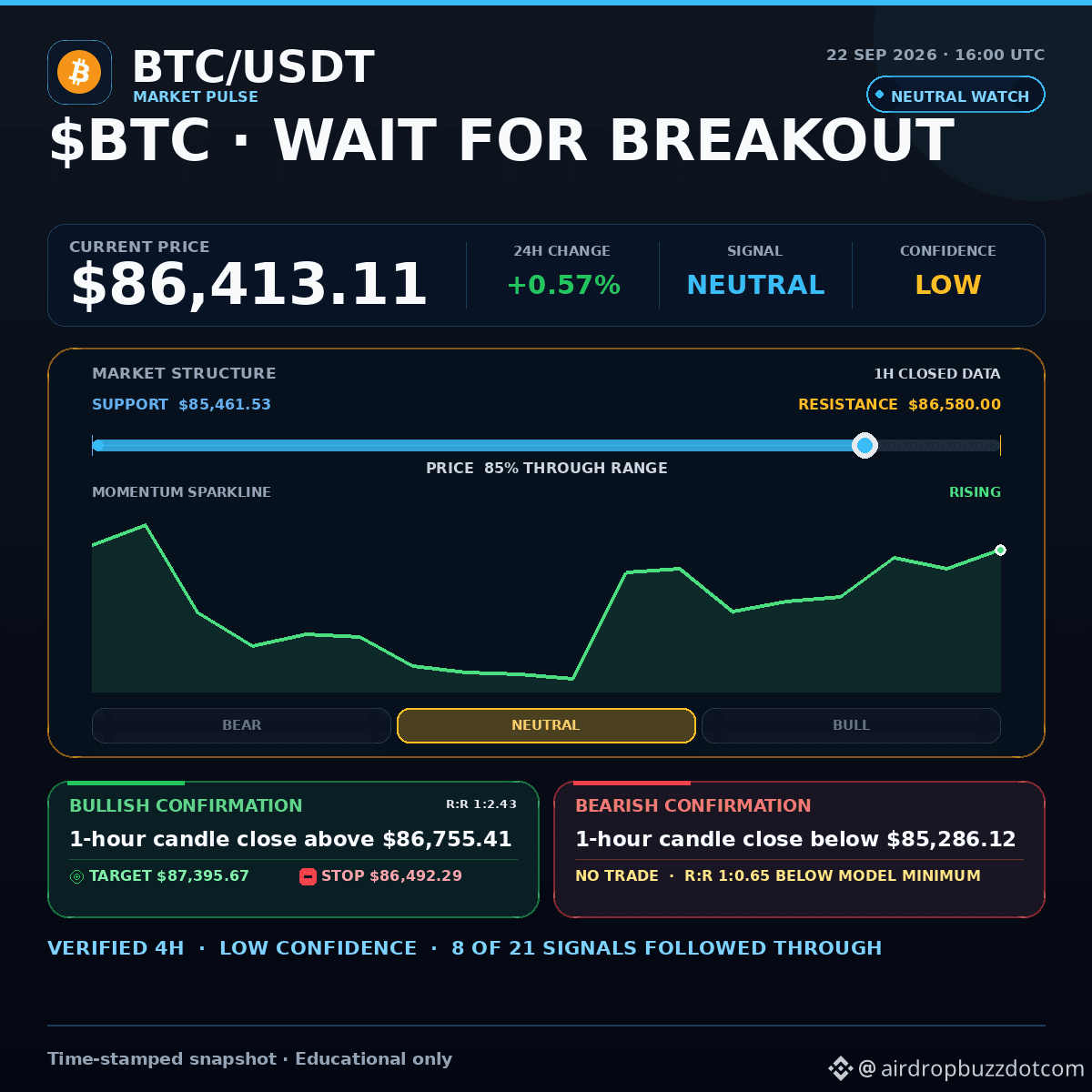
Is $BTC showing direction, or just noise before confirmation?
📊 Snapshot
• Price: $86,413.11
• 24H: +0.57%
• Bias: Neutral
📈 Bull Trigger
1-hour close above $86,755.41 with open interest confirmation
📉 Bear Trigger
1-hour close below $85,286.12 with open interest confirmation
🎯 Signal Read
The setup is balanced enough to punish guesses; wait for price and participation to confirm the same side.
📌 Confidence
Low · Low historical confidence · 8 of 21 directional moves were favorable
Signal Quality
- OI: Flat (+0.54%)
- 4H: Bullish | 1D: Bullish (Aligned)
- ATR filter: 0.50 ATR ($350.83)
Use closed-candle confirmation because these levels define conditions, not future price forecasts.
Front-run it or wait? Reply FRONT-RUN or WAIT.
#BTC #Bitcoin #CryptoTrading #MarketPulse
Educational only. Time-stamped market snapshot, not financial advice.
Is $BTC showing direction, or just noise before confirmation?
📊 Snapshot
• Price: $86,413.11
• 24H: +0.57%
• Bias: Neutral
📈 Bull Trigger
1-hour close above $86,755.41 with open interest confirmation
📉 Bear Trigger
1-hour close below $85,286.12 with open interest confirmation
🎯 Signal Read
The setup is balanced enough to punish guesses; wait for price and participation to confirm the same side.
📌 Confidence
Low · Low historical confidence · 8 of 21 directional moves were favorable
Signal Quality
- OI: Flat (+0.54%)
- 4H: Bullish | 1D: Bullish (Aligned)
- ATR filter: 0.50 ATR ($350.83)
Use closed-candle confirmation because these levels define conditions, not future price forecasts.
Front-run it or wait? Reply FRONT-RUN or WAIT.
#BTC #Bitcoin #CryptoTrading #MarketPulse
Educational only. Time-stamped market snapshot, not financial advice.
📊 Snapshot
• Price: $86,413.11
• 24H: +0.57%
• Bias: Neutral
📈 Bull Trigger
1-hour close above $86,755.41 with open interest confirmation
📉 Bear Trigger
1-hour close below $85,286.12 with open interest confirmation
🎯 Signal Read
The setup is balanced enough to punish guesses; wait for price and participation to confirm the same side.
📌 Confidence
Low · Low historical confidence · 8 of 21 directional moves were favorable
Signal Quality
- OI: Flat (+0.54%)
- 4H: Bullish | 1D: Bullish (Aligned)
- ATR filter: 0.50 ATR ($350.83)
Use closed-candle confirmation because these levels define conditions, not future price forecasts.
Front-run it or wait? Reply FRONT-RUN or WAIT.
#BTC #Bitcoin #CryptoTrading #MarketPulse
Educational only. Time-stamped market snapshot, not financial advice.
14
Article
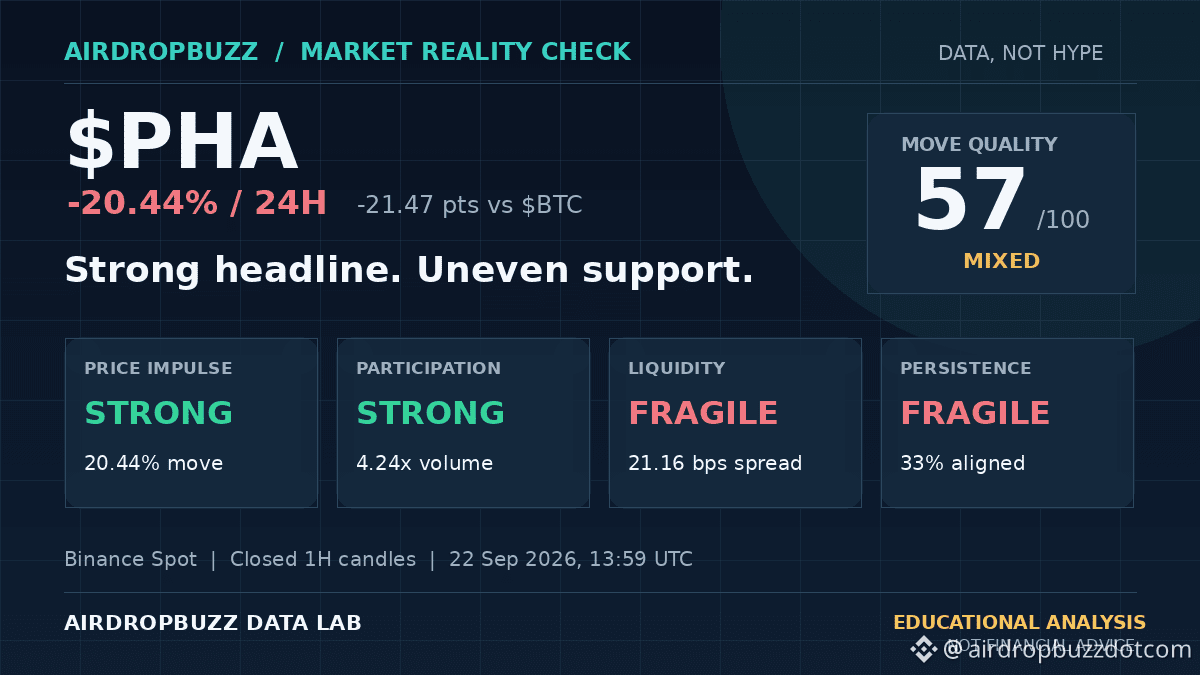
$PHA Moved -20.44% - But Liquidity Still Looks Fragile$PHA fell 20.44% over the latest 24 closed hourly candles and lagged $BTC by 21.47 percentage points. The headline is easy to see. The more useful question is whether volume, flow, persistence and liquidity support it together.
THE QUICK READ
Strong headline. Uneven support. The Move Quality score is 57/100, classified as Mixed.
PARTICIPATION CHECK
Recent hourly quote volume is 4.24x its baseline, which is well above its recent hourly baseline. Trade count is 3.78x baseline, so participation is well above its recent hourly baseline. During the same six-hour sample, taker buys represented 57.2% of quote volume; buyers accounted for a clear majority of aggressive flow.
MOVE QUALITY
The price impulse is stronger than the composite quality beneath it. Turnover can still be elevated, but weaker persistence, order-flow balance or book depth makes follow-through more dependent on fresh participation. Directional persistence was 33% across the six most recent closed hourly candles.
LIQUIDITY CHECK
The observed bid-ask spread was 21.16 basis points. Balanced visible depth within 0.5% of price was approximately $3.3K. The move deserves extra caution because available depth or spread quality was less convincing than the headline activity.
WHAT WOULD CHANGE THIS READING?
A stronger reading would require price activity, turnover and trade breadth to remain aligned across several closed candles. A weaker reading would appear if the headline move continues while volume, trade count or balanced depth deteriorates. This framework evaluates participation quality; it is not a prediction of the next candle.
BOTTOM LINE
Strong headline. Uneven support. Which would you need to see improve first here: volume, trade breadth or order-book depth?
$PHA $BTC #MarketStructure #CryptoEducation
Method: AirdropBuzz Data Lab Reality Check v1.0.0 compares price impulse with volume, trade breadth, taker flow, persistence and visible liquidity using fixed rules.
Data: Binance Spot closed 1H candles, 24H ticker and order-book snapshot at 2026-09-22 13:59 UTC. Educational analysis only; not financial advice.
$PHA Moved -20.44% - But Liquidity Still Looks Fragile
$PHA fell 20.44% over the latest 24 closed hourly candles and lagged $BTC by 21.47 percentage points. The headline is easy to see. The more useful question is whether volume, flow, persistence and liquidity support it together.
THE QUICK READ
Strong headline. Uneven support. The Move Quality score is 57/100, classified as Mixed.
PARTICIPATION CHECK
Recent hourly quote volume is 4.24x its baseline, which is well above its recent hourly baseline. Trade count is 3.78x baseline, so participation is well above its recent hourly baseline. During the same six-hour sample, taker buys represented 57.2% of quote volume; buyers accounted for a clear majority of aggressive flow.
MOVE QUALITY
The price impulse is stronger than the composite quality beneath it. Turnover can still be elevated, but weaker persistence, order-flow balance or book depth makes follow-through more dependent on fresh participation. Directional persistence was 33% across the six most recent closed hourly candles.
LIQUIDITY CHECK
The observed bid-ask spread was 21.16 basis points. Balanced visible depth within 0.5% of price was approximately $3.3K. The move deserves extra caution because available depth or spread quality was less convincing than the headline activity.
WHAT WOULD CHANGE THIS READING?
A stronger reading would require price activity, turnover and trade breadth to remain aligned across several closed candles. A weaker reading would appear if the headline move continues while volume, trade count or balanced depth deteriorates. This framework evaluates participation quality; it is not a prediction of the next candle.
BOTTOM LINE
Strong headline. Uneven support. Which would you need to see improve first here: volume, trade breadth or order-book depth?
$PHA $BTC #MarketStructure #CryptoEducation
Method: AirdropBuzz Data Lab Reality Check v1.0.0 compares price impulse with volume, trade breadth, taker flow, persistence and visible liquidity using fixed rules.
Data: Binance Spot closed 1H candles, 24H ticker and order-book snapshot at 2026-09-22 13:59 UTC. Educational analysis only; not financial advice.
THE QUICK READ
Strong headline. Uneven support. The Move Quality score is 57/100, classified as Mixed.
PARTICIPATION CHECK
Recent hourly quote volume is 4.24x its baseline, which is well above its recent hourly baseline. Trade count is 3.78x baseline, so participation is well above its recent hourly baseline. During the same six-hour sample, taker buys represented 57.2% of quote volume; buyers accounted for a clear majority of aggressive flow.
MOVE QUALITY
The price impulse is stronger than the composite quality beneath it. Turnover can still be elevated, but weaker persistence, order-flow balance or book depth makes follow-through more dependent on fresh participation. Directional persistence was 33% across the six most recent closed hourly candles.
LIQUIDITY CHECK
The observed bid-ask spread was 21.16 basis points. Balanced visible depth within 0.5% of price was approximately $3.3K. The move deserves extra caution because available depth or spread quality was less convincing than the headline activity.
WHAT WOULD CHANGE THIS READING?
A stronger reading would require price activity, turnover and trade breadth to remain aligned across several closed candles. A weaker reading would appear if the headline move continues while volume, trade count or balanced depth deteriorates. This framework evaluates participation quality; it is not a prediction of the next candle.
BOTTOM LINE
Strong headline. Uneven support. Which would you need to see improve first here: volume, trade breadth or order-book depth?
$PHA $BTC #MarketStructure #CryptoEducation
Method: AirdropBuzz Data Lab Reality Check v1.0.0 compares price impulse with volume, trade breadth, taker flow, persistence and visible liquidity using fixed rules.
Data: Binance Spot closed 1H candles, 24H ticker and order-book snapshot at 2026-09-22 13:59 UTC. Educational analysis only; not financial advice.
75
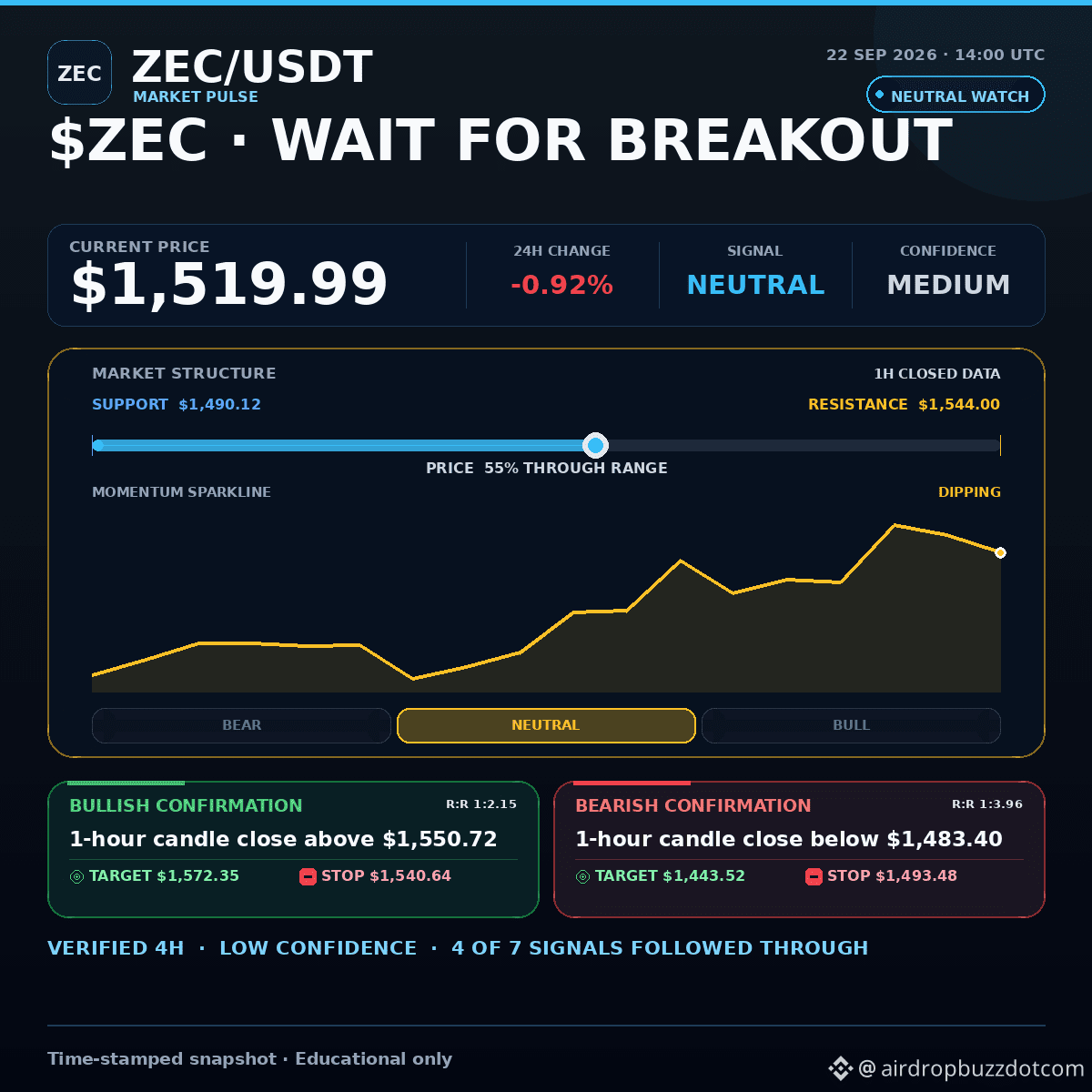
The next 1H close matters more than the current $ZEC wick.
📊 Snapshot
• Price: $1,519.99
• 24H: -0.92%
• Bias: Neutral
📈 Bull Trigger
1-hour close above $1,550.72 with open interest confirmation
📉 Bear Trigger
1-hour close below $1,483.40 with open interest confirmation
🎯 Signal Read
The setup is balanced enough to punish guesses; wait for price and participation to confirm the same side.
📌 Confidence
Medium · Low historical confidence · 4 of 7 directional moves were favorable
Signal Quality
- OI: Flat (+0.50%)
- 4H: Bullish | 1D: Bullish (Aligned)
- ATR filter: 0.50 ATR ($13.44)
- Risk/reward: 1:2.15
Bull scenario risk plan
- Entry: $1,550.72
- Stop: $1,540.64
- Target: $1,572.35
A trigger marks confirmation, not a guaranteed entry, outcome, or price destination.
Bull or bear first? Drop 🐂 or 🐻.
#ZEC #Zcash #CryptoTrading #MarketPulse
Educational only. Time-stamped market snapshot, not financial advice.
The next 1H close matters more than the current $ZEC wick.
📊 Snapshot
• Price: $1,519.99
• 24H: -0.92%
• Bias: Neutral
📈 Bull Trigger
1-hour close above $1,550.72 with open interest confirmation
📉 Bear Trigger
1-hour close below $1,483.40 with open interest confirmation
🎯 Signal Read
The setup is balanced enough to punish guesses; wait for price and participation to confirm the same side.
📌 Confidence
Medium · Low historical confidence · 4 of 7 directional moves were favorable
Signal Quality
- OI: Flat (+0.50%)
- 4H: Bullish | 1D: Bullish (Aligned)
- ATR filter: 0.50 ATR ($13.44)
- Risk/reward: 1:2.15
Bull scenario risk plan
- Entry: $1,550.72
- Stop: $1,540.64
- Target: $1,572.35
A trigger marks confirmation, not a guaranteed entry, outcome, or price destination.
Bull or bear first? Drop 🐂 or 🐻.
#ZEC #Zcash #CryptoTrading #MarketPulse
Educational only. Time-stamped market snapshot, not financial advice.
📊 Snapshot
• Price: $1,519.99
• 24H: -0.92%
• Bias: Neutral
📈 Bull Trigger
1-hour close above $1,550.72 with open interest confirmation
📉 Bear Trigger
1-hour close below $1,483.40 with open interest confirmation
🎯 Signal Read
The setup is balanced enough to punish guesses; wait for price and participation to confirm the same side.
📌 Confidence
Medium · Low historical confidence · 4 of 7 directional moves were favorable
Signal Quality
- OI: Flat (+0.50%)
- 4H: Bullish | 1D: Bullish (Aligned)
- ATR filter: 0.50 ATR ($13.44)
- Risk/reward: 1:2.15
Bull scenario risk plan
- Entry: $1,550.72
- Stop: $1,540.64
- Target: $1,572.35
A trigger marks confirmation, not a guaranteed entry, outcome, or price destination.
Bull or bear first? Drop 🐂 or 🐻.
#ZEC #Zcash #CryptoTrading #MarketPulse
Educational only. Time-stamped market snapshot, not financial advice.
156
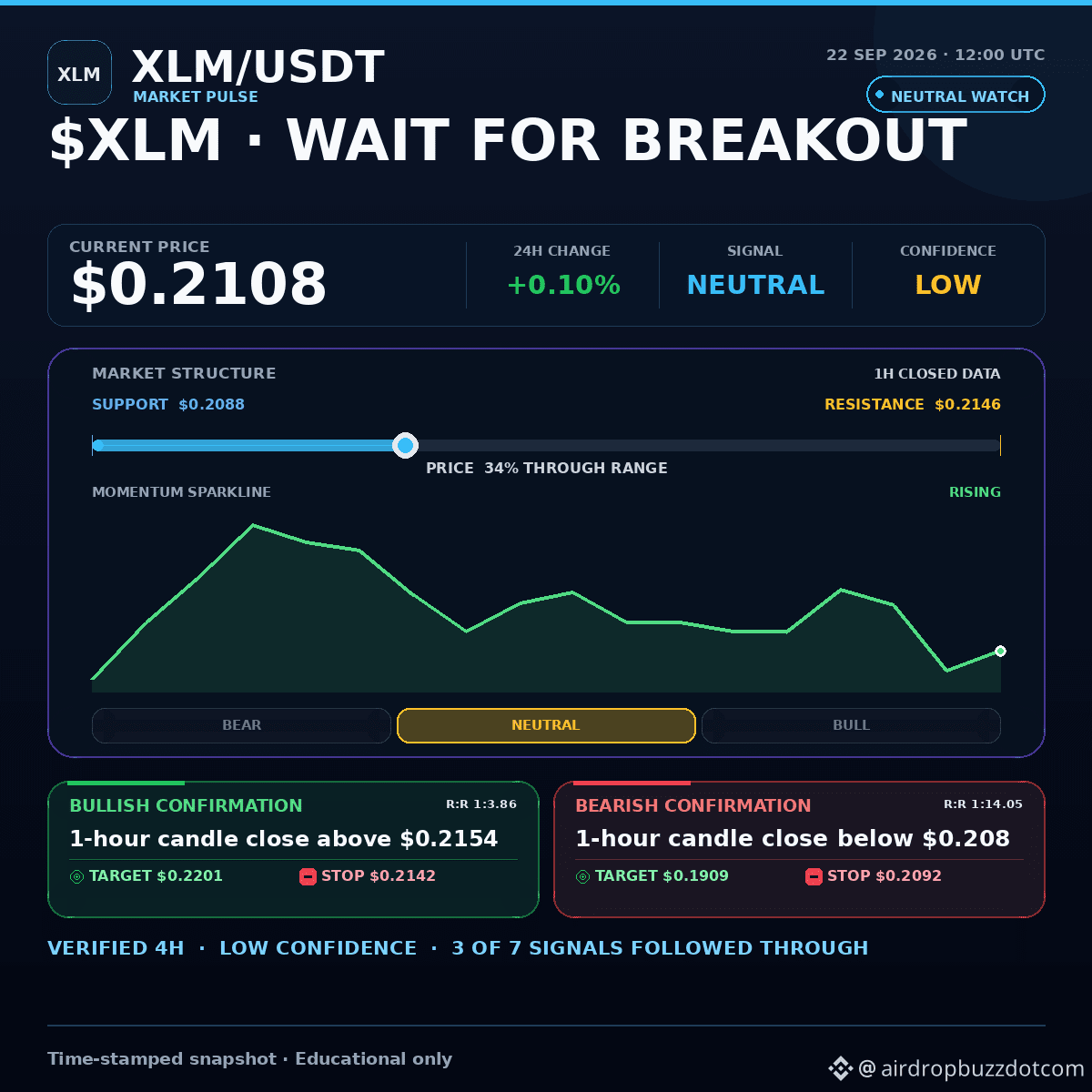
The headline is $XLM price. The real story is whether the confirmation layers agree.
📊 Snapshot
• Price: $0.2108
• 24H: +0.10%
• Bias: Neutral
📈 Bull Trigger
1-hour close above $0.2154 with open interest confirmation
📉 Bear Trigger
1-hour close below $0.208 with open interest confirmation
🎯 Signal Read
Conflicting evidence keeps this conditional, so the close matters more than predicting the direction early.
📌 Confidence
Low · Low historical confidence · 3 of 7 directional moves were favorable
Signal Quality
- OI: Flat (+0.85%)
- 4H: Bullish | 1D: Bullish (Aligned)
- ATR filter: 0.50 ATR ($0.001621)
- Risk/reward: 1:14.05
Bear scenario risk plan
- Entry: $0.208
- Stop: $0.2092
- Target: $0.1909
Triggers confirm conditions rather than price targets, so always wait for the candle close.
Front-run it or wait? Reply FRONT-RUN or WAIT.
#XLM #Stellar #CryptoTrading #MarketPulse
Educational only. Time-stamped market snapshot, not financial advice.
The headline is $XLM price. The real story is whether the confirmation layers agree.
📊 Snapshot
• Price: $0.2108
• 24H: +0.10%
• Bias: Neutral
📈 Bull Trigger
1-hour close above $0.2154 with open interest confirmation
📉 Bear Trigger
1-hour close below $0.208 with open interest confirmation
🎯 Signal Read
Conflicting evidence keeps this conditional, so the close matters more than predicting the direction early.
📌 Confidence
Low · Low historical confidence · 3 of 7 directional moves were favorable
Signal Quality
- OI: Flat (+0.85%)
- 4H: Bullish | 1D: Bullish (Aligned)
- ATR filter: 0.50 ATR ($0.001621)
- Risk/reward: 1:14.05
Bear scenario risk plan
- Entry: $0.208
- Stop: $0.2092
- Target: $0.1909
Triggers confirm conditions rather than price targets, so always wait for the candle close.
Front-run it or wait? Reply FRONT-RUN or WAIT.
#XLM #Stellar #CryptoTrading #MarketPulse
Educational only. Time-stamped market snapshot, not financial advice.
📊 Snapshot
• Price: $0.2108
• 24H: +0.10%
• Bias: Neutral
📈 Bull Trigger
1-hour close above $0.2154 with open interest confirmation
📉 Bear Trigger
1-hour close below $0.208 with open interest confirmation
🎯 Signal Read
Conflicting evidence keeps this conditional, so the close matters more than predicting the direction early.
📌 Confidence
Low · Low historical confidence · 3 of 7 directional moves were favorable
Signal Quality
- OI: Flat (+0.85%)
- 4H: Bullish | 1D: Bullish (Aligned)
- ATR filter: 0.50 ATR ($0.001621)
- Risk/reward: 1:14.05
Bear scenario risk plan
- Entry: $0.208
- Stop: $0.2092
- Target: $0.1909
Triggers confirm conditions rather than price targets, so always wait for the candle close.
Front-run it or wait? Reply FRONT-RUN or WAIT.
#XLM #Stellar #CryptoTrading #MarketPulse
Educational only. Time-stamped market snapshot, not financial advice.
11
$SOL news
What happened
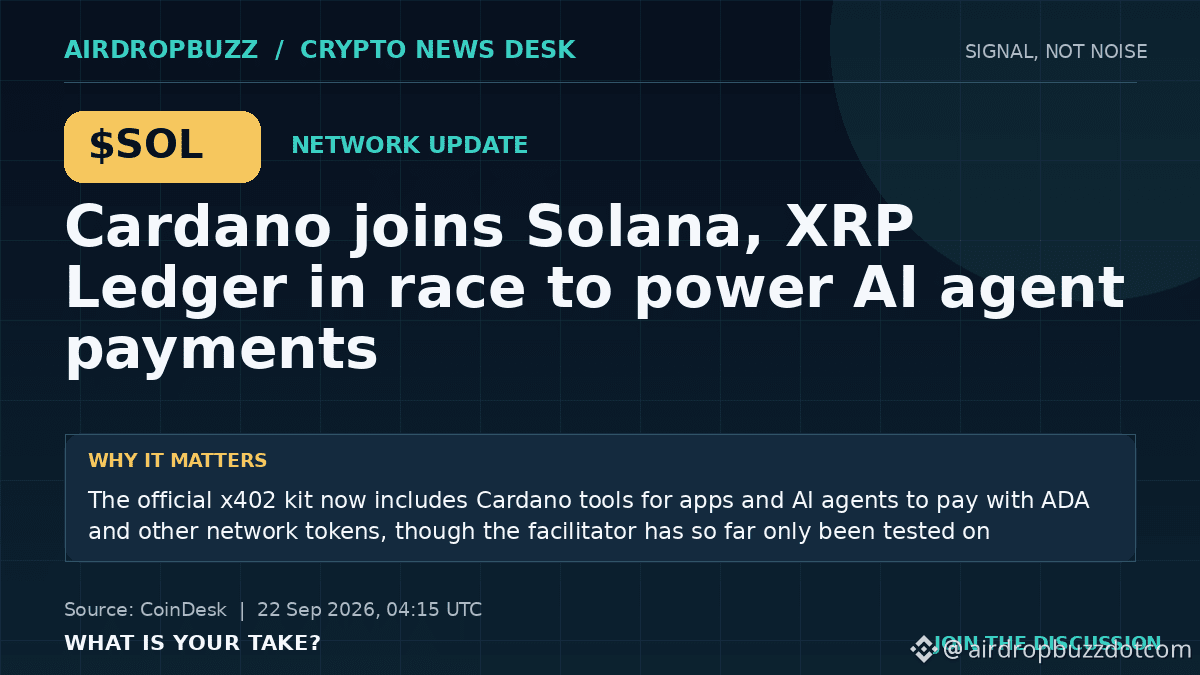
Cardano joins Solana, XRP Ledger in race to power AI agent payments
The official x402 kit now includes Cardano tools for apps and AI agents to pay with ADA and other network tokens, though the facilitator has so far only been tested on pre-production.
What to verify
For network developments, distinguish an announcement from a deployed upgrade. Check rollout dates, affected users and any migration steps in official documentation.
Source: CoinDesk
#CryptoNews
$SOL news
What happened
Cardano joins Solana, XRP Ledger in race to power AI agent payments
The official x402 kit now includes Cardano tools for apps and AI agents to pay with ADA and other network tokens, though the facilitator has so far only been tested on pre-production.
What to verify
For network developments, distinguish an announcement from a deployed upgrade. Check rollout dates, affected users and any migration steps in official documentation.
Source: CoinDesk
#CryptoNews
What happened
Cardano joins Solana, XRP Ledger in race to power AI agent payments
The official x402 kit now includes Cardano tools for apps and AI agents to pay with ADA and other network tokens, though the facilitator has so far only been tested on pre-production.
What to verify
For network developments, distinguish an announcement from a deployed upgrade. Check rollout dates, affected users and any migration steps in official documentation.
Source: CoinDesk
#CryptoNews
102
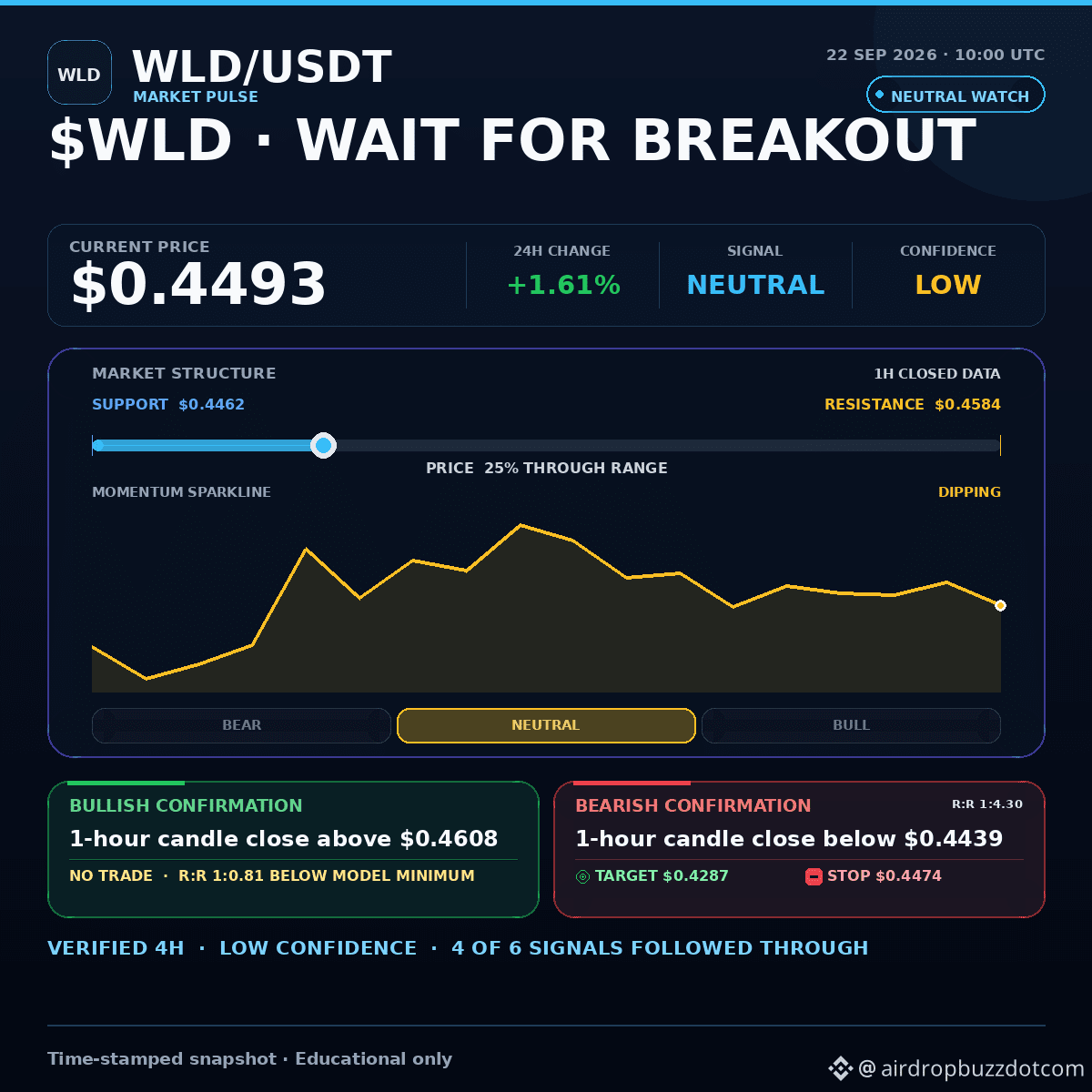
The number that matters for $WLD: 4 of 6 recent directional moves finished favorably.
📊 Snapshot
• Price: $0.4493
• 24H: +1.61%
• Bias: Neutral
📈 Bull Trigger
1-hour close above $0.4608 with open interest confirmation
📉 Bear Trigger
1-hour close below $0.4439 with open interest confirmation
🎯 Signal Read
Neither scenario is actionable on movement alone; confirmation decides which side has earned the edge.
📌 Confidence
Low · Low historical confidence · 4 of 6 directional moves were favorable
Signal Quality
- OI: Flat (-0.74%)
- 4H: Bullish | 1D: Bullish (Aligned)
- ATR filter: 0.50 ATR ($0.0047)
- Risk/reward: 1:4.30
Bear scenario risk plan
- Entry: $0.4439
- Stop: $0.4474
- Target: $0.4287
Trigger levels define confirmation; they do not guarantee where price will finish.
Front-run it or wait? Reply FRONT-RUN or WAIT.
#WLD #Worldcoin #CryptoTrading #MarketPulse
Educational only. Time-stamped market snapshot, not financial advice.
The number that matters for $WLD : 4 of 6 recent directional moves finished favorably.
📊 Snapshot
• Price: $0.4493
• 24H: +1.61%
• Bias: Neutral
📈 Bull Trigger
1-hour close above $0.4608 with open interest confirmation
📉 Bear Trigger
1-hour close below $0.4439 with open interest confirmation
🎯 Signal Read
Neither scenario is actionable on movement alone; confirmation decides which side has earned the edge.
📌 Confidence
Low · Low historical confidence · 4 of 6 directional moves were favorable
Signal Quality
- OI: Flat (-0.74%)
- 4H: Bullish | 1D: Bullish (Aligned)
- ATR filter: 0.50 ATR ($0.0047)
- Risk/reward: 1:4.30
Bear scenario risk plan
- Entry: $0.4439
- Stop: $0.4474
- Target: $0.4287
Trigger levels define confirmation; they do not guarantee where price will finish.
Front-run it or wait? Reply FRONT-RUN or WAIT.
#WLD #Worldcoin #CryptoTrading #MarketPulse
Educational only. Time-stamped market snapshot, not financial advice.
📊 Snapshot
• Price: $0.4493
• 24H: +1.61%
• Bias: Neutral
📈 Bull Trigger
1-hour close above $0.4608 with open interest confirmation
📉 Bear Trigger
1-hour close below $0.4439 with open interest confirmation
🎯 Signal Read
Neither scenario is actionable on movement alone; confirmation decides which side has earned the edge.
📌 Confidence
Low · Low historical confidence · 4 of 6 directional moves were favorable
Signal Quality
- OI: Flat (-0.74%)
- 4H: Bullish | 1D: Bullish (Aligned)
- ATR filter: 0.50 ATR ($0.0047)
- Risk/reward: 1:4.30
Bear scenario risk plan
- Entry: $0.4439
- Stop: $0.4474
- Target: $0.4287
Trigger levels define confirmation; they do not guarantee where price will finish.
Front-run it or wait? Reply FRONT-RUN or WAIT.
#WLD #Worldcoin #CryptoTrading #MarketPulse
Educational only. Time-stamped market snapshot, not financial advice.
9
Article
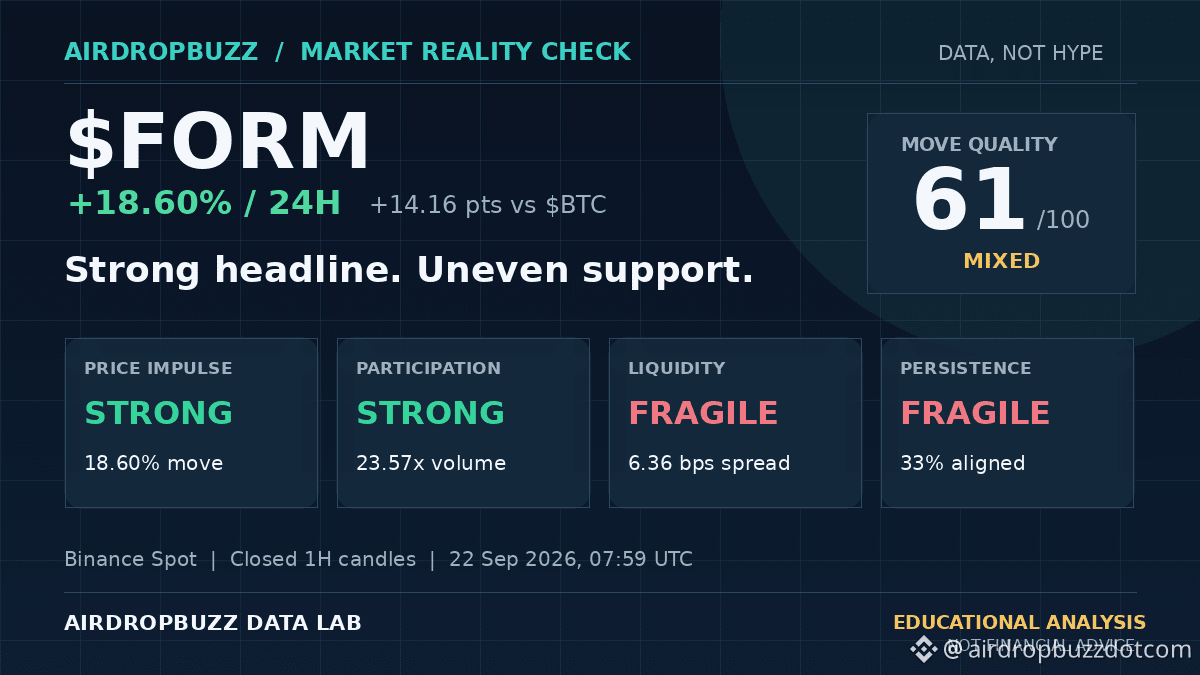
$FORM Moved +18.60% - But Liquidity Still Looks Fragile$FORM rose 18.60% over the latest 24 closed hourly candles and outperformed $BTC by 14.16 percentage points. The headline is easy to see. The more useful question is whether volume, flow, persistence and liquidity support it together.
THE QUICK READ
Strong headline. Uneven support. The Move Quality score is 61/100, classified as Mixed.
PARTICIPATION CHECK
Recent hourly quote volume is 23.57x its baseline, which is well above its recent hourly baseline. Trade count is 15.16x baseline, so participation is well above its recent hourly baseline. During the same six-hour sample, taker buys represented 42.6% of quote volume; sellers accounted for a clear majority of aggressive flow.
MOVE QUALITY
The price impulse is stronger than the composite quality beneath it. Turnover can still be elevated, but weaker persistence, order-flow balance or book depth makes follow-through more dependent on fresh participation. Directional persistence was 33% across the six most recent closed hourly candles.
LIQUIDITY CHECK
The observed bid-ask spread was 6.36 basis points. Balanced visible depth within 0.5% of price was approximately $5.7K. The move deserves extra caution because available depth or spread quality was less convincing than the headline activity.
WHAT WOULD CHANGE THIS READING?
A stronger reading would require price activity, turnover and trade breadth to remain aligned across several closed candles. A weaker reading would appear if the headline move continues while volume, trade count or balanced depth deteriorates. This framework evaluates participation quality; it is not a prediction of the next candle.
BOTTOM LINE
Strong headline. Uneven support. Which would you need to see improve first here: volume, trade breadth or order-book depth?
$FORM $BTC #MarketStructure #CryptoEducation
Method: AirdropBuzz Data Lab Reality Check v1.0.0 compares price impulse with volume, trade breadth, taker flow, persistence and visible liquidity using fixed rules.
Data: Binance Spot closed 1H candles, 24H ticker and order-book snapshot at 2026-09-22 07:59 UTC. Educational analysis only; not financial advice.
$FORM Moved +18.60% - But Liquidity Still Looks Fragile
$FORM rose 18.60% over the latest 24 closed hourly candles and outperformed $BTC by 14.16 percentage points. The headline is easy to see. The more useful question is whether volume, flow, persistence and liquidity support it together.
THE QUICK READ
Strong headline. Uneven support. The Move Quality score is 61/100, classified as Mixed.
PARTICIPATION CHECK
Recent hourly quote volume is 23.57x its baseline, which is well above its recent hourly baseline. Trade count is 15.16x baseline, so participation is well above its recent hourly baseline. During the same six-hour sample, taker buys represented 42.6% of quote volume; sellers accounted for a clear majority of aggressive flow.
MOVE QUALITY
The price impulse is stronger than the composite quality beneath it. Turnover can still be elevated, but weaker persistence, order-flow balance or book depth makes follow-through more dependent on fresh participation. Directional persistence was 33% across the six most recent closed hourly candles.
LIQUIDITY CHECK
The observed bid-ask spread was 6.36 basis points. Balanced visible depth within 0.5% of price was approximately $5.7K. The move deserves extra caution because available depth or spread quality was less convincing than the headline activity.
WHAT WOULD CHANGE THIS READING?
A stronger reading would require price activity, turnover and trade breadth to remain aligned across several closed candles. A weaker reading would appear if the headline move continues while volume, trade count or balanced depth deteriorates. This framework evaluates participation quality; it is not a prediction of the next candle.
BOTTOM LINE
Strong headline. Uneven support. Which would you need to see improve first here: volume, trade breadth or order-book depth?
$FORM $BTC #MarketStructure #CryptoEducation
Method: AirdropBuzz Data Lab Reality Check v1.0.0 compares price impulse with volume, trade breadth, taker flow, persistence and visible liquidity using fixed rules.
Data: Binance Spot closed 1H candles, 24H ticker and order-book snapshot at 2026-09-22 07:59 UTC. Educational analysis only; not financial advice.
THE QUICK READ
Strong headline. Uneven support. The Move Quality score is 61/100, classified as Mixed.
PARTICIPATION CHECK
Recent hourly quote volume is 23.57x its baseline, which is well above its recent hourly baseline. Trade count is 15.16x baseline, so participation is well above its recent hourly baseline. During the same six-hour sample, taker buys represented 42.6% of quote volume; sellers accounted for a clear majority of aggressive flow.
MOVE QUALITY
The price impulse is stronger than the composite quality beneath it. Turnover can still be elevated, but weaker persistence, order-flow balance or book depth makes follow-through more dependent on fresh participation. Directional persistence was 33% across the six most recent closed hourly candles.
LIQUIDITY CHECK
The observed bid-ask spread was 6.36 basis points. Balanced visible depth within 0.5% of price was approximately $5.7K. The move deserves extra caution because available depth or spread quality was less convincing than the headline activity.
WHAT WOULD CHANGE THIS READING?
A stronger reading would require price activity, turnover and trade breadth to remain aligned across several closed candles. A weaker reading would appear if the headline move continues while volume, trade count or balanced depth deteriorates. This framework evaluates participation quality; it is not a prediction of the next candle.
BOTTOM LINE
Strong headline. Uneven support. Which would you need to see improve first here: volume, trade breadth or order-book depth?
$FORM $BTC #MarketStructure #CryptoEducation
Method: AirdropBuzz Data Lab Reality Check v1.0.0 compares price impulse with volume, trade breadth, taker flow, persistence and visible liquidity using fixed rules.
Data: Binance Spot closed 1H candles, 24H ticker and order-book snapshot at 2026-09-22 07:59 UTC. Educational analysis only; not financial advice.
7
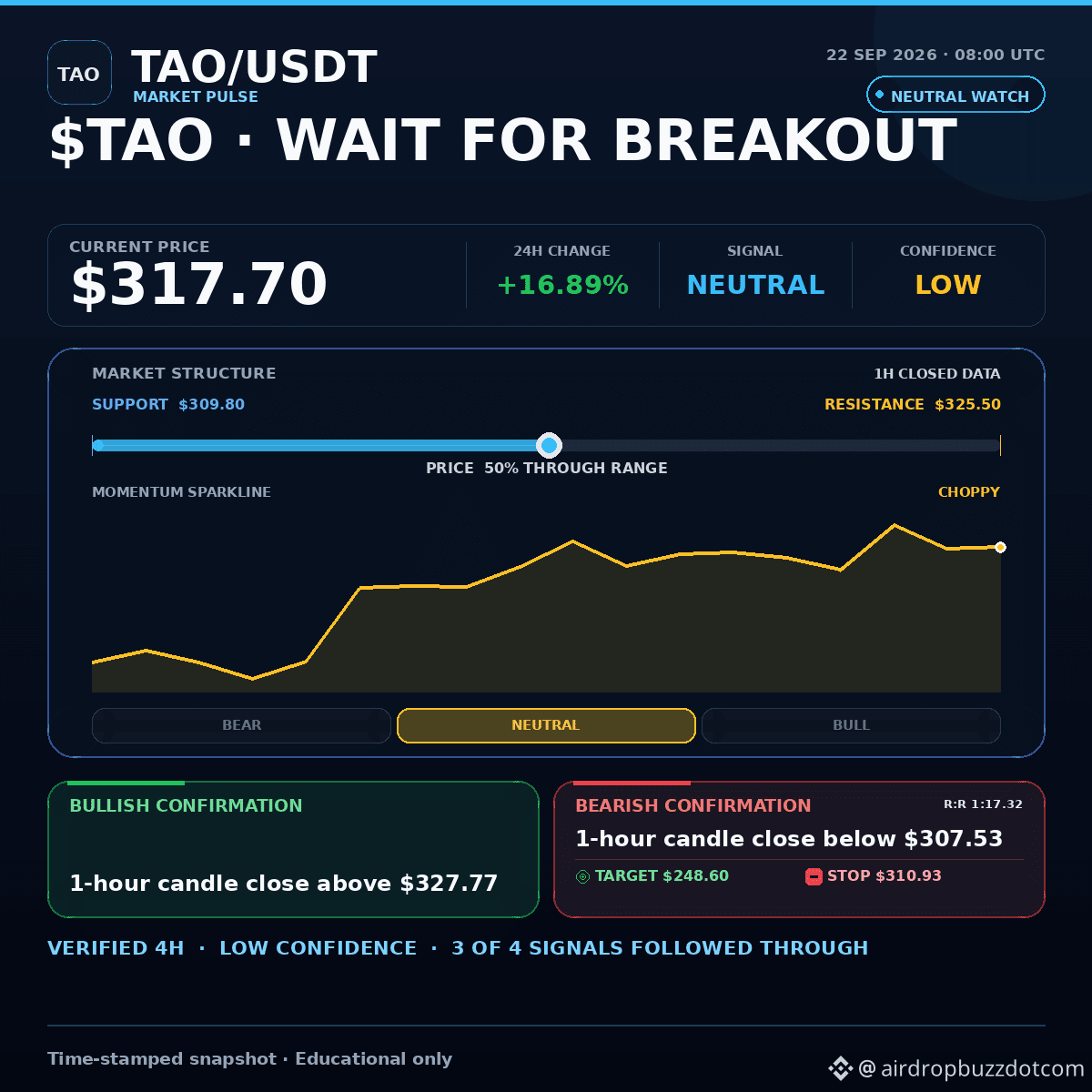
Would you trust the first $TAO wick—or wait for the close?
📊 Snapshot
• Price: $317.70
• 24H: +16.89%
• Bias: Neutral
📈 Bull Trigger
1-hour close above $327.77 with open interest confirmation
📉 Bear Trigger
1-hour close below $307.53 with open interest confirmation
🎯 Signal Read
The useful signal is the first confirmed close that settles the current fight for control, not another intraday wick.
📌 Confidence
Low · Low historical confidence · 3 of 4 directional moves were favorable
Signal Quality
- OI: Flat (-0.07%)
- 4H: Bullish | 1D: Bullish (Aligned)
- ATR filter: 0.50 ATR ($4.54)
Trigger levels define confirmation; they do not guarantee where price will finish.
Front-run it or wait? Reply FRONT-RUN or WAIT.
#TAO #Bittensor #CryptoTrading #MarketPulse
Educational only. Time-stamped market snapshot, not financial advice.
Would you trust the first $TAO wick—or wait for the close?
📊 Snapshot
• Price: $317.70
• 24H: +16.89%
• Bias: Neutral
📈 Bull Trigger
1-hour close above $327.77 with open interest confirmation
📉 Bear Trigger
1-hour close below $307.53 with open interest confirmation
🎯 Signal Read
The useful signal is the first confirmed close that settles the current fight for control, not another intraday wick.
📌 Confidence
Low · Low historical confidence · 3 of 4 directional moves were favorable
Signal Quality
- OI: Flat (-0.07%)
- 4H: Bullish | 1D: Bullish (Aligned)
- ATR filter: 0.50 ATR ($4.54)
Trigger levels define confirmation; they do not guarantee where price will finish.
Front-run it or wait? Reply FRONT-RUN or WAIT.
#TAO #Bittensor #CryptoTrading #MarketPulse
Educational only. Time-stamped market snapshot, not financial advice.
📊 Snapshot
• Price: $317.70
• 24H: +16.89%
• Bias: Neutral
📈 Bull Trigger
1-hour close above $327.77 with open interest confirmation
📉 Bear Trigger
1-hour close below $307.53 with open interest confirmation
🎯 Signal Read
The useful signal is the first confirmed close that settles the current fight for control, not another intraday wick.
📌 Confidence
Low · Low historical confidence · 3 of 4 directional moves were favorable
Signal Quality
- OI: Flat (-0.07%)
- 4H: Bullish | 1D: Bullish (Aligned)
- ATR filter: 0.50 ATR ($4.54)
Trigger levels define confirmation; they do not guarantee where price will finish.
Front-run it or wait? Reply FRONT-RUN or WAIT.
#TAO #Bittensor #CryptoTrading #MarketPulse
Educational only. Time-stamped market snapshot, not financial advice.
16
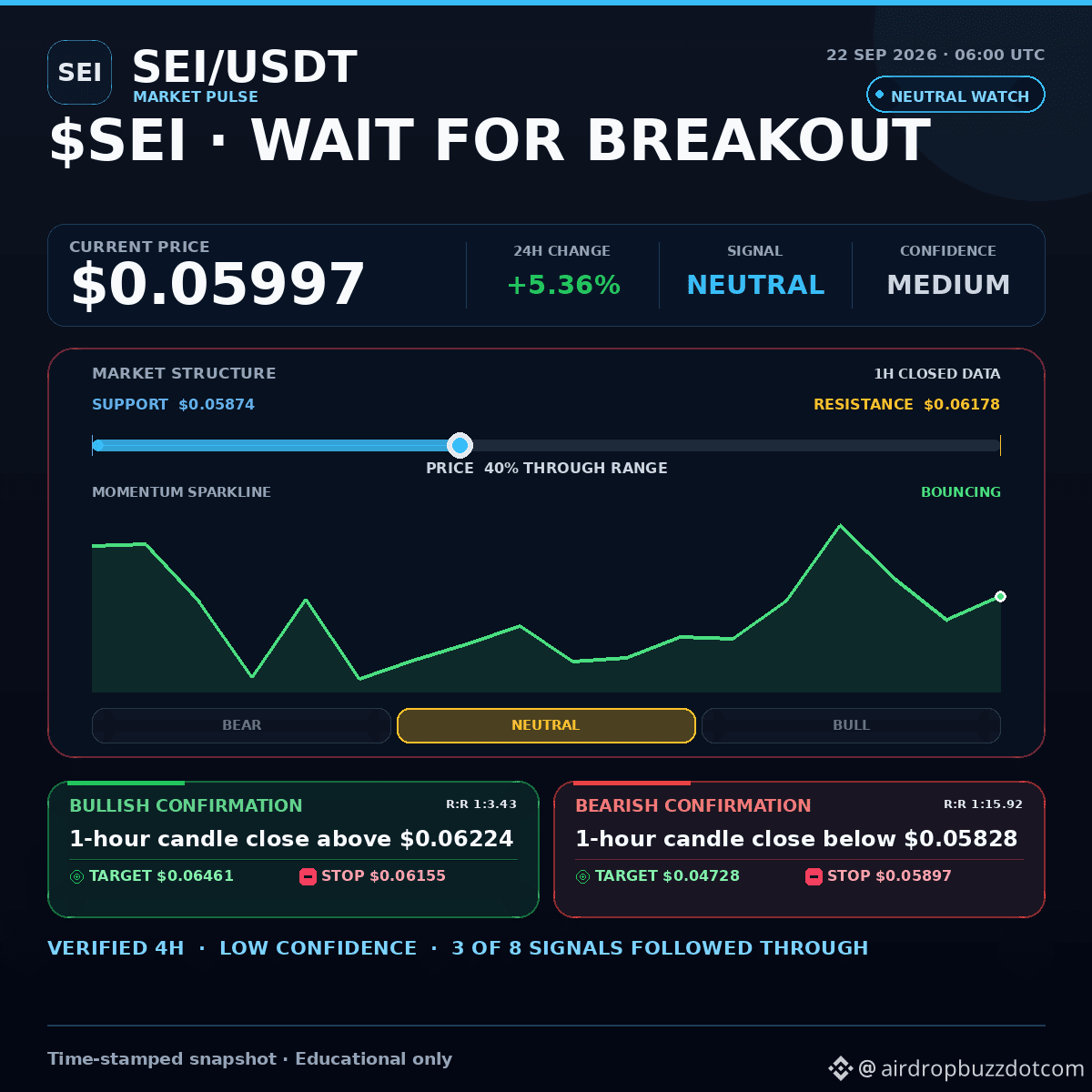
$SEI can move without producing a clean setup. This trigger still has to earn confirmation.
📊 Snapshot
• Price: $0.05997
• 24H: +5.36%
• Bias: Neutral
📈 Bull Trigger
1-hour close above $0.06224 with open interest confirmation
📉 Bear Trigger
1-hour close below $0.05828 with open interest confirmation
🎯 Signal Read
The useful signal is the first confirmed close that settles the current fight for control, not another intraday wick.
📌 Confidence
Medium · Low historical confidence · 3 of 8 directional moves were favorable
Signal Quality
- OI: Rising (+1.93%)
- 4H: Bullish | 1D: Bullish (Aligned)
- ATR filter: 0.50 ATR ($0.0009214)
- Risk/reward: 1:3.43
Bull scenario risk plan
- Entry: $0.06224
- Stop: $0.06155
- Target: $0.06461
Use closed-candle confirmation because these levels define conditions, not future price forecasts.
Front-run it or wait? Reply FRONT-RUN or WAIT.
#SEI #Sei #CryptoTrading #MarketPulse
Educational only. Time-stamped market snapshot, not financial advice.
$SEI can move without producing a clean setup. This trigger still has to earn confirmation.
📊 Snapshot
• Price: $0.05997
• 24H: +5.36%
• Bias: Neutral
📈 Bull Trigger
1-hour close above $0.06224 with open interest confirmation
📉 Bear Trigger
1-hour close below $0.05828 with open interest confirmation
🎯 Signal Read
The useful signal is the first confirmed close that settles the current fight for control, not another intraday wick.
📌 Confidence
Medium · Low historical confidence · 3 of 8 directional moves were favorable
Signal Quality
- OI: Rising (+1.93%)
- 4H: Bullish | 1D: Bullish (Aligned)
- ATR filter: 0.50 ATR ($0.0009214)
- Risk/reward: 1:3.43
Bull scenario risk plan
- Entry: $0.06224
- Stop: $0.06155
- Target: $0.06461
Use closed-candle confirmation because these levels define conditions, not future price forecasts.
Front-run it or wait? Reply FRONT-RUN or WAIT.
#SEI #Sei #CryptoTrading #MarketPulse
Educational only. Time-stamped market snapshot, not financial advice.
📊 Snapshot
• Price: $0.05997
• 24H: +5.36%
• Bias: Neutral
📈 Bull Trigger
1-hour close above $0.06224 with open interest confirmation
📉 Bear Trigger
1-hour close below $0.05828 with open interest confirmation
🎯 Signal Read
The useful signal is the first confirmed close that settles the current fight for control, not another intraday wick.
📌 Confidence
Medium · Low historical confidence · 3 of 8 directional moves were favorable
Signal Quality
- OI: Rising (+1.93%)
- 4H: Bullish | 1D: Bullish (Aligned)
- ATR filter: 0.50 ATR ($0.0009214)
- Risk/reward: 1:3.43
Bull scenario risk plan
- Entry: $0.06224
- Stop: $0.06155
- Target: $0.06461
Use closed-candle confirmation because these levels define conditions, not future price forecasts.
Front-run it or wait? Reply FRONT-RUN or WAIT.
#SEI #Sei #CryptoTrading #MarketPulse
Educational only. Time-stamped market snapshot, not financial advice.
47
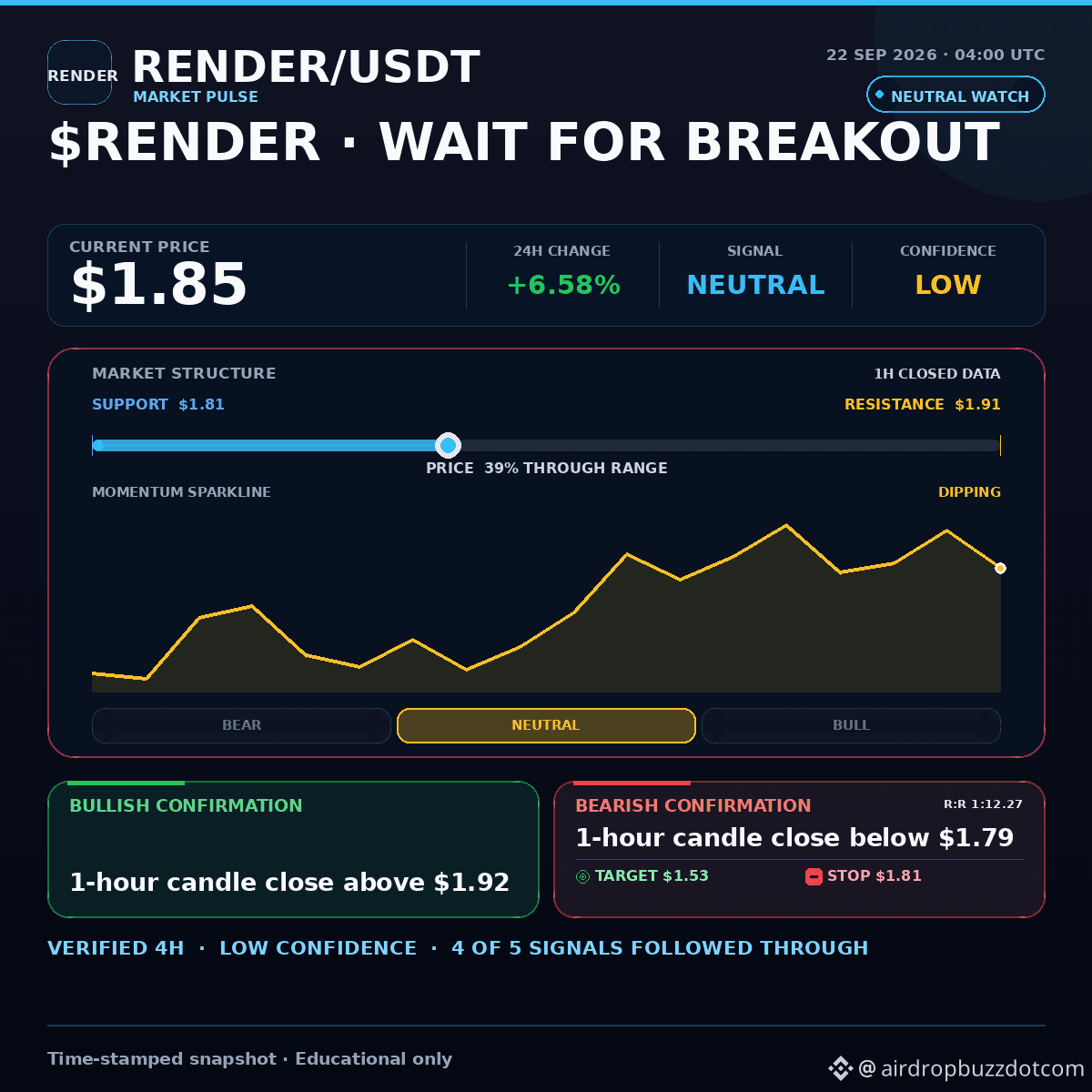
$RENDER follow-through check: 4 of 5 recent directional moves were favorable.
📊 Snapshot
• Price: $1.85
• 24H: +6.58%
• Bias: Neutral
📈 Bull Trigger
1-hour close above $1.92 with open interest confirmation
📉 Bear Trigger
1-hour close below $1.79 with open interest confirmation
🎯 Signal Read
Conflicting evidence keeps this conditional, so the close matters more than predicting the direction early.
📌 Confidence
Low · Low historical confidence · 4 of 5 directional moves were favorable
Signal Quality
- OI: Flat (-1.15%)
- 4H: Bullish | 1D: Bullish (Aligned)
- ATR filter: 0.50 ATR ($0.03)
- Risk/reward: 1:12.27
Bear scenario risk plan
- Entry: $1.79
- Stop: $1.81
- Target: $1.53
Triggers confirm conditions rather than price targets, so always wait for the candle close.
Bull or bear first? Drop 🐂 or 🐻.
#RENDER #Render #CryptoTrading #MarketPulse
Educational only. Time-stamped market snapshot, not financial advice.
$RENDER follow-through check: 4 of 5 recent directional moves were favorable.
📊 Snapshot
• Price: $1.85
• 24H: +6.58%
• Bias: Neutral
📈 Bull Trigger
1-hour close above $1.92 with open interest confirmation
📉 Bear Trigger
1-hour close below $1.79 with open interest confirmation
🎯 Signal Read
Conflicting evidence keeps this conditional, so the close matters more than predicting the direction early.
📌 Confidence
Low · Low historical confidence · 4 of 5 directional moves were favorable
Signal Quality
- OI: Flat (-1.15%)
- 4H: Bullish | 1D: Bullish (Aligned)
- ATR filter: 0.50 ATR ($0.03)
- Risk/reward: 1:12.27
Bear scenario risk plan
- Entry: $1.79
- Stop: $1.81
- Target: $1.53
Triggers confirm conditions rather than price targets, so always wait for the candle close.
Bull or bear first? Drop 🐂 or 🐻.
#RENDER #Render #CryptoTrading #MarketPulse
Educational only. Time-stamped market snapshot, not financial advice.
📊 Snapshot
• Price: $1.85
• 24H: +6.58%
• Bias: Neutral
📈 Bull Trigger
1-hour close above $1.92 with open interest confirmation
📉 Bear Trigger
1-hour close below $1.79 with open interest confirmation
🎯 Signal Read
Conflicting evidence keeps this conditional, so the close matters more than predicting the direction early.
📌 Confidence
Low · Low historical confidence · 4 of 5 directional moves were favorable
Signal Quality
- OI: Flat (-1.15%)
- 4H: Bullish | 1D: Bullish (Aligned)
- ATR filter: 0.50 ATR ($0.03)
- Risk/reward: 1:12.27
Bear scenario risk plan
- Entry: $1.79
- Stop: $1.81
- Target: $1.53
Triggers confirm conditions rather than price targets, so always wait for the candle close.
Bull or bear first? Drop 🐂 or 🐻.
#RENDER #Render #CryptoTrading #MarketPulse
Educational only. Time-stamped market snapshot, not financial advice.
62
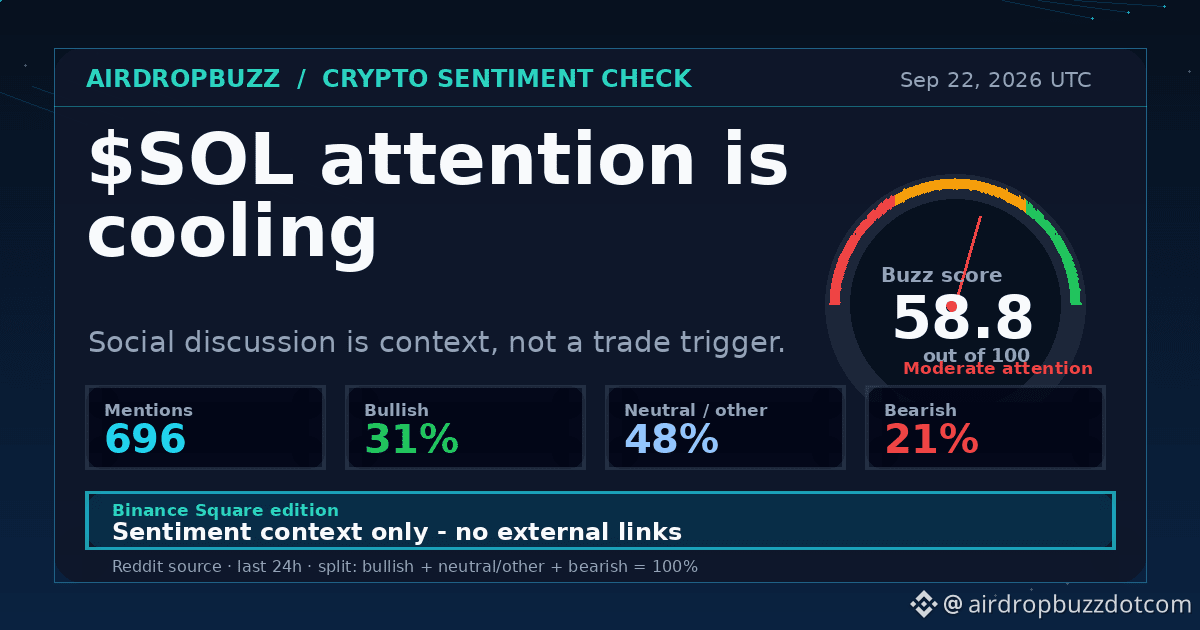
Crypto Sentiment Check: $SOL attention is cooling.
Social crypto discussion around $SOL is active today, and discussion is leaning more constructive than cautious. The useful read is patience: sentiment is context, but confirmation still has to come from price, volume and risk conditions.
Treat this as market context, not a trade trigger. Wait for confirmation before acting.
Educational only, not financial advice.
Crypto Sentiment Check: $SOL attention is cooling.
Social crypto discussion around $SOL is active today, and discussion is leaning more constructive than cautious. The useful read is patience: sentiment is context, but confirmation still has to come from price, volume and risk conditions.
Treat this as market context, not a trade trigger. Wait for confirmation before acting.
Educational only, not financial advice.
Social crypto discussion around $SOL is active today, and discussion is leaning more constructive than cautious. The useful read is patience: sentiment is context, but confirmation still has to come from price, volume and risk conditions.
Treat this as market context, not a trade trigger. Wait for confirmation before acting.
Educational only, not financial advice.
63
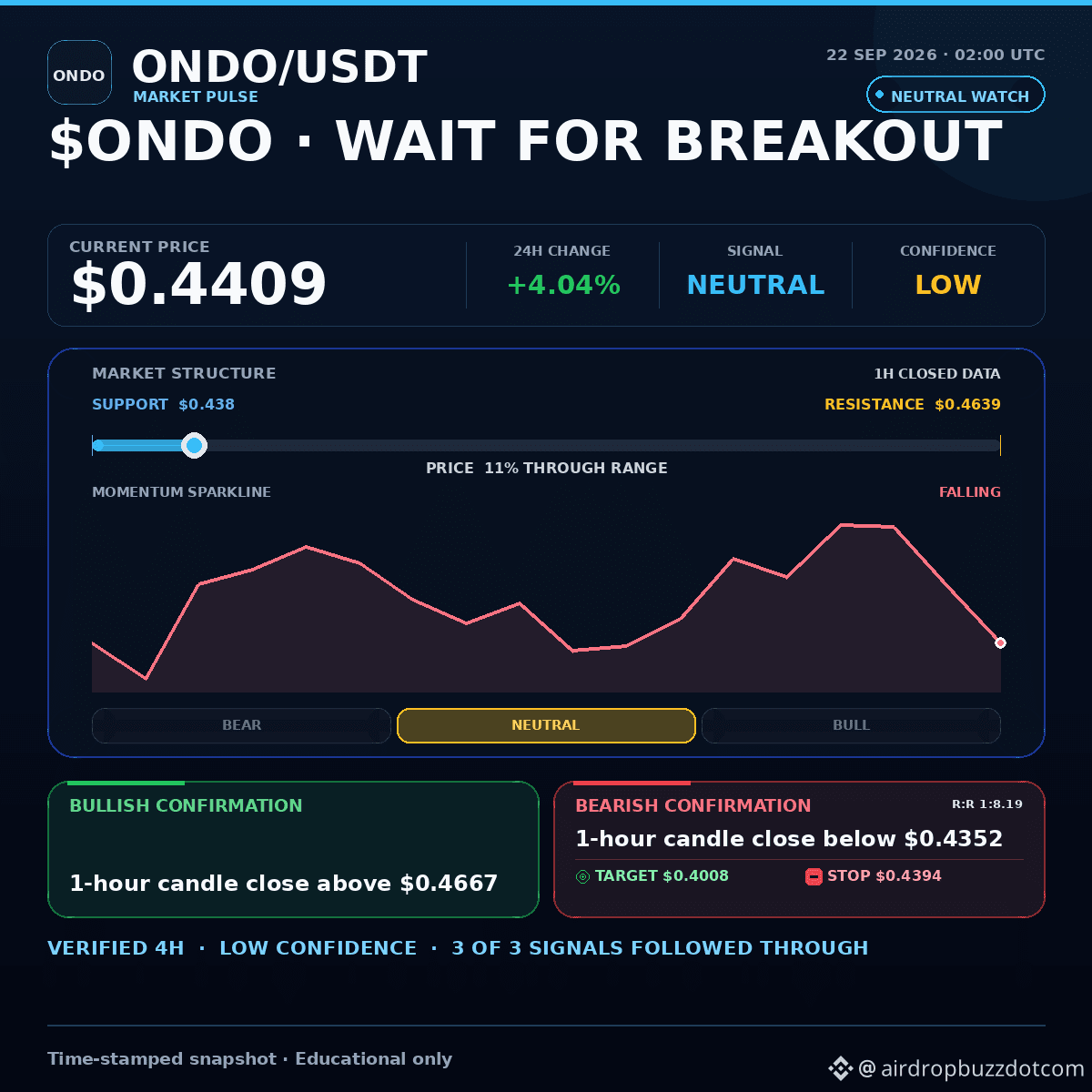
Which fires first for $ONDO: the bull trigger or the bear trigger?
📊 Snapshot
• Price: $0.4409
• 24H: +4.04%
• Bias: Neutral
📈 Bull Trigger
1-hour close above $0.4667 with open interest confirmation
📉 Bear Trigger
1-hour close below $0.4352 with open interest confirmation
🎯 Signal Read
Direction is secondary until the market closes beyond a trigger with supporting participation.
📌 Confidence
Low · Low historical confidence · 3 of 3 directional moves were favorable
Signal Quality
- OI: Flat (-0.63%)
- 4H: Bullish | 1D: Bullish (Aligned)
- ATR filter: 0.50 ATR ($0.005557)
A trigger marks confirmation, not a guaranteed entry, outcome, or price destination.
Break or fake? Reply BREAK or FAKE.
#ONDO #Ondo #CryptoTrading #MarketPulse
Educational only. Time-stamped market snapshot, not financial advice.
Which fires first for $ONDO : the bull trigger or the bear trigger?
📊 Snapshot
• Price: $0.4409
• 24H: +4.04%
• Bias: Neutral
📈 Bull Trigger
1-hour close above $0.4667 with open interest confirmation
📉 Bear Trigger
1-hour close below $0.4352 with open interest confirmation
🎯 Signal Read
Direction is secondary until the market closes beyond a trigger with supporting participation.
📌 Confidence
Low · Low historical confidence · 3 of 3 directional moves were favorable
Signal Quality
- OI: Flat (-0.63%)
- 4H: Bullish | 1D: Bullish (Aligned)
- ATR filter: 0.50 ATR ($0.005557)
A trigger marks confirmation, not a guaranteed entry, outcome, or price destination.
Break or fake? Reply BREAK or FAKE.
#ONDO #Ondo #CryptoTrading #MarketPulse
Educational only. Time-stamped market snapshot, not financial advice.
📊 Snapshot
• Price: $0.4409
• 24H: +4.04%
• Bias: Neutral
📈 Bull Trigger
1-hour close above $0.4667 with open interest confirmation
📉 Bear Trigger
1-hour close below $0.4352 with open interest confirmation
🎯 Signal Read
Direction is secondary until the market closes beyond a trigger with supporting participation.
📌 Confidence
Low · Low historical confidence · 3 of 3 directional moves were favorable
Signal Quality
- OI: Flat (-0.63%)
- 4H: Bullish | 1D: Bullish (Aligned)
- ATR filter: 0.50 ATR ($0.005557)
A trigger marks confirmation, not a guaranteed entry, outcome, or price destination.
Break or fake? Reply BREAK or FAKE.
#ONDO #Ondo #CryptoTrading #MarketPulse
Educational only. Time-stamped market snapshot, not financial advice.
129
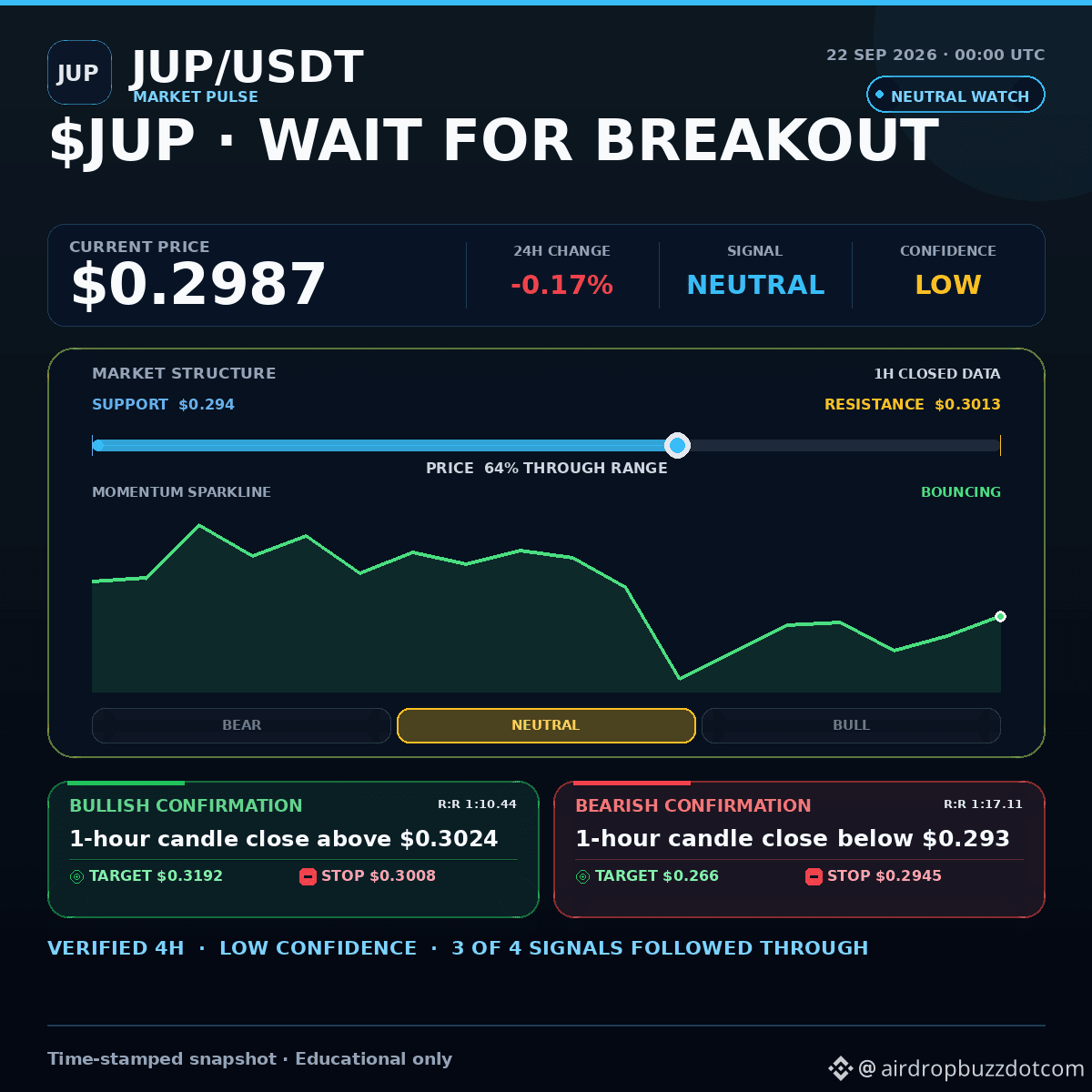
Forget the first $JUP wick—the confirmed close carries more information.
📊 Snapshot
• Price: $0.2987
• 24H: -0.17%
• Bias: Neutral
📈 Bull Trigger
1-hour close above $0.3024 with open interest confirmation
📉 Bear Trigger
1-hour close below $0.293 with open interest confirmation
🎯 Signal Read
Conflicting evidence keeps this conditional, so the close matters more than predicting the direction early.
📌 Confidence
Low · Low historical confidence · 3 of 4 directional moves were favorable
Signal Quality
- OI: Flat (-0.65%)
- 4H: Bullish | 1D: Bullish (Aligned)
- ATR filter: 0.50 ATR ($0.0021)
- Risk/reward: 1:17.11
Bear scenario risk plan
- Entry: $0.293
- Stop: $0.2945
- Target: $0.266
A trigger marks confirmation, not a guaranteed entry, outcome, or price destination.
Bull or bear first? Drop 🐂 or 🐻.
#JUP #Jupiter #CryptoTrading #MarketPulse
Educational only. Time-stamped market snapshot, not financial advice.
Forget the first $JUP wick—the confirmed close carries more information.
📊 Snapshot
• Price: $0.2987
• 24H: -0.17%
• Bias: Neutral
📈 Bull Trigger
1-hour close above $0.3024 with open interest confirmation
📉 Bear Trigger
1-hour close below $0.293 with open interest confirmation
🎯 Signal Read
Conflicting evidence keeps this conditional, so the close matters more than predicting the direction early.
📌 Confidence
Low · Low historical confidence · 3 of 4 directional moves were favorable
Signal Quality
- OI: Flat (-0.65%)
- 4H: Bullish | 1D: Bullish (Aligned)
- ATR filter: 0.50 ATR ($0.0021)
- Risk/reward: 1:17.11
Bear scenario risk plan
- Entry: $0.293
- Stop: $0.2945
- Target: $0.266
A trigger marks confirmation, not a guaranteed entry, outcome, or price destination.
Bull or bear first? Drop 🐂 or 🐻.
#JUP #Jupiter #CryptoTrading #MarketPulse
Educational only. Time-stamped market snapshot, not financial advice.
📊 Snapshot
• Price: $0.2987
• 24H: -0.17%
• Bias: Neutral
📈 Bull Trigger
1-hour close above $0.3024 with open interest confirmation
📉 Bear Trigger
1-hour close below $0.293 with open interest confirmation
🎯 Signal Read
Conflicting evidence keeps this conditional, so the close matters more than predicting the direction early.
📌 Confidence
Low · Low historical confidence · 3 of 4 directional moves were favorable
Signal Quality
- OI: Flat (-0.65%)
- 4H: Bullish | 1D: Bullish (Aligned)
- ATR filter: 0.50 ATR ($0.0021)
- Risk/reward: 1:17.11
Bear scenario risk plan
- Entry: $0.293
- Stop: $0.2945
- Target: $0.266
A trigger marks confirmation, not a guaranteed entry, outcome, or price destination.
Bull or bear first? Drop 🐂 or 🐻.
#JUP #Jupiter #CryptoTrading #MarketPulse
Educational only. Time-stamped market snapshot, not financial advice.
59
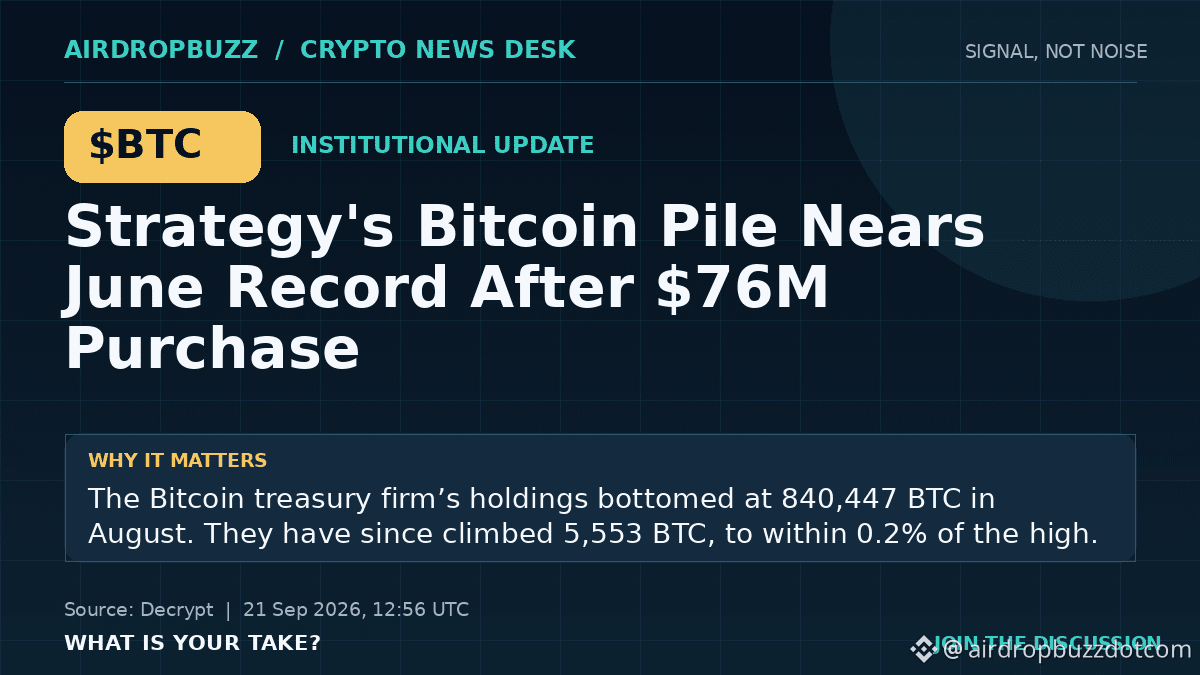
$BTC news
What happened
Strategy's Bitcoin Pile Nears June Record After $76M Purchase
The Bitcoin treasury firm’s holdings bottomed at 840,447 BTC in August. They have since climbed 5,553 BTC, to within 0.2% of the high.
What to verify
Check whether the announcement describes a completed transaction, a filing or a plan. Reported institutional activity does not by itself establish future demand or returns.
Source: Decrypt
#CryptoNews
$BTC news
What happened
Strategy's Bitcoin Pile Nears June Record After $76M Purchase
The Bitcoin treasury firm’s holdings bottomed at 840,447 BTC in August. They have since climbed 5,553 BTC, to within 0.2% of the high.
What to verify
Check whether the announcement describes a completed transaction, a filing or a plan. Reported institutional activity does not by itself establish future demand or returns.
Source: Decrypt
#CryptoNews
What happened
Strategy's Bitcoin Pile Nears June Record After $76M Purchase
The Bitcoin treasury firm’s holdings bottomed at 840,447 BTC in August. They have since climbed 5,553 BTC, to within 0.2% of the high.
What to verify
Check whether the announcement describes a completed transaction, a filing or a plan. Reported institutional activity does not by itself establish future demand or returns.
Source: Decrypt
#CryptoNews
41
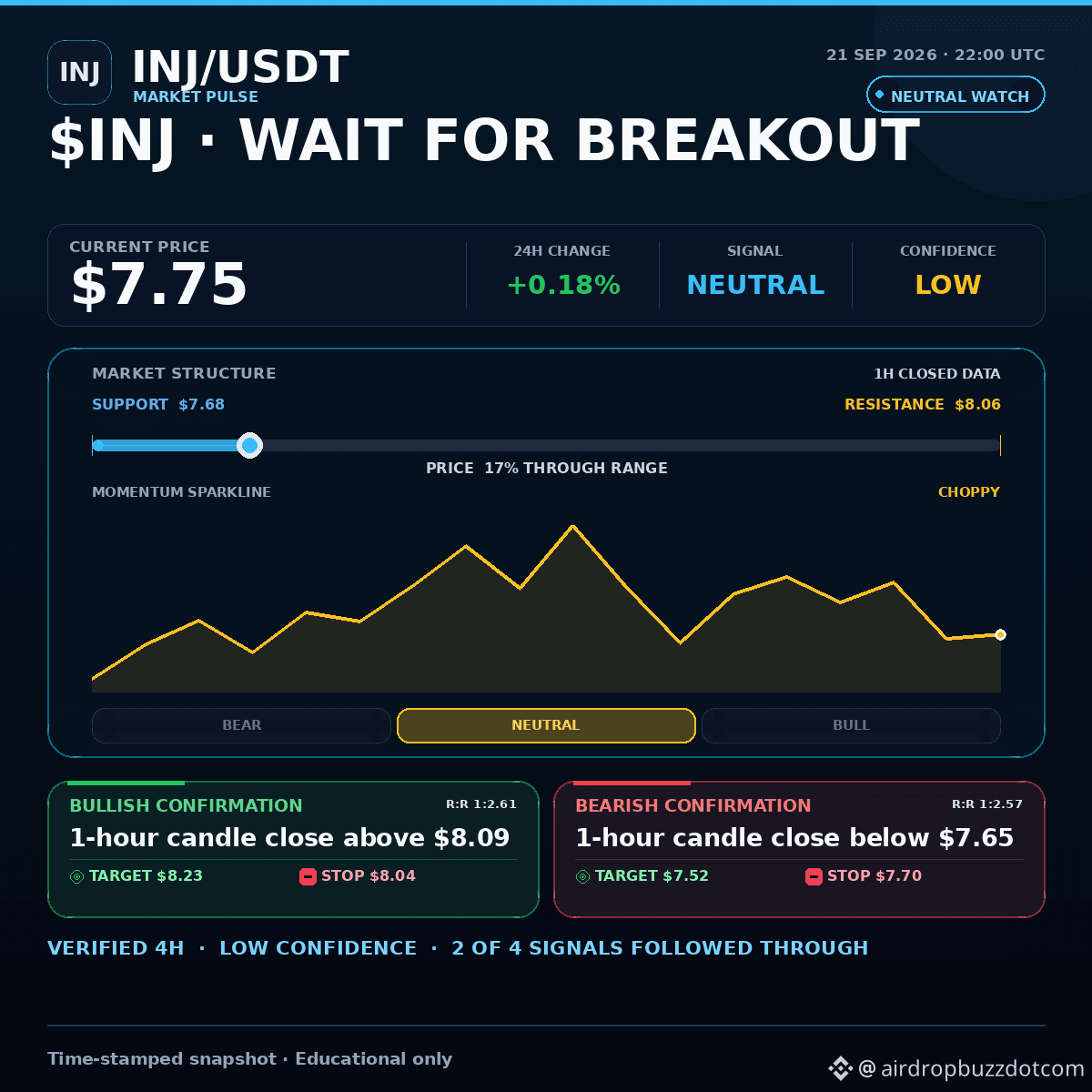
The $INJ setup stays on hold until the next 1H candle confirms a side.
📊 Snapshot
• Price: $7.75
• 24H: +0.18%
• Bias: Neutral
📈 Bull Trigger
1-hour close above $8.09 with open interest confirmation
📉 Bear Trigger
1-hour close below $7.65 with open interest confirmation
🎯 Signal Read
Conflicting evidence keeps this conditional, so the close matters more than predicting the direction early.
📌 Confidence
Low · Low historical confidence · 2 of 4 directional moves were favorable
Signal Quality
- OI: Flat (+0.65%)
- 4H: Bullish | 1D: Bullish (Aligned)
- ATR filter: 0.50 ATR ($0.06)
- Risk/reward: 1:2.57
Bear scenario risk plan
- Entry: $7.65
- Stop: $7.70
- Target: $7.52
Use closed-candle confirmation because these levels define conditions, not future price forecasts.
Up or down first? Reply UP or DOWN.
#INJ #Injective #CryptoTrading #MarketPulse
Educational only. Time-stamped market snapshot, not financial advice.
The $INJ setup stays on hold until the next 1H candle confirms a side.
📊 Snapshot
• Price: $7.75
• 24H: +0.18%
• Bias: Neutral
📈 Bull Trigger
1-hour close above $8.09 with open interest confirmation
📉 Bear Trigger
1-hour close below $7.65 with open interest confirmation
🎯 Signal Read
Conflicting evidence keeps this conditional, so the close matters more than predicting the direction early.
📌 Confidence
Low · Low historical confidence · 2 of 4 directional moves were favorable
Signal Quality
- OI: Flat (+0.65%)
- 4H: Bullish | 1D: Bullish (Aligned)
- ATR filter: 0.50 ATR ($0.06)
- Risk/reward: 1:2.57
Bear scenario risk plan
- Entry: $7.65
- Stop: $7.70
- Target: $7.52
Use closed-candle confirmation because these levels define conditions, not future price forecasts.
Up or down first? Reply UP or DOWN.
#INJ #Injective #CryptoTrading #MarketPulse
Educational only. Time-stamped market snapshot, not financial advice.
📊 Snapshot
• Price: $7.75
• 24H: +0.18%
• Bias: Neutral
📈 Bull Trigger
1-hour close above $8.09 with open interest confirmation
📉 Bear Trigger
1-hour close below $7.65 with open interest confirmation
🎯 Signal Read
Conflicting evidence keeps this conditional, so the close matters more than predicting the direction early.
📌 Confidence
Low · Low historical confidence · 2 of 4 directional moves were favorable
Signal Quality
- OI: Flat (+0.65%)
- 4H: Bullish | 1D: Bullish (Aligned)
- ATR filter: 0.50 ATR ($0.06)
- Risk/reward: 1:2.57
Bear scenario risk plan
- Entry: $7.65
- Stop: $7.70
- Target: $7.52
Use closed-candle confirmation because these levels define conditions, not future price forecasts.
Up or down first? Reply UP or DOWN.
#INJ #Injective #CryptoTrading #MarketPulse
Educational only. Time-stamped market snapshot, not financial advice.
121
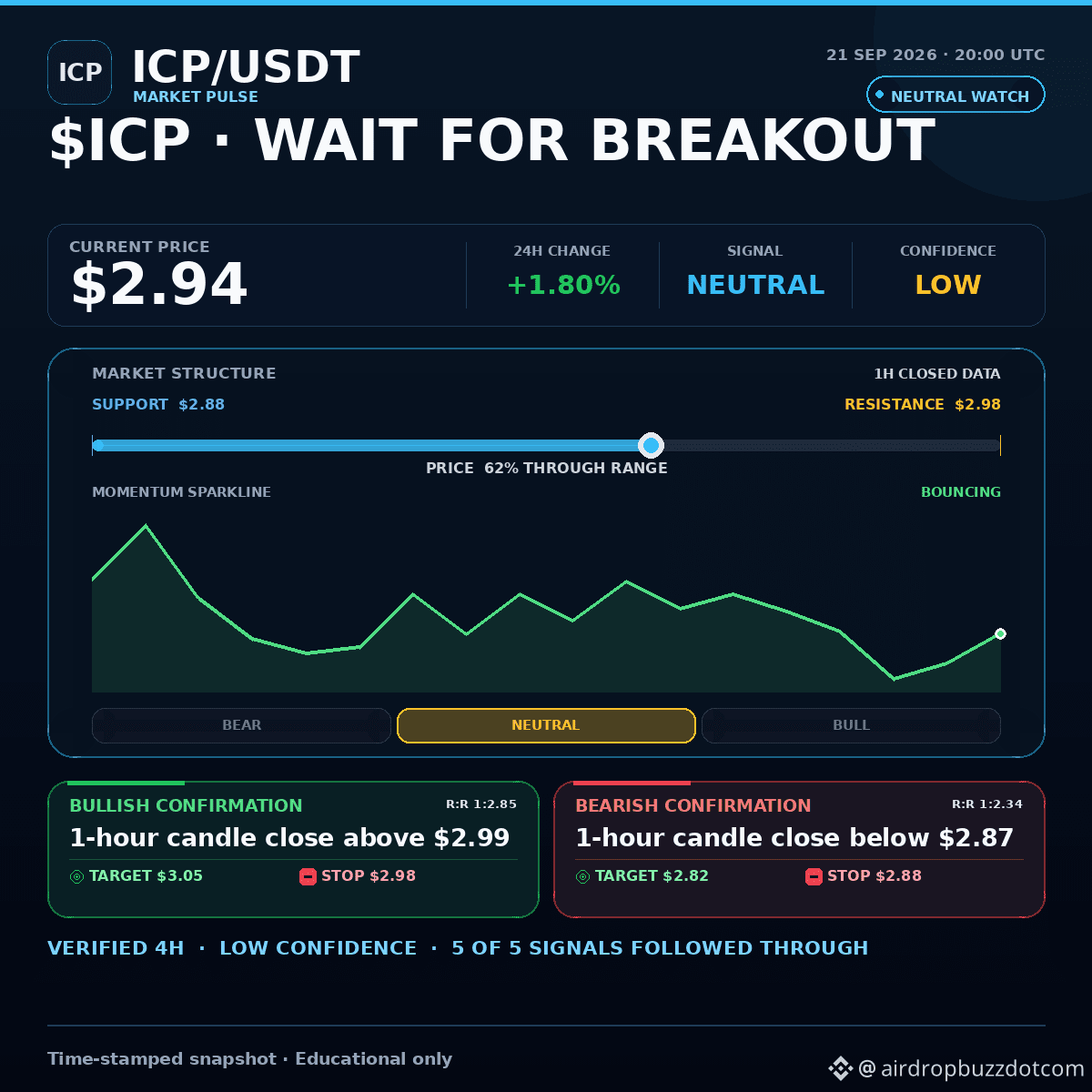
Only 5 of 5 recent directional moves were favorable for $ICP. Confirmation has to do the heavy lifting.
📊 Snapshot
• Price: $2.94
• 24H: +1.80%
• Bias: Neutral
📈 Bull Trigger
1-hour close above $2.99 with open interest confirmation
📉 Bear Trigger
1-hour close below $2.87 with open interest confirmation
🎯 Signal Read
Neither scenario is actionable on movement alone; confirmation decides which side has earned the edge.
📌 Confidence
Low · Low historical confidence · 5 of 5 directional moves were favorable
Signal Quality
- OI: Flat (+0.40%)
- 4H: Bullish | 1D: Bullish (Aligned)
- ATR filter: 0.50 ATR ($0.02)
- Risk/reward: 1:2.34
Bear scenario risk plan
- Entry: $2.87
- Stop: $2.88
- Target: $2.82
Triggers confirm conditions rather than price targets, so always wait for the candle close.
Front-run it or wait? Reply FRONT-RUN or WAIT.
#ICP #InternetComputer #CryptoTrading #MarketPulse
Educational only. Time-stamped market snapshot, not financial advice.
Only 5 of 5 recent directional moves were favorable for $ICP . Confirmation has to do the heavy lifting.
📊 Snapshot
• Price: $2.94
• 24H: +1.80%
• Bias: Neutral
📈 Bull Trigger
1-hour close above $2.99 with open interest confirmation
📉 Bear Trigger
1-hour close below $2.87 with open interest confirmation
🎯 Signal Read
Neither scenario is actionable on movement alone; confirmation decides which side has earned the edge.
📌 Confidence
Low · Low historical confidence · 5 of 5 directional moves were favorable
Signal Quality
- OI: Flat (+0.40%)
- 4H: Bullish | 1D: Bullish (Aligned)
- ATR filter: 0.50 ATR ($0.02)
- Risk/reward: 1:2.34
Bear scenario risk plan
- Entry: $2.87
- Stop: $2.88
- Target: $2.82
Triggers confirm conditions rather than price targets, so always wait for the candle close.
Front-run it or wait? Reply FRONT-RUN or WAIT.
#ICP #InternetComputer #CryptoTrading #MarketPulse
Educational only. Time-stamped market snapshot, not financial advice.
📊 Snapshot
• Price: $2.94
• 24H: +1.80%
• Bias: Neutral
📈 Bull Trigger
1-hour close above $2.99 with open interest confirmation
📉 Bear Trigger
1-hour close below $2.87 with open interest confirmation
🎯 Signal Read
Neither scenario is actionable on movement alone; confirmation decides which side has earned the edge.
📌 Confidence
Low · Low historical confidence · 5 of 5 directional moves were favorable
Signal Quality
- OI: Flat (+0.40%)
- 4H: Bullish | 1D: Bullish (Aligned)
- ATR filter: 0.50 ATR ($0.02)
- Risk/reward: 1:2.34
Bear scenario risk plan
- Entry: $2.87
- Stop: $2.88
- Target: $2.82
Triggers confirm conditions rather than price targets, so always wait for the candle close.
Front-run it or wait? Reply FRONT-RUN or WAIT.
#ICP #InternetComputer #CryptoTrading #MarketPulse
Educational only. Time-stamped market snapshot, not financial advice.
114
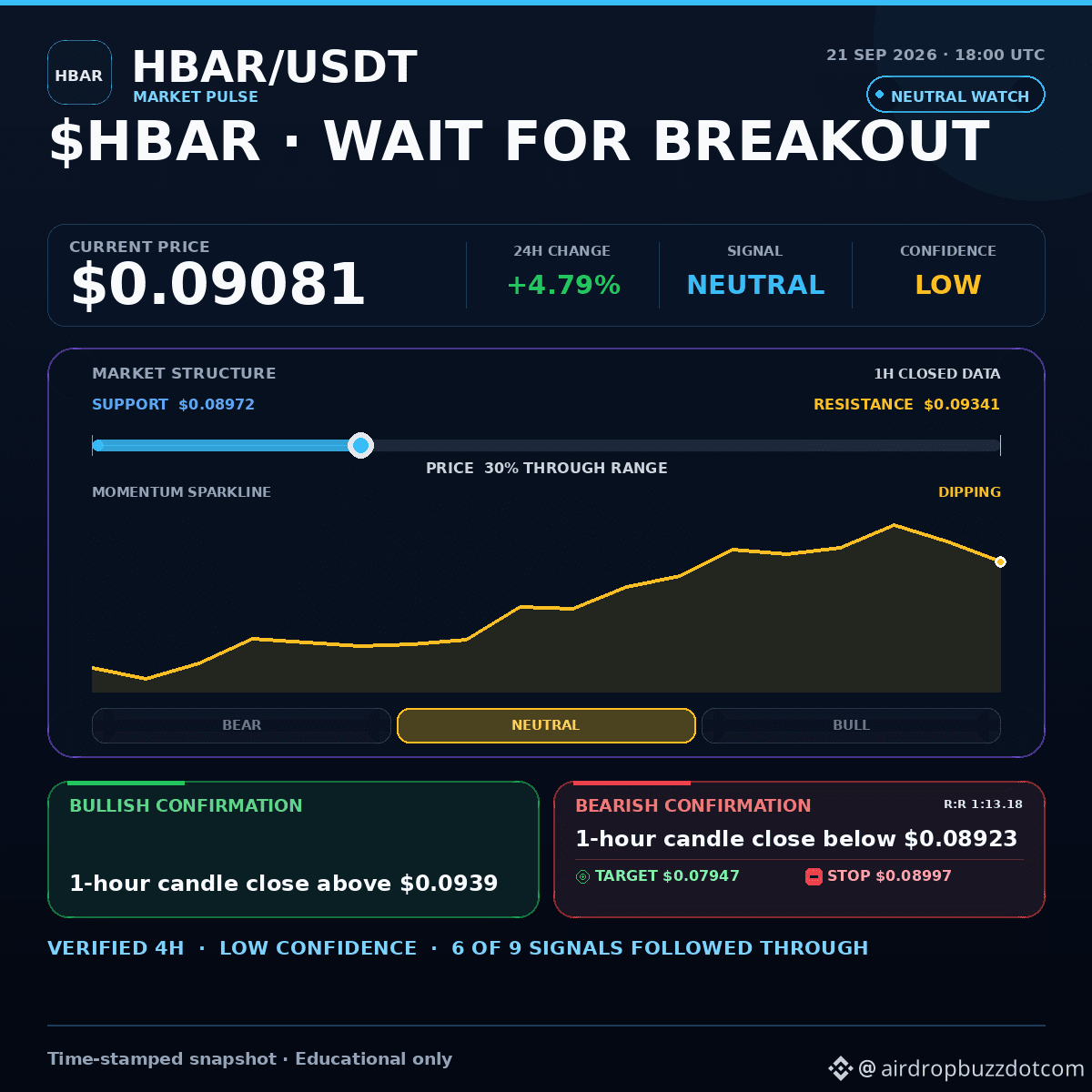
Breakout, breakdown, or another $HBAR trap?
📊 Snapshot
• Price: $0.09081
• 24H: +4.79%
• Bias: Neutral
📈 Bull Trigger
1-hour close above $0.0939 with open interest confirmation
📉 Bear Trigger
1-hour close below $0.08923 with open interest confirmation
🎯 Signal Read
The setup is balanced enough to punish guesses; wait for price and participation to confirm the same side.
📌 Confidence
Low · Low historical confidence · 6 of 9 directional moves were favorable
Signal Quality
- OI: Flat (-0.86%)
- 4H: Bullish | 1D: Bullish (Aligned)
- ATR filter: 0.50 ATR ($0.0009829)
Use closed-candle confirmation because these levels define conditions, not future price forecasts.
Break or fake? Reply BREAK or FAKE.
#HBAR #Hedera #CryptoTrading #MarketPulse
Educational only. Time-stamped market snapshot, not financial advice.
Breakout, breakdown, or another $HBAR trap?
📊 Snapshot
• Price: $0.09081
• 24H: +4.79%
• Bias: Neutral
📈 Bull Trigger
1-hour close above $0.0939 with open interest confirmation
📉 Bear Trigger
1-hour close below $0.08923 with open interest confirmation
🎯 Signal Read
The setup is balanced enough to punish guesses; wait for price and participation to confirm the same side.
📌 Confidence
Low · Low historical confidence · 6 of 9 directional moves were favorable
Signal Quality
- OI: Flat (-0.86%)
- 4H: Bullish | 1D: Bullish (Aligned)
- ATR filter: 0.50 ATR ($0.0009829)
Use closed-candle confirmation because these levels define conditions, not future price forecasts.
Break or fake? Reply BREAK or FAKE.
#HBAR #Hedera #CryptoTrading #MarketPulse
Educational only. Time-stamped market snapshot, not financial advice.
📊 Snapshot
• Price: $0.09081
• 24H: +4.79%
• Bias: Neutral
📈 Bull Trigger
1-hour close above $0.0939 with open interest confirmation
📉 Bear Trigger
1-hour close below $0.08923 with open interest confirmation
🎯 Signal Read
The setup is balanced enough to punish guesses; wait for price and participation to confirm the same side.
📌 Confidence
Low · Low historical confidence · 6 of 9 directional moves were favorable
Signal Quality
- OI: Flat (-0.86%)
- 4H: Bullish | 1D: Bullish (Aligned)
- ATR filter: 0.50 ATR ($0.0009829)
Use closed-candle confirmation because these levels define conditions, not future price forecasts.
Break or fake? Reply BREAK or FAKE.
#HBAR #Hedera #CryptoTrading #MarketPulse
Educational only. Time-stamped market snapshot, not financial advice.
4
Log in to explore more content
Join global crypto users on Binance Square
⚡️ Get latest and useful information about crypto.
💬 Trusted by the world’s largest crypto exchange.
👍 Discover real insights from verified creators.
Email / Phone number
Trending Topics
AIStocksWhatNext
322,011 views
2,828 Discussing
Share & Win Traffic Reward in our Trending Hashtag Campaign
✨Topic: What Other Investment Opportunities Remain as AI Stocks Keep Rising?
👉How to Join:
Publish a short post or article with hashtag #AIStocksWhatNext
Share whether you’re bullish or bearish, and post your AI stock holdings or trade — using the trade widget may improve your eligibility.
You can also strengthen your post by sharing data or charts, and avoiding AI-generated images.
✍️Create content based on the below angles:
- Nvidia says chip sales will double next year, and top AI companies keep hitting record revenue, the compute spend behind it is just as staggering. Is AI demand really taking off? And how long can it last? AI stocks are up across the board. Is this a real breakout, or just a short-term bounce?
- Industry leaders are calling to slow down AI development, while Trump plans to build an “AI Force”, claiming AI could account for 25% of U.S. GDP in the future. Whose side are you on? Will state-level backing be a long-term win for AI stocks?
- Are you buying AI stocks? Share your AI-related trade/holdings with our trade sharing widget.
⏰Campaign Period:
- 2026-09-22 7:00 - 2026-09-24 4:00 UTC
🎁Reward:
- Qualified posts that comply with the above guidelines and contain more than 100 words will be reviewed and may receive a random traffic boost of 500 to 3,000 views. You will receive a notification from your feed secretary if your post is selected.
- Get a chance to have your article featured on Binance Square Official
Need ideas for your post? Visit the topic page #AIStocksWhatNext or the Square Guide on How to Post for Better Reach.
Binance Square Official
·344 Likes
·826.7k views
BitcoinBreaksAboveMayHighNears$86K
12,328 views
178 Discussing
DogecoinRises15%
37,940 views
920 Discussing