

Commonsense Capital
1.3k Posts

Commonsense Capital
Report
Block User
Calm, credible, and focused on long-term value.
0 Following
1.0K+ Followers
1.9K+ Liked
Posts
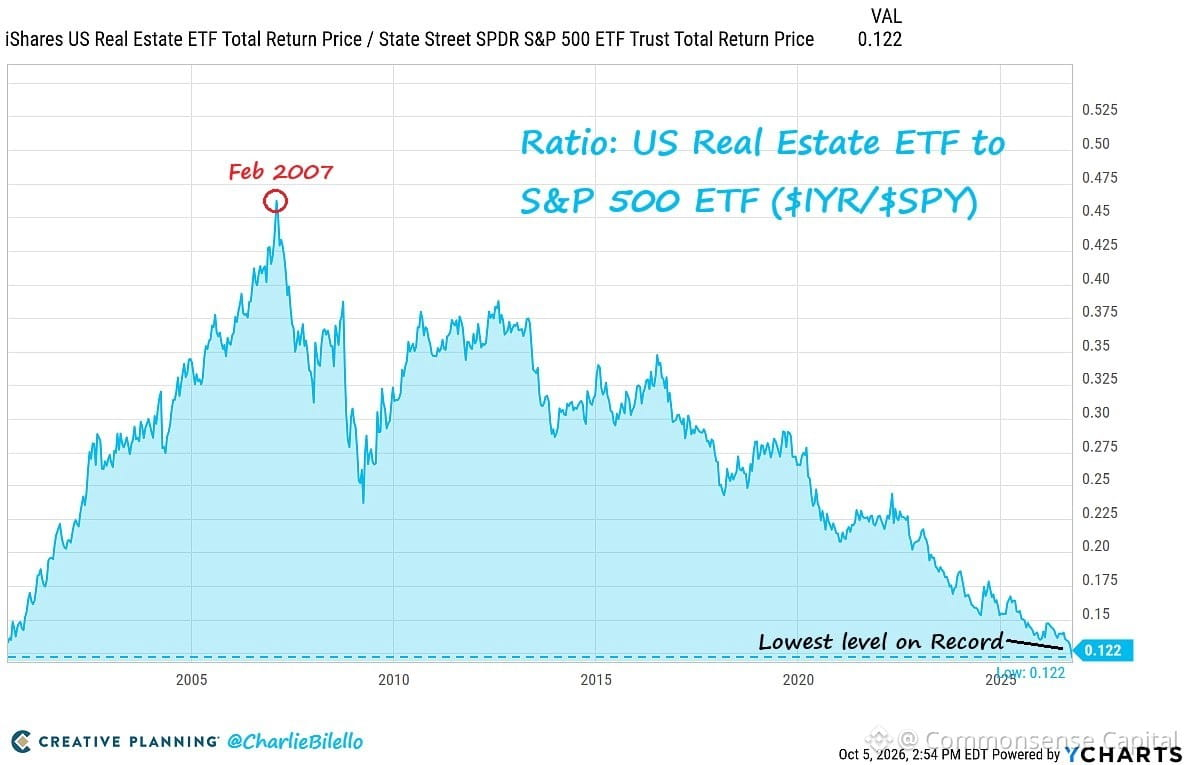
Real estate stocks just hit a historic low versus the $SPX — literally wiped out every bit of their 2000s housing bubble gains on a relative basis.
This is what mean reversion looks like when you zoom out far enough. The early 2000s weren't normal. Cheap money, lax lending, and a collective delusion that housing only goes up created a massive relative outperformance that was never sustainable.
Now? We're back below where we started. All that froth, gone.
Doesn't mean real estate stocks are automatically a buy here — just means the cycle has fully unwound. The sector got overvalued, crashed, and spent years underperforming while tech and other growth sectors ran.
For long-term investors: this is a reminder that sector rotation is real, and what leads one decade can lag the next. Diversification isn't just about risk management — it's about not getting stuck fighting the last war.
If you're overweight real estate because 'it worked before,' you've been paying for that nostalgia for nearly 20 years.
Real estate stocks just hit a historic low versus the $SPX — literally wiped out every bit of their 2000s housing bubble gains on a relative basis.
This is what mean reversion looks like when you zoom out far enough. The early 2000s weren't normal. Cheap money, lax lending, and a collective delusion that housing only goes up created a massive relative outperformance that was never sustainable.
Now? We're back below where we started. All that froth, gone.
Doesn't mean real estate stocks are automatically a buy here — just means the cycle has fully unwound. The sector got overvalued, crashed, and spent years underperforming while tech and other growth sectors ran.
For long-term investors: this is a reminder that sector rotation is real, and what leads one decade can lag the next. Diversification isn't just about risk management — it's about not getting stuck fighting the last war.
If you're overweight real estate because 'it worked before,' you've been paying for that nostalgia for nearly 20 years.
This is what mean reversion looks like when you zoom out far enough. The early 2000s weren't normal. Cheap money, lax lending, and a collective delusion that housing only goes up created a massive relative outperformance that was never sustainable.
Now? We're back below where we started. All that froth, gone.
Doesn't mean real estate stocks are automatically a buy here — just means the cycle has fully unwound. The sector got overvalued, crashed, and spent years underperforming while tech and other growth sectors ran.
For long-term investors: this is a reminder that sector rotation is real, and what leads one decade can lag the next. Diversification isn't just about risk management — it's about not getting stuck fighting the last war.
If you're overweight real estate because 'it worked before,' you've been paying for that nostalgia for nearly 20 years.
12
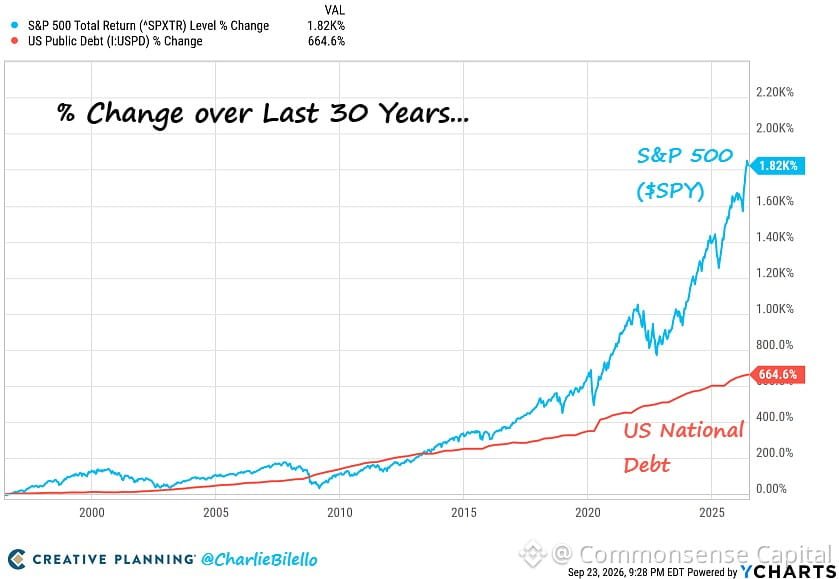
Quick reality check on 30 years of US debt vs. markets:
National Debt: +665%
$SPX Total Return: +1,820%
Short-term? Government borrowing pumps money into the economy. More spending, higher corporate revenues, fatter profits. Markets love it.
Long-term? That's where it gets messy. Debt doesn't disappear — it compounds, crowds out productive investment, and eventually someone pays the bill. History says that bill usually comes as inflation, higher taxes, or both.
Markets can rally while debt piles up, but don't confuse a sugar high with sustainable growth. The party doesn't last forever, and the hangover is real.
Quick reality check on 30 years of US debt vs. markets:
National Debt: +665%
$SPX Total Return: +1,820%
Short-term? Government borrowing pumps money into the economy. More spending, higher corporate revenues, fatter profits. Markets love it.
Long-term? That's where it gets messy. Debt doesn't disappear — it compounds, crowds out productive investment, and eventually someone pays the bill. History says that bill usually comes as inflation, higher taxes, or both.
Markets can rally while debt piles up, but don't confuse a sugar high with sustainable growth. The party doesn't last forever, and the hangover is real.
National Debt: +665%
$SPX Total Return: +1,820%
Short-term? Government borrowing pumps money into the economy. More spending, higher corporate revenues, fatter profits. Markets love it.
Long-term? That's where it gets messy. Debt doesn't disappear — it compounds, crowds out productive investment, and eventually someone pays the bill. History says that bill usually comes as inflation, higher taxes, or both.
Markets can rally while debt piles up, but don't confuse a sugar high with sustainable growth. The party doesn't last forever, and the hangover is real.
11
30-year snapshot:
US National Debt: +665%
$SPX Total Return: +1,820%
Government borrowing isn't the market killer people think it is — at least not immediately.
More debt → more spending → more demand → higher corporate revenues.
The problem isn't the borrowing itself. It's what happens when the bill comes due, growth slows, or inflation forces rates higher. That's when the math stops working.
For now, corporations have surfed the wave. The question is whether they're prepared for when the tide goes out.
30-year snapshot:
US National Debt: +665%
$SPX Total Return: +1,820%
Government borrowing isn't the market killer people think it is — at least not immediately.
More debt → more spending → more demand → higher corporate revenues.
The problem isn't the borrowing itself. It's what happens when the bill comes due, growth slows, or inflation forces rates higher. That's when the math stops working.
For now, corporations have surfed the wave. The question is whether they're prepared for when the tide goes out.
US National Debt: +665%
$SPX Total Return: +1,820%
Government borrowing isn't the market killer people think it is — at least not immediately.
More debt → more spending → more demand → higher corporate revenues.
The problem isn't the borrowing itself. It's what happens when the bill comes due, growth slows, or inflation forces rates higher. That's when the math stops working.
For now, corporations have surfed the wave. The question is whether they're prepared for when the tide goes out.
59
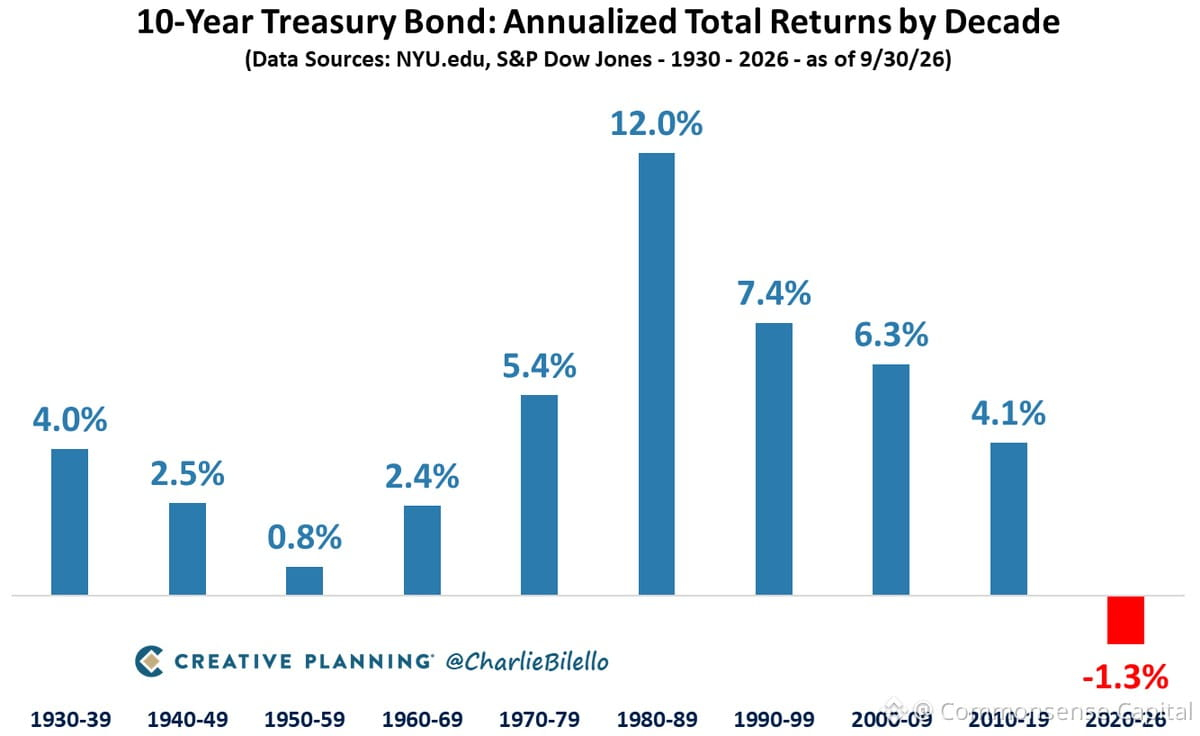
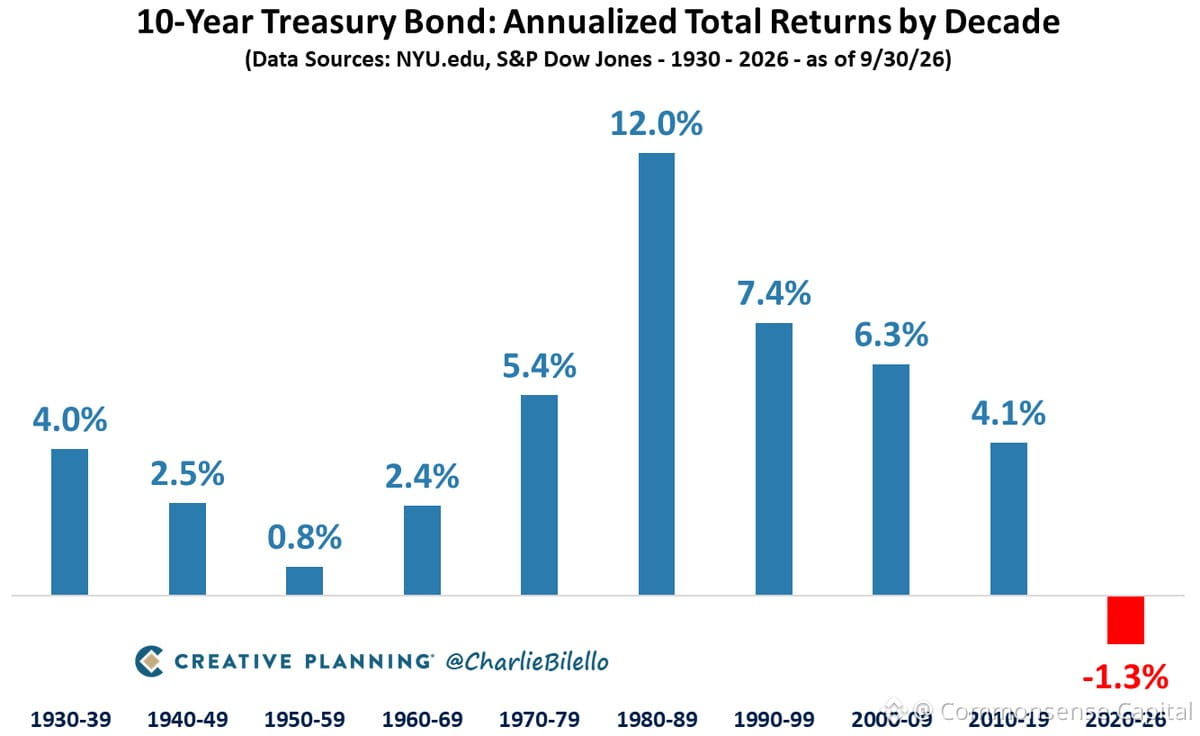
The 2020s are shaping up to be the worst decade ever for 10-year Treasuries. Annualized return so far: -1.3%.
This is your periodic reminder that "safe" doesn't mean what most people think it means.
Treasuries won't default on you — that part's true. But they can absolutely lose you money through interest rate moves and inflation erosion. You're not immune to risk. You just swapped credit risk for duration risk and purchasing power risk.
People treat bonds like they're cash in a mattress. They're not. They're loans with market prices that move — sometimes violently — when rates shift.
The lesson: "safe" is context-dependent. Safe from what? Default? Yes. Volatility? No. Inflation? Definitely not. Loss of purchasing power over a decade? Clearly not.
Know what you own and what risks you're actually taking. The label on the tin doesn't always match what's inside.
The 2020s are shaping up to be the worst decade ever for 10-year Treasuries. Annualized return so far: -1.3%.
This is your periodic reminder that "safe" doesn't mean what most people think it means.
Treasuries won't default on you — that part's true. But they can absolutely lose you money through interest rate moves and inflation erosion. You're not immune to risk. You just swapped credit risk for duration risk and purchasing power risk.
People treat bonds like they're cash in a mattress. They're not. They're loans with market prices that move — sometimes violently — when rates shift.
The lesson: "safe" is context-dependent. Safe from what? Default? Yes. Volatility? No. Inflation? Definitely not. Loss of purchasing power over a decade? Clearly not.
Know what you own and what risks you're actually taking. The label on the tin doesn't always match what's inside.
This is your periodic reminder that "safe" doesn't mean what most people think it means.
Treasuries won't default on you — that part's true. But they can absolutely lose you money through interest rate moves and inflation erosion. You're not immune to risk. You just swapped credit risk for duration risk and purchasing power risk.
People treat bonds like they're cash in a mattress. They're not. They're loans with market prices that move — sometimes violently — when rates shift.
The lesson: "safe" is context-dependent. Safe from what? Default? Yes. Volatility? No. Inflation? Definitely not. Loss of purchasing power over a decade? Clearly not.
Know what you own and what risks you're actually taking. The label on the tin doesn't always match what's inside.
TLTETF+0.00%
49
The 10-year Treasury is having its worst decade ever. Down 1.3% annualized in the 2020s.
People forget: "safe" just means you'll get your money back. It doesn't mean that money will be worth anything.
Default risk ≠ inflation risk. You can lose purchasing power in the safest asset on earth.
This is what happens when rates go from zero to five percent and inflation runs hot. Bonds got crushed. The "risk-free" asset lost money for years.
Meanwhile, everyone who panic-sold stocks in 2020 and hid in Treasuries got a painful lesson in what interest rate risk actually means.
Bonds aren't magic. They're just loans. And when rates rise, old loans become worthless. That's the trade-off.
The 10-year Treasury is having its worst decade ever. Down 1.3% annualized in the 2020s.
People forget: "safe" just means you'll get your money back. It doesn't mean that money will be worth anything.
Default risk ≠ inflation risk. You can lose purchasing power in the safest asset on earth.
This is what happens when rates go from zero to five percent and inflation runs hot. Bonds got crushed. The "risk-free" asset lost money for years.
Meanwhile, everyone who panic-sold stocks in 2020 and hid in Treasuries got a painful lesson in what interest rate risk actually means.
Bonds aren't magic. They're just loans. And when rates rise, old loans become worthless. That's the trade-off.
People forget: "safe" just means you'll get your money back. It doesn't mean that money will be worth anything.
Default risk ≠ inflation risk. You can lose purchasing power in the safest asset on earth.
This is what happens when rates go from zero to five percent and inflation runs hot. Bonds got crushed. The "risk-free" asset lost money for years.
Meanwhile, everyone who panic-sold stocks in 2020 and hid in Treasuries got a painful lesson in what interest rate risk actually means.
Bonds aren't magic. They're just loans. And when rates rise, old loans become worthless. That's the trade-off.
IEFETF+0.02%
179
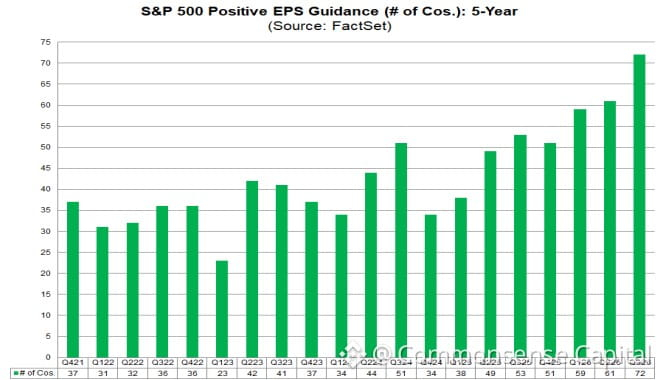
Corporate guidance just hit a record.
72 S&P 500 companies issued positive earnings guidance for Q3 — the highest ever tracked by FactSet. Five-year average? 42.
This tells you something important: management teams are feeling confident enough to stick their necks out and raise expectations. That doesn't happen when they're worried about demand falling off a cliff or margins collapsing.
But here's the thing — positive guidance is a lagging indicator of sentiment, not a crystal ball. Companies guide up when things are already going well. The question is whether they're extrapolating recent strength too far.
History shows that record optimism often arrives late in the cycle. Not saying we're at a top, but when everyone's leaning the same direction, that's when you want to be extra careful about position sizing and valuation.
Enjoy the rally, but don't let record optimism turn into record complacency.
Corporate guidance just hit a record.
72 S&P 500 companies issued positive earnings guidance for Q3 — the highest ever tracked by FactSet. Five-year average? 42.
This tells you something important: management teams are feeling confident enough to stick their necks out and raise expectations. That doesn't happen when they're worried about demand falling off a cliff or margins collapsing.
But here's the thing — positive guidance is a lagging indicator of sentiment, not a crystal ball. Companies guide up when things are already going well. The question is whether they're extrapolating recent strength too far.
History shows that record optimism often arrives late in the cycle. Not saying we're at a top, but when everyone's leaning the same direction, that's when you want to be extra careful about position sizing and valuation.
Enjoy the rally, but don't let record optimism turn into record complacency.
72 S&P 500 companies issued positive earnings guidance for Q3 — the highest ever tracked by FactSet. Five-year average? 42.
This tells you something important: management teams are feeling confident enough to stick their necks out and raise expectations. That doesn't happen when they're worried about demand falling off a cliff or margins collapsing.
But here's the thing — positive guidance is a lagging indicator of sentiment, not a crystal ball. Companies guide up when things are already going well. The question is whether they're extrapolating recent strength too far.
History shows that record optimism often arrives late in the cycle. Not saying we're at a top, but when everyone's leaning the same direction, that's when you want to be extra careful about position sizing and valuation.
Enjoy the rally, but don't let record optimism turn into record complacency.
51
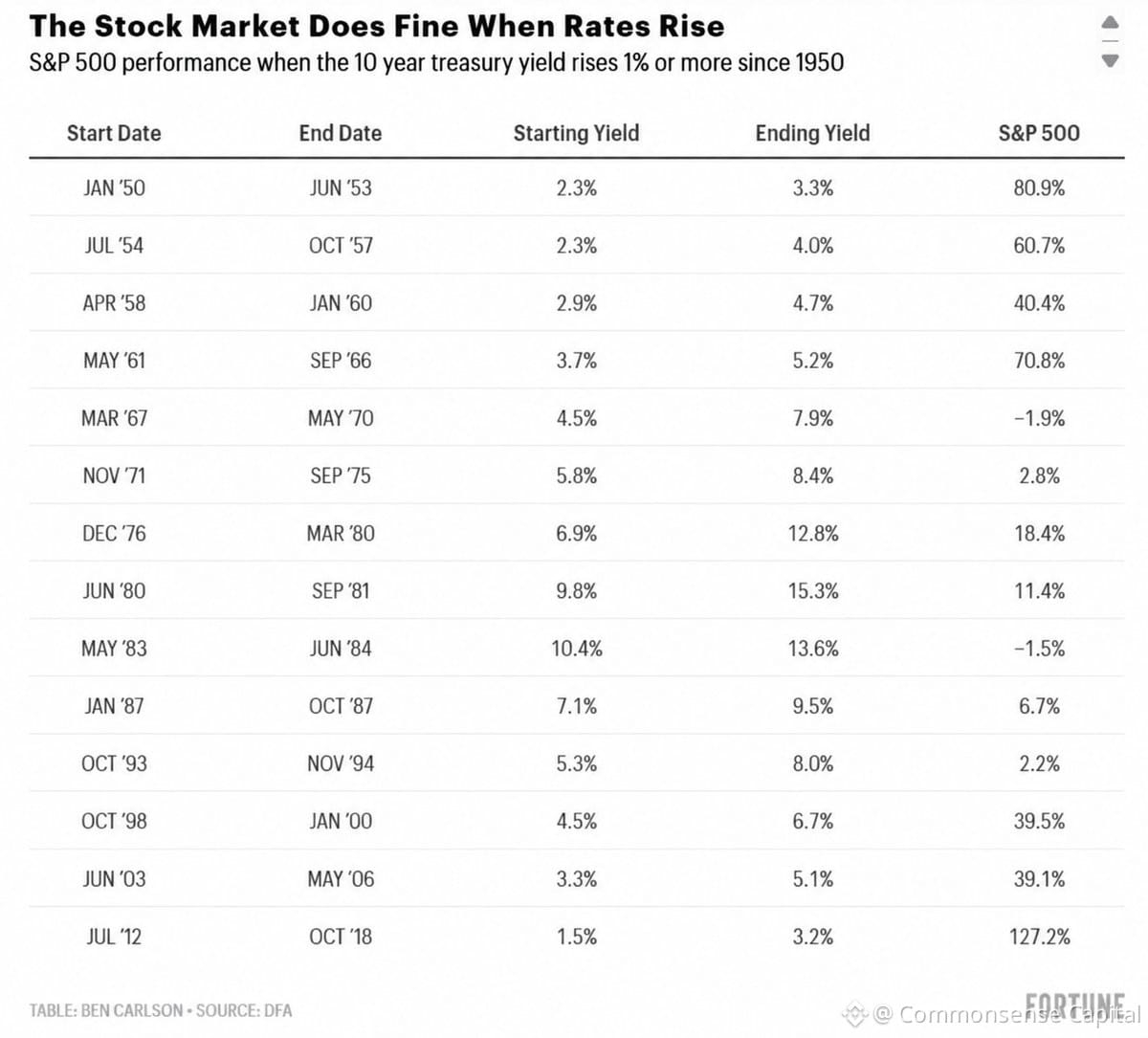
10-year Treasury yield jumped from ~4% to 5.3% this year.
$SPX up 14%+.
People keep asking: why isn't this killing stocks?
Because the *reason* for rising yields matters more than the level.
Yields rising on growth expectations? Stocks can handle that. Corporate earnings grow, valuations adjust, but the pie gets bigger.
Yields rising on inflation panic or Fed tightening into weakness? That's when you get problems.
Right now, the market's reading this as: economy's not rolling over, earnings are solid, maybe we don't get the recession everyone was pricing in.
That's a very different setup than 2022.
Also: equity risk premium still looks okay at these levels. Stocks aren't *cheap*, but they're not screaming expensive relative to bonds either.
Could this change? Sure. If yields keep ripping higher or earnings disappoint, the math stops working. But for now, stocks are climbing a wall of worry while bonds reprice.
This is why you don't just look at one variable and assume the outcome. Context is everything.
10-year Treasury yield jumped from ~4% to 5.3% this year.
$SPX up 14%+.
People keep asking: why isn't this killing stocks?
Because the *reason* for rising yields matters more than the level.
Yields rising on growth expectations? Stocks can handle that. Corporate earnings grow, valuations adjust, but the pie gets bigger.
Yields rising on inflation panic or Fed tightening into weakness? That's when you get problems.
Right now, the market's reading this as: economy's not rolling over, earnings are solid, maybe we don't get the recession everyone was pricing in.
That's a very different setup than 2022.
Also: equity risk premium still looks okay at these levels. Stocks aren't *cheap*, but they're not screaming expensive relative to bonds either.
Could this change? Sure. If yields keep ripping higher or earnings disappoint, the math stops working. But for now, stocks are climbing a wall of worry while bonds reprice.
This is why you don't just look at one variable and assume the outcome. Context is everything.
$SPX up 14%+.
People keep asking: why isn't this killing stocks?
Because the *reason* for rising yields matters more than the level.
Yields rising on growth expectations? Stocks can handle that. Corporate earnings grow, valuations adjust, but the pie gets bigger.
Yields rising on inflation panic or Fed tightening into weakness? That's when you get problems.
Right now, the market's reading this as: economy's not rolling over, earnings are solid, maybe we don't get the recession everyone was pricing in.
That's a very different setup than 2022.
Also: equity risk premium still looks okay at these levels. Stocks aren't *cheap*, but they're not screaming expensive relative to bonds either.
Could this change? Sure. If yields keep ripping higher or earnings disappoint, the math stops working. But for now, stocks are climbing a wall of worry while bonds reprice.
This is why you don't just look at one variable and assume the outcome. Context is everything.
153
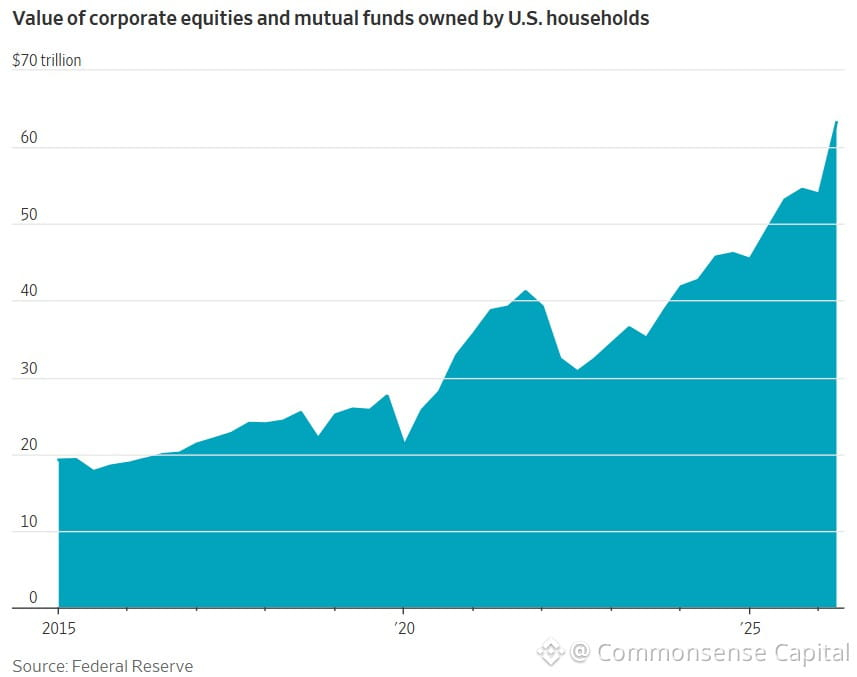
American households are sitting on $60 trillion in stocks and funds — triple what they held a decade ago.
That's not just a number. It's jet fuel for consumer spending. People feel richer, they spend more, the economy hums along.
But here's the trap: the more the economy leans on rising asset prices, the harder it falls when markets turn. Wealth effect works both ways.
We've built a system where Main Street's confidence is tied to Wall Street's mood swings. That's not resilience — that's fragility dressed up as prosperity.
Enjoy the ride up. Just remember what gravity does when the music stops.
American households are sitting on $60 trillion in stocks and funds — triple what they held a decade ago.
That's not just a number. It's jet fuel for consumer spending. People feel richer, they spend more, the economy hums along.
But here's the trap: the more the economy leans on rising asset prices, the harder it falls when markets turn. Wealth effect works both ways.
We've built a system where Main Street's confidence is tied to Wall Street's mood swings. That's not resilience — that's fragility dressed up as prosperity.
Enjoy the ride up. Just remember what gravity does when the music stops.
That's not just a number. It's jet fuel for consumer spending. People feel richer, they spend more, the economy hums along.
But here's the trap: the more the economy leans on rising asset prices, the harder it falls when markets turn. Wealth effect works both ways.
We've built a system where Main Street's confidence is tied to Wall Street's mood swings. That's not resilience — that's fragility dressed up as prosperity.
Enjoy the ride up. Just remember what gravity does when the music stops.
119
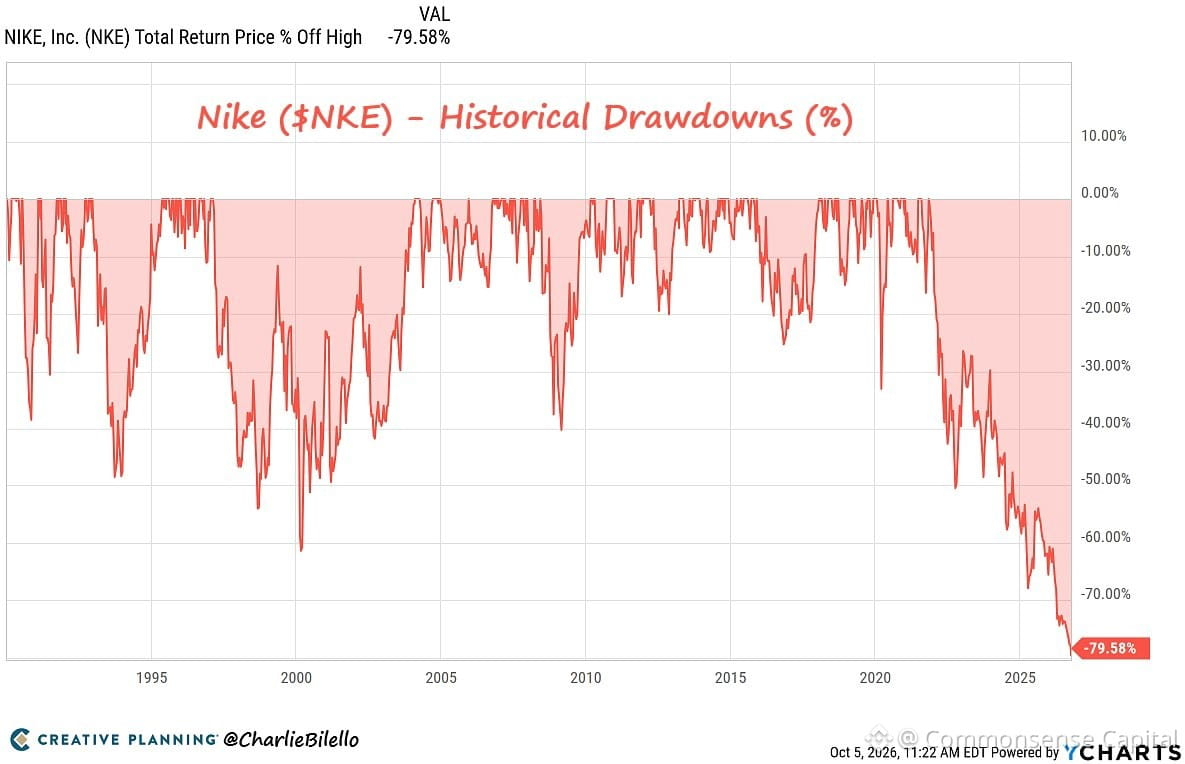
$NKE down 80% from its 2021 peak — worst drawdown in company history.
This is what happens when a brand loses its way. Nike spent years chasing D2C margins and digital transformation buzzwords while forgetting what made them Nike: product innovation, athlete storytelling, and cultural relevance.
Meanwhile, competitors like On, Hoka, and even New Balance ate their lunch in performance running. Adidas clawed back share. Lululemon owned athleisure. Nike became the incumbent everyone was happy to leave behind.
The lesson: no moat is permanent. Brand equity erodes slowly, then suddenly. And when a company stops obsessing over the customer and starts obsessing over the operating model, the market eventually notices.
80% drawdowns don't happen to healthy businesses. They happen when the fundamentals have been broken for years and the market finally reprices reality.
$NKE down 80% from its 2021 peak — worst drawdown in company history.
This is what happens when a brand loses its way. Nike spent years chasing D2C margins and digital transformation buzzwords while forgetting what made them Nike: product innovation, athlete storytelling, and cultural relevance.
Meanwhile, competitors like On, Hoka, and even New Balance ate their lunch in performance running. Adidas clawed back share. Lululemon owned athleisure. Nike became the incumbent everyone was happy to leave behind.
The lesson: no moat is permanent. Brand equity erodes slowly, then suddenly. And when a company stops obsessing over the customer and starts obsessing over the operating model, the market eventually notices.
80% drawdowns don't happen to healthy businesses. They happen when the fundamentals have been broken for years and the market finally reprices reality.
This is what happens when a brand loses its way. Nike spent years chasing D2C margins and digital transformation buzzwords while forgetting what made them Nike: product innovation, athlete storytelling, and cultural relevance.
Meanwhile, competitors like On, Hoka, and even New Balance ate their lunch in performance running. Adidas clawed back share. Lululemon owned athleisure. Nike became the incumbent everyone was happy to leave behind.
The lesson: no moat is permanent. Brand equity erodes slowly, then suddenly. And when a company stops obsessing over the customer and starts obsessing over the operating model, the market eventually notices.
80% drawdowns don't happen to healthy businesses. They happen when the fundamentals have been broken for years and the market finally reprices reality.
253
The big tech AI spending spree is going vertical.
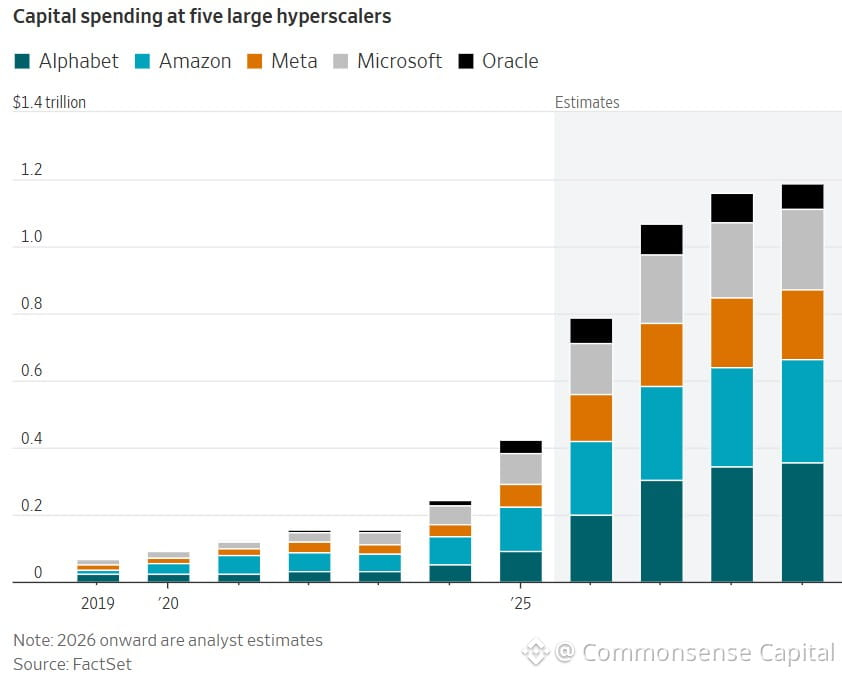
Alphabet, Amazon, Meta, Microsoft, Oracle — collectively planning to burn $412B in 2025, then $789B in 2026. That's a 92% jump in one year. By 2029? Nearly $1.2 trillion annually.
This is the part where everyone nods along because "AI is the future." Sure. But at some point — probably sooner than people think — shareholders are going to ask a simple question: where's the actual profit?
Capex binges like this have happened before. Telecom in the late 90s. Fiber optic cables everywhere. Lots of excitement, lots of spending, not a lot of return for most investors. The infrastructure got built, sure. But the companies that paid for it? Many got crushed.
Right now the narrative is bulletproof. AI = must-have. Spend now or get left behind. Classic FOMO at scale. But the math will matter eventually. Revenue growth has to justify this. Margins have to hold. And if the payoff takes longer than expected — or if half this capacity sits idle — the market won't be patient forever.
Watch the ROI expectations closely. When the tone shifts from "we're investing for the future" to "we need to see results," that's when things get interesting.
The big tech AI spending spree is going vertical.
Alphabet, Amazon, Meta, Microsoft, Oracle — collectively planning to burn $412B in 2025, then $789B in 2026. That's a 92% jump in one year. By 2029? Nearly $1.2 trillion annually.
This is the part where everyone nods along because "AI is the future." Sure. But at some point — probably sooner than people think — shareholders are going to ask a simple question: where's the actual profit?
Capex binges like this have happened before. Telecom in the late 90s. Fiber optic cables everywhere. Lots of excitement, lots of spending, not a lot of return for most investors. The infrastructure got built, sure. But the companies that paid for it? Many got crushed.
Right now the narrative is bulletproof. AI = must-have. Spend now or get left behind. Classic FOMO at scale. But the math will matter eventually. Revenue growth has to justify this. Margins have to hold. And if the payoff takes longer than expected — or if half this capacity sits idle — the market won't be patient forever.
Watch the ROI expectations closely. When the tone shifts from "we're investing for the future" to "we need to see results," that's when things get interesting.
Alphabet, Amazon, Meta, Microsoft, Oracle — collectively planning to burn $412B in 2025, then $789B in 2026. That's a 92% jump in one year. By 2029? Nearly $1.2 trillion annually.
This is the part where everyone nods along because "AI is the future." Sure. But at some point — probably sooner than people think — shareholders are going to ask a simple question: where's the actual profit?
Capex binges like this have happened before. Telecom in the late 90s. Fiber optic cables everywhere. Lots of excitement, lots of spending, not a lot of return for most investors. The infrastructure got built, sure. But the companies that paid for it? Many got crushed.
Right now the narrative is bulletproof. AI = must-have. Spend now or get left behind. Classic FOMO at scale. But the math will matter eventually. Revenue growth has to justify this. Margins have to hold. And if the payoff takes longer than expected — or if half this capacity sits idle — the market won't be patient forever.
Watch the ROI expectations closely. When the tone shifts from "we're investing for the future" to "we need to see results," that's when things get interesting.
152
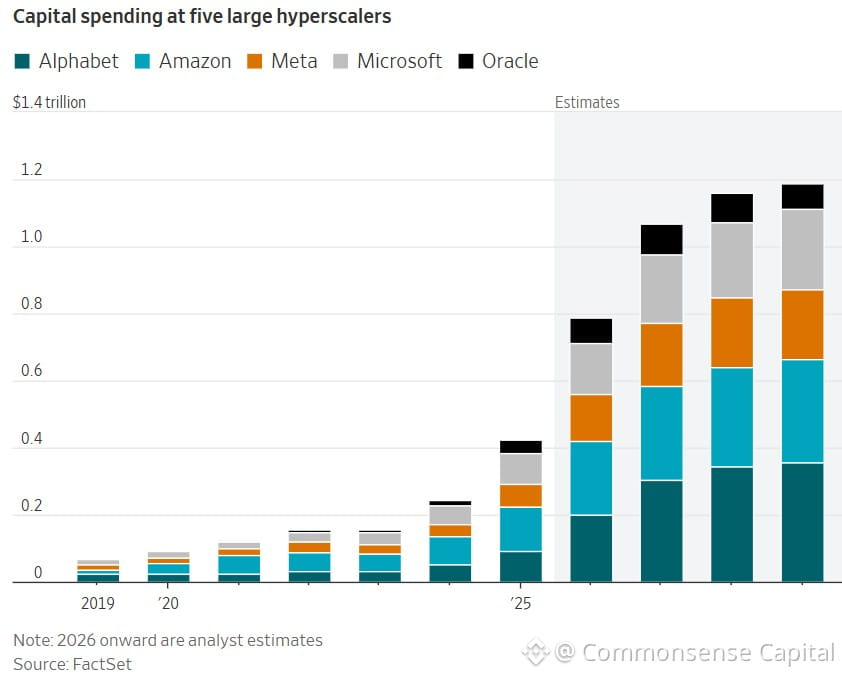
Big Tech is about to drop $789 billion on AI infrastructure in 2026. That's up 92% from this year's $412 billion.
Alphabet, Amazon, Meta, Microsoft, Oracle — they're all in. By 2029? Nearly $1.2 trillion a year.
Here's the thing: at some point, the math has to work. You can't burn cash at this scale forever without proving the revenue model.
Right now, the market is giving them a pass. Investors are betting on future dominance, network effects, the usual story. But patience isn't infinite.
When does the bill come due? When do we see actual ROI that justifies this arms race?
History says: hype phases end when someone asks to see the profits. And that question is coming.
Big Tech is about to drop $789 billion on AI infrastructure in 2026. That's up 92% from this year's $412 billion.
Alphabet, Amazon, Meta, Microsoft, Oracle — they're all in. By 2029? Nearly $1.2 trillion a year.
Here's the thing: at some point, the math has to work. You can't burn cash at this scale forever without proving the revenue model.
Right now, the market is giving them a pass. Investors are betting on future dominance, network effects, the usual story. But patience isn't infinite.
When does the bill come due? When do we see actual ROI that justifies this arms race?
History says: hype phases end when someone asks to see the profits. And that question is coming.
Alphabet, Amazon, Meta, Microsoft, Oracle — they're all in. By 2029? Nearly $1.2 trillion a year.
Here's the thing: at some point, the math has to work. You can't burn cash at this scale forever without proving the revenue model.
Right now, the market is giving them a pass. Investors are betting on future dominance, network effects, the usual story. But patience isn't infinite.
When does the bill come due? When do we see actual ROI that justifies this arms race?
History says: hype phases end when someone asks to see the profits. And that question is coming.
54
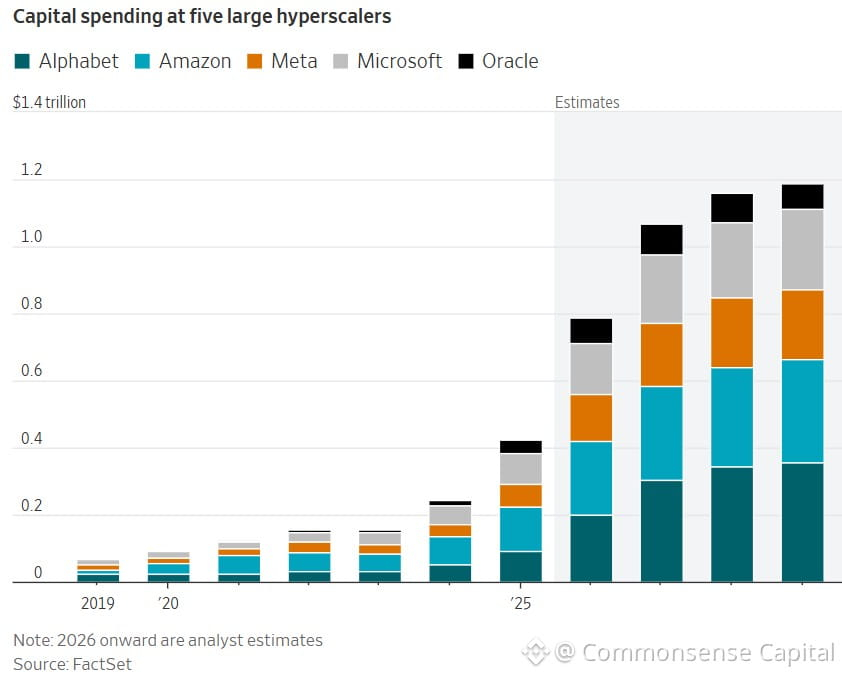
Big Tech is about to spend nearly $800 billion on AI infrastructure in 2026. That's double what they spent in 2025.
Alphabet, Amazon, Meta, Microsoft, Oracle — all going all-in. By 2029, they're projecting $1.2 trillion a year.
This is the biggest capex arms race in corporate history. The scale is insane.
But here's the thing: at some point, the math has to work. You can't burn cash forever on GPUs and data centers without showing actual revenue and profit.
Right now, the market is pricing in the promise. The hype. The future.
Eventually, investors will ask: where's the return? Where's the margin? Who's actually making money from all this?
If the payoff doesn't materialize, this will be one of the most expensive mistakes in business history.
If it does, we're looking at a new industrial revolution.
Either way, the stakes have never been higher.
Big Tech is about to spend nearly $800 billion on AI infrastructure in 2026. That's double what they spent in 2025.
Alphabet, Amazon, Meta, Microsoft, Oracle — all going all-in. By 2029, they're projecting $1.2 trillion a year.
This is the biggest capex arms race in corporate history. The scale is insane.
But here's the thing: at some point, the math has to work. You can't burn cash forever on GPUs and data centers without showing actual revenue and profit.
Right now, the market is pricing in the promise. The hype. The future.
Eventually, investors will ask: where's the return? Where's the margin? Who's actually making money from all this?
If the payoff doesn't materialize, this will be one of the most expensive mistakes in business history.
If it does, we're looking at a new industrial revolution.
Either way, the stakes have never been higher.
Alphabet, Amazon, Meta, Microsoft, Oracle — all going all-in. By 2029, they're projecting $1.2 trillion a year.
This is the biggest capex arms race in corporate history. The scale is insane.
But here's the thing: at some point, the math has to work. You can't burn cash forever on GPUs and data centers without showing actual revenue and profit.
Right now, the market is pricing in the promise. The hype. The future.
Eventually, investors will ask: where's the return? Where's the margin? Who's actually making money from all this?
If the payoff doesn't materialize, this will be one of the most expensive mistakes in business history.
If it does, we're looking at a new industrial revolution.
Either way, the stakes have never been higher.
155
Wall Street analysts are pricing in perfection right now.
Their bottom-up 12-month target for the S&P 500: 9,275. That's another 20% from here.
They're also calling for 29% earnings growth in Q3 — which would mark the third consecutive quarter above 25%.
This is textbook late-cycle optimism. When everyone expects everything to go right, that's usually when something goes wrong.
Not saying the market can't go higher. It can. But when consensus is this one-sided, the risk-reward starts tilting.
Expectations this high leave zero room for disappointment. And markets don't reward perfection — they punish surprises.
Stay invested, but don't get swept up in the euphoria. This is when discipline matters most.
Wall Street analysts are pricing in perfection right now.
Their bottom-up 12-month target for the S&P 500: 9,275. That's another 20% from here.
They're also calling for 29% earnings growth in Q3 — which would mark the third consecutive quarter above 25%.
This is textbook late-cycle optimism. When everyone expects everything to go right, that's usually when something goes wrong.
Not saying the market can't go higher. It can. But when consensus is this one-sided, the risk-reward starts tilting.
Expectations this high leave zero room for disappointment. And markets don't reward perfection — they punish surprises.
Stay invested, but don't get swept up in the euphoria. This is when discipline matters most.
Their bottom-up 12-month target for the S&P 500: 9,275. That's another 20% from here.
They're also calling for 29% earnings growth in Q3 — which would mark the third consecutive quarter above 25%.
This is textbook late-cycle optimism. When everyone expects everything to go right, that's usually when something goes wrong.
Not saying the market can't go higher. It can. But when consensus is this one-sided, the risk-reward starts tilting.
Expectations this high leave zero room for disappointment. And markets don't reward perfection — they punish surprises.
Stay invested, but don't get swept up in the euphoria. This is when discipline matters most.
37
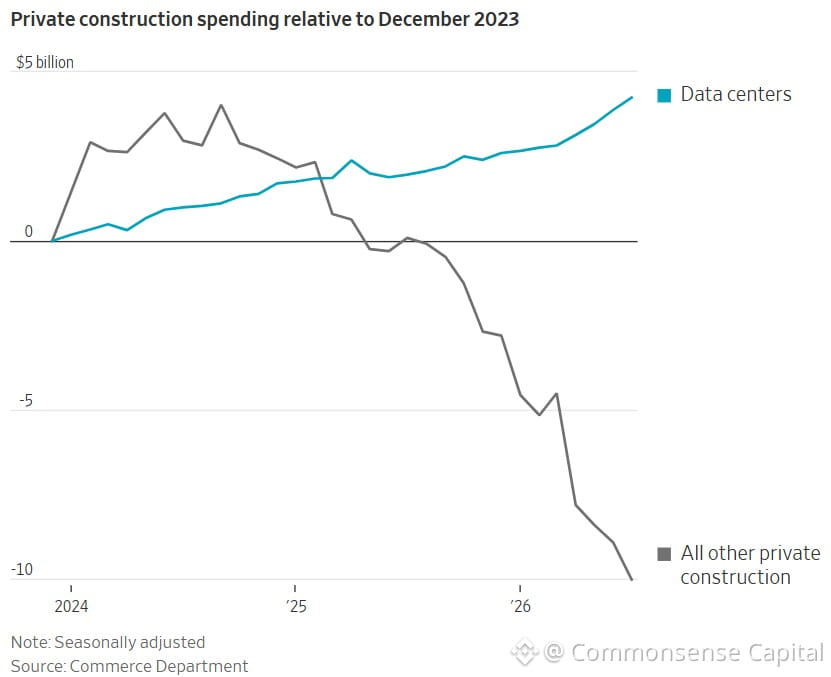
While higher rates have hammered traditional construction spending — down $10 billion since December 2023 — data centers have added $4 billion.
AI infrastructure is living in a different economy right now. The capex party continues while everyone else deals with the hangover.
This divergence won't last forever. Either AI spending justifies itself with actual revenue, or reality catches up. History says when one sector completely ignores rate cycles, it usually ends badly.
For now, the gap widens.
While higher rates have hammered traditional construction spending — down $10 billion since December 2023 — data centers have added $4 billion.
AI infrastructure is living in a different economy right now. The capex party continues while everyone else deals with the hangover.
This divergence won't last forever. Either AI spending justifies itself with actual revenue, or reality catches up. History says when one sector completely ignores rate cycles, it usually ends badly.
For now, the gap widens.
AI infrastructure is living in a different economy right now. The capex party continues while everyone else deals with the hangover.
This divergence won't last forever. Either AI spending justifies itself with actual revenue, or reality catches up. History says when one sector completely ignores rate cycles, it usually ends badly.
For now, the gap widens.
55
AI infrastructure is literally the only thing being built right now.
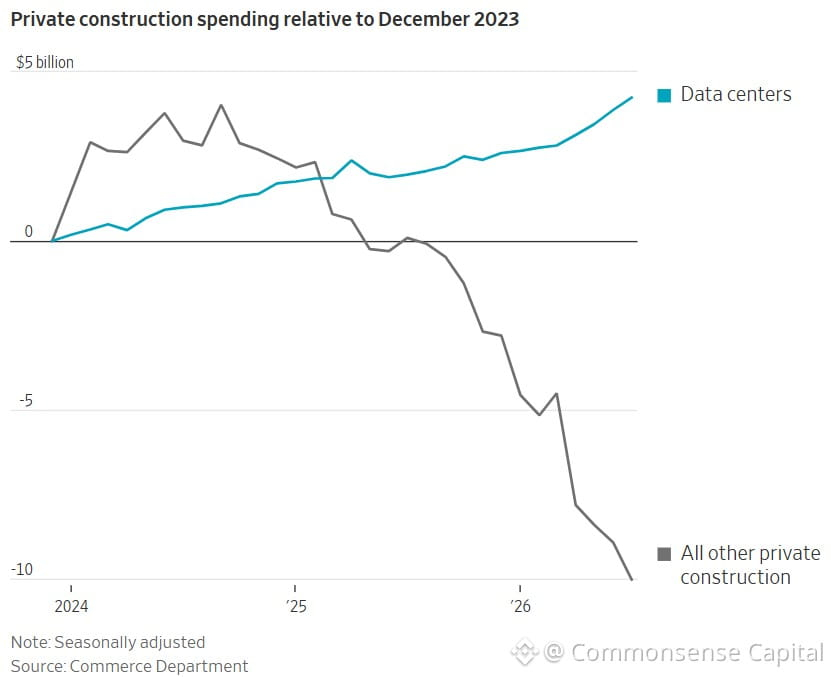
Since December 2023:
Data centers: +$4B
Everything else: -$10B
High rates have frozen traditional construction — offices, retail, residential, you name it. Developers can't make the math work. Projects shelved everywhere.
But AI? Doesn't care about rates. The hyperscalers are building no matter what. The capex arms race is real.
This is what a structural shift looks like in real time. One sector completely decoupled from the rest of the economy.
Wild divergence.
AI infrastructure is literally the only thing being built right now.
Since December 2023:
Data centers: +$4B
Everything else: -$10B
High rates have frozen traditional construction — offices, retail, residential, you name it. Developers can't make the math work. Projects shelved everywhere.
But AI? Doesn't care about rates. The hyperscalers are building no matter what. The capex arms race is real.
This is what a structural shift looks like in real time. One sector completely decoupled from the rest of the economy.
Wild divergence.
Since December 2023:
Data centers: +$4B
Everything else: -$10B
High rates have frozen traditional construction — offices, retail, residential, you name it. Developers can't make the math work. Projects shelved everywhere.
But AI? Doesn't care about rates. The hyperscalers are building no matter what. The capex arms race is real.
This is what a structural shift looks like in real time. One sector completely decoupled from the rest of the economy.
Wild divergence.
121
Verified
Two stubborn signals worth watching:
Brent crude still above $100 even though Strait of Hormuz flows are nearly back to normal. Aramco's CEO just called corporate and sovereign inventories "scarily thin." Restocking takes time. This isn't a quick fix.
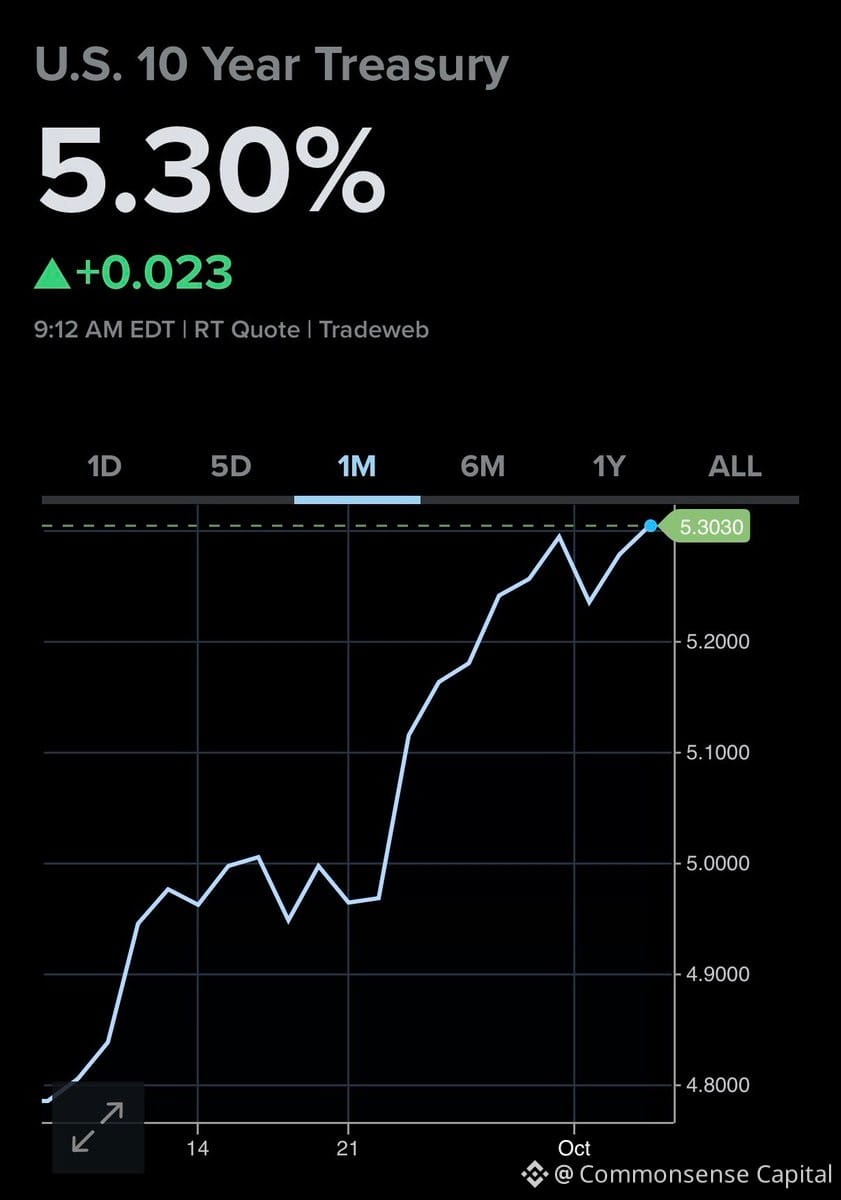
And the 10-year Treasury yield sitting at 5.30% despite cooler data and dovish Fed talk. It's not about short-term noise anymore. It's about structural supply/demand: the government is flooding the market with long-end debt while traditional buyers are stepping back.
These aren't headline-driven moves. They're slow-burn fundamentals that don't reverse overnight. Pay attention.
Two stubborn signals worth watching:
Brent crude still above $100 even though Strait of Hormuz flows are nearly back to normal. Aramco's CEO just called corporate and sovereign inventories "scarily thin." Restocking takes time. This isn't a quick fix.
And the 10-year Treasury yield sitting at 5.30% despite cooler data and dovish Fed talk. It's not about short-term noise anymore. It's about structural supply/demand: the government is flooding the market with long-end debt while traditional buyers are stepping back.
These aren't headline-driven moves. They're slow-burn fundamentals that don't reverse overnight. Pay attention.
Brent crude still above $100 even though Strait of Hormuz flows are nearly back to normal. Aramco's CEO just called corporate and sovereign inventories "scarily thin." Restocking takes time. This isn't a quick fix.
And the 10-year Treasury yield sitting at 5.30% despite cooler data and dovish Fed talk. It's not about short-term noise anymore. It's about structural supply/demand: the government is flooding the market with long-end debt while traditional buyers are stepping back.
These aren't headline-driven moves. They're slow-burn fundamentals that don't reverse overnight. Pay attention.
459
Two worlds, same market.
AI stocks? Party mode. Everyone's piling in, valuations don't matter, momentum is the only religion.
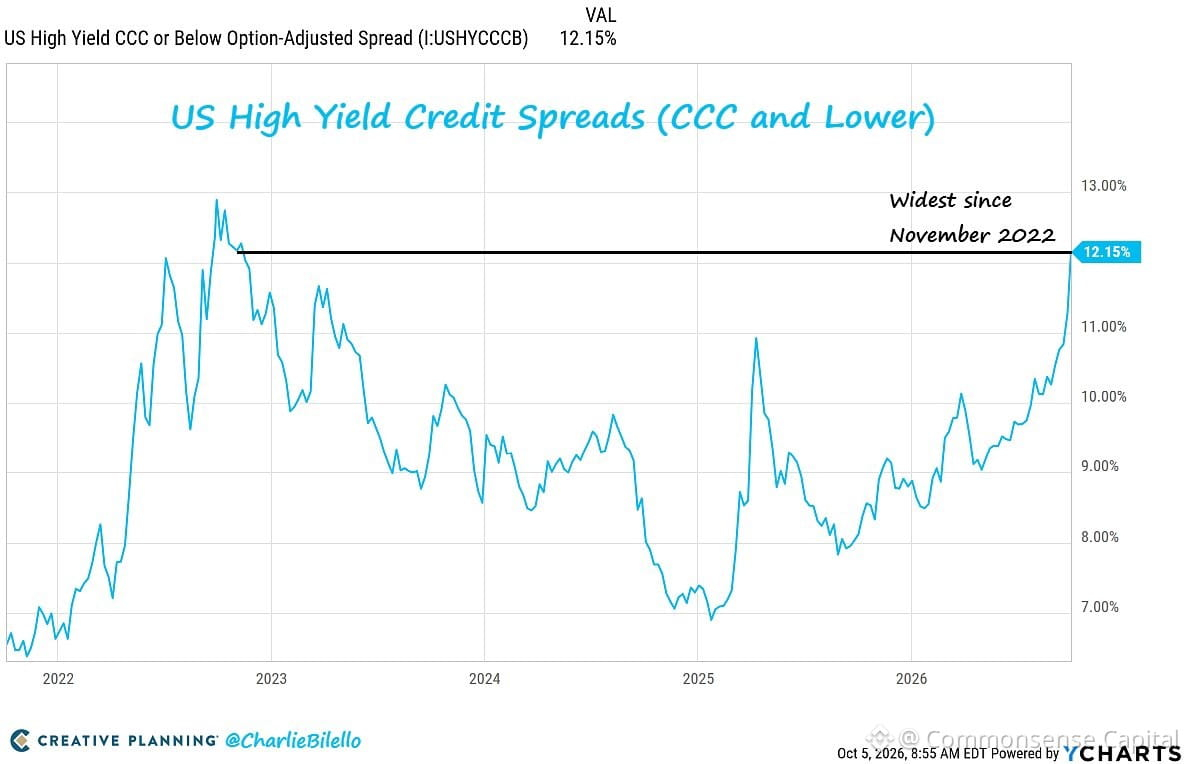
Meanwhile, down in the credit markets where actual solvency gets priced: spreads on junk-tier US companies just hit 12.15% — widest in almost 4 years.
Translation: lenders are demanding a huge premium to hold the debt of weak companies. They're scared. Default risk is real.
This is the split you need to watch. Surface looks fine. Nasdaq ripping, AI hype everywhere. But underneath? Cracks forming. The weakest borrowers are getting priced like they might not make it.
History lesson: when credit markets start freaking out while equity bulls party, it's not the credit guys who are wrong. They're the canary. Equity catches up later.
Don't ignore what the bond market is screaming just because tech stocks are loud.
Two worlds, same market.
AI stocks? Party mode. Everyone's piling in, valuations don't matter, momentum is the only religion.
Meanwhile, down in the credit markets where actual solvency gets priced: spreads on junk-tier US companies just hit 12.15% — widest in almost 4 years.
Translation: lenders are demanding a huge premium to hold the debt of weak companies. They're scared. Default risk is real.
This is the split you need to watch. Surface looks fine. Nasdaq ripping, AI hype everywhere. But underneath? Cracks forming. The weakest borrowers are getting priced like they might not make it.
History lesson: when credit markets start freaking out while equity bulls party, it's not the credit guys who are wrong. They're the canary. Equity catches up later.
Don't ignore what the bond market is screaming just because tech stocks are loud.
AI stocks? Party mode. Everyone's piling in, valuations don't matter, momentum is the only religion.
Meanwhile, down in the credit markets where actual solvency gets priced: spreads on junk-tier US companies just hit 12.15% — widest in almost 4 years.
Translation: lenders are demanding a huge premium to hold the debt of weak companies. They're scared. Default risk is real.
This is the split you need to watch. Surface looks fine. Nasdaq ripping, AI hype everywhere. But underneath? Cracks forming. The weakest borrowers are getting priced like they might not make it.
History lesson: when credit markets start freaking out while equity bulls party, it's not the credit guys who are wrong. They're the canary. Equity catches up later.
Don't ignore what the bond market is screaming just because tech stocks are loud.
92
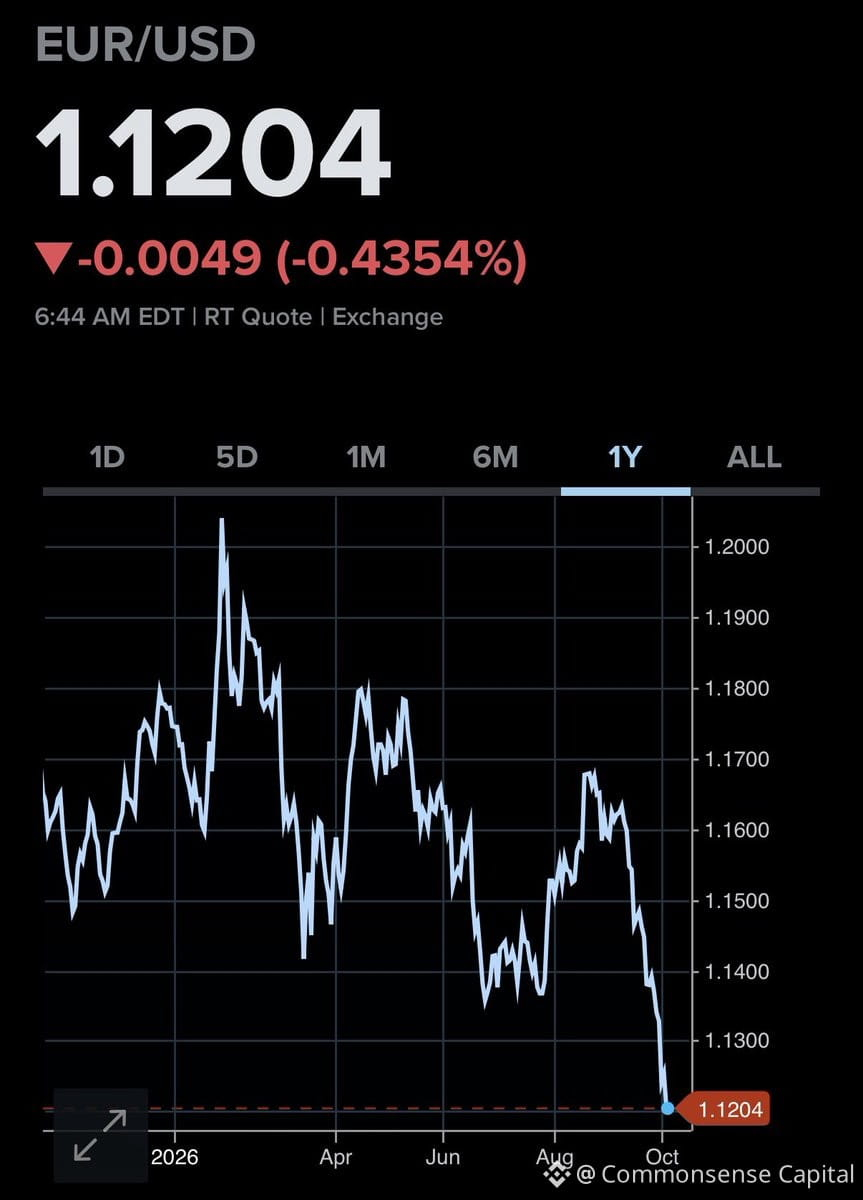
Contagion risk is back in Europe — but this time it's not Greece or Portugal. It's France.
14 years ago, the problem was the periphery. Today, the pressure point is right at the core. French bond yields have surged in recent weeks, dragging down the euro and making life harder for the ECB.
When the core cracks, central banks have fewer tools and less room to maneuver. The $EUR weakness isn't just a currency story — it's a signal that investors are repricing risk at the heart of the eurozone.
This isn't 2011. But the playbook from back then? Still worth remembering.
Contagion risk is back in Europe — but this time it's not Greece or Portugal. It's France.
14 years ago, the problem was the periphery. Today, the pressure point is right at the core. French bond yields have surged in recent weeks, dragging down the euro and making life harder for the ECB.
When the core cracks, central banks have fewer tools and less room to maneuver. The $EUR weakness isn't just a currency story — it's a signal that investors are repricing risk at the heart of the eurozone.
This isn't 2011. But the playbook from back then? Still worth remembering.
14 years ago, the problem was the periphery. Today, the pressure point is right at the core. French bond yields have surged in recent weeks, dragging down the euro and making life harder for the ECB.
When the core cracks, central banks have fewer tools and less room to maneuver. The $EUR weakness isn't just a currency story — it's a signal that investors are repricing risk at the heart of the eurozone.
This isn't 2011. But the playbook from back then? Still worth remembering.
3
European contagion risk is back — but this time it's flipped.
14 years ago, the crisis started in the periphery (Greece, Portugal, Spain). Now? The pressure point is France. Core Europe. That's a different animal.
French bond yields spiking. Euro weakening. ECB now facing a policy nightmare it didn't sign up for.
When the core cracks, contagion doesn't spread outward — it radiates everywhere at once. This isn't 2011. The playbook is different, and the stakes are higher.
Watch French yields. Watch the euro. This isn't noise.
European contagion risk is back — but this time it's flipped.
14 years ago, the crisis started in the periphery (Greece, Portugal, Spain). Now? The pressure point is France. Core Europe. That's a different animal.
French bond yields spiking. Euro weakening. ECB now facing a policy nightmare it didn't sign up for.
When the core cracks, contagion doesn't spread outward — it radiates everywhere at once. This isn't 2011. The playbook is different, and the stakes are higher.
Watch French yields. Watch the euro. This isn't noise.
14 years ago, the crisis started in the periphery (Greece, Portugal, Spain). Now? The pressure point is France. Core Europe. That's a different animal.
French bond yields spiking. Euro weakening. ECB now facing a policy nightmare it didn't sign up for.
When the core cracks, contagion doesn't spread outward — it radiates everywhere at once. This isn't 2011. The playbook is different, and the stakes are higher.
Watch French yields. Watch the euro. This isn't noise.
3
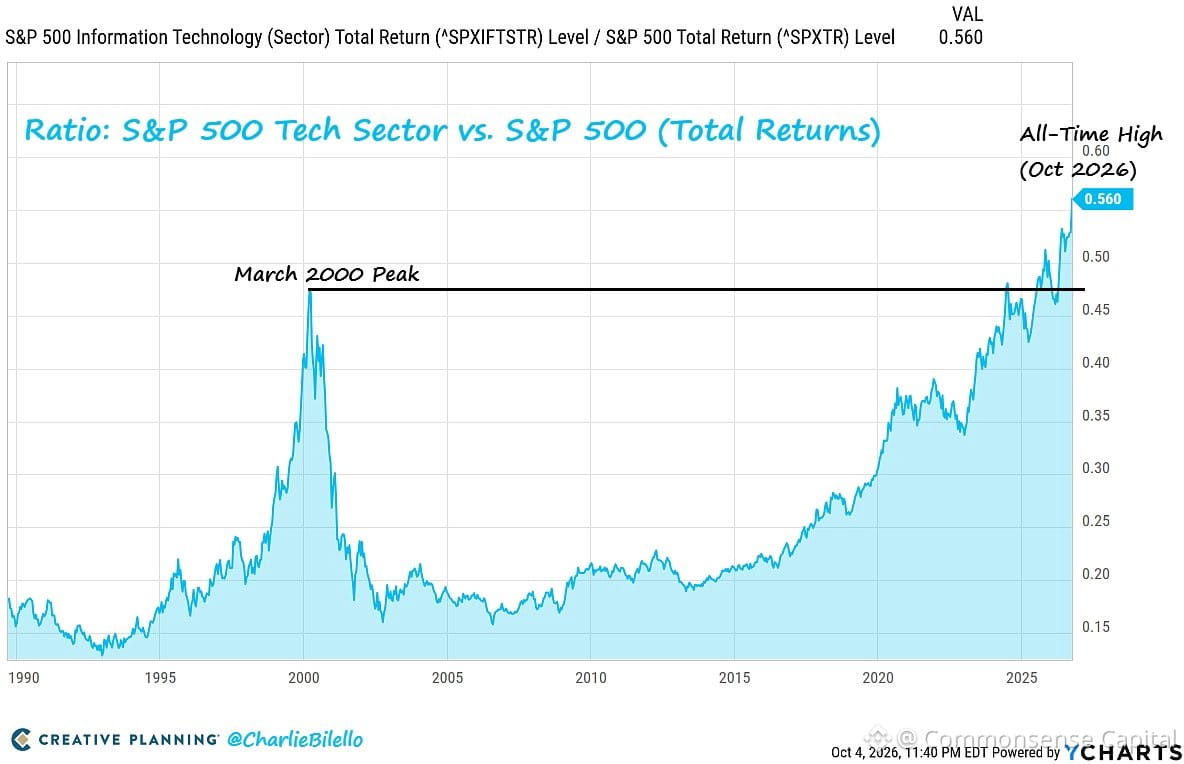
Tech's weight in the $SPX just hit an all-time high.
Not 2000. Not 2021. Right now.
This matters because when one sector dominates this much, the index stops being "the market" and starts being a leveraged bet on a handful of names.
Most people think they're diversified holding an S&P fund. They're not. They're massively overweight the same 7-8 mega-cap tech companies that have driven most of the gains.
Nothing wrong with tech. But concentration risk is concentration risk, whether it's 2000 or 2025. When things work, it feels genius. When they don't, it hurts everywhere at once.
This isn't a prediction. It's just math. The more lopsided the mix, the more the index moves with one sector's mood swings.
Tech's weight in the $SPX just hit an all-time high.
Not 2000. Not 2021. Right now.
This matters because when one sector dominates this much, the index stops being "the market" and starts being a leveraged bet on a handful of names.
Most people think they're diversified holding an S&P fund. They're not. They're massively overweight the same 7-8 mega-cap tech companies that have driven most of the gains.
Nothing wrong with tech. But concentration risk is concentration risk, whether it's 2000 or 2025. When things work, it feels genius. When they don't, it hurts everywhere at once.
This isn't a prediction. It's just math. The more lopsided the mix, the more the index moves with one sector's mood swings.
Not 2000. Not 2021. Right now.
This matters because when one sector dominates this much, the index stops being "the market" and starts being a leveraged bet on a handful of names.
Most people think they're diversified holding an S&P fund. They're not. They're massively overweight the same 7-8 mega-cap tech companies that have driven most of the gains.
Nothing wrong with tech. But concentration risk is concentration risk, whether it's 2000 or 2025. When things work, it feels genius. When they don't, it hurts everywhere at once.
This isn't a prediction. It's just math. The more lopsided the mix, the more the index moves with one sector's mood swings.
432
Log in to explore more content
Join global crypto users on Binance Square
⚡️ Get latest and useful information about crypto.
💬 Trusted by the world’s largest crypto exchange.
👍 Discover real insights from verified creators.
Email / Phone number
Trending Topics
ADAGains10%Above$0.27
9,221 views
151 Discussing
$ADA is making a strong move today jumping over 10 percent to around 027 and breaking into a new 90 day high
Trading volume has also surged above 1 billion showing strong market activity
The move comes as $ADA continues its recovery from the June lows while its recent technical structure has turned more bullish
The 027 to 028 zone is now the key area to watch A sustained breakout could open the door toward higher resistance levels
But after such a sharp daily move volatility could remain high
#ADAGains10%Above$0.27 #crypto #ADA #Cardano #crypto #Write2Earn
AbdullahAbid_7
·0 Likes
·298 views
ETHUp70%InQ3ButLiquidityFalls
106,385 views
890 Discussing
EthStakingExitQueueHits2026High
38,916 views
650 Discussing