

舍利子- Chocbears
17.5k Posts

舍利子- Chocbears
Report
Block User
Holder, occasional trader, market observer with a skeptical bias. BP-019227A55D19
Open Trade
Frequent Trader
5.6 Years
2.4K+ Following
249 Followers
157 Liked
Posts
Portfolio
All
Quotes
My vision for Binance Intelligence: make finance easier to understand and easier to act on — turning complex market data into clear insights, so we can see what matters, spot opportunities, and make smarter decisions instead of just following the noise. @Binance_Square_Official
My vision for Binance Intelligence: make finance easier to understand and easier to act on — turning complex market data into clear insights, so we can see what matters, spot opportunities, and make smarter decisions instead of just following the noise. @Binance Square Official


Binance Square Official
·
--
Introducing a new layer of intelligence for everything finance.
Join the Binance Intelligence launch livestream for an early look at what we've been building.
🗓 Oct 5 | 12:00 UTC
📍 Binance Square Official
Repost this post and tag @Binance Square Official to share your vision for Binance Intelligence for a chance to be one of 5 winners selected for a 20 USDC reward.
Join the Binance Intelligence launch livestream for an early look at what we've been building.
🗓 Oct 5 | 12:00 UTC
📍 Binance Square Official
Repost this post and tag @Binance Square Official to share your vision for Binance Intelligence for a chance to be one of 5 winners selected for a 20 USDC reward.
68
🚀 Getting started with bPay on BNB Chain!
bPay is building an easy entry point for seamless Web3 payments into the BSC ecosystem. Complete the verification steps and explore the latest community reward campaign!
📌 Official Details: • CA: 0xb13003bf44de426dd2a3aae3df9c3400de0a7777 • Code: BP-019227A55D19
🔗 Verification Portal: https://bpays.fun/claim
#Bpay #bpaysfun #Airdrops_free
🚀 Getting started with bPay on BNB Chain!
bPay is building an easy entry point for seamless Web3 payments into the BSC ecosystem. Complete the verification steps and explore the latest community reward campaign!
📌 Official Details: • CA: 0xb13003bf44de426dd2a3aae3df9c3400de0a7777 • Code: BP-019227A55D19
🔗 Verification Portal: https://bpays.fun/claim
#Bpay #bpaysfun #Airdrops_free
bPay is building an easy entry point for seamless Web3 payments into the BSC ecosystem. Complete the verification steps and explore the latest community reward campaign!
📌 Official Details: • CA: 0xb13003bf44de426dd2a3aae3df9c3400de0a7777 • Code: BP-019227A55D19
🔗 Verification Portal: https://bpays.fun/claim
#Bpay #bpaysfun #Airdrops_free
1

First gold. Then stocks. Now real estate.
What happens when everything becomes a token?
Tether is expanding deeper into the RWA space through Hadron, supporting the tokenization of institutional-grade real estate assets in Saudi Arabia.
But real estate may only be the beginning.
The same infrastructure could later be used for energy projects, infrastructure financing, and other strategic real-world assets.
Tether is no longer building only around stablecoins. It is building the infrastructure to bring traditional assets onchain.
The future of tokenization may be much bigger than crypto itself
#RWA
$USDT
First gold. Then stocks. Now real estate.
What happens when everything becomes a token?
Tether is expanding deeper into the RWA space through Hadron, supporting the tokenization of institutional-grade real estate assets in Saudi Arabia.
But real estate may only be the beginning.
The same infrastructure could later be used for energy projects, infrastructure financing, and other strategic real-world assets.
Tether is no longer building only around stablecoins. It is building the infrastructure to bring traditional assets onchain.
The future of tokenization may be much bigger than crypto itself
#RWA
$USDT
What happens when everything becomes a token?
Tether is expanding deeper into the RWA space through Hadron, supporting the tokenization of institutional-grade real estate assets in Saudi Arabia.
But real estate may only be the beginning.
The same infrastructure could later be used for energy projects, infrastructure financing, and other strategic real-world assets.
Tether is no longer building only around stablecoins. It is building the infrastructure to bring traditional assets onchain.
The future of tokenization may be much bigger than crypto itself
#RWA
$USDT

1
71
Exchange or self-custody—which is actually safer? 🔐
CZ argues that exchanges may be statistically safer, pointing to more Bitcoin being lost through self-custody than through exchange failures.
Willy Woo disagrees. He still prefers multisig self-custody, believing it is more resilient than relying on either an exchange or a single seed phrase.
Both sides carry different risks:
Exchanges can be hacked, frozen, or fail.
Self-custody can be lost forever through one human mistake.
Personally, I keep most of my crypto on exchanges because I don’t like seeing my money sit idle. 😂 But I also understand why long-term holders prefer full control.
Which risk would you rather manage: trusting an exchange or trusting yourself?
$BNB $BTC
Exchange or self-custody—which is actually safer? 🔐
CZ argues that exchanges may be statistically safer, pointing to more Bitcoin being lost through self-custody than through exchange failures.
Willy Woo disagrees. He still prefers multisig self-custody, believing it is more resilient than relying on either an exchange or a single seed phrase.
Both sides carry different risks:
Exchanges can be hacked, frozen, or fail.
Self-custody can be lost forever through one human mistake.
Personally, I keep most of my crypto on exchanges because I don’t like seeing my money sit idle. 😂 But I also understand why long-term holders prefer full control.
Which risk would you rather manage: trusting an exchange or trusting yourself?
$BNB $BTC
CZ argues that exchanges may be statistically safer, pointing to more Bitcoin being lost through self-custody than through exchange failures.
Willy Woo disagrees. He still prefers multisig self-custody, believing it is more resilient than relying on either an exchange or a single seed phrase.
Both sides carry different risks:
Exchanges can be hacked, frozen, or fail.
Self-custody can be lost forever through one human mistake.
Personally, I keep most of my crypto on exchanges because I don’t like seeing my money sit idle. 😂 But I also understand why long-term holders prefer full control.
Which risk would you rather manage: trusting an exchange or trusting yourself?
$BNB $BTC

93
I found 9 nines! 👀✨
A fun challenge to celebrate an amazing milestone. Happy 9th Anniversary, Binance! 🚀
#ShineForBinance9
I found 9 nines! 👀✨
A fun challenge to celebrate an amazing milestone. Happy 9th Anniversary, Binance! 🚀
#ShineForBinance9
A fun challenge to celebrate an amazing milestone. Happy 9th Anniversary, Binance! 🚀
#ShineForBinance9


Sunshine 🔶
·
--
𝐃𝐚𝐲 𝟗 𝐂𝐡𝐚𝐥𝐥𝐞𝐧𝐠𝐞: 𝐇𝐨𝐰 𝐌𝐚𝐧𝐲 𝟗𝐬 𝐂𝐚𝐧 𝐘𝐨𝐮 𝐅𝐢𝐧𝐝? 🔍
𝐌𝐞𝐜𝐡𝐚𝐧𝐢𝐜𝐬:
1️⃣ Count how many number 9s you can see in the photo.
2️⃣ Share your answer in the comments with #ShineForBinance9 and RT/share my challenge post.
3️⃣ Make sure to follow the full mechanics and fill out the form to complete your entry.
Form link here
Complete the challenge for a chance to win #Binance swag! 🎁
𝐌𝐞𝐜𝐡𝐚𝐧𝐢𝐜𝐬:
1️⃣ Count how many number 9s you can see in the photo.
2️⃣ Share your answer in the comments with #ShineForBinance9 and RT/share my challenge post.
3️⃣ Make sure to follow the full mechanics and fill out the form to complete your entry.
Form link here
Complete the challenge for a chance to win #Binance swag! 🎁
8
My 9 is ready to launch
🚀🌞
Happy 9th Anniversary Binance! 💛
Keep building, keep shining!
#ShineForBinance9
My 9 is ready to launch
🚀🌞
Happy 9th Anniversary Binance! 💛
Keep building, keep shining!
#ShineForBinance9
🚀🌞
Happy 9th Anniversary Binance! 💛
Keep building, keep shining!
#ShineForBinance9

Sunshine 🔶
·
--
𝐃𝐚𝐲 𝟖 𝐂𝐡𝐚𝐥𝐥𝐞𝐧𝐠𝐞: 𝐌𝐚𝐤𝐞 𝐭𝐡𝐞 𝟗 𝐒𝐡𝐢𝐧𝐞! 🎨
Turn the 9 into Art.
𝐌𝐞𝐜𝐡𝐚𝐧𝐢𝐜𝐬:
1️⃣ Use the provided photo as your template. Turn the number 9 into your own creative anniversary design and add a special message for Binance.
2️⃣ Share your finished design in the comments with #ShineForBinance9 and RT/share my challenge post.
3️⃣ Make sure to follow the full mechanics and fill out the form to complete your entry.
Form link here
Make the 9 shine for a chance to get #Binance swag! 🎁
Turn the 9 into Art.
𝐌𝐞𝐜𝐡𝐚𝐧𝐢𝐜𝐬:
1️⃣ Use the provided photo as your template. Turn the number 9 into your own creative anniversary design and add a special message for Binance.
2️⃣ Share your finished design in the comments with #ShineForBinance9 and RT/share my challenge post.
3️⃣ Make sure to follow the full mechanics and fill out the form to complete your entry.
Form link here
Make the 9 shine for a chance to get #Binance swag! 🎁
92
Sunshine 🔶
·
--
𝐃𝐚𝐲 𝟑 𝐂𝐡𝐚𝐥𝐥𝐞𝐧𝐠𝐞: 𝐃𝐞𝐜𝐨𝐝𝐞 𝐭𝐡𝐞 𝐄𝐦𝐨𝐣𝐢, 𝐆𝐮𝐞𝐬𝐬 𝐭𝐡𝐞 𝐂𝐫𝐲𝐩𝐭𝐨 𝐖𝐨𝐫𝐝! 🕵️♀️
𝗠𝗲𝗰𝗵𝗮𝗻𝗶𝗰𝘀:
1️⃣ Take the challenge 👇
Crack the code here
2️⃣ Comment #ShineForBinance9 on my challenge posts.
3️⃣ RT/share the challenge post.
Make sure to follow the full mechanics.
Get a chance to receive exclusive #Binance swag!
𝗠𝗲𝗰𝗵𝗮𝗻𝗶𝗰𝘀:
1️⃣ Take the challenge 👇
Crack the code here
2️⃣ Comment #ShineForBinance9 on my challenge posts.
3️⃣ RT/share the challenge post.
Make sure to follow the full mechanics.
Get a chance to receive exclusive #Binance swag!
25
Done! Curious to see if I caught the right word 👀 #ShineForBinance9
Done! Curious to see if I caught the right word 👀 #ShineForBinance9
Sunshine 🔶
·
--
𝗗𝗮𝘆 𝟭 𝗖𝗵𝗮𝗹𝗹𝗲𝗻𝗴𝗲 𝗶𝘀 𝗵𝗲𝗿𝗲: 𝗖𝗮𝘁𝗰𝗵 𝘁𝗵𝗲 𝗪𝗼𝗿𝗱 𝗖𝗵𝗮𝗹𝗹𝗲𝗻𝗴𝗲 ⚡
𝗠𝗲𝗰𝗵𝗮𝗻𝗶𝗰𝘀:
Take the challenge and make sure to follow the mechanics 👇
Join here!
#ShineForBinance9
Goodluck! 💛
𝗠𝗲𝗰𝗵𝗮𝗻𝗶𝗰𝘀:
Take the challenge and make sure to follow the mechanics 👇
Join here!
#ShineForBinance9
Goodluck! 💛
8
Verified
If you were starting from zero today, would you still go into US stocks and ETFs immediately —
or spend more time learning first, even if it meant missing out on years of market experience?
Looking back, I sometimes feel I entered investing before I fully understood what I was doing.
I opened a brokerage account and bought my first stocks mostly based on broker recommendations. After that, I started reading market news, buying investing books, and learning from more experienced investors along the way.
The experience taught me a lot, but it also led to mistakes and losses that better preparation might have helped me avoid.
If you could start over, would you prioritize learning first or getting real market experience as early as possible?
#MyStocksQuestions
If you were starting from zero today, would you still go into US stocks and ETFs immediately —
or spend more time learning first, even if it meant missing out on years of market experience?
Looking back, I sometimes feel I entered investing before I fully understood what I was doing.
I opened a brokerage account and bought my first stocks mostly based on broker recommendations. After that, I started reading market news, buying investing books, and learning from more experienced investors along the way.
The experience taught me a lot, but it also led to mistakes and losses that better preparation might have helped me avoid.
If you could start over, would you prioritize learning first or getting real market experience as early as possible?
#MyStocksQuestions
or spend more time learning first, even if it meant missing out on years of market experience?
Looking back, I sometimes feel I entered investing before I fully understood what I was doing.
I opened a brokerage account and bought my first stocks mostly based on broker recommendations. After that, I started reading market news, buying investing books, and learning from more experienced investors along the way.
The experience taught me a lot, but it also led to mistakes and losses that better preparation might have helped me avoid.
If you could start over, would you prioritize learning first or getting real market experience as early as possible?
#MyStocksQuestions

20
4
540
I’ve been loosely following US stocks for about a while now, mostly just looking at big names and headlines rather than actively tracking prices.
My approach is very simple — I usually react to news like revenue growth or strong company performance.
What I’m still unsure about is whether this kind of approach actually works in the long run, or if I’m missing something about how people really invest over time.
Do you think most investors stick with stock picking, or eventually move toward ETFs for consistency?
#MyStocksQuestion
I’ve been loosely following US stocks for about a while now, mostly just looking at big names and headlines rather than actively tracking prices.
My approach is very simple — I usually react to news like revenue growth or strong company performance.
What I’m still unsure about is whether this kind of approach actually works in the long run, or if I’m missing something about how people really invest over time.
Do you think most investors stick with stock picking, or eventually move toward ETFs for consistency?
#MyStocksQuestion
My approach is very simple — I usually react to news like revenue growth or strong company performance.
What I’m still unsure about is whether this kind of approach actually works in the long run, or if I’m missing something about how people really invest over time.
Do you think most investors stick with stock picking, or eventually move toward ETFs for consistency?
#MyStocksQuestion
148
I’ve been investing in my local stock market for a while, mostly by picking individual companies, and that approach has worked reasonably well for me so far.
But now that I’m exploring US stocks through Binance, I keep noticing something interesting:
A lot of investors I talk to immediately shift their mindset from stock picking → ETFs once they enter the US market.
Not because they suddenly lose interest in individual companies, but because they feel the US market is “harder to beat.”
So I’m trying to understand this better:
Do you personally believe the preference for ETFs in US stocks comes from actual market efficiency…
or is it more about investors underestimating their ability to consistently outperform the index?
Genuinely curious how people who’ve tried both approaches think about this.
#MyStocksQuestion
I’ve been investing in my local stock market for a while, mostly by picking individual companies, and that approach has worked reasonably well for me so far.
But now that I’m exploring US stocks through Binance, I keep noticing something interesting:
A lot of investors I talk to immediately shift their mindset from stock picking → ETFs once they enter the US market.
Not because they suddenly lose interest in individual companies, but because they feel the US market is “harder to beat.”
So I’m trying to understand this better:
Do you personally believe the preference for ETFs in US stocks comes from actual market efficiency…
or is it more about investors underestimating their ability to consistently outperform the index?
Genuinely curious how people who’ve tried both approaches think about this.
#MyStocksQuestion
But now that I’m exploring US stocks through Binance, I keep noticing something interesting:
A lot of investors I talk to immediately shift their mindset from stock picking → ETFs once they enter the US market.
Not because they suddenly lose interest in individual companies, but because they feel the US market is “harder to beat.”
So I’m trying to understand this better:
Do you personally believe the preference for ETFs in US stocks comes from actual market efficiency…
or is it more about investors underestimating their ability to consistently outperform the index?
Genuinely curious how people who’ve tried both approaches think about this.
#MyStocksQuestion
6
3
200
Wall Street’s favorite chain is moving toward privacy
Ethereum keeps pushing privacy deeper into the stack while governments move in the opposite direction..
Kohaku SDK doesn’t read like a normal dev release.
It feels like Ethereum quietly betting that full transparency was never going to work at scale.
The market thinks privacy in crypto is dead.
Ethereum appears to think otherwise.
A few years ago, that narrative belonged to coins like Monero.
Now Ethereum seems to be inching into the same territory.
Wall Street’s favorite chain is moving toward privacy
Ethereum keeps pushing privacy deeper into the stack while governments move in the opposite direction..
Kohaku SDK doesn’t read like a normal dev release.
It feels like Ethereum quietly betting that full transparency was never going to work at scale.
The market thinks privacy in crypto is dead.
Ethereum appears to think otherwise.
A few years ago, that narrative belonged to coins like Monero.
Now Ethereum seems to be inching into the same territory.
Ethereum keeps pushing privacy deeper into the stack while governments move in the opposite direction..
Kohaku SDK doesn’t read like a normal dev release.
It feels like Ethereum quietly betting that full transparency was never going to work at scale.
The market thinks privacy in crypto is dead.
Ethereum appears to think otherwise.
A few years ago, that narrative belonged to coins like Monero.
Now Ethereum seems to be inching into the same territory.

184
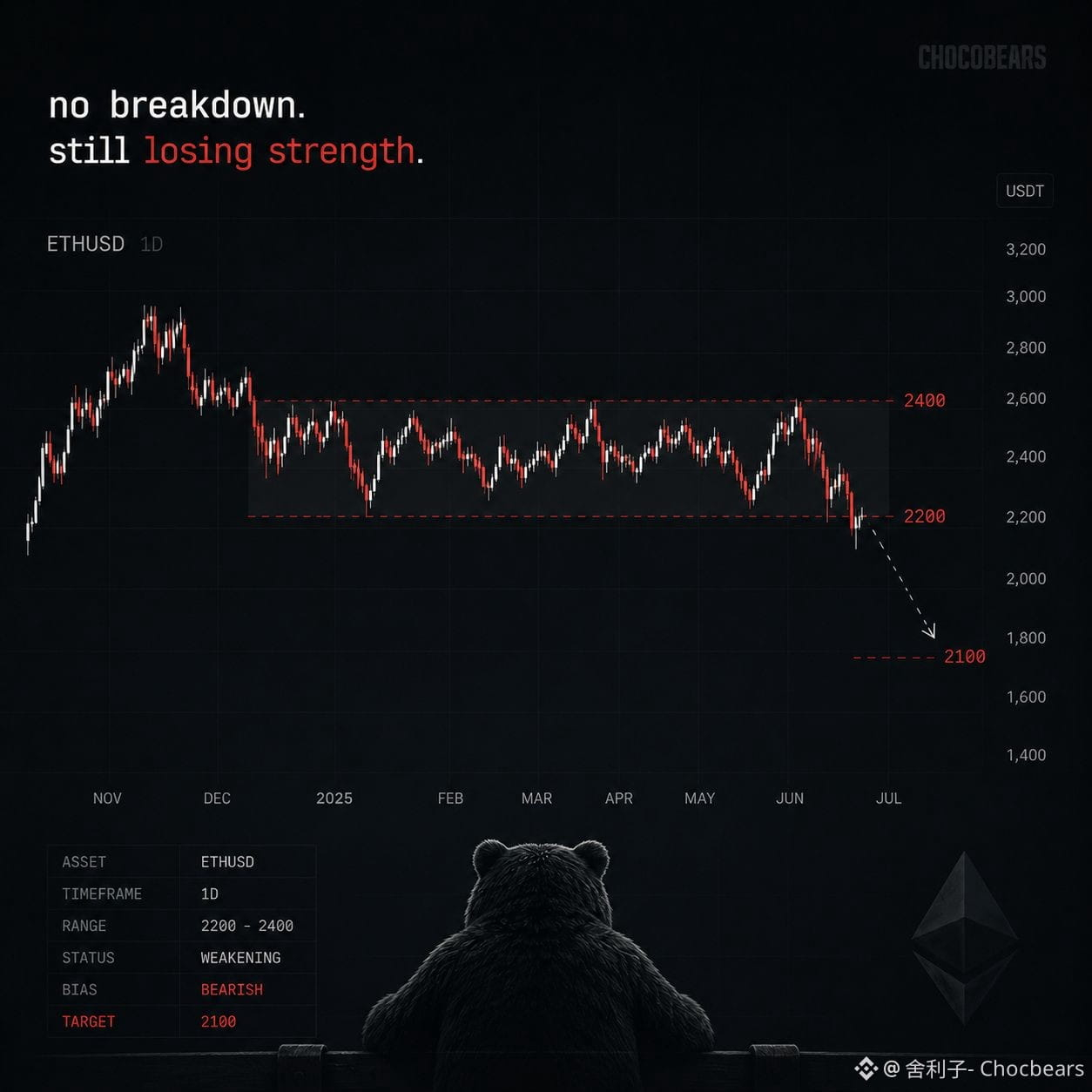
Holder ETH are running out of patience — not because they panic, but because they’ve stopped caring.
The panic selling already happened higher. What’s left is slow decay — positions held out of habit, not conviction.
ETH has been stuck between 2200–2400 so long the range stopped being neutral. It started feeling like gravity.
Now it’s sliding toward 2100, and sentiment is doing what it always does when belief fades but exposure remains — it gets noisy, defensive, and confused.
On-chain looks tired. New demand isn’t showing up. Old interest is quietly bleeding out.
Attention has moved on, and ETH didn’t even get a proper rotation story.
Nothing is breaking.
That’s the uncomfortable part — it doesn’t need to break to stop working.
Holder ETH are running out of patience — not because they panic, but because they’ve stopped caring.
The panic selling already happened higher. What’s left is slow decay — positions held out of habit, not conviction.
ETH has been stuck between 2200–2400 so long the range stopped being neutral. It started feeling like gravity.
Now it’s sliding toward 2100, and sentiment is doing what it always does when belief fades but exposure remains — it gets noisy, defensive, and confused.
On-chain looks tired. New demand isn’t showing up. Old interest is quietly bleeding out.
Attention has moved on, and ETH didn’t even get a proper rotation story.
Nothing is breaking.
That’s the uncomfortable part — it doesn’t need to break to stop working.
The panic selling already happened higher. What’s left is slow decay — positions held out of habit, not conviction.
ETH has been stuck between 2200–2400 so long the range stopped being neutral. It started feeling like gravity.
Now it’s sliding toward 2100, and sentiment is doing what it always does when belief fades but exposure remains — it gets noisy, defensive, and confused.
On-chain looks tired. New demand isn’t showing up. Old interest is quietly bleeding out.
Attention has moved on, and ETH didn’t even get a proper rotation story.
Nothing is breaking.
That’s the uncomfortable part — it doesn’t need to break to stop working.
87
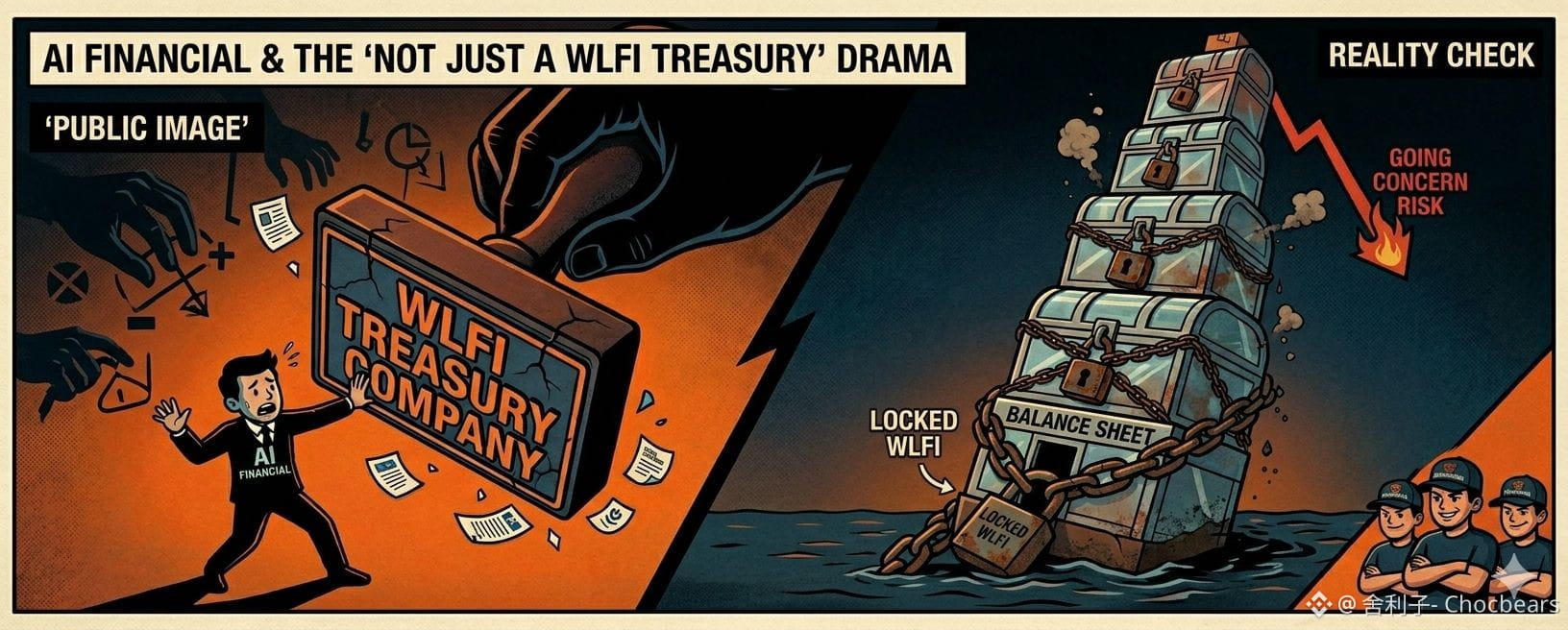
AI Financial says it’s “not just a WLFI treasury company.”
But the market is starting to ask a dangerous question:
If that’s true… why did the entire story suddenly begin revolving around WLFI?
Right now:
• operating revenue is tiny
• most of the balance sheet is locked WLFI
• going concern risk still exists
At some point, the denial itself becomes part of the narrative.
Because markets don’t care what a company calls itself.
They care what actually drives the story.
AI Financial says it’s “not just a WLFI treasury company.”
But the market is starting to ask a dangerous question:
If that’s true… why did the entire story suddenly begin revolving around WLFI?
Right now:
• operating revenue is tiny
• most of the balance sheet is locked WLFI
• going concern risk still exists
At some point, the denial itself becomes part of the narrative.
Because markets don’t care what a company calls itself.
They care what actually drives the story.
But the market is starting to ask a dangerous question:
If that’s true… why did the entire story suddenly begin revolving around WLFI?
Right now:
• operating revenue is tiny
• most of the balance sheet is locked WLFI
• going concern risk still exists
At some point, the denial itself becomes part of the narrative.
Because markets don’t care what a company calls itself.
They care what actually drives the story.
2
287
LTC: The Illusion of Immutability 🤡🔥
👾 *“They said blockchain is immutable. They said ‘Code is Law.’
Litecoin just rolled back 13 blocks after the MWEB exploit. History rewritten.
Immutable? Nah. It’s humans pulling the undo lever.
Decentralized? More like a bank database with better PR.
Keep your bags ‘decentralized’ — the exit button is controlled by someone else.”*
LTC: The Illusion of Immutability 🤡🔥
👾 *“They said blockchain is immutable. They said ‘Code is Law.’
Litecoin just rolled back 13 blocks after the MWEB exploit. History rewritten.
Immutable? Nah. It’s humans pulling the undo lever.
Decentralized? More like a bank database with better PR.
Keep your bags ‘decentralized’ — the exit button is controlled by someone else.”*
👾 *“They said blockchain is immutable. They said ‘Code is Law.’
Litecoin just rolled back 13 blocks after the MWEB exploit. History rewritten.
Immutable? Nah. It’s humans pulling the undo lever.
Decentralized? More like a bank database with better PR.
Keep your bags ‘decentralized’ — the exit button is controlled by someone else.”*

241
Sometimes the project is expendable.
The liquidity isn’t.
Since February, Binance has been quietly pushing USD1 exposure through spot, funding, and futures incentive programs.
That changes the way this WLFI conflict should be viewed.
Maybe the market is too focused on the lawsuit itself.
Because once a stablecoin starts expanding across major exchange infrastructure, protecting liquidity distribution becomes more important than protecting narratives.
In crypto, liquidity decides direction.
$WLFI
Sometimes the project is expendable.
The liquidity isn’t.
Since February, Binance has been quietly pushing USD1 exposure through spot, funding, and futures incentive programs.
That changes the way this WLFI conflict should be viewed.
Maybe the market is too focused on the lawsuit itself.
Because once a stablecoin starts expanding across major exchange infrastructure, protecting liquidity distribution becomes more important than protecting narratives.
In crypto, liquidity decides direction.
$WLFI
The liquidity isn’t.
Since February, Binance has been quietly pushing USD1 exposure through spot, funding, and futures incentive programs.
That changes the way this WLFI conflict should be viewed.
Maybe the market is too focused on the lawsuit itself.
Because once a stablecoin starts expanding across major exchange infrastructure, protecting liquidity distribution becomes more important than protecting narratives.
In crypto, liquidity decides direction.
$WLFI
216
First there was partnership.
Then airdrops.
Now lawsuits.
Justin Sun once helped push liquidity and attention toward WLFI when momentum started fading.
But in crypto, the biggest liquidity providers rarely stay “just supporters.”
Over time, liquidity becomes leverage.
And leverage eventually turns into influence over the narrative, governance, and direction of a project.
The uncomfortable part is that this isn’t unique to WLFI.
Crypto says decentralization.
But when things break, the market quickly discovers who actually holds the gravity around the ecosystem.
$TRX
First there was partnership.
Then airdrops.
Now lawsuits.
Justin Sun once helped push liquidity and attention toward WLFI when momentum started fading.
But in crypto, the biggest liquidity providers rarely stay “just supporters.”
Over time, liquidity becomes leverage.
And leverage eventually turns into influence over the narrative, governance, and direction of a project.
The uncomfortable part is that this isn’t unique to WLFI.
Crypto says decentralization.
But when things break, the market quickly discovers who actually holds the gravity around the ecosystem.
$TRX
Then airdrops.
Now lawsuits.
Justin Sun once helped push liquidity and attention toward WLFI when momentum started fading.
But in crypto, the biggest liquidity providers rarely stay “just supporters.”
Over time, liquidity becomes leverage.
And leverage eventually turns into influence over the narrative, governance, and direction of a project.
The uncomfortable part is that this isn’t unique to WLFI.
Crypto says decentralization.
But when things break, the market quickly discovers who actually holds the gravity around the ecosystem.
$TRX
229
Article
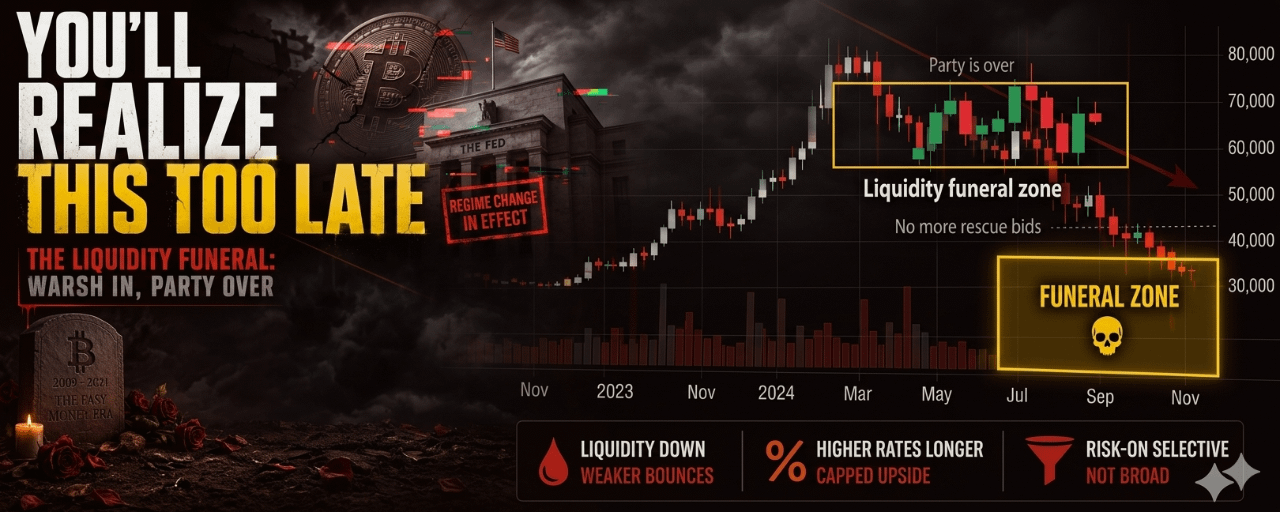
BTC STRUCTURE UPDATE: THE LIQUIDITY FUNERAL PHASE📊 BTC 1D Structure (From 29/4 onwards)
“Party is over” → distribution top near 82,850
“Liquidity funeral zone” → first breakdown from range
“No more rescue bids” → failed support recovery
“Survival mode” → post-dump sideways compression
📊 BTC CHART CONTEXT
This structure is not theoretical.
It is visible directly on the BTC 1D chart:
distribution at the top → breakdown → failed recovery → low-volatility survival phase.
The chart is the proof.
🧠 MARKET REALITY
This is not a normal correction.
This is a liquidity contraction phase inside a macro distribution cycle.
And the behavior change is now obvious:
every bounce is weaker than the previous one.
📉 WHAT IS ACTUALLY HAPPENING
Buy-side liquidity is fading
Rebounds are losing follow-through
Support levels are failing to attract demand
Price is spending more time in compression than expansion
BTC is no longer reacting like a strong risk-on asset.
⚠️ KEY STRUCTURAL SHIFT
The market is transitioning into a phase where:
liquidity, not sentiment, drives price behavior.
Dip buying is no longer consistently rewarded because liquidity is not expanding fast enough to sustain rebounds.
💣 TRADING IMPLICATION
In this environment:
“buy every dip” becomes less efficient
weak bounces trap reactive traders
momentum trades require stronger confirmation
positioning matters more than prediction
🧭 CORE MARKET QUESTION
This is no longer about calling direction.
It is about understanding structure:
Are you still treating BTC as a bounce asset…
or recognizing it as a liquidity-driven regime?
📌 STRATEGIC FOCUS
In this phase, the edge is not prediction.
The edge is identifying:
where liquidity is still active
where participation is rotating
which levels are still attracting flow
Because:
attention = liquidity
liquidity = movement
⚡ FINAL TAKEAWAY
This is not a crash phase.
This is a repricing of liquidity conditions.
And in repricing phases:
narratives lag price behavioremotional trading gets punishedpositioning becomes the only real advantage
🧭 CORE MARKET QUESTION
This is no longer about calling direction.
It is about understanding structure:
Are you still treating BTC as a bounce asset…
or recognizing it as a liquidity-driven regime?
📌 STRATEGIC FOCUS
In this phase, the edge is not prediction.
The edge is identifying:
where liquidity is still active
where participation is rotating
which levels are still attracting flow
Because:
attention = liquidity
liquidity = movement
⚡ FINAL TAKEAWAY
This is not a crash phase.
This is a repricing of liquidity conditions.
And in repricing phases:
narratives lag price behavior
emotional trading gets punished
positioning becomes the only real advantage
📍 BTC remains the core reference asset for global crypto liquidity structure.
$BTC
#bitcoin #LiquidityCrisis
BTC STRUCTURE UPDATE: THE LIQUIDITY FUNERAL PHASE
📊 BTC 1D Structure (From 29/4 onwards)
“Party is over” → distribution top near 82,850
“Liquidity funeral zone” → first breakdown from range
“No more rescue bids” → failed support recovery
“Survival mode” → post-dump sideways compression
📊 BTC CHART CONTEXT
This structure is not theoretical.
It is visible directly on the BTC 1D chart:
distribution at the top → breakdown → failed recovery → low-volatility survival phase.
The chart is the proof.
🧠 MARKET REALITY
This is not a normal correction.
This is a liquidity contraction phase inside a macro distribution cycle.
And the behavior change is now obvious:
every bounce is weaker than the previous one.
📉 WHAT IS ACTUALLY HAPPENING
Buy-side liquidity is fading
Rebounds are losing follow-through
Support levels are failing to attract demand
Price is spending more time in compression than expansion
BTC is no longer reacting like a strong risk-on asset.
⚠️ KEY STRUCTURAL SHIFT
The market is transitioning into a phase where:
liquidity, not sentiment, drives price behavior.
Dip buying is no longer consistently rewarded because liquidity is not expanding fast enough to sustain rebounds.
💣 TRADING IMPLICATION
In this environment:
“buy every dip” becomes less efficient
weak bounces trap reactive traders
momentum trades require stronger confirmation
positioning matters more than prediction
🧭 CORE MARKET QUESTION
This is no longer about calling direction.
It is about understanding structure:
Are you still treating BTC as a bounce asset…
or recognizing it as a liquidity-driven regime?
📌 STRATEGIC FOCUS
In this phase, the edge is not prediction.
The edge is identifying:
where liquidity is still active
where participation is rotating
which levels are still attracting flow
Because:
attention = liquidity
liquidity = movement
⚡ FINAL TAKEAWAY
This is not a crash phase.
This is a repricing of liquidity conditions.
And in repricing phases:
narratives lag price behavioremotional trading gets punishedpositioning becomes the only real advantage
🧭 CORE MARKET QUESTION
This is no longer about calling direction.
It is about understanding structure:
Are you still treating BTC as a bounce asset…
or recognizing it as a liquidity-driven regime?
📌 STRATEGIC FOCUS
In this phase, the edge is not prediction.
The edge is identifying:
where liquidity is still active
where participation is rotating
which levels are still attracting flow
Because:
attention = liquidity
liquidity = movement
⚡ FINAL TAKEAWAY
This is not a crash phase.
This is a repricing of liquidity conditions.
And in repricing phases:
narratives lag price behavior
emotional trading gets punished
positioning becomes the only real advantage
📍 BTC remains the core reference asset for global crypto liquidity structure.
$BTC
#bitcoin #LiquidityCrisis
“Party is over” → distribution top near 82,850
“Liquidity funeral zone” → first breakdown from range
“No more rescue bids” → failed support recovery
“Survival mode” → post-dump sideways compression
📊 BTC CHART CONTEXT
This structure is not theoretical.
It is visible directly on the BTC 1D chart:
distribution at the top → breakdown → failed recovery → low-volatility survival phase.
The chart is the proof.
🧠 MARKET REALITY
This is not a normal correction.
This is a liquidity contraction phase inside a macro distribution cycle.
And the behavior change is now obvious:
every bounce is weaker than the previous one.
📉 WHAT IS ACTUALLY HAPPENING
Buy-side liquidity is fading
Rebounds are losing follow-through
Support levels are failing to attract demand
Price is spending more time in compression than expansion
BTC is no longer reacting like a strong risk-on asset.
⚠️ KEY STRUCTURAL SHIFT
The market is transitioning into a phase where:
liquidity, not sentiment, drives price behavior.
Dip buying is no longer consistently rewarded because liquidity is not expanding fast enough to sustain rebounds.
💣 TRADING IMPLICATION
In this environment:
“buy every dip” becomes less efficient
weak bounces trap reactive traders
momentum trades require stronger confirmation
positioning matters more than prediction
🧭 CORE MARKET QUESTION
This is no longer about calling direction.
It is about understanding structure:
Are you still treating BTC as a bounce asset…
or recognizing it as a liquidity-driven regime?
📌 STRATEGIC FOCUS
In this phase, the edge is not prediction.
The edge is identifying:
where liquidity is still active
where participation is rotating
which levels are still attracting flow
Because:
attention = liquidity
liquidity = movement
⚡ FINAL TAKEAWAY
This is not a crash phase.
This is a repricing of liquidity conditions.
And in repricing phases:
narratives lag price behavioremotional trading gets punishedpositioning becomes the only real advantage
🧭 CORE MARKET QUESTION
This is no longer about calling direction.
It is about understanding structure:
Are you still treating BTC as a bounce asset…
or recognizing it as a liquidity-driven regime?
📌 STRATEGIC FOCUS
In this phase, the edge is not prediction.
The edge is identifying:
where liquidity is still active
where participation is rotating
which levels are still attracting flow
Because:
attention = liquidity
liquidity = movement
⚡ FINAL TAKEAWAY
This is not a crash phase.
This is a repricing of liquidity conditions.
And in repricing phases:
narratives lag price behavior
emotional trading gets punished
positioning becomes the only real advantage
📍 BTC remains the core reference asset for global crypto liquidity structure.
$BTC
#bitcoin #LiquidityCrisis
1
130
BINANCE TRANSITION: THE SERIES (Part 4)
Survival Over Soul: The Death of the "Ivy League" Era
Binance has officially traded its soul for survival. Richard Teng is building the "JP Morgan of Crypto": safe, compliant, and legally bulletproof. But this safety comes with a price.
The Reality:
The gatekeeper has changed. [Back then](https://app.binance.com/uni-qr/cpos/322958565488705?l=en&r=YOC4EYFB&uc=web_square_share_link&uco=4sV-HHk5I0QKP9Sr8BeO_Q&us=copylink), a Binance listing was a stamp of global quality. Today, it’s a volume game. The "Ivy League" standards have been replaced by mass listings.
The Yi He Factor:
Amidst this shift, Yi He remains the "Silent Anchor." While RT builds the corporate walls, Yi He is the one trying to keep the original "soul" alive. She is the bridge between CZ’s wild vision and RT’s cold reality. But can even the "Mother of Binance" stop the inevitable corporate-ization?
The burden of filtering is now on YOU. Don’t expect the exchange to protect you from bad projects anymore. You are the gatekeeper now.
The Market Shift:
Pro-Traders: Your capital is safer, but the "Wild West" gains are fading.
Degens: The fun is over. Move to a DEX or get used to the boredom.
The Industry: Binance has joined the "Compliance League" with
Coinbase. Adapt or get left behind.
$BTC
$BNB
{future}(BNBUSDT)
NFA | DYOR. Chocbears POV for those who dare to see the truth. 💀
Which side are you on?
Drop your thoughts below! 👇
BINANCE TRANSITION: THE SERIES (Part 4)
Survival Over Soul: The Death of the "Ivy League" Era
Binance has officially traded its soul for survival. Richard Teng is building the "JP Morgan of Crypto": safe, compliant, and legally bulletproof. But this safety comes with a price.
The Reality:
The gatekeeper has changed. Back then, a Binance listing was a stamp of global quality. Today, it’s a volume game. The "Ivy League" standards have been replaced by mass listings.
The Yi He Factor:
Amidst this shift, Yi He remains the "Silent Anchor." While RT builds the corporate walls, Yi He is the one trying to keep the original "soul" alive. She is the bridge between CZ’s wild vision and RT’s cold reality. But can even the "Mother of Binance" stop the inevitable corporate-ization?
The burden of filtering is now on YOU. Don’t expect the exchange to protect you from bad projects anymore. You are the gatekeeper now.
The Market Shift:
Pro-Traders: Your capital is safer, but the "Wild West" gains are fading.
Degens: The fun is over. Move to a DEX or get used to the boredom.
The Industry: Binance has joined the "Compliance League" with
Coinbase. Adapt or get left behind.
$BTC
$BNB
NFA | DYOR. Chocbears POV for those who dare to see the truth. 💀
Which side are you on?
Drop your thoughts below! 👇
Survival Over Soul: The Death of the "Ivy League" Era
Binance has officially traded its soul for survival. Richard Teng is building the "JP Morgan of Crypto": safe, compliant, and legally bulletproof. But this safety comes with a price.
The Reality:
The gatekeeper has changed. Back then, a Binance listing was a stamp of global quality. Today, it’s a volume game. The "Ivy League" standards have been replaced by mass listings.
The Yi He Factor:
Amidst this shift, Yi He remains the "Silent Anchor." While RT builds the corporate walls, Yi He is the one trying to keep the original "soul" alive. She is the bridge between CZ’s wild vision and RT’s cold reality. But can even the "Mother of Binance" stop the inevitable corporate-ization?
The burden of filtering is now on YOU. Don’t expect the exchange to protect you from bad projects anymore. You are the gatekeeper now.
The Market Shift:
Pro-Traders: Your capital is safer, but the "Wild West" gains are fading.
Degens: The fun is over. Move to a DEX or get used to the boredom.
The Industry: Binance has joined the "Compliance League" with
Coinbase. Adapt or get left behind.
$BTC
$BNB
NFA | DYOR. Chocbears POV for those who dare to see the truth. 💀
Which side are you on?
Drop your thoughts below! 👇
🛡️ Safe & Boring (The RT Era)
100%
🔥 Wild & Fun (The CZ Era)
0%
1 votes • Voting closed
1
301
Log in to explore more content
Join global crypto users on Binance Square
⚡️ Get latest and useful information about crypto.
💬 Trusted by the world’s largest crypto exchange.
👍 Discover real insights from verified creators.
Email / Phone number
Trending Topics
Nikkei225Jumps2.5%ToThreeMonthHigh
7,557 views
224 Discussing
#Nikkei225Jumps2.5%ToThreeMonthHigh
🚀 Nikkei 225 Jumps 2.45% to Reach a 3-Month High!
Japan’s benchmark Nikkei 225 surged impressively on Monday, closing at 69,946.86 after briefly breaking above the milestone 70,000 level for the first time in three months.
💡 What’s Driving the Surge?
AI & Semiconductor Boom: Major tech leaders like Advantest and Tokyo Electron led the charge with robust gains.
Wall Street Momentum: Positive spillover from U.S. markets boosted overall investor confidence.
Macro Shifts: Cooler-than-expected U.S. jobs data eased fears, reducing expectations of an aggressive October Fed rate hike.
📊 Market Takeaway:
This powerful rally signals a strong resurgence of investor appetite for technology and AI-driven assets. However, traders should keep a close eye on elevated bond yields as an ongoing risk factor.
Do you think the Nikkei can successfully hold above 70,000 and power toward brand-new highs? Let us know your thoughts!
#JapanStocks #StockMarket" #AIStocks #Semiconductors #Investing #Nikkei225
$EWJ
Nurul Hasnat Samir
·0 Likes
·81 views
DriftHackVictimsBeginClaims
82,879 views
919 Discussing
SolanaTokenizedStockVolumeTops$4.4BInSeptember
8,234 views
94 Discussing