

Chen Xi 晨若曦
5k Posts

Chen Xi 晨若曦
Report
Block User
热爱加密货币、区块链和Web3生态,长期关注市场趋势与潜力项目,喜欢分享真实交易经验、投资思路和行业动态,希望与更多朋友一起交流学习、共同成长 🚀✨
52 Following
54 Followers
153 Liked
Posts
·
--
Bullish
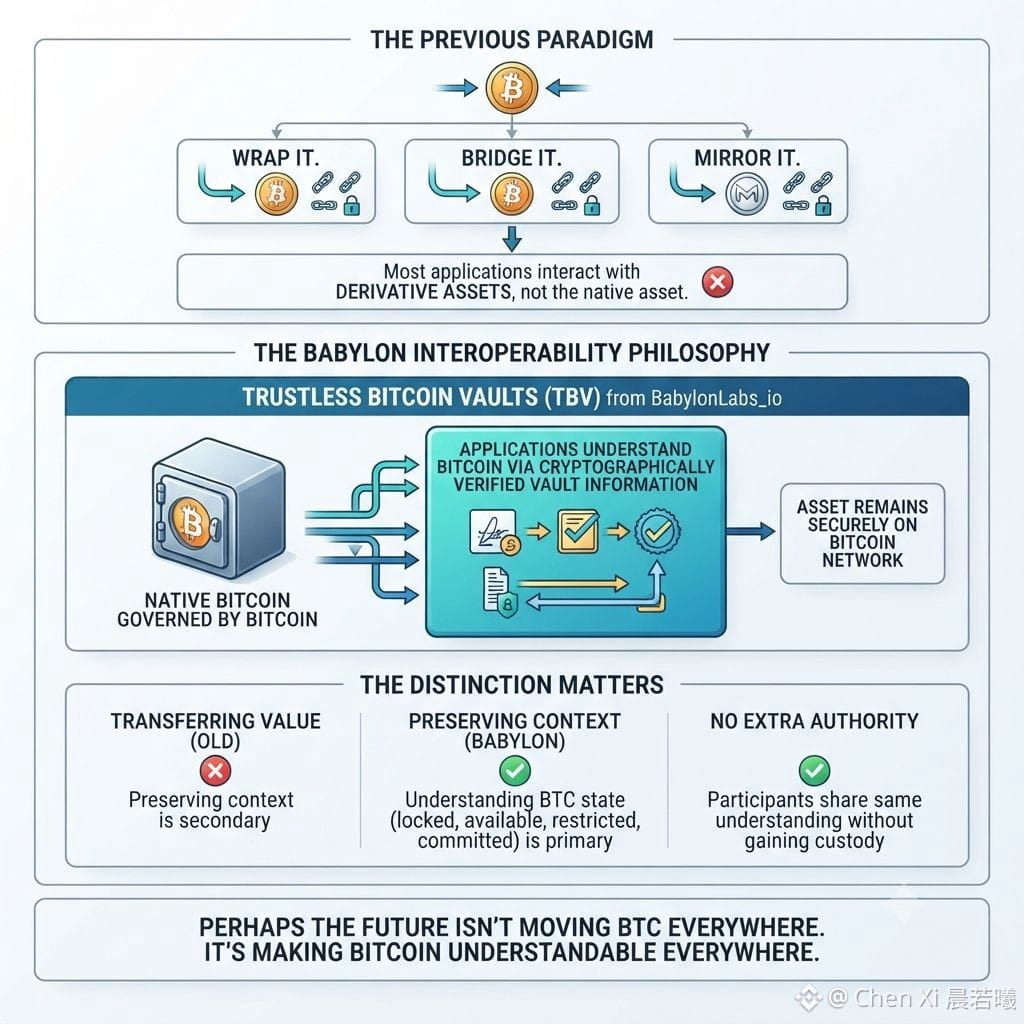
Bitcoin has spent years adapting to the rules of other ecosystems.
Wrap it. Bridge it. Mirror it.
Only then can most applications interact with it.
Trustless Bitcoin Vaults (TBV) from BabylonLabs_io propose a different philosophy.
Instead of reshaping Bitcoin to fit another network, they allow applications to understand Bitcoin through cryptographically verified vault information while the asset itself remains governed by Bitcoin.
That distinction matters.
Interoperability isn't just about transferring value from one chain to another. It's about preserving context.
If an application can't accurately determine whether BTC is locked, available, restricted, or already committed elsewhere, then moving the asset alone solves very little.
The strongest interoperability model is one where every participant shares the same understanding of Bitcoin's state—without any application gaining custody or extra authority over the asset.
That's a much higher standard than simply creating another wrapped token.
Perhaps the future of Bitcoin interoperability isn't about moving BTC everywhere.
It's about making Bitcoin understandable everywhere—without asking it to become anything else.
$BABY @babylonlabs_io #baby
{future}(BABYUSDT)
Bitcoin has spent years adapting to the rules of other ecosystems.
Wrap it. Bridge it. Mirror it.
Only then can most applications interact with it.
Trustless Bitcoin Vaults (TBV) from BabylonLabs_io propose a different philosophy.
Instead of reshaping Bitcoin to fit another network, they allow applications to understand Bitcoin through cryptographically verified vault information while the asset itself remains governed by Bitcoin.
That distinction matters.
Interoperability isn't just about transferring value from one chain to another. It's about preserving context.
If an application can't accurately determine whether BTC is locked, available, restricted, or already committed elsewhere, then moving the asset alone solves very little.
The strongest interoperability model is one where every participant shares the same understanding of Bitcoin's state—without any application gaining custody or extra authority over the asset.
That's a much higher standard than simply creating another wrapped token.
Perhaps the future of Bitcoin interoperability isn't about moving BTC everywhere.
It's about making Bitcoin understandable everywhere—without asking it to become anything else.
$BABY @BabylonLabs_io #baby
Wrap it. Bridge it. Mirror it.
Only then can most applications interact with it.
Trustless Bitcoin Vaults (TBV) from BabylonLabs_io propose a different philosophy.
Instead of reshaping Bitcoin to fit another network, they allow applications to understand Bitcoin through cryptographically verified vault information while the asset itself remains governed by Bitcoin.
That distinction matters.
Interoperability isn't just about transferring value from one chain to another. It's about preserving context.
If an application can't accurately determine whether BTC is locked, available, restricted, or already committed elsewhere, then moving the asset alone solves very little.
The strongest interoperability model is one where every participant shares the same understanding of Bitcoin's state—without any application gaining custody or extra authority over the asset.
That's a much higher standard than simply creating another wrapped token.
Perhaps the future of Bitcoin interoperability isn't about moving BTC everywhere.
It's about making Bitcoin understandable everywhere—without asking it to become anything else.
$BABY @BabylonLabs_io #baby
1
97
·
--
Bullish
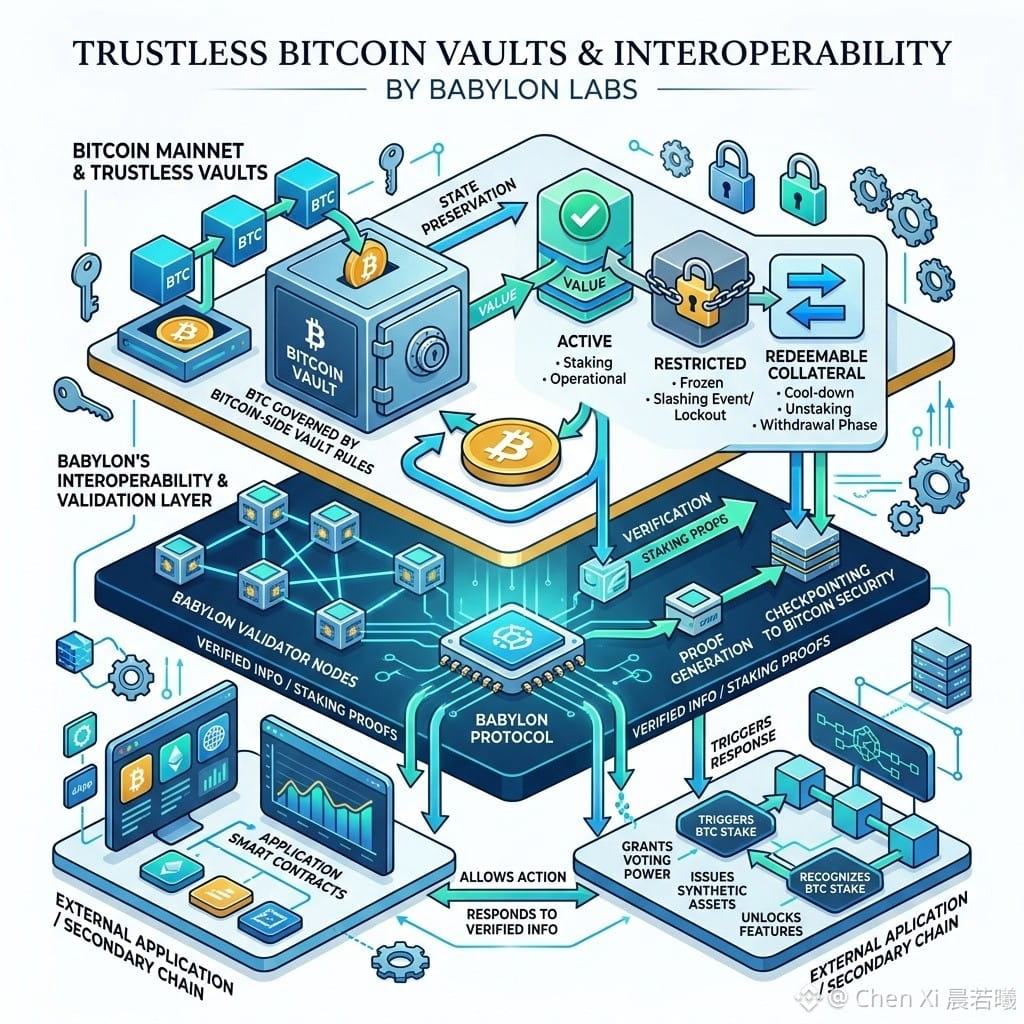
Interoperability usually asks Bitcoin to become something else before another application can understand it.
Trustless Bitcoin Vaults from BabylonLabs_io explore a different path.
Instead of turning BTC into a wrapped reprsentation, TBV can keep the asset governed by Bitcoin-side vault rules while an external application responds to verified information about that vault.
The difficult part is no longer moving Bitcoin between systems.
It is preserving the meaning of its state across them.
Can the application correctly understand whether collateral is active, restricted, redeemable, or no longer safe to rely on? And can it do that without gaining broader control over the BTC itself?
For me, that is the real interoperability test.
A native design is not succesful merely because Bitcoin stays on Bitcoin. It succeeds when another system can use the vault without misreading its permissions status, or limits.
Wrapped assets transport value.
TBV may allow applications to coordinate around Bitcoin without transforming the asset they depend on.
$BABY @babylonlabs_io #baby
{future}(BABYUSDT)
Interoperability usually asks Bitcoin to become something else before another application can understand it.
Trustless Bitcoin Vaults from BabylonLabs_io explore a different path.
Instead of turning BTC into a wrapped reprsentation, TBV can keep the asset governed by Bitcoin-side vault rules while an external application responds to verified information about that vault.
The difficult part is no longer moving Bitcoin between systems.
It is preserving the meaning of its state across them.
Can the application correctly understand whether collateral is active, restricted, redeemable, or no longer safe to rely on? And can it do that without gaining broader control over the BTC itself?
For me, that is the real interoperability test.
A native design is not succesful merely because Bitcoin stays on Bitcoin. It succeeds when another system can use the vault without misreading its permissions status, or limits.
Wrapped assets transport value.
TBV may allow applications to coordinate around Bitcoin without transforming the asset they depend on.
$BABY @BabylonLabs_io #baby
Trustless Bitcoin Vaults from BabylonLabs_io explore a different path.
Instead of turning BTC into a wrapped reprsentation, TBV can keep the asset governed by Bitcoin-side vault rules while an external application responds to verified information about that vault.
The difficult part is no longer moving Bitcoin between systems.
It is preserving the meaning of its state across them.
Can the application correctly understand whether collateral is active, restricted, redeemable, or no longer safe to rely on? And can it do that without gaining broader control over the BTC itself?
For me, that is the real interoperability test.
A native design is not succesful merely because Bitcoin stays on Bitcoin. It succeeds when another system can use the vault without misreading its permissions status, or limits.
Wrapped assets transport value.
TBV may allow applications to coordinate around Bitcoin without transforming the asset they depend on.
$BABY @BabylonLabs_io #baby
92
·
--
Bullish
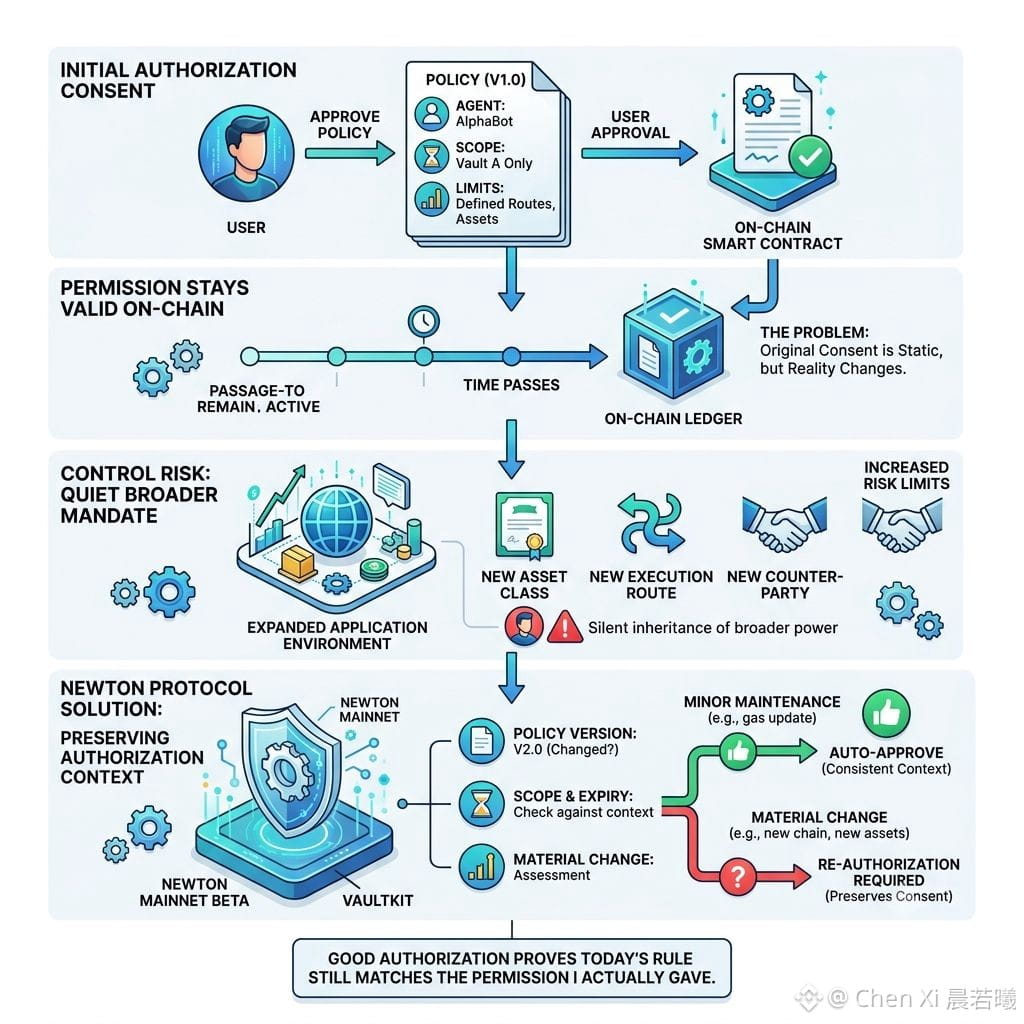
A permission can stay valid onchain after it stops matching what I agreed to.
That is the control risk I keep thinking about with NewtonProtocol.
An AI agent may be authorized to manage one vault under one policy. But if the application later adds new assets, execution routes, counterparties, or risk limits, the original consent can quietly become a much broader mandate.
For me NEWT becomes stronger when Newton Mainnet Beta and VaultKit preserve authorization context: policy version, scope, expiry, and whether the agent’s authority materially changed.
Minor maintenance should not require constant approval. But a new chain, asset class, or spending power should never be inherited silently.
That is what I’m watching with Newt.
Good authorization should prove not only that the agent folowed today’s rule, but that today’s rule still matches the permission I actually gave.
$NEWT @NewtonProtocol #Newt $LAB $VANRY #Velvet #xau #VANRY #Labs
{future}(NEWTUSDT)
A permission can stay valid onchain after it stops matching what I agreed to.
That is the control risk I keep thinking about with NewtonProtocol.
An AI agent may be authorized to manage one vault under one policy. But if the application later adds new assets, execution routes, counterparties, or risk limits, the original consent can quietly become a much broader mandate.
For me NEWT becomes stronger when Newton Mainnet Beta and VaultKit preserve authorization context: policy version, scope, expiry, and whether the agent’s authority materially changed.
Minor maintenance should not require constant approval. But a new chain, asset class, or spending power should never be inherited silently.
That is what I’m watching with Newt.
Good authorization should prove not only that the agent folowed today’s rule, but that today’s rule still matches the permission I actually gave.
$NEWT @NewtonProtocol #Newt $LAB $VANRY #Velvet #xau #VANRY #Labs
That is the control risk I keep thinking about with NewtonProtocol.
An AI agent may be authorized to manage one vault under one policy. But if the application later adds new assets, execution routes, counterparties, or risk limits, the original consent can quietly become a much broader mandate.
For me NEWT becomes stronger when Newton Mainnet Beta and VaultKit preserve authorization context: policy version, scope, expiry, and whether the agent’s authority materially changed.
Minor maintenance should not require constant approval. But a new chain, asset class, or spending power should never be inherited silently.
That is what I’m watching with Newt.
Good authorization should prove not only that the agent folowed today’s rule, but that today’s rule still matches the permission I actually gave.
$NEWT @NewtonProtocol #Newt $LAB $VANRY #Velvet #xau #VANRY #Labs
1
212
·
--
Article
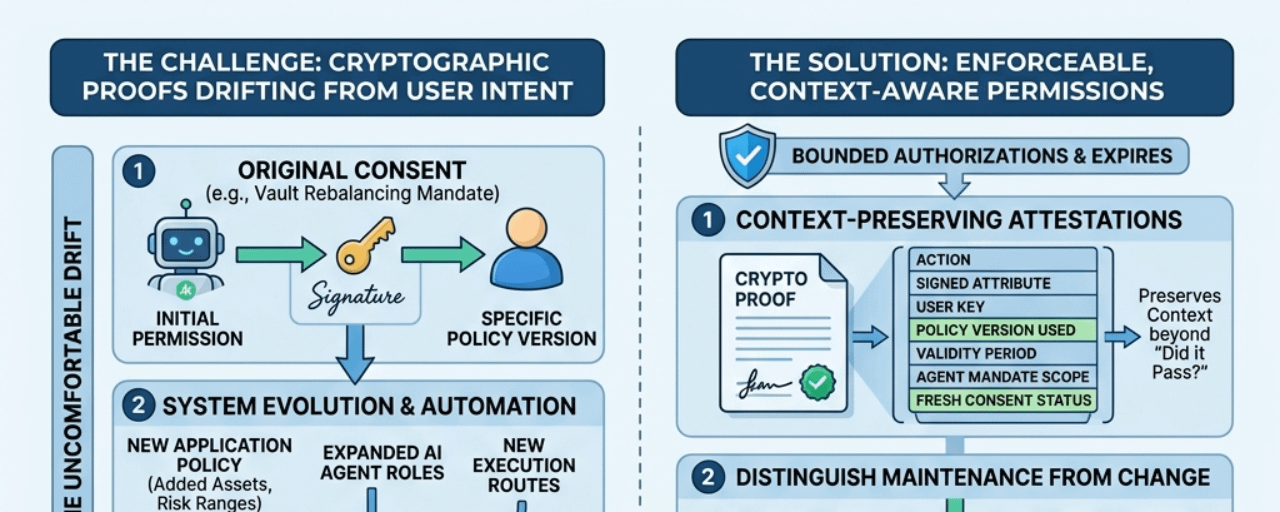
When a Valid Proof Outlives the Permission Behind ItA cryptographic proof can remain valid long after my consent has become outdated.
That is the privacy and control problem I keep thinking about while studying NewtonProtocol.
Pre-settlement authorization is valuable because it moves an important decision ahead of execution. An application can check whether an action fits a policy before funds move, and a signed attestation can show that the required evaluation occurred.
But financial permission is not permanent.
The policy may change.
The application may add new capabilities.
The AI agent’s role may expand.
The user may no longer understand the same authorization in the way they understood it when they first agreed.
At that point, I do not only care whether the proof remains technically valid.
I care whether the permission behind it still reflects my intent.
The action can stay the same while its meaning changes
Suppose I authorize an AI agent to rebalance one vault within a narrow set of assets.
At the beginning, the mandate is easy to understand. The agent can reduce concentration, maintain collateral limits, and route trades to approved venues.
Next the application updates its policy.
A new asset category is added.
A different execution route becomes available.
The approved risk range changes.
The old authorization may still satisfy the system’s technical requirements, yet the practical meaning of my permission has expnded.
I may have approved the original behavior.
I did not necessarily approve every future interpretation of that behavior.
This is where I think the $NEWT conversation becomes deeper than simply proving that a policy check passed.
A valid attestation can show that an action complied with the rule used at that moment.
It does not automatically show that I understood or accepted every change made to that rule since my original consent.
Policy versioning is also a consent problem
Newton Mainnet Beta and VaultKit make programmable authorization more concrete to me. Developers can define enforceable conditions around automated actions rather than leaving important restrictions inside a frontend or written mandate.
That is useful.
But once policies become programmable, changes to those policies become part of user control.
I would want to know:
Which policy version did I originally approve?
What changed afterward?
Did the change narrow the agent’s authority or expand it?
Does a major update require fresh consent?
Can an old permission continue operating under a new policy automatically?
Those questions matter because not every update is equal.
Correcting a technical error may not change the user’s risk.
Adding a new counterparty might.
Refreshing a data source may preserve the same mandate.
Allowing the agent to move capital across another chain may expand it significantly.
A strong system should distinguish maintenance from meaningful permission change.
AI agents make silent expansion easier to miss
This becomes more important when an automated agent acts frequently.
A human may notice that an application changed and stop to review it.
An agent may continue operating under whatever policy the system now considers active.
From the agent’s perspective, nothing unusual happened. The request passed authorization and the transaction remained inside the current rules.
From my perspective, control may have drfted.
The agent can remain fully compliant with the new policy while acting outside the boundaries I thought I had approved.
That is the uncomfortable part.
Automation does not need to break a rule to exceed user intent.
Sometimes the rule itself moves.
For me, this is why consent cannot be treated as a one-time checkbox. It should remain connected to scope, policy version, application context, and time.
A signed attestation should preserve context
I see value in signed attestations because they can make authorization decisions easier to verify.
But I would want the evidence to preserve enough context to answer more than “did this pass?”
I would want to know:
which policy version controlled the action,whether that version differed from the one I approved,whether my authorization had an expiry,whether the agent’s mandate changed,and whether the application required fresh consent after a material update.
That information does not all need to become public.
Some of it may belong only to the user, application, or authorized auditor.
But it should exist.
Without context, a clean attestation can prove that the system followed its current rules while hiding the fact that the user agreed to something narrower.
Consent should expire before it becomes ambiguous
I do not think every automated action should require another manual signature. That would defeat much of the convenience automation is supposed to provide.
But I also do not think permission should remain open-ended.
A better model may use bounded authorization:
one vault,
one application,
one policy version or compatible policy range,
one defined risk mandate
and one clear validity period.
Minor updates could continue without interruption when they do not expand authority.
Material changes should trigger review.
If the agent gains access to new assets, counterparties, chains, or spending powers, I would want fresh consent rather than silent inheritance from an older approval.
That feels especially important for institutional workflows.
A fund mandate approved under one policy should not quietly expand because an application updated its configuration. Auditors and risk teams need to know not only that the transaction passed, but that the active policy still matched the authority originally granted.
What I am watching with #Newt
I am interested in whether Newton-based applications can make financial permissions enforceable before settlement.
But I am also watching how those permissions age.
Can users see when a policy changes?
Can applications distinguish a harmless update from an expansion of authority?
Can attestations identify the exact policy version used?
Can AI agents stop or request renewed permission when their mandate changes materially?
Can consent expire without exposing sensitive information publicly?
Those answers would tell me whether programmable authorization protects user intent over time instead of only at the moment permission is first created.
For me, the strongest authorization layer will not simply ask whether the transaction matches today’s rule.
It will also ask whether today’s rule still matches the permission I actually gave.
That difference matters.
A proof can remain cryptographically correct.
A policy can remain technically enforceable.
An AI agent can remain fully compliant.
And the user’s original consent can still be left behind.
That is the kind of drift I would want @NewtonProtocol applications to prevent before automated finance becomes normal.
$NEWT @NewtonProtocol #Newt $LAB #Velvet #xau #VANRY #Labs
{future}(NEWTUSDT)
When a Valid Proof Outlives the Permission Behind It
A cryptographic proof can remain valid long after my consent has become outdated.
That is the privacy and control problem I keep thinking about while studying NewtonProtocol.
Pre-settlement authorization is valuable because it moves an important decision ahead of execution. An application can check whether an action fits a policy before funds move, and a signed attestation can show that the required evaluation occurred.
But financial permission is not permanent.
The policy may change.
The application may add new capabilities.
The AI agent’s role may expand.
The user may no longer understand the same authorization in the way they understood it when they first agreed.
At that point, I do not only care whether the proof remains technically valid.
I care whether the permission behind it still reflects my intent.
The action can stay the same while its meaning changes
Suppose I authorize an AI agent to rebalance one vault within a narrow set of assets.
At the beginning, the mandate is easy to understand. The agent can reduce concentration, maintain collateral limits, and route trades to approved venues.
Next the application updates its policy.
A new asset category is added.
A different execution route becomes available.
The approved risk range changes.
The old authorization may still satisfy the system’s technical requirements, yet the practical meaning of my permission has expnded.
I may have approved the original behavior.
I did not necessarily approve every future interpretation of that behavior.
This is where I think the $NEWT conversation becomes deeper than simply proving that a policy check passed.
A valid attestation can show that an action complied with the rule used at that moment.
It does not automatically show that I understood or accepted every change made to that rule since my original consent.
Policy versioning is also a consent problem
Newton Mainnet Beta and VaultKit make programmable authorization more concrete to me. Developers can define enforceable conditions around automated actions rather than leaving important restrictions inside a frontend or written mandate.
That is useful.
But once policies become programmable, changes to those policies become part of user control.
I would want to know:
Which policy version did I originally approve?
What changed afterward?
Did the change narrow the agent’s authority or expand it?
Does a major update require fresh consent?
Can an old permission continue operating under a new policy automatically?
Those questions matter because not every update is equal.
Correcting a technical error may not change the user’s risk.
Adding a new counterparty might.
Refreshing a data source may preserve the same mandate.
Allowing the agent to move capital across another chain may expand it significantly.
A strong system should distinguish maintenance from meaningful permission change.
AI agents make silent expansion easier to miss
This becomes more important when an automated agent acts frequently.
A human may notice that an application changed and stop to review it.
An agent may continue operating under whatever policy the system now considers active.
From the agent’s perspective, nothing unusual happened. The request passed authorization and the transaction remained inside the current rules.
From my perspective, control may have drfted.
The agent can remain fully compliant with the new policy while acting outside the boundaries I thought I had approved.
That is the uncomfortable part.
Automation does not need to break a rule to exceed user intent.
Sometimes the rule itself moves.
For me, this is why consent cannot be treated as a one-time checkbox. It should remain connected to scope, policy version, application context, and time.
A signed attestation should preserve context
I see value in signed attestations because they can make authorization decisions easier to verify.
But I would want the evidence to preserve enough context to answer more than “did this pass?”
I would want to know:
which policy version controlled the action,whether that version differed from the one I approved,whether my authorization had an expiry,whether the agent’s mandate changed,and whether the application required fresh consent after a material update.
That information does not all need to become public.
Some of it may belong only to the user, application, or authorized auditor.
But it should exist.
Without context, a clean attestation can prove that the system followed its current rules while hiding the fact that the user agreed to something narrower.
Consent should expire before it becomes ambiguous
I do not think every automated action should require another manual signature. That would defeat much of the convenience automation is supposed to provide.
But I also do not think permission should remain open-ended.
A better model may use bounded authorization:
one vault,
one application,
one policy version or compatible policy range,
one defined risk mandate
and one clear validity period.
Minor updates could continue without interruption when they do not expand authority.
Material changes should trigger review.
If the agent gains access to new assets, counterparties, chains, or spending powers, I would want fresh consent rather than silent inheritance from an older approval.
That feels especially important for institutional workflows.
A fund mandate approved under one policy should not quietly expand because an application updated its configuration. Auditors and risk teams need to know not only that the transaction passed, but that the active policy still matched the authority originally granted.
What I am watching with #Newt
I am interested in whether Newton-based applications can make financial permissions enforceable before settlement.
But I am also watching how those permissions age.
Can users see when a policy changes?
Can applications distinguish a harmless update from an expansion of authority?
Can attestations identify the exact policy version used?
Can AI agents stop or request renewed permission when their mandate changes materially?
Can consent expire without exposing sensitive information publicly?
Those answers would tell me whether programmable authorization protects user intent over time instead of only at the moment permission is first created.
For me, the strongest authorization layer will not simply ask whether the transaction matches today’s rule.
It will also ask whether today’s rule still matches the permission I actually gave.
That difference matters.
A proof can remain cryptographically correct.
A policy can remain technically enforceable.
An AI agent can remain fully compliant.
And the user’s original consent can still be left behind.
That is the kind of drift I would want @NewtonProtocol applications to prevent before automated finance becomes normal.
$NEWT @NewtonProtocol #Newt $LAB #Velvet #xau #VANRY #Labs
That is the privacy and control problem I keep thinking about while studying NewtonProtocol.
Pre-settlement authorization is valuable because it moves an important decision ahead of execution. An application can check whether an action fits a policy before funds move, and a signed attestation can show that the required evaluation occurred.
But financial permission is not permanent.
The policy may change.
The application may add new capabilities.
The AI agent’s role may expand.
The user may no longer understand the same authorization in the way they understood it when they first agreed.
At that point, I do not only care whether the proof remains technically valid.
I care whether the permission behind it still reflects my intent.
The action can stay the same while its meaning changes
Suppose I authorize an AI agent to rebalance one vault within a narrow set of assets.
At the beginning, the mandate is easy to understand. The agent can reduce concentration, maintain collateral limits, and route trades to approved venues.
Next the application updates its policy.
A new asset category is added.
A different execution route becomes available.
The approved risk range changes.
The old authorization may still satisfy the system’s technical requirements, yet the practical meaning of my permission has expnded.
I may have approved the original behavior.
I did not necessarily approve every future interpretation of that behavior.
This is where I think the $NEWT conversation becomes deeper than simply proving that a policy check passed.
A valid attestation can show that an action complied with the rule used at that moment.
It does not automatically show that I understood or accepted every change made to that rule since my original consent.
Policy versioning is also a consent problem
Newton Mainnet Beta and VaultKit make programmable authorization more concrete to me. Developers can define enforceable conditions around automated actions rather than leaving important restrictions inside a frontend or written mandate.
That is useful.
But once policies become programmable, changes to those policies become part of user control.
I would want to know:
Which policy version did I originally approve?
What changed afterward?
Did the change narrow the agent’s authority or expand it?
Does a major update require fresh consent?
Can an old permission continue operating under a new policy automatically?
Those questions matter because not every update is equal.
Correcting a technical error may not change the user’s risk.
Adding a new counterparty might.
Refreshing a data source may preserve the same mandate.
Allowing the agent to move capital across another chain may expand it significantly.
A strong system should distinguish maintenance from meaningful permission change.
AI agents make silent expansion easier to miss
This becomes more important when an automated agent acts frequently.
A human may notice that an application changed and stop to review it.
An agent may continue operating under whatever policy the system now considers active.
From the agent’s perspective, nothing unusual happened. The request passed authorization and the transaction remained inside the current rules.
From my perspective, control may have drfted.
The agent can remain fully compliant with the new policy while acting outside the boundaries I thought I had approved.
That is the uncomfortable part.
Automation does not need to break a rule to exceed user intent.
Sometimes the rule itself moves.
For me, this is why consent cannot be treated as a one-time checkbox. It should remain connected to scope, policy version, application context, and time.
A signed attestation should preserve context
I see value in signed attestations because they can make authorization decisions easier to verify.
But I would want the evidence to preserve enough context to answer more than “did this pass?”
I would want to know:
which policy version controlled the action,whether that version differed from the one I approved,whether my authorization had an expiry,whether the agent’s mandate changed,and whether the application required fresh consent after a material update.
That information does not all need to become public.
Some of it may belong only to the user, application, or authorized auditor.
But it should exist.
Without context, a clean attestation can prove that the system followed its current rules while hiding the fact that the user agreed to something narrower.
Consent should expire before it becomes ambiguous
I do not think every automated action should require another manual signature. That would defeat much of the convenience automation is supposed to provide.
But I also do not think permission should remain open-ended.
A better model may use bounded authorization:
one vault,
one application,
one policy version or compatible policy range,
one defined risk mandate
and one clear validity period.
Minor updates could continue without interruption when they do not expand authority.
Material changes should trigger review.
If the agent gains access to new assets, counterparties, chains, or spending powers, I would want fresh consent rather than silent inheritance from an older approval.
That feels especially important for institutional workflows.
A fund mandate approved under one policy should not quietly expand because an application updated its configuration. Auditors and risk teams need to know not only that the transaction passed, but that the active policy still matched the authority originally granted.
What I am watching with #Newt
I am interested in whether Newton-based applications can make financial permissions enforceable before settlement.
But I am also watching how those permissions age.
Can users see when a policy changes?
Can applications distinguish a harmless update from an expansion of authority?
Can attestations identify the exact policy version used?
Can AI agents stop or request renewed permission when their mandate changes materially?
Can consent expire without exposing sensitive information publicly?
Those answers would tell me whether programmable authorization protects user intent over time instead of only at the moment permission is first created.
For me, the strongest authorization layer will not simply ask whether the transaction matches today’s rule.
It will also ask whether today’s rule still matches the permission I actually gave.
That difference matters.
A proof can remain cryptographically correct.
A policy can remain technically enforceable.
An AI agent can remain fully compliant.
And the user’s original consent can still be left behind.
That is the kind of drift I would want @NewtonProtocol applications to prevent before automated finance becomes normal.
$NEWT @NewtonProtocol #Newt $LAB #Velvet #xau #VANRY #Labs
1
276
·
--
Article
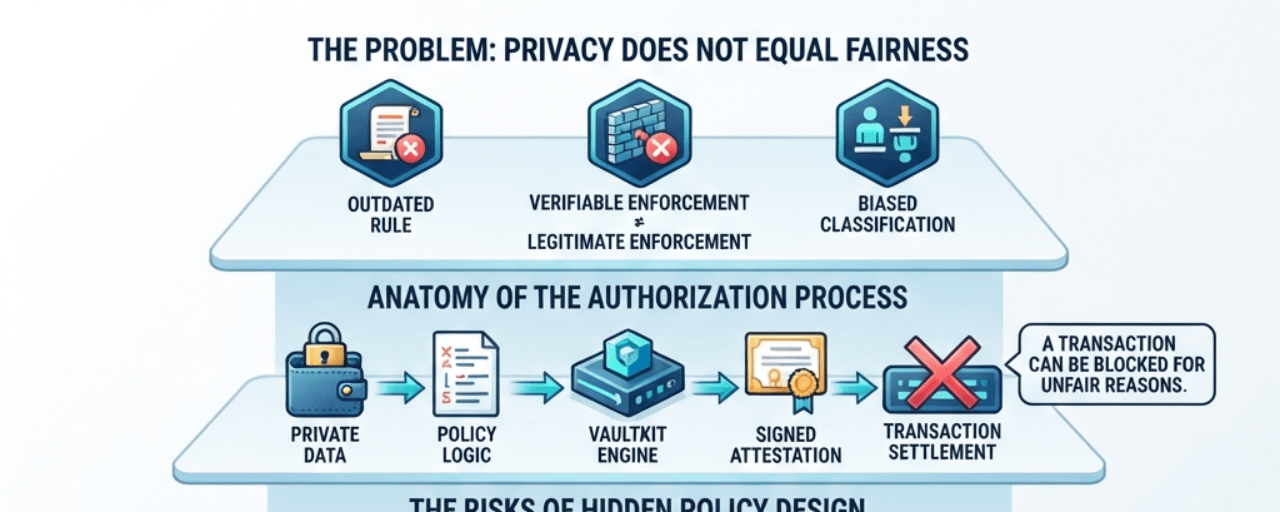
A Private Policy Can Still Be an Unfair PolicyI do not think a cryptographic proof can make a bad rule fair.
That is the concern I keep returning to while looking at @NewtonProtocol and privacy-preserving authorization.
The idea is attractive: a transction can be checked against a policy before settlement without exposing every private detail behind the decision. A user may prove eligibility without publishing identity documents. An institution may verify that a requirement passed without placing sensitive compliance data onchain.
I understand why that matters.
But privacy solves only one part of the problem.
The policy itself can still be poorly designed, overly restrictive, outdated, or unfair.
Newton Mainnet Beta and VaultKit make pre-settlement authorization more concrete. An application can define rules, evaluate an action before execution, and use a signed attestation to show that the required check occurred.
That creates verifiable enforcement.
It does not automatically create legitimate enforcement.
Correct execution is not the same as a fair decision
Imagine a tokenized asset platform that allows participation only when several conditions are satisfied.
The system may check jurisdiction, investor status, transaction size, counterparty eligibility, and risk limits. All private data remains hidden. Authorization process is exactly as stated.
The result may still exclude people for reasons that are too general, poorly justified or no longer relevant.
A policy may block a whole region instead of assessing the real risk.
It may rely on an outdated classification.
It may treat two users differently because their data providers use different scoring methods.
It may apply a rule that was created for one product to another product with a completely different risk profile.
The proof can confirm that the rule was followed.
It cannot prove that the rule deserved to exist in that form.
That distinction matters to me.
In crypto, I often see “verifiable” treated as if it means “trustworthy.” But verification answers a narrower question.
Did the system apply the policy correctly?
It does not answer:
Was the policy reasonable?
Was it updated fairly?
Did it discriminate unnecessarily?
Did the affected user have any way to challenge it?
Those are governance questions, not cryptographic ones.
Hidden data can also hide weak policy design
Privacy can make this tension harder to notice.
If the policy depends on private atributes outside observers may not be able to understand why one wallet passed and another failed. That may be necessary to protect user data, but it can also make poor rules harder to detect.
I do not want every private condition published publicly.
I also do not want privacy to become a shield around decisions that nobody can meaningfully audit.
For me, the stronger design would separate three things:
the user’s private data,the policy logic,and the governance process that approved the policy.
The first may need strong confidentiality.
The second may need controlled inspection.
The third should remain accountable.
A user should not have to reveal personal information publicly to question whether a rule is fair.
An auditor should be able to examine the policy without exposing the user.
A developer should be able to explain why a condition exists.
And the application should be able to show when the rule changed, who approved the change, and which policy version controlled the transaction.
That is the kind of accountability I would want around $NEWT.
AI agents can enforce unfairness at machine speed
This issue becomes more serious when AI agents are involved.
A human compliance team may notice that a rule is producing strange outcomes.
An automated agent may simply apply it thousands of times.
If the policy is too strict, the agent will block legitimate activity consistently.
If the policy is biased toward one category of user, the agent will repeat that bias without hesitation.
If the rule is outdated, the system may continue enforcing yesterday’s assumptions at today’s speed.
Automation does not create the unfairnes.
It scales it.
That is why I think programmable authorization needs policy review, not only policy execution.
The system should make it possible to ask:
How often does this rule reject legitimate activity?
Are certain users affected more than others?
Did the policy produce the outcome its designers intended?
Has the rule been updated since the underlying regulation or risk model changed?
Can the user contest the result without exposing private information publicly?
Those questions are not outside the technical system.
They determine whether the system deserves long-term trust.
What I would want to see from Newton-based applications
I am not claiming that Newton itself defines every policy used by every application. The applications, vaults, issuers, and developers using the infrastructure will still make important design choices.
That is exactly why the surrounding architecture matters.
For applications built around Newton Mainnet Beta and VaultKit, I would watch for several things.
First, policy versioning should be clear.
A signed attestation is more meaningful when I can know which committed rule set was used.
Second, sensitive rules should still be reviewable by authorized parties.
Privacy should restrict unnecessary exposure, not eliminate accountability.
Third, users should have a private path to understand and challenge a decision.
A rejection that cannot be questioned may be technically clean but operationally unfair.
Fourth, policy outcomes should be measured over time.
If one rule consistently blocks valid activity or affects one category disproportionately, the application should be able to detect that pattern and reconsider the design.
Fifth, emergency changes should not be made permanent without review.
A temporary restriction introduced during market stress may remain long after the original reason disappears.
Programmable rules can be updated quickly.
That does not mean they should change without governance.
The real test is not only whether the proof is private
This is why I am watching #Newt through the policy-legitimacy lens.
Privacy-preserving authorization can solve a real problem for onchain finance. It can reduce unnecessary disclosure while keeping important controls enforceable before settlement.
But I do not think privacy alone makes the system trustworthy.
A private decision can still be arbitrary.
A verifiable rule can still be outdated.
A perfectly executed policy can still produce an unfair result.
For me, the strongest authorization layer will do more than prove that a rule was followed.
It will make it possible to verify that the rule was governed respnsibly, reviewed over time, and challengeable when it caused harm.
Because in automated finance, the danger is not only that the system ignores the policy.
Sometimes the danger is that it follows the wrong policy perfectly.
I do not think a cryptographic proof can make a bad rule fair.
That is the concern I keep returning to while looking at @NewtonProtocol and privacy-preserving authorization.
The idea is attractive: a transction can be checked against a policy before settlement without exposing every private detail behind the decision. A user may prove eligibility without publishing identity documents. An institution may verify that a requirement passed without placing sensitive compliance data onchain.
I understand why that matters.
But privacy solves only one part of the problem.
The policy itself can still be poorly designed, overly restrictive, outdated, or unfair.
Newton Mainnet Beta and VaultKit make pre-settlement authorization more concrete. An application can define rules, evaluate an action before execution, and use a signed attestation to show that the required check occurred.
That creates verifiable enforcement.
It does not automatically create legitimate enforcement.
Correct execution is not the same as a fair decision
Imagine a tokenized asset platform that allows participation only when several conditions are satisfied.
The system may check jurisdiction, investor status, transaction size, counterparty eligibility, and risk limits. All private data remains hidden. Authorization process is exactly as stated.
The result may still exclude people for reasons that are too general, poorly justified or no longer relevant.
A policy may block a whole region instead of assessing the real risk.
It may rely on an outdated classification.
It may treat two users differently because their data providers use different scoring methods.
It may apply a rule that was created for one product to another product with a completely different risk profile.
The proof can confirm that the rule was followed.
It cannot prove that the rule deserved to exist in that form.
That distinction matters to me.
In crypto, I often see “verifiable” treated as if it means “trustworthy.” But verification answers a narrower question.
Did the system apply the policy correctly?
It does not answer:
Was the policy reasonable?
Was it updated fairly?
Did it discriminate unnecessarily?
Did the affected user have any way to challenge it?
Those are governance questions, not cryptographic ones.
Hidden data can also hide weak policy design
Privacy can make this tension harder to notice.
If the policy depends on private atributes outside observers may not be able to understand why one wallet passed and another failed. That may be necessary to protect user data, but it can also make poor rules harder to detect.
I do not want every private condition published publicly.
I also do not want privacy to become a shield around decisions that nobody can meaningfully audit.
For me, the stronger design would separate three things:
the user’s private data,the policy logic,and the governance process that approved the policy.
The first may need strong confidentiality.
The second may need controlled inspection.
The third should remain accountable.
A user should not have to reveal personal information publicly to question whether a rule is fair.
An auditor should be able to examine the policy without exposing the user.
A developer should be able to explain why a condition exists.
And the application should be able to show when the rule changed, who approved the change, and which policy version controlled the transaction.
That is the kind of accountability I would want around $NEWT.
AI agents can enforce unfairness at machine speed
This issue becomes more serious when AI agents are involved.
A human compliance team may notice that a rule is producing strange outcomes.
An automated agent may simply apply it thousands of times.
If the policy is too strict, the agent will block legitimate activity consistently.
If the policy is biased toward one category of user, the agent will repeat that bias without hesitation.
If the rule is outdated, the system may continue enforcing yesterday’s assumptions at today’s speed.
Automation does not create the unfairnes.
It scales it.
That is why I think programmable authorization needs policy review, not only policy execution.
The system should make it possible to ask:
How often does this rule reject legitimate activity?
Are certain users affected more than others?
Did the policy produce the outcome its designers intended?
Has the rule been updated since the underlying regulation or risk model changed?
Can the user contest the result without exposing private information publicly?
Those questions are not outside the technical system.
They determine whether the system deserves long-term trust.
What I would want to see from Newton-based applications
I am not claiming that Newton itself defines every policy used by every application. The applications, vaults, issuers, and developers using the infrastructure will still make important design choices.
That is exactly why the surrounding architecture matters.
For applications built around Newton Mainnet Beta and VaultKit, I would watch for several things.
First, policy versioning should be clear.
A signed attestation is more meaningful when I can know which committed rule set was used.
Second, sensitive rules should still be reviewable by authorized parties.
Privacy should restrict unnecessary exposure, not eliminate accountability.
Third, users should have a private path to understand and challenge a decision.
A rejection that cannot be questioned may be technically clean but operationally unfair.
Fourth, policy outcomes should be measured over time.
If one rule consistently blocks valid activity or affects one category disproportionately, the application should be able to detect that pattern and reconsider the design.
Fifth, emergency changes should not be made permanent without review.
A temporary restriction introduced during market stress may remain long after the original reason disappears.
Programmable rules can be updated quickly.
That does not mean they should change without governance.
The real test is not only whether the proof is private
This is why I am watching #Newt #Newt h the policy-legitimacy lens.
Privacy-preserving authorization can solve a real problem for onchain finance. It can reduce unnecessary disclosure while keeping important controls enforceable before settlement.
But I do not think privacy alone makes the system trustworthy.
A private decision can still be arbitrary.
A verifiable rule can still be outdated.
A perfectly executed policy can still produce an unfair result.
For me, the strongest authorization layer will do more than prove that a rule was followed.
It will make it possible to verify that the rule was governed respnsibly, reviewed over time, and challengeable when it caused harm.
Because in automated finance, the danger is not only that the system ignores the policy.
Sometimes the danger is that it follows the wrong policy perfectly.
$NEWT @NewtonProtocol $LAB $VANRY #Velvet #xau
{future}(NEWTUSDT)
A Private Policy Can Still Be an Unfair Policy
I do not think a cryptographic proof can make a bad rule fair.
That is the concern I keep returning to while looking at @NewtonProtocol and privacy-preserving authorization.
The idea is attractive: a transction can be checked against a policy before settlement without exposing every private detail behind the decision. A user may prove eligibility without publishing identity documents. An institution may verify that a requirement passed without placing sensitive compliance data onchain.
I understand why that matters.
But privacy solves only one part of the problem.
The policy itself can still be poorly designed, overly restrictive, outdated, or unfair.
Newton Mainnet Beta and VaultKit make pre-settlement authorization more concrete. An application can define rules, evaluate an action before execution, and use a signed attestation to show that the required check occurred.
That creates verifiable enforcement.
It does not automatically create legitimate enforcement.
Correct execution is not the same as a fair decision
Imagine a tokenized asset platform that allows participation only when several conditions are satisfied.
The system may check jurisdiction, investor status, transaction size, counterparty eligibility, and risk limits. All private data remains hidden. Authorization process is exactly as stated.
The result may still exclude people for reasons that are too general, poorly justified or no longer relevant.
A policy may block a whole region instead of assessing the real risk.
It may rely on an outdated classification.
It may treat two users differently because their data providers use different scoring methods.
It may apply a rule that was created for one product to another product with a completely different risk profile.
The proof can confirm that the rule was followed.
It cannot prove that the rule deserved to exist in that form.
That distinction matters to me.
In crypto, I often see “verifiable” treated as if it means “trustworthy.” But verification answers a narrower question.
Did the system apply the policy correctly?
It does not answer:
Was the policy reasonable?
Was it updated fairly?
Did it discriminate unnecessarily?
Did the affected user have any way to challenge it?
Those are governance questions, not cryptographic ones.
Hidden data can also hide weak policy design
Privacy can make this tension harder to notice.
If the policy depends on private atributes outside observers may not be able to understand why one wallet passed and another failed. That may be necessary to protect user data, but it can also make poor rules harder to detect.
I do not want every private condition published publicly.
I also do not want privacy to become a shield around decisions that nobody can meaningfully audit.
For me, the stronger design would separate three things:
the user’s private data,the policy logic,and the governance process that approved the policy.
The first may need strong confidentiality.
The second may need controlled inspection.
The third should remain accountable.
A user should not have to reveal personal information publicly to question whether a rule is fair.
An auditor should be able to examine the policy without exposing the user.
A developer should be able to explain why a condition exists.
And the application should be able to show when the rule changed, who approved the change, and which policy version controlled the transaction.
That is the kind of accountability I would want around $NEWT .
AI agents can enforce unfairness at machine speed
This issue becomes more serious when AI agents are involved.
A human compliance team may notice that a rule is producing strange outcomes.
An automated agent may simply apply it thousands of times.
If the policy is too strict, the agent will block legitimate activity consistently.
If the policy is biased toward one category of user, the agent will repeat that bias without hesitation.
If the rule is outdated, the system may continue enforcing yesterday’s assumptions at today’s speed.
Automation does not create the unfairnes.
It scales it.
That is why I think programmable authorization needs policy review, not only policy execution.
The system should make it possible to ask:
How often does this rule reject legitimate activity?
Are certain users affected more than others?
Did the policy produce the outcome its designers intended?
Has the rule been updated since the underlying regulation or risk model changed?
Can the user contest the result without exposing private information publicly?
Those questions are not outside the technical system.
They determine whether the system deserves long-term trust.
What I would want to see from Newton-based applications
I am not claiming that Newton itself defines every policy used by every application. The applications, vaults, issuers, and developers using the infrastructure will still make important design choices.
That is exactly why the surrounding architecture matters.
For applications built around Newton Mainnet Beta and VaultKit, I would watch for several things.
First, policy versioning should be clear.
A signed attestation is more meaningful when I can know which committed rule set was used.
Second, sensitive rules should still be reviewable by authorized parties.
Privacy should restrict unnecessary exposure, not eliminate accountability.
Third, users should have a private path to understand and challenge a decision.
A rejection that cannot be questioned may be technically clean but operationally unfair.
Fourth, policy outcomes should be measured over time.
If one rule consistently blocks valid activity or affects one category disproportionately, the application should be able to detect that pattern and reconsider the design.
Fifth, emergency changes should not be made permanent without review.
A temporary restriction introduced during market stress may remain long after the original reason disappears.
Programmable rules can be updated quickly.
That does not mean they should change without governance.
The real test is not only whether the proof is private
This is why I am watching #Newt through the policy-legitimacy lens.
Privacy-preserving authorization can solve a real problem for onchain finance. It can reduce unnecessary disclosure while keeping important controls enforceable before settlement.
But I do not think privacy alone makes the system trustworthy.
A private decision can still be arbitrary.
A verifiable rule can still be outdated.
A perfectly executed policy can still produce an unfair result.
For me, the strongest authorization layer will do more than prove that a rule was followed.
It will make it possible to verify that the rule was governed respnsibly, reviewed over time, and challengeable when it caused harm.
Because in automated finance, the danger is not only that the system ignores the policy.
Sometimes the danger is that it follows the wrong policy perfectly.
I do not think a cryptographic proof can make a bad rule fair.
That is the concern I keep returning to while looking at @NewtonProtocol and privacy-preserving authorization.
The idea is attractive: a transction can be checked against a policy before settlement without exposing every private detail behind the decision. A user may prove eligibility without publishing identity documents. An institution may verify that a requirement passed without placing sensitive compliance data onchain.
I understand why that matters.
But privacy solves only one part of the problem.
The policy itself can still be poorly designed, overly restrictive, outdated, or unfair.
Newton Mainnet Beta and VaultKit make pre-settlement authorization more concrete. An application can define rules, evaluate an action before execution, and use a signed attestation to show that the required check occurred.
That creates verifiable enforcement.
It does not automatically create legitimate enforcement.
Correct execution is not the same as a fair decision
Imagine a tokenized asset platform that allows participation only when several conditions are satisfied.
The system may check jurisdiction, investor status, transaction size, counterparty eligibility, and risk limits. All private data remains hidden. Authorization process is exactly as stated.
The result may still exclude people for reasons that are too general, poorly justified or no longer relevant.
A policy may block a whole region instead of assessing the real risk.
It may rely on an outdated classification.
It may treat two users differently because their data providers use different scoring methods.
It may apply a rule that was created for one product to another product with a completely different risk profile.
The proof can confirm that the rule was followed.
It cannot prove that the rule deserved to exist in that form.
That distinction matters to me.
In crypto, I often see “verifiable” treated as if it means “trustworthy.” But verification answers a narrower question.
Did the system apply the policy correctly?
It does not answer:
Was the policy reasonable?
Was it updated fairly?
Did it discriminate unnecessarily?
Did the affected user have any way to challenge it?
Those are governance questions, not cryptographic ones.
Hidden data can also hide weak policy design
Privacy can make this tension harder to notice.
If the policy depends on private atributes outside observers may not be able to understand why one wallet passed and another failed. That may be necessary to protect user data, but it can also make poor rules harder to detect.
I do not want every private condition published publicly.
I also do not want privacy to become a shield around decisions that nobody can meaningfully audit.
For me, the stronger design would separate three things:
the user’s private data,the policy logic,and the governance process that approved the policy.
The first may need strong confidentiality.
The second may need controlled inspection.
The third should remain accountable.
A user should not have to reveal personal information publicly to question whether a rule is fair.
An auditor should be able to examine the policy without exposing the user.
A developer should be able to explain why a condition exists.
And the application should be able to show when the rule changed, who approved the change, and which policy version controlled the transaction.
That is the kind of accountability I would want around $NEWT .
AI agents can enforce unfairness at machine speed
This issue becomes more serious when AI agents are involved.
A human compliance team may notice that a rule is producing strange outcomes.
An automated agent may simply apply it thousands of times.
If the policy is too strict, the agent will block legitimate activity consistently.
If the policy is biased toward one category of user, the agent will repeat that bias without hesitation.
If the rule is outdated, the system may continue enforcing yesterday’s assumptions at today’s speed.
Automation does not create the unfairnes.
It scales it.
That is why I think programmable authorization needs policy review, not only policy execution.
The system should make it possible to ask:
How often does this rule reject legitimate activity?
Are certain users affected more than others?
Did the policy produce the outcome its designers intended?
Has the rule been updated since the underlying regulation or risk model changed?
Can the user contest the result without exposing private information publicly?
Those questions are not outside the technical system.
They determine whether the system deserves long-term trust.
What I would want to see from Newton-based applications
I am not claiming that Newton itself defines every policy used by every application. The applications, vaults, issuers, and developers using the infrastructure will still make important design choices.
That is exactly why the surrounding architecture matters.
For applications built around Newton Mainnet Beta and VaultKit, I would watch for several things.
First, policy versioning should be clear.
A signed attestation is more meaningful when I can know which committed rule set was used.
Second, sensitive rules should still be reviewable by authorized parties.
Privacy should restrict unnecessary exposure, not eliminate accountability.
Third, users should have a private path to understand and challenge a decision.
A rejection that cannot be questioned may be technically clean but operationally unfair.
Fourth, policy outcomes should be measured over time.
If one rule consistently blocks valid activity or affects one category disproportionately, the application should be able to detect that pattern and reconsider the design.
Fifth, emergency changes should not be made permanent without review.
A temporary restriction introduced during market stress may remain long after the original reason disappears.
Programmable rules can be updated quickly.
That does not mean they should change without governance.
The real test is not only whether the proof is private
This is why I am watching #Newt #Newt h the policy-legitimacy lens.
Privacy-preserving authorization can solve a real problem for onchain finance. It can reduce unnecessary disclosure while keeping important controls enforceable before settlement.
But I do not think privacy alone makes the system trustworthy.
A private decision can still be arbitrary.
A verifiable rule can still be outdated.
A perfectly executed policy can still produce an unfair result.
For me, the strongest authorization layer will do more than prove that a rule was followed.
It will make it possible to verify that the rule was governed respnsibly, reviewed over time, and challengeable when it caused harm.
Because in automated finance, the danger is not only that the system ignores the policy.
Sometimes the danger is that it follows the wrong policy perfectly.
$NEWT @NewtonProtocol $LAB $VANRY #Velvet #xau
That is the concern I keep returning to while looking at @NewtonProtocol and privacy-preserving authorization.
The idea is attractive: a transction can be checked against a policy before settlement without exposing every private detail behind the decision. A user may prove eligibility without publishing identity documents. An institution may verify that a requirement passed without placing sensitive compliance data onchain.
I understand why that matters.
But privacy solves only one part of the problem.
The policy itself can still be poorly designed, overly restrictive, outdated, or unfair.
Newton Mainnet Beta and VaultKit make pre-settlement authorization more concrete. An application can define rules, evaluate an action before execution, and use a signed attestation to show that the required check occurred.
That creates verifiable enforcement.
It does not automatically create legitimate enforcement.
Correct execution is not the same as a fair decision
Imagine a tokenized asset platform that allows participation only when several conditions are satisfied.
The system may check jurisdiction, investor status, transaction size, counterparty eligibility, and risk limits. All private data remains hidden. Authorization process is exactly as stated.
The result may still exclude people for reasons that are too general, poorly justified or no longer relevant.
A policy may block a whole region instead of assessing the real risk.
It may rely on an outdated classification.
It may treat two users differently because their data providers use different scoring methods.
It may apply a rule that was created for one product to another product with a completely different risk profile.
The proof can confirm that the rule was followed.
It cannot prove that the rule deserved to exist in that form.
That distinction matters to me.
In crypto, I often see “verifiable” treated as if it means “trustworthy.” But verification answers a narrower question.
Did the system apply the policy correctly?
It does not answer:
Was the policy reasonable?
Was it updated fairly?
Did it discriminate unnecessarily?
Did the affected user have any way to challenge it?
Those are governance questions, not cryptographic ones.
Hidden data can also hide weak policy design
Privacy can make this tension harder to notice.
If the policy depends on private atributes outside observers may not be able to understand why one wallet passed and another failed. That may be necessary to protect user data, but it can also make poor rules harder to detect.
I do not want every private condition published publicly.
I also do not want privacy to become a shield around decisions that nobody can meaningfully audit.
For me, the stronger design would separate three things:
the user’s private data,the policy logic,and the governance process that approved the policy.
The first may need strong confidentiality.
The second may need controlled inspection.
The third should remain accountable.
A user should not have to reveal personal information publicly to question whether a rule is fair.
An auditor should be able to examine the policy without exposing the user.
A developer should be able to explain why a condition exists.
And the application should be able to show when the rule changed, who approved the change, and which policy version controlled the transaction.
That is the kind of accountability I would want around $NEWT .
AI agents can enforce unfairness at machine speed
This issue becomes more serious when AI agents are involved.
A human compliance team may notice that a rule is producing strange outcomes.
An automated agent may simply apply it thousands of times.
If the policy is too strict, the agent will block legitimate activity consistently.
If the policy is biased toward one category of user, the agent will repeat that bias without hesitation.
If the rule is outdated, the system may continue enforcing yesterday’s assumptions at today’s speed.
Automation does not create the unfairnes.
It scales it.
That is why I think programmable authorization needs policy review, not only policy execution.
The system should make it possible to ask:
How often does this rule reject legitimate activity?
Are certain users affected more than others?
Did the policy produce the outcome its designers intended?
Has the rule been updated since the underlying regulation or risk model changed?
Can the user contest the result without exposing private information publicly?
Those questions are not outside the technical system.
They determine whether the system deserves long-term trust.
What I would want to see from Newton-based applications
I am not claiming that Newton itself defines every policy used by every application. The applications, vaults, issuers, and developers using the infrastructure will still make important design choices.
That is exactly why the surrounding architecture matters.
For applications built around Newton Mainnet Beta and VaultKit, I would watch for several things.
First, policy versioning should be clear.
A signed attestation is more meaningful when I can know which committed rule set was used.
Second, sensitive rules should still be reviewable by authorized parties.
Privacy should restrict unnecessary exposure, not eliminate accountability.
Third, users should have a private path to understand and challenge a decision.
A rejection that cannot be questioned may be technically clean but operationally unfair.
Fourth, policy outcomes should be measured over time.
If one rule consistently blocks valid activity or affects one category disproportionately, the application should be able to detect that pattern and reconsider the design.
Fifth, emergency changes should not be made permanent without review.
A temporary restriction introduced during market stress may remain long after the original reason disappears.
Programmable rules can be updated quickly.
That does not mean they should change without governance.
The real test is not only whether the proof is private
This is why I am watching #Newt through the policy-legitimacy lens.
Privacy-preserving authorization can solve a real problem for onchain finance. It can reduce unnecessary disclosure while keeping important controls enforceable before settlement.
But I do not think privacy alone makes the system trustworthy.
A private decision can still be arbitrary.
A verifiable rule can still be outdated.
A perfectly executed policy can still produce an unfair result.
For me, the strongest authorization layer will do more than prove that a rule was followed.
It will make it possible to verify that the rule was governed respnsibly, reviewed over time, and challengeable when it caused harm.
Because in automated finance, the danger is not only that the system ignores the policy.
Sometimes the danger is that it follows the wrong policy perfectly.
I do not think a cryptographic proof can make a bad rule fair.
That is the concern I keep returning to while looking at @NewtonProtocol and privacy-preserving authorization.
The idea is attractive: a transction can be checked against a policy before settlement without exposing every private detail behind the decision. A user may prove eligibility without publishing identity documents. An institution may verify that a requirement passed without placing sensitive compliance data onchain.
I understand why that matters.
But privacy solves only one part of the problem.
The policy itself can still be poorly designed, overly restrictive, outdated, or unfair.
Newton Mainnet Beta and VaultKit make pre-settlement authorization more concrete. An application can define rules, evaluate an action before execution, and use a signed attestation to show that the required check occurred.
That creates verifiable enforcement.
It does not automatically create legitimate enforcement.
Correct execution is not the same as a fair decision
Imagine a tokenized asset platform that allows participation only when several conditions are satisfied.
The system may check jurisdiction, investor status, transaction size, counterparty eligibility, and risk limits. All private data remains hidden. Authorization process is exactly as stated.
The result may still exclude people for reasons that are too general, poorly justified or no longer relevant.
A policy may block a whole region instead of assessing the real risk.
It may rely on an outdated classification.
It may treat two users differently because their data providers use different scoring methods.
It may apply a rule that was created for one product to another product with a completely different risk profile.
The proof can confirm that the rule was followed.
It cannot prove that the rule deserved to exist in that form.
That distinction matters to me.
In crypto, I often see “verifiable” treated as if it means “trustworthy.” But verification answers a narrower question.
Did the system apply the policy correctly?
It does not answer:
Was the policy reasonable?
Was it updated fairly?
Did it discriminate unnecessarily?
Did the affected user have any way to challenge it?
Those are governance questions, not cryptographic ones.
Hidden data can also hide weak policy design
Privacy can make this tension harder to notice.
If the policy depends on private atributes outside observers may not be able to understand why one wallet passed and another failed. That may be necessary to protect user data, but it can also make poor rules harder to detect.
I do not want every private condition published publicly.
I also do not want privacy to become a shield around decisions that nobody can meaningfully audit.
For me, the stronger design would separate three things:
the user’s private data,the policy logic,and the governance process that approved the policy.
The first may need strong confidentiality.
The second may need controlled inspection.
The third should remain accountable.
A user should not have to reveal personal information publicly to question whether a rule is fair.
An auditor should be able to examine the policy without exposing the user.
A developer should be able to explain why a condition exists.
And the application should be able to show when the rule changed, who approved the change, and which policy version controlled the transaction.
That is the kind of accountability I would want around $NEWT .
AI agents can enforce unfairness at machine speed
This issue becomes more serious when AI agents are involved.
A human compliance team may notice that a rule is producing strange outcomes.
An automated agent may simply apply it thousands of times.
If the policy is too strict, the agent will block legitimate activity consistently.
If the policy is biased toward one category of user, the agent will repeat that bias without hesitation.
If the rule is outdated, the system may continue enforcing yesterday’s assumptions at today’s speed.
Automation does not create the unfairnes.
It scales it.
That is why I think programmable authorization needs policy review, not only policy execution.
The system should make it possible to ask:
How often does this rule reject legitimate activity?
Are certain users affected more than others?
Did the policy produce the outcome its designers intended?
Has the rule been updated since the underlying regulation or risk model changed?
Can the user contest the result without exposing private information publicly?
Those questions are not outside the technical system.
They determine whether the system deserves long-term trust.
What I would want to see from Newton-based applications
I am not claiming that Newton itself defines every policy used by every application. The applications, vaults, issuers, and developers using the infrastructure will still make important design choices.
That is exactly why the surrounding architecture matters.
For applications built around Newton Mainnet Beta and VaultKit, I would watch for several things.
First, policy versioning should be clear.
A signed attestation is more meaningful when I can know which committed rule set was used.
Second, sensitive rules should still be reviewable by authorized parties.
Privacy should restrict unnecessary exposure, not eliminate accountability.
Third, users should have a private path to understand and challenge a decision.
A rejection that cannot be questioned may be technically clean but operationally unfair.
Fourth, policy outcomes should be measured over time.
If one rule consistently blocks valid activity or affects one category disproportionately, the application should be able to detect that pattern and reconsider the design.
Fifth, emergency changes should not be made permanent without review.
A temporary restriction introduced during market stress may remain long after the original reason disappears.
Programmable rules can be updated quickly.
That does not mean they should change without governance.
The real test is not only whether the proof is private
This is why I am watching #Newt #Newt h the policy-legitimacy lens.
Privacy-preserving authorization can solve a real problem for onchain finance. It can reduce unnecessary disclosure while keeping important controls enforceable before settlement.
But I do not think privacy alone makes the system trustworthy.
A private decision can still be arbitrary.
A verifiable rule can still be outdated.
A perfectly executed policy can still produce an unfair result.
For me, the strongest authorization layer will do more than prove that a rule was followed.
It will make it possible to verify that the rule was governed respnsibly, reviewed over time, and challengeable when it caused harm.
Because in automated finance, the danger is not only that the system ignores the policy.
Sometimes the danger is that it follows the wrong policy perfectly.
$NEWT @NewtonProtocol $LAB $VANRY #Velvet #xau
2
350
·
--
Bullish
The most dangerous policy may be the one that fails consistently.
That is what I keep thinking about with NewtonProtocol.
A private, verifiable check can prove that the same rule was applied before settlement. But consistency alone does not prove that the rule was fair, current, or appropriate for every user.
For me, NEWT becomes more meaningful when authorization includes accountability around the policy itself: clear versioning, measurable rejection patterns, controled review, and a private path to challenge an incorrect outcome.
AI agents can enforce rules at machine speed. If the rule is flawed they can scale the flaw just as efficiently.
That is why I’m watching Newt beyond cryptographic proof.
I do not only want evidence that the policy ran correctly. I want evidence that its outcomes remain worth defending.
$NEWT @NewtonProtocol #Newt $LAB $VANRY #Velvet #xau #VANRY #Labs
{future}(NEWTUSDT)
The most dangerous policy may be the one that fails consistently.
That is what I keep thinking about with NewtonProtocol.
A private, verifiable check can prove that the same rule was applied before settlement. But consistency alone does not prove that the rule was fair, current, or appropriate for every user.
For me, NEWT becomes more meaningful when authorization includes accountability around the policy itself: clear versioning, measurable rejection patterns, controled review, and a private path to challenge an incorrect outcome.
AI agents can enforce rules at machine speed. If the rule is flawed they can scale the flaw just as efficiently.
That is why I’m watching Newt beyond cryptographic proof.
I do not only want evidence that the policy ran correctly. I want evidence that its outcomes remain worth defending.
$NEWT @NewtonProtocol #Newt $LAB $VANRY #Velvet #xau #VANRY #Labs
That is what I keep thinking about with NewtonProtocol.
A private, verifiable check can prove that the same rule was applied before settlement. But consistency alone does not prove that the rule was fair, current, or appropriate for every user.
For me, NEWT becomes more meaningful when authorization includes accountability around the policy itself: clear versioning, measurable rejection patterns, controled review, and a private path to challenge an incorrect outcome.
AI agents can enforce rules at machine speed. If the rule is flawed they can scale the flaw just as efficiently.
That is why I’m watching Newt beyond cryptographic proof.
I do not only want evidence that the policy ran correctly. I want evidence that its outcomes remain worth defending.
$NEWT @NewtonProtocol #Newt $LAB $VANRY #Velvet #xau #VANRY #Labs
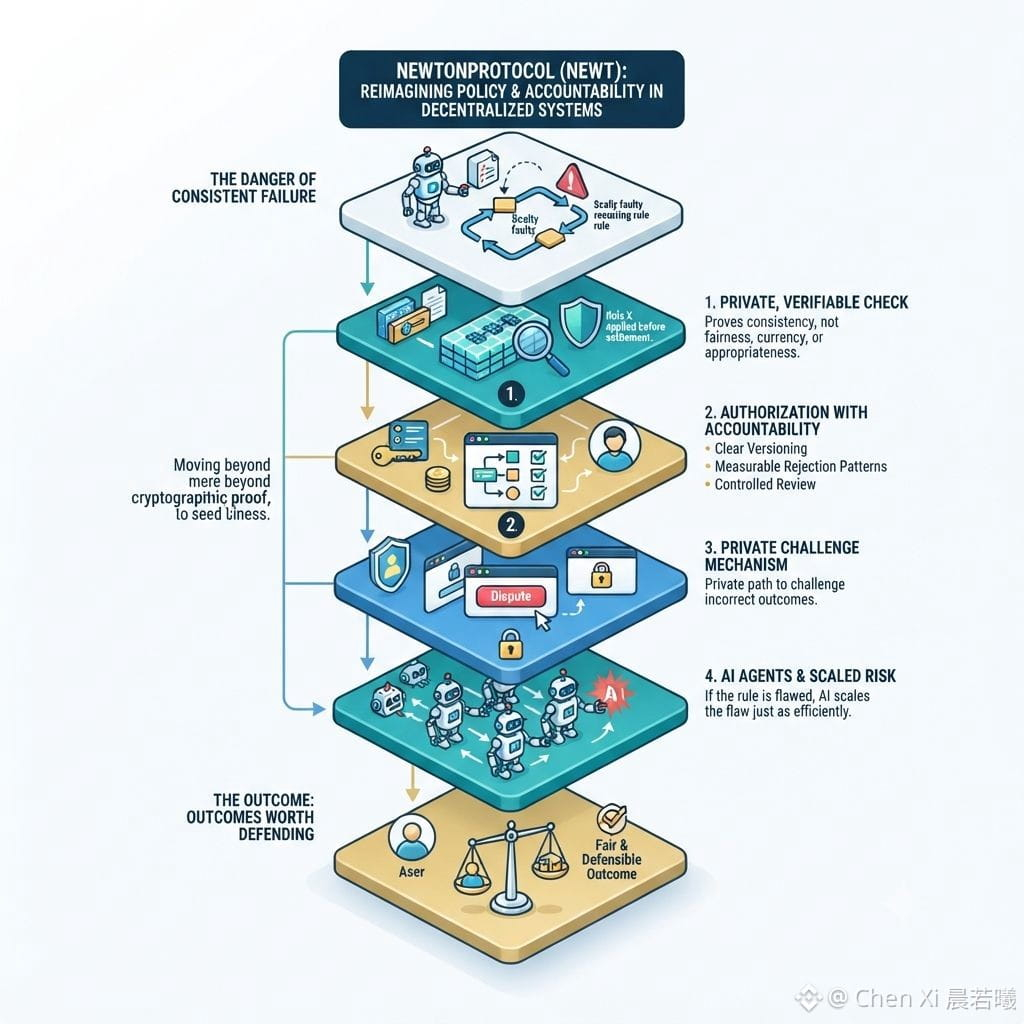
2
375
·
--
Bullish
The most dangerous automated trade is the one that never learned when to stop.
That’s what I keep thinking about with NewtonProtocol. A fast strategy can rebalance, route capital, or react to market data before I even check the screen, but speed alone does not make it safe.
For me, NEWT becomes interesting because Newton’s Mainet Beta and VaultKit focus on policy checks before settlement. If an automated strategy is only allowed to act within certain limits, I want that boundary tested before funds move, not explained after the mistake is already final.
A signed attestation is not a magic shield, but it can make the control layer more visible.
That is why I’m watching Newt from a risk-control angle: automated trading does not just need faster execution. It needs enforceable rules that can say no.
$NEWT @NewtonProtocol #Newt $LAB $VANRY #Velvet #xau #VANRY #Labs
{future}(NEWTUSDT)
The most dangerous automated trade is the one that never learned when to stop.
That’s what I keep thinking about with NewtonProtocol. A fast strategy can rebalance, route capital, or react to market data before I even check the screen, but speed alone does not make it safe.
For me, NEWT becomes interesting because Newton’s Mainet Beta and VaultKit focus on policy checks before settlement. If an automated strategy is only allowed to act within certain limits, I want that boundary tested before funds move, not explained after the mistake is already final.
A signed attestation is not a magic shield, but it can make the control layer more visible.
That is why I’m watching Newt from a risk-control angle: automated trading does not just need faster execution. It needs enforceable rules that can say no.
$NEWT @NewtonProtocol #Newt $LAB $VANRY #Velvet #xau #VANRY #Labs
That’s what I keep thinking about with NewtonProtocol. A fast strategy can rebalance, route capital, or react to market data before I even check the screen, but speed alone does not make it safe.
For me, NEWT becomes interesting because Newton’s Mainet Beta and VaultKit focus on policy checks before settlement. If an automated strategy is only allowed to act within certain limits, I want that boundary tested before funds move, not explained after the mistake is already final.
A signed attestation is not a magic shield, but it can make the control layer more visible.
That is why I’m watching Newt from a risk-control angle: automated trading does not just need faster execution. It needs enforceable rules that can say no.
$NEWT @NewtonProtocol #Newt $LAB $VANRY #Velvet #xau #VANRY #Labs
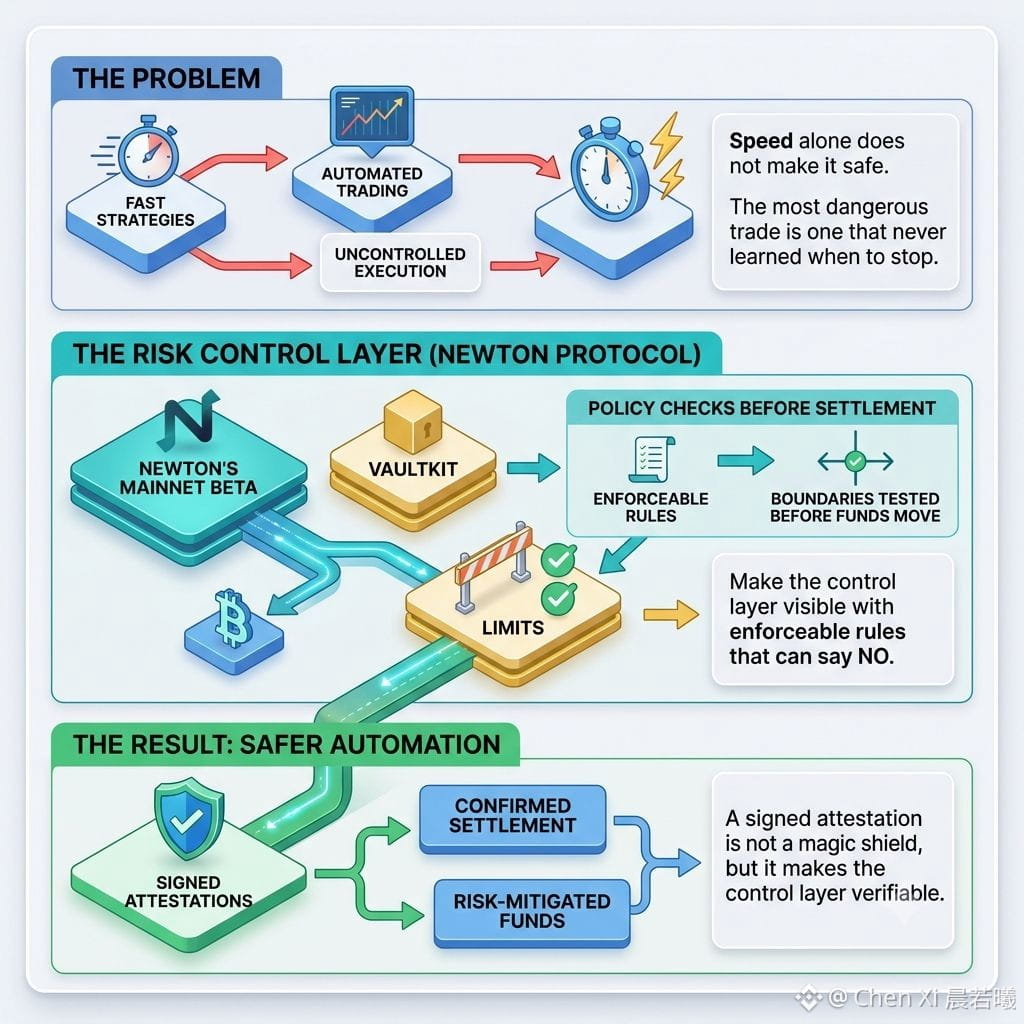
4
1
273
·
--
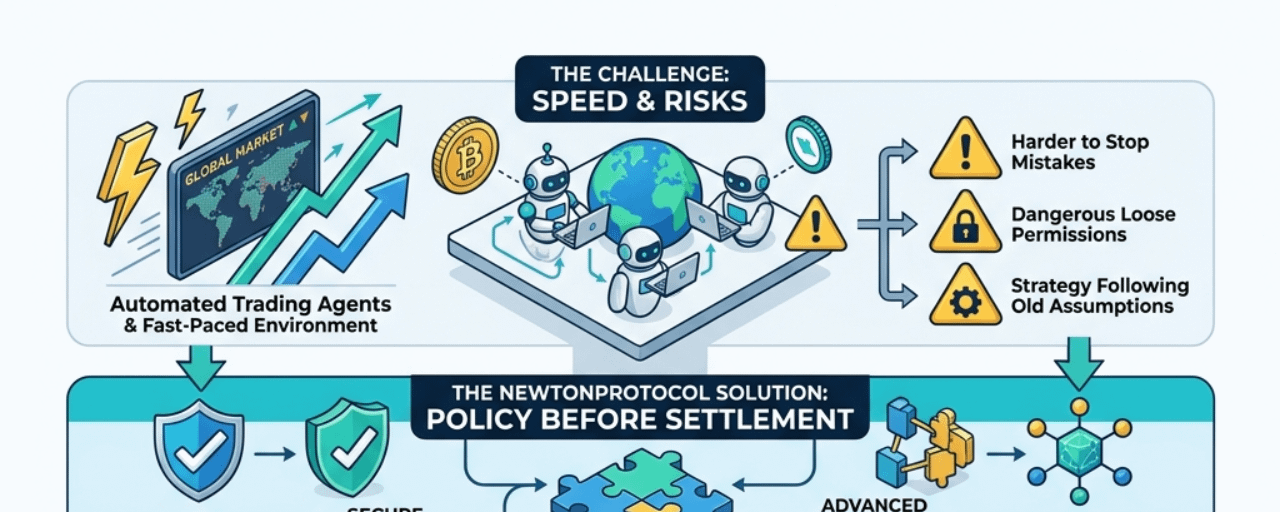
Article
A fast trading strategy still needs a brake.That is the thought I keep coming back to when I look at automated finance. Everyone likes the idea of a strategy that can react instantly: rebalance a vault, reduce exposure, follow market data, or move capital before a human even opens the chart.
Speed sounds powerful.
But speed also makes mistakes harder to stop.
This is where NewtonProtocol becomes interesting to me. I don’t see Newton only as an AI automation story. I see it as infrastructure trying to answer a more pratical question: what happens when an automated strategy wants to act, but the conditions around that action have changed?
In manual trading, I can hesitate. I can look again. I can decide that the market feels too thin, the risk is too high, or the setup no longer matches my plan. Automated strategies do not naturally hesitate. They execute whatever logic they are allowed to execute.
That is useful when the logic is right.
It is dangerous when the permission layer is too loose.
For me, the strongest part of Newton’s Mainnet Beta and VaultKit direction is the idea of checking policy before settlement. If a vault or agent is only allowed to act within certain boundaries, the transaction should be tested against those boundaries before value moves. A signed attestation can then show that the rule check happened instead of leaving everyone to reconstruct the decision later.
That matters for automated trading because the risk is not always a dramatic hack. Sometimes the risk is simpler: a position gets adjsted when the collateral condition is no longer acceptable, an agent routes capital outside the intended range, or a strategy keeps following old assumptions because nobody built a proper stop into the permission system.
I think NEWT becomes more relevant when viewed through that lens.
The question is not “can automation trade faster?”
The better question is “can automation be forced to respect the rules before execution becomes final?”
Of course, this does not remove every weakness. A policy can be badly written. A data input can be wrong. A developer can create a system that users barely understand. If that happens, Newton can make the check verifiable, but the quality of the trading control still depends on the quality of the rule.
That is why I like this angle but also stay cautious.
The future of automated trading will not be judged only by performance screenshots. It will also be judged by whether the system knows when not to act.
For me, that is the serious part of Newt.
A powerful strategy can create returns.
A controlled strategy can survive long enough for those returns to matter.
$NEWT @NewtonProtocol #Newt $LAB $VANRY #Velvet #xau #VANRY #Labs
{future}(NEWTUSDT)
A fast trading strategy still needs a brake.
That is the thought I keep coming back to when I look at automated finance. Everyone likes the idea of a strategy that can react instantly: rebalance a vault, reduce exposure, follow market data, or move capital before a human even opens the chart.
Speed sounds powerful.
But speed also makes mistakes harder to stop.
This is where NewtonProtocol becomes interesting to me. I don’t see Newton only as an AI automation story. I see it as infrastructure trying to answer a more pratical question: what happens when an automated strategy wants to act, but the conditions around that action have changed?
In manual trading, I can hesitate. I can look again. I can decide that the market feels too thin, the risk is too high, or the setup no longer matches my plan. Automated strategies do not naturally hesitate. They execute whatever logic they are allowed to execute.
That is useful when the logic is right.
It is dangerous when the permission layer is too loose.
For me, the strongest part of Newton’s Mainnet Beta and VaultKit direction is the idea of checking policy before settlement. If a vault or agent is only allowed to act within certain boundaries, the transaction should be tested against those boundaries before value moves. A signed attestation can then show that the rule check happened instead of leaving everyone to reconstruct the decision later.
That matters for automated trading because the risk is not always a dramatic hack. Sometimes the risk is simpler: a position gets adjsted when the collateral condition is no longer acceptable, an agent routes capital outside the intended range, or a strategy keeps following old assumptions because nobody built a proper stop into the permission system.
I think NEWT becomes more relevant when viewed through that lens.
The question is not “can automation trade faster?”
The better question is “can automation be forced to respect the rules before execution becomes final?”
Of course, this does not remove every weakness. A policy can be badly written. A data input can be wrong. A developer can create a system that users barely understand. If that happens, Newton can make the check verifiable, but the quality of the trading control still depends on the quality of the rule.
That is why I like this angle but also stay cautious.
The future of automated trading will not be judged only by performance screenshots. It will also be judged by whether the system knows when not to act.
For me, that is the serious part of Newt.
A powerful strategy can create returns.
A controlled strategy can survive long enough for those returns to matter.
$NEWT @NewtonProtocol #Newt $LAB $VANRY #Velvet #xau #VANRY #Labs
Speed sounds powerful.
But speed also makes mistakes harder to stop.
This is where NewtonProtocol becomes interesting to me. I don’t see Newton only as an AI automation story. I see it as infrastructure trying to answer a more pratical question: what happens when an automated strategy wants to act, but the conditions around that action have changed?
In manual trading, I can hesitate. I can look again. I can decide that the market feels too thin, the risk is too high, or the setup no longer matches my plan. Automated strategies do not naturally hesitate. They execute whatever logic they are allowed to execute.
That is useful when the logic is right.
It is dangerous when the permission layer is too loose.
For me, the strongest part of Newton’s Mainnet Beta and VaultKit direction is the idea of checking policy before settlement. If a vault or agent is only allowed to act within certain boundaries, the transaction should be tested against those boundaries before value moves. A signed attestation can then show that the rule check happened instead of leaving everyone to reconstruct the decision later.
That matters for automated trading because the risk is not always a dramatic hack. Sometimes the risk is simpler: a position gets adjsted when the collateral condition is no longer acceptable, an agent routes capital outside the intended range, or a strategy keeps following old assumptions because nobody built a proper stop into the permission system.
I think NEWT becomes more relevant when viewed through that lens.
The question is not “can automation trade faster?”
The better question is “can automation be forced to respect the rules before execution becomes final?”
Of course, this does not remove every weakness. A policy can be badly written. A data input can be wrong. A developer can create a system that users barely understand. If that happens, Newton can make the check verifiable, but the quality of the trading control still depends on the quality of the rule.
That is why I like this angle but also stay cautious.
The future of automated trading will not be judged only by performance screenshots. It will also be judged by whether the system knows when not to act.
For me, that is the serious part of Newt.
A powerful strategy can create returns.
A controlled strategy can survive long enough for those returns to matter.
$NEWT @NewtonProtocol #Newt $LAB $VANRY #Velvet #xau #VANRY #Labs
3
321
·
--
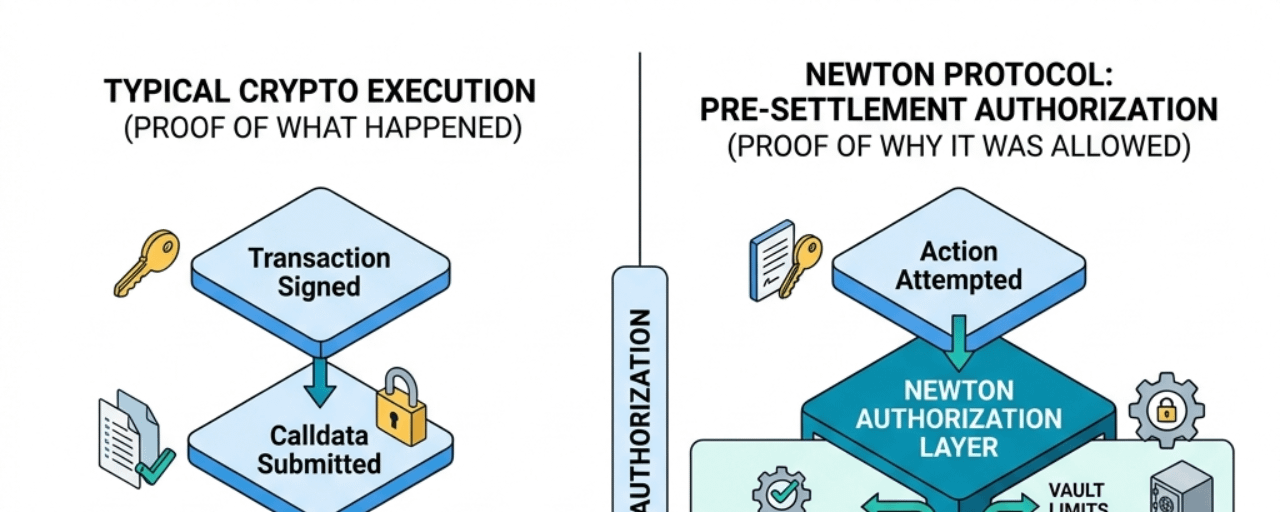
Article
The chain can prove what happened, but it rarely proves why it was allowed.That is the part I keep thinking about with @NewtonProtocol. Most of crypto is very good at recording execution. A transaction was signed, calldata was submitted, gas was paid, and the state changed. From the chain’s point of view, that is enough.
But from a user, vault, institution, or automated strategy perspective, that answer feels incomplete.
I don’t only want to know that a transaction happened. I want to know whether it matched the permission structure before it happened.
This is where Newton’s Mainnet Beta and VaultKit direction feel important to me. The focus is not just execution speed or another AI narrative. The focus is pre-settlement authorization: checking an action against policy before the transaction settles, then producing a signed attestation that shows the check was performed.
That changes the kind of evidence available.
Without an authorization layer, a transaction receipt mostly tells me the chain accepted the instruction. With Newton’s approach, the more interesting receipt is the one that can say the action passed a defined rule before execution. That may sound like a small difference, but in automated finance, it matters a lot.
If a vault has limits, those limits should not live only in a document.
If an AI agent has permission boundaries, those boundaries should not depend only on trust.
If an institution needs compliance checks, those checks should not be reconstructed after the fact.
For me, NEWT becomes more interesting when I look at it through this lens. Newton is trying to make authorization visible, verifiable, and tied to execution instead of leaving it as an offchain assumption.
I also like that this creates a clearer accountability trail. A signed attestation does not just say “something happened.” It helps show which policy check was involved before the action moved forward. That kind of record could matter for vault curators, developers, auditors, and users who need more than a simple transaction hash.
Still, I don’t think this makes Newton risk-free.
A receipt is only as useful as the rule behind it. If the policy is weak, the system can verify a weak rule. If the integration is poor users may not understand what they approved. If the market treats every attestation as a guarantee of safety, that would be a mistake.
But I still think Newton is focusing on a real missing layer.
Crypto already has strong proof of excution. What it often lacks is proof that execution stayed inside the intended permission boundary.
That is why I’m watching #Newt from the authorization evidence angle. As automated strategies and agent-based workflows grow, I think the question will become less about whether a transction can be executed.
The harder question will be whether it should have been allowed in the first place.
$NEWT @NewtonProtocol $LAB $VANRY #Velvet #xau #VANRY #Labs
{future}(NEWTUSDT)
The chain can prove what happened, but it rarely proves why it was allowed.
That is the part I keep thinking about with @NewtonProtocol. Most of crypto is very good at recording execution. A transaction was signed, calldata was submitted, gas was paid, and the state changed. From the chain’s point of view, that is enough.
But from a user, vault, institution, or automated strategy perspective, that answer feels incomplete.
I don’t only want to know that a transaction happened. I want to know whether it matched the permission structure before it happened.
This is where Newton’s Mainnet Beta and VaultKit direction feel important to me. The focus is not just execution speed or another AI narrative. The focus is pre-settlement authorization: checking an action against policy before the transaction settles, then producing a signed attestation that shows the check was performed.
That changes the kind of evidence available.
Without an authorization layer, a transaction receipt mostly tells me the chain accepted the instruction. With Newton’s approach, the more interesting receipt is the one that can say the action passed a defined rule before execution. That may sound like a small difference, but in automated finance, it matters a lot.
If a vault has limits, those limits should not live only in a document.
If an AI agent has permission boundaries, those boundaries should not depend only on trust.
If an institution needs compliance checks, those checks should not be reconstructed after the fact.
For me, NEWT becomes more interesting when I look at it through this lens. Newton is trying to make authorization visible, verifiable, and tied to execution instead of leaving it as an offchain assumption.
I also like that this creates a clearer accountability trail. A signed attestation does not just say “something happened.” It helps show which policy check was involved before the action moved forward. That kind of record could matter for vault curators, developers, auditors, and users who need more than a simple transaction hash.
Still, I don’t think this makes Newton risk-free.
A receipt is only as useful as the rule behind it. If the policy is weak, the system can verify a weak rule. If the integration is poor users may not understand what they approved. If the market treats every attestation as a guarantee of safety, that would be a mistake.
But I still think Newton is focusing on a real missing layer.
Crypto already has strong proof of excution. What it often lacks is proof that execution stayed inside the intended permission boundary.
That is why I’m watching #Newt from the authorization evidence angle. As automated strategies and agent-based workflows grow, I think the question will become less about whether a transction can be executed.
The harder question will be whether it should have been allowed in the first place.
$NEWT @NewtonProtocol $LAB $VANRY #Velvet #xau #VANRY #Labs
But from a user, vault, institution, or automated strategy perspective, that answer feels incomplete.
I don’t only want to know that a transaction happened. I want to know whether it matched the permission structure before it happened.
This is where Newton’s Mainnet Beta and VaultKit direction feel important to me. The focus is not just execution speed or another AI narrative. The focus is pre-settlement authorization: checking an action against policy before the transaction settles, then producing a signed attestation that shows the check was performed.
That changes the kind of evidence available.
Without an authorization layer, a transaction receipt mostly tells me the chain accepted the instruction. With Newton’s approach, the more interesting receipt is the one that can say the action passed a defined rule before execution. That may sound like a small difference, but in automated finance, it matters a lot.
If a vault has limits, those limits should not live only in a document.
If an AI agent has permission boundaries, those boundaries should not depend only on trust.
If an institution needs compliance checks, those checks should not be reconstructed after the fact.
For me, NEWT becomes more interesting when I look at it through this lens. Newton is trying to make authorization visible, verifiable, and tied to execution instead of leaving it as an offchain assumption.
I also like that this creates a clearer accountability trail. A signed attestation does not just say “something happened.” It helps show which policy check was involved before the action moved forward. That kind of record could matter for vault curators, developers, auditors, and users who need more than a simple transaction hash.
Still, I don’t think this makes Newton risk-free.
A receipt is only as useful as the rule behind it. If the policy is weak, the system can verify a weak rule. If the integration is poor users may not understand what they approved. If the market treats every attestation as a guarantee of safety, that would be a mistake.
But I still think Newton is focusing on a real missing layer.
Crypto already has strong proof of excution. What it often lacks is proof that execution stayed inside the intended permission boundary.
That is why I’m watching #Newt from the authorization evidence angle. As automated strategies and agent-based workflows grow, I think the question will become less about whether a transction can be executed.
The harder question will be whether it should have been allowed in the first place.
$NEWT @NewtonProtocol $LAB $VANRY #Velvet #xau #VANRY #Labs
5
1
373
·
--
Bullish
A transaction hash tells me what happened, not why it was allowed.
That difference is where NewtonProtocol becomes interesting to me. Crypto already proves execution very well: signed, submitted, settled, recorded.
But automated finance needs another layer of proof.
If an AI agent rebalances a vault or routes capital, I don’t only want to see that the action executed. I want evidence that it passed the right permission check before settlement.
That is why I’m watching NEWT through the authorization-proof lens. Newton Mainnet Beta, VaultKit, and signed attestations make the question more concrete: did this action stay inside the policy before value moved?
For me, Newt is not just about faster automation. It is about making permission visible before execution becomes irreversible.
$NEWT @NewtonProtocol #Newt $LAB $VANRY #Velvet #xau #VANRY #Labs
{future}(NEWTUSDT)
A transaction hash tells me what happened, not why it was allowed.
That difference is where NewtonProtocol becomes interesting to me. Crypto already proves execution very well: signed, submitted, settled, recorded.
But automated finance needs another layer of proof.
If an AI agent rebalances a vault or routes capital, I don’t only want to see that the action executed. I want evidence that it passed the right permission check before settlement.
That is why I’m watching NEWT through the authorization-proof lens. Newton Mainnet Beta, VaultKit, and signed attestations make the question more concrete: did this action stay inside the policy before value moved?
For me, Newt is not just about faster automation. It is about making permission visible before execution becomes irreversible.
$NEWT @NewtonProtocol #Newt $LAB $VANRY #Velvet #xau #VANRY #Labs
That difference is where NewtonProtocol becomes interesting to me. Crypto already proves execution very well: signed, submitted, settled, recorded.
But automated finance needs another layer of proof.
If an AI agent rebalances a vault or routes capital, I don’t only want to see that the action executed. I want evidence that it passed the right permission check before settlement.
That is why I’m watching NEWT through the authorization-proof lens. Newton Mainnet Beta, VaultKit, and signed attestations make the question more concrete: did this action stay inside the policy before value moved?
For me, Newt is not just about faster automation. It is about making permission visible before execution becomes irreversible.
$NEWT @NewtonProtocol #Newt $LAB $VANRY #Velvet #xau #VANRY #Labs
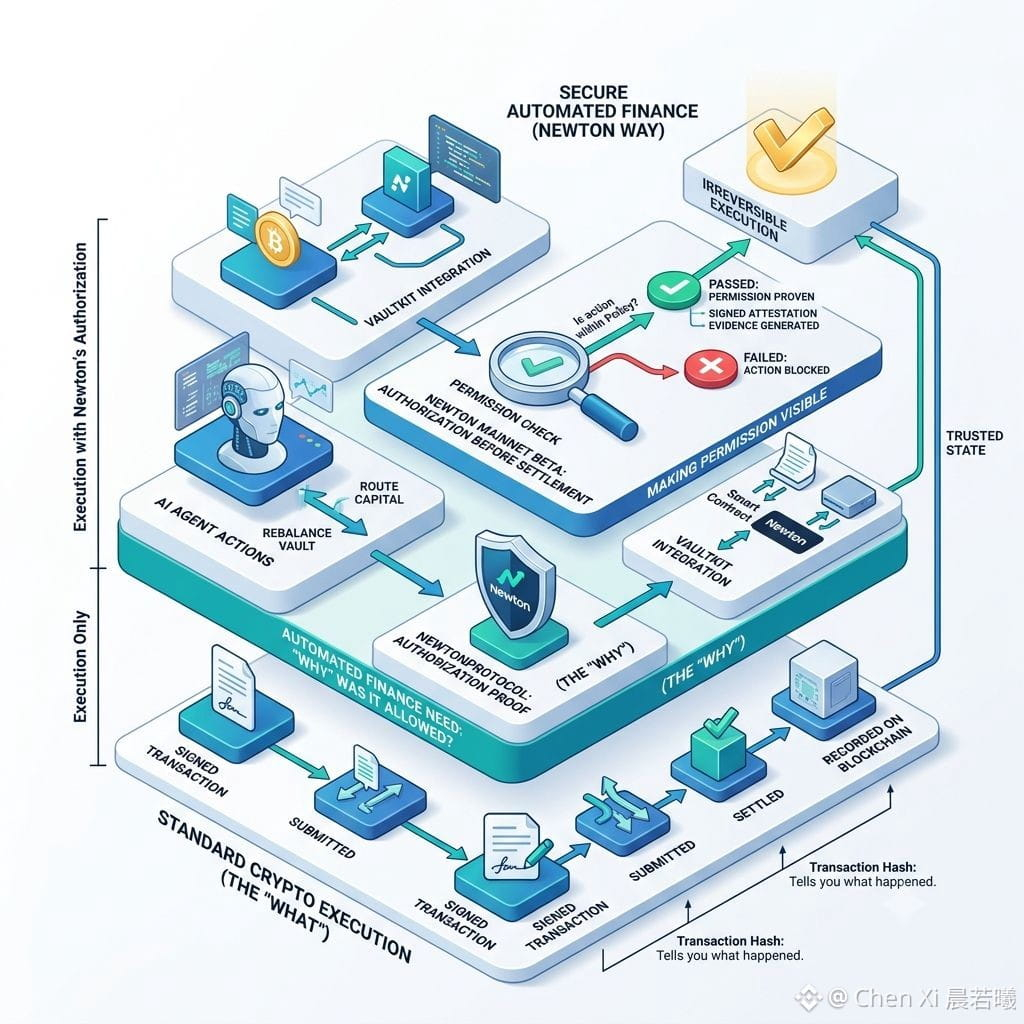
1
1
329
·
--
Bullish
The most misleading risk score is the one that looks too precise.
Imagine an automated vault sees an asset risk score of 82/100.
The number feels objective.
The policy check passes before settlement.
But if that score depends on dlayed liquidity data, thin venue coverage, or compressed volatility inputs, the exact number may hide weak confidence.
That is the data-quality detail I would watch around Newton Mainnet Beta.
Through VaultKit, @NewtonProtocol can place policy evaluation before settlement but serious integrations should not treat every clean score as equally reliable.
A risk score should carry its uncertainty with it.
Otherwise, an agent may act on a number that looks scientific while the underlying inputs are fragile.
In automated vaults, precision is useful only when the confidence behind it is real.
$NEWT @NewtonProtocol #Newt $LAB $VANRY #Velvet #xau #VANRY #Labs
{future}(NEWTUSDT)
The most misleading risk score is the one that looks too precise.
Imagine an automated vault sees an asset risk score of 82/100.
The number feels objective.
The policy check passes before settlement.
But if that score depends on dlayed liquidity data, thin venue coverage, or compressed volatility inputs, the exact number may hide weak confidence.
That is the data-quality detail I would watch around Newton Mainnet Beta.
Through VaultKit, @NewtonProtocol can place policy evaluation before settlement but serious integrations should not treat every clean score as equally reliable.
A risk score should carry its uncertainty with it.
Otherwise, an agent may act on a number that looks scientific while the underlying inputs are fragile.
In automated vaults, precision is useful only when the confidence behind it is real.
$NEWT @NewtonProtocol #Newt $LAB $VANRY #Velvet #xau #VANRY #Labs
Imagine an automated vault sees an asset risk score of 82/100.
The number feels objective.
The policy check passes before settlement.
But if that score depends on dlayed liquidity data, thin venue coverage, or compressed volatility inputs, the exact number may hide weak confidence.
That is the data-quality detail I would watch around Newton Mainnet Beta.
Through VaultKit, @NewtonProtocol can place policy evaluation before settlement but serious integrations should not treat every clean score as equally reliable.
A risk score should carry its uncertainty with it.
Otherwise, an agent may act on a number that looks scientific while the underlying inputs are fragile.
In automated vaults, precision is useful only when the confidence behind it is real.
$NEWT @NewtonProtocol #Newt $LAB $VANRY #Velvet #xau #VANRY #Labs
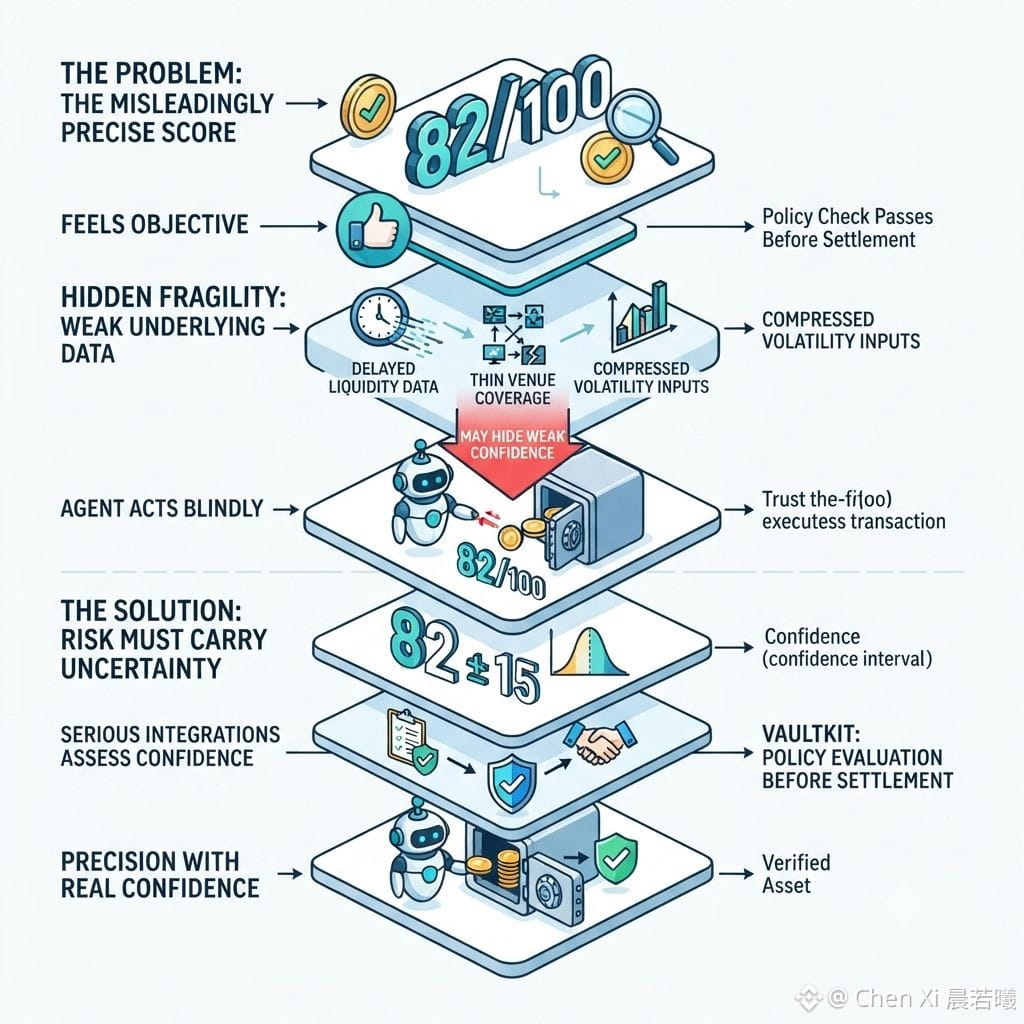
3
1
191
·
--
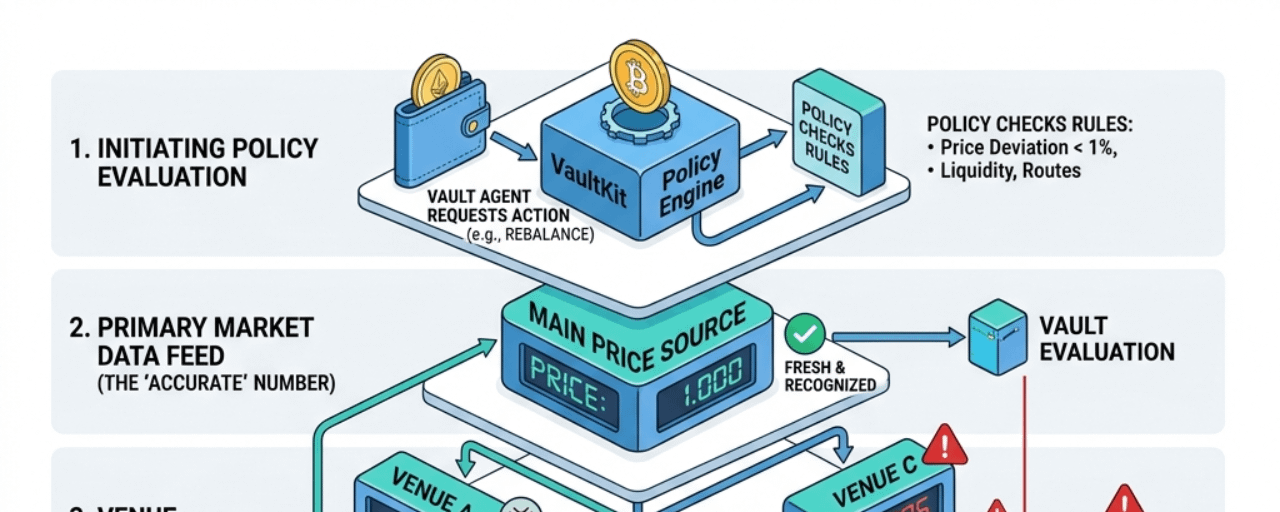
Article
The Price Was Accurate. The Market Was Not Agreeing.The most dangerous price in an automated vault may be the one that is correct on one venue and misleading everywhere else.
That is the data reliability problem I would watch around Newton Mainnet Beta.
In automated finance, a policy often needs a number before it can make a decision.
Price.
Liquidity.
Volatility.
Spread.
Risk score.
Deviation.
If the number is fresh and comes from a recognized source, it can feel reliable enough for pre-settlement evaluation. The vault checks the rule, the action fits the limit, and the system moves forward.
But market data is not always a single truth.
Sometimes the real signal is not the price itself.
It is the disagreement around the price.
Imagine an automated vault using VaultKit to evaluate a rebalance before settlement. The policy allows the agent to move into an asset only if the price deviation is below 1%, liquidity is acceptable, and the route stays inside approved execution paths.
Venue A reports the asset at 1.000.
Venue B reports it at 0.986.
Venue C shows thin liquidity and a widening spread.
The primary feed still reports a fresh price close to 1.000.
The requested action appears to pass.
The destination is approved.
The amount is inside the asset limit.
The policy is enforced correctly before settlement.
Nothing looks broken.
But the data disagreement is itself a risk signal.
If one venue says the asset is stable while another venue shows stress, the policy should not treat the clean price as if the whole market agrees. The number may be accurate where it was measured. It may still be unreliable as a decision input for a vault that must execute across real liquidity.
That distinction matters for Yasir’s lane.
A valid number is not always a reliable number.
A fresh price is not always a complete market signal.
A policy can evaluate the available input correctly and still miss the fact that the input is disputed by the market.
This is where @NewtonProtocol becomes interesting from a data-quality perspective.
Through VaultKit, applications can place policy evaluation before settlement. Actions can be checked against asset limits, routes, approved destinations, and policy conditions before value moves. Signed authorization records can help show that a request was evaluated under a policy context.
That is meaningful.
But a signed result can prove that the policy ran.
It does not automatically prove that the market data behind the policy was uncontested.
For serious automated vaults, venue disagrement should not be treated as background noise. It should be part of the risk context.
If the policy uses only one clean price during a fragmented market, the agent may receive a false sense of safety. It may move capital into a position that looks acceptable under one venue and dangerous under another.
The issue is not always manipulation.
It can be latency.
It can be thin liquidity.
It can be fragmented order books.
It can be regional venue stress.
It can be a temporary imbalance during volatility.
It can be a stable asset beginning to trade differently across markets before the primary feed fully reflects the stress.
The data point is not necessarily fake.
It is incomplete because it hides disagreement.
Consider a vault reducing exposure during a volatile period.
The agent wants to move into a stable asset.
The main price source shows 0.999.
Another venue shows 0.985 with low depth.
A third venue still shows 0.998, but only for small size.
If the policy only asks whether the reported price is within range, the action may pass.
If the policy asks whether venues agree enough to support the action size, the result may be different.
That is the real standard.
The question is not only:
“What is the price?”
The better question is:
“How much confidence should this price carry when venues disagree?”
This becomes even more important when the action size is large.
A small transfer may tolerate some venue disagreement.
A large rebalance may not.
A low-risk maintenance action may proceed with a wider tolerance.
A new exposure increase during fragmented liquidity should demand stronger confirmation.
A risk-reducing exit may need a different standard from a yield-seeking entry.
The policy should not treat every disagreement the same.
It should scale its caution with action type, size, route senstivity, and market stress.
There is a trade-off.
If every venue mismatch blocks automation, the vault becomes fragile. Markets are never perfectly synchronized. Small differences are normal. Overreacting to every spread can slow down useful execution and create unnecessary failed authorizations.
But if venue disagreement is ignored completely, the vault may act on a clean-looking number while the broader market is already warning that execution risk has changed.
The better standard is disagreement-aware evaluation.
Small differences can be tolerated.
Large gaps can reduce limits.
Persistent disagreement can require additional sources.
Disagreement during stress can allow only risk-reducing actions.
Disagreement across venues with thin liquidity can trigger stronger review before settlement.
That kind of policy does not need to claim perfect market truth.
It only needs to admit that a single number may not deserve full trust when the market around it is fractured.
This is the Yasir-style test I would apply to Newton Mainet Beta.
Can a VaultKit-powered application distinguish a clean price from a contested market?
Can policy evaluation account for venue disagreement before settlement?
Can signed records show whether an action passed under normal data confidence or disputed data conditions?
Can agents avoid treating one venue’s accurate number as universal truth?
Can risk limits adapt when the market stops speaking with one voice?
Automated vaults do not only need data that updates.
They need data that carries enough agreement to justify action.
Because the danger is not always a stale feed or a false price.
Sometimes the price is accurate.
The mistake is believing it represents the market.
$NEWT @NewtonProtocol #Newt $LAB $VANRY #Velvet #xau #VANRY #Labs
{future}(NEWTUSDT)
The Price Was Accurate. The Market Was Not Agreeing.
The most dangerous price in an automated vault may be the one that is correct on one venue and misleading everywhere else.
That is the data reliability problem I would watch around Newton Mainnet Beta.
In automated finance, a policy often needs a number before it can make a decision.
Price.
Liquidity.
Volatility.
Spread.
Risk score.
Deviation.
If the number is fresh and comes from a recognized source, it can feel reliable enough for pre-settlement evaluation. The vault checks the rule, the action fits the limit, and the system moves forward.
But market data is not always a single truth.
Sometimes the real signal is not the price itself.
It is the disagreement around the price.
Imagine an automated vault using VaultKit to evaluate a rebalance before settlement. The policy allows the agent to move into an asset only if the price deviation is below 1%, liquidity is acceptable, and the route stays inside approved execution paths.
Venue A reports the asset at 1.000.
Venue B reports it at 0.986.
Venue C shows thin liquidity and a widening spread.
The primary feed still reports a fresh price close to 1.000.
The requested action appears to pass.
The destination is approved.
The amount is inside the asset limit.
The policy is enforced correctly before settlement.
Nothing looks broken.
But the data disagreement is itself a risk signal.
If one venue says the asset is stable while another venue shows stress, the policy should not treat the clean price as if the whole market agrees. The number may be accurate where it was measured. It may still be unreliable as a decision input for a vault that must execute across real liquidity.
That distinction matters for Yasir’s lane.
A valid number is not always a reliable number.
A fresh price is not always a complete market signal.
A policy can evaluate the available input correctly and still miss the fact that the input is disputed by the market.
This is where @NewtonProtocol becomes interesting from a data-quality perspective.
Through VaultKit, applications can place policy evaluation before settlement. Actions can be checked against asset limits, routes, approved destinations, and policy conditions before value moves. Signed authorization records can help show that a request was evaluated under a policy context.
That is meaningful.
But a signed result can prove that the policy ran.
It does not automatically prove that the market data behind the policy was uncontested.
For serious automated vaults, venue disagrement should not be treated as background noise. It should be part of the risk context.
If the policy uses only one clean price during a fragmented market, the agent may receive a false sense of safety. It may move capital into a position that looks acceptable under one venue and dangerous under another.
The issue is not always manipulation.
It can be latency.
It can be thin liquidity.
It can be fragmented order books.
It can be regional venue stress.
It can be a temporary imbalance during volatility.
It can be a stable asset beginning to trade differently across markets before the primary feed fully reflects the stress.
The data point is not necessarily fake.
It is incomplete because it hides disagreement.
Consider a vault reducing exposure during a volatile period.
The agent wants to move into a stable asset.
The main price source shows 0.999.
Another venue shows 0.985 with low depth.
A third venue still shows 0.998, but only for small size.
If the policy only asks whether the reported price is within range, the action may pass.
If the policy asks whether venues agree enough to support the action size, the result may be different.
That is the real standard.
The question is not only:
“What is the price?”
The better question is:
“How much confidence should this price carry when venues disagree?”
This becomes even more important when the action size is large.
A small transfer may tolerate some venue disagreement.
A large rebalance may not.
A low-risk maintenance action may proceed with a wider tolerance.
A new exposure increase during fragmented liquidity should demand stronger confirmation.
A risk-reducing exit may need a different standard from a yield-seeking entry.
The policy should not treat every disagreement the same.
It should scale its caution with action type, size, route senstivity, and market stress.
There is a trade-off.
If every venue mismatch blocks automation, the vault becomes fragile. Markets are never perfectly synchronized. Small differences are normal. Overreacting to every spread can slow down useful execution and create unnecessary failed authorizations.
But if venue disagreement is ignored completely, the vault may act on a clean-looking number while the broader market is already warning that execution risk has changed.
The better standard is disagreement-aware evaluation.
Small differences can be tolerated.
Large gaps can reduce limits.
Persistent disagreement can require additional sources.
Disagreement during stress can allow only risk-reducing actions.
Disagreement across venues with thin liquidity can trigger stronger review before settlement.
That kind of policy does not need to claim perfect market truth.
It only needs to admit that a single number may not deserve full trust when the market around it is fractured.
This is the Yasir-style test I would apply to Newton Mainet Beta.
Can a VaultKit-powered application distinguish a clean price from a contested market?
Can policy evaluation account for venue disagreement before settlement?
Can signed records show whether an action passed under normal data confidence or disputed data conditions?
Can agents avoid treating one venue’s accurate number as universal truth?
Can risk limits adapt when the market stops speaking with one voice?
Automated vaults do not only need data that updates.
They need data that carries enough agreement to justify action.
Because the danger is not always a stale feed or a false price.
Sometimes the price is accurate.
The mistake is believing it represents the market.
$NEWT @NewtonProtocol #Newt $LAB $VANRY #Velvet #xau #VANRY #Labs
That is the data reliability problem I would watch around Newton Mainnet Beta.
In automated finance, a policy often needs a number before it can make a decision.
Price.
Liquidity.
Volatility.
Spread.
Risk score.
Deviation.
If the number is fresh and comes from a recognized source, it can feel reliable enough for pre-settlement evaluation. The vault checks the rule, the action fits the limit, and the system moves forward.
But market data is not always a single truth.
Sometimes the real signal is not the price itself.
It is the disagreement around the price.
Imagine an automated vault using VaultKit to evaluate a rebalance before settlement. The policy allows the agent to move into an asset only if the price deviation is below 1%, liquidity is acceptable, and the route stays inside approved execution paths.
Venue A reports the asset at 1.000.
Venue B reports it at 0.986.
Venue C shows thin liquidity and a widening spread.
The primary feed still reports a fresh price close to 1.000.
The requested action appears to pass.
The destination is approved.
The amount is inside the asset limit.
The policy is enforced correctly before settlement.
Nothing looks broken.
But the data disagreement is itself a risk signal.
If one venue says the asset is stable while another venue shows stress, the policy should not treat the clean price as if the whole market agrees. The number may be accurate where it was measured. It may still be unreliable as a decision input for a vault that must execute across real liquidity.
That distinction matters for Yasir’s lane.
A valid number is not always a reliable number.
A fresh price is not always a complete market signal.
A policy can evaluate the available input correctly and still miss the fact that the input is disputed by the market.
This is where @NewtonProtocol becomes interesting from a data-quality perspective.
Through VaultKit, applications can place policy evaluation before settlement. Actions can be checked against asset limits, routes, approved destinations, and policy conditions before value moves. Signed authorization records can help show that a request was evaluated under a policy context.
That is meaningful.
But a signed result can prove that the policy ran.
It does not automatically prove that the market data behind the policy was uncontested.
For serious automated vaults, venue disagrement should not be treated as background noise. It should be part of the risk context.
If the policy uses only one clean price during a fragmented market, the agent may receive a false sense of safety. It may move capital into a position that looks acceptable under one venue and dangerous under another.
The issue is not always manipulation.
It can be latency.
It can be thin liquidity.
It can be fragmented order books.
It can be regional venue stress.
It can be a temporary imbalance during volatility.
It can be a stable asset beginning to trade differently across markets before the primary feed fully reflects the stress.
The data point is not necessarily fake.
It is incomplete because it hides disagreement.
Consider a vault reducing exposure during a volatile period.
The agent wants to move into a stable asset.
The main price source shows 0.999.
Another venue shows 0.985 with low depth.
A third venue still shows 0.998, but only for small size.
If the policy only asks whether the reported price is within range, the action may pass.
If the policy asks whether venues agree enough to support the action size, the result may be different.
That is the real standard.
The question is not only:
“What is the price?”
The better question is:
“How much confidence should this price carry when venues disagree?”
This becomes even more important when the action size is large.
A small transfer may tolerate some venue disagreement.
A large rebalance may not.
A low-risk maintenance action may proceed with a wider tolerance.
A new exposure increase during fragmented liquidity should demand stronger confirmation.
A risk-reducing exit may need a different standard from a yield-seeking entry.
The policy should not treat every disagreement the same.
It should scale its caution with action type, size, route senstivity, and market stress.
There is a trade-off.
If every venue mismatch blocks automation, the vault becomes fragile. Markets are never perfectly synchronized. Small differences are normal. Overreacting to every spread can slow down useful execution and create unnecessary failed authorizations.
But if venue disagreement is ignored completely, the vault may act on a clean-looking number while the broader market is already warning that execution risk has changed.
The better standard is disagreement-aware evaluation.
Small differences can be tolerated.
Large gaps can reduce limits.
Persistent disagreement can require additional sources.
Disagreement during stress can allow only risk-reducing actions.
Disagreement across venues with thin liquidity can trigger stronger review before settlement.
That kind of policy does not need to claim perfect market truth.
It only needs to admit that a single number may not deserve full trust when the market around it is fractured.
This is the Yasir-style test I would apply to Newton Mainet Beta.
Can a VaultKit-powered application distinguish a clean price from a contested market?
Can policy evaluation account for venue disagreement before settlement?
Can signed records show whether an action passed under normal data confidence or disputed data conditions?
Can agents avoid treating one venue’s accurate number as universal truth?
Can risk limits adapt when the market stops speaking with one voice?
Automated vaults do not only need data that updates.
They need data that carries enough agreement to justify action.
Because the danger is not always a stale feed or a false price.
Sometimes the price is accurate.
The mistake is believing it represents the market.
$NEWT @NewtonProtocol #Newt $LAB $VANRY #Velvet #xau #VANRY #Labs
8
3
225
·
--
Bullish
The riskiest data point may be the one the policy never received.
Imagine an automated vault checks price, liquidity and volatility before settlement.
Price is fresh.
Liquidity looks acceptable.
But volatility data is missing.
If the system treats that missing input as neutral the action may pass even though one risk dimension was never evaluated.
That is the data-quality detail I would watch around Newton Mainnet Beta.
Through VaultKit, applications can place policy checks before settlement, but serious integrations should distinguish “safe,” “unsafe,” and “unknown.”
Unknown should not quietly become approved.
A signed result can prove that the policy ran.
It should also make clear whether the policy had enough data to judge the action.
In automated vaults, missing risk context is not empty space.
It is a decision waiting to be mishandled.
$NEWT @NewtonProtocol #Newt $LAB $VANRY #Velvet #xau #VANRY #Labs
{future}(NEWTUSDT)
The riskiest data point may be the one the policy never received.
Imagine an automated vault checks price, liquidity and volatility before settlement.
Price is fresh.
Liquidity looks acceptable.
But volatility data is missing.
If the system treats that missing input as neutral the action may pass even though one risk dimension was never evaluated.
That is the data-quality detail I would watch around Newton Mainnet Beta.
Through VaultKit, applications can place policy checks before settlement, but serious integrations should distinguish “safe,” “unsafe,” and “unknown.”
Unknown should not quietly become approved.
A signed result can prove that the policy ran.
It should also make clear whether the policy had enough data to judge the action.
In automated vaults, missing risk context is not empty space.
It is a decision waiting to be mishandled.
$NEWT @NewtonProtocol #Newt $LAB $VANRY #Velvet #xau #VANRY #Labs
Imagine an automated vault checks price, liquidity and volatility before settlement.
Price is fresh.
Liquidity looks acceptable.
But volatility data is missing.
If the system treats that missing input as neutral the action may pass even though one risk dimension was never evaluated.
That is the data-quality detail I would watch around Newton Mainnet Beta.
Through VaultKit, applications can place policy checks before settlement, but serious integrations should distinguish “safe,” “unsafe,” and “unknown.”
Unknown should not quietly become approved.
A signed result can prove that the policy ran.
It should also make clear whether the policy had enough data to judge the action.
In automated vaults, missing risk context is not empty space.
It is a decision waiting to be mishandled.
$NEWT @NewtonProtocol #Newt $LAB $VANRY #Velvet #xau #VANRY #Labs
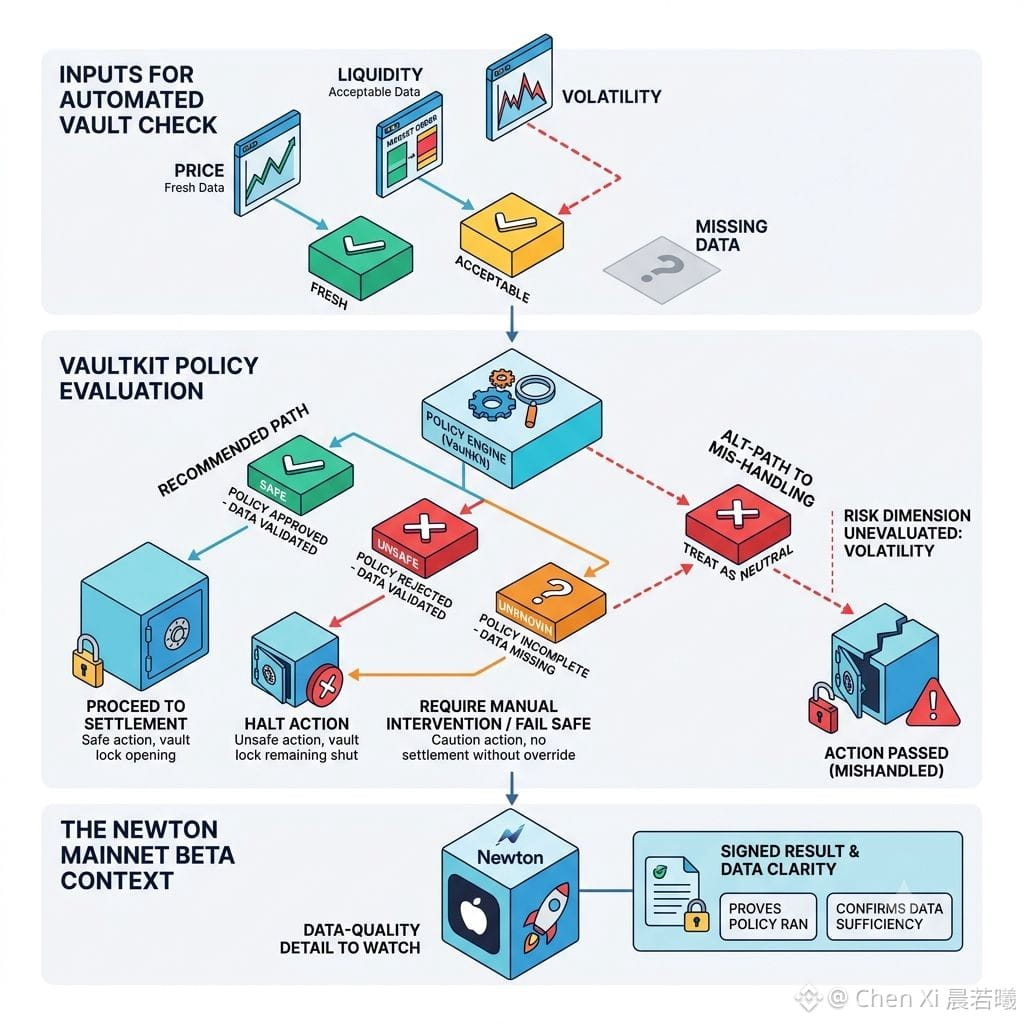
4
1
304
·
--
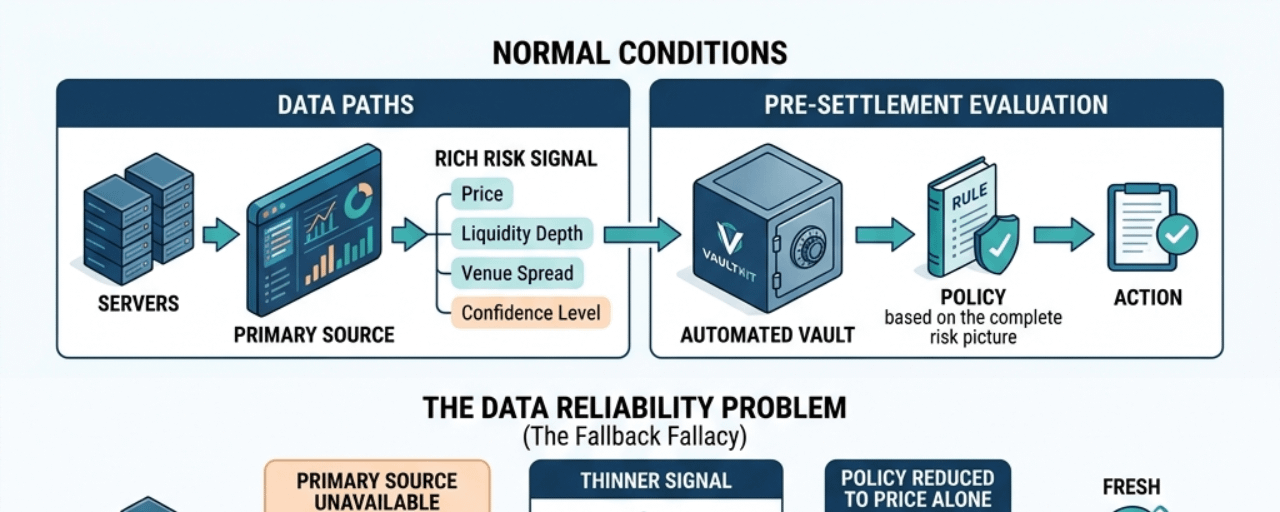
Article
The Fallback Worked. The Risk Signal Disappeared.The most dangerous backup data source is the one that keeps the number alive while quietly removing the context that made the number safe to use.
That is the data reliability problem I would watch around Newton Mainnet Beta.
In automated finance, fallback data sounds like resilience.
If the primary source is delayed, use another source.
If one oracle stops updating, read from a backup.
If one venue is unavailable, pull the price from a different venue.
The system keeps moving. The agent avoids downtime. The vault does not freeze just because one data path failed.
That is useful.
But fallback data is not automatically equivalent data.
A primary source may provide more than a price. It may provide liquidity depth, venue spread, confidence level, timestamp quality, asset coverage, and data-source health. A fallback source may only provide the last tradable price.
Both may look like “market data.”
Only one may be rich enough to govern risk.
Imagine an automated vault using VaultKit to evaluate a rebalance before settlement.
The policy says the vault can move into an asset only if the price deviation is below 1%, liquidity depth is above a defined threshold, and volatility is within the allowed band.
Under normal conditions, the policy reads from a primary data path that includes price, depth, spread, and recent volatility.
The action passes only when the full risk picture is aceptable.
Now volatility rises.
The primary source becomes delayed or unavailable.
The system switches to a fallback feed.
The fallback price is fresh.
The price deviation is only 0.4%.
The destination is approved.
The amount is inside the asset limit.
The pre-settlement check passes.
On paper, the system worked.
But the fallback feed did not provide reliable depth. It did not show that the main venue had widened spreads. It did not carry the same confidence signal as the primary source. It kept the price alive, but it removed the risk context around the price.
That is not the same decision.
A policy that was designed for price plus liquidity has now been reduced to price alone.
This is where the word “fresh” becomes dangerous.
Fresh fallback data can still be incomplete.
The issue is not whether the number updated recently.
The issue is whether the number still contains enough meaning to support the same policy decision.
That distinction matters for Newton because pre-settlement policy evaluation is only as reliable as the data interpretation behind it. Through VaultKit, applications can place policy checks before settlement. Signed authorization records can help show that an action was evaluated under a policy version.
But a signed result can prove that the policy ran.
It does not automatically prove that the data behind the policy had the same quality as usual.
That is the Yasir-style test I would apply:
Was the policy evaluating the same risk, or only a thinner version of the risk?
A serious integration should treat fallback activation as a change in decision quality, not just a change in data source.
If the primary source includes price, depth, volatility, and confidence while the fallback only includes price, the policy should not behave as if nothing changed.
It should downgrade confidence.
It should tighten limits.
It should require additional checks.
It should block high-risk actions until full data quality returns.
Or at minimum, the signed record should make clear that the action passed under fallback conditions.
This matters because fallback logic often fails quietly.
The policy may still return pass or fail.
The agent may still act.
The manager may still see a valid approval.
The vault may still settle normally.
But the decision has changed underneath the interface.
The system has not become more resilient.
It has become more confident with less evidence.
Consider a stablecoin strategy during a depeg scare.
A fallback source reports the asset at 0.997.
That looks acceptable.
But another venue shows thin liquidity. A large exit would move the market. Redemption queues are forming. The spread is widening.
If the fallback source only reports the price, the policy may approve exposure that looks safe numerically but is weak operationally.
The number is not false.
It is incomplete.
And incomplete data can be more dangerous than missing data because it lets the system continue with misplaced confidence.
There is a real trade-off.
If every fallback condition blocks automation, vaults may become fragile. A single data outage could freeze legitimate rebalances, emergency hedges, or user-protective actions.
But if every fallback source is treated as equal to the primary source, the system may execute under degraded visibility while pretending risk has not changed.
The better standard is graded fallback behavior.
A low-risk action may continue under fallback data.
A large allocation change may need reduced limits.
“A volatile asset may require multiple sources.
A route involving thin liquidity may need stronger confidence.
A strategy operating during market stress may pause expansion and allow only risk-reducing actions.
The policy should adapt to data quality, not merely data availability.
This is the standard I would apply to Newton Mainnet Beta.
Can a VaultKit-powered application distinguish primary data quality from fallback data quality?
Can it show when an authorization pased under degraded inputs?
Can policy rules change behavior when depth, spread, or confidence is missing?
Can signed results preserve not only the policy version, but the data-quality context behind the decision?
Can an agent be prevented from treating a price-only fallback as a full risk signal?
Automated vaults do not only need data that arrives.
They need data that still means enough.
Because the danger is not always a broken feed.
Sometimes the fallback works perfectly.
It gives the system a fresh number, a clean pass, and just enough missing context to make the approval unreliable.
$NEWT @NewtonProtocol #Newt $LAB $VANRY #Velvet #xau #VANRY #Labs
{future}(NEWTUSDT)
The Fallback Worked. The Risk Signal Disappeared.
The most dangerous backup data source is the one that keeps the number alive while quietly removing the context that made the number safe to use.
That is the data reliability problem I would watch around Newton Mainnet Beta.
In automated finance, fallback data sounds like resilience.
If the primary source is delayed, use another source.
If one oracle stops updating, read from a backup.
If one venue is unavailable, pull the price from a different venue.
The system keeps moving. The agent avoids downtime. The vault does not freeze just because one data path failed.
That is useful.
But fallback data is not automatically equivalent data.
A primary source may provide more than a price. It may provide liquidity depth, venue spread, confidence level, timestamp quality, asset coverage, and data-source health. A fallback source may only provide the last tradable price.
Both may look like “market data.”
Only one may be rich enough to govern risk.
Imagine an automated vault using VaultKit to evaluate a rebalance before settlement.
The policy says the vault can move into an asset only if the price deviation is below 1%, liquidity depth is above a defined threshold, and volatility is within the allowed band.
Under normal conditions, the policy reads from a primary data path that includes price, depth, spread, and recent volatility.
The action passes only when the full risk picture is aceptable.
Now volatility rises.
The primary source becomes delayed or unavailable.
The system switches to a fallback feed.
The fallback price is fresh.
The price deviation is only 0.4%.
The destination is approved.
The amount is inside the asset limit.
The pre-settlement check passes.
On paper, the system worked.
But the fallback feed did not provide reliable depth. It did not show that the main venue had widened spreads. It did not carry the same confidence signal as the primary source. It kept the price alive, but it removed the risk context around the price.
That is not the same decision.
A policy that was designed for price plus liquidity has now been reduced to price alone.
This is where the word “fresh” becomes dangerous.
Fresh fallback data can still be incomplete.
The issue is not whether the number updated recently.
The issue is whether the number still contains enough meaning to support the same policy decision.
That distinction matters for Newton because pre-settlement policy evaluation is only as reliable as the data interpretation behind it. Through VaultKit, applications can place policy checks before settlement. Signed authorization records can help show that an action was evaluated under a policy version.
But a signed result can prove that the policy ran.
It does not automatically prove that the data behind the policy had the same quality as usual.
That is the Yasir-style test I would apply:
Was the policy evaluating the same risk, or only a thinner version of the risk?
A serious integration should treat fallback activation as a change in decision quality, not just a change in data source.
If the primary source includes price, depth, volatility, and confidence while the fallback only includes price, the policy should not behave as if nothing changed.
It should downgrade confidence.
It should tighten limits.
It should require additional checks.
It should block high-risk actions until full data quality returns.
Or at minimum, the signed record should make clear that the action passed under fallback conditions.
This matters because fallback logic often fails quietly.
The policy may still return pass or fail.
The agent may still act.
The manager may still see a valid approval.
The vault may still settle normally.
But the decision has changed underneath the interface.
The system has not become more resilient.
It has become more confident with less evidence.
Consider a stablecoin strategy during a depeg scare.
A fallback source reports the asset at 0.997.
That looks acceptable.
But another venue shows thin liquidity. A large exit would move the market. Redemption queues are forming. The spread is widening.
If the fallback source only reports the price, the policy may approve exposure that looks safe numerically but is weak operationally.
The number is not false.
It is incomplete.
And incomplete data can be more dangerous than missing data because it lets the system continue with misplaced confidence.
There is a real trade-off.
If every fallback condition blocks automation, vaults may become fragile. A single data outage could freeze legitimate rebalances, emergency hedges, or user-protective actions.
But if every fallback source is treated as equal to the primary source, the system may execute under degraded visibility while pretending risk has not changed.
The better standard is graded fallback behavior.
A low-risk action may continue under fallback data.
A large allocation change may need reduced limits.
“A volatile asset may require multiple sources.
A route involving thin liquidity may need stronger confidence.
A strategy operating during market stress may pause expansion and allow only risk-reducing actions.
The policy should adapt to data quality, not merely data availability.
This is the standard I would apply to Newton Mainnet Beta.
Can a VaultKit-powered application distinguish primary data quality from fallback data quality?
Can it show when an authorization pased under degraded inputs?
Can policy rules change behavior when depth, spread, or confidence is missing?
Can signed results preserve not only the policy version, but the data-quality context behind the decision?
Can an agent be prevented from treating a price-only fallback as a full risk signal?
Automated vaults do not only need data that arrives.
They need data that still means enough.
Because the danger is not always a broken feed.
Sometimes the fallback works perfectly.
It gives the system a fresh number, a clean pass, and just enough missing context to make the approval unreliable.
$NEWT @NewtonProtocol #Newt $LAB $VANRY #Velvet #xau #VANRY #Labs
That is the data reliability problem I would watch around Newton Mainnet Beta.
In automated finance, fallback data sounds like resilience.
If the primary source is delayed, use another source.
If one oracle stops updating, read from a backup.
If one venue is unavailable, pull the price from a different venue.
The system keeps moving. The agent avoids downtime. The vault does not freeze just because one data path failed.
That is useful.
But fallback data is not automatically equivalent data.
A primary source may provide more than a price. It may provide liquidity depth, venue spread, confidence level, timestamp quality, asset coverage, and data-source health. A fallback source may only provide the last tradable price.
Both may look like “market data.”
Only one may be rich enough to govern risk.
Imagine an automated vault using VaultKit to evaluate a rebalance before settlement.
The policy says the vault can move into an asset only if the price deviation is below 1%, liquidity depth is above a defined threshold, and volatility is within the allowed band.
Under normal conditions, the policy reads from a primary data path that includes price, depth, spread, and recent volatility.
The action passes only when the full risk picture is aceptable.
Now volatility rises.
The primary source becomes delayed or unavailable.
The system switches to a fallback feed.
The fallback price is fresh.
The price deviation is only 0.4%.
The destination is approved.
The amount is inside the asset limit.
The pre-settlement check passes.
On paper, the system worked.
But the fallback feed did not provide reliable depth. It did not show that the main venue had widened spreads. It did not carry the same confidence signal as the primary source. It kept the price alive, but it removed the risk context around the price.
That is not the same decision.
A policy that was designed for price plus liquidity has now been reduced to price alone.
This is where the word “fresh” becomes dangerous.
Fresh fallback data can still be incomplete.
The issue is not whether the number updated recently.
The issue is whether the number still contains enough meaning to support the same policy decision.
That distinction matters for Newton because pre-settlement policy evaluation is only as reliable as the data interpretation behind it. Through VaultKit, applications can place policy checks before settlement. Signed authorization records can help show that an action was evaluated under a policy version.
But a signed result can prove that the policy ran.
It does not automatically prove that the data behind the policy had the same quality as usual.
That is the Yasir-style test I would apply:
Was the policy evaluating the same risk, or only a thinner version of the risk?
A serious integration should treat fallback activation as a change in decision quality, not just a change in data source.
If the primary source includes price, depth, volatility, and confidence while the fallback only includes price, the policy should not behave as if nothing changed.
It should downgrade confidence.
It should tighten limits.
It should require additional checks.
It should block high-risk actions until full data quality returns.
Or at minimum, the signed record should make clear that the action passed under fallback conditions.
This matters because fallback logic often fails quietly.
The policy may still return pass or fail.
The agent may still act.
The manager may still see a valid approval.
The vault may still settle normally.
But the decision has changed underneath the interface.
The system has not become more resilient.
It has become more confident with less evidence.
Consider a stablecoin strategy during a depeg scare.
A fallback source reports the asset at 0.997.
That looks acceptable.
But another venue shows thin liquidity. A large exit would move the market. Redemption queues are forming. The spread is widening.
If the fallback source only reports the price, the policy may approve exposure that looks safe numerically but is weak operationally.
The number is not false.
It is incomplete.
And incomplete data can be more dangerous than missing data because it lets the system continue with misplaced confidence.
There is a real trade-off.
If every fallback condition blocks automation, vaults may become fragile. A single data outage could freeze legitimate rebalances, emergency hedges, or user-protective actions.
But if every fallback source is treated as equal to the primary source, the system may execute under degraded visibility while pretending risk has not changed.
The better standard is graded fallback behavior.
A low-risk action may continue under fallback data.
A large allocation change may need reduced limits.
“A volatile asset may require multiple sources.
A route involving thin liquidity may need stronger confidence.
A strategy operating during market stress may pause expansion and allow only risk-reducing actions.
The policy should adapt to data quality, not merely data availability.
This is the standard I would apply to Newton Mainnet Beta.
Can a VaultKit-powered application distinguish primary data quality from fallback data quality?
Can it show when an authorization pased under degraded inputs?
Can policy rules change behavior when depth, spread, or confidence is missing?
Can signed results preserve not only the policy version, but the data-quality context behind the decision?
Can an agent be prevented from treating a price-only fallback as a full risk signal?
Automated vaults do not only need data that arrives.
They need data that still means enough.
Because the danger is not always a broken feed.
Sometimes the fallback works perfectly.
It gives the system a fresh number, a clean pass, and just enough missing context to make the approval unreliable.
$NEWT @NewtonProtocol #Newt $LAB $VANRY #Velvet #xau #VANRY #Labs
4
1
266
·
--
Bullish
The same price should not carry the same authority when confidence has collapsed.
Imagine a vault checks a stablecoin price before moving capital. The feed still shows $1, so the policy passes.
But under the surface, markets are thin, spreads are widening, and different venues are no longer agreeing tightly.
The number looks normal.
The confidence behind it does not.
That is the data-risk detail I would watch around Newton Mainnet Beta.
Through VaultKit, NewtonProtocol can place policy evaluation before settlement, but serious integrations should not only check the value of an input.
They should also check how reliable that value is under curent market conditions.
A valid number can become dangerous when uncertainty rises.
In automated finance, confidence is not metadata.
It is part of the risk.
$NEWT @NewtonProtocol #Newt $LAB $VANRY #Velvet #xau #VANRY #Labs
{future}(NEWTUSDT)
The same price should not carry the same authority when confidence has collapsed.
Imagine a vault checks a stablecoin price before moving capital. The feed still shows $1, so the policy passes.
But under the surface, markets are thin, spreads are widening, and different venues are no longer agreeing tightly.
The number looks normal.
The confidence behind it does not.
That is the data-risk detail I would watch around Newton Mainnet Beta.
Through VaultKit, NewtonProtocol can place policy evaluation before settlement, but serious integrations should not only check the value of an input.
They should also check how reliable that value is under curent market conditions.
A valid number can become dangerous when uncertainty rises.
In automated finance, confidence is not metadata.
It is part of the risk.
$NEWT @NewtonProtocol #Newt $LAB $VANRY #Velvet #xau #VANRY #Labs
Imagine a vault checks a stablecoin price before moving capital. The feed still shows $1, so the policy passes.
But under the surface, markets are thin, spreads are widening, and different venues are no longer agreeing tightly.
The number looks normal.
The confidence behind it does not.
That is the data-risk detail I would watch around Newton Mainnet Beta.
Through VaultKit, NewtonProtocol can place policy evaluation before settlement, but serious integrations should not only check the value of an input.
They should also check how reliable that value is under curent market conditions.
A valid number can become dangerous when uncertainty rises.
In automated finance, confidence is not metadata.
It is part of the risk.
$NEWT @NewtonProtocol #Newt $LAB $VANRY #Velvet #xau #VANRY #Labs
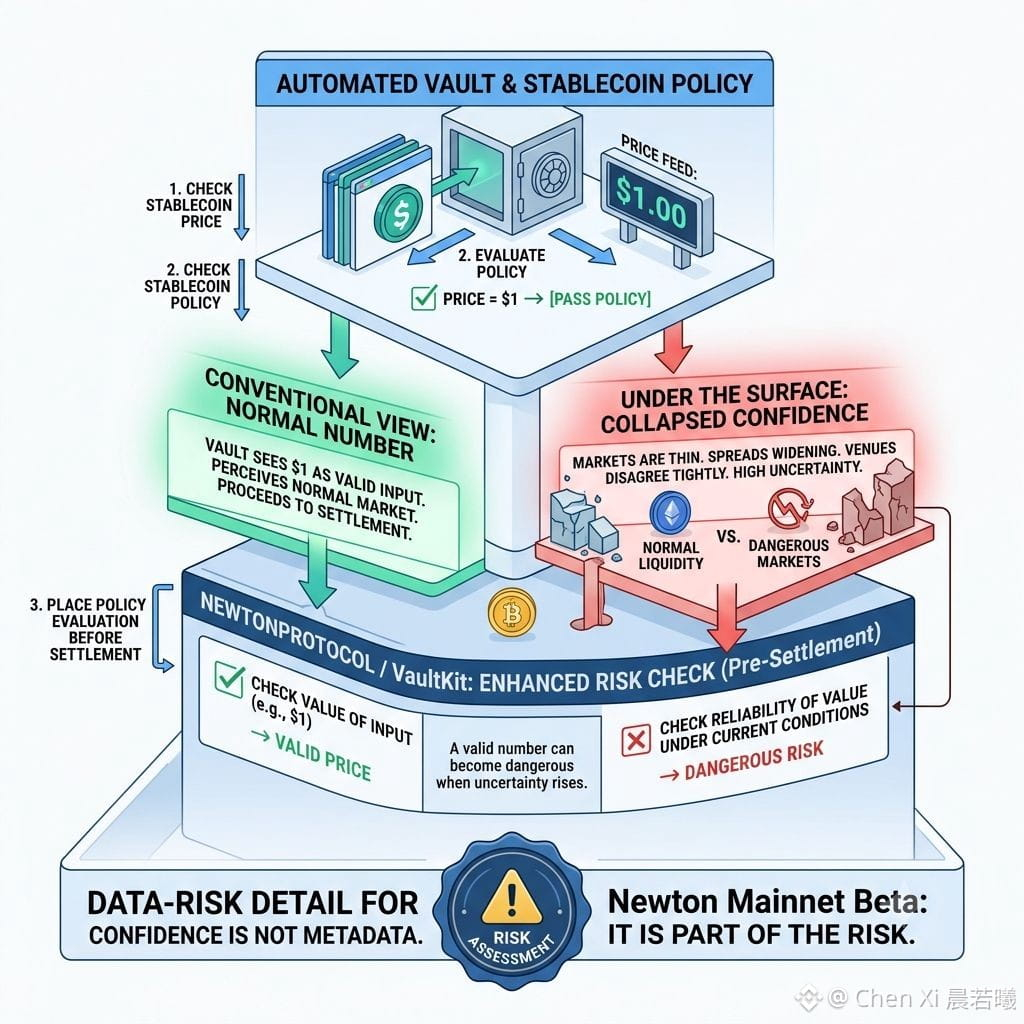
8
1
370
·
--
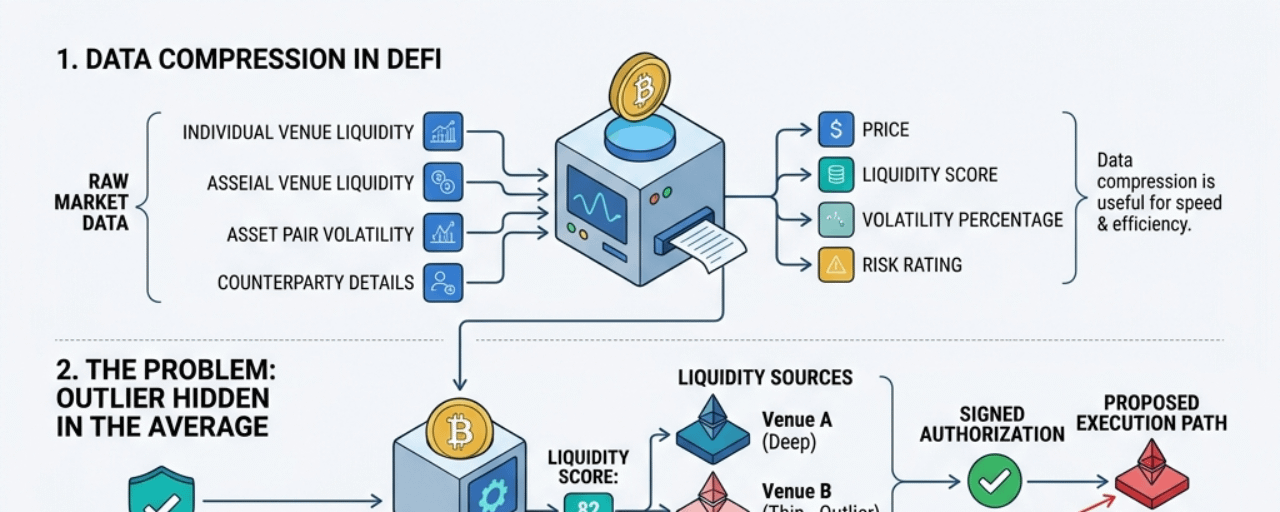
Article
The Average Passed. The Outlier Was the Risk.A policy can approve a calm number while the danger is hiding inside the data it averaged away.
That is the data problem I would watch closely around Newton Mainnet Beta.
Automated finance often depends on compressed inputs.
A price becomes one value.
Liquidity becomes one score.
Volatility becomes one percentage.
Risk becomes one rating.
That compression is useful. A policy system cannot inspect every market detail manually before each action. Applications need clean inputs so agents and vaults can decide quickly.
But compressed data can also hide the exact information that matters most.
Imagine an automated vault wants to move capital into a strategy that requires minimum liquidity.
The application receives a liquidity score above the required threshold.
The policy check passes before settlement.
The signed authorization result shows that the request satisfied the rule.
From the outside, everything looks corect.
But the liquidity score may be an average across several venues.
One venue may be deep.
Another may be thin.
One pool may have stable liquidity.
Another may be heavily imbalanced.
One route may be safe for a small order but dangerous for the actual execution size.
The average stays above the threshold.
The risky route still exists inside it.
This is not old data.
The data may be fresh.
It is different from corrupted data.
The sources may be authentic.
It is different from a unit mismatch.
The number may be formatted correctly.
The failure is that the policy trusted a summary without understanding what the summary concealed.
That matters because DeFi risk is often uneven.
Liquidity is not always distributed cleanly.
Slippage is not always linear.
A route that looks safe at 10,000 USDC may behave very differently at 500,000 USDC.
A volatility average may look calm while one asset pair is already breaking.
A counterparty risk score may look acceptable while one dependency carries most of the danger.
The average can pass while the tail risk is already flashing red.
This is where VaultKit becomes interesting to evaluate.
Through @NewtonProtocol, applications can place policy evaluation before settlement. That creates a powerful checkpoint where an action can be rejected before capital moves.
But the strength of that checkpoint depends heavily on the quality of the data it consumes.
If a VaultKit policy only sees “liquidity score: 82,” it may approve an action that looks safe at the summary level.
A stronger integration would preserve more context around that score:
which venues were included,
how the score was weighted,
whether any venue was excluded,
how much dispersion existed between sources,
whether the execution size was tested against available depth,
and whether an outlier was hidden inside the aggregate.
The point is not that every policy must read every raw data point.
That would make automation slow and difficult to maintain.
The point is that high-value actions should not rely on summaries that cannot explain their own risk.
A signed authorization record becomes more useful when it can show not only that a threshold was met, but also what kind of data structure produced that threshold.
For example, “average liquidity above 70” is weaker than “all required routes maintain minimum depth for the proposed execution size.”
“Volatility below 5%” is weaker than “no included venue shows extreme deviation.”
“Risk score acceptable” is weaker than “no single depndency dominates the risk profile.”
Those are different standards.
The first trusts compression.
The second asks whether compression is hiding danger.
This distinction matters especially for autonomous agents because agents optimize around rules.
If the rule says average liquidity must stay above a number, the agent may route through a path that satisfies the average while exposing capital to the weakest segment.
The agent may not be malicious.
It may simply obey the measurable condition.
That is the deeper risk: poorly designed data summaries can teach automation to find the safe-looking number instead of the safe execution.
A serious pre-settlement authorization layer should reduce that gap.
It should help applications define when aggregate data is enough and when distribution-level checks are required.
A small routine action may only need a simple score.
A large treasury movement may need depth by route.
A volatile market condition may require outlier detection.
A cross-venue strategy may need to know whether one source is carrying the entire average.
The standard should scale with the consequence of the action.
There is a trade-off.
More granular checks can improve safety, but they also increase complexity.
Too much detail can make policy rules harder to write, harder to review, and easier to misconfigure.
Too little detail can make clean authorization records that approve fragile decisions.
The solution is not maximum data.
It is relevant data.
A good policy should ask for the level of detail needed to judge the actual risk being taken.
This is the standard I would apply to Newton-powered applications.
Can the policy distinguish average safety from route-specific safety?
Can it detect when one source or venue dominates the result?
Can it treat outliers as risk signals instead of noise?
Can the authorization record preserve enough context for reviewers to understand why the summary was trusted?
Can high-value actions require deeper data than routine actions?
If the answer is yes, pre-settlement authorization becomes much more meaningful.
It no longer asks only whether the number pased.
It asks whether the number deserved to be trusted for that action.
That is the kind of data discipline automated finance needs.
Because a policy can be correct, the data can be fresh, and the signature can be valid — while the real risk sits inside the average no one bothered to open.
$NEWT @NewtonProtocol #Newt $LAB $VANRY #Velvet #xau #VANRY #Labs
{future}(NEWTUSDT)
The Average Passed. The Outlier Was the Risk.
A policy can approve a calm number while the danger is hiding inside the data it averaged away.
That is the data problem I would watch closely around Newton Mainnet Beta.
Automated finance often depends on compressed inputs.
A price becomes one value.
Liquidity becomes one score.
Volatility becomes one percentage.
Risk becomes one rating.
That compression is useful. A policy system cannot inspect every market detail manually before each action. Applications need clean inputs so agents and vaults can decide quickly.
But compressed data can also hide the exact information that matters most.
Imagine an automated vault wants to move capital into a strategy that requires minimum liquidity.
The application receives a liquidity score above the required threshold.
The policy check passes before settlement.
The signed authorization result shows that the request satisfied the rule.
From the outside, everything looks corect.
But the liquidity score may be an average across several venues.
One venue may be deep.
Another may be thin.
One pool may have stable liquidity.
Another may be heavily imbalanced.
One route may be safe for a small order but dangerous for the actual execution size.
The average stays above the threshold.
The risky route still exists inside it.
This is not old data.
The data may be fresh.
It is different from corrupted data.
The sources may be authentic.
It is different from a unit mismatch.
The number may be formatted correctly.
The failure is that the policy trusted a summary without understanding what the summary concealed.
That matters because DeFi risk is often uneven.
Liquidity is not always distributed cleanly.
Slippage is not always linear.
A route that looks safe at 10,000 USDC may behave very differently at 500,000 USDC.
A volatility average may look calm while one asset pair is already breaking.
A counterparty risk score may look acceptable while one dependency carries most of the danger.
The average can pass while the tail risk is already flashing red.
This is where VaultKit becomes interesting to evaluate.
Through @NewtonProtocol, applications can place policy evaluation before settlement. That creates a powerful checkpoint where an action can be rejected before capital moves.
But the strength of that checkpoint depends heavily on the quality of the data it consumes.
If a VaultKit policy only sees “liquidity score: 82,” it may approve an action that looks safe at the summary level.
A stronger integration would preserve more context around that score:
which venues were included,
how the score was weighted,
whether any venue was excluded,
how much dispersion existed between sources,
whether the execution size was tested against available depth,
and whether an outlier was hidden inside the aggregate.
The point is not that every policy must read every raw data point.
That would make automation slow and difficult to maintain.
The point is that high-value actions should not rely on summaries that cannot explain their own risk.
A signed authorization record becomes more useful when it can show not only that a threshold was met, but also what kind of data structure produced that threshold.
For example, “average liquidity above 70” is weaker than “all required routes maintain minimum depth for the proposed execution size.”
“Volatility below 5%” is weaker than “no included venue shows extreme deviation.”
“Risk score acceptable” is weaker than “no single depndency dominates the risk profile.”
Those are different standards.
The first trusts compression.
The second asks whether compression is hiding danger.
This distinction matters especially for autonomous agents because agents optimize around rules.
If the rule says average liquidity must stay above a number, the agent may route through a path that satisfies the average while exposing capital to the weakest segment.
The agent may not be malicious.
It may simply obey the measurable condition.
That is the deeper risk: poorly designed data summaries can teach automation to find the safe-looking number instead of the safe execution.
A serious pre-settlement authorization layer should reduce that gap.
It should help applications define when aggregate data is enough and when distribution-level checks are required.
A small routine action may only need a simple score.
A large treasury movement may need depth by route.
A volatile market condition may require outlier detection.
A cross-venue strategy may need to know whether one source is carrying the entire average.
The standard should scale with the consequence of the action.
There is a trade-off.
More granular checks can improve safety, but they also increase complexity.
Too much detail can make policy rules harder to write, harder to review, and easier to misconfigure.
Too little detail can make clean authorization records that approve fragile decisions.
The solution is not maximum data.
It is relevant data.
A good policy should ask for the level of detail needed to judge the actual risk being taken.
This is the standard I would apply to Newton-powered applications.
Can the policy distinguish average safety from route-specific safety?
Can it detect when one source or venue dominates the result?
Can it treat outliers as risk signals instead of noise?
Can the authorization record preserve enough context for reviewers to understand why the summary was trusted?
Can high-value actions require deeper data than routine actions?
If the answer is yes, pre-settlement authorization becomes much more meaningful.
It no longer asks only whether the number pased.
It asks whether the number deserved to be trusted for that action.
That is the kind of data discipline automated finance needs.
Because a policy can be correct, the data can be fresh, and the signature can be valid — while the real risk sits inside the average no one bothered to open.
$NEWT @NewtonProtocol #Newt $LAB $VANRY #Velvet #xau #VANRY #Labs
That is the data problem I would watch closely around Newton Mainnet Beta.
Automated finance often depends on compressed inputs.
A price becomes one value.
Liquidity becomes one score.
Volatility becomes one percentage.
Risk becomes one rating.
That compression is useful. A policy system cannot inspect every market detail manually before each action. Applications need clean inputs so agents and vaults can decide quickly.
But compressed data can also hide the exact information that matters most.
Imagine an automated vault wants to move capital into a strategy that requires minimum liquidity.
The application receives a liquidity score above the required threshold.
The policy check passes before settlement.
The signed authorization result shows that the request satisfied the rule.
From the outside, everything looks corect.
But the liquidity score may be an average across several venues.
One venue may be deep.
Another may be thin.
One pool may have stable liquidity.
Another may be heavily imbalanced.
One route may be safe for a small order but dangerous for the actual execution size.
The average stays above the threshold.
The risky route still exists inside it.
This is not old data.
The data may be fresh.
It is different from corrupted data.
The sources may be authentic.
It is different from a unit mismatch.
The number may be formatted correctly.
The failure is that the policy trusted a summary without understanding what the summary concealed.
That matters because DeFi risk is often uneven.
Liquidity is not always distributed cleanly.
Slippage is not always linear.
A route that looks safe at 10,000 USDC may behave very differently at 500,000 USDC.
A volatility average may look calm while one asset pair is already breaking.
A counterparty risk score may look acceptable while one dependency carries most of the danger.
The average can pass while the tail risk is already flashing red.
This is where VaultKit becomes interesting to evaluate.
Through @NewtonProtocol, applications can place policy evaluation before settlement. That creates a powerful checkpoint where an action can be rejected before capital moves.
But the strength of that checkpoint depends heavily on the quality of the data it consumes.
If a VaultKit policy only sees “liquidity score: 82,” it may approve an action that looks safe at the summary level.
A stronger integration would preserve more context around that score:
which venues were included,
how the score was weighted,
whether any venue was excluded,
how much dispersion existed between sources,
whether the execution size was tested against available depth,
and whether an outlier was hidden inside the aggregate.
The point is not that every policy must read every raw data point.
That would make automation slow and difficult to maintain.
The point is that high-value actions should not rely on summaries that cannot explain their own risk.
A signed authorization record becomes more useful when it can show not only that a threshold was met, but also what kind of data structure produced that threshold.
For example, “average liquidity above 70” is weaker than “all required routes maintain minimum depth for the proposed execution size.”
“Volatility below 5%” is weaker than “no included venue shows extreme deviation.”
“Risk score acceptable” is weaker than “no single depndency dominates the risk profile.”
Those are different standards.
The first trusts compression.
The second asks whether compression is hiding danger.
This distinction matters especially for autonomous agents because agents optimize around rules.
If the rule says average liquidity must stay above a number, the agent may route through a path that satisfies the average while exposing capital to the weakest segment.
The agent may not be malicious.
It may simply obey the measurable condition.
That is the deeper risk: poorly designed data summaries can teach automation to find the safe-looking number instead of the safe execution.
A serious pre-settlement authorization layer should reduce that gap.
It should help applications define when aggregate data is enough and when distribution-level checks are required.
A small routine action may only need a simple score.
A large treasury movement may need depth by route.
A volatile market condition may require outlier detection.
A cross-venue strategy may need to know whether one source is carrying the entire average.
The standard should scale with the consequence of the action.
There is a trade-off.
More granular checks can improve safety, but they also increase complexity.
Too much detail can make policy rules harder to write, harder to review, and easier to misconfigure.
Too little detail can make clean authorization records that approve fragile decisions.
The solution is not maximum data.
It is relevant data.
A good policy should ask for the level of detail needed to judge the actual risk being taken.
This is the standard I would apply to Newton-powered applications.
Can the policy distinguish average safety from route-specific safety?
Can it detect when one source or venue dominates the result?
Can it treat outliers as risk signals instead of noise?
Can the authorization record preserve enough context for reviewers to understand why the summary was trusted?
Can high-value actions require deeper data than routine actions?
If the answer is yes, pre-settlement authorization becomes much more meaningful.
It no longer asks only whether the number pased.
It asks whether the number deserved to be trusted for that action.
That is the kind of data discipline automated finance needs.
Because a policy can be correct, the data can be fresh, and the signature can be valid — while the real risk sits inside the average no one bothered to open.
$NEWT @NewtonProtocol #Newt $LAB $VANRY #Velvet #xau #VANRY #Labs
4
479
·
--
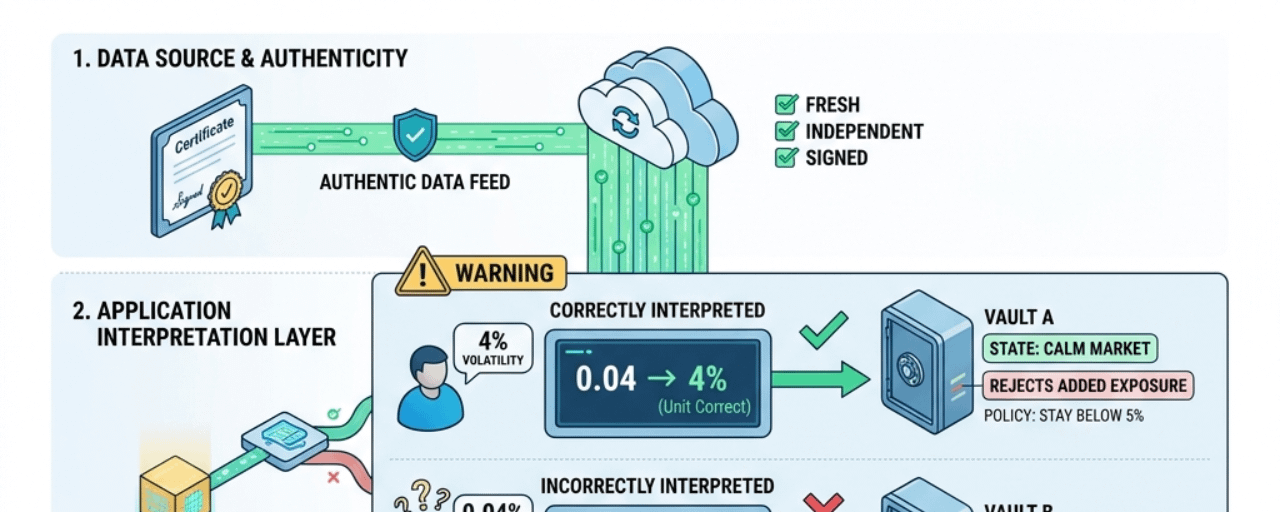
Article
The Data Was Correct Until the Application Translated ItA price feed can be fresh, independent, and authentic—and still become dangerous after one incorrect conversion.
Imagine an automated vault that may increase exposure only when market volatility remains below 5%.
The data provider reports volatility as 0.04.
One application interprets that value correctly as 4%.
Another treats it as 0.04%.
Both applications receive the same signed input.
Both can prove where the number came from.
Only one understands what the number means.
The second vault sees an apparently calm market, approves aditional exposure, and settles the action under a policy that worked exactly as written.
Nothing was stale.
No source was manipulated.
The failure occurred between receiving the data and turning it into a policy input.
That translation layer is the part of autonomous finance I think receives too little attention.
Financial policies rarely consume raw reality.
They consume representations of reality.
A price becomes a collateral value.
Several prices become a volatility estimate.
Liquidity observations become a risk score.
Counterparty information becomes an eligibility result.
Each transformation introduces assumptions about units, decimal precision, time windows, asset identifiers, rounding, aggregation, and missing values.
By the time an authorization rule evaluates the result, the original data may have passed through several pieces of software.
The policy does not see the market directly.
It sees what the application says the market means.
This is where Newton Mainnet Beta becomes especially interesting to me.
Through VaultKit, applications can define conditions around what an agent, manager, or automated strategy is allowed to do. @NewtonProtocol can place that policy evaluation before settlement, creating a point where an unsafe action can still be rejected before value moves.
A signed authorization result can also make the decision easier to inspect afterward.
But the strength of that result depends on more than the source and timestamp of the input.
I would also want to understand how the application transformed that input before the policy evaluated it.
Suppose a vault policy says collateralization must remain above 150%.
That ratio may depend on several earlier decisions:
Which assets count as collateral?
Which price represents each asset?
Are liabilities measured before or after pending interest?
How are token decimals normalized?
Does the ratio use the latest observation or an average?
How does the system handle an aset that temporarily lacks a price?
The final number may look precise.
Its meaning depends on the complete calculation behind it.
A policy can therefore be deterministic while the path into that policy remains ambiguous.
That distinction matters because software often hides transformation complexity behind one clean variable.
collateral_ratio = 1.54
The policy sees 154% and approves the action.
But that single value may contain several assumptions that the authorization record does not make visible.
If one token was interpreted with the wrong decimal precision, if one liability was excluded, or if one price was converted through the wrong quote asset, the final ratio can still look perfectly valid.
The cleaner the result appears, the easier it may be to trust without examining its construction.
I think serious Newton-powered applications should treat transformation logic as part of authorization provenance.
A meaningful decision record should not necessarily publish every line of application code.
But an authorized reviewer should be able to determine:
Which raw inputs were used?
Which transformation version converted them into the policy variable?
What units and precision were expected?
Which time window shaped the derived metric?
How were missing or conflicting values handled?
Did the settled action use the same calculation that the policy was designed around?
Those questions become especially important after an application update.
A developer may improve the risk engine without changing the policy text.
The rule still says “volatility below 5%.”
But the new version may calculate volatility over one hour instead of twenty-four hours.
It may use a different sampling interval.
It may exclude low-liquidity venues.
It may change how extreme observations are handled.
The policy wording remains identical while the number entering it acquires a different meaning.
That is not necessarily a bug.
The new model may be better.
But changing the interpretation of a policy input can change the authority boundary just as much as changing the policy itself.
If an agent was permitted to act under the old calculation, the application should not assume that the same permission carries the same meaning under the new one.
This creates a difficult operational trade-off.
Recording every intermediate calculation can improve auditability.
It can also create larger records, slower processing, greater implementation complexity, and possible exposure of proprietary risk logic.
Recording only the final number keeps the system simpler.
It may also make a disputed authorization impossible to reconstruct.
The goal should not be maximum data disclosure.
It should be sufficient lineage.
The application should preserve enough context to show how the value used by the policy was produced, without exposing information unrelated to the authorization decision.
Different actions may also deserve different levels of evidence.
A small risk-reducing repayment may not require the same transformation scrutiny as opening a large leveraged position.
A routine rebalance may tolerate conservative rounding.
A collateral withdrawal near a liquidation threshold may require much stricter precision.
The consequence of the action should influence how much confidence the system demands from the calculation behind it.
This becomes even more important when AI agents consume authorization results automatically.
A human analyst may notice that a volatility figure looks unrealistic.
Software may see a valid policy result and continue immediately.
If the input variable was produced incorrectly, automation can repeat the same translation error across many actions while every authorization appears internally consistent.
Consistency does not repair a misunderstood unit.
A signature does not correct a wrong calculation.
And a policy cannot protect against assumptions it was never told to examine.
That is the standard I would apply to Newton Mainnet Beta.
Not only whether an application can verify that data was fresh and approved.
Whether it can preserve the meaning of that data as it moves from source to calculation to policy to settlement.
The strongest authorization record should help answer more than:
“Was this number accepted?”
It should help answer:
“What did this number mean when the system decided capital could move?”
Because in autonomous finance, the dangerous input may not be false, stale, or manipulated.
It may be completely correct—until the application translates it into something else.
$NEWT @NewtonProtocol #Newt $LAB $VANRY #Velvet #xau #VANRY #Labs
{future}(NEWTUSDT)
The Data Was Correct Until the Application Translated It
A price feed can be fresh, independent, and authentic—and still become dangerous after one incorrect conversion.
Imagine an automated vault that may increase exposure only when market volatility remains below 5%.
The data provider reports volatility as 0.04.
One application interprets that value correctly as 4%.
Another treats it as 0.04%.
Both applications receive the same signed input.
Both can prove where the number came from.
Only one understands what the number means.
The second vault sees an apparently calm market, approves aditional exposure, and settles the action under a policy that worked exactly as written.
Nothing was stale.
No source was manipulated.
The failure occurred between receiving the data and turning it into a policy input.
That translation layer is the part of autonomous finance I think receives too little attention.
Financial policies rarely consume raw reality.
They consume representations of reality.
A price becomes a collateral value.
Several prices become a volatility estimate.
Liquidity observations become a risk score.
Counterparty information becomes an eligibility result.
Each transformation introduces assumptions about units, decimal precision, time windows, asset identifiers, rounding, aggregation, and missing values.
By the time an authorization rule evaluates the result, the original data may have passed through several pieces of software.
The policy does not see the market directly.
It sees what the application says the market means.
This is where Newton Mainnet Beta becomes especially interesting to me.
Through VaultKit, applications can define conditions around what an agent, manager, or automated strategy is allowed to do. @NewtonProtocol can place that policy evaluation before settlement, creating a point where an unsafe action can still be rejected before value moves.
A signed authorization result can also make the decision easier to inspect afterward.
But the strength of that result depends on more than the source and timestamp of the input.
I would also want to understand how the application transformed that input before the policy evaluated it.
Suppose a vault policy says collateralization must remain above 150%.
That ratio may depend on several earlier decisions:
Which assets count as collateral?
Which price represents each asset?
Are liabilities measured before or after pending interest?
How are token decimals normalized?
Does the ratio use the latest observation or an average?
How does the system handle an aset that temporarily lacks a price?
The final number may look precise.
Its meaning depends on the complete calculation behind it.
A policy can therefore be deterministic while the path into that policy remains ambiguous.
That distinction matters because software often hides transformation complexity behind one clean variable.
collateral_ratio = 1.54
The policy sees 154% and approves the action.
But that single value may contain several assumptions that the authorization record does not make visible.
If one token was interpreted with the wrong decimal precision, if one liability was excluded, or if one price was converted through the wrong quote asset, the final ratio can still look perfectly valid.
The cleaner the result appears, the easier it may be to trust without examining its construction.
I think serious Newton-powered applications should treat transformation logic as part of authorization provenance.
A meaningful decision record should not necessarily publish every line of application code.
But an authorized reviewer should be able to determine:
Which raw inputs were used?
Which transformation version converted them into the policy variable?
What units and precision were expected?
Which time window shaped the derived metric?
How were missing or conflicting values handled?
Did the settled action use the same calculation that the policy was designed around?
Those questions become especially important after an application update.
A developer may improve the risk engine without changing the policy text.
The rule still says “volatility below 5%.”
But the new version may calculate volatility over one hour instead of twenty-four hours.
It may use a different sampling interval.
It may exclude low-liquidity venues.
It may change how extreme observations are handled.
The policy wording remains identical while the number entering it acquires a different meaning.
That is not necessarily a bug.
The new model may be better.
But changing the interpretation of a policy input can change the authority boundary just as much as changing the policy itself.
If an agent was permitted to act under the old calculation, the application should not assume that the same permission carries the same meaning under the new one.
This creates a difficult operational trade-off.
Recording every intermediate calculation can improve auditability.
It can also create larger records, slower processing, greater implementation complexity, and possible exposure of proprietary risk logic.
Recording only the final number keeps the system simpler.
It may also make a disputed authorization impossible to reconstruct.
The goal should not be maximum data disclosure.
It should be sufficient lineage.
The application should preserve enough context to show how the value used by the policy was produced, without exposing information unrelated to the authorization decision.
Different actions may also deserve different levels of evidence.
A small risk-reducing repayment may not require the same transformation scrutiny as opening a large leveraged position.
A routine rebalance may tolerate conservative rounding.
A collateral withdrawal near a liquidation threshold may require much stricter precision.
The consequence of the action should influence how much confidence the system demands from the calculation behind it.
This becomes even more important when AI agents consume authorization results automatically.
A human analyst may notice that a volatility figure looks unrealistic.
Software may see a valid policy result and continue immediately.
If the input variable was produced incorrectly, automation can repeat the same translation error across many actions while every authorization appears internally consistent.
Consistency does not repair a misunderstood unit.
A signature does not correct a wrong calculation.
And a policy cannot protect against assumptions it was never told to examine.
That is the standard I would apply to Newton Mainnet Beta.
Not only whether an application can verify that data was fresh and approved.
Whether it can preserve the meaning of that data as it moves from source to calculation to policy to settlement.
The strongest authorization record should help answer more than:
“Was this number accepted?”
It should help answer:
“What did this number mean when the system decided capital could move?”
Because in autonomous finance, the dangerous input may not be false, stale, or manipulated.
It may be completely correct—until the application translates it into something else.
$NEWT @NewtonProtocol #Newt $LAB $VANRY #Velvet #xau #VANRY #Labs
Imagine an automated vault that may increase exposure only when market volatility remains below 5%.
The data provider reports volatility as 0.04.
One application interprets that value correctly as 4%.
Another treats it as 0.04%.
Both applications receive the same signed input.
Both can prove where the number came from.
Only one understands what the number means.
The second vault sees an apparently calm market, approves aditional exposure, and settles the action under a policy that worked exactly as written.
Nothing was stale.
No source was manipulated.
The failure occurred between receiving the data and turning it into a policy input.
That translation layer is the part of autonomous finance I think receives too little attention.
Financial policies rarely consume raw reality.
They consume representations of reality.
A price becomes a collateral value.
Several prices become a volatility estimate.
Liquidity observations become a risk score.
Counterparty information becomes an eligibility result.
Each transformation introduces assumptions about units, decimal precision, time windows, asset identifiers, rounding, aggregation, and missing values.
By the time an authorization rule evaluates the result, the original data may have passed through several pieces of software.
The policy does not see the market directly.
It sees what the application says the market means.
This is where Newton Mainnet Beta becomes especially interesting to me.
Through VaultKit, applications can define conditions around what an agent, manager, or automated strategy is allowed to do. @NewtonProtocol can place that policy evaluation before settlement, creating a point where an unsafe action can still be rejected before value moves.
A signed authorization result can also make the decision easier to inspect afterward.
But the strength of that result depends on more than the source and timestamp of the input.
I would also want to understand how the application transformed that input before the policy evaluated it.
Suppose a vault policy says collateralization must remain above 150%.
That ratio may depend on several earlier decisions:
Which assets count as collateral?
Which price represents each asset?
Are liabilities measured before or after pending interest?
How are token decimals normalized?
Does the ratio use the latest observation or an average?
How does the system handle an aset that temporarily lacks a price?
The final number may look precise.
Its meaning depends on the complete calculation behind it.
A policy can therefore be deterministic while the path into that policy remains ambiguous.
That distinction matters because software often hides transformation complexity behind one clean variable.
collateral_ratio = 1.54
The policy sees 154% and approves the action.
But that single value may contain several assumptions that the authorization record does not make visible.
If one token was interpreted with the wrong decimal precision, if one liability was excluded, or if one price was converted through the wrong quote asset, the final ratio can still look perfectly valid.
The cleaner the result appears, the easier it may be to trust without examining its construction.
I think serious Newton-powered applications should treat transformation logic as part of authorization provenance.
A meaningful decision record should not necessarily publish every line of application code.
But an authorized reviewer should be able to determine:
Which raw inputs were used?
Which transformation version converted them into the policy variable?
What units and precision were expected?
Which time window shaped the derived metric?
How were missing or conflicting values handled?
Did the settled action use the same calculation that the policy was designed around?
Those questions become especially important after an application update.
A developer may improve the risk engine without changing the policy text.
The rule still says “volatility below 5%.”
But the new version may calculate volatility over one hour instead of twenty-four hours.
It may use a different sampling interval.
It may exclude low-liquidity venues.
It may change how extreme observations are handled.
The policy wording remains identical while the number entering it acquires a different meaning.
That is not necessarily a bug.
The new model may be better.
But changing the interpretation of a policy input can change the authority boundary just as much as changing the policy itself.
If an agent was permitted to act under the old calculation, the application should not assume that the same permission carries the same meaning under the new one.
This creates a difficult operational trade-off.
Recording every intermediate calculation can improve auditability.
It can also create larger records, slower processing, greater implementation complexity, and possible exposure of proprietary risk logic.
Recording only the final number keeps the system simpler.
It may also make a disputed authorization impossible to reconstruct.
The goal should not be maximum data disclosure.
It should be sufficient lineage.
The application should preserve enough context to show how the value used by the policy was produced, without exposing information unrelated to the authorization decision.
Different actions may also deserve different levels of evidence.
A small risk-reducing repayment may not require the same transformation scrutiny as opening a large leveraged position.
A routine rebalance may tolerate conservative rounding.
A collateral withdrawal near a liquidation threshold may require much stricter precision.
The consequence of the action should influence how much confidence the system demands from the calculation behind it.
This becomes even more important when AI agents consume authorization results automatically.
A human analyst may notice that a volatility figure looks unrealistic.
Software may see a valid policy result and continue immediately.
If the input variable was produced incorrectly, automation can repeat the same translation error across many actions while every authorization appears internally consistent.
Consistency does not repair a misunderstood unit.
A signature does not correct a wrong calculation.
And a policy cannot protect against assumptions it was never told to examine.
That is the standard I would apply to Newton Mainnet Beta.
Not only whether an application can verify that data was fresh and approved.
Whether it can preserve the meaning of that data as it moves from source to calculation to policy to settlement.
The strongest authorization record should help answer more than:
“Was this number accepted?”
It should help answer:
“What did this number mean when the system decided capital could move?”
Because in autonomous finance, the dangerous input may not be false, stale, or manipulated.
It may be completely correct—until the application translates it into something else.
$NEWT @NewtonProtocol #Newt $LAB $VANRY #Velvet #xau #VANRY #Labs
2
369
·
--
Bullish
A policy should never trust a number without knowing what that number means.
Imagine a vault permits an action when its liquidity score remains above 70.
Under the original model, that score is measured out of 100. After an application update, the calculation changes—but the policy threshold remains 70.
The input is fresh.
The calculation succeeds.
The rule passes.
Yet the system may now be comparing the same threshold against a different definition of risk.
That is the data challenge I see around Newton Mainet Beta. Through VaultKit, @NewtonProtocol can place policy evaluation before settlement, but a serious authorization record should preserve the input’s unit, precision, calculation version, and intended meaning.
A signed result can prove that the rule ran.
It should also make clear what the number meant when capital was allowed to move.
$NEWT @NewtonProtocol #Newt $LAB $VANRY #Velvet #xau #VANRY #Labs
{future}(NEWTUSDT)
A policy should never trust a number without knowing what that number means.
Imagine a vault permits an action when its liquidity score remains above 70.
Under the original model, that score is measured out of 100. After an application update, the calculation changes—but the policy threshold remains 70.
The input is fresh.
The calculation succeeds.
The rule passes.
Yet the system may now be comparing the same threshold against a different definition of risk.
That is the data challenge I see around Newton Mainet Beta. Through VaultKit, @NewtonProtocol can place policy evaluation before settlement, but a serious authorization record should preserve the input’s unit, precision, calculation version, and intended meaning.
A signed result can prove that the rule ran.
It should also make clear what the number meant when capital was allowed to move.
$NEWT @NewtonProtocol #Newt $LAB $VANRY #Velvet #xau #VANRY #Labs
Imagine a vault permits an action when its liquidity score remains above 70.
Under the original model, that score is measured out of 100. After an application update, the calculation changes—but the policy threshold remains 70.
The input is fresh.
The calculation succeeds.
The rule passes.
Yet the system may now be comparing the same threshold against a different definition of risk.
That is the data challenge I see around Newton Mainet Beta. Through VaultKit, @NewtonProtocol can place policy evaluation before settlement, but a serious authorization record should preserve the input’s unit, precision, calculation version, and intended meaning.
A signed result can prove that the rule ran.
It should also make clear what the number meant when capital was allowed to move.
$NEWT @NewtonProtocol #Newt $LAB $VANRY #Velvet #xau #VANRY #Labs
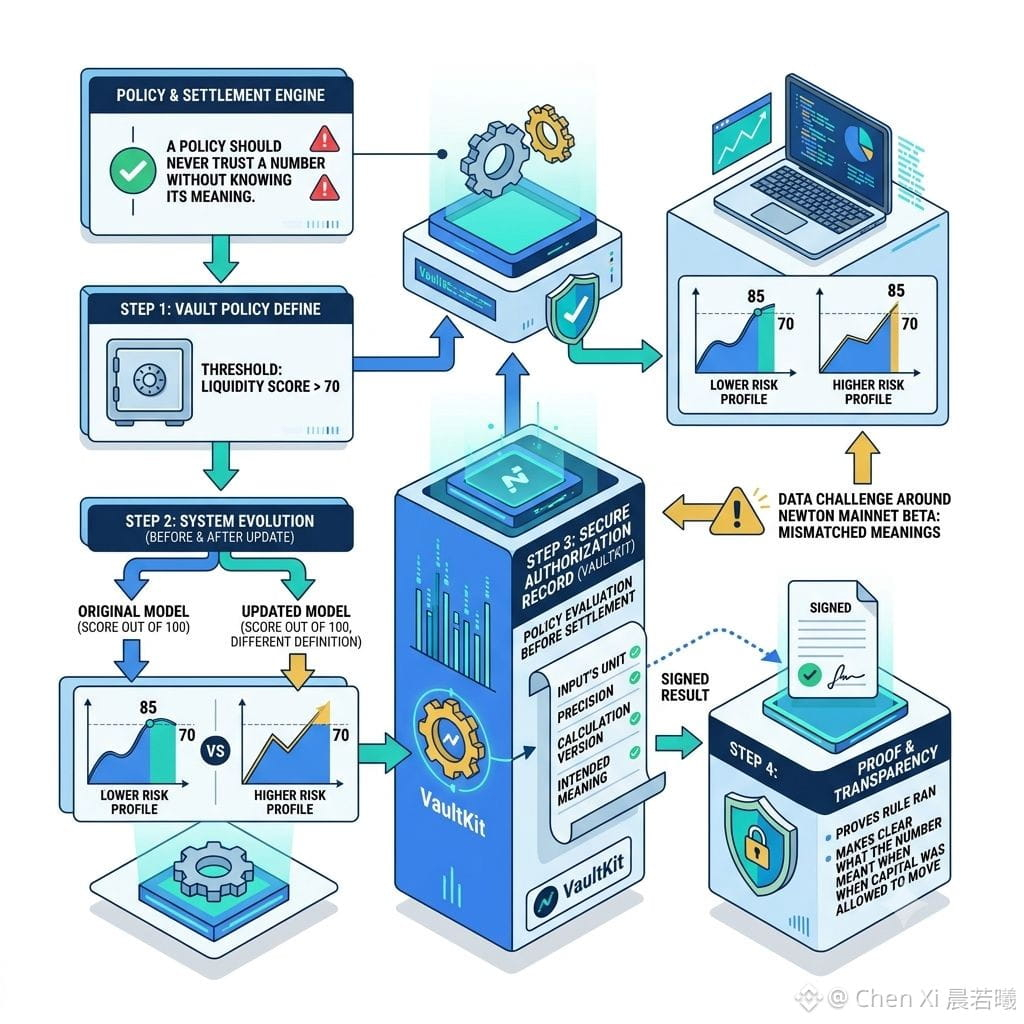
427
·
--
Bullish
The most suspicious moment in a multi-source system may be when every source agrees too easily.
Imagine a vault checks five approved price feeds before opening exposure. Every value is fresh. Every number falls inside the permitted range. The policy passes.
But all five feeds ultimately depend on the same thin market.
The system has not collected five independent opinions. It has repeated one dependency five times—and mistaken agrement for confidence.
That is the data test I see around Newton Mainnet Beta. Through VaultKit, @NewtonProtocol can place policy evaluation before settlement.
But I would judge a serious integration by whether it distinguishes the number of feeds from the number of independent failure paths behind them.
More confirmations do not automaticaly create stronger evidence.
Five feeds are still one opinion when they all learned the answer from the same place.
$NEWT @NewtonProtocol #Newt $LAB $VANRY #Velvet #xau #VANRY #Labs
{future}(NEWTUSDT)
The most suspicious moment in a multi-source system may be when every source agrees too easily.
Imagine a vault checks five approved price feeds before opening exposure. Every value is fresh. Every number falls inside the permitted range. The policy passes.
But all five feeds ultimately depend on the same thin market.
The system has not collected five independent opinions. It has repeated one dependency five times—and mistaken agrement for confidence.
That is the data test I see around Newton Mainnet Beta. Through VaultKit, @NewtonProtocol can place policy evaluation before settlement.
But I would judge a serious integration by whether it distinguishes the number of feeds from the number of independent failure paths behind them.
More confirmations do not automaticaly create stronger evidence.
Five feeds are still one opinion when they all learned the answer from the same place.
$NEWT @NewtonProtocol #Newt $LAB $VANRY #Velvet #xau #VANRY #Labs
Imagine a vault checks five approved price feeds before opening exposure. Every value is fresh. Every number falls inside the permitted range. The policy passes.
But all five feeds ultimately depend on the same thin market.
The system has not collected five independent opinions. It has repeated one dependency five times—and mistaken agrement for confidence.
That is the data test I see around Newton Mainnet Beta. Through VaultKit, @NewtonProtocol can place policy evaluation before settlement.
But I would judge a serious integration by whether it distinguishes the number of feeds from the number of independent failure paths behind them.
More confirmations do not automaticaly create stronger evidence.
Five feeds are still one opinion when they all learned the answer from the same place.
$NEWT @NewtonProtocol #Newt $LAB $VANRY #Velvet #xau #VANRY #Labs
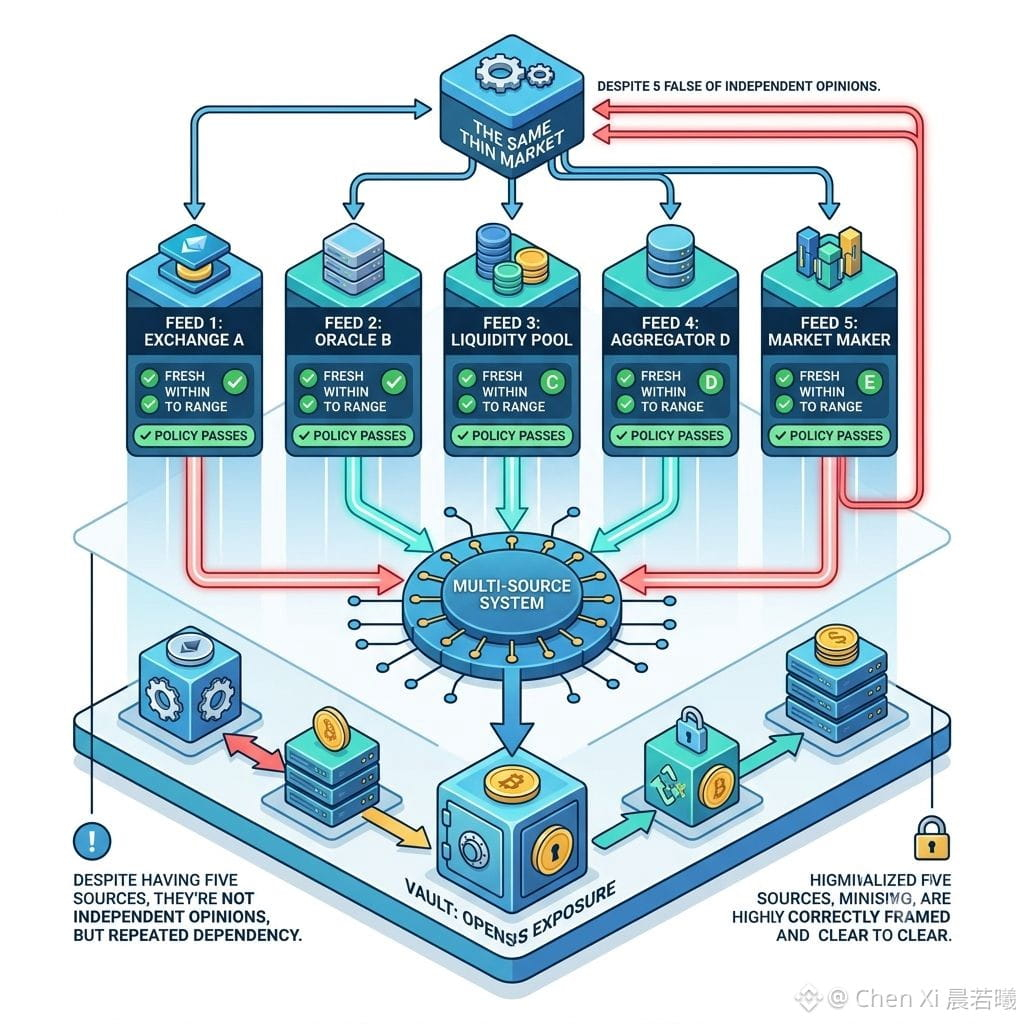
1
1
441
·
--
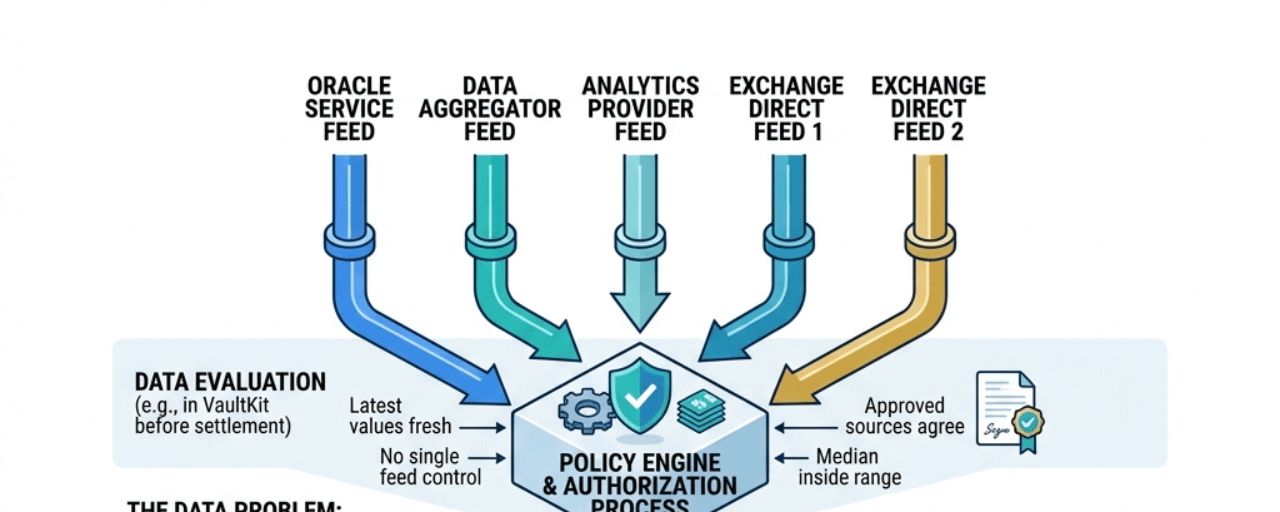
Article
Five Data Feeds Can Still Be One SourceA system can consult five independent-looking feeds and still be seeing the market through one pair of eyes.
Imagine an automated vault that will rebalance only when several approved price sources agree.
The policy appears conservative.
No single feed can control the result.
The latest values are fresh.
The median remains inside the permitted range.
VaultKit evaluates the action before settlement, every required condition passes, and the authorization process produces a signed result.
Then the vault discovers that all five feeds depended, directly or indirectly, on the same thin market.
They did not fail separately.
They repeated the same weakness five times.
Nothing needed to be fabricated.
The data could be current.
The values could agree.
The policy could execute exactly as designed.
The hidden failure would be treating agrement as independence.
That is the data problem I think becomes more important as autonomous finance relies on increasingly complex evidence.
A policy engine can count how many sources support a decision.
It cannot assume that those sources represent genuinely different information simply because they arrive through different interfaces.
Three providers may ultimately reference the same exchange.
Several feeds may use the same upstream aggregator.
Different market-data services may depend on liquidity concentrated in one venue.
Even independently operated systems can become correlated when they observe the same narrow part of the market.
From the application’s perspective, the evidence appears diverse.
From the risk perspective, it may still have one point of failure.
This is where I find Newton Mainnet Beta interesting.
Through VaultKit, applications can define conditions around what an agent, manager, or automated strategy is permitted to do. @NewtonProtocol can place that evaluation before settlement, creating a point where an action can still be rejected before value moves. Signed attestations can also make the authorization event easier to inspect afterward.
That is a stronger position than reviewing the decision only after the transaction becomes final.
But a signed result can prove that the required checks occurred without proving that the evidence behind those checks was meaningfuly independent.
An attestation may show that five approved inputs agreed.
It does not automatically show that those five inputs represented five separate views of reality.
For me, that distinction is critical.
Consensus among sources can increase confidence only when disagreement was genuinely possible.
If every feed shares the same upstream dependency, agreement may be the default outcome even when the dependency itself is wrong.
The number of sources then becomes a misleading security metric.
The stronger question is not:
How many feeds were checked?
It is:
How many distinct failure paths were represented?
Consider a vault using several price inputs before opening new exposure.
One feed comes from an oracle service.
Another comes through a data aggregator.
A third is supplied by an analytics provider.
On the surface, the sources look independent.
But if all three calculate their reference price from the same exchange during a period of weak liquidity, the application has not diversified its evidence as much as it appears.
The interfaces are different.
The underlying market assumption is the same.
This creates a subtle failure because the policy may look more robust precisely when it has become more dependent.
More feeds produce more confirmations.
More confirmations create greater confidence.
Greater confidence allows the agent to act faster.
Yet the entire chain may still rest on one market that temporarily stopped representing broader value.
Automation can therefore scale false confidence without any participant behaving dishonestly.
That is different from stale data.
A stale input describes an earlier market.
Correlated evidence may describe the current market accurately—but only from one narrow and potentially distorted viewpoint.
Both can authorize the wrong action.
They fail for different reasons.
I would want serious Newton-powered applications to preserve that distinction.
A policy should not treat “fresh” and “independent” as interchangeable properties.
It should also avoid treating every source as equal simply because each one is approved.
Some decisions may require diversity across venues.
Others may require diversity across providers.
A high-risk action may need evidence that reflects both price and available liquidity.
A low-risk repayment may remain safe with a simpler standard.
The evidence requirement should match the consequence of the action.
Opening leveraged exposure should not necessarily rely on the same source assumptions as closing risk.
Withdrawing collateral should not be evaluated exactly like repaying debt.
The harder the action is to reverse, the more important it becomes to understand where the supporting evidence came from.
I also would not solve this by demanding the maximum number of sources for every transaction.
More inputs introduce cost.
They can slow authorization.
They can create disagreement that the policy must resolve.
They can make the application harder to operate and audit.
And adding another feed provides little value when it repeats the same upstream dependency.
The goal is not maximum redundancy.
It is useful independence.
That means developers need to understand the evidence chain behind each policy condition.
Which market produced the value?
Which provider transformed it?
Which assumptions were shared?
How much liquidity supported the observation?
What should happen when sources agree numerically but fail the independence requirement?
Those questions make data provenance part of authorization design rather than an invisible infrastructure detail.
A meaningful signed authorization record could then help reviewers understand not only that the policy passed but what evidence class supported the decision.
The record does not need to expose every private implementation detail publicly.
But developers, users, and authorized reviewers should be able to distinguish a decision supported by genuinely diverse inputs from one supported by several copies of the same dependency.
This is especially important when AI agents consume authorization results automatically.
A human analyst may notice that five feeds all rely on one unstable venue.
Software may see five confirmations and increase its confidence.
The more machine-readable the approval becomes, the more carefully the evidence behind it must be classified.
Otherwise, the system can become perfectly consistent about trusting the wrong kind of agreement.
That is the standard I would use when judging Newton Mainnet Beta.
Not simply whether an application can enforce a multi-source rule before settlement.
Whether the policy can recognize that several sources may still represent one underlying risk.
A reliable authorization system should not count interfaces.
It should count independent ways the evidence could have been wrong.
Because five agreeing feeds do not create five truths when all five learned the answer from the same place.
$NEWT @NewtonProtocol #Newt $LAB $VANRY #Velvet #xau #VANRY #Labs
{future}(NEWTUSDT)
Five Data Feeds Can Still Be One Source
A system can consult five independent-looking feeds and still be seeing the market through one pair of eyes.
Imagine an automated vault that will rebalance only when several approved price sources agree.
The policy appears conservative.
No single feed can control the result.
The latest values are fresh.
The median remains inside the permitted range.
VaultKit evaluates the action before settlement, every required condition passes, and the authorization process produces a signed result.
Then the vault discovers that all five feeds depended, directly or indirectly, on the same thin market.
They did not fail separately.
They repeated the same weakness five times.
Nothing needed to be fabricated.
The data could be current.
The values could agree.
The policy could execute exactly as designed.
The hidden failure would be treating agrement as independence.
That is the data problem I think becomes more important as autonomous finance relies on increasingly complex evidence.
A policy engine can count how many sources support a decision.
It cannot assume that those sources represent genuinely different information simply because they arrive through different interfaces.
Three providers may ultimately reference the same exchange.
Several feeds may use the same upstream aggregator.
Different market-data services may depend on liquidity concentrated in one venue.
Even independently operated systems can become correlated when they observe the same narrow part of the market.
From the application’s perspective, the evidence appears diverse.
From the risk perspective, it may still have one point of failure.
This is where I find Newton Mainnet Beta interesting.
Through VaultKit, applications can define conditions around what an agent, manager, or automated strategy is permitted to do. @NewtonProtocol can place that evaluation before settlement, creating a point where an action can still be rejected before value moves. Signed attestations can also make the authorization event easier to inspect afterward.
That is a stronger position than reviewing the decision only after the transaction becomes final.
But a signed result can prove that the required checks occurred without proving that the evidence behind those checks was meaningfuly independent.
An attestation may show that five approved inputs agreed.
It does not automatically show that those five inputs represented five separate views of reality.
For me, that distinction is critical.
Consensus among sources can increase confidence only when disagreement was genuinely possible.
If every feed shares the same upstream dependency, agreement may be the default outcome even when the dependency itself is wrong.
The number of sources then becomes a misleading security metric.
The stronger question is not:
How many feeds were checked?
It is:
How many distinct failure paths were represented?
Consider a vault using several price inputs before opening new exposure.
One feed comes from an oracle service.
Another comes through a data aggregator.
A third is supplied by an analytics provider.
On the surface, the sources look independent.
But if all three calculate their reference price from the same exchange during a period of weak liquidity, the application has not diversified its evidence as much as it appears.
The interfaces are different.
The underlying market assumption is the same.
This creates a subtle failure because the policy may look more robust precisely when it has become more dependent.
More feeds produce more confirmations.
More confirmations create greater confidence.
Greater confidence allows the agent to act faster.
Yet the entire chain may still rest on one market that temporarily stopped representing broader value.
Automation can therefore scale false confidence without any participant behaving dishonestly.
That is different from stale data.
A stale input describes an earlier market.
Correlated evidence may describe the current market accurately—but only from one narrow and potentially distorted viewpoint.
Both can authorize the wrong action.
They fail for different reasons.
I would want serious Newton-powered applications to preserve that distinction.
A policy should not treat “fresh” and “independent” as interchangeable properties.
It should also avoid treating every source as equal simply because each one is approved.
Some decisions may require diversity across venues.
Others may require diversity across providers.
A high-risk action may need evidence that reflects both price and available liquidity.
A low-risk repayment may remain safe with a simpler standard.
The evidence requirement should match the consequence of the action.
Opening leveraged exposure should not necessarily rely on the same source assumptions as closing risk.
Withdrawing collateral should not be evaluated exactly like repaying debt.
The harder the action is to reverse, the more important it becomes to understand where the supporting evidence came from.
I also would not solve this by demanding the maximum number of sources for every transaction.
More inputs introduce cost.
They can slow authorization.
They can create disagreement that the policy must resolve.
They can make the application harder to operate and audit.
And adding another feed provides little value when it repeats the same upstream dependency.
The goal is not maximum redundancy.
It is useful independence.
That means developers need to understand the evidence chain behind each policy condition.
Which market produced the value?
Which provider transformed it?
Which assumptions were shared?
How much liquidity supported the observation?
What should happen when sources agree numerically but fail the independence requirement?
Those questions make data provenance part of authorization design rather than an invisible infrastructure detail.
A meaningful signed authorization record could then help reviewers understand not only that the policy passed but what evidence class supported the decision.
The record does not need to expose every private implementation detail publicly.
But developers, users, and authorized reviewers should be able to distinguish a decision supported by genuinely diverse inputs from one supported by several copies of the same dependency.
This is especially important when AI agents consume authorization results automatically.
A human analyst may notice that five feeds all rely on one unstable venue.
Software may see five confirmations and increase its confidence.
The more machine-readable the approval becomes, the more carefully the evidence behind it must be classified.
Otherwise, the system can become perfectly consistent about trusting the wrong kind of agreement.
That is the standard I would use when judging Newton Mainnet Beta.
Not simply whether an application can enforce a multi-source rule before settlement.
Whether the policy can recognize that several sources may still represent one underlying risk.
A reliable authorization system should not count interfaces.
It should count independent ways the evidence could have been wrong.
Because five agreeing feeds do not create five truths when all five learned the answer from the same place.
$NEWT @NewtonProtocol #Newt $LAB $VANRY #Velvet #xau #VANRY #Labs
Imagine an automated vault that will rebalance only when several approved price sources agree.
The policy appears conservative.
No single feed can control the result.
The latest values are fresh.
The median remains inside the permitted range.
VaultKit evaluates the action before settlement, every required condition passes, and the authorization process produces a signed result.
Then the vault discovers that all five feeds depended, directly or indirectly, on the same thin market.
They did not fail separately.
They repeated the same weakness five times.
Nothing needed to be fabricated.
The data could be current.
The values could agree.
The policy could execute exactly as designed.
The hidden failure would be treating agrement as independence.
That is the data problem I think becomes more important as autonomous finance relies on increasingly complex evidence.
A policy engine can count how many sources support a decision.
It cannot assume that those sources represent genuinely different information simply because they arrive through different interfaces.
Three providers may ultimately reference the same exchange.
Several feeds may use the same upstream aggregator.
Different market-data services may depend on liquidity concentrated in one venue.
Even independently operated systems can become correlated when they observe the same narrow part of the market.
From the application’s perspective, the evidence appears diverse.
From the risk perspective, it may still have one point of failure.
This is where I find Newton Mainnet Beta interesting.
Through VaultKit, applications can define conditions around what an agent, manager, or automated strategy is permitted to do. @NewtonProtocol can place that evaluation before settlement, creating a point where an action can still be rejected before value moves. Signed attestations can also make the authorization event easier to inspect afterward.
That is a stronger position than reviewing the decision only after the transaction becomes final.
But a signed result can prove that the required checks occurred without proving that the evidence behind those checks was meaningfuly independent.
An attestation may show that five approved inputs agreed.
It does not automatically show that those five inputs represented five separate views of reality.
For me, that distinction is critical.
Consensus among sources can increase confidence only when disagreement was genuinely possible.
If every feed shares the same upstream dependency, agreement may be the default outcome even when the dependency itself is wrong.
The number of sources then becomes a misleading security metric.
The stronger question is not:
How many feeds were checked?
It is:
How many distinct failure paths were represented?
Consider a vault using several price inputs before opening new exposure.
One feed comes from an oracle service.
Another comes through a data aggregator.
A third is supplied by an analytics provider.
On the surface, the sources look independent.
But if all three calculate their reference price from the same exchange during a period of weak liquidity, the application has not diversified its evidence as much as it appears.
The interfaces are different.
The underlying market assumption is the same.
This creates a subtle failure because the policy may look more robust precisely when it has become more dependent.
More feeds produce more confirmations.
More confirmations create greater confidence.
Greater confidence allows the agent to act faster.
Yet the entire chain may still rest on one market that temporarily stopped representing broader value.
Automation can therefore scale false confidence without any participant behaving dishonestly.
That is different from stale data.
A stale input describes an earlier market.
Correlated evidence may describe the current market accurately—but only from one narrow and potentially distorted viewpoint.
Both can authorize the wrong action.
They fail for different reasons.
I would want serious Newton-powered applications to preserve that distinction.
A policy should not treat “fresh” and “independent” as interchangeable properties.
It should also avoid treating every source as equal simply because each one is approved.
Some decisions may require diversity across venues.
Others may require diversity across providers.
A high-risk action may need evidence that reflects both price and available liquidity.
A low-risk repayment may remain safe with a simpler standard.
The evidence requirement should match the consequence of the action.
Opening leveraged exposure should not necessarily rely on the same source assumptions as closing risk.
Withdrawing collateral should not be evaluated exactly like repaying debt.
The harder the action is to reverse, the more important it becomes to understand where the supporting evidence came from.
I also would not solve this by demanding the maximum number of sources for every transaction.
More inputs introduce cost.
They can slow authorization.
They can create disagreement that the policy must resolve.
They can make the application harder to operate and audit.
And adding another feed provides little value when it repeats the same upstream dependency.
The goal is not maximum redundancy.
It is useful independence.
That means developers need to understand the evidence chain behind each policy condition.
Which market produced the value?
Which provider transformed it?
Which assumptions were shared?
How much liquidity supported the observation?
What should happen when sources agree numerically but fail the independence requirement?
Those questions make data provenance part of authorization design rather than an invisible infrastructure detail.
A meaningful signed authorization record could then help reviewers understand not only that the policy passed but what evidence class supported the decision.
The record does not need to expose every private implementation detail publicly.
But developers, users, and authorized reviewers should be able to distinguish a decision supported by genuinely diverse inputs from one supported by several copies of the same dependency.
This is especially important when AI agents consume authorization results automatically.
A human analyst may notice that five feeds all rely on one unstable venue.
Software may see five confirmations and increase its confidence.
The more machine-readable the approval becomes, the more carefully the evidence behind it must be classified.
Otherwise, the system can become perfectly consistent about trusting the wrong kind of agreement.
That is the standard I would use when judging Newton Mainnet Beta.
Not simply whether an application can enforce a multi-source rule before settlement.
Whether the policy can recognize that several sources may still represent one underlying risk.
A reliable authorization system should not count interfaces.
It should count independent ways the evidence could have been wrong.
Because five agreeing feeds do not create five truths when all five learned the answer from the same place.
$NEWT @NewtonProtocol #Newt $LAB $VANRY #Velvet #xau #VANRY #Labs
289
Log in to explore more content
Join global crypto users on Binance Square
⚡️ Get latest and useful information about crypto.
💬 Trusted by the world’s largest crypto exchange.
👍 Discover real insights from verified creators.
Email / Phone number
Trending Topics
SECHaltsCryptoETFReviewsAmidFundingLapse
36,574 views
495 Discussing
🔥 CRYPTO INVESTORS: PUT THIS ON YOUR WATCHLIST
The SEC has reportedly paused reviews of new crypto ETF applications during the funding lapse.
That means upcoming decisions could be delayed — but the underlying ETF pipeline hasn't disappeared.
📌 Watch:
• SEC funding developments
• ETF deadlines
• $BTC and $ETH reaction
• New altcoin ETF filings
The next regulatory update could matter. 👀
$BTC $ETH $SOL $XRP $ADA
#sechaltscryptoetfreviewsamidfundinglapse
CryptoMahibaloch
·6 Likes
·9.7k views
ZcashETFPostsFirstWeeklyOutflow$93.6M
61,821 views
195 Discussing
GreekPoliceBustCryptoScamRingArrest17
199,696 views
1,431 Discussing