

空空Skr
1.2k Posts

空空Skr
 Square Verified
Report
Block User
| 暴富机会挖掘| 空投福利派送| 长期持币信仰者
BP-A9F61F89DCE1
High-Frequency Trader
5.2 Years
504 Following
19.3K+ Followers
8.7K+ Liked
Posts
All
Quotes
Live
·
--
The upward trend of $ZEC is back—keep adding to your position 💪
The upward trend of $ZEC is back—keep adding to your position 💪
1
320
·
--
$ZEC Keep buying when it opens low and get some momentum going. It’s been dropping for so long, but I can’t be shaken—it's really strong. The drawdown is also smaller than BTC/ETH. It’s truly strong, wow.
$ZEC Keep buying when it opens low and get some momentum going. It’s been dropping for so long, but I can’t be shaken—it's really strong. The drawdown is also smaller than BTC/ETH. It’s truly strong, wow.
375
·
--
$ZEC keep falling is right, be brave to do swing trades. Small amounts are just like picking up money; earn a bit of daily living expenses. First, watch 1530 to take profit.
$ZEC keep falling is right, be brave to do swing trades. Small amounts are just like picking up money; earn a bit of daily living expenses. First, watch 1530 to take profit.
319
·
--
$ZEC Feeling like doing T has become addictive. At this point, if you don’t go in now, when will you? It keeps breaking through but can’t; sooner or later it will drop. If it rises to 1670, buy a position there; if it hits 1700, cut losses.
$ZEC Feeling like doing T has become addictive. At this point, if you don’t go in now, when will you? It keeps breaking through but can’t; sooner or later it will drop. If it rises to 1670, buy a position there; if it hits 1700, cut losses.
1
2
452
·
--
$ZEC really feels great—wake up and it's time to collect gains (take profits). Never go empty (don’t stay idle). If it dips, just open long.
$ZEC really feels great—wake up and it's time to collect gains (take profits). Never go empty (don’t stay idle). If it dips, just open long.
1
519
·
--
$ZEC Others are panicking, having greed; the positions have already been built. As long as he dares to rise, I’ll keep adding. ZEC is the most shining one in this bull market.
$ZEC Others are panicking, having greed; the positions have already been built. As long as he dares to rise, I’ll keep adding. ZEC is the most shining one in this bull market.
1.1k
·
--
When looking at a Web3 project, I’m no longer easily impressed by “grand narratives.”
What’s really worth a closer look is whether it can actually be used—and what real needs it addresses.
PolyFlow @Polyflow_PayFi gives me the feeling that it’s gradually turning PayFi from a concept into tangible products:
PolyFlow Card connects on-chain assets with everyday spending;
Scan to Earn turns spending receipts into on-chain points;
Yield to Earn brings liquidity into yield-generating scenarios;
eSIM supports cross-border travel;
Global salary payments serve digital nomads and cross-border workers.
And beyond that, there’s AI Agent payments.
Once you connect these products, you realize PolyFlow isn’t just trying to make transfers faster—it’s covering real scenarios like spending, travel, payroll, and cross-border settlement, and steadily building a complete on-chain payment infrastructure.
I’ve always felt that Web3’s truly large-scale adoption doesn’t necessarily mean teaching everyone how to use blockchain, but rather getting people to use it without even noticing.
If crypto assets can only be traded back and forth on-chain, the ceiling will always be limited; the moment it enters everyday life—that’s where PayFi’s bigger imagination lies.
So I’ll keep watching this space, and PolyFlow is also one of the earlier projects that piece together real-world scenarios step by step.
#PolyFlow
When looking at a Web3 project, I’m no longer easily impressed by “grand narratives.”
What’s really worth a closer look is whether it can actually be used—and what real needs it addresses.
PolyFlow @Polyflow_PayFi gives me the feeling that it’s gradually turning PayFi from a concept into tangible products:
PolyFlow Card connects on-chain assets with everyday spending;
Scan to Earn turns spending receipts into on-chain points;
Yield to Earn brings liquidity into yield-generating scenarios;
eSIM supports cross-border travel;
Global salary payments serve digital nomads and cross-border workers.
And beyond that, there’s AI Agent payments.
Once you connect these products, you realize PolyFlow isn’t just trying to make transfers faster—it’s covering real scenarios like spending, travel, payroll, and cross-border settlement, and steadily building a complete on-chain payment infrastructure.
I’ve always felt that Web3’s truly large-scale adoption doesn’t necessarily mean teaching everyone how to use blockchain, but rather getting people to use it without even noticing.
If crypto assets can only be traded back and forth on-chain, the ceiling will always be limited; the moment it enters everyday life—that’s where PayFi’s bigger imagination lies.
So I’ll keep watching this space, and PolyFlow is also one of the earlier projects that piece together real-world scenarios step by step.
#PolyFlow
What’s really worth a closer look is whether it can actually be used—and what real needs it addresses.
PolyFlow @Polyflow_PayFi gives me the feeling that it’s gradually turning PayFi from a concept into tangible products:
PolyFlow Card connects on-chain assets with everyday spending;
Scan to Earn turns spending receipts into on-chain points;
Yield to Earn brings liquidity into yield-generating scenarios;
eSIM supports cross-border travel;
Global salary payments serve digital nomads and cross-border workers.
And beyond that, there’s AI Agent payments.
Once you connect these products, you realize PolyFlow isn’t just trying to make transfers faster—it’s covering real scenarios like spending, travel, payroll, and cross-border settlement, and steadily building a complete on-chain payment infrastructure.
I’ve always felt that Web3’s truly large-scale adoption doesn’t necessarily mean teaching everyone how to use blockchain, but rather getting people to use it without even noticing.
If crypto assets can only be traded back and forth on-chain, the ceiling will always be limited; the moment it enters everyday life—that’s where PayFi’s bigger imagination lies.
So I’ll keep watching this space, and PolyFlow is also one of the earlier projects that piece together real-world scenarios step by step.
#PolyFlow

126
·
--
Two people, in less than a year—how far can they take an on-chain financial product?
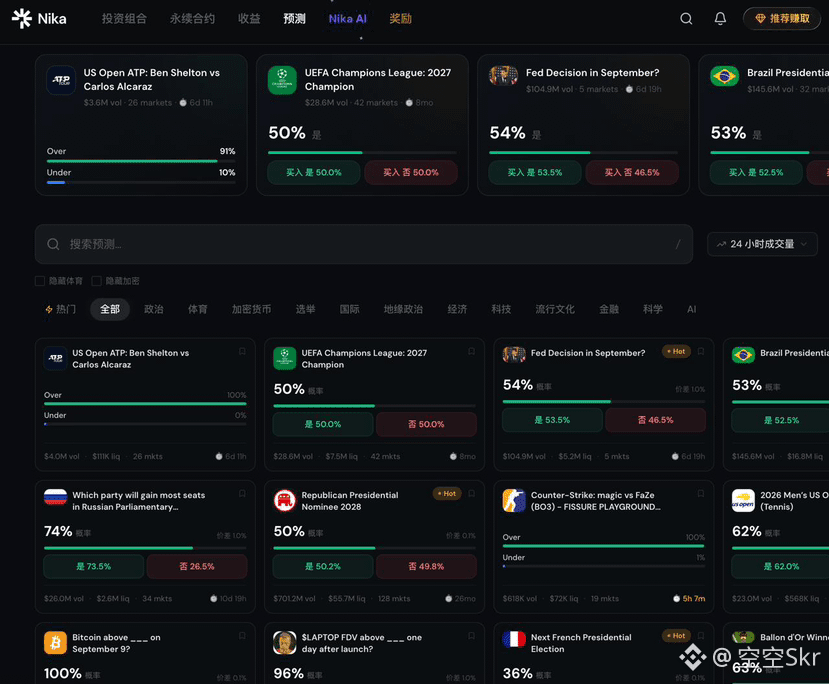
The results from Nika Finance are pretty interesting: they completed a $2 million funding round, grew their user base to over 50,000, reached more than 30 countries, and the platform has already integrated 500+ markets. What surprised me even more is that the core team that built this suite of products consists of just two people.
On September 8, @Nika_Finance officially launched Nika AI v1.
In the past, when we used AI to look at market data, we typically only got a single piece of analysis. When it was time to actually trade, we still had to reopen the trading platform, look up the underlying assets, calculate position sizes, and then set take-profit and stop-loss levels. Nika AI puts research, plan generation, and trade execution into the same chat interface.
Users can ask it to research a specific market, check the concentration of their holdings, find gaps in their asset allocation, or see whether there’s long-idle capital in their account. After deciding on a direction, they can also generate rebalancing and funding allocation plans.
At present, Nika covers 500+ markets including Crypto, stocks, commodities, forex, and prediction markets, and it uses a non-custodial model. Control of assets remains with users. Position sizes, allocation limits, and risk parameters can also be set by the users themselves.
Now the platform has opened Alpha Pass, so you can try Nika AI v1–
https://reurl.cc/VnmaLy
Two people, in less than a year—how far can they take an on-chain financial product?
The results from Nika Finance are pretty interesting: they completed a $2 million funding round, grew their user base to over 50,000, reached more than 30 countries, and the platform has already integrated 500+ markets. What surprised me even more is that the core team that built this suite of products consists of just two people.
On September 8, @Nika_Finance officially launched Nika AI v1.
In the past, when we used AI to look at market data, we typically only got a single piece of analysis. When it was time to actually trade, we still had to reopen the trading platform, look up the underlying assets, calculate position sizes, and then set take-profit and stop-loss levels. Nika AI puts research, plan generation, and trade execution into the same chat interface.
Users can ask it to research a specific market, check the concentration of their holdings, find gaps in their asset allocation, or see whether there’s long-idle capital in their account. After deciding on a direction, they can also generate rebalancing and funding allocation plans.
At present, Nika covers 500+ markets including Crypto, stocks, commodities, forex, and prediction markets, and it uses a non-custodial model. Control of assets remains with users. Position sizes, allocation limits, and risk parameters can also be set by the users themselves.
Now the platform has opened Alpha Pass, so you can try Nika AI v1–
https://reurl.cc/VnmaLy
The results from Nika Finance are pretty interesting: they completed a $2 million funding round, grew their user base to over 50,000, reached more than 30 countries, and the platform has already integrated 500+ markets. What surprised me even more is that the core team that built this suite of products consists of just two people.
On September 8, @Nika_Finance officially launched Nika AI v1.
In the past, when we used AI to look at market data, we typically only got a single piece of analysis. When it was time to actually trade, we still had to reopen the trading platform, look up the underlying assets, calculate position sizes, and then set take-profit and stop-loss levels. Nika AI puts research, plan generation, and trade execution into the same chat interface.
Users can ask it to research a specific market, check the concentration of their holdings, find gaps in their asset allocation, or see whether there’s long-idle capital in their account. After deciding on a direction, they can also generate rebalancing and funding allocation plans.
At present, Nika covers 500+ markets including Crypto, stocks, commodities, forex, and prediction markets, and it uses a non-custodial model. Control of assets remains with users. Position sizes, allocation limits, and risk parameters can also be set by the users themselves.
Now the platform has opened Alpha Pass, so you can try Nika AI v1–
https://reurl.cc/VnmaLy
5
3
2k
·
--
Verified
$TMX was priced as a “newly listed small-cap coin.” The protocol’s age doesn’t match this label.
The mainnet went live in April 2025—not on August 25. Now there are 10 chains, 1.5 million wallets, official figures of 90 million TVL. Keyrock and Edge Capital manage the vaults; idle funds go to Aave, Morpho, and Venus on their own. YZi Labs’ strategic investment happened last month—after TGE—not something obtained by a single roadmap.
The token side is even more stringent. The circulating market cap is 18 million; roughly 153 million tokens are in circulation, just over 15% of the total supply. 46% of the team, advisors, and investors’ allocations are locked until August 2027. Pendle has a market cap of 300 million, with market cap/TVL of 0.25; TermMax is 0.20. On the fixed-rate chains, there are only these two names.
A week of bearish candles can’t change any of this. What changes is who’s willing to hand the chips over to the next person within the 15% circulating float. What I want more is that window before the lockups are opened.
$TMX
{alpha}(560x3c2f61f2e27c865981d2e7aaf6b2cdf823030039)
$TMX was priced as a “newly listed small-cap coin.” The protocol’s age doesn’t match this label.
The mainnet went live in April 2025—not on August 25. Now there are 10 chains, 1.5 million wallets, official figures of 90 million TVL. Keyrock and Edge Capital manage the vaults; idle funds go to Aave, Morpho, and Venus on their own. YZi Labs’ strategic investment happened last month—after TGE—not something obtained by a single roadmap.
The token side is even more stringent. The circulating market cap is 18 million; roughly 153 million tokens are in circulation, just over 15% of the total supply. 46% of the team, advisors, and investors’ allocations are locked until August 2027. Pendle has a market cap of 300 million, with market cap/TVL of 0.25; TermMax is 0.20. On the fixed-rate chains, there are only these two names.
A week of bearish candles can’t change any of this. What changes is who’s willing to hand the chips over to the next person within the 15% circulating float. What I want more is that window before the lockups are opened.
$TMX
The mainnet went live in April 2025—not on August 25. Now there are 10 chains, 1.5 million wallets, official figures of 90 million TVL. Keyrock and Edge Capital manage the vaults; idle funds go to Aave, Morpho, and Venus on their own. YZi Labs’ strategic investment happened last month—after TGE—not something obtained by a single roadmap.
The token side is even more stringent. The circulating market cap is 18 million; roughly 153 million tokens are in circulation, just over 15% of the total supply. 46% of the team, advisors, and investors’ allocations are locked until August 2027. Pendle has a market cap of 300 million, with market cap/TVL of 0.25; TermMax is 0.20. On the fixed-rate chains, there are only these two names.
A week of bearish candles can’t change any of this. What changes is who’s willing to hand the chips over to the next person within the 15% circulating float. What I want more is that window before the lockups are opened.
$TMX
662
·
--
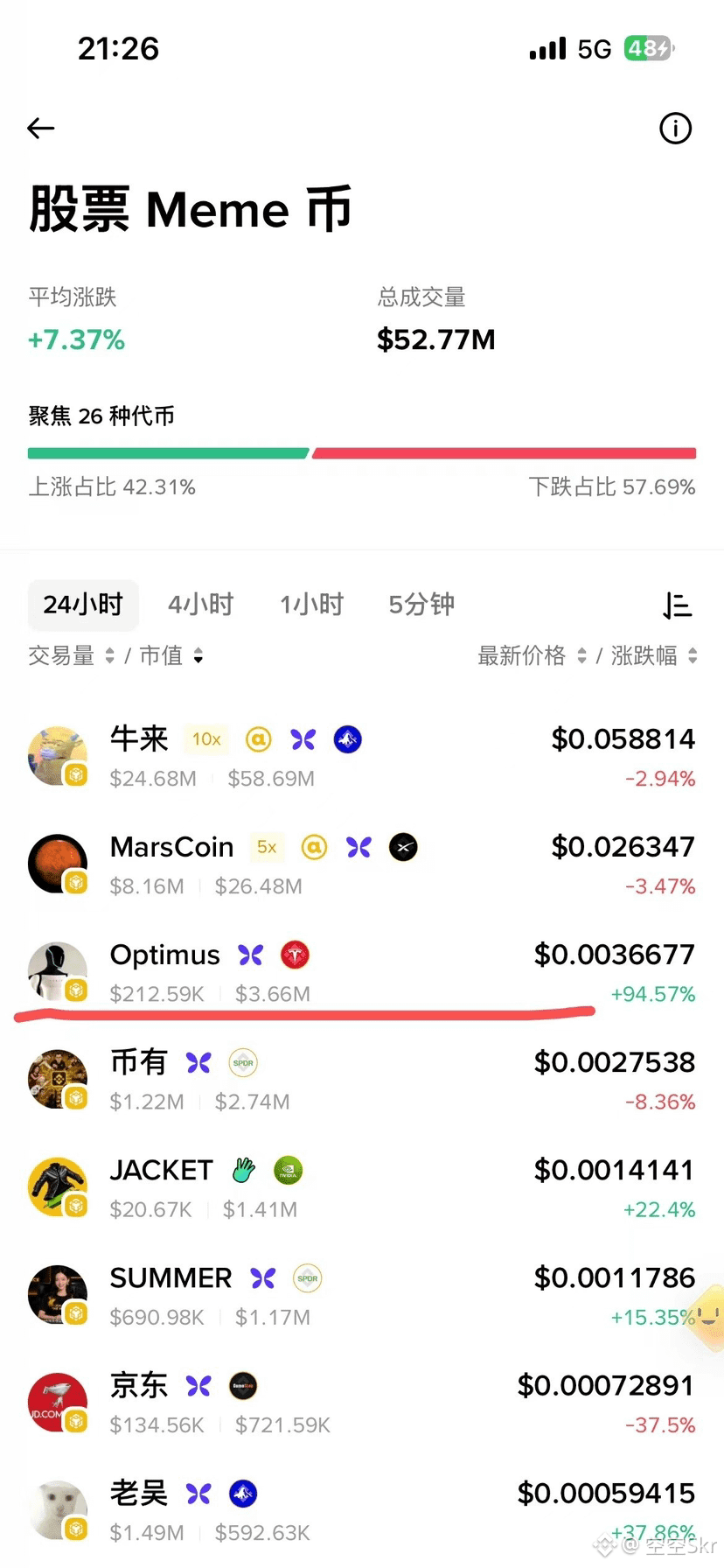
I just came across a pretty interesting $Optimus—it's already live on Binance in the MEME Stocks board.
The storyline actually makes a lot of sense:
Tesla Optimus humanoid robot + Meme + RWA—basically takes the popular concept of the Tesla robot and brings it on-chain.
Right now the market cap is only $4.5M, and it’s already in the TOP3 of the Binance Stocks Meme section. The size is still relatively small.
🪙 Total supply: 1 billion
🏦 Pool anchored to Tesla stock
💰 Holds 100,000 $Optimus coins, eligible to participate in Tesla stock dividends
CA:
0x937f5ca6b4d465b9dc7e18b3f40b4d1376db7777
Buy 3%|Sell 3%
Tesla has Optimus, and on-chain it’s got a “Optimus Prime” too.
With this kind of trending narrative + low market cap, add it to your watchlist first. DYOR
#Optimus
I just came across a pretty interesting $Optimus—it's already live on Binance in the MEME Stocks board.
The storyline actually makes a lot of sense:
Tesla Optimus humanoid robot + Meme + RWA—basically takes the popular concept of the Tesla robot and brings it on-chain.
Right now the market cap is only $4.5M, and it’s already in the TOP3 of the Binance Stocks Meme section. The size is still relatively small.
🪙 Total supply: 1 billion
🏦 Pool anchored to Tesla stock
💰 Holds 100,000 $Optimus coins, eligible to participate in Tesla stock dividends
CA:
0x937f5ca6b4d465b9dc7e18b3f40b4d1376db7777
Buy 3%|Sell 3%
Tesla has Optimus, and on-chain it’s got a “Optimus Prime” too.
With this kind of trending narrative + low market cap, add it to your watchlist first. DYOR
#Optimus
The storyline actually makes a lot of sense:
Tesla Optimus humanoid robot + Meme + RWA—basically takes the popular concept of the Tesla robot and brings it on-chain.
Right now the market cap is only $4.5M, and it’s already in the TOP3 of the Binance Stocks Meme section. The size is still relatively small.
🪙 Total supply: 1 billion
🏦 Pool anchored to Tesla stock
💰 Holds 100,000 $Optimus coins, eligible to participate in Tesla stock dividends
CA:
0x937f5ca6b4d465b9dc7e18b3f40b4d1376db7777
Buy 3%|Sell 3%
Tesla has Optimus, and on-chain it’s got a “Optimus Prime” too.
With this kind of trending narrative + low market cap, add it to your watchlist first. DYOR
#Optimus
137
·
--
Today $BTC 、$ETH — this move is really starting to get addictive.
This morning it was still churning around $63K, and in the blink of an eye it touched $65K+; ETH is even more exaggerated—it's clearly started to lead and set the pace.
I don’t think this rally is just a simple technical bounce. A few good catalysts lined up perfectly:
First, market expectations for further Fed rate cuts have picked up again, and risk-asset sentiment has clearly warmed;
Second, BTC ETF fund flows have returned, and institutional money hasn’t actually exited;
Third, today the U.S. Treasury increased its long-term T-bill repo operations, pushing the 10-year yield lower, and liquidity expectations improved as well.
On top of that, there were quite a lot of short positions pressed earlier—this breakout directly started to force short covering.
So it created this feeling:
Longs are buying, and shorts are also buying.
And honestly, I’m starting to feel a bit excited.
If BTC can hold above 68K and ETH keeps outperforming BTC, then this may not be just a rebound—it could really be starting the second leg.
Of course, don’t YOLO just because you see a big bullish candle in the futures. Wait for a pullback and confirmation—it’s actually more comfortable.
{future}(BTCUSDT)
Today $BTC 、$ETH — this move is really starting to get addictive.
This morning it was still churning around $63K, and in the blink of an eye it touched $65K+; ETH is even more exaggerated—it's clearly started to lead and set the pace.
I don’t think this rally is just a simple technical bounce. A few good catalysts lined up perfectly:
First, market expectations for further Fed rate cuts have picked up again, and risk-asset sentiment has clearly warmed;
Second, BTC ETF fund flows have returned, and institutional money hasn’t actually exited;
Third, today the U.S. Treasury increased its long-term T-bill repo operations, pushing the 10-year yield lower, and liquidity expectations improved as well.
On top of that, there were quite a lot of short positions pressed earlier—this breakout directly started to force short covering.
So it created this feeling:
Longs are buying, and shorts are also buying.
And honestly, I’m starting to feel a bit excited.
If BTC can hold above 68K and ETH keeps outperforming BTC, then this may not be just a rebound—it could really be starting the second leg.
Of course, don’t YOLO just because you see a big bullish candle in the futures. Wait for a pullback and confirmation—it’s actually more comfortable.
This morning it was still churning around $63K, and in the blink of an eye it touched $65K+; ETH is even more exaggerated—it's clearly started to lead and set the pace.
I don’t think this rally is just a simple technical bounce. A few good catalysts lined up perfectly:
First, market expectations for further Fed rate cuts have picked up again, and risk-asset sentiment has clearly warmed;
Second, BTC ETF fund flows have returned, and institutional money hasn’t actually exited;
Third, today the U.S. Treasury increased its long-term T-bill repo operations, pushing the 10-year yield lower, and liquidity expectations improved as well.
On top of that, there were quite a lot of short positions pressed earlier—this breakout directly started to force short covering.
So it created this feeling:
Longs are buying, and shorts are also buying.
And honestly, I’m starting to feel a bit excited.
If BTC can hold above 68K and ETH keeps outperforming BTC, then this may not be just a rebound—it could really be starting the second leg.
Of course, don’t YOLO just because you see a big bullish candle in the futures. Wait for a pullback and confirmation—it’s actually more comfortable.
137
·
--
Bullish
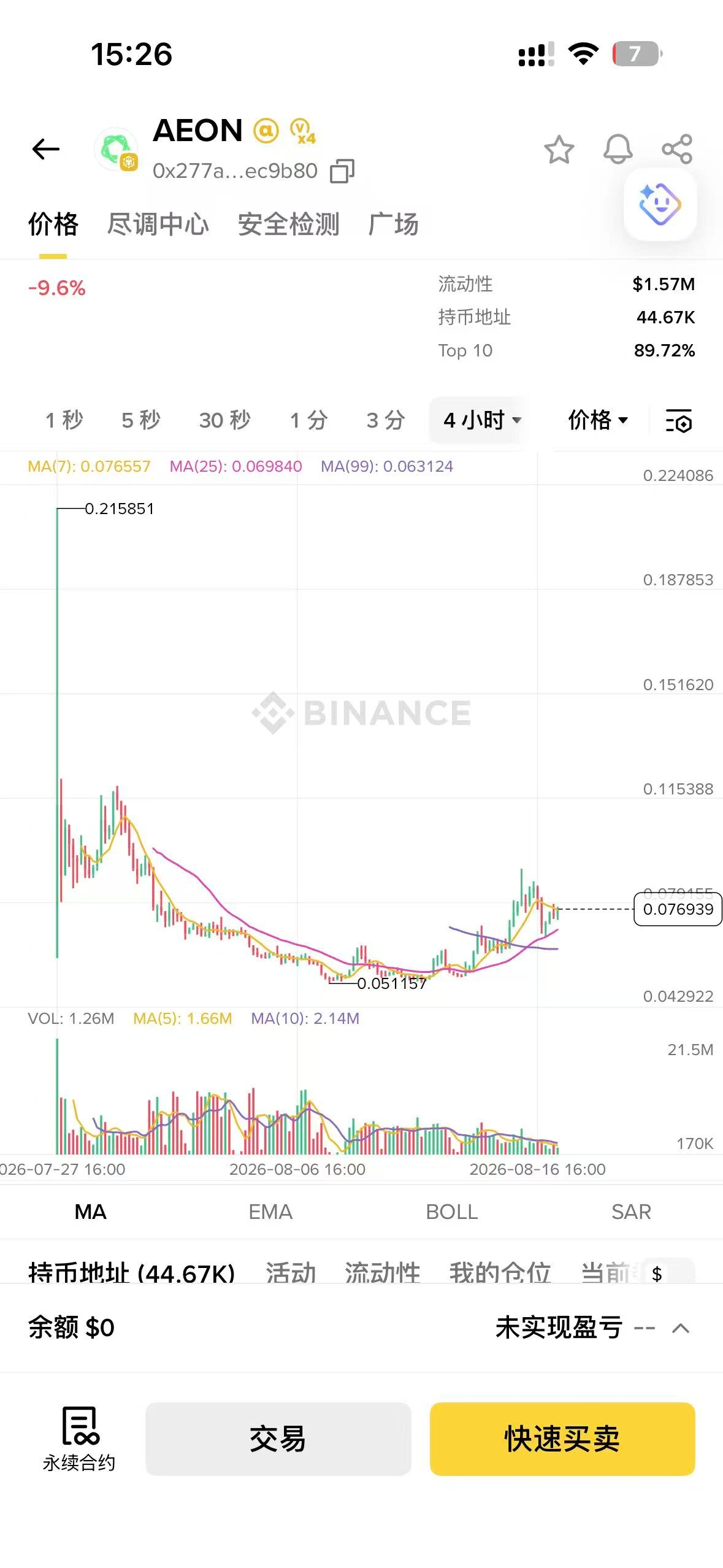
The recent trend of $AEON looks very strong and is worth paying close attention to.
From the 4H candlestick chart, there was a fairly long period of consolidation beforehand, with the lowest pullback reaching around 0.05115.
After that, trading volume gradually increased, the price began to rise, and it broke through the resistance level. The high reached above 0.07+, and it is currently ranging around 0.0769.
Overall, it followed a fairly typical pattern:
Low-level consolidation → volume expansion → breakout → second confirmation.
From 0.05115 to 0.0769, the stage gain is already close to 50%.
And now, market attention on $AEON may be shifting from a “new coin” story toward real-world use.
The launch on Binance Alpha brings the first round of liquidity and attention. If it can still maintain its strength after the Listing, it suggests the market is starting to reassess AEON’s fundamentals.
Especially recently, the narrative around AI Agent Payment / x402 has been heating up again.
As AI Agents move from “chatting” to “execution,” executing tasks creates payment demand. In the future, whether it’s purchasing APIs, computing power, data, or Agent-to-Agent Payment, all of it will require a new payment infrastructure.
And AEON is precisely positioned at:
AI Agent + Crypto Payment + Settlement
—that intersection.
So in the short term, I’ll mainly watch whether volume and price can continue to expand and break out. In the long term, I’ll focus on the actual rollout of the real payment network and Agent Payment.
If this logic continues to play out, the pricing of $AEON may gradually shift from a “new coin” perspective to AI payment infrastructure.
#AEON
The recent trend of $AEON looks very strong and is worth paying close attention to.
From the 4H candlestick chart, there was a fairly long period of consolidation beforehand, with the lowest pullback reaching around 0.05115.
After that, trading volume gradually increased, the price began to rise, and it broke through the resistance level. The high reached above 0.07+, and it is currently ranging around 0.0769.
Overall, it followed a fairly typical pattern:
Low-level consolidation → volume expansion → breakout → second confirmation.
From 0.05115 to 0.0769, the stage gain is already close to 50%.
And now, market attention on $AEON may be shifting from a “new coin” story toward real-world use.
The launch on Binance Alpha brings the first round of liquidity and attention. If it can still maintain its strength after the Listing, it suggests the market is starting to reassess AEON’s fundamentals.
Especially recently, the narrative around AI Agent Payment / x402 has been heating up again.
As AI Agents move from “chatting” to “execution,” executing tasks creates payment demand. In the future, whether it’s purchasing APIs, computing power, data, or Agent-to-Agent Payment, all of it will require a new payment infrastructure.
And AEON is precisely positioned at:
AI Agent + Crypto Payment + Settlement
—that intersection.
So in the short term, I’ll mainly watch whether volume and price can continue to expand and break out. In the long term, I’ll focus on the actual rollout of the real payment network and Agent Payment.
If this logic continues to play out, the pricing of $AEON may gradually shift from a “new coin” perspective to AI payment infrastructure.
#AEON
From the 4H candlestick chart, there was a fairly long period of consolidation beforehand, with the lowest pullback reaching around 0.05115.
After that, trading volume gradually increased, the price began to rise, and it broke through the resistance level. The high reached above 0.07+, and it is currently ranging around 0.0769.
Overall, it followed a fairly typical pattern:
Low-level consolidation → volume expansion → breakout → second confirmation.
From 0.05115 to 0.0769, the stage gain is already close to 50%.
And now, market attention on $AEON may be shifting from a “new coin” story toward real-world use.
The launch on Binance Alpha brings the first round of liquidity and attention. If it can still maintain its strength after the Listing, it suggests the market is starting to reassess AEON’s fundamentals.
Especially recently, the narrative around AI Agent Payment / x402 has been heating up again.
As AI Agents move from “chatting” to “execution,” executing tasks creates payment demand. In the future, whether it’s purchasing APIs, computing power, data, or Agent-to-Agent Payment, all of it will require a new payment infrastructure.
And AEON is precisely positioned at:
AI Agent + Crypto Payment + Settlement
—that intersection.
So in the short term, I’ll mainly watch whether volume and price can continue to expand and break out. In the long term, I’ll focus on the actual rollout of the real payment network and Agent Payment.
If this logic continues to play out, the pricing of $AEON may gradually shift from a “new coin” perspective to AI payment infrastructure.
#AEON
1.2k
1
62
1.2k
·
--
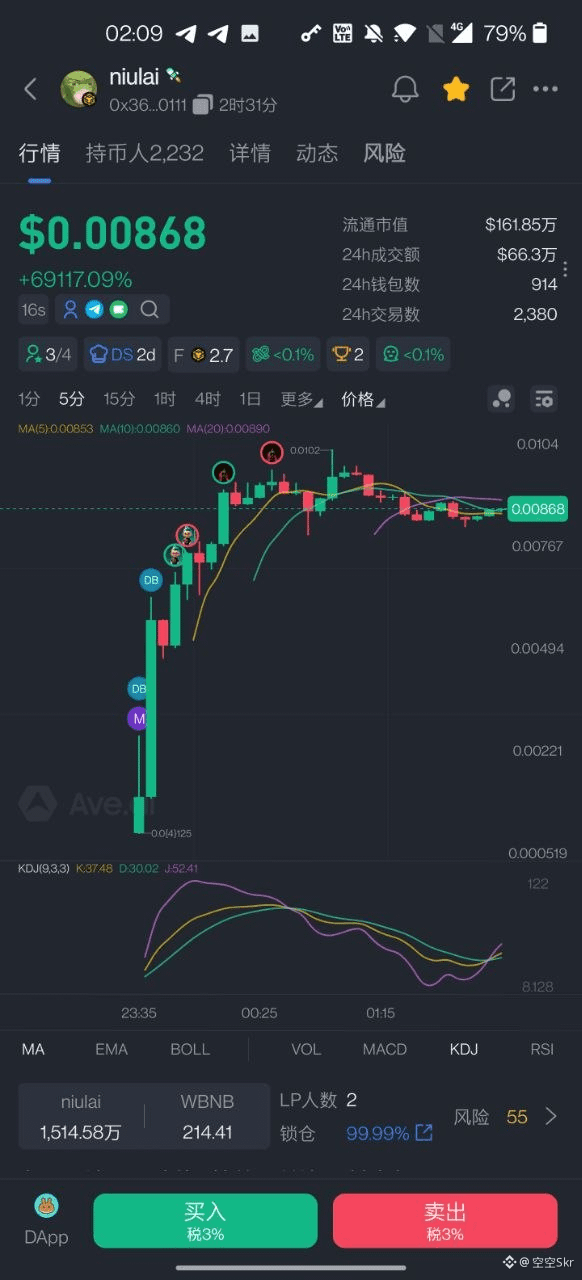
$NIULAI|This wave is actually kind of interesting 👀
The “shadow-coin symbiosis” narrative directly connects the movie IP with Meme gameplay. By leveraging the film traffic of《牛来》, they’re trying to open a real gateway from Web2 to Web3—building a “coin lane” supported by an actual IP story.
More importantly, the DEV team isn’t weak. They’ve previously built several projects that went up by tens of thousands of times, which is also why I’m paying attention to $NIULAI.
Right now is the moment when market attention is rapidly consolidating. IP + Meme + film traffic means there’s definitely plenty of narrative room.
If the distribution of the movie IP really takes off later on, the imagination won’t be limited to just a typical Meme.
👀 $NIULAI is worth watching early.
Contract:
0x3604b5c377124d2180c4fb791953fc8431a90111
NFA, DYOR.
$NIULAI|This wave is actually kind of interesting 👀
The “shadow-coin symbiosis” narrative directly connects the movie IP with Meme gameplay. By leveraging the film traffic of《牛来》, they’re trying to open a real gateway from Web2 to Web3—building a “coin lane” supported by an actual IP story.
More importantly, the DEV team isn’t weak. They’ve previously built several projects that went up by tens of thousands of times, which is also why I’m paying attention to $NIULAI.
Right now is the moment when market attention is rapidly consolidating. IP + Meme + film traffic means there’s definitely plenty of narrative room.
If the distribution of the movie IP really takes off later on, the imagination won’t be limited to just a typical Meme.
👀 $NIULAI is worth watching early.
Contract:
0x3604b5c377124d2180c4fb791953fc8431a90111
NFA, DYOR.
The “shadow-coin symbiosis” narrative directly connects the movie IP with Meme gameplay. By leveraging the film traffic of《牛来》, they’re trying to open a real gateway from Web2 to Web3—building a “coin lane” supported by an actual IP story.
More importantly, the DEV team isn’t weak. They’ve previously built several projects that went up by tens of thousands of times, which is also why I’m paying attention to $NIULAI.
Right now is the moment when market attention is rapidly consolidating. IP + Meme + film traffic means there’s definitely plenty of narrative room.
If the distribution of the movie IP really takes off later on, the imagination won’t be limited to just a typical Meme.
👀 $NIULAI is worth watching early.
Contract:
0x3604b5c377124d2180c4fb791953fc8431a90111
NFA, DYOR.
2
2
122
·
--
$AKE This wave is really ruthless.
In 7 days it has jumped 150%+, and yesterday it even surged straight to $0.0154 at one point; today it has clearly started to retreat.
What this kind of coin fears most is people getting carried away and chasing longs.
Instead, I’ll focus mainly on the area around $0.010. If it holds, there’s still an expectation of a second spike; if the rebound lacks strength and it breaks below this level, then the short trade’s odds on the futures contract actually look more comfortable—first looking for the area around $0.008.
In short:
Hold above $0.01 → take a low-long to bet on the rebound
Break below $0.01 → short in line with the move
AKE isn’t that there’s no opportunity now—it's just that the volatility is too high, so the futures contract must include a stop-loss.
For coins that explode like this, what really gets people excited is often the second leg of the move.
{future}(AKEUSDT)
$AKE This wave is really ruthless.
In 7 days it has jumped 150%+, and yesterday it even surged straight to $0.0154 at one point; today it has clearly started to retreat.
What this kind of coin fears most is people getting carried away and chasing longs.
Instead, I’ll focus mainly on the area around $0.010. If it holds, there’s still an expectation of a second spike; if the rebound lacks strength and it breaks below this level, then the short trade’s odds on the futures contract actually look more comfortable—first looking for the area around $0.008.
In short:
Hold above $0.01 → take a low-long to bet on the rebound
Break below $0.01 → short in line with the move
AKE isn’t that there’s no opportunity now—it's just that the volatility is too high, so the futures contract must include a stop-loss.
For coins that explode like this, what really gets people excited is often the second leg of the move.
In 7 days it has jumped 150%+, and yesterday it even surged straight to $0.0154 at one point; today it has clearly started to retreat.
What this kind of coin fears most is people getting carried away and chasing longs.
Instead, I’ll focus mainly on the area around $0.010. If it holds, there’s still an expectation of a second spike; if the rebound lacks strength and it breaks below this level, then the short trade’s odds on the futures contract actually look more comfortable—first looking for the area around $0.008.
In short:
Hold above $0.01 → take a low-long to bet on the rebound
Break below $0.01 → short in line with the move
AKE isn’t that there’s no opportunity now—it's just that the volatility is too high, so the futures contract must include a stop-loss.
For coins that explode like this, what really gets people excited is often the second leg of the move.
4.8k
·
--
$LAB This round, the shorts may finally get to feel comfortable.
Down from the high level earlier, and today it keeps grinding back and forth around $0.08. The rebounds don’t show much strength.
With this kind of price action, I usually don’t rush to buy the dip. Instead, I’ll wait for it to fail to rebound, and then look for another opportunity to short.
If $0.08 can’t hold, my next watch level is $0.075. After a breakdown, there may be more room for downside to open up.
Of course, if it suddenly rallies with heavy volume back above $0.09, then shorts would need to run.
In this kind of market, both bulls and bears can trade. But personally, I’m more biased toward the short side.
After all, in a weak market, the scariest thing is catching a thrown knife.
$LAB
{future}(LABUSDT)
$LAB This round, the shorts may finally get to feel comfortable.
Down from the high level earlier, and today it keeps grinding back and forth around $0.08. The rebounds don’t show much strength.
With this kind of price action, I usually don’t rush to buy the dip. Instead, I’ll wait for it to fail to rebound, and then look for another opportunity to short.
If $0.08 can’t hold, my next watch level is $0.075. After a breakdown, there may be more room for downside to open up.
Of course, if it suddenly rallies with heavy volume back above $0.09, then shorts would need to run.
In this kind of market, both bulls and bears can trade. But personally, I’m more biased toward the short side.
After all, in a weak market, the scariest thing is catching a thrown knife.
$LAB
Down from the high level earlier, and today it keeps grinding back and forth around $0.08. The rebounds don’t show much strength.
With this kind of price action, I usually don’t rush to buy the dip. Instead, I’ll wait for it to fail to rebound, and then look for another opportunity to short.
If $0.08 can’t hold, my next watch level is $0.075. After a breakdown, there may be more room for downside to open up.
Of course, if it suddenly rallies with heavy volume back above $0.09, then shorts would need to run.
In this kind of market, both bulls and bears can trade. But personally, I’m more biased toward the short side.
After all, in a weak market, the scariest thing is catching a thrown knife.
$LAB
678
·
--
$COW This move is kind of interesting today.
The 24H price increase is close to +80%~90%, and the trading volume has clearly expanded as well—this isn’t just a simple range-grinding market anymore.
I’m more focused on whether this surge in volume can turn into a trend, rather than chasing the first big bullish candle.
If it can pull back and hold steady around $0.16, I think there’s still an expectation of further upside; if it surges on higher volume and then drops straight back, then we need to be careful about profit-takers dumping.
For this kind of stock, the biggest fear isn’t missing the opportunity—it’s getting in when sentiment is at its hottest.
I’d be more inclined to wait for the pullback to confirm; if a second acceleration actually shows up, that’s even more worth watching.
$COW
{future}(COWUSDT)
$COW This move is kind of interesting today.
The 24H price increase is close to +80%~90%, and the trading volume has clearly expanded as well—this isn’t just a simple range-grinding market anymore.
I’m more focused on whether this surge in volume can turn into a trend, rather than chasing the first big bullish candle.
If it can pull back and hold steady around $0.16, I think there’s still an expectation of further upside; if it surges on higher volume and then drops straight back, then we need to be careful about profit-takers dumping.
For this kind of stock, the biggest fear isn’t missing the opportunity—it’s getting in when sentiment is at its hottest.
I’d be more inclined to wait for the pullback to confirm; if a second acceleration actually shows up, that’s even more worth watching.
$COW
The 24H price increase is close to +80%~90%, and the trading volume has clearly expanded as well—this isn’t just a simple range-grinding market anymore.
I’m more focused on whether this surge in volume can turn into a trend, rather than chasing the first big bullish candle.
If it can pull back and hold steady around $0.16, I think there’s still an expectation of further upside; if it surges on higher volume and then drops straight back, then we need to be careful about profit-takers dumping.
For this kind of stock, the biggest fear isn’t missing the opportunity—it’s getting in when sentiment is at its hottest.
I’d be more inclined to wait for the pullback to confirm; if a second acceleration actually shows up, that’s even more worth watching.
$COW
683
·
--
Last night, the U.S. July CPI came out. Overall, it was basically in line with expectations and didn’t create too many surprises for the market.
The CPI year-over-year was 3.4%, core CPI was 2.5%, and month-over-month rose by 0.1% and 0.2%, respectively—everything was essentially in line with expectations. After the data was released, U.S. stocks were somewhat stronger, but BTC’s reaction was rather muted; at one point it even slipped below the $64,000 area.
I think the biggest significance of this CPI for the crypto market isn’t that it directly sparks a fresh round of explosive gains, but rather that:
At least for now, it doesn’t give the Federal Reserve a new reason to remain more hawkish.
Previously, the nonfarm payrolls already showed clear signs of cooling, and inflation hasn’t re-accelerated either. Concerns about September policy have eased somewhat.
But the issue is that the CPI is only “in line with expectations,” not clearly below them—so the rate-cut trade hasn’t been fully ignited for the moment.
For BTC, what matters more next is liquidity and the Fed’s outlook. If employment continues to weaken and inflation keeps drifting downward gradually, the market will start pricing in rate cuts again, and the capital environment for BTC, ETH, and high-beta altcoins will improve significantly.
My view:
Short term: consolidating upward, but it’s not time to directly kick off a one-way rally.
Medium term: if subsequent data continues to support the rate-cut outlook, there’s still room for risk assets to move higher.
So right now I’d rather wait for BTC to break out, instead of FOMO’ing just because a CPI that’s in line with expectations came out.
The worst period for macro may be behind us, but the true liquidity inflection point still needs more data confirmation.
Last night, the U.S. July CPI came out. Overall, it was basically in line with expectations and didn’t create too many surprises for the market.
The CPI year-over-year was 3.4%, core CPI was 2.5%, and month-over-month rose by 0.1% and 0.2%, respectively—everything was essentially in line with expectations. After the data was released, U.S. stocks were somewhat stronger, but BTC’s reaction was rather muted; at one point it even slipped below the $64,000 area.
I think the biggest significance of this CPI for the crypto market isn’t that it directly sparks a fresh round of explosive gains, but rather that:
At least for now, it doesn’t give the Federal Reserve a new reason to remain more hawkish.
Previously, the nonfarm payrolls already showed clear signs of cooling, and inflation hasn’t re-accelerated either. Concerns about September policy have eased somewhat.
But the issue is that the CPI is only “in line with expectations,” not clearly below them—so the rate-cut trade hasn’t been fully ignited for the moment.
For BTC, what matters more next is liquidity and the Fed’s outlook. If employment continues to weaken and inflation keeps drifting downward gradually, the market will start pricing in rate cuts again, and the capital environment for BTC, ETH, and high-beta altcoins will improve significantly.
My view:
Short term: consolidating upward, but it’s not time to directly kick off a one-way rally.
Medium term: if subsequent data continues to support the rate-cut outlook, there’s still room for risk assets to move higher.
So right now I’d rather wait for BTC to break out, instead of FOMO’ing just because a CPI that’s in line with expectations came out.
The worst period for macro may be behind us, but the true liquidity inflection point still needs more data confirmation.
The CPI year-over-year was 3.4%, core CPI was 2.5%, and month-over-month rose by 0.1% and 0.2%, respectively—everything was essentially in line with expectations. After the data was released, U.S. stocks were somewhat stronger, but BTC’s reaction was rather muted; at one point it even slipped below the $64,000 area.
I think the biggest significance of this CPI for the crypto market isn’t that it directly sparks a fresh round of explosive gains, but rather that:
At least for now, it doesn’t give the Federal Reserve a new reason to remain more hawkish.
Previously, the nonfarm payrolls already showed clear signs of cooling, and inflation hasn’t re-accelerated either. Concerns about September policy have eased somewhat.
But the issue is that the CPI is only “in line with expectations,” not clearly below them—so the rate-cut trade hasn’t been fully ignited for the moment.
For BTC, what matters more next is liquidity and the Fed’s outlook. If employment continues to weaken and inflation keeps drifting downward gradually, the market will start pricing in rate cuts again, and the capital environment for BTC, ETH, and high-beta altcoins will improve significantly.
My view:
Short term: consolidating upward, but it’s not time to directly kick off a one-way rally.
Medium term: if subsequent data continues to support the rate-cut outlook, there’s still room for risk assets to move higher.
So right now I’d rather wait for BTC to break out, instead of FOMO’ing just because a CPI that’s in line with expectations came out.
The worst period for macro may be behind us, but the true liquidity inflection point still needs more data confirmation.

410
·
--
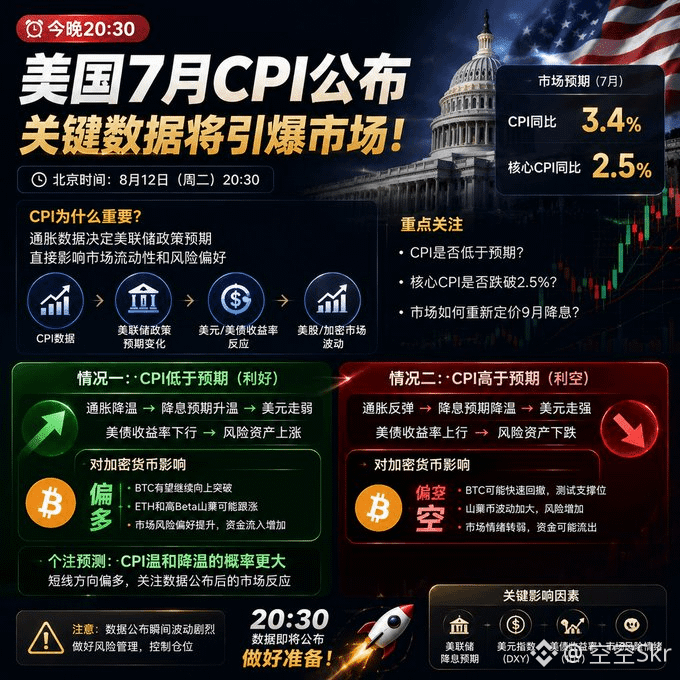
Tonight at 20:30, the U.S. CPI for July is about to be released.
I think the market will be fairly sensitive this time.
At present, expectations are CPI YoY at 3.4% and core CPI at 2.5%. If the data comes in below expectations, rate-cut expectations may keep heating up, U.S. Treasury yields and the dollar could face downward pressure, and U.S. tech stocks and risk assets like BTC will likely first get a bout of positive sentiment.
On the other hand, if core CPI is clearly higher than 2.5%, then things will get troublesome—the rate-cut expectations that were just ignited by the weak nonfarm payrolls could be pushed back down again, and both U.S. stocks and crypto could see a quick pullback.
Personally, I lean toward CPI cooling moderately, so tonight the short-term bias is slightly bullish.
For crypto, the key point isn’t the CPI itself, but what happens after the data comes out:
Dollar ↓ + U.S. Treasury yields ↓ + Rate-cut expectations ↑ = $BTC / $ETH slightly favorable
If this combination shows up, BTC may have a chance to continue probing higher, and capital could also flow back toward ETH and high-beta altcoins.
But if core CPI comes in above expectations, don’t rush to buy the dip—tonight could very likely start with a round of intense stop-sweeping.
In this move tonight, the data is just the fuse; what truly determines the market is how participants will reprice the September Fed.
Do you think tonight’s CPI will be below expectations, or will it hit the market with another round of disappointment?
Tonight at 20:30, the U.S. CPI for July is about to be released.
I think the market will be fairly sensitive this time.
At present, expectations are CPI YoY at 3.4% and core CPI at 2.5%. If the data comes in below expectations, rate-cut expectations may keep heating up, U.S. Treasury yields and the dollar could face downward pressure, and U.S. tech stocks and risk assets like BTC will likely first get a bout of positive sentiment.
On the other hand, if core CPI is clearly higher than 2.5%, then things will get troublesome—the rate-cut expectations that were just ignited by the weak nonfarm payrolls could be pushed back down again, and both U.S. stocks and crypto could see a quick pullback.
Personally, I lean toward CPI cooling moderately, so tonight the short-term bias is slightly bullish.
For crypto, the key point isn’t the CPI itself, but what happens after the data comes out:
Dollar ↓ + U.S. Treasury yields ↓ + Rate-cut expectations ↑ = $BTC / $ETH slightly favorable
If this combination shows up, BTC may have a chance to continue probing higher, and capital could also flow back toward ETH and high-beta altcoins.
But if core CPI comes in above expectations, don’t rush to buy the dip—tonight could very likely start with a round of intense stop-sweeping.
In this move tonight, the data is just the fuse; what truly determines the market is how participants will reprice the September Fed.
Do you think tonight’s CPI will be below expectations, or will it hit the market with another round of disappointment?
I think the market will be fairly sensitive this time.
At present, expectations are CPI YoY at 3.4% and core CPI at 2.5%. If the data comes in below expectations, rate-cut expectations may keep heating up, U.S. Treasury yields and the dollar could face downward pressure, and U.S. tech stocks and risk assets like BTC will likely first get a bout of positive sentiment.
On the other hand, if core CPI is clearly higher than 2.5%, then things will get troublesome—the rate-cut expectations that were just ignited by the weak nonfarm payrolls could be pushed back down again, and both U.S. stocks and crypto could see a quick pullback.
Personally, I lean toward CPI cooling moderately, so tonight the short-term bias is slightly bullish.
For crypto, the key point isn’t the CPI itself, but what happens after the data comes out:
Dollar ↓ + U.S. Treasury yields ↓ + Rate-cut expectations ↑ = $BTC / $ETH slightly favorable
If this combination shows up, BTC may have a chance to continue probing higher, and capital could also flow back toward ETH and high-beta altcoins.
But if core CPI comes in above expectations, don’t rush to buy the dip—tonight could very likely start with a round of intense stop-sweeping.
In this move tonight, the data is just the fuse; what truly determines the market is how participants will reprice the September Fed.
Do you think tonight’s CPI will be below expectations, or will it hit the market with another round of disappointment?
141
·
--
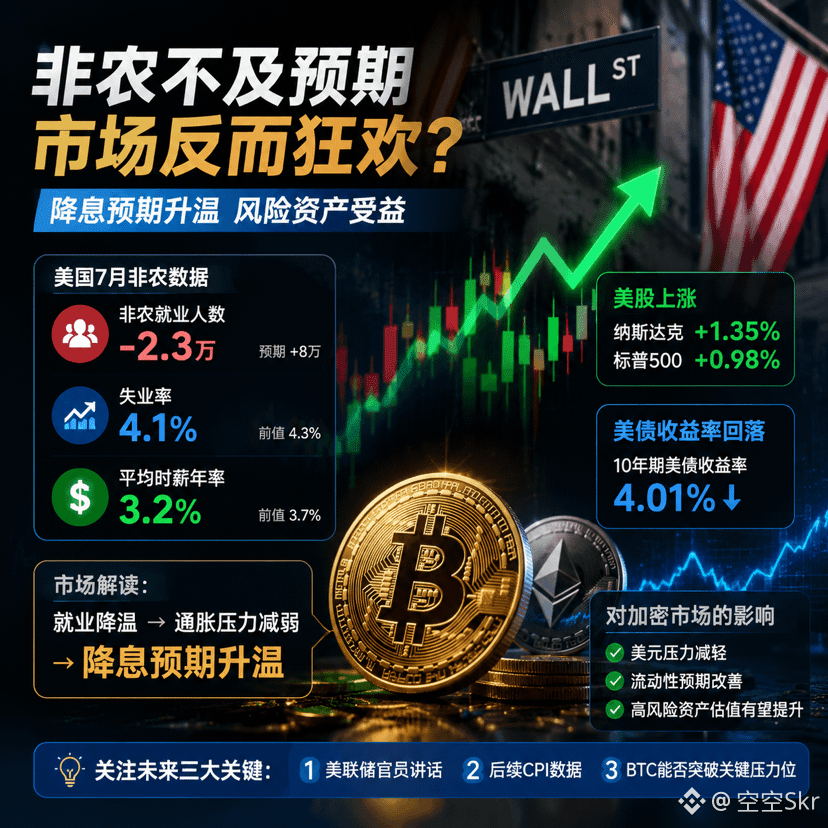
Tonight’s nonfarm payrolls are out, and the US stock market gets “bad news as good news”?
Tonight’s US July nonfarm data came in below expectations:
📉 Nonfarm payrolls fell by 23,000
📉 The market previously expected an increase of about 80,000
📉 Wage growth slowed to 3.2%
There are signs that the job market is cooling. 
But the market reaction is surprisingly interesting.
After the data was released, US stocks didn’t panic and drop—instead, they rose.
The reason is simple:
The market isn’t trading a worsening economy. Instead it’s trading:
Job-market cooling → easing inflation pressure → more room for the Fed to cut rates
As rate-cut expectations heat up, it provides support for tech stocks and growth assets. The Nasdaq has been relatively strong, and funds are flowing back into risk assets. 
For the crypto market, this is also an important signal.
Over the past few months, risk assets such as $BTC and $ETH have been heavily influenced by rate expectations.
If economic data continues to weaken later on, but does not slip into a recession:
✅ Downward pressure on the US dollar could ease
✅ Liquidity expectations may improve
✅ Valuations for high-risk assets may rise
However, it’s important to note:
Weak employment is a double-edged sword.
If future data keeps deteriorating and the market begins to worry about a recession, the logic could shift from “hoping for rate cuts” to “fearing growth” — and risk assets may come under pressure again.
In the short term:
Tonight’s nonfarm payrolls have sent a somewhat dovish signal to the market.
Next, watch:
1️⃣ Remarks from Fed officials
2️⃣ Upcoming CPI data
3️⃣ Whether BTC can break through a key resistance level
Right now, the market is pricing in a new expectation:
The economy is cooling, but the liquidity turning point may be approaching.
{future}(ETHUSDT)
{future}(BTCUSDT)
Tonight’s nonfarm payrolls are out, and the US stock market gets “bad news as good news”?
Tonight’s US July nonfarm data came in below expectations:
📉 Nonfarm payrolls fell by 23,000
📉 The market previously expected an increase of about 80,000
📉 Wage growth slowed to 3.2%
There are signs that the job market is cooling. 
But the market reaction is surprisingly interesting.
After the data was released, US stocks didn’t panic and drop—instead, they rose.
The reason is simple:
The market isn’t trading a worsening economy. Instead it’s trading:
Job-market cooling → easing inflation pressure → more room for the Fed to cut rates
As rate-cut expectations heat up, it provides support for tech stocks and growth assets. The Nasdaq has been relatively strong, and funds are flowing back into risk assets. 
For the crypto market, this is also an important signal.
Over the past few months, risk assets such as $BTC and $ETH have been heavily influenced by rate expectations.
If economic data continues to weaken later on, but does not slip into a recession:
✅ Downward pressure on the US dollar could ease
✅ Liquidity expectations may improve
✅ Valuations for high-risk assets may rise
However, it’s important to note:
Weak employment is a double-edged sword.
If future data keeps deteriorating and the market begins to worry about a recession, the logic could shift from “hoping for rate cuts” to “fearing growth” — and risk assets may come under pressure again.
In the short term:
Tonight’s nonfarm payrolls have sent a somewhat dovish signal to the market.
Next, watch:
1️⃣ Remarks from Fed officials
2️⃣ Upcoming CPI data
3️⃣ Whether BTC can break through a key resistance level
Right now, the market is pricing in a new expectation:
The economy is cooling, but the liquidity turning point may be approaching.
Tonight’s US July nonfarm data came in below expectations:
📉 Nonfarm payrolls fell by 23,000
📉 The market previously expected an increase of about 80,000
📉 Wage growth slowed to 3.2%
There are signs that the job market is cooling. 
But the market reaction is surprisingly interesting.
After the data was released, US stocks didn’t panic and drop—instead, they rose.
The reason is simple:
The market isn’t trading a worsening economy. Instead it’s trading:
Job-market cooling → easing inflation pressure → more room for the Fed to cut rates
As rate-cut expectations heat up, it provides support for tech stocks and growth assets. The Nasdaq has been relatively strong, and funds are flowing back into risk assets. 
For the crypto market, this is also an important signal.
Over the past few months, risk assets such as $BTC and $ETH have been heavily influenced by rate expectations.
If economic data continues to weaken later on, but does not slip into a recession:
✅ Downward pressure on the US dollar could ease
✅ Liquidity expectations may improve
✅ Valuations for high-risk assets may rise
However, it’s important to note:
Weak employment is a double-edged sword.
If future data keeps deteriorating and the market begins to worry about a recession, the logic could shift from “hoping for rate cuts” to “fearing growth” — and risk assets may come under pressure again.
In the short term:
Tonight’s nonfarm payrolls have sent a somewhat dovish signal to the market.
Next, watch:
1️⃣ Remarks from Fed officials
2️⃣ Upcoming CPI data
3️⃣ Whether BTC can break through a key resistance level
Right now, the market is pricing in a new expectation:
The economy is cooling, but the liquidity turning point may be approaching.
1
2
4.2k
·
--
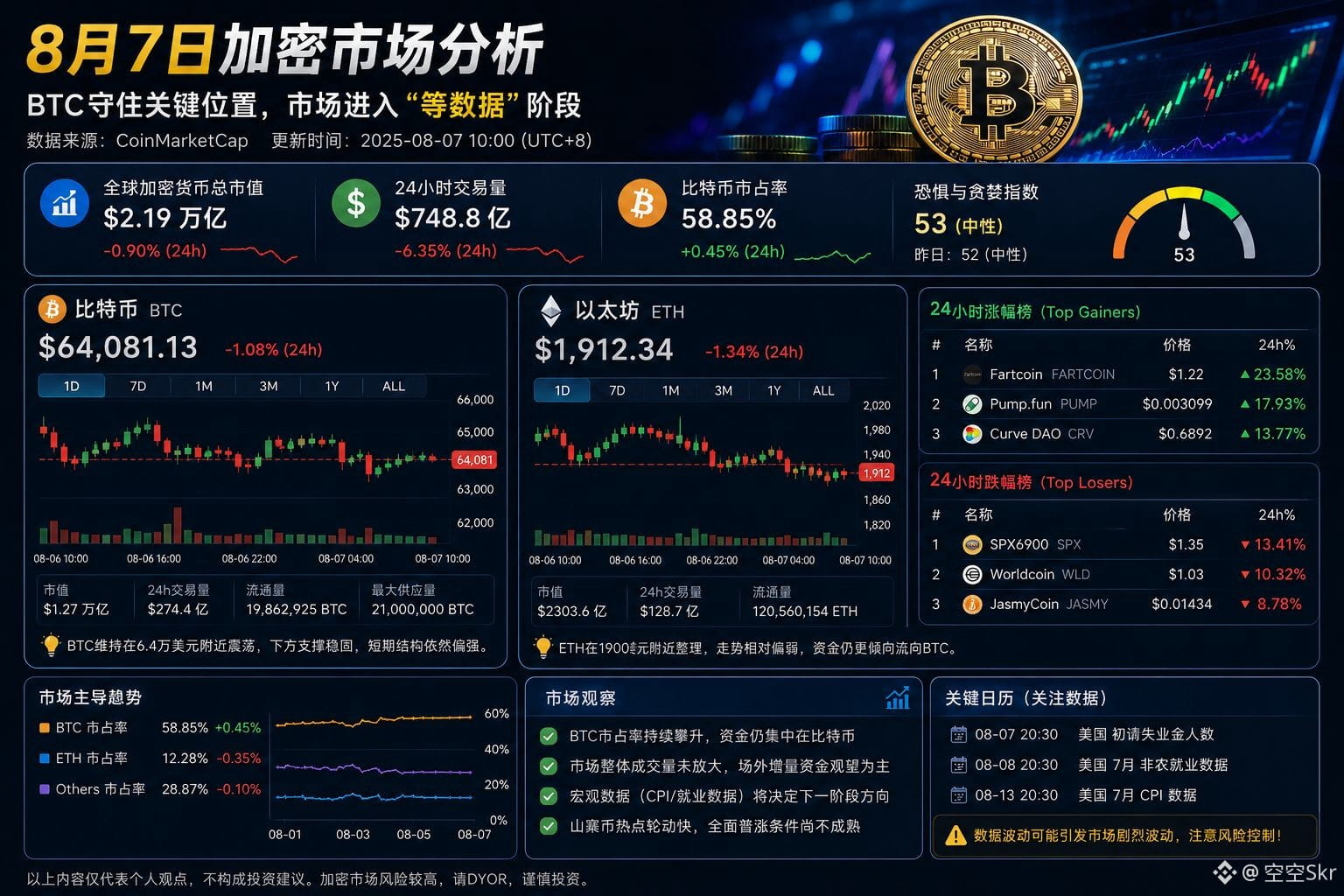
August 7 Crypto Market Analysis|BTC holds key levels as the market enters an “awaiting data” phase
As of now, the global total crypto market cap is about $2.19 trillion, down roughly 0.9% over the past 24 hours. Bitcoin’s market share has risen to 58.85%, remaining at a high level. This indicates that capital is still tilted toward mainstream assets, while altcoins overall are still performing weaker than BTC.
Bitcoin remains the stabilizing force in the market.
{future}(BTCUSDT)
$BTC is currently holding around $64,000, trading sideways. There has been a slight pullback of about 1% in the past 24 hours. Although it hasn’t broken to new highs, there is still underlying support and no sign of a capitulation sell-off with heavy volume. Compared with the past few days, overall market sentiment has clearly stabilized.
{future}(ETHUSDT)
$ETH , on the other hand, is relatively weaker. It is currently consolidating around $1,900. In the short term, its trend still lags behind Bitcoin. More of the capital is still flowing into BTC rather than broadly rotating back into the altcoin market.
There’s also one very clear signal on the recent order flow.
Bitcoin’s market share continues to rise, but the total market trading volume has not expanded in tandem.
This suggests institutional capital is still allocating to Bitcoin, while there is no obvious influx of incremental capital from the sidelines. For most altcoins, this kind of environment remains uncomfortable—there may be hotspots, but it will be hard to see a broad-based rally where most altcoins surge together.
So we still shouldn’t easily say, “Altseason is here.”
On the macro front, what the market is truly waiting for is the upcoming U.S. economic data.
Whether it’s CPI or employment data, it will directly affect market expectations for the Federal Reserve’s rate-cut path. If inflation continues to cool, risk assets could see further repair; if the data runs hotter than expected, expectations for higher interest rates may rise again, and short-term volatility in the crypto market is likely to increase.
Therefore, over the past few days it feels more like capital has moved into a wait-and-see mode in advance.
My view:
At present, BTC’s overall structure is still relatively strong. As long as it can hold key support levels, after the consolidation there may still be opportunities to challenge higher.
However, before macro data is confirmed, I’m more inclined to define the current situation as “consolidation building strength,” rather than the start of a new major uptrend.
What’s truly worth watching isn’t just how many percentage points it goes up or down today, but when capital returns to altcoins—and whether market trading volume can expand at the same time.
The above is for personal opinion only and does not constitute investment advice. DYOR.
August 7 Crypto Market Analysis|BTC holds key levels as the market enters an “awaiting data” phase
As of now, the global total crypto market cap is about $2.19 trillion, down roughly 0.9% over the past 24 hours. Bitcoin’s market share has risen to 58.85%, remaining at a high level. This indicates that capital is still tilted toward mainstream assets, while altcoins overall are still performing weaker than BTC.
Bitcoin remains the stabilizing force in the market.
$BTC is currently holding around $64,000, trading sideways. There has been a slight pullback of about 1% in the past 24 hours. Although it hasn’t broken to new highs, there is still underlying support and no sign of a capitulation sell-off with heavy volume. Compared with the past few days, overall market sentiment has clearly stabilized.
$ETH , on the other hand, is relatively weaker. It is currently consolidating around $1,900. In the short term, its trend still lags behind Bitcoin. More of the capital is still flowing into BTC rather than broadly rotating back into the altcoin market.
There’s also one very clear signal on the recent order flow.
Bitcoin’s market share continues to rise, but the total market trading volume has not expanded in tandem.
This suggests institutional capital is still allocating to Bitcoin, while there is no obvious influx of incremental capital from the sidelines. For most altcoins, this kind of environment remains uncomfortable—there may be hotspots, but it will be hard to see a broad-based rally where most altcoins surge together.
So we still shouldn’t easily say, “Altseason is here.”
On the macro front, what the market is truly waiting for is the upcoming U.S. economic data.
Whether it’s CPI or employment data, it will directly affect market expectations for the Federal Reserve’s rate-cut path. If inflation continues to cool, risk assets could see further repair; if the data runs hotter than expected, expectations for higher interest rates may rise again, and short-term volatility in the crypto market is likely to increase.
Therefore, over the past few days it feels more like capital has moved into a wait-and-see mode in advance.
My view:
At present, BTC’s overall structure is still relatively strong. As long as it can hold key support levels, after the consolidation there may still be opportunities to challenge higher.
However, before macro data is confirmed, I’m more inclined to define the current situation as “consolidation building strength,” rather than the start of a new major uptrend.
What’s truly worth watching isn’t just how many percentage points it goes up or down today, but when capital returns to altcoins—and whether market trading volume can expand at the same time.
The above is for personal opinion only and does not constitute investment advice. DYOR.
As of now, the global total crypto market cap is about $2.19 trillion, down roughly 0.9% over the past 24 hours. Bitcoin’s market share has risen to 58.85%, remaining at a high level. This indicates that capital is still tilted toward mainstream assets, while altcoins overall are still performing weaker than BTC.
Bitcoin remains the stabilizing force in the market.
$BTC is currently holding around $64,000, trading sideways. There has been a slight pullback of about 1% in the past 24 hours. Although it hasn’t broken to new highs, there is still underlying support and no sign of a capitulation sell-off with heavy volume. Compared with the past few days, overall market sentiment has clearly stabilized.
$ETH , on the other hand, is relatively weaker. It is currently consolidating around $1,900. In the short term, its trend still lags behind Bitcoin. More of the capital is still flowing into BTC rather than broadly rotating back into the altcoin market.
There’s also one very clear signal on the recent order flow.
Bitcoin’s market share continues to rise, but the total market trading volume has not expanded in tandem.
This suggests institutional capital is still allocating to Bitcoin, while there is no obvious influx of incremental capital from the sidelines. For most altcoins, this kind of environment remains uncomfortable—there may be hotspots, but it will be hard to see a broad-based rally where most altcoins surge together.
So we still shouldn’t easily say, “Altseason is here.”
On the macro front, what the market is truly waiting for is the upcoming U.S. economic data.
Whether it’s CPI or employment data, it will directly affect market expectations for the Federal Reserve’s rate-cut path. If inflation continues to cool, risk assets could see further repair; if the data runs hotter than expected, expectations for higher interest rates may rise again, and short-term volatility in the crypto market is likely to increase.
Therefore, over the past few days it feels more like capital has moved into a wait-and-see mode in advance.
My view:
At present, BTC’s overall structure is still relatively strong. As long as it can hold key support levels, after the consolidation there may still be opportunities to challenge higher.
However, before macro data is confirmed, I’m more inclined to define the current situation as “consolidation building strength,” rather than the start of a new major uptrend.
What’s truly worth watching isn’t just how many percentage points it goes up or down today, but when capital returns to altcoins—and whether market trading volume can expand at the same time.
The above is for personal opinion only and does not constitute investment advice. DYOR.
202
Log in to explore more content
Join global crypto users on Binance Square
⚡️ Get latest and useful information about crypto.
💬 Trusted by the world’s largest crypto exchange.
👍 Discover real insights from verified creators.
Email / Phone number