

F A R R I S
17.7k Posts

F A R R I S
Report
Block User
I trade what I see, not what I feel...
1.0K+ Following
28.8K+ Followers
15.3K+ Liked
Posts
All
Quotes
Live
·
--
Bullish
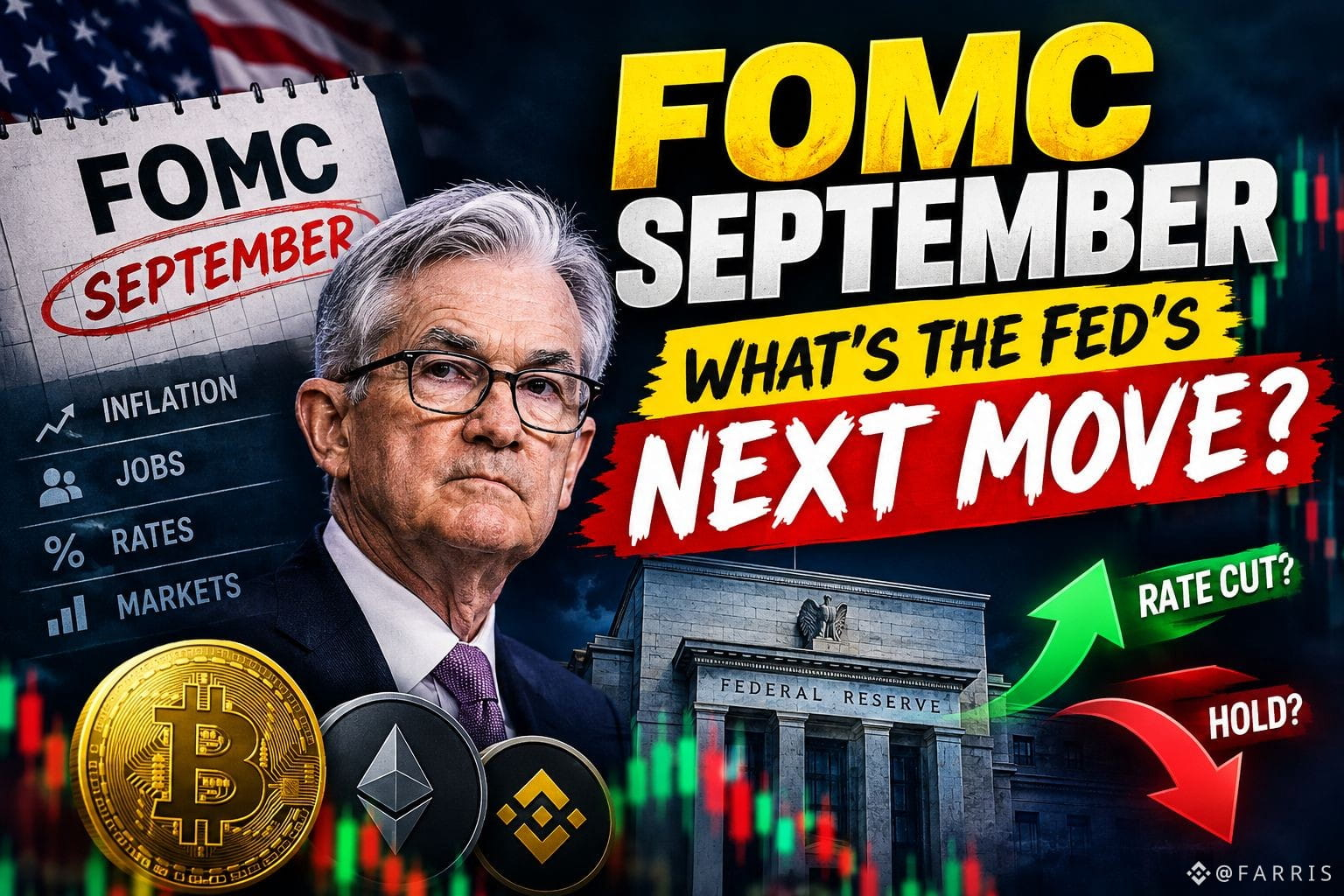
Lately, the biggest question in the market isn’t Bitcoin or altcoins — it’s the Fed. 👀
September FOMC is getting closer, and traders are watching every inflation, jobs, and economic signal for clues about the next move.
A rate cut could bring fresh liquidity and improve risk appetite across crypto. But if the Fed stays cautious, markets could remain volatile and impatient.
The interesting part? Markets often move before the Fed actually speaks.
That’s why I’m watching expectations more than headlines.
One change in Powell’s tone could shift the entire market narrative within minutes.
FOMC September could be another major volatility trigger. ⚡
Eyes on the Fed. Eyes on liquidity. 👀
#FedRateWatch
Lately, the biggest question in the market isn’t Bitcoin or altcoins — it’s the Fed. 👀
September FOMC is getting closer, and traders are watching every inflation, jobs, and economic signal for clues about the next move.
A rate cut could bring fresh liquidity and improve risk appetite across crypto. But if the Fed stays cautious, markets could remain volatile and impatient.
The interesting part? Markets often move before the Fed actually speaks.
That’s why I’m watching expectations more than headlines.
One change in Powell’s tone could shift the entire market narrative within minutes.
FOMC September could be another major volatility trigger. ⚡
Eyes on the Fed. Eyes on liquidity. 👀
#FedRateWatch
September FOMC is getting closer, and traders are watching every inflation, jobs, and economic signal for clues about the next move.
A rate cut could bring fresh liquidity and improve risk appetite across crypto. But if the Fed stays cautious, markets could remain volatile and impatient.
The interesting part? Markets often move before the Fed actually speaks.
That’s why I’m watching expectations more than headlines.
One change in Powell’s tone could shift the entire market narrative within minutes.
FOMC September could be another major volatility trigger. ⚡
Eyes on the Fed. Eyes on liquidity. 👀
#FedRateWatch
3
7
417
·
--
⚡ $SNDK
{future}(SNDKUSDT)
is getting interesting! ⚡
A $10.038K short liquidation at $1,748.71 just hit Binance. That tells me sellers are getting squeezed, so I’d watch the next move carefully. 👀
📍 Support: $1,700–$1,720
🧱 Resistance: $1,780–$1,820
🎯 Next Target: $1,850+
🟢 Entry Zone: $1,720–$1,750
🛑 SL: $1,680
🎯 TP1: $1,800
🎯 TP2: $1,850
🎯 TP3: $1,920
💡 Pro Tip: Don’t chase a sudden pump. Let price retest the entry zone and watch volume. If resistance breaks with strength, the short-liquidation pressure could push SNDK toward the higher targets. If support fails, step aside and protect capital.
One level at a time. Let the chart confirm the move. 🔥
#BankOfAmericaGroupPilotsUSBDCStablecoin #USStrikesTargetsNearHormuzAndJask #DowFallsOver600Points #OilRisesToHighestSinceJuly #RippleLobbiesToAdvanceCLARITYActVote
⚡ $SNDK
is getting interesting! ⚡
A $10.038K short liquidation at $1,748.71 just hit Binance. That tells me sellers are getting squeezed, so I’d watch the next move carefully. 👀
📍 Support: $1,700–$1,720
🧱 Resistance: $1,780–$1,820
🎯 Next Target: $1,850+
🟢 Entry Zone: $1,720–$1,750
🛑 SL: $1,680
🎯 TP1: $1,800
🎯 TP2: $1,850
🎯 TP3: $1,920
💡 Pro Tip: Don’t chase a sudden pump. Let price retest the entry zone and watch volume. If resistance breaks with strength, the short-liquidation pressure could push SNDK toward the higher targets. If support fails, step aside and protect capital.
One level at a time. Let the chart confirm the move. 🔥
#BankOfAmericaGroupPilotsUSBDCStablecoin #USStrikesTargetsNearHormuzAndJask #DowFallsOver600Points #OilRisesToHighestSinceJuly #RippleLobbiesToAdvanceCLARITYActVote
is getting interesting! ⚡
A $10.038K short liquidation at $1,748.71 just hit Binance. That tells me sellers are getting squeezed, so I’d watch the next move carefully. 👀
📍 Support: $1,700–$1,720
🧱 Resistance: $1,780–$1,820
🎯 Next Target: $1,850+
🟢 Entry Zone: $1,720–$1,750
🛑 SL: $1,680
🎯 TP1: $1,800
🎯 TP2: $1,850
🎯 TP3: $1,920
💡 Pro Tip: Don’t chase a sudden pump. Let price retest the entry zone and watch volume. If resistance breaks with strength, the short-liquidation pressure could push SNDK toward the higher targets. If support fails, step aside and protect capital.
One level at a time. Let the chart confirm the move. 🔥
#BankOfAmericaGroupPilotsUSBDCStablecoin #USStrikesTargetsNearHormuzAndJask #DowFallsOver600Points #OilRisesToHighestSinceJuly #RippleLobbiesToAdvanceCLARITYActVote
209
·
--
Lately, $UAI
{future}(UAIUSDT)
is getting interesting after a $5.06K short liquidation around $0.759 on Binance. That shows some short positions got squeezed, so I’m watching the next move closely.
📊 UAI Setup
🟢 Spot: ~$0.759
🧱 Resistance: $0.78–$0.80
🎯 Next Target: $0.82
🚪 Entry Zone: $0.74–$0.76
🛑 SL: $0.71
🎯 TP1: $0.78
🎯 TP2: $0.82
🎯 TP3: $0.88
💡 Pro Tip: Don’t chase a sudden green candle. I’d rather see price hold the entry zone and break resistance with real volume. If $0.74 fails, the setup becomes weaker and I’d step back instead of forcing the trade.
This is a trading setup, not guaranteed profit. Manage risk first.
#BankOfAmericaGroupPilotsUSBDCStablecoin #RippleLobbiesToAdvanceCLARITYActVote #OilRisesToHighestSinceJuly #DowFallsOver600Points
Lately, $UAI
is getting interesting after a $5.06K short liquidation around $0.759 on Binance. That shows some short positions got squeezed, so I’m watching the next move closely.
📊 UAI Setup
🟢 Spot: ~$0.759
🧱 Resistance: $0.78–$0.80
🎯 Next Target: $0.82
🚪 Entry Zone: $0.74–$0.76
🛑 SL: $0.71
🎯 TP1: $0.78
🎯 TP2: $0.82
🎯 TP3: $0.88
💡 Pro Tip: Don’t chase a sudden green candle. I’d rather see price hold the entry zone and break resistance with real volume. If $0.74 fails, the setup becomes weaker and I’d step back instead of forcing the trade.
This is a trading setup, not guaranteed profit. Manage risk first.
#BankOfAmericaGroupPilotsUSBDCStablecoin #RippleLobbiesToAdvanceCLARITYActVote #OilRisesToHighestSinceJuly #DowFallsOver600Points
is getting interesting after a $5.06K short liquidation around $0.759 on Binance. That shows some short positions got squeezed, so I’m watching the next move closely.
📊 UAI Setup
🟢 Spot: ~$0.759
🧱 Resistance: $0.78–$0.80
🎯 Next Target: $0.82
🚪 Entry Zone: $0.74–$0.76
🛑 SL: $0.71
🎯 TP1: $0.78
🎯 TP2: $0.82
🎯 TP3: $0.88
💡 Pro Tip: Don’t chase a sudden green candle. I’d rather see price hold the entry zone and break resistance with real volume. If $0.74 fails, the setup becomes weaker and I’d step back instead of forcing the trade.
This is a trading setup, not guaranteed profit. Manage risk first.
#BankOfAmericaGroupPilotsUSBDCStablecoin #RippleLobbiesToAdvanceCLARITYActVote #OilRisesToHighestSinceJuly #DowFallsOver600Points
420
·
--
#dusk $DUSK @Dusk_Foundation
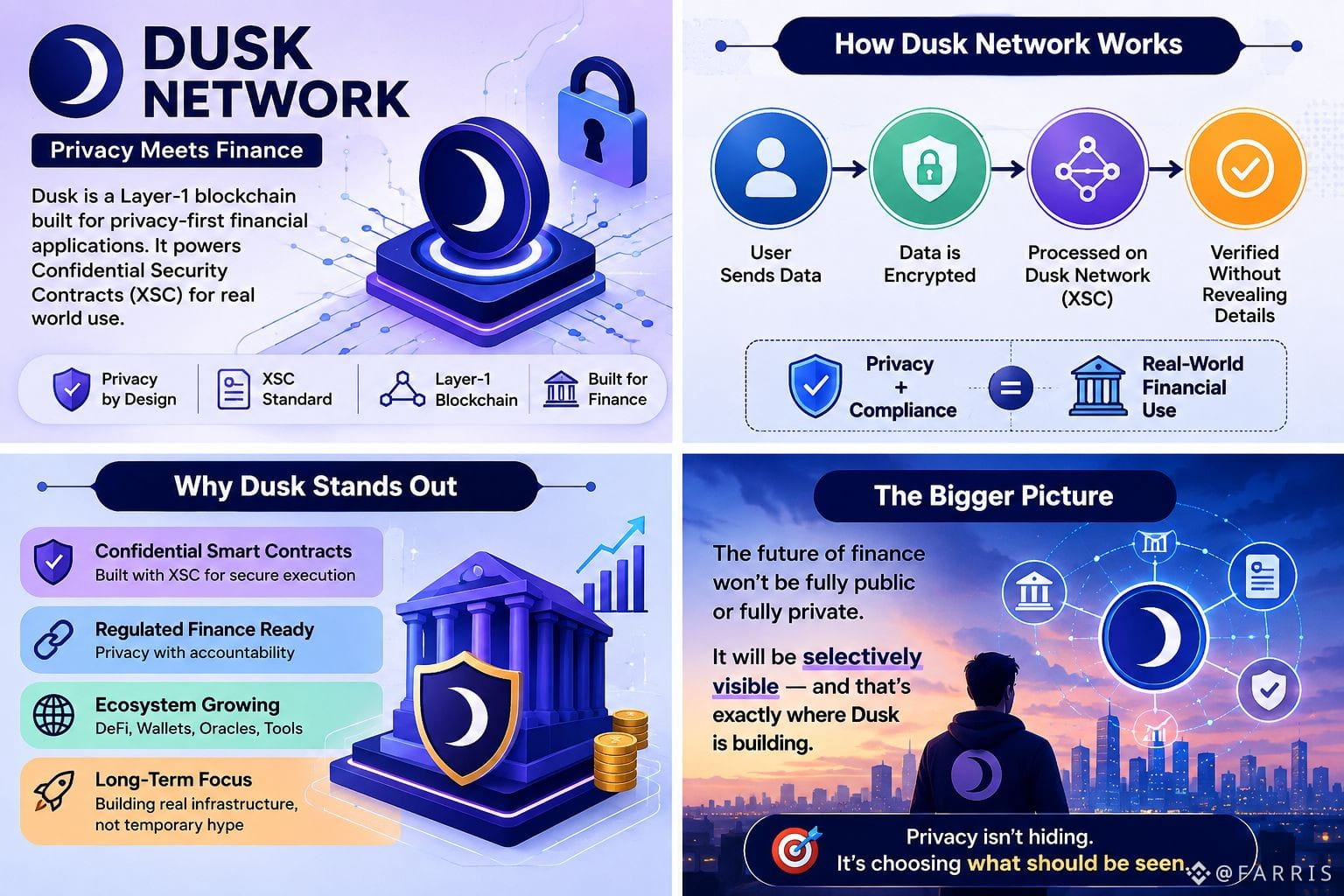
I keep coming back to Dusk because the interesting part isn’t simply that it talks about privacy.
It’s what they’re doing with it.
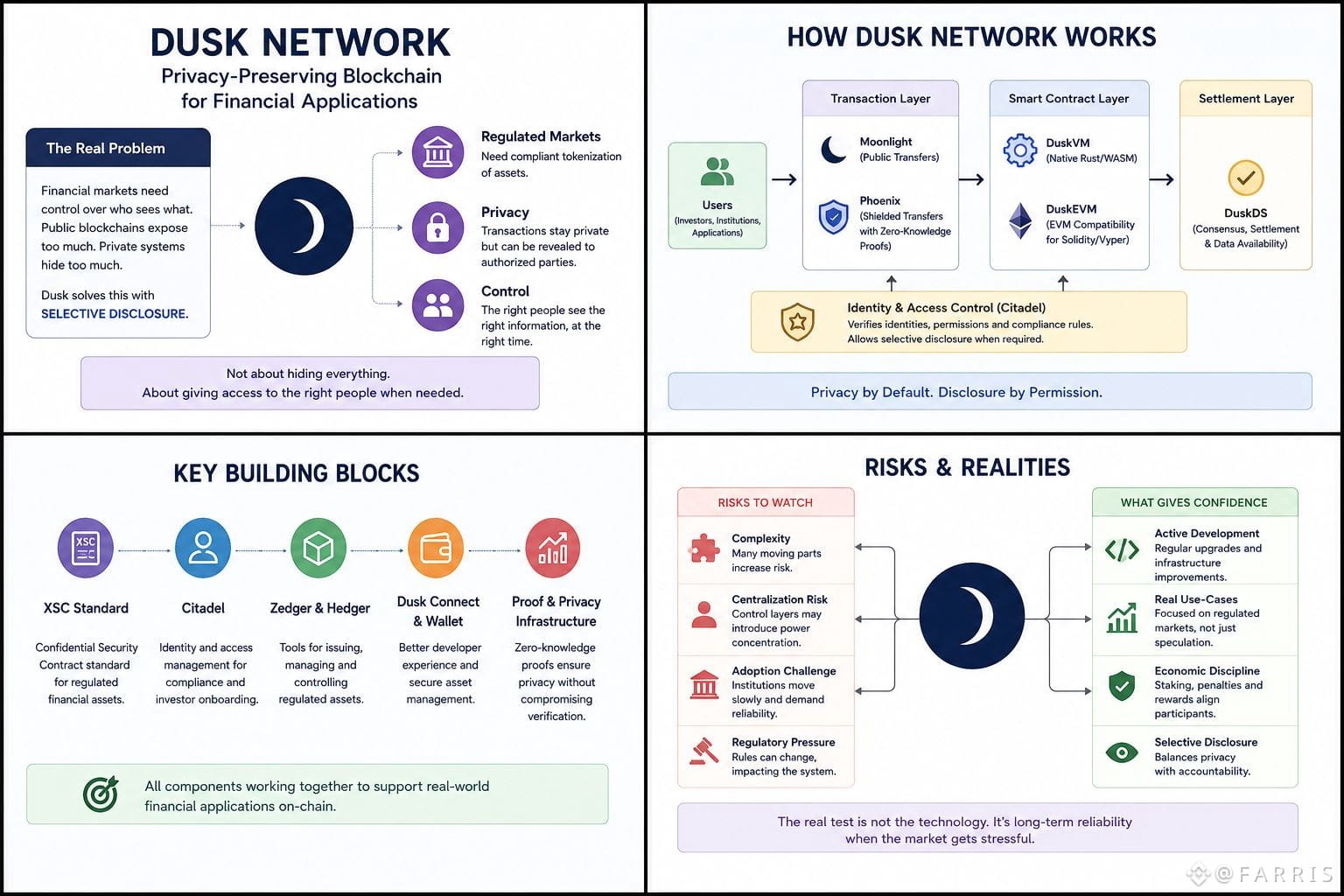
The network is increasingly being shaped around regulated markets, where keeping everything public can be just as problematic as hiding everything. Dusk is building around selective disclosure, confidential transfers, deterministic settlement, and financial workflows that still need rules around who can hold or move an asset.
And lately, the development activity has been hard to ignore.
The recent Boreas upgrade changed transaction handling, VM pricing and deployment rules, while retiring the older Phoenix transaction model. Before that, Aegis brought PLONK V3 and additional consensus hardening. That tells me the team is spending time on the uncomfortable infrastructure work, not just adding features for appearances.
Then there’s DuskEVM.
Solidity developers can now have an EVM path while settling through Dusk’s underlying infrastructure, while DuskVM remains available for native Rust/WASM applications that need deeper access to privacy and zero-knowledge capabilities.
Even the smaller pieces caught my attention. Dusk Connect and the new wallet are aimed at fixing the basic developer-to-wallet experience, and recent engineering work has been tightening proof validation, serialization checks, Merkle handling and reproducible devnet testing.
That’s the kind of progress I actually like watching.
Not one giant announcement.
Just layer after layer getting harder to break.
And maybe that’s the real test for Dusk now: can all these pieces eventually become reliable enough that regulated financial activity can actually depend on them when the market gets messy?
Because privacy is interesting.
Reliable financial infrastructure is much harder.
#BitcoinStrongestWeekSinceMarch2023 #SandboxSANDSuspectedInfiniteMintFlawOnBase #USCanadaTradeTalksCollapseCanadaVowsRetaliation #SandboxSANDSuspectedInfiniteMintFlawOnBase
#dusk $DUSK @Dusk
I keep coming back to Dusk because the interesting part isn’t simply that it talks about privacy.
It’s what they’re doing with it.
The network is increasingly being shaped around regulated markets, where keeping everything public can be just as problematic as hiding everything. Dusk is building around selective disclosure, confidential transfers, deterministic settlement, and financial workflows that still need rules around who can hold or move an asset.
And lately, the development activity has been hard to ignore.
The recent Boreas upgrade changed transaction handling, VM pricing and deployment rules, while retiring the older Phoenix transaction model. Before that, Aegis brought PLONK V3 and additional consensus hardening. That tells me the team is spending time on the uncomfortable infrastructure work, not just adding features for appearances.
Then there’s DuskEVM.
Solidity developers can now have an EVM path while settling through Dusk’s underlying infrastructure, while DuskVM remains available for native Rust/WASM applications that need deeper access to privacy and zero-knowledge capabilities.
Even the smaller pieces caught my attention. Dusk Connect and the new wallet are aimed at fixing the basic developer-to-wallet experience, and recent engineering work has been tightening proof validation, serialization checks, Merkle handling and reproducible devnet testing.
That’s the kind of progress I actually like watching.
Not one giant announcement.
Just layer after layer getting harder to break.
And maybe that’s the real test for Dusk now: can all these pieces eventually become reliable enough that regulated financial activity can actually depend on them when the market gets messy?
Because privacy is interesting.
Reliable financial infrastructure is much harder.
#BitcoinStrongestWeekSinceMarch2023 #SandboxSANDSuspectedInfiniteMintFlawOnBase #USCanadaTradeTalksCollapseCanadaVowsRetaliation #SandboxSANDSuspectedInfiniteMintFlawOnBase
I keep coming back to Dusk because the interesting part isn’t simply that it talks about privacy.
It’s what they’re doing with it.
The network is increasingly being shaped around regulated markets, where keeping everything public can be just as problematic as hiding everything. Dusk is building around selective disclosure, confidential transfers, deterministic settlement, and financial workflows that still need rules around who can hold or move an asset.
And lately, the development activity has been hard to ignore.
The recent Boreas upgrade changed transaction handling, VM pricing and deployment rules, while retiring the older Phoenix transaction model. Before that, Aegis brought PLONK V3 and additional consensus hardening. That tells me the team is spending time on the uncomfortable infrastructure work, not just adding features for appearances.
Then there’s DuskEVM.
Solidity developers can now have an EVM path while settling through Dusk’s underlying infrastructure, while DuskVM remains available for native Rust/WASM applications that need deeper access to privacy and zero-knowledge capabilities.
Even the smaller pieces caught my attention. Dusk Connect and the new wallet are aimed at fixing the basic developer-to-wallet experience, and recent engineering work has been tightening proof validation, serialization checks, Merkle handling and reproducible devnet testing.
That’s the kind of progress I actually like watching.
Not one giant announcement.
Just layer after layer getting harder to break.
And maybe that’s the real test for Dusk now: can all these pieces eventually become reliable enough that regulated financial activity can actually depend on them when the market gets messy?
Because privacy is interesting.
Reliable financial infrastructure is much harder.
#BitcoinStrongestWeekSinceMarch2023 #SandboxSANDSuspectedInfiniteMintFlawOnBase #USCanadaTradeTalksCollapseCanadaVowsRetaliation #SandboxSANDSuspectedInfiniteMintFlawOnBase
170
·
--
Bullish
Verified
#dusk $DUSK @Dusk_Foundation
The strange thing about Dusk is that the more I looked at it, the less interesting the word “privacy” became.
What caught my attention was something quieter.
Markets usually become easier to understand when more information is visible. You can watch balances move, track flows, see who is taking risk, and react when something starts looking wrong.
But financial markets also have a point where too much visibility becomes a liability.
A large position cannot always be exposed to everyone. A regulated asset cannot treat every piece of investor information as public data. And during volatility, broadcasting every move can change the market you are trying to operate in.
That tension is where Dusk started making more sense to me.
Its architecture separates public and shielded transaction models, while its documentation puts selective disclosure alongside privacy rather than treating privacy as simply hiding everything.
And the project has been quietly moving beyond the “privacy chain” label too. There are new wallet and developer-connection tools, continued protocol upgrades, and recent work around regulated asset infrastructure.
That changed my view.
The real question isn't whether a blockchain can keep information private.
It's whether people can still coordinate when they don't all see the same information.
Because when markets get stressed, nobody cares that the system was designed with good intentions. They care about what they can verify, who can verify it, and how quickly they can get comfortable enough to stay.
#QWRX #ZDEX1000
That is the part of Dusk I find worth watching.#SSV.每日智能策略 #advise
Privacy may not be the product.
It may be the test of whether financial coordination still works when transparency itself becomes expensive.
$TRUMP
{spot}(TRUMPUSDT)
$BEAT
{future}(BEATUSDT)
#dusk $DUSK @Dusk
The strange thing about Dusk is that the more I looked at it, the less interesting the word “privacy” became.
What caught my attention was something quieter.
Markets usually become easier to understand when more information is visible. You can watch balances move, track flows, see who is taking risk, and react when something starts looking wrong.
But financial markets also have a point where too much visibility becomes a liability.
A large position cannot always be exposed to everyone. A regulated asset cannot treat every piece of investor information as public data. And during volatility, broadcasting every move can change the market you are trying to operate in.
That tension is where Dusk started making more sense to me.
Its architecture separates public and shielded transaction models, while its documentation puts selective disclosure alongside privacy rather than treating privacy as simply hiding everything.
And the project has been quietly moving beyond the “privacy chain” label too. There are new wallet and developer-connection tools, continued protocol upgrades, and recent work around regulated asset infrastructure.
That changed my view.
The real question isn't whether a blockchain can keep information private.
It's whether people can still coordinate when they don't all see the same information.
Because when markets get stressed, nobody cares that the system was designed with good intentions. They care about what they can verify, who can verify it, and how quickly they can get comfortable enough to stay.
#QWRX #ZDEX1000
That is the part of Dusk I find worth watching.#SSV.每日智能策略 #advise
Privacy may not be the product.
It may be the test of whether financial coordination still works when transparency itself becomes expensive.
$TRUMP
$BEAT
The strange thing about Dusk is that the more I looked at it, the less interesting the word “privacy” became.
What caught my attention was something quieter.
Markets usually become easier to understand when more information is visible. You can watch balances move, track flows, see who is taking risk, and react when something starts looking wrong.
But financial markets also have a point where too much visibility becomes a liability.
A large position cannot always be exposed to everyone. A regulated asset cannot treat every piece of investor information as public data. And during volatility, broadcasting every move can change the market you are trying to operate in.
That tension is where Dusk started making more sense to me.
Its architecture separates public and shielded transaction models, while its documentation puts selective disclosure alongside privacy rather than treating privacy as simply hiding everything.
And the project has been quietly moving beyond the “privacy chain” label too. There are new wallet and developer-connection tools, continued protocol upgrades, and recent work around regulated asset infrastructure.
That changed my view.
The real question isn't whether a blockchain can keep information private.
It's whether people can still coordinate when they don't all see the same information.
Because when markets get stressed, nobody cares that the system was designed with good intentions. They care about what they can verify, who can verify it, and how quickly they can get comfortable enough to stay.
#QWRX #ZDEX1000
That is the part of Dusk I find worth watching.#SSV.每日智能策略 #advise
Privacy may not be the product.
It may be the test of whether financial coordination still works when transparency itself becomes expensive.
$TRUMP
$BEAT
😭 ENA
38%
🍭 PROM
25%
🐶 NEIRO
12%
🔮 ZORA
25%
8 votes • Voting closed
8
11
1k
·
--
Bullish
#dusk $DUSK @Dusk_Foundation
The part of Dusk I keep coming back to
I used to associate blockchain transparency with trust.
The more information everyone could see, the more confident I felt that a system was doing things properly. But finance makes that idea a little more complicated.
Imagine putting real securities, institutions, and regulated assets on-chain. Do you really want every transaction and every detail exposed to everyone all the time?
Probably not.
That’s where Dusk started to make more sense to me.
What I find interesting is the idea that privacy doesn’t have to mean hiding everything. Certain information can stay protected while the right parties can still prove or verify what they need to know.
That distinction matters.
With tools like zero-knowledge proofs and confidential transactions, the goal seems less about choosing between a completely public or completely private blockchain, and more about creating controlled access to information without giving up verifiability.
For financial markets, I think that’s a much more realistic direction.
#SSV.每日智能策略 #Educational_Post✨
The real test, though, won’t be how convincing the architecture looks on paper.
#bdxn #OOKIUSDT
It will be what happens when actual assets, institutions, compliance requirements, and large amounts of capital start moving through it.
That’s the part I’ll be watching.
$ONG
{spot}(ONGUSDT)
$BTW
{future}(BTWUSDT)
#dusk $DUSK @Dusk
The part of Dusk I keep coming back to
I used to associate blockchain transparency with trust.
The more information everyone could see, the more confident I felt that a system was doing things properly. But finance makes that idea a little more complicated.
Imagine putting real securities, institutions, and regulated assets on-chain. Do you really want every transaction and every detail exposed to everyone all the time?
Probably not.
That’s where Dusk started to make more sense to me.
What I find interesting is the idea that privacy doesn’t have to mean hiding everything. Certain information can stay protected while the right parties can still prove or verify what they need to know.
That distinction matters.
With tools like zero-knowledge proofs and confidential transactions, the goal seems less about choosing between a completely public or completely private blockchain, and more about creating controlled access to information without giving up verifiability.
For financial markets, I think that’s a much more realistic direction.
#SSV.每日智能策略 #Educational_Post✨
The real test, though, won’t be how convincing the architecture looks on paper.
#bdxn #OOKIUSDT
It will be what happens when actual assets, institutions, compliance requirements, and large amounts of capital start moving through it.
That’s the part I’ll be watching.
$ONG
$BTW
The part of Dusk I keep coming back to
I used to associate blockchain transparency with trust.
The more information everyone could see, the more confident I felt that a system was doing things properly. But finance makes that idea a little more complicated.
Imagine putting real securities, institutions, and regulated assets on-chain. Do you really want every transaction and every detail exposed to everyone all the time?
Probably not.
That’s where Dusk started to make more sense to me.
What I find interesting is the idea that privacy doesn’t have to mean hiding everything. Certain information can stay protected while the right parties can still prove or verify what they need to know.
That distinction matters.
With tools like zero-knowledge proofs and confidential transactions, the goal seems less about choosing between a completely public or completely private blockchain, and more about creating controlled access to information without giving up verifiability.
For financial markets, I think that’s a much more realistic direction.
#SSV.每日智能策略 #Educational_Post✨
The real test, though, won’t be how convincing the architecture looks on paper.
#bdxn #OOKIUSDT
It will be what happens when actual assets, institutions, compliance requirements, and large amounts of capital start moving through it.
That’s the part I’ll be watching.
$ONG
$BTW
Below $0.03
25%
Above $0.1
60%
Between $0.035 and 0.05
15%
20 votes • Voting closed
2
6
2.7k
·
--
Bullish
#dusk $DUSK @Dusk_Foundation
The more I read about Dusk, the more interesting the approach becomes.
It’s not trying to make everything private just for the sake of privacy. The design seems much more focused on financial use cases where some information needs to stay confidential, while certain details can still be disclosed when required.
#PowellPower
The XSC standard for confidential smart contracts is probably the part I find most interesting. Dusk combines that with shielded transactions, zero-knowledge proofs, and selective disclosure rather than treating privacy as a simple on/off switch.
#GFT/USDT
What stands out to me is the trade-off: financial markets need privacy, but they also need rules, verification, and predictable settlement.#SSV.24小时交易策略
That makes Dusk worth watching—not because of the narrative, but because the real test is whether this architecture can actually work for regulated financial activity at scale.#EWY
$HEMI
{spot}(HEMIUSDT)
$RE
{spot}(REUSDT)
#dusk $DUSK @Dusk
The more I read about Dusk, the more interesting the approach becomes.
It’s not trying to make everything private just for the sake of privacy. The design seems much more focused on financial use cases where some information needs to stay confidential, while certain details can still be disclosed when required.
#PowellPower
The XSC standard for confidential smart contracts is probably the part I find most interesting. Dusk combines that with shielded transactions, zero-knowledge proofs, and selective disclosure rather than treating privacy as a simple on/off switch.
#GFT/USDT
What stands out to me is the trade-off: financial markets need privacy, but they also need rules, verification, and predictable settlement.#SSV.24小时交易策略
That makes Dusk worth watching—not because of the narrative, but because the real test is whether this architecture can actually work for regulated financial activity at scale.#EWY
$HEMI
$RE
The more I read about Dusk, the more interesting the approach becomes.
It’s not trying to make everything private just for the sake of privacy. The design seems much more focused on financial use cases where some information needs to stay confidential, while certain details can still be disclosed when required.
#PowellPower
The XSC standard for confidential smart contracts is probably the part I find most interesting. Dusk combines that with shielded transactions, zero-knowledge proofs, and selective disclosure rather than treating privacy as a simple on/off switch.
#GFT/USDT
What stands out to me is the trade-off: financial markets need privacy, but they also need rules, verification, and predictable settlement.#SSV.24小时交易策略
That makes Dusk worth watching—not because of the narrative, but because the real test is whether this architecture can actually work for regulated financial activity at scale.#EWY
$HEMI
$RE
🚀 TUT: 70%
25%
🛰️ GPS: 12%
0%
⭐ STAR: 10%
50%
🤡 The one I buy: 8%
25%
4 votes • Voting closed
13
12
168
·
--
#dusk $DUSK @Dusk_Foundation
I stopped looking at Dusk the way I used to look at most privacy projects.
#EthereumOpensGlamsterdamEarlyTestnet
The interesting part isn’t the privacy narrative. It’s what happens when you try to build financial infrastructure where some information is deliberately visible, some is deliberately hidden, and the market still has to trust that everything underneath is behaving correctly.
#StrategySellsStockToRepurchasePreferred
That distinction has become more interesting to me lately.
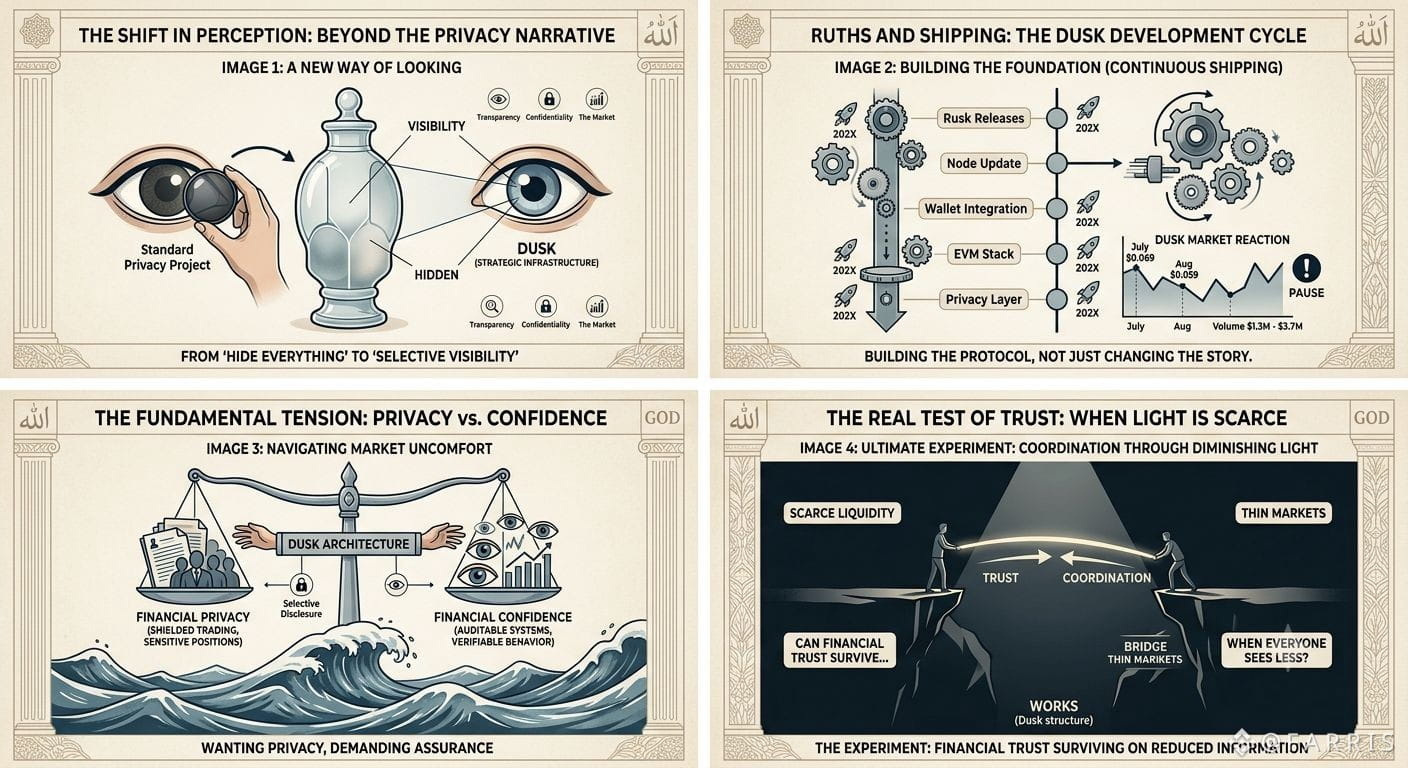
Dusk has kept shipping at the protocol level rather than simply changing the story around the token. Rusk has seen multiple releases this year, while the ecosystem repositories are still being updated across the node, wallet, EVM, and privacy stack.
And the market hasn’t exactly treated that development with much patience.
DUSK was around $0.069 in late July and was closer to $0.059 in early August, with daily trading volumes moving between roughly $1.3M and $3.7M in that period.
That’s the part I find useful to watch.
Because Dusk is trying to solve a problem that becomes more difficult precisely when markets get uncomfortable: financial participants want privacy, but they also want confidence. They want sensitive positions hidden without feeling like the system itself has become opaque.
Dusk’s architecture reflects that tension directly. Public and shielded transaction models coexist, while selective disclosure is built into the broader design.
#USPressesSouthKoreaToPrioritizeMemoryChips
I used to think the hard part would be proving that confidential execution works.
Now I think the harder test is proving that people will keep coordinating around it when liquidity gets thin and certainty becomes expensive.
That’s when infrastructure stops being an idea and starts revealing who actually trusts it.
#BTCPerpFundingRateHits20MonthHigh
$BTW
{future}(BTWUSDT)
$VELVET
{future}(VELVETUSDT)
#dusk $DUSK @Dusk
I stopped looking at Dusk the way I used to look at most privacy projects.
#EthereumOpensGlamsterdamEarlyTestnet
The interesting part isn’t the privacy narrative. It’s what happens when you try to build financial infrastructure where some information is deliberately visible, some is deliberately hidden, and the market still has to trust that everything underneath is behaving correctly.
#StrategySellsStockToRepurchasePreferred
That distinction has become more interesting to me lately.
Dusk has kept shipping at the protocol level rather than simply changing the story around the token. Rusk has seen multiple releases this year, while the ecosystem repositories are still being updated across the node, wallet, EVM, and privacy stack.
And the market hasn’t exactly treated that development with much patience.
DUSK was around $0.069 in late July and was closer to $0.059 in early August, with daily trading volumes moving between roughly $1.3M and $3.7M in that period.
That’s the part I find useful to watch.
Because Dusk is trying to solve a problem that becomes more difficult precisely when markets get uncomfortable: financial participants want privacy, but they also want confidence. They want sensitive positions hidden without feeling like the system itself has become opaque.
Dusk’s architecture reflects that tension directly. Public and shielded transaction models coexist, while selective disclosure is built into the broader design.
#USPressesSouthKoreaToPrioritizeMemoryChips
I used to think the hard part would be proving that confidential execution works.
Now I think the harder test is proving that people will keep coordinating around it when liquidity gets thin and certainty becomes expensive.
That’s when infrastructure stops being an idea and starts revealing who actually trusts it.
#BTCPerpFundingRateHits20MonthHigh
$BTW
$VELVET
I stopped looking at Dusk the way I used to look at most privacy projects.
#EthereumOpensGlamsterdamEarlyTestnet
The interesting part isn’t the privacy narrative. It’s what happens when you try to build financial infrastructure where some information is deliberately visible, some is deliberately hidden, and the market still has to trust that everything underneath is behaving correctly.
#StrategySellsStockToRepurchasePreferred
That distinction has become more interesting to me lately.
Dusk has kept shipping at the protocol level rather than simply changing the story around the token. Rusk has seen multiple releases this year, while the ecosystem repositories are still being updated across the node, wallet, EVM, and privacy stack.
And the market hasn’t exactly treated that development with much patience.
DUSK was around $0.069 in late July and was closer to $0.059 in early August, with daily trading volumes moving between roughly $1.3M and $3.7M in that period.
That’s the part I find useful to watch.
Because Dusk is trying to solve a problem that becomes more difficult precisely when markets get uncomfortable: financial participants want privacy, but they also want confidence. They want sensitive positions hidden without feeling like the system itself has become opaque.
Dusk’s architecture reflects that tension directly. Public and shielded transaction models coexist, while selective disclosure is built into the broader design.
#USPressesSouthKoreaToPrioritizeMemoryChips
I used to think the hard part would be proving that confidential execution works.
Now I think the harder test is proving that people will keep coordinating around it when liquidity gets thin and certainty becomes expensive.
That’s when infrastructure stops being an idea and starts revealing who actually trusts it.
#BTCPerpFundingRateHits20MonthHigh
$BTW
$VELVET
13
14
505
·
--
#dusk $DUSK @Dusk_Foundation
The more I read about Dusk, the more interesting the privacy angle becomes.
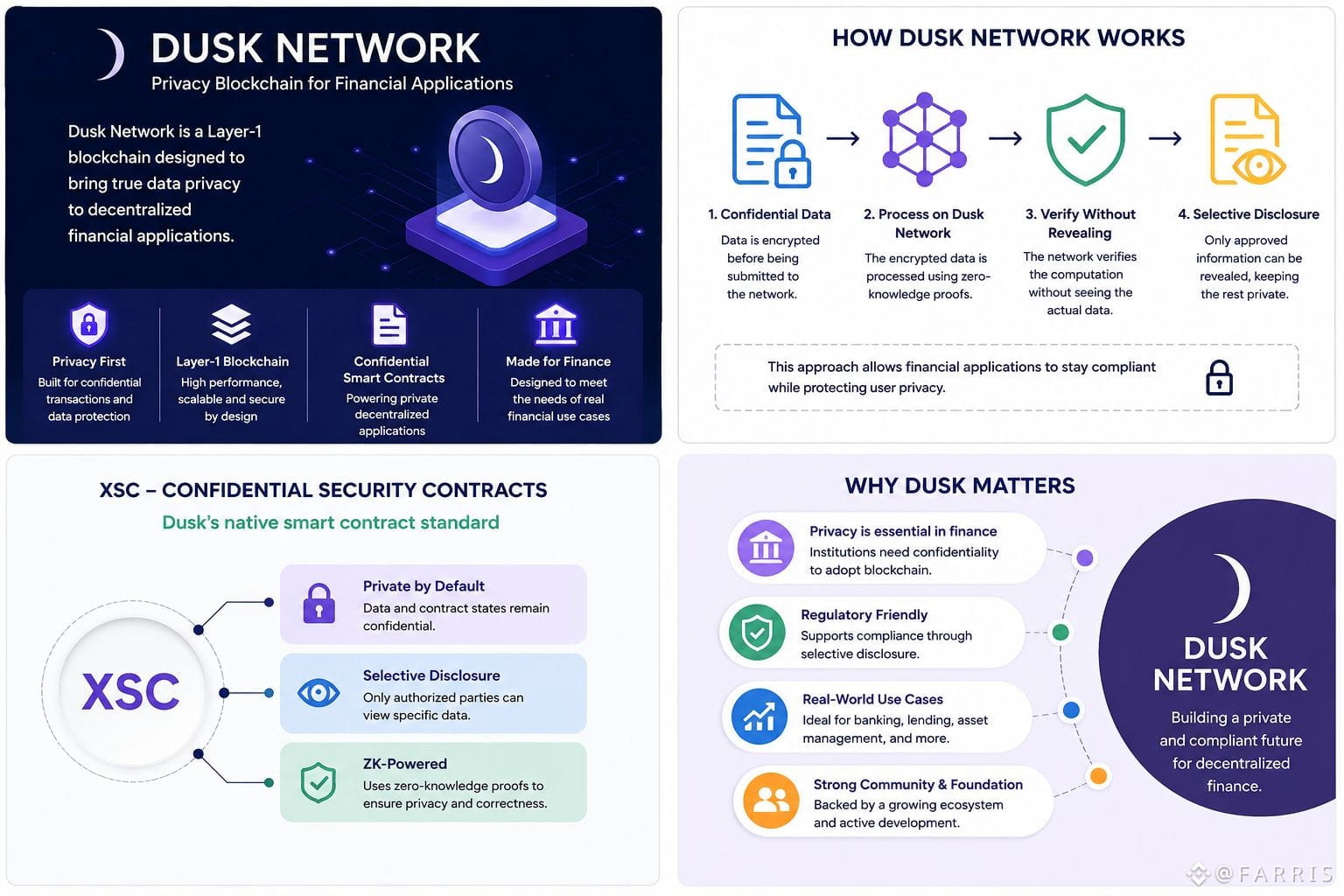
What caught my attention isn’t simply that it’s a privacy-focused L1, but how it tries to balance confidentiality with the realities of financial markets. Its XSC standard is built for confidential smart contracts, while zero-knowledge proofs and selective disclosure can keep sensitive activity private without making everything invisible.
My take: for regulated finance, privacy probably isn’t an optional feature. The harder question is whether Dusk can make that privacy practical enough for real financial workflows. That’s the part I’m watching.
#StrategySellsStockToRepurchasePreferred #DollarHits3MonthLow #EthereumFoundationLaunchesGlamsterdamTestnet #US30YearYieldHitsHighestSince2007
$ACE
{spot}(ACEUSDT)
$TUT
{spot}(TUTUSDT)
#dusk $DUSK @Dusk
The more I read about Dusk, the more interesting the privacy angle becomes.
What caught my attention isn’t simply that it’s a privacy-focused L1, but how it tries to balance confidentiality with the realities of financial markets. Its XSC standard is built for confidential smart contracts, while zero-knowledge proofs and selective disclosure can keep sensitive activity private without making everything invisible.
My take: for regulated finance, privacy probably isn’t an optional feature. The harder question is whether Dusk can make that privacy practical enough for real financial workflows. That’s the part I’m watching.
#StrategySellsStockToRepurchasePreferred #DollarHits3MonthLow #EthereumFoundationLaunchesGlamsterdamTestnet #US30YearYieldHitsHighestSince2007
$ACE
$TUT
The more I read about Dusk, the more interesting the privacy angle becomes.
What caught my attention isn’t simply that it’s a privacy-focused L1, but how it tries to balance confidentiality with the realities of financial markets. Its XSC standard is built for confidential smart contracts, while zero-knowledge proofs and selective disclosure can keep sensitive activity private without making everything invisible.
My take: for regulated finance, privacy probably isn’t an optional feature. The harder question is whether Dusk can make that privacy practical enough for real financial workflows. That’s the part I’m watching.
#StrategySellsStockToRepurchasePreferred #DollarHits3MonthLow #EthereumFoundationLaunchesGlamsterdamTestnet #US30YearYieldHitsHighestSince2007
$ACE
$TUT
12
12
144
·
--
#dusk $DUSK @Dusk_Foundation
I used to think the hardest part of privacy was hiding information.
Watching Dusk over time made me question that.
The interesting part isn’t simply that Dusk is building confidential smart contracts through its XSC standard. It’s the direction the network has taken around regulated finance, where privacy has to coexist with disclosure, settlement, and actual institutional workflows.
That distinction matters.
The codebase has also been moving forward rather than sitting still. Dusk’s Rust-based Rusk client is now the active implementation, with releases continuing in 2026, while the ecosystem has been expanding around EVM tooling, wallets, staking, Chainlink connectivity and regulated-market infrastructure.
And yet the market still tends to look at DUSK through the same short-term lens as everything else.
That’s where my view changed.
I’m less interested in whether Dusk can attract attention and more interested in whether financial activity eventually demands what public blockchains struggle to provide: information that can be verified without being exposed to everyone.
If that becomes the real bottleneck, Dusk’s privacy isn’t the story.
The uncomfortable realization is that selective visibility may matter more than complete transparency when serious money starts moving onchain.
#SECReviewsSix3xLeveragedCommodityETFs #SP500TopsRecord7800 #COWRises55.77%In24h #BNBChainToActivatePasteurHardFork
#dusk $DUSK @Dusk
I used to think the hardest part of privacy was hiding information.
Watching Dusk over time made me question that.
The interesting part isn’t simply that Dusk is building confidential smart contracts through its XSC standard. It’s the direction the network has taken around regulated finance, where privacy has to coexist with disclosure, settlement, and actual institutional workflows.
That distinction matters.
The codebase has also been moving forward rather than sitting still. Dusk’s Rust-based Rusk client is now the active implementation, with releases continuing in 2026, while the ecosystem has been expanding around EVM tooling, wallets, staking, Chainlink connectivity and regulated-market infrastructure.
And yet the market still tends to look at DUSK through the same short-term lens as everything else.
That’s where my view changed.
I’m less interested in whether Dusk can attract attention and more interested in whether financial activity eventually demands what public blockchains struggle to provide: information that can be verified without being exposed to everyone.
If that becomes the real bottleneck, Dusk’s privacy isn’t the story.
The uncomfortable realization is that selective visibility may matter more than complete transparency when serious money starts moving onchain.
#SECReviewsSix3xLeveragedCommodityETFs #SP500TopsRecord7800 #COWRises55.77%In24h #BNBChainToActivatePasteurHardFork
I used to think the hardest part of privacy was hiding information.
Watching Dusk over time made me question that.
The interesting part isn’t simply that Dusk is building confidential smart contracts through its XSC standard. It’s the direction the network has taken around regulated finance, where privacy has to coexist with disclosure, settlement, and actual institutional workflows.
That distinction matters.
The codebase has also been moving forward rather than sitting still. Dusk’s Rust-based Rusk client is now the active implementation, with releases continuing in 2026, while the ecosystem has been expanding around EVM tooling, wallets, staking, Chainlink connectivity and regulated-market infrastructure.
And yet the market still tends to look at DUSK through the same short-term lens as everything else.
That’s where my view changed.
I’m less interested in whether Dusk can attract attention and more interested in whether financial activity eventually demands what public blockchains struggle to provide: information that can be verified without being exposed to everyone.
If that becomes the real bottleneck, Dusk’s privacy isn’t the story.
The uncomfortable realization is that selective visibility may matter more than complete transparency when serious money starts moving onchain.
#SECReviewsSix3xLeveragedCommodityETFs #SP500TopsRecord7800 #COWRises55.77%In24h #BNBChainToActivatePasteurHardFork
7
10
132
·
--
#dusk $DUSK @Dusk_Foundation
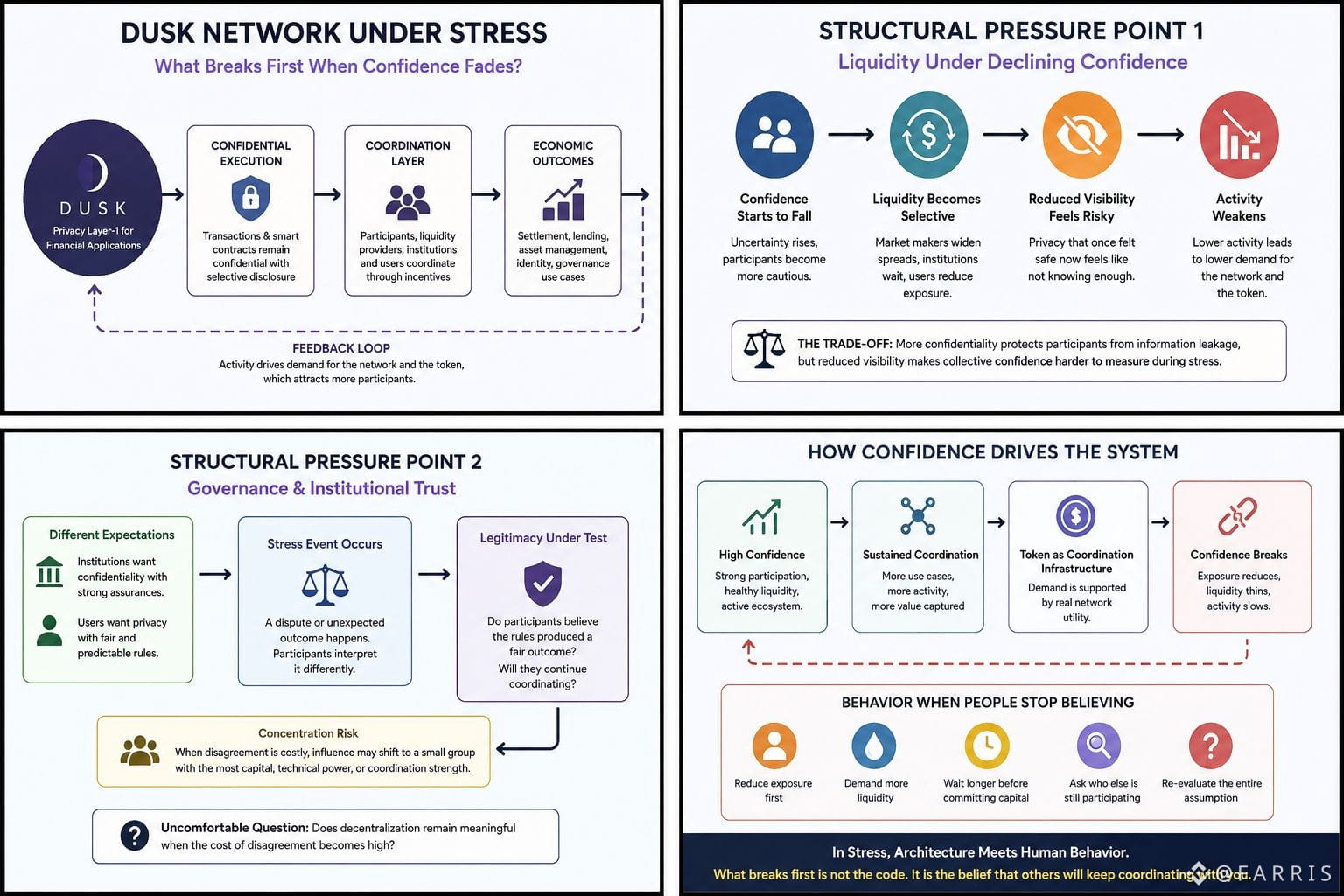
I keep coming back to one question with Dusk: what happens when people stop believing in the system they are coordinating through?
The interesting part is not the privacy architecture itself. It is how that privacy behaves when markets become stressed. Dusk is designed around confidential financial activity, selective disclosure, and deterministic settlement, which can make sensitive financial coordination more practical without exposing every position or transaction publicly.
But confidence is a different problem.
When liquidity is comfortable, privacy can feel like protection. When liquidity disappears, the same privacy can feel like uncertainty. Participants start asking what they cannot see, who still has conviction, and whether other participants will remain active when conditions worsen.
That creates a structural trade-off: stronger confidentiality can protect market participants from information leakage, while reduced visibility can make collective confidence harder to judge during stress.
The same tension reaches governance. A protocol can execute rules perfectly and still face a deeper question: who absorbs the consequences when those rules produce an outcome participants no longer accept?
I have watched capital rotate between narratives long enough to know that incentives eventually speak louder than design intentions. DUSK matters here as coordination infrastructure, but its real test is whether economic participants continue finding value in coordinating through the network when confidence becomes expensive.
That is where the architecture stops being theoretical and starts meeting human behavior.
#BerkshireAddsToDeltaAndAlphabetHoldings #PolymarketOddsIranBlockadeEndFallTo23% #DollarFallsToMayLow #TradersCutFedRateHikeBetsBeforeMid2027
#dusk $DUSK @Dusk
I keep coming back to one question with Dusk: what happens when people stop believing in the system they are coordinating through?
The interesting part is not the privacy architecture itself. It is how that privacy behaves when markets become stressed. Dusk is designed around confidential financial activity, selective disclosure, and deterministic settlement, which can make sensitive financial coordination more practical without exposing every position or transaction publicly.
But confidence is a different problem.
When liquidity is comfortable, privacy can feel like protection. When liquidity disappears, the same privacy can feel like uncertainty. Participants start asking what they cannot see, who still has conviction, and whether other participants will remain active when conditions worsen.
That creates a structural trade-off: stronger confidentiality can protect market participants from information leakage, while reduced visibility can make collective confidence harder to judge during stress.
The same tension reaches governance. A protocol can execute rules perfectly and still face a deeper question: who absorbs the consequences when those rules produce an outcome participants no longer accept?
I have watched capital rotate between narratives long enough to know that incentives eventually speak louder than design intentions. DUSK matters here as coordination infrastructure, but its real test is whether economic participants continue finding value in coordinating through the network when confidence becomes expensive.
That is where the architecture stops being theoretical and starts meeting human behavior.
#BerkshireAddsToDeltaAndAlphabetHoldings #PolymarketOddsIranBlockadeEndFallTo23% #DollarFallsToMayLow #TradersCutFedRateHikeBetsBeforeMid2027
I keep coming back to one question with Dusk: what happens when people stop believing in the system they are coordinating through?
The interesting part is not the privacy architecture itself. It is how that privacy behaves when markets become stressed. Dusk is designed around confidential financial activity, selective disclosure, and deterministic settlement, which can make sensitive financial coordination more practical without exposing every position or transaction publicly.
But confidence is a different problem.
When liquidity is comfortable, privacy can feel like protection. When liquidity disappears, the same privacy can feel like uncertainty. Participants start asking what they cannot see, who still has conviction, and whether other participants will remain active when conditions worsen.
That creates a structural trade-off: stronger confidentiality can protect market participants from information leakage, while reduced visibility can make collective confidence harder to judge during stress.
The same tension reaches governance. A protocol can execute rules perfectly and still face a deeper question: who absorbs the consequences when those rules produce an outcome participants no longer accept?
I have watched capital rotate between narratives long enough to know that incentives eventually speak louder than design intentions. DUSK matters here as coordination infrastructure, but its real test is whether economic participants continue finding value in coordinating through the network when confidence becomes expensive.
That is where the architecture stops being theoretical and starts meeting human behavior.
#BerkshireAddsToDeltaAndAlphabetHoldings #PolymarketOddsIranBlockadeEndFallTo23% #DollarFallsToMayLow #TradersCutFedRateHikeBetsBeforeMid2027
11
11
157
·
--
#dusk $DUSK @Dusk_Foundation
The strange thing about Dusk is that the market can look at it for months and still miss what is actually being built.
I’ve followed enough crypto cycles to know that infrastructure usually gets judged by the wrong clock. Price moves in days. Narratives rotate in weeks. Serious financial infrastructure can take years before anyone cares whether the underlying system actually handles the boring details.
What caught my attention with Dusk is how much of the recent work has moved away from explaining the idea and toward making the stack usable.
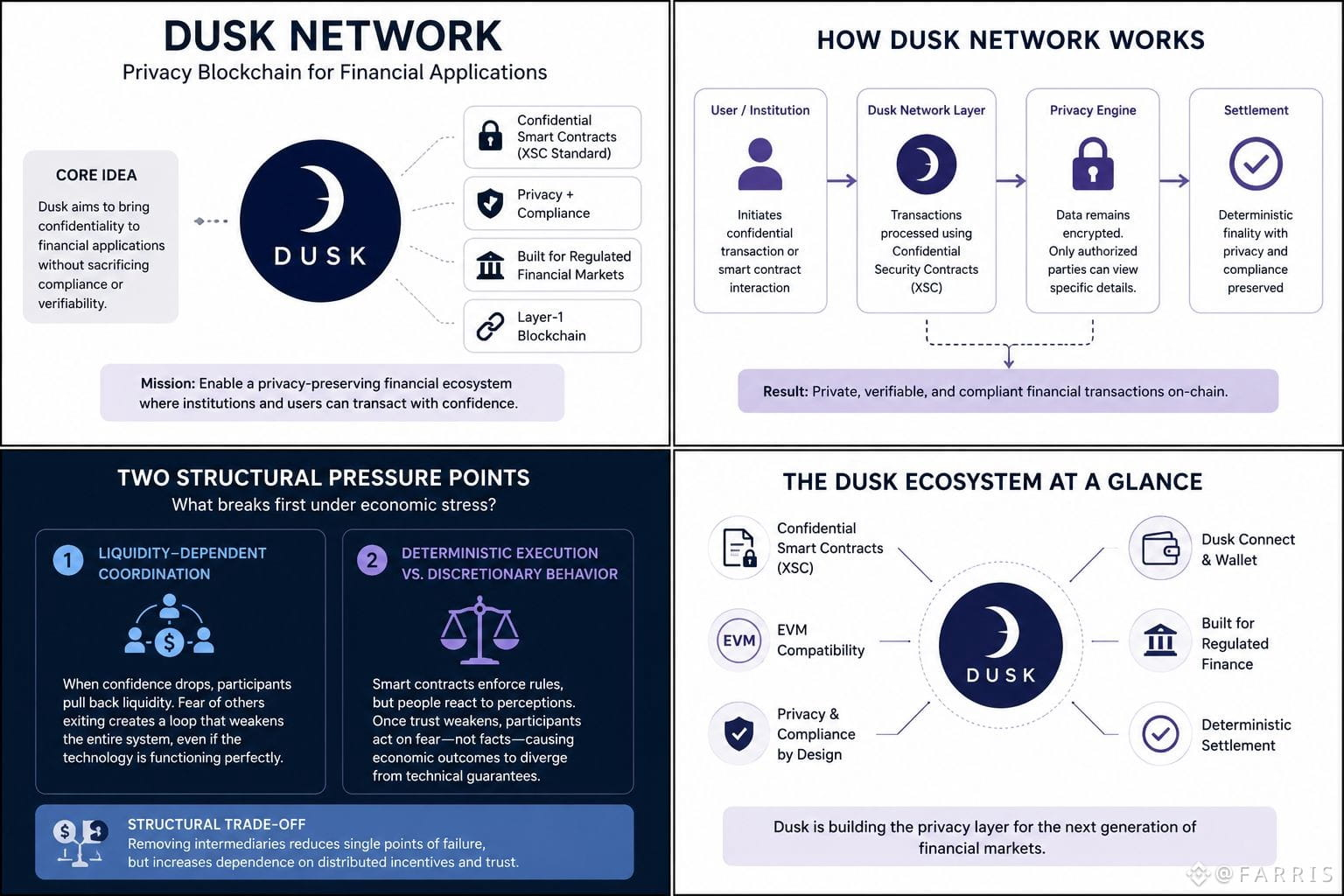
The network is already live, with separate public and shielded transaction models, deterministic settlement, native smart-contract environments, and an EVM path. More recently, Dusk has been working on the less glamorous layer around that infrastructure too: Dusk Connect and a new wallet aimed at making dApps easier to interact with.
That matters more to me than another partnership announcement.
Because eventually the question stops being “is privacy interesting?”
It becomes “will people actually use this when money is involved?”
Dusk is taking a very specific bet: regulated markets may need privacy without giving up verifiability, access controls, and settlement. Its XSC design is built around that tension rather than pretending financial assets can simply behave like ordinary tokens.
And that’s where my view changed.
I used to think the hardest part would be proving that confidential execution works.
Now I think the harder test is whether Dusk can make confidentiality feel normal enough that institutions stop treating it as a special feature and start treating it as infrastructure.
That is a much slower problem.
And probably the more important one.
#RedditToJoinSP500 #TapestryFallsNearly15%OnEarnings #SP500ClosesAtRecordHigh #DeepSeekLaunchesHarnessCodeAgentBeta
#dusk $DUSK @Dusk
The strange thing about Dusk is that the market can look at it for months and still miss what is actually being built.
I’ve followed enough crypto cycles to know that infrastructure usually gets judged by the wrong clock. Price moves in days. Narratives rotate in weeks. Serious financial infrastructure can take years before anyone cares whether the underlying system actually handles the boring details.
What caught my attention with Dusk is how much of the recent work has moved away from explaining the idea and toward making the stack usable.
The network is already live, with separate public and shielded transaction models, deterministic settlement, native smart-contract environments, and an EVM path. More recently, Dusk has been working on the less glamorous layer around that infrastructure too: Dusk Connect and a new wallet aimed at making dApps easier to interact with.
That matters more to me than another partnership announcement.
Because eventually the question stops being “is privacy interesting?”
It becomes “will people actually use this when money is involved?”
Dusk is taking a very specific bet: regulated markets may need privacy without giving up verifiability, access controls, and settlement. Its XSC design is built around that tension rather than pretending financial assets can simply behave like ordinary tokens.
And that’s where my view changed.
I used to think the hardest part would be proving that confidential execution works.
Now I think the harder test is whether Dusk can make confidentiality feel normal enough that institutions stop treating it as a special feature and start treating it as infrastructure.
That is a much slower problem.
And probably the more important one.
#RedditToJoinSP500 #TapestryFallsNearly15%OnEarnings #SP500ClosesAtRecordHigh #DeepSeekLaunchesHarnessCodeAgentBeta
The strange thing about Dusk is that the market can look at it for months and still miss what is actually being built.
I’ve followed enough crypto cycles to know that infrastructure usually gets judged by the wrong clock. Price moves in days. Narratives rotate in weeks. Serious financial infrastructure can take years before anyone cares whether the underlying system actually handles the boring details.
What caught my attention with Dusk is how much of the recent work has moved away from explaining the idea and toward making the stack usable.
The network is already live, with separate public and shielded transaction models, deterministic settlement, native smart-contract environments, and an EVM path. More recently, Dusk has been working on the less glamorous layer around that infrastructure too: Dusk Connect and a new wallet aimed at making dApps easier to interact with.
That matters more to me than another partnership announcement.
Because eventually the question stops being “is privacy interesting?”
It becomes “will people actually use this when money is involved?”
Dusk is taking a very specific bet: regulated markets may need privacy without giving up verifiability, access controls, and settlement. Its XSC design is built around that tension rather than pretending financial assets can simply behave like ordinary tokens.
And that’s where my view changed.
I used to think the hardest part would be proving that confidential execution works.
Now I think the harder test is whether Dusk can make confidentiality feel normal enough that institutions stop treating it as a special feature and start treating it as infrastructure.
That is a much slower problem.
And probably the more important one.
#RedditToJoinSP500 #TapestryFallsNearly15%OnEarnings #SP500ClosesAtRecordHigh #DeepSeekLaunchesHarnessCodeAgentBeta
1
121
·
--
Article
Dusk Network: The Hard Problem Behind Private Financial InfrastructureDusk Network is easy to describe as a privacy-focused Layer-1 for financial applications, but that description misses the more difficult problem it is actually trying to solve. The deeper issue is not simply that blockchains reveal too much information. It is that financial markets require two things that appear, at first, to be in tension: verifiable coordination and controlled information.
Public blockchains made transparency a default. That works remarkably well for systems where everyone benefits from seeing the same state. Financial institutions, however, often operate under different conditions. A portfolio manager does not necessarily want competitors seeing positions in real time. A market participant may need to prove eligibility without revealing an entire identity. An issuer may need transfer restrictions, ownership limits, settlement rules and regulatory controls without publishing every commercially sensitive detail.
Dusk is built around this tension. Its stated architecture combines confidential transactions, selective disclosure, deterministic settlement and programmable financial workflows. Its XSC — Confidential Security Contract — standard is intended to support privacy-enabled tokenized securities while allowing rules associated with regulated assets to be represented in the system.
The uncomfortable reality is that privacy alone does not solve institutional finance. Institutions do not simply want secrecy. They want controlled visibility. They need to keep some information private while proving other information to counterparties, auditors, regulators or other authorized parties. That makes Dusk's problem considerably harder than building another confidential transaction system.
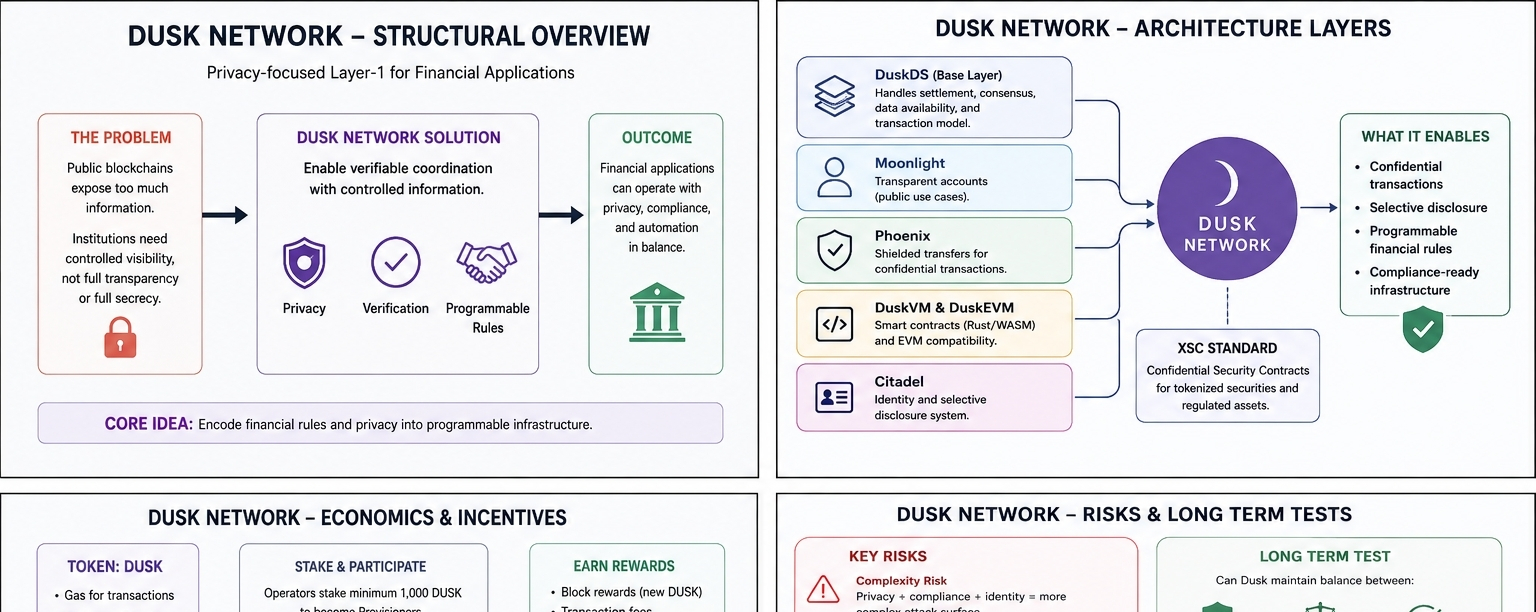
At the architectural level, Dusk approaches this through several interacting components rather than one privacy mechanism. DuskDS provides settlement, data availability, consensus and transaction models. Moonlight supports transparent public accounts, while Phoenix provides shielded transfers. Dusk also has DuskVM for native Rust/WASM contracts and DuskEVM for EVM-compatible execution. Citadel provides identity and selective-disclosure primitives.
This separation matters because privacy is not binary. A serious financial system cannot simply make everything invisible. It needs different levels of visibility depending on the transaction and the participants involved. Dusk's architecture therefore tries to make privacy programmable rather than treating it as an all-or-nothing property. Its documentation describes the ability to keep sensitive state protected while producing evidence for parties that legitimately require it.
The XSC concept is particularly interesting for this reason. A security token cannot simply behave like a freely transferable cryptocurrency. Real securities can involve eligibility requirements, ownership restrictions, redemption procedures, voting rights, dividends and other contractual conditions. Dusk's earlier Zedger design was created specifically around this problem, combining UTXO-style privacy characteristics with account-like functionality needed for securities workflows.
That design choice reveals something important about Dusk's philosophy: the protocol is not trying to remove institutional constraints. It is trying to encode them into programmable infrastructure.
That creates both its strongest argument and one of its biggest risks.
The strongest argument is that compliance does not necessarily have to mean sacrificing cryptographic privacy. The network can potentially prove that a rule was satisfied without exposing every underlying piece of information. In theory, this is a better model than forcing financial institutions to choose between completely transparent public ledgers and conventional private databases.
But there is an important philosophical tradeoff. The more financial rules become embedded in smart contracts, identity systems and permission structures, the more important the designers of those mechanisms become. A system can be technically decentralized while still concentrating meaningful power around the entities that define asset rules, access conditions, disclosure mechanisms or identity credentials.
This is where the decentralization question becomes more complicated than counting validators.
Dusk uses Succinct Attestation, a committee-based proof-of-stake consensus system. Provisioners stake DUSK and can be selected to propose, validate and ratify blocks. The protocol is designed around randomly selected committees and deterministic finality.
Economically, DUSK serves as both gas and staking collateral. Direct provisioners currently need at least 1,000 DUSK, and operators must keep nodes online and synchronized to participate effectively. The reward system combines newly emitted DUSK with transaction fees, while penalties can apply to failed participation or provably invalid consensus behavior.
That creates a reasonably clear economic loop: the network pays participants to provide infrastructure, while staking exposes them to consequences for harmful behavior.
Yet economic security is not the same thing as decentralization.
A 1,000-DUSK minimum may be accessible enough for individual operators, but the real question is distribution. If a relatively small number of entities control a large percentage of the effective stake, committee selection can remain formally permissionless while practical influence becomes concentrated. Similarly, large professional operators can gain advantages through infrastructure reliability, monitoring, security practices and operational expertise.
The economics therefore deserve more attention than the headline staking requirement.
Dusk's token model has an initial 500 million DUSK supply with another 500 million scheduled to be emitted over time, reaching a maximum of 1 billion. Emissions are designed to decline over a long period, while block rewards are divided among the block generator, committees and a development fund.
This creates an important long-term test. Early infrastructure can be subsidized by token issuance, but mature infrastructure eventually has to justify itself through actual economic activity. If regulated financial applications generate meaningful transaction demand, fees can become a stronger component of network security. If usage remains limited, emissions can continue paying for security without necessarily proving that the underlying market has found the network indispensable.
That distinction is crucial.
A blockchain can look healthy because it has active staking, functioning validators and a polished application layer. But those indicators can create surface-level confidence. Long-term reliability comes from something harder: users continuing to depend on the system when incentives change.
Dusk also faces a technical risk specific to its ambition. Privacy increases the complexity of the system. Zero-knowledge proofs, confidential state, selective disclosure, identity mechanisms and programmable compliance create more places where assumptions can fail. Dusk's documentation identifies a range of cryptographic primitives and explicitly points developers toward formal security analysis and its whitepaper for deeper arguments.
The project has also subjected important infrastructure to external auditing. Oak Security's 2024 review covered the Rusk consensus and node libraries. That is useful evidence of serious engineering discipline, but an audit should never be interpreted as proof that a system is permanently secure.
There is another vulnerability that is less obvious: privacy can become a systems-integration problem.
Even if transaction data is cryptographically protected, information can leak through surrounding infrastructure, user behavior, timing, application interfaces, identity systems or poorly designed contracts. Confidentiality is therefore not just a property of the underlying proof system. It becomes a property of the entire financial workflow.
The same applies to compliance. Selective disclosure sounds elegant in principle, but its real value depends on who controls the credentials, how revocation works, how disputes are handled and what happens when regulatory requirements change. A smart contract can enforce yesterday's rules perfectly while still being unsuitable for tomorrow's legal environment.
This is why I think Dusk should ultimately be judged less by whether it can keep transactions private and more by whether it can maintain credible boundaries between privacy, authority and verification.
If it succeeds, its architecture could become more useful precisely because it does not treat decentralization as the removal of every institution. Instead, it attempts to make institutional rules auditable and programmable while preserving confidentiality around information that does not need to be public.
If it fails, the failure probably will not look like a dramatic cryptographic collapse. It may be quieter. Institutions may decide that integrating the system is more complicated than maintaining existing infrastructure. Developers may find the specialized privacy and financial tooling harder to work with than established ecosystems. Liquidity may fragment. Compliance mechanisms may become too rigid. Or economic activity may simply remain too small to replace subsidized participation with organic demand.
That is the real test for Dusk.
The interesting question is not whether a blockchain can hide financial information. Modern cryptography already makes that possible. The harder question is whether a decentralized system can preserve confidentiality without destroying accountability, encode financial rules without creating excessive centralized control, and maintain security without depending indefinitely on token emissions.
Those are difficult problems because they are not purely technical. They are problems of incentives, institutional behavior and trust.
Dusk's architecture is therefore worth watching not because it promises to make finance magically decentralized, but because it is attempting something more uncomfortable: building infrastructure where privacy and regulation have to coexist inside the same system.
Whether that produces durable infrastructure will ultimately depend on what happens after the initial confidence disappears — when real capital, real counterparties, real regulatory pressure and real economic incentives begin testing the assumptions embedded in the design.
#dusk
@Dusk_Foundation
$DUSK
{spot}(DUSKUSDT)
Dusk Network: The Hard Problem Behind Private Financial Infrastructure
Dusk Network is easy to describe as a privacy-focused Layer-1 for financial applications, but that description misses the more difficult problem it is actually trying to solve. The deeper issue is not simply that blockchains reveal too much information. It is that financial markets require two things that appear, at first, to be in tension: verifiable coordination and controlled information.
Public blockchains made transparency a default. That works remarkably well for systems where everyone benefits from seeing the same state. Financial institutions, however, often operate under different conditions. A portfolio manager does not necessarily want competitors seeing positions in real time. A market participant may need to prove eligibility without revealing an entire identity. An issuer may need transfer restrictions, ownership limits, settlement rules and regulatory controls without publishing every commercially sensitive detail.
Dusk is built around this tension. Its stated architecture combines confidential transactions, selective disclosure, deterministic settlement and programmable financial workflows. Its XSC — Confidential Security Contract — standard is intended to support privacy-enabled tokenized securities while allowing rules associated with regulated assets to be represented in the system.
The uncomfortable reality is that privacy alone does not solve institutional finance. Institutions do not simply want secrecy. They want controlled visibility. They need to keep some information private while proving other information to counterparties, auditors, regulators or other authorized parties. That makes Dusk's problem considerably harder than building another confidential transaction system.
At the architectural level, Dusk approaches this through several interacting components rather than one privacy mechanism. DuskDS provides settlement, data availability, consensus and transaction models. Moonlight supports transparent public accounts, while Phoenix provides shielded transfers. Dusk also has DuskVM for native Rust/WASM contracts and DuskEVM for EVM-compatible execution. Citadel provides identity and selective-disclosure primitives.
This separation matters because privacy is not binary. A serious financial system cannot simply make everything invisible. It needs different levels of visibility depending on the transaction and the participants involved. Dusk's architecture therefore tries to make privacy programmable rather than treating it as an all-or-nothing property. Its documentation describes the ability to keep sensitive state protected while producing evidence for parties that legitimately require it.
The XSC concept is particularly interesting for this reason. A security token cannot simply behave like a freely transferable cryptocurrency. Real securities can involve eligibility requirements, ownership restrictions, redemption procedures, voting rights, dividends and other contractual conditions. Dusk's earlier Zedger design was created specifically around this problem, combining UTXO-style privacy characteristics with account-like functionality needed for securities workflows.
That design choice reveals something important about Dusk's philosophy: the protocol is not trying to remove institutional constraints. It is trying to encode them into programmable infrastructure.
That creates both its strongest argument and one of its biggest risks.
The strongest argument is that compliance does not necessarily have to mean sacrificing cryptographic privacy. The network can potentially prove that a rule was satisfied without exposing every underlying piece of information. In theory, this is a better model than forcing financial institutions to choose between completely transparent public ledgers and conventional private databases.
But there is an important philosophical tradeoff. The more financial rules become embedded in smart contracts, identity systems and permission structures, the more important the designers of those mechanisms become. A system can be technically decentralized while still concentrating meaningful power around the entities that define asset rules, access conditions, disclosure mechanisms or identity credentials.
This is where the decentralization question becomes more complicated than counting validators.
Dusk uses Succinct Attestation, a committee-based proof-of-stake consensus system. Provisioners stake DUSK and can be selected to propose, validate and ratify blocks. The protocol is designed around randomly selected committees and deterministic finality.
Economically, DUSK serves as both gas and staking collateral. Direct provisioners currently need at least 1,000 DUSK, and operators must keep nodes online and synchronized to participate effectively. The reward system combines newly emitted DUSK with transaction fees, while penalties can apply to failed participation or provably invalid consensus behavior.
That creates a reasonably clear economic loop: the network pays participants to provide infrastructure, while staking exposes them to consequences for harmful behavior.
Yet economic security is not the same thing as decentralization.
A 1,000-DUSK minimum may be accessible enough for individual operators, but the real question is distribution. If a relatively small number of entities control a large percentage of the effective stake, committee selection can remain formally permissionless while practical influence becomes concentrated. Similarly, large professional operators can gain advantages through infrastructure reliability, monitoring, security practices and operational expertise.
The economics therefore deserve more attention than the headline staking requirement.
Dusk's token model has an initial 500 million DUSK supply with another 500 million scheduled to be emitted over time, reaching a maximum of 1 billion. Emissions are designed to decline over a long period, while block rewards are divided among the block generator, committees and a development fund.
This creates an important long-term test. Early infrastructure can be subsidized by token issuance, but mature infrastructure eventually has to justify itself through actual economic activity. If regulated financial applications generate meaningful transaction demand, fees can become a stronger component of network security. If usage remains limited, emissions can continue paying for security without necessarily proving that the underlying market has found the network indispensable.
That distinction is crucial.
A blockchain can look healthy because it has active staking, functioning validators and a polished application layer. But those indicators can create surface-level confidence. Long-term reliability comes from something harder: users continuing to depend on the system when incentives change.
Dusk also faces a technical risk specific to its ambition. Privacy increases the complexity of the system. Zero-knowledge proofs, confidential state, selective disclosure, identity mechanisms and programmable compliance create more places where assumptions can fail. Dusk's documentation identifies a range of cryptographic primitives and explicitly points developers toward formal security analysis and its whitepaper for deeper arguments.
The project has also subjected important infrastructure to external auditing. Oak Security's 2024 review covered the Rusk consensus and node libraries. That is useful evidence of serious engineering discipline, but an audit should never be interpreted as proof that a system is permanently secure.
There is another vulnerability that is less obvious: privacy can become a systems-integration problem.
Even if transaction data is cryptographically protected, information can leak through surrounding infrastructure, user behavior, timing, application interfaces, identity systems or poorly designed contracts. Confidentiality is therefore not just a property of the underlying proof system. It becomes a property of the entire financial workflow.
The same applies to compliance. Selective disclosure sounds elegant in principle, but its real value depends on who controls the credentials, how revocation works, how disputes are handled and what happens when regulatory requirements change. A smart contract can enforce yesterday's rules perfectly while still being unsuitable for tomorrow's legal environment.
This is why I think Dusk should ultimately be judged less by whether it can keep transactions private and more by whether it can maintain credible boundaries between privacy, authority and verification.
If it succeeds, its architecture could become more useful precisely because it does not treat decentralization as the removal of every institution. Instead, it attempts to make institutional rules auditable and programmable while preserving confidentiality around information that does not need to be public.
If it fails, the failure probably will not look like a dramatic cryptographic collapse. It may be quieter. Institutions may decide that integrating the system is more complicated than maintaining existing infrastructure. Developers may find the specialized privacy and financial tooling harder to work with than established ecosystems. Liquidity may fragment. Compliance mechanisms may become too rigid. Or economic activity may simply remain too small to replace subsidized participation with organic demand.
That is the real test for Dusk.
The interesting question is not whether a blockchain can hide financial information. Modern cryptography already makes that possible. The harder question is whether a decentralized system can preserve confidentiality without destroying accountability, encode financial rules without creating excessive centralized control, and maintain security without depending indefinitely on token emissions.
Those are difficult problems because they are not purely technical. They are problems of incentives, institutional behavior and trust.
Dusk's architecture is therefore worth watching not because it promises to make finance magically decentralized, but because it is attempting something more uncomfortable: building infrastructure where privacy and regulation have to coexist inside the same system.
Whether that produces durable infrastructure will ultimately depend on what happens after the initial confidence disappears — when real capital, real counterparties, real regulatory pressure and real economic incentives begin testing the assumptions embedded in the design.
#dusk
@Dusk
$DUSK
Public blockchains made transparency a default. That works remarkably well for systems where everyone benefits from seeing the same state. Financial institutions, however, often operate under different conditions. A portfolio manager does not necessarily want competitors seeing positions in real time. A market participant may need to prove eligibility without revealing an entire identity. An issuer may need transfer restrictions, ownership limits, settlement rules and regulatory controls without publishing every commercially sensitive detail.
Dusk is built around this tension. Its stated architecture combines confidential transactions, selective disclosure, deterministic settlement and programmable financial workflows. Its XSC — Confidential Security Contract — standard is intended to support privacy-enabled tokenized securities while allowing rules associated with regulated assets to be represented in the system.
The uncomfortable reality is that privacy alone does not solve institutional finance. Institutions do not simply want secrecy. They want controlled visibility. They need to keep some information private while proving other information to counterparties, auditors, regulators or other authorized parties. That makes Dusk's problem considerably harder than building another confidential transaction system.
At the architectural level, Dusk approaches this through several interacting components rather than one privacy mechanism. DuskDS provides settlement, data availability, consensus and transaction models. Moonlight supports transparent public accounts, while Phoenix provides shielded transfers. Dusk also has DuskVM for native Rust/WASM contracts and DuskEVM for EVM-compatible execution. Citadel provides identity and selective-disclosure primitives.
This separation matters because privacy is not binary. A serious financial system cannot simply make everything invisible. It needs different levels of visibility depending on the transaction and the participants involved. Dusk's architecture therefore tries to make privacy programmable rather than treating it as an all-or-nothing property. Its documentation describes the ability to keep sensitive state protected while producing evidence for parties that legitimately require it.
The XSC concept is particularly interesting for this reason. A security token cannot simply behave like a freely transferable cryptocurrency. Real securities can involve eligibility requirements, ownership restrictions, redemption procedures, voting rights, dividends and other contractual conditions. Dusk's earlier Zedger design was created specifically around this problem, combining UTXO-style privacy characteristics with account-like functionality needed for securities workflows.
That design choice reveals something important about Dusk's philosophy: the protocol is not trying to remove institutional constraints. It is trying to encode them into programmable infrastructure.
That creates both its strongest argument and one of its biggest risks.
The strongest argument is that compliance does not necessarily have to mean sacrificing cryptographic privacy. The network can potentially prove that a rule was satisfied without exposing every underlying piece of information. In theory, this is a better model than forcing financial institutions to choose between completely transparent public ledgers and conventional private databases.
But there is an important philosophical tradeoff. The more financial rules become embedded in smart contracts, identity systems and permission structures, the more important the designers of those mechanisms become. A system can be technically decentralized while still concentrating meaningful power around the entities that define asset rules, access conditions, disclosure mechanisms or identity credentials.
This is where the decentralization question becomes more complicated than counting validators.
Dusk uses Succinct Attestation, a committee-based proof-of-stake consensus system. Provisioners stake DUSK and can be selected to propose, validate and ratify blocks. The protocol is designed around randomly selected committees and deterministic finality.
Economically, DUSK serves as both gas and staking collateral. Direct provisioners currently need at least 1,000 DUSK, and operators must keep nodes online and synchronized to participate effectively. The reward system combines newly emitted DUSK with transaction fees, while penalties can apply to failed participation or provably invalid consensus behavior.
That creates a reasonably clear economic loop: the network pays participants to provide infrastructure, while staking exposes them to consequences for harmful behavior.
Yet economic security is not the same thing as decentralization.
A 1,000-DUSK minimum may be accessible enough for individual operators, but the real question is distribution. If a relatively small number of entities control a large percentage of the effective stake, committee selection can remain formally permissionless while practical influence becomes concentrated. Similarly, large professional operators can gain advantages through infrastructure reliability, monitoring, security practices and operational expertise.
The economics therefore deserve more attention than the headline staking requirement.
Dusk's token model has an initial 500 million DUSK supply with another 500 million scheduled to be emitted over time, reaching a maximum of 1 billion. Emissions are designed to decline over a long period, while block rewards are divided among the block generator, committees and a development fund.
This creates an important long-term test. Early infrastructure can be subsidized by token issuance, but mature infrastructure eventually has to justify itself through actual economic activity. If regulated financial applications generate meaningful transaction demand, fees can become a stronger component of network security. If usage remains limited, emissions can continue paying for security without necessarily proving that the underlying market has found the network indispensable.
That distinction is crucial.
A blockchain can look healthy because it has active staking, functioning validators and a polished application layer. But those indicators can create surface-level confidence. Long-term reliability comes from something harder: users continuing to depend on the system when incentives change.
Dusk also faces a technical risk specific to its ambition. Privacy increases the complexity of the system. Zero-knowledge proofs, confidential state, selective disclosure, identity mechanisms and programmable compliance create more places where assumptions can fail. Dusk's documentation identifies a range of cryptographic primitives and explicitly points developers toward formal security analysis and its whitepaper for deeper arguments.
The project has also subjected important infrastructure to external auditing. Oak Security's 2024 review covered the Rusk consensus and node libraries. That is useful evidence of serious engineering discipline, but an audit should never be interpreted as proof that a system is permanently secure.
There is another vulnerability that is less obvious: privacy can become a systems-integration problem.
Even if transaction data is cryptographically protected, information can leak through surrounding infrastructure, user behavior, timing, application interfaces, identity systems or poorly designed contracts. Confidentiality is therefore not just a property of the underlying proof system. It becomes a property of the entire financial workflow.
The same applies to compliance. Selective disclosure sounds elegant in principle, but its real value depends on who controls the credentials, how revocation works, how disputes are handled and what happens when regulatory requirements change. A smart contract can enforce yesterday's rules perfectly while still being unsuitable for tomorrow's legal environment.
This is why I think Dusk should ultimately be judged less by whether it can keep transactions private and more by whether it can maintain credible boundaries between privacy, authority and verification.
If it succeeds, its architecture could become more useful precisely because it does not treat decentralization as the removal of every institution. Instead, it attempts to make institutional rules auditable and programmable while preserving confidentiality around information that does not need to be public.
If it fails, the failure probably will not look like a dramatic cryptographic collapse. It may be quieter. Institutions may decide that integrating the system is more complicated than maintaining existing infrastructure. Developers may find the specialized privacy and financial tooling harder to work with than established ecosystems. Liquidity may fragment. Compliance mechanisms may become too rigid. Or economic activity may simply remain too small to replace subsidized participation with organic demand.
That is the real test for Dusk.
The interesting question is not whether a blockchain can hide financial information. Modern cryptography already makes that possible. The harder question is whether a decentralized system can preserve confidentiality without destroying accountability, encode financial rules without creating excessive centralized control, and maintain security without depending indefinitely on token emissions.
Those are difficult problems because they are not purely technical. They are problems of incentives, institutional behavior and trust.
Dusk's architecture is therefore worth watching not because it promises to make finance magically decentralized, but because it is attempting something more uncomfortable: building infrastructure where privacy and regulation have to coexist inside the same system.
Whether that produces durable infrastructure will ultimately depend on what happens after the initial confidence disappears — when real capital, real counterparties, real regulatory pressure and real economic incentives begin testing the assumptions embedded in the design.
#dusk
@Dusk
$DUSK
2
109
·
--
#baby @babylonlabs_io $BABY
I almost ignored Babylon.
Not because I thought it was a bad idea. It just wasn't the loudest story in the market, and after enough years in crypto, I've learned that the loudest stories rarely stay that way.
So I kept watching.
What stood out wasn't the price or the headlines. It was the kind of conversations happening around it. People were spending more time discussing how incentives hold together under pressure than celebrating short-term moves. That's not something you see very often.
I've watched too many narratives fall apart the moment the market gets uncomfortable. That's why I pay more attention to what people do when excitement fades than what they say when everything is green.
Babylon made me rethink one thing.
Maybe the real test for a protocol isn't how fast it grows. It's whether people still choose to participate when there's no easy reason to stay.
That's the part the chart can't show, and it's usually the part that matters most.
#USIranDealOrNoDeal #SpaceXToReportQ2Results #KoreaMarginHikeCutsLeveragedETFTrading #KOSPINikkeiOpenHigherOnChipStocks
#baby @BabylonLabs_io $BABY
I almost ignored Babylon.
Not because I thought it was a bad idea. It just wasn't the loudest story in the market, and after enough years in crypto, I've learned that the loudest stories rarely stay that way.
So I kept watching.
What stood out wasn't the price or the headlines. It was the kind of conversations happening around it. People were spending more time discussing how incentives hold together under pressure than celebrating short-term moves. That's not something you see very often.
I've watched too many narratives fall apart the moment the market gets uncomfortable. That's why I pay more attention to what people do when excitement fades than what they say when everything is green.
Babylon made me rethink one thing.
Maybe the real test for a protocol isn't how fast it grows. It's whether people still choose to participate when there's no easy reason to stay.
That's the part the chart can't show, and it's usually the part that matters most.
#USIranDealOrNoDeal #SpaceXToReportQ2Results #KoreaMarginHikeCutsLeveragedETFTrading #KOSPINikkeiOpenHigherOnChipStocks
I almost ignored Babylon.
Not because I thought it was a bad idea. It just wasn't the loudest story in the market, and after enough years in crypto, I've learned that the loudest stories rarely stay that way.
So I kept watching.
What stood out wasn't the price or the headlines. It was the kind of conversations happening around it. People were spending more time discussing how incentives hold together under pressure than celebrating short-term moves. That's not something you see very often.
I've watched too many narratives fall apart the moment the market gets uncomfortable. That's why I pay more attention to what people do when excitement fades than what they say when everything is green.
Babylon made me rethink one thing.
Maybe the real test for a protocol isn't how fast it grows. It's whether people still choose to participate when there's no easy reason to stay.
That's the part the chart can't show, and it's usually the part that matters most.
#USIranDealOrNoDeal #SpaceXToReportQ2Results #KoreaMarginHikeCutsLeveragedETFTrading #KOSPINikkeiOpenHigherOnChipStocks
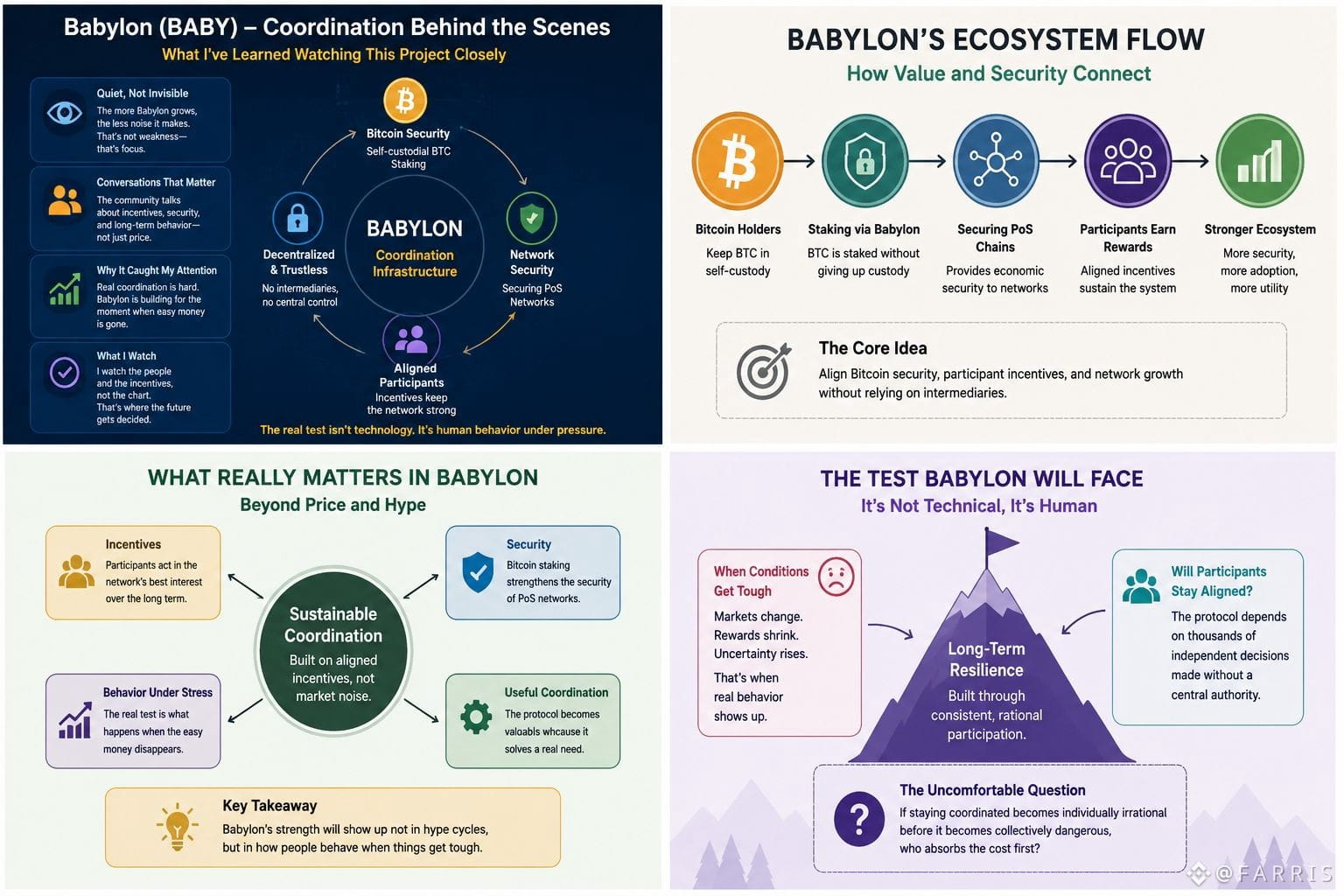
5
4
152
·
--
Bullish
#baby $BABY
@babylonlabs_io
I keep coming back to one question about Babylon.
Most people judge decentralized systems when markets are calm. I prefer watching what happens when liquidity disappears and everyone starts protecting their own interests.
That’s where coordination is truly tested.
The real challenge isn’t whether the technology keeps running—it’s whether people keep cooperating when incentives change. Security can remain intact while commitment quietly fades. Markets don’t need a technical failure to weaken a system. Sometimes all it takes is participants becoming more cautious, more selective, and less willing to sacrifice flexibility.
That’s why I see $BABY as coordination infrastructure rather than just another token. Its long-term significance depends on whether it can continue aligning incentives when economic pressure makes individual survival more important than collective confidence.
There’s also a trade-off that can’t be ignored: stronger coordination usually requires stronger commitment, but stronger commitment reduces flexibility when conditions suddenly change.
The question I can’t shake is simple:
When people stop believing that everyone else will continue coordinating, what actually breaks first—the technology, or the incentives holding it together
That’s the part worth studying.
#OilCrashes9% #USToCancelIranAttackSubjectToDeal #CardanoRisesNearly10% #CoinkiteMayFaceLegalActionOverColdcardFlaw $BICO
{spot}(BICOUSDT)
#baby $BABY
@BabylonLabs_io
I keep coming back to one question about Babylon.
Most people judge decentralized systems when markets are calm. I prefer watching what happens when liquidity disappears and everyone starts protecting their own interests.
That’s where coordination is truly tested.
The real challenge isn’t whether the technology keeps running—it’s whether people keep cooperating when incentives change. Security can remain intact while commitment quietly fades. Markets don’t need a technical failure to weaken a system. Sometimes all it takes is participants becoming more cautious, more selective, and less willing to sacrifice flexibility.
That’s why I see $BABY as coordination infrastructure rather than just another token. Its long-term significance depends on whether it can continue aligning incentives when economic pressure makes individual survival more important than collective confidence.
There’s also a trade-off that can’t be ignored: stronger coordination usually requires stronger commitment, but stronger commitment reduces flexibility when conditions suddenly change.
The question I can’t shake is simple:
When people stop believing that everyone else will continue coordinating, what actually breaks first—the technology, or the incentives holding it together
That’s the part worth studying.
#OilCrashes9% #USToCancelIranAttackSubjectToDeal #CardanoRisesNearly10% #CoinkiteMayFaceLegalActionOverColdcardFlaw $BICO
@BabylonLabs_io
I keep coming back to one question about Babylon.
Most people judge decentralized systems when markets are calm. I prefer watching what happens when liquidity disappears and everyone starts protecting their own interests.
That’s where coordination is truly tested.
The real challenge isn’t whether the technology keeps running—it’s whether people keep cooperating when incentives change. Security can remain intact while commitment quietly fades. Markets don’t need a technical failure to weaken a system. Sometimes all it takes is participants becoming more cautious, more selective, and less willing to sacrifice flexibility.
That’s why I see $BABY as coordination infrastructure rather than just another token. Its long-term significance depends on whether it can continue aligning incentives when economic pressure makes individual survival more important than collective confidence.
There’s also a trade-off that can’t be ignored: stronger coordination usually requires stronger commitment, but stronger commitment reduces flexibility when conditions suddenly change.
The question I can’t shake is simple:
When people stop believing that everyone else will continue coordinating, what actually breaks first—the technology, or the incentives holding it together
That’s the part worth studying.
#OilCrashes9% #USToCancelIranAttackSubjectToDeal #CardanoRisesNearly10% #CoinkiteMayFaceLegalActionOverColdcardFlaw $BICO
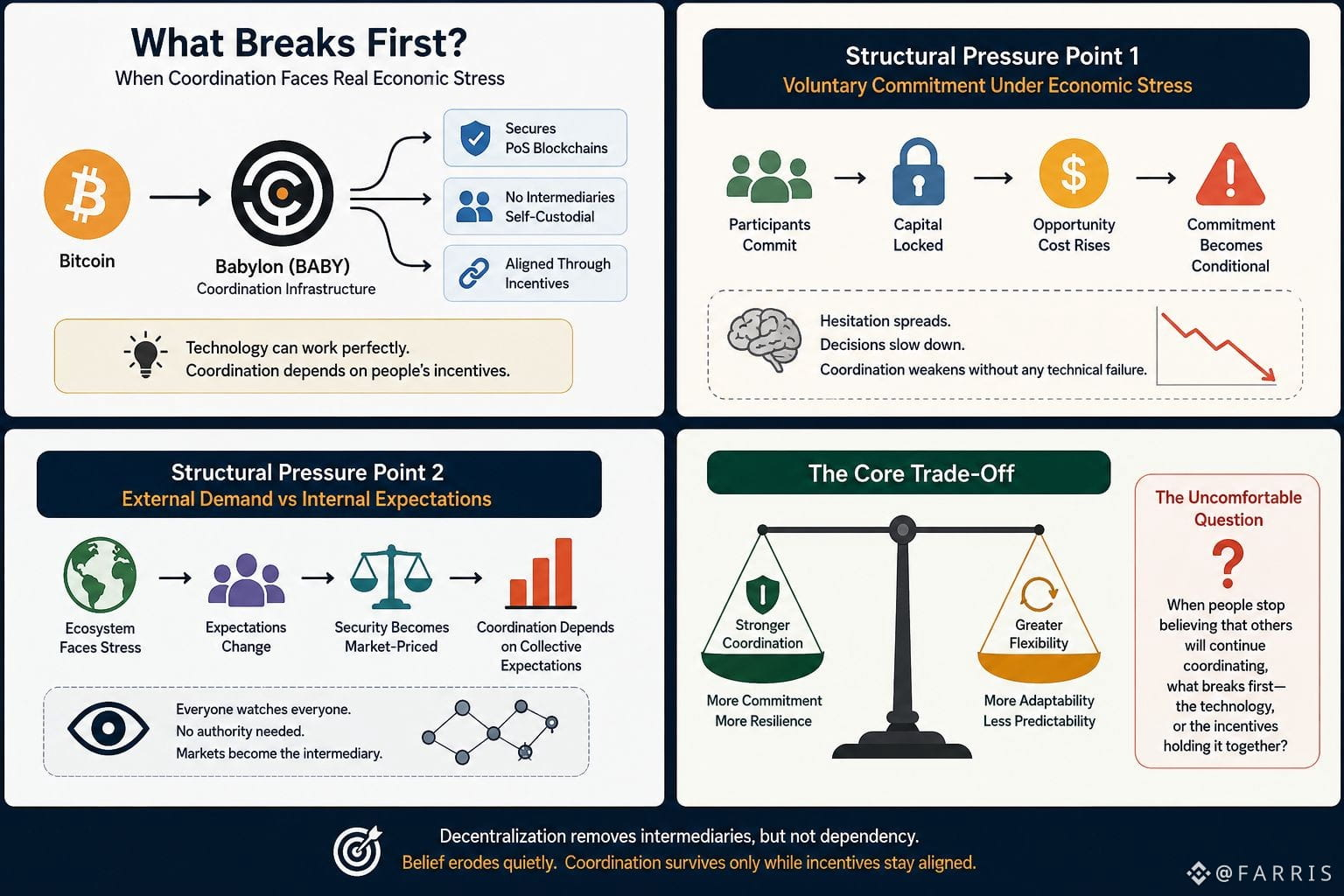
5
2
296
·
--
#baby $BABY @babylonlabs_io
I don't chase narratives anymore. I watch how they behave when markets stop rewarding belief.
The projects that matter aren't the ones making the most noise. They're the ones that can keep participants aligned when liquidity gets tight, incentives shift, and confidence fades.
That's why I spend more time studying market structure than price charts. Every cycle reminds me that intentions sound great, but incentives decide what people actually do.
Babylon caught my attention because it raises a bigger question than staking or security. What happens when decentralized coordination is tested by real economic pressure?
If a system only works while everyone agrees, it isn't resilient. The real test begins when people have reasons to disagree.
I'm here to explore protocols through behavior, incentives, and long-term structure—not hype, not headlines, and not short-term price action.
Markets change. Narratives rotate. Capital moves.
Understanding why people stay coordinated when they don't have to is far more valuable than predicting the next trend.
That's the lens I'll keep bringing to every project I study.
#KOSPIWorstMonthlyDropSince2008 #BitcoinMiningDifficultyFalls14%FromYearHigh #ColdcardFlawDrains594BTC #USToCancelIranAttackSubjectToDeal
#baby $BABY @BabylonLabs_io
I don't chase narratives anymore. I watch how they behave when markets stop rewarding belief.
The projects that matter aren't the ones making the most noise. They're the ones that can keep participants aligned when liquidity gets tight, incentives shift, and confidence fades.
That's why I spend more time studying market structure than price charts. Every cycle reminds me that intentions sound great, but incentives decide what people actually do.
Babylon caught my attention because it raises a bigger question than staking or security. What happens when decentralized coordination is tested by real economic pressure?
If a system only works while everyone agrees, it isn't resilient. The real test begins when people have reasons to disagree.
I'm here to explore protocols through behavior, incentives, and long-term structure—not hype, not headlines, and not short-term price action.
Markets change. Narratives rotate. Capital moves.
Understanding why people stay coordinated when they don't have to is far more valuable than predicting the next trend.
That's the lens I'll keep bringing to every project I study.
#KOSPIWorstMonthlyDropSince2008 #BitcoinMiningDifficultyFalls14%FromYearHigh #ColdcardFlawDrains594BTC #USToCancelIranAttackSubjectToDeal
I don't chase narratives anymore. I watch how they behave when markets stop rewarding belief.
The projects that matter aren't the ones making the most noise. They're the ones that can keep participants aligned when liquidity gets tight, incentives shift, and confidence fades.
That's why I spend more time studying market structure than price charts. Every cycle reminds me that intentions sound great, but incentives decide what people actually do.
Babylon caught my attention because it raises a bigger question than staking or security. What happens when decentralized coordination is tested by real economic pressure?
If a system only works while everyone agrees, it isn't resilient. The real test begins when people have reasons to disagree.
I'm here to explore protocols through behavior, incentives, and long-term structure—not hype, not headlines, and not short-term price action.
Markets change. Narratives rotate. Capital moves.
Understanding why people stay coordinated when they don't have to is far more valuable than predicting the next trend.
That's the lens I'll keep bringing to every project I study.
#KOSPIWorstMonthlyDropSince2008 #BitcoinMiningDifficultyFalls14%FromYearHigh #ColdcardFlawDrains594BTC #USToCancelIranAttackSubjectToDeal
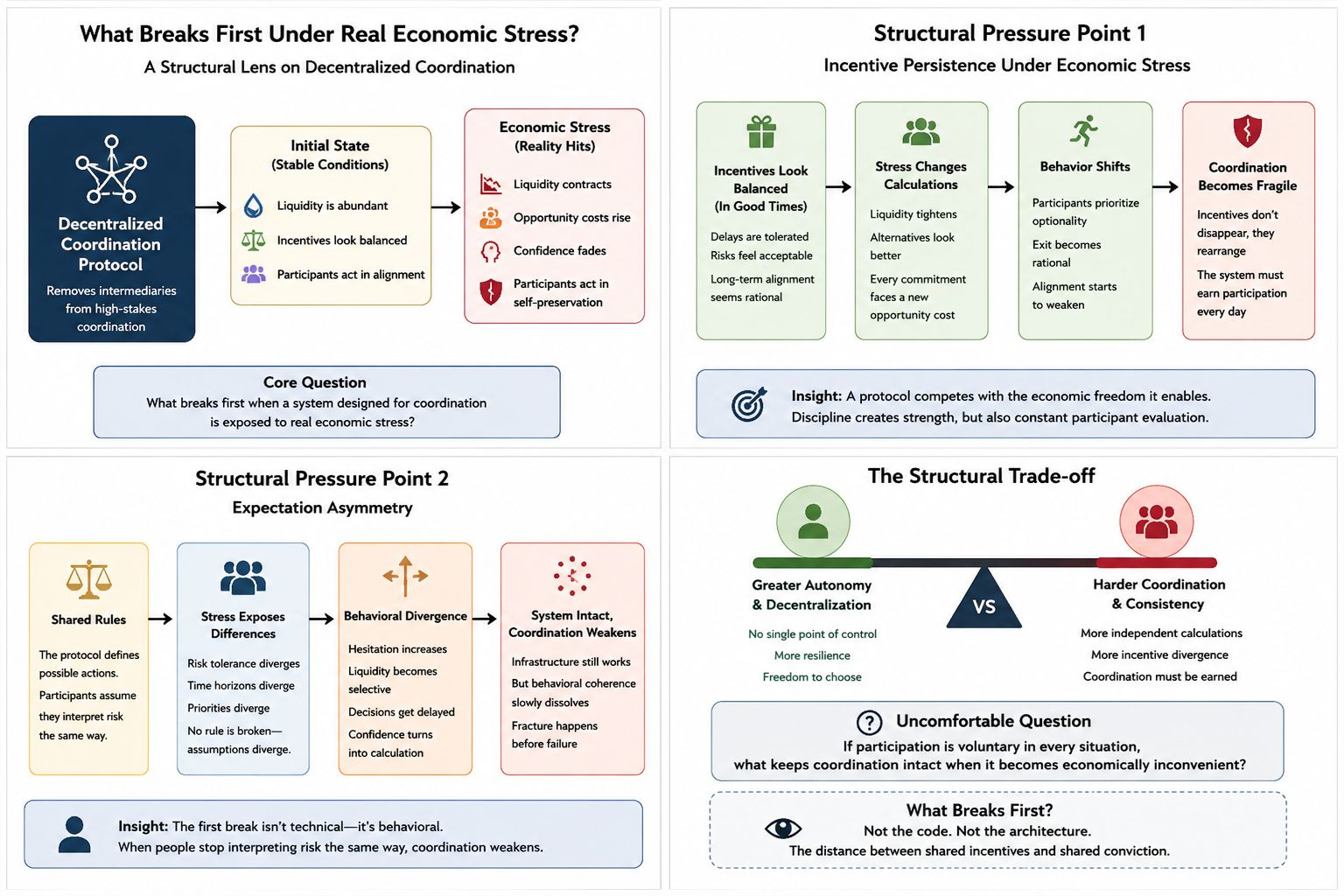
9
10
142
·
--
🎙️ What are some wealth secrets today? Welcome to exchange ideas

End
03 h 15 m 15 s
11.5k
32
26
·
--
🎙️ Federal Reserve September rate hike odds surge to 82%! Risk-free interest rates spike as Trump speaks out to keep hitting Iran—where will the crypto market go next?
End
03 h 21 m 10 s
10.9k
31
74
·
--
Bullish
#baby $BABY @babylonlabs_io
The more I read about Babylon, the more interesting the approach becomes. What stood out to me is that it isn't trying to move Bitcoin somewhere else just to earn yield. The focus on self-custodial BTC staking while helping strengthen PoS networks feels like a thoughtful design choice. Keeping Bitcoin on its own network instead of relying on wrapped assets is probably the part I find most compelling. It's still early, but this is one of those ideas that's genuinely worth following to see how it develops.
#RussiaPlacesDurovOnInternationalWantedList #BlackRockBringsBUIDLToUniswap #BNBSmartChainToUndergoHardFork #SouthKoreaRestrictsLeveragedETFTrading
$ON
{future}(ONUSDT)
$B3
#baby $BABY @BabylonLabs_io
The more I read about Babylon, the more interesting the approach becomes. What stood out to me is that it isn't trying to move Bitcoin somewhere else just to earn yield. The focus on self-custodial BTC staking while helping strengthen PoS networks feels like a thoughtful design choice. Keeping Bitcoin on its own network instead of relying on wrapped assets is probably the part I find most compelling. It's still early, but this is one of those ideas that's genuinely worth following to see how it develops.
#RussiaPlacesDurovOnInternationalWantedList #BlackRockBringsBUIDLToUniswap #BNBSmartChainToUndergoHardFork #SouthKoreaRestrictsLeveragedETFTrading
$ON
$B3
The more I read about Babylon, the more interesting the approach becomes. What stood out to me is that it isn't trying to move Bitcoin somewhere else just to earn yield. The focus on self-custodial BTC staking while helping strengthen PoS networks feels like a thoughtful design choice. Keeping Bitcoin on its own network instead of relying on wrapped assets is probably the part I find most compelling. It's still early, but this is one of those ideas that's genuinely worth following to see how it develops.
#RussiaPlacesDurovOnInternationalWantedList #BlackRockBringsBUIDLToUniswap #BNBSmartChainToUndergoHardFork #SouthKoreaRestrictsLeveragedETFTrading
$ON
$B3
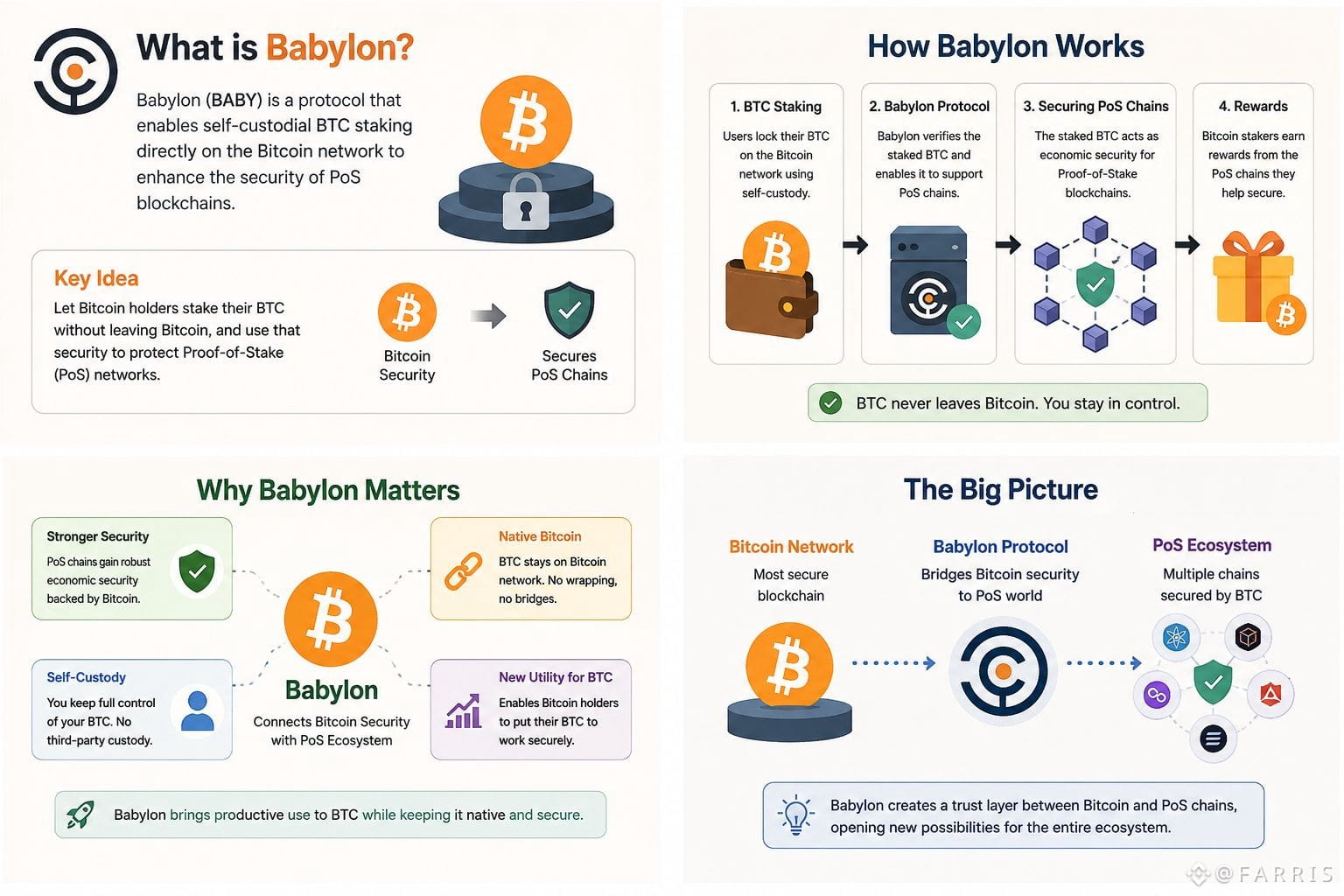
11
10
927
Log in to explore more content
Join global crypto users on Binance Square
⚡️ Get latest and useful information about crypto.
💬 Trusted by the world’s largest crypto exchange.
👍 Discover real insights from verified creators.
Email / Phone number
Trending Topics
EtherGains70.9%InQ3
179,390 views
1,196 Discussing
One of the best third quarters in history 💰
September closed out last night, and with it, the quarter. For the quarter, BTC is up 42%—the second-best Q3 on record. ETH had a record-breaking Q3 overall, up 70%.
Looking at the chart, things are still looking good: we’re holding support, but we’re testing it more and more often. Plus, ETF momentum is weakening — inflows are gradually declining, and yesterday saw outflows for the first time in a long while.
Yes, historically, October has been a good month for crypto — it’s not called “Uptober” for nothing. But it’s also one of the most volatile months. Last year, for example, we managed to hit a new all-time high (ATH) and experience a flash crash.
🚀 High Accuracy Trades.
$BTC
$ETH
$SOL
#EtherGains70.9%InQ3 #DollarIndexHitsHighestSinceMay2025 #CFTCSubmitsTwoEventContractRulesToWhiteHouse #MicronBeatsEarningsLiftsGuidance
Knowledge is Power
·0 Likes
·259 views
TreasuryLetsStatesFileStablecoinCertificationsEarly
11,889 views
93 Discussing
US10YearYieldNears5.3%
161,402 views
1,167 Discussing