

Crypto 牧星
38 Posts

Crypto 牧星
Report
Block User
5 Following
65 Followers
62 Liked
Posts
All
Quotes
·
--

Article
Yen Carry Trade | Exacerbating Turmoil in the Global Bond MarketThe surge in Japanese government bond yields is likely driving 'Mrs. Watanabe' to close her positions, which could be an invisible hand exacerbating turmoil in the global bond market.
In this round of the global bond market storm, one player has been severely underestimated — Japan.
Japan is one of the largest creditor nations in the world.
For decades, Japan's domestic interest rates have been super low, so Japanese investors chasing returns have had to allocate funds to overseas high-yield assets. This means borrowing low-interest yen to buy high-yield dollar assets and pocketing the spread.
Japan's pensions, sovereign funds, and financial institutions hold trillions of dollars in foreign bonds, with U.S. Treasuries being the largest component. Even the trillion-dollar 'Mrs. Watanabe' would do this.
Yen Carry Trade | Exacerbating Turmoil in the Global Bond Market
The surge in Japanese government bond yields is likely driving 'Mrs. Watanabe' to close her positions, which could be an invisible hand exacerbating turmoil in the global bond market.
In this round of the global bond market storm, one player has been severely underestimated — Japan.
Japan is one of the largest creditor nations in the world.
For decades, Japan's domestic interest rates have been super low, so Japanese investors chasing returns have had to allocate funds to overseas high-yield assets. This means borrowing low-interest yen to buy high-yield dollar assets and pocketing the spread.
Japan's pensions, sovereign funds, and financial institutions hold trillions of dollars in foreign bonds, with U.S. Treasuries being the largest component. Even the trillion-dollar 'Mrs. Watanabe' would do this.
In this round of the global bond market storm, one player has been severely underestimated — Japan.
Japan is one of the largest creditor nations in the world.
For decades, Japan's domestic interest rates have been super low, so Japanese investors chasing returns have had to allocate funds to overseas high-yield assets. This means borrowing low-interest yen to buy high-yield dollar assets and pocketing the spread.
Japan's pensions, sovereign funds, and financial institutions hold trillions of dollars in foreign bonds, with U.S. Treasuries being the largest component. Even the trillion-dollar 'Mrs. Watanabe' would do this.
140
·
--

Article
CLARITY Act | Who Wins? Who Loses? Who's Betting?New phase: the regulatory bill has crossed a critical threshold.
The legislative process has entered a decisive phase.
On May 14, 2026, the Senate Banking Committee passed the CLARITY Act with a vote of 15 to 9.
This event itself isn't surprising; what's unexpected is that it came earlier than most people's predictions.
Insiders know that the committee stage is actually the easiest part; the real challenges lie ahead.
The full Senate needs to gather 60 votes for it to pass.
The Agriculture Committee's version needs some coordination.
The House needs to merge the bill texts.
The White House needs to sign off.
......
If any link gets stuck, the entire process could be reset.
CLARITY Act | Who Wins? Who Loses? Who's Betting?
New phase: the regulatory bill has crossed a critical threshold.
The legislative process has entered a decisive phase.
On May 14, 2026, the Senate Banking Committee passed the CLARITY Act with a vote of 15 to 9.
This event itself isn't surprising; what's unexpected is that it came earlier than most people's predictions.
Insiders know that the committee stage is actually the easiest part; the real challenges lie ahead.
The full Senate needs to gather 60 votes for it to pass.
The Agriculture Committee's version needs some coordination.
The House needs to merge the bill texts.
The White House needs to sign off.
......
If any link gets stuck, the entire process could be reset.
The legislative process has entered a decisive phase.
On May 14, 2026, the Senate Banking Committee passed the CLARITY Act with a vote of 15 to 9.
This event itself isn't surprising; what's unexpected is that it came earlier than most people's predictions.
Insiders know that the committee stage is actually the easiest part; the real challenges lie ahead.
The full Senate needs to gather 60 votes for it to pass.
The Agriculture Committee's version needs some coordination.
The House needs to merge the bill texts.
The White House needs to sign off.
......
If any link gets stuck, the entire process could be reset.
200
·
--
After institutions allocated to crypto ETFs, there wasn't an explosive increase in positions, not because they don't like it, but because they don't know how to classify crypto assets within their existing frameworks.
After the approval of spot ETFs for BTC and ETH, institutions have indeed been net buyers, with significant inflows into BlackRock's IBIT and Fidelity's FBTC.
However, a closer look at the numbers reveals that the proportion of crypto ETFs in the overall AUM of institutions is still very low, and the inflow speed is far below market expectations.
Institutions are buying, but the volume doesn't match the initial expectations. Why is that?
This leads to the core issue: crypto assets are seen by institutions as assets with 【no standard classification】. They are neither bonds, stocks, commodities, nor currencies.
There are no standard asset category codes, no accompanying risk models, and no industry-standard allocation ratio references.
This means that each institution wishing to allocate to crypto ETFs has to run a complete internal approval process specifically for it. This isn't just a regular approval process; it's a full framework adaptation that takes much longer.
For example: If an institution wants to allocate to crypto ETFs, which risk model should they use? What standard should the allocation ratio refer to? What format should the position report follow? Which account category does it fall under? There are no industry-standard answers for these questions.
Each institution has to design from scratch, and every step has to be justified individually. Just convincing the investment committee that "this allocation ratio is reasonable" could take several rounds of meetings.
The value of the CLARITY Act is that it solves this problem all at once.
After this, institutions won't say, "We have no precedent for this asset; we need special approval," but will directly say, "This asset belongs to digital goods, similar to gold and commodities, and can be allocated under that framework."
Looking at the history of gold ETFs, once the asset category framework is adapted, the demand for allocation will steadily grow along the model-driven path.
After institutions allocated to crypto ETFs, there wasn't an explosive increase in positions, not because they don't like it, but because they don't know how to classify crypto assets within their existing frameworks.
After the approval of spot ETFs for BTC and ETH, institutions have indeed been net buyers, with significant inflows into BlackRock's IBIT and Fidelity's FBTC.
However, a closer look at the numbers reveals that the proportion of crypto ETFs in the overall AUM of institutions is still very low, and the inflow speed is far below market expectations.
Institutions are buying, but the volume doesn't match the initial expectations. Why is that?
This leads to the core issue: crypto assets are seen by institutions as assets with 【no standard classification】. They are neither bonds, stocks, commodities, nor currencies.
There are no standard asset category codes, no accompanying risk models, and no industry-standard allocation ratio references.
This means that each institution wishing to allocate to crypto ETFs has to run a complete internal approval process specifically for it. This isn't just a regular approval process; it's a full framework adaptation that takes much longer.
For example: If an institution wants to allocate to crypto ETFs, which risk model should they use? What standard should the allocation ratio refer to? What format should the position report follow? Which account category does it fall under? There are no industry-standard answers for these questions.
Each institution has to design from scratch, and every step has to be justified individually. Just convincing the investment committee that "this allocation ratio is reasonable" could take several rounds of meetings.
The value of the CLARITY Act is that it solves this problem all at once.
After this, institutions won't say, "We have no precedent for this asset; we need special approval," but will directly say, "This asset belongs to digital goods, similar to gold and commodities, and can be allocated under that framework."
Looking at the history of gold ETFs, once the asset category framework is adapted, the demand for allocation will steadily grow along the model-driven path.
After the approval of spot ETFs for BTC and ETH, institutions have indeed been net buyers, with significant inflows into BlackRock's IBIT and Fidelity's FBTC.
However, a closer look at the numbers reveals that the proportion of crypto ETFs in the overall AUM of institutions is still very low, and the inflow speed is far below market expectations.
Institutions are buying, but the volume doesn't match the initial expectations. Why is that?
This leads to the core issue: crypto assets are seen by institutions as assets with 【no standard classification】. They are neither bonds, stocks, commodities, nor currencies.
There are no standard asset category codes, no accompanying risk models, and no industry-standard allocation ratio references.
This means that each institution wishing to allocate to crypto ETFs has to run a complete internal approval process specifically for it. This isn't just a regular approval process; it's a full framework adaptation that takes much longer.
For example: If an institution wants to allocate to crypto ETFs, which risk model should they use? What standard should the allocation ratio refer to? What format should the position report follow? Which account category does it fall under? There are no industry-standard answers for these questions.
Each institution has to design from scratch, and every step has to be justified individually. Just convincing the investment committee that "this allocation ratio is reasonable" could take several rounds of meetings.
The value of the CLARITY Act is that it solves this problem all at once.
After this, institutions won't say, "We have no precedent for this asset; we need special approval," but will directly say, "This asset belongs to digital goods, similar to gold and commodities, and can be allocated under that framework."
Looking at the history of gold ETFs, once the asset category framework is adapted, the demand for allocation will steadily grow along the model-driven path.
1
228
·
--

Article
$uPEG, $SATO, $SLOP丨【Creating Actions】Expand DeFi Boundaries#uPEG #SATO #slop
Unlocking infinite innovation space.
Hooks build liquidity Legos.
From rigid trading tools to a programmable financial infrastructure.
A lot of folks hearing that Uniswap V4 introduced Hooks might think, 'Here we go again with the hype.'
But this time, there might actually be something substantial.
The essence of Hooks is to modularize custom logic embedded throughout the entire lifecycle of a liquidity pool. Previously, Uniswap's pool functionality was fixed—just swap and collect fees.
After Hooks dropped, the pools became programmable—developers can plug in dynamic fees, limit orders, auto-compounding features, and even tightly integrate trading actions with completely unrelated on-chain activities like art generation and NFT burning.
$uPEG, $SATO, $SLOP丨【Creating Actions】Expand DeFi Boundaries
#uPEG #SATO #slop
Unlocking infinite innovation space.
Hooks build liquidity Legos.
From rigid trading tools to a programmable financial infrastructure.
A lot of folks hearing that Uniswap V4 introduced Hooks might think, 'Here we go again with the hype.'
But this time, there might actually be something substantial.
The essence of Hooks is to modularize custom logic embedded throughout the entire lifecycle of a liquidity pool. Previously, Uniswap's pool functionality was fixed—just swap and collect fees.
After Hooks dropped, the pools became programmable—developers can plug in dynamic fees, limit orders, auto-compounding features, and even tightly integrate trading actions with completely unrelated on-chain activities like art generation and NFT burning.
Unlocking infinite innovation space.
Hooks build liquidity Legos.
From rigid trading tools to a programmable financial infrastructure.
A lot of folks hearing that Uniswap V4 introduced Hooks might think, 'Here we go again with the hype.'
But this time, there might actually be something substantial.
The essence of Hooks is to modularize custom logic embedded throughout the entire lifecycle of a liquidity pool. Previously, Uniswap's pool functionality was fixed—just swap and collect fees.
After Hooks dropped, the pools became programmable—developers can plug in dynamic fees, limit orders, auto-compounding features, and even tightly integrate trading actions with completely unrelated on-chain activities like art generation and NFT burning.
207
·
--

Article
What are the Hooks in Uniswap V4?What are the Hooks in Uniswap V4? Why do they call them hooks?
In the programming world, a 'Hook' is a classic term that refers to specific points in the main workflow of a system where external code can attach and execute custom logic without altering the core code itself.
We can think of Hooks as little programs or smart triggers attached to each liquidity pool. Developers can set rules in advance, allowing the liquidity pool to automatically execute operations at specific times.
For example, checking participant eligibility before a trade, dynamically adjusting fees based on market fluctuations during a trade, or automatically reinvesting profits after a trade.
What are the Hooks in Uniswap V4?
What are the Hooks in Uniswap V4? Why do they call them hooks?
In the programming world, a 'Hook' is a classic term that refers to specific points in the main workflow of a system where external code can attach and execute custom logic without altering the core code itself.
We can think of Hooks as little programs or smart triggers attached to each liquidity pool. Developers can set rules in advance, allowing the liquidity pool to automatically execute operations at specific times.
For example, checking participant eligibility before a trade, dynamically adjusting fees based on market fluctuations during a trade, or automatically reinvesting profits after a trade.
In the programming world, a 'Hook' is a classic term that refers to specific points in the main workflow of a system where external code can attach and execute custom logic without altering the core code itself.
We can think of Hooks as little programs or smart triggers attached to each liquidity pool. Developers can set rules in advance, allowing the liquidity pool to automatically execute operations at specific times.
For example, checking participant eligibility before a trade, dynamically adjusting fees based on market fluctuations during a trade, or automatically reinvesting profits after a trade.
535
·
--
I heard that the liquidity in crypto has all flowed into the US stock market, treating those stocks like meme coins and shitcoins, is that right?
I heard that the liquidity in crypto has all flowed into the US stock market, treating those stocks like meme coins and shitcoins, is that right?

106
·
--
Bearish
The explosive growth and certain prospects in the AI sector are attracting a ton of crypto talent and capital to shift its way.
By 2025, AI venture capital is expected to exceed $200 billion, while crypto only sits at $19.7 billion, creating a massive capital gap that results in a powerful resource siphoning effect.
The weekly code commits in the crypto industry have plummeted by 75% since the start of 2025, with active developers down by 56%. By early 2026, hiring in the crypto space has nosedived by 80% year-on-year, with only about 6.5 new positions created daily.
This migration is seen as a natural selection of tech talent in search of higher returns, more stable development paths, and a stronger sense of being at the tech frontier.
AI companies like OpenAI, Anthropic, and DeepSeek offer compensation and growth opportunities that far exceed the crypto industry's average, while the token incentives and remote culture that crypto once relied on are being diluted by the globalization of remote hiring and competitive salaries also provided by AI firms.
This is essentially a rational choice for tech talent during the cyclical bear market of the crypto space.
Moreover, behind star AI projects like Hermes Agent and OpenRouter are seasoned figures from the crypto industry.
They are successfully transferring the product thinking, community operations, and rapid iteration capabilities accumulated in the Web3 space to the AI track.
🚀 The hotshot Hermes Agent is backed by the open-source AI research institution Nous Research, whose CEO Jeffrey Quesnelle was the chief engineer for the Ethereum MEV infrastructure project Eden Network.
🚀 The founder of the world’s largest AI large model aggregation platform, OpenRouter, Alex Atallah, was a co-founder of OpenSea.
#Aİ #AI代理 #x402
The explosive growth and certain prospects in the AI sector are attracting a ton of crypto talent and capital to shift its way.
By 2025, AI venture capital is expected to exceed $200 billion, while crypto only sits at $19.7 billion, creating a massive capital gap that results in a powerful resource siphoning effect.
The weekly code commits in the crypto industry have plummeted by 75% since the start of 2025, with active developers down by 56%. By early 2026, hiring in the crypto space has nosedived by 80% year-on-year, with only about 6.5 new positions created daily.
This migration is seen as a natural selection of tech talent in search of higher returns, more stable development paths, and a stronger sense of being at the tech frontier.
AI companies like OpenAI, Anthropic, and DeepSeek offer compensation and growth opportunities that far exceed the crypto industry's average, while the token incentives and remote culture that crypto once relied on are being diluted by the globalization of remote hiring and competitive salaries also provided by AI firms.
This is essentially a rational choice for tech talent during the cyclical bear market of the crypto space.
Moreover, behind star AI projects like Hermes Agent and OpenRouter are seasoned figures from the crypto industry.
They are successfully transferring the product thinking, community operations, and rapid iteration capabilities accumulated in the Web3 space to the AI track.
🚀 The hotshot Hermes Agent is backed by the open-source AI research institution Nous Research, whose CEO Jeffrey Quesnelle was the chief engineer for the Ethereum MEV infrastructure project Eden Network.
🚀 The founder of the world’s largest AI large model aggregation platform, OpenRouter, Alex Atallah, was a co-founder of OpenSea.
#Aİ #AI代理 #x402
By 2025, AI venture capital is expected to exceed $200 billion, while crypto only sits at $19.7 billion, creating a massive capital gap that results in a powerful resource siphoning effect.
The weekly code commits in the crypto industry have plummeted by 75% since the start of 2025, with active developers down by 56%. By early 2026, hiring in the crypto space has nosedived by 80% year-on-year, with only about 6.5 new positions created daily.
This migration is seen as a natural selection of tech talent in search of higher returns, more stable development paths, and a stronger sense of being at the tech frontier.
AI companies like OpenAI, Anthropic, and DeepSeek offer compensation and growth opportunities that far exceed the crypto industry's average, while the token incentives and remote culture that crypto once relied on are being diluted by the globalization of remote hiring and competitive salaries also provided by AI firms.
This is essentially a rational choice for tech talent during the cyclical bear market of the crypto space.
Moreover, behind star AI projects like Hermes Agent and OpenRouter are seasoned figures from the crypto industry.
They are successfully transferring the product thinking, community operations, and rapid iteration capabilities accumulated in the Web3 space to the AI track.
🚀 The hotshot Hermes Agent is backed by the open-source AI research institution Nous Research, whose CEO Jeffrey Quesnelle was the chief engineer for the Ethereum MEV infrastructure project Eden Network.
🚀 The founder of the world’s largest AI large model aggregation platform, OpenRouter, Alex Atallah, was a co-founder of OpenSea.
#Aİ #AI代理 #x402
98
·
--
☀️First off, you just need to study the crypto market,
⛈️Now, you also need to keep an eye on US stocks, AI, macro liquidity, geopolitical factors ......
The era where Bitcoin's price was driven by a single narrative (like halving cycles or digital gold) is over.
Traders are gradually realizing that Bitcoin's price is actually the result of multiple structural forces at play: ETF capital flows, miner sell pressure, corporate treasury accumulation, derivatives liquidation, regulatory policy changes, and the tightening or loosening of macro liquidity ......
Therefore, the analytical framework must shift from 【listening to stories】 to 【seeing structures】. This includes analyzing on-chain data (like illiquid supply, net exchange flows), monitoring daily ETF inflows and outflows, observing options market position distributions/expirations, and evaluating miners' break-even points and expectations around the Fed's actions ......
In this new paradigm where structure reigns, having a profound understanding of the market's microstructure often allows you to better capture market trends, rather than blindly chasing grand narratives.
☀️First off, you just need to study the crypto market,
⛈️Now, you also need to keep an eye on US stocks, AI, macro liquidity, geopolitical factors ......
The era where Bitcoin's price was driven by a single narrative (like halving cycles or digital gold) is over.
Traders are gradually realizing that Bitcoin's price is actually the result of multiple structural forces at play: ETF capital flows, miner sell pressure, corporate treasury accumulation, derivatives liquidation, regulatory policy changes, and the tightening or loosening of macro liquidity ......
Therefore, the analytical framework must shift from 【listening to stories】 to 【seeing structures】. This includes analyzing on-chain data (like illiquid supply, net exchange flows), monitoring daily ETF inflows and outflows, observing options market position distributions/expirations, and evaluating miners' break-even points and expectations around the Fed's actions ......
In this new paradigm where structure reigns, having a profound understanding of the market's microstructure often allows you to better capture market trends, rather than blindly chasing grand narratives.
⛈️Now, you also need to keep an eye on US stocks, AI, macro liquidity, geopolitical factors ......
The era where Bitcoin's price was driven by a single narrative (like halving cycles or digital gold) is over.
Traders are gradually realizing that Bitcoin's price is actually the result of multiple structural forces at play: ETF capital flows, miner sell pressure, corporate treasury accumulation, derivatives liquidation, regulatory policy changes, and the tightening or loosening of macro liquidity ......
Therefore, the analytical framework must shift from 【listening to stories】 to 【seeing structures】. This includes analyzing on-chain data (like illiquid supply, net exchange flows), monitoring daily ETF inflows and outflows, observing options market position distributions/expirations, and evaluating miners' break-even points and expectations around the Fed's actions ......
In this new paradigm where structure reigns, having a profound understanding of the market's microstructure often allows you to better capture market trends, rather than blindly chasing grand narratives.
111
·
--
From escaping Wall Street to returning to Wall Street
Personally, I find it ironic that Bitcoin is currently being co-opted by the establishment to achieve its mainstream status, despite its anti-establishment origins.
The genesis block of Bitcoin even has a critique of the traditional financial system etched into it.
However, the largest wave of adoption right now is being driven by the very entities it aimed to disrupt, like banks, investment banks, and asset management firms.
Major whales might also leverage the ETF's physical exchange mechanism to move Bitcoin from decentralized wallets to institutional custody accounts like those at BlackRock, in exchange for more liquid and protected fund shares within the traditional financial system.
This creates a profound paradox: Bitcoin gains the widespread recognition and legitimacy it initially dreamed of through being absorbed and regulated by the traditional financial system.
#华尔街 #比特币 #传统金融
From escaping Wall Street to returning to Wall Street
Personally, I find it ironic that Bitcoin is currently being co-opted by the establishment to achieve its mainstream status, despite its anti-establishment origins.
The genesis block of Bitcoin even has a critique of the traditional financial system etched into it.
However, the largest wave of adoption right now is being driven by the very entities it aimed to disrupt, like banks, investment banks, and asset management firms.
Major whales might also leverage the ETF's physical exchange mechanism to move Bitcoin from decentralized wallets to institutional custody accounts like those at BlackRock, in exchange for more liquid and protected fund shares within the traditional financial system.
This creates a profound paradox: Bitcoin gains the widespread recognition and legitimacy it initially dreamed of through being absorbed and regulated by the traditional financial system.
#华尔街 #比特币 #传统金融
Personally, I find it ironic that Bitcoin is currently being co-opted by the establishment to achieve its mainstream status, despite its anti-establishment origins.
The genesis block of Bitcoin even has a critique of the traditional financial system etched into it.
However, the largest wave of adoption right now is being driven by the very entities it aimed to disrupt, like banks, investment banks, and asset management firms.
Major whales might also leverage the ETF's physical exchange mechanism to move Bitcoin from decentralized wallets to institutional custody accounts like those at BlackRock, in exchange for more liquid and protected fund shares within the traditional financial system.
This creates a profound paradox: Bitcoin gains the widespread recognition and legitimacy it initially dreamed of through being absorbed and regulated by the traditional financial system.
#华尔街 #比特币 #传统金融
182
·
--
Head of ETH treasury firm — BITMINE, announces it will slow down its ETH purchases. Their stack is incredibly robust, holding 5.18 million ETH, of which 4.36 million are staked.
Here lies a structural cognitive gap: over 80% of investors in the crypto space only understand cryptocurrencies as price speculation.
This cognitive model is singular and linear, meaning that 【buying is the only bullish action, selling/ceasing to buy is bearish behavior】.
In reality, for institutions holding millions of ETH, price appreciation is just one dimension of their massive profit matrix.
Even though BITMINE is slowing its buying pace, their methods of earning through staking, capturing ecosystem value via protocol development, and innovating financial products to set industry standards represent a more advanced and sustainable way of being bullish and realizing value.
This is a multidimensional game of capital, showcasing the profound cognitive and behavioral gap between institutions and retail investors.
#BITMINE #DAT #以太坊 #以太坊质押 #ETH
Head of ETH treasury firm — BITMINE, announces it will slow down its ETH purchases. Their stack is incredibly robust, holding 5.18 million ETH, of which 4.36 million are staked.
Here lies a structural cognitive gap: over 80% of investors in the crypto space only understand cryptocurrencies as price speculation.
This cognitive model is singular and linear, meaning that 【buying is the only bullish action, selling/ceasing to buy is bearish behavior】.
In reality, for institutions holding millions of ETH, price appreciation is just one dimension of their massive profit matrix.
Even though BITMINE is slowing its buying pace, their methods of earning through staking, capturing ecosystem value via protocol development, and innovating financial products to set industry standards represent a more advanced and sustainable way of being bullish and realizing value.
This is a multidimensional game of capital, showcasing the profound cognitive and behavioral gap between institutions and retail investors.
#BITMINE #DAT #以太坊 #以太坊质押 #ETH
Here lies a structural cognitive gap: over 80% of investors in the crypto space only understand cryptocurrencies as price speculation.
This cognitive model is singular and linear, meaning that 【buying is the only bullish action, selling/ceasing to buy is bearish behavior】.
In reality, for institutions holding millions of ETH, price appreciation is just one dimension of their massive profit matrix.
Even though BITMINE is slowing its buying pace, their methods of earning through staking, capturing ecosystem value via protocol development, and innovating financial products to set industry standards represent a more advanced and sustainable way of being bullish and realizing value.
This is a multidimensional game of capital, showcasing the profound cognitive and behavioral gap between institutions and retail investors.
#BITMINE #DAT #以太坊 #以太坊质押 #ETH
1
295
·
--
Ethereum co-founder Vitalik Buterin fell victim to a sandwich attack by one of the most notorious MEV bots on Ethereum, jaredfromsubway.eth, while executing a small XDB token swap worth about $3.86.
The bot manipulated the XDB price by buying and selling around Buterin's trade, utilizing approximately $1.14 million in WETH between SushiSwap and Uniswap V2.
However, after deducting around $5.14 in Gas fees, the bot actually ended up taking a loss, while Buterin's slippage loss was only a few cents.
What stands out in this incident is that even Vitalik Buterin, a co-founder of Ethereum with a deep understanding of MEV issues, could not avoid becoming a target of an MEV attack.
The often-cited "dark forest" analogy in DeFi suggests that in the public blockchain mempool, all trades are exposed to automated bot surveillance, and any profitable trade can potentially be attacked.
If an expert user like Buterin can be attacked due to improper trade settings, the threats faced by regular users are clearly much greater.
#VitalikButerin #XDB #MEV #三明治攻击 #WETH
Ethereum co-founder Vitalik Buterin fell victim to a sandwich attack by one of the most notorious MEV bots on Ethereum, jaredfromsubway.eth, while executing a small XDB token swap worth about $3.86.
The bot manipulated the XDB price by buying and selling around Buterin's trade, utilizing approximately $1.14 million in WETH between SushiSwap and Uniswap V2.
However, after deducting around $5.14 in Gas fees, the bot actually ended up taking a loss, while Buterin's slippage loss was only a few cents.
What stands out in this incident is that even Vitalik Buterin, a co-founder of Ethereum with a deep understanding of MEV issues, could not avoid becoming a target of an MEV attack.
The often-cited "dark forest" analogy in DeFi suggests that in the public blockchain mempool, all trades are exposed to automated bot surveillance, and any profitable trade can potentially be attacked.
If an expert user like Buterin can be attacked due to improper trade settings, the threats faced by regular users are clearly much greater.
#VitalikButerin #XDB #MEV #三明治攻击 #WETH
The bot manipulated the XDB price by buying and selling around Buterin's trade, utilizing approximately $1.14 million in WETH between SushiSwap and Uniswap V2.
However, after deducting around $5.14 in Gas fees, the bot actually ended up taking a loss, while Buterin's slippage loss was only a few cents.
What stands out in this incident is that even Vitalik Buterin, a co-founder of Ethereum with a deep understanding of MEV issues, could not avoid becoming a target of an MEV attack.
The often-cited "dark forest" analogy in DeFi suggests that in the public blockchain mempool, all trades are exposed to automated bot surveillance, and any profitable trade can potentially be attacked.
If an expert user like Buterin can be attacked due to improper trade settings, the threats faced by regular users are clearly much greater.
#VitalikButerin #XDB #MEV #三明治攻击 #WETH
1
174
·
--
Looking at the ups and downs of the Bitcoin market in 2025, you can clearly see a main thread: the expansion and contraction rhythm of global central banks' (especially the Fed's) balance sheets, along with the scale of fiscal deficits in major economies, forms the 'tide force' of Bitcoin prices.
Progress in regulation, like the <a>GENIUS Act</a>, acts like a solid dam and canal, allowing this tide force to impact the crypto market in a more orderly and massive way.
Without a channel, water would flow everywhere, making it hard to gather momentum; but without water, even the best channel is just a dried-up project. The bull market of 2025 is the result of liquidity, the 'water', surging through the regulatory 'canal'.
As the market anticipates tightening liquidity by the end of 2025, no matter how smooth the channels are, when the flow weakens, prices should naturally drop. This ultimately validates that liquidity is that more fundamental and powerful core driving factor.
#流动性 #监管框架
Looking at the ups and downs of the Bitcoin market in 2025, you can clearly see a main thread: the expansion and contraction rhythm of global central banks' (especially the Fed's) balance sheets, along with the scale of fiscal deficits in major economies, forms the 'tide force' of Bitcoin prices.
Progress in regulation, like the <a>GENIUS Act</a>, acts like a solid dam and canal, allowing this tide force to impact the crypto market in a more orderly and massive way.
Without a channel, water would flow everywhere, making it hard to gather momentum; but without water, even the best channel is just a dried-up project. The bull market of 2025 is the result of liquidity, the 'water', surging through the regulatory 'canal'.
As the market anticipates tightening liquidity by the end of 2025, no matter how smooth the channels are, when the flow weakens, prices should naturally drop. This ultimately validates that liquidity is that more fundamental and powerful core driving factor.
#流动性 #监管框架
Progress in regulation, like the <a>GENIUS Act</a>, acts like a solid dam and canal, allowing this tide force to impact the crypto market in a more orderly and massive way.
Without a channel, water would flow everywhere, making it hard to gather momentum; but without water, even the best channel is just a dried-up project. The bull market of 2025 is the result of liquidity, the 'water', surging through the regulatory 'canal'.
As the market anticipates tightening liquidity by the end of 2025, no matter how smooth the channels are, when the flow weakens, prices should naturally drop. This ultimately validates that liquidity is that more fundamental and powerful core driving factor.
#流动性 #监管框架
108
·
--
Bearish
The 'Whale's Dominance' and Centralized Risks
One entity holds over 818,000 BTC, which goes against the decentralized vision.
Let's look at an unavoidable fundamental fact: by May 2026, just MicroStrategy alone will possess over 818,000 Bitcoins, accounting for about 4% of the total circulating supply.
This concentration of holdings has created an unprecedented 'whale position' in Bitcoin's history, capable of influencing the market ecology.
This stands in stark contrast to Satoshi's vision of one CPU, one vote, and a decentralized network on a physical level.
Saylor's victory has, in effect, intensified the centralization of Bitcoin asset ownership through massive capital.
This means that a single company's financial decisions (like dealing with debt or regulatory pressure) could cause a tsunami-like impact on the market, which itself undermines the original intent of Bitcoin's anti-fragile design.
#微策略 #DAT
The 'Whale's Dominance' and Centralized Risks
One entity holds over 818,000 BTC, which goes against the decentralized vision.
Let's look at an unavoidable fundamental fact: by May 2026, just MicroStrategy alone will possess over 818,000 Bitcoins, accounting for about 4% of the total circulating supply.
This concentration of holdings has created an unprecedented 'whale position' in Bitcoin's history, capable of influencing the market ecology.
This stands in stark contrast to Satoshi's vision of one CPU, one vote, and a decentralized network on a physical level.
Saylor's victory has, in effect, intensified the centralization of Bitcoin asset ownership through massive capital.
This means that a single company's financial decisions (like dealing with debt or regulatory pressure) could cause a tsunami-like impact on the market, which itself undermines the original intent of Bitcoin's anti-fragile design.
#微策略 #DAT
One entity holds over 818,000 BTC, which goes against the decentralized vision.
Let's look at an unavoidable fundamental fact: by May 2026, just MicroStrategy alone will possess over 818,000 Bitcoins, accounting for about 4% of the total circulating supply.
This concentration of holdings has created an unprecedented 'whale position' in Bitcoin's history, capable of influencing the market ecology.
This stands in stark contrast to Satoshi's vision of one CPU, one vote, and a decentralized network on a physical level.
Saylor's victory has, in effect, intensified the centralization of Bitcoin asset ownership through massive capital.
This means that a single company's financial decisions (like dealing with debt or regulatory pressure) could cause a tsunami-like impact on the market, which itself undermines the original intent of Bitcoin's anti-fragile design.
#微策略 #DAT
191
·
--

Article
MicroStrategy CEO hints at selling coins; has the faith of only buying and not selling loosened?Is MicroStrategy about to take a dive? Run? The market is in a frenzy over Phong Le's comment about "considering selling Bitcoin." However, we might be overreading the situation.
👨🎓Preliminary considerations
💡 CEO says "considering selling coins"; why does "considering" ≠ "selling right away"?
💡 Saylor talks faith, Phong Le talks reason—who is the true essence of MicroStrategy?
💡 The conditions to trigger a sell-off are extremely strict; do you really understand that warning line?
💡 Is what the market should truly fear the fact that "it wants to sell" itself?
CEO publicly acknowledges the possibility of selling Bitcoin for the first time
MicroStrategy CEO hints at selling coins; has the faith of only buying and not selling loosened?
Is MicroStrategy about to take a dive? Run? The market is in a frenzy over Phong Le's comment about "considering selling Bitcoin." However, we might be overreading the situation.
👨🎓Preliminary considerations
💡 CEO says "considering selling coins"; why does "considering" ≠ "selling right away"?
💡 Saylor talks faith, Phong Le talks reason—who is the true essence of MicroStrategy?
💡 The conditions to trigger a sell-off are extremely strict; do you really understand that warning line?
💡 Is what the market should truly fear the fact that "it wants to sell" itself?
CEO publicly acknowledges the possibility of selling Bitcoin for the first time
👨🎓Preliminary considerations
💡 CEO says "considering selling coins"; why does "considering" ≠ "selling right away"?
💡 Saylor talks faith, Phong Le talks reason—who is the true essence of MicroStrategy?
💡 The conditions to trigger a sell-off are extremely strict; do you really understand that warning line?
💡 Is what the market should truly fear the fact that "it wants to sell" itself?
CEO publicly acknowledges the possibility of selling Bitcoin for the first time
1
206
·
--

Article
Crypto Core3 ETF | A New Choice for Configuring the Big Three in Crypto#ETF #GSR #BESO
👨🎓Preliminary Thoughts
💡 GSR's transition from market maker to asset management — is it a strategic blow or a cross-industry gamble?
💡 What exactly is the active management strategy? Can it really generate more yield?
💡 In a ‘red ocean’ dominated by giants in the Bitcoin ETF space, how can Crypto Core3 ETF break through?
💡 Management fees are nearly four times higher than those of passive crypto ETFs — what makes GSR worth that price in the market?
Introduction
On April 22, 2026, the Nasdaq exchange welcomed a unique crypto ETF — GSR Crypto Core3 ETF (ticker BESO).
Crypto Core3 ETF | A New Choice for Configuring the Big Three in Crypto
#ETF #GSR #BESO
👨🎓Preliminary Thoughts
💡 GSR's transition from market maker to asset management — is it a strategic blow or a cross-industry gamble?
💡 What exactly is the active management strategy? Can it really generate more yield?
💡 In a ‘red ocean’ dominated by giants in the Bitcoin ETF space, how can Crypto Core3 ETF break through?
💡 Management fees are nearly four times higher than those of passive crypto ETFs — what makes GSR worth that price in the market?
Introduction
On April 22, 2026, the Nasdaq exchange welcomed a unique crypto ETF — GSR Crypto Core3 ETF (ticker BESO).
👨🎓Preliminary Thoughts
💡 GSR's transition from market maker to asset management — is it a strategic blow or a cross-industry gamble?
💡 What exactly is the active management strategy? Can it really generate more yield?
💡 In a ‘red ocean’ dominated by giants in the Bitcoin ETF space, how can Crypto Core3 ETF break through?
💡 Management fees are nearly four times higher than those of passive crypto ETFs — what makes GSR worth that price in the market?
Introduction
On April 22, 2026, the Nasdaq exchange welcomed a unique crypto ETF — GSR Crypto Core3 ETF (ticker BESO).
1
353
·
--

Article
Four-Star General Reveals in Congress: The Military is Running Bitcoin Nodes
👨🎓Preliminary Thoughts
What's the purpose of the military running a Bitcoin network node?
What can a single Bitcoin full node do and what can't it do?
Why does Paparo repeatedly emphasize that 'attacks require physical costs'?
Bitcoin touts 'censorship resistance', but when sovereign states start running nodes, does that narrative still hold?
Introduction
A testimony at a U.S. congressional hearing has caught the global crypto community and geopolitical watchers by surprise. U.S. Indo-Pacific Command Admiral Samuel Paparo openly admitted that the military is running a real-time node on the Bitcoin network. This move shatters the original narrative of Bitcoin as a tool against power, directly integrating it into the toolkit of national strength.
👨🎓Preliminary Thoughts
What's the purpose of the military running a Bitcoin network node?
What can a single Bitcoin full node do and what can't it do?
Why does Paparo repeatedly emphasize that 'attacks require physical costs'?
Bitcoin touts 'censorship resistance', but when sovereign states start running nodes, does that narrative still hold?
Introduction
A testimony at a U.S. congressional hearing has caught the global crypto community and geopolitical watchers by surprise. U.S. Indo-Pacific Command Admiral Samuel Paparo openly admitted that the military is running a real-time node on the Bitcoin network. This move shatters the original narrative of Bitcoin as a tool against power, directly integrating it into the toolkit of national strength.
Four-Star General Reveals in Congress: The Military is Running Bitcoin Nodes
👨🎓Preliminary Thoughts
What's the purpose of the military running a Bitcoin network node?
What can a single Bitcoin full node do and what can't it do?
Why does Paparo repeatedly emphasize that 'attacks require physical costs'?
Bitcoin touts 'censorship resistance', but when sovereign states start running nodes, does that narrative still hold?
Introduction
A testimony at a U.S. congressional hearing has caught the global crypto community and geopolitical watchers by surprise. U.S. Indo-Pacific Command Admiral Samuel Paparo openly admitted that the military is running a real-time node on the Bitcoin network. This move shatters the original narrative of Bitcoin as a tool against power, directly integrating it into the toolkit of national strength.
1
112
·
--

Article
Hot Topics | Guotai Junan International Obtains Hong Kong Crypto Trading License / Strategic Logic Behind Chinese Concept Stock Nano Labs' Large Increase in BNB HoldingsTable of Contents
1. Guotai Junan International | Obtained Hong Kong Crypto Trading License
Guotai Junan International has been approved by the Hong Kong Securities and Futures Commission to upgrade its securities license to virtual asset trading service qualification, supporting trading of BTC, ETH, etc., and promoting the integration of traditional finance with the crypto ecosystem.
2. Hong Kong Company Dalian Holdings | Collaborates with ViaBTC to Build a Crypto Service Ecosystem
Hong Kong-listed Dalian Holdings and Mining Pool ViaBTC Establish Joint Venture, Layout Crypto OTC, Asset Management, and Compliance Platform Development, Explore Bitcoin Reserves, Achieve Complementarity of Financial Resources and Technological Advantages.
3. Breakthrough in Hong Kong Stablecoin Regulation | Implementation of Multi-Currency and Autonomous Network Policies
Hot Topics | Guotai Junan International Obtains Hong Kong Crypto Trading License / Strategic Logic Behind Chinese Concept Stock Nano Labs' Large Increase in BNB Holdings
Table of Contents
1. Guotai Junan International | Obtained Hong Kong Crypto Trading License
Guotai Junan International has been approved by the Hong Kong Securities and Futures Commission to upgrade its securities license to virtual asset trading service qualification, supporting trading of BTC, ETH, etc., and promoting the integration of traditional finance with the crypto ecosystem.
2. Hong Kong Company Dalian Holdings | Collaborates with ViaBTC to Build a Crypto Service Ecosystem
Hong Kong-listed Dalian Holdings and Mining Pool ViaBTC Establish Joint Venture, Layout Crypto OTC, Asset Management, and Compliance Platform Development, Explore Bitcoin Reserves, Achieve Complementarity of Financial Resources and Technological Advantages.
3. Breakthrough in Hong Kong Stablecoin Regulation | Implementation of Multi-Currency and Autonomous Network Policies
1. Guotai Junan International | Obtained Hong Kong Crypto Trading License
Guotai Junan International has been approved by the Hong Kong Securities and Futures Commission to upgrade its securities license to virtual asset trading service qualification, supporting trading of BTC, ETH, etc., and promoting the integration of traditional finance with the crypto ecosystem.
2. Hong Kong Company Dalian Holdings | Collaborates with ViaBTC to Build a Crypto Service Ecosystem
Hong Kong-listed Dalian Holdings and Mining Pool ViaBTC Establish Joint Venture, Layout Crypto OTC, Asset Management, and Compliance Platform Development, Explore Bitcoin Reserves, Achieve Complementarity of Financial Resources and Technological Advantages.
3. Breakthrough in Hong Kong Stablecoin Regulation | Implementation of Multi-Currency and Autonomous Network Policies
1.3k
·
--

Article
Hot Topics丨HashKey Collaborates with Guangzhou Data Exchange for Major Initiative / Goldman Sachs Warns U.S. Debt Approaches World War II PeaksTable of Contents
1. Guangdong-Hong Kong Heavyweight丨HashKey Collaborates with Guangzhou Data Exchange for Major Initiative
On June 17, 2025, HashKey Group and the Guangzhou Data Exchange signed a memorandum of cooperation to jointly promote the construction of the innovative pilot zone for cross-border flow of digital assets in Nansha, Guangzhou, building a compliant digital asset service ecosystem and assisting in the development of the digital economy in the Guangdong-Hong Kong-Macao Greater Bay Area.
2. Alchemy Pay丨Central Exchange Hub for Stablecoins
On June 19, 2025, Alchemy Pay officially announced plans to launch Alchemy Chain and issue stablecoins in the fourth quarter of 2025, creating a central exchange hub for global and local stablecoins to address the high costs and low efficiency of cross-border payments.
Hot Topics丨HashKey Collaborates with Guangzhou Data Exchange for Major Initiative / Goldman Sachs Warns U.S. Debt Approaches World War II Peaks
Table of Contents
1. Guangdong-Hong Kong Heavyweight丨HashKey Collaborates with Guangzhou Data Exchange for Major Initiative
On June 17, 2025, HashKey Group and the Guangzhou Data Exchange signed a memorandum of cooperation to jointly promote the construction of the innovative pilot zone for cross-border flow of digital assets in Nansha, Guangzhou, building a compliant digital asset service ecosystem and assisting in the development of the digital economy in the Guangdong-Hong Kong-Macao Greater Bay Area.
2. Alchemy Pay丨Central Exchange Hub for Stablecoins
On June 19, 2025, Alchemy Pay officially announced plans to launch Alchemy Chain and issue stablecoins in the fourth quarter of 2025, creating a central exchange hub for global and local stablecoins to address the high costs and low efficiency of cross-border payments.
1. Guangdong-Hong Kong Heavyweight丨HashKey Collaborates with Guangzhou Data Exchange for Major Initiative
On June 17, 2025, HashKey Group and the Guangzhou Data Exchange signed a memorandum of cooperation to jointly promote the construction of the innovative pilot zone for cross-border flow of digital assets in Nansha, Guangzhou, building a compliant digital asset service ecosystem and assisting in the development of the digital economy in the Guangdong-Hong Kong-Macao Greater Bay Area.
2. Alchemy Pay丨Central Exchange Hub for Stablecoins
On June 19, 2025, Alchemy Pay officially announced plans to launch Alchemy Chain and issue stablecoins in the fourth quarter of 2025, creating a central exchange hub for global and local stablecoins to address the high costs and low efficiency of cross-border payments.
174
·
--

Article
Hot Topics丨Overview of Four Key Regulatory Changes in Hong Kong, Aiming to Become a New Hub for Global Asset Management Across Borders / Sun Yuchen's Tron Shell Listing#香港 #孙宇晨 #监管 #企业BTC #全球资管
Catalog
Hong Kong Regulatory Upgrade丨Overview of Four Key Reforms
The Hong Kong Securities and Futures Commission will include over-the-counter trading and custody in the regulatory framework, expand the asset range of spot ETFs, and allow staking services while accelerating the pilot of securities tokenization, launching a regulatory sandbox to balance innovation and risk.
Vietnam丨The World's First Digital Technology Law
The Vietnamese National Assembly passed the Digital Technology Industry Law, regulating the classification of digital assets and implementing a dual-track compliance framework, providing tax incentives to promote the semiconductor and AI industries, responding to FATF anti-money laundering requirements.
Cold Wallet Scam丨$6.9 Million Disappeared Overnight
Hot Topics丨Overview of Four Key Regulatory Changes in Hong Kong, Aiming to Become a New Hub for Global Asset Management Across Borders / Sun Yuchen's Tron Shell Listing
#香港 #孙宇晨 #监管 #企业BTC #全球资管
Catalog
Hong Kong Regulatory Upgrade丨Overview of Four Key Reforms
The Hong Kong Securities and Futures Commission will include over-the-counter trading and custody in the regulatory framework, expand the asset range of spot ETFs, and allow staking services while accelerating the pilot of securities tokenization, launching a regulatory sandbox to balance innovation and risk.
Vietnam丨The World's First Digital Technology Law
The Vietnamese National Assembly passed the Digital Technology Industry Law, regulating the classification of digital assets and implementing a dual-track compliance framework, providing tax incentives to promote the semiconductor and AI industries, responding to FATF anti-money laundering requirements.
Cold Wallet Scam丨$6.9 Million Disappeared Overnight
Catalog
Hong Kong Regulatory Upgrade丨Overview of Four Key Reforms
The Hong Kong Securities and Futures Commission will include over-the-counter trading and custody in the regulatory framework, expand the asset range of spot ETFs, and allow staking services while accelerating the pilot of securities tokenization, launching a regulatory sandbox to balance innovation and risk.
Vietnam丨The World's First Digital Technology Law
The Vietnamese National Assembly passed the Digital Technology Industry Law, regulating the classification of digital assets and implementing a dual-track compliance framework, providing tax incentives to promote the semiconductor and AI industries, responding to FATF anti-money laundering requirements.
Cold Wallet Scam丨$6.9 Million Disappeared Overnight
1
129
·
--
✨ A new species of digital art investment!
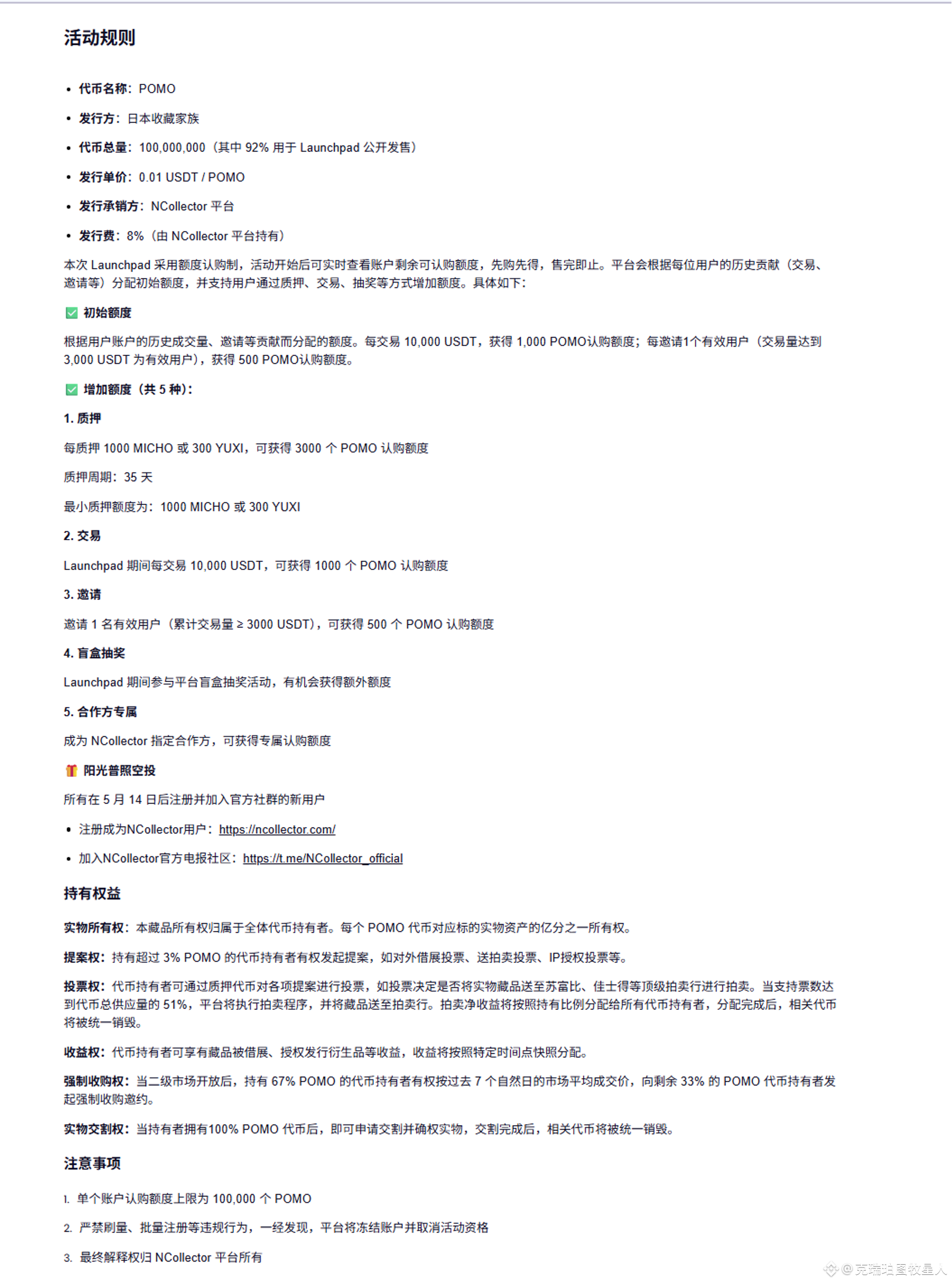
Today is May 23, 2025, and the subscription for the third phase of token #$POMO #NCollector #RWA代币化 has entered the countdown.
Below is a quick guide to help you understand this revolutionary experiment of 'art + blockchain'👇
🎨 Top-tier Art IP + Ultra-low Subscription Threshold
The $POMO token corresponds to the late masterpiece 'Splash Ink Landscape Scroll' by Chinese ink painting master Zhang Daqian, which is currently housed in a museum in Tokyo, Japan, and insured by Mitsubishi Insurance.
92% of the total supply of 100 million tokens is open for subscription, with a single price of only 0.01U (≈¥0.07), and a minimum of 1U is required to participate. As of May 19, 50.2% of the shares have been snapped up, with the listing trading date set for May 27.
🖼️ The Scarcity and Cultural Value of Artwork
Zhang Daqian (1899-1983), known as the 'Brush of the East,' is the founder of the 'Splash Ink and Color' technique in 20th-century Chinese painting, whose works embody both traditional heritage and modern aesthetics.
The 'Splash Ink Landscape Scroll,' as a peak work of his later years, has a market valuation of 15 million to 25 million US dollars and is recognized as an important carrier of cultural heritage transmission.
🔑 $POMO Rights
✅ Physical Ownership: Proportional shared ownership of the painting, supporting 67% share forced buyout or 100% physical delivery;
✅ Governance Rights: Holders of more than 3% can propose votes on auction, IP licensing, and other matters;
✅ Revenue Rights: Share profits from exhibitions, derivative rights, etc.
📈 Performance of the First Two Collections
$YUXI (Qianlong Jade Seal) 68827293033 reached a maximum increase of 127 times;
$MICHO (Su Shi Calligraphy) 89747745610 reached a maximum increase of 29 times.
📝 Subscription Rules and Participation Path
1️⃣ Quota Acquisition: Initial quota is distributed through trading/inviting/staking contributions, and new users can receive a 'Sunshine Ray' airdrop by registering and joining the community;
2️⃣ Subscription Limit: A single account can subscribe up to 100,000 tokens (to avoid violations);
3️⃣ Operation Process: Register → Join the community → Recharge → Subscribe.
Beginner's Action Guide
🔸 Small Investment Trial: Participate with 'milk tea money' to avoid risk;
🔸 Long-term Perspective: Art value requires time to settle, beware of short-term speculation.
#ZhangDaqian #Collection #Subscription #Blockchain #Artwork #Auction #Sotheby's #CulturalRelics
The content of this article is for reference only and is not investment advice, DYOR.
✨ A new species of digital art investment!
Today is May 23, 2025, and the subscription for the third phase of token #$POMO #NCollector #RWA代币化 has entered the countdown.
Below is a quick guide to help you understand this revolutionary experiment of 'art + blockchain'👇
🎨 Top-tier Art IP + Ultra-low Subscription Threshold
The $POMO token corresponds to the late masterpiece 'Splash Ink Landscape Scroll' by Chinese ink painting master Zhang Daqian, which is currently housed in a museum in Tokyo, Japan, and insured by Mitsubishi Insurance.
92% of the total supply of 100 million tokens is open for subscription, with a single price of only 0.01U (≈¥0.07), and a minimum of 1U is required to participate. As of May 19, 50.2% of the shares have been snapped up, with the listing trading date set for May 27.
🖼️ The Scarcity and Cultural Value of Artwork
Zhang Daqian (1899-1983), known as the 'Brush of the East,' is the founder of the 'Splash Ink and Color' technique in 20th-century Chinese painting, whose works embody both traditional heritage and modern aesthetics.
The 'Splash Ink Landscape Scroll,' as a peak work of his later years, has a market valuation of 15 million to 25 million US dollars and is recognized as an important carrier of cultural heritage transmission.
🔑 $POMO Rights
✅ Physical Ownership: Proportional shared ownership of the painting, supporting 67% share forced buyout or 100% physical delivery;
✅ Governance Rights: Holders of more than 3% can propose votes on auction, IP licensing, and other matters;
✅ Revenue Rights: Share profits from exhibitions, derivative rights, etc.
📈 Performance of the First Two Collections
$YUXI (Qianlong Jade Seal) 68827293033 reached a maximum increase of 127 times;
$MICHO (Su Shi Calligraphy) 89747745610 reached a maximum increase of 29 times.
📝 Subscription Rules and Participation Path
1️⃣ Quota Acquisition: Initial quota is distributed through trading/inviting/staking contributions, and new users can receive a 'Sunshine Ray' airdrop by registering and joining the community;
2️⃣ Subscription Limit: A single account can subscribe up to 100,000 tokens (to avoid violations);
3️⃣ Operation Process: Register → Join the community → Recharge → Subscribe.
Beginner's Action Guide
🔸 Small Investment Trial: Participate with 'milk tea money' to avoid risk;
🔸 Long-term Perspective: Art value requires time to settle, beware of short-term speculation.
#ZhangDaqian #Collection #Subscription #Blockchain #Artwork #Auction #Sotheby's #CulturalRelics
The content of this article is for reference only and is not investment advice, DYOR.
Today is May 23, 2025, and the subscription for the third phase of token #$POMO #NCollector #RWA代币化 has entered the countdown.
Below is a quick guide to help you understand this revolutionary experiment of 'art + blockchain'👇
🎨 Top-tier Art IP + Ultra-low Subscription Threshold
The $POMO token corresponds to the late masterpiece 'Splash Ink Landscape Scroll' by Chinese ink painting master Zhang Daqian, which is currently housed in a museum in Tokyo, Japan, and insured by Mitsubishi Insurance.
92% of the total supply of 100 million tokens is open for subscription, with a single price of only 0.01U (≈¥0.07), and a minimum of 1U is required to participate. As of May 19, 50.2% of the shares have been snapped up, with the listing trading date set for May 27.
🖼️ The Scarcity and Cultural Value of Artwork
Zhang Daqian (1899-1983), known as the 'Brush of the East,' is the founder of the 'Splash Ink and Color' technique in 20th-century Chinese painting, whose works embody both traditional heritage and modern aesthetics.
The 'Splash Ink Landscape Scroll,' as a peak work of his later years, has a market valuation of 15 million to 25 million US dollars and is recognized as an important carrier of cultural heritage transmission.
🔑 $POMO Rights
✅ Physical Ownership: Proportional shared ownership of the painting, supporting 67% share forced buyout or 100% physical delivery;
✅ Governance Rights: Holders of more than 3% can propose votes on auction, IP licensing, and other matters;
✅ Revenue Rights: Share profits from exhibitions, derivative rights, etc.
📈 Performance of the First Two Collections
$YUXI (Qianlong Jade Seal) 68827293033 reached a maximum increase of 127 times;
$MICHO (Su Shi Calligraphy) 89747745610 reached a maximum increase of 29 times.
📝 Subscription Rules and Participation Path
1️⃣ Quota Acquisition: Initial quota is distributed through trading/inviting/staking contributions, and new users can receive a 'Sunshine Ray' airdrop by registering and joining the community;
2️⃣ Subscription Limit: A single account can subscribe up to 100,000 tokens (to avoid violations);
3️⃣ Operation Process: Register → Join the community → Recharge → Subscribe.
Beginner's Action Guide
🔸 Small Investment Trial: Participate with 'milk tea money' to avoid risk;
🔸 Long-term Perspective: Art value requires time to settle, beware of short-term speculation.
#ZhangDaqian #Collection #Subscription #Blockchain #Artwork #Auction #Sotheby's #CulturalRelics
The content of this article is for reference only and is not investment advice, DYOR.

1
170
Log in to explore more content
Join global crypto users on Binance Square
⚡️ Get latest and useful information about crypto.
💬 Trusted by the world’s largest crypto exchange.
👍 Discover real insights from verified creators.
Email / Phone number
Trending Topics
MetaMaskExitsLidoValidatorsAfterSecurityIncident
534 views
46 Discussing
#metamaskexitslidovalidatorsaftersecurityincident
🦊 MetaMask & Lido: Is the honeymoon officially over?! 💔
MetaMask just hit the "Emergency Exit" button on its Lido Ethereum validators after a security scare! 😱 While MetaMask assures everyone that wallet funds are totally safe, they aren't taking any chances with their non-custodial staking infrastructure.
🔮 What happened to Lido?
No drama on Lido's side, but MetaMask is proactively pulling its affected nodes out of the Lido protocol. The validators are exiting by October 7, 2026, and the full re-entry process could take around 45 days. Good news? If you hold stETH, you can relax—no action is needed! 🛡️
🧠 What should traders do?
Don't panic-dump your bags. Keep your funds secure, double-check your staking setups, and always monitor security updates!
Not financial advice.
Support me by using code VINHTOCDO or link: https://www.binance.com/register?ref=VINHTOCDO
👇 Click trade below to support me:
$BTC
$ETH
$LDO
#MetaMask #LidoFinance #CryptoSecurity #EthereumStaking #CryptoNews #VINHTOCDO
Vinhtocdo
·2 Likes
·56 views
MicronBeatsEarningsLiftsGuidance
2,297 views
77 Discussing
CFTCSubmitsTwoEventContractRulesToWhiteHouse
3,285 views
111 Discussing