

7toraka
672 Posts

7toraka
Report
Block User
178 Following
335 Followers
1.1K+ Liked
Posts
All
Quotes
Live
·
--
Bullish
🚨🚨Key Events to Watch This Week🚨🚨
👉Tuesday – U.S. Jobs Data. ADP Weekly Jobless Claims
👉Wednesday – U.S. Unemployment Claims
#USJobsData
🚨🚨Key Events to Watch This Week🚨🚨
👉Tuesday – U.S. Jobs Data. ADP Weekly Jobless Claims
👉Wednesday – U.S. Unemployment Claims
#USJobsData
👉Tuesday – U.S. Jobs Data. ADP Weekly Jobless Claims
👉Wednesday – U.S. Unemployment Claims
#USJobsData

3
532
·
--
Bullish
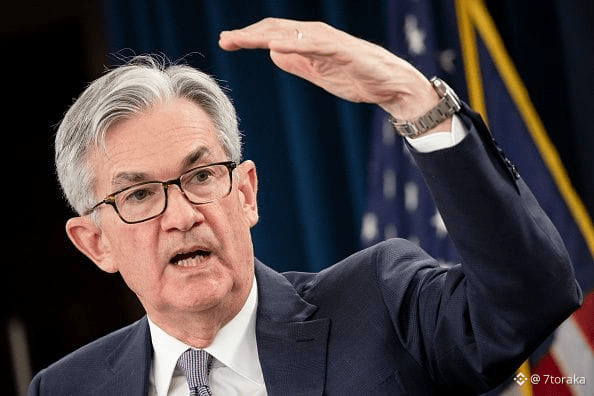
👀🤔👉Leading Candidates To Be The Next Fed Chair
Kevin Warsh and Kevin Hassett remain the leading candidates for the next Federal Reserve chair under President Trump. Other notable contenders include Scott Bessent, Chris Waller, and Rick Rieder, based on recent surveys and reports.
Kevin Warsh, a former Fed governor, tops many lists due to his experience during the financial crisis and hawkish views aligning with Trump's preferences. Kevin Hassett, Trump's National Economic Council director, is a close second, valued for his daily consultations with the president and economic advisory role.
Scott Bessent, Treasury Secretary, ties closely in some polls at around 24% support.
Chris Waller, current Fed governor, gains traction for dovish stances on rates and optimism about Trump's policies.
Rick Rieder from BlackRock impressed in interviews but lacks prior Fed experience.
Jerome Powell's term ends in May 2026, prompting this race amid Trump's push for rate cuts and Fed alignment. Prediction markets and experts see no clear winner yet, with Senate confirmation as a key hurdle.
#FedDovishNow
👀🤔👉Leading Candidates To Be The Next Fed Chair
Kevin Warsh and Kevin Hassett remain the leading candidates for the next Federal Reserve chair under President Trump. Other notable contenders include Scott Bessent, Chris Waller, and Rick Rieder, based on recent surveys and reports.
Kevin Warsh, a former Fed governor, tops many lists due to his experience during the financial crisis and hawkish views aligning with Trump's preferences. Kevin Hassett, Trump's National Economic Council director, is a close second, valued for his daily consultations with the president and economic advisory role.
Scott Bessent, Treasury Secretary, ties closely in some polls at around 24% support.
Chris Waller, current Fed governor, gains traction for dovish stances on rates and optimism about Trump's policies.
Rick Rieder from BlackRock impressed in interviews but lacks prior Fed experience.
Jerome Powell's term ends in May 2026, prompting this race amid Trump's push for rate cuts and Fed alignment. Prediction markets and experts see no clear winner yet, with Senate confirmation as a key hurdle.
#FedDovishNow
Kevin Warsh and Kevin Hassett remain the leading candidates for the next Federal Reserve chair under President Trump. Other notable contenders include Scott Bessent, Chris Waller, and Rick Rieder, based on recent surveys and reports.
Kevin Warsh, a former Fed governor, tops many lists due to his experience during the financial crisis and hawkish views aligning with Trump's preferences. Kevin Hassett, Trump's National Economic Council director, is a close second, valued for his daily consultations with the president and economic advisory role.
Scott Bessent, Treasury Secretary, ties closely in some polls at around 24% support.
Chris Waller, current Fed governor, gains traction for dovish stances on rates and optimism about Trump's policies.
Rick Rieder from BlackRock impressed in interviews but lacks prior Fed experience.
Jerome Powell's term ends in May 2026, prompting this race amid Trump's push for rate cuts and Fed alignment. Prediction markets and experts see no clear winner yet, with Senate confirmation as a key hurdle.
#FedDovishNow
8
·
--
Bullish
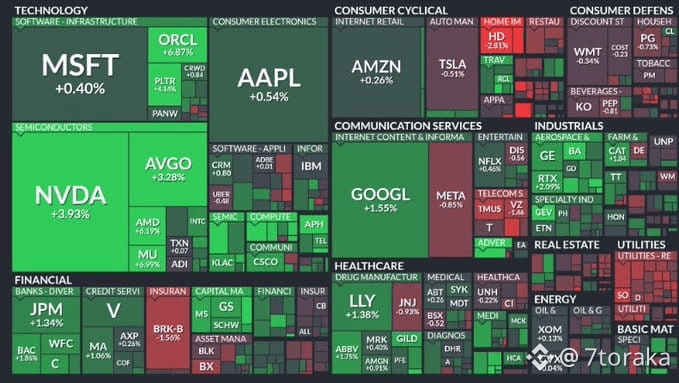
👀👀👉S&P 500 $SPX Friday Heat Map
On Friday, the S&P 500 closed higher amid a tech-led rally. The index ended the trading day at 6,834.50.
#S&P500
👀👀👉S&P 500 $SPX Friday Heat Map
On Friday, the S&P 500 closed higher amid a tech-led rally. The index ended the trading day at 6,834.50.
#S&P500
On Friday, the S&P 500 closed higher amid a tech-led rally. The index ended the trading day at 6,834.50.
#S&P500
2
1k
·
--
Bullish
👀👀👉Unexpected Disinflation in November Despite Shutdown Data Gaps
The November 2025 US CPI data signals cooling inflation across both headline and core measures, suggesting reduced price pressures in the economy. This deceleration, with headline CPI at 2.7% year-over-year (below expectations of 3.1%) and core at 2.6%, indicates disinflationary trends in goods and services, including shelter costs.
Lower inflation eases burdens on consumers and businesses, potentially supporting sustained spending despite a recent government shutdown distorting data collection. Energy prices rose but food cooled, pointing to mixed sector dynamics amid robust prior GDP growth.
The Federal Reserve may accelerate rate cuts if this trend persists, as evidenced by falling Treasury yields post-release, boosting odds of looser monetary policy. Overall, it reflects economic resilience rather than distress, though one month's data warrants caution amid holiday-season discounts.
#CPIWatch
👀👀👉Unexpected Disinflation in November Despite Shutdown Data Gaps
The November 2025 US CPI data signals cooling inflation across both headline and core measures, suggesting reduced price pressures in the economy. This deceleration, with headline CPI at 2.7% year-over-year (below expectations of 3.1%) and core at 2.6%, indicates disinflationary trends in goods and services, including shelter costs.
Lower inflation eases burdens on consumers and businesses, potentially supporting sustained spending despite a recent government shutdown distorting data collection. Energy prices rose but food cooled, pointing to mixed sector dynamics amid robust prior GDP growth.
The Federal Reserve may accelerate rate cuts if this trend persists, as evidenced by falling Treasury yields post-release, boosting odds of looser monetary policy. Overall, it reflects economic resilience rather than distress, though one month's data warrants caution amid holiday-season discounts.
#CPIWatch
The November 2025 US CPI data signals cooling inflation across both headline and core measures, suggesting reduced price pressures in the economy. This deceleration, with headline CPI at 2.7% year-over-year (below expectations of 3.1%) and core at 2.6%, indicates disinflationary trends in goods and services, including shelter costs.
Lower inflation eases burdens on consumers and businesses, potentially supporting sustained spending despite a recent government shutdown distorting data collection. Energy prices rose but food cooled, pointing to mixed sector dynamics amid robust prior GDP growth.
The Federal Reserve may accelerate rate cuts if this trend persists, as evidenced by falling Treasury yields post-release, boosting odds of looser monetary policy. Overall, it reflects economic resilience rather than distress, though one month's data warrants caution amid holiday-season discounts.
#CPIWatch
1
1
1
606
·
--
Bullish
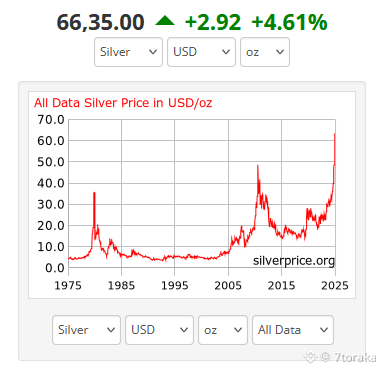
👀👀👉Silver Price Hits Historic $67 Peak
Silver prices surged to a record high near $67 per ounce, driven by strong industrial demand and supply constraints. While some reports confirm it touched $67.045 before retreating slightly, the current spot price stands at $66.35 per ounce.
#Silver
👀👀👉Silver Price Hits Historic $67 Peak
Silver prices surged to a record high near $67 per ounce, driven by strong industrial demand and supply constraints. While some reports confirm it touched $67.045 before retreating slightly, the current spot price stands at $66.35 per ounce.
#Silver
Silver prices surged to a record high near $67 per ounce, driven by strong industrial demand and supply constraints. While some reports confirm it touched $67.045 before retreating slightly, the current spot price stands at $66.35 per ounce.
#Silver
1
355
·
--
Bullish
👀👀👉Tomorrow's CPI: Two-Month Update After Shutdown, Eyes on Sticky 3% Inflation
The November CPI release is expected to show headline inflation at about 3.1% and core around 3.0–3.1%, both still above the Fed’s 2% target. Because the October report was canceled due to the shutdown, this release effectively covers two months and could have an unusually large impact on Fed policy expectations and markets.
#CPIWatch
👀👀👉Tomorrow's CPI: Two-Month Update After Shutdown, Eyes on Sticky 3% Inflation
The November CPI release is expected to show headline inflation at about 3.1% and core around 3.0–3.1%, both still above the Fed’s 2% target. Because the October report was canceled due to the shutdown, this release effectively covers two months and could have an unusually large impact on Fed policy expectations and markets.
#CPIWatch
The November CPI release is expected to show headline inflation at about 3.1% and core around 3.0–3.1%, both still above the Fed’s 2% target. Because the October report was canceled due to the shutdown, this release effectively covers two months and could have an unusually large impact on Fed policy expectations and markets.
#CPIWatch
2
597
·
--
Bullish
👀👀👉US Economic Indicators for November 2025 Released Today
The latest US employment and retail sales data, corresponding to November 2025 and released today, show mixed labor market signals amid steady consumer spending trends.
Labor Market Key Metrics
👉Non-Farm Employment Change increased by 64,000 jobs, below recent averages.
👉Unemployment Rate rose to 4.6%.
👉Average Hourly Earnings m/m grew by 0.3%, with year-over-year at 3.5%.
#USNonFarmPayrollReport
👀👀👉US Economic Indicators for November 2025 Released Today
The latest US employment and retail sales data, corresponding to November 2025 and released today, show mixed labor market signals amid steady consumer spending trends.
Labor Market Key Metrics
👉Non-Farm Employment Change increased by 64,000 jobs, below recent averages.
👉Unemployment Rate rose to 4.6%.
👉Average Hourly Earnings m/m grew by 0.3%, with year-over-year at 3.5%.
#USNonFarmPayrollReport
The latest US employment and retail sales data, corresponding to November 2025 and released today, show mixed labor market signals amid steady consumer spending trends.
Labor Market Key Metrics
👉Non-Farm Employment Change increased by 64,000 jobs, below recent averages.
👉Unemployment Rate rose to 4.6%.
👉Average Hourly Earnings m/m grew by 0.3%, with year-over-year at 3.5%.
#USNonFarmPayrollReport
4
514
·
--
Bullish
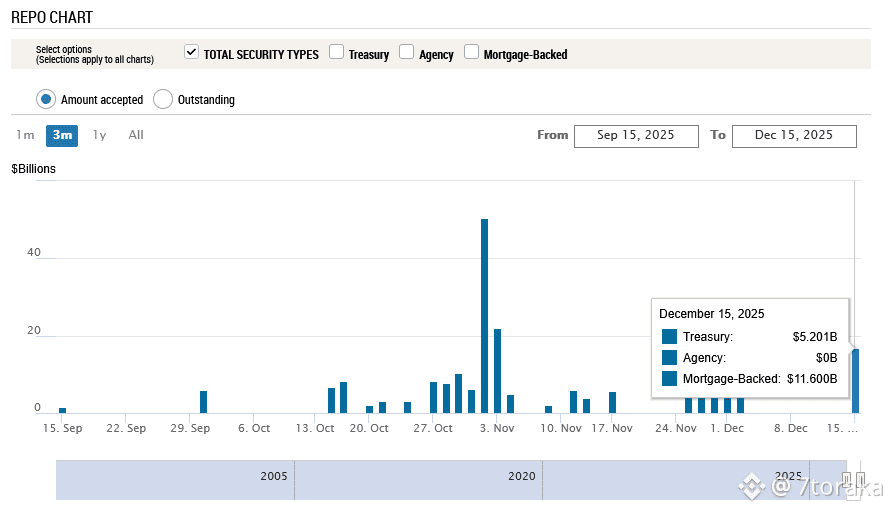
👀👀👉Federal Reserve's $5.2 Billion Overnight Repo Operation: Liquidity Support
The Federal Reserve conducted overnight repurchase agreements totaling $5.201 billion on December 15, 2025.
It alleviates short-term funding strains for banks and dealers,
maintaining the federal funds rate within the 3.5-3.75% target range. Full-allotment standing repos, effective since December 11, mitigate rate volatility akin to 2019 disruptions, supporting Treasury and money market equilibrium.
These actions enhance liquidity flow to risk assets, potentially elevating equities and cryptocurrencies through re-hypothecation, as observed with prior $13.5 billion injections. Yet, as a minor daily volume in the $12.6 trillion repo market, it sustains accommodative policy absent significant price swings.
Amid the FOMC's rate cut and quantitative tightening cessation, it
reinforces easing measures, with stable rate projections aiding 2026 expansion while tracking inflation. Short-term Treasury yields remain subdued, bolstering equity performance.
#Fed
👀👀👉Federal Reserve's $5.2 Billion Overnight Repo Operation: Liquidity Support
The Federal Reserve conducted overnight repurchase agreements totaling $5.201 billion on December 15, 2025.
It alleviates short-term funding strains for banks and dealers,
maintaining the federal funds rate within the 3.5-3.75% target range. Full-allotment standing repos, effective since December 11, mitigate rate volatility akin to 2019 disruptions, supporting Treasury and money market equilibrium.
These actions enhance liquidity flow to risk assets, potentially elevating equities and cryptocurrencies through re-hypothecation, as observed with prior $13.5 billion injections. Yet, as a minor daily volume in the $12.6 trillion repo market, it sustains accommodative policy absent significant price swings.
Amid the FOMC's rate cut and quantitative tightening cessation, it
reinforces easing measures, with stable rate projections aiding 2026 expansion while tracking inflation. Short-term Treasury yields remain subdued, bolstering equity performance.
#Fed
The Federal Reserve conducted overnight repurchase agreements totaling $5.201 billion on December 15, 2025.
It alleviates short-term funding strains for banks and dealers,
maintaining the federal funds rate within the 3.5-3.75% target range. Full-allotment standing repos, effective since December 11, mitigate rate volatility akin to 2019 disruptions, supporting Treasury and money market equilibrium.
These actions enhance liquidity flow to risk assets, potentially elevating equities and cryptocurrencies through re-hypothecation, as observed with prior $13.5 billion injections. Yet, as a minor daily volume in the $12.6 trillion repo market, it sustains accommodative policy absent significant price swings.
Amid the FOMC's rate cut and quantitative tightening cessation, it
reinforces easing measures, with stable rate projections aiding 2026 expansion while tracking inflation. Short-term Treasury yields remain subdued, bolstering equity performance.
#Fed
157
·
--
Bullish
👀👀👉Polymarket: Warsh Surges Past Hassett in Fed Chair
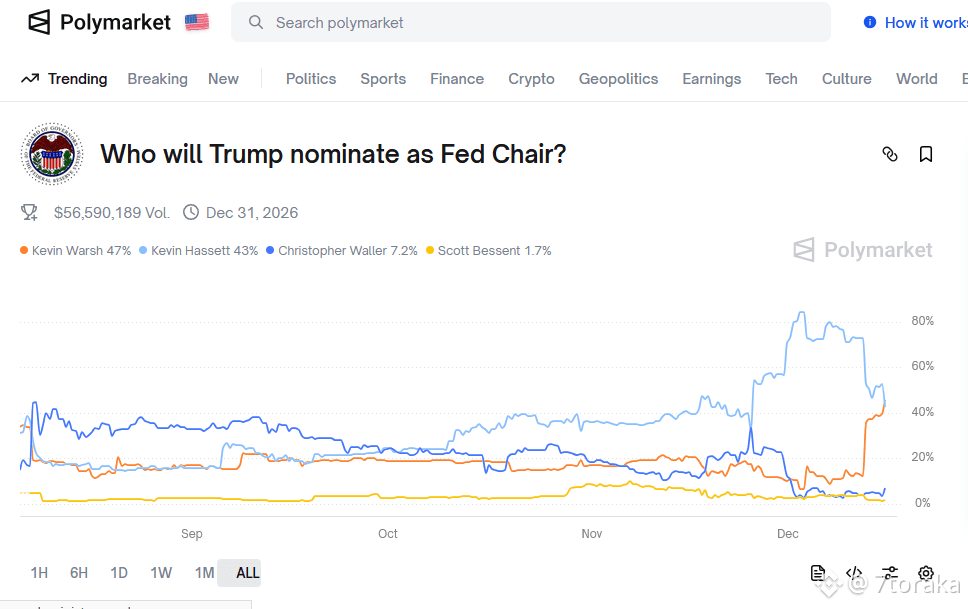
Kevin Warsh has gained significant momentum in the race to replace Federal Reserve Chair Jerome Powell, recently overtaking Kevin Hassett in prediction markets. This shift reflects evolving sentiment among traders and advisors close to President Donald Trump.
Warsh now leads on platforms like Polymarket (46%) and Kalshi (47-52%), while Hassett trails at 41-44%. These figures mark a reversal from early December, when Hassett held odds above 80%.
Trump's recent comments to the Wall Street Journal placed Warsh at the top of his shortlist, following a strong White House interview. Resistance to Hassett stems from concerns over his close ties to Trump potentially undermining Fed independence.
Who's your favorite?
#Fed
👀👀👉Polymarket: Warsh Surges Past Hassett in Fed Chair
Kevin Warsh has gained significant momentum in the race to replace Federal Reserve Chair Jerome Powell, recently overtaking Kevin Hassett in prediction markets. This shift reflects evolving sentiment among traders and advisors close to President Donald Trump.
Warsh now leads on platforms like Polymarket (46%) and Kalshi (47-52%), while Hassett trails at 41-44%. These figures mark a reversal from early December, when Hassett held odds above 80%.
Trump's recent comments to the Wall Street Journal placed Warsh at the top of his shortlist, following a strong White House interview. Resistance to Hassett stems from concerns over his close ties to Trump potentially undermining Fed independence.
Who's your favorite?
#Fed
Kevin Warsh has gained significant momentum in the race to replace Federal Reserve Chair Jerome Powell, recently overtaking Kevin Hassett in prediction markets. This shift reflects evolving sentiment among traders and advisors close to President Donald Trump.
Warsh now leads on platforms like Polymarket (46%) and Kalshi (47-52%), while Hassett trails at 41-44%. These figures mark a reversal from early December, when Hassett held odds above 80%.
Trump's recent comments to the Wall Street Journal placed Warsh at the top of his shortlist, following a strong White House interview. Resistance to Hassett stems from concerns over his close ties to Trump potentially undermining Fed independence.
Who's your favorite?
#Fed
1
379
·
--
Bullish
🚨🚨Key Events to Watch This Week🚨🚨
👉Tuesday – U.S. Jobs Data
👉Thursday – U.S. CPI Inflation Data
👉Initial Jobless Claims
👉Friday – Existing Home Sales
👉 Consumer Sentiment
#news
🚨🚨Key Events to Watch This Week🚨🚨
👉Tuesday – U.S. Jobs Data
👉Thursday – U.S. CPI Inflation Data
👉Initial Jobless Claims
👉Friday – Existing Home Sales
👉 Consumer Sentiment
#news
👉Tuesday – U.S. Jobs Data
👉Thursday – U.S. CPI Inflation Data
👉Initial Jobless Claims
👉Friday – Existing Home Sales
👉 Consumer Sentiment
#news

2
876
·
--
Bullish
👀👀👉Crypto Trust Banks: A New Wave of Competition for Traditional Finance
The [Office of the Comptroller of the Currency](https://www.binance.com/en/square/post/33627881292346) (OCC) has granted conditional national trust bank charters to five digital-asset firms: Ripple, Fidelity Digital Assets, Paxos, BitGo, and First National Digital Currency Bank. These charters enable the firms to provide crypto-focused services, such as custody and settlement, under a federal framework without the requirements of traditional insured depository banks.
The American Bankers Association (ABA) argues that these charters blur the definition of a "bank," undermine charter integrity, and allow regulatory arbitrage, as crypto firms gain national preemption without matching capital, liquidity, or supervisory standards. The Independent Community Bankers of America (ICBA) contends that the OCC exceeds the traditional scope of national trust charters, which focused on fiduciary roles, creating a two-tier system that burdens community banks with stricter regulations.
These complaints stem from valid questions about statutory authority and historical precedents, including exemptions from FDIC insurance, Community Reinvestment Act obligations, and certain capital rules. Yet they also reflect competitive pressures, as crypto firms like Ripple and Paxos can now operate as "national trust banks," bypassing state regulations while traditional banks face higher compliance costs.
This development integrates crypto into the federal banking system through hybrid entities, potentially normalizing digital-asset custody. Traditional banks may need to adapt, though outcomes depend on final charter conditions and access to Federal Reserve services.
#USCryptoRegulation
👀👀👉Crypto Trust Banks: A New Wave of Competition for Traditional Finance
The Office of the Comptroller of the Currency (OCC) has granted conditional national trust bank charters to five digital-asset firms: Ripple, Fidelity Digital Assets, Paxos, BitGo, and First National Digital Currency Bank. These charters enable the firms to provide crypto-focused services, such as custody and settlement, under a federal framework without the requirements of traditional insured depository banks.
The American Bankers Association (ABA) argues that these charters blur the definition of a "bank," undermine charter integrity, and allow regulatory arbitrage, as crypto firms gain national preemption without matching capital, liquidity, or supervisory standards. The Independent Community Bankers of America (ICBA) contends that the OCC exceeds the traditional scope of national trust charters, which focused on fiduciary roles, creating a two-tier system that burdens community banks with stricter regulations.
These complaints stem from valid questions about statutory authority and historical precedents, including exemptions from FDIC insurance, Community Reinvestment Act obligations, and certain capital rules. Yet they also reflect competitive pressures, as crypto firms like Ripple and Paxos can now operate as "national trust banks," bypassing state regulations while traditional banks face higher compliance costs.
This development integrates crypto into the federal banking system through hybrid entities, potentially normalizing digital-asset custody. Traditional banks may need to adapt, though outcomes depend on final charter conditions and access to Federal Reserve services.
#USCryptoRegulation
The Office of the Comptroller of the Currency (OCC) has granted conditional national trust bank charters to five digital-asset firms: Ripple, Fidelity Digital Assets, Paxos, BitGo, and First National Digital Currency Bank. These charters enable the firms to provide crypto-focused services, such as custody and settlement, under a federal framework without the requirements of traditional insured depository banks.
The American Bankers Association (ABA) argues that these charters blur the definition of a "bank," undermine charter integrity, and allow regulatory arbitrage, as crypto firms gain national preemption without matching capital, liquidity, or supervisory standards. The Independent Community Bankers of America (ICBA) contends that the OCC exceeds the traditional scope of national trust charters, which focused on fiduciary roles, creating a two-tier system that burdens community banks with stricter regulations.
These complaints stem from valid questions about statutory authority and historical precedents, including exemptions from FDIC insurance, Community Reinvestment Act obligations, and certain capital rules. Yet they also reflect competitive pressures, as crypto firms like Ripple and Paxos can now operate as "national trust banks," bypassing state regulations while traditional banks face higher compliance costs.
This development integrates crypto into the federal banking system through hybrid entities, potentially normalizing digital-asset custody. Traditional banks may need to adapt, though outcomes depend on final charter conditions and access to Federal Reserve services.
#USCryptoRegulation
2
459
·
--
Bullish
👀👀👉US Crypto Bill Talks Stall Despite December Hopes
US crypto Market Structure Bill negotiations are dragging on. Industry groups, the White House, Republicans, and Democrats keep talking, even with draft language out there. High hopes for December action have faded—no markup before the holiday break, so it's delayed to January 2026.
The House pushed the Senate hard to pass the CLARITY Act by month's end, after its own approval back in July. Senate Banking Chair Tim Scott aimed for markups this December, and Coinbase CEO Brian Armstrong lobbied fiercely for regulatory clarity on CFTC roles and DeFi.
Key disputes include ethics rules tied to Trump connections, stablecoin yields, SEC powers over tokens, and DeFi safeguards. GOP compromise offers to Democrats on December 9 built some optimism, but the tight calendar forced a postponement. Bipartisan drive remains solid for early next year.
#USGovernment
👀👀👉US Crypto Bill Talks Stall Despite December Hopes
US crypto Market Structure Bill negotiations are dragging on. Industry groups, the White House, Republicans, and Democrats keep talking, even with draft language out there. High hopes for December action have faded—no markup before the holiday break, so it's delayed to January 2026.
The House pushed the Senate hard to pass the CLARITY Act by month's end, after its own approval back in July. Senate Banking Chair Tim Scott aimed for markups this December, and Coinbase CEO Brian Armstrong lobbied fiercely for regulatory clarity on CFTC roles and DeFi.
Key disputes include ethics rules tied to Trump connections, stablecoin yields, SEC powers over tokens, and DeFi safeguards. GOP compromise offers to Democrats on December 9 built some optimism, but the tight calendar forced a postponement. Bipartisan drive remains solid for early next year.
#USGovernment
US crypto Market Structure Bill negotiations are dragging on. Industry groups, the White House, Republicans, and Democrats keep talking, even with draft language out there. High hopes for December action have faded—no markup before the holiday break, so it's delayed to January 2026.
The House pushed the Senate hard to pass the CLARITY Act by month's end, after its own approval back in July. Senate Banking Chair Tim Scott aimed for markups this December, and Coinbase CEO Brian Armstrong lobbied fiercely for regulatory clarity on CFTC roles and DeFi.
Key disputes include ethics rules tied to Trump connections, stablecoin yields, SEC powers over tokens, and DeFi safeguards. GOP compromise offers to Democrats on December 9 built some optimism, but the tight calendar forced a postponement. Bipartisan drive remains solid for early next year.
#USGovernment
177
·
--
Bullish
👀👀👉OCC Approves Trust Charters for Ripple, Circle, BitGo, Fidelity, Paxos
The Office of the Comptroller of the Currency (OCC), the top U.S. federal banking regulator, has granted conditional approval for national trust bank charters to Ripple, Circle, BitGo, Fidelity Digital Assets, and Paxos today, marking a major step toward mainstream banking integration for major crypto firms.
What the OCC approved:
The OCC conditionally approved:
👉Two new (de novo) national trust bank charters:
👉Ripple National Trust Bank (for Ripple).
👉First National Digital Currency Bank (for Circle, to oversee the USDC reserve and provide fiduciary digital asset custody).
Conversions of existing state trust companies into national trust banks:
👉BitGo Bank & Trust (BitGo’s South Dakota trust company).
👉Fidelity Digital Assets (Fidelity’s digital assets trust business).
👉Paxos Trust Company (Paxos’s existing state trust charter).
#USCrypto $XRP
👀👀👉OCC Approves Trust Charters for Ripple, Circle, BitGo, Fidelity, Paxos
The Office of the Comptroller of the Currency (OCC), the top U.S. federal banking regulator, has granted conditional approval for national trust bank charters to Ripple, Circle, BitGo, Fidelity Digital Assets, and Paxos today, marking a major step toward mainstream banking integration for major crypto firms.
What the OCC approved:
The OCC conditionally approved:
👉Two new (de novo) national trust bank charters:
👉Ripple National Trust Bank (for Ripple).
👉First National Digital Currency Bank (for Circle, to oversee the USDC reserve and provide fiduciary digital asset custody).
Conversions of existing state trust companies into national trust banks:
👉BitGo Bank & Trust (BitGo’s South Dakota trust company).
👉Fidelity Digital Assets (Fidelity’s digital assets trust business).
👉Paxos Trust Company (Paxos’s existing state trust charter).
#USCrypto $XRP
The Office of the Comptroller of the Currency (OCC), the top U.S. federal banking regulator, has granted conditional approval for national trust bank charters to Ripple, Circle, BitGo, Fidelity Digital Assets, and Paxos today, marking a major step toward mainstream banking integration for major crypto firms.
What the OCC approved:
The OCC conditionally approved:
👉Two new (de novo) national trust bank charters:
👉Ripple National Trust Bank (for Ripple).
👉First National Digital Currency Bank (for Circle, to oversee the USDC reserve and provide fiduciary digital asset custody).
Conversions of existing state trust companies into national trust banks:
👉BitGo Bank & Trust (BitGo’s South Dakota trust company).
👉Fidelity Digital Assets (Fidelity’s digital assets trust business).
👉Paxos Trust Company (Paxos’s existing state trust charter).
#USCrypto $XRP
1
158
·
--
Bullish
👀👀👉Federal Reserve Extends Terms for 11 Regional Presidents
The Federal Reserve’s Board of Governors voted unanimously to reappoint the existing regional Reserve Bank presidents to new five‑year terms that begin on March 1, 2026. By law, these presidents serve five‑year terms that all expire at the end of February in years ending in 1 or 6, so the board periodically votes to extend or replace them.
Atlanta Fed President Raphael Bostic had already announced that he will retire at the end of his current term in February, so he is not being reappointed to a new term. Because of that planned retirement, the reappointment action effectively covers 11 sitting Reserve Bank presidents rather than all 12, with a search under way for Bostic’s successor in Atlanta.
#Fed
👀👀👉Federal Reserve Extends Terms for 11 Regional Presidents
The Federal Reserve’s Board of Governors voted unanimously to reappoint the existing regional Reserve Bank presidents to new five‑year terms that begin on March 1, 2026. By law, these presidents serve five‑year terms that all expire at the end of February in years ending in 1 or 6, so the board periodically votes to extend or replace them.
Atlanta Fed President Raphael Bostic had already announced that he will retire at the end of his current term in February, so he is not being reappointed to a new term. Because of that planned retirement, the reappointment action effectively covers 11 sitting Reserve Bank presidents rather than all 12, with a search under way for Bostic’s successor in Atlanta.
#Fed
The Federal Reserve’s Board of Governors voted unanimously to reappoint the existing regional Reserve Bank presidents to new five‑year terms that begin on March 1, 2026. By law, these presidents serve five‑year terms that all expire at the end of February in years ending in 1 or 6, so the board periodically votes to extend or replace them.
Atlanta Fed President Raphael Bostic had already announced that he will retire at the end of his current term in February, so he is not being reappointed to a new term. Because of that planned retirement, the reappointment action effectively covers 11 sitting Reserve Bank presidents rather than all 12, with a search under way for Bostic’s successor in Atlanta.
#Fed
2
861
·
--
Bullish
👀👀👉Oracle Down 7%, Software Slump Overshadows Cloud Wins
Oracle is dropping after hours because its latest earnings report disappointed investors on revenue and raised concerns about the sustainability and quality of its growth.
Oracle reported its latest fiscal quarter after the close, posting adjusted earnings per share that were above Wall Street estimates but revenue that came in below consensus expectations. The stock is trading down around 6–7% in the after‑hours session as investors react more to the revenue shortfall than to the earnings beat.
Analysts had expected higher top‑line growth from Oracle’s cloud and software businesses, but total revenue of about 16.06 billion dollars missed the roughly 16.19 billion dollars the street was looking for. The miss is being interpreted as a sign that demand for some of Oracle’s software and cloud offerings may be softer than hoped, especially given elevated expectations around AI‑driven growth.
Oracle did highlight very strong remaining performance obligations (its backlog of contracted but not yet recognized revenue), which it said surged by more than 400%, helped by large cloud deals with customers such as Meta and Nvidia. However, traders are currently prioritizing the near‑term revenue miss and questions about how quickly that backlog will convert into reported sales, which is contributing to the sharp after‑hours sell‑off despite the strong long‑term contract pipeline.
#earnings
👀👀👉Oracle Down 7%, Software Slump Overshadows Cloud Wins
Oracle is dropping after hours because its latest earnings report disappointed investors on revenue and raised concerns about the sustainability and quality of its growth.
Oracle reported its latest fiscal quarter after the close, posting adjusted earnings per share that were above Wall Street estimates but revenue that came in below consensus expectations. The stock is trading down around 6–7% in the after‑hours session as investors react more to the revenue shortfall than to the earnings beat.
Analysts had expected higher top‑line growth from Oracle’s cloud and software businesses, but total revenue of about 16.06 billion dollars missed the roughly 16.19 billion dollars the street was looking for. The miss is being interpreted as a sign that demand for some of Oracle’s software and cloud offerings may be softer than hoped, especially given elevated expectations around AI‑driven growth.
Oracle did highlight very strong remaining performance obligations (its backlog of contracted but not yet recognized revenue), which it said surged by more than 400%, helped by large cloud deals with customers such as Meta and Nvidia. However, traders are currently prioritizing the near‑term revenue miss and questions about how quickly that backlog will convert into reported sales, which is contributing to the sharp after‑hours sell‑off despite the strong long‑term contract pipeline.
#earnings
Oracle is dropping after hours because its latest earnings report disappointed investors on revenue and raised concerns about the sustainability and quality of its growth.
Oracle reported its latest fiscal quarter after the close, posting adjusted earnings per share that were above Wall Street estimates but revenue that came in below consensus expectations. The stock is trading down around 6–7% in the after‑hours session as investors react more to the revenue shortfall than to the earnings beat.
Analysts had expected higher top‑line growth from Oracle’s cloud and software businesses, but total revenue of about 16.06 billion dollars missed the roughly 16.19 billion dollars the street was looking for. The miss is being interpreted as a sign that demand for some of Oracle’s software and cloud offerings may be softer than hoped, especially given elevated expectations around AI‑driven growth.
Oracle did highlight very strong remaining performance obligations (its backlog of contracted but not yet recognized revenue), which it said surged by more than 400%, helped by large cloud deals with customers such as Meta and Nvidia. However, traders are currently prioritizing the near‑term revenue miss and questions about how quickly that backlog will convert into reported sales, which is contributing to the sharp after‑hours sell‑off despite the strong long‑term contract pipeline.
#earnings
1
1
659
·
--
Bullish
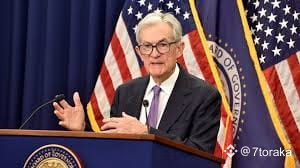
🚨🚨Fed’s 0.25% Cut Reflects Tightrope Between Hawks and Doves 🚨🚨
The Federal Reserve cut its key interest rate by 0.25 percentage points, bringing the target range to 3.5%–3.75%. This move, widely anticipated as a "hawkish cut," exposed notable divisions within the Federal Open Market Committee (FOMC).
This split underscores an ongoing debate between the Fed’s "hawks," focused on taming inflation, and "doves," who prioritize supporting economic growth and the labor market.
This latest cut marks the third in a row, but signals from the Fed suggest limited scope for more reductions soon. The "dot plot," illustrating officials’ rate projections, anticipates just one more cut in 2026 and another in 2027, eventually settling near 3%. Meanwhile, the Fed raised its GDP growth forecast for 2026 to 2.3%, even as inflation, currently at 2.8%, is expected to stay above the 2% target until 2028.
In a strategic shift, the Fed will resume purchasing $40 billion in Treasury bills monthly starting this Friday to ease pressures in overnight funding markets, marking a key tactical move after pausing its balance sheet runoff.
#Fed
🚨🚨Fed’s 0.25% Cut Reflects Tightrope Between Hawks and Doves 🚨🚨
The Federal Reserve cut its key interest rate by 0.25 percentage points, bringing the target range to 3.5%–3.75%. This move, widely anticipated as a "hawkish cut," exposed notable divisions within the Federal Open Market Committee (FOMC).
This split underscores an ongoing debate between the Fed’s "hawks," focused on taming inflation, and "doves," who prioritize supporting economic growth and the labor market.
This latest cut marks the third in a row, but signals from the Fed suggest limited scope for more reductions soon. The "dot plot," illustrating officials’ rate projections, anticipates just one more cut in 2026 and another in 2027, eventually settling near 3%. Meanwhile, the Fed raised its GDP growth forecast for 2026 to 2.3%, even as inflation, currently at 2.8%, is expected to stay above the 2% target until 2028.
In a strategic shift, the Fed will resume purchasing $40 billion in Treasury bills monthly starting this Friday to ease pressures in overnight funding markets, marking a key tactical move after pausing its balance sheet runoff.
#Fed
The Federal Reserve cut its key interest rate by 0.25 percentage points, bringing the target range to 3.5%–3.75%. This move, widely anticipated as a "hawkish cut," exposed notable divisions within the Federal Open Market Committee (FOMC).
This split underscores an ongoing debate between the Fed’s "hawks," focused on taming inflation, and "doves," who prioritize supporting economic growth and the labor market.
This latest cut marks the third in a row, but signals from the Fed suggest limited scope for more reductions soon. The "dot plot," illustrating officials’ rate projections, anticipates just one more cut in 2026 and another in 2027, eventually settling near 3%. Meanwhile, the Fed raised its GDP growth forecast for 2026 to 2.3%, even as inflation, currently at 2.8%, is expected to stay above the 2% target until 2028.
In a strategic shift, the Fed will resume purchasing $40 billion in Treasury bills monthly starting this Friday to ease pressures in overnight funding markets, marking a key tactical move after pausing its balance sheet runoff.
#Fed
9
·
--
Bullish
👀👀👉US Employment Cost Index: Stable 3.5% Growth Amid Cooling Labor Market
The September 2025 Employment Cost Index (ECI) data indicates stable wage and compensation growth in the US economy, signaling a cooling labor market without sharp inflationary pressures from labor costs.
Over the 12-month period, civilian worker compensation rose 3.5%, matching wages, salaries, and benefits, while private industry saw slightly higher wage growth at 3.6% and inflation-adjusted real wages up 0.6%, suggesting workers are gaining modest purchasing power amid moderating inflation. State and local government costs increased 3.6%, with benefits up 3.8%, reflecting steady public sector pressures. The 0.8% quarterly rise (seasonally adjusted) points to sustained but not accelerating cost trends.
These figures align with a resilient yet moderating US economy, where productivity gains (from AI and other efficiencies) offset slower employment growth, preventing overheating. Lower survey response rates due to the federal shutdown introduce some data uncertainty, but the balanced growth—neither surging nor stalling—supports forecasts of around 2% real GDP expansion into 2026 without imminent recession risks. This stability aids the Federal Reserve in balancing rate cuts against lingering inflation around 2.75-3%.
#USJobsData
👀👀👉US Employment Cost Index: Stable 3.5% Growth Amid Cooling Labor Market
The September 2025 Employment Cost Index (ECI) data indicates stable wage and compensation growth in the US economy, signaling a cooling labor market without sharp inflationary pressures from labor costs.
Over the 12-month period, civilian worker compensation rose 3.5%, matching wages, salaries, and benefits, while private industry saw slightly higher wage growth at 3.6% and inflation-adjusted real wages up 0.6%, suggesting workers are gaining modest purchasing power amid moderating inflation. State and local government costs increased 3.6%, with benefits up 3.8%, reflecting steady public sector pressures. The 0.8% quarterly rise (seasonally adjusted) points to sustained but not accelerating cost trends.
These figures align with a resilient yet moderating US economy, where productivity gains (from AI and other efficiencies) offset slower employment growth, preventing overheating. Lower survey response rates due to the federal shutdown introduce some data uncertainty, but the balanced growth—neither surging nor stalling—supports forecasts of around 2% real GDP expansion into 2026 without imminent recession risks. This stability aids the Federal Reserve in balancing rate cuts against lingering inflation around 2.75-3%.
#USJobsData
The September 2025 Employment Cost Index (ECI) data indicates stable wage and compensation growth in the US economy, signaling a cooling labor market without sharp inflationary pressures from labor costs.
Over the 12-month period, civilian worker compensation rose 3.5%, matching wages, salaries, and benefits, while private industry saw slightly higher wage growth at 3.6% and inflation-adjusted real wages up 0.6%, suggesting workers are gaining modest purchasing power amid moderating inflation. State and local government costs increased 3.6%, with benefits up 3.8%, reflecting steady public sector pressures. The 0.8% quarterly rise (seasonally adjusted) points to sustained but not accelerating cost trends.
These figures align with a resilient yet moderating US economy, where productivity gains (from AI and other efficiencies) offset slower employment growth, preventing overheating. Lower survey response rates due to the federal shutdown introduce some data uncertainty, but the balanced growth—neither surging nor stalling—supports forecasts of around 2% real GDP expansion into 2026 without imminent recession risks. This stability aids the Federal Reserve in balancing rate cuts against lingering inflation around 2.75-3%.
#USJobsData
2
512
·
--
Bullish
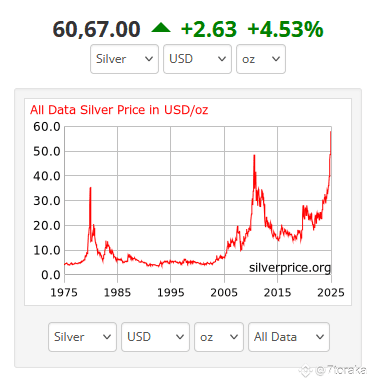
👀👀👉Silver spot prices have surpassed $61 per ounce for the first time in history.
Silver futures reached $61.16 per ounce, with an intraday high of $61.295 and reports of spot prices hitting around $60.74 to $61 per troy ounce during late U.S. trading. This marks a daily gain of over 4.7%, or about $2.755 from the previous close of $58.405. The year's low was $28.31, confirming a more than doubling in value throughout 2025.
#Silver
👀👀👉Silver spot prices have surpassed $61 per ounce for the first time in history.
Silver futures reached $61.16 per ounce, with an intraday high of $61.295 and reports of spot prices hitting around $60.74 to $61 per troy ounce during late U.S. trading. This marks a daily gain of over 4.7%, or about $2.755 from the previous close of $58.405. The year's low was $28.31, confirming a more than doubling in value throughout 2025.
#Silver
Silver futures reached $61.16 per ounce, with an intraday high of $61.295 and reports of spot prices hitting around $60.74 to $61 per troy ounce during late U.S. trading. This marks a daily gain of over 4.7%, or about $2.755 from the previous close of $58.405. The year's low was $28.31, confirming a more than doubling in value throughout 2025.
#Silver
4
740
·
--
Bullish
👀👀👉JOLTS Job Openings 7.7 Million: What's the State of the US Economy?
The October 2025 JOLTS report indicates a stable but cooling US labor market, with job openings steady at 7.7 million (4.6% rate), hires at 5.1 million (3.2% rate), and total separations at 5.1 million (3.2% rate). This balance—where openings exceed hires but show little movement—suggests employers retain demand for workers amid moderating hiring activity, consistent with a broader economic slowdown rather than contraction.
Quits remaining low at 2.9 million (1.8% rate, down 276,000 year-over-year) signal reduced worker confidence in finding better opportunities, a classic sign of labor market softening that often precedes slower wage growth and consumer spending. Layoffs and discharges holding at 1.9 million (1.2% rate) point to limited distress, though upticks in sectors like accommodation and food services hint at pockets of pressure from demand weakness. Sector declines in federal government and health care further reflect fiscal tightening and post-pandemic normalization.
Overall, these figures align with resilience in a high-interest-rate
environment: no sharp deterioration, but stagnation implies the economy faces headwinds from tariffs, policy uncertainty, and prior tightening, potentially tipping toward recession risks in 2026 as forecasts suggest GDP growth slowing to 1.4%. Compared to August's 7.2 million openings, the uptick to 7.7 million shows mild recovery, yet year-ago levels were higher (around 7.6-7.7 million), confirming a downtrend from peak tightness.
#USJobsData
👀👀👉JOLTS Job Openings 7.7 Million: What's the State of the US Economy?
The October 2025 JOLTS report indicates a stable but cooling US labor market, with job openings steady at 7.7 million (4.6% rate), hires at 5.1 million (3.2% rate), and total separations at 5.1 million (3.2% rate). This balance—where openings exceed hires but show little movement—suggests employers retain demand for workers amid moderating hiring activity, consistent with a broader economic slowdown rather than contraction.
Quits remaining low at 2.9 million (1.8% rate, down 276,000 year-over-year) signal reduced worker confidence in finding better opportunities, a classic sign of labor market softening that often precedes slower wage growth and consumer spending. Layoffs and discharges holding at 1.9 million (1.2% rate) point to limited distress, though upticks in sectors like accommodation and food services hint at pockets of pressure from demand weakness. Sector declines in federal government and health care further reflect fiscal tightening and post-pandemic normalization.
Overall, these figures align with resilience in a high-interest-rate
environment: no sharp deterioration, but stagnation implies the economy faces headwinds from tariffs, policy uncertainty, and prior tightening, potentially tipping toward recession risks in 2026 as forecasts suggest GDP growth slowing to 1.4%. Compared to August's 7.2 million openings, the uptick to 7.7 million shows mild recovery, yet year-ago levels were higher (around 7.6-7.7 million), confirming a downtrend from peak tightness.
#USJobsData
The October 2025 JOLTS report indicates a stable but cooling US labor market, with job openings steady at 7.7 million (4.6% rate), hires at 5.1 million (3.2% rate), and total separations at 5.1 million (3.2% rate). This balance—where openings exceed hires but show little movement—suggests employers retain demand for workers amid moderating hiring activity, consistent with a broader economic slowdown rather than contraction.
Quits remaining low at 2.9 million (1.8% rate, down 276,000 year-over-year) signal reduced worker confidence in finding better opportunities, a classic sign of labor market softening that often precedes slower wage growth and consumer spending. Layoffs and discharges holding at 1.9 million (1.2% rate) point to limited distress, though upticks in sectors like accommodation and food services hint at pockets of pressure from demand weakness. Sector declines in federal government and health care further reflect fiscal tightening and post-pandemic normalization.
Overall, these figures align with resilience in a high-interest-rate
environment: no sharp deterioration, but stagnation implies the economy faces headwinds from tariffs, policy uncertainty, and prior tightening, potentially tipping toward recession risks in 2026 as forecasts suggest GDP growth slowing to 1.4%. Compared to August's 7.2 million openings, the uptick to 7.7 million shows mild recovery, yet year-ago levels were higher (around 7.6-7.7 million), confirming a downtrend from peak tightness.
#USJobsData
2
408
·
--
Bullish
👀👀👉 ADP National Employment Report, U.S. Private Payrolls Bounce Back
For the four weeks ending Nov 22, 2025, private employers added a modest average of 4,750 jobs per week—a welcome rebound from prior declines. This preliminary estimate from ADP Research and Stanford Digital Economy Lab uses high-frequency payroll data, offering a sneak peek ahead of official reports.
Key Highlights
👉Tracks week-over-week changes via a 4-week moving average, revised as more data flows in.
👉Follows November's surprise -32K net loss, hit hard by small business cuts after October's +47K gain.
#USJobsData
👀👀👉 ADP National Employment Report, U.S. Private Payrolls Bounce Back
For the four weeks ending Nov 22, 2025, private employers added a modest average of 4,750 jobs per week—a welcome rebound from prior declines. This preliminary estimate from ADP Research and Stanford Digital Economy Lab uses high-frequency payroll data, offering a sneak peek ahead of official reports.
Key Highlights
👉Tracks week-over-week changes via a 4-week moving average, revised as more data flows in.
👉Follows November's surprise -32K net loss, hit hard by small business cuts after October's +47K gain.
#USJobsData
For the four weeks ending Nov 22, 2025, private employers added a modest average of 4,750 jobs per week—a welcome rebound from prior declines. This preliminary estimate from ADP Research and Stanford Digital Economy Lab uses high-frequency payroll data, offering a sneak peek ahead of official reports.
Key Highlights
👉Tracks week-over-week changes via a 4-week moving average, revised as more data flows in.
👉Follows November's surprise -32K net loss, hit hard by small business cuts after October's +47K gain.
#USJobsData
2
816
Log in to explore more content
Join global crypto users on Binance Square
⚡️ Get latest and useful information about crypto.
💬 Trusted by the world’s largest crypto exchange.
👍 Discover real insights from verified creators.
Email / Phone number