Binance Square
0xxinxinn
544 Posts

0xxinxinn

推特同名 0xxinxinn ,幣安反佣邀請碼:437648564
High-Frequency Trader
4.1 Years
98 Following
10.8K+ Followers
4.1K+ Liked
Posts
PINNED
·
--
Welcome everyone to join my Binance chat room~~ We can discuss alpha tokens, chat casually, and have fun together✌️

Welcome everyone to join my Binance chat room~~

We can discuss alpha tokens, chat casually, and have fun together✌️
Verified
ZEC's Orchard privacy pool has been hit with a serious soundness bug for over 4 years, and the news has caused ZEC to crash by 30-50%. Big players like Arthur Hayes sold off, triggering a wave of liquidations. This brings to light the fundamental contradictions of privacy coins, making one wonder if the world is just a makeshift stage, allowing such a significant blunder in the realm of privacy crypto. This reminds me of Genius @GeniusOfficial , which, while pursuing extreme execution efficiency, has built-in privacy mechanisms like Ghost orders. By employing MPC for order splitting and using multiple wallets for decentralized execution, it hides the true intentions and holding addresses, attempting to ease the "privacy vs. verifiability" trade-off. $GENIUS unlike pure privacy coins that just hide everything in a black box and hope for no bugs, Genius makes privacy an optional execution layer—you can enjoy quick, windowless trades while also choosing Ghost mode to fend off MEV front-running, keeping the routing transparency brought by solver competition while maintaining non-custodial and on-chain verifiability. This may well be the right approach for the next-gen DeFi execution tools: not extreme in seeking the unknown, but providing enough privacy, verifiability, and recoverability. #genius
ZEC's Orchard privacy pool has been hit with a serious soundness bug for over 4 years, and the news has caused ZEC to crash by 30-50%. Big players like Arthur Hayes sold off, triggering a wave of liquidations. This brings to light the fundamental contradictions of privacy coins, making one wonder if the world is just a makeshift stage, allowing such a significant blunder in the realm of privacy crypto.

This reminds me of Genius @GeniusOfficial , which, while pursuing extreme execution efficiency, has built-in privacy mechanisms like Ghost orders. By employing MPC for order splitting and using multiple wallets for decentralized execution, it hides the true intentions and holding addresses, attempting to ease the "privacy vs. verifiability" trade-off.

$GENIUS unlike pure privacy coins that just hide everything in a black box and hope for no bugs, Genius makes privacy an optional execution layer—you can enjoy quick, windowless trades while also choosing Ghost mode to fend off MEV front-running, keeping the routing transparency brought by solver competition while maintaining non-custodial and on-chain verifiability.

This may well be the right approach for the next-gen DeFi execution tools: not extreme in seeking the unknown, but providing enough privacy, verifiability, and recoverability. #genius
Recently checked out BTCFi, and a lot of projects still have high APYs and short-term visions that look promising, but fundamentally, they are trading the security of BTC for riskier returns, leaning heavily into speculation. Now, Bedrock @Bedrock with its 2.0 adjustment, I think there's something interesting going on. Many folks are focused on uniBTC's cross-chain capabilities and ecosystem expansion, but if you dig deeper, you'll see it aims to do more than just allow BTC staking; it's about maximizing capital efficiency. In the past, these types of products had a simple logic: users would deposit BTC, and the returns were mostly tied to basic staking, with extra yields often relying on subsidies or airdrops to hold it up, which makes sustainability questionable. A big change with Bedrock 2.0 is it no longer locks assets into a single path; instead, it tries to implement an automated scheduling mechanism to allocate between different strategies and market opportunities, like hedging, market-neutral, or cross-chain arbitrage scenarios. You can think of it as aiming to create a more 'strategy routing' layer rather than just a single staking entry point. This also means that $BR or the entire Bedrock system could evolve into something more than just a BTC staking certificate; it might become a liquidity hub within BTCFi. Especially now, as overall yields are continuously declining, merely chasing high annualized returns is becoming riskier, so being able to support the model with genuine strategy-generated returns is increasingly crucial. From a directional standpoint, BR is trying to break away from BTCFi's past reliance on subsidies, narratives, and high yields to attract funds, shifting towards a focus on underlying efficiency and capital allocation. This shift, I believe, deserves more attention than just telling a new story. #Bedrock
Recently checked out BTCFi, and a lot of projects still have high APYs and short-term visions that look promising, but fundamentally, they are trading the security of BTC for riskier returns, leaning heavily into speculation.

Now, Bedrock @Bedrock with its 2.0 adjustment, I think there's something interesting going on.

Many folks are focused on uniBTC's cross-chain capabilities and ecosystem expansion, but if you dig deeper, you'll see it aims to do more than just allow BTC staking; it's about maximizing capital efficiency.

In the past, these types of products had a simple logic: users would deposit BTC, and the returns were mostly tied to basic staking, with extra yields often relying on subsidies or airdrops to hold it up, which makes sustainability questionable. A big change with Bedrock 2.0 is it no longer locks assets into a single path; instead, it tries to implement an automated scheduling mechanism to allocate between different strategies and market opportunities, like hedging, market-neutral, or cross-chain arbitrage scenarios. You can think of it as aiming to create a more 'strategy routing' layer rather than just a single staking entry point.

This also means that $BR or the entire Bedrock system could evolve into something more than just a BTC staking certificate; it might become a liquidity hub within BTCFi. Especially now, as overall yields are continuously declining, merely chasing high annualized returns is becoming riskier, so being able to support the model with genuine strategy-generated returns is increasingly crucial.

From a directional standpoint, BR is trying to break away from BTCFi's past reliance on subsidies, narratives, and high yields to attract funds, shifting towards a focus on underlying efficiency and capital allocation. This shift, I believe, deserves more attention than just telling a new story.

#Bedrock
Today is another day without airdrops and empty rotations; I've missed out several times in a row. Recently, I've been scrolling through Twitter and seeing a lot of influencers talking about Genius @GeniusOfficial Season 2, and I’ve participated a bit myself. From a technical standpoint, Genius's claims of global asset management and one-click routing settlement do have innovative advantages. Relying on the intent execution model saves the hassle of cross-chain swaps, Gas top-ups, and contract authorizations, allowing for quick trades during sudden market movements, far exceeding traditional multi-chain aggregators in efficiency. However, the ultra-simple, no-popup confirmation front-end design is a double-edged sword. It abandons the traditional model of Web3 wallets verifying each contract with pop-up confirmations, leaving a black-box operation that lacks transaction detail prompts. Regular users find it hard to check on-chain execution details, impacting their sense of fund security and hiding potential uncontrollable risks in contract calls. In contrast, Ghost's phantom orders represent another extreme approach. It relies on MPC (Multi-Party Computation) to split orders and distribute them across multiple temporary wallets for execution, hiding the real holding addresses and effectively avoiding MEV (Miner Extractable Value) bot sniping. However, high privacy comes with a high cost. MPC computation itself incurs additional expenses, and the dispersed execution might increase total Gas consumption, making it unprofitable for small, frequent trades. Moreover, privacy and verifiability often come as a trade-off; while you successfully hide your tracks, you might sacrifice some transparency that brings community trust or regulatory compliance benefits. #genius $GENIUS
Today is another day without airdrops and empty rotations; I've missed out several times in a row.

Recently, I've been scrolling through Twitter and seeing a lot of influencers talking about Genius @GeniusOfficial Season 2, and I’ve participated a bit myself. From a technical standpoint, Genius's claims of global asset management and one-click routing settlement do have innovative advantages. Relying on the intent execution model saves the hassle of cross-chain swaps, Gas top-ups, and contract authorizations, allowing for quick trades during sudden market movements, far exceeding traditional multi-chain aggregators in efficiency.

However, the ultra-simple, no-popup confirmation front-end design is a double-edged sword. It abandons the traditional model of Web3 wallets verifying each contract with pop-up confirmations, leaving a black-box operation that lacks transaction detail prompts. Regular users find it hard to check on-chain execution details, impacting their sense of fund security and hiding potential uncontrollable risks in contract calls.

In contrast, Ghost's phantom orders represent another extreme approach. It relies on MPC (Multi-Party Computation) to split orders and distribute them across multiple temporary wallets for execution, hiding the real holding addresses and effectively avoiding MEV (Miner Extractable Value) bot sniping. However, high privacy comes with a high cost. MPC computation itself incurs additional expenses, and the dispersed execution might increase total Gas consumption, making it unprofitable for small, frequent trades. Moreover, privacy and verifiability often come as a trade-off; while you successfully hide your tracks, you might sacrifice some transparency that brings community trust or regulatory compliance benefits.

#genius $GENIUS
$LAB cashed out too early, otherwise could've kept raking in the gains.
Verified
Have you all noticed that the top-tier quant trading and stable institutional arbitrage strategies in the industry have long been monopolized within professional trading systems? Countless regular Bitcoin holders can only passively ride the market ups and downs, never touching the low-risk yield logic at the institutional level. This has never been a tech issue, but rather an ongoing information and resource barrier within the industry, keeping regular retail traders isolated from the core yield circles. However, the emergence of Bedrock 2.0 @Bedrock has completely shattered this rigid pattern. With its modular vault architecture, it transforms the traditional closed institutional strategy model, opening up multiple independent yield channels that are transparent and logically sound, allowing everyone to share in professional institutional-level asset appreciation plans. This innovative framework builds four independent yet interconnected yield systems, catering to different market conditions and risk appetites: First, there's the Delta-Neutral market-neutral quantitative arbitrage, which is the core strategy best suited for volatile markets. There's no need to predict price movements; the more intense the market fluctuations, the more opportunities for arbitrage the strategy can seize, while completely avoiding the risks of one-sided directional bets, ensuring stable and certain profits. Second, we have the RWA real asset yield track, which breaks free from the shackles of cryptocurrency price volatility, relying on off-chain real assets to create long-term stable returns, taking a steady and robust appreciation route. Third, leveraging an over-collateralized lending mechanism, it continuously earns steady interest in a low-risk mode, suitable for conservative holders. These four yield channels are not only independent and perform their own roles but also support intelligent dynamic switching under a unified modular architecture, flexibly adapting to different market cycles. Bedrock encapsulates this professional institutional strategy into a pluggable modular architecture, allowing for future iterations of new features like RWA vaults and credit lending vaults without having to reconstruct the underlying system, enabling flexible expansion and upgrades like building with blocks, maximizing ecological extensibility. For regular holders, this is a disruptive opportunity. No need to delve into complex underlying code or master professional quantitative logic; you can access top-tier institutional mature yield systems with just one click. In the past, regular folks could only watch institutions profit, but now anyone can equally participate and engage in the professional appreciation strategies for BTC assets. #bedrock $BR
Have you all noticed that the top-tier quant trading and stable institutional arbitrage strategies in the industry have long been monopolized within professional trading systems? Countless regular Bitcoin holders can only passively ride the market ups and downs, never touching the low-risk yield logic at the institutional level.

This has never been a tech issue, but rather an ongoing information and resource barrier within the industry, keeping regular retail traders isolated from the core yield circles.

However, the emergence of Bedrock 2.0 @Bedrock has completely shattered this rigid pattern. With its modular vault architecture, it transforms the traditional closed institutional strategy model, opening up multiple independent yield channels that are transparent and logically sound, allowing everyone to share in professional institutional-level asset appreciation plans.

This innovative framework builds four independent yet interconnected yield systems, catering to different market conditions and risk appetites:
First, there's the Delta-Neutral market-neutral quantitative arbitrage, which is the core strategy best suited for volatile markets. There's no need to predict price movements; the more intense the market fluctuations, the more opportunities for arbitrage the strategy can seize, while completely avoiding the risks of one-sided directional bets, ensuring stable and certain profits.
Second, we have the RWA real asset yield track, which breaks free from the shackles of cryptocurrency price volatility, relying on off-chain real assets to create long-term stable returns, taking a steady and robust appreciation route.
Third, leveraging an over-collateralized lending mechanism, it continuously earns steady interest in a low-risk mode, suitable for conservative holders.
These four yield channels are not only independent and perform their own roles but also support intelligent dynamic switching under a unified modular architecture, flexibly adapting to different market cycles.

Bedrock encapsulates this professional institutional strategy into a pluggable modular architecture, allowing for future iterations of new features like RWA vaults and credit lending vaults without having to reconstruct the underlying system, enabling flexible expansion and upgrades like building with blocks, maximizing ecological extensibility.

For regular holders, this is a disruptive opportunity. No need to delve into complex underlying code or master professional quantitative logic; you can access top-tier institutional mature yield systems with just one click. In the past, regular folks could only watch institutions profit, but now anyone can equally participate and engage in the professional appreciation strategies for BTC assets.
#bedrock $BR
Verified
US stocks are hitting new highs every day, but BTC is breaking new lows daily. The capital flow has completely shifted towards stocks, and fewer people are sticking around in this space. In this environment, the genius @GeniusOfficial is up 10% against the trend. Compared to price action, I'm more focused on the project's fundamentals rather than short-term volatility. After flipping through the whitepaper for a few days, I found that the underlying logic of Genius is particularly robust, far deeper than most intent + solver projects. It's not just another aggregator or a simple cross-chain bridge; it's genuinely aiming to abstract all the fragmented pieces of DeFi into a Chain-Invisible professional trading OS. The goal is to replicate the smooth experience of CEX on-chain while maintaining non-custodial and decentralized principles. The core Genius Bridge Protocol leverages Lit Protocol to create decentralized solvers and orchestrators, governed by deterministic JavaScript Lit Actions. Anyone can provide USDC liquidity to multi-chain Vaults, and the protocol automatically rebalances, supporting arbitrary calldata to execute complex intents. Coupled with signatureless programmable key-pairs, users barely feel gas, approvals, chain-switching, or pop-ups; all actions are condensed into a single click. Ghost Orders utilize MPC to break orders into hundreds of ephemeral wallets, completely hiding large footprints. After reading the whitepaper, it feels like this project isn't chasing narratives but is solving the fundamental UX bottleneck in DeFi. In the current climate of capital outflow and soaring US stocks, projects with real product deployment and robust technical moats like this one possess the most resilience and long-term value. If the execution can keep up with the roadmap, the future potential is worth keeping an eye on.  #genius $GENIUS
US stocks are hitting new highs every day, but BTC is breaking new lows daily. The capital flow has completely shifted towards stocks, and fewer people are sticking around in this space.

In this environment, the genius @GeniusOfficial is up 10% against the trend. Compared to price action, I'm more focused on the project's fundamentals rather than short-term volatility. After flipping through the whitepaper for a few days, I found that the underlying logic of Genius is particularly robust, far deeper than most intent + solver projects.

It's not just another aggregator or a simple cross-chain bridge; it's genuinely aiming to abstract all the fragmented pieces of DeFi into a Chain-Invisible professional trading OS. The goal is to replicate the smooth experience of CEX on-chain while maintaining non-custodial and decentralized principles.

The core Genius Bridge Protocol leverages Lit Protocol to create decentralized solvers and orchestrators, governed by deterministic JavaScript Lit Actions. Anyone can provide USDC liquidity to multi-chain Vaults, and the protocol automatically rebalances, supporting arbitrary calldata to execute complex intents. Coupled with signatureless programmable key-pairs, users barely feel gas, approvals, chain-switching, or pop-ups; all actions are condensed into a single click. Ghost Orders utilize MPC to break orders into hundreds of ephemeral wallets, completely hiding large footprints.

After reading the whitepaper, it feels like this project isn't chasing narratives but is solving the fundamental UX bottleneck in DeFi. In the current climate of capital outflow and soaring US stocks, projects with real product deployment and robust technical moats like this one possess the most resilience and long-term value. If the execution can keep up with the roadmap, the future potential is worth keeping an eye on.

#genius $GENIUS
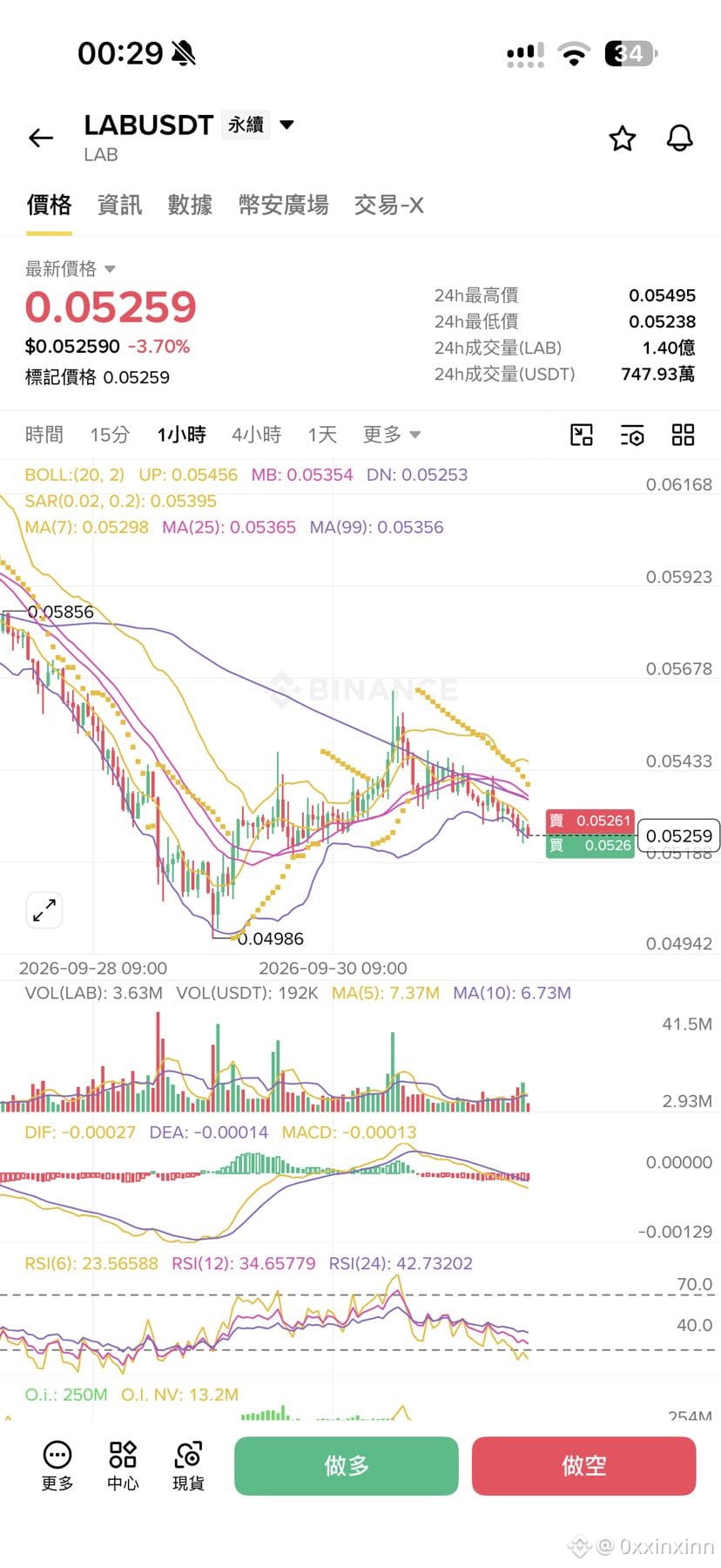
$LAB It's midnight again and we're seeing a dip. First time I bottomed out and it dropped to 7, scared the hell out of me. Unlocking on the 14th, can we pump it back up?
$LAB It's midnight again and we're seeing a dip. First time I bottomed out and it dropped to 7, scared the hell out of me.

Unlocking on the 14th, can we pump it back up?
Wow, Binance just integrated ChatGPT! I have to say, AI is getting smarter and more convenient every day. No need to log in, data comes straight from Binance, and you can use Binance's features directly through AI now~~~
$EDGE pump it up and then dump it day
Verified
Imagine you're out there trading and you catch wind that a new meme on Solana is about to pump. No need to switch to your Phantom wallet or bridge USDC from ETH first. Just enter the amount you want to buy in Genius, and behind the scenes, it invisibly handles routing, gas optimization, and cross-chain transactions, all completed in under a second. After buying, you can instantly set up Ghost Orders for large limit orders—the system breaks them down into smaller trades for execution, so outsiders can’t see what you’re really accumulating, avoiding sandwich attacks. At this moment, you truly experience what a professional-grade trading experience feels like: no annoying wallet pop-ups, no anxiety over cross-chain waits, and no fear of big orders being monitored across the blockchain. The whole operation is as simple as one-click buying on the Binance App, yet it's fully non-custodial and on-chain verifiable. After buying the meme, you can effortlessly hedge with Perp on the same screen, set a Trailing Stop, or directly throw any leftover funds into a yield vault to keep earning. This is what Genius @GeniusOfficial $GENIUS is doing—compressing what used to take a dozen apps, multiple signatures, and half an hour into a smooth experience that takes just seconds, allowing you to confidently place larger funds on-chain for new trades, without the cautious 'DeFi guerilla warfare' approach. After trying it, you'll realize that the old DeFi was just too exhausting, and Genius is the essential tool for the future of professional traders. #genius
Imagine you're out there trading and you catch wind that a new meme on Solana is about to pump. No need to switch to your Phantom wallet or bridge USDC from ETH first. Just enter the amount you want to buy in Genius, and behind the scenes, it invisibly handles routing, gas optimization, and cross-chain transactions, all completed in under a second. After buying, you can instantly set up Ghost Orders for large limit orders—the system breaks them down into smaller trades for execution, so outsiders can’t see what you’re really accumulating, avoiding sandwich attacks.

At this moment, you truly experience what a professional-grade trading experience feels like: no annoying wallet pop-ups, no anxiety over cross-chain waits, and no fear of big orders being monitored across the blockchain. The whole operation is as simple as one-click buying on the Binance App, yet it's fully non-custodial and on-chain verifiable. After buying the meme, you can effortlessly hedge with Perp on the same screen, set a Trailing Stop, or directly throw any leftover funds into a yield vault to keep earning.

This is what Genius @GeniusOfficial $GENIUS is doing—compressing what used to take a dozen apps, multiple signatures, and half an hour into a smooth experience that takes just seconds, allowing you to confidently place larger funds on-chain for new trades, without the cautious 'DeFi guerilla warfare' approach. After trying it, you'll realize that the old DeFi was just too exhausting, and Genius is the essential tool for the future of professional traders.

#genius
Verified
BR @Bedrock In today's rapidly evolving BTCfi landscape, the era of simply chasing high APY is completely outdated. As the rewards from re-staking decline structurally due to market competition and capital influx, the real game-changer is no longer who can offer explosive short-term yields, but rather who can smartly route Bitcoin capital to generate consistent, transparent, and sustainable returns across different market environments. This is the core transformation as Bedrock moves from 1.0 to 2.0: evolving from a single yield provider into a savvy dynamic asset manager for Bitcoin capital, and the new homepage is the most intuitive presentation of this macro evolution. Over the past year, Bedrock has been on the frontlines building, continuously listening to market feedback and the real pain points of users. Instead of stubbornly holding on to high APY, Bedrock has actively embraced market maturation—through brand revitalization and a new homepage, clearly conveying the concept of smart routing. Transforming Bitcoin from a passive store of value into productive capital that spans multiple strategies and risk levels. Users can immediately see a clear three-step process upon entry—deposit, choose yield sources, and then let BRclaw AI assist in optimizing allocation, making complex BTCfi strategies as intuitive and user-friendly as CEX. The underlying logic of this shift is Bedrock's profound insight into the macro trends of BTCfi. BTCfi 1.0 solved the question of 'can Bitcoin generate yields,' but left behind issues of fragmented liquidity, dispersed opportunities, and unsustainable high APY. Bedrock 2.0, with uniBTC and brBTC as core capital management tools, becomes a dynamic asset manager. $BR #Bedrock
BR @Bedrock In today's rapidly evolving BTCfi landscape, the era of simply chasing high APY is completely outdated. As the rewards from re-staking decline structurally due to market competition and capital influx, the real game-changer is no longer who can offer explosive short-term yields, but rather who can smartly route Bitcoin capital to generate consistent, transparent, and sustainable returns across different market environments. This is the core transformation as Bedrock moves from 1.0 to 2.0: evolving from a single yield provider into a savvy dynamic asset manager for Bitcoin capital, and the new homepage is the most intuitive presentation of this macro evolution.

Over the past year, Bedrock has been on the frontlines building, continuously listening to market feedback and the real pain points of users. Instead of stubbornly holding on to high APY, Bedrock has actively embraced market maturation—through brand revitalization and a new homepage, clearly conveying the concept of smart routing. Transforming Bitcoin from a passive store of value into productive capital that spans multiple strategies and risk levels. Users can immediately see a clear three-step process upon entry—deposit, choose yield sources, and then let BRclaw AI assist in optimizing allocation, making complex BTCfi strategies as intuitive and user-friendly as CEX.

The underlying logic of this shift is Bedrock's profound insight into the macro trends of BTCfi. BTCfi 1.0 solved the question of 'can Bitcoin generate yields,' but left behind issues of fragmented liquidity, dispersed opportunities, and unsustainable high APY. Bedrock 2.0, with uniBTC and brBTC as core capital management tools, becomes a dynamic asset manager.

$BR #Bedrock
Verified
The real issue with DeFi isn't a lack of liquidity, but rather a terrible user experience. Genius @GeniusOfficial is looking to tackle DeFi's most painful problems: fragmentation and opacity, aiming to create an On-Chain Binance. The core logic of Genius is to fully replicate the ultimate experience of CEX on-chain while using technology to fix the transparency gaps and fragmentation issues that plague DeFi. This will finally give professional traders the confidence to put their hard-earned cash on-chain without the need to constantly switch between CEX and DEX. $GENIUS Little Genius isn't just an aggregator; it's a one-stop command center connecting 150+ DEXs, supporting Spot and Perp trading, Copy Trading, and Token Launches. It has also rapidly launched low-cost PropAMM on the BNB Chain to inject native liquidity, showcasing strong execution. CZ himself serves as a strategic advisor, further validating the strategic value of this direction—it's not about recreating the blockchain, but redefining the trading experience from the ground up, standing on existing public chains. This allows DeFi to evolve from a toy-like tool into an institutional-grade everyday weapon. This is precisely the strategy a genius-level project should have: seeing through the core pain points, cross-domain tech reorganization, and then rapidly iterating to make it happen. #genius
The real issue with DeFi isn't a lack of liquidity, but rather a terrible user experience. Genius @GeniusOfficial is looking to tackle DeFi's most painful problems: fragmentation and opacity, aiming to create an On-Chain Binance.

The core logic of Genius is to fully replicate the ultimate experience of CEX on-chain while using technology to fix the transparency gaps and fragmentation issues that plague DeFi. This will finally give professional traders the confidence to put their hard-earned cash on-chain without the need to constantly switch between CEX and DEX.

$GENIUS Little Genius isn't just an aggregator; it's a one-stop command center connecting 150+ DEXs, supporting Spot and Perp trading, Copy Trading, and Token Launches. It has also rapidly launched low-cost PropAMM on the BNB Chain to inject native liquidity, showcasing strong execution. CZ himself serves as a strategic advisor, further validating the strategic value of this direction—it's not about recreating the blockchain, but redefining the trading experience from the ground up, standing on existing public chains. This allows DeFi to evolve from a toy-like tool into an institutional-grade everyday weapon. This is precisely the strategy a genius-level project should have: seeing through the core pain points, cross-domain tech reorganization, and then rapidly iterating to make it happen.

#genius
The funding fee of $LAB is now being charged hourly, looks like it's really the next $RAVE .
$PORTAL pulled up from 0.007, whoa! Just realized I still have some left to short!
$PORTAL pulled up from 0.007, whoa!
Just realized I still have some left to short!
$ONDO Heard Binance is dropping a new feature today! Let’s take a small short and see how it goes.
Verified
A few days ago, that alpha big shot was still worth 700U, really gave me a kick in the shins! In the past few days, 40,000 new players have joined the game; are we all diving back in headfirst? Back to Genius @GeniusOfficial , DeFi has always had its fragmentation issues. Genius was created to tackle the long-standing pain points of DeFi fragmentation. It integrates multi-chain splits, tool hopping, high-friction trades, and privacy exposure all into a single non-custodial professional terminal. No matter where your assets are scattered across chains, users don’t need to manually bridge, switch RPCs, or jump between multiple dApps. With the Genius Bridge Protocol and backend solver architecture, $GENIUS delivers a truly Chain-Invisible experience. All cross-chain routing, Gas payments, and liquidity aggregation happen automatically in the background, making trades as smooth as using a CEX while still retaining custody. The Signatureless design significantly reduces signature pop-ups, while Ghost Orders utilize MPC technology to break down large orders into hundreds of temporary wallets for simultaneous execution. This not only hides the true intent to prevent MEV sniping but also retains auditability, providing unprecedented privacy protection and execution efficiency for professional traders and institutional users, allowing DeFi to truly mature into usability. #genius
A few days ago, that alpha big shot was still worth 700U, really gave me a kick in the shins! In the past few days, 40,000 new players have joined the game; are we all diving back in headfirst?

Back to Genius @GeniusOfficial , DeFi has always had its fragmentation issues. Genius was created to tackle the long-standing pain points of DeFi fragmentation. It integrates multi-chain splits, tool hopping, high-friction trades, and privacy exposure all into a single non-custodial professional terminal.

No matter where your assets are scattered across chains, users don’t need to manually bridge, switch RPCs, or jump between multiple dApps. With the Genius Bridge Protocol and backend solver architecture, $GENIUS delivers a truly Chain-Invisible experience. All cross-chain routing, Gas payments, and liquidity aggregation happen automatically in the background, making trades as smooth as using a CEX while still retaining custody.

The Signatureless design significantly reduces signature pop-ups, while Ghost Orders utilize MPC technology to break down large orders into hundreds of temporary wallets for simultaneous execution. This not only hides the true intent to prevent MEV sniping but also retains auditability, providing unprecedented privacy protection and execution efficiency for professional traders and institutional users, allowing DeFi to truly mature into usability.

#genius
$LAB is really something else, previously the on-chain detective said it was going to drop to 2.8u, but it just kept pumping and now it's hitting ATH again... it’s definitely the next rave.
Still pumping after three days? $ALLO
Log in to explore more content
Join global crypto users on Binance Square
⚡️ Get latest and useful information about crypto.
💬 Trusted by the world’s largest crypto exchange.
👍 Discover real insights from verified creators.
Email / Phone number
Sitemap
Cookie Preferences
Platform T&Cs