

0xMason
203 Posts

0xMason
Report
Block User
前产品经理,现独立开发者,全职开发 AI 产品|手上在开的:U 卡、全球账户、AI 订阅支付、海外收款|只写自己开过的|X:@mason0x_
3 Following
3 Followers
4 Liked
Posts
·
--
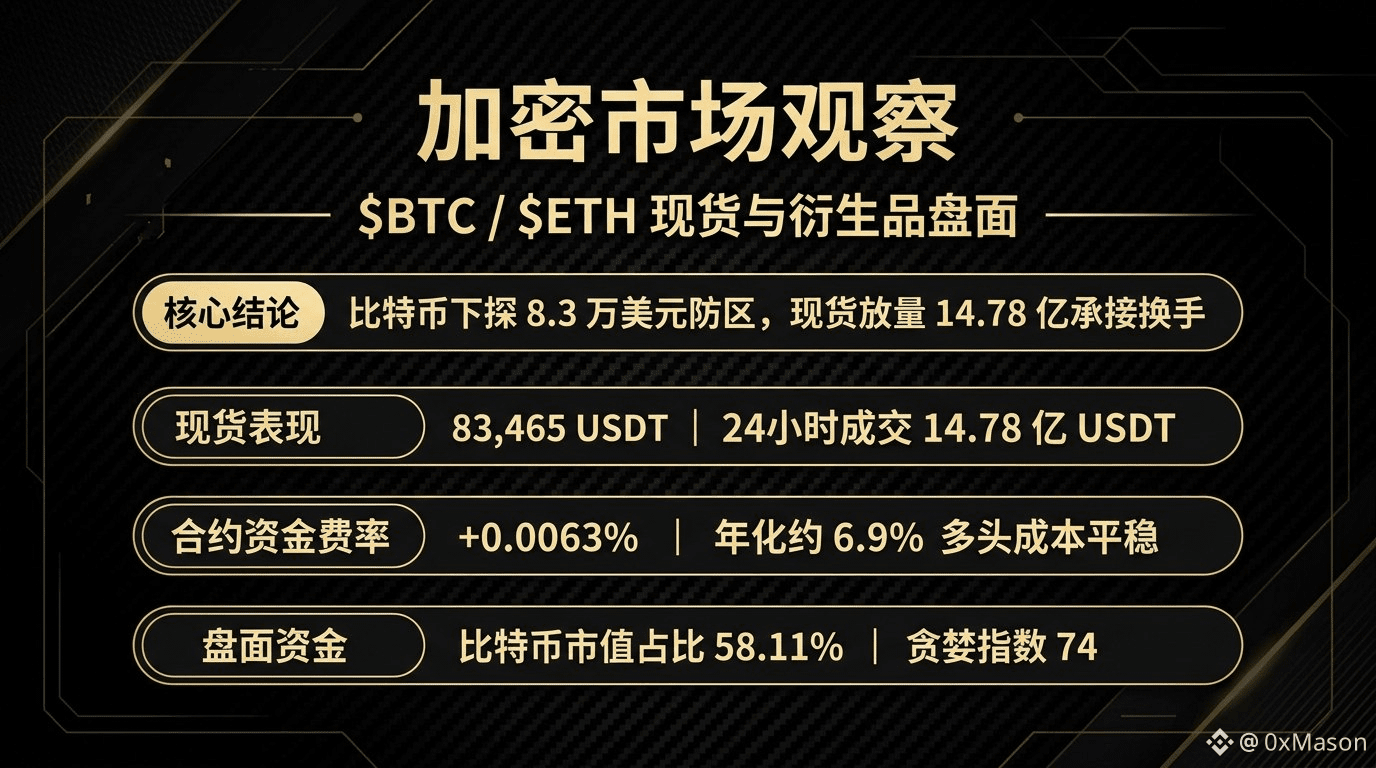
Bitcoin dips to the $83.3k support level; $BTC spot volume surges to 1.478 billion, with futures funding rates turning positive to absorb turnover
83,465.27 USDT holds onto intraday dip support. If you’re holding $BTC tonight, keep a close watch on Binance’s order book around the 83,000 level and the 0.0063% fee rate.
I just checked the BTC/USDT order book on Binance: spot at 83,465.27 USDT is sticking very tightly, down only 1.85% over the past 24 hours. Daily spot volume ran 1.478 billion USDT. Around the 14:00 snapshot, the contract funding fee rate was 0.0063%—annualized it comes to only 6.9%. There’s no leveraged liquidation on the board; longs and shorts are mainly grinding positions in the spot order book.
The main flow is still consolidating toward the Bitcoin blue chip. I switched to ETH/USDT to take a look: spot has been hovering around 2,684.66 USDT, down 0.94%, with daily spot volume of 662 million USDT. The contract funding fee rate is 0.0032%. Total crypto market cap has slipped back to $2.87 trillion, with BTC’s market share holding at 58.11%. The Fear & Greed Index reads 74.
I glanced at the depth chart on Binance. There’s dense buy-side liquidity supporting BTC in the 83,000 to 83,500 USDT range. Above that, 85,000 USDT is the main resistance zone in the past week. As long as spot BTC holds the 83,000 USDT platform, the buy-support logic for dip absorption remains valid. Only if it breaks below 82,500 USDT will the defense logic fail. Keep the core position for observation—watch the fee rate and the 83,000 USDT absorption; that’s enough.
$ETH
{spot}(ETHUSDT)
#比特币跌破8.3万美元
Bitcoin dips to the $83.3k support level; $BTC spot volume surges to 1.478 billion, with futures funding rates turning positive to absorb turnover
83,465.27 USDT holds onto intraday dip support. If you’re holding $BTC tonight, keep a close watch on Binance’s order book around the 83,000 level and the 0.0063% fee rate.
I just checked the BTC/USDT order book on Binance: spot at 83,465.27 USDT is sticking very tightly, down only 1.85% over the past 24 hours. Daily spot volume ran 1.478 billion USDT. Around the 14:00 snapshot, the contract funding fee rate was 0.0063%—annualized it comes to only 6.9%. There’s no leveraged liquidation on the board; longs and shorts are mainly grinding positions in the spot order book.
The main flow is still consolidating toward the Bitcoin blue chip. I switched to ETH/USDT to take a look: spot has been hovering around 2,684.66 USDT, down 0.94%, with daily spot volume of 662 million USDT. The contract funding fee rate is 0.0032%. Total crypto market cap has slipped back to $2.87 trillion, with BTC’s market share holding at 58.11%. The Fear & Greed Index reads 74.
I glanced at the depth chart on Binance. There’s dense buy-side liquidity supporting BTC in the 83,000 to 83,500 USDT range. Above that, 85,000 USDT is the main resistance zone in the past week. As long as spot BTC holds the 83,000 USDT platform, the buy-support logic for dip absorption remains valid. Only if it breaks below 82,500 USDT will the defense logic fail. Keep the core position for observation—watch the fee rate and the 83,000 USDT absorption; that’s enough.
$ETH
#比特币跌破8.3万美元
83,465.27 USDT holds onto intraday dip support. If you’re holding $BTC tonight, keep a close watch on Binance’s order book around the 83,000 level and the 0.0063% fee rate.
I just checked the BTC/USDT order book on Binance: spot at 83,465.27 USDT is sticking very tightly, down only 1.85% over the past 24 hours. Daily spot volume ran 1.478 billion USDT. Around the 14:00 snapshot, the contract funding fee rate was 0.0063%—annualized it comes to only 6.9%. There’s no leveraged liquidation on the board; longs and shorts are mainly grinding positions in the spot order book.
The main flow is still consolidating toward the Bitcoin blue chip. I switched to ETH/USDT to take a look: spot has been hovering around 2,684.66 USDT, down 0.94%, with daily spot volume of 662 million USDT. The contract funding fee rate is 0.0032%. Total crypto market cap has slipped back to $2.87 trillion, with BTC’s market share holding at 58.11%. The Fear & Greed Index reads 74.
I glanced at the depth chart on Binance. There’s dense buy-side liquidity supporting BTC in the 83,000 to 83,500 USDT range. Above that, 85,000 USDT is the main resistance zone in the past week. As long as spot BTC holds the 83,000 USDT platform, the buy-support logic for dip absorption remains valid. Only if it breaks below 82,500 USDT will the defense logic fail. Keep the core position for observation—watch the fee rate and the 83,000 USDT absorption; that’s enough.
$ETH
#比特币跌破8.3万美元
42
·
--
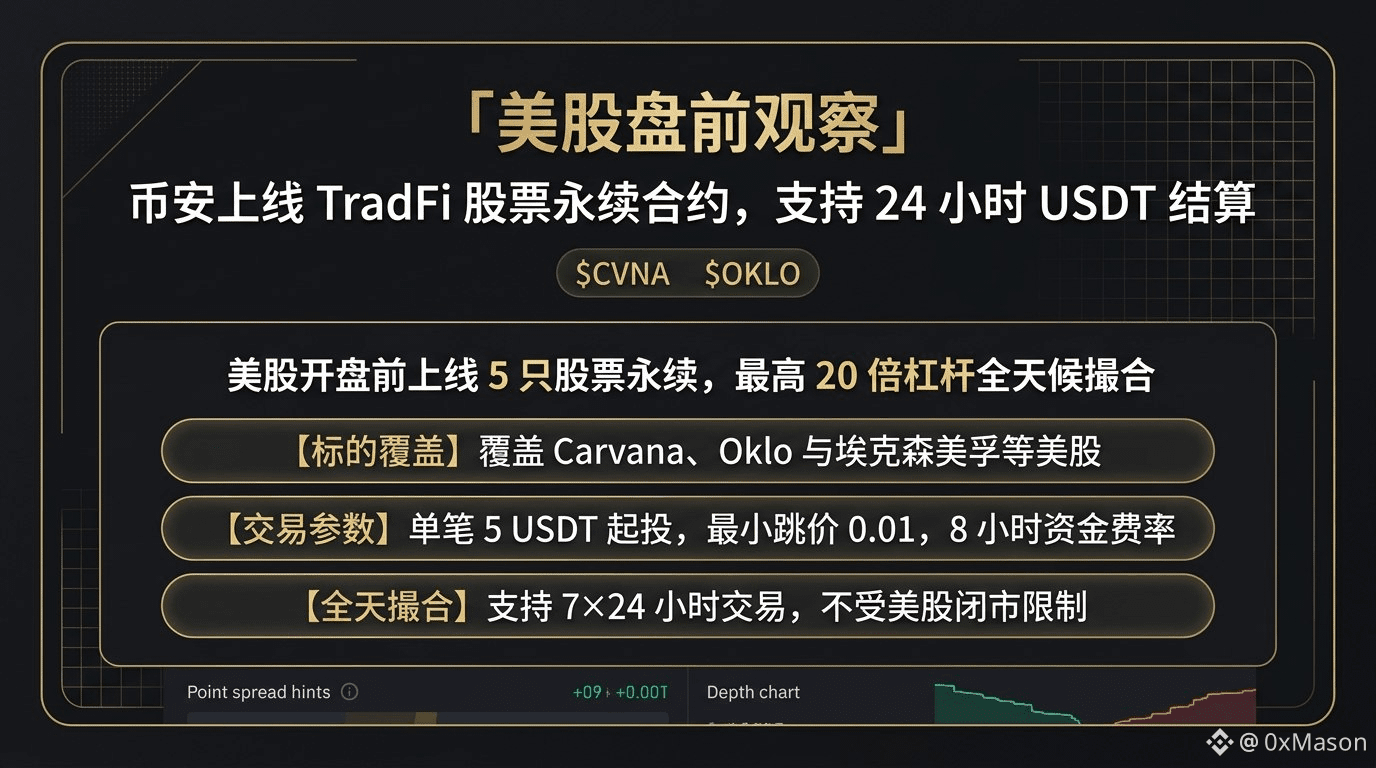
Binance Launches CVNA and OKLO Stock Perpetuals Before US Stock Market Opens, 20x Leverage Supported With 24-Hour USDT Settlement
Ahead of the 21:30 US stock market open tonight, Binance has listed 5 TradFi stock perpetuals on the order book, including $CVNA and $OKLO , with leverage up to 20x.
I looked through the contract details. The underlying assets include Carvana, Oklo, and Exxon Mobil. To place an order, you only need 5 USDT in your account. The minimum tick size is 0.01, and the funding rate cap is set at ±2.00%, charged once per 8-hour cycle. The most convenient part is that it supports 7×24 hour matching; even when external US stocks are closed at night, intraday positions can still be closed at any time.
I just checked the order book depth. The CVNA/USDT and OKLO/USDT buy and sell orders have just been laid out, and the funding rate is currently hanging at 0%. Tonight, in the pre-market period, price action is being stimulated by the stimulus list for a 30-billion tariff exemption. External futures have been moving quite violently. During the 15 minutes around the 21:30 US stock market open, the intraday spreads are generally likely to widen suddenly due to external volatility.
If you’re holding USDT and want to catch US stock volatility with 20x leverage on deals like secondhand car retail and nuclear energy, you can easily hit the liquidation line after just a few points of movement in the pre-market. Try to place limit orders in advance. In the few minutes when the broader market opens externally at 21:30, chasing with market orders can easily lead to large slippage.
$OKLO #中美公布300亿美元关税减免清单
Binance Launches CVNA and OKLO Stock Perpetuals Before US Stock Market Opens, 20x Leverage Supported With 24-Hour USDT Settlement
Ahead of the 21:30 US stock market open tonight, Binance has listed 5 TradFi stock perpetuals on the order book, including $CVNA and $OKLO , with leverage up to 20x.
I looked through the contract details. The underlying assets include Carvana, Oklo, and Exxon Mobil. To place an order, you only need 5 USDT in your account. The minimum tick size is 0.01, and the funding rate cap is set at ±2.00%, charged once per 8-hour cycle. The most convenient part is that it supports 7×24 hour matching; even when external US stocks are closed at night, intraday positions can still be closed at any time.
I just checked the order book depth. The CVNA/USDT and OKLO/USDT buy and sell orders have just been laid out, and the funding rate is currently hanging at 0%. Tonight, in the pre-market period, price action is being stimulated by the stimulus list for a 30-billion tariff exemption. External futures have been moving quite violently. During the 15 minutes around the 21:30 US stock market open, the intraday spreads are generally likely to widen suddenly due to external volatility.
If you’re holding USDT and want to catch US stock volatility with 20x leverage on deals like secondhand car retail and nuclear energy, you can easily hit the liquidation line after just a few points of movement in the pre-market. Try to place limit orders in advance. In the few minutes when the broader market opens externally at 21:30, chasing with market orders can easily lead to large slippage.
$OKLO #中美公布300亿美元关税减免清单
Ahead of the 21:30 US stock market open tonight, Binance has listed 5 TradFi stock perpetuals on the order book, including $CVNA and $OKLO , with leverage up to 20x.
I looked through the contract details. The underlying assets include Carvana, Oklo, and Exxon Mobil. To place an order, you only need 5 USDT in your account. The minimum tick size is 0.01, and the funding rate cap is set at ±2.00%, charged once per 8-hour cycle. The most convenient part is that it supports 7×24 hour matching; even when external US stocks are closed at night, intraday positions can still be closed at any time.
I just checked the order book depth. The CVNA/USDT and OKLO/USDT buy and sell orders have just been laid out, and the funding rate is currently hanging at 0%. Tonight, in the pre-market period, price action is being stimulated by the stimulus list for a 30-billion tariff exemption. External futures have been moving quite violently. During the 15 minutes around the 21:30 US stock market open, the intraday spreads are generally likely to widen suddenly due to external volatility.
If you’re holding USDT and want to catch US stock volatility with 20x leverage on deals like secondhand car retail and nuclear energy, you can easily hit the liquidation line after just a few points of movement in the pre-market. Try to place limit orders in advance. In the few minutes when the broader market opens externally at 21:30, chasing with market orders can easily lead to large slippage.
$OKLO #中美公布300亿美元关税减免清单
150
·
--
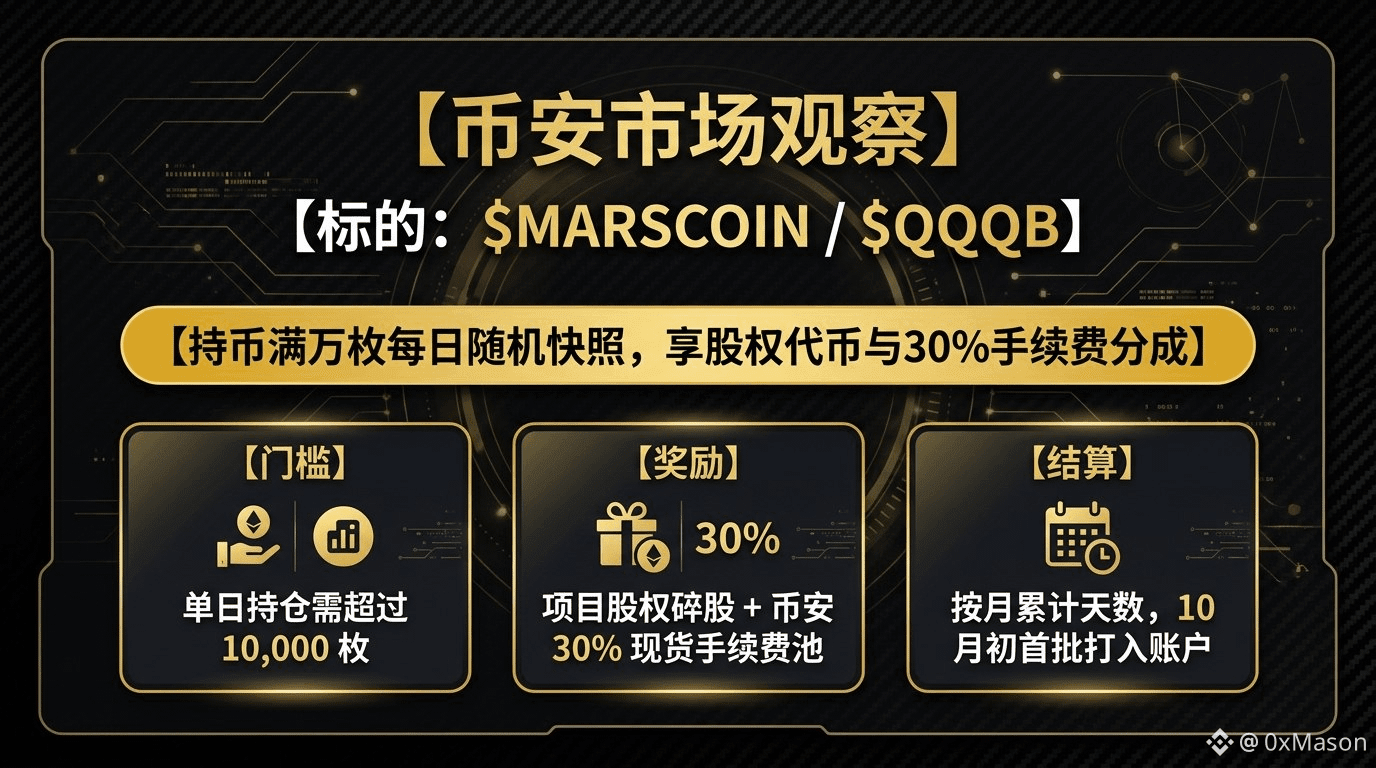
Binance lists MARSCOIN, snapshot-based airdrop for holders—spot and savings earn 30% of the fee pool converted to U.S. stock-like “fractional shares”
In your account, hold $MARSCOIN—take note of the balance. Binance will start taking daily snapshots based on a single day’s balance: 10,000 MARSCOIN per day. In early October, it will be credited directly as $QQQB and SpaceX fractional shares.
Starting in September, the system runs by calendar month. Each day Binance’s system takes one snapshot across spot, funds, and savings-earn accounts. As long as your account holds more than 10,000 MARSCOIN that day, it counts as one valid holding day. At the end of the month, the total number of qualifying days is aggregated and distributed according to the proportion across the whole network. The credited assets are SPCXB and QQQB fractional shares. The project team will provide part of the allocation on-chain, and Binance will also convert 30% of the spot trading fees on the order book into fractional shares to top up the amount. In early October, check the airdrop portal to claim.
I just checked the order book on Binance: in the past 24 hours, MARSCOIN spot had traded 41.13 million USDT, and the current price is listed at 0.1468 USDT. Holding the full 10,000 MARSCOIN threshold would require roughly 1,468 USDT principal. In the account details there are two hard rules: any liabilities created by borrowing coins on margin are not counted as holdings, and any net-debt balance account must be topped up to receive the airdrop; balances in an Alpha account are not included in the snapshot pool.
If you already hold spot or savings-earn coins, it’s best to simply keep them in your account and wait for the snapshots to distribute fractional shares—that’s very worthwhile. Going to chase the secondary market at a higher price just to bet on the airdrop isn’t a good idea: with the news-driven pump pushing up more than 15% in a single day, plus the order-book spread and an additional 0.1% buy fee, it’s easy to wipe out the monthly dividend outright.
#SEC称代币回购与网络升级不自动构成证券
Binance lists MARSCOIN, snapshot-based airdrop for holders—spot and savings earn 30% of the fee pool converted to U.S. stock-like “fractional shares”
In your account, hold $MARSCOIN—take note of the balance. Binance will start taking daily snapshots based on a single day’s balance: 10,000 MARSCOIN per day. In early October, it will be credited directly as $QQQB and SpaceX fractional shares.
Starting in September, the system runs by calendar month. Each day Binance’s system takes one snapshot across spot, funds, and savings-earn accounts. As long as your account holds more than 10,000 MARSCOIN that day, it counts as one valid holding day. At the end of the month, the total number of qualifying days is aggregated and distributed according to the proportion across the whole network. The credited assets are SPCXB and QQQB fractional shares. The project team will provide part of the allocation on-chain, and Binance will also convert 30% of the spot trading fees on the order book into fractional shares to top up the amount. In early October, check the airdrop portal to claim.
I just checked the order book on Binance: in the past 24 hours, MARSCOIN spot had traded 41.13 million USDT, and the current price is listed at 0.1468 USDT. Holding the full 10,000 MARSCOIN threshold would require roughly 1,468 USDT principal. In the account details there are two hard rules: any liabilities created by borrowing coins on margin are not counted as holdings, and any net-debt balance account must be topped up to receive the airdrop; balances in an Alpha account are not included in the snapshot pool.
If you already hold spot or savings-earn coins, it’s best to simply keep them in your account and wait for the snapshots to distribute fractional shares—that’s very worthwhile. Going to chase the secondary market at a higher price just to bet on the airdrop isn’t a good idea: with the news-driven pump pushing up more than 15% in a single day, plus the order-book spread and an additional 0.1% buy fee, it’s easy to wipe out the monthly dividend outright.
#SEC称代币回购与网络升级不自动构成证券
In your account, hold $MARSCOIN—take note of the balance. Binance will start taking daily snapshots based on a single day’s balance: 10,000 MARSCOIN per day. In early October, it will be credited directly as $QQQB and SpaceX fractional shares.
Starting in September, the system runs by calendar month. Each day Binance’s system takes one snapshot across spot, funds, and savings-earn accounts. As long as your account holds more than 10,000 MARSCOIN that day, it counts as one valid holding day. At the end of the month, the total number of qualifying days is aggregated and distributed according to the proportion across the whole network. The credited assets are SPCXB and QQQB fractional shares. The project team will provide part of the allocation on-chain, and Binance will also convert 30% of the spot trading fees on the order book into fractional shares to top up the amount. In early October, check the airdrop portal to claim.
I just checked the order book on Binance: in the past 24 hours, MARSCOIN spot had traded 41.13 million USDT, and the current price is listed at 0.1468 USDT. Holding the full 10,000 MARSCOIN threshold would require roughly 1,468 USDT principal. In the account details there are two hard rules: any liabilities created by borrowing coins on margin are not counted as holdings, and any net-debt balance account must be topped up to receive the airdrop; balances in an Alpha account are not included in the snapshot pool.
If you already hold spot or savings-earn coins, it’s best to simply keep them in your account and wait for the snapshots to distribute fractional shares—that’s very worthwhile. Going to chase the secondary market at a higher price just to bet on the airdrop isn’t a good idea: with the news-driven pump pushing up more than 15% in a single day, plus the order-book spread and an additional 0.1% buy fee, it’s easy to wipe out the monthly dividend outright.
#SEC称代币回购与网络升级不自动构成证券
270
·
--
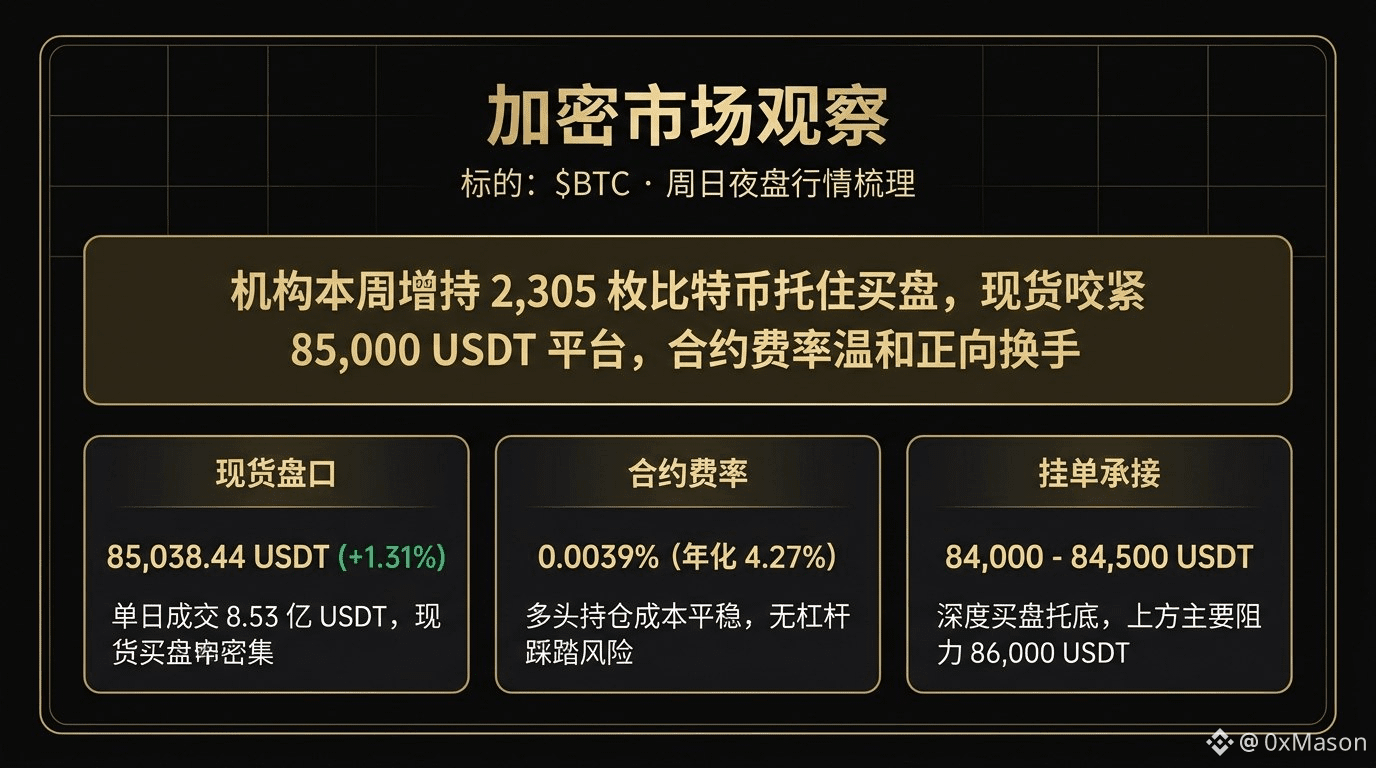
This week, institutions increased their holdings by 2,305 Bitcoins. $BTC has moved above the 85,000 USDT level, and the contract funding rate is swapping steadily.
At around Sunday evening, 2,305 Bitcoins were swept into the spot market by institutions. They’re holding $BTC , watching the Binance order book tonight around 85,038 USDT with a 0.0039% fee rate.
I just checked the BTC/USDT order book on Binance. The spot price is hovering very tightly at 85,038.44 USDT. It’s up slightly by 1.31% over the past 24 hours, and daily spot volume ran 853 million USDT. When the 14:00 snapshot was taken, the contract funding fee rate was 0.0039%; annualized, that’s only 4.27%. There’s no leverage “liquidation stampede” on the board—bulls and bears are mainly grinding for position on the spot order book.
The main flow is still concentrating into Bitcoin’s leading names. I switched to ETH/USDT and took a look: spot is hovering around 2,709.99 USDT, up 0.88%, with daily spot volume at 337 million USDT. The contract funding fee rate there is 0.0094%. Total crypto market cap has slipped back to $2.92 trillion. BTC’s market cap share is at 58.35%, and the Fear & Greed Index reads 70.
I glanced at the depth chart on Binance—there’s dense buy support around the 84,000 to 84,500 USDT range. Above that, 86,000 USDT is the main resistance zone for the week. As long as BTC spot holds the 84,000 USDT platform, the buy-support logic from institutional accumulation remains intact; only if it breaks below the 83,000 USDT defense level will that logic fail. Hold the core position and monitor the funding rate and the 84,000 USDT follow-through—should be enough.
$ETH #本周Strategy与Strive增持2305枚BTC
This week, institutions increased their holdings by 2,305 Bitcoins. $BTC has moved above the 85,000 USDT level, and the contract funding rate is swapping steadily.
At around Sunday evening, 2,305 Bitcoins were swept into the spot market by institutions. They’re holding $BTC , watching the Binance order book tonight around 85,038 USDT with a 0.0039% fee rate.
I just checked the BTC/USDT order book on Binance. The spot price is hovering very tightly at 85,038.44 USDT. It’s up slightly by 1.31% over the past 24 hours, and daily spot volume ran 853 million USDT. When the 14:00 snapshot was taken, the contract funding fee rate was 0.0039%; annualized, that’s only 4.27%. There’s no leverage “liquidation stampede” on the board—bulls and bears are mainly grinding for position on the spot order book.
The main flow is still concentrating into Bitcoin’s leading names. I switched to ETH/USDT and took a look: spot is hovering around 2,709.99 USDT, up 0.88%, with daily spot volume at 337 million USDT. The contract funding fee rate there is 0.0094%. Total crypto market cap has slipped back to $2.92 trillion. BTC’s market cap share is at 58.35%, and the Fear & Greed Index reads 70.
I glanced at the depth chart on Binance—there’s dense buy support around the 84,000 to 84,500 USDT range. Above that, 86,000 USDT is the main resistance zone for the week. As long as BTC spot holds the 84,000 USDT platform, the buy-support logic from institutional accumulation remains intact; only if it breaks below the 83,000 USDT defense level will that logic fail. Hold the core position and monitor the funding rate and the 84,000 USDT follow-through—should be enough.
$ETH #本周Strategy与Strive增持2305枚BTC
At around Sunday evening, 2,305 Bitcoins were swept into the spot market by institutions. They’re holding $BTC , watching the Binance order book tonight around 85,038 USDT with a 0.0039% fee rate.
I just checked the BTC/USDT order book on Binance. The spot price is hovering very tightly at 85,038.44 USDT. It’s up slightly by 1.31% over the past 24 hours, and daily spot volume ran 853 million USDT. When the 14:00 snapshot was taken, the contract funding fee rate was 0.0039%; annualized, that’s only 4.27%. There’s no leverage “liquidation stampede” on the board—bulls and bears are mainly grinding for position on the spot order book.
The main flow is still concentrating into Bitcoin’s leading names. I switched to ETH/USDT and took a look: spot is hovering around 2,709.99 USDT, up 0.88%, with daily spot volume at 337 million USDT. The contract funding fee rate there is 0.0094%. Total crypto market cap has slipped back to $2.92 trillion. BTC’s market cap share is at 58.35%, and the Fear & Greed Index reads 70.
I glanced at the depth chart on Binance—there’s dense buy support around the 84,000 to 84,500 USDT range. Above that, 86,000 USDT is the main resistance zone for the week. As long as BTC spot holds the 84,000 USDT platform, the buy-support logic from institutional accumulation remains intact; only if it breaks below the 83,000 USDT defense level will that logic fail. Hold the core position and monitor the funding rate and the 84,000 USDT follow-through—should be enough.
$ETH #本周Strategy与Strive增持2305枚BTC
380
·
--
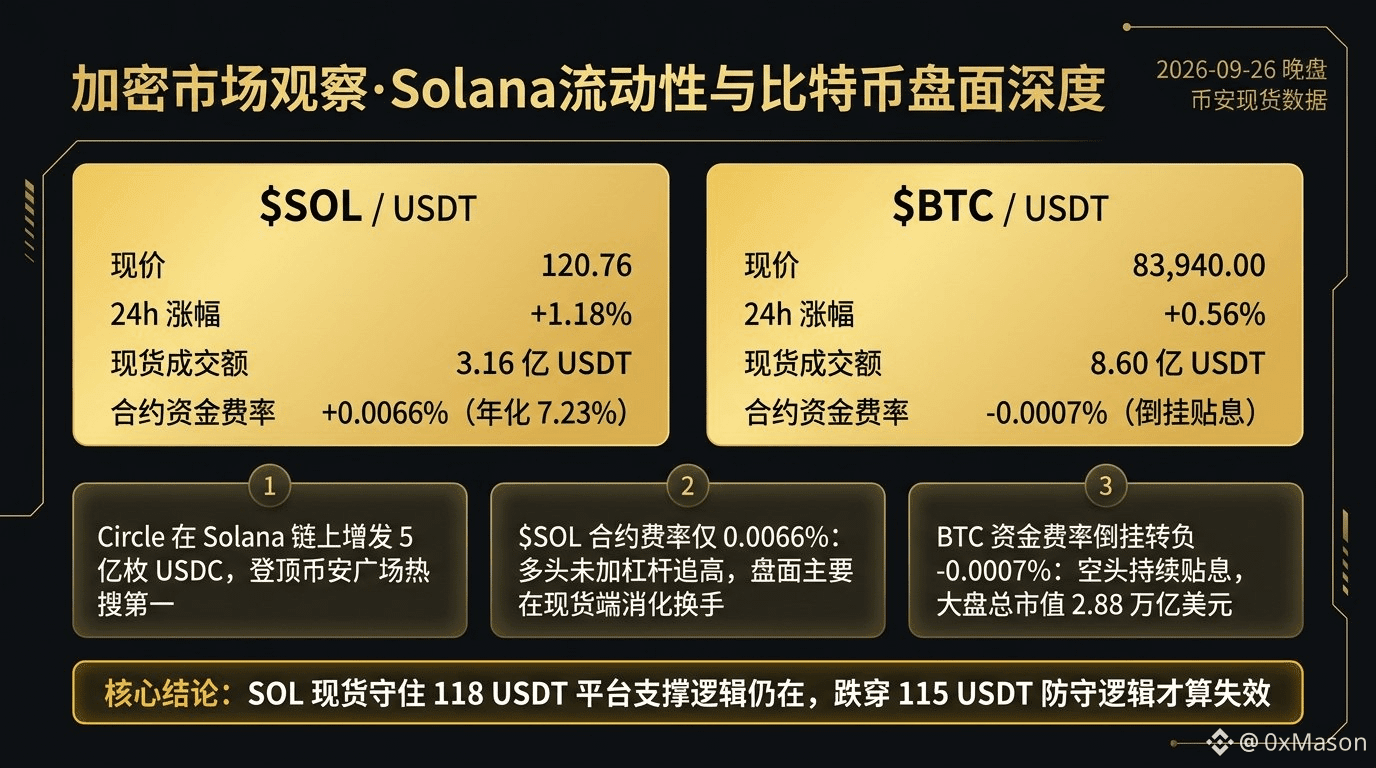
Circle issues an additional 500 million USDC to top the trending chart; $SOL holds steady with 120 USDT against Bitcoin’s negative funding rate, wearing down the chips
500 million USDC is minted and pushed onto the Solana on-chain, and the holder has $SOL watching the Binance order book tonight, keeping a close eye on 120.76 USDT and a 0.0066% fee rate.
I just checked the SOL/USDT order book on Binance. The quotes are tightly clustered around 120.76 USDT. In the past 24 hours, it’s up slightly by 1.18%, and same-day spot volume reached 316 million USDT. At the 14:00 snapshot, the contract funding fee rate was 0.0066%, which annualizes to only 7.23%. On the board, there hasn’t been any liquidation cascade from long leverage; the longs and shorts mainly grind for position in the spot order book.
The main flow is still squeezing into Bitcoin. I switched to BTC/USDT and took a look: spot is hovering around 83,940 USDT, up 0.56%, with daily spot volume of 860 million USDT. The BTC futures funding rate has flipped and inverted into negative territory at -0.0007%, with shorts effectively paying longs; short-term hedging orders are still pressing down, and there’s no leveraged liquidation pressure on the spot side. Total crypto market cap has slipped back to $2.88 trillion, with BTC’s market cap dominance at 58.26%, and the Fear & Greed Index reads 74.
I glanced at the order book depth on Binance: SOL has dense buy walls propping it up in the 118–120 USDT range. Above that, 125 USDT is the main intraday resistance zone. As long as SOL spot holds the 118 USDT platform, the support logic from the on-chain liquidity minted still holds. Only if it breaks below 115 USDT would the defense logic fail. Holding the core position to watch and wait is enough—just keep an eye on the funding rate and the 118 USDT buy-side support.
$BTC #Circle在Solana增发5亿枚USDC
Circle issues an additional 500 million USDC to top the trending chart; $SOL holds steady with 120 USDT against Bitcoin’s negative funding rate, wearing down the chips
500 million USDC is minted and pushed onto the Solana on-chain, and the holder has $SOL watching the Binance order book tonight, keeping a close eye on 120.76 USDT and a 0.0066% fee rate.
I just checked the SOL/USDT order book on Binance. The quotes are tightly clustered around 120.76 USDT. In the past 24 hours, it’s up slightly by 1.18%, and same-day spot volume reached 316 million USDT. At the 14:00 snapshot, the contract funding fee rate was 0.0066%, which annualizes to only 7.23%. On the board, there hasn’t been any liquidation cascade from long leverage; the longs and shorts mainly grind for position in the spot order book.
The main flow is still squeezing into Bitcoin. I switched to BTC/USDT and took a look: spot is hovering around 83,940 USDT, up 0.56%, with daily spot volume of 860 million USDT. The BTC futures funding rate has flipped and inverted into negative territory at -0.0007%, with shorts effectively paying longs; short-term hedging orders are still pressing down, and there’s no leveraged liquidation pressure on the spot side. Total crypto market cap has slipped back to $2.88 trillion, with BTC’s market cap dominance at 58.26%, and the Fear & Greed Index reads 74.
I glanced at the order book depth on Binance: SOL has dense buy walls propping it up in the 118–120 USDT range. Above that, 125 USDT is the main intraday resistance zone. As long as SOL spot holds the 118 USDT platform, the support logic from the on-chain liquidity minted still holds. Only if it breaks below 115 USDT would the defense logic fail. Holding the core position to watch and wait is enough—just keep an eye on the funding rate and the 118 USDT buy-side support.
$BTC #Circle在Solana增发5亿枚USDC
500 million USDC is minted and pushed onto the Solana on-chain, and the holder has $SOL watching the Binance order book tonight, keeping a close eye on 120.76 USDT and a 0.0066% fee rate.
I just checked the SOL/USDT order book on Binance. The quotes are tightly clustered around 120.76 USDT. In the past 24 hours, it’s up slightly by 1.18%, and same-day spot volume reached 316 million USDT. At the 14:00 snapshot, the contract funding fee rate was 0.0066%, which annualizes to only 7.23%. On the board, there hasn’t been any liquidation cascade from long leverage; the longs and shorts mainly grind for position in the spot order book.
The main flow is still squeezing into Bitcoin. I switched to BTC/USDT and took a look: spot is hovering around 83,940 USDT, up 0.56%, with daily spot volume of 860 million USDT. The BTC futures funding rate has flipped and inverted into negative territory at -0.0007%, with shorts effectively paying longs; short-term hedging orders are still pressing down, and there’s no leveraged liquidation pressure on the spot side. Total crypto market cap has slipped back to $2.88 trillion, with BTC’s market cap dominance at 58.26%, and the Fear & Greed Index reads 74.
I glanced at the order book depth on Binance: SOL has dense buy walls propping it up in the 118–120 USDT range. Above that, 125 USDT is the main intraday resistance zone. As long as SOL spot holds the 118 USDT platform, the support logic from the on-chain liquidity minted still holds. Only if it breaks below 115 USDT would the defense logic fail. Holding the core position to watch and wait is enough—just keep an eye on the funding rate and the 118 USDT buy-side support.
$BTC #Circle在Solana增发5亿枚USDC
277
·
--
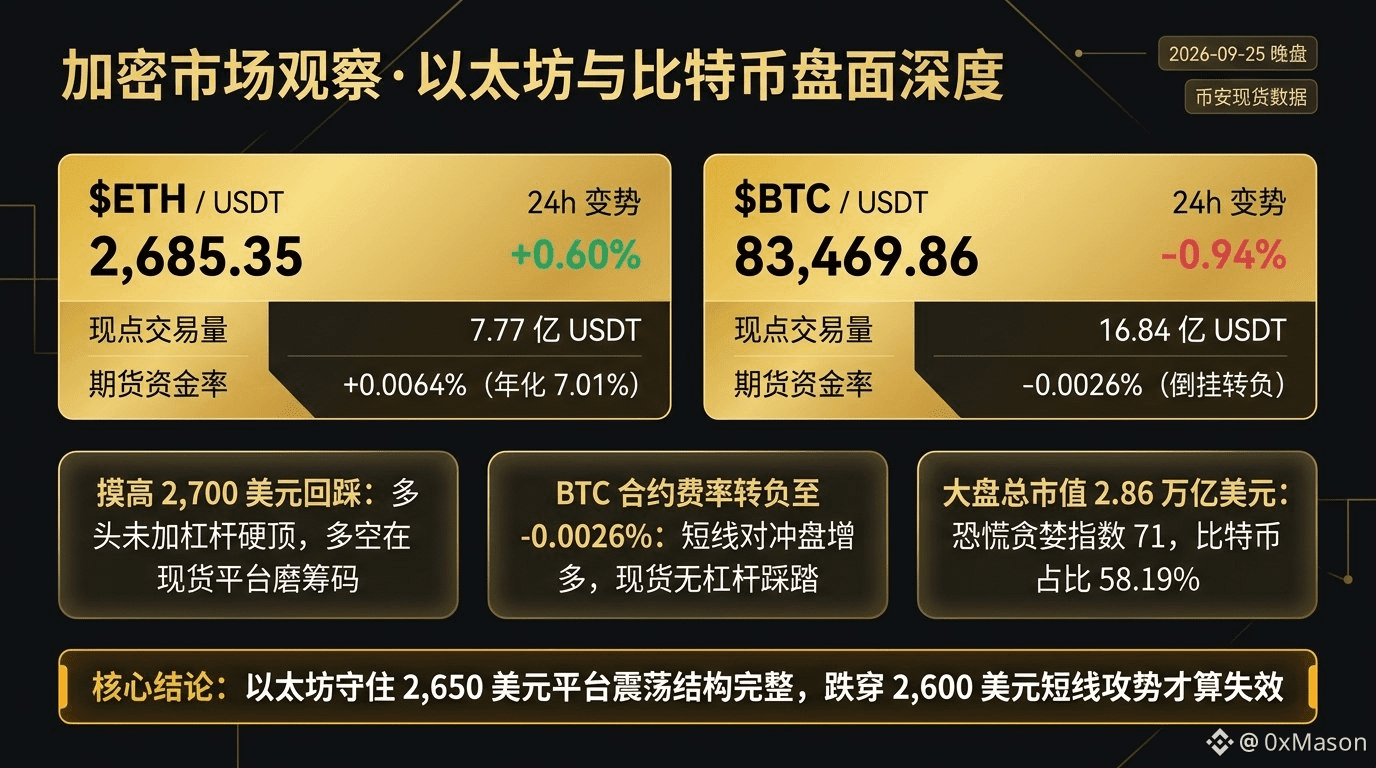
Ethereum briefly touched $2,700, then pulled back to $2,685 USDT. Bitcoin’s funding rate flipped negative to -0.0026%. Spot positioning grind between longs and shorts continues.
After Ethereum tagged $2,700 and then retraced to $2,685 USDT, with the account holding $ETH , on Binance’s order book tonight, which defensive data should you watch?
Just now I checked the ETH/USDT order book on Binance. The quotes are tightly clustered around 2,685.35 USDT. It’s up slightly by 0.60% over 24 hours, and daily spot turnover is 777.7 million USDT. At the 14:00 snapshot, the perpetual contract funding rate was 0.0064%; annualized that’s only 7.01%. There’s no liquidation-driven long leverage panic on the board—most of the longs vs. shorts are grinding positions mainly on the spot venue.
The main flow is still squeezing into Bitcoin. I switched to BTC/USDT and took a look: spot is hovering around 83,469.86 USDT, down 0.94%, with daily spot turnover of 1.684 billion USDT. The BTC contract funding rate turned negative to -0.0026%, so shorts are paying longs (i.e., moving to a “paying/interest” structure). Short-term hedging activity is increasing, and there’s no liquidation-type leverage squeeze on the spot side. Total crypto market cap is down 2.88%, retreating to $2.86 trillion; BTC’s dominance remains at 58.19%, ETH at 11.37%; the Fear & Greed Index reads 71.
I glanced at the depth chart on Binance at my bids: below 2,650 USDT, the buy-side limit orders look relatively dense. The main intraday resistance zone is up at 2,720 USDT. As long as Ethereum holds the $2,650 platform, the pullback is still in a normal consolidation structure; only if it breaks below $2,600 would the defensive logic fail. Just hold the core position and watch—keeping an eye on the funding rate and the $2,650 carry/absorption should be enough.
$ETH
{spot}(ETHUSDT)
$BTC
{spot}(BTCUSDT)
#以太坊突破2700美元
Ethereum briefly touched $2,700, then pulled back to $2,685 USDT. Bitcoin’s funding rate flipped negative to -0.0026%. Spot positioning grind between longs and shorts continues.
After Ethereum tagged $2,700 and then retraced to $2,685 USDT, with the account holding $ETH , on Binance’s order book tonight, which defensive data should you watch?
Just now I checked the ETH/USDT order book on Binance. The quotes are tightly clustered around 2,685.35 USDT. It’s up slightly by 0.60% over 24 hours, and daily spot turnover is 777.7 million USDT. At the 14:00 snapshot, the perpetual contract funding rate was 0.0064%; annualized that’s only 7.01%. There’s no liquidation-driven long leverage panic on the board—most of the longs vs. shorts are grinding positions mainly on the spot venue.
The main flow is still squeezing into Bitcoin. I switched to BTC/USDT and took a look: spot is hovering around 83,469.86 USDT, down 0.94%, with daily spot turnover of 1.684 billion USDT. The BTC contract funding rate turned negative to -0.0026%, so shorts are paying longs (i.e., moving to a “paying/interest” structure). Short-term hedging activity is increasing, and there’s no liquidation-type leverage squeeze on the spot side. Total crypto market cap is down 2.88%, retreating to $2.86 trillion; BTC’s dominance remains at 58.19%, ETH at 11.37%; the Fear & Greed Index reads 71.
I glanced at the depth chart on Binance at my bids: below 2,650 USDT, the buy-side limit orders look relatively dense. The main intraday resistance zone is up at 2,720 USDT. As long as Ethereum holds the $2,650 platform, the pullback is still in a normal consolidation structure; only if it breaks below $2,600 would the defensive logic fail. Just hold the core position and watch—keeping an eye on the funding rate and the $2,650 carry/absorption should be enough.
$ETH
$BTC
#以太坊突破2700美元
After Ethereum tagged $2,700 and then retraced to $2,685 USDT, with the account holding $ETH , on Binance’s order book tonight, which defensive data should you watch?
Just now I checked the ETH/USDT order book on Binance. The quotes are tightly clustered around 2,685.35 USDT. It’s up slightly by 0.60% over 24 hours, and daily spot turnover is 777.7 million USDT. At the 14:00 snapshot, the perpetual contract funding rate was 0.0064%; annualized that’s only 7.01%. There’s no liquidation-driven long leverage panic on the board—most of the longs vs. shorts are grinding positions mainly on the spot venue.
The main flow is still squeezing into Bitcoin. I switched to BTC/USDT and took a look: spot is hovering around 83,469.86 USDT, down 0.94%, with daily spot turnover of 1.684 billion USDT. The BTC contract funding rate turned negative to -0.0026%, so shorts are paying longs (i.e., moving to a “paying/interest” structure). Short-term hedging activity is increasing, and there’s no liquidation-type leverage squeeze on the spot side. Total crypto market cap is down 2.88%, retreating to $2.86 trillion; BTC’s dominance remains at 58.19%, ETH at 11.37%; the Fear & Greed Index reads 71.
I glanced at the depth chart on Binance at my bids: below 2,650 USDT, the buy-side limit orders look relatively dense. The main intraday resistance zone is up at 2,720 USDT. As long as Ethereum holds the $2,650 platform, the pullback is still in a normal consolidation structure; only if it breaks below $2,600 would the defensive logic fail. Just hold the core position and watch—keeping an eye on the funding rate and the $2,650 carry/absorption should be enough.
$ETH
$BTC
#以太坊突破2700美元
364
·
--
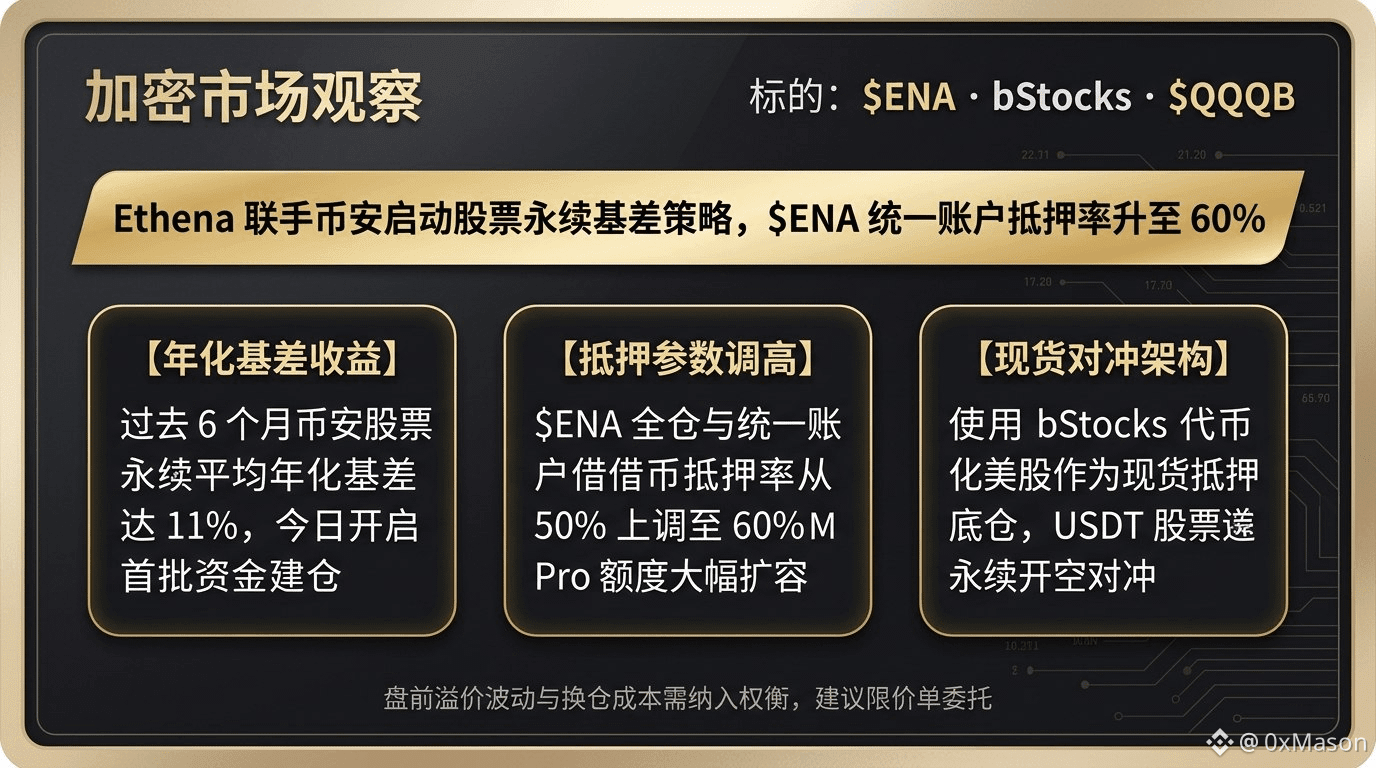
Ethena teamed up with Binance to promote a stock perpetual basis-trading strategy, and the unified account collateralization rate was raised to 60% for $ENA .
After seeing Ethena’s official announcement expanding basis trading to Binance stock perps, I checked the leveraged borrowing earlier this afternoon. In the unified account, ENA’s collateralization ratio indeed just increased from 50% to 60%.
This approach tokenizes bStocks-backed equities as spot long-term base holdings, while opening USDT-denominated short positions in Binance stock perpetuals to capture the basis. Over the past six months, Binance stock perpetuals’ average annualized basis has been about 11%. Ethena’s first batch of positions begins building today. This afternoon, Binance updated its collateral parameters: in PM Pro, ENA’s 100% collateral limit jumped from $200,000 to $800,000. The space for large-cap collateralized borrowing has clearly been loosened.
I just looked at the order book for $QQQB and $NVDAB ; the pre-market premium is roughly 0.2%, and the bid/ask orders seem reasonably solid. With a position size of this scale entering to short stock perps, funding rates are definitely going to be pushed down. The annualized 11% basis return won’t hold indefinitely. Within the day, the round-trip switching between spot and contracts costs at least 0.2% in fees; once funding rates fall, net profitability after costs may not be worth it.
If you’re holding ENA spot, your available margin in the unified account is today genuinely higher by about 10 percentage points. If you plan to hedge by trading stock perps, the highest risk is the potential gap when U.S. markets open—especially in the half hour before the open. bStocks spot can be traded all day, but when the external market opens, sudden price moves can easily cause slippage when you’re forced to trade at market price. Use limit orders only—don’t “eat” the market price.
#CFTC更新受监管机构代币化资产指引
Ethena teamed up with Binance to promote a stock perpetual basis-trading strategy, and the unified account collateralization rate was raised to 60% for $ENA .
After seeing Ethena’s official announcement expanding basis trading to Binance stock perps, I checked the leveraged borrowing earlier this afternoon. In the unified account, ENA’s collateralization ratio indeed just increased from 50% to 60%.
This approach tokenizes bStocks-backed equities as spot long-term base holdings, while opening USDT-denominated short positions in Binance stock perpetuals to capture the basis. Over the past six months, Binance stock perpetuals’ average annualized basis has been about 11%. Ethena’s first batch of positions begins building today. This afternoon, Binance updated its collateral parameters: in PM Pro, ENA’s 100% collateral limit jumped from $200,000 to $800,000. The space for large-cap collateralized borrowing has clearly been loosened.
I just looked at the order book for $QQQB and $NVDAB ; the pre-market premium is roughly 0.2%, and the bid/ask orders seem reasonably solid. With a position size of this scale entering to short stock perps, funding rates are definitely going to be pushed down. The annualized 11% basis return won’t hold indefinitely. Within the day, the round-trip switching between spot and contracts costs at least 0.2% in fees; once funding rates fall, net profitability after costs may not be worth it.
If you’re holding ENA spot, your available margin in the unified account is today genuinely higher by about 10 percentage points. If you plan to hedge by trading stock perps, the highest risk is the potential gap when U.S. markets open—especially in the half hour before the open. bStocks spot can be traded all day, but when the external market opens, sudden price moves can easily cause slippage when you’re forced to trade at market price. Use limit orders only—don’t “eat” the market price.
#CFTC更新受监管机构代币化资产指引
After seeing Ethena’s official announcement expanding basis trading to Binance stock perps, I checked the leveraged borrowing earlier this afternoon. In the unified account, ENA’s collateralization ratio indeed just increased from 50% to 60%.
This approach tokenizes bStocks-backed equities as spot long-term base holdings, while opening USDT-denominated short positions in Binance stock perpetuals to capture the basis. Over the past six months, Binance stock perpetuals’ average annualized basis has been about 11%. Ethena’s first batch of positions begins building today. This afternoon, Binance updated its collateral parameters: in PM Pro, ENA’s 100% collateral limit jumped from $200,000 to $800,000. The space for large-cap collateralized borrowing has clearly been loosened.
I just looked at the order book for $QQQB and $NVDAB ; the pre-market premium is roughly 0.2%, and the bid/ask orders seem reasonably solid. With a position size of this scale entering to short stock perps, funding rates are definitely going to be pushed down. The annualized 11% basis return won’t hold indefinitely. Within the day, the round-trip switching between spot and contracts costs at least 0.2% in fees; once funding rates fall, net profitability after costs may not be worth it.
If you’re holding ENA spot, your available margin in the unified account is today genuinely higher by about 10 percentage points. If you plan to hedge by trading stock perps, the highest risk is the potential gap when U.S. markets open—especially in the half hour before the open. bStocks spot can be traded all day, but when the external market opens, sudden price moves can easily cause slippage when you’re forced to trade at market price. Use limit orders only—don’t “eat” the market price.
#CFTC更新受监管机构代币化资产指引
169
·
--
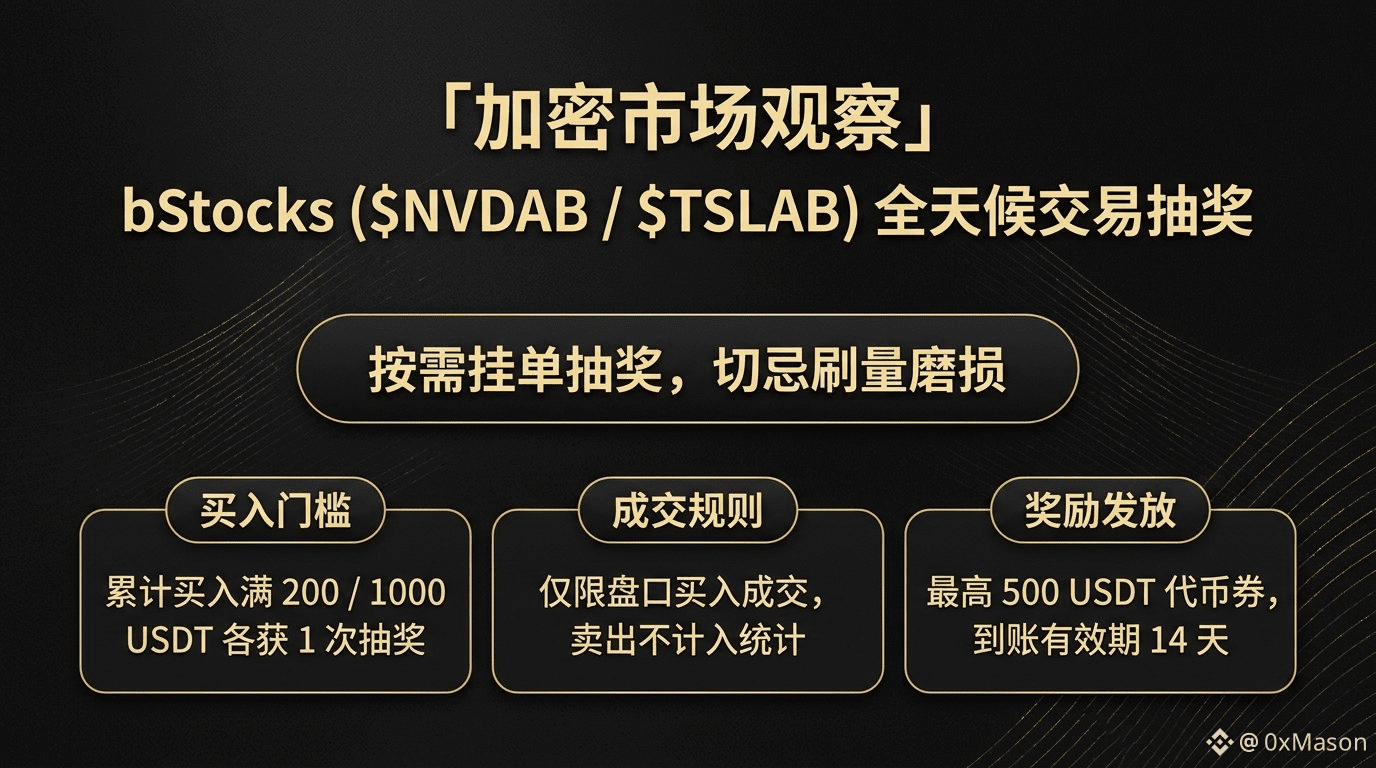
Binance launches a bStocks 24/7 trading giveaway: buy a total of 200 USDT for a chance to win up to 500 token vouchers
The 500 USDT token voucher prize pool was released just last night. If you usually trade tokenized US stocks on Binance like $NVDAB or $TSLAB , take a look at this buy-order raffle.
The campaign runs until October 14. When your bStocks buy orders add up to 200 USDT, you get 1 raffle entry; when you buy up to 1,000 USDT, you get 1 additional entry. Sell orders shown in the order book do not count—only completed buy trades are counted in the backend. The token vouchers won will be credited to the Rewards Center no later than November 14, and once credited they are valid for 14 days.
I just checked the event page a moment ago: before participating, you must click “Register Now” once on the page. If you trade without confirming registration first, the buy volume won’t be counted in the backend. Currently, bStocks supports 24-hour trading; however, during non–US stock trading hours, the bid-ask spread in the order book tends to widen. If you take market orders, slippage is more likely. Using limit orders and placing buys in batches gives you better control over costs.
If you already have plans to place US stock spot orders in the normal course of things, it’s cost-effective to set limit buy orders to reach 200 or 1,000 USDT to get raffle entries. But if you’re doing it only to chase token vouchers by frequently cycling buy volume back and forth, it’s not worth it—the bStocks order book spread plus the 0.2% trading fee can easily eat up your token voucher quota just by execution.
$NVDAB #bStocks
Binance launches a bStocks 24/7 trading giveaway: buy a total of 200 USDT for a chance to win up to 500 token vouchers
The 500 USDT token voucher prize pool was released just last night. If you usually trade tokenized US stocks on Binance like $NVDAB or $TSLAB , take a look at this buy-order raffle.
The campaign runs until October 14. When your bStocks buy orders add up to 200 USDT, you get 1 raffle entry; when you buy up to 1,000 USDT, you get 1 additional entry. Sell orders shown in the order book do not count—only completed buy trades are counted in the backend. The token vouchers won will be credited to the Rewards Center no later than November 14, and once credited they are valid for 14 days.
I just checked the event page a moment ago: before participating, you must click “Register Now” once on the page. If you trade without confirming registration first, the buy volume won’t be counted in the backend. Currently, bStocks supports 24-hour trading; however, during non–US stock trading hours, the bid-ask spread in the order book tends to widen. If you take market orders, slippage is more likely. Using limit orders and placing buys in batches gives you better control over costs.
If you already have plans to place US stock spot orders in the normal course of things, it’s cost-effective to set limit buy orders to reach 200 or 1,000 USDT to get raffle entries. But if you’re doing it only to chase token vouchers by frequently cycling buy volume back and forth, it’s not worth it—the bStocks order book spread plus the 0.2% trading fee can easily eat up your token voucher quota just by execution.
$NVDAB #bStocks
The 500 USDT token voucher prize pool was released just last night. If you usually trade tokenized US stocks on Binance like $NVDAB or $TSLAB , take a look at this buy-order raffle.
The campaign runs until October 14. When your bStocks buy orders add up to 200 USDT, you get 1 raffle entry; when you buy up to 1,000 USDT, you get 1 additional entry. Sell orders shown in the order book do not count—only completed buy trades are counted in the backend. The token vouchers won will be credited to the Rewards Center no later than November 14, and once credited they are valid for 14 days.
I just checked the event page a moment ago: before participating, you must click “Register Now” once on the page. If you trade without confirming registration first, the buy volume won’t be counted in the backend. Currently, bStocks supports 24-hour trading; however, during non–US stock trading hours, the bid-ask spread in the order book tends to widen. If you take market orders, slippage is more likely. Using limit orders and placing buys in batches gives you better control over costs.
If you already have plans to place US stock spot orders in the normal course of things, it’s cost-effective to set limit buy orders to reach 200 or 1,000 USDT to get raffle entries. But if you’re doing it only to chase token vouchers by frequently cycling buy volume back and forth, it’s not worth it—the bStocks order book spread plus the 0.2% trading fee can easily eat up your token voucher quota just by execution.
$NVDAB #bStocks
79
·
--
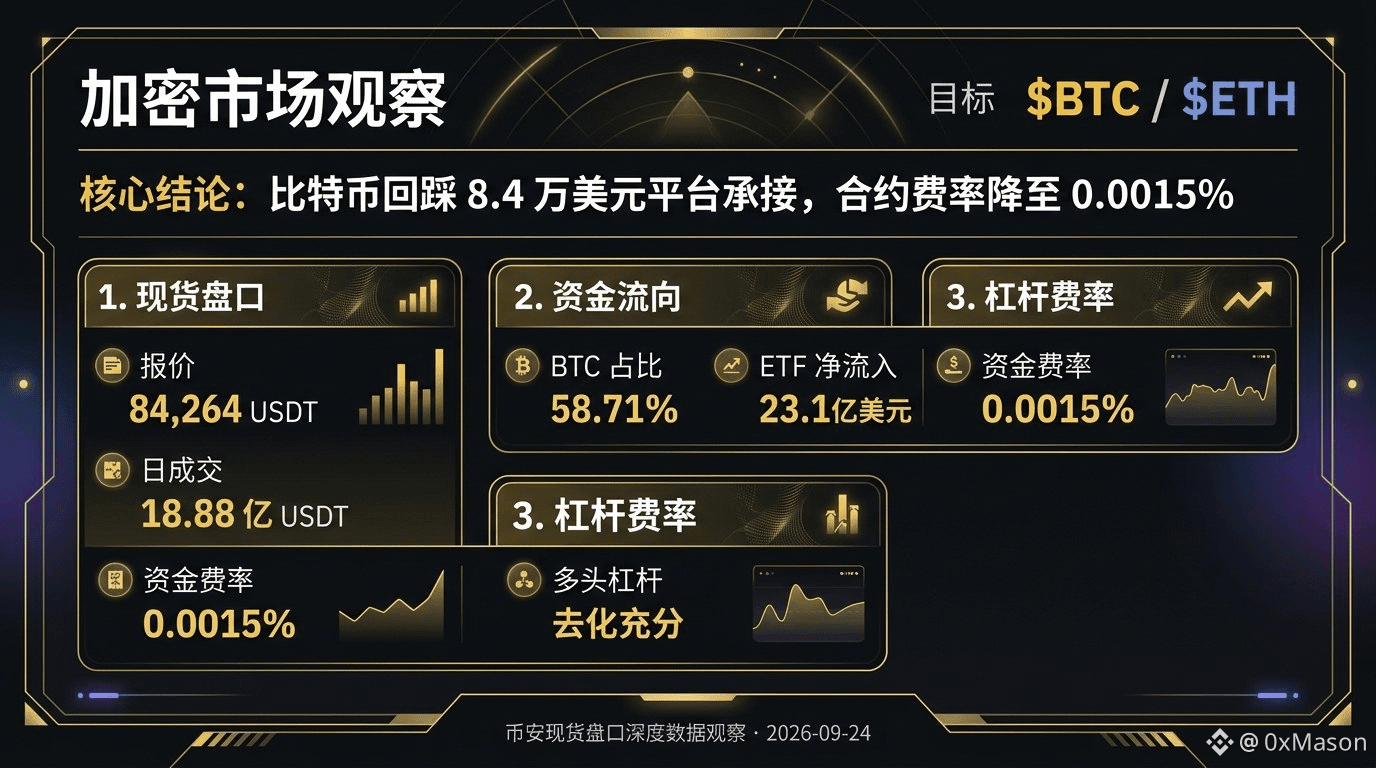
Bitcoin Twice Rebuffed and Pulls Back to the $84.0k Platform: Contract Fee Rate Compressed to 0.0015%, Deleveraging Fully
After Bitcoin was rejected twice at $87,300, it pulled back to $84,264 USDT. Holding $BTC —what acceptance data should you be watching on the Binance order book tonight?
Just now I checked the BTC/USDT order book on Binance. Near 84,264.01 USDT, the buy and sell orders are very tightly matched. In the past 24 hours it’s down slightly by 1.24%, and the day’s spot volume ran to 1.888 billion USDT. At the 2026-09-24 14:10 UTC snapshot, the contract funding rate was pushed down to 0.0015%; annualized that’s only 1.64%. The board shows no leveraged liquidation panic—bulls and bears are mainly grinding positions on the spot platform.
All the funds are squeezing into Bitcoin. I switched to ETH/USDT and glanced—prices were hovering around 2,669.45 USDT, down 1.13%, with only 782 million USDT spot成交 volume for the day. Crypto total market cap fell 4.36% back to $2.88 trillion. Bitcoin’s market cap share is still holding at 58.71%. The Fear & Greed Index reads 71. For Bitcoin spot ETFs, net inflows over the first four trading days totaled $2.31 billion. Mainstream institutional buy orders didn’t cancel during the pullback.
I took a look at the depth chart on Binance. Below the $84,000 level, the buy-side limit orders are very dense. Above, $85,500 is the intraday supply/pressure zone for selling. If spot can hold the $84,000 platform, the pullback after failing at the highs is still within a consolidation structure; only if it breaks below the $83,000 defense logic would that thesis fail. Sit tight with your core position and keep watch—monitoring the low-rate levels should be enough.
$BTC $ETH #比特币两度受阻87300美元
Bitcoin Twice Rebuffed and Pulls Back to the $84.0k Platform: Contract Fee Rate Compressed to 0.0015%, Deleveraging Fully
After Bitcoin was rejected twice at $87,300, it pulled back to $84,264 USDT. Holding $BTC —what acceptance data should you be watching on the Binance order book tonight?
Just now I checked the BTC/USDT order book on Binance. Near 84,264.01 USDT, the buy and sell orders are very tightly matched. In the past 24 hours it’s down slightly by 1.24%, and the day’s spot volume ran to 1.888 billion USDT. At the 2026-09-24 14:10 UTC snapshot, the contract funding rate was pushed down to 0.0015%; annualized that’s only 1.64%. The board shows no leveraged liquidation panic—bulls and bears are mainly grinding positions on the spot platform.
All the funds are squeezing into Bitcoin. I switched to ETH/USDT and glanced—prices were hovering around 2,669.45 USDT, down 1.13%, with only 782 million USDT spot成交 volume for the day. Crypto total market cap fell 4.36% back to $2.88 trillion. Bitcoin’s market cap share is still holding at 58.71%. The Fear & Greed Index reads 71. For Bitcoin spot ETFs, net inflows over the first four trading days totaled $2.31 billion. Mainstream institutional buy orders didn’t cancel during the pullback.
I took a look at the depth chart on Binance. Below the $84,000 level, the buy-side limit orders are very dense. Above, $85,500 is the intraday supply/pressure zone for selling. If spot can hold the $84,000 platform, the pullback after failing at the highs is still within a consolidation structure; only if it breaks below the $83,000 defense logic would that thesis fail. Sit tight with your core position and keep watch—monitoring the low-rate levels should be enough.
$BTC $ETH #比特币两度受阻87300美元
After Bitcoin was rejected twice at $87,300, it pulled back to $84,264 USDT. Holding $BTC —what acceptance data should you be watching on the Binance order book tonight?
Just now I checked the BTC/USDT order book on Binance. Near 84,264.01 USDT, the buy and sell orders are very tightly matched. In the past 24 hours it’s down slightly by 1.24%, and the day’s spot volume ran to 1.888 billion USDT. At the 2026-09-24 14:10 UTC snapshot, the contract funding rate was pushed down to 0.0015%; annualized that’s only 1.64%. The board shows no leveraged liquidation panic—bulls and bears are mainly grinding positions on the spot platform.
All the funds are squeezing into Bitcoin. I switched to ETH/USDT and glanced—prices were hovering around 2,669.45 USDT, down 1.13%, with only 782 million USDT spot成交 volume for the day. Crypto total market cap fell 4.36% back to $2.88 trillion. Bitcoin’s market cap share is still holding at 58.71%. The Fear & Greed Index reads 71. For Bitcoin spot ETFs, net inflows over the first four trading days totaled $2.31 billion. Mainstream institutional buy orders didn’t cancel during the pullback.
I took a look at the depth chart on Binance. Below the $84,000 level, the buy-side limit orders are very dense. Above, $85,500 is the intraday supply/pressure zone for selling. If spot can hold the $84,000 platform, the pullback after failing at the highs is still within a consolidation structure; only if it breaks below the $83,000 defense logic would that thesis fail. Sit tight with your core position and keep watch—monitoring the low-rate levels should be enough.
$BTC $ETH #比特币两度受阻87300美元
80
·
--
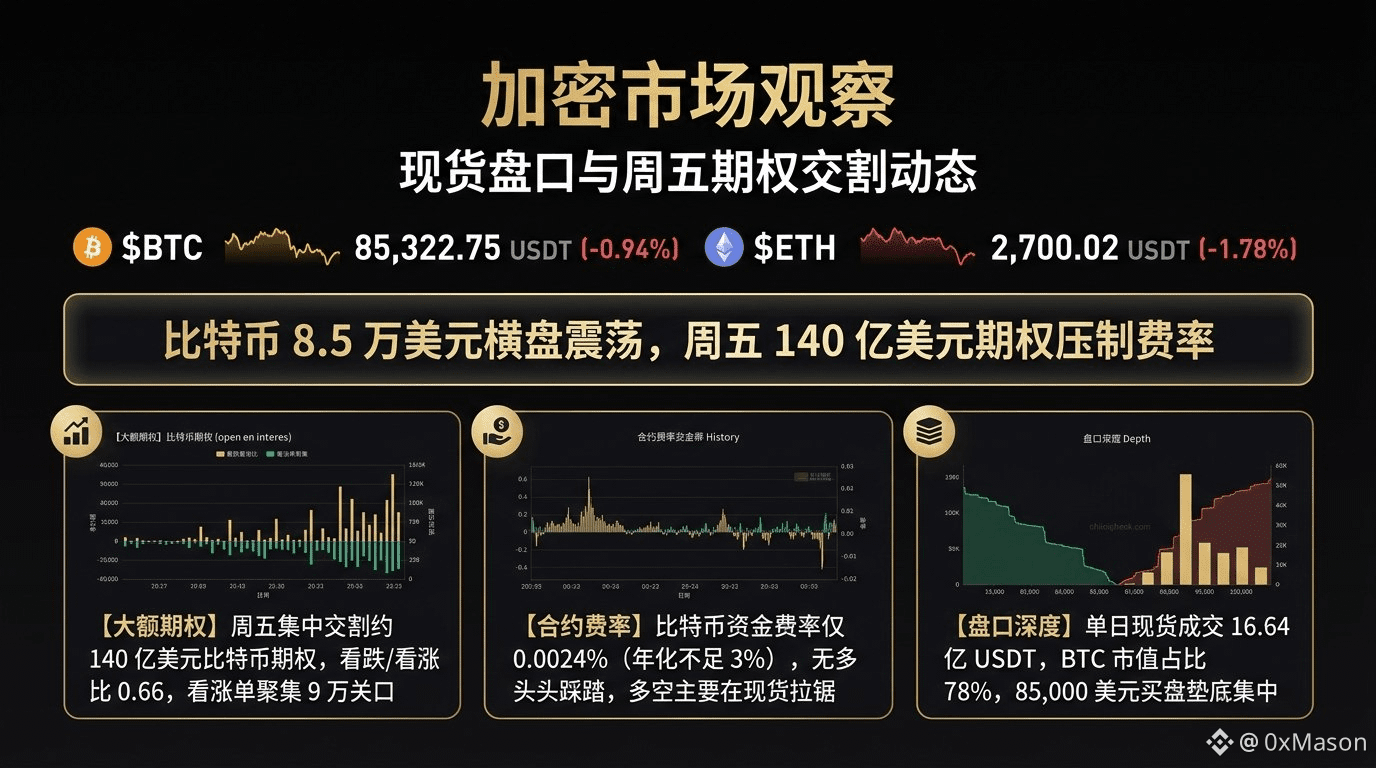
Bitcoin oscillates around $85,000 amid $14.0 billion in options expiring on Friday, weighing on longs’ funding rates
On Friday, $14.0 billion worth of Bitcoin options were pressured into expiration. With $BTC held on the Binance order book tonight, what data should you focus on?
I just checked the BTC/USDT order book on Binance a moment ago. Around 85,322.75 USDT, the bid and ask are tightly locked. In the past 24 hours, it’s down slightly by 0.94%. Daily spot trading volume is 1.664 billion USDT. At the 2026-09-23 14:10 UTC snapshot, the contract funding rate is only 0.0024%—annualized, that’s under 3%. There’s no leveraged liquidation across the board; longs and shorts mainly grind positions on the spot market.
All the capital is squeezing into Bitcoin. I switched to ETH/USDT briefly: the quote is stuck around 2,700.02 USDT, down 1.78%, and daily trading volume is only 840 million USDT. Bitcoin’s market cap share is pinned at 58.78%, and the Fear & Greed Index reads 71. In Coinbase’s order book, among Friday’s large options, the put-to-call open interest ratio for BTC is only 0.66. Just below the $90,000 threshold, there are full stacks of open call orders; ahead of expiration, the big funds are all waiting for spot first to give direction.
I glanced at the Binance depth chart: below the $85,000 level, the bids are backed by very thick support. Every time 10-billion-scale options expire, the market often gets churned back and forth on Friday afternoon. There’s no need for your spot positions to keep getting involved in a few-hundred-point noise cycle—just keep an eye on the $85,000 platform’s buy-side absorption and the funding-rate direction after expiration.
$BTC
{spot}(BTCUSDT)
$ETH
{spot}(ETHUSDT)
#140亿美元比特币期权周五到期
Bitcoin oscillates around $85,000 amid $14.0 billion in options expiring on Friday, weighing on longs’ funding rates
On Friday, $14.0 billion worth of Bitcoin options were pressured into expiration. With $BTC held on the Binance order book tonight, what data should you focus on?
I just checked the BTC/USDT order book on Binance a moment ago. Around 85,322.75 USDT, the bid and ask are tightly locked. In the past 24 hours, it’s down slightly by 0.94%. Daily spot trading volume is 1.664 billion USDT. At the 2026-09-23 14:10 UTC snapshot, the contract funding rate is only 0.0024%—annualized, that’s under 3%. There’s no leveraged liquidation across the board; longs and shorts mainly grind positions on the spot market.
All the capital is squeezing into Bitcoin. I switched to ETH/USDT briefly: the quote is stuck around 2,700.02 USDT, down 1.78%, and daily trading volume is only 840 million USDT. Bitcoin’s market cap share is pinned at 58.78%, and the Fear & Greed Index reads 71. In Coinbase’s order book, among Friday’s large options, the put-to-call open interest ratio for BTC is only 0.66. Just below the $90,000 threshold, there are full stacks of open call orders; ahead of expiration, the big funds are all waiting for spot first to give direction.
I glanced at the Binance depth chart: below the $85,000 level, the bids are backed by very thick support. Every time 10-billion-scale options expire, the market often gets churned back and forth on Friday afternoon. There’s no need for your spot positions to keep getting involved in a few-hundred-point noise cycle—just keep an eye on the $85,000 platform’s buy-side absorption and the funding-rate direction after expiration.
$BTC
$ETH
#140亿美元比特币期权周五到期
On Friday, $14.0 billion worth of Bitcoin options were pressured into expiration. With $BTC held on the Binance order book tonight, what data should you focus on?
I just checked the BTC/USDT order book on Binance a moment ago. Around 85,322.75 USDT, the bid and ask are tightly locked. In the past 24 hours, it’s down slightly by 0.94%. Daily spot trading volume is 1.664 billion USDT. At the 2026-09-23 14:10 UTC snapshot, the contract funding rate is only 0.0024%—annualized, that’s under 3%. There’s no leveraged liquidation across the board; longs and shorts mainly grind positions on the spot market.
All the capital is squeezing into Bitcoin. I switched to ETH/USDT briefly: the quote is stuck around 2,700.02 USDT, down 1.78%, and daily trading volume is only 840 million USDT. Bitcoin’s market cap share is pinned at 58.78%, and the Fear & Greed Index reads 71. In Coinbase’s order book, among Friday’s large options, the put-to-call open interest ratio for BTC is only 0.66. Just below the $90,000 threshold, there are full stacks of open call orders; ahead of expiration, the big funds are all waiting for spot first to give direction.
I glanced at the Binance depth chart: below the $85,000 level, the bids are backed by very thick support. Every time 10-billion-scale options expire, the market often gets churned back and forth on Friday afternoon. There’s no need for your spot positions to keep getting involved in a few-hundred-point noise cycle—just keep an eye on the $85,000 platform’s buy-side absorption and the funding-rate direction after expiration.
$BTC
$ETH
#140亿美元比特币期权周五到期
39
·
--
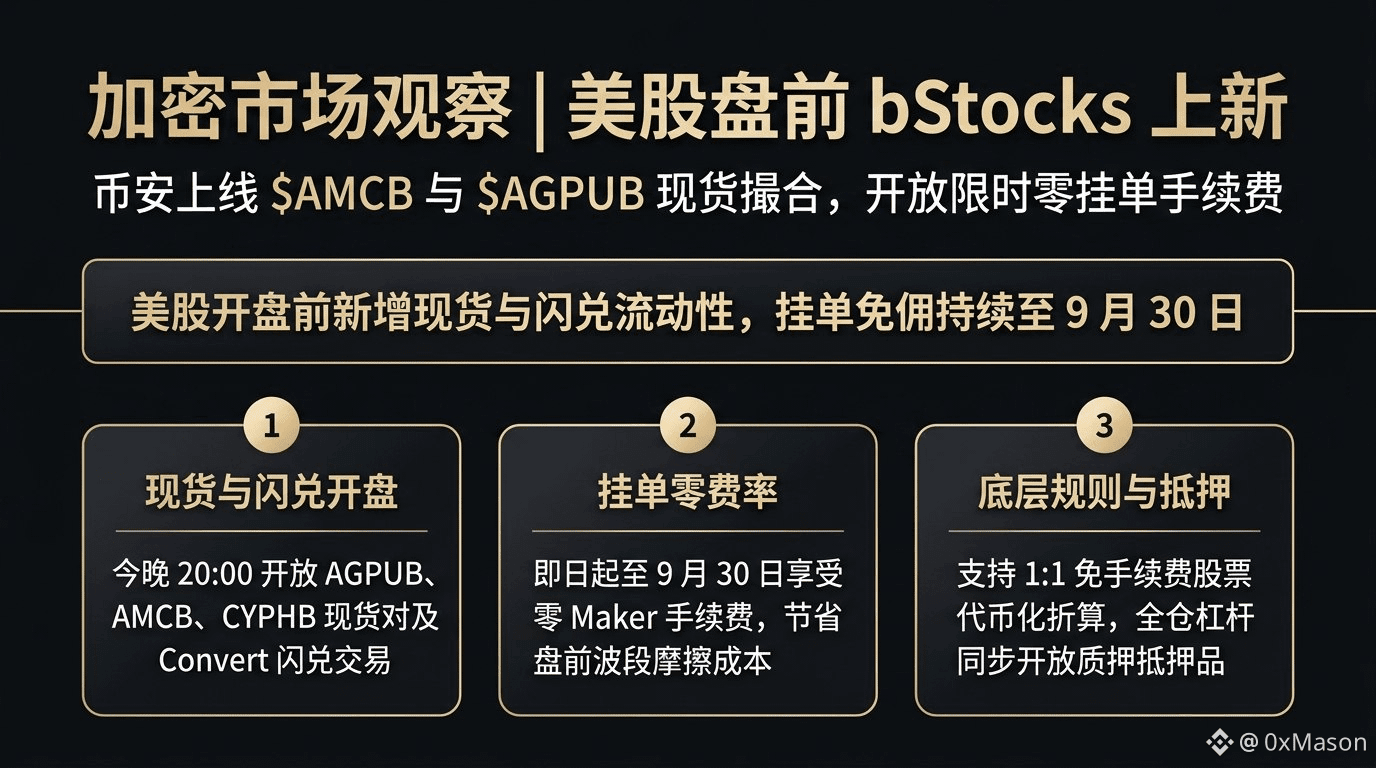
Binance listed the AMCB and AGPUB spot contracts ahead of the U.S. stock market open, with zero trading fees for orders placed until the end of the month.
The activity notice for “zero maker trading fees” has just been posted in the order book. Before the U.S. stock market opened, Binance matched $AMCB and $AGPUB {spot}(AGPUBUSDT) spot listings, waiving fees for limit orders until September 30.
At 20:00, Binance opened up the AGPUB/USDT, AMCB/USDT, and CYPHB/USDT spot pairs together with the Flash Convert feature. I checked the announcement details: the external U.S. stock support converts the 1:1 zero-fee arrangement into tokens, and full-position leverage also includes these three assets as collateral. However, collateral access is currently only available to VIP 3 and above, and borrowing has not been enabled yet.
Just now I checked the order book in the app. After AGPUB/USDT finished its first wave of the call auction, the spread between bids and asks is about 0.8%. The Flash Convert page also shows real-time quotes already. U.S. stock spot trading opens at 21:30; during the half hour beforehand, on-chain tokenized stocks often “run ahead” of external market moves. But market-making liquidity is still in the initial setup stage—if you hit the market with taker orders, you’re likely to incur slippage.
For running a pre-market swing trade on Binance, you can simply place limit orders to capture the zero maker fee without trading losses. For cross-market arbitrage, be mindful that confirmation of the 1:1 off-chain share conversion has some delay. It’s more reliable to wait until the 21:30 U.S. stock order book is fully running smoothly before hedging.
$AMCB
{spot}(AMCBUSDT)
#AI股持续上涨还有哪些投资机会
Binance listed the AMCB and AGPUB spot contracts ahead of the U.S. stock market open, with zero trading fees for orders placed until the end of the month.
The activity notice for “zero maker trading fees” has just been posted in the order book. Before the U.S. stock market opened, Binance matched $AMCB and $AGPUB spot listings, waiving fees for limit orders until September 30.
At 20:00, Binance opened up the AGPUB/USDT, AMCB/USDT, and CYPHB/USDT spot pairs together with the Flash Convert feature. I checked the announcement details: the external U.S. stock support converts the 1:1 zero-fee arrangement into tokens, and full-position leverage also includes these three assets as collateral. However, collateral access is currently only available to VIP 3 and above, and borrowing has not been enabled yet.
Just now I checked the order book in the app. After AGPUB/USDT finished its first wave of the call auction, the spread between bids and asks is about 0.8%. The Flash Convert page also shows real-time quotes already. U.S. stock spot trading opens at 21:30; during the half hour beforehand, on-chain tokenized stocks often “run ahead” of external market moves. But market-making liquidity is still in the initial setup stage—if you hit the market with taker orders, you’re likely to incur slippage.
For running a pre-market swing trade on Binance, you can simply place limit orders to capture the zero maker fee without trading losses. For cross-market arbitrage, be mindful that confirmation of the 1:1 off-chain share conversion has some delay. It’s more reliable to wait until the 21:30 U.S. stock order book is fully running smoothly before hedging.
$AMCB
#AI股持续上涨还有哪些投资机会
The activity notice for “zero maker trading fees” has just been posted in the order book. Before the U.S. stock market opened, Binance matched $AMCB and $AGPUB spot listings, waiving fees for limit orders until September 30.
At 20:00, Binance opened up the AGPUB/USDT, AMCB/USDT, and CYPHB/USDT spot pairs together with the Flash Convert feature. I checked the announcement details: the external U.S. stock support converts the 1:1 zero-fee arrangement into tokens, and full-position leverage also includes these three assets as collateral. However, collateral access is currently only available to VIP 3 and above, and borrowing has not been enabled yet.
Just now I checked the order book in the app. After AGPUB/USDT finished its first wave of the call auction, the spread between bids and asks is about 0.8%. The Flash Convert page also shows real-time quotes already. U.S. stock spot trading opens at 21:30; during the half hour beforehand, on-chain tokenized stocks often “run ahead” of external market moves. But market-making liquidity is still in the initial setup stage—if you hit the market with taker orders, you’re likely to incur slippage.
For running a pre-market swing trade on Binance, you can simply place limit orders to capture the zero maker fee without trading losses. For cross-market arbitrage, be mindful that confirmation of the 1:1 off-chain share conversion has some delay. It’s more reliable to wait until the 21:30 U.S. stock order book is fully running smoothly before hedging.
$AMCB
#AI股持续上涨还有哪些投资机会
274
·
--
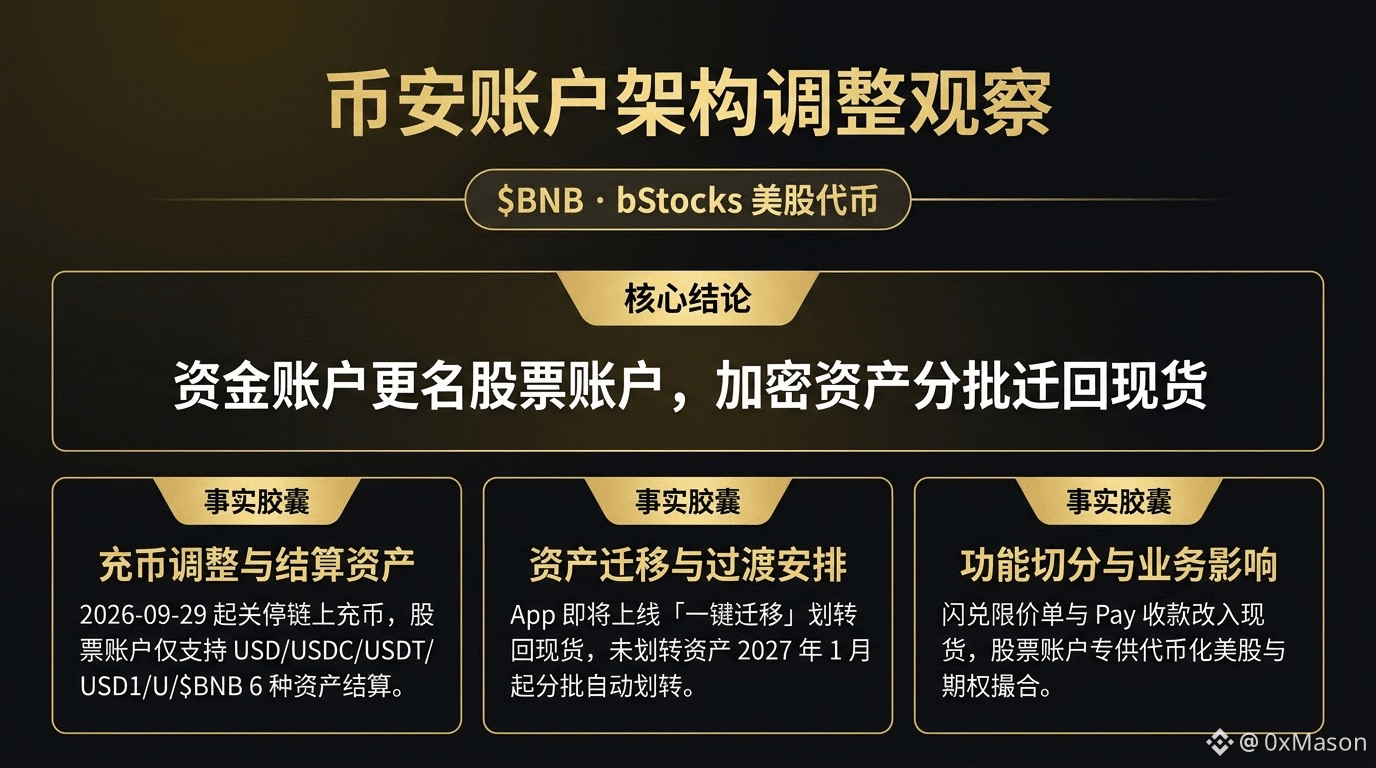
Binance Funding Account will be renamed to a Stocks Account. Crypto assets will be migrated back to the spot account in batches
Starting September 29, Binance Funding Account will be shut down for deposits and renamed as the Stocks Account. If you have $BNB or some scattered tokens in there, take a moment these days to sort things out.
I just went through the announcements—Binance has split the accounts pretty cleanly: the Funding Account will be closed for on-chain deposits on September 29, with a migration window extended to January 2027; afterward, it will officially be called the Stocks Account. Only 6 assets are supported for settlement in the account: USD, USDC, USDT, USD1, U, and $BNB—exclusively for trading settlement of US stock tokens and options.
For other small-cap coins, deposits and withdrawals will be handled entirely by the spot account going forward. The latest app will add an “One-Click Migration” button. Tap it once and the small coins in your Funding Account will be transferred back to spot. If you leave them alone, the system will automatically transfer them in batches in January 2027, with no loss to your total assets.
I just opened my phone and checked the Funding Account— the migration button hasn’t shown up yet. For any Convert limit orders you already have running, keep an eye on this: after the orders complete, the proceeds will go back to spot directly. After the 29th, any new orders you place will be fulfilled by deducting from spot. If you use Pay to receive payments, everything will also go into spot—the money in the Stocks Account can’t be used to make payments.
If you hold bStocks assets like $NVDAB or are staking $BNB , going forward, settle them directly in the Stocks Account. If you’re only storing spot, just free up any leftover balances back into spot these days.
#代币化股票平台或最早下季度启动
Binance Funding Account will be renamed to a Stocks Account. Crypto assets will be migrated back to the spot account in batches
Starting September 29, Binance Funding Account will be shut down for deposits and renamed as the Stocks Account. If you have $BNB or some scattered tokens in there, take a moment these days to sort things out.
I just went through the announcements—Binance has split the accounts pretty cleanly: the Funding Account will be closed for on-chain deposits on September 29, with a migration window extended to January 2027; afterward, it will officially be called the Stocks Account. Only 6 assets are supported for settlement in the account: USD, USDC, USDT, USD1, U, and $BNB —exclusively for trading settlement of US stock tokens and options.
For other small-cap coins, deposits and withdrawals will be handled entirely by the spot account going forward. The latest app will add an “One-Click Migration” button. Tap it once and the small coins in your Funding Account will be transferred back to spot. If you leave them alone, the system will automatically transfer them in batches in January 2027, with no loss to your total assets.
I just opened my phone and checked the Funding Account— the migration button hasn’t shown up yet. For any Convert limit orders you already have running, keep an eye on this: after the orders complete, the proceeds will go back to spot directly. After the 29th, any new orders you place will be fulfilled by deducting from spot. If you use Pay to receive payments, everything will also go into spot—the money in the Stocks Account can’t be used to make payments.
If you hold bStocks assets like $NVDAB or are staking $BNB , going forward, settle them directly in the Stocks Account. If you’re only storing spot, just free up any leftover balances back into spot these days.
#代币化股票平台或最早下季度启动
Starting September 29, Binance Funding Account will be shut down for deposits and renamed as the Stocks Account. If you have $BNB or some scattered tokens in there, take a moment these days to sort things out.
I just went through the announcements—Binance has split the accounts pretty cleanly: the Funding Account will be closed for on-chain deposits on September 29, with a migration window extended to January 2027; afterward, it will officially be called the Stocks Account. Only 6 assets are supported for settlement in the account: USD, USDC, USDT, USD1, U, and $BNB —exclusively for trading settlement of US stock tokens and options.
For other small-cap coins, deposits and withdrawals will be handled entirely by the spot account going forward. The latest app will add an “One-Click Migration” button. Tap it once and the small coins in your Funding Account will be transferred back to spot. If you leave them alone, the system will automatically transfer them in batches in January 2027, with no loss to your total assets.
I just opened my phone and checked the Funding Account— the migration button hasn’t shown up yet. For any Convert limit orders you already have running, keep an eye on this: after the orders complete, the proceeds will go back to spot directly. After the 29th, any new orders you place will be fulfilled by deducting from spot. If you use Pay to receive payments, everything will also go into spot—the money in the Stocks Account can’t be used to make payments.
If you hold bStocks assets like $NVDAB or are staking $BNB , going forward, settle them directly in the Stocks Account. If you’re only storing spot, just free up any leftover balances back into spot these days.
#代币化股票平台或最早下季度启动
68
·
--
Bitcoin breaks above $86,000 to briefly touch a high of $86,000+, with funding rates staying moderate, but the broader market’s “capital-draining” effect is evident
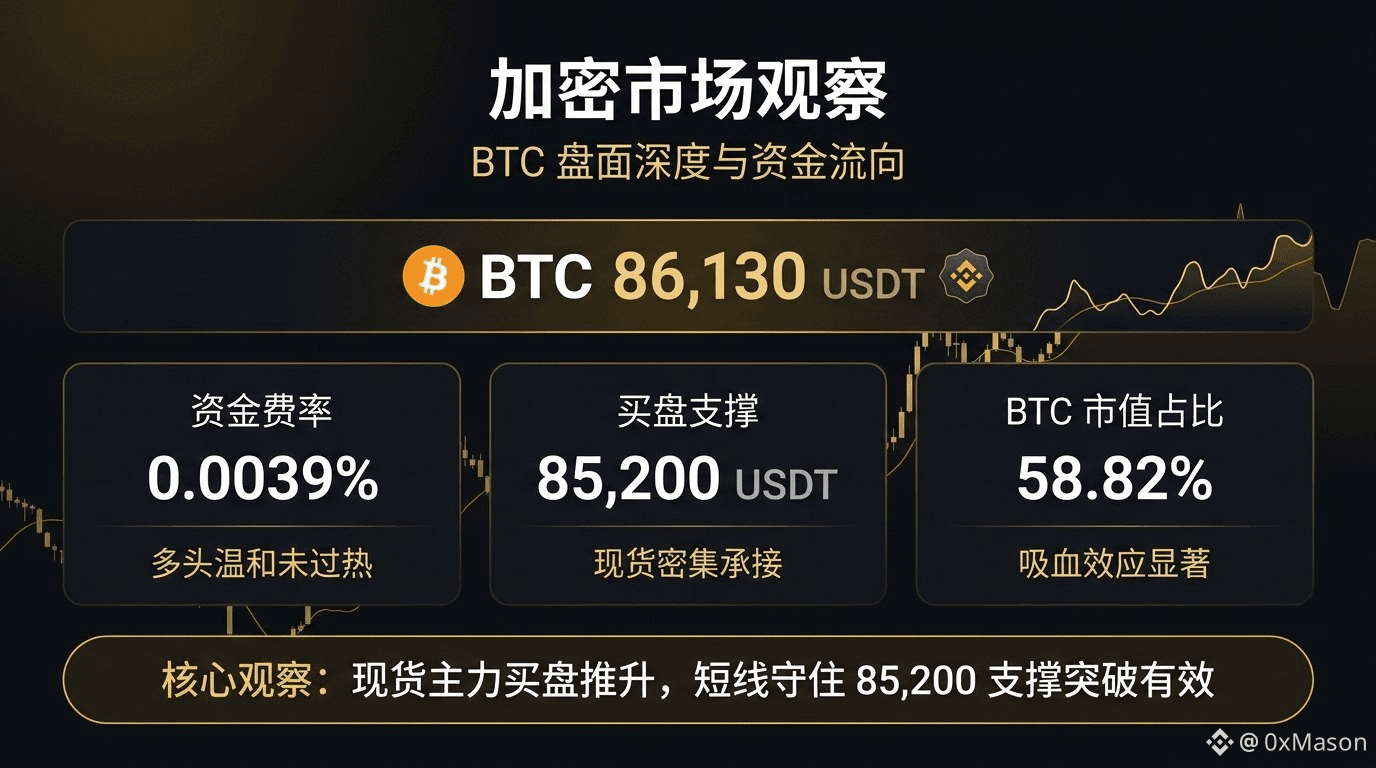
Someone holding $BTC placed spot orders on Binance tonight. The order book was tapped up to 86,130 USDT, breaking the previous high. With the fee rate at only 0.0039%, it suggests the longs haven’t gotten overheated yet—so for the short term, keep an eye on support at $85,200.
I just checked the BTC/USDT order book on Binance. Sell walls above $86,500 are spread out and not concentrated, while buy orders are all stacked between $85,200 and $85,500. As of the 2026-09-22 14:10 UTC snapshot, the 24-hour trading value is $2.04 billion USDT, and the annualized funding/position rate for the contracts is under 5%. This spike up was mainly bought up with real spot liquidity—no continuous short-liquidation “blow-ups” were seen.
All the capital is getting squeezed into Bitcoin. I switched to ETH/USDT and took a quick look: the quoted price is stuck around 2,749.01 USDT without much movement, and daily trading volume is only 1.075 billion USDT. Bitcoin’s market cap share has already risen to 58.82%, and the Fear & Greed Index reads 78. Altcoin pairs haven’t seen follow-through with incremental capital—everything is being pushed in one direction for a big “BTC pancake.”
For the short term, watch two key levels: first, whether a pullback can hold the $85,200 spot platform—breaking the structure would confirm the move; second, if it breaks down below $84,800 with volume, this run that tapped the high would likely revert back into the prior range.
$BTC
{spot}(BTCUSDT)
$ETH
{spot}(ETHUSDT)
#比特币突破5月高点逼近8.6万美元
Bitcoin breaks above $86,000 to briefly touch a high of $86,000+, with funding rates staying moderate, but the broader market’s “capital-draining” effect is evident
Someone holding $BTC placed spot orders on Binance tonight. The order book was tapped up to 86,130 USDT, breaking the previous high. With the fee rate at only 0.0039%, it suggests the longs haven’t gotten overheated yet—so for the short term, keep an eye on support at $85,200.
I just checked the BTC/USDT order book on Binance. Sell walls above $86,500 are spread out and not concentrated, while buy orders are all stacked between $85,200 and $85,500. As of the 2026-09-22 14:10 UTC snapshot, the 24-hour trading value is $2.04 billion USDT, and the annualized funding/position rate for the contracts is under 5%. This spike up was mainly bought up with real spot liquidity—no continuous short-liquidation “blow-ups” were seen.
All the capital is getting squeezed into Bitcoin. I switched to ETH/USDT and took a quick look: the quoted price is stuck around 2,749.01 USDT without much movement, and daily trading volume is only 1.075 billion USDT. Bitcoin’s market cap share has already risen to 58.82%, and the Fear & Greed Index reads 78. Altcoin pairs haven’t seen follow-through with incremental capital—everything is being pushed in one direction for a big “BTC pancake.”
For the short term, watch two key levels: first, whether a pullback can hold the $85,200 spot platform—breaking the structure would confirm the move; second, if it breaks down below $84,800 with volume, this run that tapped the high would likely revert back into the prior range.
$BTC
$ETH
#比特币突破5月高点逼近8.6万美元
Someone holding $BTC placed spot orders on Binance tonight. The order book was tapped up to 86,130 USDT, breaking the previous high. With the fee rate at only 0.0039%, it suggests the longs haven’t gotten overheated yet—so for the short term, keep an eye on support at $85,200.
I just checked the BTC/USDT order book on Binance. Sell walls above $86,500 are spread out and not concentrated, while buy orders are all stacked between $85,200 and $85,500. As of the 2026-09-22 14:10 UTC snapshot, the 24-hour trading value is $2.04 billion USDT, and the annualized funding/position rate for the contracts is under 5%. This spike up was mainly bought up with real spot liquidity—no continuous short-liquidation “blow-ups” were seen.
All the capital is getting squeezed into Bitcoin. I switched to ETH/USDT and took a quick look: the quoted price is stuck around 2,749.01 USDT without much movement, and daily trading volume is only 1.075 billion USDT. Bitcoin’s market cap share has already risen to 58.82%, and the Fear & Greed Index reads 78. Altcoin pairs haven’t seen follow-through with incremental capital—everything is being pushed in one direction for a big “BTC pancake.”
For the short term, watch two key levels: first, whether a pullback can hold the $85,200 spot platform—breaking the structure would confirm the move; second, if it breaks down below $84,800 with volume, this run that tapped the high would likely revert back into the prior range.
$BTC
$ETH
#比特币突破5月高点逼近8.6万美元
267
·
--
Binance Lists the Moonshot Pre-IPO Contract for “The Dark Side of the Moon” (MOONSHOT), Anchoring a 1 Billion-Share Expected Total Float in Hong Kong Equities
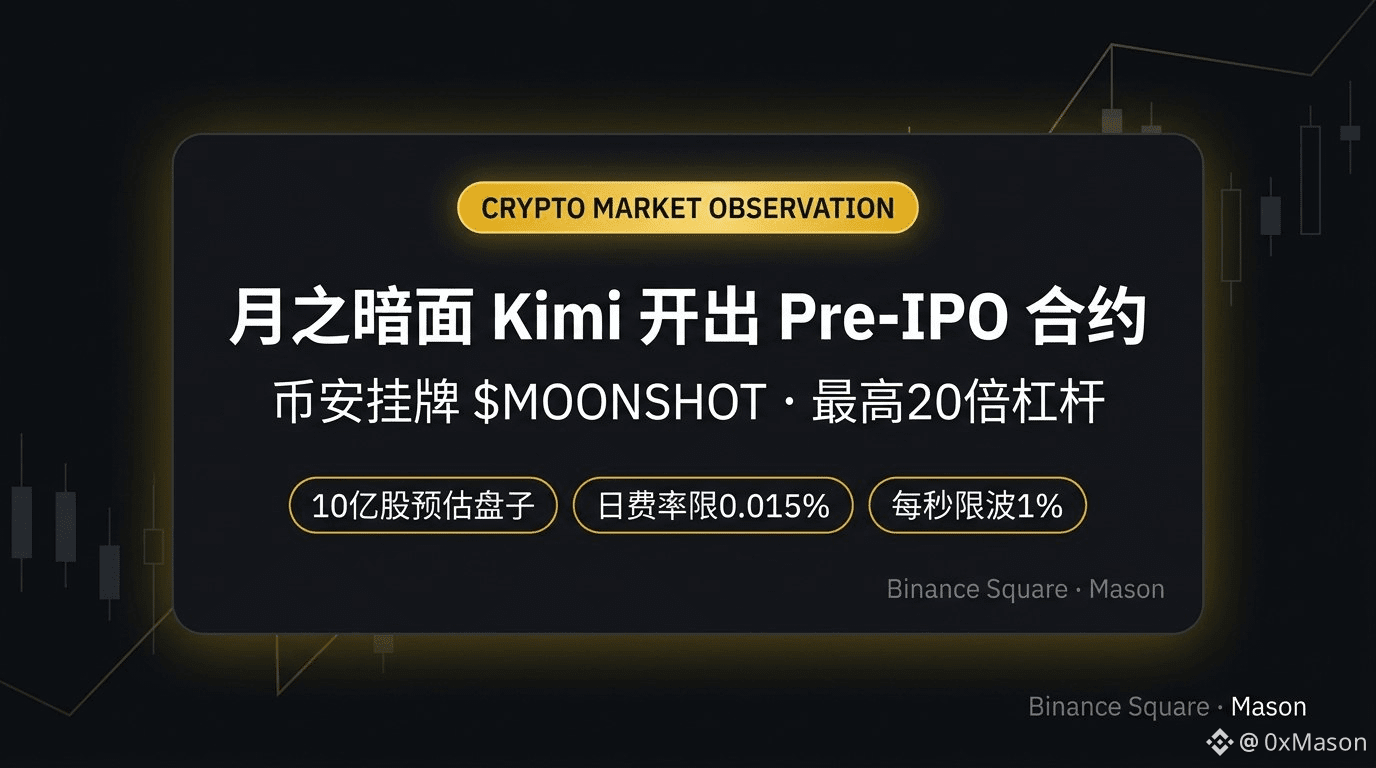
“The Dark Side of the Moon” hasn’t rang the bell in Hong Kong yet, but today Binance has already posted the $MOONSHOT order book, with leverage reaching up to 20x.
The underlying asset corresponds to “The Dark Side of the Moon” for a Kimi-style product. Binance calculates the notional using an estimated 1 billion shares as the float, with USDT settlement. Buying this does not give you real shares—it's purely a bet on how high the pre-listing valuation can be traded.
Since there is no spot position to anchor the contract during trading, Binance has set protective limits. The funding rate has an 8-hour cap of only +0.005%, and over a day the maximum interest is up to 0.015%. The mark price is also restricted to move by at most 1% per second, to prevent someone from deliberately “injecting” during thin order-book conditions to trigger liquidation.
I just checked the order book a moment ago—the bid-ask spread at launch is noticeably wider than for typical futures contracts. Also note that the “1 billion shares” is only a provisional multiplier; if the actual share count disclosed in the prospectus later differs, the official side will adjust the contract size proportionally.
Before the US market opens, all the funds are watching $NVDA, and domestic large-model derivatives just launched with very shallow liquidity. If you want to test the waters, place limit orders and let them queue slowly—never hit the market order to chase the spread.
$MOONSHOT
{future}(MOONSHOTUSDT)
$NVDA
{future}(NVDAUSDT)
#AI股持续上涨还有哪些投资机会
Binance Lists the Moonshot Pre-IPO Contract for “The Dark Side of the Moon” (MOONSHOT), Anchoring a 1 Billion-Share Expected Total Float in Hong Kong Equities
“The Dark Side of the Moon” hasn’t rang the bell in Hong Kong yet, but today Binance has already posted the $MOONSHOT order book, with leverage reaching up to 20x.
The underlying asset corresponds to “The Dark Side of the Moon” for a Kimi-style product. Binance calculates the notional using an estimated 1 billion shares as the float, with USDT settlement. Buying this does not give you real shares—it's purely a bet on how high the pre-listing valuation can be traded.
Since there is no spot position to anchor the contract during trading, Binance has set protective limits. The funding rate has an 8-hour cap of only +0.005%, and over a day the maximum interest is up to 0.015%. The mark price is also restricted to move by at most 1% per second, to prevent someone from deliberately “injecting” during thin order-book conditions to trigger liquidation.
I just checked the order book a moment ago—the bid-ask spread at launch is noticeably wider than for typical futures contracts. Also note that the “1 billion shares” is only a provisional multiplier; if the actual share count disclosed in the prospectus later differs, the official side will adjust the contract size proportionally.
Before the US market opens, all the funds are watching $NVDA , and domestic large-model derivatives just launched with very shallow liquidity. If you want to test the waters, place limit orders and let them queue slowly—never hit the market order to chase the spread.
$MOONSHOT
$NVDA
#AI股持续上涨还有哪些投资机会
“The Dark Side of the Moon” hasn’t rang the bell in Hong Kong yet, but today Binance has already posted the $MOONSHOT order book, with leverage reaching up to 20x.
The underlying asset corresponds to “The Dark Side of the Moon” for a Kimi-style product. Binance calculates the notional using an estimated 1 billion shares as the float, with USDT settlement. Buying this does not give you real shares—it's purely a bet on how high the pre-listing valuation can be traded.
Since there is no spot position to anchor the contract during trading, Binance has set protective limits. The funding rate has an 8-hour cap of only +0.005%, and over a day the maximum interest is up to 0.015%. The mark price is also restricted to move by at most 1% per second, to prevent someone from deliberately “injecting” during thin order-book conditions to trigger liquidation.
I just checked the order book a moment ago—the bid-ask spread at launch is noticeably wider than for typical futures contracts. Also note that the “1 billion shares” is only a provisional multiplier; if the actual share count disclosed in the prospectus later differs, the official side will adjust the contract size proportionally.
Before the US market opens, all the funds are watching $NVDA , and domestic large-model derivatives just launched with very shallow liquidity. If you want to test the waters, place limit orders and let them queue slowly—never hit the market order to chase the spread.
$MOONSHOT
$NVDA
#AI股持续上涨还有哪些投资机会
427
·
--
TQQQB and SQQQB will have a snapshot dividend at 8:00 AM tomorrow. Cash net proceeds will be converted directly into shares credited to your account
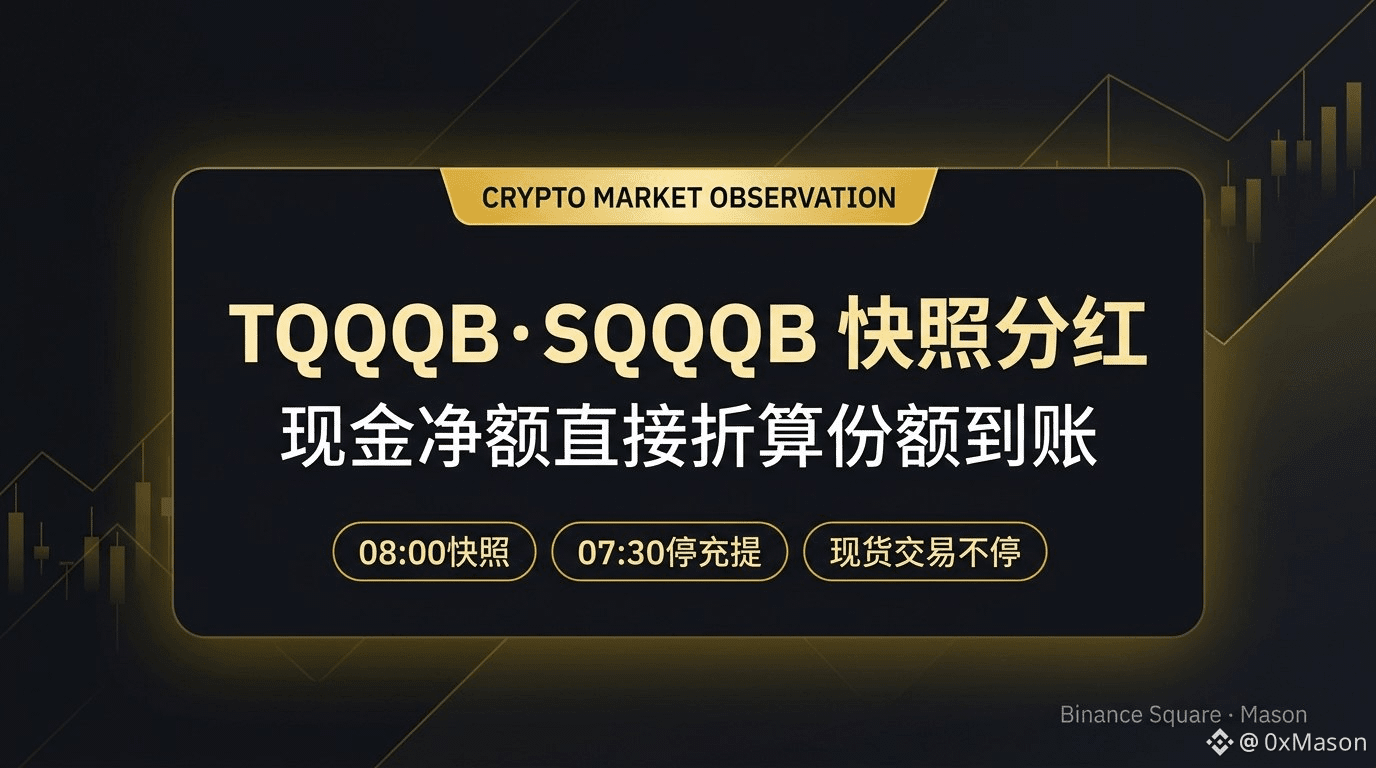
If you hold $TQQQB or short $SQQQB , please pay attention tonight: there will be a cash dividend snapshot on Binance at 8:00 AM tomorrow.
The dividend will be credited in the form of fractional shares directly—no USD cash will be distributed. After deducting a 30% withholding tax, the system will convert it at the market price into the corresponding bStocks share amounts and credit them to your spot account. Spot, margin, and Earn-on-Coin’s flexible savings holdings are all included.
Deposits/withdrawals and share conversions will be paused at 07:30 tomorrow (23:30 UTC), including 1:1 share conversion and Convert via the Instant Exchange. Intraday spot trading is not affected, and the TQQQB/USDT trading pair will continue to match as usual.
I just checked the Instant Exchange page a moment ago—the maintenance notice has already been posted. If you’re still waiting for external deposits to arrive, it’s definitely too late. If you really want to get the dividend, you can only place a limit order directly on the order book to buy.
Daily decay applies to 3x leveraged ETFs. It’s not necessary to hard-carry overnight just to capture the dividend. If you already have them in your “car,” just hold and wait for the payout.
$TQQQB
{spot}(TQQQBUSDT)
#AI股持续上涨还有哪些投资机会
TQQQB and SQQQB will have a snapshot dividend at 8:00 AM tomorrow. Cash net proceeds will be converted directly into shares credited to your account
If you hold $TQQQB or short $SQQQB , please pay attention tonight: there will be a cash dividend snapshot on Binance at 8:00 AM tomorrow.
The dividend will be credited in the form of fractional shares directly—no USD cash will be distributed. After deducting a 30% withholding tax, the system will convert it at the market price into the corresponding bStocks share amounts and credit them to your spot account. Spot, margin, and Earn-on-Coin’s flexible savings holdings are all included.
Deposits/withdrawals and share conversions will be paused at 07:30 tomorrow (23:30 UTC), including 1:1 share conversion and Convert via the Instant Exchange. Intraday spot trading is not affected, and the TQQQB/USDT trading pair will continue to match as usual.
I just checked the Instant Exchange page a moment ago—the maintenance notice has already been posted. If you’re still waiting for external deposits to arrive, it’s definitely too late. If you really want to get the dividend, you can only place a limit order directly on the order book to buy.
Daily decay applies to 3x leveraged ETFs. It’s not necessary to hard-carry overnight just to capture the dividend. If you already have them in your “car,” just hold and wait for the payout.
$TQQQB
#AI股持续上涨还有哪些投资机会
If you hold $TQQQB or short $SQQQB , please pay attention tonight: there will be a cash dividend snapshot on Binance at 8:00 AM tomorrow.
The dividend will be credited in the form of fractional shares directly—no USD cash will be distributed. After deducting a 30% withholding tax, the system will convert it at the market price into the corresponding bStocks share amounts and credit them to your spot account. Spot, margin, and Earn-on-Coin’s flexible savings holdings are all included.
Deposits/withdrawals and share conversions will be paused at 07:30 tomorrow (23:30 UTC), including 1:1 share conversion and Convert via the Instant Exchange. Intraday spot trading is not affected, and the TQQQB/USDT trading pair will continue to match as usual.
I just checked the Instant Exchange page a moment ago—the maintenance notice has already been posted. If you’re still waiting for external deposits to arrive, it’s definitely too late. If you really want to get the dividend, you can only place a limit order directly on the order book to buy.
Daily decay applies to 3x leveraged ETFs. It’s not necessary to hard-carry overnight just to capture the dividend. If you already have them in your “car,” just hold and wait for the payout.
$TQQQB
#AI股持续上涨还有哪些投资机会
1
352
·
--
Binance 9/25 removes 7 USDC spot pairs: what’s taken down is the pair, not the coin
On September 25 at 11:00 (Taipei time), Binance will shut down seven spot pairs: AIXBT/USDC, DOLO/USDC, ENJ/USDC, HUMA/USDC, SXT/USDC, TNSR/USDC, and TURTLE/USDC. The spot trading bots placed on these pairs will also be turned off.
Don’t interpret it as “these coins will disappear from Binance.” Multiple news alerts that match this are pointing to the withdrawal of the trading pairs; the tokens themselves can probably still trade on other spot pairs. What you really need to watch out for is the grid/bot: if it isn’t shut down in time, when the scheduled time comes and you don’t stop it early, it might be forcibly suspended.
If you still have open orders or bots in your account for these USDC pairs, just clear them out before Wednesday morning. Don’t turn “delisting 7 pairs” into a weekend panic/evacuation signal.
Binance 9/25 removes 7 USDC spot pairs: what’s taken down is the pair, not the coin
On September 25 at 11:00 (Taipei time), Binance will shut down seven spot pairs: AIXBT/USDC, DOLO/USDC, ENJ/USDC, HUMA/USDC, SXT/USDC, TNSR/USDC, and TURTLE/USDC. The spot trading bots placed on these pairs will also be turned off.
Don’t interpret it as “these coins will disappear from Binance.” Multiple news alerts that match this are pointing to the withdrawal of the trading pairs; the tokens themselves can probably still trade on other spot pairs. What you really need to watch out for is the grid/bot: if it isn’t shut down in time, when the scheduled time comes and you don’t stop it early, it might be forcibly suspended.
If you still have open orders or bots in your account for these USDC pairs, just clear them out before Wednesday morning. Don’t turn “delisting 7 pairs” into a weekend panic/evacuation signal.
On September 25 at 11:00 (Taipei time), Binance will shut down seven spot pairs: AIXBT/USDC, DOLO/USDC, ENJ/USDC, HUMA/USDC, SXT/USDC, TNSR/USDC, and TURTLE/USDC. The spot trading bots placed on these pairs will also be turned off.
Don’t interpret it as “these coins will disappear from Binance.” Multiple news alerts that match this are pointing to the withdrawal of the trading pairs; the tokens themselves can probably still trade on other spot pairs. What you really need to watch out for is the grid/bot: if it isn’t shut down in time, when the scheduled time comes and you don’t stop it early, it might be forcibly suspended.
If you still have open orders or bots in your account for these USDC pairs, just clear them out before Wednesday morning. Don’t turn “delisting 7 pairs” into a weekend panic/evacuation signal.
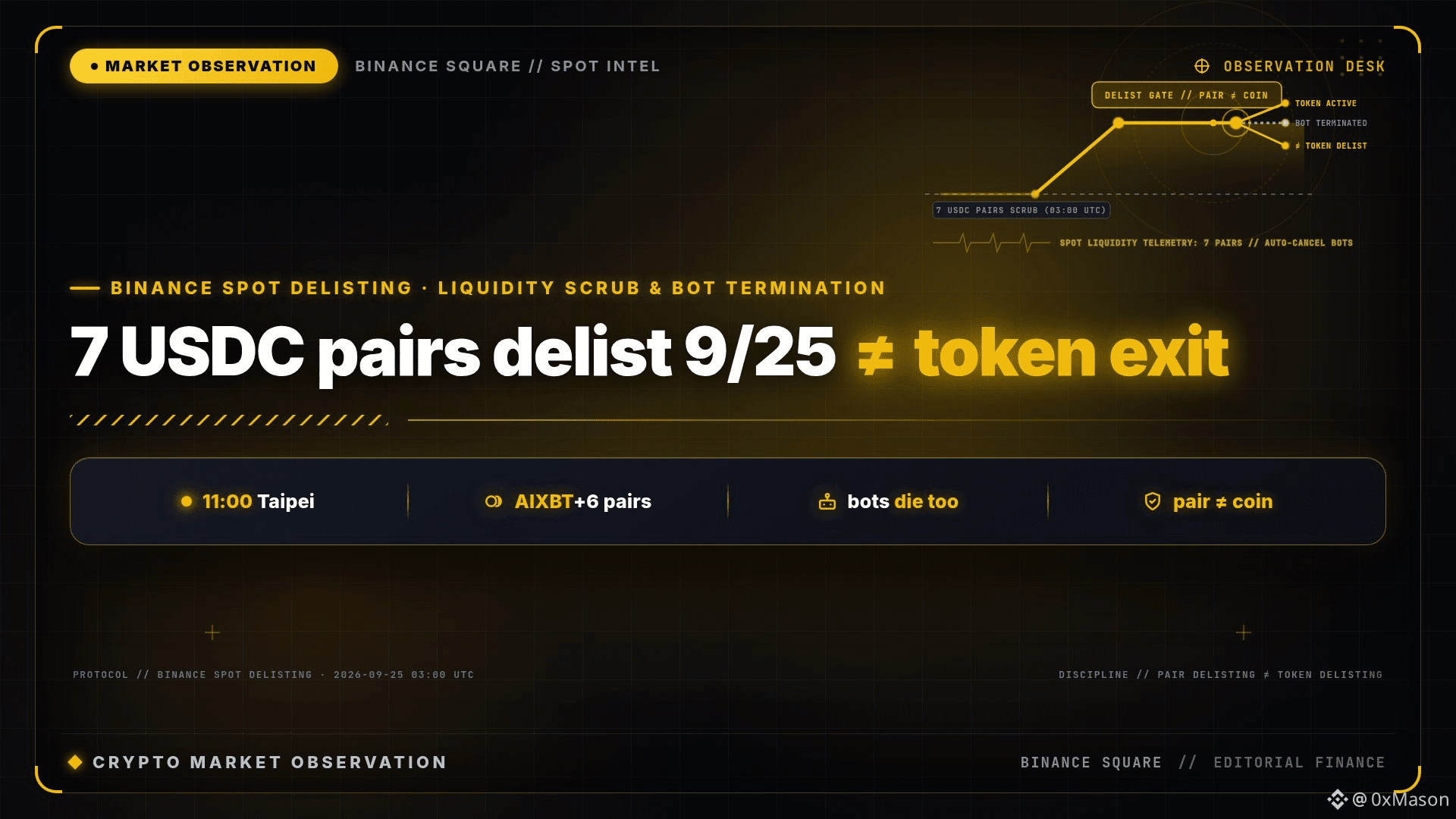
1
426
·
--
Hana’s $100M digital bond on Euroclear: T+0 doesn’t mean you can buy on-chain
For settling South Korea’s foreign-currency bonds, it’s common to require an additional 3–5 business days. But with Hana Bank’s $100 million five-year digital bond, settlement is completed on the same day.
It uses Euroclear’s D-FMI distributed ledger settlement track, with Standard Chartered as the exclusive lead arranger. The documentation follows its existing global medium-term note (GMTN) framework. Institutions can subscribe using their original Euroclear accounts—no need to set up a separate on-chain wallet system. Korean financial institutions issuing directly on Euroclear’s own blockchain infrastructure is, according to the public record, a first.
What you can’t quite “click and buy” is: this is a digitally native note for institutional settlement. It’s not the kind of token you can chase off a social media headline. Without Euroclear access, you generally can’t get in. Don’t take “T+0” to mean a retail on-chain airdrop window.
Just remember the deal speeds up settlement—don’t assume it’s a new offering you can scan for in next week’s app.
Hana’s $100M digital bond on Euroclear: T+0 doesn’t mean you can buy on-chain
For settling South Korea’s foreign-currency bonds, it’s common to require an additional 3–5 business days. But with Hana Bank’s $100 million five-year digital bond, settlement is completed on the same day.
It uses Euroclear’s D-FMI distributed ledger settlement track, with Standard Chartered as the exclusive lead arranger. The documentation follows its existing global medium-term note (GMTN) framework. Institutions can subscribe using their original Euroclear accounts—no need to set up a separate on-chain wallet system. Korean financial institutions issuing directly on Euroclear’s own blockchain infrastructure is, according to the public record, a first.
What you can’t quite “click and buy” is: this is a digitally native note for institutional settlement. It’s not the kind of token you can chase off a social media headline. Without Euroclear access, you generally can’t get in. Don’t take “T+0” to mean a retail on-chain airdrop window.
Just remember the deal speeds up settlement—don’t assume it’s a new offering you can scan for in next week’s app.
For settling South Korea’s foreign-currency bonds, it’s common to require an additional 3–5 business days. But with Hana Bank’s $100 million five-year digital bond, settlement is completed on the same day.
It uses Euroclear’s D-FMI distributed ledger settlement track, with Standard Chartered as the exclusive lead arranger. The documentation follows its existing global medium-term note (GMTN) framework. Institutions can subscribe using their original Euroclear accounts—no need to set up a separate on-chain wallet system. Korean financial institutions issuing directly on Euroclear’s own blockchain infrastructure is, according to the public record, a first.
What you can’t quite “click and buy” is: this is a digitally native note for institutional settlement. It’s not the kind of token you can chase off a social media headline. Without Euroclear access, you generally can’t get in. Don’t take “T+0” to mean a retail on-chain airdrop window.
Just remember the deal speeds up settlement—don’t assume it’s a new offering you can scan for in next week’s app.
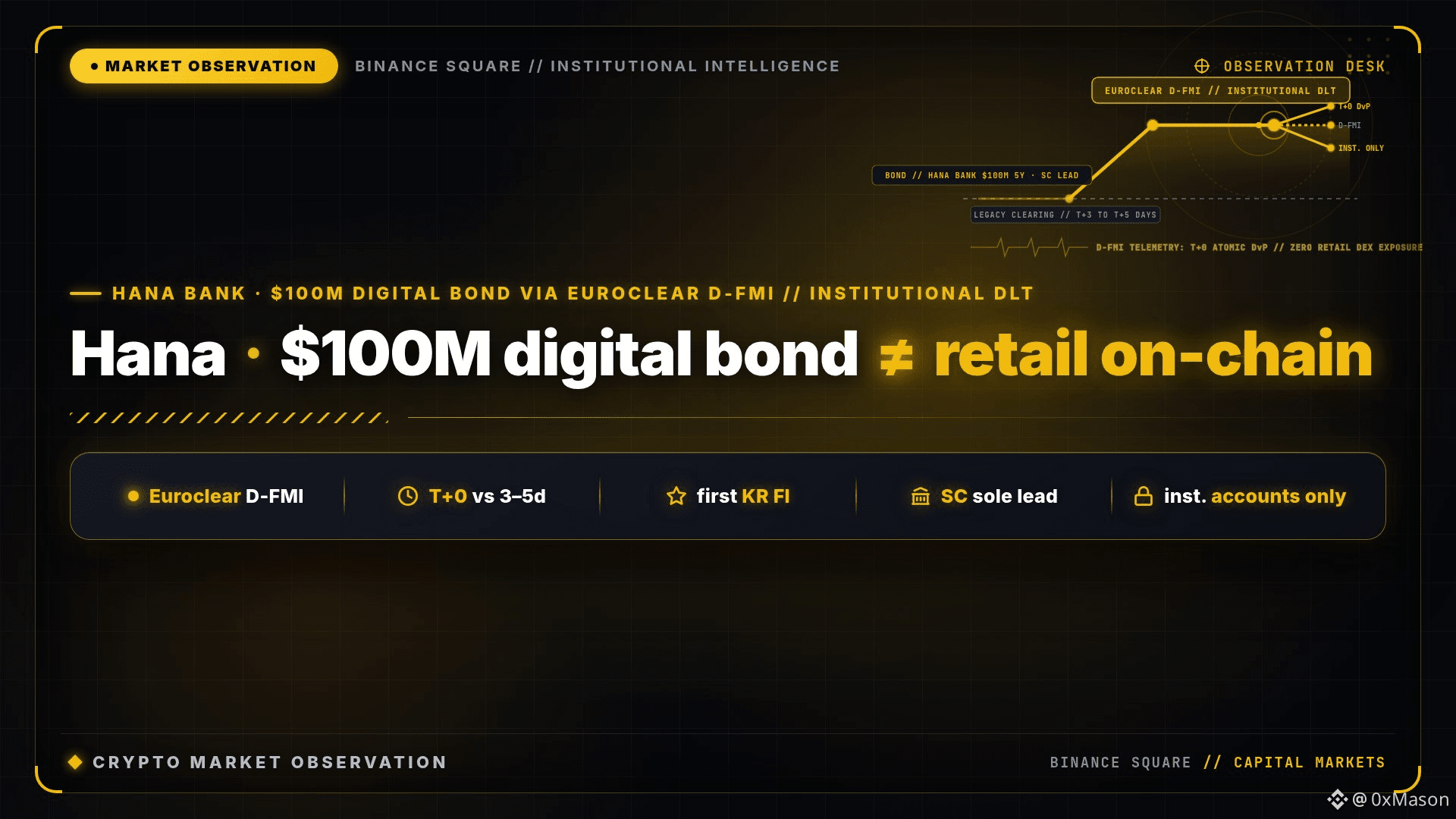
24
·
--
Binance TQQQB/SQQQB Freeze for tonight: trading is still open ≠ you can still swap or deposit/withdraw
These TQQQB and SQQQB batches are not fully frozen yet: Binance says that starting from 23:30 UTC on September 22, conversions and deposits/withdrawals for the TQQQ↔️TQQQB and SQQQ↔️SQQQB pairs will be paused first—while the trading pair itself is still open. Don’t confuse “can be matched” with “can still be swapped” or “can still be deposited/withdrawn.”
The same announcement is essentially split into two rounds: for SOXSB and MUUB, the record-date snapshots are 00:00 UTC on September 22, and conversions and deposits/withdrawals were frozen at 23:30 UTC yesterday. For TQQQB and SQQQB, the record date only takes effect at 00:00 UTC on September 23. After dividends’ net amount is reduced by taxes and fees, it’s reinvested into extra units (or fractional shares) of the same underlying. What you receive goes into your spot account as bStocks—not into your US stock account as an extra share.
What you can’t get is the “direct shareholding”: the announcement explicitly states that this is a certificate under the ADGM prospectus channel, not the listed shares themselves—so your region may not be able to access it. Dividends from holdings in accounts such as wealth management or leveraged accounts will also be allocated to the spot account first.
That freezing countdown tonight matters more than the dividend copy—if you hold TQQQB/SQQQB and plan to swap or withdraw, don’t bet against the notice.
$TQQQ
{future}(TQQQUSDT)
$SQQQB
{spot}(SQQQBUSDT)
Binance TQQQB/SQQQB Freeze for tonight: trading is still open ≠ you can still swap or deposit/withdraw
These TQQQB and SQQQB batches are not fully frozen yet: Binance says that starting from 23:30 UTC on September 22, conversions and deposits/withdrawals for the TQQQ↔️TQQQB and SQQQ↔️SQQQB pairs will be paused first—while the trading pair itself is still open. Don’t confuse “can be matched” with “can still be swapped” or “can still be deposited/withdrawn.”
The same announcement is essentially split into two rounds: for SOXSB and MUUB, the record-date snapshots are 00:00 UTC on September 22, and conversions and deposits/withdrawals were frozen at 23:30 UTC yesterday. For TQQQB and SQQQB, the record date only takes effect at 00:00 UTC on September 23. After dividends’ net amount is reduced by taxes and fees, it’s reinvested into extra units (or fractional shares) of the same underlying. What you receive goes into your spot account as bStocks—not into your US stock account as an extra share.
What you can’t get is the “direct shareholding”: the announcement explicitly states that this is a certificate under the ADGM prospectus channel, not the listed shares themselves—so your region may not be able to access it. Dividends from holdings in accounts such as wealth management or leveraged accounts will also be allocated to the spot account first.
That freezing countdown tonight matters more than the dividend copy—if you hold TQQQB/SQQQB and plan to swap or withdraw, don’t bet against the notice.
$TQQQ
$SQQQB
These TQQQB and SQQQB batches are not fully frozen yet: Binance says that starting from 23:30 UTC on September 22, conversions and deposits/withdrawals for the TQQQ↔️TQQQB and SQQQ↔️SQQQB pairs will be paused first—while the trading pair itself is still open. Don’t confuse “can be matched” with “can still be swapped” or “can still be deposited/withdrawn.”
The same announcement is essentially split into two rounds: for SOXSB and MUUB, the record-date snapshots are 00:00 UTC on September 22, and conversions and deposits/withdrawals were frozen at 23:30 UTC yesterday. For TQQQB and SQQQB, the record date only takes effect at 00:00 UTC on September 23. After dividends’ net amount is reduced by taxes and fees, it’s reinvested into extra units (or fractional shares) of the same underlying. What you receive goes into your spot account as bStocks—not into your US stock account as an extra share.
What you can’t get is the “direct shareholding”: the announcement explicitly states that this is a certificate under the ADGM prospectus channel, not the listed shares themselves—so your region may not be able to access it. Dividends from holdings in accounts such as wealth management or leveraged accounts will also be allocated to the spot account first.
That freezing countdown tonight matters more than the dividend copy—if you hold TQQQB/SQQQB and plan to swap or withdraw, don’t bet against the notice.
$TQQQ
$SQQQB
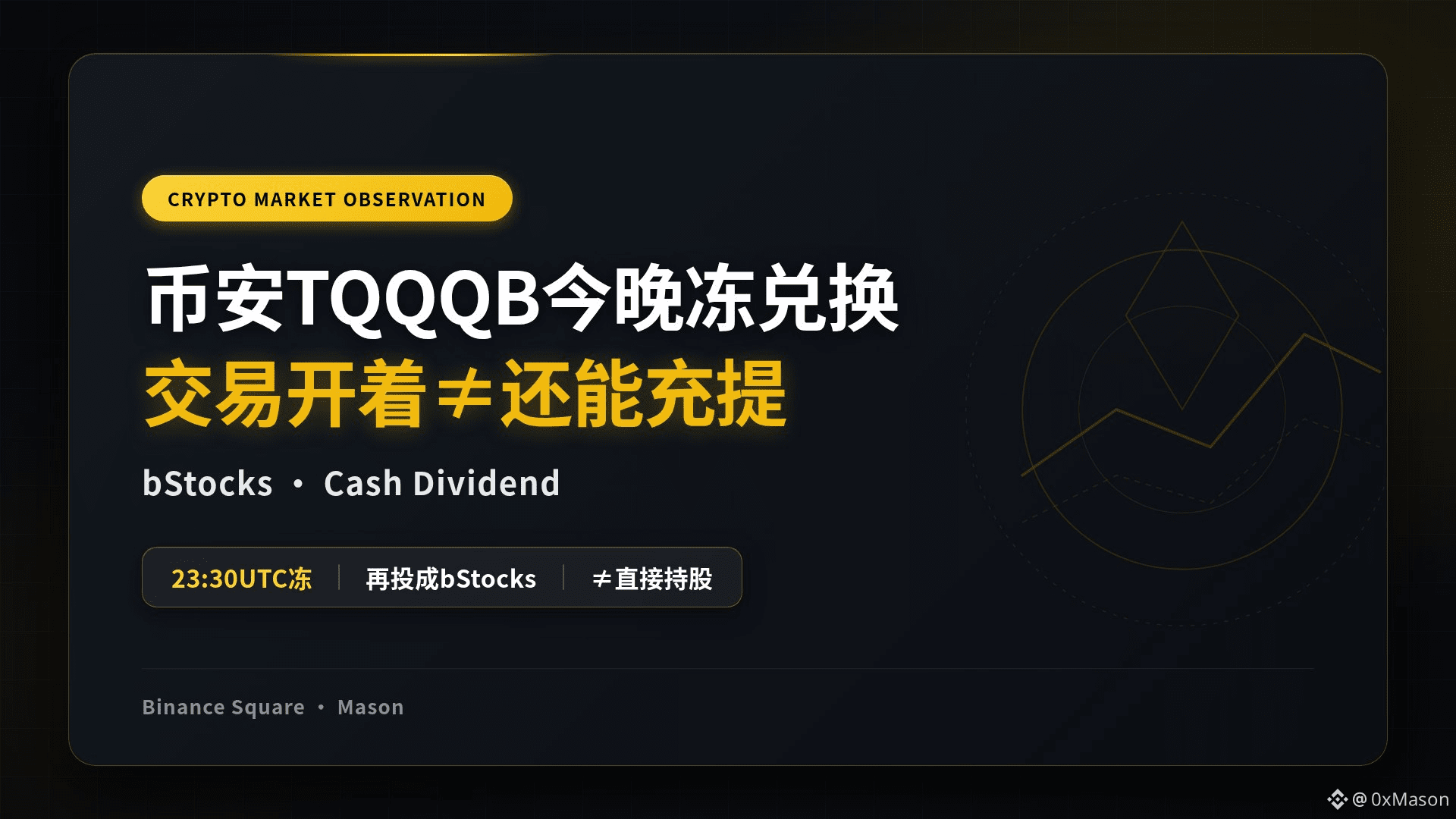
467
·
--
Trueo moves Ethereum L1: Chain-migration announcement ≠ “blow-up” entry
News headlines about the migration mainnet are stuffed with “10x surge”—that’s market noise. The real story is that Trueo is expected to move from Base to Ethereum L1.
Official statements: during the migration period, trading, settlement, and redemptions on Base will continue as usual. At the same time, they suggest not opening any new markets on Base that have expiration dates later than January 31, 2027. As for the token migration window, what they wrote is that it will remain open long-term—not a time-limited 48-hour airdrop window. Vitalik publicly called it out by name, praising its decentralization and ethical orientation—not drawing you a profit curve.
What you can’t actually get is “hop on by following the like-price”: a chain-migration announcement doesn’t mean the L1 order book has already paved the way for you. The documentation may also show Base contract addresses—if you click the wrong chain or chase the wrong position, you’ll end up paying more than if you simply missed a round of volatility. And these clickbait headline “surge” percentages aren’t copy-paste entry conditions.
I’ll just record this as basic infrastructure moving—not as take-signal trading material.
$ETH
{spot}(ETHUSDT)
Trueo moves Ethereum L1: Chain-migration announcement ≠ “blow-up” entry
News headlines about the migration mainnet are stuffed with “10x surge”—that’s market noise. The real story is that Trueo is expected to move from Base to Ethereum L1.
Official statements: during the migration period, trading, settlement, and redemptions on Base will continue as usual. At the same time, they suggest not opening any new markets on Base that have expiration dates later than January 31, 2027. As for the token migration window, what they wrote is that it will remain open long-term—not a time-limited 48-hour airdrop window. Vitalik publicly called it out by name, praising its decentralization and ethical orientation—not drawing you a profit curve.
What you can’t actually get is “hop on by following the like-price”: a chain-migration announcement doesn’t mean the L1 order book has already paved the way for you. The documentation may also show Base contract addresses—if you click the wrong chain or chase the wrong position, you’ll end up paying more than if you simply missed a round of volatility. And these clickbait headline “surge” percentages aren’t copy-paste entry conditions.
I’ll just record this as basic infrastructure moving—not as take-signal trading material.
$ETH
News headlines about the migration mainnet are stuffed with “10x surge”—that’s market noise. The real story is that Trueo is expected to move from Base to Ethereum L1.
Official statements: during the migration period, trading, settlement, and redemptions on Base will continue as usual. At the same time, they suggest not opening any new markets on Base that have expiration dates later than January 31, 2027. As for the token migration window, what they wrote is that it will remain open long-term—not a time-limited 48-hour airdrop window. Vitalik publicly called it out by name, praising its decentralization and ethical orientation—not drawing you a profit curve.
What you can’t actually get is “hop on by following the like-price”: a chain-migration announcement doesn’t mean the L1 order book has already paved the way for you. The documentation may also show Base contract addresses—if you click the wrong chain or chase the wrong position, you’ll end up paying more than if you simply missed a round of volatility. And these clickbait headline “surge” percentages aren’t copy-paste entry conditions.
I’ll just record this as basic infrastructure moving—not as take-signal trading material.
$ETH
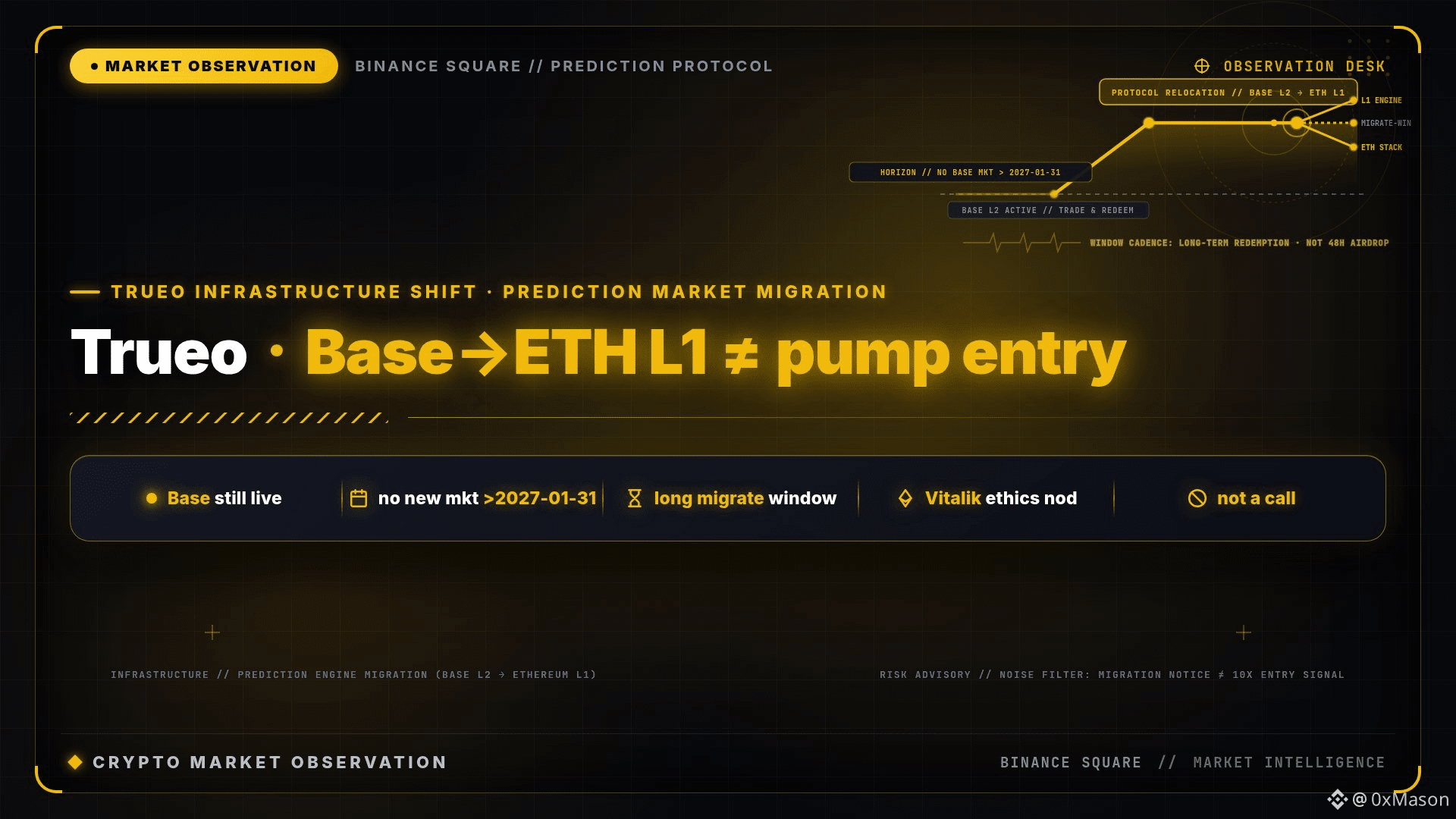
125
·
--
Balancer Official Fork Proposal: Tokenized Stock Exchange ≠ Settlement Airdrop
On the Balancer forum, there are two proposals lying side by side: one calls for a orderly shutdown, with about $9 million in Treasury distributed to people who burn BAL; the other, led by MAXYZ, proposes an official fork into “Tokenized Stock Exchange”—don’t assume it’s like $BAL , where a new token is about to be issued right away.
The fork proposal is very specific: roughly 6 million BAL that are still not circulating (about $690,000) as the seed; the pools and the Vault can be delayed at most until Q2 2027 before being paused; what’s being changed is that if there is a future TGE, 10% of FDV is reserved for the Balancer treasury. Official X also said this is independent of the settlement proposal, and it was only posted to Snapshot around the weekend.
What you definitely can’t get is the “lock and wait for an airdrop”: the seed is non-circulating BAL allocated to the fork entity, not an airdrop based on holdings. For the settlement proposal to pass, participants would need to burn BAL to claim share of the profits. The two outcomes are mutually exclusive, and both are still before the vote. TVL is roughly still around $57 million; the migration window is written into the proposal—however, a window isn’t a guarantee of value.
Until the weekend’s vote comes out, I’ll treat this as governance documentation changing pages, not as a story trigger.
$BAL
Balancer Official Fork Proposal: Tokenized Stock Exchange ≠ Settlement Airdrop
On the Balancer forum, there are two proposals lying side by side: one calls for a orderly shutdown, with about $9 million in Treasury distributed to people who burn BAL; the other, led by MAXYZ, proposes an official fork into “Tokenized Stock Exchange”—don’t assume it’s like $BAL , where a new token is about to be issued right away.
The fork proposal is very specific: roughly 6 million BAL that are still not circulating (about $690,000) as the seed; the pools and the Vault can be delayed at most until Q2 2027 before being paused; what’s being changed is that if there is a future TGE, 10% of FDV is reserved for the Balancer treasury. Official X also said this is independent of the settlement proposal, and it was only posted to Snapshot around the weekend.
What you definitely can’t get is the “lock and wait for an airdrop”: the seed is non-circulating BAL allocated to the fork entity, not an airdrop based on holdings. For the settlement proposal to pass, participants would need to burn BAL to claim share of the profits. The two outcomes are mutually exclusive, and both are still before the vote. TVL is roughly still around $57 million; the migration window is written into the proposal—however, a window isn’t a guarantee of value.
Until the weekend’s vote comes out, I’ll treat this as governance documentation changing pages, not as a story trigger.
$BAL
On the Balancer forum, there are two proposals lying side by side: one calls for a orderly shutdown, with about $9 million in Treasury distributed to people who burn BAL; the other, led by MAXYZ, proposes an official fork into “Tokenized Stock Exchange”—don’t assume it’s like $BAL , where a new token is about to be issued right away.
The fork proposal is very specific: roughly 6 million BAL that are still not circulating (about $690,000) as the seed; the pools and the Vault can be delayed at most until Q2 2027 before being paused; what’s being changed is that if there is a future TGE, 10% of FDV is reserved for the Balancer treasury. Official X also said this is independent of the settlement proposal, and it was only posted to Snapshot around the weekend.
What you definitely can’t get is the “lock and wait for an airdrop”: the seed is non-circulating BAL allocated to the fork entity, not an airdrop based on holdings. For the settlement proposal to pass, participants would need to burn BAL to claim share of the profits. The two outcomes are mutually exclusive, and both are still before the vote. TVL is roughly still around $57 million; the migration window is written into the proposal—however, a window isn’t a guarantee of value.
Until the weekend’s vote comes out, I’ll treat this as governance documentation changing pages, not as a story trigger.
$BAL
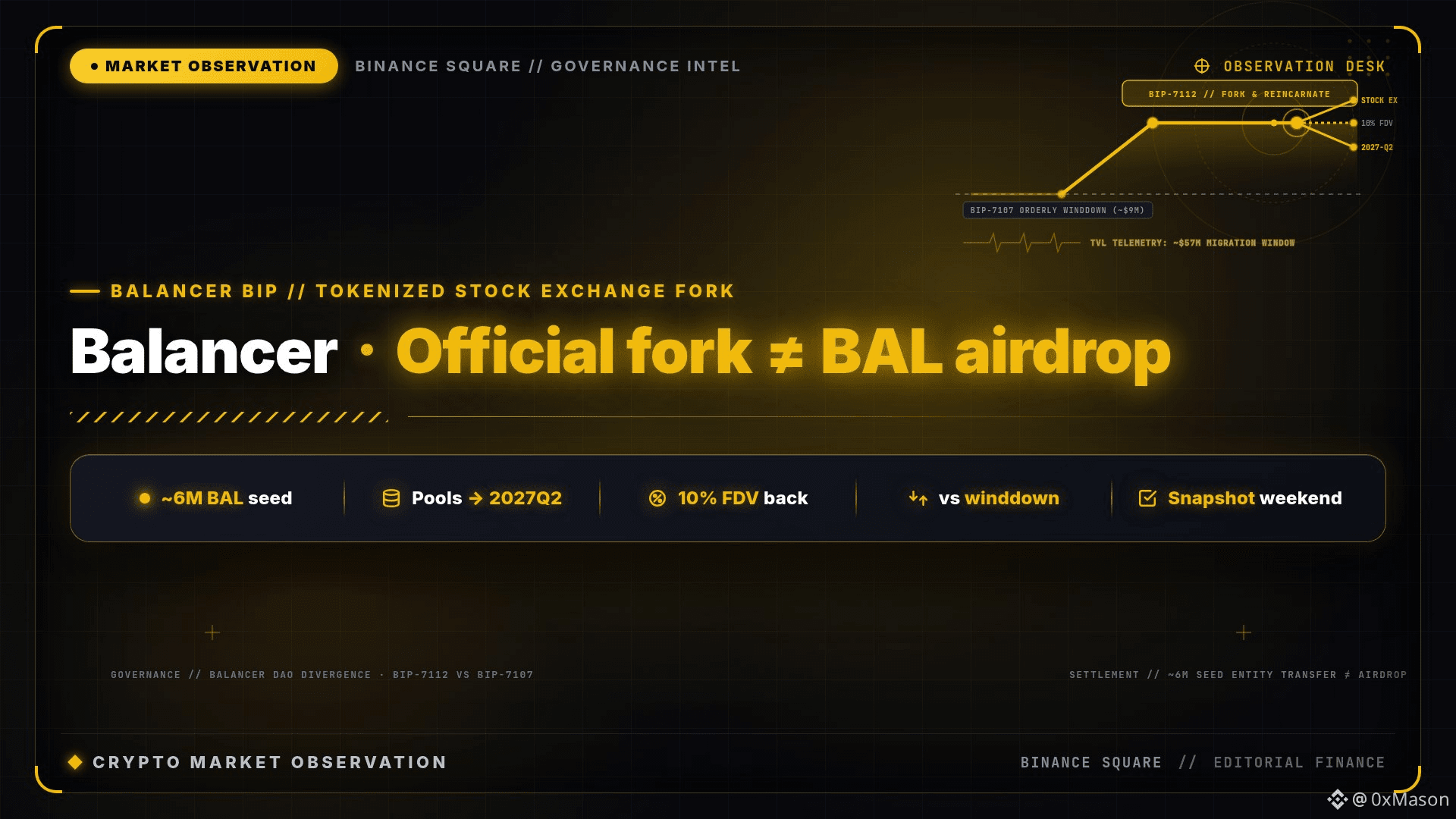
60
Log in to explore more content
Join global crypto users on Binance Square
⚡️ Get latest and useful information about crypto.
💬 Trusted by the world’s largest crypto exchange.
👍 Discover real insights from verified creators.
Email / Phone number
Trending Topics
NvidiaApproves$150BBuyback
1,178 views
30 Discussing
#NvidiaApproves$150BBuyback
Nvidia’s $150 Billion Buyback Shockwave: Is AI Cash Flow Driving the Next Market Rally? 🚀
The AI supercycle just sent shockwaves across tradfi and crypto markets! NVIDIA's Board of Directors authorized a massive $150 Billion increase to its share repurchase program, expanding the company's total remaining buyback authorization to $235 Billion.
This marks the largest share buyback authorization in U.S. corporate history, surpassing Apple’s $110 billion benchmark.
📰 Key Headlines & Market Breakdown
Record-Breaking Capital Return: NVIDIA founder and CEO Jensen Huang cited "once-in-a-generation platform shift to AI" and strong corporate cash flow as the main drivers behind returning capital to shareholders.
Defying Market Downturns: Despite broader equity pressure and rising U.S. Treasury yields, $NVDA shares surged over 3% on the announcement, showing institutional confidence in tech assets.
Spillover into Decentralized AI: Historically, major bullish headlines for NVIDIA trigger positive sentiment for decentralized AI infrastructure protocols (such as NEAR, RENDER, and FET), as web3 AI projects track broader AI sector valuations.
❓ Discussion Point
Nvidia announces a massive $150B buyback! Will tech stock gains bleed over into Bitcoin and AI tokens?
$RENDER
📊 Related Crypto Trade Signal: RENDER/USDT
Trade Bias: Bullish
Entry Zone: $5.20 – $5.45
Target 1 (TP1): $6.10
Target 2 (TP2): $6.85
Stop Loss (SL): $4.85
Leverage (Futures): 3x – 5x (Isolated)
Technical Rationale: RENDER tends to react strongly to Nvidia hardware and AI capital developments. Price is consolidating near key moving average support with rising spot volume following the $NVDAB
news.
#HackersDrainOver12.4MXRPFromDCENTWallets #CryptoNews #AITokens #TradingSignals
Lily星星
·1 Likes
·96 views
OpenAIDelaysGPT6.1OverSafetyIssues
5,265 views
251 Discussing
AMDToAcquireWorldLabsFor$8.2B
788 views
28 Discussing