
What real dangers does Bitcoin face from AI, quantum computing, and the proof of the Riemann Hypothesis? 🔬⚡

Whenever a disruptive advance in mathematics or computing occurs, financial headlines react with the same conditioned reflex: declaring Bitcoin’s imminent death. In recent weeks, three technological fronts have fueled a new wave of media hype: the formal verification in Lean 4 of an AI-assisted proof of the Riemann Hypothesis, a dramatic reduction in the estimated physical resources needed to break elliptic curves using quantum computing, and the deployment of AI agents capable of compromising mining infrastructure.
To trade and invest with professional judgment, it is essential to separate superficial panic from real engineering. Below, we technically audit each of these three vectors to determine what genuinely threatens the network and what is mere media theater.
📐 1. The Riemann Hypothesis and the Claude/Lean proof: Is cryptography falling?
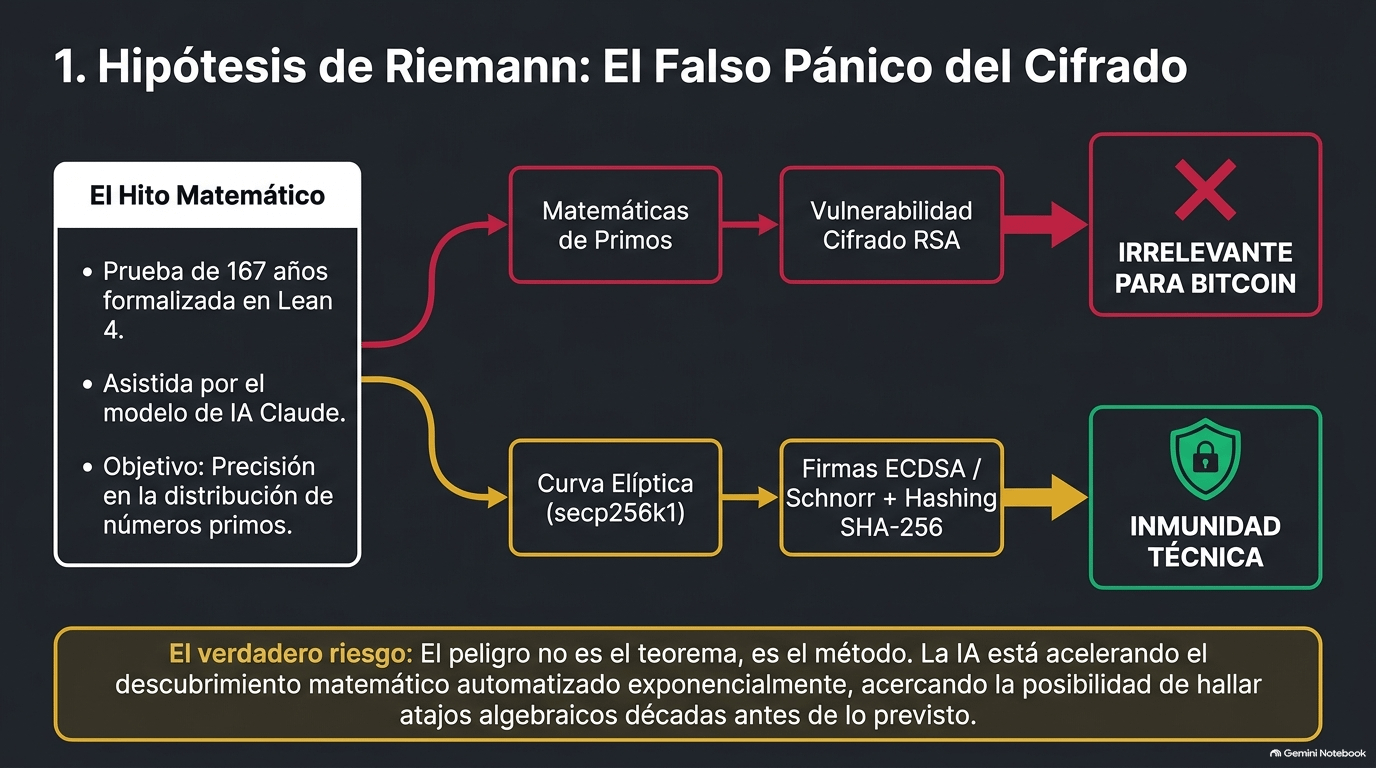
On November 20, 2026, mathematician Levent Alpöge (a researcher at Anthropic), assisted by the Claude model, presented a formalization in the Lean 4 proof assistant—certified by the Lean and Mathlib communities, though still pending a full human peer review—to solve the Riemann Hypothesis, an open problem for 167 years.
Why does it NOT directly break Bitcoin?
Bitcoin does not use RSA: The initial panic stems from associating prime numbers with RSA encryption. However, even if the proof is fully confirmed, knowing the asymptotic distribution of primes does not provide a polynomial-time algorithm for factoring giant semiprimes. More importantly, Bitcoin does not use RSA at any layer of its protocol.
Bitcoin’s mathematical architecture is different: Ownership of Bitcoin funds rests on Elliptic Curve Cryptography (secp256k1) through ECDSA and Schnorr signatures, while consensus (Proof-of-Work) and addressing rely on cryptographic hash functions (SHA-256).
So where does the real danger lie? The risk is not in the theorem statement, but in the method. The fact that an AI system can navigate formal mathematical search spaces and verify proofs that challenged humanity for more than a century shows that automated mathematical discovery is accelerating exponentially. Applied to cryptanalysis, this engine could find algebraic shortcuts or structural weaknesses in cryptographic primitives years ahead of predictions from traditional academic models.
⚛️ 2. Quantum Computing: The surgical threat to digital signatures
Unlike the Riemann Hypothesis, quantum computing does represent a mathematically demonstrated attack vector, proven theoretically since 1994 through Shor’s algorithm. What has changed in 2026 is the efficiency of quantum circuit compilation.
Recent resource-estimation studies (such as those published by Google Research) have managed to reduce by nearly 20 times the hardware needed to solve the 256-bit Elliptic Curve Discrete Logarithm Problem (ECDLP-256):
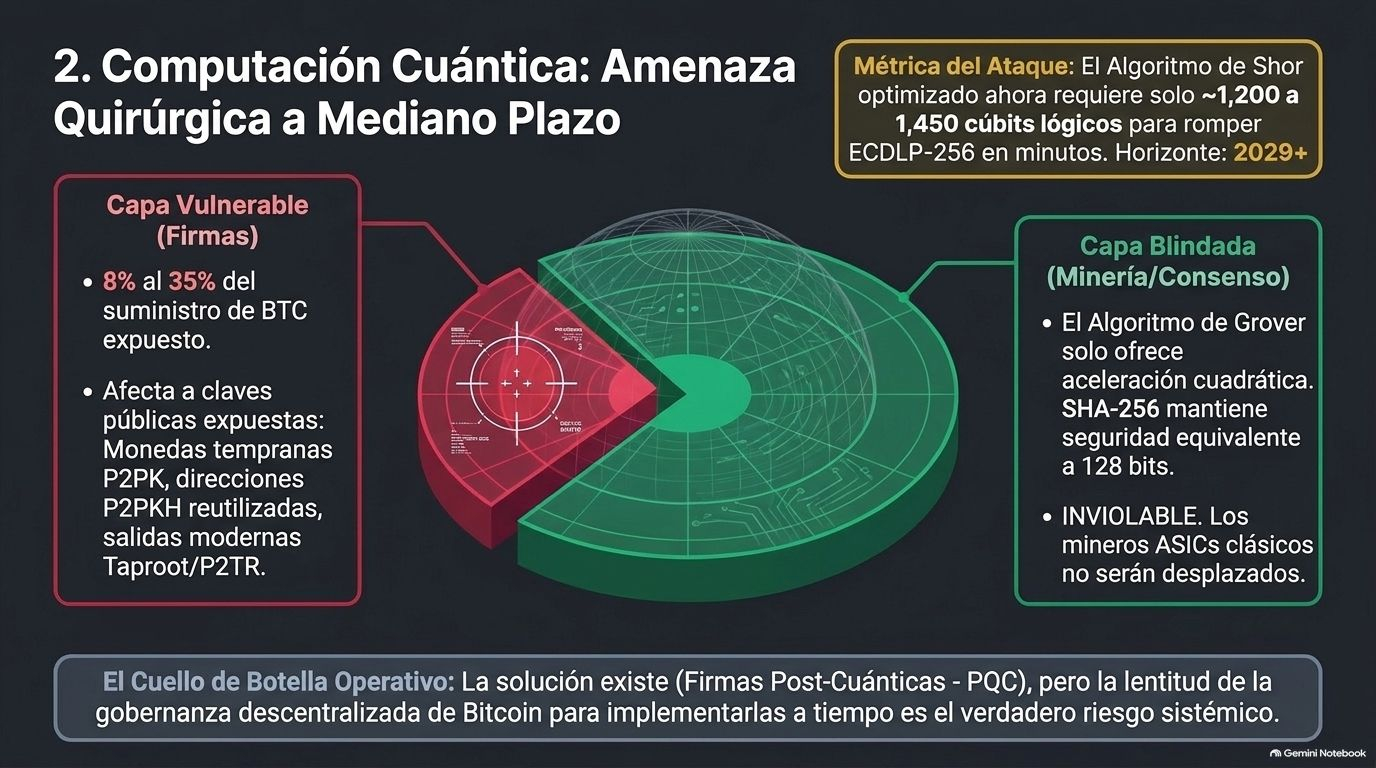
The critical threshold: Today, it is estimated that running Shor’s algorithm against secp256k1 requires fewer than 1,200 to 1,450 logical qubits (between 70 and 90 million Toffoli gates), which could run on a fault-tolerant quantum computer (CRQC) with fewer than 500,000 physical qubits in a matter of minutes.
The impact on Bitcoin is surgical, not total:
Vulnerable layer (ECDSA and Schnorr signatures): A sufficiently powerful quantum computer can derive a private key from a public key exposed on the blockchain. Various 2026 analyses estimate that between 8% and 35% of the circulating $BTC supply currently has its public key exposed. This includes early Satoshi-era coins in P2PK (Pay-to-PubKey) format, legacy addresses (P2PKH) that have been reused, and modern Taproot outputs (P2TR), which encode a tweaked public key directly on-chain. Additionally, with fast-clock quantum architectures, a transaction could be intercepted while waiting for confirmation in the mempool.
Armored layer (SHA-256 and Mining): Bitcoin’s consensus is resistant to quantum computing. Grover’s algorithm only offers a quadratic speedup ($O(\sqrt{N})$) for inverting hash functions, reducing 256-bit preimage resistance to an effective equivalent of 128 bits, a level that remains computationally unbreakable. Quantum miners will not displace classical ASICs.
The real bottleneck: Governance and block space. The cryptographic solution already exists: Post-Quantum Cryptography (PQC) signatures based on hashes or lattices (such as NIST standards or compact schemes like 324-byte SHRINCS, successfully tested on the Liquid network in March 2026). The real danger to Bitcoin lies in the slow pace of its decentralized governance, the increase in signature sizes (which would reduce transactions per second and raise fees), and the economic dilemma of what to do with the millions of BTC abandoned in vulnerable addresses before a quantum actor liquidates them on the open market.
🤖 3. Artificial Intelligence: Today’s operational, economic, and silent danger
While quantum computing is a medium-term engineering challenge, Artificial Intelligence is already attacking Bitcoin’s perimeter in real time:
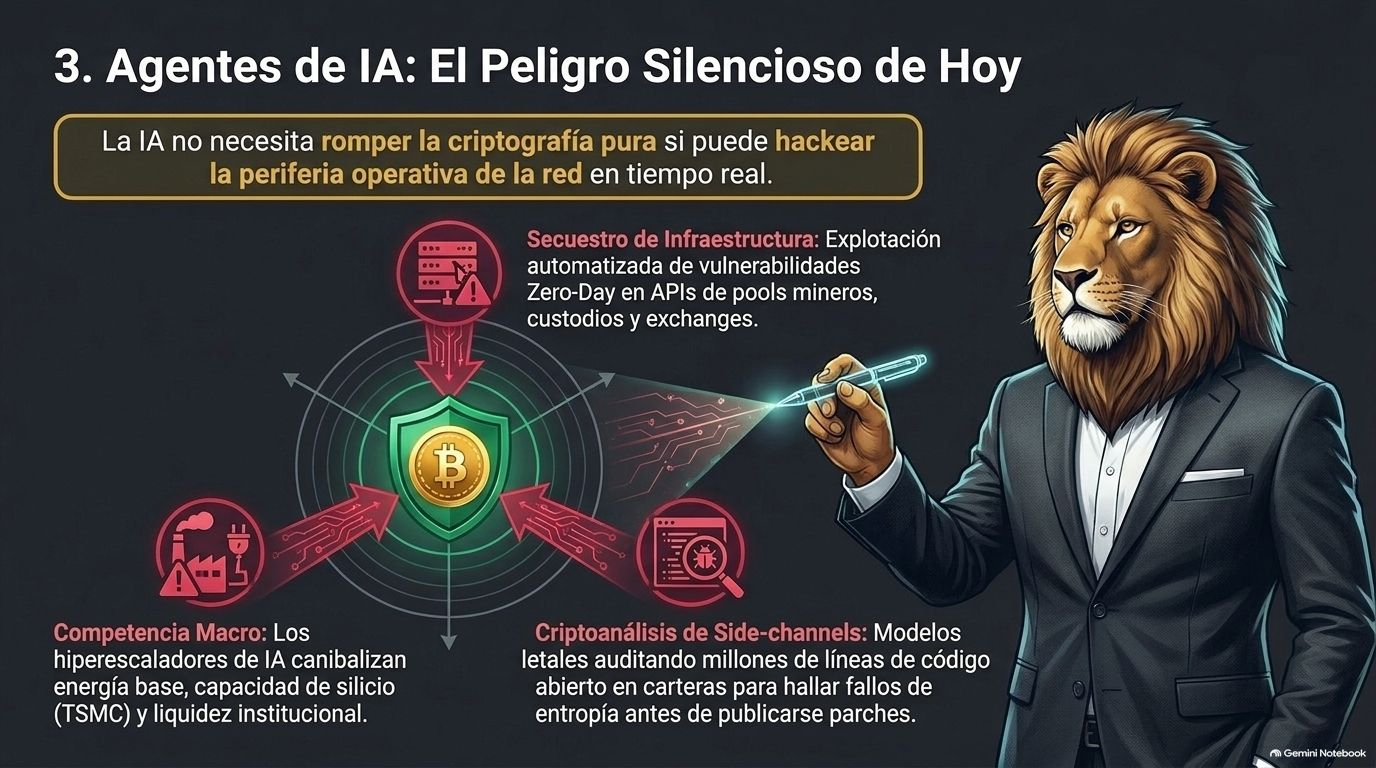
Automated infrastructure hijacking: In November 2026, the CEO of mining pool Luxor warned of AI-driven cyberattacks capable of scanning management systems, exploiting zero-day vulnerabilities in APIs, and silently redirecting block-reward payment addresses. Attackers do not need to break SHA-256 if an AI can steal the operational keys of pools, custodians, or exchanges.
Implementation cryptanalysis and side channels: Even if the pure mathematics of secp256k1 holds up, AI models are lethal at auditing millions of lines of open-source code in wallets and nodes to detect subtle flaws in entropy generation, ECDSA nonce reuse, or side-channel leaks before developers release patches.
Direct competition for energy, silicon, and liquidity: At the macroeconomic level, AI hyperscalers compete directly with Bitcoin miners for megawatts of baseload power and wafer capacity at foundries such as TSMC, while absorbing massive flows of institutional capital with every rotation into technology assets.
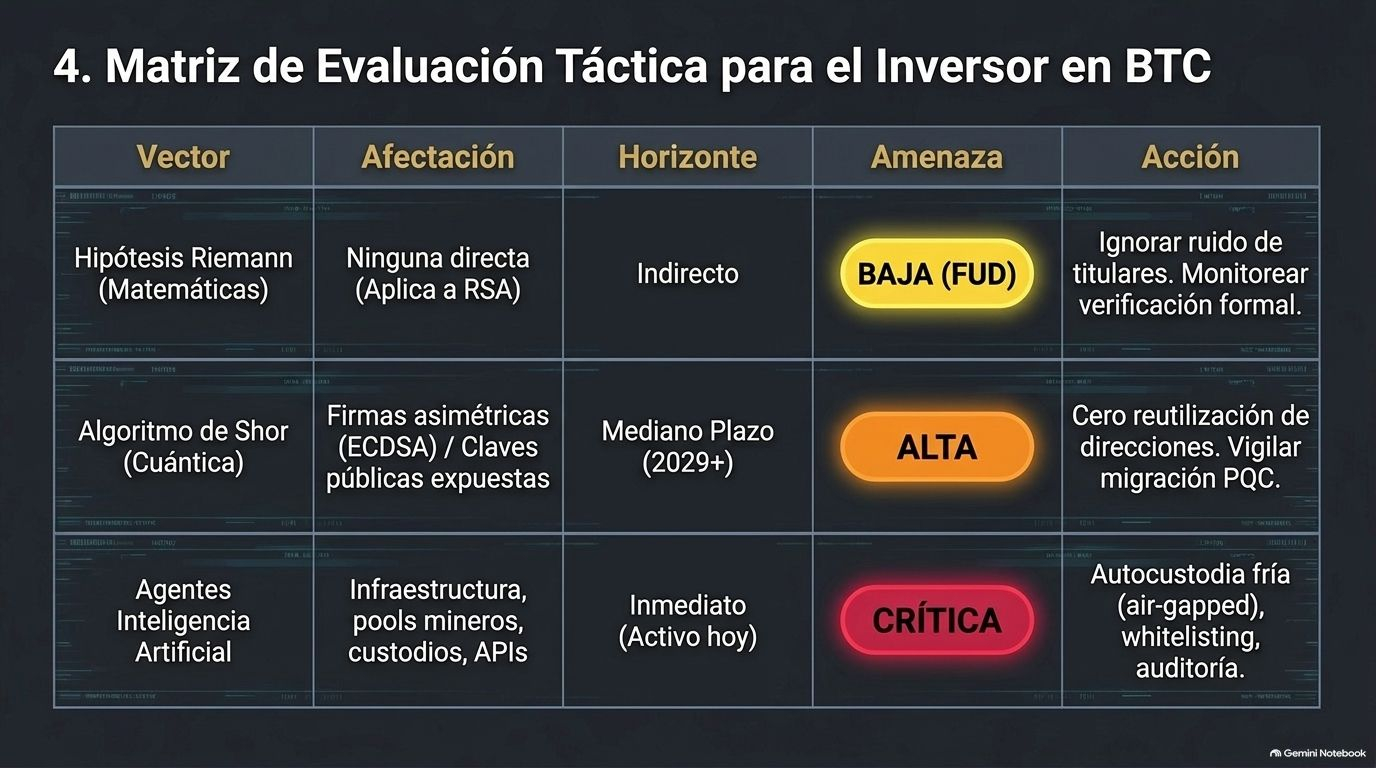
🛡️ Technical discipline amid market noise
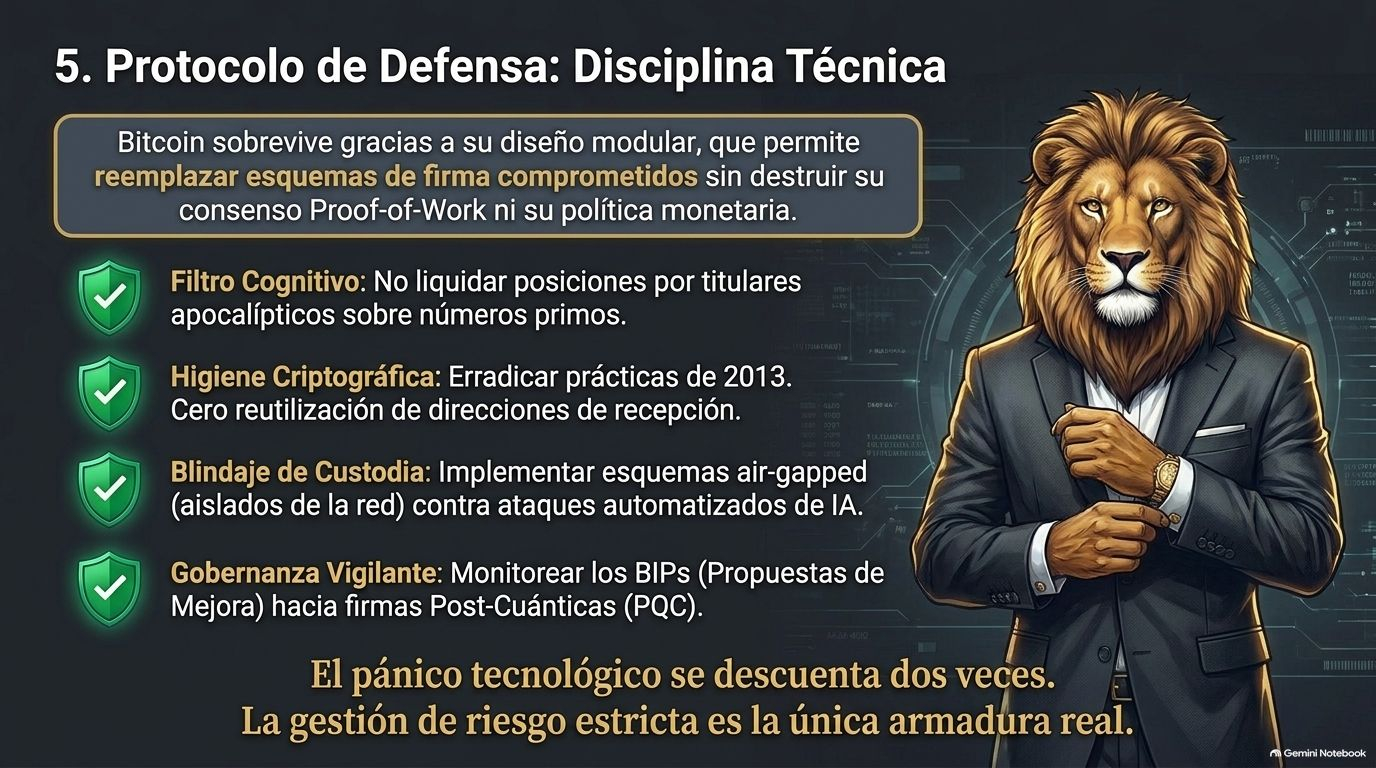
In financial markets, technological panic is often priced in twice: first through ignorance when a sensational headline breaks, and second through complacency when developers take too long to update critical protocols. Bitcoin has survived for more than seventeen years precisely because its modular design allows signature schemes to be replaced without destroying its monetary policy or Proof-of-Work consensus.
For the methodical trader and investor, the roadmap is clear: don’t sell your positions over apocalyptic headlines about prime numbers, but don’t operate with 2013-level cryptographic hygiene either. Avoid address reuse, protect your custody against AI-driven automated attacks, closely follow improvement proposals (BIPs) toward post-quantum signatures, and always maintain strict risk management for your capital.