


On November 17, 2026, the Financial Crimes Enforcement Network (FinCEN) proposed new rules for verifying who owns or controls a business. Under the proposal, banks could no longer accept Individual Taxpayer Identification Numbers (ITINs) to identify beneficial owners. The change could make banking more difficult for some foreign-owned firms.
However, this measure wouldn’t prohibit ITIN holders from opening an account or make a difference in the Employer Identification Number of the businesses. According to FinCEN, the initiative will prevent financial crimes. Community bankers, on the other hand, say that the tough measures may lead to some unnecessary hindrances for legitimate customers.
What an ITIN proves, and what it doesn’t
An ITIN refers to a nine-digit number issued by the Internal Revenue Service (IRS) for federal tax purposes to people who are not eligible for a Social Security number.
The main purpose of an ITIN is taxation. According to the IRS, an ITIN does not give a person the right to work, provide information about immigration status, or be used as identification beyond the federal tax system.
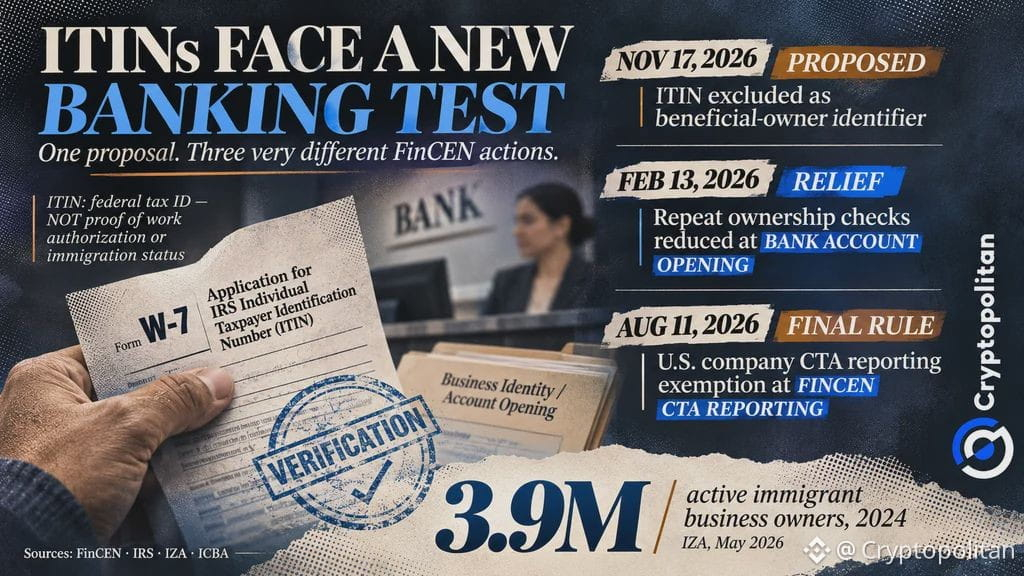 FinCEN proposes ITIN restrictions for business owners at US banks
A tighter screen on who owns a business
The ITIN restriction proposed by FinCEN would amend the Customer Due Diligence (CDD) Rule. This rule requires banks and other covered financial institutions to identify and verify their business customers’ beneficial owners. A beneficial owner is someone who owns at least 25% of a company or has significant responsibility for managing it.
The proposal is made following an executive order from May 19, 2026. Banks could no longer accept ITINs as identifying numbers for beneficial owners. Non-U.S. owners could still provide passports or other specified government documents.
As a measure of precaution, banks would be entitled to investigate someone’s immigration status or work permit if they feel there may be certain risks involved. These restrictions apply only to some customers of the bank.
Relief from repeated ownership checks
FinCEN is pushing for stricter identification rules while easing repeat checks. Specifically, FinCEN notes that banks are no longer obligated to verify a company’s owner whenever the company opens additional accounts, as required under an order issued by FinCEN on February 13. Verification is necessary when opening accounts for the first time, when earlier information becomes unreliable, or when risks deem it necessary.
The November proposal would make that relief part of the CDD Rule. Separately, an August 11 final rule exempted U.S. companies and persons from Corporate Transparency Act reporting. Certain foreign companies must still file. The August rule concerns government reporting, not bank verification.
Community bankers warn of over-screening
Community bankers worry the proposed ITIN restriction could go too far. In a June 23 letter, the Independent Community Bankers of America warned that treating ITIN use alone as suspicious could delay mortgages, farm loans and small-business credit. It urged regulators not to make banks “legal-status gatekeepers.”
FinCEN’s June advisory identifies certain ITIN-related practices as potential warning signs, not proof of wrongdoing. Banks must distinguish suspicious activity from routine tax identification.
Immigrant businesses and the market-access question
An IZA study counted 3.9 million active immigrant business owners in 2024, up from 3.0 million before the pandemic. Growth included construction, transportation and professional services. The figures do not measure ITIN use.
Still, stricter checks could complicate U.S. banking and cross-border transactions for foreign entrepreneurs. The Financial Action Task Force advocates safeguards that preserve financial inclusion.
Meanwhile, Cryptopolitan reported $12.7 billion in suspected crypto-scam activity flagged in 2023–2025 filings. The figure represents neither confirmed losses nor evidence of ITIN misuse. FinCEN must balance crime prevention with banking access for legitimate businesses. Comments close 60 days after Federal Register publication.
The smartest crypto minds already read our newsletter. Want in? Join them.