


$BTC returned to $65,000 on Sunday after falling to $62,006 in the morning. However, three bearish indicators warn of hidden market weakness.
The rally brought the crypto market capitalization back to $2.2 trillion, but barely reduced the monthly decline $BTC to 21.23%.
Investors are accelerating withdrawals from stablecoins
The first warning comes from stablecoins, dollar-pegged tokens traders use to buy cryptocurrencies.
According to Lookonchain, stablecoin supply grew by $716 million from September 28 to October 4. Then, over the following five weeks, through November 8, it declined every week.
The decline began with a $856 million drop in the week of October 5–11. By the week of November 2–8, the weekly decline had grown to $4.68 billion.
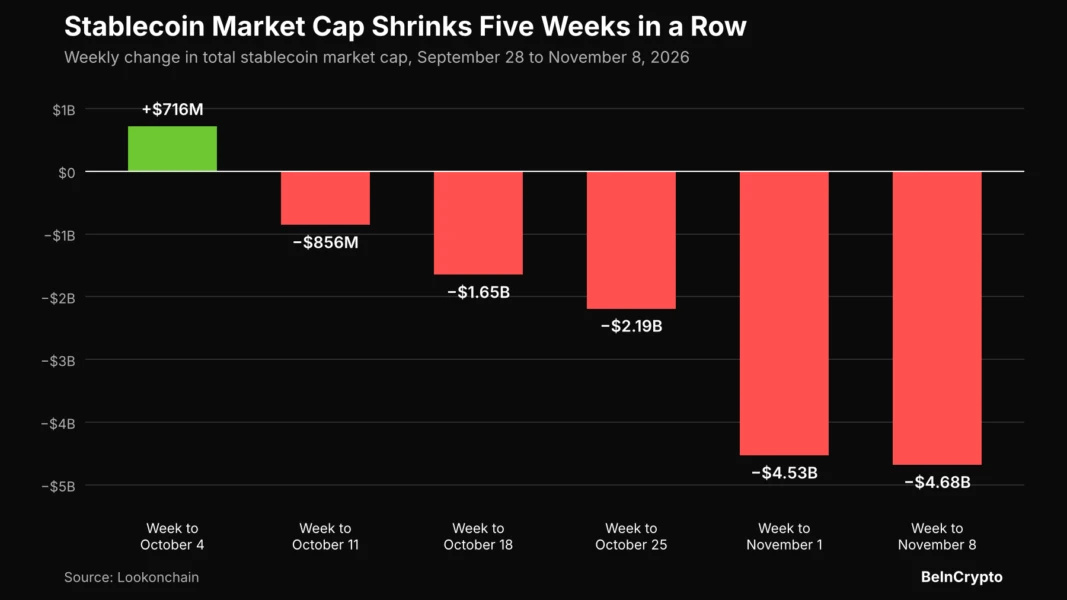
Glassnode estimates the 30-day contraction at $17.1 billion—the fastest outflow since June 2022. A week earlier, when BeInCrypto reported on the biggest liquidity warning sign, the figure stood at $14.2 billion.
Glassnode analysts note that when investors move money from stablecoins into dollars, purchasing power leaves the crypto market.
Spot demand falls as traders turn to leverage
The decline in stablecoin funds is reflected in on-chain traders’ purchases.
According to Lookonchain, spot trading volume on decentralized exchanges (DEXs) fell in four of the past six weeks. Meanwhile, perpetual futures volume, where trades are opened using borrowed funds, rose in four of the six weeks.
As a result, in the six weeks through November 8, spot trading volume fell by about 18%, while perpetual contract volume rose by about 7%.
The growing use of borrowed funds makes the market more vulnerable to sharp drops. This week, a wave of forced liquidations wiped out more than $1 billion in long positions in a single day.
Companies sell reserves ahead of Strategy’s removal from MSCI indexes
Corporate investors have also changed their strategy. Public companies were net buyers of bitcoin in four of the six weeks tracked by Lookonchain. Their purchases fell from 7,721 BTC to 6,202 BTC, and then to 1,462 BTC.
In the week to November 8, companies sold 11,647 BTC worth about $869 million. Strategy, the largest corporate holder, meanwhile added another 1,037 BTC to its portfolio.
MSCI confirmed it will exclude Strategy from its benchmark equity indexes after the close on November 30. Funds tracking these indexes are required to sell their Strategy shares $MSTR .
This will make it harder for Strategy to raise capital for new bitcoin purchases.
Can the crypto market rebound withstand the Fed and Nvidia tests?
Bearish metrics coincide with a packed macroeconomic calendar. On Monday, U.S. spot bitcoin ETFs will report fresh figures after seven consecutive trading days of outflows. Over the past two weeks, the funds have lost about $2.35 billion.
Nvidia will report earnings on Tuesday amid a sell-off in AI stocks that has weighed on the crypto market this month. On Wednesday, the U.S. Federal Reserve (Fed) will publish the minutes of its October meeting. Futures are pricing in an almost 100% chance of a rate hike in December.
Glassnode analysts stated the key condition for a trend reversal back on November 14:
“For the market to turn bullish, capital must flow into the ecosystem, not out of it.”
Until stablecoin supply starts growing again, there isn’t enough available capital to fuel a market rebound.