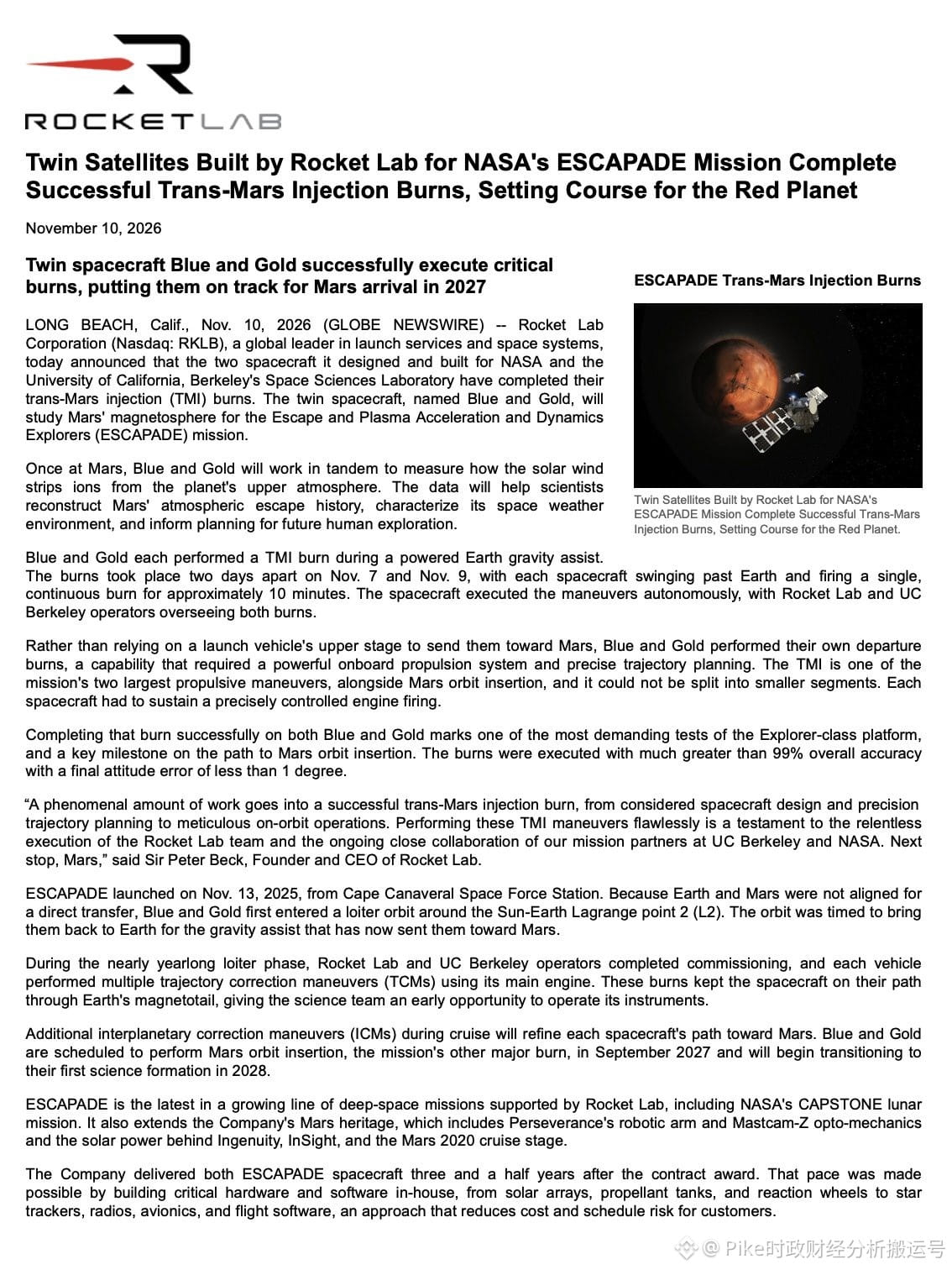
The two Mars probes, Blue and Gold, developed by Rocket Lab for NASA, have successfully begun their deep-space journey to Mars. According to an update released by the company on November 10, both spacecraft successfully completed their Earth-to-Mars transfer burns and entered their planned trajectories.
This mission is a crucial real-world test for Rocket Lab’s Space Systems business. Using their onboard propulsion units, the two probes independently carried out the key maneuvers needed to reach Mars, demonstrating Rocket Lab’s end-to-end delivery capabilities—from overall spacecraft configuration design, propulsion technology and spacecraft flight software development to in-orbit mission management.
During these orbital maneuvers, the probes flew past Earth on November 7 and 9, respectively. They used Earth’s gravity for a boost and relied on their onboard engines, which fired continuously for about 10 minutes, to successfully enter their Mars-bound trajectories. The entire burn and trajectory-change sequence was completed using the probes’ autonomous control systems, while tracking and monitoring from the ground were jointly handled by the University of California, Berkeley, and Rocket Lab. According to data provided by the company, the combined execution accuracy of the two burns exceeded 99%, and the final attitude error was precisely kept within 1 degree.