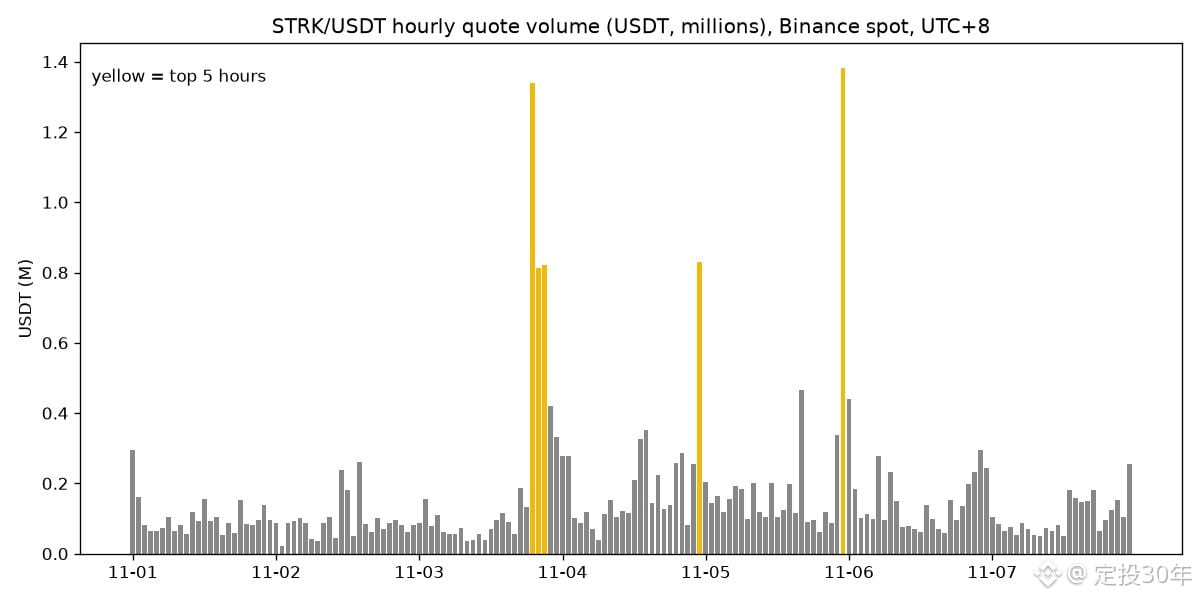
$STRK Last week (00:00 on November 1 to 00:00 on November 8, Beijing time; 168 hourly candles), about 26.1M USDT was traded on Binance spot in total. The price moved from 0.04578 to 0.04035, a drop of 11.9%.
I ranked the trading volume for each hour: the top five hours accounted for 19.9% of the week's total; the bottom 84 hours combined accounted for just 23.6%.
The two highest-volume candles: the hour at 23:00 on November 5 saw 1.38M traded, 13.5 times the median hourly volume for the week, and the price fell 7.05% that hour; at 19:00 on November 3, 1.34M was traded and the price rose 6.21%. One fell and one rose, with roughly similar volume.
There's another thing that can be misleading if you look only at averages. When you tally the busiest hours by time of day, the 23:00 slot accounts for 12.3% of the week's volume, making it look like a consistently active period. But 42.9% of that came from the single candle on November 5. Remove it, and 23:00 accounts for just 7.4%.
Trading in small-cap coins is highly concentrated. Order books are usually thin, and real volume comes in just a few hours. This week, the two hourly candles with the biggest price moves were also the two with the highest volume. If you're trading futures, don't rush to jump in with high leverage when volume surges.
When you look at small-cap coins, do you pay attention to hourly trading volume, or just the daily chart?