

小恐龙说趋势
571 Posts

小恐龙说趋势
Report
Block User
X:XiaoKongLong_88 , 6 年加密市场经历 , 牛市里见过疯狂,熊市里见过人性
6 Following
2.1K+ Followers
3.0K+ Liked
Posts
All
Live
·
--
#strategy未购比特币斥资2.05亿美元回购strc
The company that amassed 840,000 Bitcoin suddenly stopped buying altogether—and instead spent $205 million buying back its own preferred shares 🦖
[📈 进群一起分析行情](https://app.binance.com/uni-qr/JpwCPfBj)
An 8-K filing submitted by Strategy on October 26 showed that for the full seven days from October 19 to 25, it bought no Bitcoin and sold no shares through at-the-market offerings. This was the first full week it had stood down since mid-September. Before that, it had bought Bitcoin for five consecutive weeks. Its holdings remain at 848,517 BTC, acquired at a total cost of $64.02 billion, or an average of $75,446 per coin.
The real firepower was redirected toward its own preferred shares, STRC. This week, it spent $204.9 million to buy back 2,068,459 shares, setting a weekly record. Since the buyback program launched in late July, it has spent more than $2 billion. The figures for the previous two weeks were $193.1 million and $192.4 million, respectively—each week more aggressive than the last.
The cost is written directly into its cash balance 💰 Its freely available U.S. dollar cash fell from $447.3 million to $242.4 million, down nearly half in a week. The $4.83 billion reserve set aside specifically for preferred dividends and debt interest was untouched. The buyback authorization is capped at $3 billion, with $956.8 million still available.
More subtle is the price. The average price of the latest buyback was about $99.06, compared with just $86.52 for the first one. The closer the price gets to par value of $100, the higher the per-share cost of supporting it. Analyst Ragnar estimates that Strategy itself accounted for 28% of STRC's trading volume that week.
The other side of the story that same week is even more interesting: another Bitcoin-hoarding company, Strive, spent $511 million to buy Bitcoin. One is stepping back, the other is stepping in—the marginal buyer is changing.
My take: this flywheel of issuing preferred shares and convertible debt to buy Bitcoin has visibly turned in reverse for the first time. When the preferred share price needs support, cash flows to preferred shares first, not Bitcoin. That doesn't mean the company is bearish, but it does show that at the $80,000 level, the largest holder is beginning to prioritize balance-sheet stability over continuing to add to its position.
Shareholders will also vote on October 28 on whether to switch the preferred shares to daily dividend payments. The annualized dividend yield will remain unchanged at 12% for now. If the measure passes, STRC could trade closer to par, easing the pressure to buy back shares. If cash keeps falling, the pause is likely to last more than a week ⚠️
Do you think Strategy's pause is a short-term portfolio adjustment, or a turning point for its Bitcoin-hoarding strategy?
Tap the profile picture to watch the livestream
Every day, we bring you the latest on Bitcoin and institutional fund flows—not just what’s happening, but also the logic and opportunities behind the headlines 👀🚀
#strategy未购比特币斥资2.05亿美元回购strc
The company that amassed 840,000 Bitcoin suddenly stopped buying altogether—and instead spent $205 million buying back its own preferred shares 🦖
📈 进群一起分析行情
An 8-K filing submitted by Strategy on October 26 showed that for the full seven days from October 19 to 25, it bought no Bitcoin and sold no shares through at-the-market offerings. This was the first full week it had stood down since mid-September. Before that, it had bought Bitcoin for five consecutive weeks. Its holdings remain at 848,517 BTC, acquired at a total cost of $64.02 billion, or an average of $75,446 per coin.
The real firepower was redirected toward its own preferred shares, STRC. This week, it spent $204.9 million to buy back 2,068,459 shares, setting a weekly record. Since the buyback program launched in late July, it has spent more than $2 billion. The figures for the previous two weeks were $193.1 million and $192.4 million, respectively—each week more aggressive than the last.
The cost is written directly into its cash balance 💰 Its freely available U.S. dollar cash fell from $447.3 million to $242.4 million, down nearly half in a week. The $4.83 billion reserve set aside specifically for preferred dividends and debt interest was untouched. The buyback authorization is capped at $3 billion, with $956.8 million still available.
More subtle is the price. The average price of the latest buyback was about $99.06, compared with just $86.52 for the first one. The closer the price gets to par value of $100, the higher the per-share cost of supporting it. Analyst Ragnar estimates that Strategy itself accounted for 28% of STRC's trading volume that week.
The other side of the story that same week is even more interesting: another Bitcoin-hoarding company, Strive, spent $511 million to buy Bitcoin. One is stepping back, the other is stepping in—the marginal buyer is changing.
My take: this flywheel of issuing preferred shares and convertible debt to buy Bitcoin has visibly turned in reverse for the first time. When the preferred share price needs support, cash flows to preferred shares first, not Bitcoin. That doesn't mean the company is bearish, but it does show that at the $80,000 level, the largest holder is beginning to prioritize balance-sheet stability over continuing to add to its position.
Shareholders will also vote on October 28 on whether to switch the preferred shares to daily dividend payments. The annualized dividend yield will remain unchanged at 12% for now. If the measure passes, STRC could trade closer to par, easing the pressure to buy back shares. If cash keeps falling, the pause is likely to last more than a week ⚠️
Do you think Strategy's pause is a short-term portfolio adjustment, or a turning point for its Bitcoin-hoarding strategy?
Tap the profile picture to watch the livestream
Every day, we bring you the latest on Bitcoin and institutional fund flows—not just what’s happening, but also the logic and opportunities behind the headlines 👀🚀

184
·
--
78% of trading came from corporate accounts. Retail traders accounted for just 22%. After an election, businesses converted their local currency into dollar stablecoins 🦖💵
[🕐 最新解读群里更新](https://app.binance.com/uni-qr/JpwCPfBj)
On the Sunday after the results of Brazil’s election came in, corporate accounts on a local trading platform accounted for 78% of trading volume, while retail traders made up just 22%. Trading in the dollar stablecoin USDT surged nearly 800% from the previous week, and Bitcoin trading jumped 865% compared with the previous Sunday.
When traditional markets opened the next day, the benchmark stock index plunged 14% in a single day—its worst drop since March 2020. The real fell more than 8% against the dollar, its biggest one-day decline since 1999. Businesses had made their move a day early, just before the currency slumped.
And there’s more. On Monday, total stablecoin trading against the real reached 1.84 billion reais, or about $350 million—up 65% from the previous week. Bitcoin trading climbed to 1,336 coins, nine times the usual volume. Data from another service aggregating 10 platforms showed that USDT trading against the real rose 150%, while USDC trading against the real rose 318%.
The market structure is even more telling. That same Sunday, Bitcoin-to-dollar trading volume on global platforms actually fell 25%, while Bitcoin-to-real trading rose 370%. Bitcoin gained 9.4% against the real but fell just 0.2% against the dollar. The price barely moved—the local currency did.
My take is that this wave of buying isn’t speculation. Corporate finance departments are hedging against foreign-exchange risk. When banks and stock markets are closed, stablecoins become the only dollar channel available 24/7—and you can start with a very small amount. In the past, dollarization in emerging markets meant opening an offshore account and waiting in line. Now all you need is a phone.
The real risk is changing, too. If businesses in a country start getting used to using stablecoins to escape their local currency, regulators will most likely focus next not on the coin’s price, but on the channels. Capital controls, transaction limits, and identity checks will follow ⚠️
Which country do you think will be next to see its local currency depreciate and businesses collectively switch to stablecoins? 📉
Tap the profile picture to watch the livestream.
Every day, I bring you the latest on stablecoins and on-chain fund flows. We don’t just cover what’s happening—we help you understand the logic and opportunities behind it 👀🚀
78% of trading came from corporate accounts. Retail traders accounted for just 22%. After an election, businesses converted their local currency into dollar stablecoins 🦖💵
🕐 最新解读群里更新
On the Sunday after the results of Brazil’s election came in, corporate accounts on a local trading platform accounted for 78% of trading volume, while retail traders made up just 22%. Trading in the dollar stablecoin USDT surged nearly 800% from the previous week, and Bitcoin trading jumped 865% compared with the previous Sunday.
When traditional markets opened the next day, the benchmark stock index plunged 14% in a single day—its worst drop since March 2020. The real fell more than 8% against the dollar, its biggest one-day decline since 1999. Businesses had made their move a day early, just before the currency slumped.
And there’s more. On Monday, total stablecoin trading against the real reached 1.84 billion reais, or about $350 million—up 65% from the previous week. Bitcoin trading climbed to 1,336 coins, nine times the usual volume. Data from another service aggregating 10 platforms showed that USDT trading against the real rose 150%, while USDC trading against the real rose 318%.
The market structure is even more telling. That same Sunday, Bitcoin-to-dollar trading volume on global platforms actually fell 25%, while Bitcoin-to-real trading rose 370%. Bitcoin gained 9.4% against the real but fell just 0.2% against the dollar. The price barely moved—the local currency did.
My take is that this wave of buying isn’t speculation. Corporate finance departments are hedging against foreign-exchange risk. When banks and stock markets are closed, stablecoins become the only dollar channel available 24/7—and you can start with a very small amount. In the past, dollarization in emerging markets meant opening an offshore account and waiting in line. Now all you need is a phone.
The real risk is changing, too. If businesses in a country start getting used to using stablecoins to escape their local currency, regulators will most likely focus next not on the coin’s price, but on the channels. Capital controls, transaction limits, and identity checks will follow ⚠️
Which country do you think will be next to see its local currency depreciate and businesses collectively switch to stablecoins? 📉
Tap the profile picture to watch the livestream.
Every day, I bring you the latest on stablecoins and on-chain fund flows. We don’t just cover what’s happening—we help you understand the logic and opportunities behind it 👀🚀

148
·
--
A veteran asset manager with $500 billion in assets moved the entire Nasdaq-100 on-chain—with just one fund 🦖
[🔭 进群看资金去哪](https://app.binance.com/uni-qr/JpwCPfBj)
On October 27, London-based asset manager Janus Henderson teamed up with blockchain platform Centrifuge to launch JQQQ on Stellar, an on-chain fund that directly tracks the Nasdaq-100. Its 100 constituents include Nvidia, Apple, and Microsoft. Janus Henderson issues and manages the fund, while Nasdaq licenses the index.
This is the first tokenized index fund to receive authorization from Nasdaq. The previous one was SPXA, which Janus Henderson launched last year with authorization from S&P Dow Jones. In just one year, the two biggest index providers have both licensed on-chain products 📈
The interesting part isn’t the size—it’s the structure. This is an issuer-led model: the fund company issues the product, the blockchain platform provides the infrastructure, and the index provider grants the license. Each of the three handles its own part. Most stock tokens on the market, by contrast, are created by third parties. They may be backed by shares held in custody, or be separate instruments designed to track a stock’s price. Buyers don’t necessarily own the underlying shares or receive shareholder rights.
In the past couple of days, four public companies have publicly opposed an exchange and a futures exchange group tokenizing their stocks. The dispute is about who has the right to put stocks on-chain. The issuer-led model resolves that question at the source, because both the issuer and the index provider have given their approval ⚖️
The numbers are even more interesting side by side. Janus Henderson manages around $500 billion, while its on-chain investment platform now has just over $1 billion in total, across U.S. Treasuries, structured credit, and equities. That’s about 0.2% of its assets under management. In other words, its on-chain business is still taking its first steps—but it’s no longer focused solely on U.S. Treasuries.
Sean Wasserman, head of Nasdaq’s index product management, says investors are using digital infrastructure to find new ways into the market, and demand for mature, transparent benchmarks continues to grow. Centrifuge Chief Strategy and Growth Officer Anil Sood puts it more plainly: tokenization becomes truly useful when the assets investors want to hold can also become building blocks for on-chain financial systems.
In other words, the next step isn’t faster trading—it’s collateral. If shares in stock funds can be used to borrow or move freely between on-chain applications, they go from being a certificate to becoming collateral. But that depends on regulatory and platform support, and we’re not there yet.
My take: the dividing line for tokenized stocks isn’t trading speed—it’s rights. Who issues them, who authorizes them, and whether holders have shareholder rights: these three things determine whether they’re securities or shadow claims. If the index-authorization route proves successful, the next players to follow will be more index providers, not more trading venues.
As for the markets: Bitcoin is at $80,489, up 0.19% over 24 hours; Ethereum is at $2,345, up 0.89%. The Fed’s rate decision will be announced at 2 a.m. Beijing time on October 29. Rates are widely expected to stay at 3.75%–4.00%.
Would you rather buy an on-chain index fund or pick a few stocks yourself? Let’s talk in the comments 👀
I bring you the latest crypto market developments every day—not just what’s happening, but the logic and opportunities behind the headlines 👀🚀
A veteran asset manager with $500 billion in assets moved the entire Nasdaq-100 on-chain—with just one fund 🦖
🔭 进群看资金去哪
On October 27, London-based asset manager Janus Henderson teamed up with blockchain platform Centrifuge to launch JQQQ on Stellar, an on-chain fund that directly tracks the Nasdaq-100. Its 100 constituents include Nvidia, Apple, and Microsoft. Janus Henderson issues and manages the fund, while Nasdaq licenses the index.
This is the first tokenized index fund to receive authorization from Nasdaq. The previous one was SPXA, which Janus Henderson launched last year with authorization from S&P Dow Jones. In just one year, the two biggest index providers have both licensed on-chain products 📈
The interesting part isn’t the size—it’s the structure. This is an issuer-led model: the fund company issues the product, the blockchain platform provides the infrastructure, and the index provider grants the license. Each of the three handles its own part. Most stock tokens on the market, by contrast, are created by third parties. They may be backed by shares held in custody, or be separate instruments designed to track a stock’s price. Buyers don’t necessarily own the underlying shares or receive shareholder rights.
In the past couple of days, four public companies have publicly opposed an exchange and a futures exchange group tokenizing their stocks. The dispute is about who has the right to put stocks on-chain. The issuer-led model resolves that question at the source, because both the issuer and the index provider have given their approval ⚖️
The numbers are even more interesting side by side. Janus Henderson manages around $500 billion, while its on-chain investment platform now has just over $1 billion in total, across U.S. Treasuries, structured credit, and equities. That’s about 0.2% of its assets under management. In other words, its on-chain business is still taking its first steps—but it’s no longer focused solely on U.S. Treasuries.
Sean Wasserman, head of Nasdaq’s index product management, says investors are using digital infrastructure to find new ways into the market, and demand for mature, transparent benchmarks continues to grow. Centrifuge Chief Strategy and Growth Officer Anil Sood puts it more plainly: tokenization becomes truly useful when the assets investors want to hold can also become building blocks for on-chain financial systems.
In other words, the next step isn’t faster trading—it’s collateral. If shares in stock funds can be used to borrow or move freely between on-chain applications, they go from being a certificate to becoming collateral. But that depends on regulatory and platform support, and we’re not there yet.
My take: the dividing line for tokenized stocks isn’t trading speed—it’s rights. Who issues them, who authorizes them, and whether holders have shareholder rights: these three things determine whether they’re securities or shadow claims. If the index-authorization route proves successful, the next players to follow will be more index providers, not more trading venues.
As for the markets: Bitcoin is at $80,489, up 0.19% over 24 hours; Ethereum is at $2,345, up 0.89%. The Fed’s rate decision will be announced at 2 a.m. Beijing time on October 29. Rates are widely expected to stay at 3.75%–4.00%.
Would you rather buy an on-chain index fund or pick a few stocks yourself? Let’s talk in the comments 👀
I bring you the latest crypto market developments every day—not just what’s happening, but the logic and opportunities behind the headlines 👀🚀
15
·
--
#bitmine增持10452枚eth
A company has stashed 4.95% of Ethereum’s total supply in its own vault 🐋
[👉 加入小恐龙粉丝群](https://app.binance.com/uni-qr/JpwCPfBj)
On October 27, BitMine disclosed that it held 6,051,933 ETH. At $2,365 per coin, that’s worth about $14.3 billion. Add 215 Bitcoin, $514 million in cash, and stakes in Beast Industries and Eightco, and its total holdings come to $15 billion.
In just 15 months, it has completed 99% of the so-called “5% alchemy.” It’s just one step away from swallowing 5% of all ETH. Of its holdings, 5,227,037 ETH have already been staked—worth about $12.3 billion at $2,356 per coin—through its own MAVAN validator network.
So far, the story sounds straightforward. The unusual part comes next: Last week, the company bought back 2.04 million of its own shares at an average price of $22.48. So far in 2026, it has repurchased a total of 22.9 million shares at an average price of $17.48, for a total of $399.6 million. It says this is the largest buyback in the history of crypto treasury companies.
It’s gobbling up crypto while also buying back its own shares. That’s a signal. With ETH down 13% from its recent high and its stock falling even harder than the coin, management is putting its money where its mouth is, betting that its own shares are cheaper than Ethereum. Chairman Tom Lee’s take is that the U.S. semiconductor index fell 20% over the same period, while crypto’s pullback has been relatively mild—and that’s proof the bull market is taking shape 📈
Put another way, companies that hoard crypto have historically been some of the steadiest marginal buyers of spot Ethereum. If they shift from buying ETH to buying back shares, that takes away a major source of incremental demand for Ethereum. On the other hand, if the discount on their stock narrows, they’ll have more firepower to keep scooping up crypto. So what’s really worth watching isn’t how much they’ve bought, but where they put their money next week ⚠️
Do you think this is a treasury company buying the dip in its own stock—or a roundabout admission that buying crypto no longer adds up? 🦖
Every day, we bring you the latest in crypto—not just what’s happening, but the logic and opportunities behind the headlines 👀🚀
#bitmine增持10452枚eth
A company has stashed 4.95% of Ethereum’s total supply in its own vault 🐋
👉 加入小恐龙粉丝群
On October 27, BitMine disclosed that it held 6,051,933 ETH. At $2,365 per coin, that’s worth about $14.3 billion. Add 215 Bitcoin, $514 million in cash, and stakes in Beast Industries and Eightco, and its total holdings come to $15 billion.
In just 15 months, it has completed 99% of the so-called “5% alchemy.” It’s just one step away from swallowing 5% of all ETH. Of its holdings, 5,227,037 ETH have already been staked—worth about $12.3 billion at $2,356 per coin—through its own MAVAN validator network.
So far, the story sounds straightforward. The unusual part comes next: Last week, the company bought back 2.04 million of its own shares at an average price of $22.48. So far in 2026, it has repurchased a total of 22.9 million shares at an average price of $17.48, for a total of $399.6 million. It says this is the largest buyback in the history of crypto treasury companies.
It’s gobbling up crypto while also buying back its own shares. That’s a signal. With ETH down 13% from its recent high and its stock falling even harder than the coin, management is putting its money where its mouth is, betting that its own shares are cheaper than Ethereum. Chairman Tom Lee’s take is that the U.S. semiconductor index fell 20% over the same period, while crypto’s pullback has been relatively mild—and that’s proof the bull market is taking shape 📈
Put another way, companies that hoard crypto have historically been some of the steadiest marginal buyers of spot Ethereum. If they shift from buying ETH to buying back shares, that takes away a major source of incremental demand for Ethereum. On the other hand, if the discount on their stock narrows, they’ll have more firepower to keep scooping up crypto. So what’s really worth watching isn’t how much they’ve bought, but where they put their money next week ⚠️
Do you think this is a treasury company buying the dip in its own stock—or a roundabout admission that buying crypto no longer adds up? 🦖
Every day, we bring you the latest in crypto—not just what’s happening, but the logic and opportunities behind the headlines 👀🚀
375
·
--
Poured in $48.76 million, taking PEPE holdings from $267,000 to $51.01 million in two weeks 🦖
[🔥 🔍 进群聊行情](https://app.binance.com/uni-qr/JpwCPfBj)
On October 17 and 26, two wallets linked to Tron founder Justin Sun received PEPE from an exchange in two separate transfers. The first was 7.2 trillion tokens, worth about $28.44 million; the second was 4.65 trillion tokens, worth about $20.32 million. That’s 11.85 trillion tokens in total, now worth around $51.01 million at current prices.
Note: this wasn’t gradual accumulation. The position grew 174-fold in just two weeks. Before October 17, he held only 68 billion tokens, worth about $267,000.
So where did the money come from? Between October 15 and 25, the same group of addresses transferred $77 million in stablecoins to the exchange in six transactions: $60 million USDT and $17 million USDC. The funds had previously been withdrawn from three lending protocols: Spark, AAVE, and Sky.
He pulled out stablecoins that were earning yield and used the funds to buy a meme coin with no cash flow, building a position equal to 2.82% of PEPE’s total supply. That’s equivalent to 2.2% of his $2.29 billion in on-chain wealth.
Now, look at the timing. Bitcoin was trading around $79,935 on the evening of October 27, 37% below its all-time high of $126,080. PEPE was also down 0.63% over the past 24 hours. The Fed meets on October 27–28 to decide on rates, with its decision due at 2 a.m. Beijing time on October 29. Rates are widely expected to hold at 3.75%–4.00%, while the odds of another hike in December have already topped 68% today 📈
Making this kind of move in the 48 hours before the decision reads to me as a statement about risk appetite, not a portfolio allocation. The $77 million in the lending protocols was earning yield; PEPE generates no cash flow. He’s not focused on the interest rate itself, but on whether sentiment will return after the decision.
But three things need to be made clear. First, PEPE’s total market cap is just $1.82 billion. A 2.82% holding means he is the liquidity—when he wants to exit, he could end up being his own counterparty. Second, these tokens passed through two established exchanges, so the true cost is hidden in slippage and fees—not simply the $48.76 million on paper. Third, unrealized gains of just over $2 million amount to only a little over 4% of the $48.76 million cost. A 10% pullback could wipe them all out ⚠️
So what’s worth watching isn’t his unrealized profit. It’s whether PEPE holdings become even more concentrated among the top 10 addresses, and whether net PEPE inflows to exchanges turn positive. Large transfers into exchanges are the real signal that someone may be looking to sell 🐋
Do you think this is smart money getting in early, or the meme coin’s final liquidity wave?
Share your thoughts in the comments.
Every day, I bring you the latest crypto market trends—not just what’s happening, but the logic and opportunities behind it 👀🚀
Poured in $48.76 million, taking PEPE holdings from $267,000 to $51.01 million in two weeks 🦖
🔥 🔍 进群聊行情
On October 17 and 26, two wallets linked to Tron founder Justin Sun received PEPE from an exchange in two separate transfers. The first was 7.2 trillion tokens, worth about $28.44 million; the second was 4.65 trillion tokens, worth about $20.32 million. That’s 11.85 trillion tokens in total, now worth around $51.01 million at current prices.
Note: this wasn’t gradual accumulation. The position grew 174-fold in just two weeks. Before October 17, he held only 68 billion tokens, worth about $267,000.
So where did the money come from? Between October 15 and 25, the same group of addresses transferred $77 million in stablecoins to the exchange in six transactions: $60 million USDT and $17 million USDC. The funds had previously been withdrawn from three lending protocols: Spark, AAVE, and Sky.
He pulled out stablecoins that were earning yield and used the funds to buy a meme coin with no cash flow, building a position equal to 2.82% of PEPE’s total supply. That’s equivalent to 2.2% of his $2.29 billion in on-chain wealth.
Now, look at the timing. Bitcoin was trading around $79,935 on the evening of October 27, 37% below its all-time high of $126,080. PEPE was also down 0.63% over the past 24 hours. The Fed meets on October 27–28 to decide on rates, with its decision due at 2 a.m. Beijing time on October 29. Rates are widely expected to hold at 3.75%–4.00%, while the odds of another hike in December have already topped 68% today 📈
Making this kind of move in the 48 hours before the decision reads to me as a statement about risk appetite, not a portfolio allocation. The $77 million in the lending protocols was earning yield; PEPE generates no cash flow. He’s not focused on the interest rate itself, but on whether sentiment will return after the decision.
But three things need to be made clear. First, PEPE’s total market cap is just $1.82 billion. A 2.82% holding means he is the liquidity—when he wants to exit, he could end up being his own counterparty. Second, these tokens passed through two established exchanges, so the true cost is hidden in slippage and fees—not simply the $48.76 million on paper. Third, unrealized gains of just over $2 million amount to only a little over 4% of the $48.76 million cost. A 10% pullback could wipe them all out ⚠️
So what’s worth watching isn’t his unrealized profit. It’s whether PEPE holdings become even more concentrated among the top 10 addresses, and whether net PEPE inflows to exchanges turn positive. Large transfers into exchanges are the real signal that someone may be looking to sell 🐋
Do you think this is smart money getting in early, or the meme coin’s final liquidity wave?
Share your thoughts in the comments.
Every day, I bring you the latest crypto market trends—not just what’s happening, but the logic and opportunities behind it 👀🚀
200
·
--
Nearly 19,000 hardware wallets were destroyed by the manufacturer with their own hands because a key that could not be changed was stolen 🦖
[📣 盘面异动群里喊](https://app.binance.com/uni-qr/JpwCPfBj)
On October 20, the official website of hardware wallet maker Keystone was breached. The entry point was a vulnerability in a third-party data monitoring tool. 25,964 buyer records were taken, including names, contact information, shipping addresses, and order details. Another 12,873 unpaid checkout records may also have been affected.
What is truly fatal is not these records, but that key 💥 It was written into the device during production and can never be changed after leaving the factory. Whoever gets it can make a counterfeit wallet pass verification on the official website. Users think they are holding a genuine device, but in fact it has been tampered with.
The company's response was to destroy all 18,835 unsold units in inventory, switch website sales to pre-orders, replace the authentication key for new devices, and reduce customer data retention from 180 days to 90 days.
What is most heartbreaking is this self-criticism: under the 180-day policy, many records should already have been deleted, but the automatic deletion tool failed silently, and the company itself never noticed. Their original words were: We failed to fulfill our promise to delete customer data on time. We take responsibility for this failure ⚠️
This is not an isolated case. Just the day before, hardware wallet maker Foundation disclosed that attackers sent more than 23,000 phishing emails using fake official domain names. About 5,600 mailing addresses and 5,200 phone numbers from an old database may have been exposed. Earlier this year, devices sold by Ledger through a Southeast Asia distributor were found to contain a spy chip that secretly recorded seed phrases during initialization. Coldcard's random number flaw was even worse: attackers did not need to touch the device and could remotely reconstruct private keys, stealing about 70 million dollars.
My view is that hardware wallets have always sold the belief of offline equals safe. But as long as the production-stage key, the website database, and the shipping address are still in the manufacturer's hands, the attack surface will shift from the chip to the people. Buying a genuine device does not mean you are not being watched. That shipping list with names, phone numbers, and addresses is the most valuable asset in the eyes of the black market 🐋
Three details are worth watching. Devices received and successfully verified before October 20 can continue to be used. Devices received after that date that were shipped using the old key must be rechecked first. As for any message claiming a recall, or asking you to move assets to a new address, treat it as fake.
Where do you keep your coins now: in a hardware wallet or on an exchange? Have you ever worried that your shipping address might be exposed?
Follow me every day for crypto security highlights. Not only to see what happened in the news, but also to understand the logic and opportunities behind it 👀🚀
Nearly 19,000 hardware wallets were destroyed by the manufacturer with their own hands because a key that could not be changed was stolen 🦖
📣 盘面异动群里喊
On October 20, the official website of hardware wallet maker Keystone was breached. The entry point was a vulnerability in a third-party data monitoring tool. 25,964 buyer records were taken, including names, contact information, shipping addresses, and order details. Another 12,873 unpaid checkout records may also have been affected.
What is truly fatal is not these records, but that key 💥 It was written into the device during production and can never be changed after leaving the factory. Whoever gets it can make a counterfeit wallet pass verification on the official website. Users think they are holding a genuine device, but in fact it has been tampered with.
The company's response was to destroy all 18,835 unsold units in inventory, switch website sales to pre-orders, replace the authentication key for new devices, and reduce customer data retention from 180 days to 90 days.
What is most heartbreaking is this self-criticism: under the 180-day policy, many records should already have been deleted, but the automatic deletion tool failed silently, and the company itself never noticed. Their original words were: We failed to fulfill our promise to delete customer data on time. We take responsibility for this failure ⚠️
This is not an isolated case. Just the day before, hardware wallet maker Foundation disclosed that attackers sent more than 23,000 phishing emails using fake official domain names. About 5,600 mailing addresses and 5,200 phone numbers from an old database may have been exposed. Earlier this year, devices sold by Ledger through a Southeast Asia distributor were found to contain a spy chip that secretly recorded seed phrases during initialization. Coldcard's random number flaw was even worse: attackers did not need to touch the device and could remotely reconstruct private keys, stealing about 70 million dollars.
My view is that hardware wallets have always sold the belief of offline equals safe. But as long as the production-stage key, the website database, and the shipping address are still in the manufacturer's hands, the attack surface will shift from the chip to the people. Buying a genuine device does not mean you are not being watched. That shipping list with names, phone numbers, and addresses is the most valuable asset in the eyes of the black market 🐋
Three details are worth watching. Devices received and successfully verified before October 20 can continue to be used. Devices received after that date that were shipped using the old key must be rechecked first. As for any message claiming a recall, or asking you to move assets to a new address, treat it as fake.
Where do you keep your coins now: in a hardware wallet or on an exchange? Have you ever worried that your shipping address might be exposed?
Follow me every day for crypto security highlights. Not only to see what happened in the news, but also to understand the logic and opportunities behind it 👀🚀

183
·
--
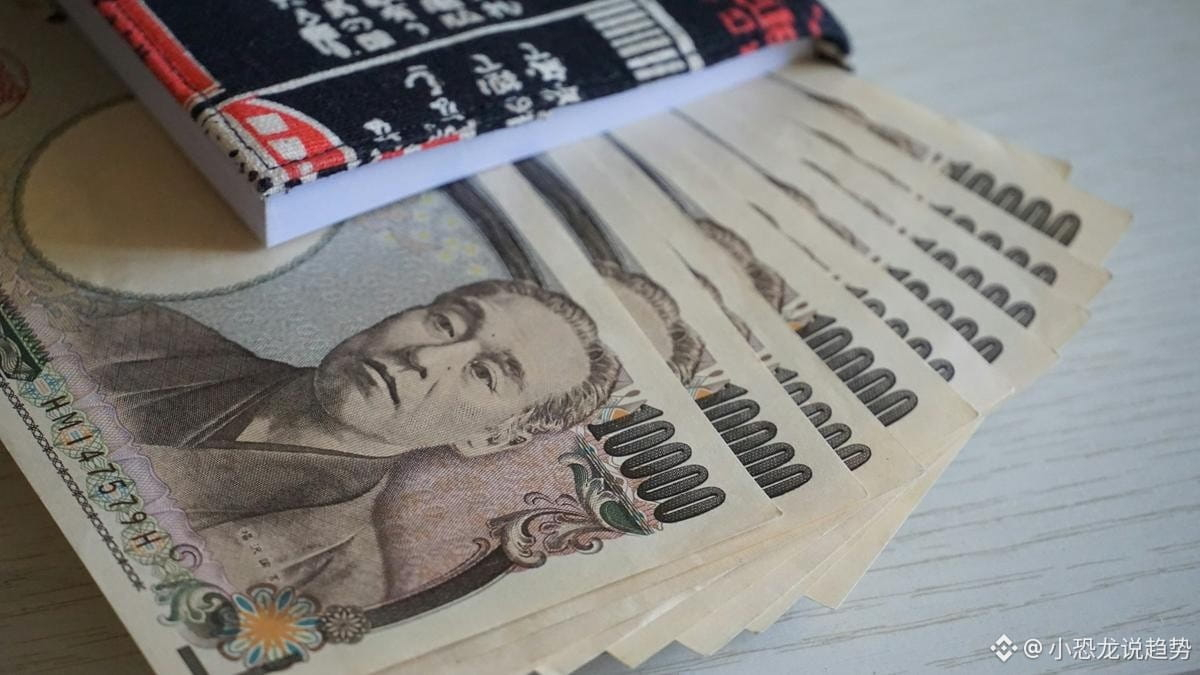
A total of 12.1 billion yen issued, only 3.2 billion left in circulation 🦖
[📢 ⏰ 消息群里第一时间说](https://app.binance.com/uni-qr/JpwCPfBj)
JPYC, Japan's largest compliant yen-pegged stablecoin, has been live for just over a year. Its report card: 3.2 billion yen in circulation, about $20 million, only a quarter of its issuer's target. Yet cumulative issuance has reached 12.1 billion yen. In other words, more than 70% of what was issued has been redeemed. Founder and CEO Takanori Okabe told the media bluntly: to be honest, I don't think it's growing 📉
Even more unusual was the wave in September: after a Korean trading platform listed JPYC, arbitrage pushed the price above 1 yen. In a single day, that platform and Uniswap together saw turnover of about 35 billion yen, and circulating supply briefly broke above 4.2 billion yen before falling back to around 3 billion yen. The money came fast and left even faster; what remained was trading volume, not balance 💴
He points to one cap as the cause. Under Japan's second-class funds transfer business rules, a single transaction can only be 1 million yen. In May, the rule was changed from 1 million yen per day to 1 million yen per transaction, but it still restricts repeated operations over a short period. Software company Asteria wants to hold 1 billion yen worth of JPYC, but can only accumulate it slowly in small batches. At 1 million yen per transfer, it would take at least 1,000 transactions. Corporate cash pools can't get in, so the stablecoin is just a payment tool, not a store of value
The partnership list is actually not short. Logistics company AZ-COM Maruwa formed an alliance in July to cover about 2,300 business partners. This month, SBJ Bank and LINE NEXT also agreed to test direct bank-account top-ups, but it is still in the trial stage. Japan's Financial Services Agency is reviewing stablecoin regulation, and the roadmap is expected to come out only in early 2027. Okabe's target for the second year is several hundred billion yen, about 10 times the current level ⚠️
My view is that the bottleneck for stablecoins has never been issuance or listing, but per-transaction limits and settlement rails. As long as large corporate settlements are kept out, balances won't stick. Arbitrage capital will come, but it will only stay for a few days. What really matters is whether the early-2027 roadmap will change the limits, and whether Japanese companies are willing to put JPYC on their balance sheets instead of treating it only as a payment code
Bitcoin is now at $79,787, down 0.58% in 24 hours. Ethereum is at $2,312, down 0.77%. The rate decision is at 2:00 a.m. Beijing time on October 29, and risk assets are still waiting for direction
If your company needs to make cross-border payments, would you try stablecoins first, or wait for the banking system to upgrade itself
Follow me every day for stablecoin news. Not just what happened, but also the logic and opportunities behind it 👀🚀
A total of 12.1 billion yen issued, only 3.2 billion left in circulation 🦖
📢 ⏰ 消息群里第一时间说
JPYC, Japan's largest compliant yen-pegged stablecoin, has been live for just over a year. Its report card: 3.2 billion yen in circulation, about $20 million, only a quarter of its issuer's target. Yet cumulative issuance has reached 12.1 billion yen. In other words, more than 70% of what was issued has been redeemed. Founder and CEO Takanori Okabe told the media bluntly: to be honest, I don't think it's growing 📉
Even more unusual was the wave in September: after a Korean trading platform listed JPYC, arbitrage pushed the price above 1 yen. In a single day, that platform and Uniswap together saw turnover of about 35 billion yen, and circulating supply briefly broke above 4.2 billion yen before falling back to around 3 billion yen. The money came fast and left even faster; what remained was trading volume, not balance 💴
He points to one cap as the cause. Under Japan's second-class funds transfer business rules, a single transaction can only be 1 million yen. In May, the rule was changed from 1 million yen per day to 1 million yen per transaction, but it still restricts repeated operations over a short period. Software company Asteria wants to hold 1 billion yen worth of JPYC, but can only accumulate it slowly in small batches. At 1 million yen per transfer, it would take at least 1,000 transactions. Corporate cash pools can't get in, so the stablecoin is just a payment tool, not a store of value
The partnership list is actually not short. Logistics company AZ-COM Maruwa formed an alliance in July to cover about 2,300 business partners. This month, SBJ Bank and LINE NEXT also agreed to test direct bank-account top-ups, but it is still in the trial stage. Japan's Financial Services Agency is reviewing stablecoin regulation, and the roadmap is expected to come out only in early 2027. Okabe's target for the second year is several hundred billion yen, about 10 times the current level ⚠️
My view is that the bottleneck for stablecoins has never been issuance or listing, but per-transaction limits and settlement rails. As long as large corporate settlements are kept out, balances won't stick. Arbitrage capital will come, but it will only stay for a few days. What really matters is whether the early-2027 roadmap will change the limits, and whether Japanese companies are willing to put JPYC on their balance sheets instead of treating it only as a payment code
Bitcoin is now at $79,787, down 0.58% in 24 hours. Ethereum is at $2,312, down 0.77%. The rate decision is at 2:00 a.m. Beijing time on October 29, and risk assets are still waiting for direction
If your company needs to make cross-border payments, would you try stablecoins first, or wait for the banking system to upgrade itself
Follow me every day for stablecoin news. Not just what happened, but also the logic and opportunities behind it 👀🚀
114
·
--
#比特币再度跌破8万美元
From $80,000 to $57,000 in just 12 months 🦖
[🧭 群里聊方向](https://app.binance.com/uni-qr/JpwCPfBj)
On October 27, tech investor Jason Calacanis publicly urged people on X to sell Bitcoin, setting a target of $57,000 within the next 12 months—28% below Tuesday’s price of around $79,600. He added that Bitcoin would never hit a new all-time high again.
Back in 2023, he was among the first to call on crypto entrepreneurs to pivot entirely to AI. This time, he aimed the same message at Bitcoin holders. His exact words: “Why put resources into a dead network that offers nothing but a store of value?”
His reasoning isn’t about the technology; it’s that buyers have disappeared. Bitcoin used to have an aura of being a must-own asset. Now, people won’t be mocked for not buying it, and money has moved to more useful places. He pointed to U.S. spot Bitcoin ETFs, which saw net outflows of about $774 million last Thursday and Friday, followed by just $110 million flowing back in on Monday. Bitcoin was still trading around $79,600 on Tuesday, 37% below its all-time high of $126,080.
Note that he’s not anti-crypto. He holds TAO, the token of Bittensor. His reason is that this network uses tokens to reward people who provide computing power, storage, and AI responses. So his view can be summed up in one sentence: Pay for tokens that produce AI, not tokens that merely store value.
There’s a structural shift worth watching here: Bitcoin’s marginal buyers have shifted from retail investors chasing a story to ETF allocators. Since the start of October, U.S. spot Bitcoin ETFs have seen cumulative net outflows of about $314 million. When institutional allocators redeem continuously, price discovery shifts back to balance sheets and is no longer driven by halving events and narratives. And $57,000 isn’t a random number—it’s around the low point of the previous cycle. If Bitcoin returns there, it would give back all of this cycle’s gains 💥
My take: the number $57,000 itself isn’t what matters; what matters are the conditions it represents. If AI continues to draw away attention and capital while ETFs see net outflows for five consecutive weeks, that level will be tested. On the other hand, as long as ETFs return to consecutive net inflows, this kind of call is just noise. Bitcoin is now at $79,886, down 0.48% over 24 hours; Ethereum is at $2,314, down 0.5%. The market is still waiting for the rate decision at 2 a.m. on October 29 📉
Where do you think Bitcoin’s next wave of buyers will come from—ETFs, corporate balance sheets, or the next big narrative? ⚠️
I bring you Bitcoin’s hottest topics every day—not just what’s happening in the news, but also the logic and opportunities behind it 👀🚀
#比特币再度跌破8万美元
From $80,000 to $57,000 in just 12 months 🦖
🧭 群里聊方向
On October 27, tech investor Jason Calacanis publicly urged people on X to sell Bitcoin, setting a target of $57,000 within the next 12 months—28% below Tuesday’s price of around $79,600. He added that Bitcoin would never hit a new all-time high again.
Back in 2023, he was among the first to call on crypto entrepreneurs to pivot entirely to AI. This time, he aimed the same message at Bitcoin holders. His exact words: “Why put resources into a dead network that offers nothing but a store of value?”
His reasoning isn’t about the technology; it’s that buyers have disappeared. Bitcoin used to have an aura of being a must-own asset. Now, people won’t be mocked for not buying it, and money has moved to more useful places. He pointed to U.S. spot Bitcoin ETFs, which saw net outflows of about $774 million last Thursday and Friday, followed by just $110 million flowing back in on Monday. Bitcoin was still trading around $79,600 on Tuesday, 37% below its all-time high of $126,080.
Note that he’s not anti-crypto. He holds TAO, the token of Bittensor. His reason is that this network uses tokens to reward people who provide computing power, storage, and AI responses. So his view can be summed up in one sentence: Pay for tokens that produce AI, not tokens that merely store value.
There’s a structural shift worth watching here: Bitcoin’s marginal buyers have shifted from retail investors chasing a story to ETF allocators. Since the start of October, U.S. spot Bitcoin ETFs have seen cumulative net outflows of about $314 million. When institutional allocators redeem continuously, price discovery shifts back to balance sheets and is no longer driven by halving events and narratives. And $57,000 isn’t a random number—it’s around the low point of the previous cycle. If Bitcoin returns there, it would give back all of this cycle’s gains 💥
My take: the number $57,000 itself isn’t what matters; what matters are the conditions it represents. If AI continues to draw away attention and capital while ETFs see net outflows for five consecutive weeks, that level will be tested. On the other hand, as long as ETFs return to consecutive net inflows, this kind of call is just noise. Bitcoin is now at $79,886, down 0.48% over 24 hours; Ethereum is at $2,314, down 0.5%. The market is still waiting for the rate decision at 2 a.m. on October 29 📉
Where do you think Bitcoin’s next wave of buyers will come from—ETFs, corporate balance sheets, or the next big narrative? ⚠️
I bring you Bitcoin’s hottest topics every day—not just what’s happening in the news, but also the logic and opportunities behind it 👀🚀

1
1.9k
·
--
A patch was closed by developers on October 19, then urgently merged on October 26—just 7 days later 🦖
[🚨 行情变了群里说](https://app.binance.com/uni-qr/JpwCPfBj)
A vulnerability hidden in Glamsterdam, Ethereum’s next major upgrade, could have sent staking deposits to the wrong account. Researcher Avsetsin uncovered it during testing. It involved three leading staking protocols: Lido, Origin, and Rocket Pool. So far, there have been no losses ⚠️
The issue stemmed from how roles were separated. The upgrade split block builders and staking validators into two groups. Both groups need to deposit ETH, and their balances should be recorded separately. But the draft rules for handling deposits that hadn’t yet been credited during the upgrade looked only at the public key.
That meant an operator could register as a builder using a public key, then have a staking service deposit ETH to that same key to create a validator. Under the draft rules, both deposits would be credited to the builder. In the researcher’s words, “An operator could withdraw the protocol’s funds.”
Worse, the validator was never created in the first place. The staking service had no credentials, so it couldn’t prove the funds belonged to it 🔍
The fix itself was a twist. The proposal was closed on October 19. Maintainer Justin Traglia said client support wasn’t sufficient at the time. On October 23, the researcher added tests. On Monday, the patch was reopened and merged. The revised rule sorts pending deposits by withdrawal credentials, keeping validators’ funds under their own names.
The patch is now in the consensus specification, but client teams still need to implement it individually. Hoodi testnet’s launch, originally scheduled for October 26, has been delayed. It has already been tested once on Sepolia, and the mainnet timeline remains uncertain.
My take: this wasn’t a code exploit; it was a gap in how the rules defined the boundaries. The reason there were no losses is that someone found it before the mainnet launch. The researcher also said this was a conditional code finding, not a confirmed real-world attack. But think about it: a scenario uncovered through rapid AI-assisted scanning could affect three leading protocols. That shows how much more boundary testing is needed before upgrades go live 📉
What’s worth watching is whether client implementations will interpret the rules differently again—and when Glamsterdam will actually land on mainnet 👀
Join the discussion in the comments: What do you think is the biggest risk in staking—the code or the rules?
Tap the profile picture to watch the livestream
Every day, I bring you the latest Ethereum developments—not just what’s happening, but also the logic and opportunities behind it 👀🚀
A patch was closed by developers on October 19, then urgently merged on October 26—just 7 days later 🦖
🚨 行情变了群里说
A vulnerability hidden in Glamsterdam, Ethereum’s next major upgrade, could have sent staking deposits to the wrong account. Researcher Avsetsin uncovered it during testing. It involved three leading staking protocols: Lido, Origin, and Rocket Pool. So far, there have been no losses ⚠️
The issue stemmed from how roles were separated. The upgrade split block builders and staking validators into two groups. Both groups need to deposit ETH, and their balances should be recorded separately. But the draft rules for handling deposits that hadn’t yet been credited during the upgrade looked only at the public key.
That meant an operator could register as a builder using a public key, then have a staking service deposit ETH to that same key to create a validator. Under the draft rules, both deposits would be credited to the builder. In the researcher’s words, “An operator could withdraw the protocol’s funds.”
Worse, the validator was never created in the first place. The staking service had no credentials, so it couldn’t prove the funds belonged to it 🔍
The fix itself was a twist. The proposal was closed on October 19. Maintainer Justin Traglia said client support wasn’t sufficient at the time. On October 23, the researcher added tests. On Monday, the patch was reopened and merged. The revised rule sorts pending deposits by withdrawal credentials, keeping validators’ funds under their own names.
The patch is now in the consensus specification, but client teams still need to implement it individually. Hoodi testnet’s launch, originally scheduled for October 26, has been delayed. It has already been tested once on Sepolia, and the mainnet timeline remains uncertain.
My take: this wasn’t a code exploit; it was a gap in how the rules defined the boundaries. The reason there were no losses is that someone found it before the mainnet launch. The researcher also said this was a conditional code finding, not a confirmed real-world attack. But think about it: a scenario uncovered through rapid AI-assisted scanning could affect three leading protocols. That shows how much more boundary testing is needed before upgrades go live 📉
What’s worth watching is whether client implementations will interpret the rules differently again—and when Glamsterdam will actually land on mainnet 👀
Join the discussion in the comments: What do you think is the biggest risk in staking—the code or the rules?
Tap the profile picture to watch the livestream
Every day, I bring you the latest Ethereum developments—not just what’s happening, but also the logic and opportunities behind it 👀🚀
3
2.6k
·
--
Verified
#比特币再度跌破8万美元
Insuring $10 million in AI debt costs over $1 million a year 🦖
[🔭 进群看资金去哪](https://app.binance.com/uni-qr/JpwCPfBj)
On October 23, Justin Biemann, a global investment strategist at J.P. Morgan Private Bank, published a report about an unnamed AI infrastructure company that has been expanding by borrowing heavily. The quote for five-year credit default swaps (CDS) on its debt surged to 1,100 basis points. That works out to over $1 million a year in insurance premiums for every $10 million of debt.
And it’s not an isolated case. Morgan Stanley’s data shows that in September, weekly trading volume in CDS tied to bonds from Oracle, SpaceX, Google, Amazon, Meta, Broadcom, and Nvidia exceeded $9 billion on average. In July, it was less than $2 billion. That’s more than a fourfold increase in two months ⚠️
For comparison, five-year protection on the AI leaders with the strongest cash flows costs just 50 to 120 basis points. That rises to around 300 basis points for established infrastructure borrowers. The riskiest tier is at 1,100 basis points. Biemann’s interpretation: that quote implies a probability of default over the next five years approaching or exceeding 50%, up from less than 30% a year ago 💥
He stopped short of making a definitive call, saying that CDS are more like a warning light than a countdown clock right now. That’s because trading in CDS on leading companies looks more like hedging than betting on a collapse. But he put Lehman alongside them: in the third quarter of 2007, Lehman’s CDS averaged less than 100 basis points. By mid-September 2008, they had surged above 1,400, and the company subsequently filed for bankruptcy.
What does this have to do with crypto? Risk appetite. Over the past two years, AI has been the strongest narrative. Bitcoin and Nvidia both bottomed within weeks of ChatGPT’s launch in late 2022, then climbed together. Now the Nasdaq has fallen from 31,360 on October 6 to 29,263. In this pullback of more than 6%, AI-related stocks have fallen harder than the index. If AI really does trigger a credit event, the first assets to be sold often won’t be AI debt, but the most liquid assets—the easiest to turn into cash. Bitcoin sits near the top of that list.
Bitcoin is now at $79,749, down 0.46% in 24 hours. Ethereum is at $2,309, down 0.52%, and SOL is at $99.78, down 1.08%. The three major assets are all hovering below $80,000. The rate decision is due at 2 a.m. on October 29 📉
My take: this round of AI risk isn’t starting with stock prices—it’s starting with the cost of insurance. Stock prices can be propped up by a story; premiums can’t. Premiums reflect real money being put behind the probability of default. The 1,100-basis-point quote is right there: the bond market is already stress-testing a company. What crypto investors should watch next isn’t how many points the Nasdaq drops each day, but whether CDS spreads keep widening. If they do, the $80,000 support level will be very thin.
Do you think this AI pullback is normal, or the start of a credit crack? Let’s talk in the comments.
Every day, we bring you the latest on the intersection of AI and crypto—not just what’s happening, but the logic and opportunities behind it 👀🚀
Tap the profile picture to watch the livestream
#比特币再度跌破8万美元
Insuring $10 million in AI debt costs over $1 million a year 🦖
🔭 进群看资金去哪
On October 23, Justin Biemann, a global investment strategist at J.P. Morgan Private Bank, published a report about an unnamed AI infrastructure company that has been expanding by borrowing heavily. The quote for five-year credit default swaps (CDS) on its debt surged to 1,100 basis points. That works out to over $1 million a year in insurance premiums for every $10 million of debt.
And it’s not an isolated case. Morgan Stanley’s data shows that in September, weekly trading volume in CDS tied to bonds from Oracle, SpaceX, Google, Amazon, Meta, Broadcom, and Nvidia exceeded $9 billion on average. In July, it was less than $2 billion. That’s more than a fourfold increase in two months ⚠️
For comparison, five-year protection on the AI leaders with the strongest cash flows costs just 50 to 120 basis points. That rises to around 300 basis points for established infrastructure borrowers. The riskiest tier is at 1,100 basis points. Biemann’s interpretation: that quote implies a probability of default over the next five years approaching or exceeding 50%, up from less than 30% a year ago 💥
He stopped short of making a definitive call, saying that CDS are more like a warning light than a countdown clock right now. That’s because trading in CDS on leading companies looks more like hedging than betting on a collapse. But he put Lehman alongside them: in the third quarter of 2007, Lehman’s CDS averaged less than 100 basis points. By mid-September 2008, they had surged above 1,400, and the company subsequently filed for bankruptcy.
What does this have to do with crypto? Risk appetite. Over the past two years, AI has been the strongest narrative. Bitcoin and Nvidia both bottomed within weeks of ChatGPT’s launch in late 2022, then climbed together. Now the Nasdaq has fallen from 31,360 on October 6 to 29,263. In this pullback of more than 6%, AI-related stocks have fallen harder than the index. If AI really does trigger a credit event, the first assets to be sold often won’t be AI debt, but the most liquid assets—the easiest to turn into cash. Bitcoin sits near the top of that list.
Bitcoin is now at $79,749, down 0.46% in 24 hours. Ethereum is at $2,309, down 0.52%, and SOL is at $99.78, down 1.08%. The three major assets are all hovering below $80,000. The rate decision is due at 2 a.m. on October 29 📉
My take: this round of AI risk isn’t starting with stock prices—it’s starting with the cost of insurance. Stock prices can be propped up by a story; premiums can’t. Premiums reflect real money being put behind the probability of default. The 1,100-basis-point quote is right there: the bond market is already stress-testing a company. What crypto investors should watch next isn’t how many points the Nasdaq drops each day, but whether CDS spreads keep widening. If they do, the $80,000 support level will be very thin.
Do you think this AI pullback is normal, or the start of a credit crack? Let’s talk in the comments.
Every day, we bring you the latest on the intersection of AI and crypto—not just what’s happening, but the logic and opportunities behind it 👀🚀
Tap the profile picture to watch the livestream

1
2.9k
·
--
#btc
A bug report now costs $100 to submit: a million-dollar audit contest received 809 reports, but only 127 were genuine vulnerabilities 🦖
[⚡ 有大动静群里说](https://app.binance.com/uni-qr/JpwCPfBj)
Starting Monday, Firedancer, Solana’s second client, changed the rules: every bug report must come with the permanent burning of 1 SOL, worth about $100 at current prices. Invalid, out-of-scope, and duplicate submissions are all nonrefundable. Reports without proof of a burn are ineligible for rewards.
This wasn’t a spur-of-the-moment decision. From April 9 to May 9, Jump Crypto held a $1 million audit contest. 162 researchers submitted 809 reports. After removing observations that couldn’t be exploited, only 127 distinct, valid findings remained. Nearly half of the valid submissions were duplicates.
Jump’s conclusion: AI was involved in almost every submission. Finding vulnerabilities has become cheap; assessing them is still expensive ⚠️
At its worst, 299 reports were waiting in the queue for review. About 80% of duplicate submissions arrived more than three days after the first report. Some researchers even rediscovered issues that had already been reported but not yet fixed or disclosed. Engineering time was repeatedly wasted, while genuinely dangerous issues were pushed further back in the queue.
The cost isn’t abstract. The contest uncovered serious issues, including a scheduling bug that could cause Firedancer to process transactions in the wrong order, directly conflicting with how other Solana validators viewed the network’s state. Once live on mainnet, this could affect transfers and transaction confirmations.
So they’re charging an entry fee while increasing the rewards. Until November 20, eligible findings will receive double the standard payout; findings involving the Alpenglow voting system will get triple. Critical-severity issues can earn up to $300,000. The new platform also limits each primary report to 3,000 characters: spell out the attack path first, then talk money.
My take: this isn’t stinginess; it’s putting a price on attention. When AI brings the marginal cost of finding vulnerabilities close to zero, bug reports go from scarce to a flood, while the cost of verifying them still falls on engineers. 1 SOL isn’t much, but it’s enough to screen out people who aren’t willing to take responsibility for their submissions 💰
More importantly for the ecosystem, genuine white hats won’t walk away over $100. The ones who will drop out are script farms churning out cookie-cutter reports. People who can reproduce an issue, clearly explain the attack path, and provide tests are instead getting two to three times the payout. Security budgets are shifting from quantity to quality.
BTC is now at $79,788, ETH at $2,314, and SOL at $100. The broader market is treading water, but changes to infrastructure-level rules like this often determine who survives the next cycle before prices do.
Do you think this deposit system will keep genuine white hats away? Let’s discuss in the comments.
Every day, I bring you the latest in crypto security—not just what’s happening, but the logic and opportunities behind it 👀🚀
#btc
A bug report now costs $100 to submit: a million-dollar audit contest received 809 reports, but only 127 were genuine vulnerabilities 🦖
⚡ 有大动静群里说
Starting Monday, Firedancer, Solana’s second client, changed the rules: every bug report must come with the permanent burning of 1 SOL, worth about $100 at current prices. Invalid, out-of-scope, and duplicate submissions are all nonrefundable. Reports without proof of a burn are ineligible for rewards.
This wasn’t a spur-of-the-moment decision. From April 9 to May 9, Jump Crypto held a $1 million audit contest. 162 researchers submitted 809 reports. After removing observations that couldn’t be exploited, only 127 distinct, valid findings remained. Nearly half of the valid submissions were duplicates.
Jump’s conclusion: AI was involved in almost every submission. Finding vulnerabilities has become cheap; assessing them is still expensive ⚠️
At its worst, 299 reports were waiting in the queue for review. About 80% of duplicate submissions arrived more than three days after the first report. Some researchers even rediscovered issues that had already been reported but not yet fixed or disclosed. Engineering time was repeatedly wasted, while genuinely dangerous issues were pushed further back in the queue.
The cost isn’t abstract. The contest uncovered serious issues, including a scheduling bug that could cause Firedancer to process transactions in the wrong order, directly conflicting with how other Solana validators viewed the network’s state. Once live on mainnet, this could affect transfers and transaction confirmations.
So they’re charging an entry fee while increasing the rewards. Until November 20, eligible findings will receive double the standard payout; findings involving the Alpenglow voting system will get triple. Critical-severity issues can earn up to $300,000. The new platform also limits each primary report to 3,000 characters: spell out the attack path first, then talk money.
My take: this isn’t stinginess; it’s putting a price on attention. When AI brings the marginal cost of finding vulnerabilities close to zero, bug reports go from scarce to a flood, while the cost of verifying them still falls on engineers. 1 SOL isn’t much, but it’s enough to screen out people who aren’t willing to take responsibility for their submissions 💰
More importantly for the ecosystem, genuine white hats won’t walk away over $100. The ones who will drop out are script farms churning out cookie-cutter reports. People who can reproduce an issue, clearly explain the attack path, and provide tests are instead getting two to three times the payout. Security budgets are shifting from quantity to quality.
BTC is now at $79,788, ETH at $2,314, and SOL at $100. The broader market is treading water, but changes to infrastructure-level rules like this often determine who survives the next cycle before prices do.
Do you think this deposit system will keep genuine white hats away? Let’s discuss in the comments.
Every day, I bring you the latest in crypto security—not just what’s happening, but the logic and opportunities behind it 👀🚀

279
·
--
The $80,000 floor has broken. The world’s biggest Bitcoin buyer just happened to hit pause the same week 🦖
On October 27, Bitcoin fell to $79,830, down 2.5% for the day, losing the lower end of the $80,000–$87,000 range it had held for nearly a month 📉
[🔎 进群看完整分析](https://app.binance.com/uni-qr/JpwCPfBj)
And its biggest corporate holder, Strategy, bought zero coins and sold zero coins during the week of October 19–25. It didn’t even issue shares through an at-the-market offering.
As of October 25, Strategy held 848,517 bitcoins, at a total cost of $64.02 billion, with an average cost of $75,446 per coin.
At $79,830, that leaves just $4,384 in unrealized gains per coin—a 5.8% cushion, or about $3.7 billion in total.
Against a cost basis of $64 billion, that’s a very thin pad.
Even more unusual was what it did last week: it spent $204.9 million in cash to repurchase 1,068,459 shares of STRC perpetual preferred stock instead of continuing to buy Bitcoin.
On one side, the biggest marginal buyer has gone to zero. On the other, U.S. spot Bitcoin ETFs saw net inflows of just $110.3 million yesterday, all of it going into BlackRock’s IBIT. Ethereum ETFs, meanwhile, saw net outflows of $88.6 million.
One giant hitting pause can outweigh several days of ETF inflows. That’s how concentrated the buying is.
Put simply, part of Bitcoin’s recent rally was driven by Strategy constantly converting fiat into coins by issuing shares and convertible notes. It doesn’t care much about the price; it cares about whether it can raise money.
Now it’s gone a week without buying and is using its money to support the price of its preferred stock. That tells the market the perpetual buying machine needs maintenance ⚠️
The real dividing line isn’t $80,000—it’s $75,446. That’s its average cost, and one of the most conspicuous lines in the entire market ⚖️
Above that price, it can still tell a story about unrealized gains. If Bitcoin falls below it, the world’s largest corporate holder will have to face unrealized losses.
On top of that, the Fed is widely expected to hold rates at 4.0% this Wednesday, while bets on a December rate hike have already topped 68%. The opportunity cost of holding a non-yielding asset keeps rising.
So this drop isn’t panic selling. It looks more like the hand supporting the price has loosened its grip.
Do you think $80,000 is a false breakdown and Bitcoin will bounce back, or is it headed for $75,446 this time? Let’s discuss in the comments.
Tap the profile picture to watch the livestream.
Every day, we bring you the latest on Bitcoin and the Fed—not just what’s happening, but the logic and opportunities behind it 👀🚀
The $80,000 floor has broken. The world’s biggest Bitcoin buyer just happened to hit pause the same week 🦖
On October 27, Bitcoin fell to $79,830, down 2.5% for the day, losing the lower end of the $80,000–$87,000 range it had held for nearly a month 📉
🔎 进群看完整分析
And its biggest corporate holder, Strategy, bought zero coins and sold zero coins during the week of October 19–25. It didn’t even issue shares through an at-the-market offering.
As of October 25, Strategy held 848,517 bitcoins, at a total cost of $64.02 billion, with an average cost of $75,446 per coin.
At $79,830, that leaves just $4,384 in unrealized gains per coin—a 5.8% cushion, or about $3.7 billion in total.
Against a cost basis of $64 billion, that’s a very thin pad.
Even more unusual was what it did last week: it spent $204.9 million in cash to repurchase 1,068,459 shares of STRC perpetual preferred stock instead of continuing to buy Bitcoin.
On one side, the biggest marginal buyer has gone to zero. On the other, U.S. spot Bitcoin ETFs saw net inflows of just $110.3 million yesterday, all of it going into BlackRock’s IBIT. Ethereum ETFs, meanwhile, saw net outflows of $88.6 million.
One giant hitting pause can outweigh several days of ETF inflows. That’s how concentrated the buying is.
Put simply, part of Bitcoin’s recent rally was driven by Strategy constantly converting fiat into coins by issuing shares and convertible notes. It doesn’t care much about the price; it cares about whether it can raise money.
Now it’s gone a week without buying and is using its money to support the price of its preferred stock. That tells the market the perpetual buying machine needs maintenance ⚠️
The real dividing line isn’t $80,000—it’s $75,446. That’s its average cost, and one of the most conspicuous lines in the entire market ⚖️
Above that price, it can still tell a story about unrealized gains. If Bitcoin falls below it, the world’s largest corporate holder will have to face unrealized losses.
On top of that, the Fed is widely expected to hold rates at 4.0% this Wednesday, while bets on a December rate hike have already topped 68%. The opportunity cost of holding a non-yielding asset keeps rising.
So this drop isn’t panic selling. It looks more like the hand supporting the price has loosened its grip.
Do you think $80,000 is a false breakdown and Bitcoin will bounce back, or is it headed for $75,446 this time? Let’s discuss in the comments.
Tap the profile picture to watch the livestream.
Every day, we bring you the latest on Bitcoin and the Fed—not just what’s happening, but the logic and opportunities behind it 👀🚀
412
·
--
A year ago, it was still called the king of safe havens. Now gold is just 3% above its one-year low 🦖
On October 27, COMEX gold futures were at $4,021, down 28% from the one-year high of $5,586 and just 3% above the one-year low of $3,901.
[📈 进群看今日思路](https://app.binance.com/uni-qr/JpwCPfBj)
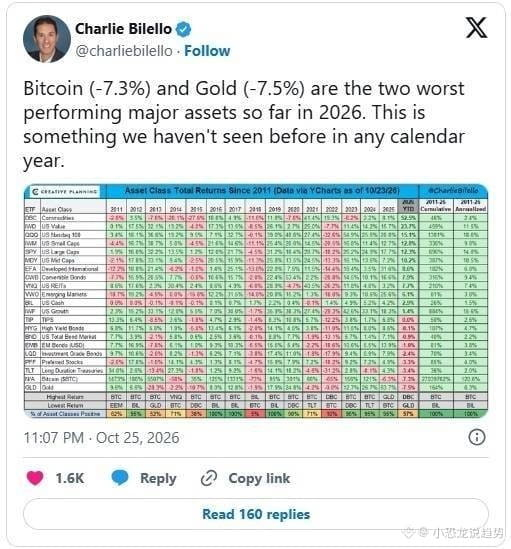
On the same day, Bitcoin was at $79,803, down 36.7% from its all-time high of $126,080. Year to date, gold is down 7.1% and Bitcoin is down 8.9%. Together, they’re at the bottom of the mainstream asset rankings.
Charlie Bilello, chief market strategist at Creative Planning, put it more bluntly in his October 23 asset table: this is the first time on record that gold and Bitcoin have both been the worst-performing assets in the same calendar year 📉
It wasn’t like this before. In 2014, 2018, and 2022, both ended the year down, but Bitcoin fell 58%, 73%, and 65%, respectively, while gold managed to hold its ground. Each time, Bitcoin was the one taking the hit.
The money flows tell an even clearer story. In October, U.S. spot Bitcoin ETFs saw net outflows of about $314 million. On Thursday and Friday last week alone, $773 million flowed out. Gold also failed to attract any meaningful safe-haven buying over the same period. Marginal buyers on both sides left at the same time. It’s not that people’s views on value suddenly changed—the positions were simply being unwound.
Things have changed this year. Gold and Bitcoin are now priced by the same pool of money. When real interest rates, the dollar, and liquidity all tighten, both fall; when they ease, both rise.
So the old hedging playbook—buy gold when stocks fall, buy gold when crypto falls—hasn’t worked once this year. What stings even more is that global stocks are still near record highs. The money hasn’t disappeared; it’s just moved to a different lane: AI ⚠️
The Fed’s rate decision lands at 2 a.m. Thursday. Rates are widely expected to stay in the 3.75%–4.00% range. Goldman Sachs expects the final rate hike of this cycle to come in December. If the Fed’s wording is hawkish, gold’s first level to watch is $3,901, and Bitcoin’s is $77,000.
Whichever of these levels breaks first will be the real weak link in this cycle. It’s not about which asset is more resilient, but whose buyers run out of support first.
If you hold both gold and Bitcoin, are you losing on both sides this year, or has one saved the other?
Tap the profile picture to watch the livestream.
Every day, we bring you the latest crypto market developments—not just what’s happening, but the logic and opportunities behind it 👀🚀
A year ago, it was still called the king of safe havens. Now gold is just 3% above its one-year low 🦖
On October 27, COMEX gold futures were at $4,021, down 28% from the one-year high of $5,586 and just 3% above the one-year low of $3,901.
📈 进群看今日思路
On the same day, Bitcoin was at $79,803, down 36.7% from its all-time high of $126,080. Year to date, gold is down 7.1% and Bitcoin is down 8.9%. Together, they’re at the bottom of the mainstream asset rankings.
Charlie Bilello, chief market strategist at Creative Planning, put it more bluntly in his October 23 asset table: this is the first time on record that gold and Bitcoin have both been the worst-performing assets in the same calendar year 📉
It wasn’t like this before. In 2014, 2018, and 2022, both ended the year down, but Bitcoin fell 58%, 73%, and 65%, respectively, while gold managed to hold its ground. Each time, Bitcoin was the one taking the hit.
The money flows tell an even clearer story. In October, U.S. spot Bitcoin ETFs saw net outflows of about $314 million. On Thursday and Friday last week alone, $773 million flowed out. Gold also failed to attract any meaningful safe-haven buying over the same period. Marginal buyers on both sides left at the same time. It’s not that people’s views on value suddenly changed—the positions were simply being unwound.
Things have changed this year. Gold and Bitcoin are now priced by the same pool of money. When real interest rates, the dollar, and liquidity all tighten, both fall; when they ease, both rise.
So the old hedging playbook—buy gold when stocks fall, buy gold when crypto falls—hasn’t worked once this year. What stings even more is that global stocks are still near record highs. The money hasn’t disappeared; it’s just moved to a different lane: AI ⚠️
The Fed’s rate decision lands at 2 a.m. Thursday. Rates are widely expected to stay in the 3.75%–4.00% range. Goldman Sachs expects the final rate hike of this cycle to come in December. If the Fed’s wording is hawkish, gold’s first level to watch is $3,901, and Bitcoin’s is $77,000.
Whichever of these levels breaks first will be the real weak link in this cycle. It’s not about which asset is more resilient, but whose buyers run out of support first.
If you hold both gold and Bitcoin, are you losing on both sides this year, or has one saved the other?
Tap the profile picture to watch the livestream.
Every day, we bring you the latest crypto market developments—not just what’s happening, but the logic and opportunities behind it 👀🚀
203
·
--
$110.3M flowed into a single fund, while $88.6M was pulled from Ethereum the same day
[💡 群里更新数据解读](https://app.binance.com/uni-qr/JpwCPfBj)
On October 26, U.S. spot Bitcoin ETFs saw total net inflows of $110.3 million. BlackRock’s IBIT alone took in the full $110.3 million, while all other products had zero net flows.
That same day, spot Ethereum ETFs saw net outflows of $88.6 million. BlackRock’s ETHA alone saw $104.7 million withdrawn, while Fidelity’s FETH took in $16.1 million—those inflows and outflows offset each other, leaving a net outflow of exactly $88.6 million.
One side had a single product swallow the entire pool; the other had a single product bear the entire outflow. The structure is perfectly symmetrical. 📊
Put these two sets of numbers in the context of October, and they look different.
Spot Bitcoin ETFs are still down about $314 million in net flows for October. $773 million flowed out last Thursday and Friday; yesterday’s $110.3 million only clawed back less than a third of that.
As for Ethereum, there had already been six consecutive trading days of net outflows, totaling $202 million. Yesterday was a small counterflow on day seven—not enough to call a reversal. ⚠️
My take: this isn’t money coming back; it’s a one-off rebalancing.
IBIT taking in all the net inflows suggests a single large order from an authorized participant—not broad-based buying. This kind of inflow can easily reverse the very next day. Healthy inflows should be spread across multiple products, with a little coming into each.
The issue with ETH is more structural. U.S. spot Ethereum ETFs currently can’t pass staking rewards on to holders. For the same institutional investor, buying an ETF means actively giving up a 3%–4% annual staking yield. Holding the coins directly is more worthwhile, so when Ethereum sees redemptions, ETFs are usually the first place investors sell. 🦖
Now look at prices: Bitcoin at $79,712, down 0.35% over 24 hours; Ethereum at $2,312, down 0.32%. Both are basically flat, suggesting these flows haven’t yet made their way into the market price. The redemptions in Ethereum ETFs look more like post-quarter-end rebalancing than panic.
The rate decision is due at 2 a.m. Beijing time on October 29. Rates are widely expected to remain at 3.75%–4.00%. These inflows and outflows ahead of the decision look more like minor position adjustments than a statement about market direction.
If you’re watching anything, watch two things: first, whether Bitcoin ETFs can maintain net inflows for five or more consecutive trading days; second, whether Ethereum ETF redemptions continue to be concentrated in ETHA. The first will determine whether Bitcoin can hold the $80,000 level; the second will determine how much longer Ethereum’s relative weakness lasts. 👀
Do you currently hold more ETF shares, or coins in your own wallet? Let’s talk in the comments.
I bring you the latest crypto market developments every day—not just what’s happening, but the logic and opportunities behind it. 👀🚀
$110.3M flowed into a single fund, while $88.6M was pulled from Ethereum the same day
💡 群里更新数据解读
On October 26, U.S. spot Bitcoin ETFs saw total net inflows of $110.3 million. BlackRock’s IBIT alone took in the full $110.3 million, while all other products had zero net flows.
That same day, spot Ethereum ETFs saw net outflows of $88.6 million. BlackRock’s ETHA alone saw $104.7 million withdrawn, while Fidelity’s FETH took in $16.1 million—those inflows and outflows offset each other, leaving a net outflow of exactly $88.6 million.
One side had a single product swallow the entire pool; the other had a single product bear the entire outflow. The structure is perfectly symmetrical. 📊
Put these two sets of numbers in the context of October, and they look different.
Spot Bitcoin ETFs are still down about $314 million in net flows for October. $773 million flowed out last Thursday and Friday; yesterday’s $110.3 million only clawed back less than a third of that.
As for Ethereum, there had already been six consecutive trading days of net outflows, totaling $202 million. Yesterday was a small counterflow on day seven—not enough to call a reversal. ⚠️
My take: this isn’t money coming back; it’s a one-off rebalancing.
IBIT taking in all the net inflows suggests a single large order from an authorized participant—not broad-based buying. This kind of inflow can easily reverse the very next day. Healthy inflows should be spread across multiple products, with a little coming into each.
The issue with ETH is more structural. U.S. spot Ethereum ETFs currently can’t pass staking rewards on to holders. For the same institutional investor, buying an ETF means actively giving up a 3%–4% annual staking yield. Holding the coins directly is more worthwhile, so when Ethereum sees redemptions, ETFs are usually the first place investors sell. 🦖
Now look at prices: Bitcoin at $79,712, down 0.35% over 24 hours; Ethereum at $2,312, down 0.32%. Both are basically flat, suggesting these flows haven’t yet made their way into the market price. The redemptions in Ethereum ETFs look more like post-quarter-end rebalancing than panic.
The rate decision is due at 2 a.m. Beijing time on October 29. Rates are widely expected to remain at 3.75%–4.00%. These inflows and outflows ahead of the decision look more like minor position adjustments than a statement about market direction.
If you’re watching anything, watch two things: first, whether Bitcoin ETFs can maintain net inflows for five or more consecutive trading days; second, whether Ethereum ETF redemptions continue to be concentrated in ETHA. The first will determine whether Bitcoin can hold the $80,000 level; the second will determine how much longer Ethereum’s relative weakness lasts. 👀
Do you currently hold more ETF shares, or coins in your own wallet? Let’s talk in the comments.
I bring you the latest crypto market developments every day—not just what’s happening, but the logic and opportunities behind it. 👀🚀

446
·
--
Bitcoin barely moved, but the $2.69 trillion market lost $39 billion 🦖
At noon on October 27, Bitcoin was trading at $79,715, up just 0.18% in 24 hours. Ethereum was at $2,311, up 0.38%; XRP at $1.30, up 1.57%; and SOL at $100.03, down slightly by 0.21%. The four major coins were all basically standing still.
[💬 群里一起聊行情](https://app.binance.com/uni-qr/JpwCPfBj)
But at the same time, the global crypto market cap fell from $2.73 trillion to $2.69 trillion, shrinking by 1.44% in 24 hours. Bitcoin dominance actually rose to 59.4%.
Put these four figures together and there’s only one explanation: it wasn’t Bitcoin that fell—it was the $1.09 trillion outside of Bitcoin.
The Fed’s October 27–28 policy meeting is underway, with the decision due at 2 a.m. Beijing time on October 29. Rates are expected to stay at 3.75%–4.00%. The Fed just raised rates once in September, its first hike since July 2023.
Before a rate decision, capital doesn’t retreat evenly. It pulls out of the thinnest corners first. A few million dollars in daily trading volume means that even a small amount of selling can trigger a double-digit drop. Bitcoin, by contrast, has enough market depth that the same amount of selling wouldn’t even move it by 0.2%.
That creates a pretty awkward situation: the broader market looks bad, but the leader is holding steady. People watching the index think something’s wrong; people watching Bitcoin think everything’s fine. Neither side is making things up.
My view is that this kind of market structure offers protection before the decision, but creates risk afterward. If Warsh’s wording comes across as hawkish, the catch-up selloff will spread from the middle outward: first the most liquid assets, then the thinnest ones. By then, altcoins often have very little support left 📉
Historically, this kind of divergence shows up before every rate decision. What really determines the direction is the 30 minutes after the announcement—not the 24 hours before it.
$80,000 is now both Bitcoin’s floor and the market’s emotional line. As long as it holds, it means nobody has been forced to sell. If it breaks, it means someone has no choice but to sell ⚖️
Are your holdings on the Bitcoin side or the other side? Let’s talk in the comments.
Tap the profile picture to watch the livestream.
Every day, I’ll keep you up to date on Bitcoin and Fed news—not just what’s happening, but also the logic and opportunities behind it 👀🚀
Bitcoin barely moved, but the $2.69 trillion market lost $39 billion 🦖
At noon on October 27, Bitcoin was trading at $79,715, up just 0.18% in 24 hours. Ethereum was at $2,311, up 0.38%; XRP at $1.30, up 1.57%; and SOL at $100.03, down slightly by 0.21%. The four major coins were all basically standing still.
💬 群里一起聊行情
But at the same time, the global crypto market cap fell from $2.73 trillion to $2.69 trillion, shrinking by 1.44% in 24 hours. Bitcoin dominance actually rose to 59.4%.
Put these four figures together and there’s only one explanation: it wasn’t Bitcoin that fell—it was the $1.09 trillion outside of Bitcoin.
The Fed’s October 27–28 policy meeting is underway, with the decision due at 2 a.m. Beijing time on October 29. Rates are expected to stay at 3.75%–4.00%. The Fed just raised rates once in September, its first hike since July 2023.
Before a rate decision, capital doesn’t retreat evenly. It pulls out of the thinnest corners first. A few million dollars in daily trading volume means that even a small amount of selling can trigger a double-digit drop. Bitcoin, by contrast, has enough market depth that the same amount of selling wouldn’t even move it by 0.2%.
That creates a pretty awkward situation: the broader market looks bad, but the leader is holding steady. People watching the index think something’s wrong; people watching Bitcoin think everything’s fine. Neither side is making things up.
My view is that this kind of market structure offers protection before the decision, but creates risk afterward. If Warsh’s wording comes across as hawkish, the catch-up selloff will spread from the middle outward: first the most liquid assets, then the thinnest ones. By then, altcoins often have very little support left 📉
Historically, this kind of divergence shows up before every rate decision. What really determines the direction is the 30 minutes after the announcement—not the 24 hours before it.
$80,000 is now both Bitcoin’s floor and the market’s emotional line. As long as it holds, it means nobody has been forced to sell. If it breaks, it means someone has no choice but to sell ⚖️
Are your holdings on the Bitcoin side or the other side? Let’s talk in the comments.
Tap the profile picture to watch the livestream.
Every day, I’ll keep you up to date on Bitcoin and Fed news—not just what’s happening, but also the logic and opportunities behind it 👀🚀
1
364
·
--
90% of the money is betting on no rate hike this week 🦖 But Goldman Sachs has penciled in one final hike for December
In its October 27 report, Goldman Sachs said the Fed is highly likely to hold rates steady at its policy meeting early Thursday morning Beijing time, keeping them in the 3.75%–4% range. But December could bring the final rate hike of this cycle.
Goldman’s reasoning is straightforward: Since September, the financial conditions index has tightened by only about 30 basis points—not enough to substitute for an actual rate hike. So markets shouldn’t interpret tighter financial conditions as a sign that the hiking cycle is over.
That message is really aimed at two groups: people who see falling stocks and high oil prices and conclude that the Fed won’t dare to act, and bulls who have already started treating no hike as good news.
Market pricing is now sharply divided. CME data shows just a 12% chance of a hike at this week’s meeting, with more than 90% betting on no change. But for the December meeting, some traders are already pricing in a 25-basis-point hike. In other words, people aren’t betting on no hike—they’re betting on a hike later.
Goldman also laid out a timeline: As the effects of tariffs, energy shocks, and AI-related price pressures gradually fade, U.S. inflation will improve in 2027. Under its baseline scenario, the Fed won’t make another move before March 2027. There’s just one wild card: Middle East tensions could push oil prices higher again. Brent crude surged to $117 last Friday, then fell back to $110 on Monday—not far from the comfort zone Goldman described. The latest year-over-year PCE inflation reading was 3.4%.
The crypto market is in a more vulnerable position. Bitcoin is currently around $79,688, still 36% below its all-time high of $126,080 📉 Spot Bitcoin ETFs saw net outflows of about $314 million in October, with $773 million withdrawn in just two days last Thursday and Friday. The price is now stuck around $80,000. The $82,000 level is where rallies began in both August and September. If Bitcoin can’t reclaim it, bulls will remain on the back foot. Below that, $75,000 is the key support level identified by a HashKey researcher.
My take: Thursday morning’s decision itself won’t tell us much. What really matters is how Warsh describes December at the press conference. If the language shifts from “data-dependent” to “inflation remains elevated,” the odds of a December hike could jump above their current 30% ⚠️ For the short term, that’s the biggest risk this week.
Do you think there’ll be a hike in December, or is this cycle really over? Share your thoughts in the comments.
I bring you the latest on Bitcoin and the Fed every day—not just what’s happening, but the logic and opportunities behind the headlines 👀🚀
Tap my profile picture to watch the livestream

425
·
--
There’s an average of just $844 sitting in 300 million wallets 🦖
On October 27, Lorenzo Valente, Director of Digital Asset Research at ARK Invest, wrote that the number of addresses holding stablecoins had surpassed 300 million for the first time. The Ethereum ecosystem accounts for 37% of them, up from just 29% two years ago. Around three-quarters of that increase came from L2s.
At the same time, the two largest stablecoins, USDT and USDC, had market caps of $182.2 billion and $71 billion, respectively—a combined total of about $253.3 billion. Spread across those 300 million addresses, that works out to just $844 per address on average.
That’s the easiest thing to misread about this data: the number of addresses isn’t the number of users, let alone the amount of money. An arbitrage bot can generate thousands of wallets in batches, and a single airdrop farm can leave behind hundreds of thousands of small-balance addresses. An average of $844 suggests that many addresses are just temporary wallets, not accounts for storing value.
But look at it the other way, and reaching 300 million addresses in just eight years is still a significant milestone. In 2018, the total stablecoin market cap was in the tens of billions of dollars. Today, USDT alone is worth $182.2 billion. Address growth and capital growth are two different curves: the former is slow, the latter fast.
Ethereum’s shift is even more noteworthy. Two years ago, 29% of stablecoin addresses were in the Ethereum ecosystem; now it’s 37%. Three-quarters of that eight-percentage-point increase came from L2s. The message is clear: new users aren’t crowding onto mainnet. They’re moving from mainnet to cheaper chains—or landing on L2s as soon as they enter the market. 🐋
Valente also shared a bigger figure: EVM-compatible chains host about 94% of stablecoin addresses. By that measure, non-EVM chains like Solana have a very small share of stablecoin addresses. That doesn’t mean the money isn’t there—it means the distribution of addresses and the distribution of capital aren’t the same thing.
His prediction is that going from 300 million to 1 billion could take just 18 months—a much faster pace than the growth seen over the past eight years. If that prediction comes true, the real test won’t be the number of addresses, but whether the average balance can rise above $844, and whether use cases like payroll, remittances, and merchant settlements can take hold. ⚖️
Bitcoin is currently around $79,905 and Ethereum at $2,318. The market hasn’t given us a clear direction, but stablecoin address data has offered one first.
Do you think stablecoin addresses really can reach 1 billion in 18 months? Or will it be another numbers game driven by airdrop farming? Let’s discuss in the comments.
Every day, we bring you the latest in stablecoins and on-chain capital flows—not just what’s happening, but the logic and opportunities behind it. 👀🚀
204
·
--
Verified
A payment card company aiming for a $5 billion valuation: 9 million users generate just $20 in annual revenue each
A Hong Kong-based crypto payment card company is preparing to confidentially file for a U.S. IPO with the SEC before the end of the year, targeting a valuation of at least $5 billion. According to Bloomberg, the company, called RedotPay, is also in talks to raise $4 billion to $5 billion in pre-IPO funding.
Put the numbers side by side and they look a little jarring: 9 million customers, $180 million in annualized revenue. At the target valuation, that’s a price-to-sales ratio of nearly 28x. Per customer, it works out to just $20 a year. 🦖
First, here’s how the business works. Users load stablecoins onto a card, and purchases are settled in local currency. On the merchant side, transactions run through the Visa and Mastercard networks. The company earns a share of card transaction fees and profits from foreign-exchange spreads—not interest or fluctuations in crypto prices. So its revenue ceiling isn’t determined by the market; it depends on how many people are willing to use crypto for everyday spending.
That also explains how it secured this valuation. In 2025, it raised $194 million, with investors including the venture capital arm of a U.S.-regulated crypto exchange and the venture capital arm of stablecoin giant Circle. They provide both capital and real-world use cases: the card provider enables people to actually spend stablecoins, the issuer gets another channel for circulation, and the exchange gets another way for users to cash out. Everyone gets something out of it.
But a 28x price-to-sales ratio doesn’t come for free. A confidential filing is only the first step. Next come regulatory questions, prospectus disclosures, roadshows, and pricing. At every stage, user numbers, retention, bad debt, and KYC costs will be laid out in the open. Payment cards face two major risks: compliance costs rising in step with scale, and reliance on payment partners. If even one partner tightens its terms, revenue can take an immediate hit. ⚠️
My take is that the significance isn’t RedotPay itself, but the valuation benchmark it could set. If it really lists at $5 billion, every crypto payment card company still operating privately will be compared against it, and fundraising negotiations could suddenly get a lot easier. On the other hand, if the stock falls below its IPO price, the valuation story for the entire sector will have to be rewritten. No one knows the answer yet. 📉
Two dates are worth watching: the confidential filing before year-end, and the public release of the prospectus afterward. The first will show whether the company is willing to take the plunge; the second will show whether the market believes in it. If the prospectus reveals that annualized revenue growth has slowed to single digits, that $5 billion figure will need another look.
Do you know anyone who actually uses a crypto card for everyday purchases? Have you ever worked out the fees and exchange rates? Let’s talk in the comments. 👀
Every day, we bring you the latest in crypto payments—not just what’s happening, but the logic and opportunities behind it. 👀🚀
98
·
--
Verified
The $1.8 trillion asset management giant flipped a small switch: stock dividends will no longer be reinvested in stocks, but automatically used to buy Bitcoin 🦖
On October 22, Franklin Templeton registered two ETFs with Nasdaq: the Franklin US Equity Bitcoin DRIP Index ETF and the Franklin US Innovation Bitcoin DRIP Index ETF. Their underlying indexes start with 95% U.S. stocks and 5% Bitcoin.
The three letters that really matter are DRIP: Dividend Reinvestment Plan. In the past, dividends were automatically used to buy more of the same stock. Now they’re automatically directed to the Bitcoin allocation instead. Between rebalances, dividends gradually push Bitcoin’s weighting higher.
But there’s a brake on this automatic buying. The funds rebalance quarterly, cutting Bitcoin’s weighting back to 4.5% if it exceeds 5%. If it crosses the 20% threshold midway through a quarter, it’s also immediately cut back to 4.5%. In other words, this is a machine that can only add to its position gradually—not go all in. ⚖️
The two products serve different roles: one tracks U.S. large-cap blue chips, while the other focuses on innovative U.S. stocks. Both are nominally stock portfolios; Bitcoin is simply where the dividends are directed.
It’s worth looking at the broader picture, too. Over the past year, Bitcoin fell 23%, while the S&P 500 rose 18% and the Nasdaq-100 gained 19%. Year to date, Bitcoin is down 2.88%, while the two indexes are up 17% and 20%, respectively. In other words, this product isn’t chasing a hot trend in a bull market. It’s laying out a gradual entry path for traditional investors while Bitcoin is underperforming stocks.
Franklin Templeton already has a spot Bitcoin ETF, EZBC, with $466.78 million in assets, making it the ninth-largest spot Bitcoin ETF in the U.S. Now it’s launching two DRIP funds as well. That’s essentially a way to shift the same clients’ money from one-time purchases to a steady trickle of inflows every month or quarter. 📈
Put simply, this isn’t adding leverage to crypto. It’s giving Wall Street’s dividend cash flow a new destination. Dividends keep coming in every quarter, and as long as the product remains active, periodic buying will follow. The amounts may not be huge, but the direction is consistent.
The second-order effect is worth watching even more closely. If more asset managers replicate this structure, Bitcoin’s marginal buying pressure could shift from being sentiment-driven to cash-flow-driven. The sources of price volatility could shift along with it—from leveraged liquidations to quarterly rebalancing.
Do you think products that automatically use dividends to buy Bitcoin will become a standard way for traditional investors to enter the market? Share your thoughts in the comments.
Tap the profile picture to watch the livestream.
Every day, we bring you the latest on Bitcoin ETFs and institutional fund flows—not just what’s happening, but the logic and opportunities behind the headlines. 👀🚀

1.1k
·
--
44 days. One person hacked 60 companies and demanded $270,000 in ransom. In the end, only $210 came through. 🦖
The Seoul Metropolitan Police Agency announced on Monday that seven people had been arrested. This is South Korea’s first large-scale AI-assisted hacking case. Around 90 organizations were breached, and 8.2 million records were stolen.
The ringleader is 32. He studied art and physical education at university and had no IT background. He taught himself using YouTube and blogs, and worked at a security company conducting simulated attacks from 2019 to 2022. The real speed-up came at the end of August this year, when he started using an AI coding agent and an autonomous penetration-testing tool called Artex. From August 31 to October 13, he hacked 60 companies in 44 days.
The whole operation actually ran for 13 months, from last September to this October. Targets included hospitals, universities, cram schools, golf courses, and subsidiaries of large conglomerates. One funeral services provider lost 1.22 million records. Reports say the cram-school data also included information about minors. Seoul police say attacks on this scale used to take a team of hackers; now one person can do it in a few weeks. 💥
The most striking part wasn’t the hacking—it was cashing out. They sent ransom emails to 38 victims, demanding a total of 360 million won, or about $270,000. In the end, only 300,000 won—about $210—was confirmed as paid. So far, 15 organizations have reported losses. Last Friday, the ringleader was taken into custody and transferred to prosecutors on charges of violating the Information and Communications Network Act and extortion. ⚠️
Here’s a counterintuitive finding: three universities—Cambridge, Edinburgh, and Strathclyde—have just published a study analyzing 97,895 posts on cybercrime forums. Their conclusion: AI is currently mostly amplifying activities that are already automated, such as SEO fraud, social media bots, and pig-butchering scams. It doesn’t help low-skilled criminals as much as people might think. In other words, these tools have lowered the barrier to launching attacks, but the way criminals cash out is still the same old story. 🔓
For the crypto industry, what really matters in this case isn’t the 90 organizations—it’s the cost of an attack. Phishing emails, fake customer support, fake job offers, and fake interview assignments: expect these four attack vectors to become faster and more convincing. The final step before signing a wallet transaction still comes down to a person.
Do you think AI will lead to more crypto thefts in the next wave, or just more noise? Share your thoughts in the comments.
Bringing you the latest in AI and crypto security every day—not just what’s happening, but the logic and opportunities behind the headlines. 👀🚀

1.6k
Log in to explore more content
Join global crypto users on Binance Square
⚡️ Get latest and useful information about crypto.
💬 Trusted by the world’s largest crypto exchange.
👍 Discover real insights from verified creators.
Email / Phone number