

橙子Joyce
487 Posts

橙子Joyce
 Square Verified+
Report
Block User
十年以上美股市场投研策略|WEB3项目投研|十年以上投资BTC.ETH.BNB.SOL|贵金属投资策略黄金.白银.铜|中长期价值投资者|推特X:@Joyce88AI|✨星河社区联合创始人✨

BNB Holder
Frequent Trader
8.8 Years
973 Following
38.8K+ Followers
46.6K+ Liked
Posts
All
Quotes
Videos
Live
PINNED
·
--
🎙️ #Building Binance Square and co-creating an ecosystem with BNB—connecting the future, empowering diverse possibilities, and bringing an interconnected world to life!
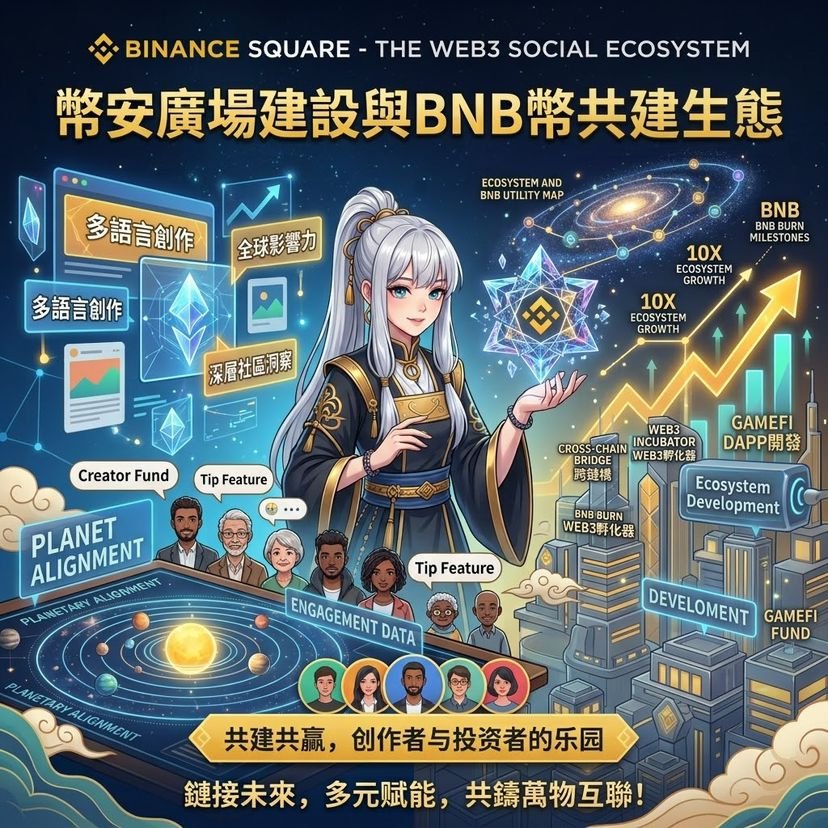
End
03 h 10 m 25 s
1.8k
16
18

·
--
go
go

周周1688
·
--
What should you keep in mind when interacting with a testnet?
Testnet tokens are usually claimed from a “faucet” and are only used to pay Gas for test transactions.
During the testnet phase, things like data resets and unstable nodes are common and completely normal.
The most important thing to remember when managing your funds: don’t treat testnet points as guaranteed earnings, and only spend as much time and transaction fees as you can afford.
$ETH 2509.08(+0.036%)
#ETH
Testnet tokens are usually claimed from a “faucet” and are only used to pay Gas for test transactions.
During the testnet phase, things like data resets and unstable nodes are common and completely normal.
The most important thing to remember when managing your funds: don’t treat testnet points as guaranteed earnings, and only spend as much time and transaction fees as you can afford.
$ETH 2509.08(+0.036%)
#ETH
382
·
--
go
go

兰汐kyL
·
--
$BTC Bitcoin plunged 8,000 points, and lots of people are saying the bull market is over? Bro, don’t rush to cut your losses. Bitcoin climbed from 60,000 to 87,000, surging 40% in one go. Now a few negative factors have knocked it back 10%. That’s a retest, not a bear market. What’s the biggest danger in a bull market? It’s not the drop—it’s getting shaken out. Sharp drops and slow climbs are just how bull markets behave. Personally, I think this looks more like the last chance to get in—not a cue to go all-in, but a reminder to stay clear-headed: buy spot in batches, avoid high-leverage contracts, add a little when it dips, and keep some skin in the game when it rises. If you really wait until everyone gets it, Bitcoin will have already taken off. What happens next? My take is simple: the harder the shakeout, the easier the rally that follows. Only those who can hold on have a shot at catching the main rally. Don’t keep asking whether the bull market is still alive. First ask yourself: would a 10% drop make you panic? If so, reduce your position; if not, stick to your plan. Remember, opportunities come from dips, and risks come from rallies. This is my personal opinion, not investment advice.#比特币反弹至8.3万美元
952
·
--
Bullish
Verified
🔥 Nvidia’s “pick-and-shovel” pivot! In talks to acquire “America’s DeepSeek,” Reflection AI
Nvidia is in talks with open-source AI startup Reflection AI about an acquisition or a deeper investment. A key asset in the U.S. open-source AI sector, Reflection AI is now valued at as much as $25 billion.
📌 Key points and deal details:
Flexible deal structure to avoid regulatory scrutiny: To avoid a lengthy antitrust review, Nvidia is considering an “acqui-hire” (hiring the core team and licensing its technology), or deepening the partnership through additional equity investment and computing power.
Strengthening its ecosystem and accelerating its expansion: After acquiring Hugging Face for $13 billion and forming a close partnership with Groq in a deal worth around $20 billion, Nvidia is stepping up its bets on the open-weight model ecosystem in an effort to address gaps in its foundation-model offerings.
A closed loop spanning AI hardware and infrastructure: Reflection AI’s recently released Beam model offers significant cost advantages, and the company has secured multi-billion-dollar computing-power partnerships with U.S. government agencies and cloud-computing giants including SpaceX and Nebius.
💡 Analysis:
> Nvidia is transforming from a mere “pick-and-shovel seller” of GPU chips into a dominant player that controls the upper-layer model ecosystem and the gateways to developer traffic. This deep “compute + models” loop not only reinforces its position among leading U.S. tech companies, but also provides further momentum for the long-term growth narrative around AI and Web3 decentralized computing.
We continue to invest
#币安交易所AI美股
#BinanceSquare
$NVDA.US
{stock_us}(NVDA.US)
$SPCX.US
{stock_us}(SPCX.US)
$GOOG.US
{stock_us}(GOOG.US)
🔥 Nvidia’s “pick-and-shovel” pivot! In talks to acquire “America’s DeepSeek,” Reflection AI
Nvidia is in talks with open-source AI startup Reflection AI about an acquisition or a deeper investment. A key asset in the U.S. open-source AI sector, Reflection AI is now valued at as much as $25 billion.
📌 Key points and deal details:
Flexible deal structure to avoid regulatory scrutiny: To avoid a lengthy antitrust review, Nvidia is considering an “acqui-hire” (hiring the core team and licensing its technology), or deepening the partnership through additional equity investment and computing power.
Strengthening its ecosystem and accelerating its expansion: After acquiring Hugging Face for $13 billion and forming a close partnership with Groq in a deal worth around $20 billion, Nvidia is stepping up its bets on the open-weight model ecosystem in an effort to address gaps in its foundation-model offerings.
A closed loop spanning AI hardware and infrastructure: Reflection AI’s recently released Beam model offers significant cost advantages, and the company has secured multi-billion-dollar computing-power partnerships with U.S. government agencies and cloud-computing giants including SpaceX and Nebius.
💡 Analysis:
> Nvidia is transforming from a mere “pick-and-shovel seller” of GPU chips into a dominant player that controls the upper-layer model ecosystem and the gateways to developer traffic. This deep “compute + models” loop not only reinforces its position among leading U.S. tech companies, but also provides further momentum for the long-term growth narrative around AI and Web3 decentralized computing.
We continue to invest
#币安交易所AI美股
#BinanceSquare
$NVDA.US
$SPCX.US
$GOOG.US
Nvidia is in talks with open-source AI startup Reflection AI about an acquisition or a deeper investment. A key asset in the U.S. open-source AI sector, Reflection AI is now valued at as much as $25 billion.
📌 Key points and deal details:
Flexible deal structure to avoid regulatory scrutiny: To avoid a lengthy antitrust review, Nvidia is considering an “acqui-hire” (hiring the core team and licensing its technology), or deepening the partnership through additional equity investment and computing power.
Strengthening its ecosystem and accelerating its expansion: After acquiring Hugging Face for $13 billion and forming a close partnership with Groq in a deal worth around $20 billion, Nvidia is stepping up its bets on the open-weight model ecosystem in an effort to address gaps in its foundation-model offerings.
A closed loop spanning AI hardware and infrastructure: Reflection AI’s recently released Beam model offers significant cost advantages, and the company has secured multi-billion-dollar computing-power partnerships with U.S. government agencies and cloud-computing giants including SpaceX and Nebius.
💡 Analysis:
> Nvidia is transforming from a mere “pick-and-shovel seller” of GPU chips into a dominant player that controls the upper-layer model ecosystem and the gateways to developer traffic. This deep “compute + models” loop not only reinforces its position among leading U.S. tech companies, but also provides further momentum for the long-term growth narrative around AI and Web3 decentralized computing.
We continue to invest
#币安交易所AI美股
#BinanceSquare
$NVDA.US
$SPCX.US
$GOOG.US
NVDAUS-0.55%
GOOGUS+0.83%
SPCXUS+1.26%
3
717
·
--
Bullish
Warren Buffett’s rational rules for investing: Emotions are the greatest enemy. He repeatedly emphasizes that investment success doesn’t depend on exceptionally high intelligence, but on having the right framework of knowledge and the ability to keep it from being corrupted by emotions.
A classic statement is: “You don’t need a stratospheric IQ, extraordinary business insight, or inside information to invest successfully over a lifetime. What you need is a sound framework for making decisions and the ability to keep emotions from corroding that framework. You must provide your own emotional discipline.”
At Berkshire’s annual meeting, he has also stated plainly that when making investment or business decisions, you should leave your emotions at the door. It’s fine to have emotions in life, but in investing, emotions are the enemy.
Core principles in practice
1. Treat the market as an “emotional partner” (Mr. Market)
A concept inherited from Benjamin Graham: The market quotes prices every day, sometimes in extreme optimism and sometimes in extreme pessimism. Rational investors should take advantage of its emotions rather than let themselves be led by them. Be fearful when others are greedy, and greedy when others are fearful.
2. Temperament matters more than intelligence
Buffett says that someone with an IQ of 150 would be better off selling 30 points to someone else, because investing doesn’t require genius. What you need is the ability to think independently, be patient and disciplined, and neither follow the crowd nor deliberately go against it. People with high IQs but poor emotional control often perform worse in the market.
3. Circle of competence + margin of safety + long-term holding
• Invest only in businesses you truly understand.
• Buy at a price significantly below intrinsic value (a margin of safety).
• Once you’ve bought a high-quality business, hold it for as long as possible and let compounding work.
Short-term share-price fluctuations are just noise; what truly matters is a company’s long-term business performance.
4. The first and second rules are not to lose money
“Rule No. 1: Never lose money. Rule No. 2: Never forget Rule No. 1.” Essentially, this means minimizing the risk of permanent capital loss when making decisions, rather than chasing short-term windfalls.
These principles have been repeatedly validated in bull markets, bear markets, tech bubbles, and financial crises. Markets change, but human nature—fear and greed—hardly does. That’s why a rational framework is the real moat that helps you weather market cycles. Buffett’s “rational rules for investing” remain one of the most reliable guides for ordinary people to combat market noise and build long-term wealth.
$SPCX.US
{stock_us}(SPCX.US)
Warren Buffett’s rational rules for investing: Emotions are the greatest enemy. He repeatedly emphasizes that investment success doesn’t depend on exceptionally high intelligence, but on having the right framework of knowledge and the ability to keep it from being corrupted by emotions.
A classic statement is: “You don’t need a stratospheric IQ, extraordinary business insight, or inside information to invest successfully over a lifetime. What you need is a sound framework for making decisions and the ability to keep emotions from corroding that framework. You must provide your own emotional discipline.”
At Berkshire’s annual meeting, he has also stated plainly that when making investment or business decisions, you should leave your emotions at the door. It’s fine to have emotions in life, but in investing, emotions are the enemy.
Core principles in practice
1. Treat the market as an “emotional partner” (Mr. Market) A concept inherited from Benjamin Graham: The market quotes prices every day, sometimes in extreme optimism and sometimes in extreme pessimism. Rational investors should take advantage of its emotions rather than let themselves be led by them. Be fearful when others are greedy, and greedy when others are fearful.
2. Temperament matters more than intelligence Buffett says that someone with an IQ of 150 would be better off selling 30 points to someone else, because investing doesn’t require genius. What you need is the ability to think independently, be patient and disciplined, and neither follow the crowd nor deliberately go against it. People with high IQs but poor emotional control often perform worse in the market.
3. Circle of competence + margin of safety + long-term holding
• Invest only in businesses you truly understand.
• Buy at a price significantly below intrinsic value (a margin of safety).
• Once you’ve bought a high-quality business, hold it for as long as possible and let compounding work. Short-term share-price fluctuations are just noise; what truly matters is a company’s long-term business performance.
4. The first and second rules are not to lose money “Rule No. 1: Never lose money. Rule No. 2: Never forget Rule No. 1.” Essentially, this means minimizing the risk of permanent capital loss when making decisions, rather than chasing short-term windfalls.
These principles have been repeatedly validated in bull markets, bear markets, tech bubbles, and financial crises. Markets change, but human nature—fear and greed—hardly does. That’s why a rational framework is the real moat that helps you weather market cycles. Buffett’s “rational rules for investing” remain one of the most reliable guides for ordinary people to combat market noise and build long-term wealth.
$SPCX.US
A classic statement is: “You don’t need a stratospheric IQ, extraordinary business insight, or inside information to invest successfully over a lifetime. What you need is a sound framework for making decisions and the ability to keep emotions from corroding that framework. You must provide your own emotional discipline.”
At Berkshire’s annual meeting, he has also stated plainly that when making investment or business decisions, you should leave your emotions at the door. It’s fine to have emotions in life, but in investing, emotions are the enemy.
Core principles in practice
1. Treat the market as an “emotional partner” (Mr. Market) A concept inherited from Benjamin Graham: The market quotes prices every day, sometimes in extreme optimism and sometimes in extreme pessimism. Rational investors should take advantage of its emotions rather than let themselves be led by them. Be fearful when others are greedy, and greedy when others are fearful.
2. Temperament matters more than intelligence Buffett says that someone with an IQ of 150 would be better off selling 30 points to someone else, because investing doesn’t require genius. What you need is the ability to think independently, be patient and disciplined, and neither follow the crowd nor deliberately go against it. People with high IQs but poor emotional control often perform worse in the market.
3. Circle of competence + margin of safety + long-term holding
• Invest only in businesses you truly understand.
• Buy at a price significantly below intrinsic value (a margin of safety).
• Once you’ve bought a high-quality business, hold it for as long as possible and let compounding work. Short-term share-price fluctuations are just noise; what truly matters is a company’s long-term business performance.
4. The first and second rules are not to lose money “Rule No. 1: Never lose money. Rule No. 2: Never forget Rule No. 1.” Essentially, this means minimizing the risk of permanent capital loss when making decisions, rather than chasing short-term windfalls.
These principles have been repeatedly validated in bull markets, bear markets, tech bubbles, and financial crises. Markets change, but human nature—fear and greed—hardly does. That’s why a rational framework is the real moat that helps you weather market cycles. Buffett’s “rational rules for investing” remain one of the most reliable guides for ordinary people to combat market noise and build long-term wealth.
$SPCX.US
SPCXUS+1.26%
4
3
1.3k
·
--
Bullish
🚨 U.S. Treasury yields hit a 25-year high! How will this affect your crypto assets and U.S. stocks on Binance?
The U.S. Treasury market has been highly volatile recently, with the 10-year Treasury yield climbing to 5.36%, its highest level in nearly 25 years. Rising inflation, a strong economy, and surging global sovereign debt (with global debt exceeding $365 trillion) are redefining how assets are priced in global financial markets.
💡 Four key market insights
* The AI funding boom is pushing interest rates higher
* S&P expects AI capital expenditure to reach $1.3 trillion next year.
* Morgan Stanley forecasts that companies will add around $570 billion in AI-related debt this year alone.
* The pressure from massive debt issuance continues to push bond yields higher, and spreads on CCC-rated high-yield bonds have begun to widen.
* A divided stock market: Tech giants are “immune,” but market breadth is deteriorating
* Although the S&P 500 has remained resilient year to date (partly thanks to three consecutive quarters of year-over-year earnings growth of 25%+), the market is becoming increasingly divided.
* The share of NYSE-listed stocks trading above their 200-day moving average has fallen from 64% to below 50%, showing that higher funding costs are beginning to weigh on sectors outside tech.
* Fixed-income assets are entering the “goldilocks zone”
* Institutional investors generally favor short-duration bonds with maturities of 1–5 years and floating-rate instruments, locking in target returns without taking on excessive interest-rate risk.
* Tax-loss harvesting—selling fixed-income holdings at a loss to offset capital gains from stocks—is becoming a new way for high-net-worth investors to improve after-tax returns.
* Potential market breaking points (warning signs)
* Keep a close eye on three signals: downward revisions to corporate earnings expectations, sharp jumps in credit spreads, and extreme volatility in foreign exchange markets.
* If the market begins to question the ROI (return on investment) of AI capital expenditure, disruptions to the debt-financing chain could become the biggest macroeconomic tail risk.
📌 Summary: The market is undergoing a profound shift from “zero/negative interest rates” to “higher/normal rates for longer.” While high yields are raising the cost of capital, they are also creating new portfolio rebalancing opportunities for developers and investors holding cash and low-risk assets.
$SPCX.US
{stock_us}(SPCX.US)
$BTC
{spot}(BTCUSDT)
$BNB
{spot}(BNBUSDT)
🚨 U.S. Treasury yields hit a 25-year high! How will this affect your crypto assets and U.S. stocks on Binance?
The U.S. Treasury market has been highly volatile recently, with the 10-year Treasury yield climbing to 5.36%, its highest level in nearly 25 years. Rising inflation, a strong economy, and surging global sovereign debt (with global debt exceeding $365 trillion) are redefining how assets are priced in global financial markets.
💡 Four key market insights
* The AI funding boom is pushing interest rates higher
* S&P expects AI capital expenditure to reach $1.3 trillion next year.
* Morgan Stanley forecasts that companies will add around $570 billion in AI-related debt this year alone.
* The pressure from massive debt issuance continues to push bond yields higher, and spreads on CCC-rated high-yield bonds have begun to widen.
* A divided stock market: Tech giants are “immune,” but market breadth is deteriorating
* Although the S&P 500 has remained resilient year to date (partly thanks to three consecutive quarters of year-over-year earnings growth of 25%+), the market is becoming increasingly divided.
* The share of NYSE-listed stocks trading above their 200-day moving average has fallen from 64% to below 50%, showing that higher funding costs are beginning to weigh on sectors outside tech.
* Fixed-income assets are entering the “goldilocks zone”
* Institutional investors generally favor short-duration bonds with maturities of 1–5 years and floating-rate instruments, locking in target returns without taking on excessive interest-rate risk.
* Tax-loss harvesting—selling fixed-income holdings at a loss to offset capital gains from stocks—is becoming a new way for high-net-worth investors to improve after-tax returns.
* Potential market breaking points (warning signs)
* Keep a close eye on three signals: downward revisions to corporate earnings expectations, sharp jumps in credit spreads, and extreme volatility in foreign exchange markets.
* If the market begins to question the ROI (return on investment) of AI capital expenditure, disruptions to the debt-financing chain could become the biggest macroeconomic tail risk.
📌 Summary: The market is undergoing a profound shift from “zero/negative interest rates” to “higher/normal rates for longer.” While high yields are raising the cost of capital, they are also creating new portfolio rebalancing opportunities for developers and investors holding cash and low-risk assets.
$SPCX.US
$BTC
$BNB
The U.S. Treasury market has been highly volatile recently, with the 10-year Treasury yield climbing to 5.36%, its highest level in nearly 25 years. Rising inflation, a strong economy, and surging global sovereign debt (with global debt exceeding $365 trillion) are redefining how assets are priced in global financial markets.
💡 Four key market insights
* The AI funding boom is pushing interest rates higher
* S&P expects AI capital expenditure to reach $1.3 trillion next year.
* Morgan Stanley forecasts that companies will add around $570 billion in AI-related debt this year alone.
* The pressure from massive debt issuance continues to push bond yields higher, and spreads on CCC-rated high-yield bonds have begun to widen.
* A divided stock market: Tech giants are “immune,” but market breadth is deteriorating
* Although the S&P 500 has remained resilient year to date (partly thanks to three consecutive quarters of year-over-year earnings growth of 25%+), the market is becoming increasingly divided.
* The share of NYSE-listed stocks trading above their 200-day moving average has fallen from 64% to below 50%, showing that higher funding costs are beginning to weigh on sectors outside tech.
* Fixed-income assets are entering the “goldilocks zone”
* Institutional investors generally favor short-duration bonds with maturities of 1–5 years and floating-rate instruments, locking in target returns without taking on excessive interest-rate risk.
* Tax-loss harvesting—selling fixed-income holdings at a loss to offset capital gains from stocks—is becoming a new way for high-net-worth investors to improve after-tax returns.
* Potential market breaking points (warning signs)
* Keep a close eye on three signals: downward revisions to corporate earnings expectations, sharp jumps in credit spreads, and extreme volatility in foreign exchange markets.
* If the market begins to question the ROI (return on investment) of AI capital expenditure, disruptions to the debt-financing chain could become the biggest macroeconomic tail risk.
📌 Summary: The market is undergoing a profound shift from “zero/negative interest rates” to “higher/normal rates for longer.” While high yields are raising the cost of capital, they are also creating new portfolio rebalancing opportunities for developers and investors holding cash and low-risk assets.
$SPCX.US
$BTC
$BNB
1
3
928
·
--
Bullish
Verified
Two Key Reasons SpaceX Stock Is Surging Today—
This article focuses on two key catalysts driving trends in the space and telecommunications markets:
Key Takeaways
1. SpaceX’s Two Catalysts:
Wall Street’s Endorsement: Barclays initiated coverage of SpaceX with an “Overweight” rating and a $254 price target, citing its dominance in launch services. This brings the share of Wall Street analysts rating SpaceX “Buy” to 76% (well above the S&P 500 average of 55%–60%), with a consensus price target of about $227.
Strategic Telecommunications Expansion: SpaceX’s acquisition of low-band spectrum will allow it to combine terrestrial mobile network coverage—including indoor penetration—with its orbital satellite broadband network, Starlink.
2. Impact on the Broader Market and Industry:
Traditional Telecom Giants Under Pressure: Shares of major carriers (AT&T, Verizon, and T-Mobile) fell 6%–7% in premarket trading amid concerns about direct competition in mobile wireless services.
Tower Infrastructure Benefits: Shares of communications tower operators (American Tower and Crown Castle) surged 6%–7%, as SpaceX’s plans rely on terrestrial tower infrastructure to complement its satellite network.
$SPCX.US
Starlink’s Growth Momentum: Starlink ended the third quarter with approximately 12 million users.
#SpaceX #Starlink
#币安交易所美股分析
{stock_us}(SPCX.US)
$NVDA.US
{stock_us}(NVDA.US)
$AMZN.US
{stock_us}(AMZN.US)
Two Key Reasons SpaceX Stock Is Surging Today—
This article focuses on two key catalysts driving trends in the space and telecommunications markets:
Key Takeaways
1. SpaceX’s Two Catalysts:
Wall Street’s Endorsement: Barclays initiated coverage of SpaceX with an “Overweight” rating and a $254 price target, citing its dominance in launch services. This brings the share of Wall Street analysts rating SpaceX “Buy” to 76% (well above the S&P 500 average of 55%–60%), with a consensus price target of about $227.
Strategic Telecommunications Expansion: SpaceX’s acquisition of low-band spectrum will allow it to combine terrestrial mobile network coverage—including indoor penetration—with its orbital satellite broadband network, Starlink.
2. Impact on the Broader Market and Industry:
Traditional Telecom Giants Under Pressure: Shares of major carriers (AT&T, Verizon, and T-Mobile) fell 6%–7% in premarket trading amid concerns about direct competition in mobile wireless services.
Tower Infrastructure Benefits: Shares of communications tower operators (American Tower and Crown Castle) surged 6%–7%, as SpaceX’s plans rely on terrestrial tower infrastructure to complement its satellite network.
$SPCX.US
Starlink’s Growth Momentum: Starlink ended the third quarter with approximately 12 million users.
#SpaceX #Starlink
#币安交易所美股分析
$NVDA.US
$AMZN.US
This article focuses on two key catalysts driving trends in the space and telecommunications markets:
Key Takeaways
1. SpaceX’s Two Catalysts:
Wall Street’s Endorsement: Barclays initiated coverage of SpaceX with an “Overweight” rating and a $254 price target, citing its dominance in launch services. This brings the share of Wall Street analysts rating SpaceX “Buy” to 76% (well above the S&P 500 average of 55%–60%), with a consensus price target of about $227.
Strategic Telecommunications Expansion: SpaceX’s acquisition of low-band spectrum will allow it to combine terrestrial mobile network coverage—including indoor penetration—with its orbital satellite broadband network, Starlink.
2. Impact on the Broader Market and Industry:
Traditional Telecom Giants Under Pressure: Shares of major carriers (AT&T, Verizon, and T-Mobile) fell 6%–7% in premarket trading amid concerns about direct competition in mobile wireless services.
Tower Infrastructure Benefits: Shares of communications tower operators (American Tower and Crown Castle) surged 6%–7%, as SpaceX’s plans rely on terrestrial tower infrastructure to complement its satellite network.
$SPCX.US
Starlink’s Growth Momentum: Starlink ended the third quarter with approximately 12 million users.
#SpaceX #Starlink
#币安交易所美股分析
$NVDA.US
$AMZN.US
AMZNUS+3.25%
NVDAUS-0.55%
SPCXUS+1.26%
1
2
1.9k
·
--
Bullish
🚀 SpaceX Looks to Acquire Nationwide Low-Frequency Spectrum, Directly Challenging Ground Telecommunications Giants
On Thursday, SpaceX announced it has reached an agreement to acquire a portfolio of 800MHz low-band spectrum assets nationwide (up to 14MHz of bandwidth) held by digital infrastructure investment company Grain Management, further paving the way for Starlink to become the United States’ leading mobile operator. In response to the news, SpaceX rose about 2.5% after the close, while traditional telecom giants AT&T, Verizon, and T-Mobile all collectively plunged more than 7% after the close.
💡 Key Advantages and Shifts in the Industry Landscape:
Technically Fill the Gaps: Starlink’s existing 2GHz mid-band provides large capacity and high bandwidth, while the newly acquired low-frequency spectrum will significantly improve signal penetration and indoor coverage. Combined with satellite high-band capacity, Starlink can reduce its reliance on traditional terrestrial cell towers.
Direct Competition with the Traditional Titans: D2D (device-to-device) communications are evolving from providing supplemental service for blind spots in remote areas into a commercial competitive offering that can potentially fully replace terrestrial cellular networks. Previously, T-Mobile, AT&T, and Verizon had formed satellite communication joint ventures (with SpaceX not involved). SpaceX’s move signals that it is accelerating an independent build-out, freeing itself from dependence on traditional carriers.
Policy Tailwinds Compound: The FCC is set to vote on multiple proposals in October. It plans to auction and open more spectrum supporting satellite direct-to-device (D2D) services, and industry players such as SpaceX and Amazon are expected to continue benefiting.
As SpaceX’s core profitable business following its record-breaking IPO in June this year with a valuation of over $2 trillion, Starlink is reshaping the global and U.S. communications market.
—————————————————————————We continue to invest in SPCX, MU, SOXL, AMZN, NVDA, and GOOG on the Binance exchange
$SPCX.US
{stock_us}(SPCX.US)
$NVDA.US
{stock_us}(NVDA.US)
$GOOG.US
{stock_us}(GOOG.US)
🚀 SpaceX Looks to Acquire Nationwide Low-Frequency Spectrum, Directly Challenging Ground Telecommunications Giants
On Thursday, SpaceX announced it has reached an agreement to acquire a portfolio of 800MHz low-band spectrum assets nationwide (up to 14MHz of bandwidth) held by digital infrastructure investment company Grain Management, further paving the way for Starlink to become the United States’ leading mobile operator. In response to the news, SpaceX rose about 2.5% after the close, while traditional telecom giants AT&T, Verizon, and T-Mobile all collectively plunged more than 7% after the close.
💡 Key Advantages and Shifts in the Industry Landscape:
Technically Fill the Gaps: Starlink’s existing 2GHz mid-band provides large capacity and high bandwidth, while the newly acquired low-frequency spectrum will significantly improve signal penetration and indoor coverage. Combined with satellite high-band capacity, Starlink can reduce its reliance on traditional terrestrial cell towers.
Direct Competition with the Traditional Titans: D2D (device-to-device) communications are evolving from providing supplemental service for blind spots in remote areas into a commercial competitive offering that can potentially fully replace terrestrial cellular networks. Previously, T-Mobile, AT&T, and Verizon had formed satellite communication joint ventures (with SpaceX not involved). SpaceX’s move signals that it is accelerating an independent build-out, freeing itself from dependence on traditional carriers.
Policy Tailwinds Compound: The FCC is set to vote on multiple proposals in October. It plans to auction and open more spectrum supporting satellite direct-to-device (D2D) services, and industry players such as SpaceX and Amazon are expected to continue benefiting.
As SpaceX’s core profitable business following its record-breaking IPO in June this year with a valuation of over $2 trillion, Starlink is reshaping the global and U.S. communications market.
—————————————————————————We continue to invest in SPCX, MU, SOXL, AMZN, NVDA, and GOOG on the Binance exchange
$SPCX.US
$NVDA.US
$GOOG.US
On Thursday, SpaceX announced it has reached an agreement to acquire a portfolio of 800MHz low-band spectrum assets nationwide (up to 14MHz of bandwidth) held by digital infrastructure investment company Grain Management, further paving the way for Starlink to become the United States’ leading mobile operator. In response to the news, SpaceX rose about 2.5% after the close, while traditional telecom giants AT&T, Verizon, and T-Mobile all collectively plunged more than 7% after the close.
💡 Key Advantages and Shifts in the Industry Landscape:
Technically Fill the Gaps: Starlink’s existing 2GHz mid-band provides large capacity and high bandwidth, while the newly acquired low-frequency spectrum will significantly improve signal penetration and indoor coverage. Combined with satellite high-band capacity, Starlink can reduce its reliance on traditional terrestrial cell towers.
Direct Competition with the Traditional Titans: D2D (device-to-device) communications are evolving from providing supplemental service for blind spots in remote areas into a commercial competitive offering that can potentially fully replace terrestrial cellular networks. Previously, T-Mobile, AT&T, and Verizon had formed satellite communication joint ventures (with SpaceX not involved). SpaceX’s move signals that it is accelerating an independent build-out, freeing itself from dependence on traditional carriers.
Policy Tailwinds Compound: The FCC is set to vote on multiple proposals in October. It plans to auction and open more spectrum supporting satellite direct-to-device (D2D) services, and industry players such as SpaceX and Amazon are expected to continue benefiting.
As SpaceX’s core profitable business following its record-breaking IPO in June this year with a valuation of over $2 trillion, Starlink is reshaping the global and U.S. communications market.
—————————————————————————We continue to invest in SPCX, MU, SOXL, AMZN, NVDA, and GOOG on the Binance exchange
$SPCX.US
$NVDA.US
$GOOG.US
NVDAUS-0.55%
GOOGUS+0.83%
SPCXUS+1.26%
2
11
23
947
·
--
Bullish
Verified
【Fed minutes: Most officials expect one more rate hike before year-end; rate-hike path is prudent】
According to the minutes released today, Fed officials expect to raise interest rates again before the end of this year to curb inflation, which has remained above target for more than five consecutive years. However, the minutes did not indicate when policymakers specifically expect to raise rates, saying only that persistently elevated prices and a stable labor market could prompt the Fed to raise rates for a second time this year. The minutes stated: “Regarding the monetary policy outlook after this meeting, most participants judged that another increase in the target range for the federal funds rate may be appropriate by the end of the year.”
“However, participants emphasized that they would approach each meeting with an open mind, and that decisions at future meetings would depend on incoming information and its implications for the economic outlook and the balance of risks.” Discussions at the September meeting showed that officials saw a risk that inflation could remain stubbornly persistent, while the labor market was “close to full employment” and overall economic growth had picked up. The minutes stated: “Many participants emphasized that, from a risk-management perspective, a path of increasing the target range for the federal funds rate would be prudent, providing insurance against the risk that inflation could remain above target because demand is stronger than expected or further adverse supply shocks occur.”
【Fed minutes: Most officials expect one more rate hike before year-end; rate-hike path is prudent】
According to the minutes released today, Fed officials expect to raise interest rates again before the end of this year to curb inflation, which has remained above target for more than five consecutive years. However, the minutes did not indicate when policymakers specifically expect to raise rates, saying only that persistently elevated prices and a stable labor market could prompt the Fed to raise rates for a second time this year. The minutes stated: “Regarding the monetary policy outlook after this meeting, most participants judged that another increase in the target range for the federal funds rate may be appropriate by the end of the year.”
“However, participants emphasized that they would approach each meeting with an open mind, and that decisions at future meetings would depend on incoming information and its implications for the economic outlook and the balance of risks.” Discussions at the September meeting showed that officials saw a risk that inflation could remain stubbornly persistent, while the labor market was “close to full employment” and overall economic growth had picked up. The minutes stated: “Many participants emphasized that, from a risk-management perspective, a path of increasing the target range for the federal funds rate would be prudent, providing insurance against the risk that inflation could remain above target because demand is stronger than expected or further adverse supply shocks occur.”
According to the minutes released today, Fed officials expect to raise interest rates again before the end of this year to curb inflation, which has remained above target for more than five consecutive years. However, the minutes did not indicate when policymakers specifically expect to raise rates, saying only that persistently elevated prices and a stable labor market could prompt the Fed to raise rates for a second time this year. The minutes stated: “Regarding the monetary policy outlook after this meeting, most participants judged that another increase in the target range for the federal funds rate may be appropriate by the end of the year.”
“However, participants emphasized that they would approach each meeting with an open mind, and that decisions at future meetings would depend on incoming information and its implications for the economic outlook and the balance of risks.” Discussions at the September meeting showed that officials saw a risk that inflation could remain stubbornly persistent, while the labor market was “close to full employment” and overall economic growth had picked up. The minutes stated: “Many participants emphasized that, from a risk-management perspective, a path of increasing the target range for the federal funds rate would be prudent, providing insurance against the risk that inflation could remain above target because demand is stronger than expected or further adverse supply shocks occur.”
1
1
4
709
·
--
Article
Who are Micron Technology’s competitors?Micron Technology is one of the world’s major semiconductor memory chip manufacturers. Its core businesses include DRAM (dynamic random-access memory), NAND flash memory, and AI-driven advanced HBM (high-bandwidth memory). Its main competitors vary by business segment, as follows:
I. Comprehensive, full-spectrum competitors (DRAM, NAND, and HBM)
These are Micron’s two strongest and most direct core competitors: 1. Samsung Electronics (South Korea)
Status: A global leader in the memory chip industry.
Who are Micron Technology’s competitors?
Micron Technology is one of the world’s major semiconductor memory chip manufacturers. Its core businesses include DRAM (dynamic random-access memory), NAND flash memory, and AI-driven advanced HBM (high-bandwidth memory). Its main competitors vary by business segment, as follows:
I. Comprehensive, full-spectrum competitors (DRAM, NAND, and HBM)
These are Micron’s two strongest and most direct core competitors: 1. Samsung Electronics (South Korea)
Status: A global leader in the memory chip industry.
I. Comprehensive, full-spectrum competitors (DRAM, NAND, and HBM)
These are Micron’s two strongest and most direct core competitors: 1. Samsung Electronics (South Korea)
Status: A global leader in the memory chip industry.
MUUS-0.79%
2
3
1.3k
·
--
Bullish
Verified
SpaceX plans to raise $40 billion to pour into Nvidia! The AI computing arms race is heating up again 🚀💥
Following its $25 billion bond issuance in June this year, Elon Musk’s SpaceX is making another aggressive push to raise capital. The company plans to raise $40 billion—including $30 billion in investment-grade bonds and $10 billion in bank loans—specifically to make large-scale purchases of Nvidia chips and accelerate its plans for space and AI data centers!
📌 Key points at a glance:
1️⃣ Fully embracing Nvidia’s Vera Rubin architecture
Musk stated unequivocally during an earnings call that SpaceX has decided to build its computing infrastructure entirely on the Nvidia platform. He also said that Vera Rubin is currently the world’s leading AI computing platform, and that the two companies will work closely together on multiple fronts.
2️⃣ Wall Street giant Apollo to lead $40 billion debt financing
The financing will be led by private equity giant Apollo Global Management and distributed to institutional investors. Bond giant Pimco is also among the lenders in discussions, and the deal is expected to close in 2027.
3️⃣ Hidden concerns in the credit market
Although SpaceX has a BBB investment-grade rating, its long-term bonds maturing in 2056 have fallen to around 85 cents on the dollar, with yields approaching junk-bond levels, due to the company’s limited financial disclosures to date. Bringing in Apollo is intended to boost confidence among institutional buyers by leveraging its extensive network and reputation.
4️⃣ AI data centers are “devouring” global capital
From Nvidia’s partnership with Apollo, BlackRock, and others to build a $500 billion financing platform, to the surge in traditional non-institutional private credit, the massive funding needs of AI computing infrastructure are rapidly draining market liquidity.
————————————————————————
💬 With Starlink in space on one hand and enormous computing power on the other, Musk has taken the AI arms race from the ground into space! We remain optimistic about the long-term capital gains from this wave of AI infrastructure investment, and continue investing in SpaceX and Nvidia (NVDA) stocks on Binance Exchange.
#加密货币 #币安推出BinanceIntelligence We’re building BNB for the long term
#币安交易所美股投资
#SpaceX AI Infrastructure
#NVDA
$NVDA.US
{stock_us}(NVDA.US)
$SPCX.US
{stock_us}(SPCX.US)
$AMZN.US
{spot}(AMZNBUSDT)
SpaceX plans to raise $40 billion to pour into Nvidia! The AI computing arms race is heating up again 🚀💥
Following its $25 billion bond issuance in June this year, Elon Musk’s SpaceX is making another aggressive push to raise capital. The company plans to raise $40 billion—including $30 billion in investment-grade bonds and $10 billion in bank loans—specifically to make large-scale purchases of Nvidia chips and accelerate its plans for space and AI data centers!
📌 Key points at a glance:
1️⃣ Fully embracing Nvidia’s Vera Rubin architecture
Musk stated unequivocally during an earnings call that SpaceX has decided to build its computing infrastructure entirely on the Nvidia platform. He also said that Vera Rubin is currently the world’s leading AI computing platform, and that the two companies will work closely together on multiple fronts.
2️⃣ Wall Street giant Apollo to lead $40 billion debt financing
The financing will be led by private equity giant Apollo Global Management and distributed to institutional investors. Bond giant Pimco is also among the lenders in discussions, and the deal is expected to close in 2027.
3️⃣ Hidden concerns in the credit market
Although SpaceX has a BBB investment-grade rating, its long-term bonds maturing in 2056 have fallen to around 85 cents on the dollar, with yields approaching junk-bond levels, due to the company’s limited financial disclosures to date. Bringing in Apollo is intended to boost confidence among institutional buyers by leveraging its extensive network and reputation.
4️⃣ AI data centers are “devouring” global capital
From Nvidia’s partnership with Apollo, BlackRock, and others to build a $500 billion financing platform, to the surge in traditional non-institutional private credit, the massive funding needs of AI computing infrastructure are rapidly draining market liquidity.
————————————————————————
💬 With Starlink in space on one hand and enormous computing power on the other, Musk has taken the AI arms race from the ground into space! We remain optimistic about the long-term capital gains from this wave of AI infrastructure investment, and continue investing in SpaceX and Nvidia (NVDA) stocks on Binance Exchange.
#加密货币 #币安推出BinanceIntelligence We’re building BNB for the long term
#币安交易所美股投资
#SpaceX AI Infrastructure
#NVDA
$NVDA.US
$SPCX.US
$AMZN.US
Following its $25 billion bond issuance in June this year, Elon Musk’s SpaceX is making another aggressive push to raise capital. The company plans to raise $40 billion—including $30 billion in investment-grade bonds and $10 billion in bank loans—specifically to make large-scale purchases of Nvidia chips and accelerate its plans for space and AI data centers!
📌 Key points at a glance:
1️⃣ Fully embracing Nvidia’s Vera Rubin architecture
Musk stated unequivocally during an earnings call that SpaceX has decided to build its computing infrastructure entirely on the Nvidia platform. He also said that Vera Rubin is currently the world’s leading AI computing platform, and that the two companies will work closely together on multiple fronts.
2️⃣ Wall Street giant Apollo to lead $40 billion debt financing
The financing will be led by private equity giant Apollo Global Management and distributed to institutional investors. Bond giant Pimco is also among the lenders in discussions, and the deal is expected to close in 2027.
3️⃣ Hidden concerns in the credit market
Although SpaceX has a BBB investment-grade rating, its long-term bonds maturing in 2056 have fallen to around 85 cents on the dollar, with yields approaching junk-bond levels, due to the company’s limited financial disclosures to date. Bringing in Apollo is intended to boost confidence among institutional buyers by leveraging its extensive network and reputation.
4️⃣ AI data centers are “devouring” global capital
From Nvidia’s partnership with Apollo, BlackRock, and others to build a $500 billion financing platform, to the surge in traditional non-institutional private credit, the massive funding needs of AI computing infrastructure are rapidly draining market liquidity.
————————————————————————
💬 With Starlink in space on one hand and enormous computing power on the other, Musk has taken the AI arms race from the ground into space! We remain optimistic about the long-term capital gains from this wave of AI infrastructure investment, and continue investing in SpaceX and Nvidia (NVDA) stocks on Binance Exchange.
#加密货币 #币安推出BinanceIntelligence We’re building BNB for the long term
#币安交易所美股投资
#SpaceX AI Infrastructure
#NVDA
$NVDA.US
$SPCX.US
$AMZN.US
AMZNUS+3.25%
NVDAUS-0.55%
SPCXUS+1.26%
2
6
11
1.1k
·
--
🎙️ 🚀🚀🚀🚀Orange Joyce’s Daily Livestream | Beijing Time 21:00–23:30 | U.S. Stock Investment Strategies and Trading on Binance ✨✨ Long-Term Development of BNB

End
02 h 49 m 16 s
1.7k

SOL
Holding
+68.88
7
3
·
--
Bullish
Verified
🚀 SpaceX Through the Eyes of Top Investors: A Long-Term Asset for the Future
SpaceX (NASDAQ: SPCX) has reached a pivotal milestone that could reshape its business model! During Starship’s 14th integrated flight test (Flight 14), the company successfully deployed 26 Starlink V3 satellites into orbit.
For the capital markets, this is more than an engineering triumph—it means Starship is rapidly becoming a revenue-generating tool with significant commercial value.
📌 Key Takeaways
* Commercial-Class Payload Capacity Proven 📦
The 26 Starlink V3 satellites launched on this mission weighed approximately 52 tonnes in total. That not only exceeds the Space Shuttle’s low Earth orbit payload limit, but also amounts to roughly half of Starship V3’s designed payload capacity.
* Directly Strengthens the Core Business 🌐
Each V3 satellite is designed to deliver downlink capacity of 1 Tbps. This mission effectively added ~26 Tbps of network capacity to Starlink in a single launch, directly bolstering its connectivity business, worth tens of billions of dollars.
* Opens Up Possibilities for “Orbital Computing” 💻
Beyond satellite communications, Starship’s exceptionally low launch cost per kilogram is also a key foundation for making orbital AI data centers a reality.
* A Clear-Eyed View of the Technical Challenges ⚠️
One engine shut down prematurely during ascent, and neither the booster nor the upper stage was recovered on this mission. But in light of the first successful orbital deployment, these are manageable costs of technical iteration.
📊 Wall Street’s View
Wall Street currently maintains a “Strong Buy” consensus rating on SPCX:
* 27 analysts recommend Buy 🟢
* 4 recommend Hold 🟡
* 2 recommend Sell 🔴
* Average price target: $235.10 (an estimated upside of approximately 40%)
————————————————————————
💡 Our Investor View (GI):
> “Don’t get too caught up in fluctuations such as engine shutdowns or short-term lockup expirations. Buy SPCX now, and ten years from now, when your children witness the orbital era ushered in by Starship, they’ll thank you for your foresight today.”
>
#币安交易所美股投资
$SPCX.US
{stock_us}(SPCX.US)
$TSM.US
{stock_us}(TSM.US)
$META.US
{stock_us}(META.US)
🚀 SpaceX Through the Eyes of Top Investors: A Long-Term Asset for the Future
SpaceX (NASDAQ: SPCX) has reached a pivotal milestone that could reshape its business model! During Starship’s 14th integrated flight test (Flight 14), the company successfully deployed 26 Starlink V3 satellites into orbit.
For the capital markets, this is more than an engineering triumph—it means Starship is rapidly becoming a revenue-generating tool with significant commercial value.
📌 Key Takeaways
* Commercial-Class Payload Capacity Proven 📦
The 26 Starlink V3 satellites launched on this mission weighed approximately 52 tonnes in total. That not only exceeds the Space Shuttle’s low Earth orbit payload limit, but also amounts to roughly half of Starship V3’s designed payload capacity.
* Directly Strengthens the Core Business 🌐
Each V3 satellite is designed to deliver downlink capacity of 1 Tbps. This mission effectively added ~26 Tbps of network capacity to Starlink in a single launch, directly bolstering its connectivity business, worth tens of billions of dollars.
* Opens Up Possibilities for “Orbital Computing” 💻
Beyond satellite communications, Starship’s exceptionally low launch cost per kilogram is also a key foundation for making orbital AI data centers a reality.
* A Clear-Eyed View of the Technical Challenges ⚠️
One engine shut down prematurely during ascent, and neither the booster nor the upper stage was recovered on this mission. But in light of the first successful orbital deployment, these are manageable costs of technical iteration.
📊 Wall Street’s View
Wall Street currently maintains a “Strong Buy” consensus rating on SPCX:
* 27 analysts recommend Buy 🟢
* 4 recommend Hold 🟡
* 2 recommend Sell 🔴
* Average price target: $235.10 (an estimated upside of approximately 40%)
————————————————————————
💡 Our Investor View (GI):
> “Don’t get too caught up in fluctuations such as engine shutdowns or short-term lockup expirations. Buy SPCX now, and ten years from now, when your children witness the orbital era ushered in by Starship, they’ll thank you for your foresight today.”
>
#币安交易所美股投资
$SPCX.US
$TSM.US
$META.US
SpaceX (NASDAQ: SPCX) has reached a pivotal milestone that could reshape its business model! During Starship’s 14th integrated flight test (Flight 14), the company successfully deployed 26 Starlink V3 satellites into orbit.
For the capital markets, this is more than an engineering triumph—it means Starship is rapidly becoming a revenue-generating tool with significant commercial value.
📌 Key Takeaways
* Commercial-Class Payload Capacity Proven 📦
The 26 Starlink V3 satellites launched on this mission weighed approximately 52 tonnes in total. That not only exceeds the Space Shuttle’s low Earth orbit payload limit, but also amounts to roughly half of Starship V3’s designed payload capacity.
* Directly Strengthens the Core Business 🌐
Each V3 satellite is designed to deliver downlink capacity of 1 Tbps. This mission effectively added ~26 Tbps of network capacity to Starlink in a single launch, directly bolstering its connectivity business, worth tens of billions of dollars.
* Opens Up Possibilities for “Orbital Computing” 💻
Beyond satellite communications, Starship’s exceptionally low launch cost per kilogram is also a key foundation for making orbital AI data centers a reality.
* A Clear-Eyed View of the Technical Challenges ⚠️
One engine shut down prematurely during ascent, and neither the booster nor the upper stage was recovered on this mission. But in light of the first successful orbital deployment, these are manageable costs of technical iteration.
📊 Wall Street’s View
Wall Street currently maintains a “Strong Buy” consensus rating on SPCX:
* 27 analysts recommend Buy 🟢
* 4 recommend Hold 🟡
* 2 recommend Sell 🔴
* Average price target: $235.10 (an estimated upside of approximately 40%)
————————————————————————
💡 Our Investor View (GI):
> “Don’t get too caught up in fluctuations such as engine shutdowns or short-term lockup expirations. Buy SPCX now, and ten years from now, when your children witness the orbital era ushered in by Starship, they’ll thank you for your foresight today.”
>
#币安交易所美股投资
$SPCX.US
$TSM.US
$META.US
METAUS-0.49%
SPCXUS+1.26%
TSMUS-1.12%
2
3
2k
·
--
Article
🚀 Musk accelerates push into AI and chips! A wave of $220 billion in bond issuance by tech giants is coming1️⃣ SpaceXAI renamed SpaceXSI, reinforcing its “superintelligence” positioning across the board
Brand overhaul: Musk confirmed on October 4 that SpaceX’s AI business, SpaceXAI, will officially be renamed SpaceXSI (SI stands for “Superintelligence”). Musk emphasized that SpaceX itself is a “superintelligence company.”
Capital integration: The business originated as xAI, founded in 2023, and was formally folded into SpaceX through an all-stock transaction in February 2026. Musk previously revealed that xAI no longer operates as an independent company. After several rounds of rebranding, it was ultimately named SpaceXSI.
🚀 Musk accelerates push into AI and chips! A wave of $220 billion in bond issuance by tech giants is coming
1️⃣ SpaceXAI renamed SpaceXSI, reinforcing its “superintelligence” positioning across the board
Brand overhaul: Musk confirmed on October 4 that SpaceX’s AI business, SpaceXAI, will officially be renamed SpaceXSI (SI stands for “Superintelligence”). Musk emphasized that SpaceX itself is a “superintelligence company.”
Capital integration: The business originated as xAI, founded in 2023, and was formally folded into SpaceX through an all-stock transaction in February 2026. Musk previously revealed that xAI no longer operates as an independent company. After several rounds of rebranding, it was ultimately named SpaceXSI.
Brand overhaul: Musk confirmed on October 4 that SpaceX’s AI business, SpaceXAI, will officially be renamed SpaceXSI (SI stands for “Superintelligence”). Musk emphasized that SpaceX itself is a “superintelligence company.”
Capital integration: The business originated as xAI, founded in 2023, and was formally folded into SpaceX through an all-stock transaction in February 2026. Musk previously revealed that xAI no longer operates as an independent company. After several rounds of rebranding, it was ultimately named SpaceXSI.
281
·
--
Bullish
Partly True
Calm on the surface, turbulent underneath! Is a massive chasm forming beneath the U.S. stock market?
The broader U.S. market still looks resilient—the S&P 500 slipped just 0.5% in September, leaving it less than 1% off its record high. But beneath the appearance of prosperity, a toxic extreme divergence is spreading!
1. The data don't lie: Is the market rotting from within?
The equal-weighted S&P 500 has fallen for 7 straight weeks, plunging 5% in September! The only other times such a losing streak occurred were in 2002 and 2022.
More stocks at 52-week lows than highs: This anomaly has appeared for the first time since the dot-com bubble in 2000, while the broad market was less than 2% off its highs!
Only 2 sectors rose: In September, only Information Technology and Communication Services gained among the 11 sectors. Meta alone (up 27% in September) added 0.6% to the S&P 500's gain.
Extreme concentration: Just 4 mega-cap stocks have contributed nearly half of the S&P 500's gains so far this year!
2. This isn't a blind bubble, but a “brutal shakeout” in the AI era
Unlike the frenzied valuation speculation of the 2000 dot-com bubble, the market is being highly rational this time:
Mega-cap valuations are actually easing: Nvidia is up this year, but its price-to-earnings ratio has fallen below the market average; Meta's valuation has also come down.
The logic is crystal clear: Money is betting in real time on “who will win and who will lose in AI.”
Winners: Meta (driven by Muse AI agents) and semiconductors (the PHLX index surged 9.5% in September).
Losers: Traditional subscription services (Planet Fitness and The New York Times) and traditional banks. The market fears AI agents will automatically cancel users' subscriptions and move their low-yield deposits elsewhere.
3. Where are the opportunities in the chasm?
Renowned bond investor Gundlach has warned that the market is “rotting from the inside out,” but historical data suggest that a narrow rally does not necessarily signal a near-term downturn:
1. The index is like the “Ship of Theseus”: it sheds poorly run companies and brings in new blood (of the original 500 companies in 1957, only 50 remain today).
2. Third-quarter earnings season is about to begin: Profits at S&P 500 companies are expected to grow 29% year over year!
3. Potential catalysts once the bad news is priced in: An easing of geopolitical tensions could bring down oil prices and Treasury yields; markets often see a strong relief rally after the midterm elections conclude in November.
$SPCX.US
{stock_us}(SPCX.US)
Calm on the surface, turbulent underneath! Is a massive chasm forming beneath the U.S. stock market?
The broader U.S. market still looks resilient—the S&P 500 slipped just 0.5% in September, leaving it less than 1% off its record high. But beneath the appearance of prosperity, a toxic extreme divergence is spreading!
1. The data don't lie: Is the market rotting from within?
The equal-weighted S&P 500 has fallen for 7 straight weeks, plunging 5% in September! The only other times such a losing streak occurred were in 2002 and 2022.
More stocks at 52-week lows than highs: This anomaly has appeared for the first time since the dot-com bubble in 2000, while the broad market was less than 2% off its highs!
Only 2 sectors rose: In September, only Information Technology and Communication Services gained among the 11 sectors. Meta alone (up 27% in September) added 0.6% to the S&P 500's gain.
Extreme concentration: Just 4 mega-cap stocks have contributed nearly half of the S&P 500's gains so far this year!
2. This isn't a blind bubble, but a “brutal shakeout” in the AI era
Unlike the frenzied valuation speculation of the 2000 dot-com bubble, the market is being highly rational this time:
Mega-cap valuations are actually easing: Nvidia is up this year, but its price-to-earnings ratio has fallen below the market average; Meta's valuation has also come down.
The logic is crystal clear: Money is betting in real time on “who will win and who will lose in AI.”
Winners: Meta (driven by Muse AI agents) and semiconductors (the PHLX index surged 9.5% in September).
Losers: Traditional subscription services (Planet Fitness and The New York Times) and traditional banks. The market fears AI agents will automatically cancel users' subscriptions and move their low-yield deposits elsewhere.
3. Where are the opportunities in the chasm?
Renowned bond investor Gundlach has warned that the market is “rotting from the inside out,” but historical data suggest that a narrow rally does not necessarily signal a near-term downturn:
1. The index is like the “Ship of Theseus”: it sheds poorly run companies and brings in new blood (of the original 500 companies in 1957, only 50 remain today).
2. Third-quarter earnings season is about to begin: Profits at S&P 500 companies are expected to grow 29% year over year!
3. Potential catalysts once the bad news is priced in: An easing of geopolitical tensions could bring down oil prices and Treasury yields; markets often see a strong relief rally after the midterm elections conclude in November.
$SPCX.US
The broader U.S. market still looks resilient—the S&P 500 slipped just 0.5% in September, leaving it less than 1% off its record high. But beneath the appearance of prosperity, a toxic extreme divergence is spreading!
1. The data don't lie: Is the market rotting from within?
The equal-weighted S&P 500 has fallen for 7 straight weeks, plunging 5% in September! The only other times such a losing streak occurred were in 2002 and 2022.
More stocks at 52-week lows than highs: This anomaly has appeared for the first time since the dot-com bubble in 2000, while the broad market was less than 2% off its highs!
Only 2 sectors rose: In September, only Information Technology and Communication Services gained among the 11 sectors. Meta alone (up 27% in September) added 0.6% to the S&P 500's gain.
Extreme concentration: Just 4 mega-cap stocks have contributed nearly half of the S&P 500's gains so far this year!
2. This isn't a blind bubble, but a “brutal shakeout” in the AI era
Unlike the frenzied valuation speculation of the 2000 dot-com bubble, the market is being highly rational this time:
Mega-cap valuations are actually easing: Nvidia is up this year, but its price-to-earnings ratio has fallen below the market average; Meta's valuation has also come down.
The logic is crystal clear: Money is betting in real time on “who will win and who will lose in AI.”
Winners: Meta (driven by Muse AI agents) and semiconductors (the PHLX index surged 9.5% in September).
Losers: Traditional subscription services (Planet Fitness and The New York Times) and traditional banks. The market fears AI agents will automatically cancel users' subscriptions and move their low-yield deposits elsewhere.
3. Where are the opportunities in the chasm?
Renowned bond investor Gundlach has warned that the market is “rotting from the inside out,” but historical data suggest that a narrow rally does not necessarily signal a near-term downturn:
1. The index is like the “Ship of Theseus”: it sheds poorly run companies and brings in new blood (of the original 500 companies in 1957, only 50 remain today).
2. Third-quarter earnings season is about to begin: Profits at S&P 500 companies are expected to grow 29% year over year!
3. Potential catalysts once the bad news is priced in: An easing of geopolitical tensions could bring down oil prices and Treasury yields; markets often see a strong relief rally after the midterm elections conclude in November.
$SPCX.US
SPCXUS+1.26%
2
2.6k
·
--
“Money buys options”—it’s the underlying logic of financial freedom: use assets to continuously cover living expenses, liberating your time from the pressure of survival.
It consists of four layers:
• Goal: gain time autonomy and the confidence to say “no.” Work becomes a choice, not a means of mere survival.
• Core equation: passive income ≥ daily expenditures. Here, passive income refers to cash flows that don’t depend on showing up for work every day—such as investment returns, rental income, royalties, and so on.
• Accumulation method: increase your savings rate, invest the difference into assets that can generate cash flow; at the same time, raise the value of each unit of time so that one hour creates more income.
• Maintenance mechanism: control desires and spending, build an emergency fund and diversified income streams, and keep your assets working long-term.
The FIRE movement often uses a rough rule of thumb: target assets ≈ annual expenses × 25. For example, if your annual living cost is 120,000 RMB, that corresponds to about 3 million RMB in assets, then withdraw/use about 4% per year.
This multiplier is just a reference. Age, lifespan, inflation, market volatility, medical expenses, and major family expenditures will all affect the result. A more prudent approach is to keep a safety margin, use a conservative withdrawal rate, and allocate assets across different time horizons and risk levels.
So, financial freedom isn’t a single balance number—it’s a state of being: your sources of income last longer than your expenses, and your life choices are more abundant than they are right now.
“Money buys options”—it’s the underlying logic of financial freedom: use assets to continuously cover living expenses, liberating your time from the pressure of survival.
It consists of four layers:
• Goal: gain time autonomy and the confidence to say “no.” Work becomes a choice, not a means of mere survival.
• Core equation: passive income ≥ daily expenditures. Here, passive income refers to cash flows that don’t depend on showing up for work every day—such as investment returns, rental income, royalties, and so on.
• Accumulation method: increase your savings rate, invest the difference into assets that can generate cash flow; at the same time, raise the value of each unit of time so that one hour creates more income.
• Maintenance mechanism: control desires and spending, build an emergency fund and diversified income streams, and keep your assets working long-term.
The FIRE movement often uses a rough rule of thumb: target assets ≈ annual expenses × 25. For example, if your annual living cost is 120,000 RMB, that corresponds to about 3 million RMB in assets, then withdraw/use about 4% per year.
This multiplier is just a reference. Age, lifespan, inflation, market volatility, medical expenses, and major family expenditures will all affect the result. A more prudent approach is to keep a safety margin, use a conservative withdrawal rate, and allocate assets across different time horizons and risk levels.
So, financial freedom isn’t a single balance number—it’s a state of being: your sources of income last longer than your expenses, and your life choices are more abundant than they are right now.
It consists of four layers:
• Goal: gain time autonomy and the confidence to say “no.” Work becomes a choice, not a means of mere survival.
• Core equation: passive income ≥ daily expenditures. Here, passive income refers to cash flows that don’t depend on showing up for work every day—such as investment returns, rental income, royalties, and so on.
• Accumulation method: increase your savings rate, invest the difference into assets that can generate cash flow; at the same time, raise the value of each unit of time so that one hour creates more income.
• Maintenance mechanism: control desires and spending, build an emergency fund and diversified income streams, and keep your assets working long-term.
The FIRE movement often uses a rough rule of thumb: target assets ≈ annual expenses × 25. For example, if your annual living cost is 120,000 RMB, that corresponds to about 3 million RMB in assets, then withdraw/use about 4% per year.
This multiplier is just a reference. Age, lifespan, inflation, market volatility, medical expenses, and major family expenditures will all affect the result. A more prudent approach is to keep a safety margin, use a conservative withdrawal rate, and allocate assets across different time horizons and risk levels.
So, financial freedom isn’t a single balance number—it’s a state of being: your sources of income last longer than your expenses, and your life choices are more abundant than they are right now.
3
515
·
--
Bullish
2.8k
27
184
2.8k
·
--
Bullish
Verified
Micron’s Latest Earnings and Market Thoughts: Can the Storage Giant Break the “Cycle Curse” Amid the AI Boom?
Micron Technology has reported strong fourth-quarter results, with key financial highlights
Earnings per share (EPS): Adjusted EPS of $33.42 (up from $3.03 in the prior year period), beating the market expectation of $31.72.
Quarterly revenue: Reached $54 billion year over year, up 379%, and surpassed expectations of $51 billion.
Gross margin: Hit a historical high of 87%.
Cash flow and balance sheet: Generated $59 billion in free cash flow for the full year, repaid $10 billion in debt (reducing the debt balance to $5 billion), and has restarted share repurchases. The market expects free cash flow in the new fiscal year to reach $129 billion.
Industry status quo and the core contradiction
1. The supply-demand situation remains tight. Global data center investment is moving into the trillion-dollar range, and AI servers are driving a surge in demand for high-end storage chips (such as HBM). CEO Sanjay Mehrotra noted that the supply-demand outlook for fiscal 2027 and 2028 is expected to be tighter than for fiscal 2026. Due to the harsh impact of the previous downcycle, the industry is extremely cautious about capacity expansion, with new production capacity not expected to come online until after mid-2027.
2. Why does Wall Street still assign a “low valuation”?
Memory chips have historically been the semiconductor sub-sector with the most severe cyclical swings. Despite Micron’s impressive performance, Wall Street’s forward P/E multiple is only about 6.6x (far below the S&P 500’s 18.5x).
Worry at the peak signal: Micron’s guidance for the next quarter indicates that sales growth and gross margin will dip slightly, causing some investors to question whether the upcycle has already topped out.
Fear from missing the cycle: Many tech investors still vividly remember losses from previously misjudging cycle tops, and they tend to exit when earnings peak.
Breakthrough attempt: Changing the business model
To escape the “high volatility, low valuation” cycle curse, Micron is pushing customers to sign long-term supply agreements lasting up to 5 years (typically 1 year):
Includes a price floor and protections with high upper limits;
Comes with binding terms and customer upfront payments;
So far, it has signed 16 contracts, covering about 20% of total memory shipments and one-third of total memory product volume.#Binance Plaza #半导体
$MU
{future}(MUUSDT)
Micron’s Latest Earnings and Market Thoughts: Can the Storage Giant Break the “Cycle Curse” Amid the AI Boom?
Micron Technology has reported strong fourth-quarter results, with key financial highlights
Earnings per share (EPS): Adjusted EPS of $33.42 (up from $3.03 in the prior year period), beating the market expectation of $31.72.
Quarterly revenue: Reached $54 billion year over year, up 379%, and surpassed expectations of $51 billion.
Gross margin: Hit a historical high of 87%.
Cash flow and balance sheet: Generated $59 billion in free cash flow for the full year, repaid $10 billion in debt (reducing the debt balance to $5 billion), and has restarted share repurchases. The market expects free cash flow in the new fiscal year to reach $129 billion.
Industry status quo and the core contradiction
1. The supply-demand situation remains tight. Global data center investment is moving into the trillion-dollar range, and AI servers are driving a surge in demand for high-end storage chips (such as HBM). CEO Sanjay Mehrotra noted that the supply-demand outlook for fiscal 2027 and 2028 is expected to be tighter than for fiscal 2026. Due to the harsh impact of the previous downcycle, the industry is extremely cautious about capacity expansion, with new production capacity not expected to come online until after mid-2027.
2. Why does Wall Street still assign a “low valuation”?
Memory chips have historically been the semiconductor sub-sector with the most severe cyclical swings. Despite Micron’s impressive performance, Wall Street’s forward P/E multiple is only about 6.6x (far below the S&P 500’s 18.5x).
Worry at the peak signal: Micron’s guidance for the next quarter indicates that sales growth and gross margin will dip slightly, causing some investors to question whether the upcycle has already topped out.
Fear from missing the cycle: Many tech investors still vividly remember losses from previously misjudging cycle tops, and they tend to exit when earnings peak.
Breakthrough attempt: Changing the business model
To escape the “high volatility, low valuation” cycle curse, Micron is pushing customers to sign long-term supply agreements lasting up to 5 years (typically 1 year):
Includes a price floor and protections with high upper limits;
Comes with binding terms and customer upfront payments;
So far, it has signed 16 contracts, covering about 20% of total memory shipments and one-third of total memory product volume.#Binance Plaza #半导体
$MU
Micron Technology has reported strong fourth-quarter results, with key financial highlights
Earnings per share (EPS): Adjusted EPS of $33.42 (up from $3.03 in the prior year period), beating the market expectation of $31.72.
Quarterly revenue: Reached $54 billion year over year, up 379%, and surpassed expectations of $51 billion.
Gross margin: Hit a historical high of 87%.
Cash flow and balance sheet: Generated $59 billion in free cash flow for the full year, repaid $10 billion in debt (reducing the debt balance to $5 billion), and has restarted share repurchases. The market expects free cash flow in the new fiscal year to reach $129 billion.
Industry status quo and the core contradiction
1. The supply-demand situation remains tight. Global data center investment is moving into the trillion-dollar range, and AI servers are driving a surge in demand for high-end storage chips (such as HBM). CEO Sanjay Mehrotra noted that the supply-demand outlook for fiscal 2027 and 2028 is expected to be tighter than for fiscal 2026. Due to the harsh impact of the previous downcycle, the industry is extremely cautious about capacity expansion, with new production capacity not expected to come online until after mid-2027.
2. Why does Wall Street still assign a “low valuation”?
Memory chips have historically been the semiconductor sub-sector with the most severe cyclical swings. Despite Micron’s impressive performance, Wall Street’s forward P/E multiple is only about 6.6x (far below the S&P 500’s 18.5x).
Worry at the peak signal: Micron’s guidance for the next quarter indicates that sales growth and gross margin will dip slightly, causing some investors to question whether the upcycle has already topped out.
Fear from missing the cycle: Many tech investors still vividly remember losses from previously misjudging cycle tops, and they tend to exit when earnings peak.
Breakthrough attempt: Changing the business model
To escape the “high volatility, low valuation” cycle curse, Micron is pushing customers to sign long-term supply agreements lasting up to 5 years (typically 1 year):
Includes a price floor and protections with high upper limits;
Comes with binding terms and customer upfront payments;
So far, it has signed 16 contracts, covering about 20% of total memory shipments and one-third of total memory product volume.#Binance Plaza #半导体
$MU
1
784
Log in to explore more content
Join global crypto users on Binance Square
⚡️ Get latest and useful information about crypto.
💬 Trusted by the world’s largest crypto exchange.
👍 Discover real insights from verified creators.
Email / Phone number
Trending Topics
ArgentinaCentralBankWillNotPushCryptoIntoBankingForTwoYears
6,617 views
144 Discussing
#ArgentinaCentralBankWillNotPushCryptoIntoBankingForTwoYears
🚨 ARGENTINA’S CENTRAL BANK PUTS CRYPTO-BANKING INTEGRATION ON HOLD FOR THE NEXT TWO YEARS.
Argentina’s central bank is signaling no near-term opening for crypto services through traditional banks, despite the country’s strong crypto adoption.
Juan Curutchet, a senior BCRA supervisor, said there would be no change this year and linked potential integration to a possible second term for President Javier Milei.
Here’s what this means:
⚠️ Banks remain restricted from offering crypto services under existing rules.
₿ Argentinians can still access crypto through authorized virtual-asset service providers.
🏦 The delay highlights the gap between growing crypto demand and regulatory caution.
This is not a new two-year ban or a confirmed reopening date. For now, the existing restrictions remain in place, and any future change depends on regulatory decisions and economic conditions.
#bitcoin #argentina #bnb
Albertc07
·0 Likes
·1.5k views
LedgerConfirmsUnauthorizedHardwareImplantInUserDevice
37,576 views
180 Discussing
EtherETFsExtendOutflowsToNineDays
148,908 views
1,718 Discussing