

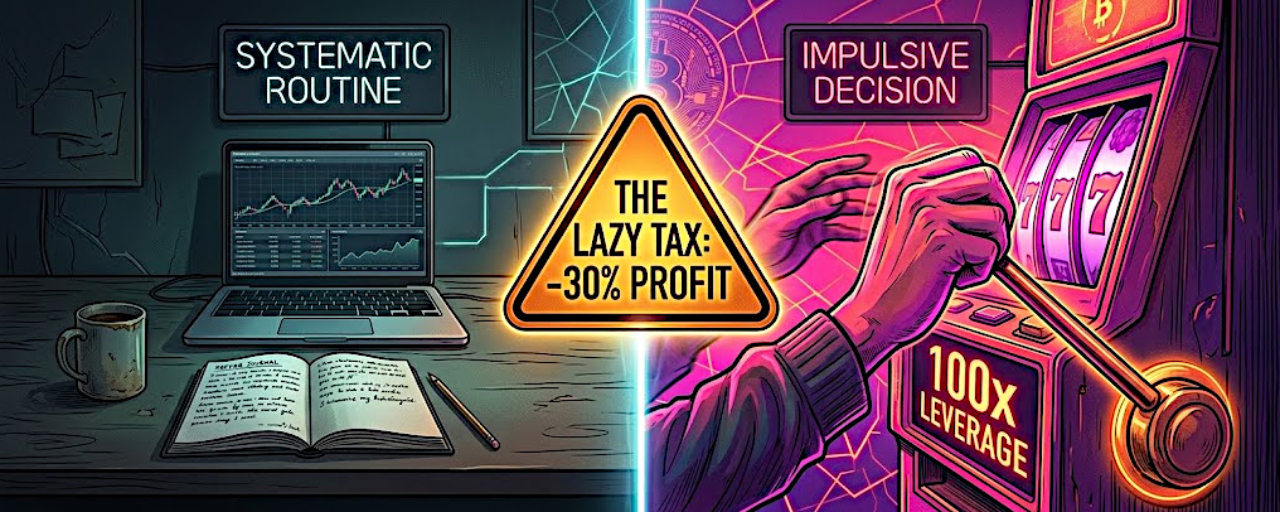

Every trader goes through this classic life cycle. In the first month of trading, you embody discipline: you keep a neat spreadsheet in Excel, calculate Risk/Reward down to the cent, and with an air of intelligence analyze charts in the evenings.
But once you grab a couple of successful take-profits, a dangerous thought clicks in your head: “I already feel this market! Why spend time on this dull bureaucracy?”
You drop the journal, start opening trades “from memory” whenever, and ignore research. Naturally, your earnings start sliding down. But instead of restoring discipline, your brain comes up with a brilliant conclusion: “I just need more volume!”—and your hand automatically reaches to push the leverage to the maximum.
Let’s break down how this trap works and exactly what we’re paying the “laziness tax” for.
1. What makes up the “laziness tax”?
Other people’s mistakes on the chart are always as clear as day: “Well, why did he even go there—there’s an obvious reversal!” But the moment you enter the trade yourself, your own foolishness instantly disguises itself as “experience,” “intuition,” and “higher confidence.” Admitting your own laziness is much harder than admitting someone else’s, but over time you pay for it with very specific dollars:
Premium for rushing (Market orders): Too lazy to set a limit and wait 5 minutes? We hit “Buy at market”! The exchange and the spread quietly clap their hands, taking 10–15% of your potential profit just for your impatience.
Amnesia of mistakes: Without a journal, you’re doomed to step on the same traps over and over. You honestly don’t notice that 80% of all your losing deposits happen, for example, on Friday evening—when you’re trying to “catch up to the weekly target,” entering low-cap coins from your phone in a bar.
Platinum funding: Were you too lazy to check the funding rate (Funding Rate) before entering futures? Congratulations—within 8 hours you’ll be surprised to find that the position burned down from holding on, simply because you paid 0.5% for the carry every couple of hours.
2. A gambling mania spiral: from casual apathy to the 100x leverage
The hardest thing in trading is to notice in time that you’ve started messing up. Admitting a miscalculation in someone else’s analysis takes two seconds, but fixing your own systemic failure—that’s a real feat. When profitability drops, your brain protects itself to the bitter end and refuses to see the obvious, launching the classic psychological spiral:
Resentment: “On 3x leverage I’m making pennies, while in social media everyone’s buying Lambos!”
Compensation: Instead of turning off emotions, opening the trade journal, and cutting out losing setups, you decide to “increase speed” and jump from 3x to 20x, and then to 50x leverage.
Final: Trading turns into a casino. Any Bitcoin hiccup of $50 kicks you out of the position, and the once systematic analyst sits at 3 a.m. with red eyes, frantically re-entering a coin with a squirrel avatar to make up the morning loss.
3. Routine isn’t boring—it's your saved money
Real professional trading is an unbearably boring job, like working as an accountant. Everything interesting happens BEFORE and AFTER pressing the button.
Trade journal: It’s your personal X-ray. If you don’t write down your entry reasons and the size of your risk, you’re not a trader—you’re just a sponsor for cryptocurrency exchanges.
A simple checklist: Ask yourself 3 questions before entering: “Where is my stop?”, “Why am I entering right now?”, “Am I trying to get even (to recoup losses)?” If there are no answers, close the terminal and go for a walk.
Voice of reason:
If you notice results getting worse, and your hand automatically reaches to crank the leverage higher to “quickly make up the morning loss,” you’re on the verge of a deep liquidation. To avoid turning it into a complete wipeout, take three simple steps:
Don’t treat a drop in quality by inflating volume: 100x leverage on a bad setup won’t make you a billionaire—it will just burn through the remaining deposit 100 times faster.
Pay the “discipline tax”: Go back to filling out your journal—at least for two weeks. You’ll be very surprised to see, clearly, how many stupid mistakes you gave the green light to simply because of plain old laziness.
Respect technical routine: Check the order book, set a limit instead of entering at market, glance at the funding timer—those 30 seconds of work will save you more money than any “secret custom indicator” from the internet.
#Трейдинг #BinanceSquare #ПсихологияТрейдинга #УправлениеРисками #Write2Earn