




The excitement around the Robinhood Chain further drives certainty and scale in crypto-stock markets. What we’re seeing in this space right now is: you can buy stocks on-chain, but the most mainstream adoption is still the crypto-stock liquidity pool for issuing new assets (memes).
The DeFi portfolio strategy originally expected was temporarily put aside.
But once stocks enter the chain, there’s an even more certain piece of the market that very few people talk about—dividends.
The idea of splitting out the future returns a target can generate and trading them separately in advance has been done in Web3 before. It’s just that now the two areas are intersecting: with underlying technology (on-chain dividend distribution) to support it, this will naturally happen on-chain.
Over the past few years, Pendle has already applied this model to ETH. For example, if users originally held an ETH yield-bearing asset like stETH or weETH, Pendle would split it into two parts:
PT represents the principal;
YT represents the yield generated before maturity.
For people who don’t want to bear收益 volatility, they can sell YT and only hold discounted PT, then redeem the underlying assets at maturity;
If you believe future收益 will rise, you can buy YT. With relatively less principal, you can obtain all the yield for a period of time.
And after stocks are put on-chain, it becomes naturally possible to do this. Also, this isn’t a fake demand—mature dividend derivatives (dividend futures) already exist in traditional financial markets.
So this piece isn’t just about one project—it breaks down the entire track and organizes it for you so you can understand it.
I. How are stock dividends split?
At the moment, in the industry, there are mainly two approaches to handle dividend payments on-chain:
One is to automatically reinvest this portion of收益: the custodian receives cash dividends, buys more underlying shares, and then reflects it through the multiplier or token net value
Another is stablecoin dividend distribution: directly pay USD + stablecoins to eligible holders
On Robinhood Chain, it uses the first approach—taking those dividend proceeds and buying the same stock again. After reinvestment, the number of stock tokens in the user’s wallet might not change, but each token would represent more shares.
For example, originally one Apple stock token represents one share of Apple. After dividends are reinvested, it might become one token representing 1.01 shares. The extra 0.01 shares are the dividend yield the user receives.
In this yield-splitting process, specifically, it works like this.
Suppose a user holds a stock token worth $100 and expects $1 in dividends in the next quarter. The user can split it into:
One PT: represents the stock principal you can retrieve at maturity;
One YT: represents all dividends generated before maturity.
After splitting, users have three main options:
The first is to sell YT and keep only PT
This is like selling future dividends upfront. Since PT no longer includes dividends before maturity, it is usually traded at a slight discount relative to the stock. As the maturity date approaches and the remaining dividends get smaller, the PT price gradually converges toward the stock token.
Need to note that PT’s “fixed income” is denominated in stocks, and it doesn’t equal a dollar-principal protected guarantee.
And while preserving the stock yield, the split-out PT can also be used as on-chain collateral
The second is to sell PT and keep only YT.
This is equivalent to only trading dividend cash flows. If actual dividends are higher than market expectations, or if the YT price is low enough, buyers may achieve higher returns.
The third option is to hold both PT and YT
Because PT + YT in economic terms should be close to a complete stock token, when the total price of the two deviates from the underlying assets, arbitrageurs can split or merge them to push prices back to a reasonable range.
Finally, it’s also necessary to clarify: the stock tokens on Robinhood Chain are not the same as users directly holding real stocks on-chain. They only provide users with an economic exposure to the corresponding stocks or ETF, but they do not grant holders legal ownership and voting rights over the underlying stocks.
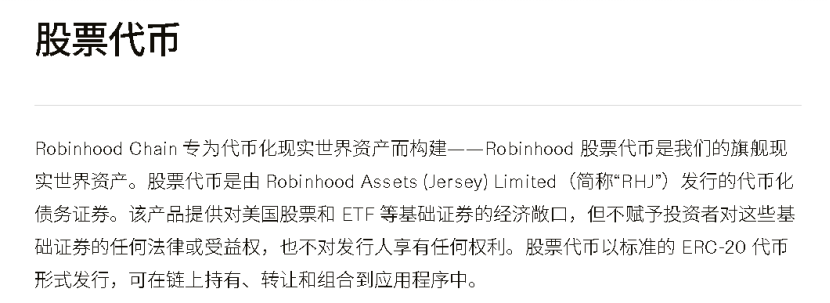
Therefore, strictly speaking, the Pendle and Pare splits mentioned below are not dividends paid directly from listed companies to on-chain stockholders. Instead, they are economic returns formed when the issuer of the stock tokens distributes dividends from the underlying assets.
II. How big is this market?
Taking the traditional market as an example, according to Capital Group’s statistics: last year alone, dividends generated by global publicly listed companies reached about $2 trillion.
This is the top-level source of cash flows in the entire dividend market. But it doesn’t mean these dividends will necessarily be split and traded. If we want to estimate how big the corresponding derived market could be, I checked third-party data (summarized by AI from the third report’s data):
Only counting dividend futures: the publicly visible global open interest notional is roughly in the range of $20–$30 billion.
Calculate dividend options based on the corresponding underlying notional size as well: listed dividend derivatives are roughly in the $50–$100 billion range.
If you add opaque OTC dividend swaps, the real market would be even larger—but currently there’s no reliable real-time global aggregation.
Then in the crypto market, what about…?
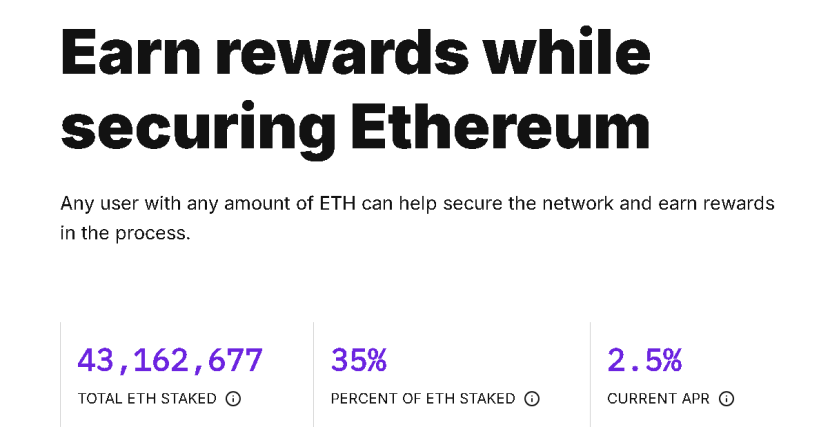
Take $ETH as an example. According to Ethereum’s official website, the current staking yields generate about 1.08 million ETH per year: 43,162,677 × 2.5%. Valued at around $2,400, the annual return is roughly $2.6 billion. This is one major source of cash flow from income-producing assets.
Since I couldn’t find any exact, granular data on the “on-chain yield derivatives” market size, I can only use Pendle’s data as a reference.
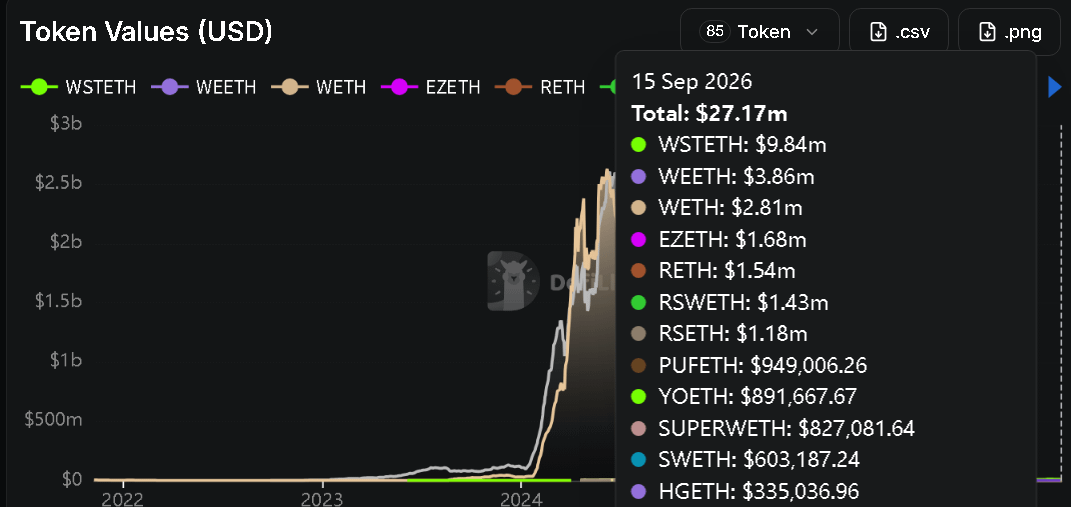
As of now, Pendle V2 data shows that ETH-related yield assets currently have TVL of about $27 million. (With total TVL around $1.25 billion, the corresponding derivative trading volume is on the order of tens of billions.) This is a rough scale reference for how big Pendle’s on-chain yield-splitting activity is at present.
Compared with traditional markets, it’s still relatively small.
After putting stocks on-chain, not all stocks can be split in the short term either; it will still be relatively mainstream assets first.
The advantage, however, is that the demand for the dividend derivatives market has already been validated off-chain.
Earlier I wrote several pieces about RWA, and I repeatedly emphasized this point: putting everything on-chain isn’t meaningful; putting assets that have consensus on-chain is meaningful.
Similarly, once stocks are on-chain, distributing dividends can be achieved in the short term in a very ideal way. I think the dividend market will also be easier for the market to understand and generate trading demand than using crypto assets as the underlying for yield splitting.
III. Participants in this market
In my view, currently there are only two that are worth discussing: one is Pendle, which was already doing yield splitting; the other is the new entrant Pare.
The former announced its move into this market just recently and officially launched a product. But I became interested in this market because of the latter.
(Around August, when Pare entered this market and started initial validation of feasibility, I basically knew Pendle would also enter this market—sure enough, it did.)
If Pendle hadn’t entered this market, I could summarize the two projects in one sentence: Pendle does crypto yield-splitting derivatives. PARE does stock-market yield-splitting derivatives.
If you believe and understand one of them, you can understand the other as well, because their yield-splitting logic is the same—only in this case the “market denominator” for stocks is bigger.
3.1 Pendle
Pendle is originally the largest yield-splitting protocol on-chain. Any asset that can generate native yield persistently on-chain can first be wrapped into a standardized yield asset SY, and then split into PT and YT.
Therefore, entering the stock dividend market isn’t a whole new business model for Pendle. It’s an expansion of the existing system to a new underlying asset.
In September 2026, Pendle entered Robinhood Chain, then launched PT/YT markets for Nvidia and Pfizer stock tokens.
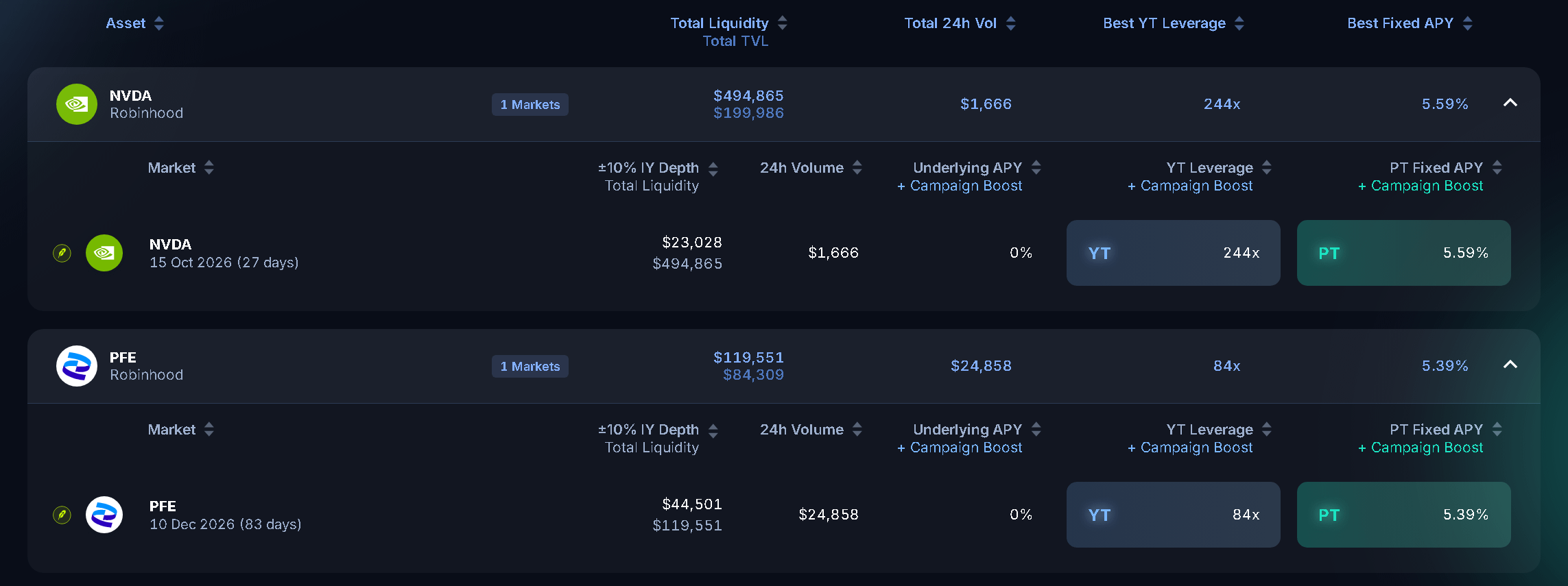
For users, the operational logic is not fundamentally different from Pendle’s original product.
If you like the stock price but don’t like short-term dividends, you can buy discounted PT. If you think the market is underestimating future dividends, you can buy YT. If you want more comprehensive yield, you can provide liquidity to this market.
Pendle doing this is quite natural, because it already has relatively mature yield-trading infrastructure. But that also means the stock market is not (mainly) mission-critical for Pendle’s survival as a business.
Pendle can generate fee revenue from other yield assets. Even if the stock dividend market ultimately never reaches scale, it won’t shake the entire protocol. This stock yield market is just one new growth direction for it, not the core narrative that must succeed.
3.2 Pare
What Pare does is much more vertical, and it’s also more early-stage—it was designed from the beginning specifically around Robinhood stock tokens.
And it’s very similar to Pendle’s design: after users deposit stock tokens, they can mint the corresponding-term PT and YT.
So far, this protocol has launched a market with derivatives based on four underlying assets: Apple, the S&P 500 ETF (SPY), the Nasdaq 100 ETF (QQQ), and Pfizer.
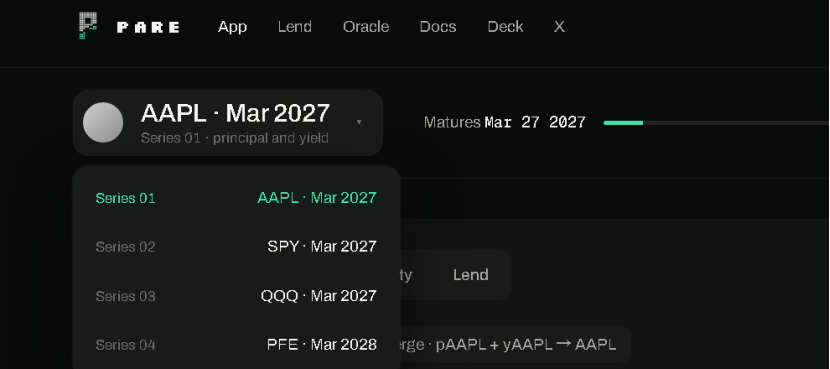
Because it’s more vertical, and the documentation PARE provides is even more detailed: it designs a mechanism that can first determine whether the increase in the redemption multiplier of a stock token is coming from dividends or from a stock split.
The so-called redemption multiplier is how many real shares a single stock token can be exchanged for.
Assume one token originally corresponds to 1 share. After automatic reinvestment of dividends, it becomes 1.02 shares. The extra 0.02 shares can be seen as yield, which belongs to YT.
If the protocol misidentifies this kind of change as a dividend, it would record a huge amount of收益 that doesn’t actually exist into YT—causing PT, YT pricing, and the protocol’s bookkeeping to be completely distorted.
For this, PARE designed a “Multiplier Accountant.”
If the multiplier increase is 0% to 3%, it’s recognized by default as ordinary dividends;
If the multiplier suddenly approaches integer ratios like 2x, 3x, 4x, and the change magnitude reaches the minimum threshold set by the protocol, the system identifies it as a stock split and does not count it toward YT yield;
If the change doesn’t resemble ordinary dividends and also isn’t an obvious stock split, the system won’t guess on its own. Instead, it’s handed to the Guardian for manual review and confirmed with a timelock;
Before the event is categorized as complete, the protocol will pause key operations like adding new splits to avoid errors continuing to expand. But existing users can still merge PT and YT back into the original asset and exit.
This mechanism is what makes me feel that PARE is different.
Because it doesn’t just solve “how to split dividend yield,” issue two wrapper tokens, and be done with it—it also identifies “what exactly the stock token’s multiplier change is” (since crypto assets rarely have split events; the last one I remember was on Polkadot).
Although Pendle’s public materials also explain how to read the dividend redemption multiplier of stock tokens, for how dividends, stock splits, and other corporate actions should be categorized, it hasn’t disclosed it as completely as PARE’s documentation.
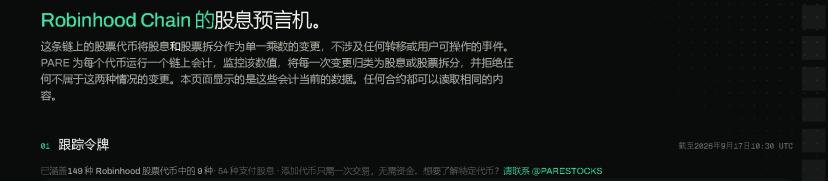
So the market PARE can enter isn’t only about creating derivatives around PT and YT; it can also identify certain corporate actions involving stock tokens on-chain through exchange ratios. That’s why its product page also has a section for [oracles], and currently it covers nine underlying assets.
At the same time, PARE has already deployed a pSPY/USDG lending market on Morpho Blue. In theory, users can buy SPY’s PT at a discount in the future, then use the PT as collateral to borrow stablecoins—improving capital efficiency.
(Before the release of public audit reports, the lending function was limited to the project treasury; ordinary users had not been officially opened.)
But!!!
As of September 17, at the time of writing, PARE is in the final phase of audit; it’s still very early. Its token market cap has already reached over $10M.
But I think if this works out for them, on Robinhood Chain it would be first-mover advantage. In that case, the market cap would be cheap, the odds corresponding to the present would be higher, and the risks would also be more concentrated.
3.3 Put together, look at it this way
From a user’s perspective, the two projects provide almost the same thing at the yield level: deposit stock tokens, receive PT and YT, then trade principal and dividends separately.
But from the perspective of protocol competition and narrative, the two are very different:
It’s like a breakfast shop (Pendle) sells all kinds of baozi. But suddenly, because of customers’ tastes, it also adds fried dough twists with soy milk.
And another breakfast shop (Pare), from start to finish, only sells fried dough twists with soy milk.
We can’t say right now which is better, but for people who like fried dough twists and soy milk, the choice may be clearer.
IV. Problems with this market
To avoid falling into blind optimism, I need to talk about the problems with this market: dividend yields for traditional stocks are generally not high (especially low-dividend growth stocks like Nvidia).
These yield-splitting protocols can only split yields—they can’t create收益 out of thin air.
If a stock generates only 0.1% to 0.5% dividends per year, then even if the protocol splits dividends perfectly, the base yield users can trade would still be very limited.
For YT to earn a high annualized return, it can only rely on an extremely low buy price or relatively large market mispricing.
(Luckily, there are still plenty of stable, high-dividend stocks and high-dividend ETFs in the market)
In traditional markets, this area is almost institution-led. Institutions trading dividend futures usually do so to hedge (that’s also why I asked AI about it), but on-chain in the short term there isn’t an equivalent scale of stock positions and hedging demand.
So this track is still at a very, very early stage. At the current stage, it can’t be said that demand has been validated on-chain at all. And with the on-chain distribution advantage, it’s still unclear what shape this track will ultimately take.
At this point, we can only be sure that yield splitting has been proven effective and has market demand on-chain, and that there is a clear dividend-derivatives market off-chain too. Whether bringing it on-chain can provide enough yield and trading demand is a different question.
It’s just like when crypto and stocks first appeared—nobody expected the most mainstream and first-succeeded application to be issuing new assets for pool matching…