




Adobe’s latest earnings report is most notable for 1 billion monthly active users and a record quarterly revenue high of $6.76 billion. Operating cash flow reached $2.52 billion as well, setting a new record for the third fiscal quarter.
But overall, when you combine this earnings report with the guidance, it’s fair to say it’s a mixed bag of good and bad news:
Adobe’s forecast for fourth-quarter revenue is $6.8 billion to $6.85 billion.
This quarter already reached $6.76 billion, meaning next quarter is expected to increase only $40 million to $90 million quarter over quarter. If you take the midpoint, that’s an increase of roughly $65 million.
A $65 million increase may not sound like nothing for a company with quarterly revenue approaching $7 billion, but it’s indeed only a small portion—especially when you put the third and fourth quarters from the past two years side by side and realize that this incremental expectation is quite conservative.
In particular, Adobe’s key metrics all beat market expectations. The downward trend after the earnings release (after-hours + regular trading) was mainly attributed by the market to the fourth fiscal quarter’s guidance not being impressive enough, which then triggered the stock price drop that day.
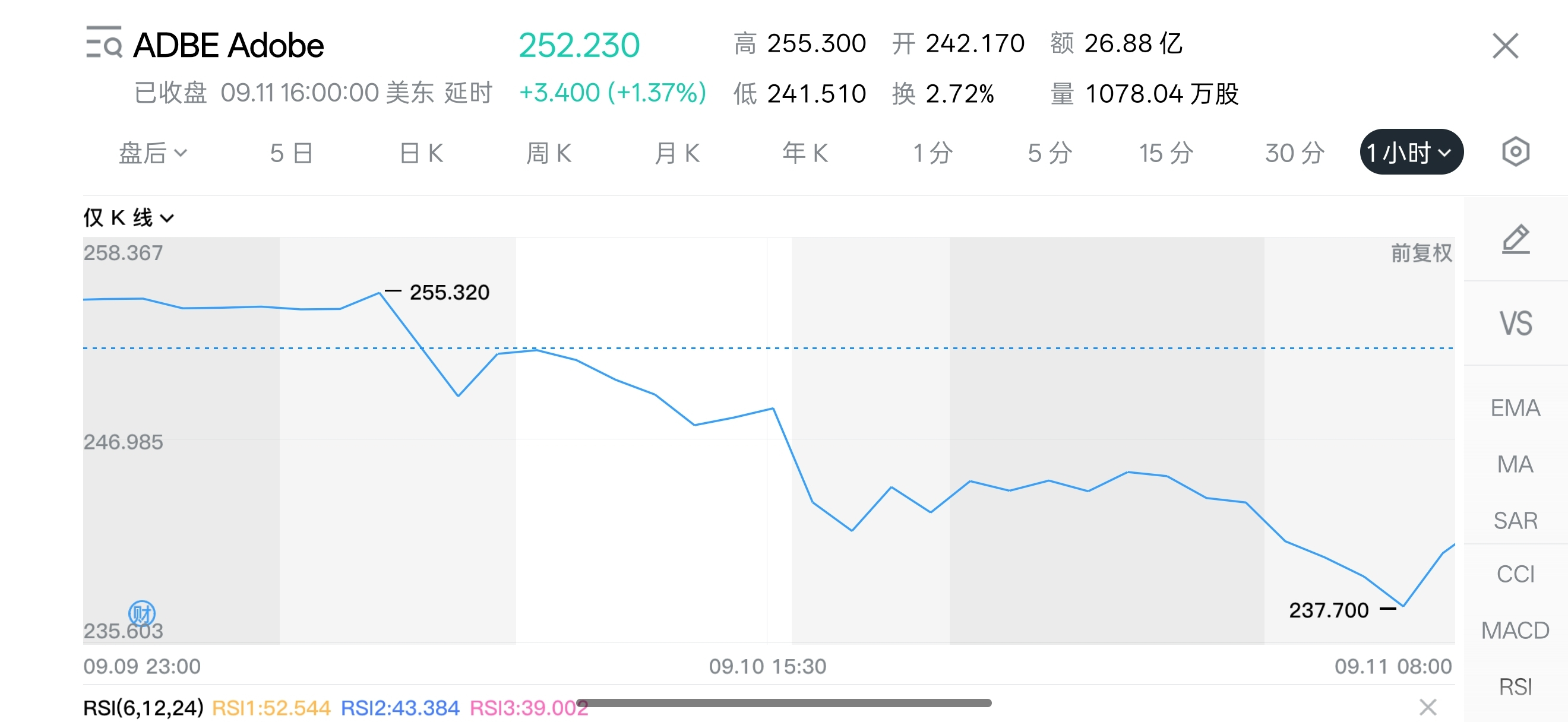
But in the next day’s regular trading session, Adobe rebounded upward again. So the market’s reaction to this earnings report is not, by itself, a simple story of “bad performance leads to a drop in stock price.”
This earnings report analysis will use data to sort through and revisit the story:
1. Where is the problem with the portion of guidance that was “less than expected”?
If we further break down the single-quarter change mentioned above, we’ll find that in the same period two years ago, the increase was about $200 million. But this year, the midpoint guidance of $65 million is essentially only about one-third of that incremental amount.
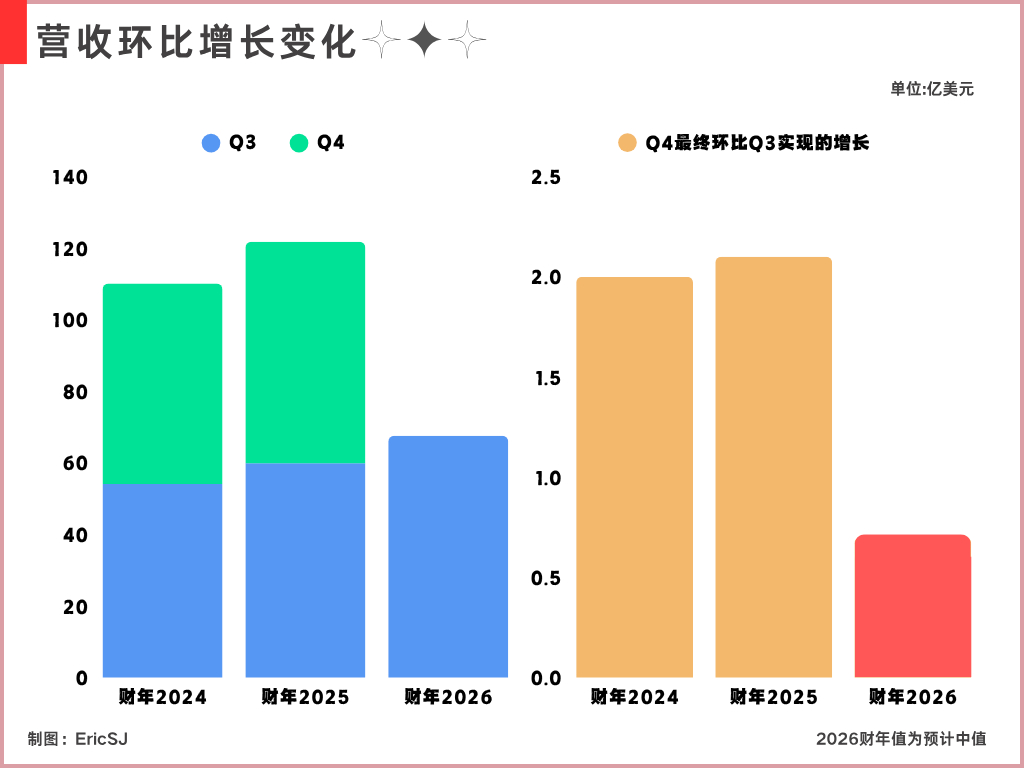
Here I want to emphasize this: the past two years were results that were ultimately delivered, while the $65 million is the midpoint in management’s forecasts given now. It could very well be conservative, and it may also end up exceeding expectations.
But it also seems to be suppressing market confidence. Especially with Adobe raising its full-year target on one hand, while only providing such a small quarter-over-quarter increase for the last quarter of the fiscal year on the other—I don’t think you can brush it off with only a sentence like “fourth-quarter guidance is slightly below market expectations.”
After all, the market always trades expectations for the future. That’s why you get a situation where results beat expectations, but because the future expectations were too conservative, the actual performance release and the stock-market trend diverged.
So we still need to dig further into what exactly went wrong—so that management would take such a conservative stance on the future.
I also broke down Adobe’s fourth-quarter guidance by customer business. Adobe now mainly splits subscription revenue into two groups:
One set aimed at business users and consumers;
Another set aimed at creative and marketing professional users.
In this quarter, revenue for the first group was $1.91 billion, and revenue for the second group was $4.65 billion. For the fourth quarter, the company expects the first group to reach $1.93 billion to $1.95 billion—an increase of $20 million to $40 million compared with this quarter. The second group is expected to reach $4.665 billion to $4.695 billion—an increase of $15 million to $45 million.
Up to this point, I’ve seen many analyses attribute the problem to the fact that the revenue implied by these two sets of guidance was lower than last year’s peak-season incremental. But I went back and rechecked Adobe’s guidance from the previous quarter, and found an easy-to-miss point:
At the time, the company expected subscription revenue from creative and marketing professional users in the third quarter to be between $4.61 billion and $4.64 billion, with a midpoint of $4.625 billion. Actual results came in at $4.65 billion—$250 million higher than originally expected.
Meanwhile, I also worked backwards from Adobe’s full-year guidance provided in the previous quarter to infer management’s expectations for the fourth quarter at that time.
Roughly reversing from the midpoint, Adobe’s prior quarter already implicitly indicated a fourth-quarter expectation of about $4.685 billion. The midpoint now provided is $4.68 billion—only about $5 million difference.
Given that the earnings-report figures are subject to rounding, this can almost be seen as no meaningful downgrade. And this also means one very key issue:
The low growth being seen in the fourth quarter is not something Adobe suddenly hit the brakes on right after the third-quarter earnings report.
I think this can at least serve as an alternative perspective for explaining the stock-price reversal the day after the earnings report:
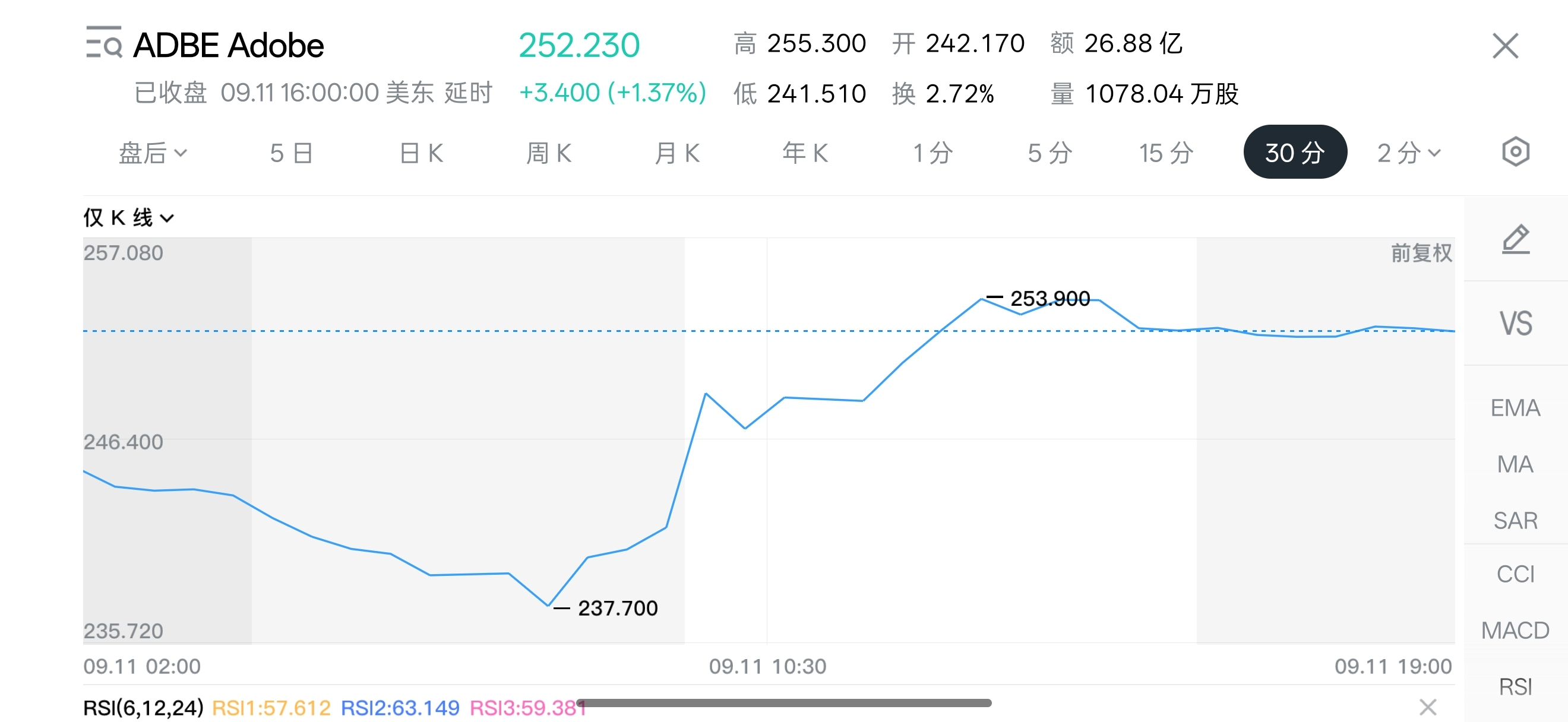
Because on that day, sentiment may have dominated and the market only looked at the first layer. But if you break it down further, you’ll find that the fourth quarter itself didn’t really suffer a clear downgrade in this earnings report. Instead, the third quarter delivered about $250 million more than originally planned, effectively shortening the distance between the two quarters.
Therefore, we also can’t take the current actual quarter-over-quarter difference, which is very small, and directly infer that management has lost confidence in its subsequent business.
But it also leads to a logical question: If the third quarter performed better than planned, why didn’t Adobe seize the opportunity to clearly raise its expectations for the fourth quarter?
2. When did the caution for the fourth quarter begin?
There are also signs of this. In the previous quarter, Adobe clearly said:
It decided to bring more creators in first through free products, while postponing part of the planned Creative Cloud product-line adjustments for the second half of the year. The company also admitted at the time that this approach would affect the incremental annualized recurring revenue coming from individual users in the short term.
Putting customer acquisition in the foreground and pushing some of the monetization to the future was a choice it already made in the previous quarter. By the third quarter, that acquisition effort did produce results: monthly active users for free creative products grew from over 90 million in the prior quarter to over 100 million.
Plainly put: Adobe had a chance in the second half of this year to make additional money from existing users, but it temporarily decided not to rush to collect it.
Why?
Because AI is changing the logic of software customer acquisition, just like the logic of visiting websites has fundamentally changed—the entry point where users first encounter “creation tools” is also starting to become fragmented.
In the past, Adobe’s business was easy to understand: one person needs to edit photos, cut videos, and do design—so they think of tools like Photoshop and Premiere, and then subscribe directly to Adobe’s products.
But now it may be coming from ChatGPT, and it may also be coming from Canva (for example, many of my data charts were actually made using Canva).
So the issue Adobe faces now is not just: “Will existing users still be willing to keep renewing subscriptions?”
Then it becomes another, even more important question:
When new users for the next generation create demand, will they still enter Adobe’s ecosystem?
So it would rather start with free Firefly, Express, and the web version of Photoshop—get people into the Adobe ecosystem first—then slowly look for paid opportunities.
But revenues are still not without progress—it's just that the company hasn’t disclosed it yet. Among the over 100 million free creative users, exactly how many have already started paying?
3. What Adobe is betting on is the users’ long-term value
Think a bit further and you can understand another seemingly counterintuitive point:
Since Adobe has such a huge user base and strong product stickiness, why not simply push revenues higher directly by raising prices?
In fact, management said it even more directly on the call. They said:
I’m actually quite glad it didn’t put the focus on raising prices. Even if raising prices could help short-term performance, it wouldn’t continue to expand adoption of new users in an important way.
This sentence actually describes Adobe’s trade-offs pretty clearly: it’s not that it doesn’t know how to make more money in the short term—it’s that for now, it doesn’t want to put “making more money” at the top priority.
So when looking back, I believe the caution in the fourth quarter is still not quite the same in nature. Of course, it’s still guidance that isn’t that strong.
But from the current perspective, it can also be interpreted as Adobe proactively sacrificing some short-term monetization efficiency in exchange for a larger user base.
Management also stated clearly that there hasn’t been any new change in the business itself. This time, they didn’t raise guidance much, and part of it is also influenced by currency exchange rate factors.
But the biggest risk of Adobe’s current strategy is also very obvious: what happens if free users ultimately don’t turn into paying customers?
At the end, I want to place a third-party viewpoint (not original, quoted)
Adobe’s current core contradiction is that it is simultaneously on the benefiting side of the AI narrative and the harmed side:
Benefited side: Adobe’s AI commercialization is accelerating. Year-over-year growth in annualized recurring revenue (ARR) for AI-priority products is consistently above 150%. When free Firefly users convert to paid, they show higher points consumption, and in this quarter the AI points consumption in Creative Cloud and Firefly is still accelerating quarter over quarter. On the enterprise side, Adobe’s core marketing products like GenStudio show year-over-year growth in annualized recurring revenue of more than 20%.
Harmed side: The rise of AI-native tools is fundamentally undermining Adobe’s pricing power. OpenAI recently updated its advertising policies, banning partners from running ads that compete with ChatGPT’s internal functions for its image and audio generation products. Adobe was identified as one of the directly affected companies—this cuts off an important customer-acquisition channel for Adobe’s independent AI creative tools.
At this point, we still can’t quantify how much impact this has on Adobe’s revenue, but it’s symbolically significant: Adobe is using new entry points like ChatGPT to reach users, while those entry points themselves are gradually becoming competitors to Adobe.
4. Back to the earnings report
In fact, looking across the past year or so of earnings reports related to AI, you can more or less see cases where the original business had to adjust because of AI’s entry, leading to the impact on a certain quarter.
So, looking at it here, in terms of understanding Adobe’s latest earnings report, it has already shifted from: “This quarter’s results beat expectations, but the guidance for next quarter isn’t good enough.”
As for the fact that the guidance outlook wasn’t strong enough, there were already signs of it at the strategic level. It believes it is actively moving some revenue from today to the future.
It uses a larger free user pool to exchange for lower short-term incremental annualized recurring revenue, and it also swaps the postponement of some product adjustments to exchange for more next-generation creators entering its ecosystem.
Does this strategy have a problem?
From my perspective, whether it’s monthly active users or free users, at most they can only be considered raw material for a moat, not the moat itself.
Under the impact of AI, Adobe is no longer a hard-to-bypass entry point in the creation layer. On top of the existing user base, if conversion efficiency still doesn’t take off, or even if you think about the endgame in a worse direction…
But if, in the end, the scale of free users Adobe gains can translate into higher paid conversion, then the money it earns less today is simply realized later.