

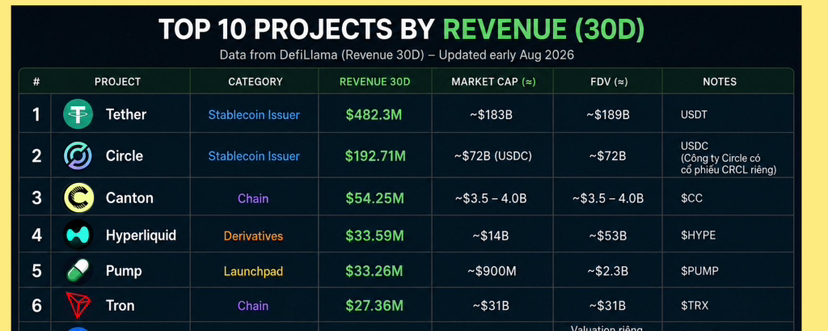

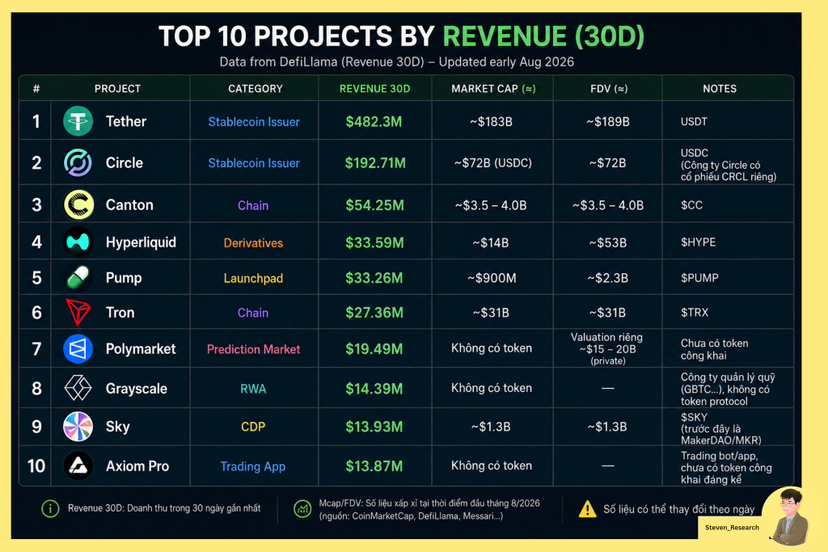
Canton Network ( $CC ) is among the highest-revenue groups in the market, but DefiLlama also issues a warning that this figure needs to be interpreted in the context that Canton is distributing very large incentives. So what is actually going on?
1. Canton is generating a very large revenue
- Canton Network is a centralized blockchain focused on institutional finance and RWA, with the involvement of many major financial institutions.
*Canton fee mechanism is quite unique:
- Network fees are paid in CC, and 100% of the tokens used to pay fees will be burned (a mechanism quite similar to TRON).
- The types of fees include traffic fees, holding fees, and some other burn mechanisms.
=> Therefore, on leaderboards like DefiLlama, the fees that are burned are recorded as Revenue.
*Currently, Canton’s figures have risen to a very high level:
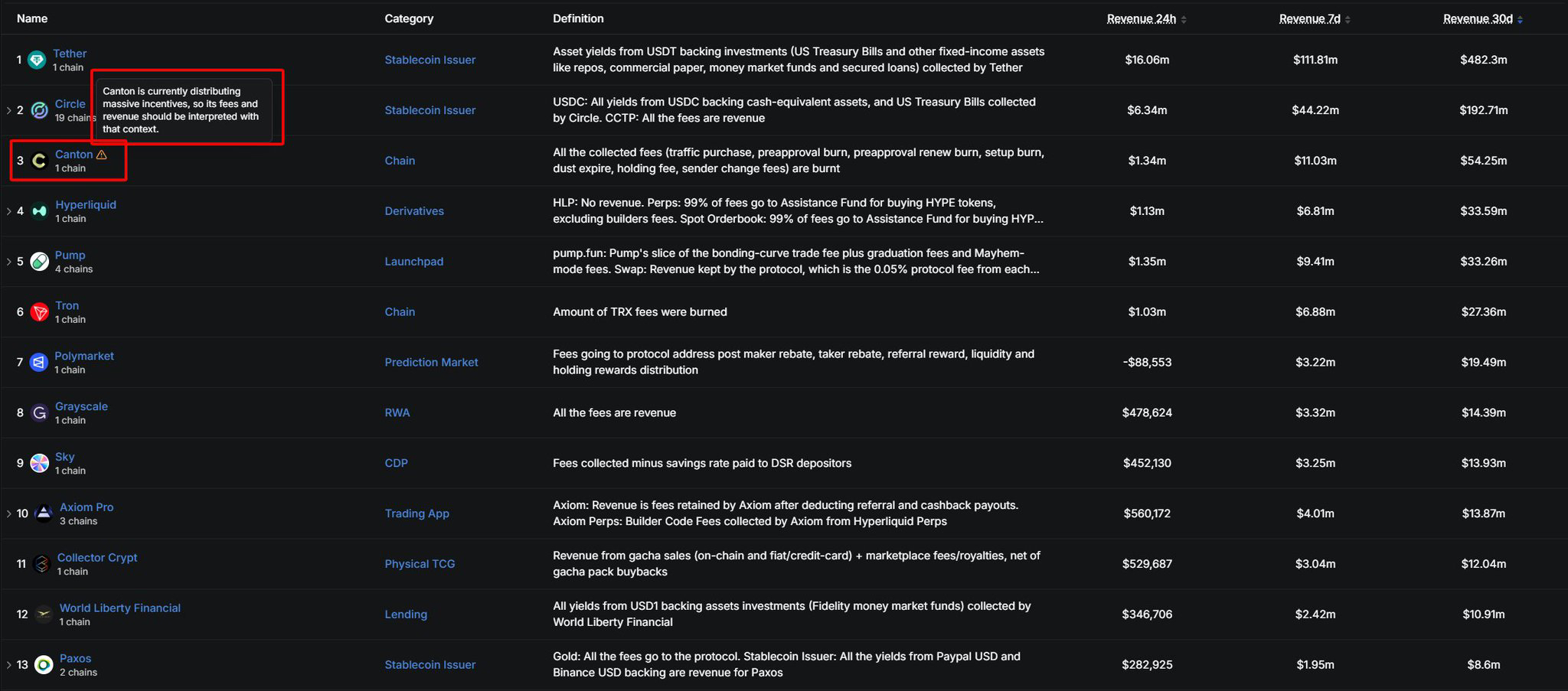
~$1.34M/24h
~$11M/7 days
~$54M/30 days
=> Canton even frequently appears at the top end of chain-revenue rankings, but that’s still not enough.
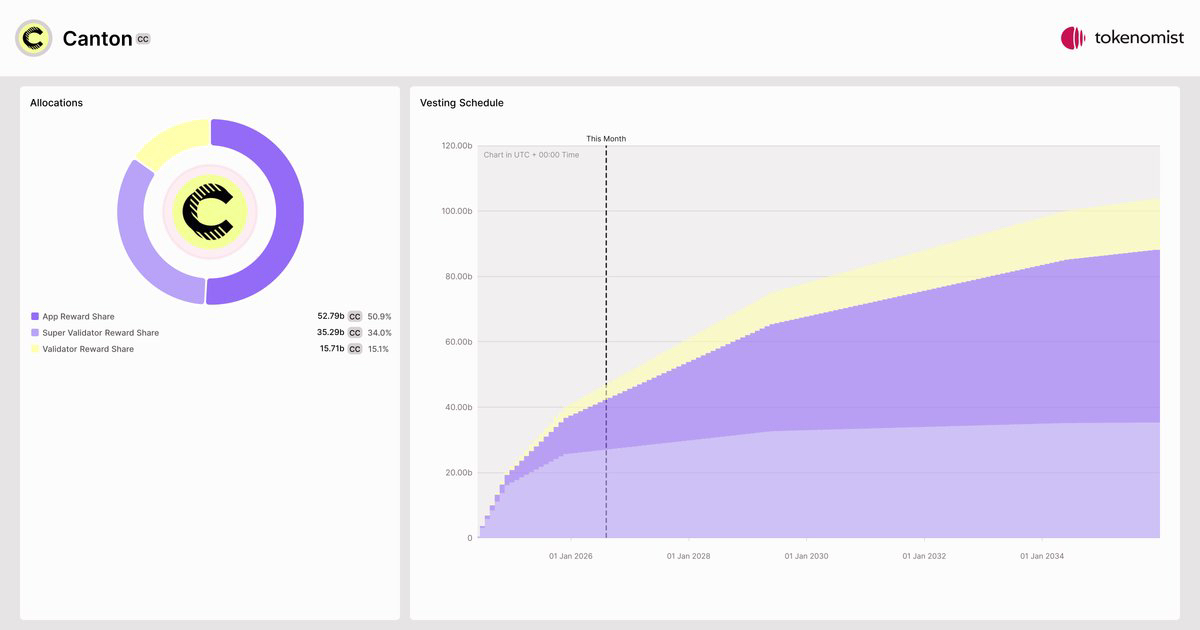
2. Canton doesn’t just burn; it also mints $CC to incentivize
*Canton uses the Burn-Mint Equilibrium model. Simply put:
- Users use the network => CC gets burned
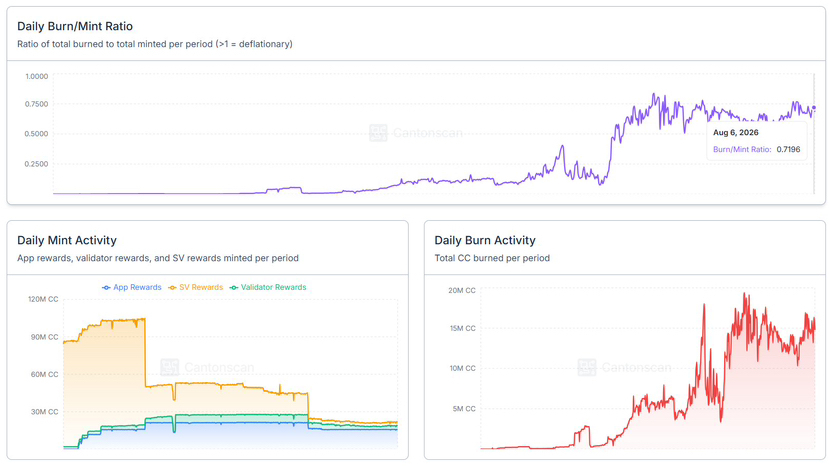
- At the same time, the Protocol mints new CC => as rewards for those who contribute to the network.
*Most of the new CC is distributed mainly to:
- Featured Applications: about 62%
- Super Validators
- Validators
- Development Fund: about 5%
=> Minting is executed according to the protocol’s schedule and the issuance amount is controlled. This is the part that many people overlook when looking at the Revenue number.
3. The issue is the “incentive loop”
- About 62% of the CC minted each month is allocated to Featured Apps. The applications receiving CC rewards can use these rewards to subsidize transaction fees for users.
*From that, a loop is created:
- Mint CC > Reward Apps > subsidize fees for users > users transact more > traffic increases > more CC is burned > Revenue increases.
=> Therefore, $54M revenue over 30 days is a real number, but you shouldn’t assume that all of that activity comes from natural demand. A significant portion is being driven by economic incentives.
*This is the reason DefiLlama attaches warnings: Canton is currently distributing massive incentives.
4. So is Canton’s “Revenue” truly real income?
- According to DefiLlama’s methodology, burned fees are counted as Revenue because burning creates token value accrual by reducing the circulating supply.
- But if you look from a traditional accounting perspective, this is not cash flowing into the treasury and turning into profit.
=> Therefore, you need to distinguish: High Revenue ≠ High Economic Profit.
5. What is truly important for CC?
- In my view, you shouldn’t look only at Canton and conclude that it’s good revenue; instead, when incentives drop, will activity still remain high?
- If the revenue is still good then—meaning organic activity is still strong—and the network’s economic value increases.
- Conversely, if most activity disappears when incentives drop, the current revenue number will not accurately reflect Canton’s long-term health.
- Currently, the burn/mint ratio has a pretty good growth trend up to 0.7—meaning inflation is still present, but it’s been reduced a lot compared with the early period
6. When does Canton’s incentives become less effective?
- The maximum token supply is about 100 billion CC in the first 10 years (from launch around the end of 2025). After that, it transitions to a permanent steady level: ~2.5 billion CC per year.
- In the early stage, Canton mints very heavily to bootstrap the network and attract Super Validators and apps.
- By 2026, App Rewards will account for ~62% of the reward pool, equivalent to 500M+ CC/month, and this share is expected to be maintained until mid-2029. After that, it will drop sharply in the following years as the network becomes more stable
- If the CC token price drops a lot, this incentive will become much less attractive, and the revenue figure will also decline accordingly (because it’s calculated using token price)
7. Personal conclusion
- A project may not be noisy, but it has very impressive numbers in a downtrend for the RWA space specifically for institutions
- The CC token is in a very strong distribution phase; you need to closely monitor price ranges as well as metrics from the project side
- What do you all think?