
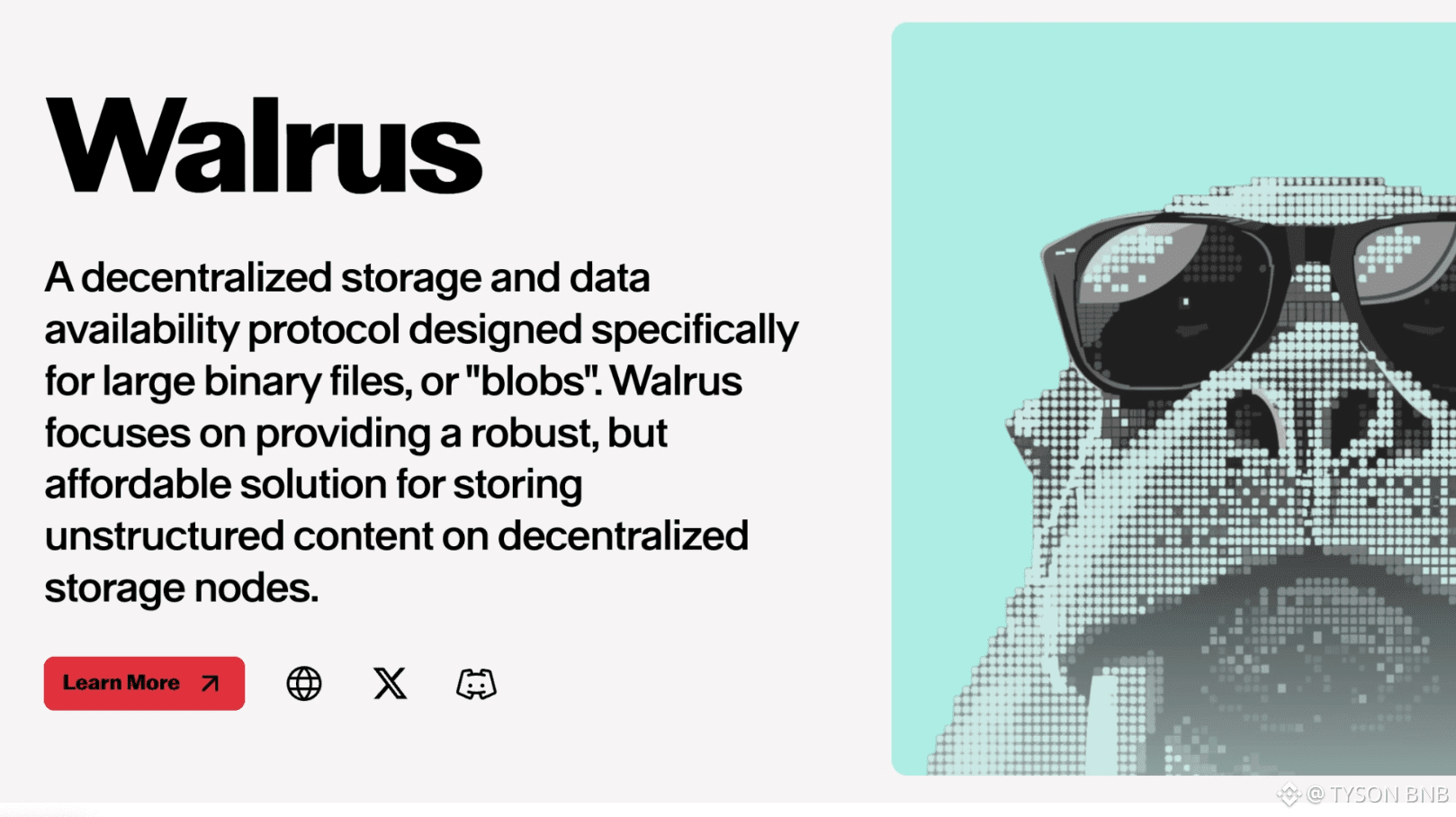
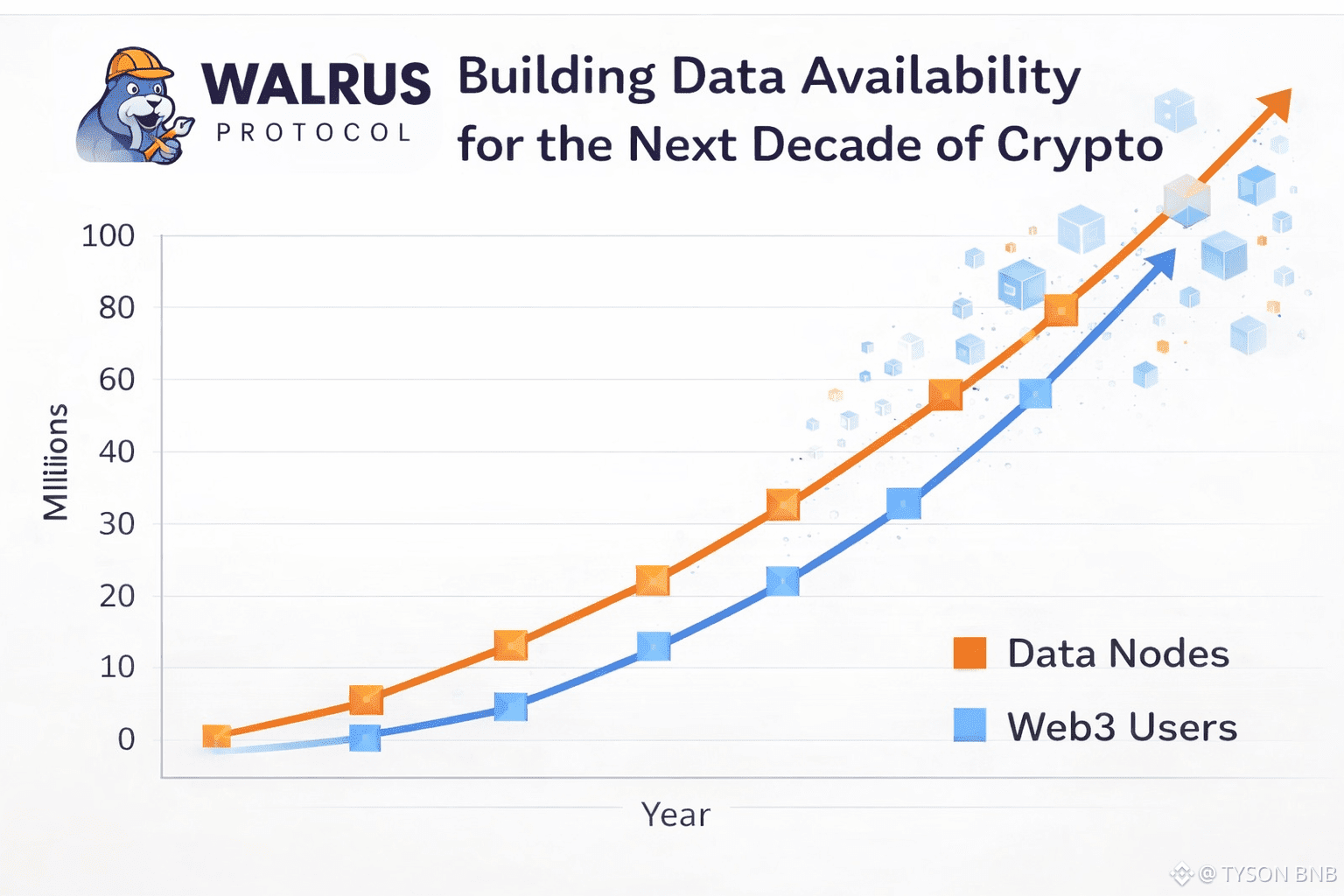
 Crypto has spent most of its life solving how value moves. Much less time was spent on whether the information behind that value would still exist tomorrow. For years, data availability was treated as an implementation detail something handled off to the side, usually by systems that were never designed to be trustless or long-lived. That shortcut worked while crypto was small. It will not work for the next decade.
Walrus exists because data availability is no longer optional infrastructure.
As crypto expands into finance, gaming, AI, governance, and social systems, applications are becoming data-heavy by nature. These systems depend on records, assets, histories, proofs, and state that must remain available long after a transaction is finalized. When that data disappears, nothing technically breaks on-chain, but everything breaks in practice. Users lose trust. Applications lose meaning. Systems decay quietly.
The problem is not that data goes off-chain. The problem is that it goes out of accountability.
Walrus is built to bring data availability back into the same reliability model that blockchains apply to execution. Data is not treated as a best-effort service. It is treated as something that must survive real-world conditions: node churn, operator failure, changing incentives, and long time horizons. Availability is designed, not assumed.
Instead of relying on single providers or fragile replication strategies, Walrus distributes data in encoded form across independent participants. No one node is critical. No one operator controls history. Failure is expected and absorbed by the system rather than becoming catastrophic. This is not about preventing failure it is about ensuring failure does not erase memory.
That distinction matters for the next decade of crypto. Early systems could afford fragility because they were experimental. The next generation cannot. Financial records must remain accessible. Game worlds must persist. AI systems must retain memory. Governance must keep archives. These are not features; they are requirements.
Walrus also addresses a quieter problem: unpredictability. In many systems, no one knows how long data will remain available or who is responsible for maintaining it. That uncertainty forces builders to design defensively and users to rely on trust. Walrus replaces uncertainty with structure. Data has expectations. Availability has a term of extent. Responsibility is enforced through incentive rather than hope.
This predictability affects or influences behaviors. Developers can build applications based upon the assumption that the behavioral elements will continue. They cannot plan based upon loss. Users can invest time and creativity without worrying that what they rely on will quietly vanish. Infrastructure stops feeling temporary.
Importantly, Walrus does not chase throughput or hype. It does not compete to be the fastest or the loudest. It focuses on something slower and more durable: making sure data remains available across market cycles, team changes, and network churn. That kind of reliability only becomes valuable with time and that is exactly why it is being built now.
The next decade of crypto will not be defined by how quickly systems move, but by how well they remember. Execution without memory creates disposable applications. Availability without guarantees creates fragile ecosystems. Walrus is built to ensure that as crypto grows up, it does not forget what it has built.
Data availability is becoming foundational infrastructure. Walrus is building it with the assumption that crypto’s future will need systems that last not just systems that work today.