

Most crypto investors talk about “cross chain” like it’s mainly a liquidity story. More bridges, more users, more volume. But when you look at regulated finance, cross chain means something else: settlement, auditability, and controlled interoperability between systems that don’t fully trust each other.
That is the lens where Dusk becomes interesting, and also where its partners matter more than the token chart.
Because Dusk’s core bet is not just “privacy on-chain.” It’s privacy that can exist inside compliance. That is a very different product than the typical privacy narrative in crypto. In plain language, Dusk is trying to make a blockchain that can support financial activity where certain information must stay confidential, while still allowing institutions and regulators to verify what they need to verify.
Partnerships are the real test of whether that goal is serious. Anyone can write a whitepaper. It’s harder to convince regulated entities and infrastructure providers to integrate their name, reputation, and operational workflows with your network.
As of today (January 11, 2026), DUSK is trading around the mid–$0.05 range, depending on the venue. CoinMarketCap shows about $0.0569 with roughly $5.5M 24-hour volume and about 487M circulating supply (max supply 1B). CoinGecko similarly shows DUSK around $0.0547 with multi-million daily volume. On Binance’s price page, DUSK is also in the same neighborhood.
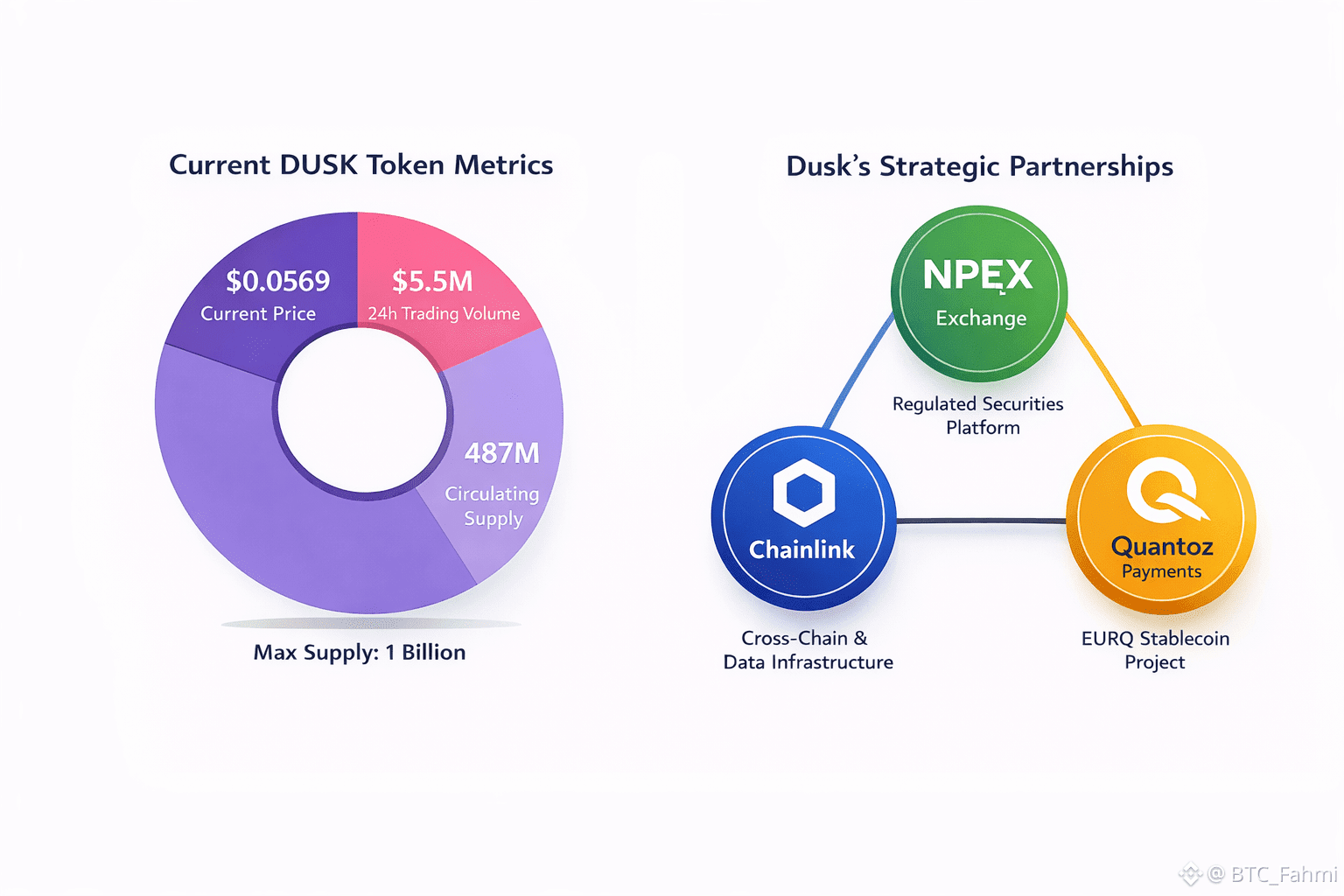
That price context matters, not because it “proves” anything, but because it frames expectations. Dusk isn’t priced like the market believes institutional adoption is guaranteed tomorrow. And honestly, that’s a healthier starting point for traders and long-term investors: when expectations are low to moderate, real progress shows up more clearly.
The most strategic partner signal lately is Dusk’s adoption of Chainlink standards, including CCIP for interoperability and Chainlink data components (Data Streams and DataLink). The reason this is important is not marketing value. It’s infrastructure value.
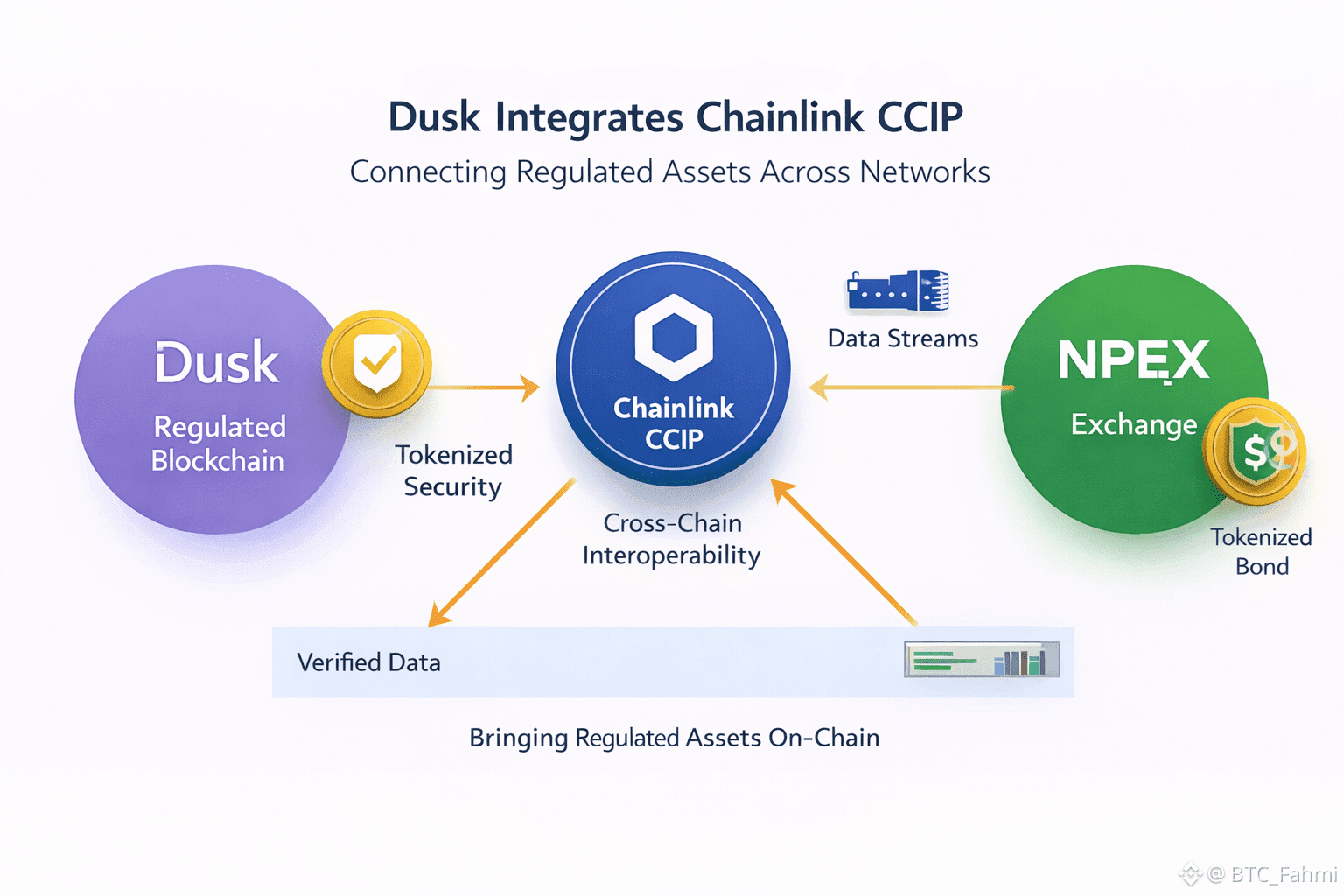
In regulated markets, cross chain cannot be “anyone can move anything anywhere.” That approach is exactly what compliance teams fear, because it reduces control over asset movement and increases counterparty and jurisdiction risk. A compliance-friendly version of cross chain is more like: the asset can move across networks, but under defined rules, with verified data, and with clear assumptions about settlement integrity.
Chainlink’s CCIP is positioned as a canonical interoperability layer, and Dusk explicitly connects this integration to bringing regulated assets on-chain, alongside NPEX. The message here is clear: if tokenized securities and regulated assets are part of Dusk’s future, cross chain needs to be robust, standardized, and institution-readable.
NPEX is another partnership that tells you what Dusk is really targeting. Dusk and NPEX signed an official agreement focused on building a blockchain-powered securities exchange for regulated financial instruments. This kind of partnership is structurally different from the usual crypto ecosystem deals, because it anchors Dusk in a world where licensing, investor protections, disclosures, and operational governance aren’t optional add-ons. They are the whole game.
This matters because “compliance” in crypto often becomes a vague word people throw around. But regulated finance has a specific meaning: a network needs a pathway for legal responsibility to exist. If nobody can be accountable, institutions will not touch it. Dusk’s strategy seems to be that privacy should not eliminate accountability, it should restructure it. In other words, confidentiality for the public, selective disclosure for the required parties.
A good third example is Quantoz Payments working with NPEX and Dusk on EURQ, positioned as a regulated euro stablecoin concept. Whether EURQ becomes massive or not is less important than what it suggests: Dusk isn’t only talking to crypto-native teams, it is connecting to payment and exchange infrastructure players that live in the regulated world. That is not easy to do, and it is not fast, but it is meaningful.
There’s also a practical side to all of this that traders sometimes underestimate. Most “real finance” workflows include private information that cannot legally or competitively be public forever. Think about it: if a small public company is raising capital, the funding amounts, who is buying, the timing, and the settlement details are not supposed to be an open-feed spectator sport. In traditional systems, privacy isn’t suspicious, it’s normal. Dusk’s entire identity sits on that reality.
Here’s a real-world example to make this less abstract.
Imagine a mid-sized European business issuing a regulated tokenized bond. The bond itself can be transparent at the high level, terms, maturity, coupon, etc. But investor identity, purchase sizes, and trade-by-trade activity often need confidentiality. At the same time, regulators may require that suspicious patterns can be investigated, or that certain disclosures can be produced if audited. Dusk’s pitch is essentially that this can be done on-chain without turning the chain into either a surveillance system or a black box.
Now zoom out to cross chain.
If that bond can only live inside one isolated network, liquidity is limited and the issuance is “on-chain” in name only. But if it can move across networks in a controlled way, or be used as collateral, or settle against other tokenized assets, then the on-chain version becomes meaningfully functional. That is the point where interoperability partners like Chainlink become more than a logo.
This is also where the risk sits.
Cross chain is historically where crypto breaks. Bridges get hacked. Interoperability assumptions collapse. And in regulated finance, one major failure does more than damage price, it damages the entire credibility of the infrastructure. This is why I view Dusk’s partner strategy as unusually rational: if you want to play in institutional markets, you don’t improvise cross chain. You inherit standards that the market is already converging on, then you build careful rails around them.
The most realistic conclusion for traders and investors is not “Dusk will win.” It’s that Dusk is one of the few projects treating compliance and interoperability as first-class engineering and business constraints. The partners reflect that direction: an exchange relationship (NPEX), interoperability and data standards (Chainlink), and payment/stablecoin experimentation (Quantoz).
If Dusk succeeds, it won’t be because retail suddenly loves privacy chains. It will be because regulated assets move on-chain in a way that feels boring, structured, and safe, and because Dusk’s partner network helped make that possible.
