
$XRP As crypto portfolios mature, the definition of security begins to change. Long-term holders worry less about hacks and more about lawsuits, liability, and ownership clarity. At that stage, protecting digital assets becomes a legal and structural exercise rather than a question of moving funds between wallets.
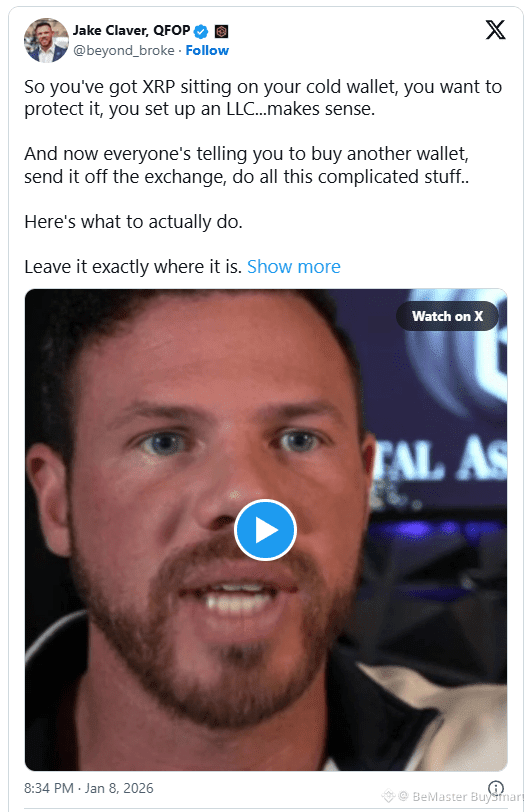
That reality frames a recent explanation shared by Jake Claver on X, where he addressed how XRP holders can protect assets already stored in cold wallets. His guidance focuses on ownership structure and documentation, not additional hardware or complicated transfers.
👉Why Moving XRP Is Often the Wrong Solution
Claver explains that cold wallets already provide strong technical security. The larger risk usually comes from personal ownership. When individuals hold crypto directly, those assets remain exposed to personal liability claims, court judgments, or creditor actions.
Instead of relocating XRP, Claver suggests leaving the tokens exactly where they are. He argues that changing legal ownership protects without introducing operational risk or transaction errors.
👉Using an LLC to Establish Legal Ownership
Under Claver’s approach, the XRP becomes an initial capital contribution to a limited liability company. The owner records the contribution in the LLC’s operating agreement, listing the wallet address, the digital asset, the number of tokens, and the fair market value on the date ownership transfers.
Claver stresses notarization as a critical step. A notarized operating agreement creates a verifiable timestamp that documents when the LLC legally acquired the crypto. This record serves as proof of ownership without requiring any on-chain movement.
👉The Importance of Asset Separation
Claver cautions against adding crypto to an LLC that already holds other assets. If an LLC manages real estate or operating businesses, it carries inherent liability. A lawsuit tied to one activity can place all LLC-held assets at risk.
In states with weaker creditor protections, that risk becomes even more pronounced. To avoid this exposure, Claver recommends placing crypto in its own standalone LLC while keeping real estate or other ventures in separate entities. Each entity isolates risk while maintaining operational clarity.
However, Claver also notes that existing LLCs require updated operating agreements to properly account for digital assets. Without clear provisions, protection remains incomplete.
👉A Set-and-Forget Protection Strategy
Once structured correctly, the process requires no ongoing action. The cold wallet stays untouched. The XRP never moves. Only legal ownership changes. For XRP holders, Claver’s framework reframes asset protection as a legal strategy rather than a technical one, offering simplicity without sacrificing security.
🚀🚀🚀 FOLLOW BE_MASTER BUY_SMART 💰💰💰
Appreciate the work. 😍 Thank You. 👍 FOLLOW BeMaster BuySmart 🚀 TO FIND OUT MORE $$$$$ 🤩 BE MASTER BUY SMART 💰🤩
🚀🚀🚀 PLEASE CLICK FOLLOW BE MASTER BUY SMART - Thank You.
