
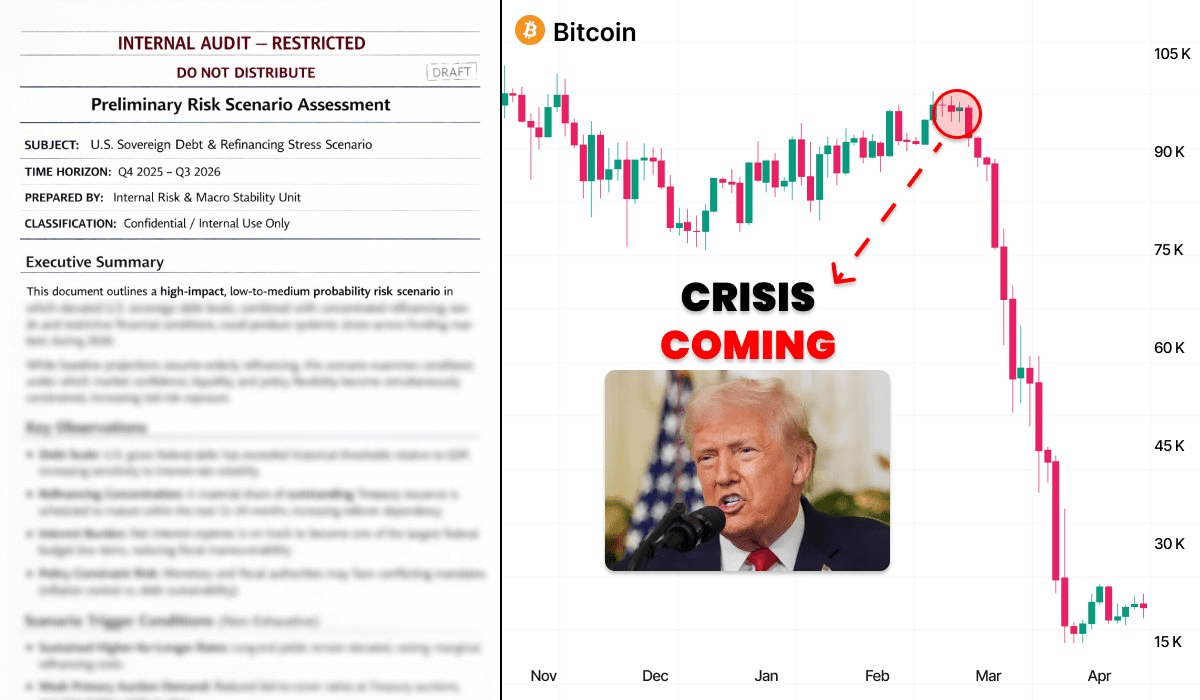
Most people are watching inflation, jobs data, and interest rates.
But the real ticking time bomb is hiding elsewhere — in the $38.5 trillion U.S. debt spiral that’s quietly setting up the next global shock.
For months, everything has looked “fine.”
Markets recovered, liquidity returned, and risk assets roared back to life.
But under the surface, the foundation of the financial system — U.S. Treasuries — is starting to crack.
And when it breaks, the whole world will feel it.
Let’s break down what’s happening, why 2026 is the breaking point, and how Bitcoin could become the ultimate winner.
🧩 The Hidden Engine: Constant Refinancing
Government debt isn’t one giant loan. It’s a constant refinancing machine.
Old bonds are repaid with new ones, but at higher rates.
That loop works fine — until rates rise too far.
The bigger the debt, the more dangerous every small rate increase becomes.
The U.S. is now refinancing trillions at rates triple what they were in 2020.
By 2026, this debt spiral collides with a wall:
Record bond issuance needed to cover maturing debt
Weakening demand from foreign buyers
Dealers overloaded and balance sheets stretched
One weak Treasury auction could trigger a full-scale funding crisis.
💣 The Foundation Shakes: Why This Is Systemic
U.S. Treasuries aren’t just “government debt.”
They’re the plumbing of global finance — the collateral for mortgages, banks, hedge funds, and currencies.
If Treasuries lose stability, everything connected to them — everything — wobbles.
The domino effect:
Repo markets freeze
Dollar liquidity evaporates
Global credit tightens overnight
This isn’t a market correction. It’s a liquidity collapse.
🇯🇵 The Japan Trigger
Japan holds over $1 trillion in U.S. debt — the largest foreign holder.
For decades, Japanese funds borrowed cheaply in yen to buy U.S. Treasuries.
Now Japan is raising rates for the first time since the 1990s.
That breaks the “carry trade” — the quiet engine behind global liquidity.
As USD/JPY rises, Japanese funds sell Treasuries to hedge losses.
Result?
Even less demand for U.S. debt, and even tighter global liquidity.
🇨🇳 The China Wildcard
China’s shadow debt is a $9–11 trillion iceberg — mostly hidden under local governments and state-linked entities.
If even one major province defaults, panic hits the yuan, capital flees, and emerging markets implode.
The dollar spikes.
Rates rise.
Liquidity vanishes.
Add that to the U.S. refinancing wall — and you’ve got a synchronized global tightening event.
⚙️ The Breaking Point
Here’s what the breaking moment looks like:
Treasury yields spike uncontrollably
The dollar strengthens violently
Stocks crash 20–30%
Crypto and tech get sold off first
It won’t feel like a normal recession.
It’ll feel like the system stops moving.
No buyers, no bids, just a liquidity vacuum.
🩸 Then Comes the Reset
When the system hits the wall, central banks won’t have a choice.
They’ll step in — again.
Emergency QE
Balance sheet expansion
Infinite liquidity injections
The system survives, but the damage lingers.
Each bailout makes the next crisis bigger.
And that’s when a shift begins — from traditional finance to anti-system assets.
🟡 The Great Rotation: Gold and Bitcoin
When real rates fall again and fiat confidence breaks, the first mover is always gold.
Then comes Bitcoin.
Gold will protect the old money.
Bitcoin will protect the new.
Because when trust dies, programmable scarcity wins.
The same pattern repeated in 2020 — the COVID crash flushed leverage, then birthed the biggest bull run in crypto history.
2026 could rhyme with that, but louder.
🚀 The Takeaway
The debt machine breaks in 2026
Japan and China amplify the shock
Central banks will print to survive
Real assets — gold and Bitcoin — become lifeboats
This isn’t the end.
It’s the start of a new regime — one where Bitcoin stops being a “risk asset” and becomes the alternative to a broken system.
History’s not repeating.
It’s evolving.
