
· Buying pressures on both Bitcoin and Ethereum have declined with a sustained decrease in futures trading volume, on-chain activity, and fund flows to exchanges.
· Data from CryptoQuant and Alphractal reveal a decline in active addresses, a contraction in buy order volume on Binance, and a slowdown in liquidity, reflecting market patterns similar to the end of 2021.
· Bitcoin failed to maintain a level above $90,000 amid a rise in forced liquidations, while Ethereum's price broke the upward trend channel and entered a corrective phase.
---
Introduction:
Buying pressure in the cryptocurrency market is simultaneously retreating at the level of price movement, derivative activity, and on-chain indicators. According to CryptoQuant analysis, Bitcoin is still struggling to maintain a price level between $87,000 and $90,000.
According to analyst "Miniolet", the slowdown in buying has been evident since late August, which initiated a period of decline in futures trading volume, a decrease in the number of active addresses, and an increase in fund flows to exchanges.
This trend is similar to the patterns seen last during the late stages of the 2021 cycle when the market completely turned bearish, and Bitcoin's price fell from $57,000 to nearly $35,000. "Miniolet" explained that active address indicators, which are linked to OTC activity and on-chain participation, have significantly declined.
Decline in buying pressure in the market:
Data from CryptoQuant charts shared by "Miniolet" indicates that the volume of buy orders on Binance peaked during the bull run in mid-2021 at levels close to $15 billion, coinciding with Bitcoin trading between $60,000 and $65,000.
However, during the current cycle, Bitcoin's price rose towards the $90,000 area at almost the same time, yet the volume of buy orders on Binance failed to return to its previous levels. The peaks seen by Bitcoin in October showed trading volumes close to only $10 to $11 billion, and this volume has continued to decline since August, without showing a sustainable recovery on the charts.
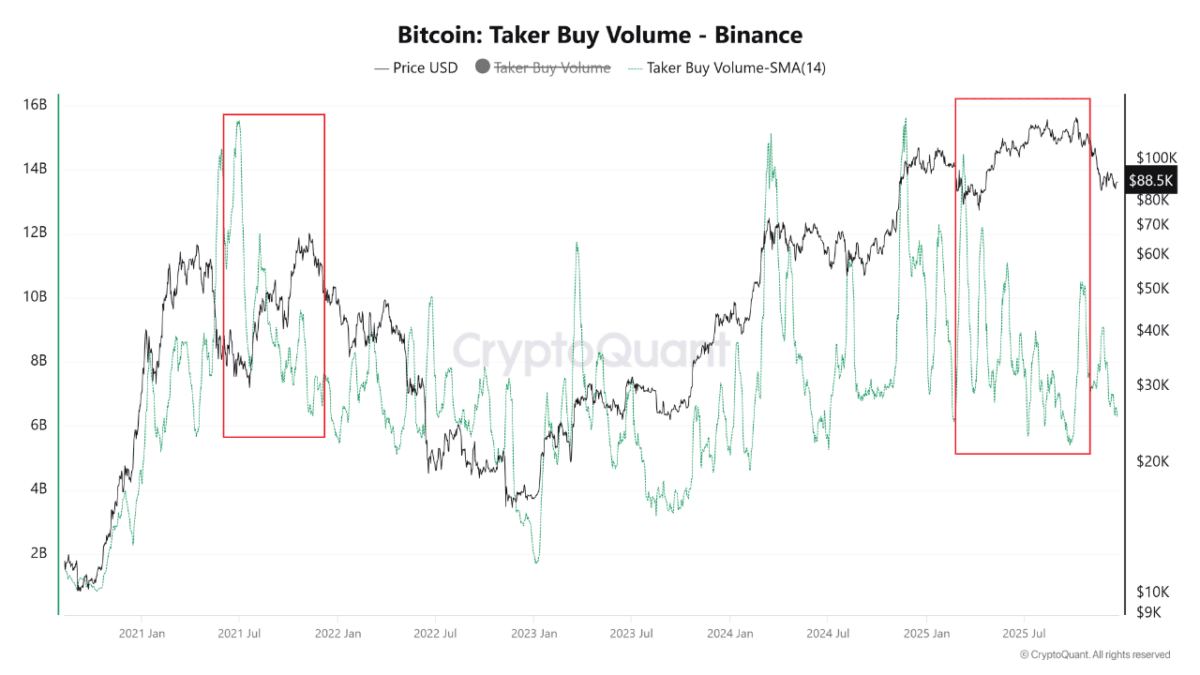
The chart also identified the "orange zone" period, where a real volume reversal was expected if a new expansion phase was underway. However, buying activity continued to weaken after that zone, while the price continued to advance. "Miniolet" sees this behavior as indicative of the final distribution phase and the end of a renewed accumulation cycle.
The analyst stated: "The market will need time to recover. Whether the traditional four-year cycle has been interrupted remains uncertain, but even if it has, this question is not of great importance at this stage."
Decline in active Bitcoin addresses:
The number of active Bitcoin addresses - the number of unique addresses participating in transactions - has declined from a three-year high seen at the end of 2024 to just over 800,000 addresses in December of this year.
Active addresses peaked above 1.15 million addresses during the "Trump" market last year, and in late 2017 and early 2021. Looking at the charts for 2025, Bitcoin's rise towards $90,000 failed to reach those levels, and active addresses have approached the range of 800,000 addresses, with the 30-day moving average trending downward.
"Miniolet" explained: "Active address indicators can be closely linked to off-exchange activity on-chain, and this slowdown is a clear indicator that public participation in the market and its vitality are fading."
More evidence of declining demand is seen in the fund flow data for exchanges through Bitcoin and Ethereum transfers:
· On November 24, when Bitcoin was trading at $88,438, Coinbase recorded cumulative flows over seven days worth $21.026 billion, while Binance saw flows of approximately $15.279 billion.
· By December 21, when Bitcoin's price slightly rose to $88,635, Coinbase's flows dropped to $7.763 billion over seven days, a decrease of about 63%. Binance's flows also fell to $10.259 billion for the same period.
Selling pressure and current liquidity:
The leading cryptocurrency (Bitcoin) also faced the strongest wave of selling pressure in the past three years, according to "Joao Widdison", the founder and CEO of the analysis platform Alphractal. In a post on X, "Widdison" mentioned that sellers would dominate after recent attempts to push prices higher.
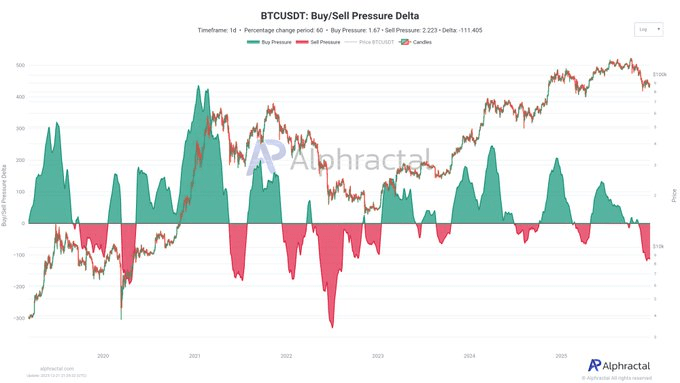
Bitcoin briefly surged above $90,000 on Monday, reaching a daily high of $90,536 on Bitstamp, but failed to maintain those levels. At the time of writing this report, Bitcoin lost 2.5% of its value over the past 24 hours, trading around $87,500.
Similarly, the second-largest cryptocurrency by market capitalization, Ethereum, failed to maintain the upper boundary of the trend channel at $3,000, and once the lower support of the channel was broken, the correction began to take its course, as the price fell to $2,900. Its immediate support lies near $2,708, while a more significant support area for buyers (bulls) exists around $2,406.
According to data from Coinglass, the total forced liquidations in the cryptocurrency market over the past day amounted to about $250 million, up 27% from the previous 24 hours.

