
There is a specific type of technology that is not born to be seen, but to operate silently as the infrastructure that supports everything around. The APRO token emerges exactly from that invisible place, where automated decisions need to be made in fractions of a second, risks need to be priced without emotion, and systems need to trust data that cannot lie. In an increasingly complex crypto ecosystem, APRO positions itself as a coordination axis between information, execution, and economic incentive, creating a layer that does not compete for attention but dominates the logic behind it.
Imagine a decentralized universe where smart contracts not only react to events but anticipate scenarios. APRO operates as the fuel of this applied intelligence, connecting oracles, validation mechanisms, and algorithmic decision models. It is not just a simple utility token, but a piece that aligns participants with distinct interests around a common goal: to produce reliable signals for systems that move billions in value. In this context, the token ceases to be a passive asset and starts to act as a mediator of trust.
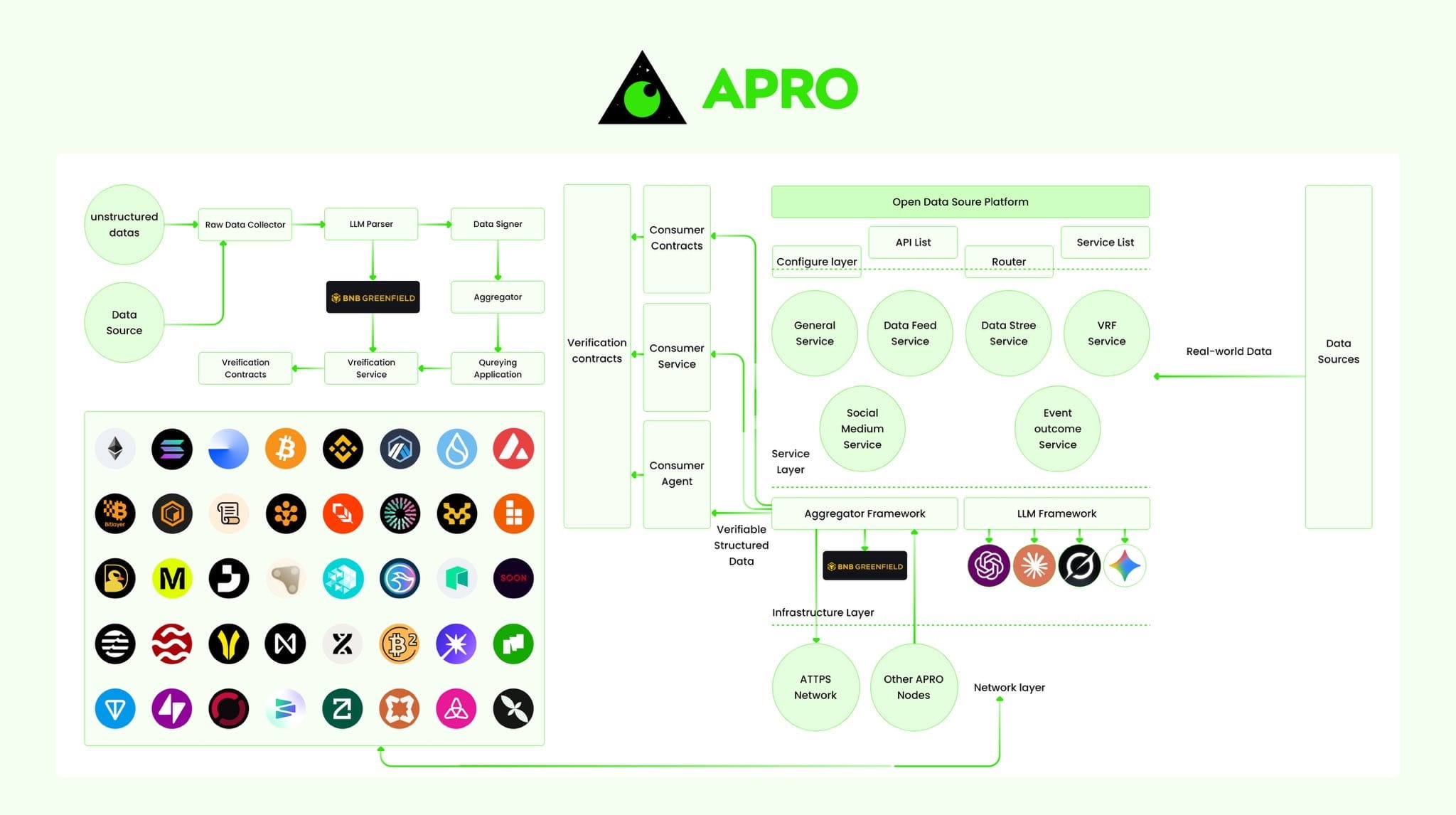


Technically, APRO still values its active participation in the network. Staking is not just a security mechanism, but an economic filter. Those who participate need to take on risk, and this risk creates a direct incentive for the honesty of the data and execution. The network behaves like a living organism: we validate, algorithms evaluate, and the token acts like the circulatory system that rewards or penalizes based on behavior. It is a design that mixes economic engineering with game theory, creating a dynamic balance that is difficult to capture but powerful when achieved.
The most interesting aspect is how APRO connects domains that rarely communicate with each other. On one side, we have decentralized finance, hungry for accurate data and predictable execution. On the other, we have advanced algorithmic models, often associated with artificial intelligence and large-scale automation. APRO acts as the bridge between these worlds, allowing complex decisions to be translated into verifiable on-chain actions. It's like transforming predictions into commands, and commands into measurable economic value.
The community plays a central role in this architecture. Unlike projects where users merely consume, here they train, adjust, and validate the system itself by interacting with it. Each participation, each token lock, each vote or validation helps refine the collective behavior of the network. This creates a continuous learning effect, where the protocol improves not only through code upgrades but through the distributed intelligence of those who use it.
From a market perspective, APRO does not promise shortcuts. Its proposal is structural, almost patient, built for long cycles. In a successful scenario, it becomes a silent standard, integrated into multiple applications without the end user needing to even know its name. In an adverse scenario, the risks are clear: dependence on adoption, technical complexity, and fierce competition for attention and liquidity. Still, it is precisely this clarity of risks that strengthens the thesis, as it does not rely on fragile narratives but on concrete utility.
When observing APRO from a broader lens, it appears less as a product and more as an organizing force. A layer that helps decentralized systems make better, faster, and fairer decisions. In an ecosystem where trust is scarce and noise is abundant, the ability to transform data into reliable action can be the definitive differentiator. APRO doesn't try to be the visible hero of the story, but that strategic element which, when removed, causes the entire plot to collapse. And sometimes, it is exactly these invisible elements that decide the fate of entire universes.
