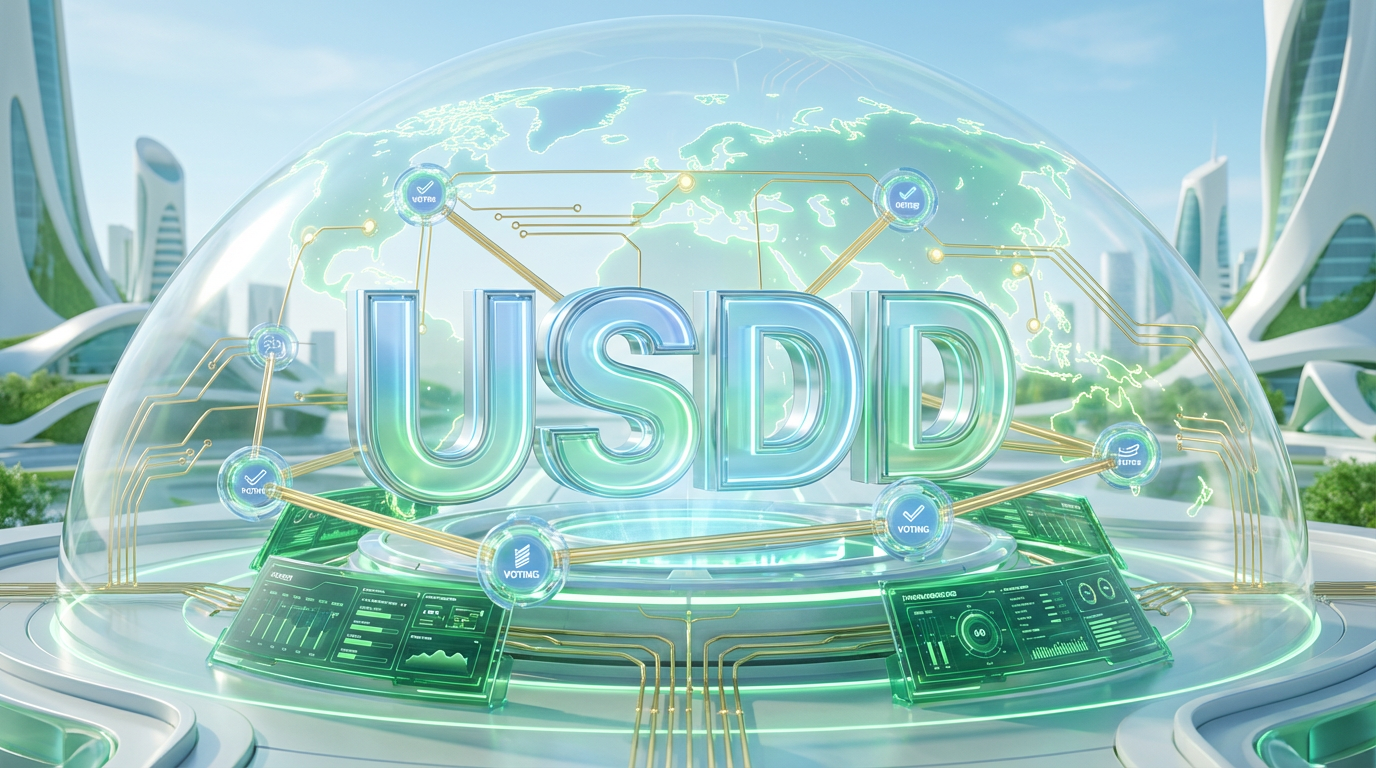
In the traditional financial world, the formulation of monetary policy is often a 'black box operation'—a few individuals in a closed room determine the purchasing power of hundreds of millions of people.
But USDD 2.0 is conducting a great experiment: returning 'monetary power' to the community. In this system, there is no 'super administrator' who can arbitrarily freeze your assets, only a transparent, fair, and mathematically logical JustLend DAO.
This is not just a technical upgrade, but a confidence in the system: USDD believes that the collective wisdom of tens of thousands of JST holders is far more resilient than a single centralized decision.
🗳️ Power Reconstruction: A Transparent Digital Dashboard
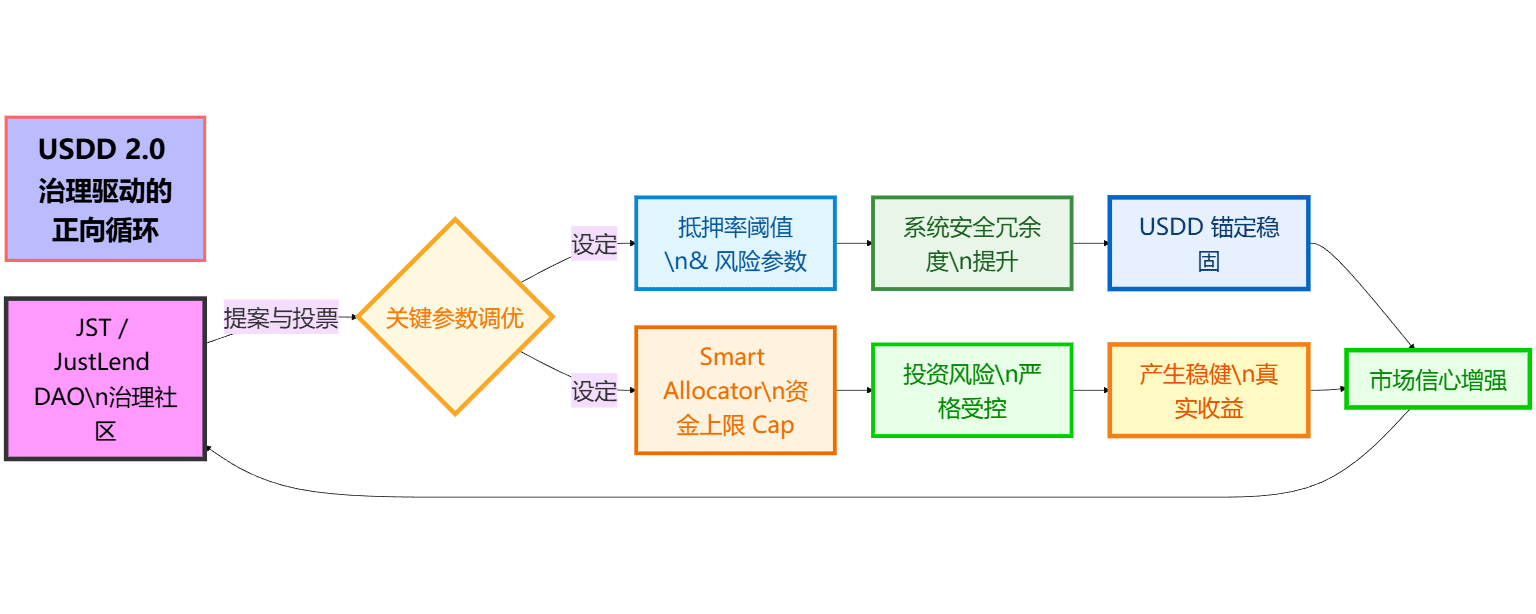
The core parameters of USDD 2.0 are not hard-coded into the contract but are dynamically adjusted through JST governance. It is like installing the most advanced digital dashboard on a giant ship.
Mechanism Breakdown: JST holders have real decision-making power. They vote to determine the collateral rate thresholds (what level of safety redundancy is reasonable), liquidation penalties (how to balance system safety and user experience), and stable fee rates.
So What? This mechanism ensures that USDD can 'self-evolve' with changes in the market environment. When market volatility increases, the community can propose to raise the collateral rate standards; when the market is stable, parameters can be optimized to improve funding efficiency. Each parameter adjustment is a transparent game made public across the network, rather than a unilateral notification.
⚖️ Wisdom of Restraint: The 'safety ceiling' of the Smart Allocator
Governance does not only mean 'decentralization', but also 'restraint'. One of the most praised designs of USDD 2.0 is the strict Cap (funding limit) set for the Smart Allocator.
Although the Smart Allocator can capture the real yields of RWA and DeFi (with cumulative profits exceeding $7.6 million), the governance mechanism sets a red line that cannot be crossed.
Risk Control Logic: The community clearly specifies the types and maximum amounts of configurable assets. This means that even if the returns are enticing, the protocol will not expose excessive funds to risk for short-term profits.
Audit Endorsement: All these rules have been validated through multiple audits by CertiK / ChainSecurity. The governance layer sets the rules, and the code layer enforces them, creating a 'double insurance' that makes fund management both flexible and rigorous.
🤝 Community of Interests: From 'Users' to 'Owners'
In a centralized stablecoin model, users are merely 'users'; whereas in the governance system of USDD, users become 'owners' of the protocol through sUSDD and JST.
The ultimate goal of governance is not the struggle for power, but the safety of systemic consistency. When every participant can protect their interests through governance, this collective force constitutes the strongest moat for USDD. It is no longer a cold code, but a 'digital federation' formed by consensus.
🎯 Conclusion: Code is law, governance is consensus
USDD 2.0 shows us the future of finance: transparent rules, rigid execution, and democratic decision-making.
It proves that stablecoins do not need to rely on endorsements from centralized institutions to operate smoothly. In this system, every parameter's fluctuation represents the community's commitment to long-term value. USDD is not only pegging to the dollar but also anchoring a type of **'decentralized trust'**.
This article does not constitute investment advice, DYOR.@USDD - Decentralized USD #USDD以稳见信