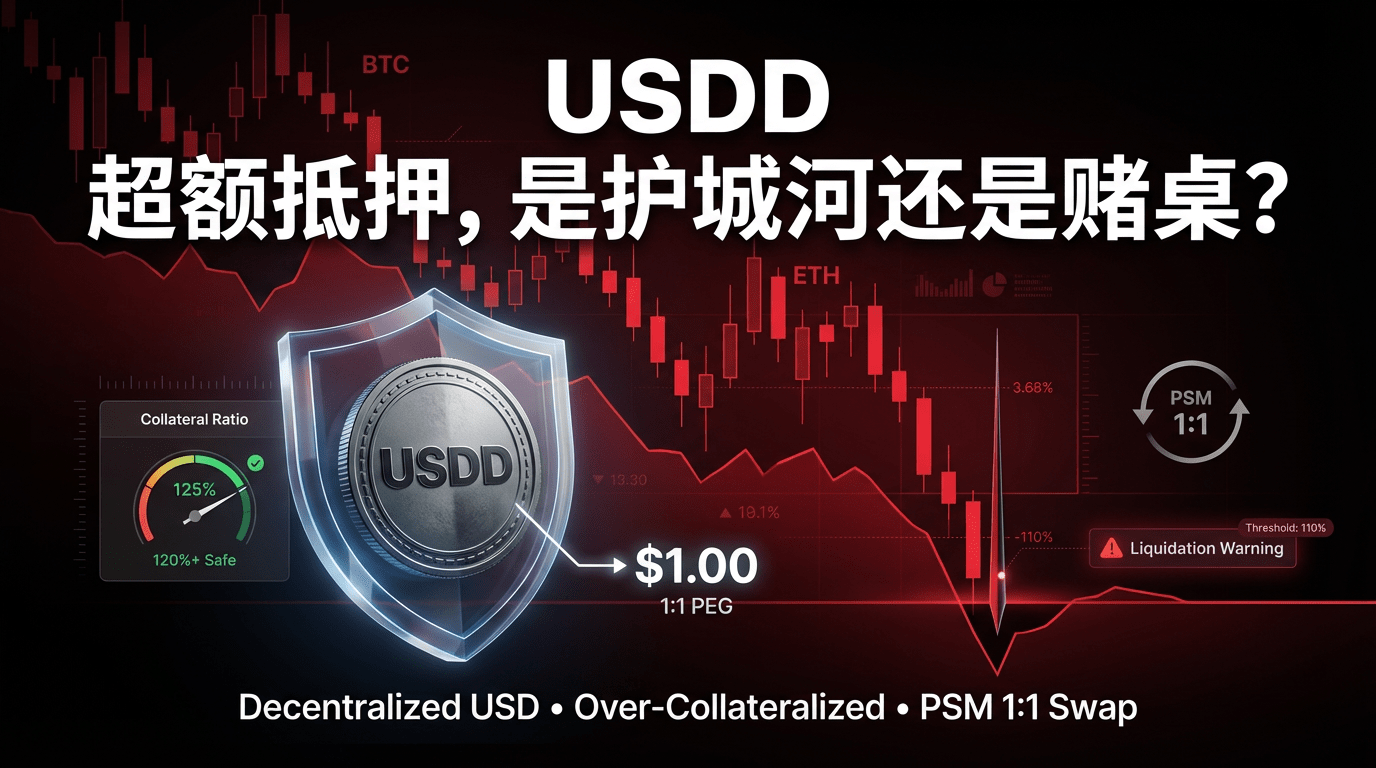
If you only remember one sentence: **Stablecoins truly die from correlation, not from decoupling.** The market on December 16 was most like a needle prick—BTC and ETH dropped approximately 4% and 7% respectively in one day, with the entire market facing about 592 million USD in forced liquidations. (The Economic Times) When risk assets plunge together, all structures that “seem stable” are forced to answer the same question: **Does your collateral move in tandem with the market, or can it diversify risk?** This is the key point to grab when discussing Decentralized USD (USDD) today.
Many people’s impression of USDD 2.0 remains on “over-collateralization”, “CDP model”, and “on-chain transparency”, but the truly critical details lie deeper: **What do you use as collateral?** The core of USDD 2.0's security is to require that the total value of collateral within the system always exceeds the total value of circulating USDD; according to the 2025 on-chain data cited in the report, the collateralization ratio usually maintains above 120%, and in some periods even exceeds 200%. It sounds tough, but over-collateralization is just a “buffer”, whether it can save lives depends on whether the buffer collapses with the floor.
The problem is — the most common risk in the crypto market is not the collapse of a single asset, but the rapid convergence of correlations during panic: you think you hold a 'diversified asset portfolio', but when a needle pricks, everything turns red together. The answer USDD 2.0 gives to this problem is to create a basket of collateral with 'functional division': TRX as the base collateral providing liquidity; BTC as 'digital gold' providing stronger value consensus and relative resistance to volatility; USDT/USDC as low-volatility pegged assets, specifically serving the immediate liquidity of the PSM module. This is not an aesthetic preference, but a structural approach to combat correlation: letting part of the collateral bear growth and liquidity while letting another part bear stability and exit.
More importantly — the risk of stablecoins has never been just about 'whether assets are enough', but rather about 'whether you can exit'. The core anchoring of USDD 2.0 is PSM (Peg Stability Module): allowing USDD to swap 1:1 with USDT/USDC without slippage, providing the market with an 'infinitely deep hard anchor', where arbitrageurs can pull the price back to 1 dollar at both the de-pegging and premium ends. This is especially important in stressed market conditions: when panic selling emerges, what you need is not a statement of 'we are over-collateralized', but an executable redemption/swap channel that allows arbitrage and liquidity to stabilize the emotions.
But here lies another layer of 'real test' for USDD: the effectiveness of PSM ultimately depends on pool depth and multi-chain entry and exit. The report mentions that USDD 2.0 maintains a PSM liquidity pool of nearly 50 million dollars on TRON, while also establishing reserves on Ethereum and BSC, and the native deployment on Ethereum can more directly access the depth of DEXs like Curve and Uniswap to buffer price fluctuations. In other words, the stability of USDD is not 'a mechanism', but a chain: over-collateralization (repayment base) → PSM (price anchor) → liquidity depth (exitability) → audit and transparency (verifiability).
By extending the perspective, you will find that this structure is actually answering a change of era: when bank-based stablecoins start to occupy payment and corporate settlement scenarios with '1:1 cash reserves, regulatory frameworks, and white-label settlements' (for example, SoFi launched SoFiUSD, emphasizing nearly instant, low-cost settlements and aiming at commercial applications). (Barron's) Decentralized stablecoins want to compete, they cannot just fight for 'more freedom', but also for 'more self-evidence'. The path of USDD is: collateral assets placed in contracts on public chains, where users can verify the sufficiency of reserves in real-time through blockchain explorers, pulling trust back from 'monthly reports' to 'on-chain status that can be verified at any time'.
So I prefer to summarize with a more brutal and pragmatic statement: **USDD (Decentralized USD) is not competing with USDT/USDC to see who is more like a bank, it is competing with market panic to see who is more anti-correlated.** When looking at USDD, do not just look at 'whether the stablecoin is 1:1', but also consider three things: whether the collateral structure is really clearly defined (source of volatility vs stabilizer); whether the collateral ratio still leaves a safety margin under pressure; whether PSM and multi-chain liquidity can provide sufficient 'exitability' during panic.
Finally, to sum up the viewpoint: in a market where a single needle can pierce through leverage, the sense of security for stablecoins is not 'never fluctuating', but 'being able to exit according to the rules when fluctuations occur'. If you regard USDD as the dollar base in DeFi, consider it as a verifiable risk control system: over-collateralization, liquidation, PSM redemption channels, liquidity depth, and on-chain transparency, none of which can be omitted. The value of USDD lies in its attempt to turn these links into a closed loop — rather than just a slogan.
Disclaimer: The above content is the personal research and views of 'Carving the Boat to Seek the Sword', intended for information sharing only and does not constitute any investment or trading advice.
@USDD - Decentralized USD #USDD以稳见信