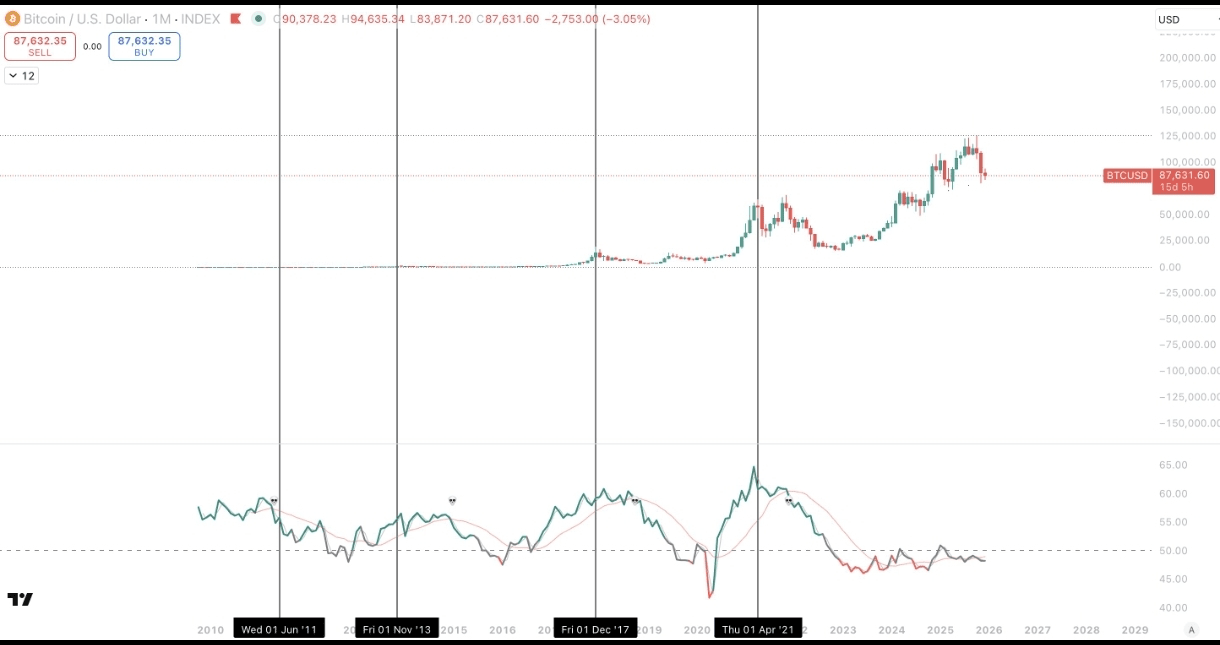
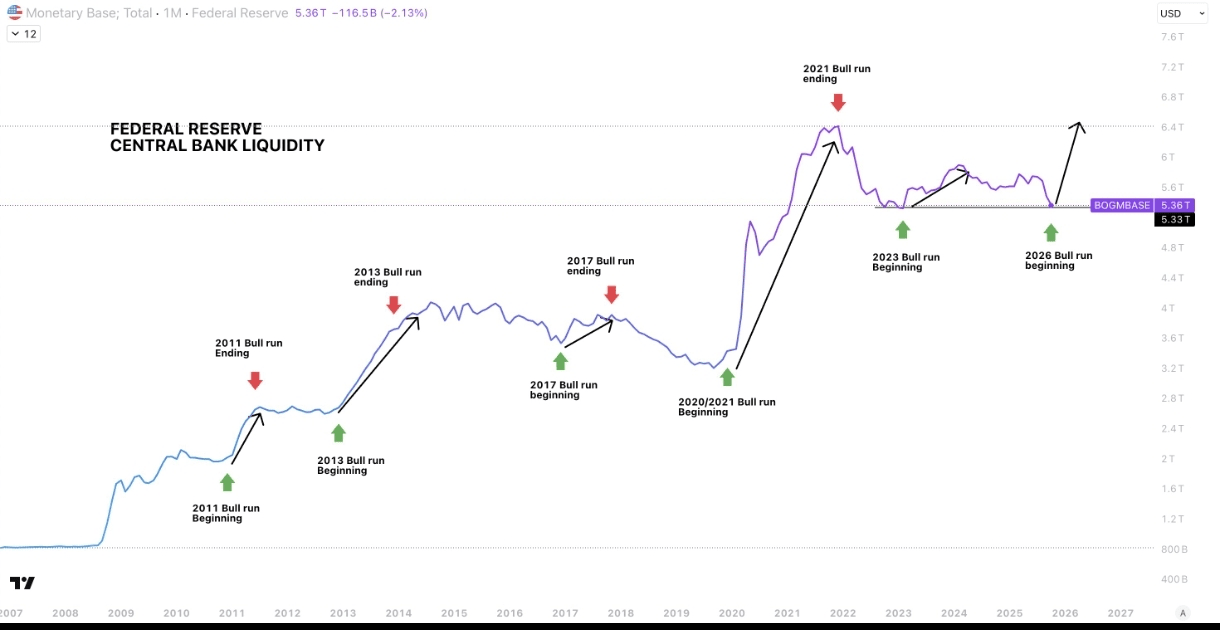
The driving forces of financial markets are far deeper than a specific time period$BTC
Today, I provided conclusive data that proves this viewpoint is incorrect and should not be blindly adhered to
I welcome anyone to debate this topic with me, but you must present data, not just 'But bro, it peaked at the same time as last time and then dropped 75%'.. this is exactly the point I want to refute
Bitcoin does not have built-in code that dictates it must adhere to a strict four-year price cycle
It has a halving feature, but at this stage of network development, the impact of this feature has significantly diminished
The following are the main reasons why the dogma of the four-year cycle cannot be taken as a standard.
1. In fact, there have only been two four-year cycles. 2011 and 2013 are the two cycles, each having two peaks. This is primarily driven by liquidity, which can be clearly seen by observing the central bank's balance sheet.
2. The business cycle is the main driving force behind Bitcoin's upward momentum, and this business cycle has experienced the longest duration of contraction, which is also coincidentally the weakest cycle for Bitcoin so far. This can be easily seen by cross-referencing with the Purchasing Managers' Index (PMI).
3. Our current situation is closer to 2019 rather than the end of a bull market, which is also due to liquidity issues. Please check charts like ETH/BTC, BTC.D, TOTAL3/BTC, etc. All these charts depict the overall market condition, which is starkly different from the end of the cycle. You cannot merely observe BTC and make judgments based on four years of data.
4. During this 'cycle', we set a new all-time high before the halving, and for the first time in history, the last year of a four-year cycle (this year) is a down year. The last year in previous cycles is usually a parabolic year.
5. This cycle has not seen any real expansion. Bitcoin has never entered the overbought zone on the 1-month chart, and the 2-week Bollinger Bands have never extended, which is historically unprecedented. This undoubtedly indicates that this cycle has not truly ended.
6. No peak signals have been issued. This point can be overlooked in isolation, but when combined with all other points, it is worthy of attention.
7. In every previous cycle, liquidity peaked before contracting. And now, we have just entered a new liquidity cycle.
8. This is the first time Bitcoin has achieved such a high price increase in a liquidity-constrained environment, thanks to artificial intelligence and ETFs. This is also why we have not yet entered the parabolic rise phase, due to the lack of liquidity support as in the past.
I may have missed some points, but there is ample evidence that the four-year cycle known to people is a perspective that should be adhered to.
The factors driving the volatility of the Bitcoin cycle are far more than these; it is foolish to ignore them and conduct a deep analysis.
Of course, the economy has cycles, but these are financial cycles, and the data clearly indicates the real drivers of these cycles.