
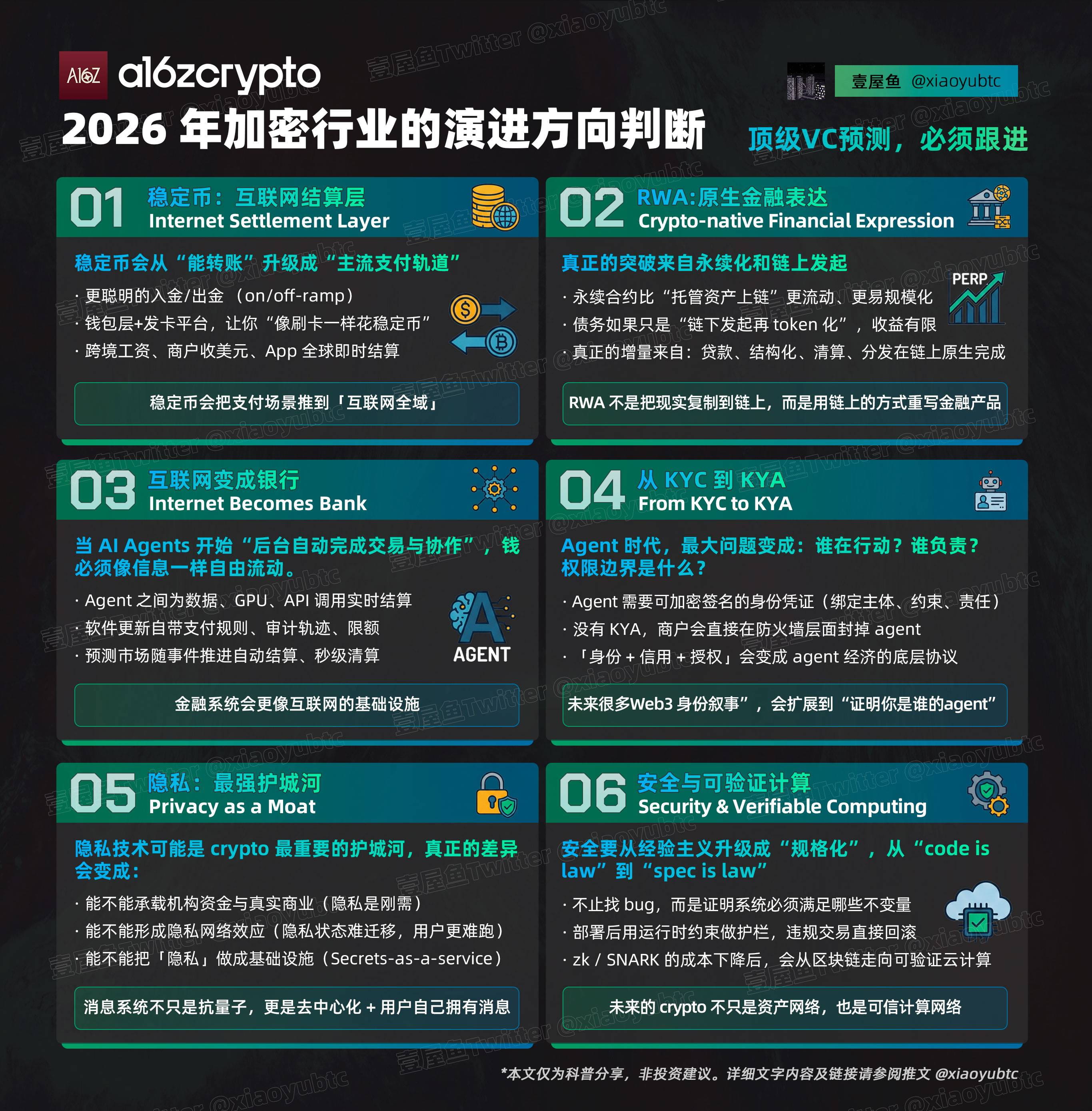
a16z crypto released a prediction report on the evolution direction of the crypto industry for 2026.
Comparing the list of sectors that Coinbase Ventures most wants to invest in for 2026, we can see many similar keywords.
For example:
RWA Contractualization / Predictive Markets / Identity Verification / Privacy, etc.
It seems that top institutions have a relatively consistent judgment on the popular sectors for 2026.
This article from a16z contains 17 core viewpoints, which I have distilled into 6 sections for the convenience of my brothers to directly grasp the key points.
▰▰▰▰▰▰▰▰▰▰
Section One: Stablecoins are not currencies, but rather the settlement layer of the internet.
One of a16z's clearest judgments: stablecoins will upgrade from 'being able to transfer' to 'mainstream payment channels.'
▰ Smarter deposit/withdrawal (local currency, banking network, compliance channels)
▰ Wallet layer + issuance platform, allowing you to 'spend stablecoins like swiping a card'
▰ Real-time cross-border wage payments, merchants can receive dollars without accounts, global instant settlement via apps
Stablecoins will push payment scenarios from the crypto space to the entire internet.
//
Section 2: RWA is not just 'assets on the chain,' but a more crypto-native financial expression
What many people understand as RWA is still: turning US Treasuries, stocks, and real estate into tokens.
a16z's perspective is: real breakthroughs may come from perpetualization and on-chain initiation.
▰ Perpetual contracts are more liquid and scalable than 'custodied assets on the chain'
▰ If debt is just 'initiated off-chain and then tokenized,' the returns are limited
▰ The real increment comes from: loans, structuring, clearing, and distribution being completed natively on-chain (of course, compliance is a hard threshold)
RWA is not about replicating reality on the chain, but rather rewriting financial products in a way that is native to the chain.
//
Section 3: The internet becomes a bank, with value routed like data packets
a16z has raised a crucial trend: when AI Agents begin to 'automate transactions and collaboration in the background,' money must flow as freely as information.
▰ Real-time settlement between agents for data, GPU, and API calls
▰ Software updates come with payment rules, audit trails, and limits
▰ Predictive markets automatically settle as events progress, with second-level clearing
When payment becomes the default behavior of the network: the financial system will resemble the infrastructure of the internet rather than being an add-on to the internet.
//
Section 4: From KYC to KYA—'Know Your Agent' will become a new entry point
The past financial identity system was KYC.
But in the agent era, the biggest problems become: who is acting? Who is responsible? What are the boundaries of authority?
▰ Agents need identity credentials with encryptable signatures (binding entities, constraints, responsibilities)
▰ Without KYA, merchants will directly block agents at the firewall level
▰ Identity + Credit + Authorization will become the underlying protocol of the agent economy
In the future, many Web3 identity narratives will expand from 'proving you are human' to 'proving who you are an agent of.'
//
Section 5: Privacy will become the strongest moat in 2026
Because performance in the public chain world will converge in the end, the real differentiation will become:
▰ Can you accommodate institutional funds and real businesses (privacy is a necessity)
▰ Can you form a privacy network effect (privacy states are hard to migrate, making it harder for users to escape)
▰ Can you make privacy an infrastructure (secrets-as-a-service: access control, key management, programmable decryption permissions)
And a16z also emphasizes one point:
The future messaging system is not just quantum-resistant, but also decentralized with users owning the messages themselves.
//
Section 6: Security and verifiable computing—from code is law to spec is law
a16z is also reflecting: why does DeFi, which has been audited many times and online for many years, still get breached?
The direction they provide is: security must upgrade from empiricism to standardization.
▰ Not just finding bugs, but proving what invariants the system must satisfy
▰ Use runtime constraints as barriers after deployment, with violations leading to direct rollbacks
▰ After the cost of zk / SNARK decreases, it will move from blockchain to verifiable cloud computing (running CPU in the cloud can also provide you with correctness proofs)
This is actually saying: the future of crypto is not just an asset network but also a trustworthy computing network.
▰▰▰▰▰▰▰▰▰▰
Overall, a16z's 2026 prediction report on the evolution direction of the crypto industry is actually quite pragmatic:
Mainly discussing which infrastructures will be driven by real demand—payment settlement, asset expression, agent identity, privacy and security, as well as trustworthy computing.
Of course, trends do not equal opportunities; implementation will be pulled back and forth by compliance, user habits, product experience, and cyclical sentiment.