
In the previous article, I introduced options to everyone. This article continues to talk about how to use options for trading and risk management. Starting from the simplest four basic operations, I will introduce some core trading strategies.
When trading cryptocurrency options, the key is to predict whether the underlying assets (such as Bitcoin or Ethereum) will rise, fall, or remain stable in the future, and then choose the corresponding 'rights' contract.
The four basic operations of options trading (Single-Leg trading)
There are four basic directions in options trading, known as 'Single-Leg' trading.
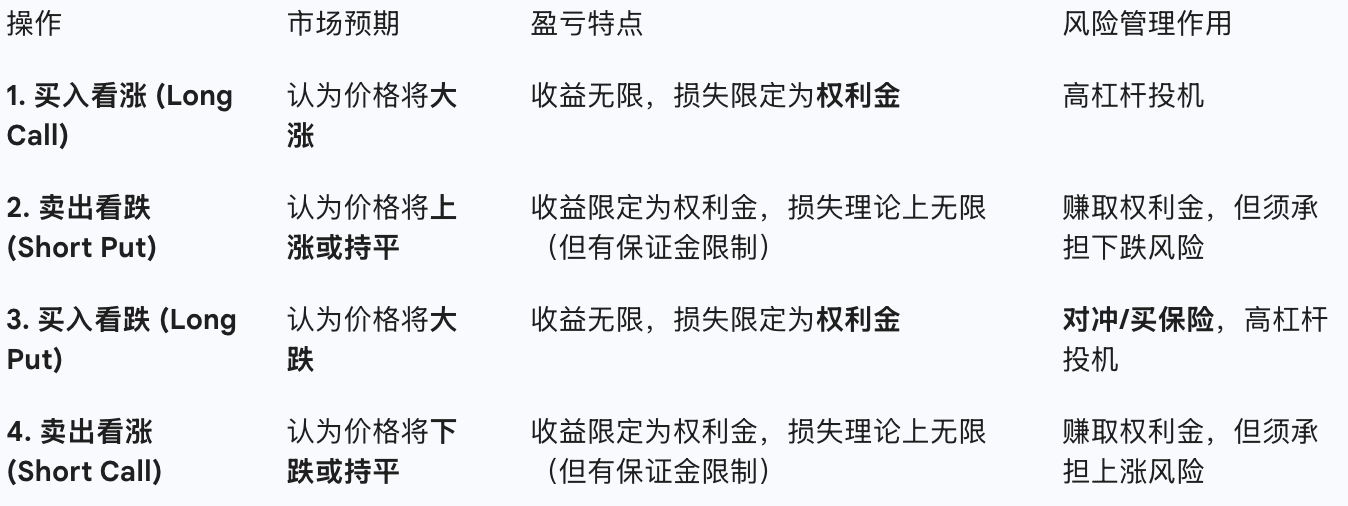
Example: Bitcoin Call Option
Assume the current Bitcoin price is $60,000 USD.
Scenario 1: High-Leverage Bullish Speculation (Buying Call Options)
Your expectation: Bitcoin will rise to $75,000 next month.
Operation: Buy a call option with a strike price of $65,000 that expires in one month, paying a premium of $2,000.
Result:
If it rises to $75,000: You can buy BTC at $65,000 and then sell at the market price of $75,000, earning a price difference of $10,000. After deducting the premium of $2,000, the net gain is $8,000. You have only invested $2,000 and earned $8,000.
If the price drops to $55,000: You will abandon exercising, and the maximum loss will be the premium paid of $2,000.
Scenario 2: Risk Hedge/Insurance (Buying Put Options)
Your holding: You currently hold 1 Bitcoin.
Your concern: Worried that the price will drop significantly next month.
Operation: Buy a put option with a strike price of $58,000 that expires in one month, paying a premium of $1,500.
Result:
If it drops to $45,000: You can sell your Bitcoin (exercise) at $58,000, locking in the selling price. After deducting the premium of $1,500, your minimum selling price is $56,500.
If the price rises to $70,000: You abandon exercising, losing only the premium of $1,500, but your spot Bitcoin earned $10,000.
Advanced strategy: Combination trading (Options Strategies)
The power of options lies in their ability to combine buying, selling, calls, and puts to form various complex strategies to adapt to different market expectations (big rise, small rise, sideways, big drop, etc.).
Covered Call - The most common income strategy
Market expectation: Prices will rise moderately or remain stable in the short term.
Operation:
Hold the underlying asset (such as 1 BTC spot).
Sell a call option (strike price higher than the current market price).
Objective: Earn premium income. If the price does not exceed the strike price, you retain the Bitcoin and earn the premium in addition. If the price rises significantly, your Bitcoin will be exercised and sold, but you also lock in profits and receive the premium.
Target audience: Investors who are bullish on and hold crypto assets long-term but wish to increase income during consolidation periods.
Straddle - Betting on volatility
Market expectation: Prices will fluctuate dramatically, but you are uncertain about whether it will rise or fall (for example, waiting for major news or meeting results).
Operation:
Buy a call option (strike price equal to the current market price).
Simultaneously buy a put option (strike price equal to the current market price).
Objective: As long as the price fluctuates more than a certain amount (beyond the sum of two premiums), you can profit. If the price remains stable, you will lose the two premiums.
Target audience: Speculators who predict significant market moves but are uncertain about the direction.
Spread Trading - Limits risk and profit
Market expectation: Prices will slightly rise or fall (moderate trend).
Operation: Simultaneously buy and sell the same type of options (either both calls or both puts) but with different strike prices.
Objective: To subsidize the cost of buying options by selling one option, thereby reducing maximum loss while simultaneously limiting maximum profit.
Main platforms for trading options
Cryptocurrency options are primarily traded on the following types of platforms:
Centralized Derivatives Exchanges: Such as Binance, etc. These platforms typically offer the highest liquidity and the most mature trading tools.
Traditional Financial Exchanges: The Chicago Mercantile Exchange (CME) also offers regulated Bitcoin and Ethereum options contracts.
Decentralized Exchanges (DEX): Such as dYdX, Lyra, etc., allow users to trade options directly through smart contracts, providing higher transparency and trustless features.
Risk reminder: Options are not a guaranteed profit.
Although the maximum loss for an option buyer is limited, it is important to remember:
Time is your enemy: Most option buyers lose to time value decay (Theta Decay). Your prediction must occur within a limited time frame.
Seller's risk is unlimited: Unless you have sufficient experience and capital management skills, it is not recommended for beginners to engage in short options (Short Call or Short Put) because potential losses can be huge.
Complexity: The combinations of options strategies are very flexible but also more complex. Be sure to grasp the basic concepts first, start with small simulated trades, and gradually try actual trading.

