

Apro is a project that provides Oracle solutions which recently raised 3 million dollars from Polychain and ABCDE Capital. So, what makes Apro's Oracle solution special? Let's explore through the article below.
1. What is Apro
1.1. What is Apro
 @APRO Oracle is an Oracle solution designed to connect decentralized applications (dApps) with data from the real world.
The project provides secure and reliable access to off-chain data, supporting a variety of use cases, including finance, gaming, and supply chain management.
With a platform built for scalability, Apro ensures the provision of accurate data for smart contracts, helping to optimize the operational efficiency of decentralized applications.
1.2. Apro service fees
Apro Oracle service fees are adjusted according to the specific types of data services requested by clients, divided into the following packages:
APRO Basic - Push
APRO Pro - Push
APRO Premium - Pull
APRO Customized - Pull
The project proposes this pricing structure with the goal of helping project teams reduce costs and provide more efficient services to users.
2. Products
Apro Oracle is a decentralized oracle network specifically designed for the Bitcoin ecosystem. This is the first solution to support Lightning Network, RGB++, and Runes protocol, providing safe, stable, and cost-effective data services.
Notable for its fast response time and high accuracy in processing new assets, APRO Oracle provides comprehensive data support across the entire Bitcoin ecosystem. Currently, APRO is the most widely integrated oracle in the Bitcoin space, with over 100 Bitcoin projects collaborating.
How does Apro operate?
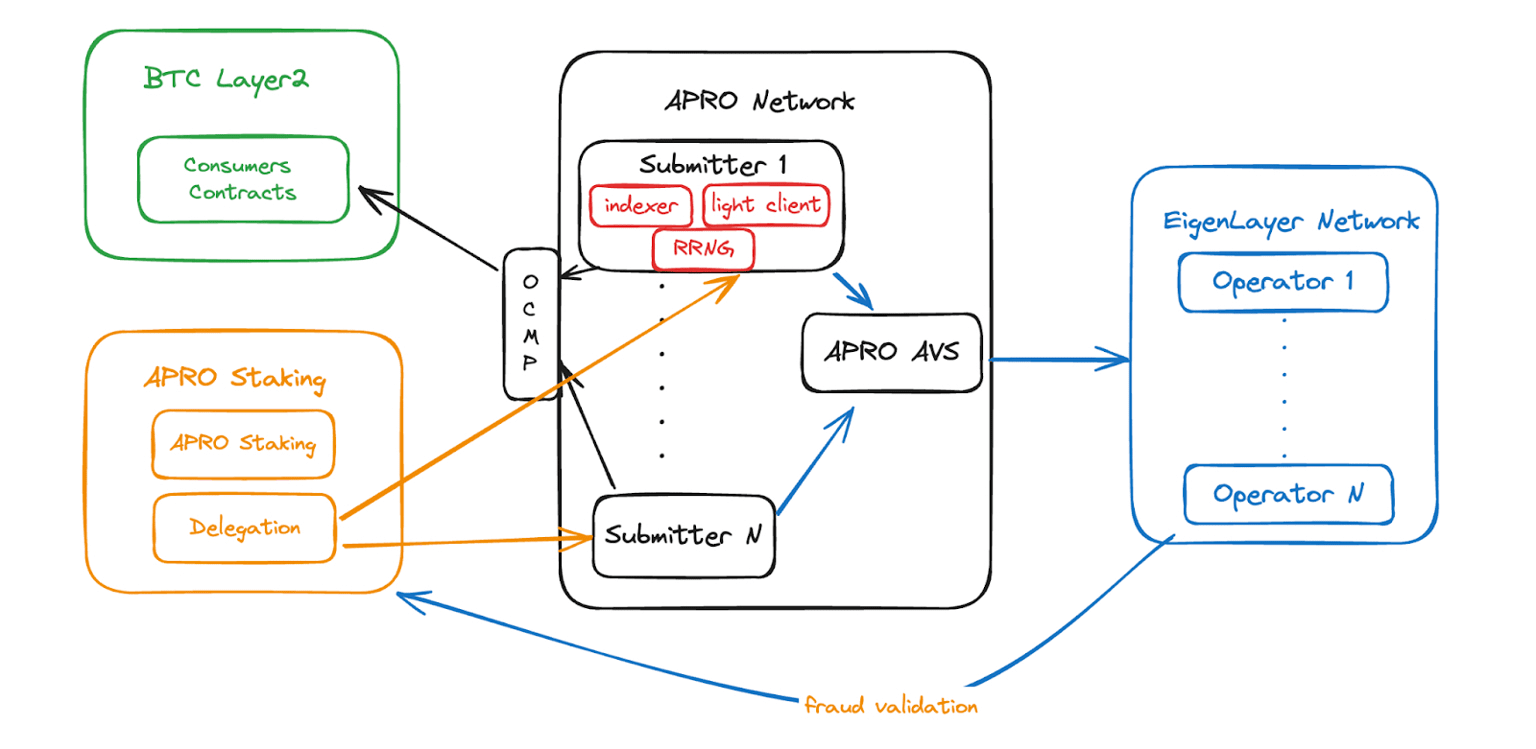
How Apro Oracle works
The operation of Apro Oracle is based on a two-layer oracle network model, aiming to ensure high security and reliability when processing data.
The specific operational process of Apro is as follows:
First layer - OCMP Network (Off Chain Message Protocol):
This is the main oracle network, consisting of nodes participating in the Apro ecosystem. These nodes collect and process off-chain data for decentralized applications.
The nodes in this layer monitor each other; if they detect significant anomalies during data collection, they can report to the second layer for verification.
Second layer - Eigenlayer Network:
The Eigenlayer network acts as a layer of prevention, serving as an arbiter in case of disputes. When there is a disagreement between clients and the OCMP aggregator, the Eigenlayer AVS Operators, entities with high reliability scores or better security levels than the first layer, will perform fraud verification.
The nodes at this layer make decisions based on historical data and strong security capabilities, helping to ensure objectivity and reliability.
The role of the nodes:
The nodes in the first layer are participants in the ecosystem, collecting and processing data.
The second layer, consisting of "arbiters", plays a role in ensuring the accuracy and transparency of the data. They do not have the authority to judge simply because of their higher position, but because their historical performance is reliable or based on the security of the Ethereum network (ETH).
Monitoring and arbitration:
The nodes in the first layer can report to the second layer in case of detecting significant anomalies. The nodes in the second layer will make the final decision based on the evidence and verification process.
This network structure supplements an "arbitration committee", which only operates when necessary, helping to minimize the risk of bribery attacks on the majority of nodes by sacrificing some degree of decentralization.
Staking mechanism:
The nodes need to stake two parts:
The first part is slashed if a node reports data that is different from the majority.
The second part is lost if a node sends incorrect data to the second layer for arbitration.
User challenge mechanism:
In addition to nodes, users can also participate in challenging the behavior of nodes by staking. This mechanism helps Apro integrate users and the community into the security system, not only monitoring each other but also being overseen from the outside.
Thus, Apro Oracle operates based on a two-layer structure: the first layer collects and processes data, while the second layer ensures accuracy through arbitration and verification. The staking and user challenge mechanisms help enhance security and fairness for the entire ecosystem. #apro $AT


