
In the world of crypto venture capital, capital can generally be divided into two types:
One is more of a 'passive fund', writing a check and hoping for the next market cycle;
The other is 'design capital', which, before investing, participates in clearly defining the rules of the game.
In 2021, when YGG announced the completion of its seed round financing, what truly caught the industry's attention was not the amount of $1,325,000, but the lead investor — Delphi Digital.
This was a deep integration between research-driven VCs and gaming guilds at that time:
Delphi Digital was not just an investor; it was also a co-designer of YGG's early token economic framework.
I am the boat seeking the sword, and what I want to discuss in this article is not 'who invested in YGG',
but how Delphi Digital, as a research-driven VC, specifically intervenes in the token economic design of a DAO.
1. From the 'death spiral' to mechanism design: why does YGG want to find Delphi Digital?
Many early DeFi/GameFi projects share a common hidden danger - the lack of value capture mechanisms:
The token primarily only plays the role of 'mining rewards' in the long term;
The protocol itself does not have a sustainable income and buyback loop;
Once the issuance speed, selling pressure, and user growth are mismatched, it is easy to head toward a 'death spiral.'
YGG clearly positions itself in the white paper as a long-term operational gaming guild and virtual asset management DAO, rather than a fleeting 'mining platform.'
This means:
YGG needs a structure that can align the incentives of the founding team, investors, players, and the DAO treasury in the long term;
and it also needs an asset-liability sheet that can withstand bear markets.
After 2018, Delphi Digital gradually established a reputation for 'research + consulting + investment' integration, being regarded as one of the leading research institutions in token economics and mechanism design.
YGG's choice to have Delphi Digital lead the investment is more like actively handing over part of the 'rule design authority' to a professional team,
hoping to replace 'emotion-driven' short-term games with rigorous models.
2. Funds + Research Dual Bet: Delphi's role in YGG
According to public information, YGG's seed round financing scale is approximately $1.325 million, led by Delphi Digital, with follow-up investments from firms like a16z in the new round of financing.
More critically, in the YGG English white paper and several project materials, there is a highly condensed statement:
"Delphi oversaw tokenomic design for YGG and Anil will provide guidance and effective treasury management prior to decentralization."
This statement basically points out two things:
Delphi Digital is responsible for overseeing the overall token economic design
including allocation structure, release rhythm, value capture paths, etc.;
The goal is to ensure that the YGG token has not only use cases but also a clear value flow.
Delphi co-founder Anil Lulla was responsible for treasury management guidance in the early days
providing experience in 'fund management and risk control' for YGG before complete decentralization;
helping YGG establish basic asset-liability management discipline, rather than treating the treasury as a 'no-owner vault.'
You can understand the relationship at that time as:
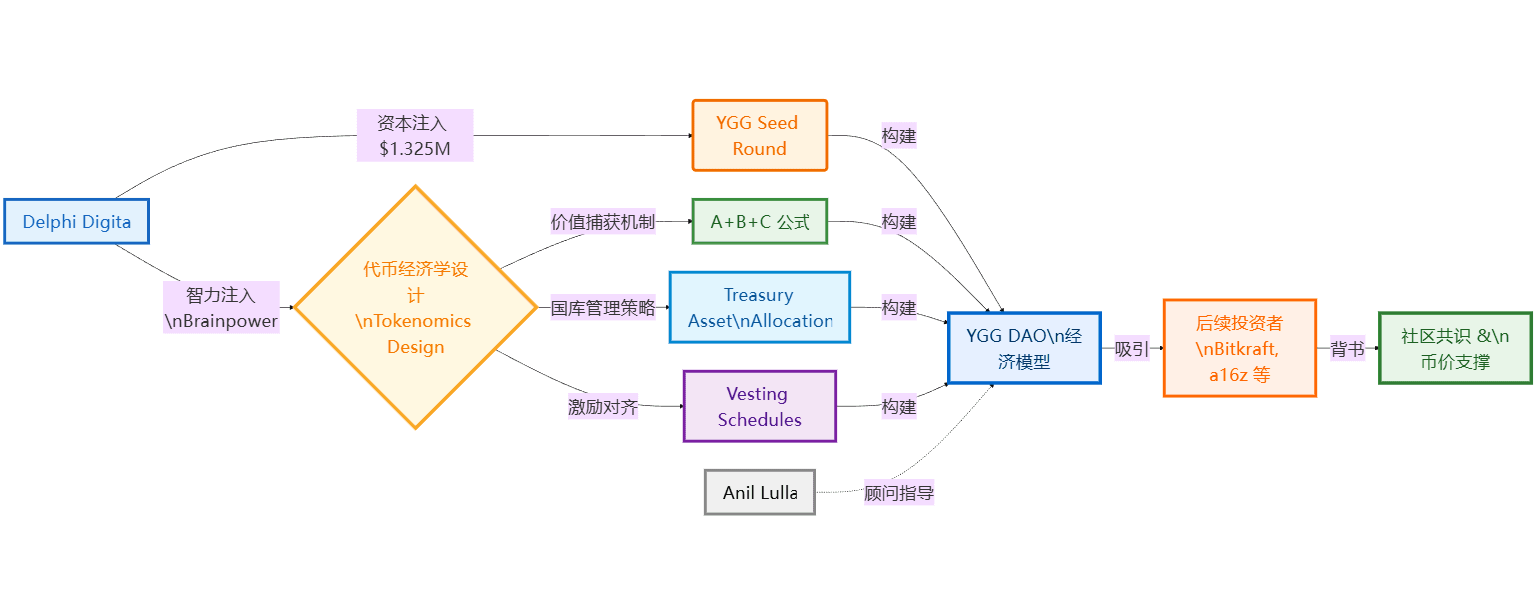
Delphi Digital plays the role of a 'research-driven designer' here:
providing YGG with initial capital while participating in building a complete set of rules for 'where the money comes from, how it is distributed, how it is spent, and how it is safeguarded.'
3. Token allocation and lock-up: putting 'constraints' on oneself
From a proportional perspective, YGG's token allocation is not complicated:
Community and ecosystem: approximately 45% (rewards, liquidity incentives, sub-guilds, etc.);
Investors (Seed & Series A): 24.9%;
Founding team: 15%;
Treasury and advisors: around 15%.
What truly reflects the design thinking is the release rhythm and lock-up rules:
Seed round and Series A investors overall received about 24.9% of the quota;
Of which seed round investors have only 20% unlocked at the mainnet launch, with the remaining 80% locked for one year and then linearly released over the following year;
The tokens of the founding team and advisors are also set with multi-year lock-ups and linear unlocks respectively.
The signal conveyed by this design is very clear:
YGG does not encourage 'short and quick' exit paths
Whether early VCs or project parties, they must go through at least one complete market cycle with the community;
Token value is driven more by long-term operations and treasury allocation rather than short-term event games.
Delphi Digital also imposes constraints on itself
As the leading investor, Delphi Digital is also subject to lock-up and linear unlocking rules;
This arrangement allows the 'designers' and 'token holders' to stand on the same timeline:
If the design fails, Delphi Digital will also bear the consequences along with other investors.
In mechanism language, this is a typical 'alignment of incentives and constraints':
The side that designs the rules is itself the bearer of the results of those rules.
4. From 'research laboratory' to 'token architect'
Delphi Digital started with research, but in the YGG case, the role has clearly extended beyond the traditional financial investor's scope:
In the white paper and multiple project analysis articles, Delphi Digital is repeatedly mentioned as the key advisor responsible for/supervising token design, treasury management, and the transition to decentralization;
This means that Delphi Digital does not simply provide a 'report', but works with YGG to land on contract parameters, unlocking curves, and resource allocation logic.
Delphi Digital's triple identity in the YGG model can be roughly summarized:
Researchers: propose hypotheses and models for 'how to create a positive sum between guilds, players, investors, and the treasury';
Designers: transform these hypotheses into specific token ratios, release curves, and governance processes;
Participants: take on the actual results of the model's success or failure through long-term holding.
This model of 'VC deep involvement in rule design',
was not mainstream before 2021,
but the combination of YGG + Delphi Digital did provide a template for many subsequent projects:
If a DAO is willing to let professional institutions participate in the design of the token economy framework,
then VCs are no longer just 'short-term fund providers',
but can be considered 'institutional co-builders' in a certain sense.
5. What does this mean for YGG token holders?
From the perspective of YGG token holders, understanding Delphi Digital's involvement roughly has several layers of meaning:
The token economy has a clear public design source
Core allocation, lock-up, and unlocking rules can be found in the white paper and various research reports;
This reduces the uncertainty of 'complete opacity', but does not mean there are no risks.
The treasury and fund management have clear professional advisory backing
Before YGG fully transitioned to a DAO, Delphi Digital's role was more like 'early financial and risk advisory';
helping YGG establish basic asset allocation and risk control frameworks during high volatility periods.
Long-term performance still depends on execution and the market, rather than the formula itself
No matter how sophisticated the token model is, it still requires actual operations to validate the assumptions;
Changes in industry cycles, the popularity of the GameFi sector, and treasury investment decisions will all affect YGG's mid to long-term performance.
In this sense, what Delphi Digital brings is not a 'bottom guarantee',
but a relatively complete design specification:
telling you how this economic system of YGG was conceived, how it is constrained, and how it is incentivized.
6. Summary of the boat seeking the sword
The collaboration between YGG and Delphi Digital is essentially an experiment about 'how research can land into token economic engineering':
YGG considers itself a virtual economy that can operate long-term, rather than a one-time mining project;
Delphi Digital not only plays the role of investor but also assumes the 'shared design responsibility' for token economics and treasury mechanisms;
The lock-up and release rules require all early participants to face the fluctuations of the complete market cycle together with the community.
For readers focused on GameFi and DAOs, the insight from this case is:
Beyond seeing 'who invested in this project',
one must look at'how much these investors participated in rule design'.
When you next study the token economy of a DAO,
you can casually ask yourself three questions:
Who wrote the rules?
Are the rule writers themselves constrained by the rules?
Once the environment changes, does this set of rules leave enough room for the community to adjust?
YGG + Delphi Digital provides a possible answer,
but the real validation still needs to be completed in future time and markets.
Risk warning and statement
The above content is a personal study and organization by the boat seeking the sword based on public materials, intended for communication and learning only, and does not constitute any investment advice or legal opinion.
Projects or institutions like YGG and Delphi Digital are mentioned in the text only as case references and do not imply recommendations for their tokens or related assets.
Cryptographic assets are highly volatile and involve multiple risks such as smart contracts, governance, liquidity, and regulation. Please be sure to conduct your own research (DYOR) and act cautiously in accordance with your own risk tolerance before making any investment or participation decisions.
I am the boat seeking the sword, an analyst who only looks at the essence and does not chase noise.@Yield Guild Games #YGGPlay $YGG

