
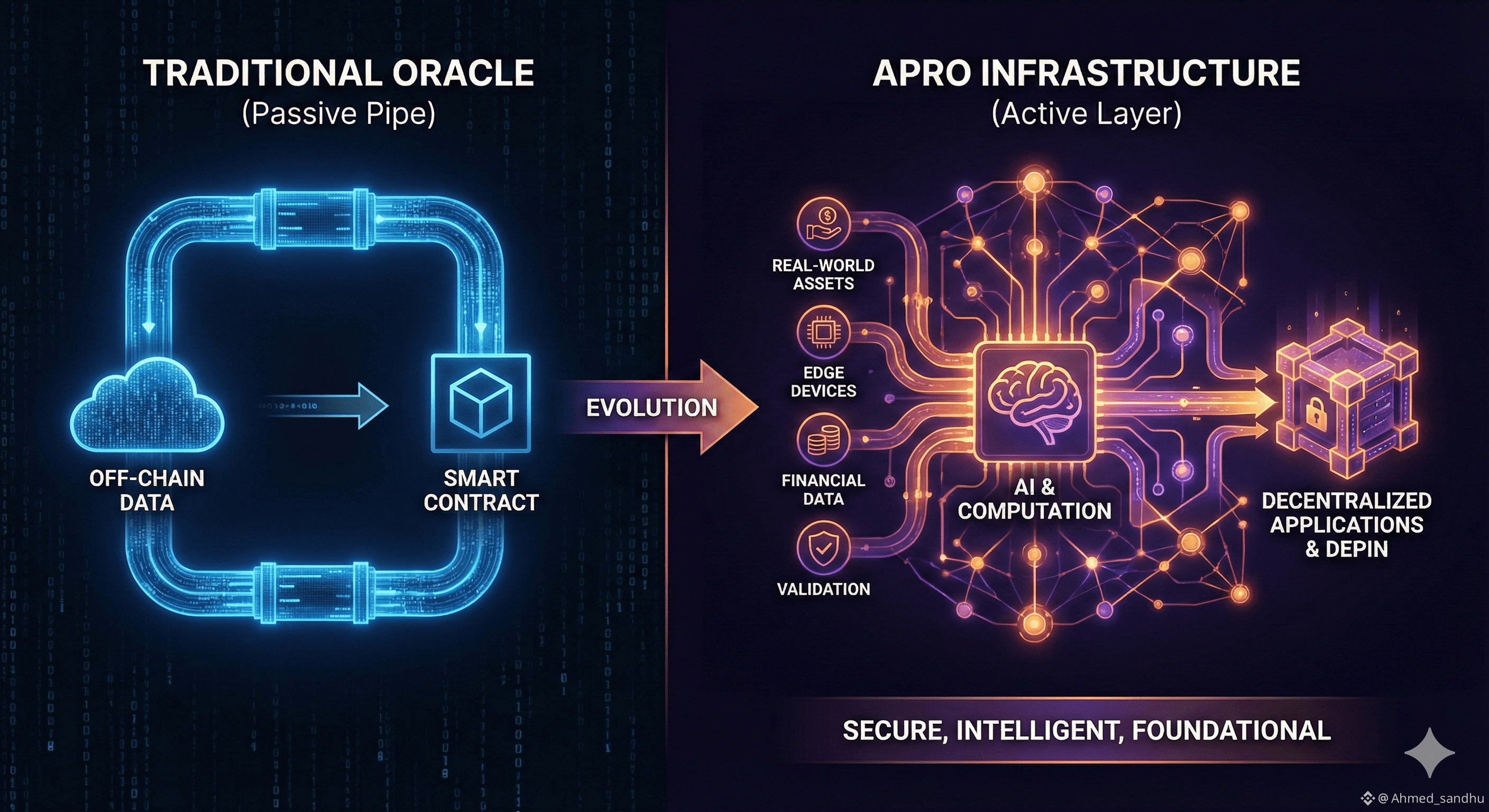
In the rapidly evolving world of blockchain, most oracle networks still behave like accessories—useful, necessary, but ultimately peripheral to the core stack. They feed data, verify events, and deliver external truth to chains, but they rarely transform the underlying architecture they serve.
APRO is the exception.
And the moment it stops acting like a traditional oracle and starts operating like real infrastructure is the moment the industry quietly shifts.
From Oracle to Infrastructure Layer
Most oracles today function as data pipelines: fetch → validate → deliver. The innovation ceiling has remained low for years.
APRO breaks this pattern by reconstructing what an oracle should be:
1. A Persistent, Autonomous Execution Layer
Instead of simply delivering information, APRO performs continuous computation on-chain and off-chain, eliminating the need for fragmented middleware.
It behaves like an execution engine for smart contracts that require stateful, long-running logic—something current oracles can’t deliver reliably.
2. Verifiable Compute as a Core Primitive
APRO treats verifiable compute the way blockchains treat consensus: as a foundational layer, not a plugin.
This shifts it from a data messenger to a computation authority—a neutral proof generator that applications can trust without centralization.
3. Native Interoperability Beyond Bridges
Traditional oracles connect chains through data feeds; APRO connects chains through logic.
Cross-chain functions can run natively without fragile bridges, improving both security and developer experience.
4. API-First, Chain-Agnostic Architecture
APRO behaves more like cloud infrastructure (AWS, GCP) than a blockchain component.
Developers plug into a flexible API layer where chains are simply execution targets.
This inversion—treating blockchains like output destinations rather than origin points—marks a major architectural evolution.
Why This Shift Matters
For Developers
No more patchwork of tools for automation, off-chain compute, and cross-chain triggers.
One unified layer to build complex apps with minimal overhead.
For Networks
Reduced congestion from off-loaded computation.
Improved reliability for apps requiring constant state syncing.
For Users
Faster, more stable applications with transparent security guarantees.
The New Role of Oracles: Invisible Infrastructure
If APRO succeeds, the concept of “oracles” may disappear altogether—because the term won’t fit anymore.
Instead, APRO becomes:
The automation engine powering every decentralized application
The compute fabric stitching chains into a single ecosystem
The intelligence layer enabling smart contracts to finally act smart
Much like how cloud infrastructure reshaped the internet without most users even knowing it existed, APRO aims to reshape blockchain from behind the scenes.
Conclusion: The Future Is Infrastructure, Not Accessories
The blockchain industry doesn’t need more oracles.
It needs infrastructure—robust, autonomous, verifiable, and chain-agnostic.
APRO represents that next step.
When it stops acting like an oracle and starts behaving like real infrastructure, it stops being a tool…
and becomes the foundation on which the next generation of decentralized applications will be built.
If you want, I can also create:
✅ a picture/graphic for this article
✅ a shorter X/Twitter post
✅ a full SEO-optimized blog version
Just tell me!

